The Excretory System AEJ Yenepoya Kidney Functions of
- Slides: 163
The Excretory System… AEJ / Yenepoya
• • • • Kidney. Functions of different parts of the nephron in urine formation. Role of kidney in water and electrolyte balance. Acidification of urine. Diuresis Kidney function tests. Juxta glomerular apparatus. Renin Angiotensin system. Renal blood flow. Structure and innervations of the bladder. Micturition. Cystometrogram. Disorders of Micturition. Principles of artificial kidney. AEJ / Yenepoya
AEJ / Yenepoya
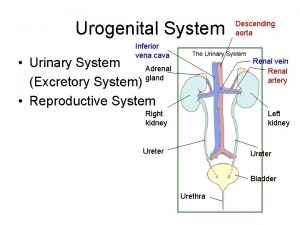
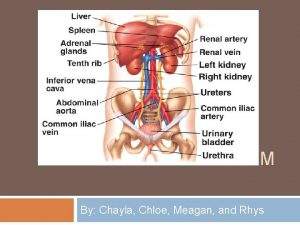
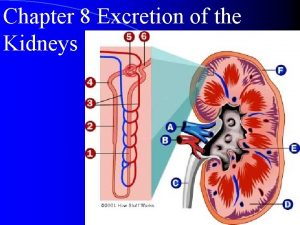
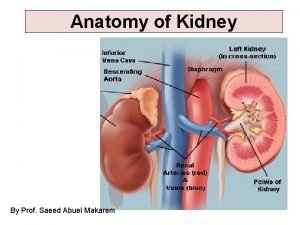
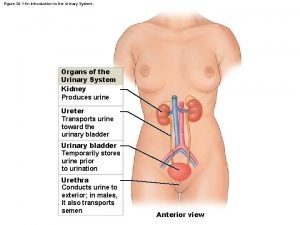
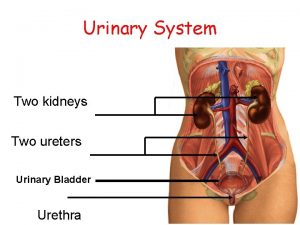
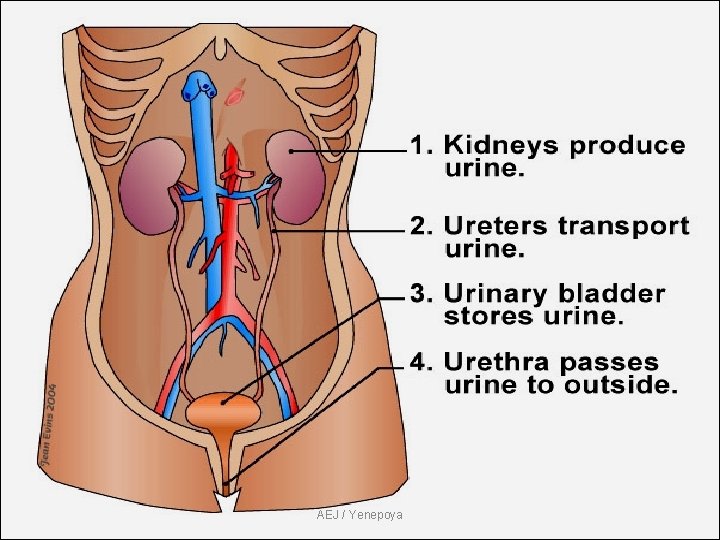
Kidney: Wt: 150 gms, Bean shaped. Abdominal cavity on the either side of the vertebral column. Right kidney is slightly lower than the left. AEJ / Yenepoya
AEJ / Yenepoya
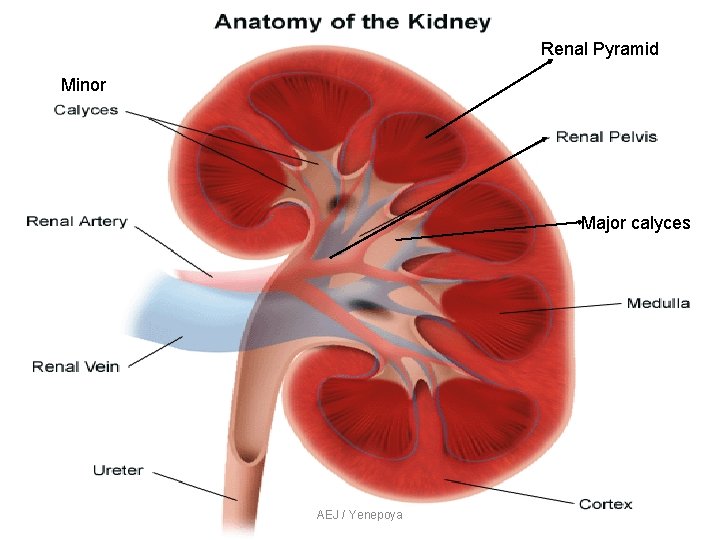
Renal Pyramid Minor Major calyces AEJ / Yenepoya
AEJ / Yenepoya
AEJ / Yenepoya
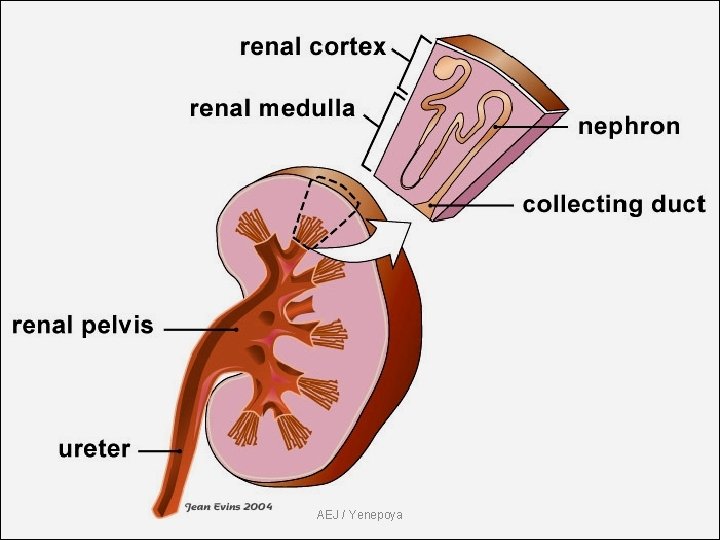
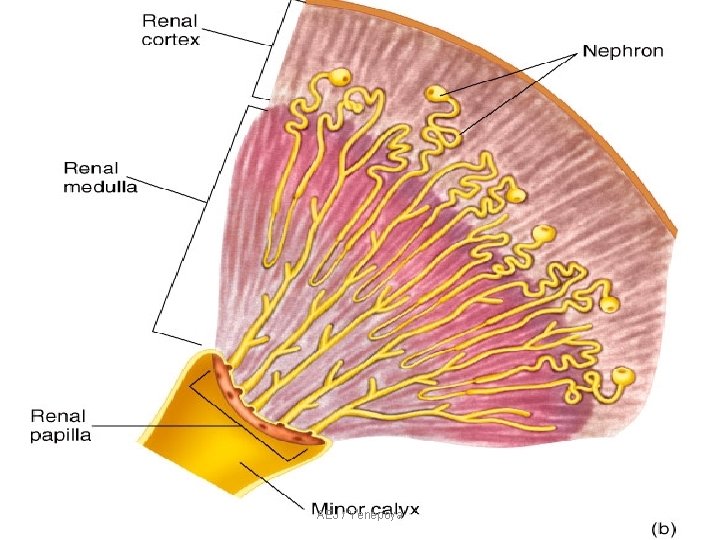
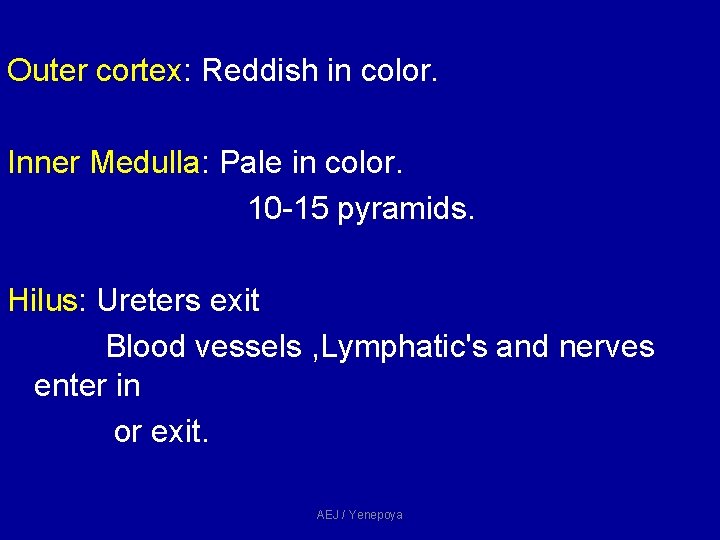
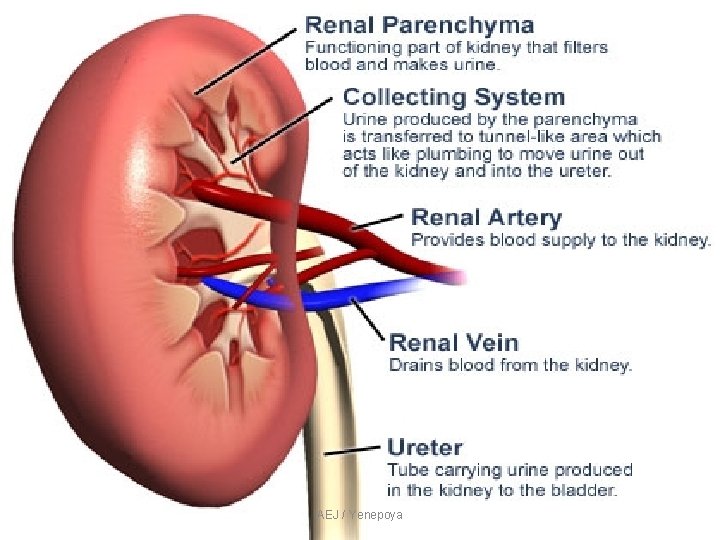
Outer cortex: Reddish in color. Inner Medulla: Pale in color. 10 -15 pyramids. Hilus: Ureters exit Blood vessels , Lymphatic's and nerves enter in or exit. AEJ / Yenepoya
AEJ / Yenepoya
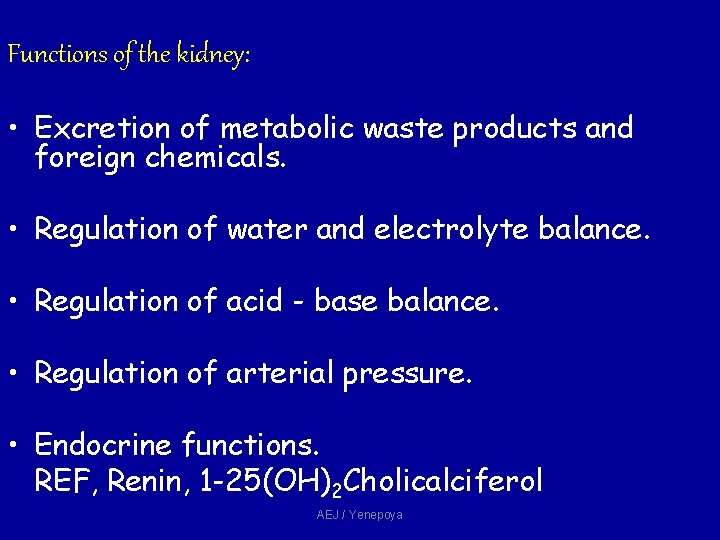
Functions of the kidney: • Excretion of metabolic waste products and foreign chemicals. • Regulation of water and electrolyte balance. • Regulation of acid - base balance. • Regulation of arterial pressure. • Endocrine functions. REF, Renin, 1 -25(OH)2 Cholicalciferol AEJ / Yenepoya
Nephron: AEJ / Yenepoya
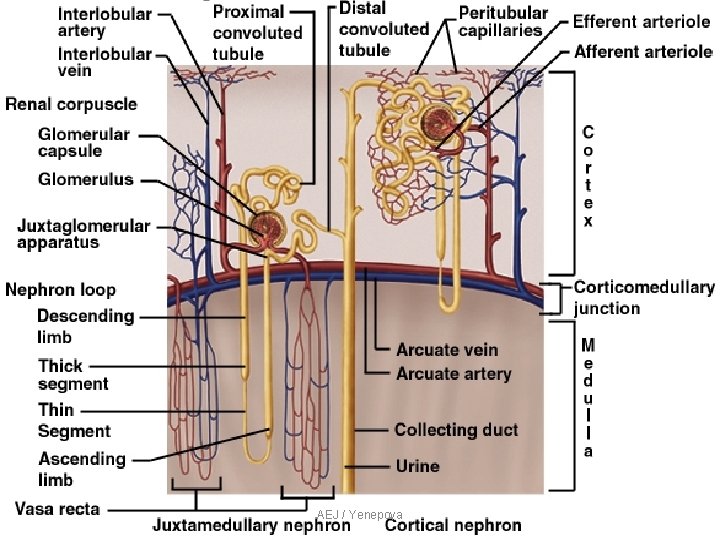
Structure of nephron: • Nephron is the structural and functional unit of kidney • Each kidney contains approximately 1 -1. 3 million nephrons. • Length ranges from 45 -65 mm. AEJ / Yenepoya
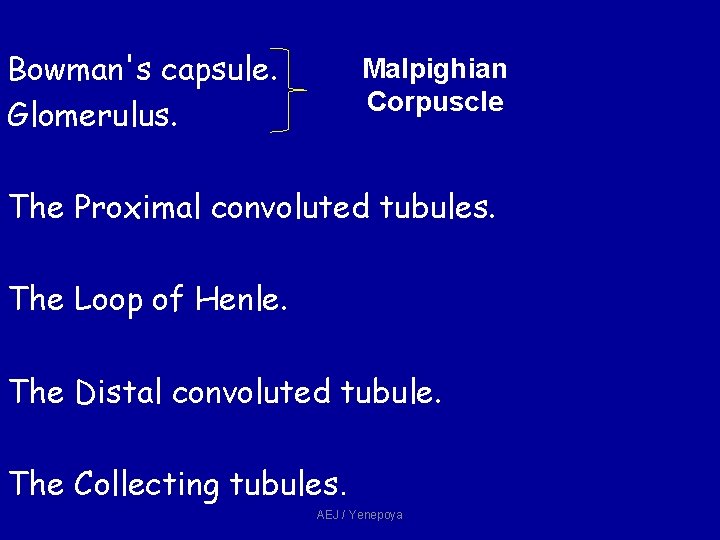
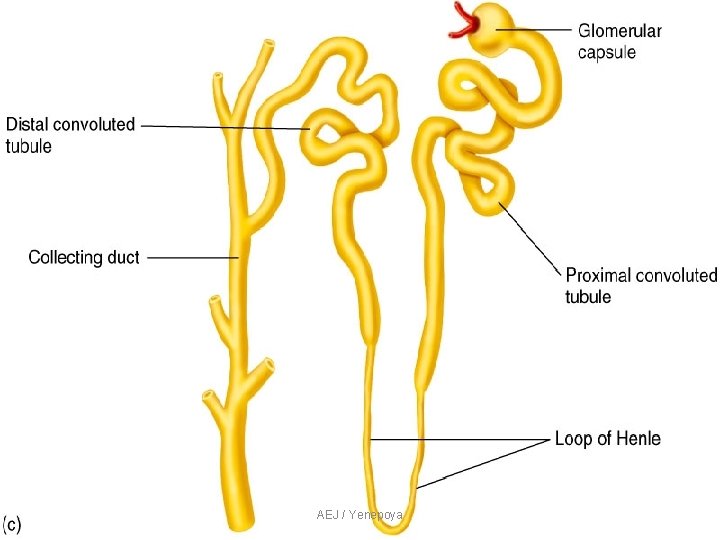
Bowman's capsule. Glomerulus. Malpighian Corpuscle The Proximal convoluted tubules. The Loop of Henle. The Distal convoluted tubule. The Collecting tubules. AEJ / Yenepoya
AEJ / Yenepoya
AEJ / Yenepoya
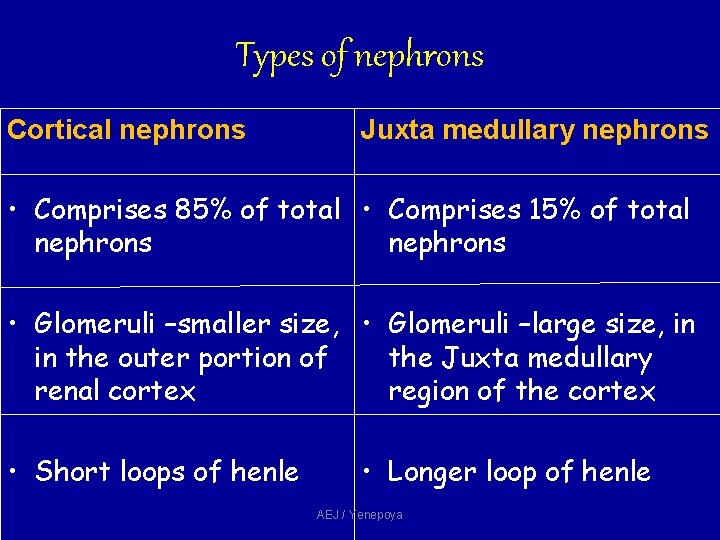
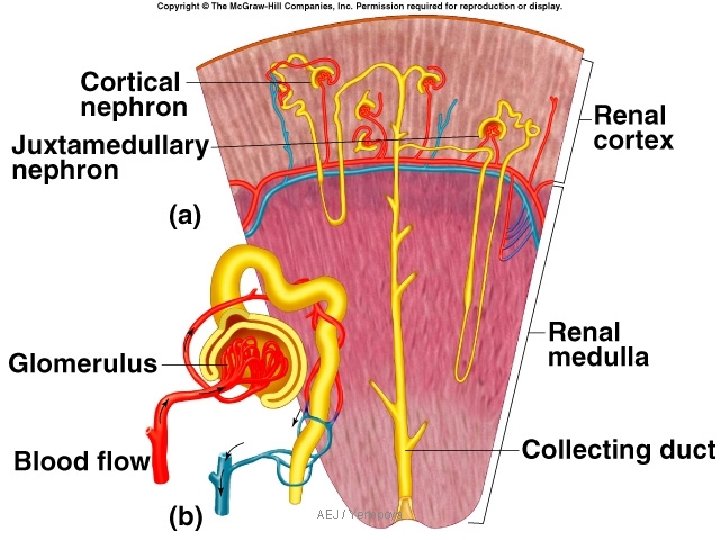
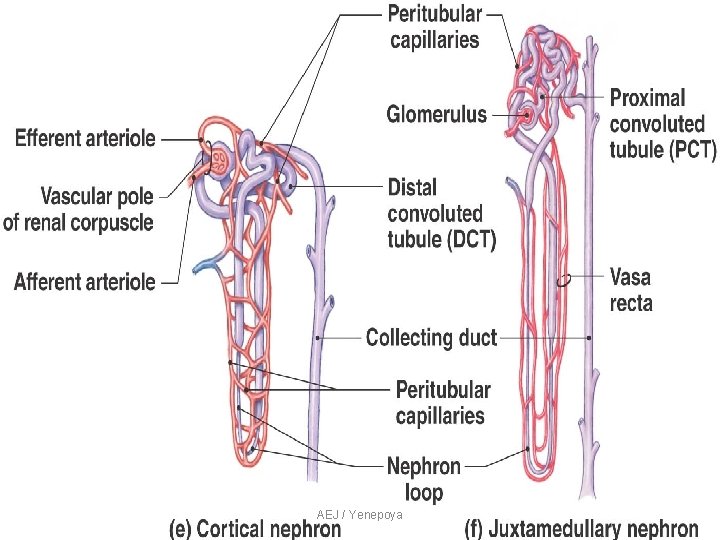
Types of nephrons Cortical nephrons Juxta medullary nephrons • Comprises 85% of total • Comprises 15% of total nephrons • Glomeruli –smaller size, • Glomeruli –large size, in in the outer portion of the Juxta medullary renal cortex region of the cortex • Short loops of henle • Longer loop of henle AEJ / Yenepoya
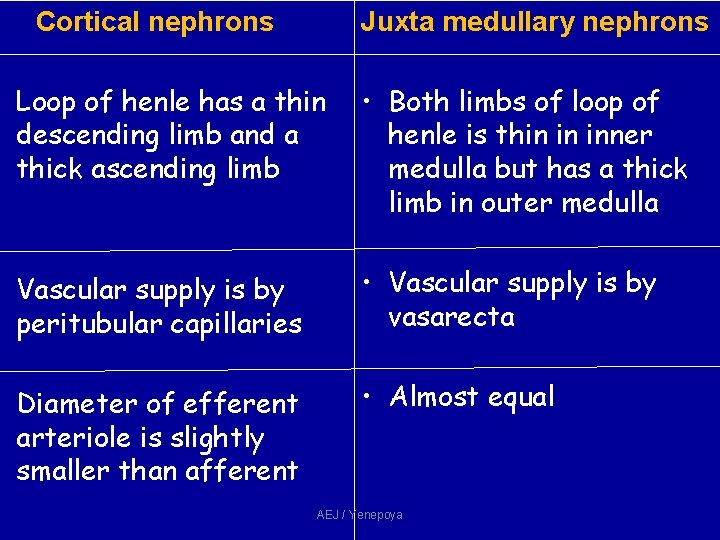
Cortical nephrons Juxta medullary nephrons • Loop of henle has a thin descending limb and a thick ascending limb • Both limbs of loop of henle is thin in inner medulla but has a thick limb in outer medulla • Vascular supply is by peritubular capillaries • Vascular supply is by vasarecta • Diameter of efferent arteriole is slightly smaller than afferent • Almost equal AEJ / Yenepoya
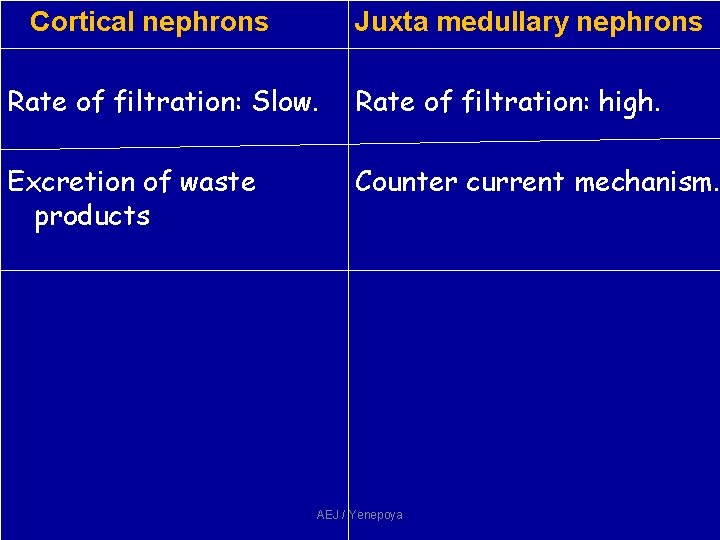
Cortical nephrons Juxta medullary nephrons Rate of filtration: Slow. Rate of filtration: high. Excretion of waste products Counter current mechanism. AEJ / Yenepoya
AEJ / Yenepoya
AEJ / Yenepoya
AEJ / Yenepoya
Malpighian corpuscle. AEJ / Yenepoya
AEJ / Yenepoya
AEJ / Yenepoya
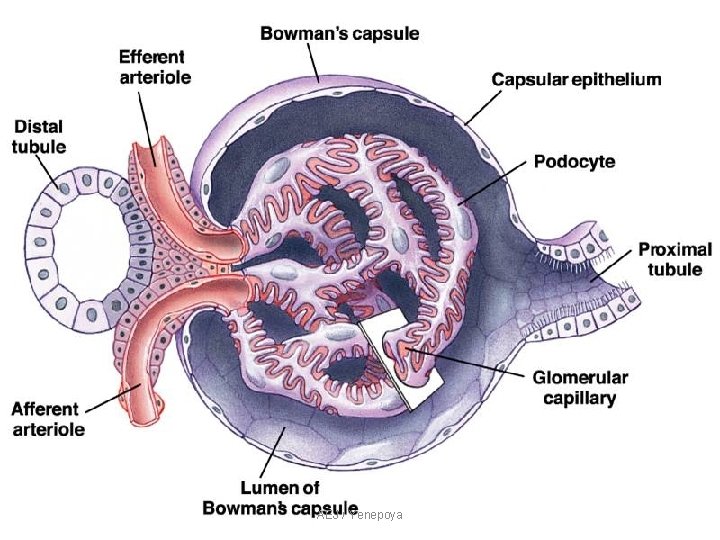
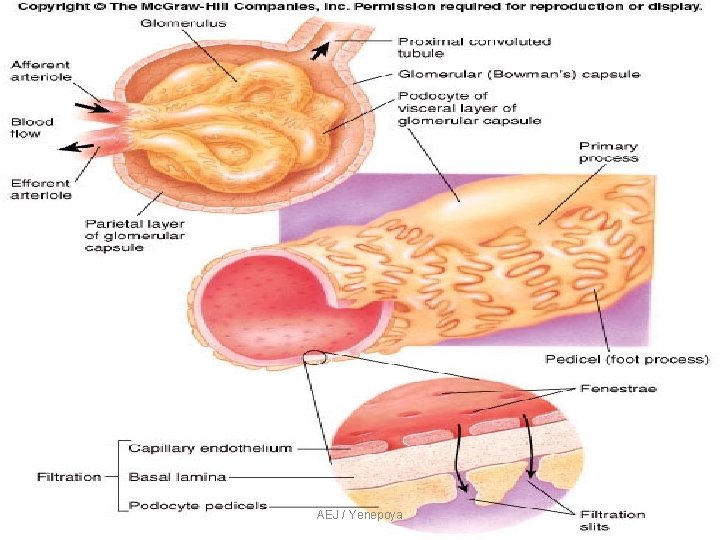
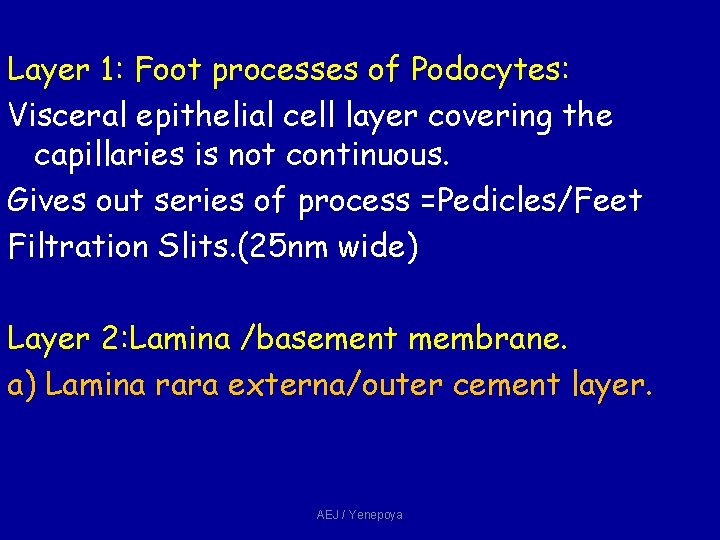
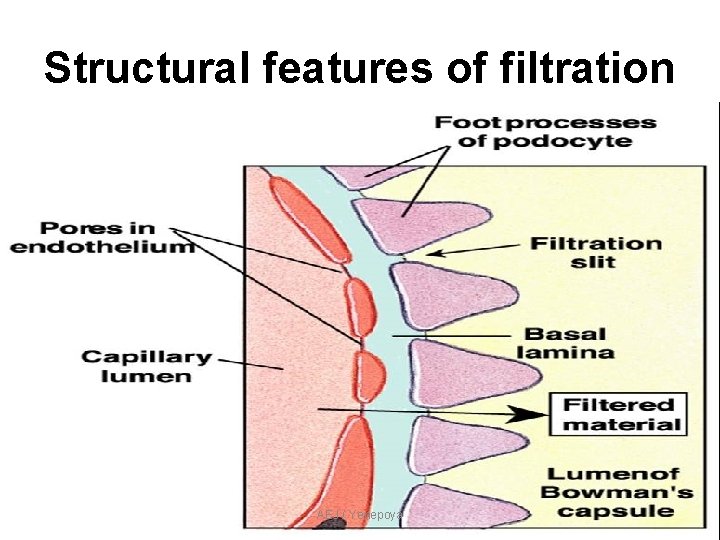
Layer 1: Foot processes of Podocytes: Visceral epithelial cell layer covering the capillaries is not continuous. Gives out series of process =Pedicles/Feet Filtration Slits. (25 nm wide) Layer 2: Lamina /basement membrane. a) Lamina rara externa/outer cement layer. AEJ / Yenepoya
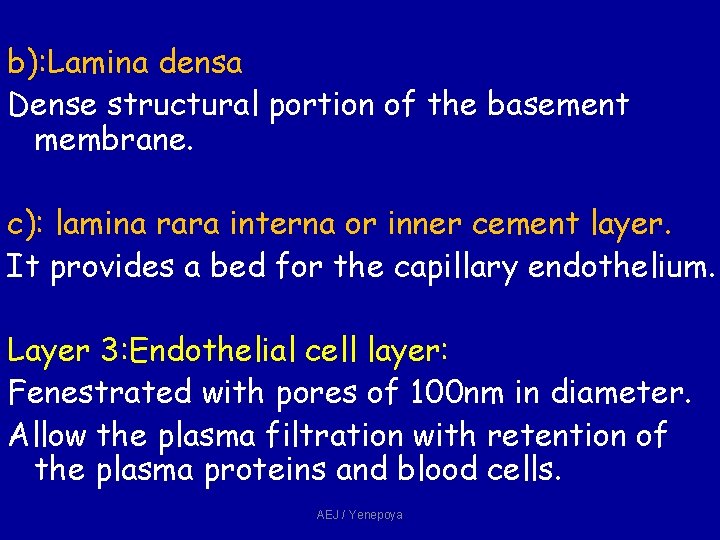
b): Lamina densa Dense structural portion of the basement membrane. c): lamina rara interna or inner cement layer. It provides a bed for the capillary endothelium. Layer 3: Endothelial cell layer: Fenestrated with pores of 100 nm in diameter. Allow the plasma filtration with retention of the plasma proteins and blood cells. AEJ / Yenepoya
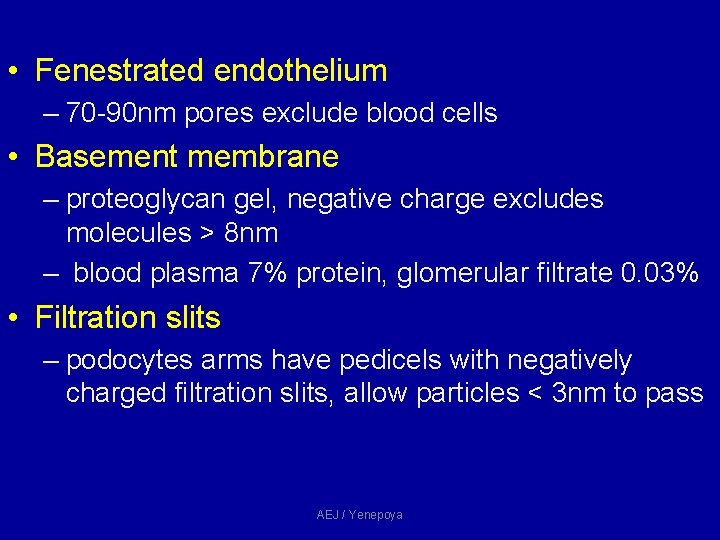
• Fenestrated endothelium – 70 -90 nm pores exclude blood cells • Basement membrane – proteoglycan gel, negative charge excludes molecules > 8 nm – blood plasma 7% protein, glomerular filtrate 0. 03% • Filtration slits – podocytes arms have pedicels with negatively charged filtration slits, allow particles < 3 nm to pass AEJ / Yenepoya
Structural features of filtration AEJ / Yenepoya
Juxta Glomerular Apparatus AEJ / Yenepoya
AEJ / Yenepoya
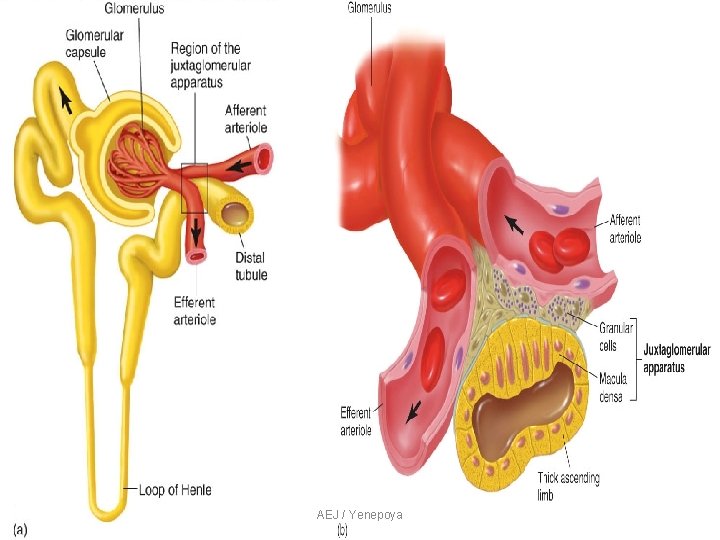
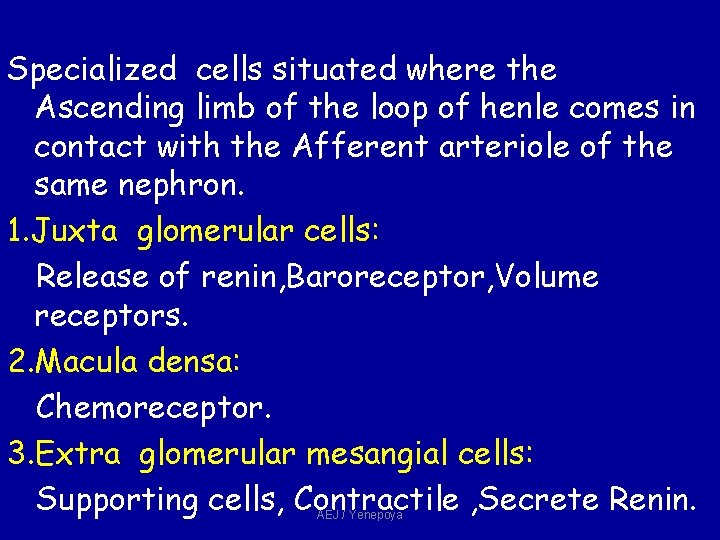
Specialized cells situated where the Ascending limb of the loop of henle comes in contact with the Afferent arteriole of the same nephron. 1. Juxta glomerular cells: Release of renin, Baroreceptor, Volume receptors. 2. Macula densa: Chemoreceptor. 3. Extra glomerular mesangial cells: Supporting cells, Contractile , Secrete Renin. AEJ / Yenepoya
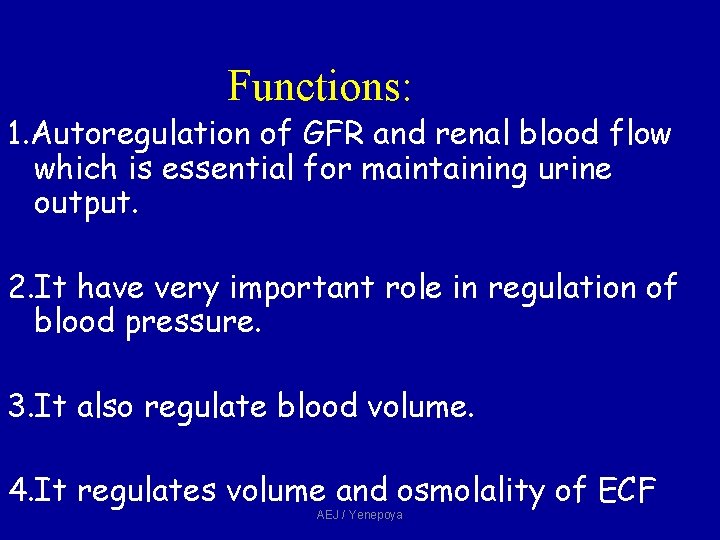
Functions: 1. Autoregulation of GFR and renal blood flow which is essential for maintaining urine output. 2. It have very important role in regulation of blood pressure. 3. It also regulate blood volume. 4. It regulates volume and osmolality of ECF AEJ / Yenepoya
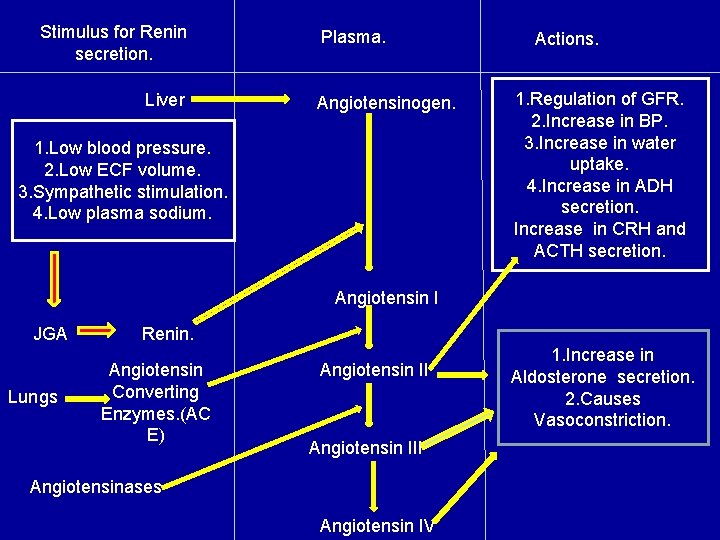
Stimulus for Renin secretion. Liver Plasma. Angiotensinogen. 1. Low blood pressure. 2. Low ECF volume. 3. Sympathetic stimulation. 4. Low plasma sodium. Actions. 1. Regulation of GFR. 2. Increase in BP. 3. Increase in water uptake. 4. Increase in ADH secretion. Increase in CRH and ACTH secretion. Angiotensin I JGA Lungs Renin. Angiotensin Converting Enzymes. (AC E) Angiotensin III Angiotensinases Angiotensin IV 1. Increase in Aldosterone secretion. 2. Causes Vasoconstriction.
Renal blood flow. . … AEJ / Yenepoya
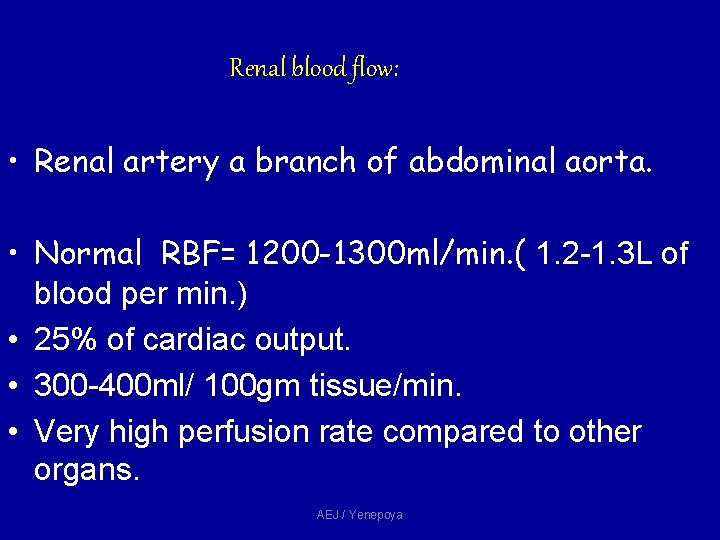
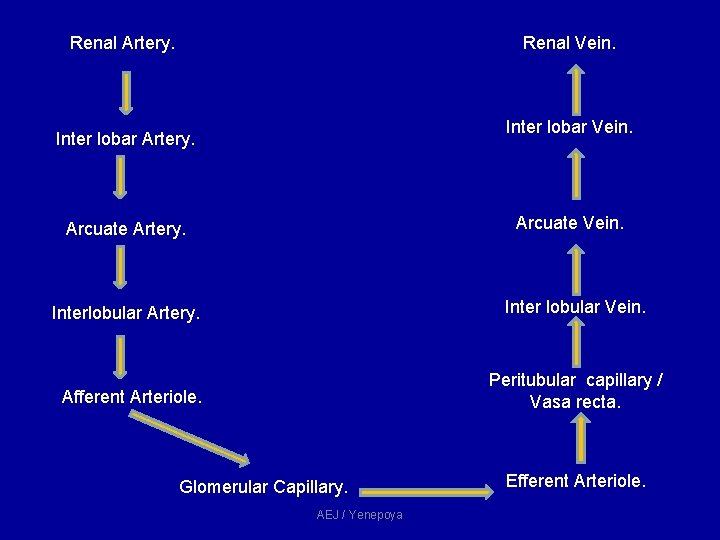
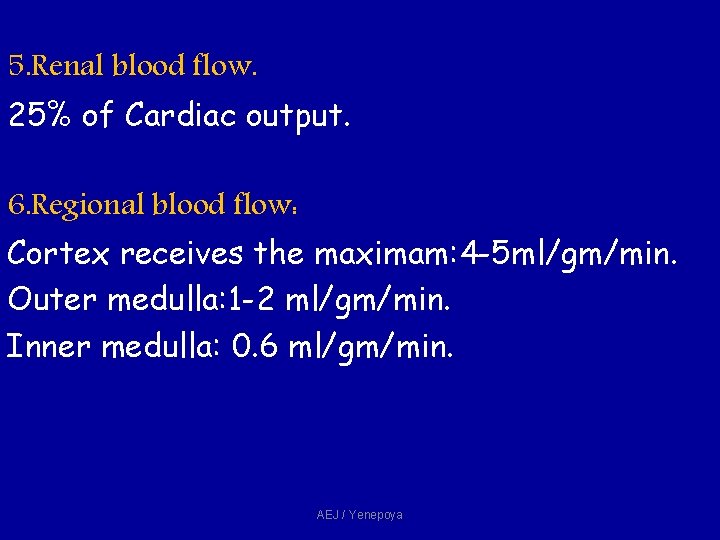
Renal blood flow: • Renal artery a branch of abdominal aorta. • Normal RBF= 1200 -1300 ml/min. ( 1. 2 -1. 3 L of blood per min. ) • 25% of cardiac output. • 300 -400 ml/ 100 gm tissue/min. • Very high perfusion rate compared to other organs. AEJ / Yenepoya
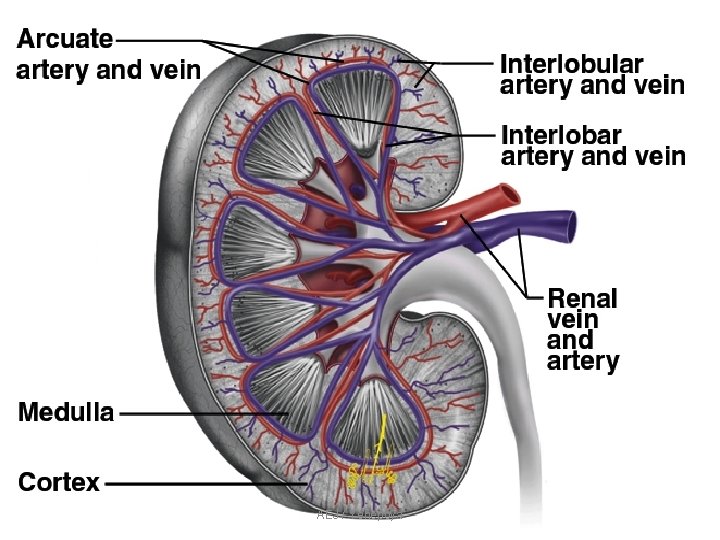
Renal Artery. Renal Vein. Inter lobar Artery. Arcuate Vein. Arcuate Artery. Inter lobular Vein. Interlobular Artery. Peritubular capillary / Vasa recta. Afferent Arteriole. Glomerular Capillary. AEJ / Yenepoya Efferent Arteriole.
AEJ / Yenepoya
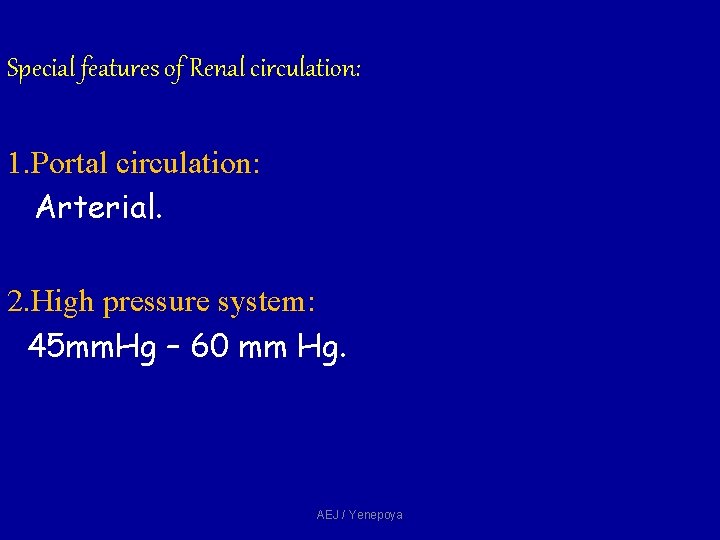
Special features of Renal circulation: 1. Portal circulation: Arterial. 2. High pressure system: 45 mm. Hg – 60 mm Hg. AEJ / Yenepoya
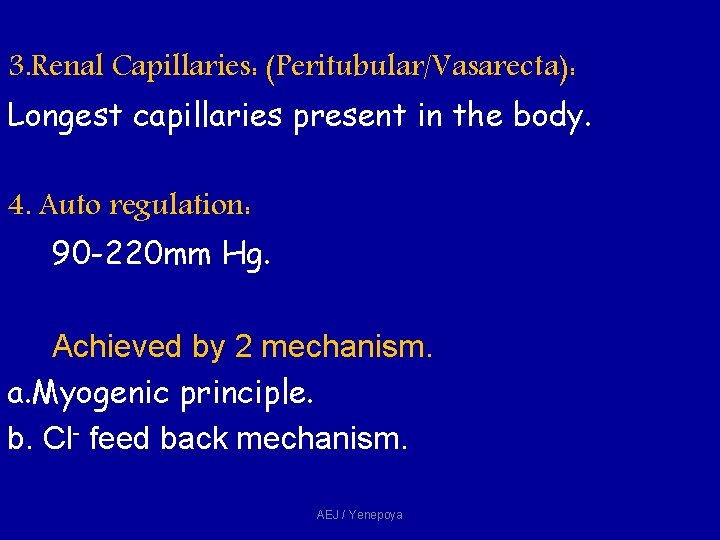
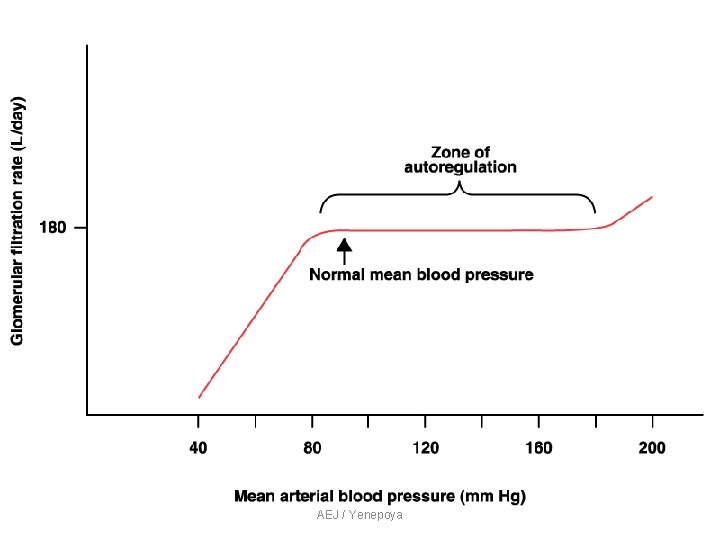
3. Renal Capillaries: (Peritubular/Vasarecta): Longest capillaries present in the body. 4. Auto regulation: 90 -220 mm Hg. Achieved by 2 mechanism. a. Myogenic principle. b. Cl- feed back mechanism. AEJ / Yenepoya
AEJ / Yenepoya
5. Renal blood flow. 25% of Cardiac output. 6. Regional blood flow: Cortex receives the maximam: 4 -5 ml/gm/min. Outer medulla: 1 -2 ml/gm/min. Inner medulla: 0. 6 ml/gm/min. AEJ / Yenepoya
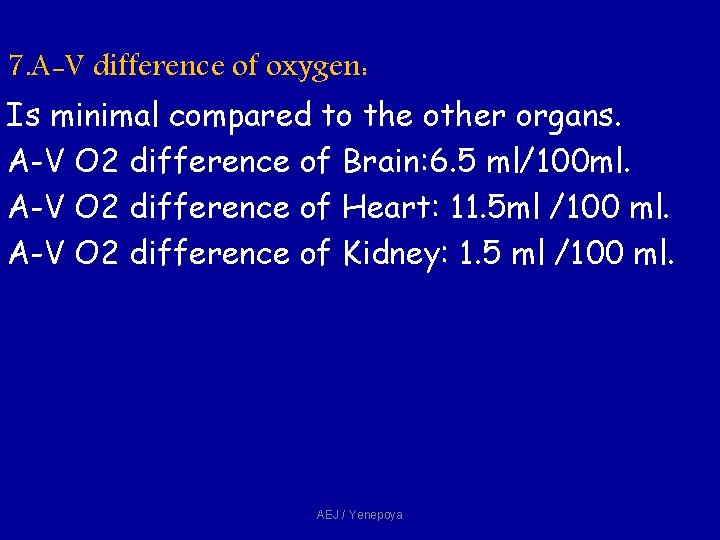
7. A-V difference of oxygen: Is minimal compared to the other organs. A-V O 2 difference of Brain: 6. 5 ml/100 ml. A-V O 2 difference of Heart: 11. 5 ml /100 ml. A-V O 2 difference of Kidney: 1. 5 ml /100 ml. AEJ / Yenepoya
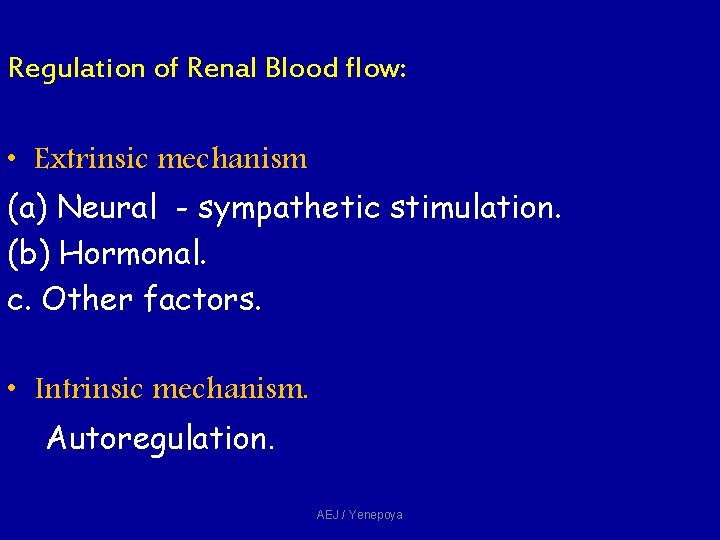
Regulation of Renal Blood flow: • Extrinsic mechanism (a) Neural - sympathetic stimulation. (b) Hormonal. c. Other factors. • Intrinsic mechanism. Autoregulation. AEJ / Yenepoya
Fick’s principle states that the amount of substance(X) taken up by an organ in a unit time is equal to A-V difference of that substance times the blood flow(Q). Substances used: Para amino hippuric acid(PAH). Diodrsat. I 131 AEJ / Yenepoya
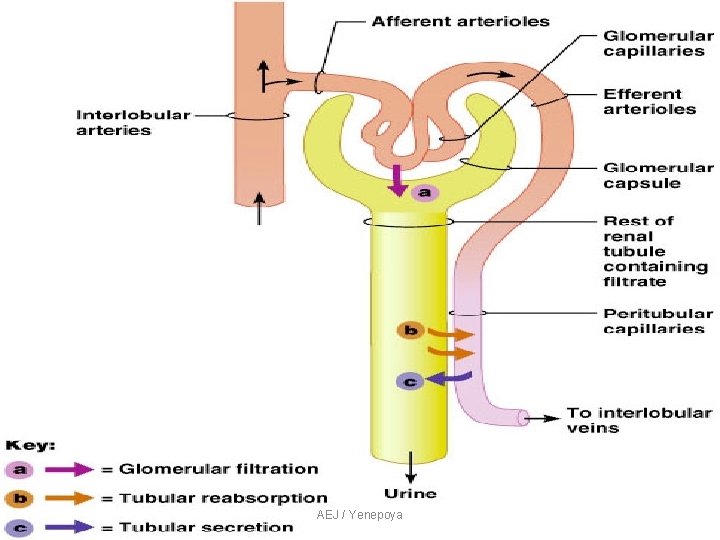
Mechanism of URINE FORMATION AEJ / Yenepoya
AEJ / Yenepoya
Glomerular filtration rate: The amount of filtrate formed by both kidneys/min. Except colloids and blood cells all other substances are filtered. Normal: 125 ml/min (180 L/day). Ultra filtrate. AEJ / Yenepoya
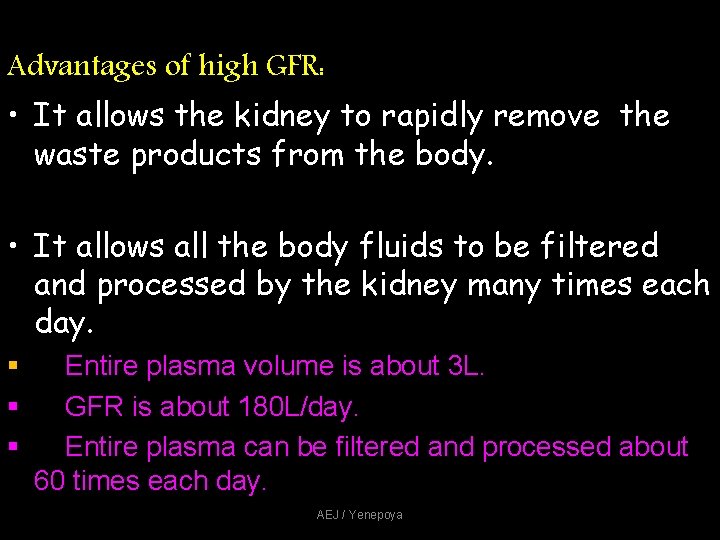
Advantages of high GFR: • It allows the kidney to rapidly remove the waste products from the body. • It allows all the body fluids to be filtered and processed by the kidney many times each day. § § § Entire plasma volume is about 3 L. GFR is about 180 L/day. Entire plasma can be filtered and processed about 60 times each day. AEJ / Yenepoya
• It also allows the kidney to precisely and rapidly control the volume and composition of the body fluids. AEJ / Yenepoya
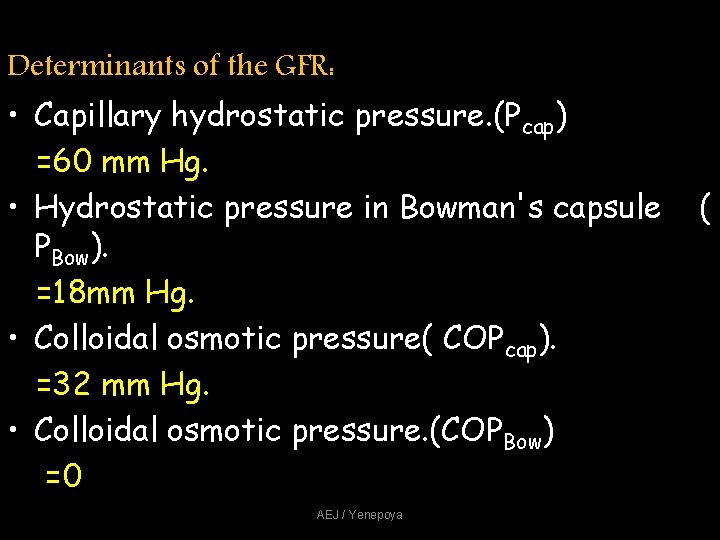
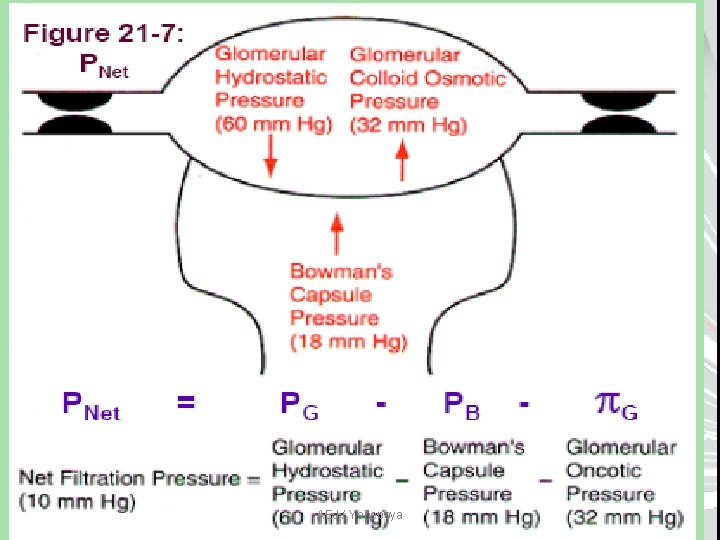
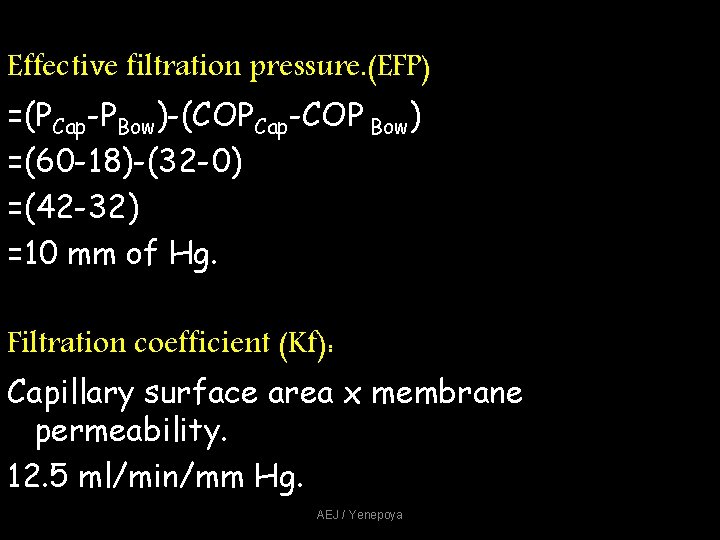
Determinants of the GFR: • Capillary hydrostatic pressure. (Pcap) =60 mm Hg. • Hydrostatic pressure in Bowman's capsule PBow). =18 mm Hg. • Colloidal osmotic pressure( COPcap). =32 mm Hg. • Colloidal osmotic pressure. (COPBow) =0 AEJ / Yenepoya (
AEJ / Yenepoya
Effective filtration pressure. (EFP) =(PCap-PBow)-(COPCap-COP Bow) =(60 -18)-(32 -0) =(42 -32) =10 mm of Hg. Filtration coefficient (Kf): Capillary surface area x membrane permeability. 12. 5 ml/min/mm Hg. AEJ / Yenepoya
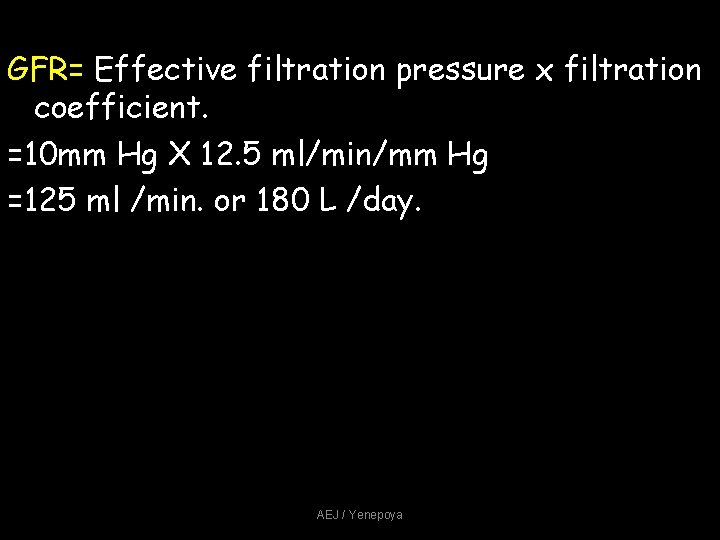
GFR= Effective filtration pressure x filtration coefficient. =10 mm Hg X 12. 5 ml/min/mm Hg =125 ml /min. or 180 L /day. AEJ / Yenepoya
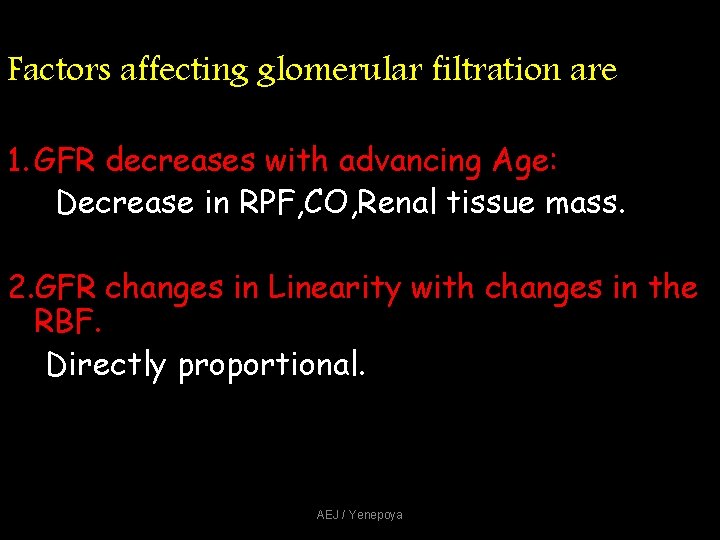
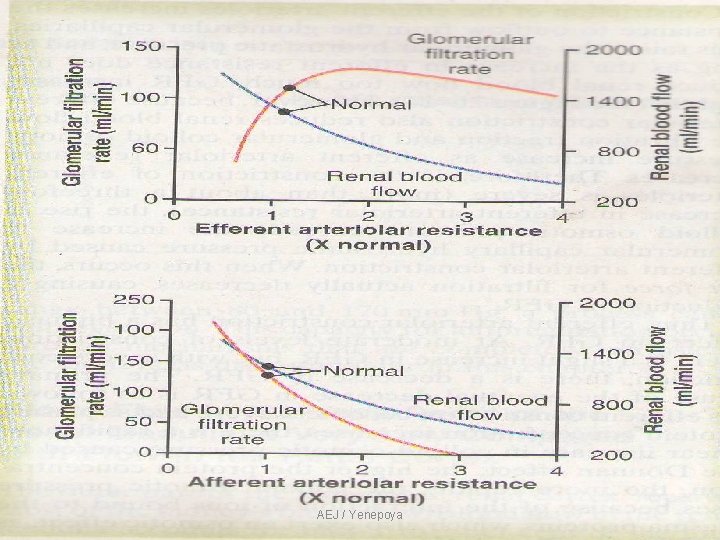
Factors affecting glomerular filtration are 1. GFR decreases with advancing Age: Decrease in RPF, CO, Renal tissue mass. 2. GFR changes in Linearity with changes in the RBF. Directly proportional. AEJ / Yenepoya
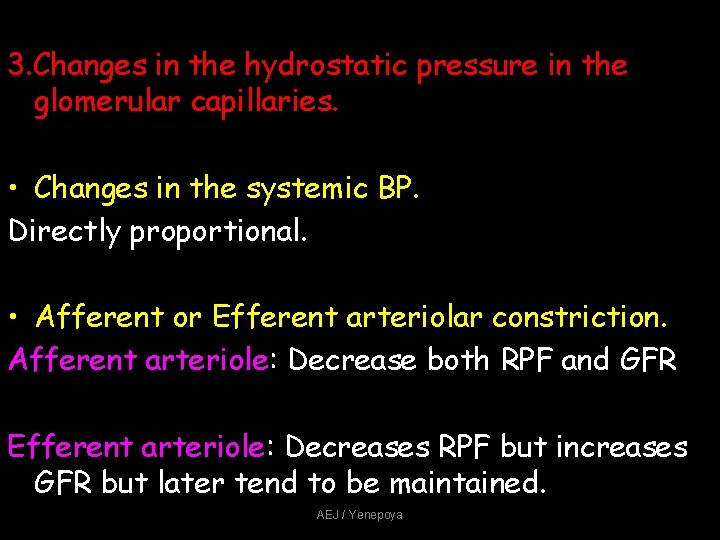
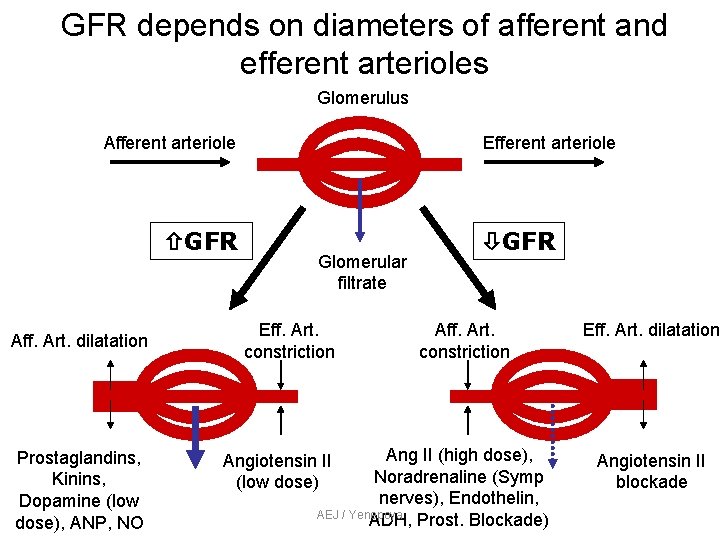
3. Changes in the hydrostatic pressure in the glomerular capillaries. • Changes in the systemic BP. Directly proportional. • Afferent or Efferent arteriolar constriction. Afferent arteriole: Decrease both RPF and GFR Efferent arteriole: Decreases RPF but increases GFR but later tend to be maintained. AEJ / Yenepoya
GFR depends on diameters of afferent and efferent arterioles Glomerulus Afferent arteriole GFR Aff. Art. dilatation Prostaglandins, Kinins, Dopamine (low dose), ANP, NO Efferent arteriole Glomerular filtrate Eff. Art. constriction GFR Aff. Art. constriction Ang II (high dose), Noradrenaline (Symp nerves), Endothelin, AEJ / Yenepoya ADH, Prost. Blockade) Angiotensin II (low dose) Eff. Art. dilatation Angiotensin II blockade
AEJ / Yenepoya
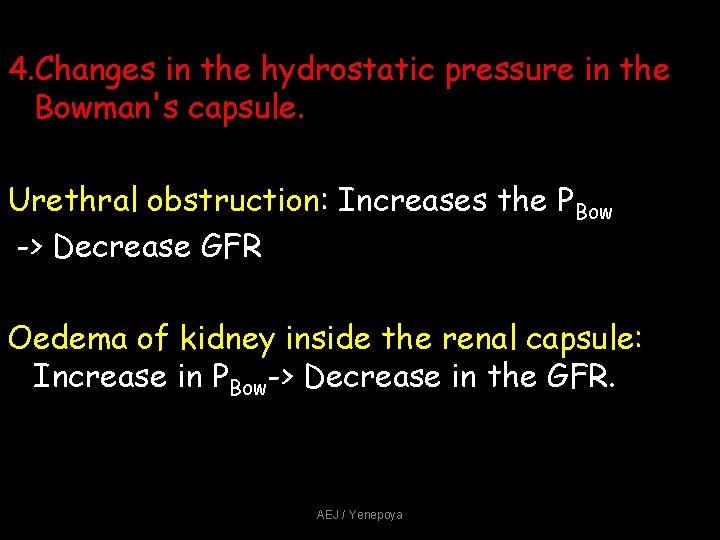
4. Changes in the hydrostatic pressure in the Bowman's capsule. Urethral obstruction: Increases the PBow -> Decrease GFR Oedema of kidney inside the renal capsule: Increase in PBow-> Decrease in the GFR. AEJ / Yenepoya
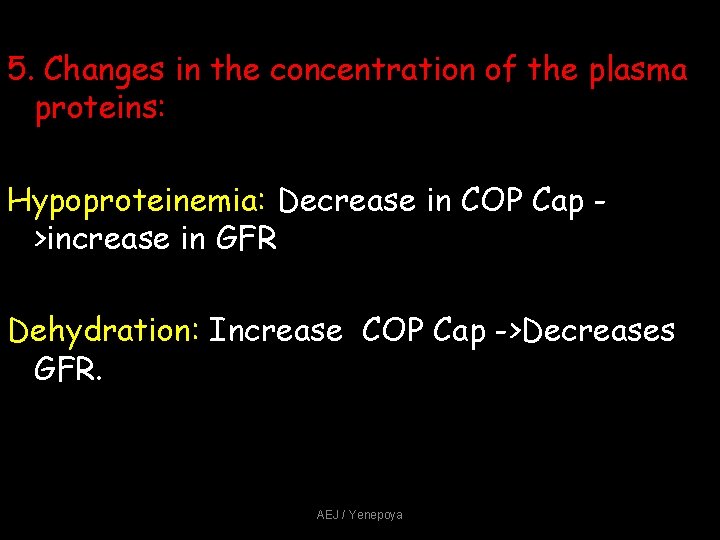
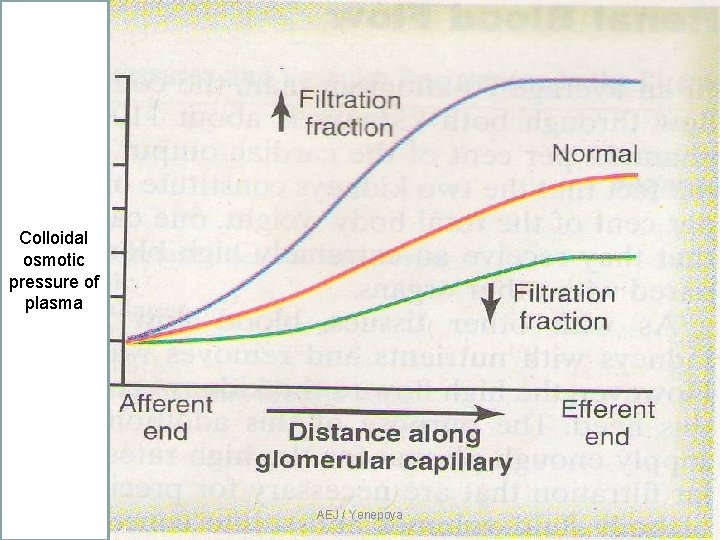
5. Changes in the concentration of the plasma proteins: Hypoproteinemia: Decrease in COP Cap >increase in GFR Dehydration: Increase COP Cap ->Decreases GFR. AEJ / Yenepoya
Colloidal osmotic pressure of plasma AEJ / Yenepoya
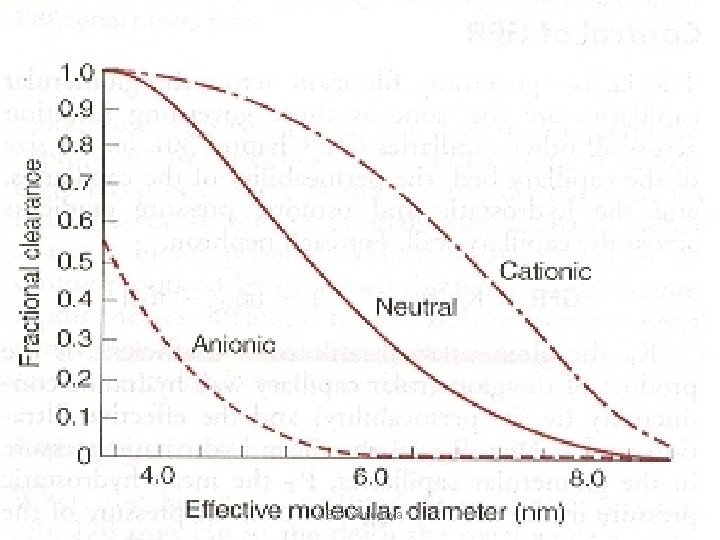
6. State of glomerular membrane: Approx. 50 times more than that of the skeletal muscles. Sialoproteins in the wall of the Glomerular membrane are negatively charged. Filtration of cationic substances slightly greater than that of anions or neutral substances of the same size. AEJ / Yenepoya
AEJ / Yenepoya
7. Size of the capillary bed: Decrease in the area available for filtration>decrease the GFR. AEJ / Yenepoya
Reabsorption and secretion in renal tubules: AEJ / Yenepoya
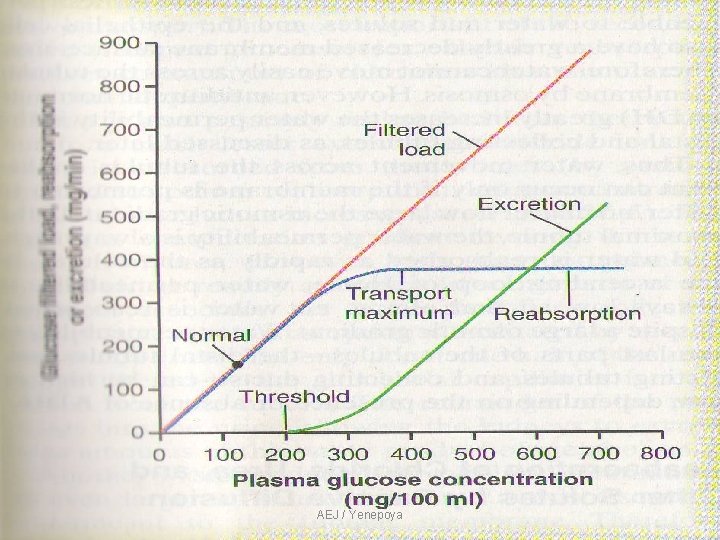
Important terms: • • • Filtered load: The excretion rate: Renal tubular transport maximum: Maximum tubular reabsorption capacity: Tubular secretory capacity: Threshold concentration: AEJ / Yenepoya
AEJ / Yenepoya
Transport mechanism: AEJ / Yenepoya
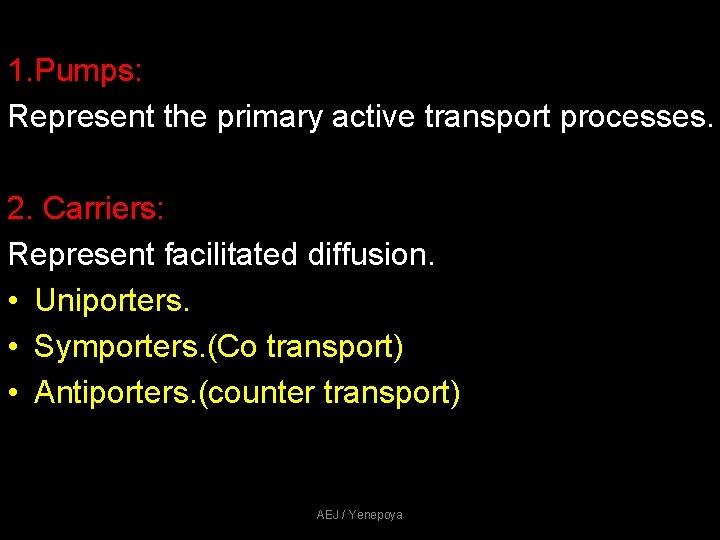
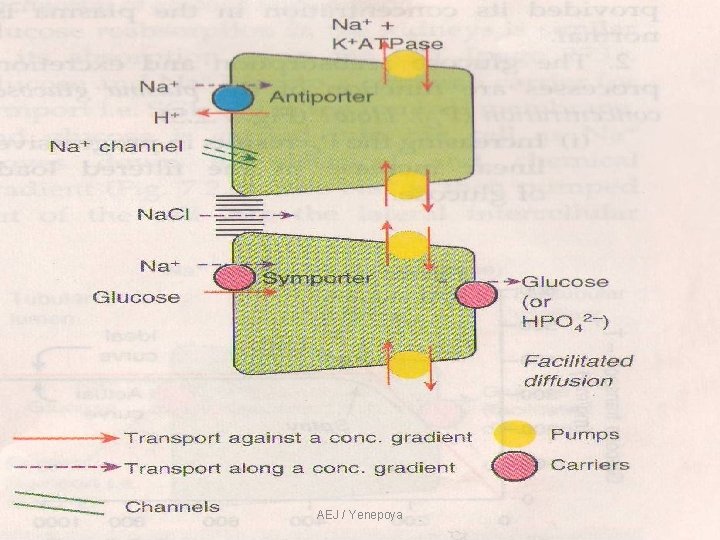
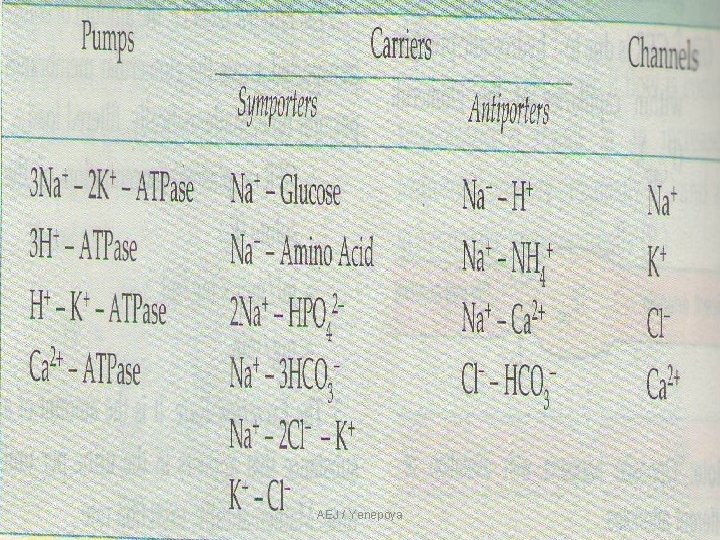
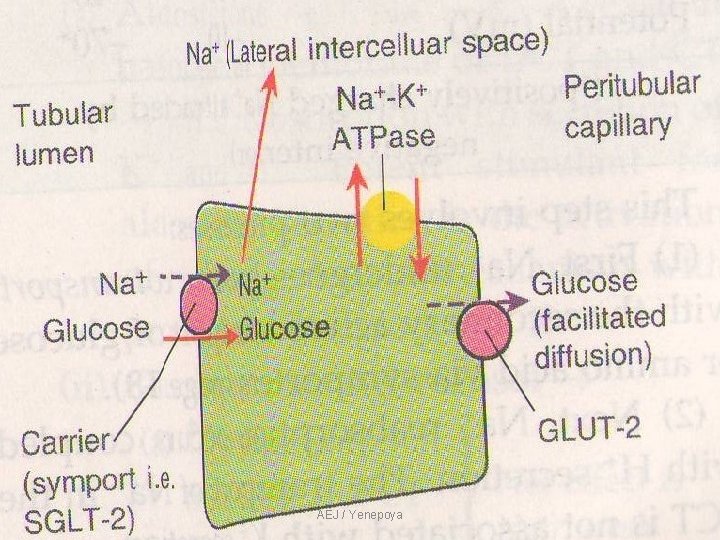
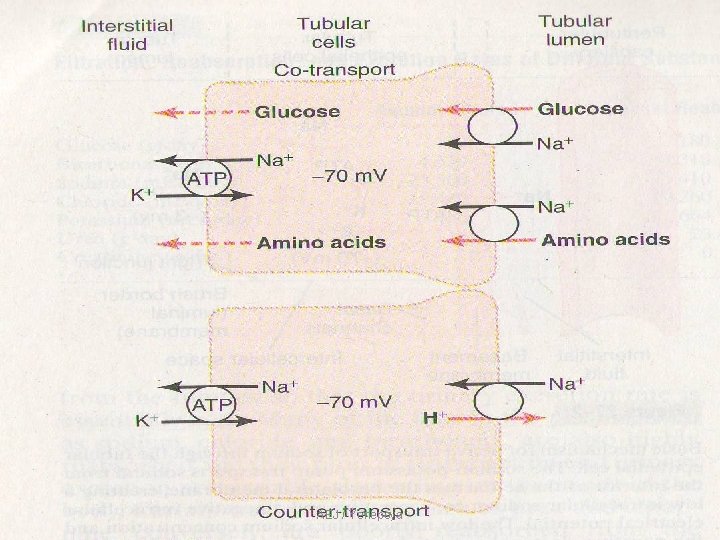
1. Pumps: Represent the primary active transport processes. 2. Carriers: Represent facilitated diffusion. • Uniporters. • Symporters. (Co transport) • Antiporters. (counter transport) AEJ / Yenepoya
AEJ / Yenepoya
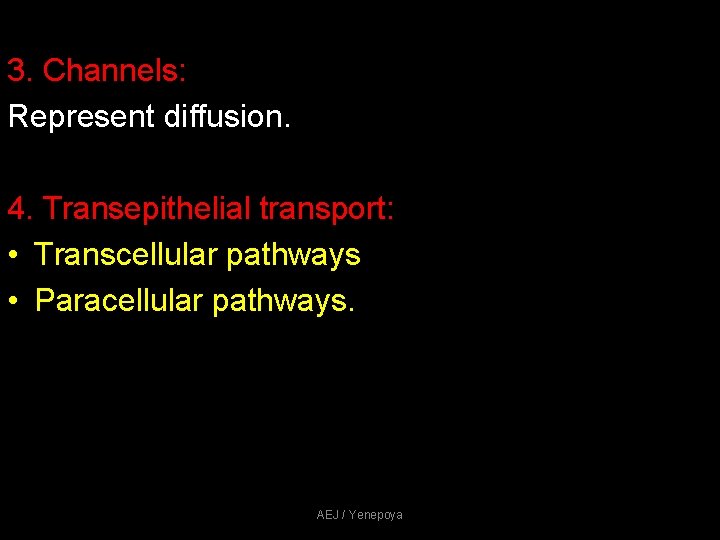
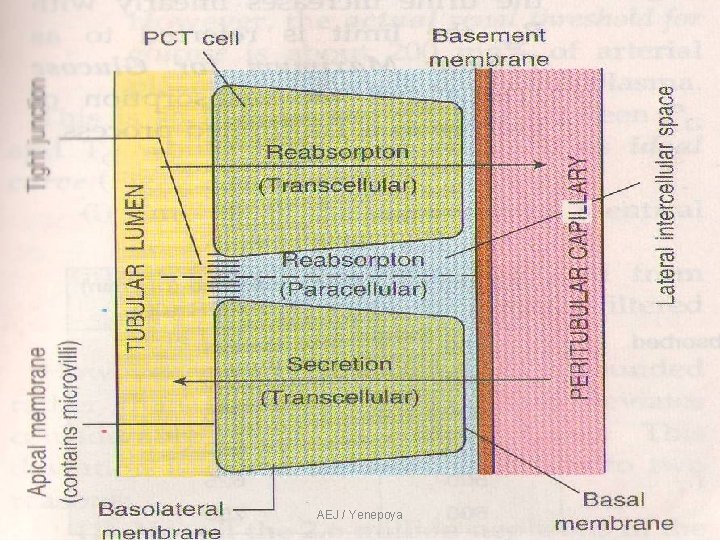
3. Channels: Represent diffusion. 4. Transepithelial transport: • Transcellular pathways • Paracellular pathways. AEJ / Yenepoya
AEJ / Yenepoya
AEJ / Yenepoya
Renal clearance. . AEJ / Yenepoya
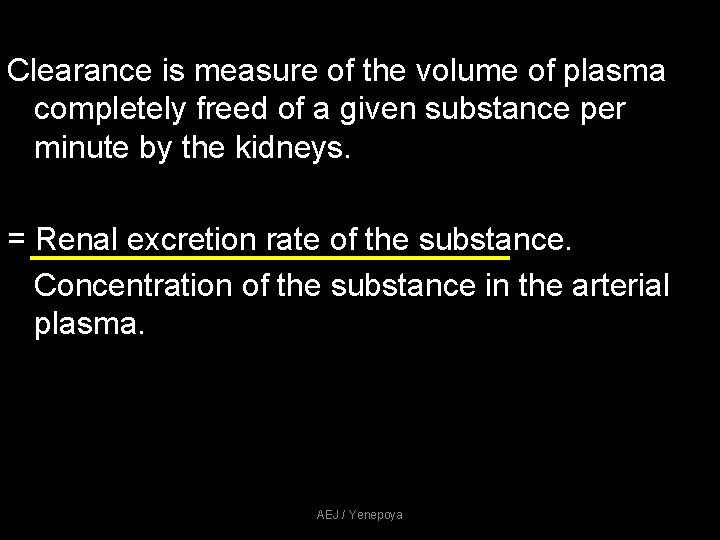
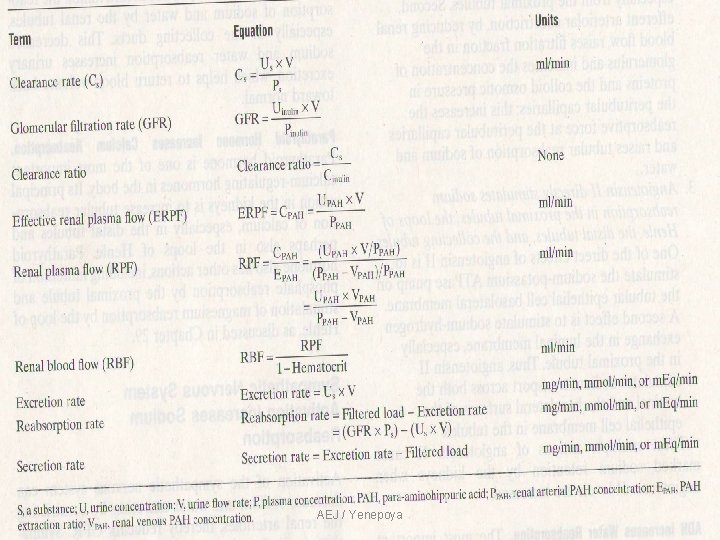
Clearance is measure of the volume of plasma completely freed of a given substance per minute by the kidneys. = Renal excretion rate of the substance. Concentration of the substance in the arterial plasma. AEJ / Yenepoya
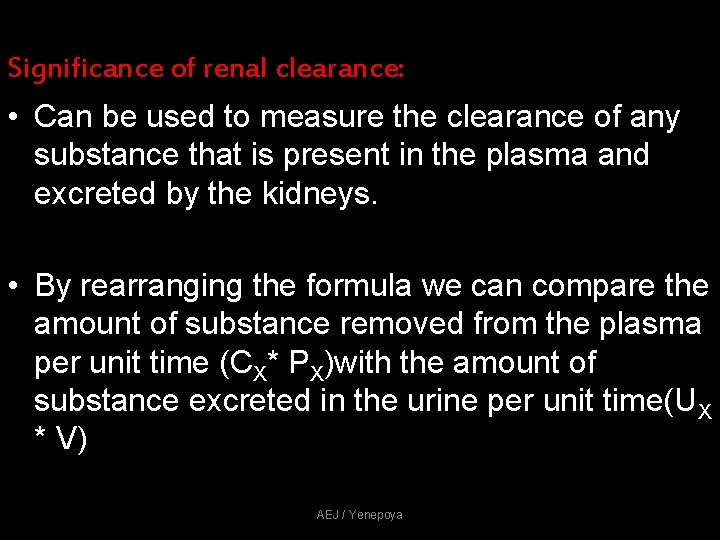
Significance of renal clearance: • Can be used to measure the clearance of any substance that is present in the plasma and excreted by the kidneys. • By rearranging the formula we can compare the amount of substance removed from the plasma per unit time (CX* PX)with the amount of substance excreted in the urine per unit time(UX * V) AEJ / Yenepoya
Applications AEJ / Yenepoya
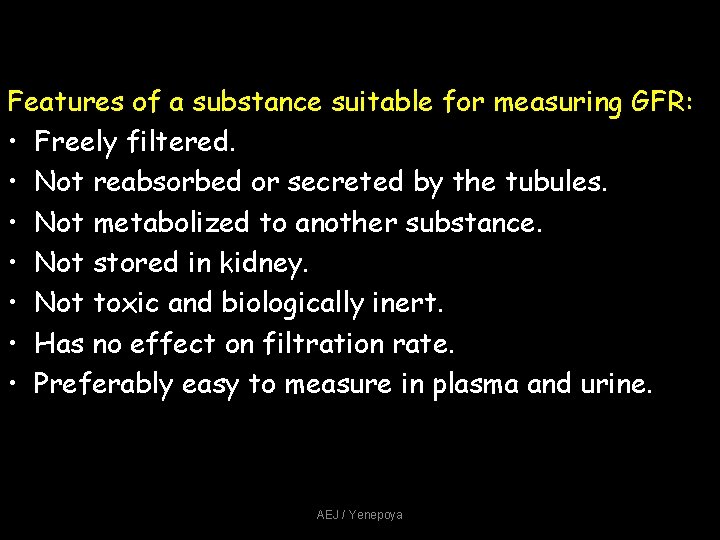
Features of a substance suitable for measuring GFR: • Freely filtered. • Not reabsorbed or secreted by the tubules. • Not metabolized to another substance. • Not stored in kidney. • Not toxic and biologically inert. • Has no effect on filtration rate. • Preferably easy to measure in plasma and urine. AEJ / Yenepoya
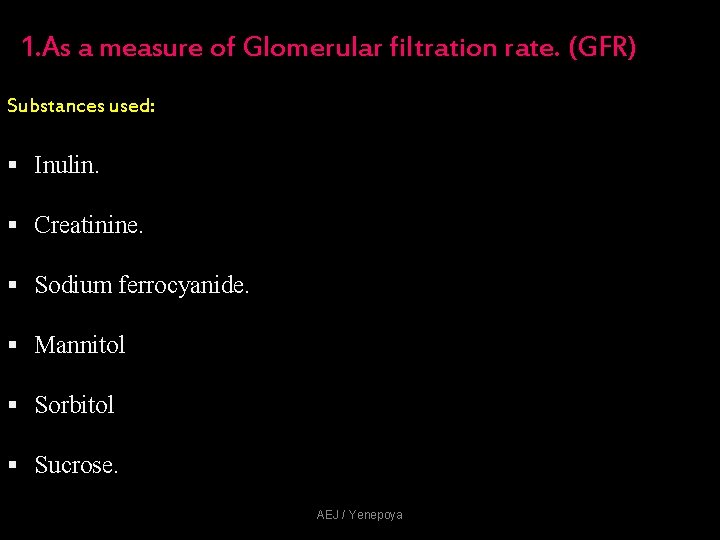
1. As a measure of Glomerular filtration rate. (GFR) Substances used: § Inulin. § Creatinine. § Sodium ferrocyanide. § Mannitol § Sorbitol § Sucrose. AEJ / Yenepoya
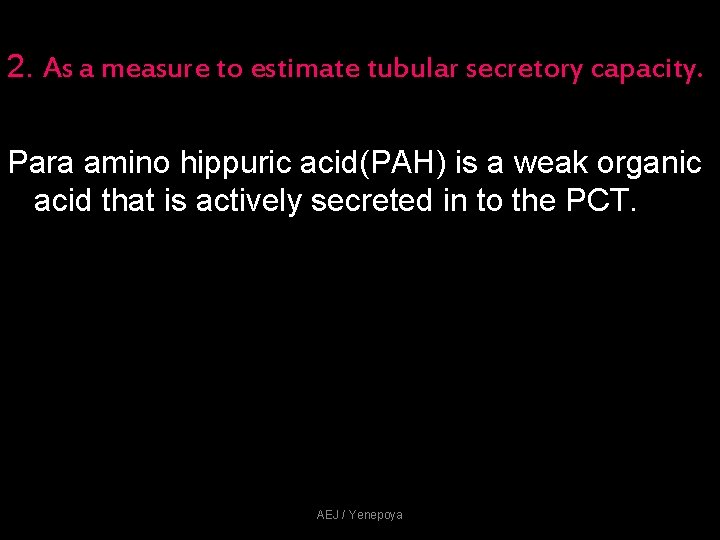
2. As a measure to estimate tubular secretory capacity. Para amino hippuric acid(PAH) is a weak organic acid that is actively secreted in to the PCT. AEJ / Yenepoya
2. As a measure to estimate tubular secretory capacity. Para amino hippuric acid(PAH) is a weak organic acid that is actively secreted in to the PCT. AEJ / Yenepoya
3. As a measure of Renal plasma flow(RPF) and Renal blood flow(RBF) Principle : Ficks principle. AEJ / Yenepoya
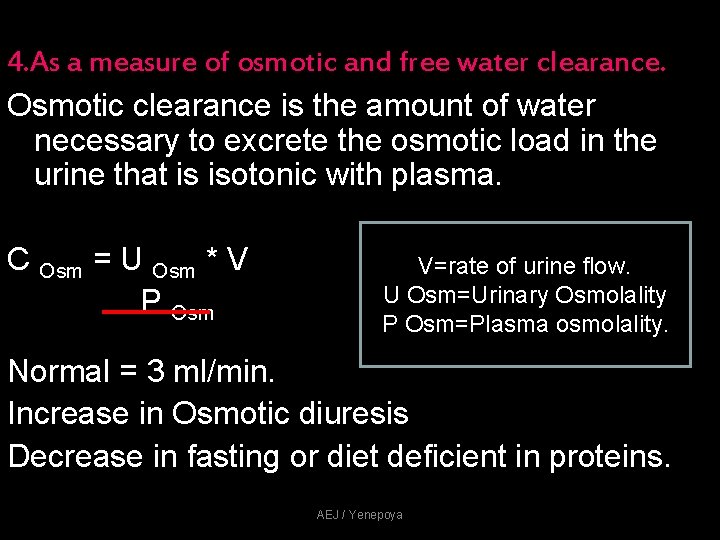
4. As a measure of osmotic and free water clearance. Osmotic clearance is the amount of water necessary to excrete the osmotic load in the urine that is isotonic with plasma. C Osm = U Osm * V P Osm V=rate of urine flow. U Osm=Urinary Osmolality P Osm=Plasma osmolality. Normal = 3 ml/min. Increase in Osmotic diuresis Decrease in fasting or diet deficient in proteins. AEJ / Yenepoya
AEJ / Yenepoya
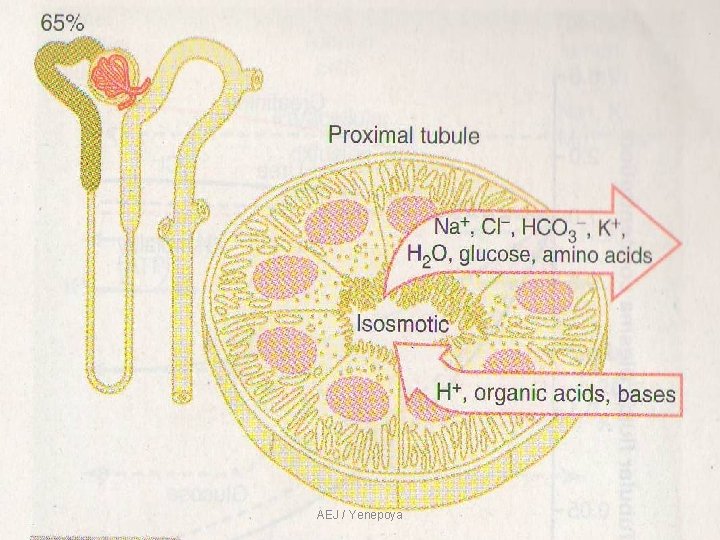
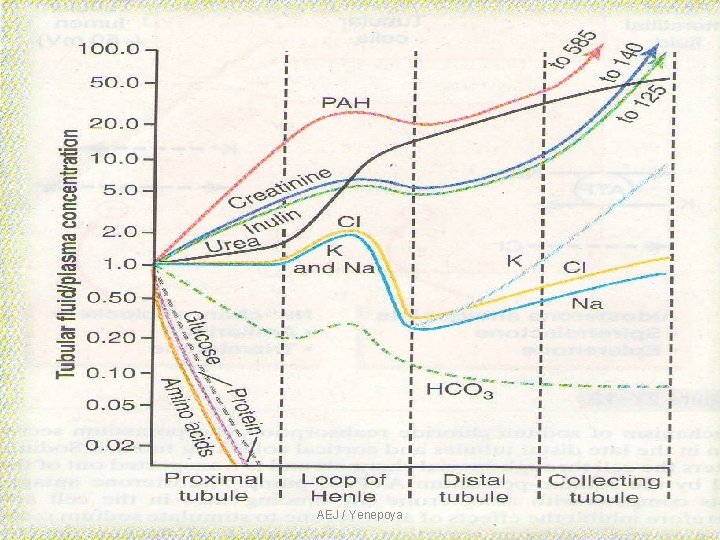
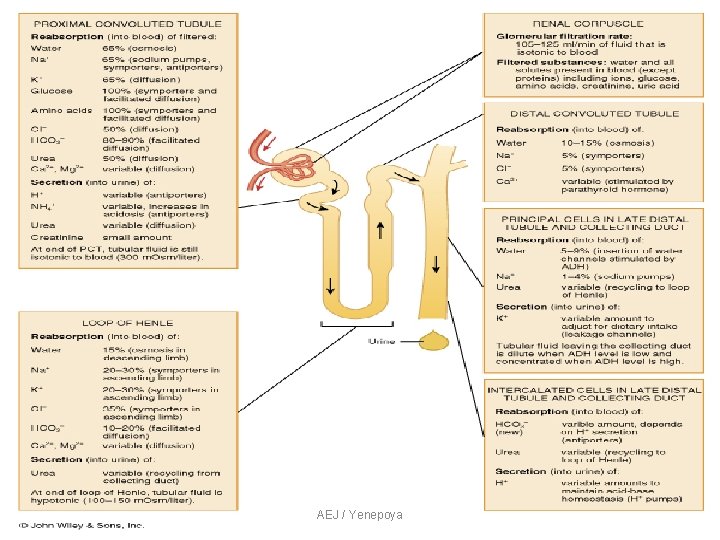
Reabsorption and secretion along the different parts of nephron AEJ / Yenepoya
AEJ / Yenepoya
AEJ / Yenepoya
AEJ / Yenepoya
AEJ / Yenepoya
AEJ / Yenepoya
AEJ / Yenepoya
AEJ / Yenepoya
AEJ / Yenepoya
AEJ / Yenepoya
AEJ / Yenepoya
AEJ / Yenepoya
AEJ / Yenepoya
AEJ / Yenepoya
AEJ / Yenepoya
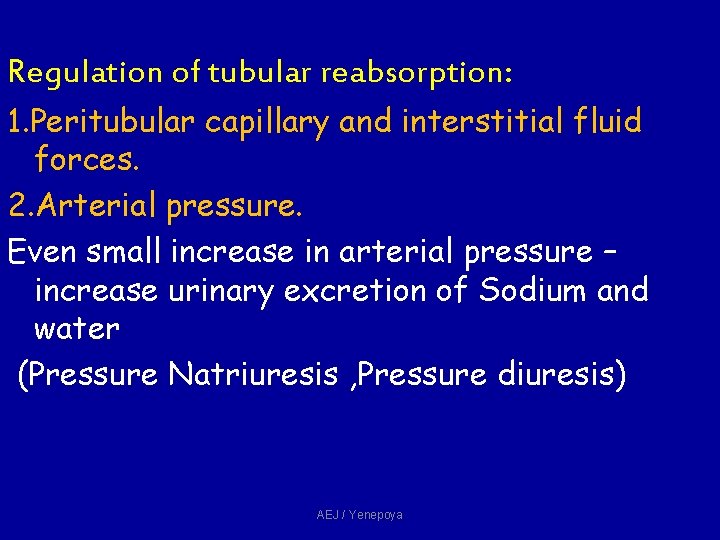
Regulation of tubular reabsorption: 1. Peritubular capillary and interstitial fluid forces. 2. Arterial pressure. Even small increase in arterial pressure – increase urinary excretion of Sodium and water (Pressure Natriuresis , Pressure diuresis) AEJ / Yenepoya
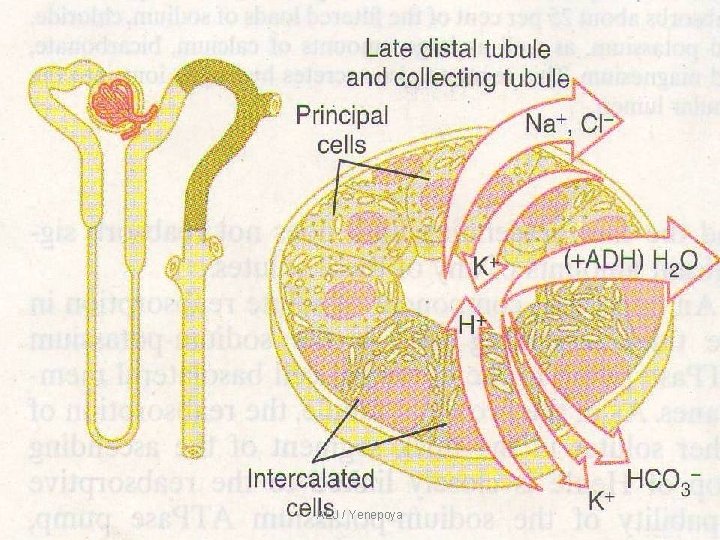
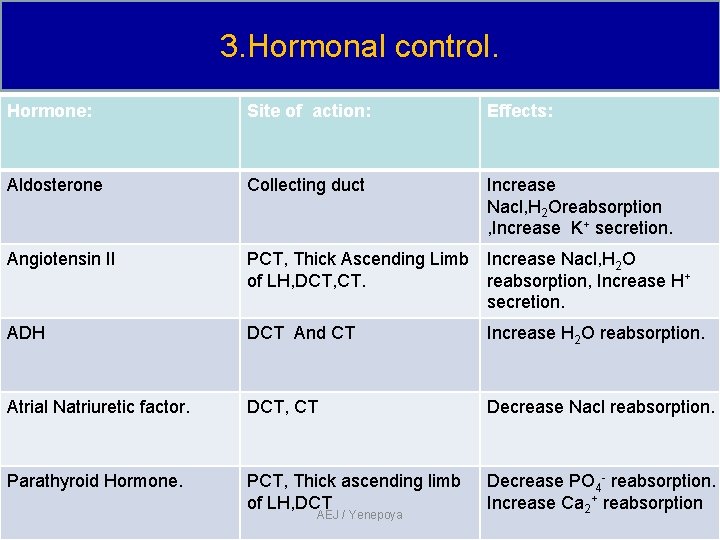
3. Hormonal control. Hormone: Site of action: Effects: Aldosterone Collecting duct Increase Nacl, H 2 Oreabsorption , Increase K+ secretion. Angiotensin II PCT, Thick Ascending Limb of LH, DCT, CT. Increase Nacl, H 2 O reabsorption, Increase H+ secretion. ADH DCT And CT Increase H 2 O reabsorption. Atrial Natriuretic factor. DCT, CT Decrease Nacl reabsorption. Parathyroid Hormone. PCT, Thick ascending limb of LH, DCT Decrease PO 4 - reabsorption. Increase Ca 2+ reabsorption AEJ / Yenepoya
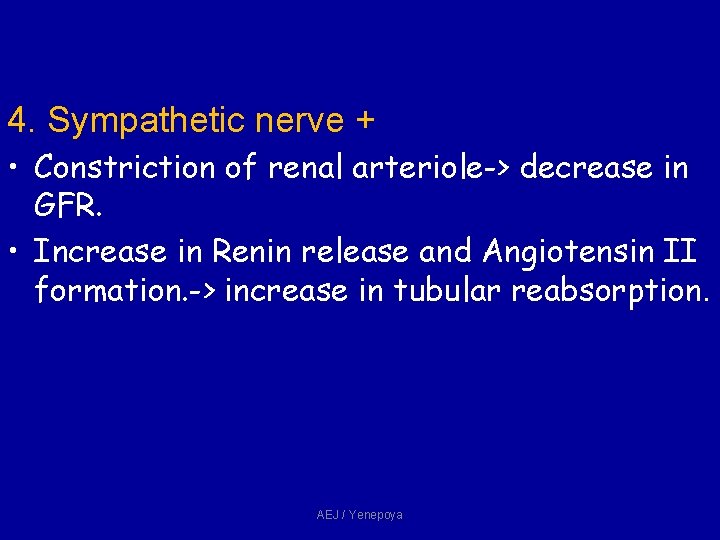
4. Sympathetic nerve + • Constriction of renal arteriole-> decrease in GFR. • Increase in Renin release and Angiotensin II formation. -> increase in tubular reabsorption. AEJ / Yenepoya
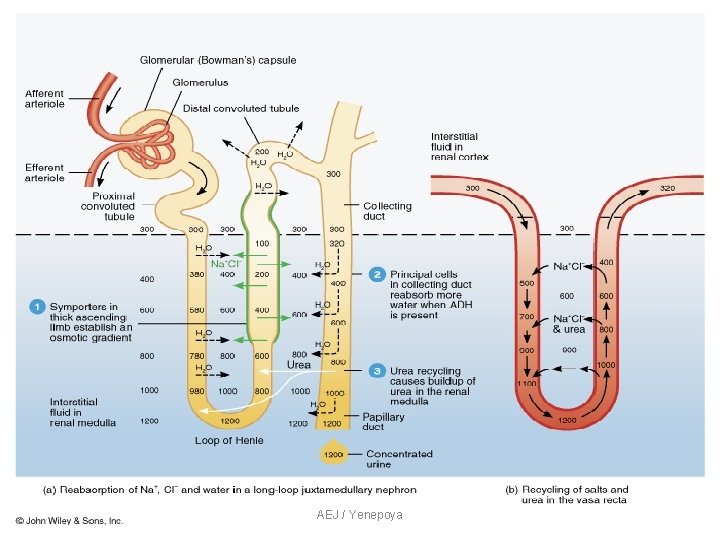
Counter Current Reabsorption and secretion along the mechanism. different parts of nephron AEJ / Yenepoya
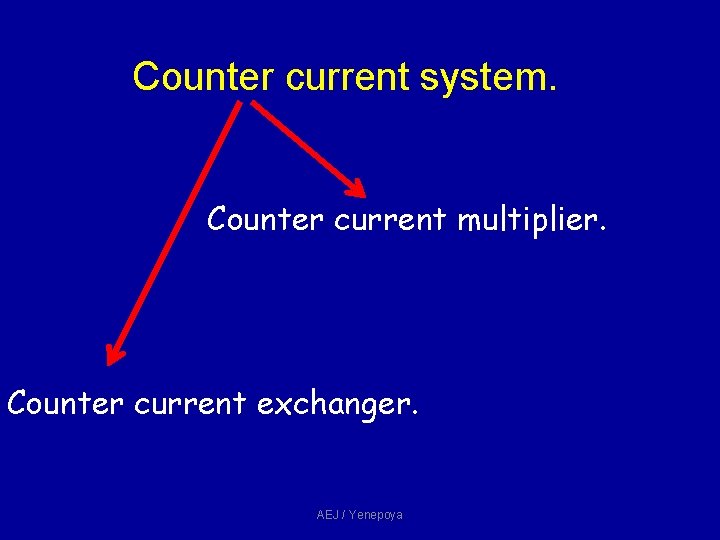
Counter current system. Counter current multiplier. Counter current exchanger. AEJ / Yenepoya
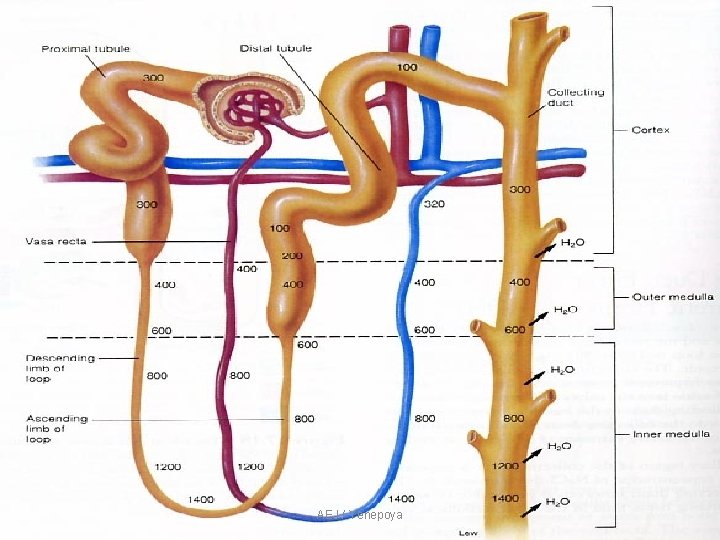
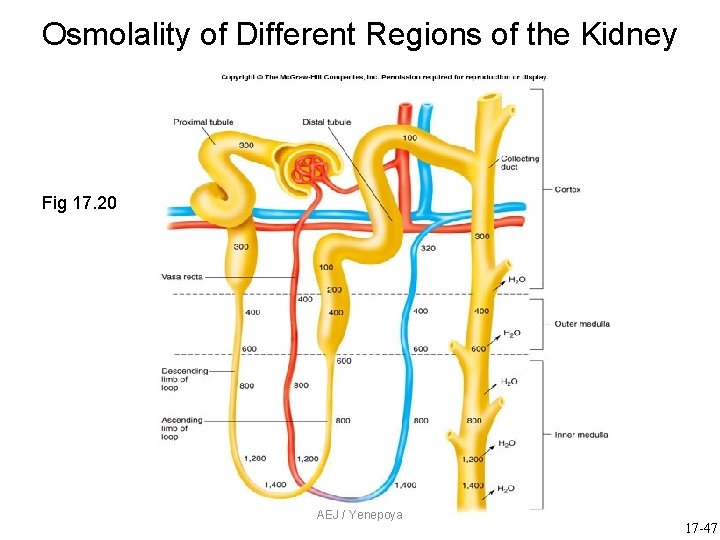
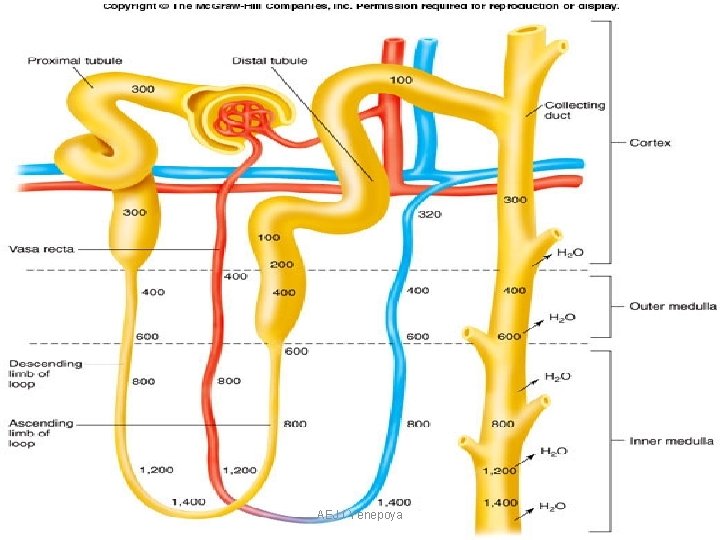
Osmolality of Different Regions of the Kidney Fig 17. 20 AEJ / Yenepoya 17 -47
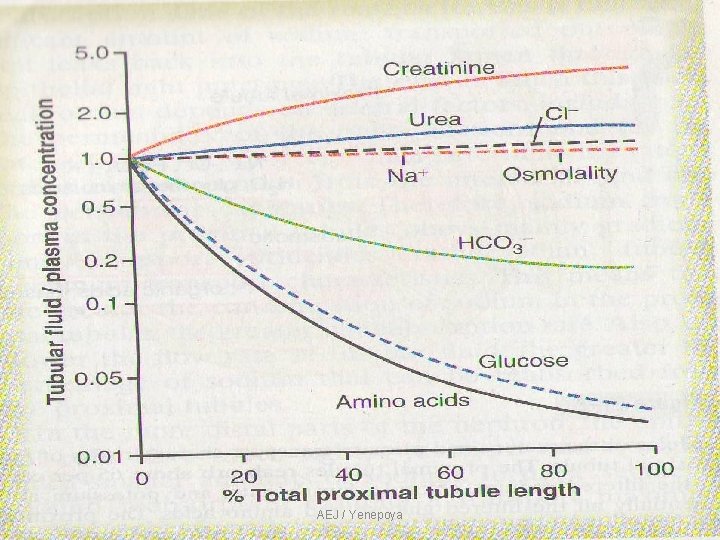
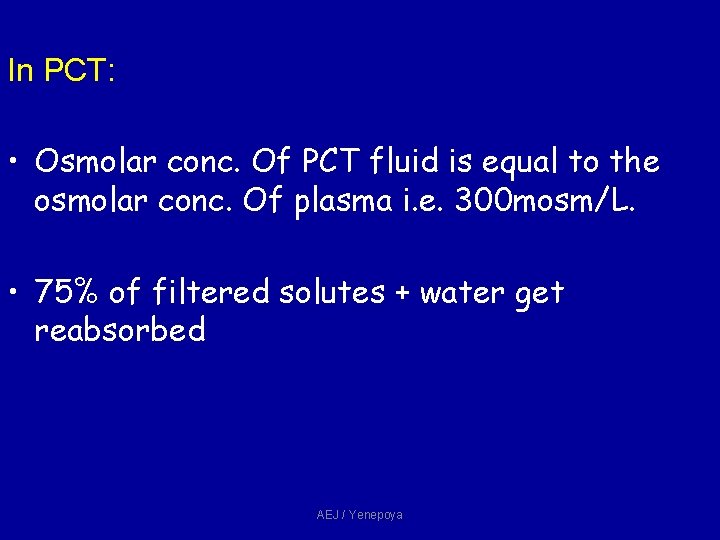
In PCT: • Osmolar conc. Of PCT fluid is equal to the osmolar conc. Of plasma i. e. 300 mosm/L. • 75% of filtered solutes + water get reabsorbed AEJ / Yenepoya
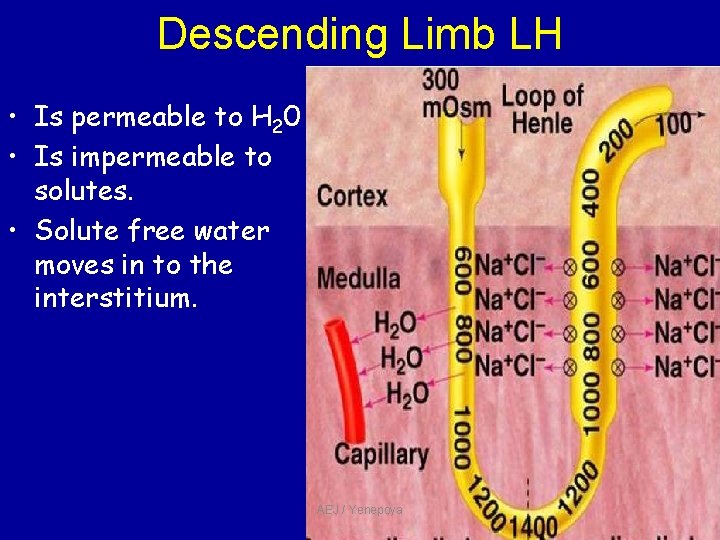
Descending Limb LH • Is permeable to H 20 • Is impermeable to solutes. • Solute free water moves in to the interstitium. AEJ / Yenepoya 17 -37
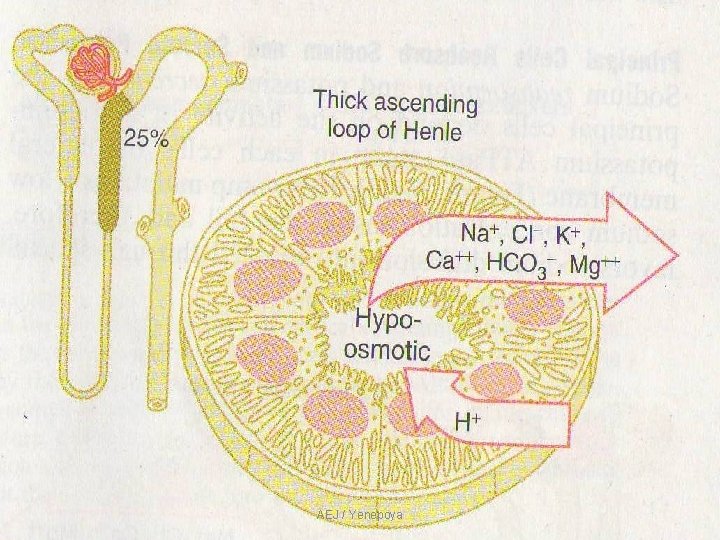
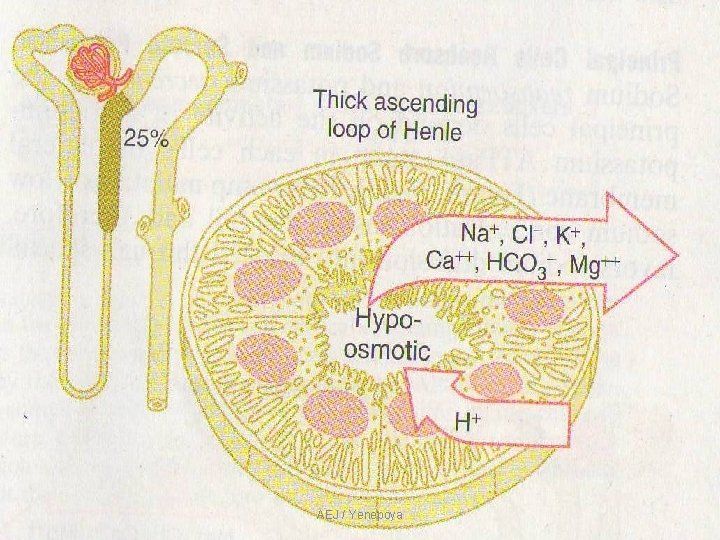
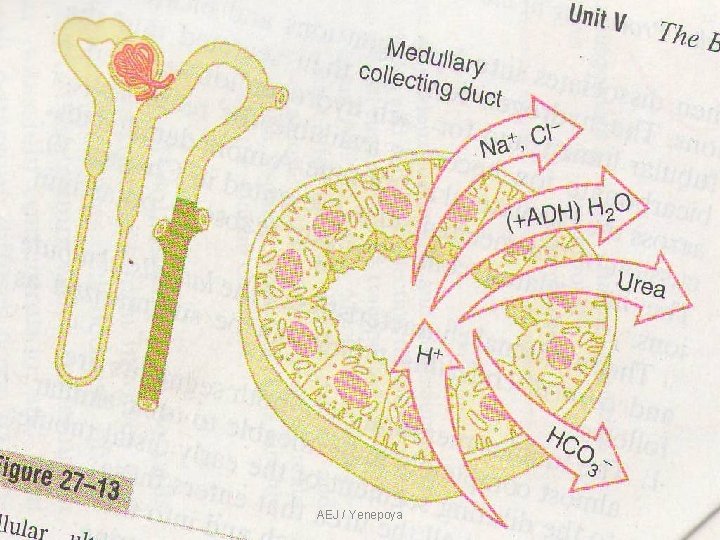
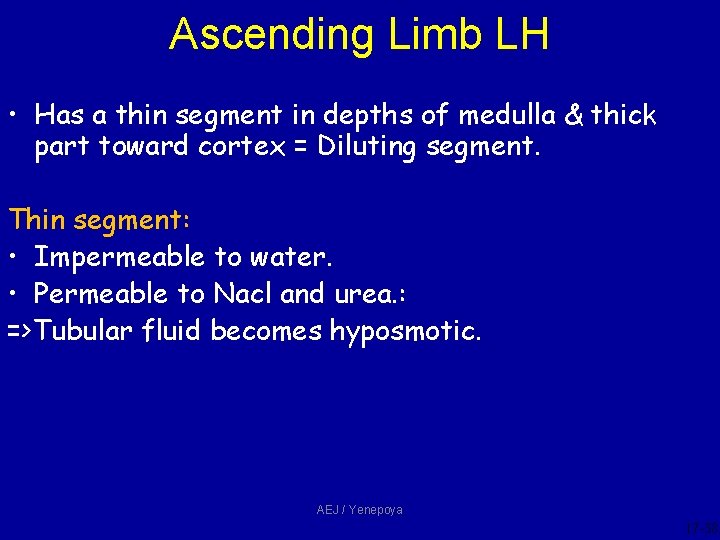
Ascending Limb LH • Has a thin segment in depths of medulla & thick part toward cortex = Diluting segment. Thin segment: • Impermeable to water. • Permeable to Nacl and urea. : =>Tubular fluid becomes hyposmotic. AEJ / Yenepoya 17 -38
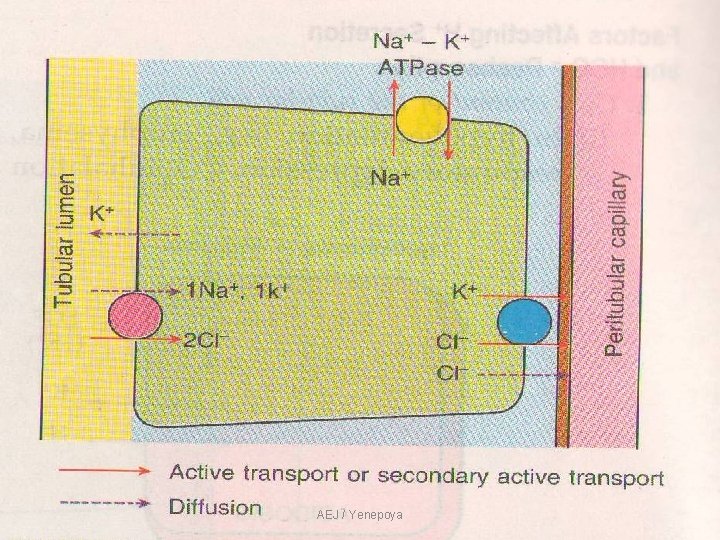
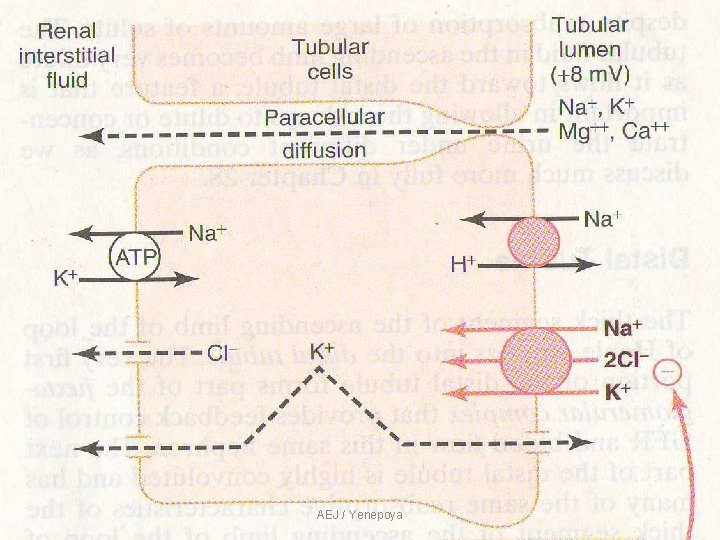
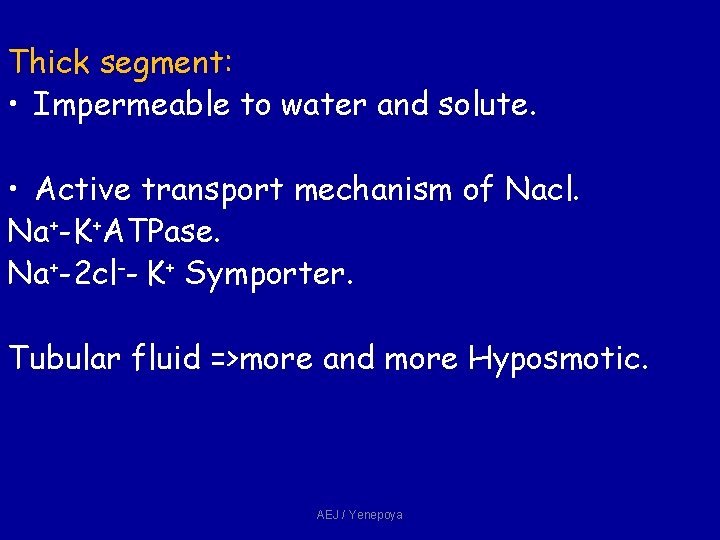
Thick segment: • Impermeable to water and solute. • Active transport mechanism of Nacl. Na+-K+ATPase. Na+-2 cl-- K+ Symporter. Tubular fluid =>more and more Hyposmotic. AEJ / Yenepoya
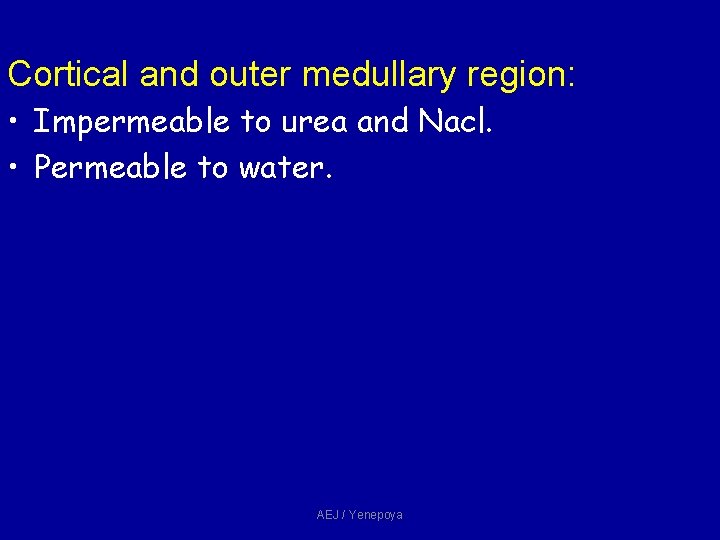
Cortical and outer medullary region: • Impermeable to urea and Nacl. • Permeable to water. AEJ / Yenepoya
Inner medullary portion of the collecting duct: AEJ / Yenepoya
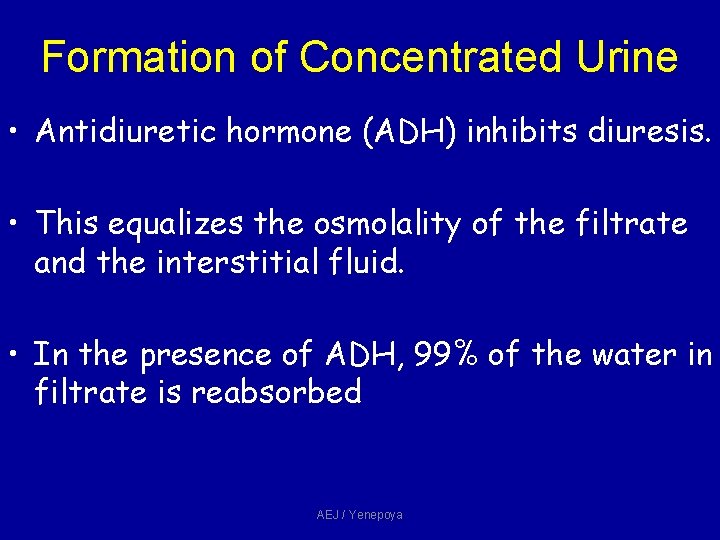
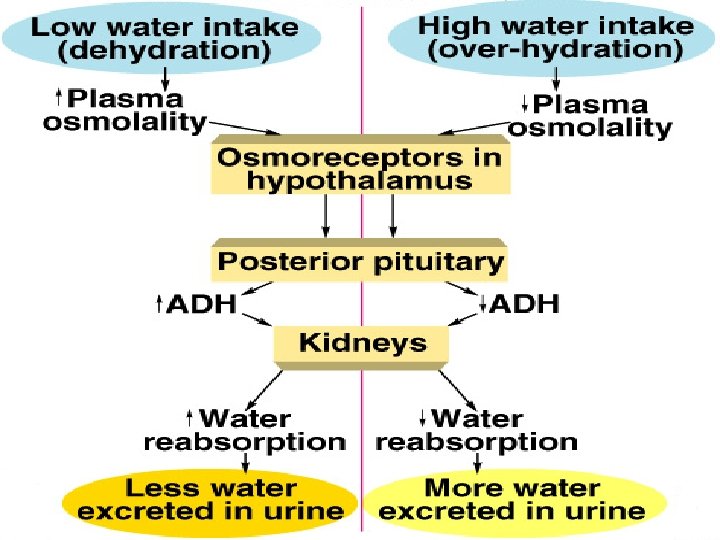
Formation of Concentrated Urine • Antidiuretic hormone (ADH) inhibits diuresis. • This equalizes the osmolality of the filtrate and the interstitial fluid. • In the presence of ADH, 99% of the water in filtrate is reabsorbed AEJ / Yenepoya
AEJ / Yenepoya
AEJ / Yenepoya
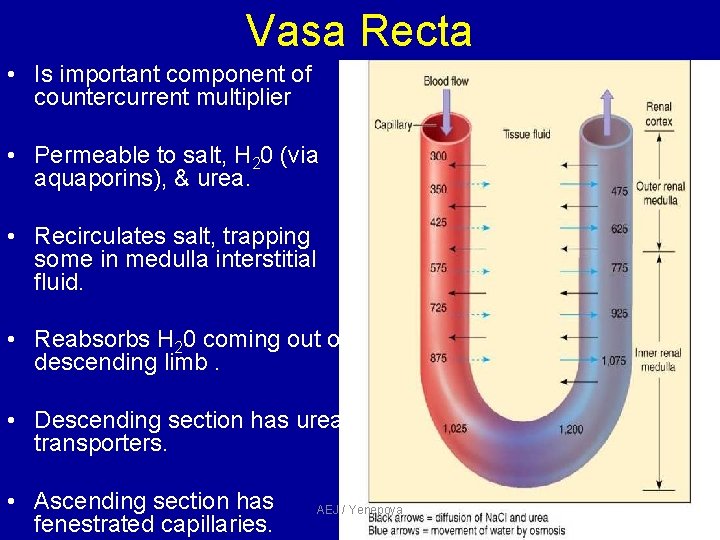
Vasa Recta • Is important component of countercurrent multiplier • Permeable to salt, H 20 (via aquaporins), & urea. • Recirculates salt, trapping some in medulla interstitial fluid. • Reabsorbs H 20 coming out of descending limb. • Descending section has urea transporters. • Ascending section has fenestrated capillaries. AEJ / Yenepoya 17 -42
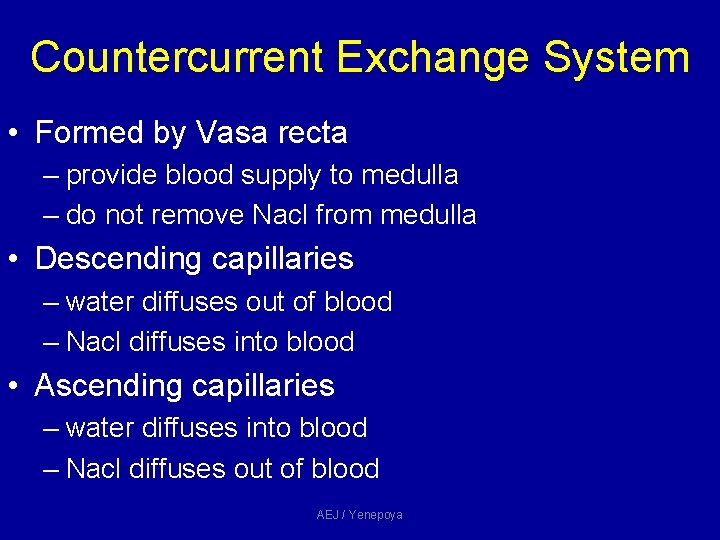
Countercurrent Exchange System • Formed by Vasa recta – provide blood supply to medulla – do not remove Nacl from medulla • Descending capillaries – water diffuses out of blood – Nacl diffuses into blood • Ascending capillaries – water diffuses into blood – Nacl diffuses out of blood AEJ / Yenepoya
AEJ / Yenepoya
Diuresis: • Water diuresis: • Osmotic diuresis. • Obligatory water reabsorption: • Facultative water reabsorption: AEJ / Yenepoya
Renal Acid-Base Regulation: AEJ / Yenepoya
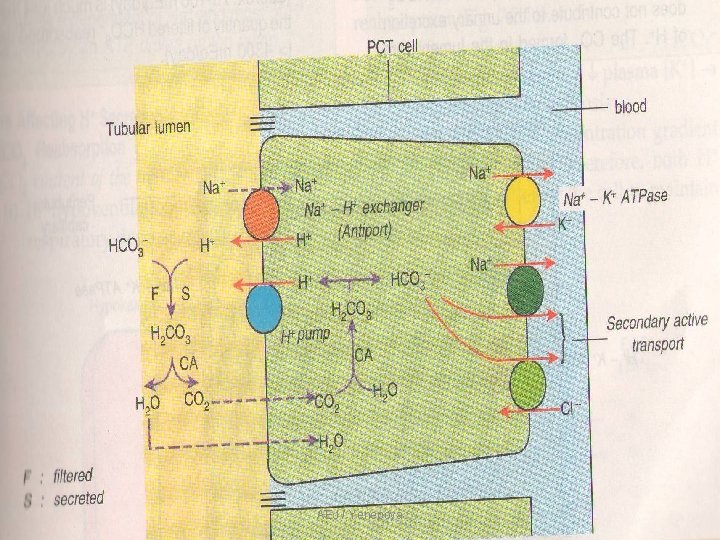
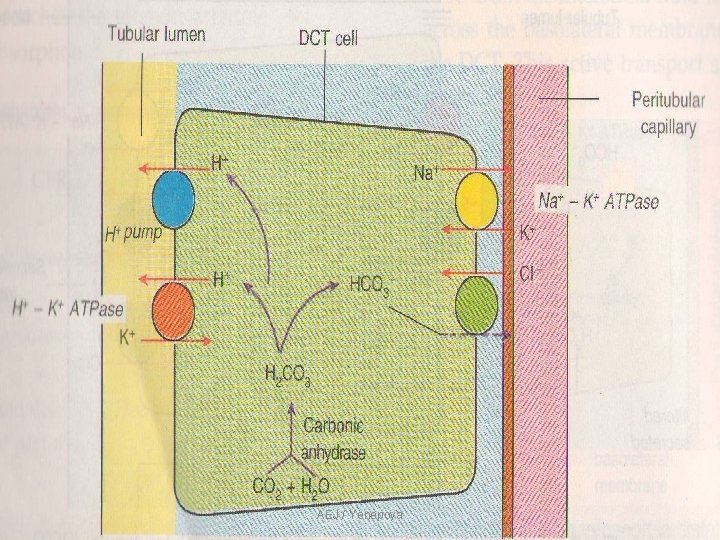
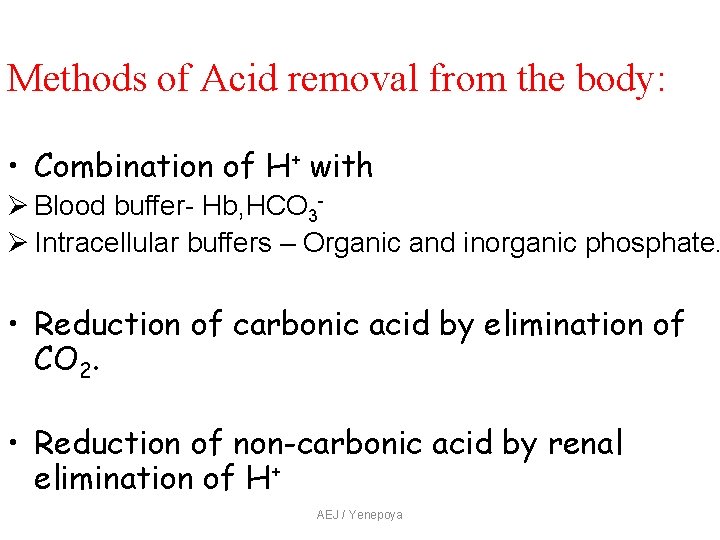
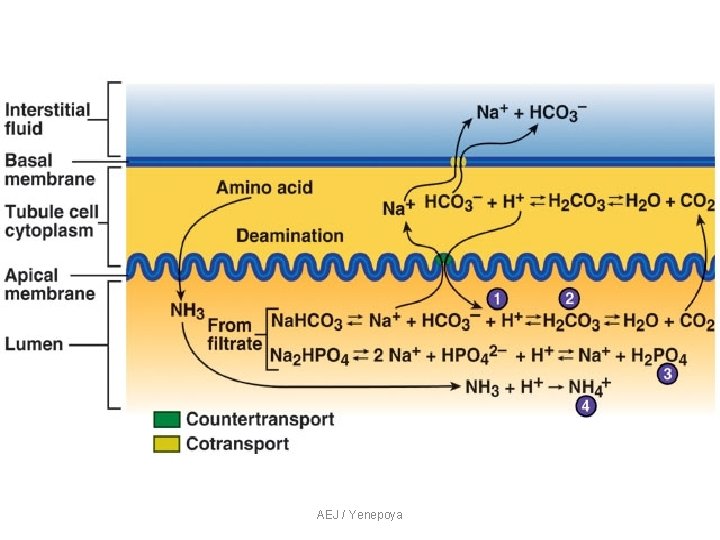
Methods of Acid removal from the body: • Combination of H+ with Ø Blood buffer- Hb, HCO 3Ø Intracellular buffers – Organic and inorganic phosphate. • Reduction of carbonic acid by elimination of CO 2. • Reduction of non-carbonic acid by renal elimination of H+ AEJ / Yenepoya
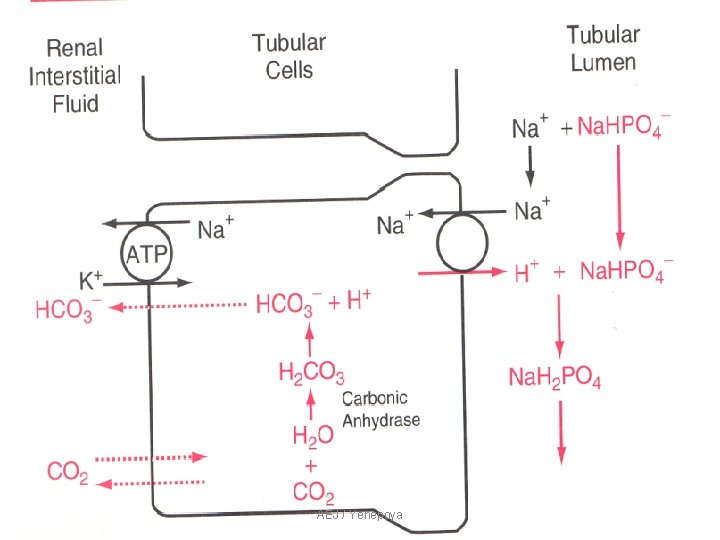
Buffering system: • Bicarbonate system. • Dibasic phosphate system. • Ammonia system. AEJ / Yenepoya
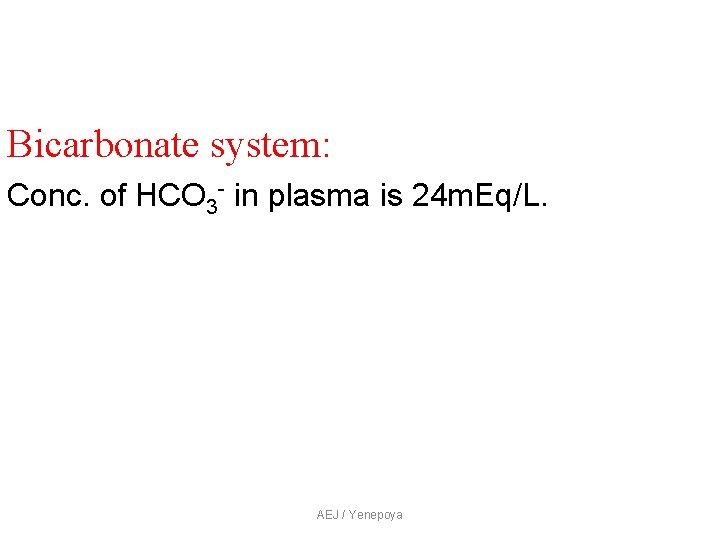
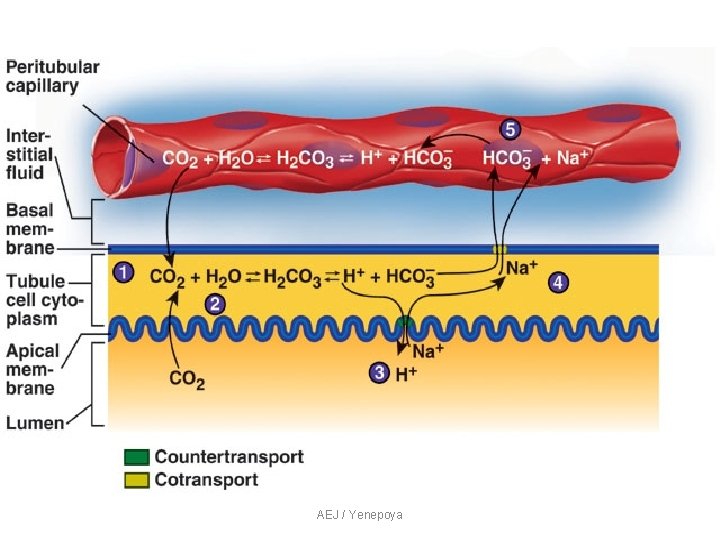
Bicarbonate system: Conc. of HCO 3 - in plasma is 24 m. Eq/L. AEJ / Yenepoya
AEJ / Yenepoya
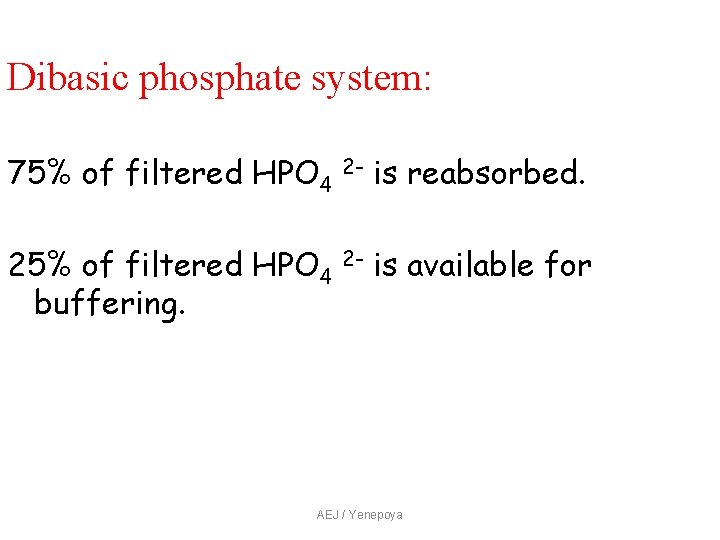
Dibasic phosphate system: 75% of filtered HPO 4 2 - is reabsorbed. 25% of filtered HPO 4 2 - is available for buffering. AEJ / Yenepoya
AEJ / Yenepoya
AEJ / Yenepoya
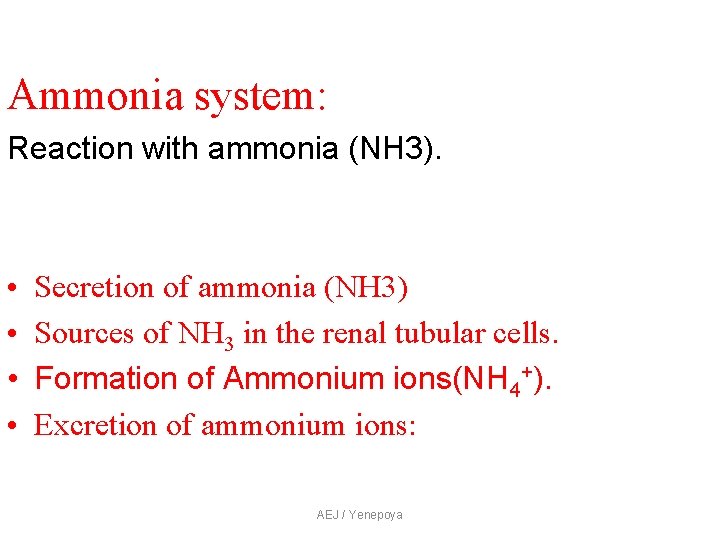
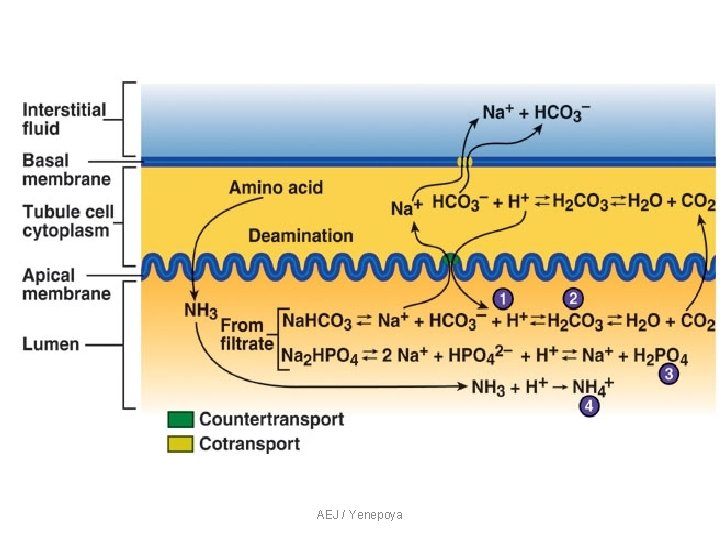
Ammonia system: Reaction with ammonia (NH 3). • • Secretion of ammonia (NH 3) Sources of NH 3 in the renal tubular cells. Formation of Ammonium ions(NH 4+). Excretion of ammonium ions: AEJ / Yenepoya
AEJ / Yenepoya
Regulation of osmolality(Tonicity) of ECF. AEJ / Yenepoya
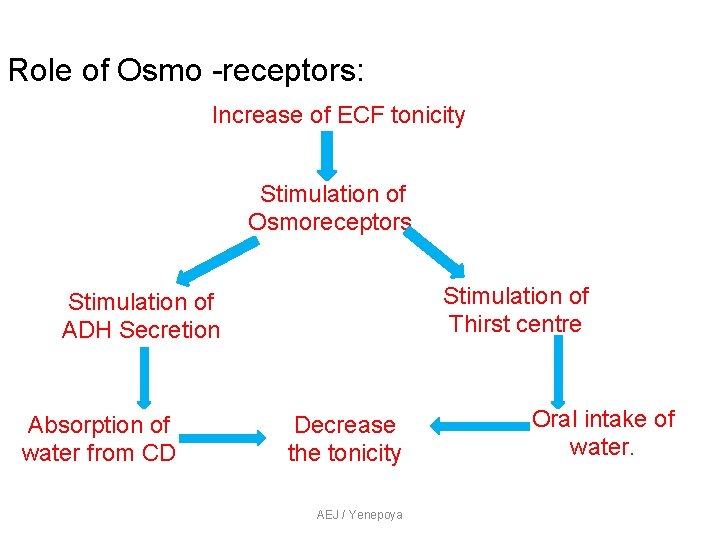
Role of Osmo -receptors: Increase of ECF tonicity Stimulation of Osmoreceptors. Stimulation of Thirst centre Stimulation of ADH Secretion Absorption of water from CD Decrease the tonicity AEJ / Yenepoya Oral intake of water.
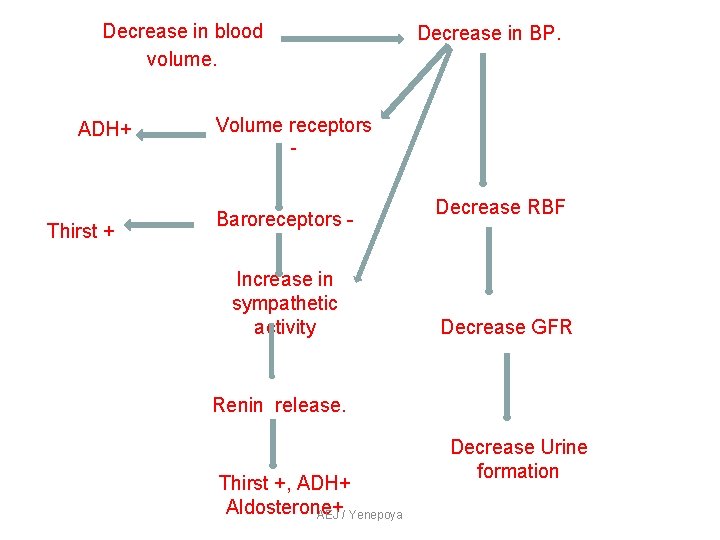
Decrease in blood volume. ADH+ Thirst + Decrease in BP. Volume receptors - Baroreceptors Increase in sympathetic activity Decrease RBF Decrease GFR Renin release. Thirst +, ADH+ Aldosterone+ AEJ / Yenepoya Decrease Urine formation
Urine: AEJ / Yenepoya
Physical Characteristics of Urine. 1. Color and transparency. 2. Odor. 3. p. H. 4. Specific gravity. 5. Composition. 6. Volume: AEJ / Yenepoya
Applied aspects: • Oliguria: • Polyuria: • Anuria: AEJ / Yenepoya
Physiology of Micturition: AEJ / Yenepoya
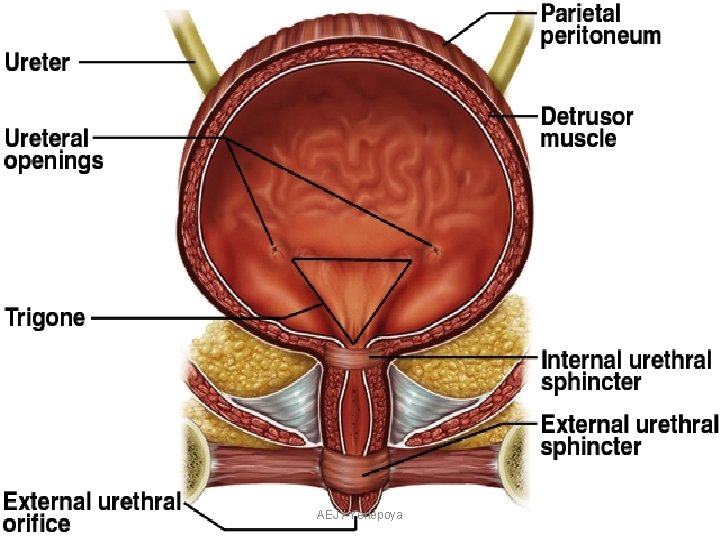
Micturition is the process by which the urinary bladder empties itself when it becomes filled. Physiological capacity: • Adult: 400 -600 ml. • At birth: 20 -50 ml. • At one year: 200 ml. Anatomical capacity: 1 L AEJ / Yenepoya
AEJ / Yenepoya
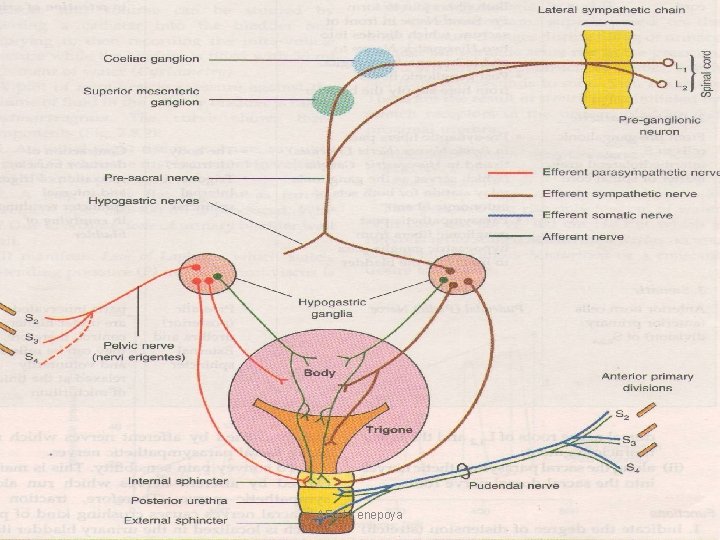
Nerve supply : • Parasympathetic. • Sympathetic • Somatic. AEJ / Yenepoya
AEJ / Yenepoya
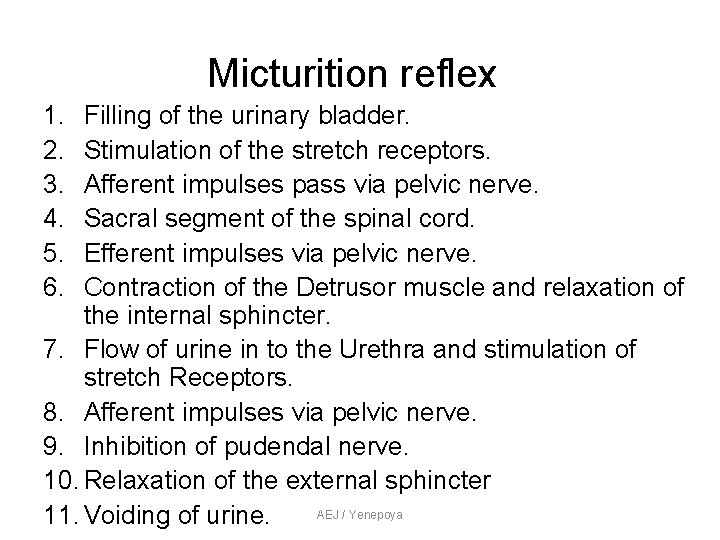
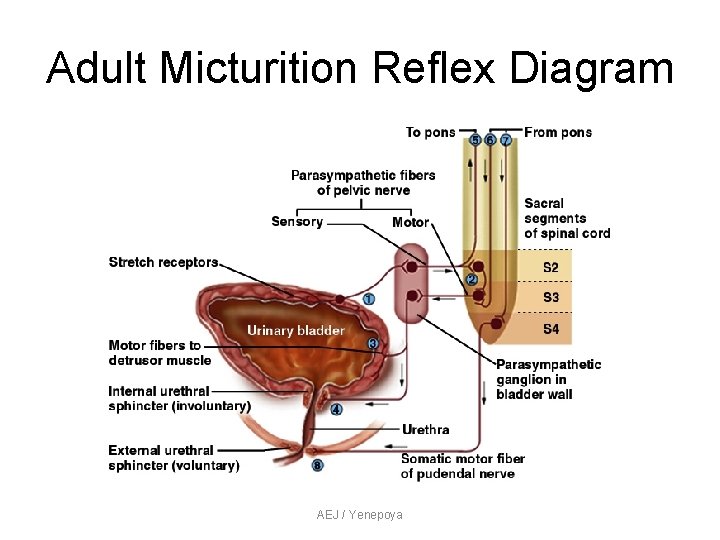
Micturition reflex 1. 2. 3. 4. 5. 6. Filling of the urinary bladder. Stimulation of the stretch receptors. Afferent impulses pass via pelvic nerve. Sacral segment of the spinal cord. Efferent impulses via pelvic nerve. Contraction of the Detrusor muscle and relaxation of the internal sphincter. 7. Flow of urine in to the Urethra and stimulation of stretch Receptors. 8. Afferent impulses via pelvic nerve. 9. Inhibition of pudendal nerve. 10. Relaxation of the external sphincter AEJ / Yenepoya 11. Voiding of urine.
Higher control of Micturition reflex: • Facilitatory area: Located in the pontine region and posterior hypothalamus. • Inhibitory area: Located in the midbrain. AEJ / Yenepoya
Adult Micturition Reflex Diagram AEJ / Yenepoya
• Residual urine: in urinary bladder dysfunction. • Nocturnal enuresis: Normal below 2 and half years. Adult : lesion in the spinal cord. AEJ / Yenepoya
Effect of injury to the parasympathetic afferent nerves. E. g. : Tabes dorsalis(Syphilis). Characteristics: • Patient is unaware of the state of distension of the bladder. • Voluntary Micturition is possible. • If patient fails to micturate at the regular time , it causes the accumulation of urine in the urinary bladder. • Overflow dribbling. The bladder becomes thin , distended and loses tone. Atonic bladder. AEJ / Yenepoya
Damage to sympathetic nerve fibers: • Micturition not affected. • There may be retro emission of the semen in to the bladder. • Ejaculation of semen is not possible. AEJ / Yenepoya
Damage to the pelvic nerve. • Voluntary control is lost. • No complete emptying of the bladder- urinary infection. • Bladder becomes smaller in size. -Autonomous bladder. AEJ / Yenepoya
Damage to spinal cord above the sacral segment: • During spinal shock Micturition reflex is abolished. • Automatic reflex-urine is emptied. ’ • Voluntary control is absent. Out flow block due to Prostate hypertrophy. AEJ / Yenepoya
Cystometrogram: AEJ / Yenepoya
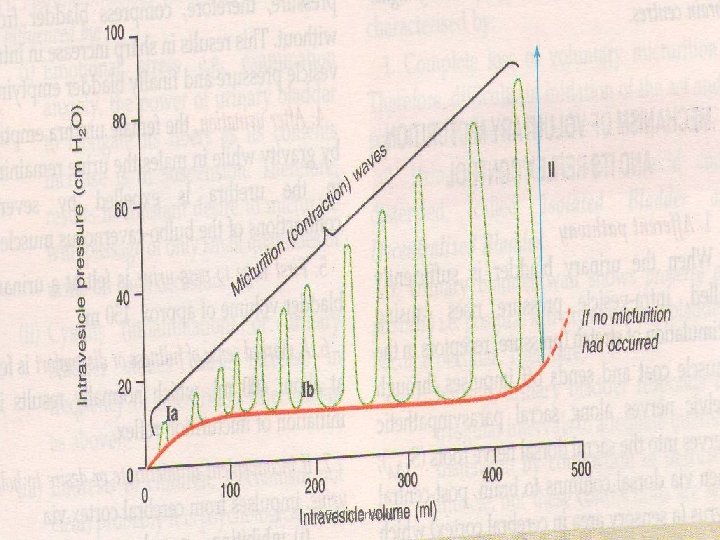
• Cystometry. Relationship b/w intra vesicle pressure and volume • Cystometrogram. AEJ / Yenepoya
AEJ / Yenepoya
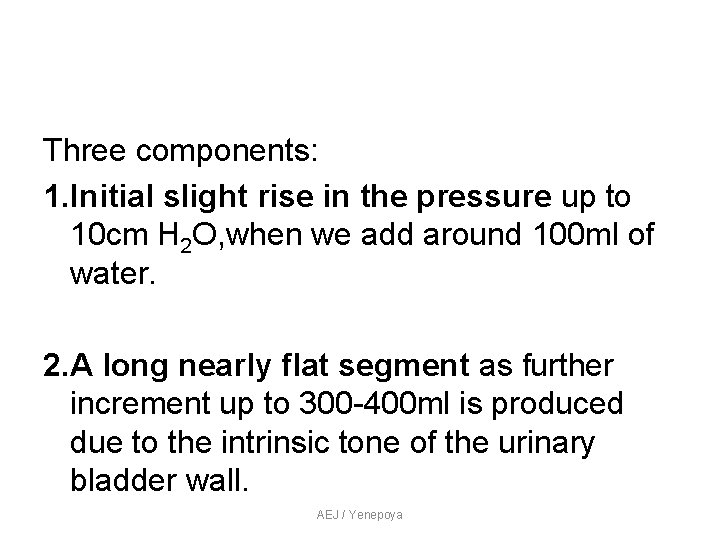
Three components: 1. Initial slight rise in the pressure up to 10 cm H 2 O, when we add around 100 ml of water. 2. A long nearly flat segment as further increment up to 300 -400 ml is produced due to the intrinsic tone of the urinary bladder wall. AEJ / Yenepoya
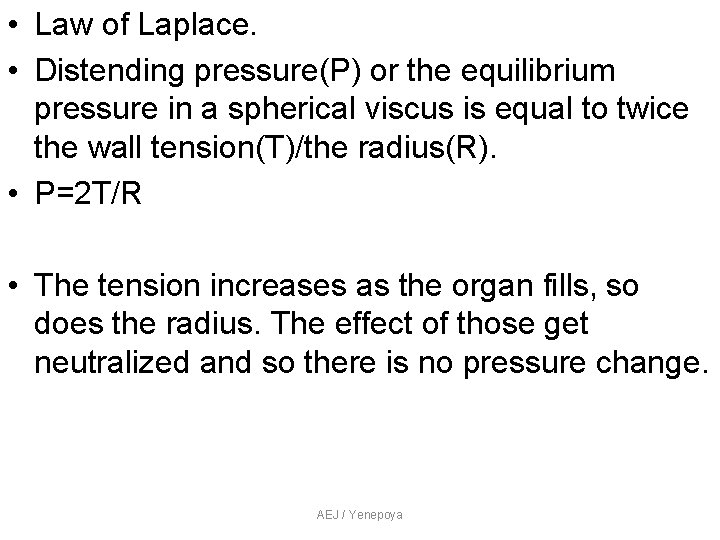
• Law of Laplace. • Distending pressure(P) or the equilibrium pressure in a spherical viscus is equal to twice the wall tension(T)/the radius(R). • P=2 T/R • The tension increases as the organ fills, so does the radius. The effect of those get neutralized and so there is no pressure change. AEJ / Yenepoya
3. Steep rise in the intra vesicular pressure. At 450 ml of urine the bladder reaches its physiological limit. Increase in the tension due to the contraction of the Detrusor but no increase in the radius. AEJ / Yenepoya
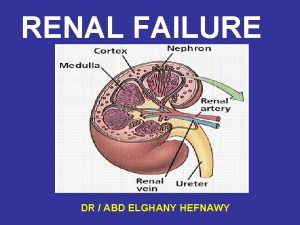
Renal failure: Deficiency in the renal function. 2 types: Ø Acute renal failure. Ø Chronic renal failure. AEJ / Yenepoya
Abnormal substances in the urine: • Blood. • Protein. • Glucose. • Ketones. • WBC. • Urobilinogen and Bilirubin. AEJ / Yenepoya
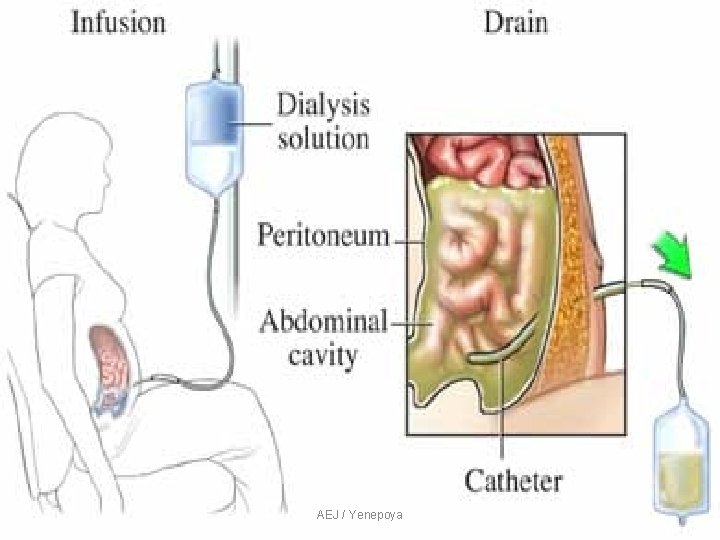
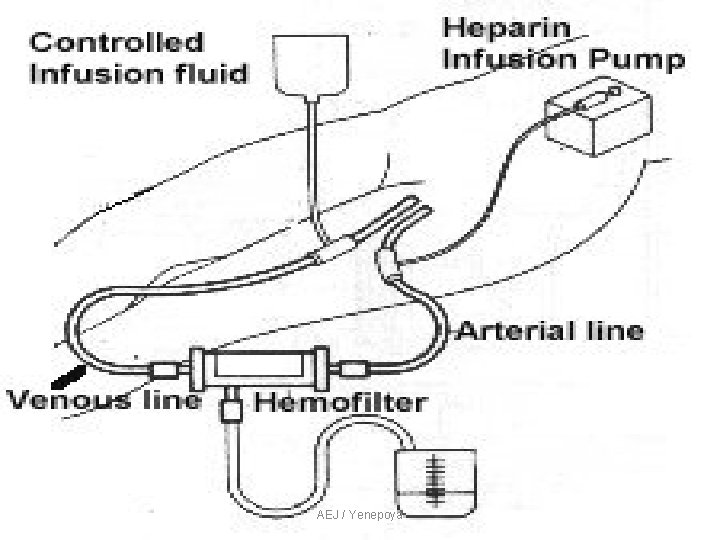
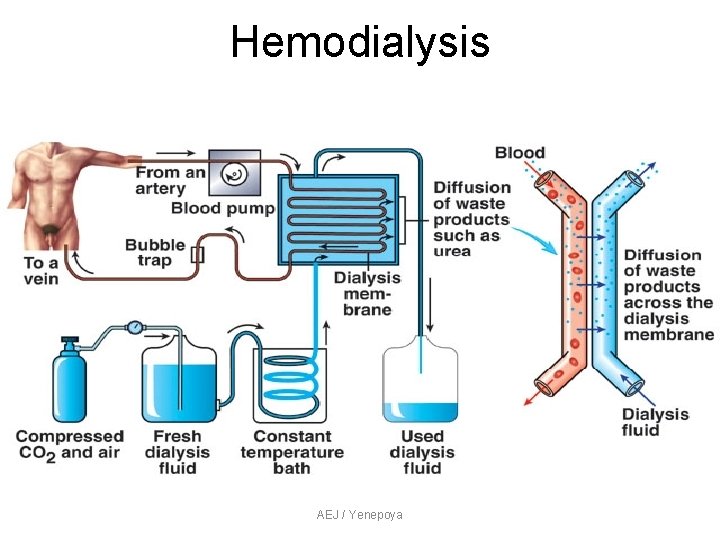
Artificial Kidney • Removes waste products from the blood by the use of an extracorporeal membrane process • Waste products pass from the blood through the membrane into the Dialysate AEJ / Yenepoya
2 types • Peritoneal dialysis • Hemodialysis AEJ / Yenepoya
AEJ / Yenepoya
AEJ / Yenepoya
Hemodialysis AEJ / Yenepoya
Complications: • Septicemia • Embolization. • Complications of heparinization like intracranial hemorrhage, hypotension etc. AEJ / Yenepoya
Renal function tests: • Estimation of blood urea level and Creatinine level. • Examination of urine. Ø Volume of urine. Ø Specific gravity. Ø Protein content and sugar. Ø Microscopic examination. • Clearance test. • Water deprivation test: AEJconcentrating ability of the / Yenepoya kidney.
• Intravenous pyelography: Excretory power of the kidney. Dye injected should be excreted by 70% in 2 hrs. • Ultra sound technique and MRI: Locate renal calculi and any pathological changes. • Biopsy: Histopathological changes in the kidney AEJ / Yenepoya