
Regulating the Internal Environment Water Balance Nitrogenous Waste
Regulating the Internal Environment Water Balance & Nitrogenous Waste Removal AP Biology 2006 -2007
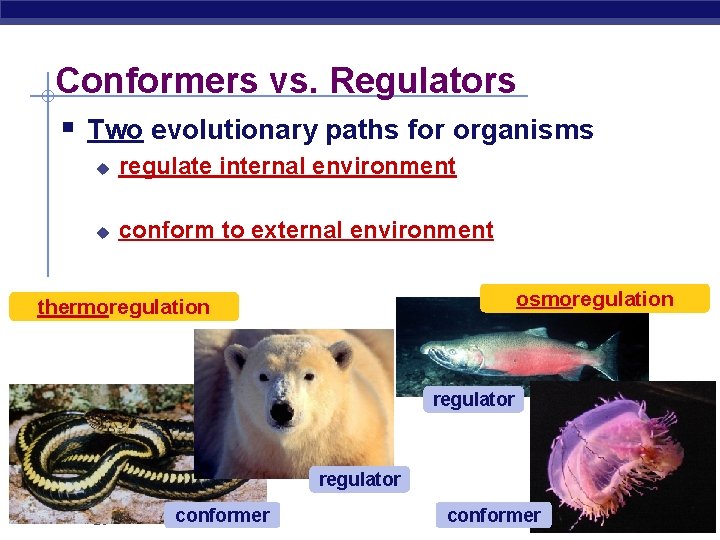
Conformers vs. Regulators § Two evolutionary paths for organisms u regulate internal environment u conform to external environment osmoregulation thermoregulation regulator AP Biology conformer
Osmoregulation § A What are the challenges faced by an osmoregulator living in freshwater? § B What are the challenges faced by an osmoregulator living in the sea? AP Biology
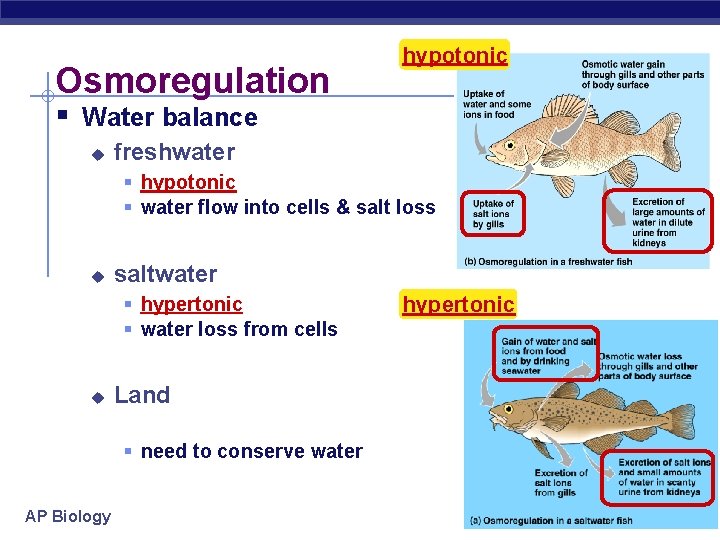
Osmoregulation hypotonic § Water balance u freshwater § hypotonic § water flow into cells & salt loss u saltwater § hypertonic § water loss from cells u Land § need to conserve water AP Biology hypertonic
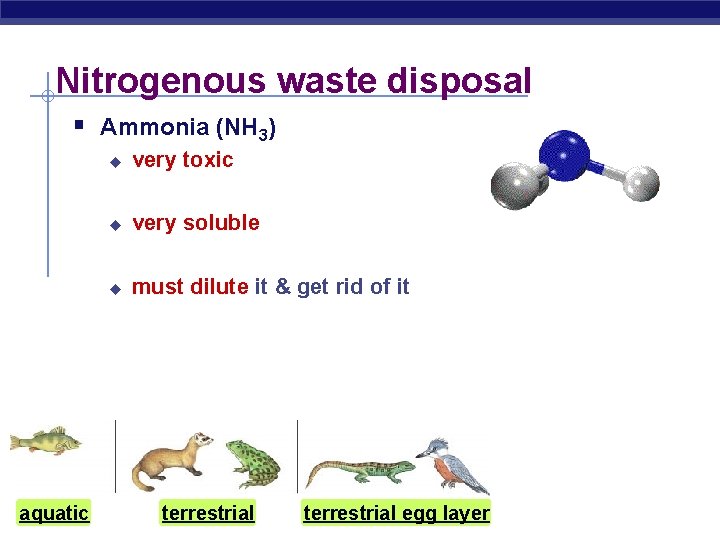
Nitrogenous waste disposal § Ammonia (NH 3) u very toxic u very soluble u must dilute it & get rid of it aquatic AP Biology terrestrial egg layer
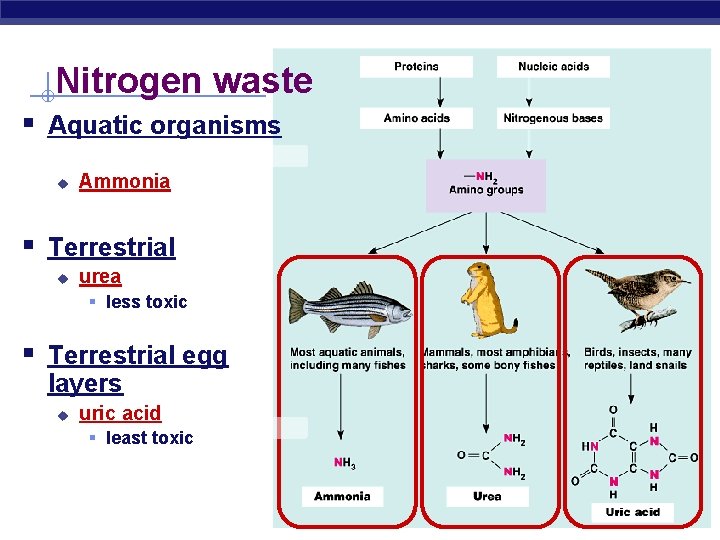
Nitrogen waste § Aquatic organisms u Ammonia § Terrestrial u urea § less toxic § Terrestrial egg layers u uric acid § least toxic AP Biology
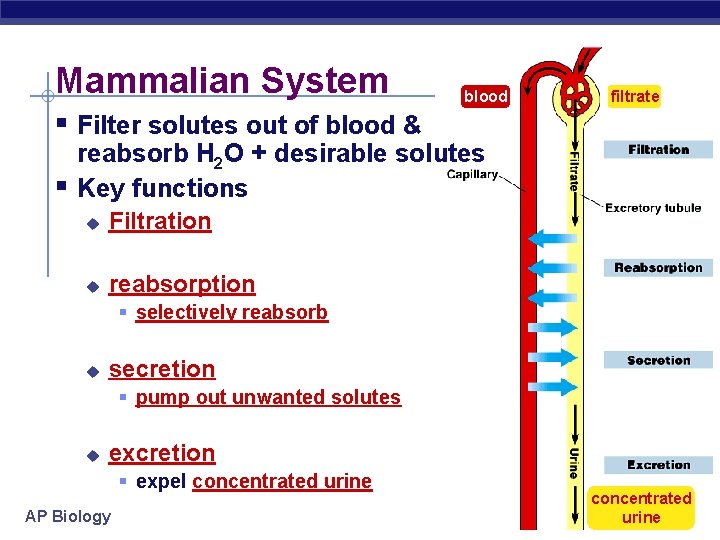
Mammalian System blood filtrate § Filter solutes out of blood & § reabsorb H 2 O + desirable solutes Key functions u Filtration u reabsorption § selectively reabsorb u secretion § pump out unwanted solutes u excretion § expel concentrated urine AP Biology concentrated urine
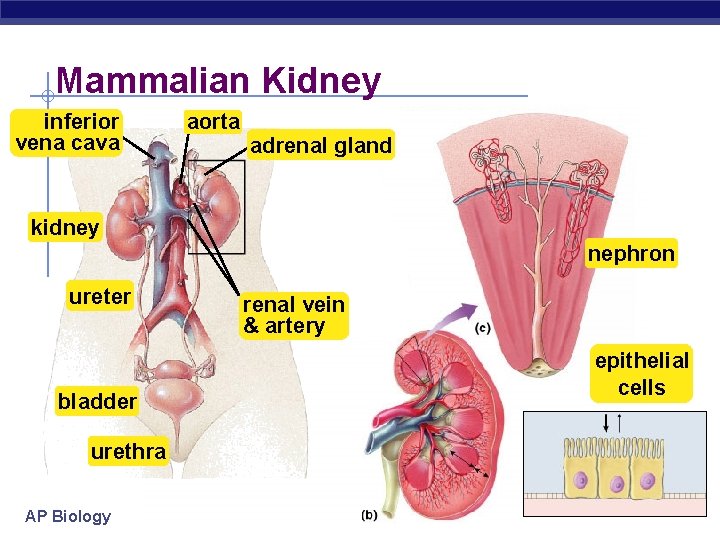
Mammalian Kidney inferior vena cava aorta adrenal gland kidney nephron ureter bladder urethra AP Biology renal vein & artery epithelial cells

Mammalian kidney § Interaction of circulatory § & excretory systems Circulatory system u Glomerulus Bowman’s capsule Proximal tubule Distal tubule Glomerulus § Excretory system u u nephron Bowman’s capsule Proximal tubule loop of Henle § descending limb § ascending limb u AP Biology u Distal tubule collecting duct Glucose Amino acids H 2 O Mg++ Ca++ H 2 O Na+ Cl. H 2 O Loop of Henle Collecting duct
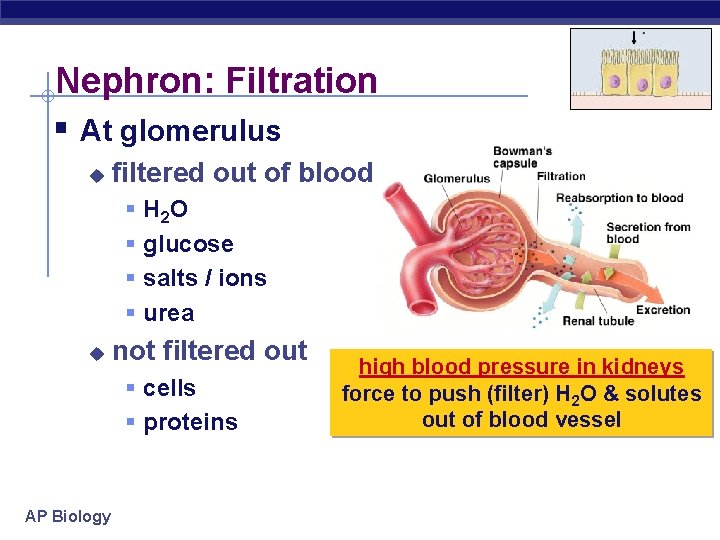
Nephron: Filtration § At glomerulus u filtered out of blood § § u H 2 O glucose salts / ions urea not filtered out § cells § proteins AP Biology high blood pressure in kidneys force to push (filter) H 2 O & solutes out of blood vessel
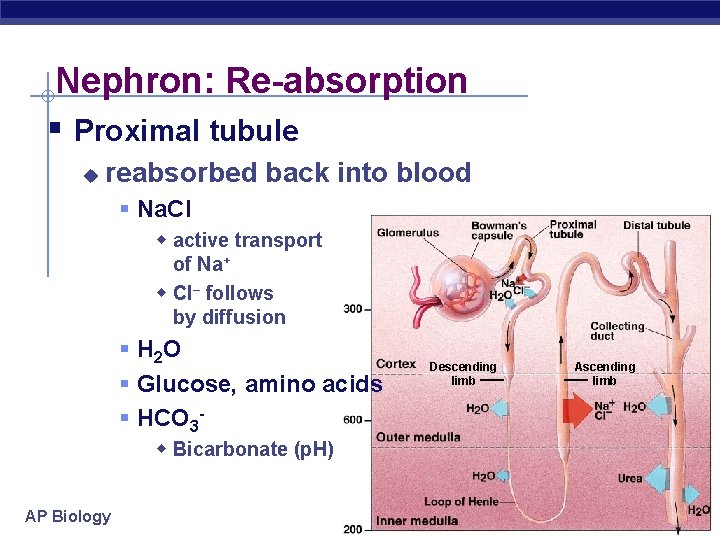
Nephron: Re-absorption § Proximal tubule u reabsorbed back into blood § Na. Cl w active transport of Na+ w Cl– follows by diffusion § H 2 O § Glucose, amino acids § HCO 3 w Bicarbonate (p. H) AP Biology Descending limb Ascending limb
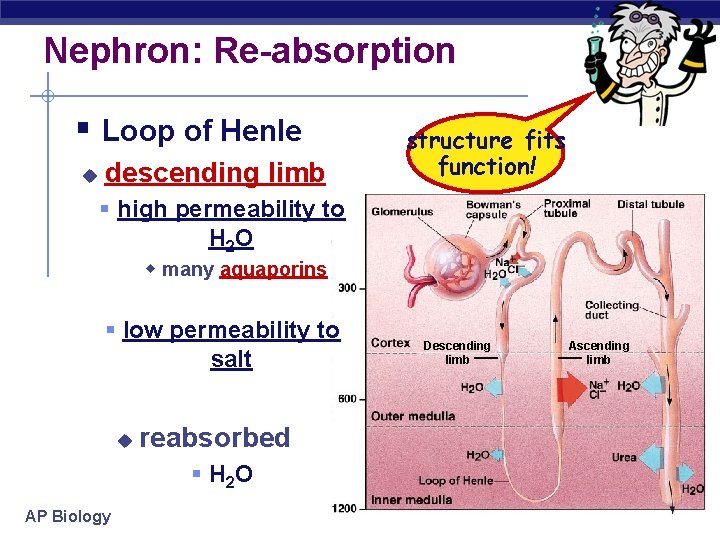
Nephron: Re-absorption § Loop of Henle u descending limb structure fits function! § high permeability to H 2 O w many aquaporins § low permeability to salt u reabsorbed § H 2 O AP Biology Descending limb Ascending limb
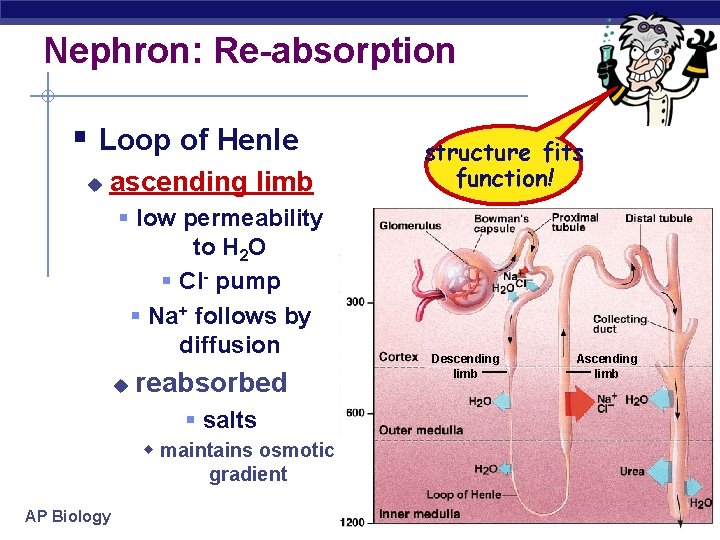
Nephron: Re-absorption § Loop of Henle u ascending limb § low permeability to H 2 O § Cl- pump § Na+ follows by diffusion u reabsorbed § salts w maintains osmotic gradient AP Biology structure fits function! Descending limb Ascending limb
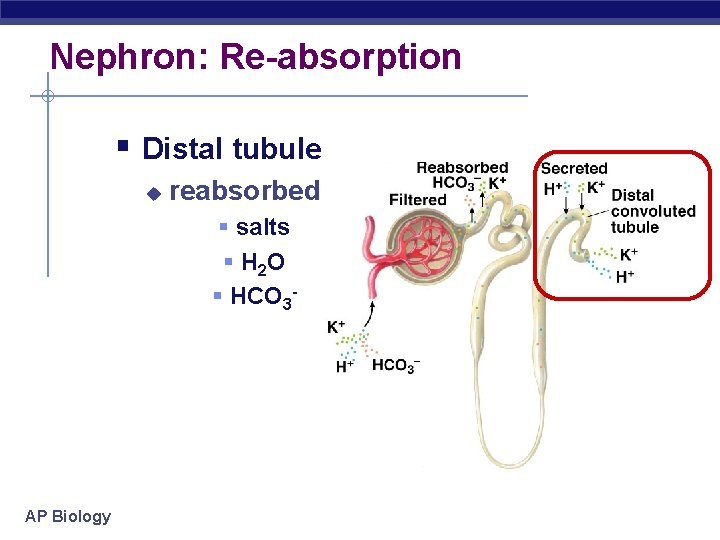
Nephron: Re-absorption § Distal tubule u reabsorbed § salts § H 2 O § HCO 3 - AP Biology
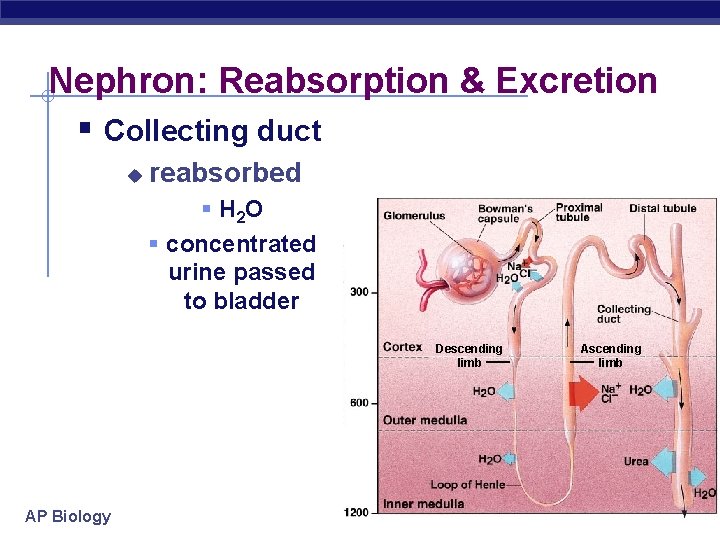
Nephron: Reabsorption & Excretion § Collecting duct u reabsorbed § H 2 O § concentrated urine passed to bladder Descending limb AP Biology Ascending limb
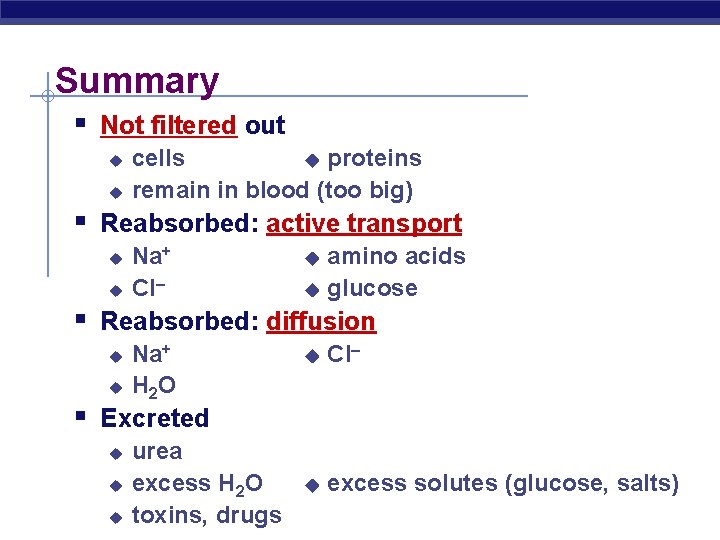
Summary § Not filtered out u u cells u proteins remain in blood (too big) § Reabsorbed: active transport u u Na+ Cl– amino acids u glucose u § Reabsorbed: diffusion u u Na+ H 2 O u Cl– u excess solutes (glucose, salts) § Excreted u u AP Biologyu urea excess H 2 O toxins, drugs
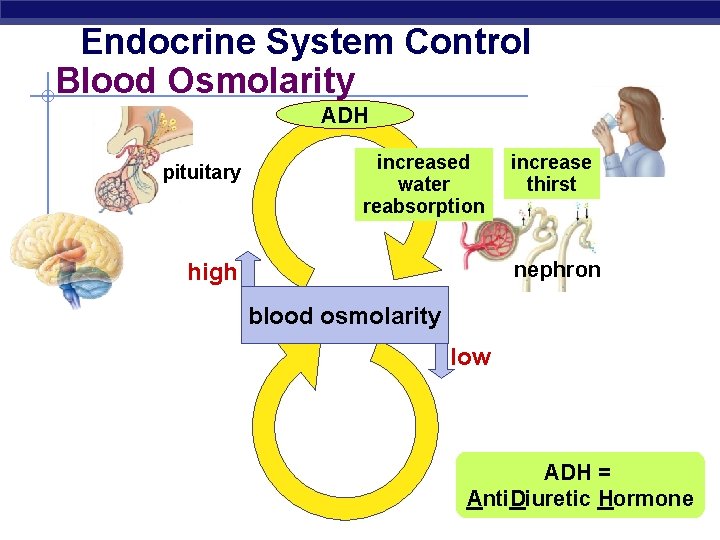
Endocrine System Control Blood Osmolarity ADH pituitary increased water reabsorption increase thirst nephron high blood osmolarity low AP Biology ADH = Anti. Diuretic Hormone
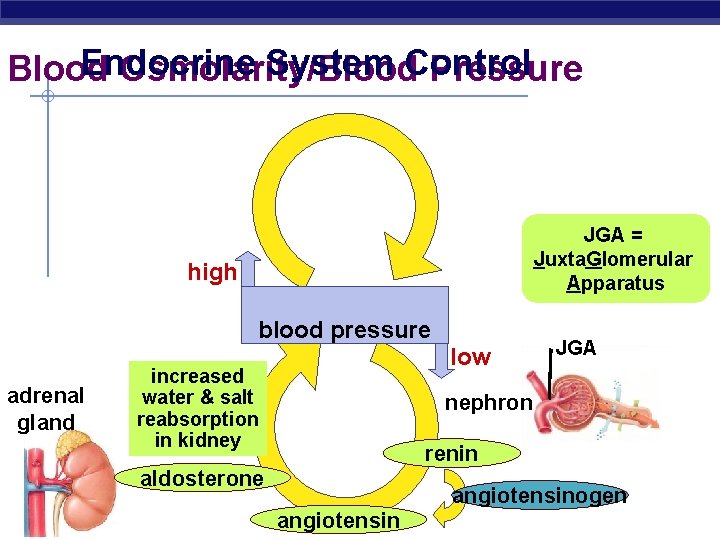
Endocrine System Control Blood Osmolarity/Blood Pressure JGA = Juxta. Glomerular Apparatus high blood pressure adrenal gland increased water & salt reabsorption in kidney JGA nephron renin aldosterone AP Biology low angiotensinogen
Don’t get batty… Ask Questions!! AP Biology
- Slides: 19