
Kidneys Kidneys the excretory organs of vertebrates function
Kidneys § Kidneys, the excretory organs of vertebrates, function in both excretion and osmoregulation § The numerous tubules of kidneys are highly organized § The vertebrate excretory system also includes ducts and other structures that carry urine from the tubules out of the kidney and out of the body © 2014 Pearson Education, Inc.
Urethra © 2014 Pearson Education, Inc.
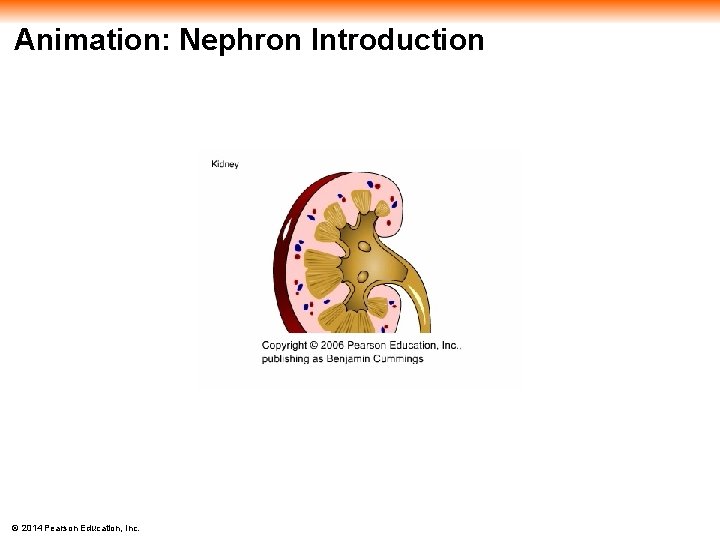
Animation: Nephron Introduction © 2014 Pearson Education, Inc.
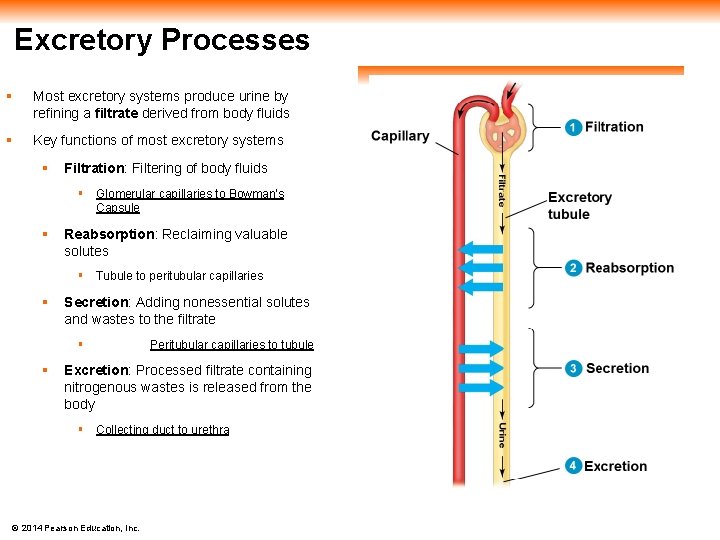
Excretory Processes § Most excretory systems produce urine by refining a filtrate derived from body fluids § Key functions of most excretory systems § Filtration: Filtering of body fluids § Glomerular capillaries to Bowman’s Capsule § Reabsorption: Reclaiming valuable solutes § Tubule to peritubular capillaries § Secretion: Adding nonessential solutes and wastes to the filtrate § § Peritubular capillaries to tubule Excretion: Processed filtrate containing nitrogenous wastes is released from the body § Collecting duct to urethra © 2014 Pearson Education, Inc.
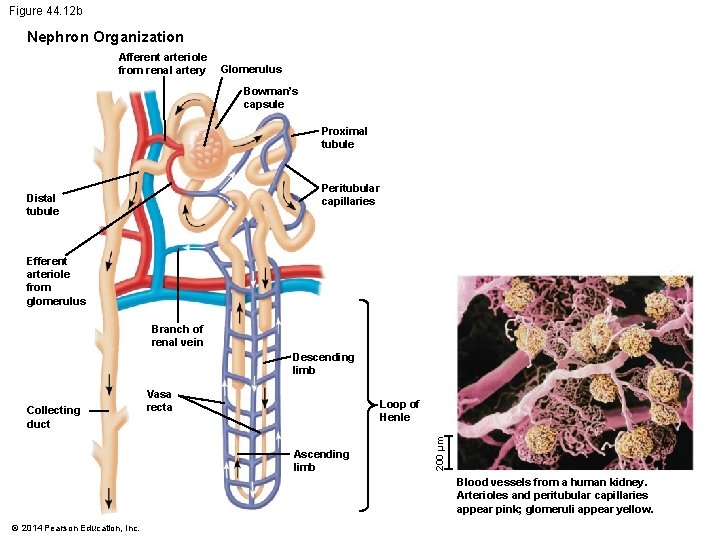
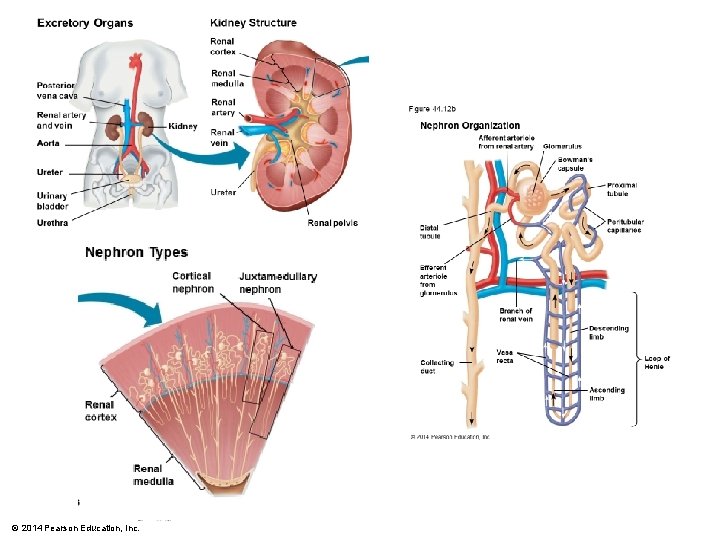
Figure 44. 12 b Nephron Organization Afferent arteriole from renal artery Glomerulus Bowman’s capsule Proximal tubule Peritubular capillaries Distal tubule Efferent arteriole from glomerulus Branch of renal vein Descending limb Loop of Henle Ascending limb 200 µm Collecting duct Vasa recta Blood vessels from a human kidney. Arterioles and peritubular capillaries appear pink; glomeruli appear yellow. © 2014 Pearson Education, Inc.

© 2014 Pearson Education, Inc.
Marine Bony Fishes § Marine bony fishes are hypoosmotic compared with their environment § Their kidneys have small glomeruli and some lack glomeruli entirely § Filtration rates are low, and very little urine is excreted © 2014 Pearson Education, Inc.
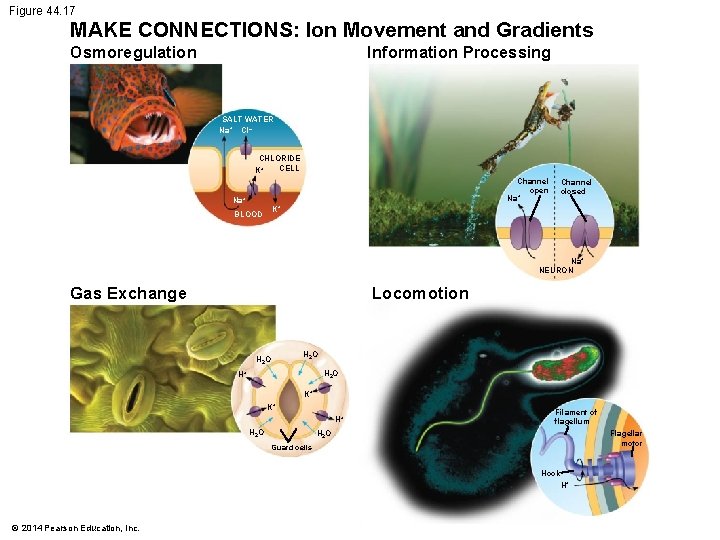
Figure 44. 17 MAKE CONNECTIONS: Ion Movement and Gradients Osmoregulation Information Processing SALT WATER Na+ Cl CHLORIDE CELL K+ Channel open Na+ Channel closed K+ BLOOD Na+ NEURON Locomotion Gas Exchange H 2 O H+ K+ K+ H+ H 2 O Filament of flagellum H 2 O Flagellar motor Guard cells Hook H+ © 2014 Pearson Education, Inc.
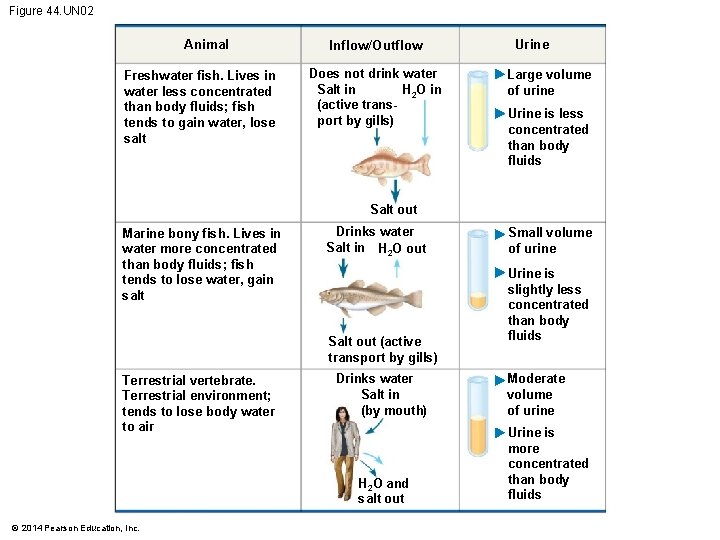
Figure 44. UN 02 Animal Freshwater fish. Lives in water less concentrated than body fluids; fish tends to gain water, lose salt Inflow/Outflow Does not drink water Salt in H 2 O in (active transport by gills) Urine Large volume of urine Urine is less concentrated than body fluids Salt out Marine bony fish. Lives in water more concentrated than body fluids; fish tends to lose water, gain salt Drinks water Salt in H 2 O out Salt out (active transport by gills) Terrestrial vertebrate. Terrestrial environment; tends to lose body water to air Drinks water Salt in (by mouth) H 2 O and salt out © 2014 Pearson Education, Inc. Small volume of urine Urine is slightly less concentrated than body fluids Moderate volume of urine Urine is more concentrated than body fluids
- Slides: 9