International Module W 502 Thermal Environment Day 1




- Slides: 175
International Module W 502 Thermal Environment Day 1
Emergency Procedures • (Insert appropriate procedures) W 502 – Thermal Environment 2.
• (Lecturers Introductions) W 502 – Thermal Environment 3.
Group Introductions In 30 seconds • Tell us who you are: • Where you work: • What your role is: W 502 – Thermal Environment 4.
Course Aims To provide participants with a sound understanding of the effects of thermal environment on people and the means of assessing and controlling the risks associated with thermal stress W 502 – Thermal Environment 5.
Course Learning Outcomes • Participants will be able to: – Identify sources of thermal stress within the working environment – Understand the nature of thermal strain on the body – Make assessments of thermal environment through appropriate measurement and other means W 502 – Thermal Environment 6.
Course Learning Outcomes (Cont) • Participants will be able to: – Evaluate the likely risk from exposure to thermal stress – Suggest appropriate control approaches for thermal environment W 502 – Thermal Environment 7.
Topics to be Discussed • • Thermal Spectrum Principles Effects of temperature extremes Thermal comfort Evaluation of hot & cold environments Thermal surveys Control of hot & cold environments Approaches to Risk Assessment W 502 – Thermal Environment 8.
Today’s Learning Outcomes • Thermal Spectrum – To understand the range of thermal environments that humans work within • Principles – Understand the basic physiological responses of the body to hot & cold environments – Understand the processes for heat production & exchange W 502 – Thermal Environment 9.
Today’s Learning Outcomes (cont) • Effects of Temperature Extremes – Understand the effects of hot & cold environments • Thermal Surveys – Understand the principles of measuring major environmental factors – Review different monitoring strategies – Understand some approaches to establishing the degree of risk resulting from a thermal survey W 502 – Thermal Environment 10.
Work Groups • Each participant will be assigned a work group for the duration of the course • The work groups are expected to work as a team when evaluating in cases studies and practical sessions W 502 – Thermal Environment 11.
Thermal Spectrum Source: University of Wollongong W 502 – Thermal Environment 12.
Thermal Spectrum • Energy from the sun is fundamental to life in all its forms – Humans, plants, animals & organisms • Evolution has decided that humans are warmblooded and their biochemistry functions within a narrow operating temperature range W 502 – Thermal Environment 13.
Thermal Spectrum (cont) • Humans can be considered as homeotherms and attempt to maintain the body temperature near 37 o. C • A deviation of a few degrees can have serious consequences W 502 – Thermal Environment 14.
Thermal Spectrum (cont) • In order to maintain the core body temperature within acceptable limits there is a need to understand control those factors which may influence this process • As there is significant variability within humans the application of any measurement index or control approach may not be appropriate to all W 502 – Thermal Environment 15.
Work in Extreme Temperatures • Humans work in extremes of heat or cold on a daily basis – Oil production in Alaska & Middle East – Mining in the Arctic regions of Canada & the high temperatures of Central Africa & Australia W 502 – Thermal Environment 16.
Work in Extreme Temperatures (cont) • Other examples of work in extreme conditions – Refrigerated areas like cool rooms & freezers – High radiant energy areas e. g. foundries, steel plants, glass plants, coke ovens, brick plants & smelters – Outdoor areas where there is exposure to the sun or wind chill – Military activities W 502 – Thermal Environment 17.
Work in Moderate Temperatures • Work in areas of extreme temperatures is associated with increased awareness with the local conditions & control methods • This is not apparent in more temperate climates • Hotter than normal conditions can affect whole production facilities through heat induced illness W 502 – Thermal Environment 18.
Work in Moderate Temperatures (cont) • Reasons for these events include: – Thermoregulation of the body is normally within very narrow range & time is needed to adjust to an increase in that range – Workforce may have more at risk persons e. g. obese, elderly, unfit – Workplace not designed for significant variation in temperatures W 502 – Thermal Environment 19.
Work in Moderate Temperatures (cont) • Activities in moderate temperatures where thermal stress may be an issue – Rubber vulcanising plants – Bakeries – Commercial kitchens – Laundries – Food canneries – Boiler rooms – Fire fighting activities W 502 – Thermal Environment 20.
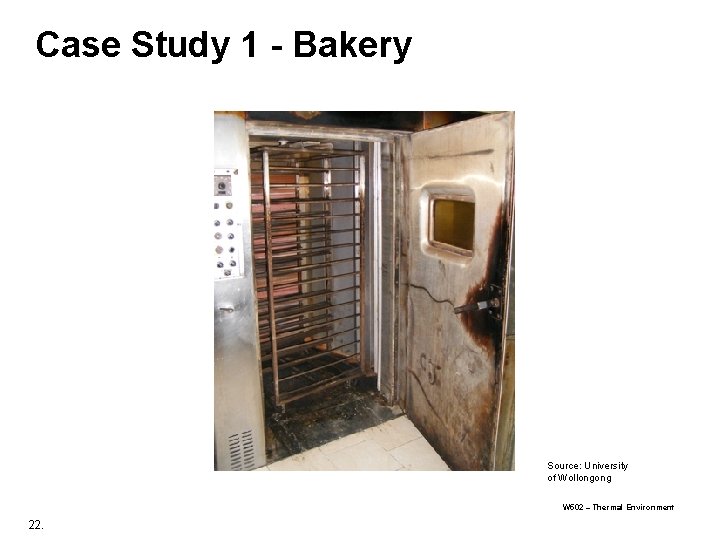
Case Study 1 - Bakery • Break up into groups and review the case study (located in appendix 2) • 20 minutes has been allocated for this review • A group discussion will be conducted after the exercise W 502 – Thermal Environment 21.
Case Study 1 - Bakery Source: University of Wollongong W 502 – Thermal Environment 22.
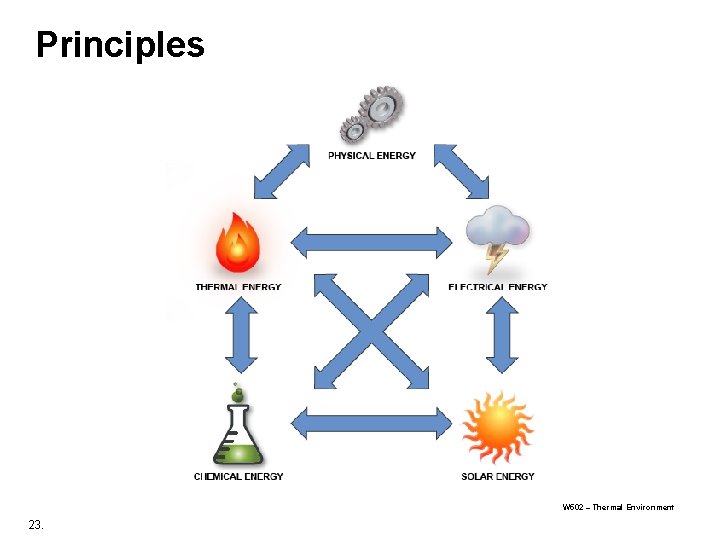
Principles W 502 – Thermal Environment 23.
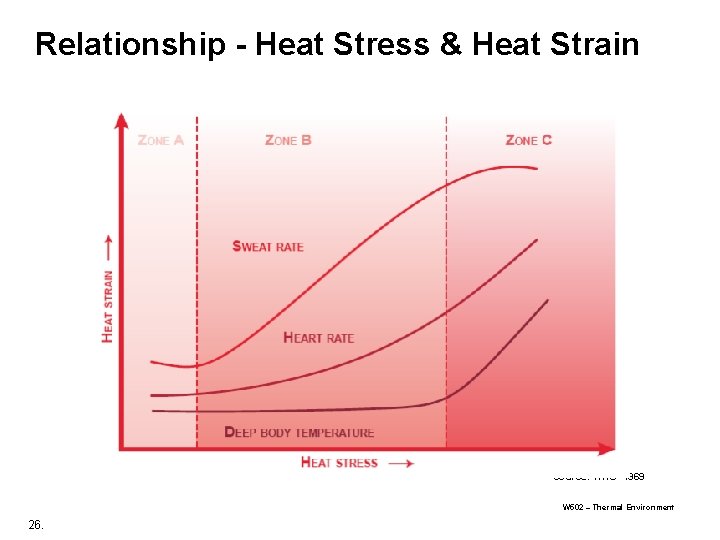
Principles • Heat Stress Net heat load from the combined contributions of work (metabolic load), environmental factors (air temperature, movement, humidity, radiant load) & clothing requirements W 502 – Thermal Environment 24.
Principles (cont) • Heat Strain The overall physiological response resulting from heat stress W 502 – Thermal Environment 25.
Relationship - Heat Stress & Heat Strain Source: WHO 1969 W 502 – Thermal Environment 26.
Homeostasis • Process by which the body keeps its internal environment (e. g. temperature, blood pressure, p. H, blood gases) stable by modulating physical functions & behavior W 502 – Thermal Environment 27.
Homeostasis (cont) • Dynamic equilibrium in which continuous changes are occurring • Process is controlled by a part of the brain called the hypothalamus which adjusts – Breathing & metabolic rates – Blood vessel dilation – Blood sugar levels in response to changes caused by factors such as ambient temperature, hormones & disease W 502 – Thermal Environment 28.
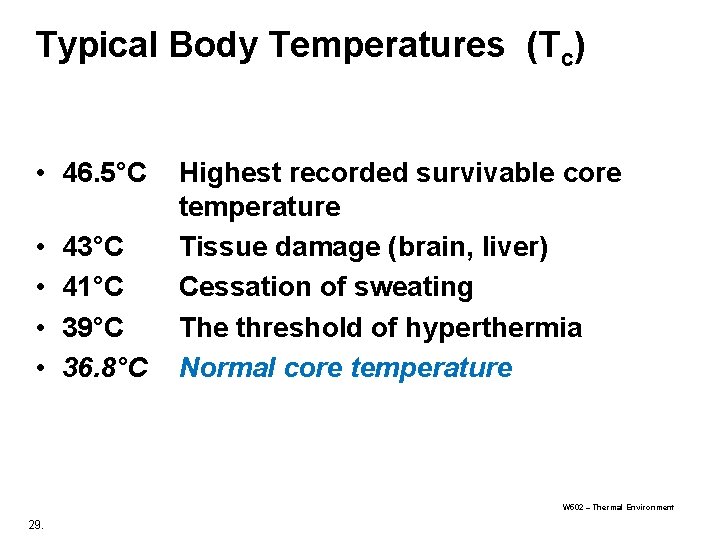
Typical Body Temperatures (Tc) • 46. 5°C • • 43°C 41°C 39°C 36. 8°C Highest recorded survivable core temperature Tissue damage (brain, liver) Cessation of sweating The threshold of hyperthermia Normal core temperature W 502 – Thermal Environment 29.
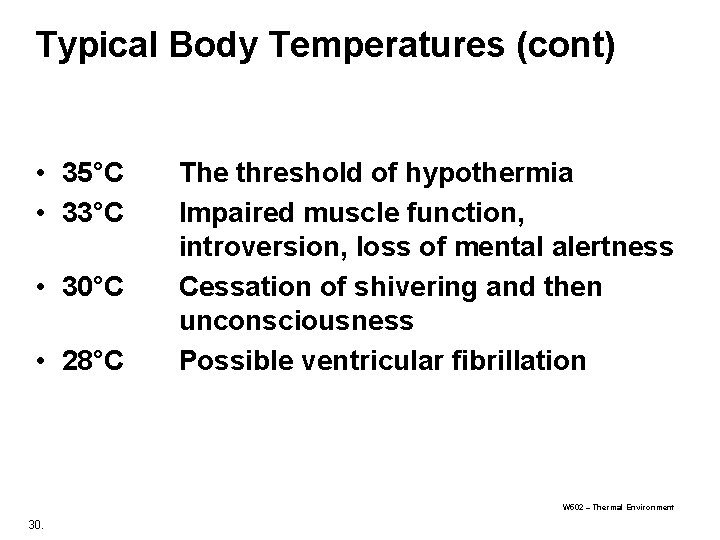
Typical Body Temperatures (cont) • 35°C • 33°C • 30°C • 28°C The threshold of hypothermia Impaired muscle function, introversion, loss of mental alertness Cessation of shivering and then unconsciousness Possible ventricular fibrillation W 502 – Thermal Environment 30.
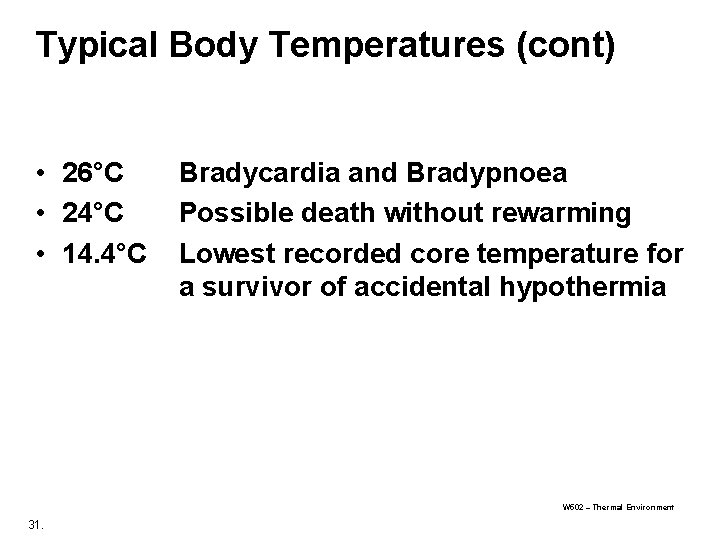
Typical Body Temperatures (cont) • 26°C • 24°C • 14. 4°C Bradycardia and Bradypnoea Possible death without rewarming Lowest recorded core temperature for a survivor of accidental hypothermia W 502 – Thermal Environment 31.
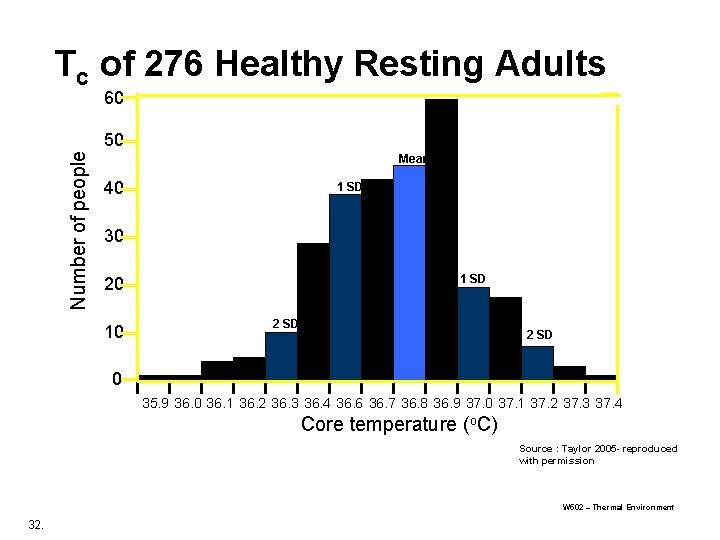
Tc of 276 Healthy Resting Adults 60 Number of people 50 Mean 40 1 SD 30 1 SD 20 10 2 SD 0 35. 9 36. 0 36. 1 36. 2 36. 3 36. 4 36. 6 36. 7 36. 8 36. 9 37. 0 37. 1 37. 2 37. 3 37. 4 Core temperature (o. C) Source : Taylor 2005 - reproduced with permission W 502 – Thermal Environment 32.
Variation of Tc in Humans • Variation occurs not only between humans but within humans – Tc may be 0. 5 -1. 0 o. C higher in evening due to inherent circadian temperature rhythm – Ovulation in women causes Tc to rise by 0. 10. 4 o. C W 502 – Thermal Environment 33.
Skin Temperature • Temperature gradient from skin surface to the superficial layers of muscle • Varies according to the external temperature , region of body surface & rate of heat conductance from core to shell • Determines rate & direction of heat flow in body W 502 – Thermal Environment 34.
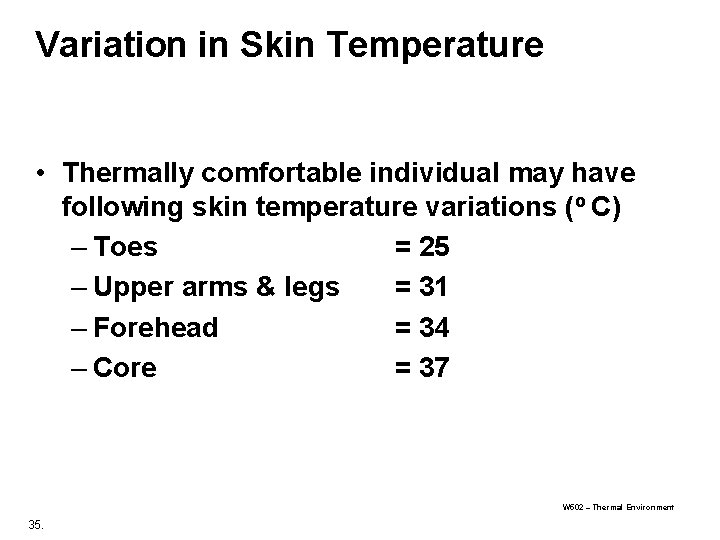
Variation in Skin Temperature • Thermally comfortable individual may have following skin temperature variations (o C) – Toes = 25 – Upper arms & legs = 31 – Forehead = 34 – Core = 37 W 502 – Thermal Environment 35.
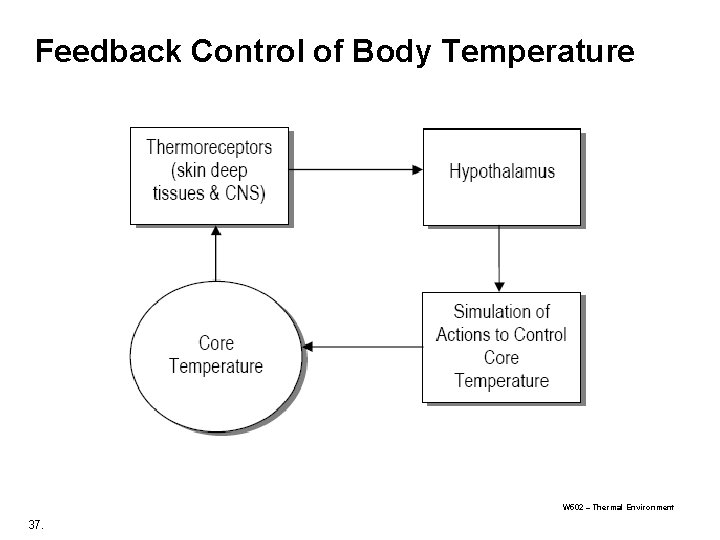
Human Thermal Regulation • Behavioral change – Clothing – Changing posture – Movement – Shelter – Personal protective equipment • Physiological systems – Hypothalamus W 502 – Thermal Environment 36.
Feedback Control of Body Temperature W 502 – Thermal Environment 37.
Physiological Responses to Hot Environments • • Vasodilatation (vasodilation) Sweating Electrolyte changes Dehydration Heart rate Respiration rate Other effects W 502 – Thermal Environment 38.
Vasodilatation (Vasodilation) Venous blood returns to the heart near the skin hence increasing the availability of heat loss from the skin to the environment W 502 – Thermal Environment 39.
Sweating • As body temperature increases, sweat is secreted over the body to allow cooling via evaporation • Eccrine sweat glands perform thermoregulatory function and there are 2 -4 million such glands distributed over the entire body surface • Major method of maintaining Tc in hot conditions W 502 – Thermal Environment 40.
Electrolyte Changes • Sweating can significantly reduce electrolytes • Many organs depend on ionic gradients across cell membranes to support electrical activity • Failure to maintain electrolyte levels often results in muscle cramps & gastrointestinal disturbances W 502 – Thermal Environment 41.
Dehydration • Sweating is a natural process to control Tc but it sacrifices body fluid to cool the skin temperature • For people working in hot environments the maximum daily sweat rate can approach 10 -15 litres/day W 502 – Thermal Environment 42.
Dehydration (cont) • Consequences of dehydration – Reduced blood volume – Impaired cardiovascular stability – Reduced physical & cognitive performance – Reduced muscle & general endurance – Elevated thermal strain – Reduced heat tolerance – Reduction in benefits of heat adaption – Increased risk of heat illness W 502 – Thermal Environment 43.
Heart Rate • Heart rate increases with – work rate in order to allow an increase in blood flow to working muscles – vasodilatation in order to allow an increase blood flow to skin for heat loss • In hot environments, competition between muscle and skin for blood can cause exhaustion W 502 – Thermal Environment 44.
Respiration Rate • Heat can be lost to the environment via evaporation of moisture in the respiratory tract W 502 – Thermal Environment 45.
Other Physiological Effects • Prickly heat – skin rash from continued exposure to humid heat and the skin remaining wet due to unevaporated sweat • Fatigue – Heat stress can contribute to increased levels of fatigue and vice versa W 502 – Thermal Environment 46.
Physiological Responses to Cold Environments • • • Vasoconstriction Shivering Piloerection Cold diuresis Respiration Heart rate Dehydration Psychological Other effects W 502 – Thermal Environment 47.
Vasoconstriction • Reaction of the body to reduce heat loss • Constriction of the superficial veins in the limbs so that blood from the skin returns along the venal comitans close to the artery thus gaining heat to return to the body core W 502 – Thermal Environment 48.
Shivering • Designed to increase the metabolic heat production within the body as an offset to a Tc decrease • In very cold environments (or cold water immersion) shivering can reduce fall in Tc but can also increase heat loss to the environment W 502 – Thermal Environment 49.
Piloerection • Occurs when skin becomes cold • Hairs stand on end so as to maintain a layer of still air between body & environment to reduce heat loss W 502 – Thermal Environment 50.
Cold Diuresis • Constriction of all skin blood vessels forces large amount of blood to body core • Causes rapid increase in blood pressure & to compensate kidneys quickly removes fluid from blood stream to stabilise BP • Resultant effect is need to urinate W 502 – Thermal Environment 51.
Respiration • Heat loss is via respiratory tract. Depends on: – Temperature & humidity of atmosphere – Respiratory ventilation rate • Cold may induce broncospasm and in some people may lead to exercise-induced asthma W 502 – Thermal Environment 52.
Heart Rate • Hypothermia can lead to an increased level of cardiovascular strain • Vasoconstriction leads to increased BP which can lead to increased levels of angina attacks, coronary & cerebral thrombosis • Persons with abnormal heart function at greater risk of heart attack in cold conditions W 502 – Thermal Environment 53.
Dehydration • Loss of heat occurs via moisture loss in the respiratory tract • Cold diuresis also results in loss of excessive fluids W 502 – Thermal Environment 54.
Other Physiological Effects • Local cold injury (freezing or non-freezing) – Frostbite – Trenchfoot • Cold allergy – Occurs on removal from cold with widespread vasodilatation over the body, headache & hypertension • Paralysis of facial nerve – Results from cold airstream on side of face (rare) W 502 – Thermal Environment 55.
Psychological Responses • Personal behavior can be influenced by thermal stress • Underlying mechanisms between thermal environments and psychological responses are not understood W 502 – Thermal Environment 56.
Basic Thermodynamics • 1 st law of thermodynamics • Simply stated: Energy cannot be created or destroyed. It can only be transformed from one state to another W 502 – Thermal Environment 57.
Basic Thermodynamics (cont) • 2 nd law of thermodynamics • Simply stated: Energy spontaneously tends to flow from being concentrated in one place to becoming diffused or dispersed Example: Hot object cooling by loss of energy (heat) to its surroundings W 502 – Thermal Environment 58.
External Heat Sources • Sun – Fundamental source of heat for all life – Temperature 5500 oc – Heat to top of earths atmosphere at rate of 1370 Wm-2 – Heat to earths surface at rate of 800 -1000 Wm-2 – Energy transposed from one form to another in accordance with laws of thermodynamics – Air temperature & radiant temperature are the two major sources of heat which can impose thermal loads on humans W 502 – Thermal Environment 59.
Internal Heat Sources • Humans are homoeothermic (warm-blooded) and generate heat derived from food & oxygen • Humans are inefficient mechanisms and approximately 80% of energy is lost as heat and must be removed • Heat energy released is distributed around the body mainly by the blood W 502 – Thermal Environment 60.
Heat Balance Equation • Given that Tc must be maintained around 37 o. C this suggest that a heat balance exists between the body and its environment • Heat processes in this heat balance – Heat generation in the body – Heat transfer – Heat storage W 502 – Thermal Environment 61.
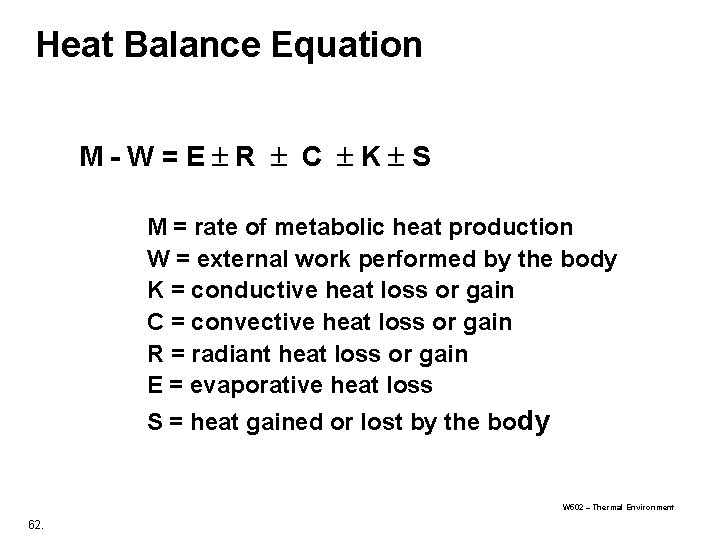
Heat Balance Equation M-W=E R C K S M = rate of metabolic heat production W = external work performed by the body K = conductive heat loss or gain C = convective heat loss or gain R = radiant heat loss or gain E = evaporative heat loss S = heat gained or lost by the body W 502 – Thermal Environment 62.
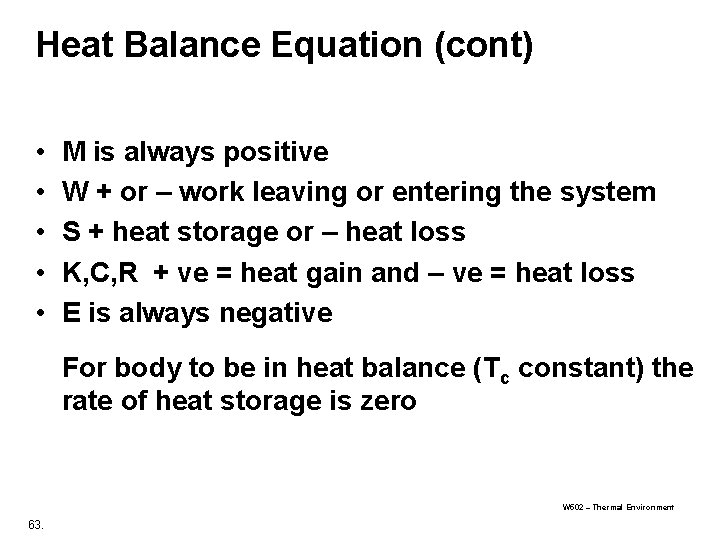
Heat Balance Equation (cont) • • • M is always positive W + or – work leaving or entering the system S + heat storage or – heat loss K, C, R + ve = heat gain and – ve = heat loss E is always negative For body to be in heat balance (Tc constant) the rate of heat storage is zero W 502 – Thermal Environment 63.
Other Equations • Using the heat balance equation it is possible to derive other equations for – Heat loss at the skin – Evaporative heat loss from the skin – Heat loss from respiration W 502 – Thermal Environment 64.
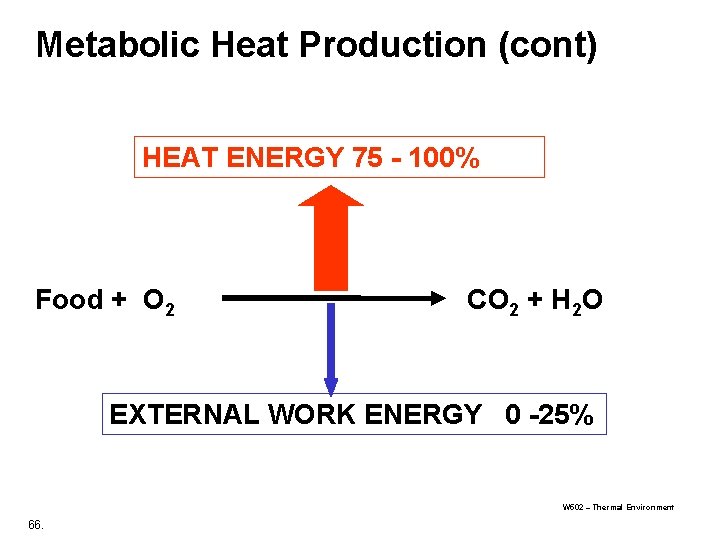
Metabolic Heat Production • Metabolism – involves the combustion of foodstuffs (carbohydrates, fats & proteins) to carbon dioxide & water using oxygen – is very inefficient (0 -25%) • Metabolic rate (M) – is the total energy produced (heat + work) measured indirectly from the rate of O 2 consumption W 502 – Thermal Environment 65.
Metabolic Heat Production (cont) HEAT ENERGY 75 - 100% Food + O 2 CO 2 + H 2 O EXTERNAL WORK ENERGY 0 -25% W 502 – Thermal Environment 66.
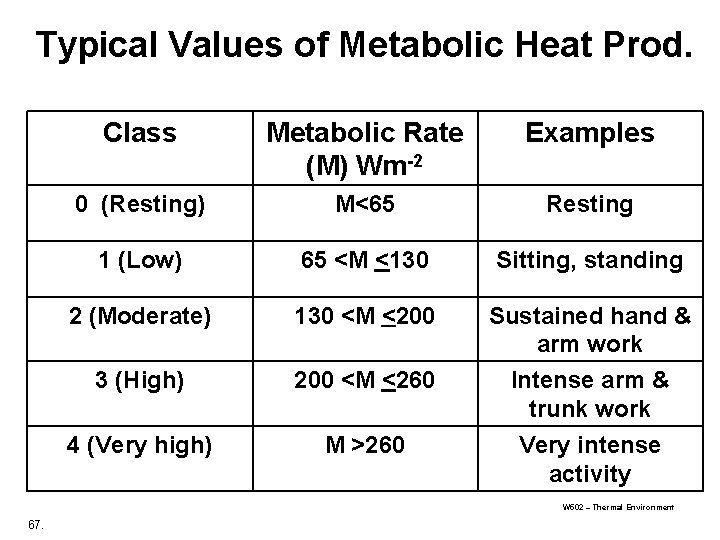
Typical Values of Metabolic Heat Prod. Class Metabolic Rate (M) Wm-2 Examples 0 (Resting) M<65 Resting 1 (Low) 65 <M <130 Sitting, standing 2 (Moderate) 130 <M <200 3 (High) 200 <M <260 Sustained hand & arm work Intense arm & trunk work 4 (Very high) M >260 Very intense activity W 502 – Thermal Environment 67.
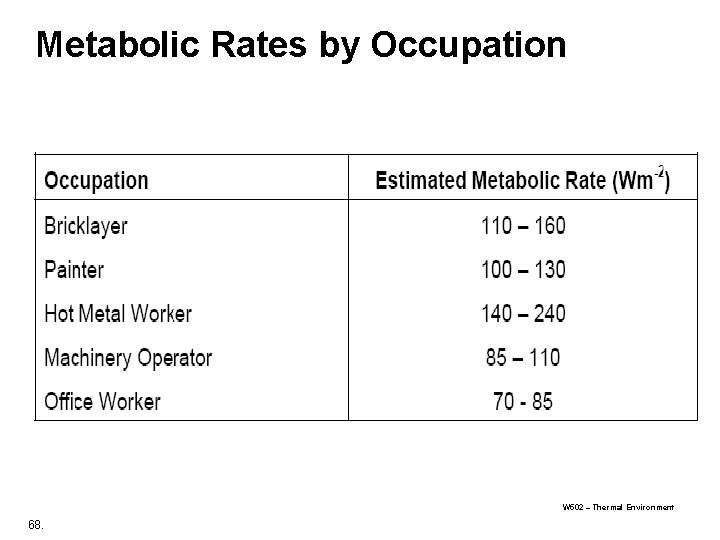
Metabolic Rates by Occupation W 502 – Thermal Environment 68.
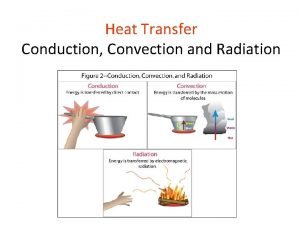
Non Evaporative Heat Transfer • Conduction • Convection • Radiation W 502 – Thermal Environment 69.
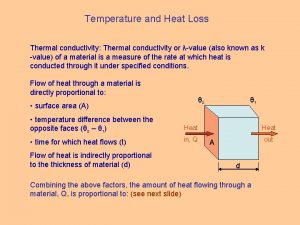
Conduction • Heat is transferred by conduction between a body and surface with which it is in contact • Amount of heat transferred is dependent on the temperature difference, the surface areas in contact and the conductance W 502 – Thermal Environment 70.
Conduction (cont) • Transfer of heat by conduction not usually significant for humans working in hot environments • Concept important when considering the insulation provided by protective clothing or insulation on hot surfaces W 502 – Thermal Environment 71.
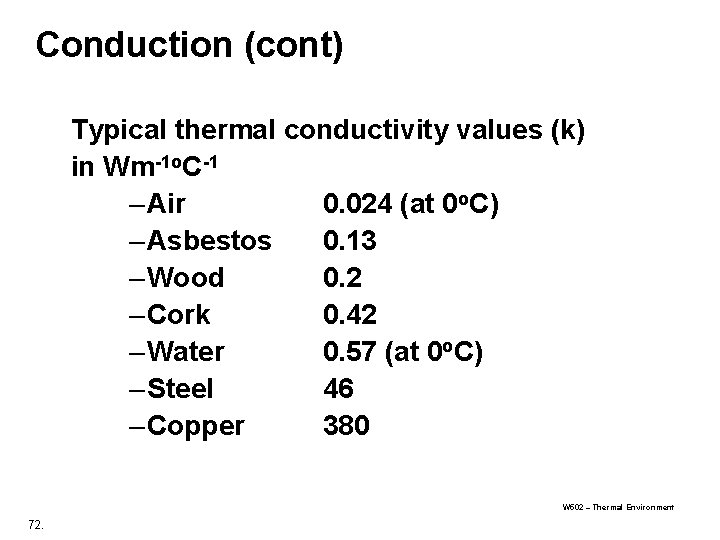
Conduction (cont) Typical thermal conductivity values (k) in Wm-1 o. C-1 – Air 0. 024 (at 0 o. C) – Asbestos 0. 13 – Wood 0. 2 – Cork 0. 42 – Water 0. 57 (at 0 o. C) – Steel 46 – Copper 380 W 502 – Thermal Environment 72.
Convection • Heat transfer will occur between a person and the boundary layer of air next to them • If surface temperature is higher than surrounding air, the heated air close to the surface moves upwards and replaced by cold air • Rate of heat loss or gain depends on temperature difference and surface area W 502 – Thermal Environment 73.
Convection (cont) • Natural convection – relative air velocity < 0. 1 m/s • Forced convection – higher heat loss or gain at higher air velocities W 502 – Thermal Environment 74.
Radiation • Radiant heat is electromagnetic radiation – Will travel through space until intercepted by an object – Energy will be absorbed to appear as ‘heat’ – Infra-red radiation (wavelengths between 760 nm & 1 mm) W 502 – Thermal Environment 75.
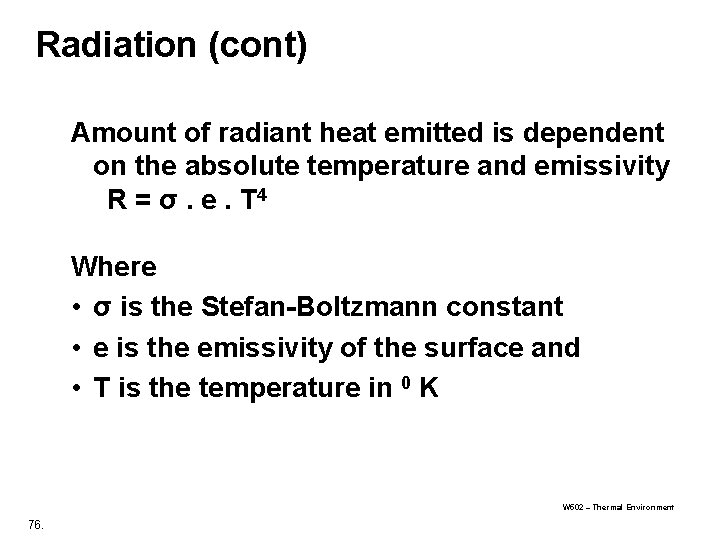
Radiation (cont) Amount of radiant heat emitted is dependent on the absolute temperature and emissivity R = σ. e. T 4 Where • σ is the Stefan-Boltzmann constant • e is the emissivity of the surface and • T is the temperature in 0 K W 502 – Thermal Environment 76.
Radiation (cont) • Emissivity – Materials have different emissivities • Expressed as a ratio to a theoretical perfect ‘black-body’ which has an emissivity of 1. 0 W 502 – Thermal Environment 77.
Radiation (cont) • Lower emissivity materials produce lower intensity radiation – Important in the choice of materials used as barriers / screens in the control of radiant heat • Materials with high emissitivity are also good absorbers of radiant heat W 502 – Thermal Environment 78.
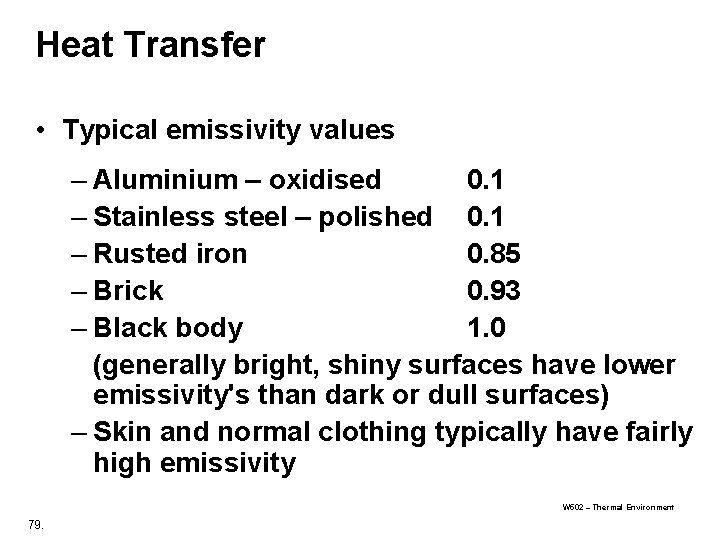
Heat Transfer • Typical emissivity values – Aluminium – oxidised 0. 1 – Stainless steel – polished 0. 1 – Rusted iron 0. 85 – Brick 0. 93 – Black body 1. 0 (generally bright, shiny surfaces have lower emissivity's than dark or dull surfaces) – Skin and normal clothing typically have fairly high emissivity W 502 – Thermal Environment 79.
Evaporative Heat Loss Heat loss only - amount of heat loss is dependent on rate of evaporation of water For humans the main mechanism is evaporation of water (sweat) from the skin but also evaporation of water from respiratory passages can occur W 502 – Thermal Environment 80.
Evaporative Heat Loss (cont) Sweating goes on continuously – even in comfortable conditions about 30 g sweat evaporate every hour – termed insensible perspiration – we are unaware of it Under more thermal stress the skin becomes wetted and we are aware of it – sensible perspiration W 502 – Thermal Environment 81.
Acclimatisation • Physiological or behavioral changes that reduce the strain caused by stressful changes in the natural environment • Acclimatised persons are able to adapt to heat and tolerate higher ambient temperatures W 502 – Thermal Environment 82.
Acclimatisation (cont) • Should take place gradually over 7 -10 days • Fit person acclimatise more readily than unfit persons • Acclimatisation declines after exposure is reduced and is lost after about 30 days of non exposure W 502 – Thermal Environment 83.
Acclimatisation (cont) • Acclimatisation in cold climates not as well understood as in hot climates • Evidence of local acclimatisation to cold of the hands & fingers in some groups (fishermen, Eskimos) W 502 – Thermal Environment 84.
Effects of Temperature Extremes W 502 – Thermal Environment 85.
Effects of Excessive Heat Strain – Hot Environments • Narrow core temperature band 36. 8 – 37. 2 °C • Core temperature remains constant when there is equilibrium between internal heat production and heat loss from the surface of the body W 502 – Thermal Environment 86.
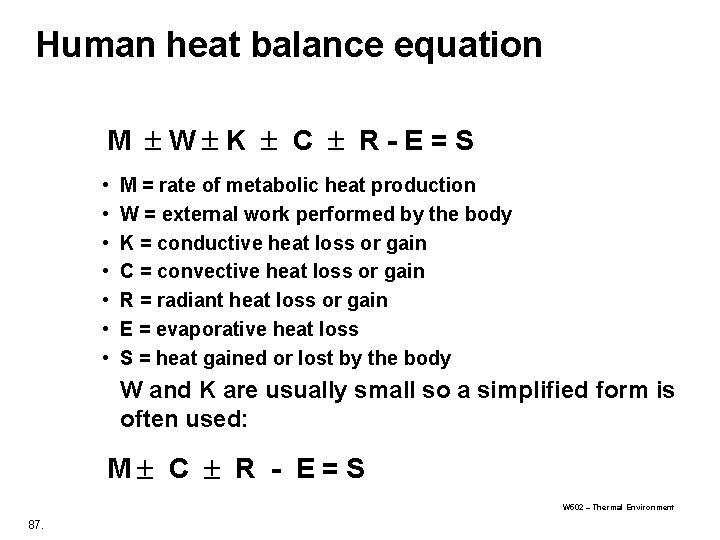
Human heat balance equation M W K C R-E=S • • M = rate of metabolic heat production W = external work performed by the body K = conductive heat loss or gain C = convective heat loss or gain R = radiant heat loss or gain E = evaporative heat loss S = heat gained or lost by the body W and K are usually small so a simplified form is often used: M C R - E=S W 502 – Thermal Environment 87.
Heat stress & heat strain • Heat Stress The combined effect of external thermal environment and internal metabolic heat production constitutes thermal stress on the body. • Heat Strain The levels of activity required in response to thermal stress by systems such as cardiovascular, thermoregulatory, respiratory, renal and endocrine constitute thermal strain. W 502 – Thermal Environment 88.
Heat Stroke • State of thermoregulatory failure • Life threatening • Characterised by: – Hot dry skin – Rapidly rising body temperature – Collapse – Loss of consciousness – Convulsions • If deep body temp exceeds 40°C danger of heat stroke is imminent W 502 – Thermal Environment 89.
Heat Stroke (cont) Treatment • Medical emergency & can lead to death • While waiting for medical help • Remove & lay in cool shaded area, remove & loosen clothing W 502 – Thermal Environment 90.
Heat Stroke (cont) • Immediate cooling necessary to reduce core to< 39°C eg Spray with cool water and fan to evapourate, ice packs on extremities • If conscious, give sips of cool water • Monitor airway & breathing W 502 – Thermal Environment 91.
Heat Exhaustion • While serious, less severe than heat stroke • Inadequate fluid replacement • Characterised by – – – – Clammy, moist skin Weakness or extreme fatigue Nausea Headache No excessive increase in body temperature Low blood pressure and weak pulse Without prompt treatment collapse may occur W 502 – Thermal Environment 92.
Heat Exhaustion (cont) Treatment • Remove & lay in cool shaded area, remove & loosen clothing • Initiate active cooling e. g. Spray with cool water and fan to evaporate • If conscious allow casualty to slowly drink cool water • Observe W 502 – Thermal Environment 93.
Heat Syncope (fainting) • Exposure of fluid deficient persons to hot environment can cause major shift of blood supply to skin vessels for heat dissipation • This can result in inadequate supply of blood to brain and consequent fainting. • Onset of heat collapse is rapid and unpredictable W 502 – Thermal Environment 94.
Heat Syncope or Fainting (cont) Treatment • Remove and lay in cool shaded area • If conscious allow casualty to slowly drink cool water • Observe W 502 – Thermal Environment 95.
Heat Cramps Caused by performing hard work in a hot environment. Characterised by: • Painful muscle spasm • Electrolyte imbalance caused by sweating • Can be caused by both too much and too little salt W 502 – Thermal Environment 96.
Heat Cramps (cont) • Thirst cannot be relied on as a guide to the need for water • Water must be taken every 15 – 20 minutes in hot environments W 502 – Thermal Environment 97.
Heat Cramps (cont) Treatment • Under extreme conditions working loss of sodium can occur & need to be replaced • Individuals need to be encouraged to maintain a balanced electrolyte intake, with meals if possible. W 502 – Thermal Environment 98.
Prickly Heat (heat rash) Occurs as a result of continued exposure to humid heat with skin remaining continuously wet from un-evapourated sweat Characterised by: • Clogged sweat glands • Itchy skin • Reduced sweating W 502 – Thermal Environment 99.
Prickly Heat or Heat Rash (cont) Treatment • Keeping the skin cool & dry • Mild drying lotions • Keep skin clean to avoid infections W 502 – Thermal Environment 100.
Possible Other Effects • Reproductive Increased risk of malformation of the unborn foetus during the first trimester of pregnancy may occur if a female’s core temperature exceeds 39°C for extended periods (evidence not conclusive). • Chronic long-term effects (eg higher incidence of kidney stones) are not conclusive. W 502 – Thermal Environment 101.
Effects of Excessive Heat Strain – Cold Environments Factors which contribute to cold stress include: • • • Cold temperatures High or cold winds Dampness Cold water Inadequate protection W 502 – Thermal Environment 102.
Cold Occupational Environments Air Temp°C Example of such an Environment - 90 Lowest temperature at south pole base Vostock - 55 Cold store for fish meat and production of frozen, dried products - 40 “Normal” temperature at polar base - 28 Cold store for frozen products -20 to – 10 Average January temp of S. Canada, N. Scandinavia and Central Russia -10 to 0 Average January temp of N. USA, S. Scandinavia, Central Europe, parts of Middle and Far East, Central & N. Japan W 502 – Thermal Environment 103.
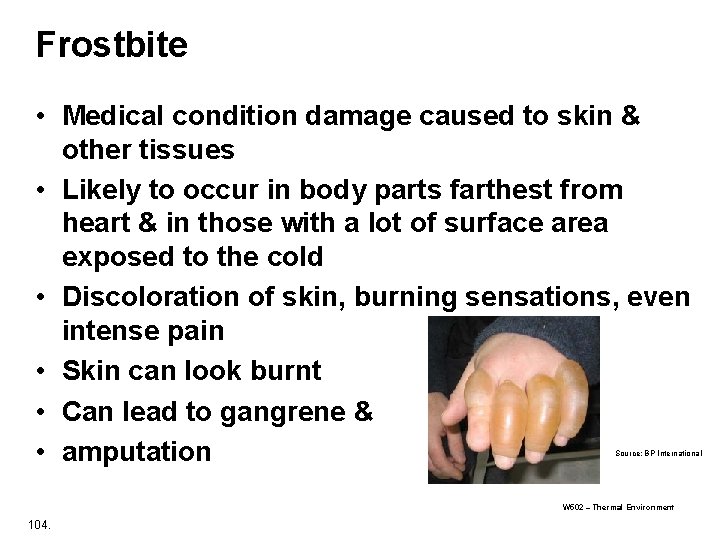
Frostbite • Medical condition damage caused to skin & other tissues • Likely to occur in body parts farthest from heart & in those with a lot of surface area exposed to the cold • Discoloration of skin, burning sensations, even intense pain • Skin can look burnt • Can lead to gangrene & • amputation Source: BP International W 502 – Thermal Environment 104.
Trenchfoot • Trench foot or immersion foot – prolonged exposure of feet to damp and cold • Does not require freezing temperatures – up to 16°C • Feet swell, may involve blisters & infections • Can lead to gangrene & amputation W 502 – Thermal Environment 105.
Hypothermia refers to any condition in which the temperature of the body drops below the level required for normal metabolism and/or bodily functions to take place W 502 – Thermal Environment 106.
Signs & Symptoms Mild hypothermia • 36. 5 - 32°C • Shivering • Lack of coordination, stumbling, fumbling hands • Slurred speech • Memory loss • Pale, cold skin W 502 – Thermal Environment 107.
Signs & Symptoms (cont) Moderate hypothermia • 32 - 30°C • Shivering stops • Unable to walk or stand • Confused or irrational W 502 – Thermal Environment 108.
Signs & Symptoms (cont) Severe hypothermia • 30 – 25. 5°C • Severe muscle stiffness • Very sleepy or unconscious • Ice cold skin • Death W 502 – Thermal Environment 109.
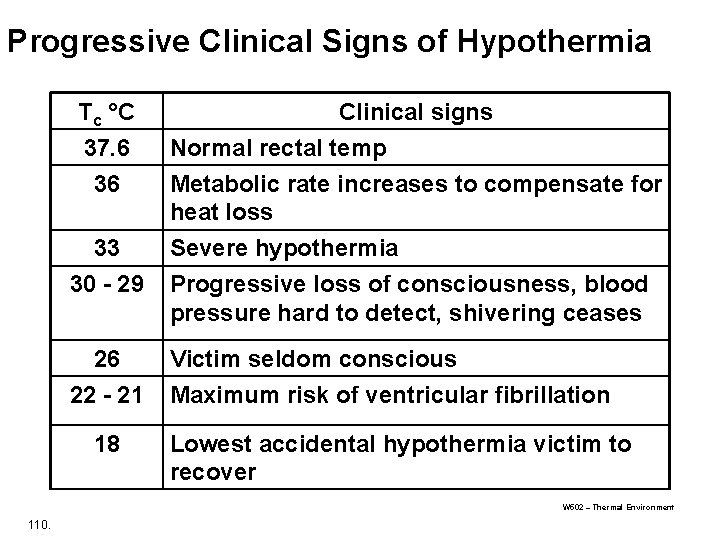
Progressive Clinical Signs of Hypothermia Tc °C 37. 6 36 33 Clinical signs Normal rectal temp Metabolic rate increases to compensate for heat loss Severe hypothermia 30 - 29 Progressive loss of consciousness, blood pressure hard to detect, shivering ceases 26 22 - 21 Victim seldom conscious Maximum risk of ventricular fibrillation 18 Lowest accidental hypothermia victim to recover W 502 – Thermal Environment 110.
Predisposing Factors – Heat Stress Age • Age as such not necessarily the important feature • Condition rather than physical debilitations associated with age • Personal factors of health & level of fitness rather than age itself W 502 – Thermal Environment 111.
Predisposing Factors (cont) Gender • Matched (cardio vascular fitness levels) groups – no difference in tolerance levels males & females General health • Some medical conditions can contribute eg Past histories of heat related illnesses Cardiovascular conditions & diabetes affects blood flow Skin disorders (sunburn, psoriases) inhibit sweating W 502 – Thermal Environment 112.
Predisposing Factors (cont) • Excess body fat – Insulator – Greater expenditure of energy to move around – Often indicates an inactive lifestyle • Lack of sleep / fatigue W 502 – Thermal Environment 113.
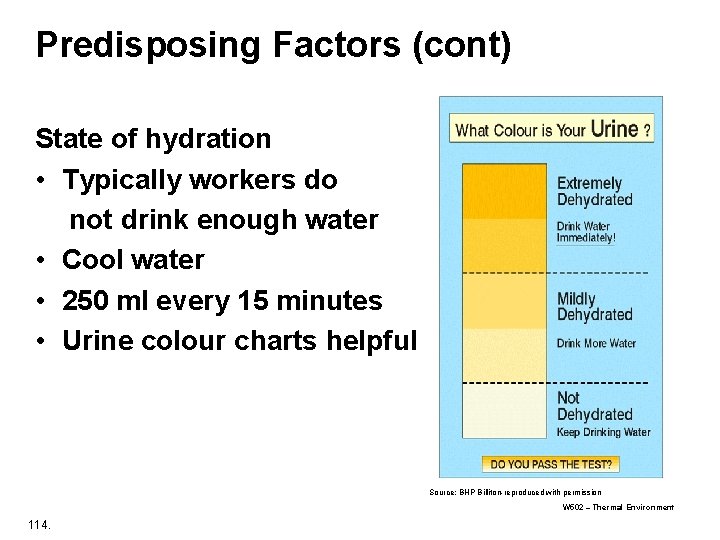
Predisposing Factors (cont) State of hydration • Typically workers do not drink enough water • Cool water • 250 ml every 15 minutes • Urine colour charts helpful Source: BHP Billiton-reproduced with permission W 502 – Thermal Environment 114.
Predisposing Factors (cont) Alcohol, Caffeine & Diet • Alcohol & caffeine consumption (even night before) should be discouraged before hot work • Alcohol & caffeine are diuretics & contribute to dehydration • Carbonated drinks may cause bloating • High protein meals – water lost in excreting nitrogenous waste W 502 – Thermal Environment 115.
Predisposing Factors (cont) Nicotine use • Using nicotine tightens blood vessels & hence those in the skin cannot widen to let heated blood reach the surface to release heat Medications • Should be confirmed by a medical practitioner that they do NOT affect body’s ability to regulate temperature W 502 – Thermal Environment 116.
Predisposing Factors (cont) Medications known to affect the bodies ability to regulate temperature • Diuretics • Tranqilisers • Antidepressants • Antihistamines • Others W 502 – Thermal Environment 117.
Predisposing Factors (cont) Acclimatisation • Recommended for new workers • Physiological adaptation which occurs with repeated exposure to hot environments W 502 – Thermal Environment 118.
Predisposing Factors (cont) • Heart rate decreases, sweating increase, sweat becomes more dilute & body temp will be lower • Varies among workers • Approx 7 days required for full acclimatisation • After a weeks absence need to reacclimatise usually 3 or 4 days W 502 – Thermal Environment 119.
Predisposing Factors (cont) Protective clothing & other protective equipment • Often impedes sweat evaporation & heat loss • Liquid/vapour/air permeable versus impermeable W 502 – Thermal Environment 120.
Predisposing Factors (cont) • Slightly loose fitting allows good ventilation & air circulation • The higher the insulation factor the more difficult to dissipate heat • Air cooled helmets & suits W 502 – Thermal Environment 121.
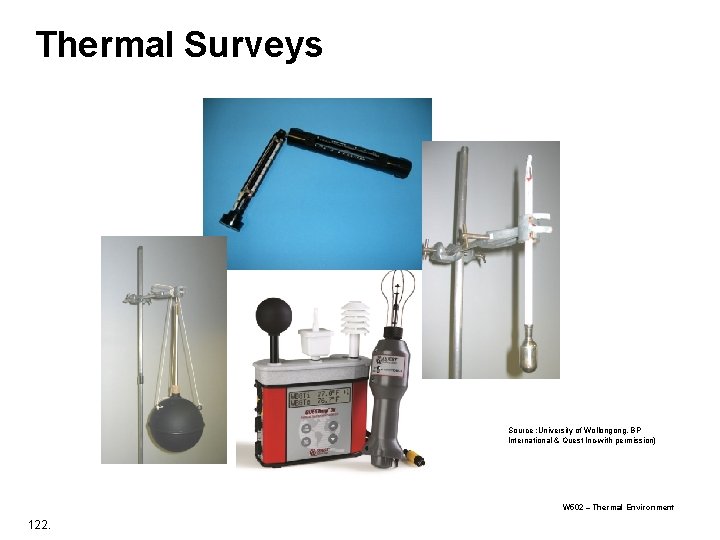
Thermal Surveys Source ; University of Wollongong, BP International & Quest Inc-with permission) W 502 – Thermal Environment 122.
Thermal Surveys • Measurement equipment – Air temperature – Radiant temperature – Humidity – Air movement – Composite integrating meters – Personal monitoring W 502 – Thermal Environment 123.
Thermal Surveys (cont) • Survey – Data collection – Monitoring strategies • Assessment of degree of risk – Recording of results – Assessment of risk – Outcomes of surveys W 502 – Thermal Environment 124.
Air Temperature • Definition Temperature of air surrounding the body which is representative of that aspect of the surroundings which determines heat flow between the human body and the air W 502 – Thermal Environment 125.
Air Temperature • Temperature scales – Celsius (centigrade) scale o. C – Fahrenheit scale o. F – Kelvin scale K W 502 – Thermal Environment 126.
Temperature Scales (cont) • 0 o C = 32 o F • 100 o C = 212 o F • Kelvin scale starts at absolute zero 0 o c = 273 K 20 oc = 293 K 100 OC = 373 K W 502 – Thermal Environment 127.
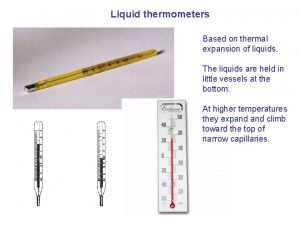
Measurement of Air Temperature • Mercury-in-glass thermometer • Thermocouple • Platinum resistance thermometer • Thermistor All techniques must be appropriately calibrated W 502 – Thermal Environment 128.
Mean Radiant Temperature • Definition Temperature of a uniform enclosure within which a small black sphere at the test point would have the same radiation exchange as it does with the real environment W 502 – Thermal Environment 129.
Mean Radiant Temperature (cont) • In practice radiant energy is measured using a globe thermometer – This absorbs heat from all sources and gives an integrated measure • Mean radiant temperature of environment can be determined by – calculation (very complex) – by using a nomogram (different nomograms for different diameter globes) W 502 – Thermal Environment 130.
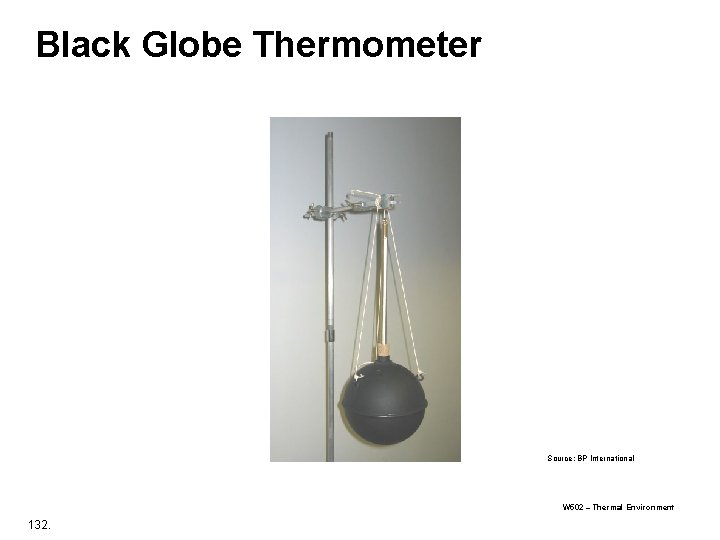
The Globe Thermometer • Normal bulb thermometer – at centre of matt black copper painted hollow sphere – thermometer sealed into the sphere • 150 mm diameter spheres are the most accurate but takes about 20 minutes to equilibrate • 40 mm diameter sphere is less accurate but only takes about 10 minutes to equilibrate W 502 – Thermal Environment 131.
Black Globe Thermometer Source: BP International W 502 – Thermal Environment 132.
Humidity • Air contains a certain amount of water vapour • Higher air temperature – more water vapour can be contained in the air • Lower air temperature – less water vapour can be contained in the air W 502 – Thermal Environment 133.
Humidity (cont) • If the air contains as much water vapour as it can at a certain temperature it is termed saturated • If air containing water vapour is cooled a temperature is reached at which the air is saturated and water will condense out. This is the dew point. W 502 – Thermal Environment 134.
Humidity (cont) • The amount of water vapour in air at a certain temperature expressed as a percentage of the amount of water vapour the air at that temperature could contain when saturated is termed the relative humidity W 502 – Thermal Environment 135.
Dry & Wet Bulb Thermometers • Water evaporating from a surface reduces the temperature of the surface • If the bulb of a thermometer is covered by a damp fabric sleeve water evaporating causes a lower reading - this is termed the wet bulb temperature W 502 – Thermal Environment 136.
Dry & Wet Bulb Thermometers (cont) • The difference between dry bulb temperature and wet bulb temperature can be used to determine relative humidity • At 100% relative humidity no evaporation takes place so the dry bulb temperature and wet bulb temperature will be the same W 502 – Thermal Environment 137.
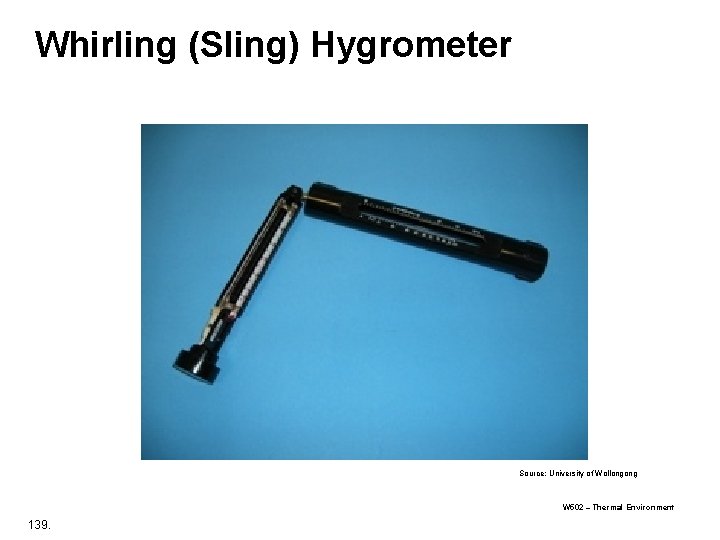
Measuring Relative Humidity • Whirling hygrometer – one dry bulb thermometer – one wet bulb thermometer - bulb covered with wick dipped into distilled water reservoir – air flow (> 4 metres / sec) achieved by ‘whirling’ – read wet bulb temperature first, then dry bulb W 502 – Thermal Environment 138.
Whirling (Sling) Hygrometer Source; University of Wollongong W 502 – Thermal Environment 139.
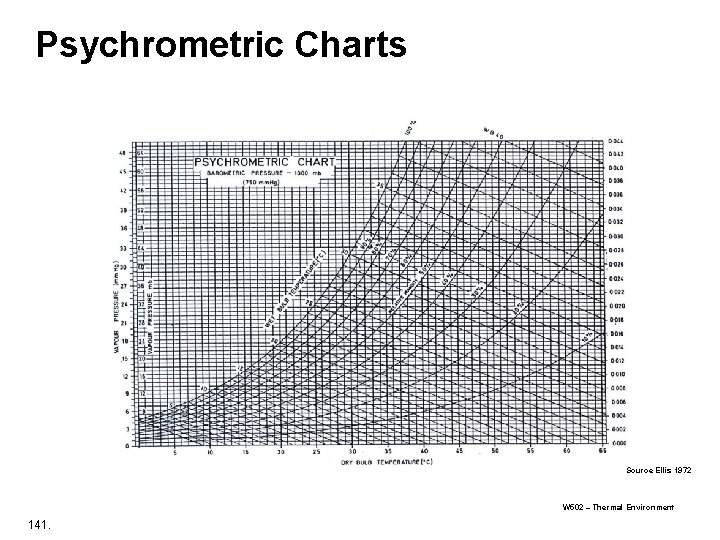
Calculation of Relative Humidity • Direct calculation from formulae • Slide rule for particular instruments • Psychrometric charts – Charts that inter-relate – vapour pressure (water content) – relative humidity – dry bulb temperature – wet bulb temperature W 502 – Thermal Environment 140.
Psychrometric Charts Source Ellis 1972 W 502 – Thermal Environment 141.
Air Movement • Air movements varies in time & direction. • Mean air velocity over the body integrated over all directions & over exposure time of interest W 502 – Thermal Environment 142.
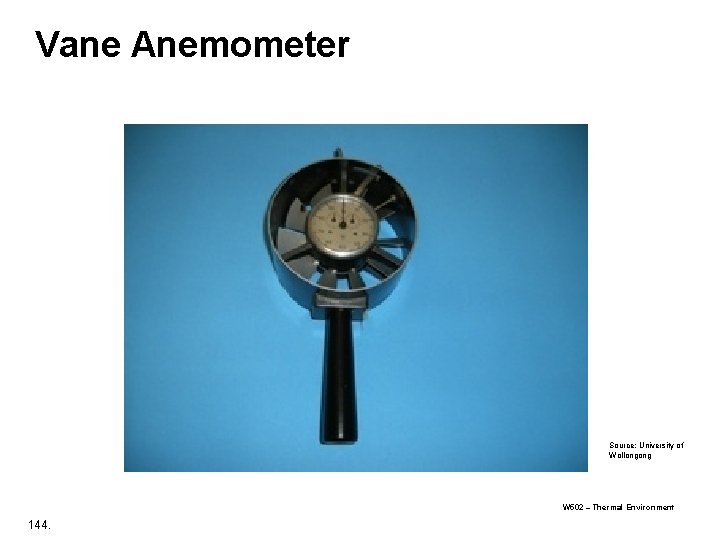
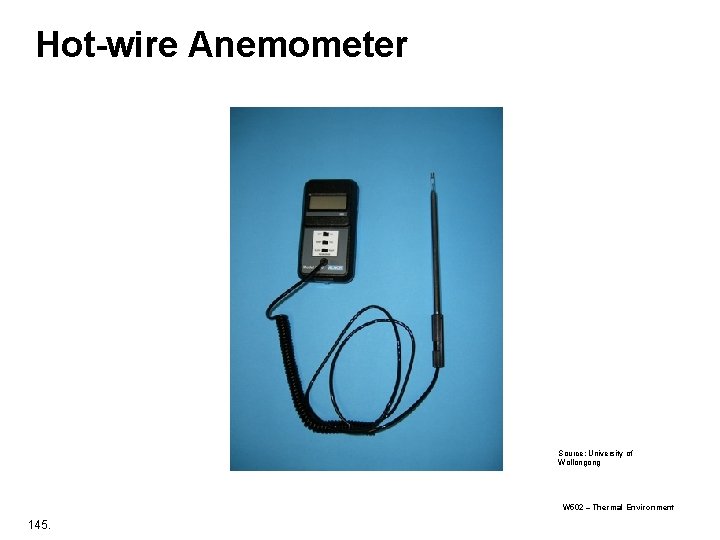
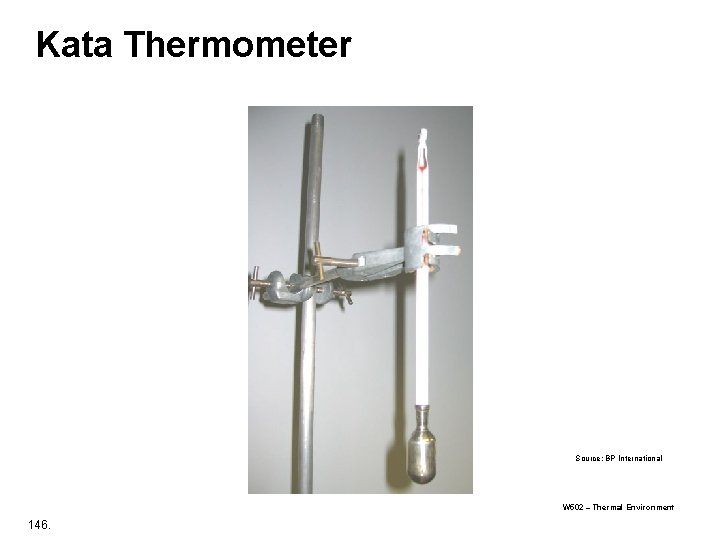
Measurement of Air Velocity • Vane anemometer – Directional & not accurate at low velocities • Hot-wire anemometer – Directional & inaccurate at low velocities • Kata thermometer – Omni-directional but not suited to conditions where large or rapid variations in air movement occur W 502 – Thermal Environment 143.
Vane Anemometer Source; University of Wollongong W 502 – Thermal Environment 144.
Hot-wire Anemometer Source; University of Wollongong W 502 – Thermal Environment 145.
Kata Thermometer Source: BP International W 502 – Thermal Environment 146.
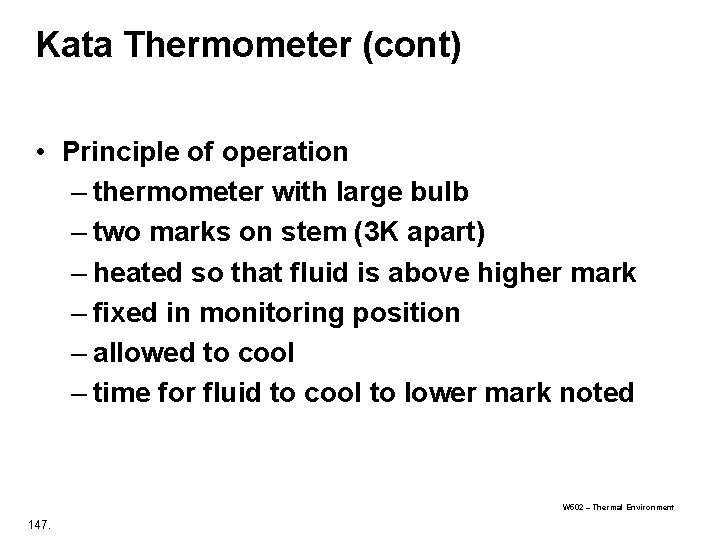
Kata Thermometer (cont) • Principle of operation – thermometer with large bulb – two marks on stem (3 K apart) – heated so that fluid is above higher mark – fixed in monitoring position – allowed to cool – time for fluid to cool to lower mark noted W 502 – Thermal Environment 147.
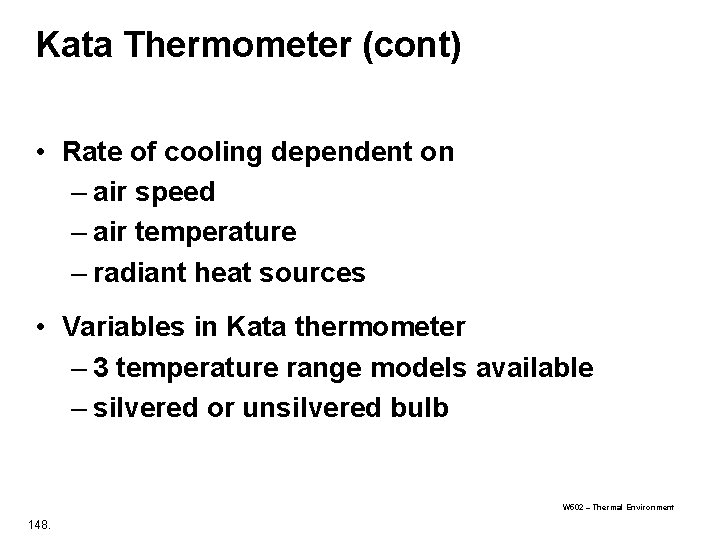
Kata Thermometer (cont) • Rate of cooling dependent on – air speed – air temperature – radiant heat sources • Variables in Kata thermometer – 3 temperature range models available – silvered or unsilvered bulb W 502 – Thermal Environment 148.
Kata Thermometer (cont) • Precautions in use – choose silvered / unsilvered - why? – heat carefully (often using hot water) – ensure bulb thoroughly dried - why? – fix stationary in sampling position - why? – repeat measurements 3 times W 502 – Thermal Environment 149.
Kata Thermometer (cont) • Advantages – omnidirectional - takes account of air movement from all directions – averages over a reasonable time period – determines very low average air speeds • Disadvantages – fragile – time consuming W 502 – Thermal Environment 150.
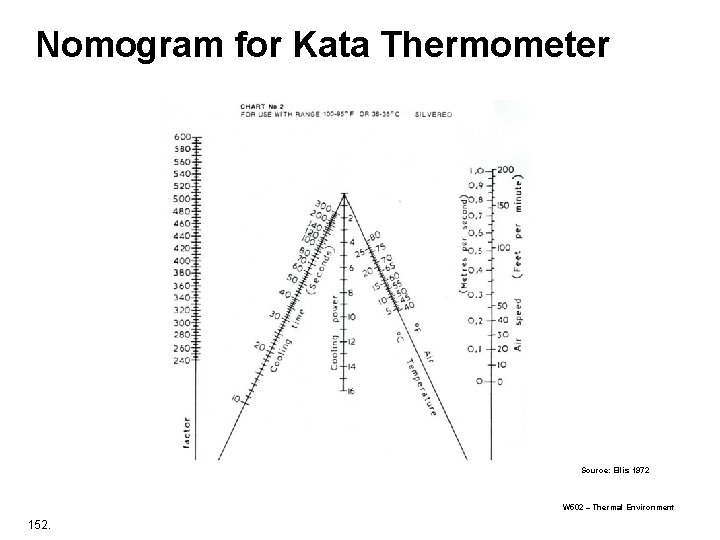
Kata Thermometer (cont) • Determining air speed – use appropriate nomogram – nomograms inter-relate § Kata factor § dry bulb temperature § cooling time – to give air speed in metres per second W 502 – Thermal Environment 151.
Nomogram for Kata Thermometer Source: Ellis 1972 W 502 – Thermal Environment 152.
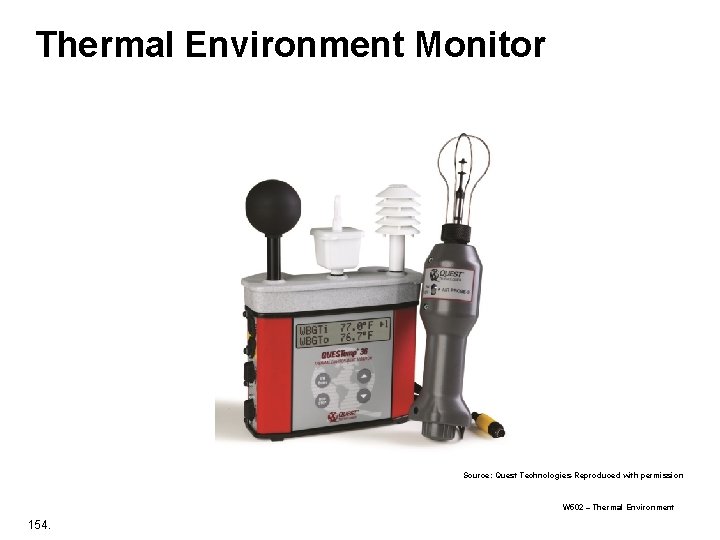
Portable Instrumentation • Basic models have ability to measure dry bulb , wet bulb & globe bulb • More modern instruments can measure humidity & air velocity • Some instruments can measure & store a vast amount of data which can be downloaded to a software programme • Sensors require calibration W 502 – Thermal Environment 153.
Thermal Environment Monitor Source: Quest Technologies-Reproduced with permission W 502 – Thermal Environment 154.
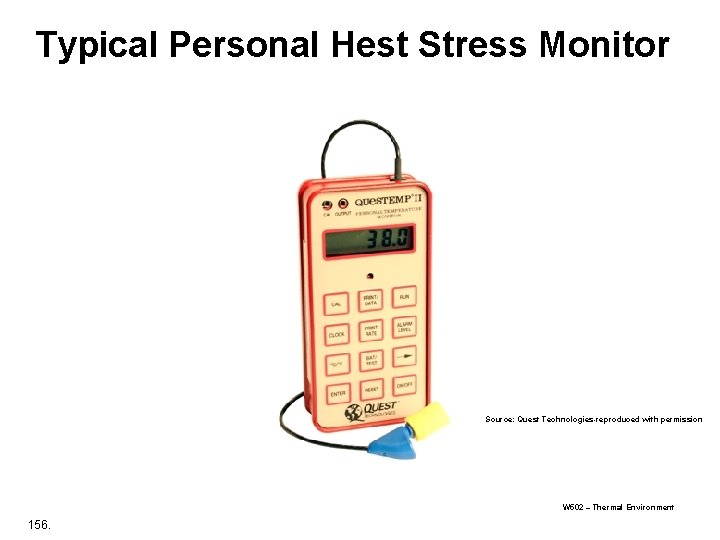
Personal Monitoring • Measure physiological indicators of heat strain rather than environmental conditions • Usually monitor factors such as heart rate, body temperature, skin temperature • Limitations of instrumentation need to be understood & care needs to be exercised with interpretation of data W 502 – Thermal Environment 155.
Typical Personal Hest Stress Monitor Source: Quest Technologies-reproduced with permission W 502 – Thermal Environment 156.
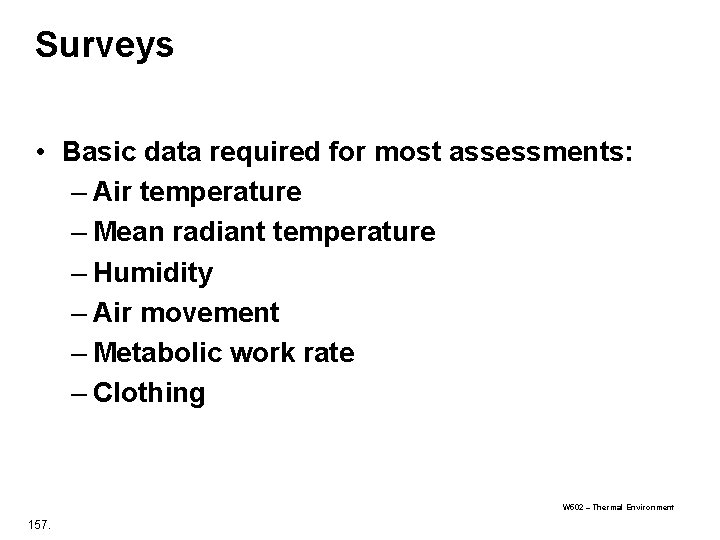
Surveys • Basic data required for most assessments: – Air temperature – Mean radiant temperature – Humidity – Air movement – Metabolic work rate – Clothing W 502 – Thermal Environment 157.
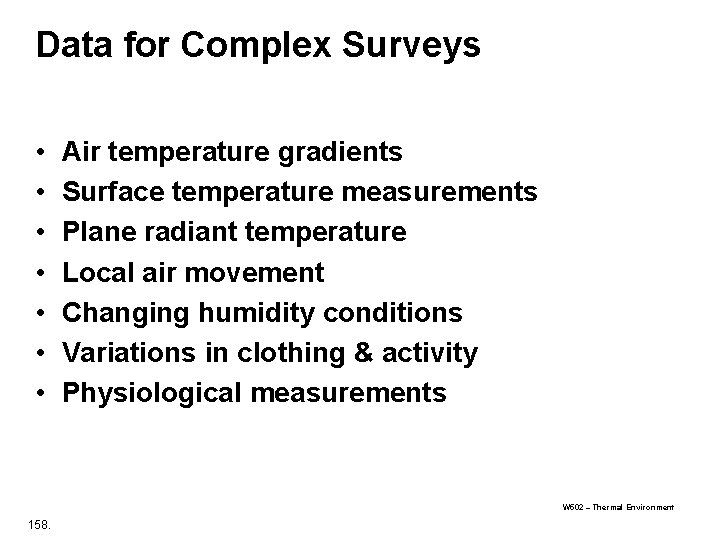
Data for Complex Surveys • • Air temperature gradients Surface temperature measurements Plane radiant temperature Local air movement Changing humidity conditions Variations in clothing & activity Physiological measurements W 502 – Thermal Environment 158.
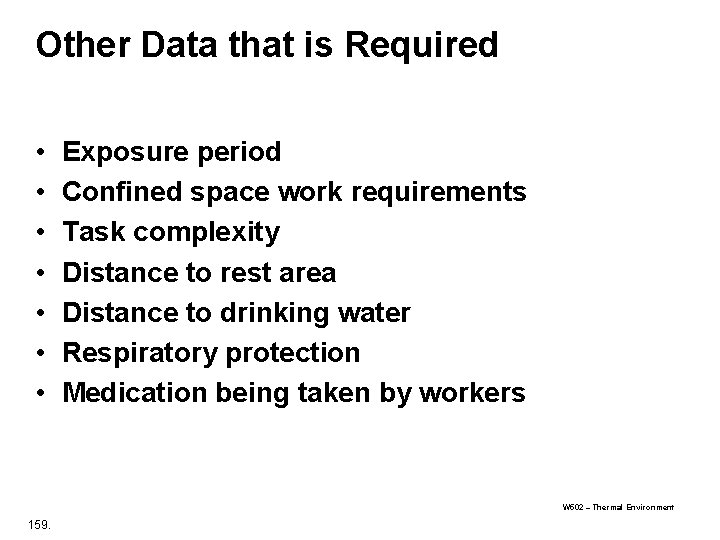
Other Data that is Required • • Exposure period Confined space work requirements Task complexity Distance to rest area Distance to drinking water Respiratory protection Medication being taken by workers W 502 – Thermal Environment 159.
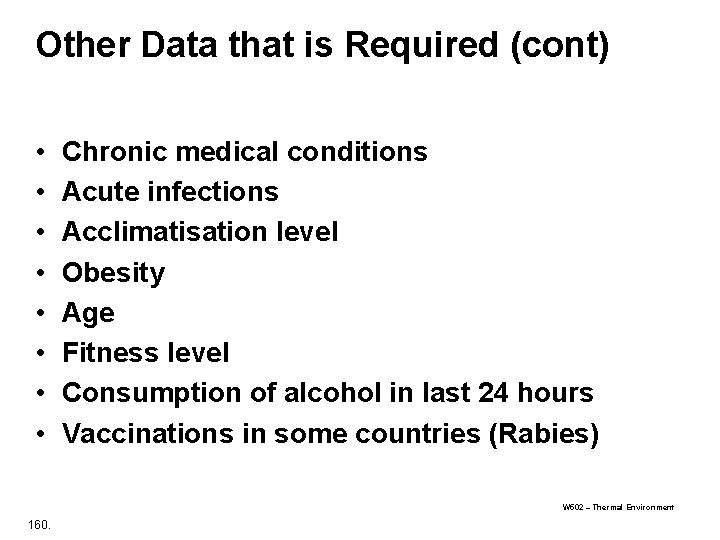
Other Data that is Required (cont) • • Chronic medical conditions Acute infections Acclimatisation level Obesity Age Fitness level Consumption of alcohol in last 24 hours Vaccinations in some countries (Rabies) W 502 – Thermal Environment 160.
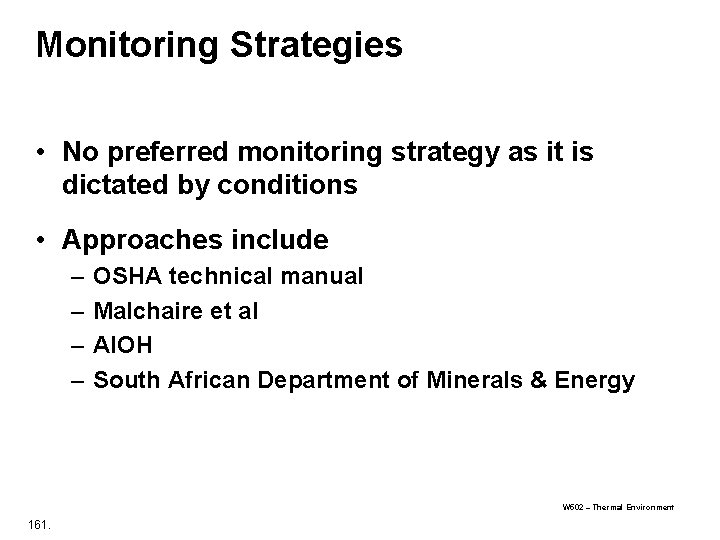
Monitoring Strategies • No preferred monitoring strategy as it is dictated by conditions • Approaches include – – OSHA technical manual Malchaire et al AIOH South African Department of Minerals & Energy W 502 – Thermal Environment 161.
OSHA Technical Manual (1995) • Employer & employee interviews • Walkaround inspection • Workload assessment • Sampling of environmental conditions W 502 – Thermal Environment 162.
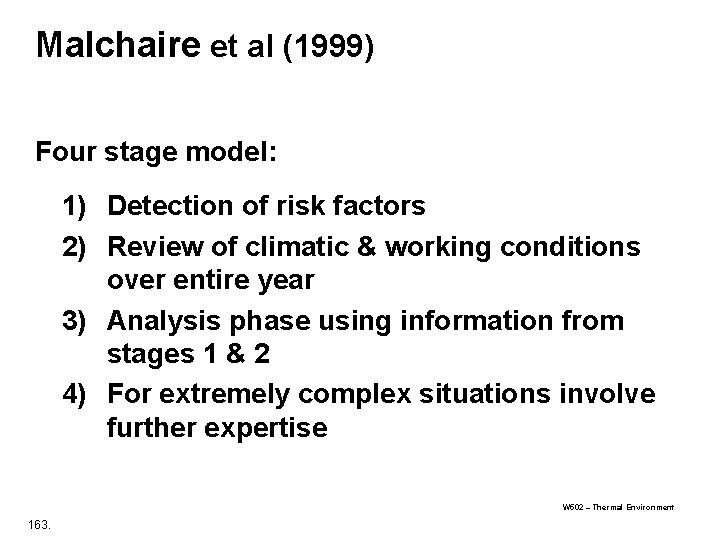
Malchaire et al (1999) Four stage model: 1) Detection of risk factors 2) Review of climatic & working conditions over entire year 3) Analysis phase using information from stages 1 & 2 4) For extremely complex situations involve further expertise W 502 – Thermal Environment 163.
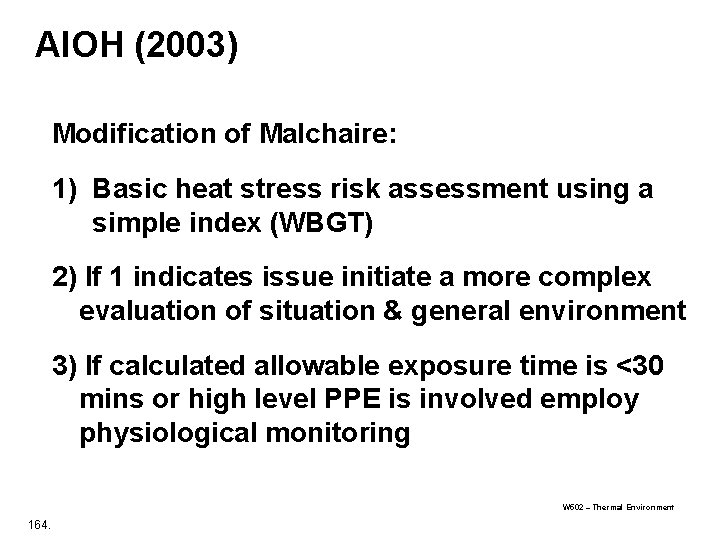
AIOH (2003) Modification of Malchaire: 1) Basic heat stress risk assessment using a simple index (WBGT) 2) If 1 indicates issue initiate a more complex evaluation of situation & general environment 3) If calculated allowable exposure time is <30 mins or high level PPE is involved employ physiological monitoring W 502 – Thermal Environment 164.
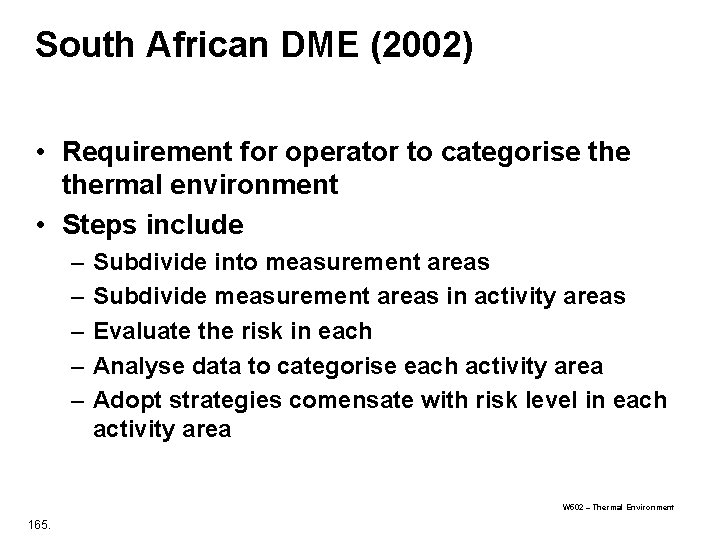
South African DME (2002) • Requirement for operator to categorise thermal environment • Steps include – – – Subdivide into measurement areas Subdivide measurement areas in activity areas Evaluate the risk in each Analyse data to categorise each activity area Adopt strategies comensate with risk level in each activity area W 502 – Thermal Environment 165.
Assessment of Risk – AIHA (Hot) • Preliminary review • Select a heat index • Select instruments • Measure thermal environment • Calculate the selected index W 502 – Thermal Environment 166.
Assessment of Risk – AIHA (Hot) • Estimate the metabolic heat load • Evaluate recommended exposure limits • Determine thermal components • Modification of hot work exposures • Re-evaluate workplace exposures after modifications W 502 – Thermal Environment 167.
Assessment of Risk – AIHA (Cold) • Preliminary review • Decide the type of analysis • Measure thermal environment • Determine the WCI W 502 – Thermal Environment 168.
Assessment of Risk – AIHA (Cold) • Estimate metabolic heat load • Determine insulation required • Modification of cold work exposure W 502 – Thermal Environment 169.
Outcome of Surveys • Environmental control measures (hot conditions) – Insulation of hot surfaces & pipe work – Shielding of radiant heat sources – Plant maintenance – Increased ventilation, air movement & local cooling W 502 – Thermal Environment 170.
Outcome of Surveys (cont) • Personnel selection & monitoring (hot conditions) – Level of fitness & obesity – Chronic illness – Minor illnesses – Prior history of heat stress W 502 – Thermal Environment 171.
Outcome of Surveys (cont) • Work-Rest regimes – Work at very high temperatures may be permitted for short periods followed by a period of rest – The body can accumulate a certain amount of heat before Tc reaches an unacceptable level W 502 – Thermal Environment 172.
Outcome of Surveys (cont) • Clothing – At extremes of hot or cold temperatures, clothing (PPE) appropriate to the prevailing conditions must be worn – Selection of clothing must be undertaken with caution to ensure adverse effects are not inadvertently introduced W 502 – Thermal Environment 173.
Review of Today’s Learning Outcomes • Thermal Spectrum – To understand the range of thermal environments that humans work within • Principles – Understand the basic physiological responses of the body to hot & cold environments – Understand the processes for heat production & exchange W 502 – Thermal Environment 174.
Today’s Learning Outcomes (cont) • Effects of Temperature Extremes – Understand the effects of hot & cold environments • Thermal Surveys – Understand the principles of measuring major environmental factors – Review different monitoring strategies – Understand some approaches to establishing the degree of risk resulting from a thermal survey W 502 – Thermal Environment 175.