The Carnot Cycle and Efficiency The definition of
- Slides: 9
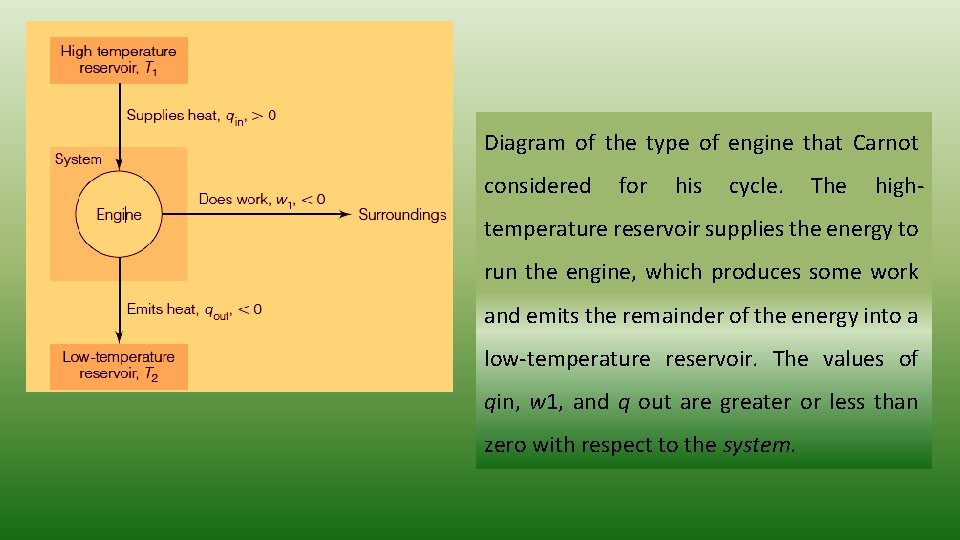
The Carnot Cycle and Efficiency The definition of the Carnot cycle was made in understanding the ability of steam engines It was thought the first to understand that there was a relationship between the efficiency of a steam engine and the temperatures involved in the process. Figure shows a modern diagram of how Carnot defined an engine. Carnot realized that every engine could be defined as getting heat, qin, from some high-temperature reservoir. The engine performed some work, w, on the surroundings. The engine is emitting some heat, qout, into the low temperature reservoir. Carnot proceeded to define the steps for the operation of an engine in such a way that the maximum efficiency could be achieved. These steps, collectively called the Carnot cycle, represent the most efficient way known to get work out of heat, as energy goes from a hightemperature reservoir to a low-temperature reservoir. The engine itself is defined as the system, and a schematic of the
Diagram of the type of engine that Carnot considered for his cycle. The high- temperature reservoir supplies the energy to run the engine, which produces some work and emits the remainder of the energy into a low-temperature reservoir. The values of qin, w 1, and q out are greater or less than zero with respect to the system.
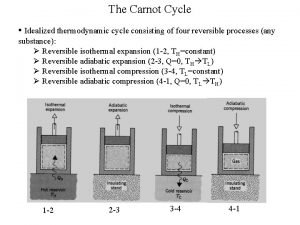
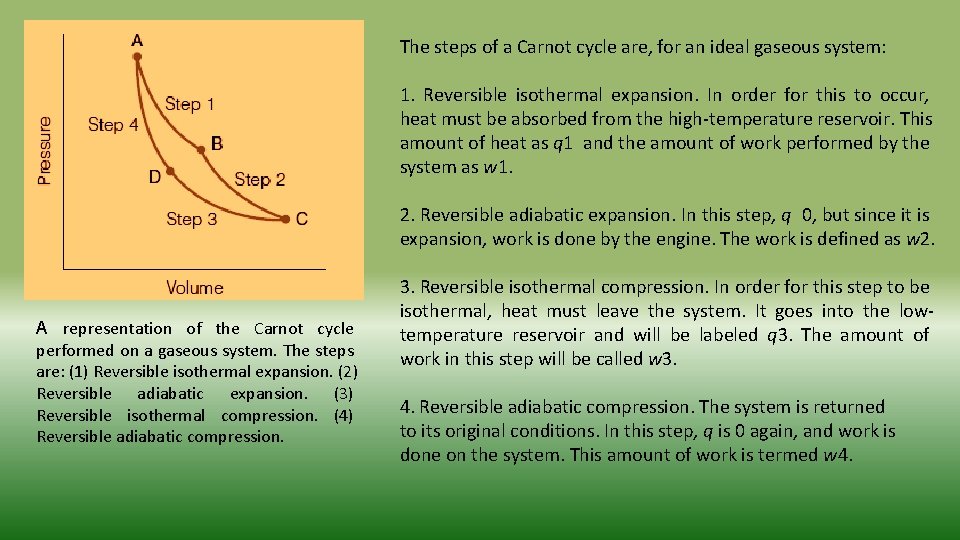
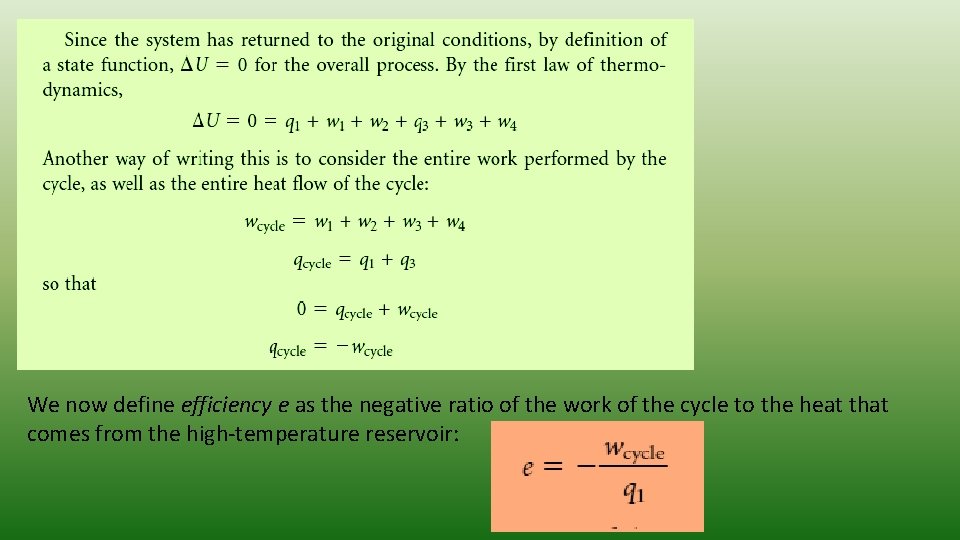
The steps of a Carnot cycle are, for an ideal gaseous system: 1. Reversible isothermal expansion. In order for this to occur, heat must be absorbed from the high-temperature reservoir. This amount of heat as q 1 and the amount of work performed by the system as w 1. 2. Reversible adiabatic expansion. In this step, q 0, but since it is expansion, work is done by the engine. The work is defined as w 2. A representation of the Carnot cycle performed on a gaseous system. The steps are: (1) Reversible isothermal expansion. (2) Reversible adiabatic expansion. (3) Reversible isothermal compression. (4) Reversible adiabatic compression. 3. Reversible isothermal compression. In order for this step to be isothermal, heat must leave the system. It goes into the lowtemperature reservoir and will be labeled q 3. The amount of work in this step will be called w 3. 4. Reversible adiabatic compression. The system is returned to its original conditions. In this step, q is 0 again, and work is done on the system. This amount of work is termed w 4.
We now define efficiency e as the negative ratio of the work of the cycle to the heat that comes from the high-temperature reservoir:
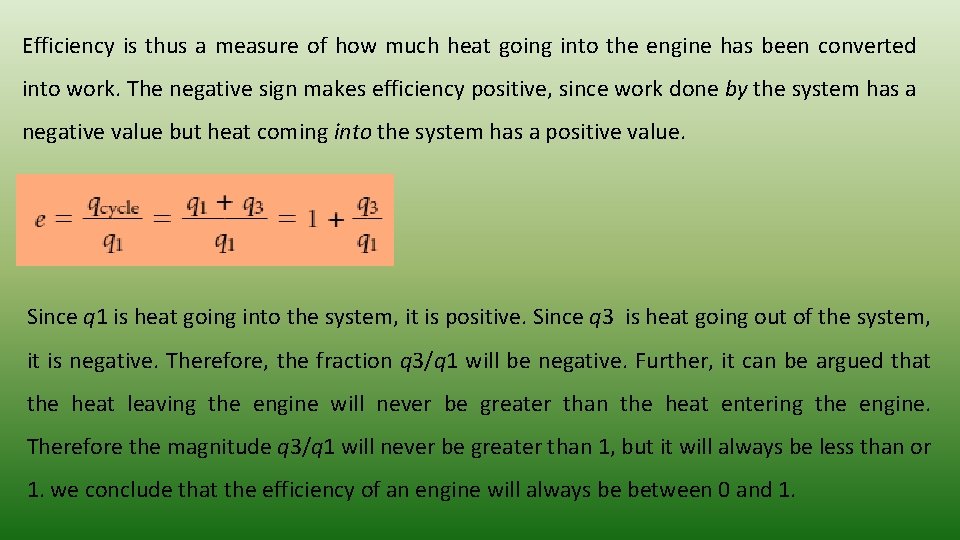
Efficiency is thus a measure of how much heat going into the engine has been converted into work. The negative sign makes efficiency positive, since work done by the system has a negative value but heat coming into the system has a positive value. Since q 1 is heat going into the system, it is positive. Since q 3 is heat going out of the system, it is negative. Therefore, the fraction q 3/q 1 will be negative. Further, it can be argued that the heat leaving the engine will never be greater than the heat entering the engine. Therefore the magnitude q 3/q 1 will never be greater than 1, but it will always be less than or 1. we conclude that the efficiency of an engine will always be between 0 and 1.
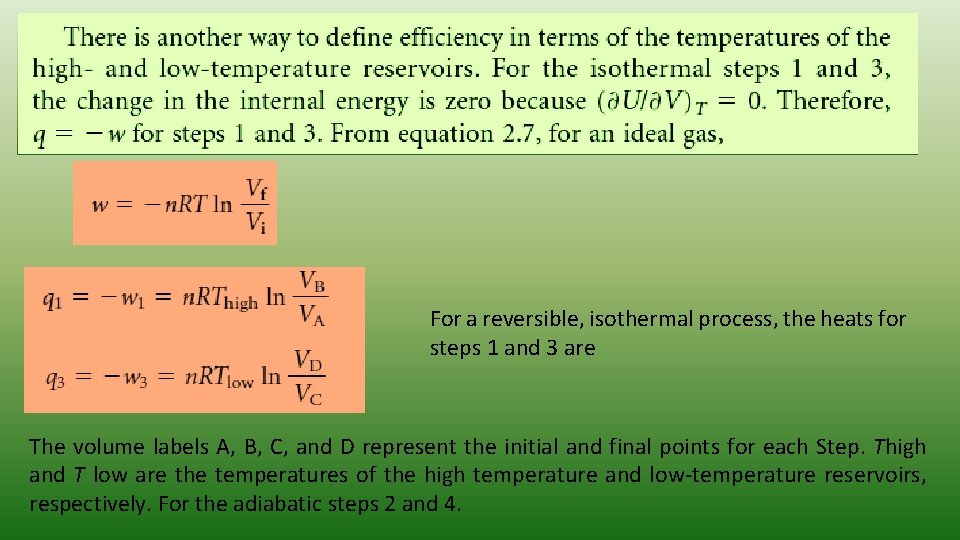
For a reversible, isothermal process, the heats for steps 1 and 3 are The volume labels A, B, C, and D represent the initial and final points for each Step. Thigh and T low are the temperatures of the high temperature and low-temperature reservoirs, respectively. For the adiabatic steps 2 and 4.
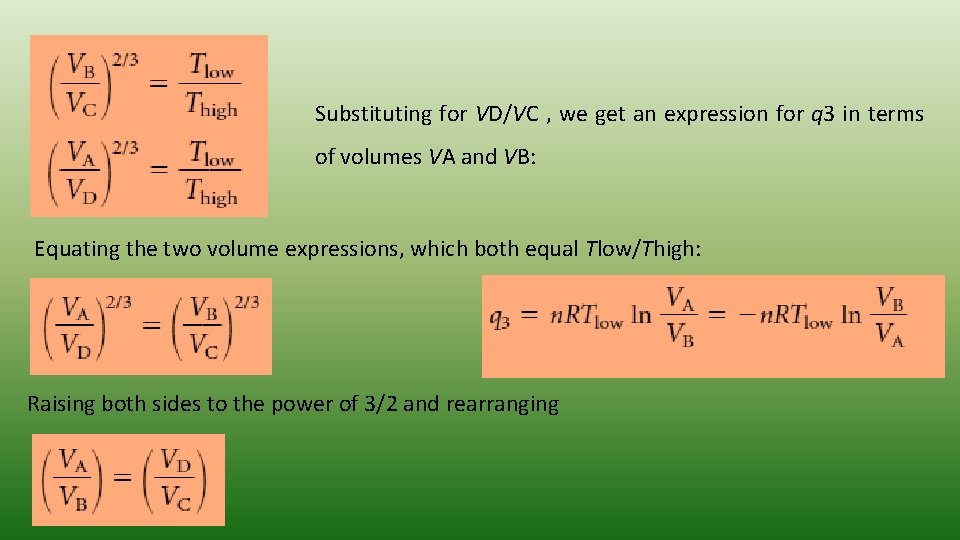
Substituting for VD/VC , we get an expression for q 3 in terms of volumes VA and VB: Equating the two volume expressions, which both equal Tlow/Thigh: Raising both sides to the power of 3/2 and rearranging
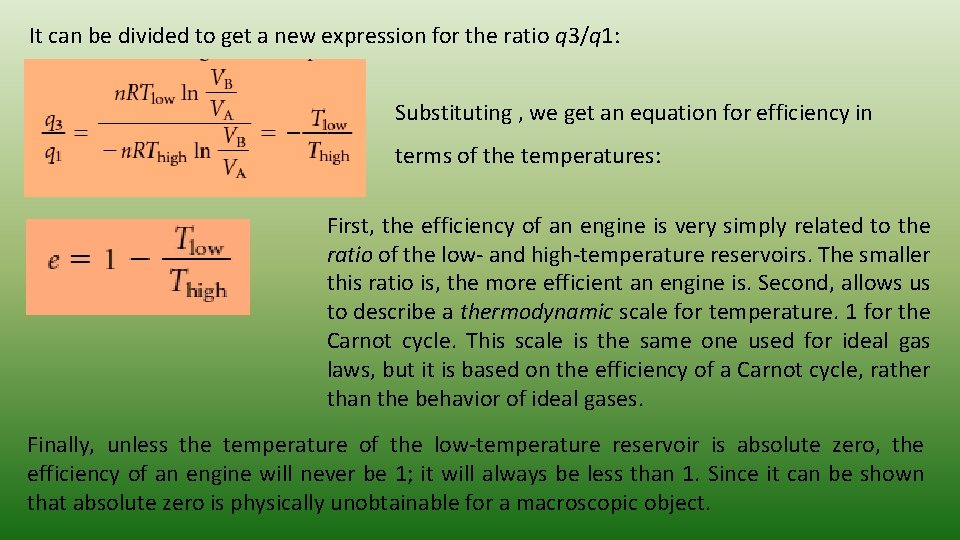
It can be divided to get a new expression for the ratio q 3/q 1: Substituting , we get an equation for efficiency in terms of the temperatures: First, the efficiency of an engine is very simply related to the ratio of the low- and high-temperature reservoirs. The smaller this ratio is, the more efficient an engine is. Second, allows us to describe a thermodynamic scale for temperature. 1 for the Carnot cycle. This scale is the same one used for ideal gas laws, but it is based on the efficiency of a Carnot cycle, rather than the behavior of ideal gases. Finally, unless the temperature of the low-temperature reservoir is absolute zero, the efficiency of an engine will never be 1; it will always be less than 1. Since it can be shown that absolute zero is physically unobtainable for a macroscopic object.
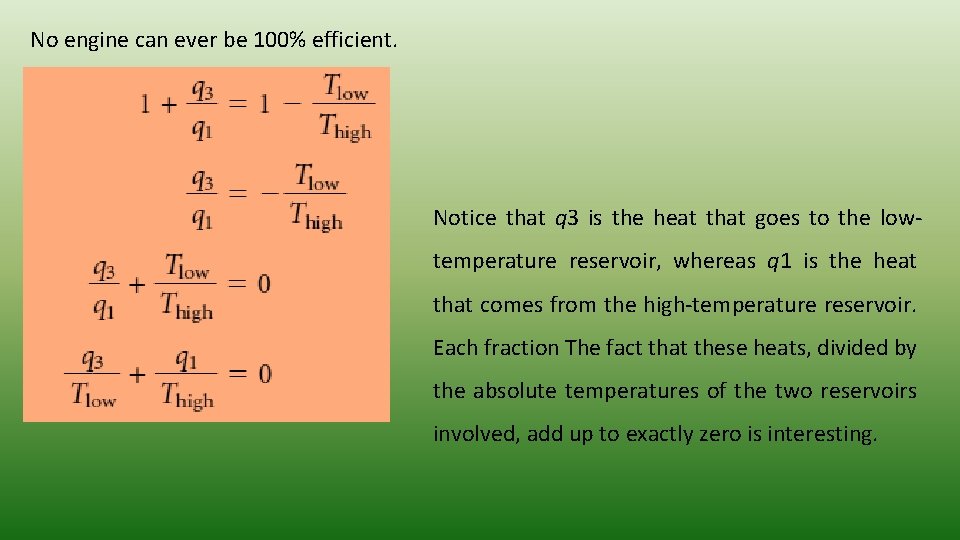
No engine can ever be 100% efficient. Notice that q 3 is the heat that goes to the lowtemperature reservoir, whereas q 1 is the heat that comes from the high-temperature reservoir. Each fraction The fact that these heats, divided by the absolute temperatures of the two reservoirs involved, add up to exactly zero is interesting.