International Girls in ICT Day Laura Kangas Europe
- Slides: 21
International Girls in ICT Day Laura Kangas, Europe Girls in ICT Coordinator International Telecommunication Union ASEM Conference Women’s Economic Empowerment: Creating Equal Opportunities in the World of Work Vilnius, Lithuania 26 May 1
About ITU ü The United Nations Specialized Agency for Information and Communication Technologies (ICTs) ü 193 Member States, 750+ Sector Members ü Founded in Paris in 1865 as the International Telegraph Union ü 2015 marked 150 years of experience and innovation ü Three sectors: • Radiocommunication • Standardization • Development 2
Gender equality and the empowerment of women and girls through ICTs ITU Resolution 70 (Rev. Busan, 2014) "Mainstreaming a gender perspective in ITU and promotion of gender equality and the empowerment of women through information and communication technologies” • Highlights the role of ICTs to advance gender equality and women’s empowerment in many ways, notably by encouraging girls to choose a career in the field of ICTs, and by fostering the use of ICTs for the social and economic empowerment of women and girls. • Calls for the celebration of International Girls in ICT Day on 4 th Thursday of April every year • Encourages Member States and Sector Members to review their policies related to the information society to ensure the inclusion of a gender perspective in all activities • Over 7, 200 events in 160 countries, empowering over 240, 000 girls and young women globally • Why? To create a global environment that encourages girls and young women to consider studies and careers in the ICT sector
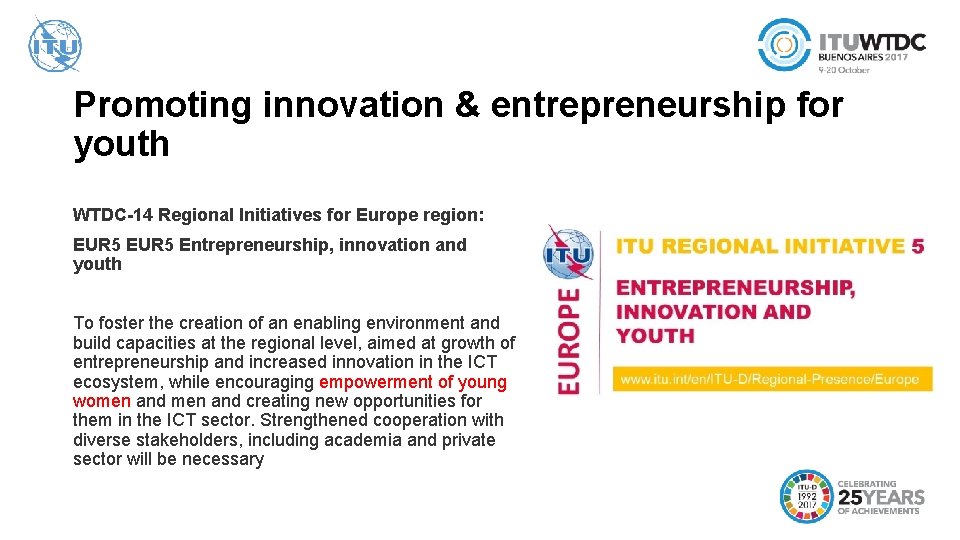
Promoting innovation & entrepreneurship for youth WTDC-14 Regional Initiatives for Europe region: EUR 5 Entrepreneurship, innovation and youth To foster the creation of an enabling environment and build capacities at the regional level, aimed at growth of entrepreneurship and increased innovation in the ICT ecosystem, while encouraging empowerment of young women and creating new opportunities for them in the ICT sector. Strengthened cooperation with diverse stakeholders, including academia and private sector will be necessary
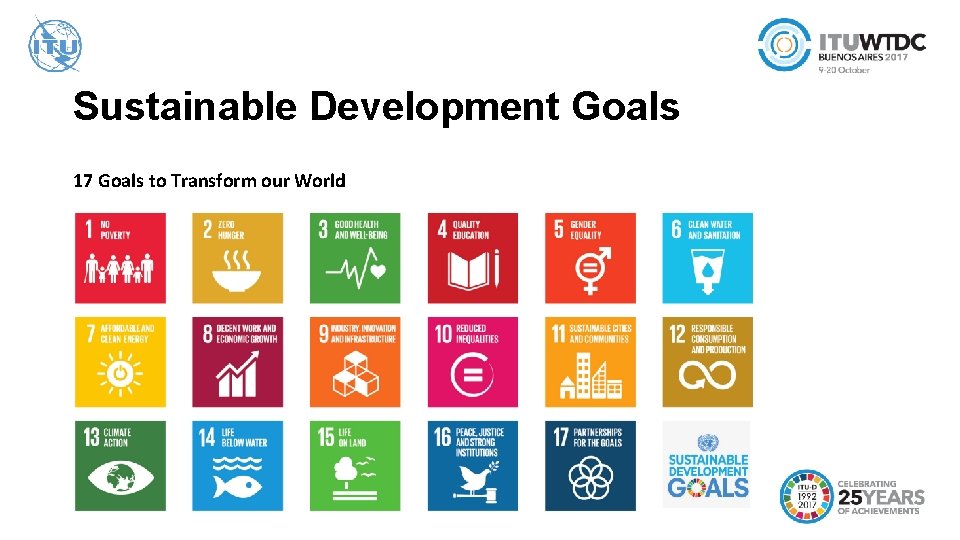
Sustainable Development Goals 17 Goals to Transform our World
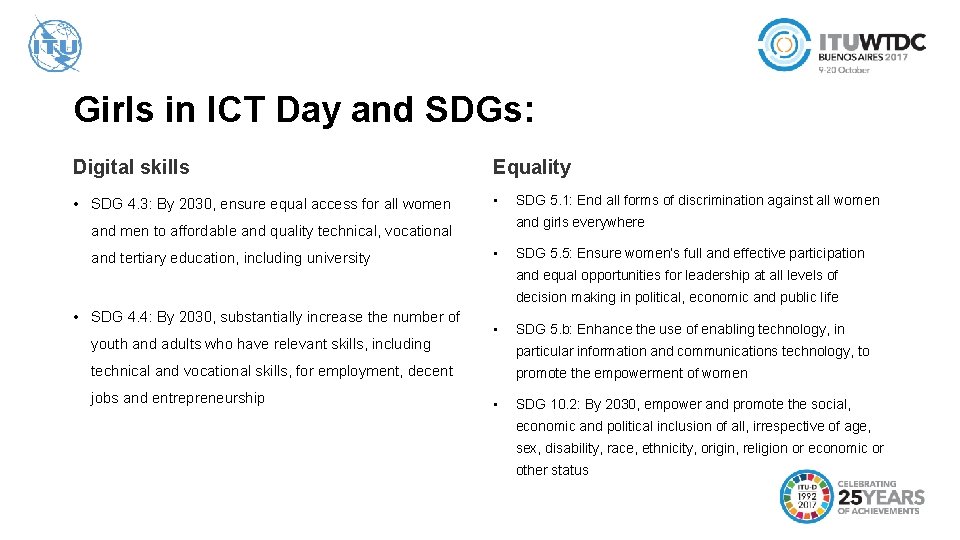
Girls in ICT Day and SDGs: Digital skills Equality • SDG 4. 3: By 2030, ensure equal access for all women • and girls everywhere and men to affordable and quality technical, vocational and tertiary education, including university SDG 5. 1: End all forms of discrimination against all women • SDG 5. 5: Ensure women’s full and effective participation and equal opportunities for leadership at all levels of decision making in political, economic and public life • SDG 4. 4: By 2030, substantially increase the number of youth and adults who have relevant skills, including • particular information and communications technology, to technical and vocational skills, for employment, decent jobs and entrepreneurship SDG 5. b: Enhance the use of enabling technology, in promote the empowerment of women • SDG 10. 2: By 2030, empower and promote the social, economic and political inclusion of all, irrespective of age, sex, disability, race, ethnicity, origin, religion or economic or other status
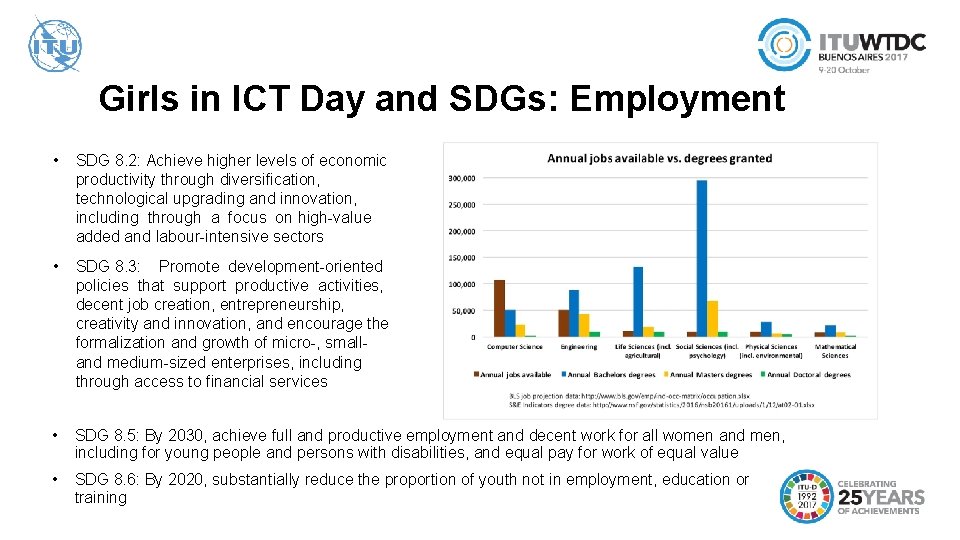
Girls in ICT Day and SDGs: Employment • SDG 8. 2: Achieve higher levels of economic productivity through diversification, technological upgrading and innovation, including through a focus on high-value added and labour-intensive sectors • SDG 8. 3: Promote development-oriented policies that support productive activities, decent job creation, entrepreneurship, creativity and innovation, and encourage the formalization and growth of micro-, small- and medium-sized enterprises, including through access to financial services • SDG 8. 5: By 2030, achieve full and productive employment and decent work for all women and men, including for young people and persons with disabilities, and equal pay for work of equal value • SDG 8. 6: By 2020, substantially reduce the proportion of youth not in employment, education or training
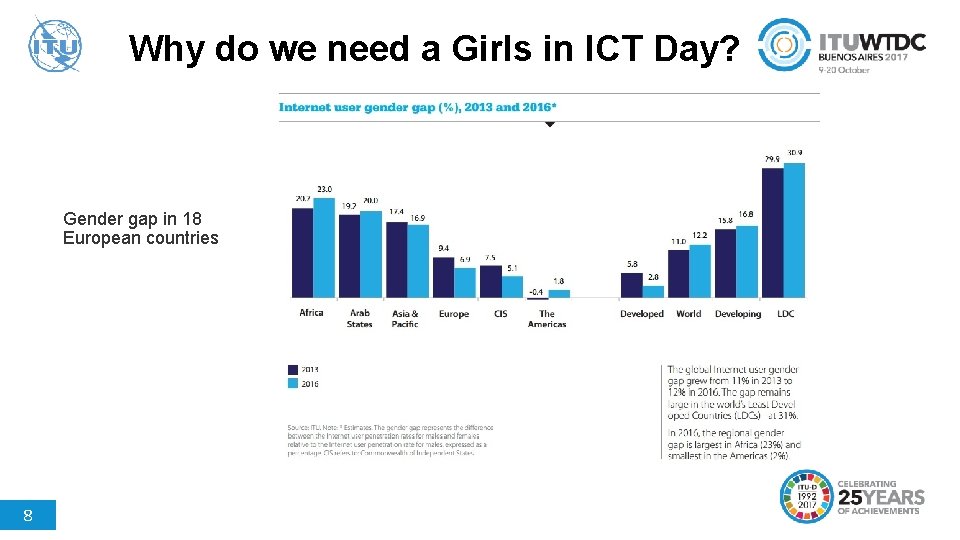
Why do we need a Girls in ICT Day? Gender gap in 18 European countries 8
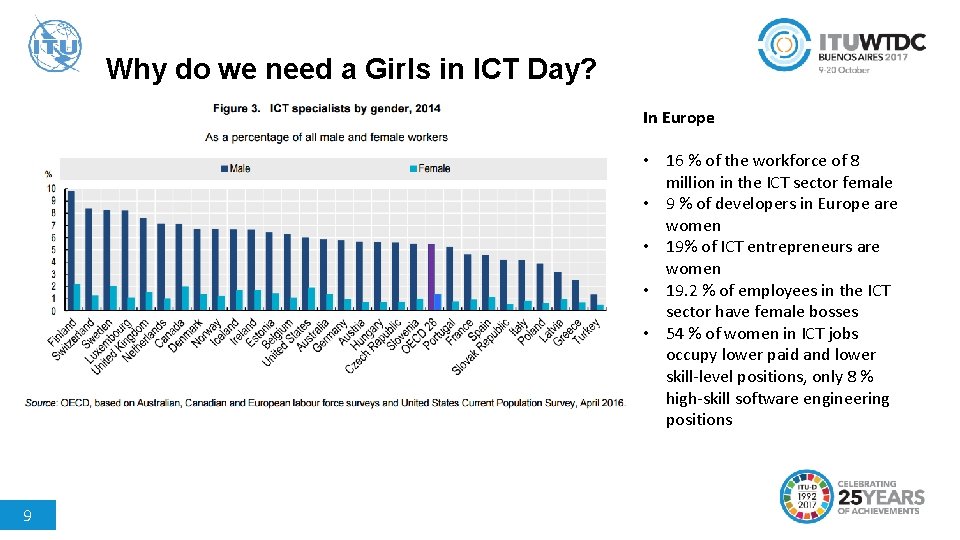
Why do we need a Girls in ICT Day? In Europe • 16 % of the workforce of 8 million in the ICT sector female • 9 % of developers in Europe are women • 19% of ICT entrepreneurs are women • 19. 2 % of employees in the ICT sector have female bosses • 54 % of women in ICT jobs occupy lower paid and lower skill-level positions, only 8 % high-skill software engineering positions 9
Why do we need Girls in ICT Day? EDUCATION: • Less than one in 20 girls considers a career in science, technology, engineering or mathematics (STEM) compared to one in five boys • 20% of graduates in the ICT field are women, 3% of all female graduates have a degree in ICT – the share has decreased the last years • Around half of female STEM graduates do not go on to work in STEM roles • 60% of school students in the EU never use digital equipment in their classroom
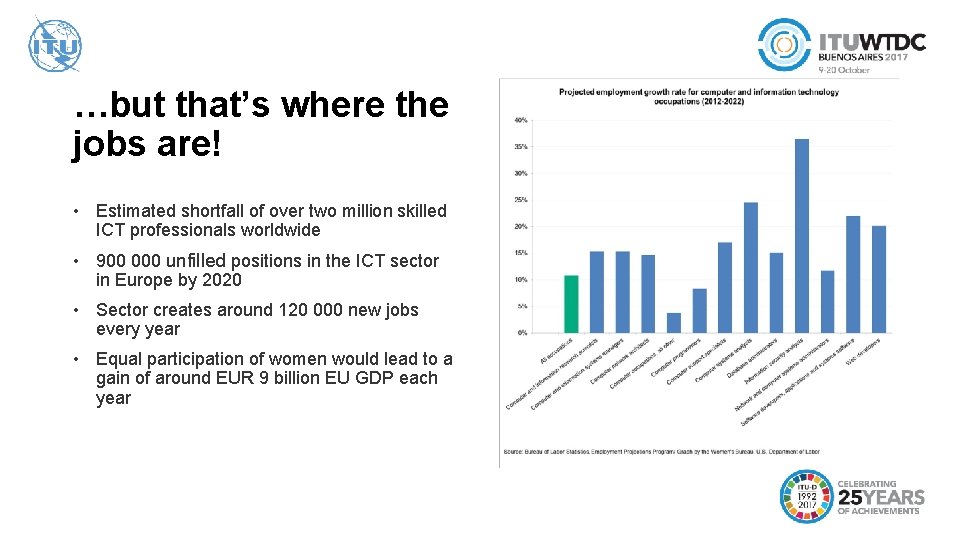
…but that’s where the jobs are! • Estimated shortfall of over two million skilled ICT professionals worldwide • 900 000 unfilled positions in the ICT sector in Europe by 2020 • Sector creates around 120 000 new jobs every year • Equal participation of women would lead to a gain of around EUR 9 billion EU GDP each year
Digital skills are increasingly important • Digital literacy has become prerequisite for employment opportunities in nearly all sectors • 95% of workers in large businesses and 85% in medium-sized businesses use the Internet as part of their jobs • over 40% of those using software at work every day do not have the skills required to use digital technologies effectively • Workers with no computer experience earn around 10% less than those with the most basic computer skills • In Europe, twelve million more digitally unskilled women than men • ICT creators are shaping our societies
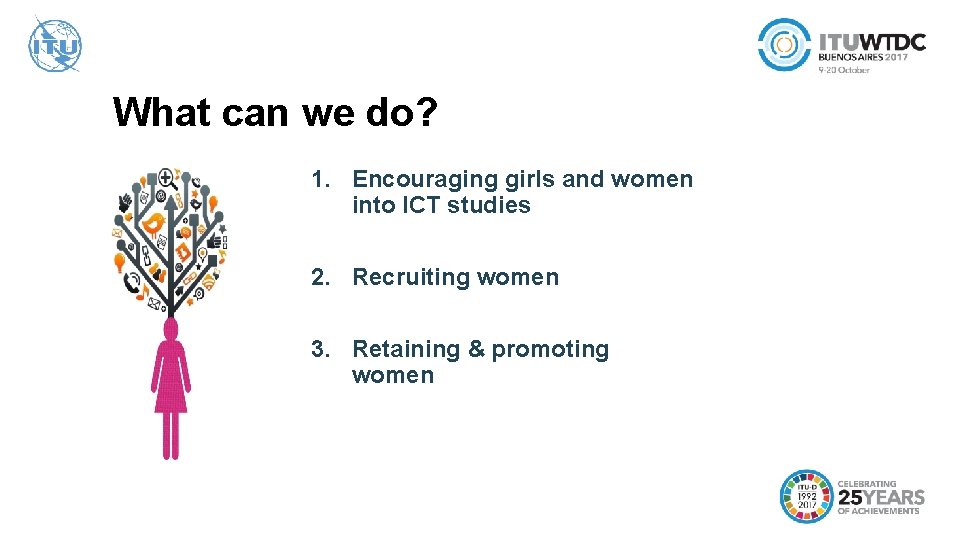
What can we do? 1. Encouraging girls and women into ICT studies 2. Recruiting women 3. Retaining & promoting women
Encouraging girls and women into ICT studies üInclude Computer Science in the school curriculum üTrain teachers and support parents üProvide female role models üInvolve students in hands-on STEM-related activities üCreate learning environments that foster inclusiveness for female students in STEM
Organize a Girls in ICT Day event! Girls in ICT Day events are organized independently or in partnerships by ITU Member States, international organizations, companies, civil society, academia or schools. A typical event would invite Girls to discover the world of ICTs through hands-on activities and information What to organize? ü Discovery tours of the company’s facilities ü Hackathons and contests ü ICT career and study fairs ü Mentoring sessions and presentations from inspiring women in ICT ü Workshops and hands-on activities: ü Robotics ü App development ü Coding ü Virtual Reality ü Creating websites
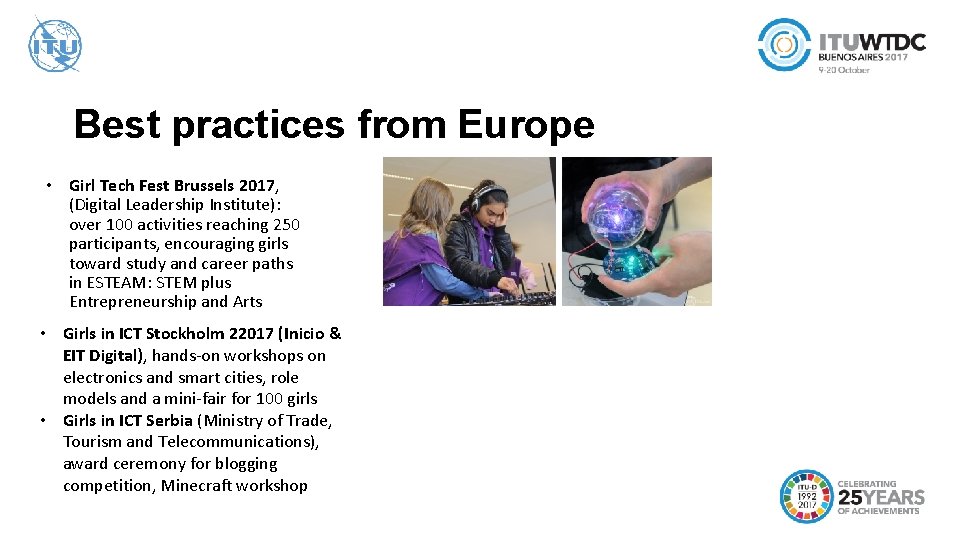
Best practices from Europe • Girl Tech Fest Brussels 2017, (Digital Leadership Institute): over 100 activities reaching 250 participants, encouraging girls toward study and career paths in ESTEAM: STEM plus Entrepreneurship and Arts • Girls in ICT Stockholm 22017 (Inicio & EIT Digital), hands-on workshops on electronics and smart cities, role models and a mini-fair for 100 girls • Girls in ICT Serbia (Ministry of Trade, Tourism and Telecommunications), award ceremony for blogging competition, Minecraft workshop
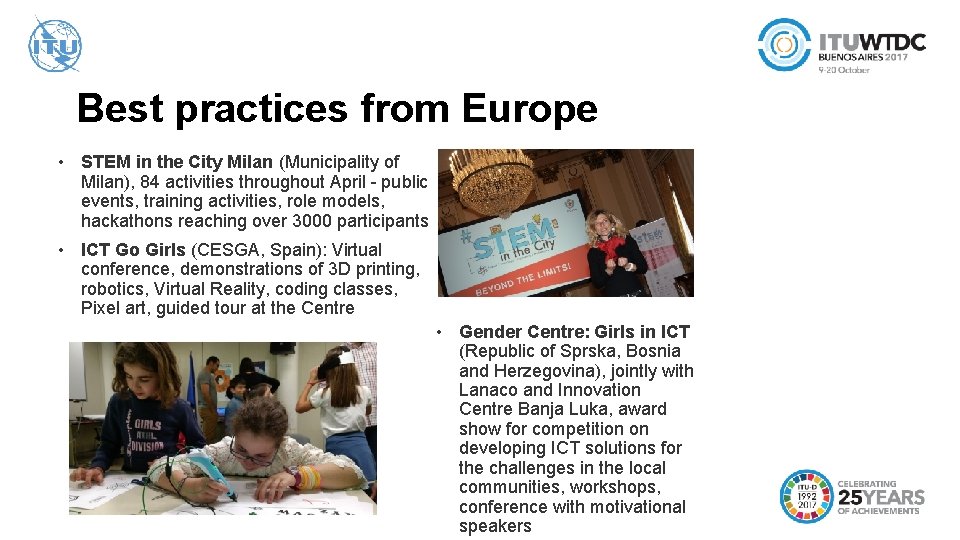
Best practices from Europe • STEM in the City Milan (Municipality of Milan), 84 activities throughout April - public events, training activities, role models, hackathons reaching over 3000 participants • ICT Go Girls (CESGA, Spain): Virtual conference, demonstrations of 3 D printing, robotics, Virtual Reality, coding classes, Pixel art, guided tour at the Centre • Gender Centre: Girls in ICT (Republic of Sprska, Bosnia and Herzegovina), jointly with Lanaco and Innovation Centre Banja Luka, award show for competition on developing ICT solutions for the challenges in the local communities, workshops, conference with motivational speakers
Best practices from Europe • Microsoft Digi. Girlz events in 11 European countries & Cisco Tech. Powers. Girls in 13 countries • Girls’ Day celebrations: Germany (over 100. 000 girls), the Netherlands (11. 000 girls), Slovakia (over 1000 girls) • Other private sector examples: Ericsson, Nokia, FDM Group, IBM
Girls in ICT Day Vilnius Regional Preparatory Meeting for WTDC-17 for Europe (RPM-EUR) & Regional Development Forum for Europe (RDF-EUR) 26 -28 April 2017 ICTs for Sustainable Development sharing national and regional strategies and policies strengthening multi-stakeholder support and partnerships ICTs for Empowering Women: Dr Danguole Rutkauskiene, Head of Young Computer User’s School at Kaunas University of Technology and Head of Working Party at National Digital Coalition, Lithuania Girls in ICT Day side event: 30 girls from schools across Lithuania, robotics workshop, Virtual Reality demonstrations, virtual conference connecting to Switzerland Lebanon, mobile quiz game, role models
Next actions and more information • Report on Europe Girls in ICT Day 2016 available on & 2017 to be published https: //www. itu. int/en/ITU-D/Regional-Presence/Europe/ • Event postings on Girls in ICT Portal www. itu. int/Girlsin. ICT • Videos available and more to come on ITU You. Tube Channel, Girls in ICT Day 2017 Playlist • WSIS Forum 2017 12 -16 June https: //www. itu. int/net 4/wsis/forum/2017/ Thematic workshops: - Women’s empowerment through ICTs organized by ITU & Partners (TBC) - How technology is being used to accelerate girls’ inclusion and access to education (particularly STEM) and improve pedagogical practices to enable critical thinking to support sustainable gender empowerment organized by e Worldwide Group - Women Engineers & Scientists in the digital economy and industry 4. 0 organized by INWES - The International Network of Women Engineers & Scientists
www. itu. int/en/ITU-D/Regional. Presence/Europe eurregion@itu. int Thank you! 21