
TFAWS Passive Thermal Paper Session PASSIVELY ACTUATED TRIANGULAR
- Slides: 17
TFAWS Passive Thermal Paper Session PASSIVELY ACTUATED, TRIANGULAR RADIATOR FIN ARRAY Josh R. Cannon, Brian D. Iverson Brigham Young University, Provo UT 84604 Wenbin Song, Rydge B. Mulford University of Dayton, Dayton OH, 45469 Presented By Josh R. Cannon Thermal & Fluids Analysis Workshop TFAWS 2020 August 18 -20, 2020 Virtual Conference
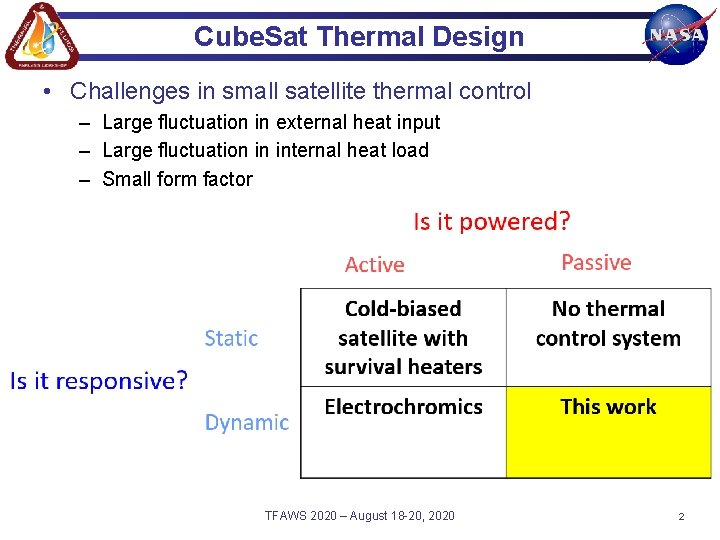
Cube. Sat Thermal Design • Challenges in small satellite thermal control – Large fluctuation in external heat input – Large fluctuation in internal heat load – Small form factor TFAWS 2020 – August 18 -20, 2020 2
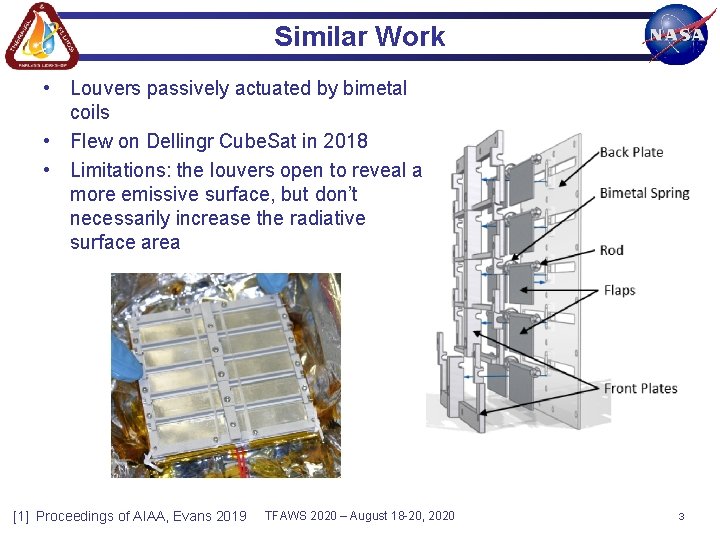
Similar Work • Louvers passively actuated by bimetal coils • Flew on Dellingr Cube. Sat in 2018 • Limitations: the louvers open to reveal a more emissive surface, but don’t necessarily increase the radiative surface area [1] Proceedings of AIAA, Evans 2019 TFAWS 2020 – August 18 -20, 2020 3
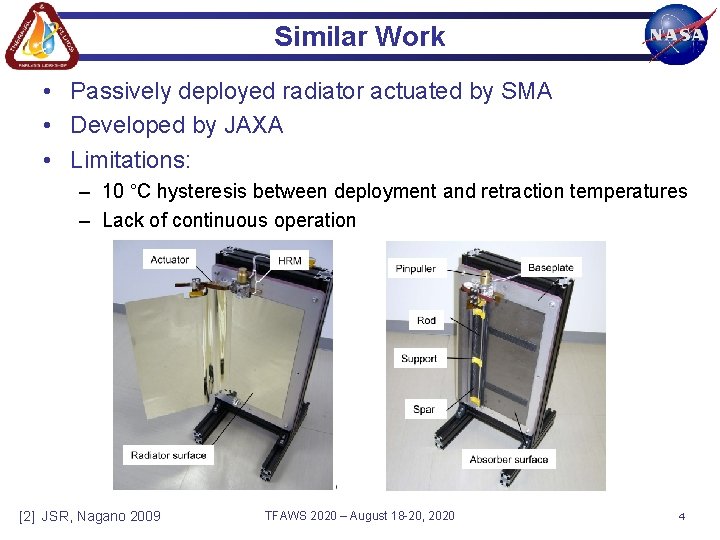
Similar Work • Passively deployed radiator actuated by SMA • Developed by JAXA • Limitations: – 10 °C hysteresis between deployment and retraction temperatures – Lack of continuous operation [2] JSR, Nagano 2009 TFAWS 2020 – August 18 -20, 2020 4
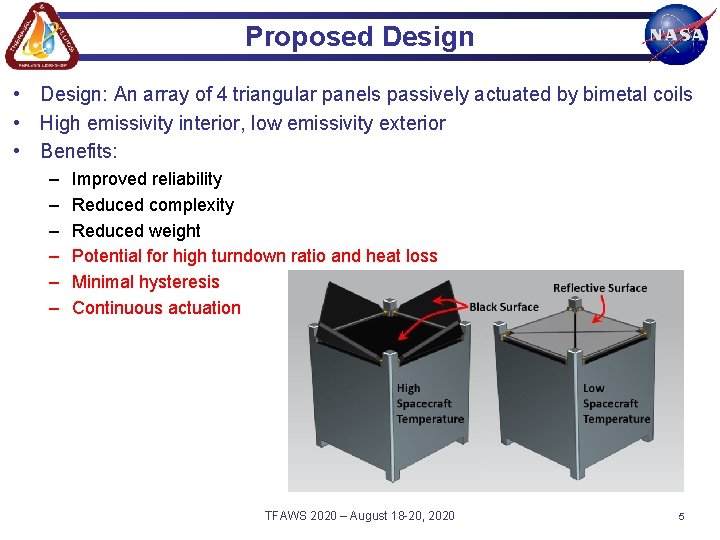
Proposed Design • Design: An array of 4 triangular panels passively actuated by bimetal coils • High emissivity interior, low emissivity exterior • Benefits: – – – Improved reliability Reduced complexity Reduced weight Potential for high turndown ratio and heat loss Minimal hysteresis Continuous actuation TFAWS 2020 – August 18 -20, 2020 5
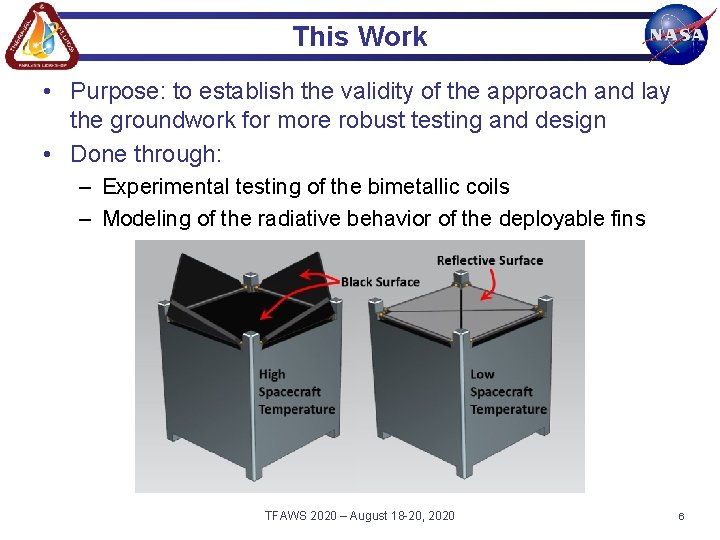
This Work • Purpose: to establish the validity of the approach and lay the groundwork for more robust testing and design • Done through: – Experimental testing of the bimetallic coils – Modeling of the radiative behavior of the deployable fins TFAWS 2020 – August 18 -20, 2020 6
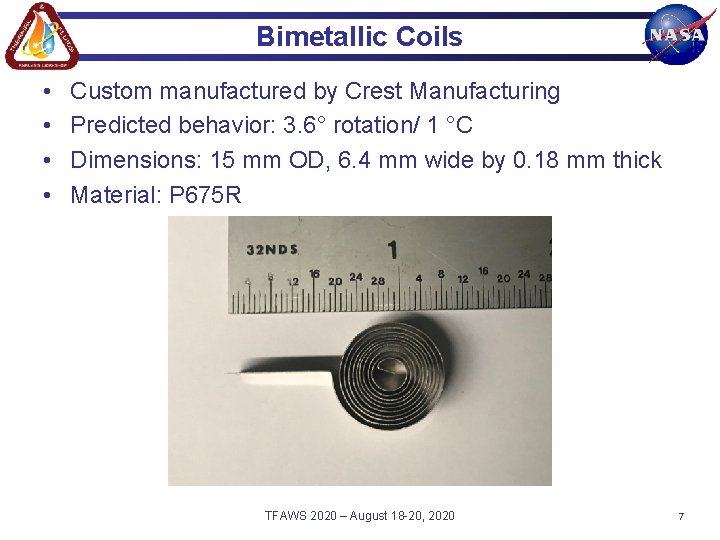
Bimetallic Coils • • Custom manufactured by Crest Manufacturing Predicted behavior: 3. 6° rotation/ 1 °C Dimensions: 15 mm OD, 6. 4 mm wide by 0. 18 mm thick Material: P 675 R TFAWS 2020 – August 18 -20, 2020 7
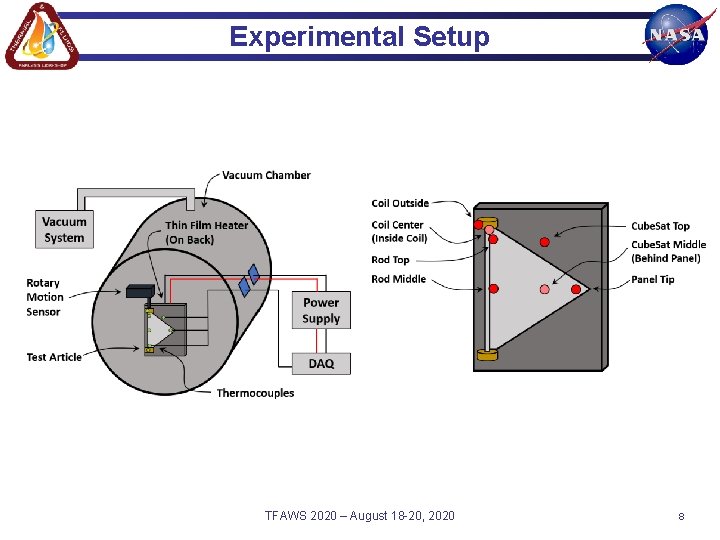
Experimental Setup TFAWS 2020 – August 18 -20, 2020 8
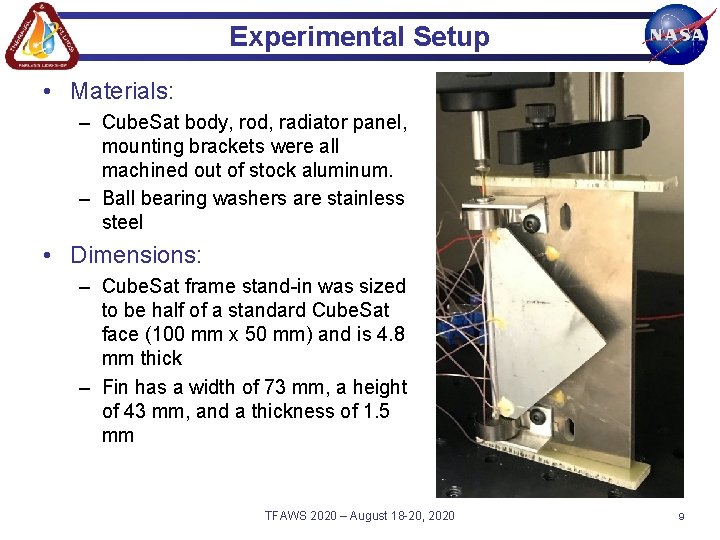
Experimental Setup • Materials: – Cube. Sat body, rod, radiator panel, mounting brackets were all machined out of stock aluminum. – Ball bearing washers are stainless steel • Dimensions: – Cube. Sat frame stand-in was sized to be half of a standard Cube. Sat face (100 mm x 50 mm) and is 4. 8 mm thick – Fin has a width of 73 mm, a height of 43 mm, and a thickness of 1. 5 mm TFAWS 2020 – August 18 -20, 2020 9
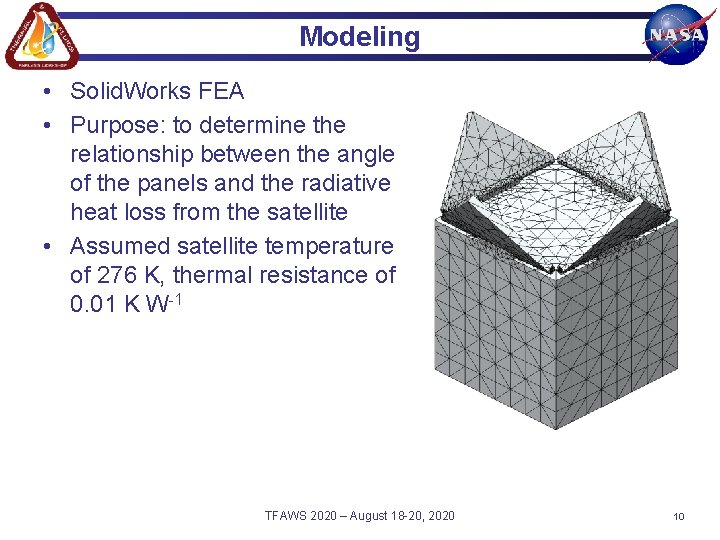
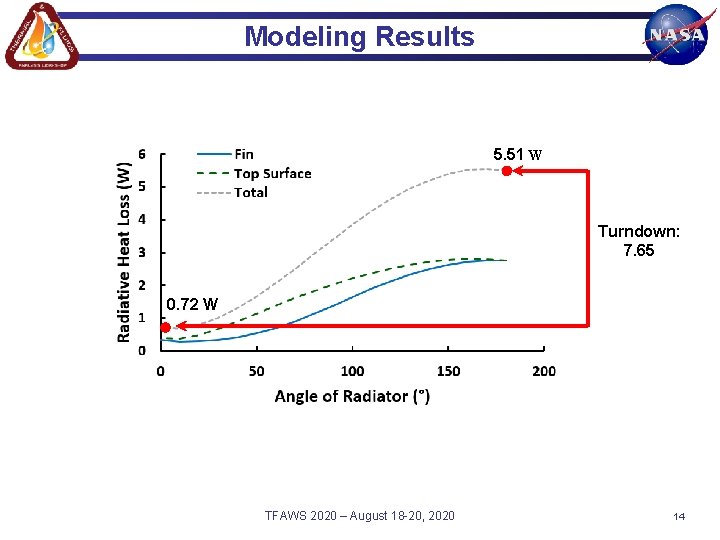
Modeling • Solid. Works FEA • Purpose: to determine the relationship between the angle of the panels and the radiative heat loss from the satellite • Assumed satellite temperature of 276 K, thermal resistance of 0. 01 K W-1 TFAWS 2020 – August 18 -20, 2020 10
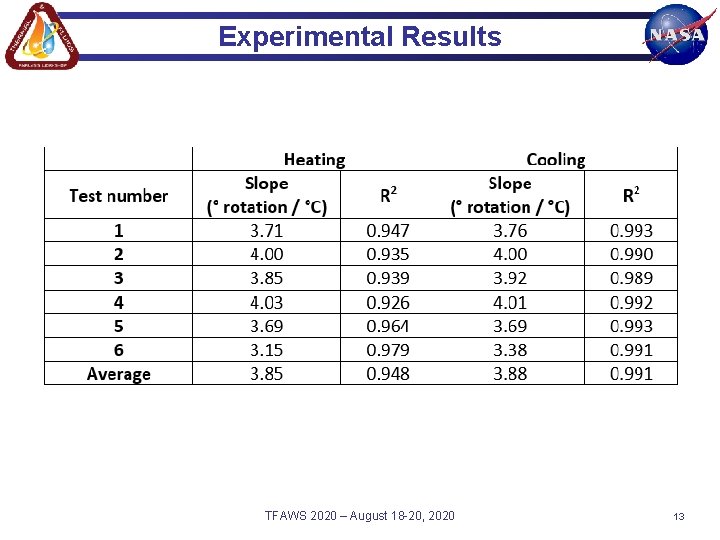
Experimental Results TFAWS 2020 – August 18 -20, 2020 11
Experimental Results TFAWS 2020 – August 18 -20, 2020 12
Experimental Results TFAWS 2020 – August 18 -20, 2020 13
Modeling Results 5. 51 W Turndown: 7. 65 0. 72 W TFAWS 2020 – August 18 -20, 2020 14
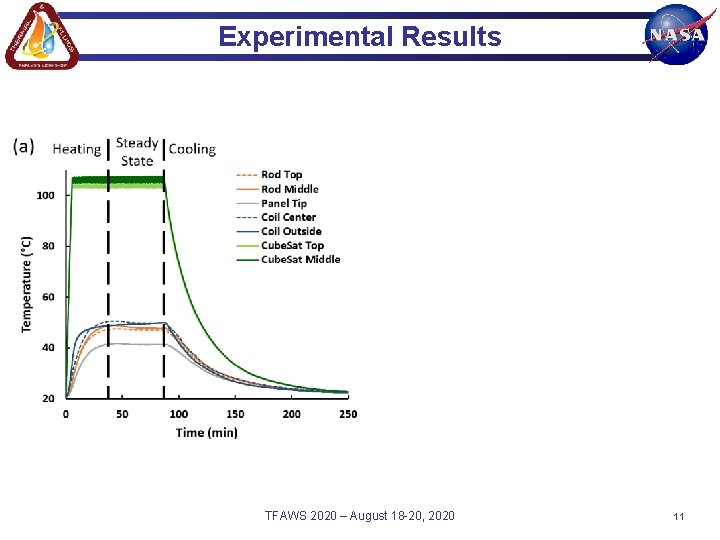
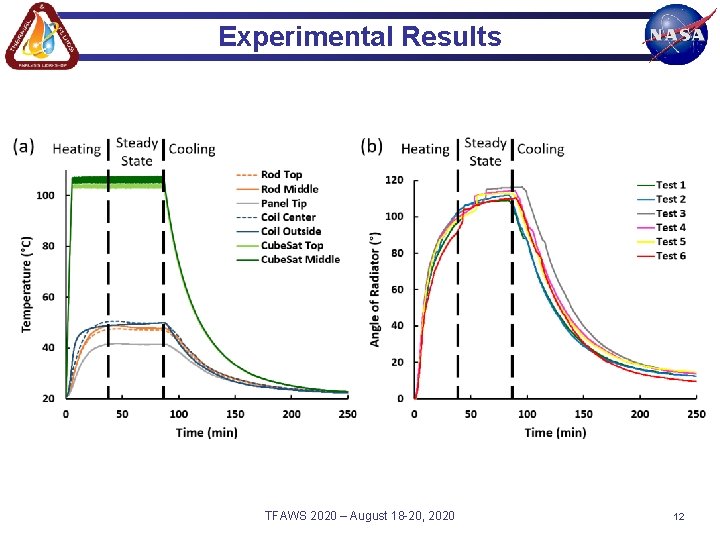
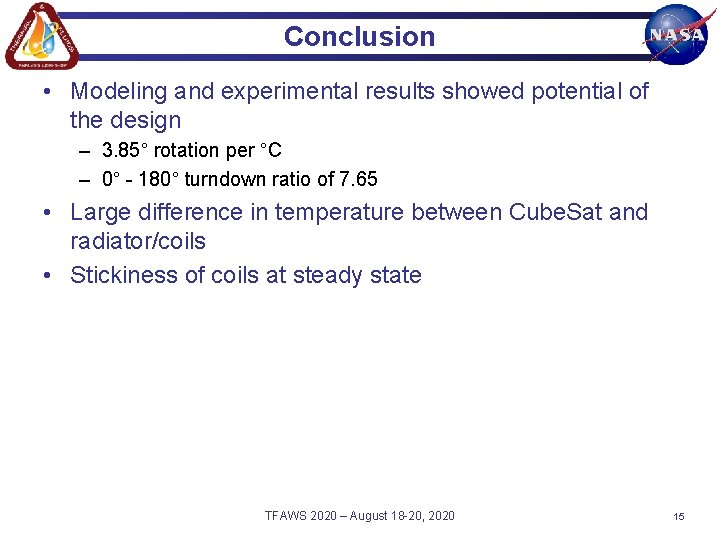
Conclusion • Modeling and experimental results showed potential of the design – 3. 85° rotation per °C – 0° - 180° turndown ratio of 7. 65 • Large difference in temperature between Cube. Sat and radiator/coils • Stickiness of coils at steady state TFAWS 2020 – August 18 -20, 2020 15
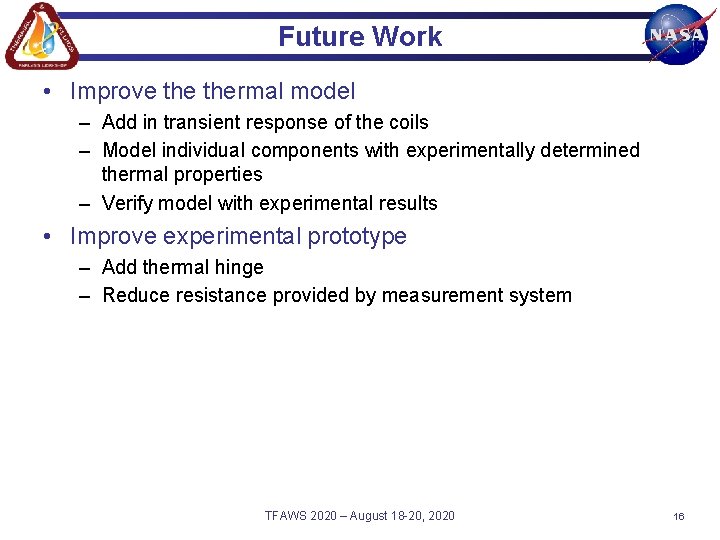
Future Work • Improve thermal model – Add in transient response of the coils – Model individual components with experimentally determined thermal properties – Verify model with experimental results • Improve experimental prototype – Add thermal hinge – Reduce resistance provided by measurement system TFAWS 2020 – August 18 -20, 2020 16
References 1. Evans, A. (2019). Design and Testing of the Cube. Sat Form Factor Thermal Control Louvers. Proceedings of the AIAA/USU Conference on Small Satellites, Technical Poster Session IV, SSC 19 -P 4 -23. https: //ntrs. nasa. gov/search. jsp? R=20190028943 2. Nagano, H. , Ohnishi, A. , Higuchi, K. , & Nagasaka, Y. (2009). Experimental Investigation of a Passive Deployable/Stowable Radiator. Journal of Spacecraft and Rockets - J SPACECRAFT ROCKET, 46, 185– 190. https: //doi. org/10. 2514/1. 30170 TFAWS 2020 – August 18 -20, 2020 17