
THE INTERNATIONAL MONETARY AND FINANCIAL ENVIRONMENT International Business
THE INTERNATIONAL MONETARY AND FINANCIAL ENVIRONMENT International Business Bluefield College March 29, 2010
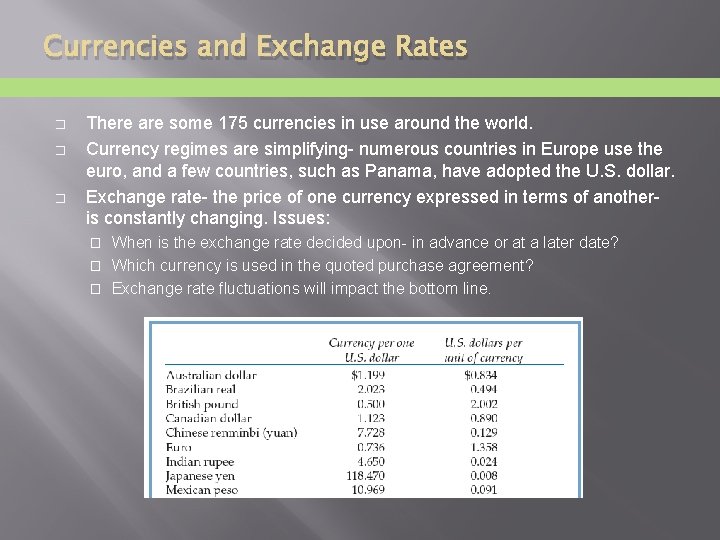
Currencies and Exchange Rates � � � There are some 175 currencies in use around the world. Currency regimes are simplifying- numerous countries in Europe use the euro, and a few countries, such as Panama, have adopted the U. S. dollar. Exchange rate- the price of one currency expressed in terms of anotheris constantly changing. Issues: When is the exchange rate decided upon- in advance or at a later date? � Which currency is used in the quoted purchase agreement? � Exchange rate fluctuations will impact the bottom line. �
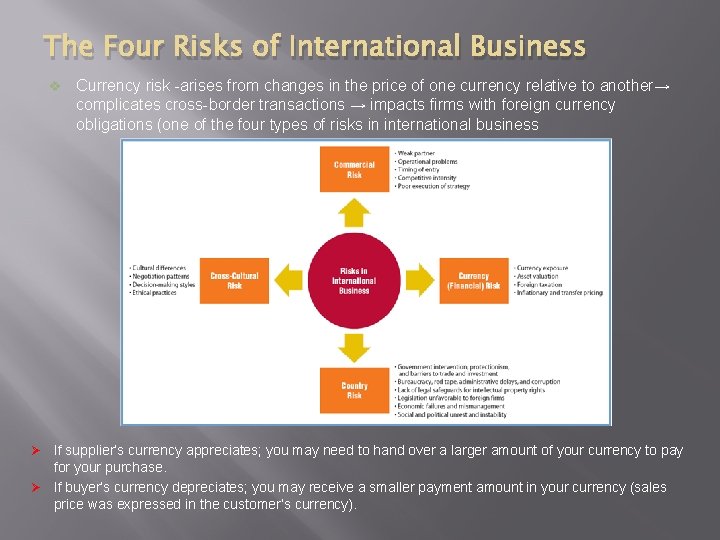
The Four Risks of International Business v Currency risk -arises from changes in the price of one currency relative to another→ complicates cross-border transactions → impacts firms with foreign currency obligations (one of the four types of risks in international business If supplier’s currency appreciates; you may need to hand over a larger amount of your currency to pay for your purchase. Ø If buyer’s currency depreciates; you may receive a smaller payment amount in your currency (sales price was expressed in the customer’s currency). Ø
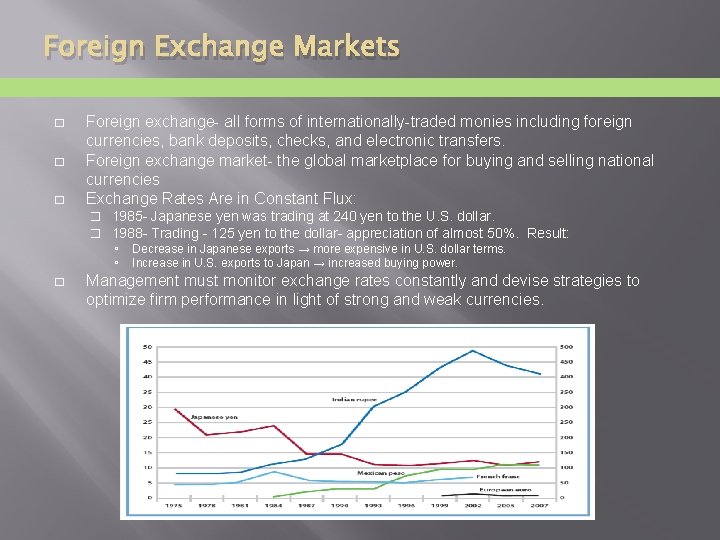
Foreign Exchange Markets � � � Foreign exchange- all forms of internationally-traded monies including foreign currencies, bank deposits, checks, and electronic transfers. Foreign exchange market- the global marketplace for buying and selling national currencies Exchange Rates Are in Constant Flux: � 1985 - Japanese yen was trading at 240 yen to the U. S. dollar. � 1988 - Trading - 125 yen to the dollar- appreciation of almost 50%. Result: Decrease in Japanese exports → more expensive in U. S. dollar terms. Increase in U. S. exports to Japan → increased buying power. � Management must monitor exchange rates constantly and devise strategies to optimize firm performance in light of strong and weak currencies.
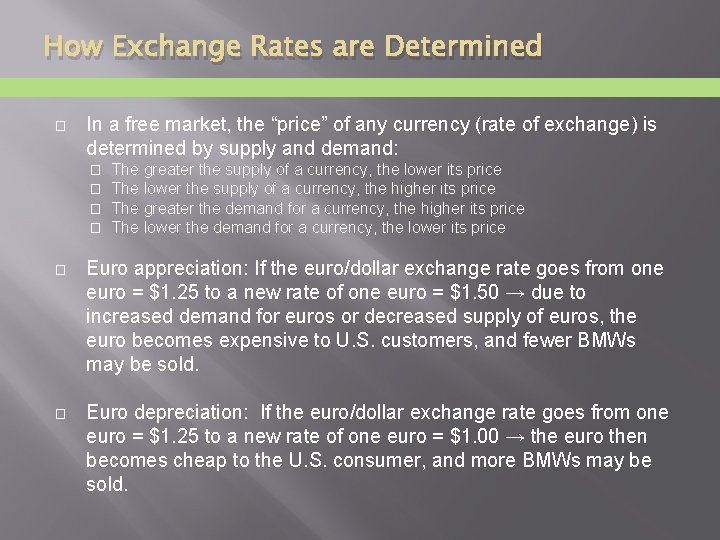
How Exchange Rates are Determined � In a free market, the “price” of any currency (rate of exchange) is determined by supply and demand: � � The greater the supply of a currency, the lower its price The lower the supply of a currency, the higher its price The greater the demand for a currency, the higher its price The lower the demand for a currency, the lower its price � Euro appreciation: If the euro/dollar exchange rate goes from one euro = $1. 25 to a new rate of one euro = $1. 50 → due to increased demand for euros or decreased supply of euros, the euro becomes expensive to U. S. customers, and fewer BMWs may be sold. � Euro depreciation: If the euro/dollar exchange rate goes from one euro = $1. 25 to a new rate of one euro = $1. 00 → the euro then becomes cheap to the U. S. consumer, and more BMWs may be sold.
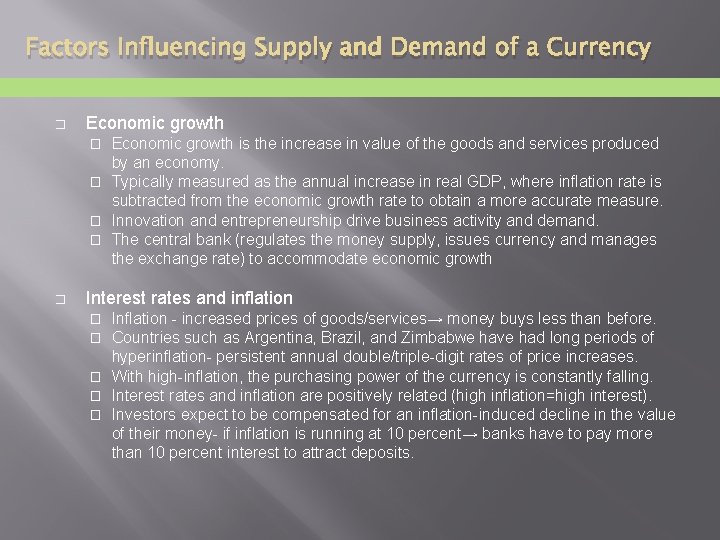
Factors Influencing Supply and Demand of a Currency � Economic growth is the increase in value of the goods and services produced by an economy. � Typically measured as the annual increase in real GDP, where inflation rate is subtracted from the economic growth rate to obtain a more accurate measure. � Innovation and entrepreneurship drive business activity and demand. � The central bank (regulates the money supply, issues currency and manages the exchange rate) to accommodate economic growth � � Interest rates and inflation Inflation - increased prices of goods/services→ money buys less than before. Countries such as Argentina, Brazil, and Zimbabwe have had long periods of hyperinflation- persistent annual double/triple-digit rates of price increases. � With high-inflation, the purchasing power of the currency is constantly falling. � Interest rates and inflation are positively related (high inflation=high interest). � Investors expect to be compensated for an inflation-induced decline in the value of their money- if inflation is running at 10 percent→ banks have to pay more than 10 percent interest to attract deposits. � �
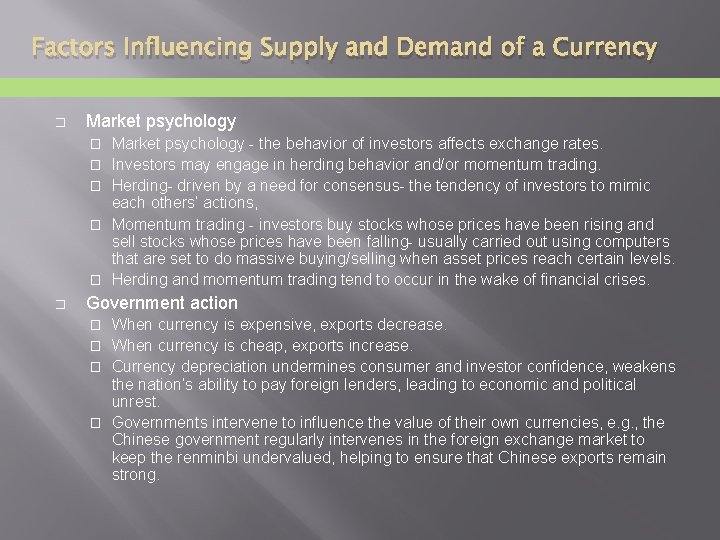
Factors Influencing Supply and Demand of a Currency � Market psychology � � � Market psychology - the behavior of investors affects exchange rates. Investors may engage in herding behavior and/or momentum trading. Herding- driven by a need for consensus- the tendency of investors to mimic each others’ actions, Momentum trading - investors buy stocks whose prices have been rising and sell stocks whose prices have been falling- usually carried out using computers that are set to do massive buying/selling when asset prices reach certain levels. Herding and momentum trading tend to occur in the wake of financial crises. Government action When currency is expensive, exports decrease. � When currency is cheap, exports increase. � Currency depreciation undermines consumer and investor confidence, weakens the nation’s ability to pay foreign lenders, leading to economic and political unrest. � Governments intervene to influence the value of their own currencies, e. g. , the Chinese government regularly intervenes in the foreign exchange market to keep the renminbi undervalued, helping to ensure that Chinese exports remain strong. �
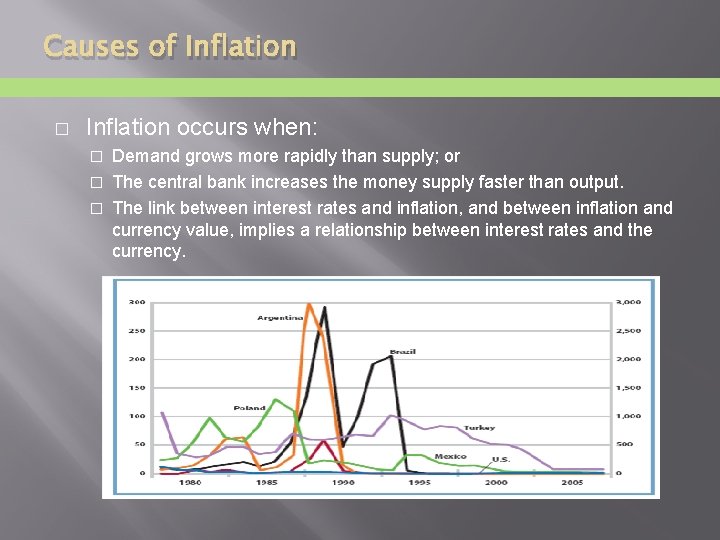
Causes of Inflation � Inflation occurs when: Demand grows more rapidly than supply; or � The central bank increases the money supply faster than output. � The link between interest rates and inflation, and between inflation and currency value, implies a relationship between interest rates and the currency. �
How Currency Affects Trade Surplus or Deficit � � � Trade surplus- country’s exports exceed its imports- may result when currency is undervalued. Trade deficit- nation's imports exceed its exports - causing a net outflow of foreign exchange. Balance of trade - the difference between the monetary value of a nation’s exports and its imports. Example- Germany exports cars to Kenya; car importer in Kenya pays the exporter in Germany, resulting in a surplus item in Germany’s balance of trade and a deficit in Kenya’s balance of trade. If the total value of Kenya’s imports from Germany is greater than the total value of Kenya’s exports to Germany, then Kenya would have a trade deficit with Germany.
Managing Balance of Payments � � Balance of trade drivers: prices of goods manufactured at home, exchange rates, trade barriers, and the method used by the government to measure the trade balance. � Devaluation- is a government action to reduce the official value of its currency, relative to other currencies- aimed at deterring imports and reducing the trade deficit. � Balance of payments- is the nation’s balance sheet of trade, investment, and transfer payments with the rest of the world. It represents the difference between the total amount of money coming into and going out of a country. Balance of payments is also affected by: citizens donating money to a foreign charity; government providing foreign aid; tourists spending money abroad.
The Modern Exchange Rate System � � � The years before World War II were characterized by turmoil in the world economy- despite decades of rising international trade. The Great Depression and the war witnessed a collapse of the international trading system. Following the war, countries initiated a framework for international monetary and financial systems stability. 1944 - 44 countries negotiated and signed the Bretton Woods agreement. Bretton Woods accord (fixed exchange rate system) pegged the value of the U. S. dollar to an established value of gold, at a rate of $35 per ounce. The U. S. government agreed to buy and sell unlimited amounts of gold in order to maintain this fixed rate.
The Bretton Woods Agreement � Each of Bretton Woods’ other signatories agreed to establish a par value of its currency in terms of the U. S. dollar and to maintain this pegged value through central bank intervention. � The Bretton Woods system kept exchange rates of major currencies fixed at a prescribed level, relative to the U. S. dollar and to each other. � Demise of Bretton Woods (1960 s) Rising government spending stimulated the economy and U. S. citizens began spending more on imported goods, aggravating the U. S. balance of payments. � The U. S. acquired trade deficits with Japan, Germany, and other European countries- eventually demand for U. S. dollars exceeded their supply so that the U. S. government could no longer maintain an adequate stock of gold. � This situation put pressure on governments in Europe, Japan, and the U. S. to revalue their currencies, a solution that nobody wanted. � 1971 - President Nixon suspended the link between the U. S. dollar and gold and withdrew the U. S. promise to exchange gold for U. S. dollars = this was the end of the Bretton Woods system. �
The World Bank � � � World Bank: An international agency that provides loans and technical assistance to low and middleincome countries with the goal of reducing poverty. Bretton Woods established the importance of currency convertibility, in which all countries adhere to a system of multilateral trade and currency conversion. Member countries agree to refrain from imposing restrictions on currency trading and agree not to engage in discriminatory currency arrangements. This principle is an important aspect of the trend toward global free trade that the world is experiencing today.
The Exchange Rate System Today � � � Following the Bretton Woods collapse, major currencies were freely traded, with their value floating according to supply and demand. The official price of gold was formally abolished. Fixed and floating exchange rate systems were given equal status. Countries were no longer compelled to maintain specific pegged values for their currency. Current exchange rate systems: the floating and fixed systems
Exchange Rate Systems � The Fixed Exchange Rate System � � � � The value of a currency is set relative to the value of another at a specified rate (or the value of a basket of currencies). It is the opposite of the floating exchange rate system. As the reference currency value rises and falls, so does the pegged currency. Many developing economies and some emerging markets use this system. To maintain the peg, the governments of these countries intervene in currency markets to buy and sell dollars and other currencies, in order to maintain the exchange rate at a fixed, preset level. Advantages: greater stability, predictability of exchange rate movements, promotes greater certainty and stability within a nation’s economy. Dirty float - hybrid- At times, countries adhere to neither system, but try to hold the value of their currency within some range - the currency value is determined by market forces, but the central bank intervenes occasionally in the foreign exchange market to maintain the value of its currency relative to a major reference currency.
Exchange Rate Systems � The Floating Exchange Rate System Most advanced economies use the floating exchange rate system. � Each nation’s currency floats independently, according to market forces without government intervention. � If a country is running a trade deficit, the floating rate system allows for this to be corrected more naturally than on a fixed exchange rate regime. � � Which Exchange Rate System Is Preferred? � Many economists believe floating exchange rates are preferable to fixed exchange rates because floating rates more naturally respond to, and represent, the supply and demand for currencies in the foreign exchange market.
International Monetary & Financial Systems � � � International monetary system refers to the institutional framework, rules, and procedures by which national currencies are exchanged for one another. Global financial system refers to the collection of financial institutions that facilitate and regulate the flows of investment and capital funds worldwideit incorporates the national and international banking systems, the international bond market, all national stock markets, and the market of bank deposits denominated in foreign currencies. Key players - finance ministries, national stock exchanges, commercial banks, central banks, the Bank for International Settlements, the World Bank, and the International Monetary Fund. The international monetary system governs exchange rates that affect the financial activities of governments and businesses. Example- if a U. S. investor buys stocks on the London Stock Exchange, the exchange rate of the British pound to the U. S. dollar will impact earnings.
Global Financial System � � � The global financial system is built on the activities of firms, banks, and financial institutions, all engaged in ongoing international financial activity. 1960 s (since) - grown in volume and structure, becoming more efficient, competitive, and stable- 1990 s accelerated with the opening of Russia/China. Massive cross-national flows of capital- mostly in the form of pension funds, mutual funds, and life insurance investments- are driving equity markets. 1960 s- FDI-related funds; New Trend- portfolio investments abroad 2005 – 15% of U. S. equity funds invested in foreign stocks. Financial Flows � � � Advantages of financial flows- developing economies- increases their foreign exchange reserves, reduces their cost of capital, and stimulates local financial markets. The growing integration of financial and monetary global activity is due to: The evolution of monetary and financial regulations worldwide. The development of new technologies and payment systems, and the use of the Internet in global financial activities. Increased global and regional interdependence of financial markets. The growing role of single-currency systems such as the euro.
Risks in Global Financial Flows � � Financial risks linked to the globalization of financial flows: Capital flows are much more volatile than FDI-type investments. It is much easier for investors to withdraw and reallocate liquid capital funds than FDI funds, which are directly tied to factories and other permanent operations. Contagion: tendency of a financial or monetary crisis in one country to spread rapidly to others due to worldwide financial integration (e. g. crisis in East Asia in the late 1990 s- capital flight made an already dire economic crisis worse). Financial instability is worsened when governments fail to adequately regulate and monitor their banking and financial sectors.
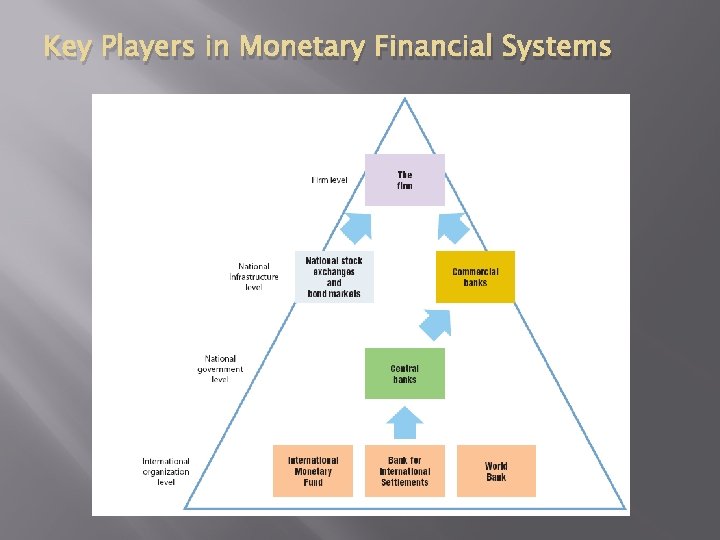
Key Players in Monetary Financial Systems
Key Players in Monetary Financial Systems � The Firm Cross-border transactions require firms to deal with sums of foreign exchange. International customers make payments to firms. Firms must convert foreign earnings, investment, franchising, licensing or speculation (profiting from exchange rate fluctuations). � Other international players- life insurance companies, savings and loan associations, stockbrokers that manage pensions and mutual funds, nontraditional financial institutions, e. g. Western Union. � � National Stock Exchanges � � � � Stock exchange -facility for the trading of securities- shares, trust funds, pension funds, and corporate/government bonds. IT has revolutionized stock market functioning- with many electronic exchanges Each country sets its own rules for issuing and redeeming stock. Trade on a stock exchange is by members only. MNEs - list on a number of exchanges to maximize access to capital. Capital structure of markets varies, and becoming increasingly integrated: Japan- most shares held by corporations Britain and the U. S. - most shares held by individuals
Key Players in Monetary Financial Systems � Bond Markets Bonds- debt that corporations and governments incur by issuing interestbearing certificates in order to raise capital and finance long-term investments. � Example- Several European telecommunications providers, such as Telecom Italia, Deutsche Telecom, and France Telecom issued international bonds. � Institutional investors—managers of pensions, mutual funds, and insurance companies- most important players today- drive global capital markets. � Example- the Government Pension Investment Fund of Japan, one of the world’s largest, has over $1 trillion of assets. � � Commercial Banks- most important function- lend money to finance business activity, play a key role in nations’ money supplies, and exchange foreign currencies. � Commercial banks- e. g. Bank of America, Mizuho Bank in Japan, and BBVA in Spain- circulate money and engage in a wide range of international transactions. � Banks- regulated by national and local governments, which have a strong interest in ensuring the solvency of their national banking system. �
More on Banks � Types of Banks � � � � Investment banks underwrite sale of stocks/bonds; advise on mergers. Merchant banks -provide capital to firms in the form of shares. Private banks manage the assets of the very rich. Offshore banks- located in low taxation/regulation jurisdictions Commercial banks deal mainly with corporations or large businesses. Many banks are MNEs themselves, such as Citibank Smaller banks participate in international business by interacting with larger, correspondent banks (large bank that maintains relations with other banks). Banks As Key Players In some countries, banks are owned by the state and are extensions of government; in other countries, banks face little regulation. � Density of banks is another distinction: � Canada, Sweden, and the Netherlands each has only five banks controlling more than 80% of all banking assets. Germany, Italy, and the U. S. - the top five banks control less than 30% of all banking assets � Banks also charge different rates for their services: Italy - the annual price of core banking services- over $300 U. S. - $150 China and the Netherlands - $50
Key Players in Monetary Financial Systems � Central Banks Regulate the money supply and credit, issues currency, manages the rate of exchange and controls the financial reserves held by private banks. � It implements monetary policy by increasing or decreasing the money supply through: � Buying and selling money in the banking system; Setting interest rates to commercial banks; or Buying and selling government securities. � The Bank for International Settlements 1930 - Established- is an international organization based in Basel, Switzerland. � Banking services- central banks and assists with monetary policy development. � Ensures that central banks maintain reserve assets and capital/asset ratios above prescribed international minimums- to avoid overindebtedness. �
Key Players in Monetary Financial Systems � The International Monetary Fund (IMF) Headquartered in Washington, D. C. , IMF determines the code of behavior for the international monetary system. � It promotes international monetary cooperation, exchange rate stability, and encourages countries to adopt sound economic policies- critical functions. � Governed by 184 countries, the IMF stands ready to provide financial assistance in the form of loans and grants to support policy programs intended to correct macroeconomic problems. � The IMF’s Role in Handling Monetary Crises: �
The IMF’s Role in Handling Monetary Crises � Currency crisis � � Results when the value of a nation’s currency depreciates sharply or when its central bank must expend substantial reserves to defend the value of its currency, pushing up interest rates. Banking crisis: Results when domestic and foreign investors lose confidence in a nation’s banking system, leading to widespread withdrawals of funds. � Banking crises usually occur in developing economies with inadequate regulatory/institutional frameworks- and can lead to exchange rate fluctuations, inflation, abrupt withdrawal of FDI funds, and economic instability. � � Foreign debt crisis When national governments borrow excessive amounts of money from banks or sell government bonds. � Governments draw huge sums out of the national money supply, which reduces the availability of these funds to consumers and firms. �
Key Players in Monetary Financial Systems � The World Bank Originally known as the International Bank for Reconstruction and Development, the initial purpose of the World Bank was to provide funding for the reconstruction of Japan and Europe following World War II. � World Bank- aims to reduce world poverty- is active in a range of development projects- water, electricity, and transportation infrastructure. � World Bank is a specialized agency of the United Nations and has more than 100 offices worldwide. (184 member countries are jointly responsible for World Bank financing) � Agencies of the World Bank � The International Development Association loans billions of dollars each year to the world’s poorest countries. The International Finance Corporation works with the private sector to promote economic development. The Multilateral Investment Guarantee Agency encourages FDI to developing countries by providing guarantees against noncommercial losses.
- Slides: 27