Production THE CINEMATOGRAPHER THE SHOTS THE ANGLES AND

- Slides: 158
Production THE CINEMATOGRAPHER: THE SHOTS, THE ANGLES, AND THE COLOR
Photography: The Cinematographer Nestor Almendros won the Oscar for cinematography for Terrence Malick’s 1978 film Days of Heaven, shot mainly during “magic hour. ” The Cinematographer • Primary responsibility for the look of a film, for the way it is photographed, and for the lighting • Sometimes works closely with the director • Sometimes is given almost total control over his or her area of expertise
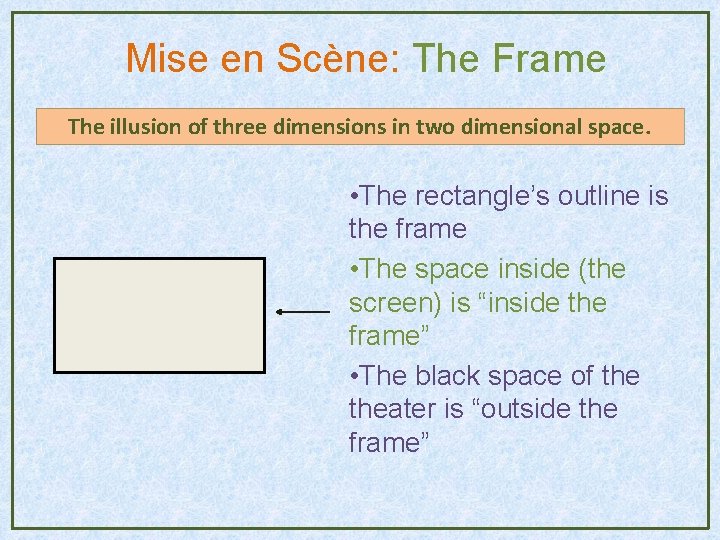
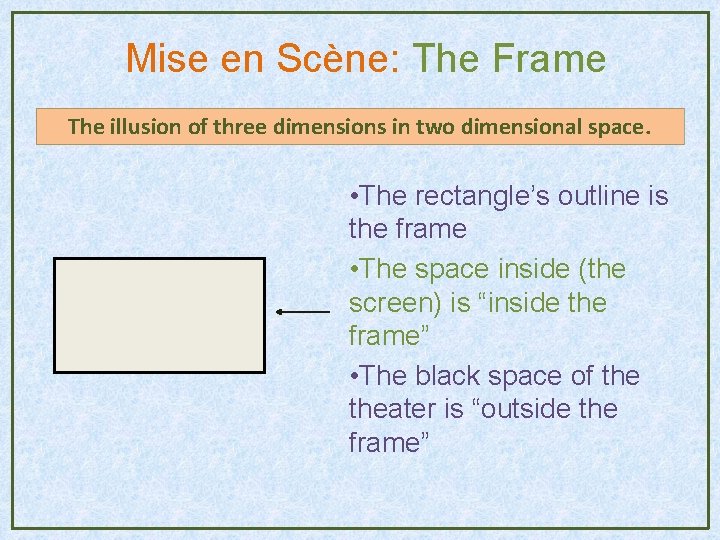
Mise en Scène: The Frame The illusion of three dimensions in two dimensional space. • The rectangle’s outline is the frame • The space inside (the screen) is “inside the frame” • The black space of theater is “outside the frame”
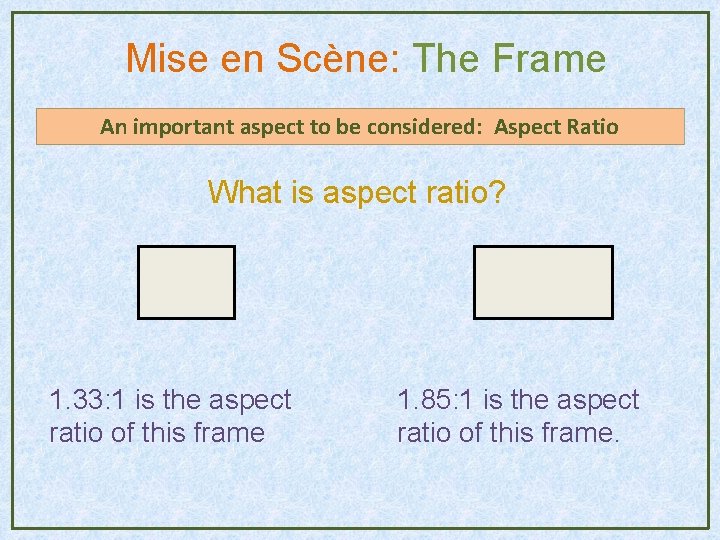
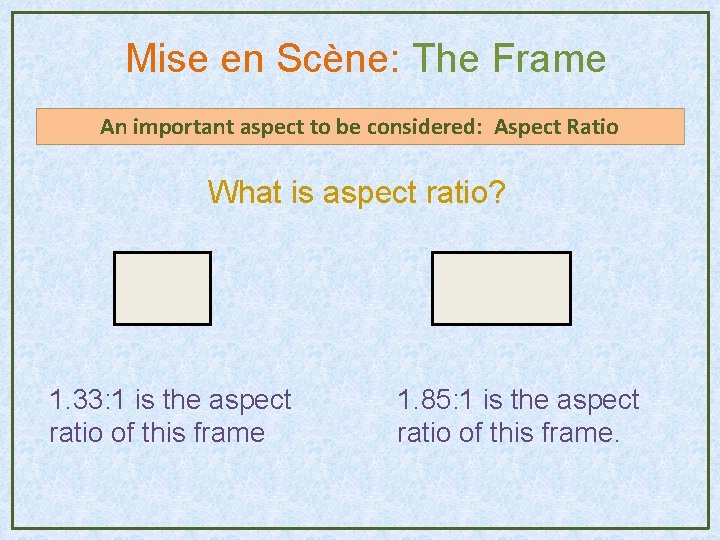
Mise en Scène: The Frame An important aspect to be considered: Aspect Ratio What is aspect ratio? 1. 33: 1 is the aspect ratio of this frame 1. 85: 1 is the aspect ratio of this frame.
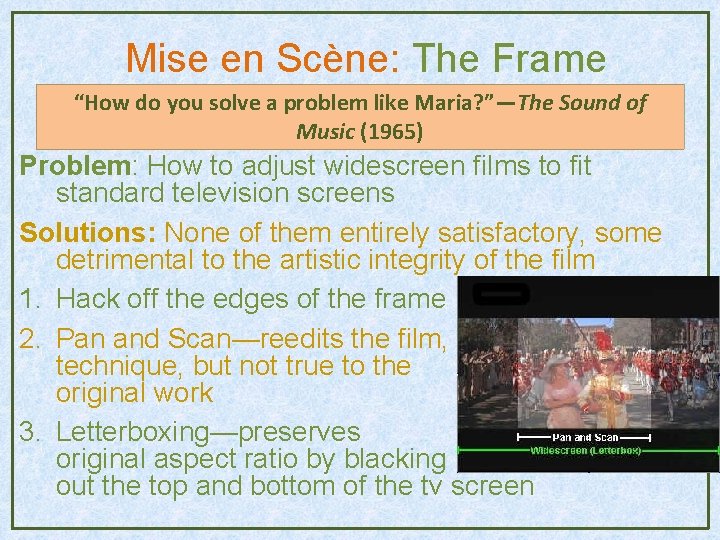
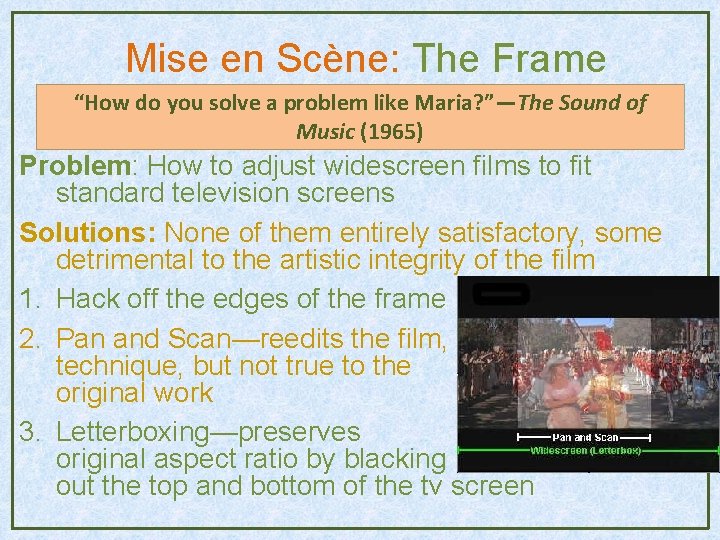
Mise en Scène: The Frame “How do you solve a problem like Maria? ”—The Sound of Music (1965) Problem: How to adjust widescreen films to fit standard television screens Solutions: None of them entirely satisfactory, some detrimental to the artistic integrity of the film 1. Hack off the edges of the frame 2. Pan and Scan—reedits the film, a less arbitrary technique, but not true to the original work 3. Letterboxing—preserves original aspect ratio by blacking out the top and bottom of the tv screen
Photography: Language • Frame = 1 picture of film • • Most film is shot at 24 fps (frames per second) word • Shot = 1 uninterrupted segment of film • sentence • Scene = 1 segment of a film that takes place in a specific place and lasts until time or location changes • paragraph
Photography: The Shots The distance of the camera from the subject or the amount of subject matter included within the frame. Six Basic Shots 1. Extreme long shot (ELS) 2. Long shot (LS) 3. Full shot (FS) 4. Medium shot (MS) 5. Close-up (CU) 6. Extreme close-up (ECU)
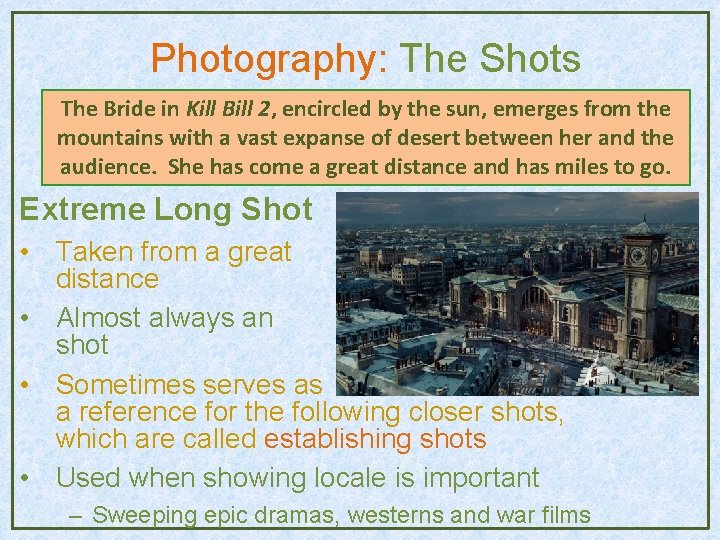
Photography: The Shots The Bride in Kill Bill 2, encircled by the sun, emerges from the mountains with a vast expanse of desert between her and the audience. She has come a great distance and has miles to go. Extreme Long Shot • Taken from a great distance • Almost always an exterior shot • Sometimes serves as a reference for the following closer shots, which are called establishing shots • Used when showing locale is important – Sweeping epic dramas, westerns and war films
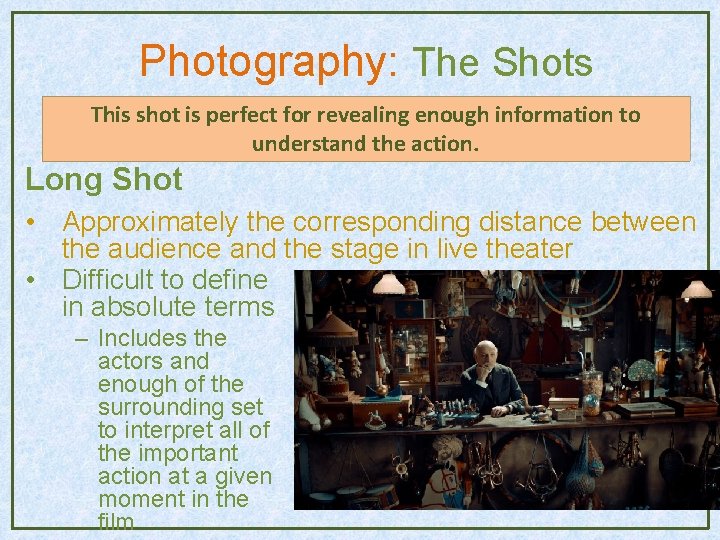
Photography: The Shots This shot is perfect for revealing enough information to understand the action. Long Shot • Approximately the corresponding distance between the audience and the stage in live theater • Difficult to define in absolute terms – Includes the actors and enough of the surrounding set to interpret all of the important action at a given moment in the film
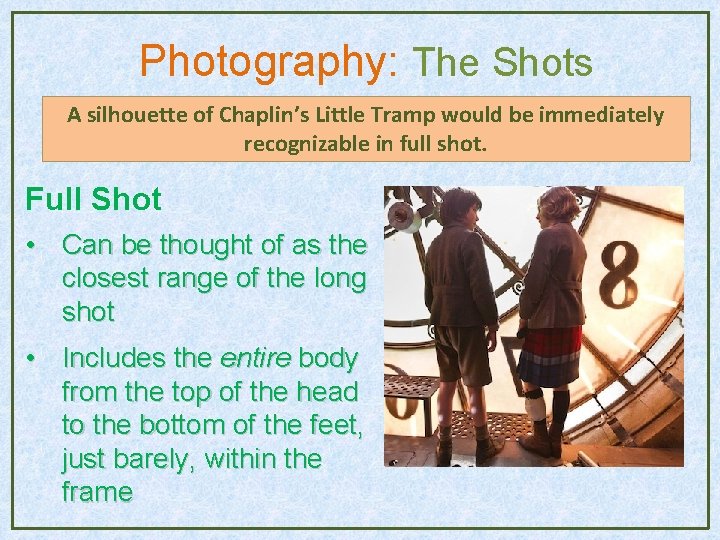
Photography: The Shots A silhouette of Chaplin’s Little Tramp would be immediately recognizable in full shot. Full Shot • Can be thought of as the closest range of the long shot • Includes the entire body from the top of the head to the bottom of the feet, just barely, within the frame
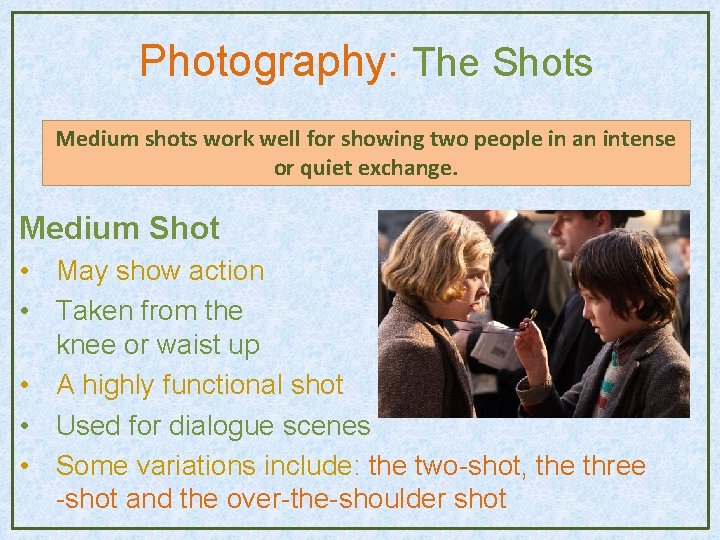
Photography: The Shots Medium shots work well for showing two people in an intense or quiet exchange. Medium Shot • May show action • Taken from the knee or waist up • A highly functional shot • Used for dialogue scenes • Some variations include: the two-shot, the three -shot and the over-the-shoulder shot
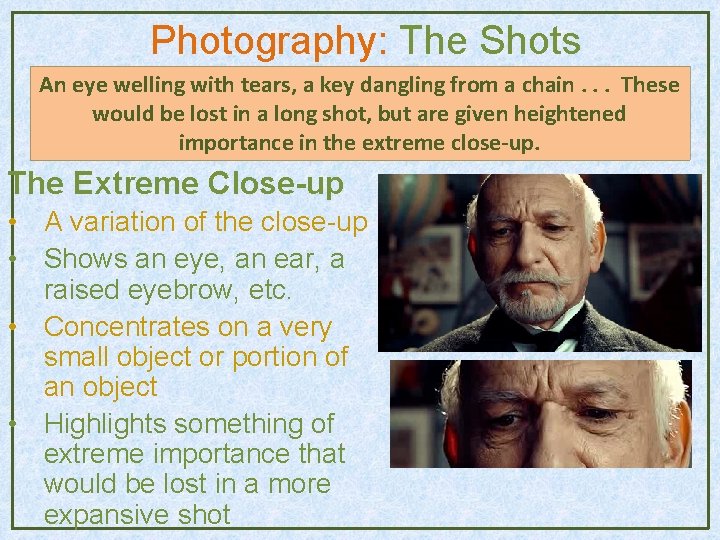
Photography: The Shots An eye welling with tears, a key dangling from a chain. . . These would be lost in a long shot, but are given heightened importance in the extreme close-up. The Extreme Close-up • A variation of the close-up • Shows an eye, an ear, a raised eyebrow, etc. • Concentrates on a very small object or portion of an object • Highlights something of extreme importance that would be lost in a more expansive shot
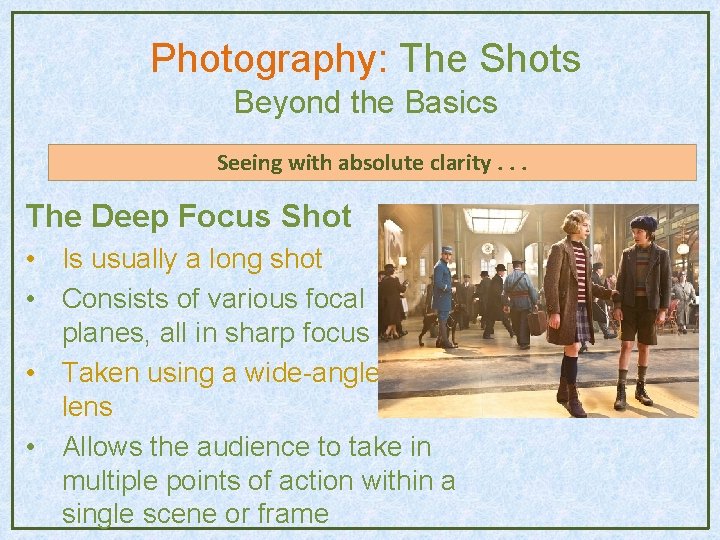
Photography: The Shots Beyond the Basics Seeing with absolute clarity. . . The Deep Focus Shot • Is usually a long shot • Consists of various focal planes, all in sharp focus • Taken using a wide-angle lens • Allows the audience to take in multiple points of action within a single scene or frame
Photography: The Shots Review Questions Q: Frequently used in epic dramas, westerns and war films, this shot is taken from a great distance and is almost always an exterior shot. What is it? A: Extreme Long Shot Q: A functional shot, taken from the knees or waist up and often used for dialogue scenes is called what? A: Medium Shot Q: Usually a long shot, taken with a wide-angle lens, this shot shows multiple focal planes in sharp focus. What is it? A: Deep Focus Shot
Photography: The Angles Looking up, looking down, or looking straight ahead. . . Think of the camera’s “eye” as your own. Five Basic Angles 1. Bird’s Eye 2. Eye-level 3. High angle 4. Low angle 5. Oblique angle (also known as Tilt or Canted)
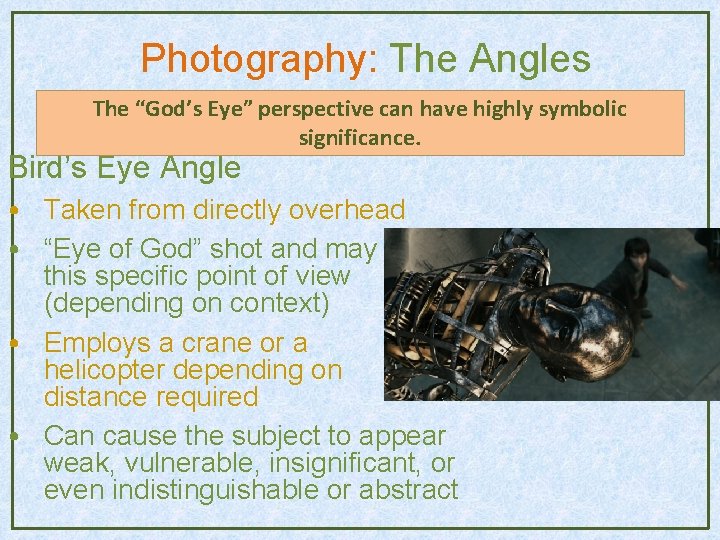
Photography: The Angles The “God’s Eye” perspective can have highly symbolic significance. Bird’s Eye Angle • Taken from directly overhead • “Eye of God” shot and may imply this specific point of view (depending on context) • Employs a crane or a helicopter depending on the distance required • Can cause the subject to appear weak, vulnerable, insignificant, or even indistinguishable or abstract
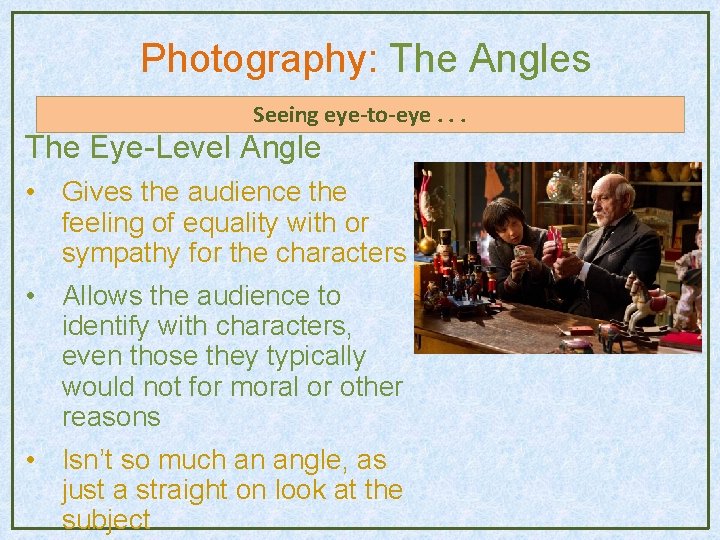
Photography: The Angles Seeing eye-to-eye. . . The Eye-Level Angle • Gives the audience the feeling of equality with or sympathy for the characters • Allows the audience to identify with characters, even those they typically would not for moral or other reasons • Isn’t so much an angle, as just a straight on look at the subject
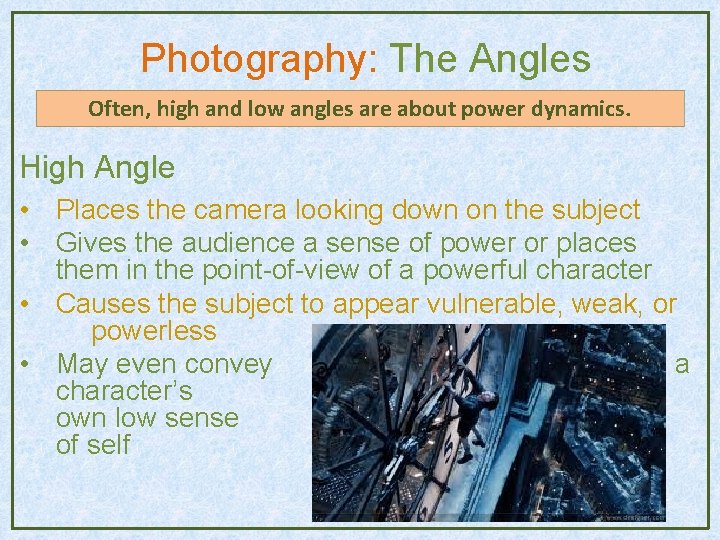
Photography: The Angles Often, high and low angles are about power dynamics. High Angle • Places the camera looking down on the subject • Gives the audience a sense of power or places them in the point-of-view of a powerful character • Causes the subject to appear vulnerable, weak, or powerless • May even convey a character’s own low sense of self
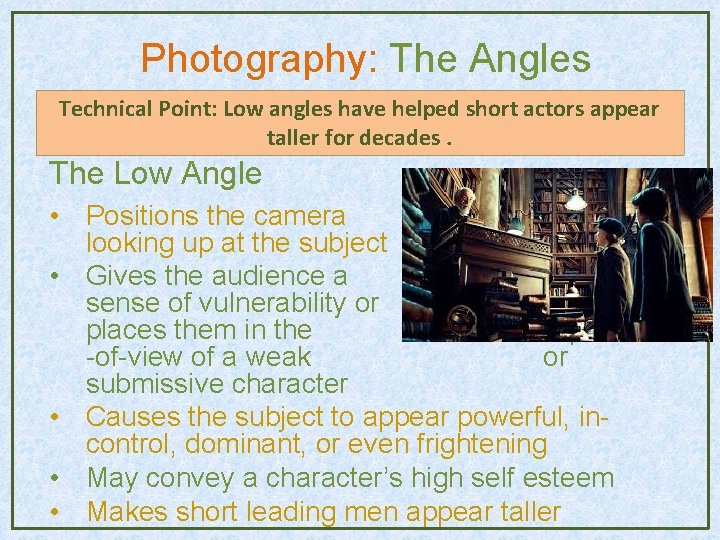
Photography: The Angles Technical Point: Low angles have helped short actors appear taller for decades. The Low Angle • Positions the camera looking up at the subject • Gives the audience a sense of vulnerability or places them in the point -of-view of a weak or submissive character • Causes the subject to appear powerful, incontrol, dominant, or even frightening • May convey a character’s high self esteem • Makes short leading men appear taller
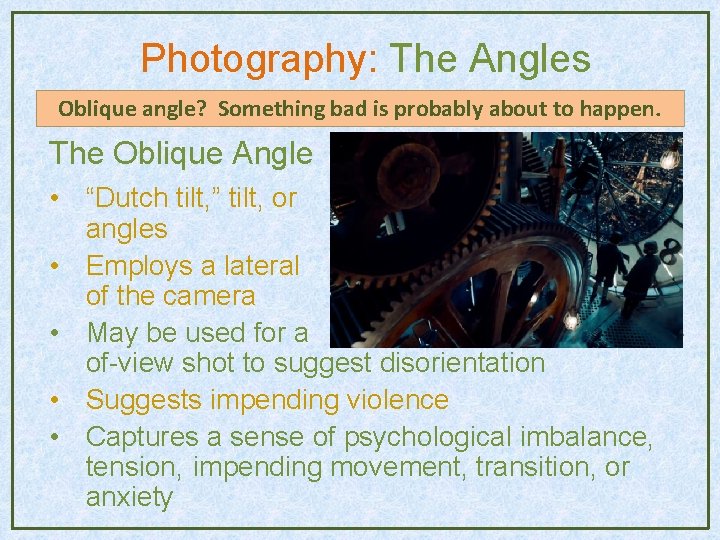
Photography: The Angles Oblique angle? Something bad is probably about to happen. The Oblique Angle • “Dutch tilt, ” tilt, or canted angles • Employs a lateral tilt of the camera • May be used for a pointof-view shot to suggest disorientation • Suggests impending violence • Captures a sense of psychological imbalance, tension, impending movement, transition, or anxiety
Photography: The Angles Review Questions Q: When the camera looks down on a subject and makes them appear weak or vulnerable, what angle is being used? A: High Angle Q: Used to suggest psychological tension, imbalance or even impending violence, what angle is achieved by tilting the camera? A: Oblique Angle Q: When the camera looks up on a subject and makes them appear dominant or powerful, what angle is being used? A: Low Angle
Photography: Light and Dark The cinematographer is responsible for the lighting of a film. Various Lighting Styles or “Keys” • High-key • Low-key • Available lighting • High-contrast • Backlighting
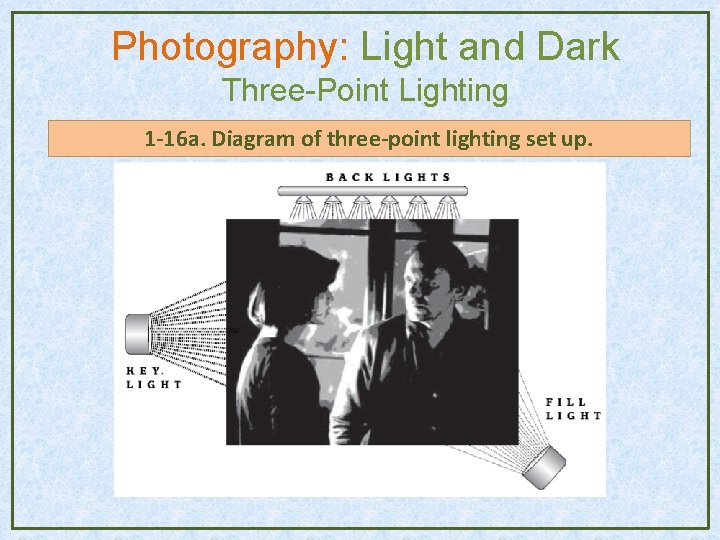
Photography: Light and Dark Three-Point Lighting 1 -16 a. Diagram of three-point lighting set up.
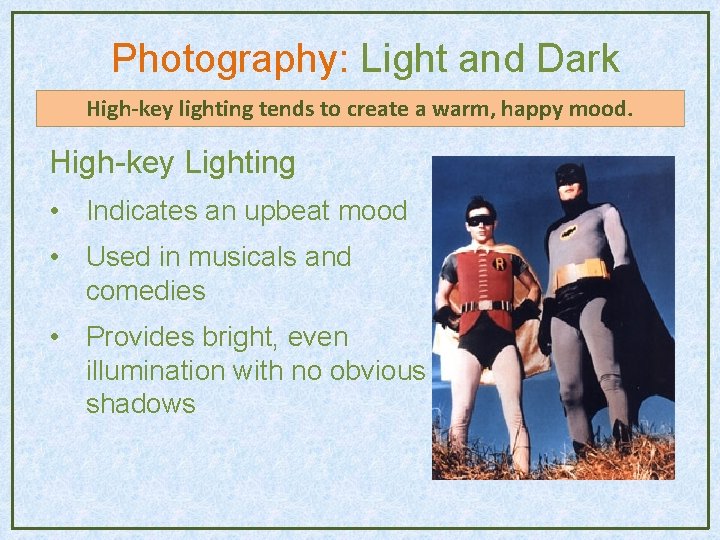
Photography: Light and Dark High-key lighting tends to create a warm, happy mood. High-key Lighting • Indicates an upbeat mood • Used in musicals and comedies • Provides bright, even illumination with no obvious shadows
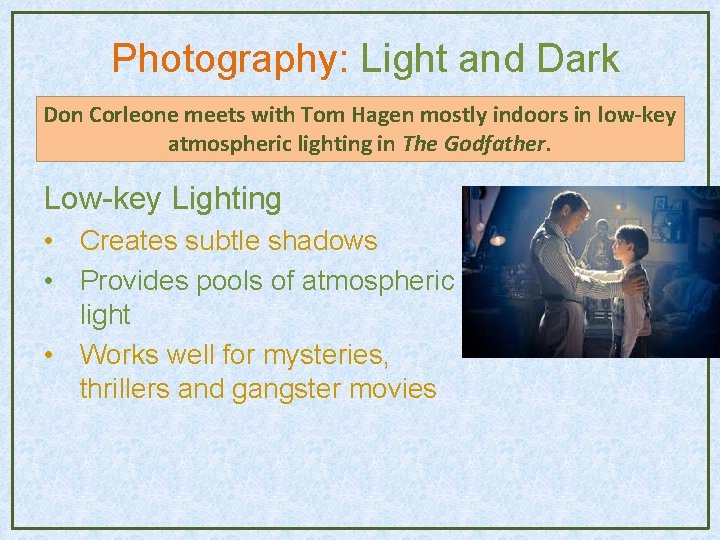
Photography: Light and Dark Don Corleone meets with Tom Hagen mostly indoors in low-key atmospheric lighting in The Godfather. Low-key Lighting • Creates subtle shadows • Provides pools of atmospheric light • Works well for mysteries, thrillers and gangster movies
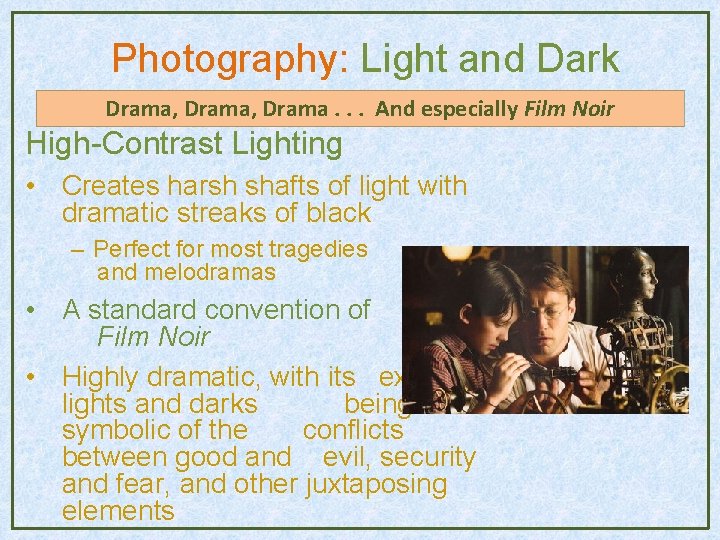
Photography: Light and Dark Drama, Drama. . . And especially Film Noir High-Contrast Lighting • Creates harsh shafts of light with dramatic streaks of black – Perfect for most tragedies and melodramas • A standard convention of Film Noir • Highly dramatic, with its extreme lights and darks being symbolic of the conflicts between good and evil, security and fear, and other juxtaposing elements
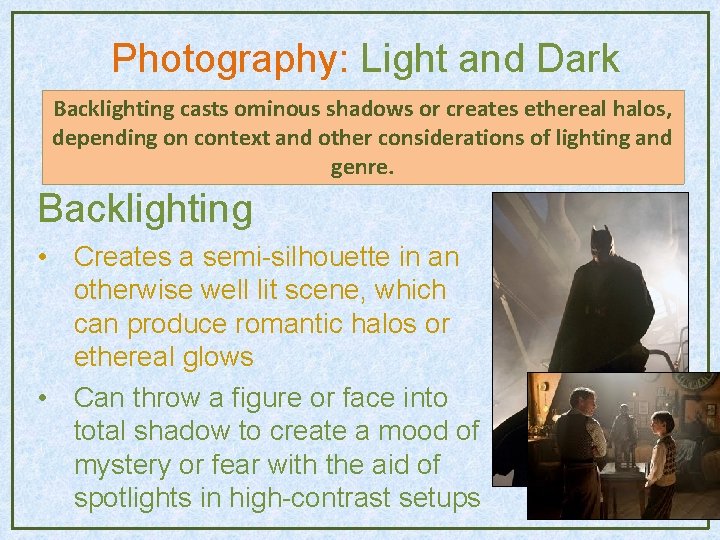
Photography: Light and Dark Backlighting casts ominous shadows or creates ethereal halos, depending on context and other considerations of lighting and genre. Backlighting • Creates a semi-silhouette in an otherwise well lit scene, which can produce romantic halos or ethereal glows • Can throw a figure or face into total shadow to create a mood of mystery or fear with the aid of spotlights in high-contrast setups
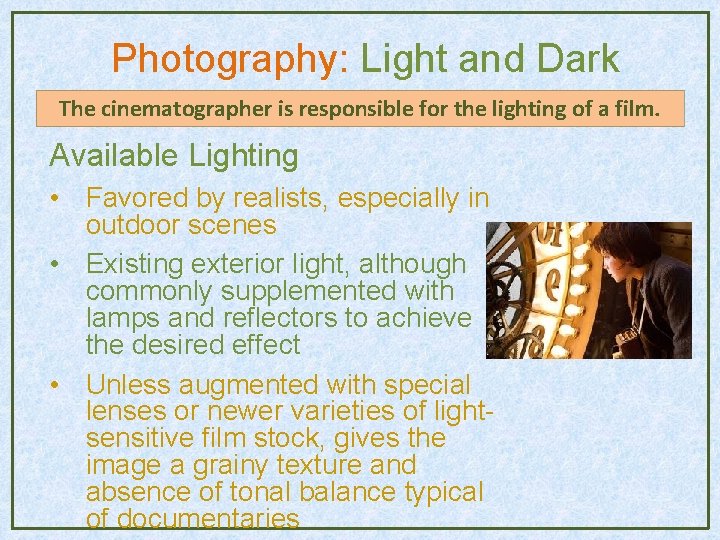
Photography: Light and Dark The cinematographer is responsible for the lighting of a film. Available Lighting • Favored by realists, especially in outdoor scenes • Existing exterior light, although commonly supplemented with lamps and reflectors to achieve the desired effect • Unless augmented with special lenses or newer varieties of lightsensitive film stock, gives the image a grainy texture and absence of tonal balance typical of documentaries
Photography: The Light and Dark Review Questions Q: Depending on the overall lighting setup, this technique can either create a mood of mystery or fear, or a romantic or ethereal effect. What is the technique? A: Backlighting Q: With its hash shafts of light and dramatic streaks of black, this lighting technique is perfect for tragedies, melodramas, and Film Noir. A: High-Contrast Lighting Q: What lighting key, with its upbeat mood, is perfect for comedies and musicals? A: High Key
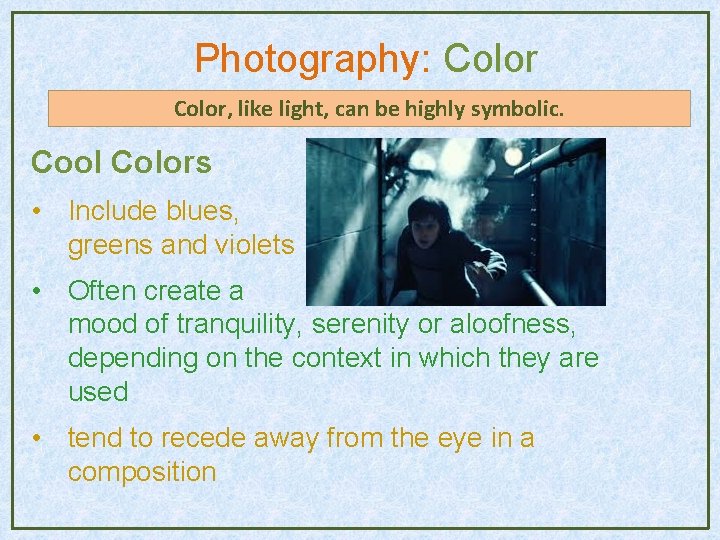
Photography: Color, like light, can be highly symbolic. Cool Colors • Include blues, greens and violets • Often create a mood of tranquility, serenity or aloofness, depending on the context in which they are used • tend to recede away from the eye in a composition
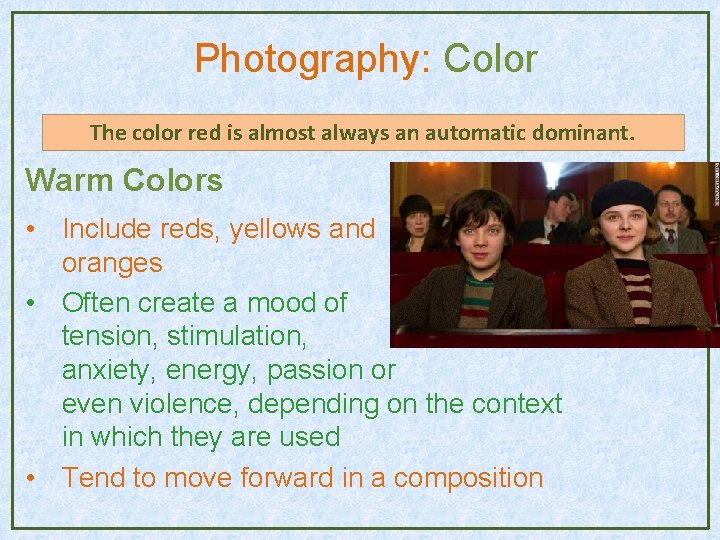
Photography: Color The color red is almost always an automatic dominant. Warm Colors • Include reds, yellows and oranges • Often create a mood of tension, stimulation, anxiety, energy, passion or even violence, depending on the context in which they are used • Tend to move forward in a composition
Production THE CINEMATOGRAPHER: LENSES
Photography: Lenses, Filters and Stocks “Some of the most striking effects in a movie image can be achieved through the distortions of the photographic process itself. ” ~ Giannetti
Photography: Lenses, Filters and Stocks There are three basic types of lenses. Three frequently used lenses • Standard or Normal • Telephoto or long • Wide-angle or short
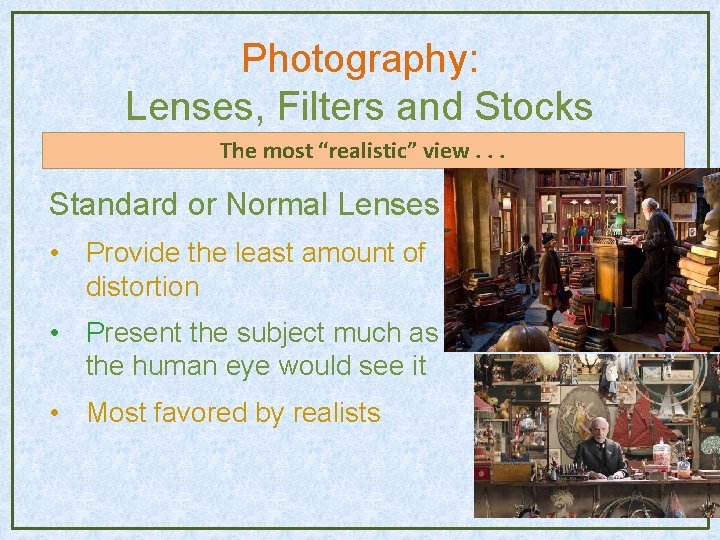
Photography: Lenses, Filters and Stocks The most “realistic” view. . . Standard or Normal Lenses • Provide the least amount of distortion • Present the subject much as the human eye would see it • Most favored by realists
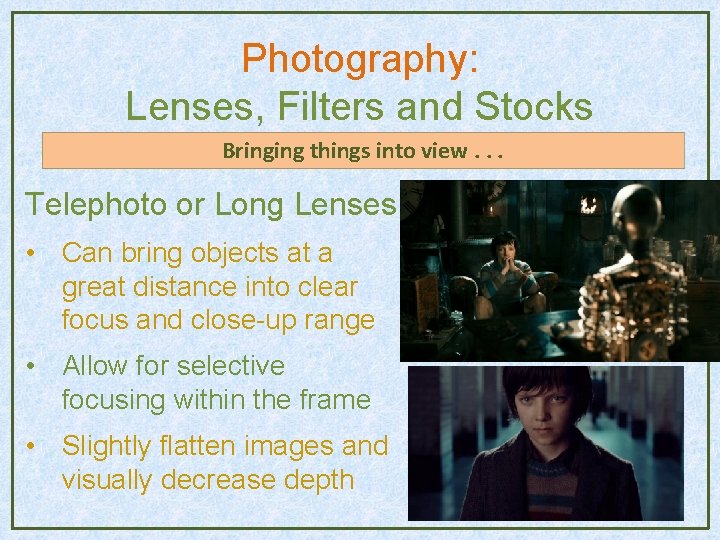
Photography: Lenses, Filters and Stocks Bringing things into view. . . Telephoto or Long Lenses • Can bring objects at a great distance into clear focus and close-up range • Allow for selective focusing within the frame • Slightly flatten images and visually decrease depth
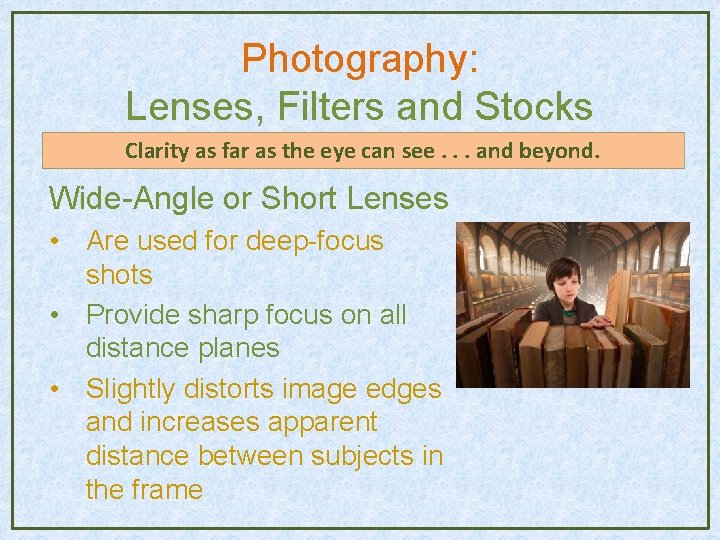
Photography: Lenses, Filters and Stocks Clarity as far as the eye can see. . . and beyond. Wide-Angle or Short Lenses • Are used for deep-focus shots • Provide sharp focus on all distance planes • Slightly distorts image edges and increases apparent distance between subjects in the frame
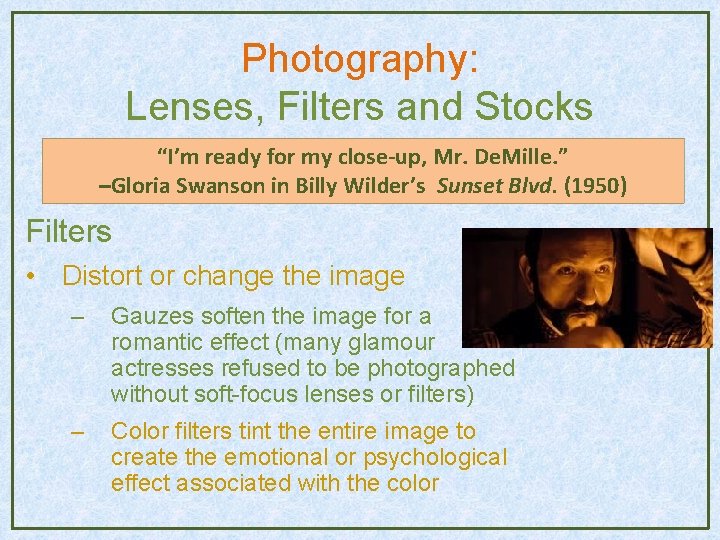
Photography: Lenses, Filters and Stocks “I’m ready for my close-up, Mr. De. Mille. ” –Gloria Swanson in Billy Wilder’s Sunset Blvd. (1950) Filters • Distort or change the image – Gauzes soften the image for a romantic effect (many glamour actresses refused to be photographed without soft-focus lenses or filters) – Color filters tint the entire image to create the emotional or psychological effect associated with the color
Photography: Lenses, Filters and Stocks The wide variety of film stocks fall within two basic categories: fast and slow. Film Stocks • Fast Stock is highly sensitive to light and offers the best choice in low-light or night shots • Slow Stock is less sensitive to light and requires bright illumination, making it a good choice for outdoor shots on a sunny day – Tends to capture color most vividly
Photography: Lenses, Filters and Stocks Review Questions Q: Which lens allows for selective focusing within the frame? A: Telephoto or Long Lens Q: Which lens allows for sharp clarity on all focal planes? A: Wide-Angle or Short Lens Q: Gauze and color are two types of these used to create cosmetic and emotional or psychological effect, respectively. What are they? A: Filters Q: Which type of film stock is the best choice for low-light, night shots? A: Fast
Production THE CINEMATOGRAPHER: MISE EN SCENE – THE FRAME
Mise en Scène Change “stage” to “frame, ” throw in a generous portion of photography, and voila! Now we’re talking about movies. Mise en scène (pronounced meez on sen, with the second syllable nasalized) was originally a French theatrical term meaning “placing on stage. ”
Chapter Two Unit 3 - Mise en Scène One must compose images as the old masters did their canvases, with the same preoccupation with effect and expression. —Marcel Carnè, Filmmaker
Mise en Scène: The Frame The illusion of three dimensions in two dimensional space. • The rectangle’s outline is the frame • The space inside (the screen) is “inside the frame” • The black space of theater is “outside the frame”
Mise en Scène: The Frame An important aspect to be considered: Aspect Ratio What is aspect ratio? 1. 33: 1 is the aspect ratio of this frame 1. 85: 1 is the aspect ratio of this frame.
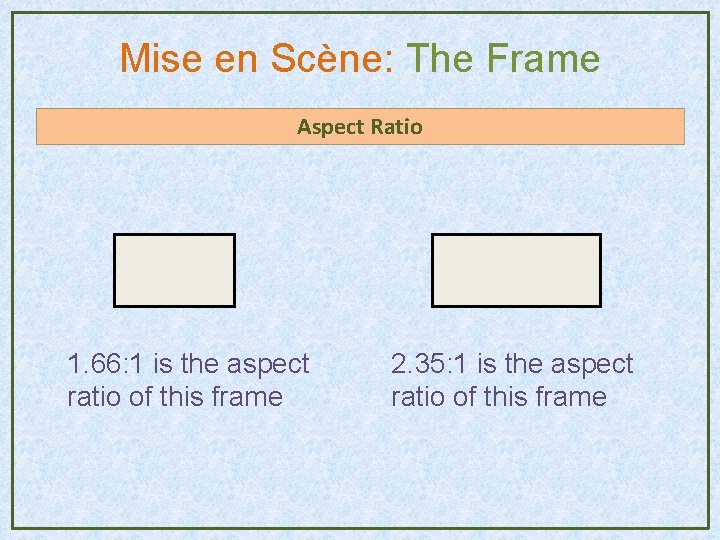
Mise en Scène: The Frame Aspect Ratio 1. 66: 1 is the aspect ratio of this frame 2. 35: 1 is the aspect ratio of this frame
Mise en Scène: The Frame Historical and Current Takes on Aspect Ratio, A Loose Timeline • c. 1890 -1930: The Silent Era, experimental stage, no standard aspect ratio • c. 1930 -1950: Hollywood Studio Era, standard or “Academy” ratio = 1. 33: 1, like televisions prior to widescreen TV
Mise en Scène: The Frame Historical and Current Takes on Aspect Ratio 1950’s— • Widescreen formats introduced, 1. 85: 1 and 2. 35: 1 • Most films are still 1. 33: 1, just like the new invention —television • To compete with small, B&W television screens, Hollywood devises the widescreen epic in glorious Technicolor • Widescreen aspect ratios vary some, occasionally using multiple screens
Mise en Scène: The Frame Historical and Current Takes on Aspect Ratio Modern Era = c. 1960 -2008: • Some films, mostly in the 1960 s, are filmed in 1. 66: 1 aspect ratio, allowing films to be screened in 1. 33: 1 or 1. 85: 1 with limited distortion • Widescreen grows in popularity and becomes the standard for films screened in theaters • Televisions still have 1. 33: 1 formatted screens
Mise en Scène: The Frame “How do you solve a problem like Maria? ”—The Sound of Music (1965) Problem: How to adjust widescreen films to fit standard television screens Solutions: None of them entirely satisfactory, some detrimental to the artistic integrity of the film 1. Hack off the edges of the frame 2. Pan and Scan—reedits the film, a less arbitrary technique, but not true to the original work 3. Letterboxing—preserves original aspect ratio by blacking out the top and bottom of the tv screen
Mise en Scène: The Frame “The only constant is change. ” –Heraclitus, Greek Philosopher Historically, aspect ratios are fairly standard by time period Now: With innovations in home theaters, particularly that of the widescreen, large, flat screen televisions, reformatting of aspect ratio for television is quickly becoming a subject of film history, a reminder of the “analog age. ”
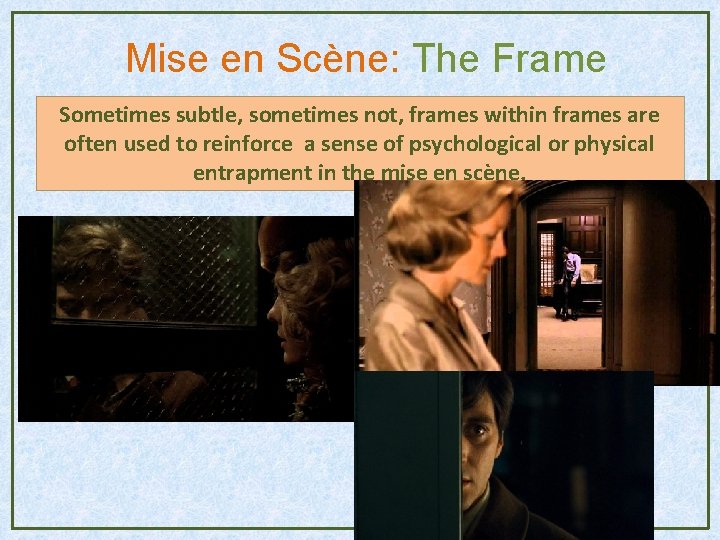
Mise en Scène: The Frame Sometimes subtle, sometimes not, frames within frames are often used to reinforce a sense of psychological or physical entrapment in the mise en scène.
Production THE CINEMATOGRAPHER: MISE EN SCENE – OPEN VS. CLOSED FORM
Mise en Scène: Open and Closed Forms Open Forms are generally a Realist Convention Open Forms • • Tend to be fairly realistic Suggest informal composition Objects and images may seem found Typically use the frame as a “window” on the action • Make the audience aware of a world outside the frame
Mise en Scène: Open and Closed Forms tend to be a Formalist Convention Closed Forms • Appear organizationally controlled • Emphasize lighting, photography, and other artistic elements • Tend to be used more in formalist compositions • Typically show everything the audience needs to know for the dramatic action of the moment within the frame • Dominance in compositions
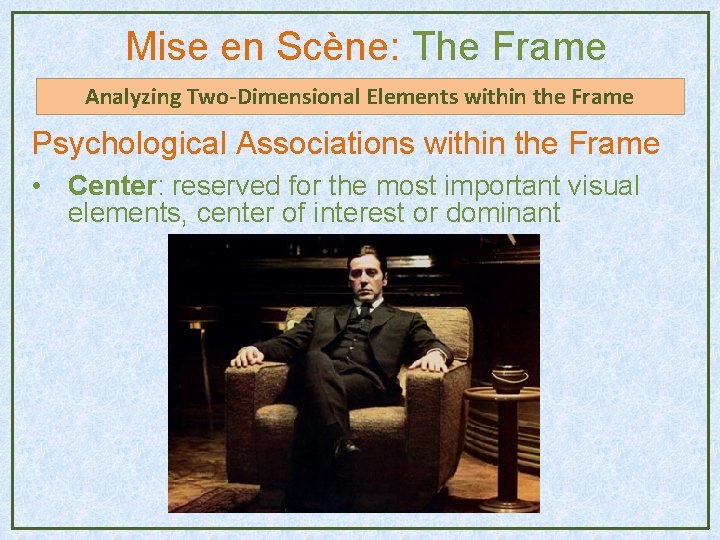
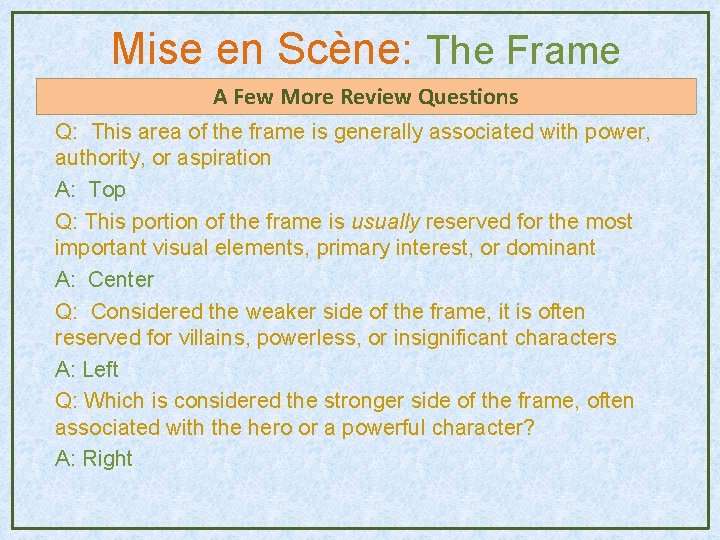
Mise en Scène: The Frame Analyzing Two-Dimensional Elements within the Frame Psychological Associations within the Frame • Center: reserved for the most important visual elements, center of interest or dominant
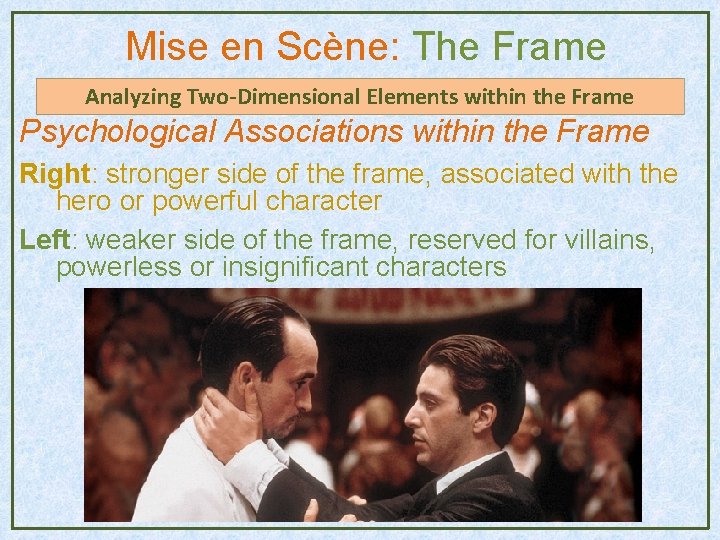
Mise en Scène: The Frame Analyzing Two-Dimensional Elements within the Frame Psychological Associations within the Frame Right: stronger side of the frame, associated with the hero or powerful character Left: weaker side of the frame, reserved for villains, powerless or insignificant characters
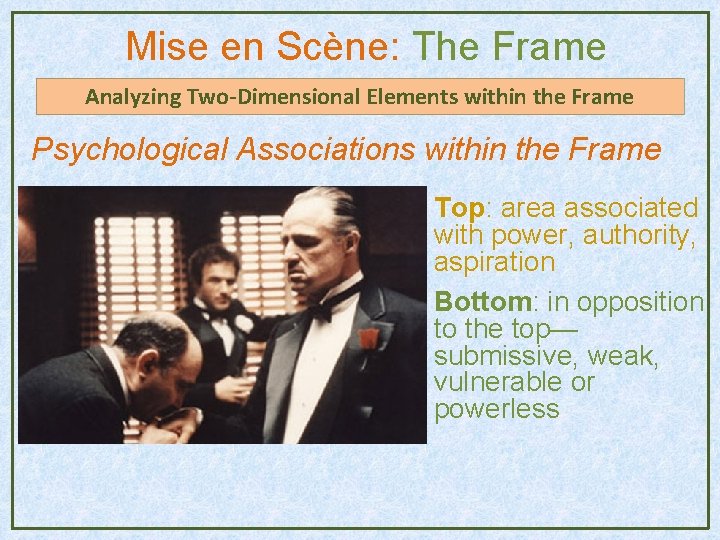
Mise en Scène: The Frame Analyzing Two-Dimensional Elements within the Frame Psychological Associations within the Frame Top: area associated with power, authority, aspiration Bottom: in opposition to the top— submissive, weak, vulnerable or powerless
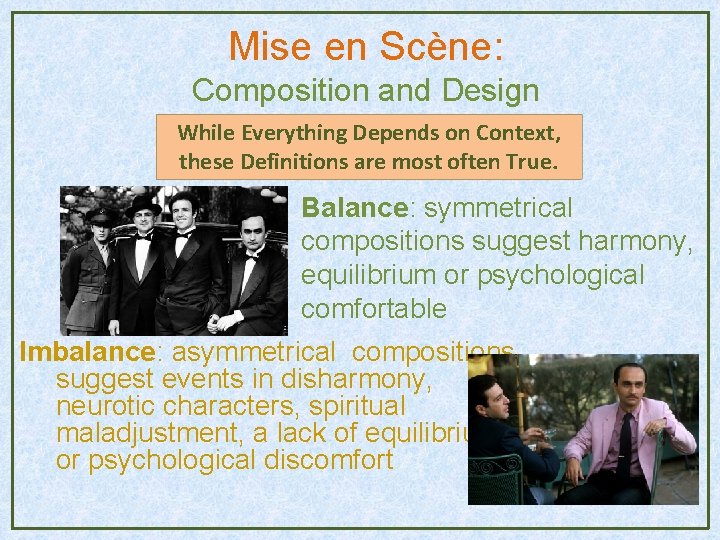
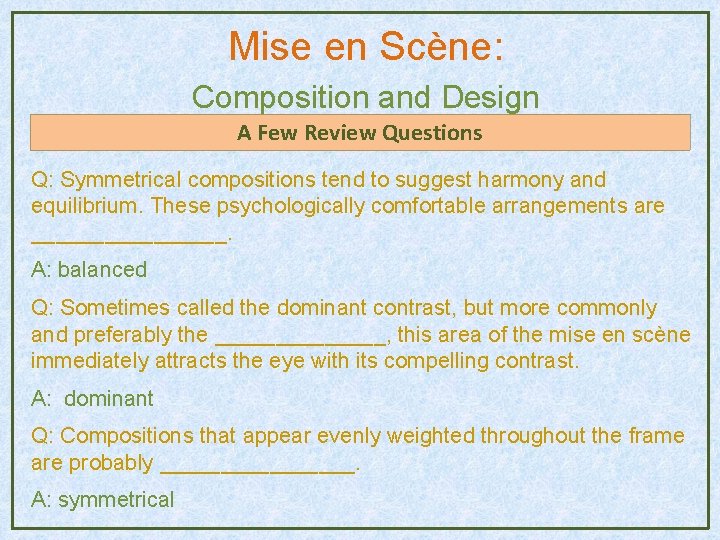
Mise en Scène: Composition and Design While Everything Depends on Context, these Definitions are most often True. Balance: symmetrical compositions suggest harmony, equilibrium or psychological comfortable Imbalance: asymmetrical compositions suggest events in disharmony, neurotic characters, spiritual maladjustment, a lack of equilibrium or psychological discomfort
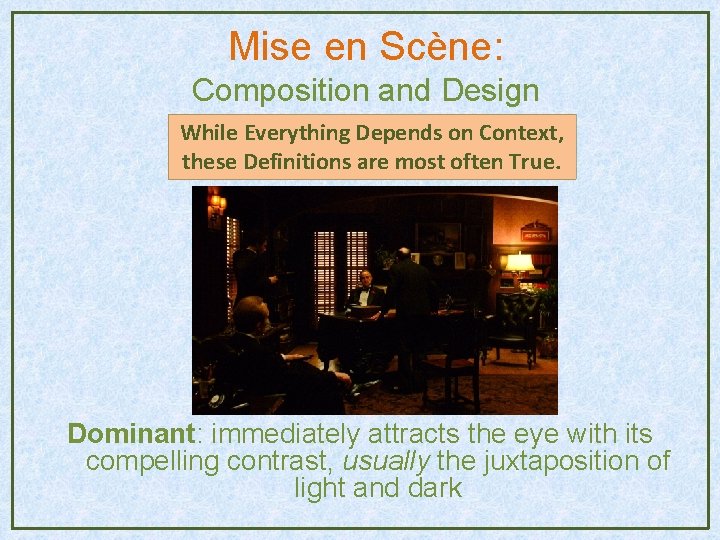
Mise en Scène: Composition and Design While Everything Depends on Context, these Definitions are most often True. Dominant: immediately attracts the eye with its compelling contrast, usually the juxtaposition of light and dark
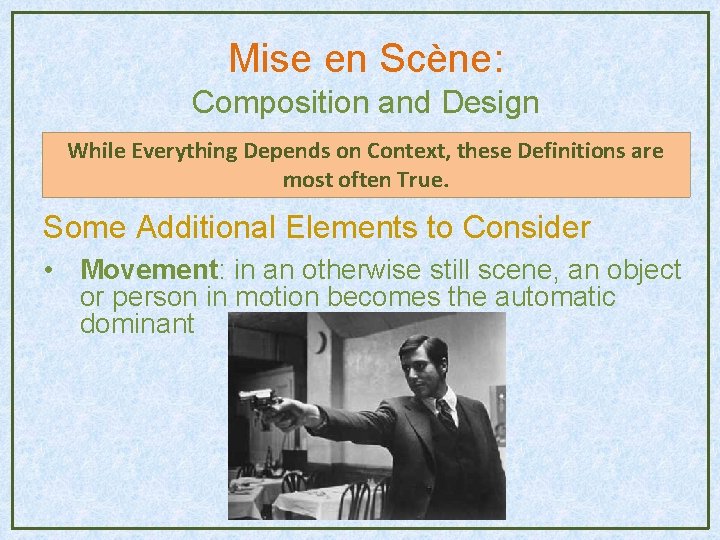
Mise en Scène: Composition and Design While Everything Depends on Context, these Definitions are most often True. Some Additional Elements to Consider • Movement: in an otherwise still scene, an object or person in motion becomes the automatic dominant
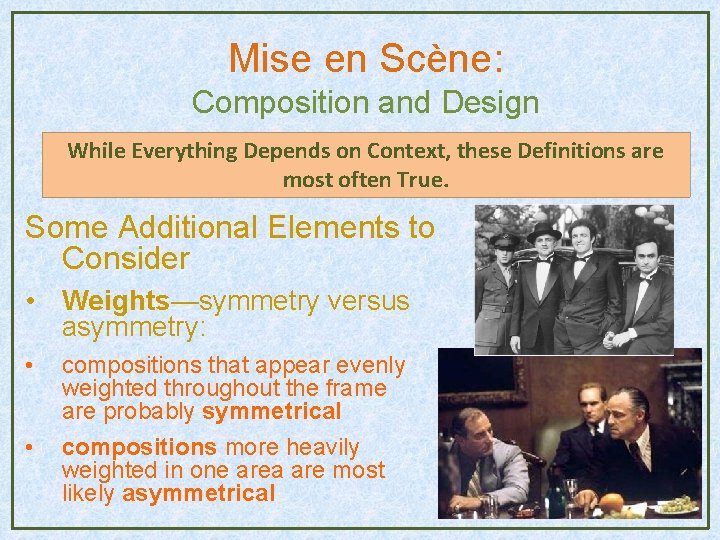
Mise en Scène: Composition and Design While Everything Depends on Context, these Definitions are most often True. Some Additional Elements to Consider • Weights—symmetry versus asymmetry: • • compositions that appear evenly weighted throughout the frame are probably symmetrical compositions more heavily weighted in one area are most likely asymmetrical
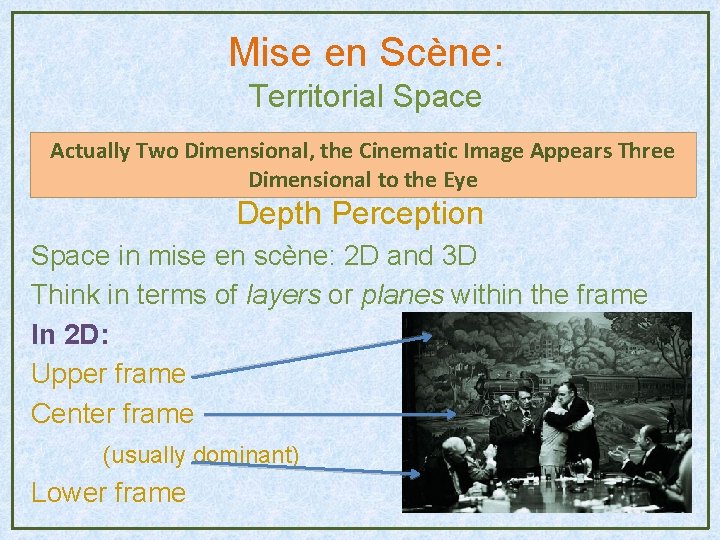
Mise en Scène: Territorial Space Actually Two Dimensional, the Cinematic Image Appears Three Dimensional to the Eye Depth Perception Space in mise en scène: 2 D and 3 D Think in terms of layers or planes within the frame In 2 D: Upper frame Center frame (usually dominant) Lower frame
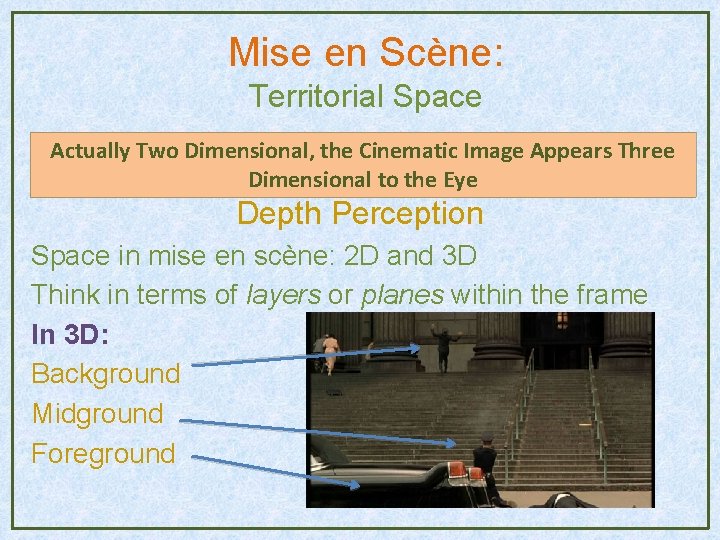
Mise en Scène: Territorial Space Actually Two Dimensional, the Cinematic Image Appears Three Dimensional to the Eye Depth Perception Space in mise en scène: 2 D and 3 D Think in terms of layers or planes within the frame In 3 D: Background Midground Foreground
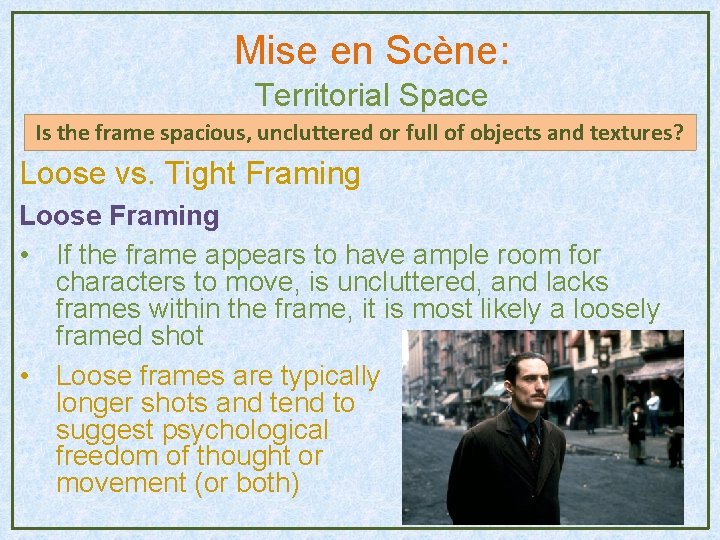
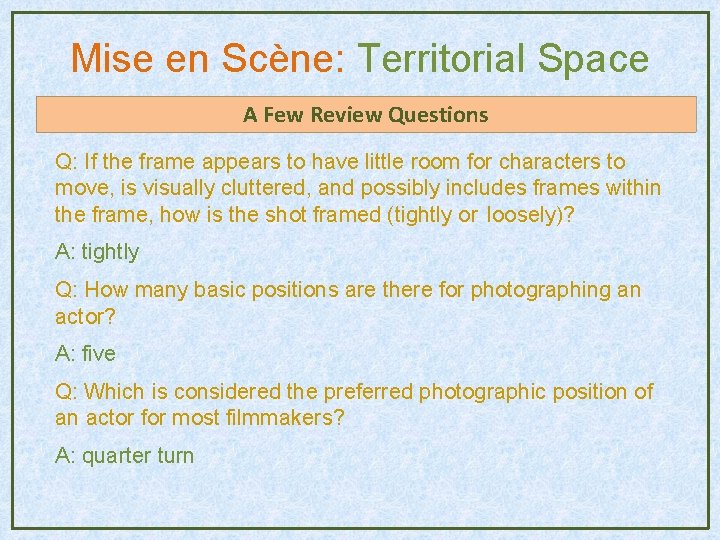
Mise en Scène: Territorial Space Is the frame spacious, uncluttered or full of objects and textures? Loose vs. Tight Framing Loose Framing • If the frame appears to have ample room for characters to move, is uncluttered, and lacks frames within the frame, it is most likely a loosely framed shot • Loose frames are typically longer shots and tend to suggest psychological freedom of thought or movement (or both)
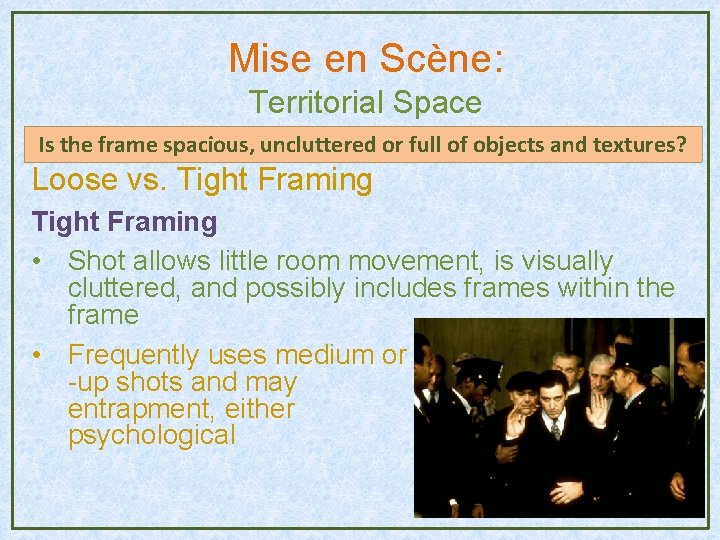
Mise en Scène: Territorial Space Is the frame spacious, uncluttered or full of objects and textures? Loose vs. Tight Framing • Shot allows little room movement, is visually cluttered, and possibly includes frames within the frame • Frequently uses medium or close -up shots and may suggest entrapment, either physical or psychological (or both)
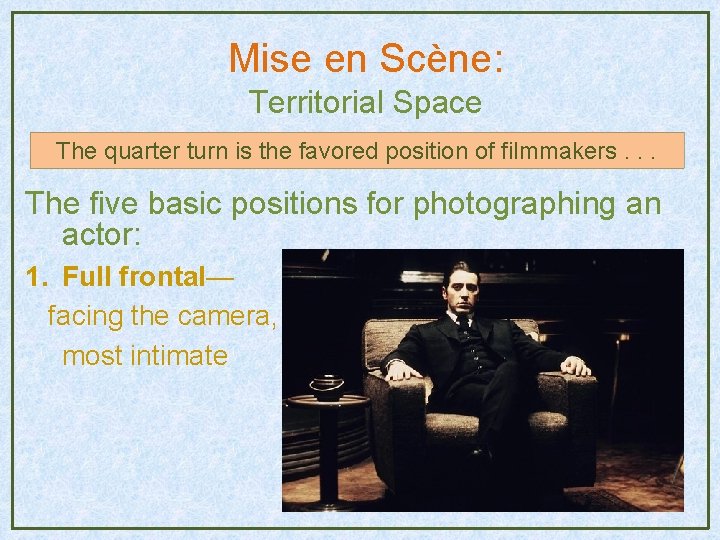
Mise en Scène: Territorial Space The quarter turn is the favored position of filmmakers. . . The five basic positions for photographing an actor: 1. Full frontal— facing the camera, most intimate
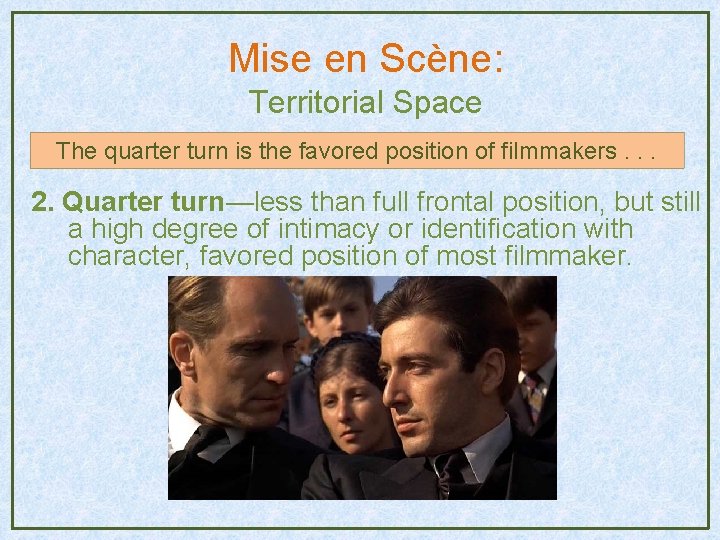
Mise en Scène: Territorial Space The quarter turn is the favored position of filmmakers. . . 2. Quarter turn—less than full frontal position, but still a high degree of intimacy or identification with character, favored position of most filmmaker.
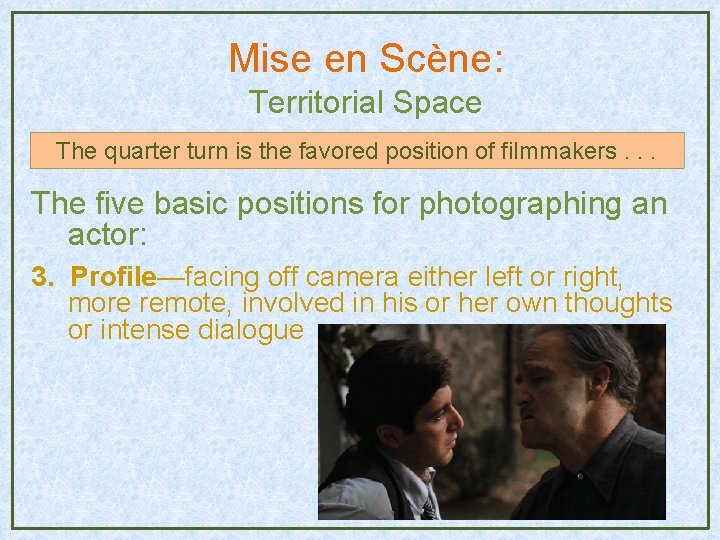
Mise en Scène: Territorial Space The quarter turn is the favored position of filmmakers. . . The five basic positions for photographing an actor: 3. Profile—facing off camera either left or right, more remote, involved in his or her own thoughts or intense dialogue
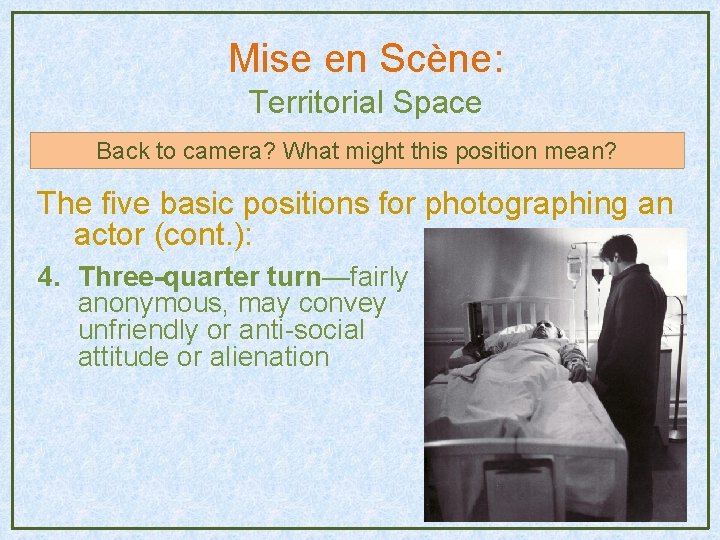
Mise en Scène: Territorial Space Back to camera? What might this position mean? The five basic positions for photographing an actor (cont. ): 4. Three-quarter turn—fairly anonymous, may convey unfriendly or anti-social attitude or alienation
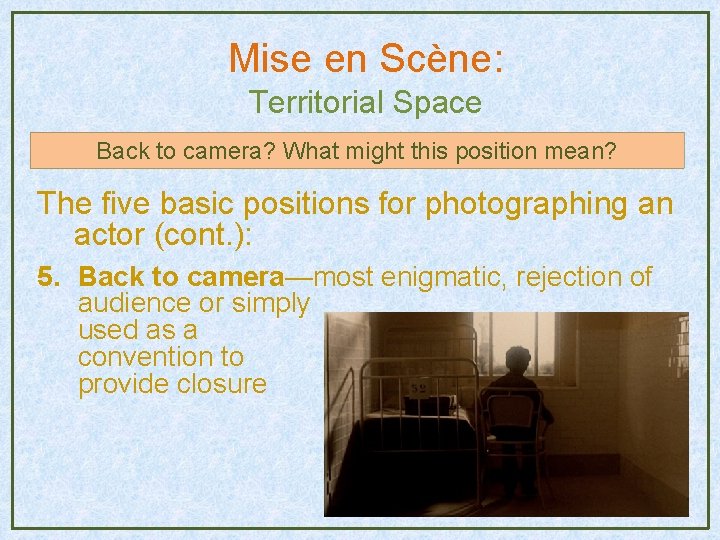
Mise en Scène: Territorial Space Back to camera? What might this position mean? The five basic positions for photographing an actor (cont. ): 5. Back to camera—most enigmatic, rejection of audience or simply used as a convention to provide closure
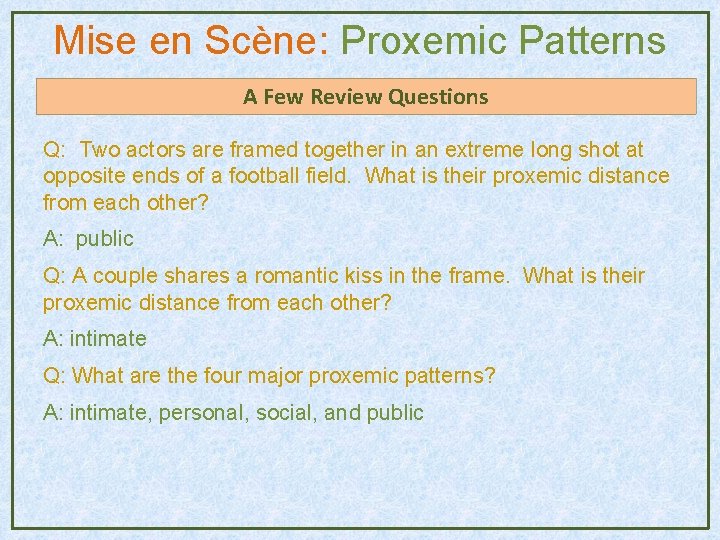
Mise en Scène: Proxemic Patterns Proxemic patterns describe the relationships between organisms within a given space The four major proxemic patterns: 1. Intimate = physical contact to approximately 18” —usually shot in close up or extreme close up 2. Personal = 18” to about 4’—generally a medium to full shot 3. Social = 4’ to 12’—usually a medium to full shot 4. Public = more than 12’ apart—usually a long to extreme long shot
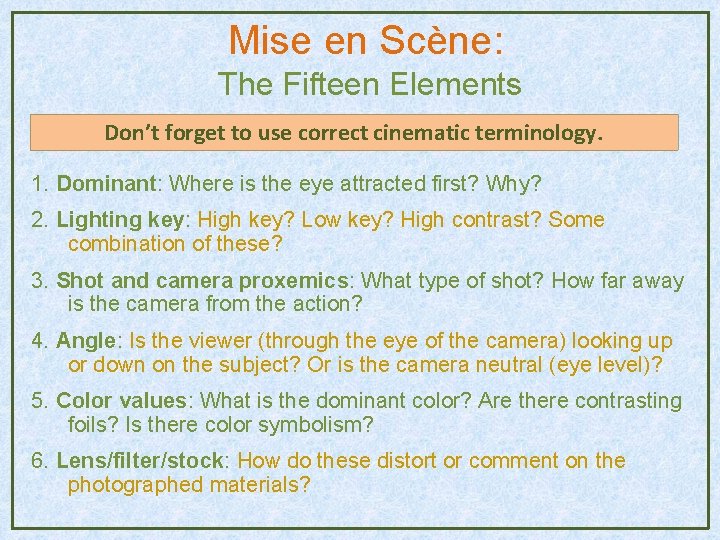
Mise en Scène: The Fifteen Elements Don’t forget to use correct cinematic terminology. 1. Dominant: Where is the eye attracted first? Why? 2. Lighting key: High key? Low key? High contrast? Some combination of these? 3. Shot and camera proxemics: What type of shot? How far away is the camera from the action? 4. Angle: Is the viewer (through the eye of the camera) looking up or down on the subject? Or is the camera neutral (eye level)? 5. Color values: What is the dominant color? Are there contrasting foils? Is there color symbolism? 6. Lens/filter/stock: How do these distort or comment on the photographed materials?
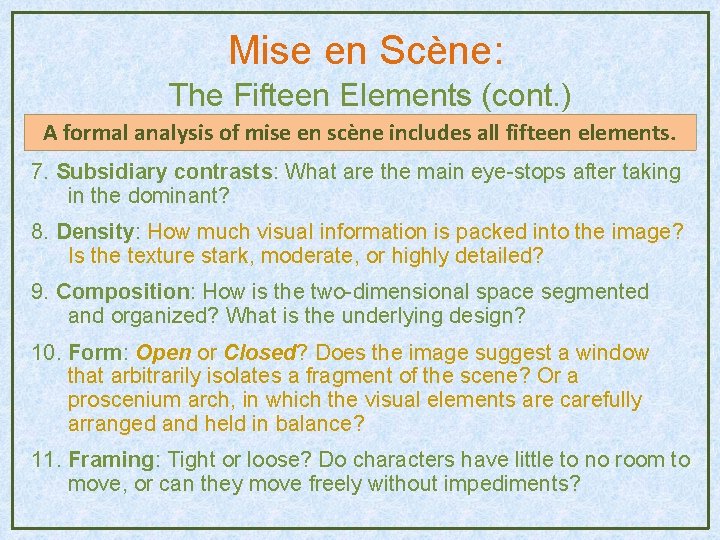
Mise en Scène: The Fifteen Elements (cont. ) A formal analysis of mise en scène includes all fifteen elements. 7. Subsidiary contrasts: What are the main eye-stops after taking in the dominant? 8. Density: How much visual information is packed into the image? Is the texture stark, moderate, or highly detailed? 9. Composition: How is the two-dimensional space segmented and organized? What is the underlying design? 10. Form: Open or Closed? Does the image suggest a window that arbitrarily isolates a fragment of the scene? Or a proscenium arch, in which the visual elements are carefully arranged and held in balance? 11. Framing: Tight or loose? Do characters have little to no room to move, or can they move freely without impediments?
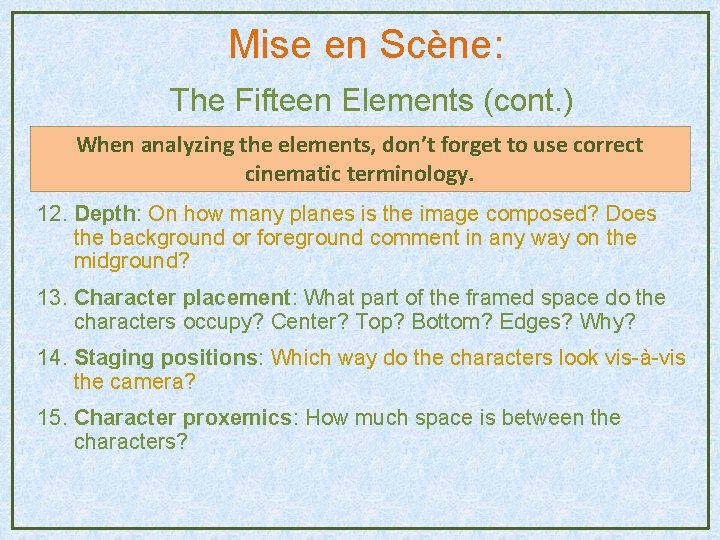
Mise en Scène: The Fifteen Elements (cont. ) When analyzing the elements, don’t forget to use correct cinematic terminology. 12. Depth: On how many planes is the image composed? Does the background or foreground comment in any way on the midground? 13. Character placement: What part of the framed space do the characters occupy? Center? Top? Bottom? Edges? Why? 14. Staging positions: Which way do the characters look vis-à-vis the camera? 15. Character proxemics: How much space is between the characters?
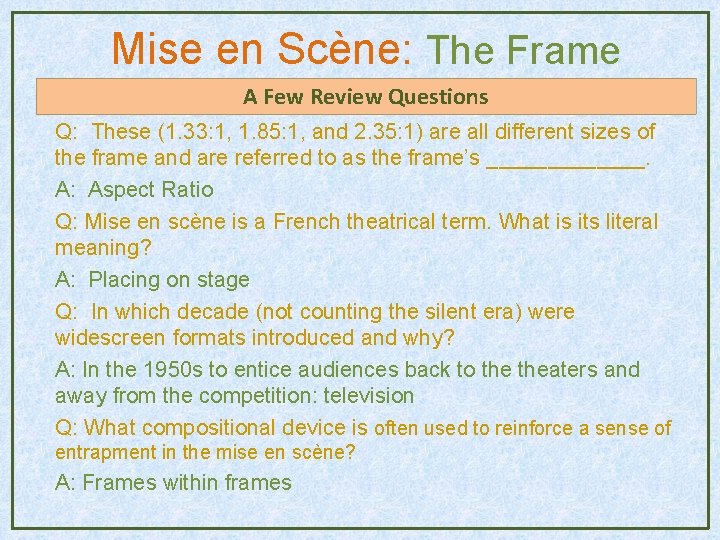
Mise en Scène: The Frame A Few Review Questions Q: These (1. 33: 1, 1. 85: 1, and 2. 35: 1) are all different sizes of the frame and are referred to as the frame’s _______. A: Aspect Ratio Q: Mise en scène is a French theatrical term. What is its literal meaning? A: Placing on stage Q: In which decade (not counting the silent era) were widescreen formats introduced and why? A: In the 1950 s to entice audiences back to theaters and away from the competition: television Q: What compositional device is often used to reinforce a sense of entrapment in the mise en scène? A: Frames within frames
Mise en Scène: The Frame A Few More Review Questions Q: This area of the frame is generally associated with power, authority, or aspiration A: Top Q: This portion of the frame is usually reserved for the most important visual elements, primary interest, or dominant A: Center Q: Considered the weaker side of the frame, it is often reserved for villains, powerless, or insignificant characters A: Left Q: Which is considered the stronger side of the frame, often associated with the hero or a powerful character? A: Right
Mise en Scène: Composition and Design A Few Review Questions Q: Symmetrical compositions tend to suggest harmony and equilibrium. These psychologically comfortable arrangements are ________. A: balanced Q: Sometimes called the dominant contrast, but more commonly and preferably the _______, this area of the mise en scène immediately attracts the eye with its compelling contrast. A: dominant Q: Compositions that appear evenly weighted throughout the frame are probably ________. A: symmetrical
Mise en Scène: Territorial Space A Few Review Questions Q: If the frame appears to have little room for characters to move, is visually cluttered, and possibly includes frames within the frame, how is the shot framed (tightly or loosely)? A: tightly Q: How many basic positions are there for photographing an actor? A: five Q: Which is considered the preferred photographic position of an actor for most filmmakers? A: quarter turn
Mise en Scène: Proxemic Patterns A Few Review Questions Q: Two actors are framed together in an extreme long shot at opposite ends of a football field. What is their proxemic distance from each other? A: public Q: A couple shares a romantic kiss in the frame. What is their proxemic distance from each other? A: intimate Q: What are the four major proxemic patterns? A: intimate, personal, social, and public
Mise en Scène: Open and Closed Forms A Few Review Questions Q: Which type of forms present controlled organization, emphasize beauty of lighting and other artistic elements, and are typically formalistic? A: closed forms Q: Which type of forms tend more towards realist compositions, presenting the mise en scène as informal, a seemingly found or relaxed arrangement that is part of a larger world of which the audience is likely to be aware? A: open forms
Kinetics Movement The opening of a door, a hand, or an eye can bring about a climax as thrilling as a crash of locomotives on the screen. —Richard Dyer Mac. Cann, Film Scholar
Movement: Kinetics Movement is centrally important in film; it’s why we call them “movies. ” The Greek word for movement is kinetic. The word is still used today. Kinetic, kinesthesia, choreography (dance terms) and cinema are all words that derive from this Greek word.
Movement: Kinetics The Three Basic Types of Movement • Literal and Concrete—realistic and practical movements • Stylized and Lyrical—abstract movements, ballet, musicals, and mime • Avant-garde—can be nonrepresentational movements, unconventional, controversial, and/or personal
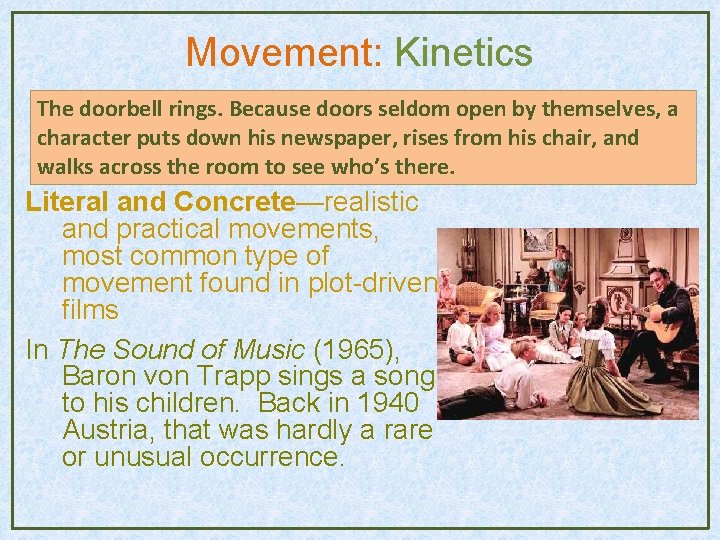
Movement: Kinetics The doorbell rings. Because doors seldom open by themselves, a character puts down his newspaper, rises from his chair, and walks across the room to see who’s there. Literal and Concrete—realistic and practical movements, most common type of movement found in plot-driven films In The Sound of Music (1965), Baron von Trapp sings a song to his children. Back in 1940 Austria, that was hardly a rare or unusual occurrence.
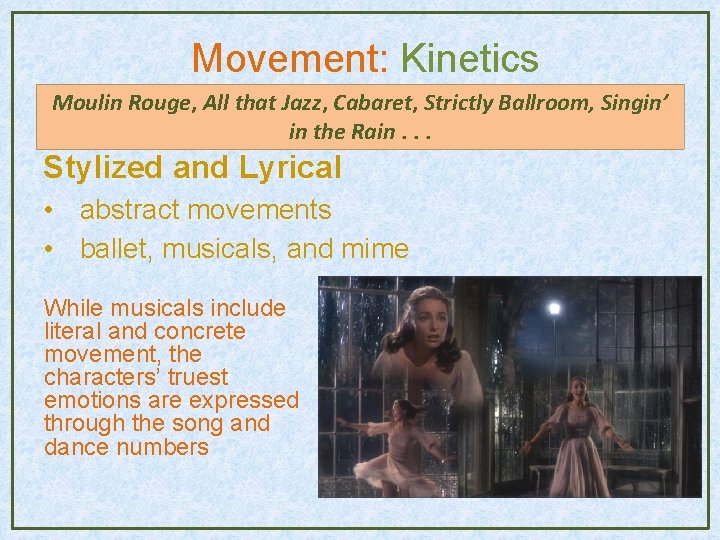
Movement: Kinetics Moulin Rouge, All that Jazz, Cabaret, Strictly Ballroom, Singin’ in the Rain. . . Stylized and Lyrical • abstract movements • ballet, musicals, and mime While musicals include literal and concrete movement, the characters’ truest emotions are expressed through the song and dance numbers
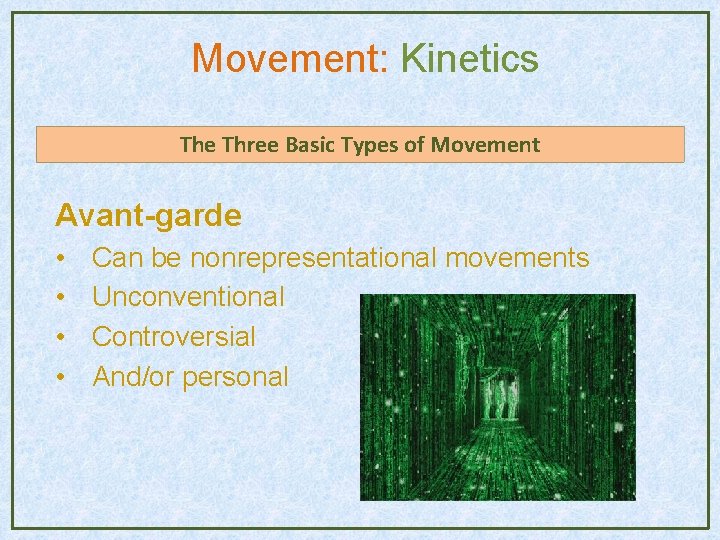
Movement: Kinetics The Three Basic Types of Movement Avant-garde • • Can be nonrepresentational movements Unconventional Controversial And/or personal
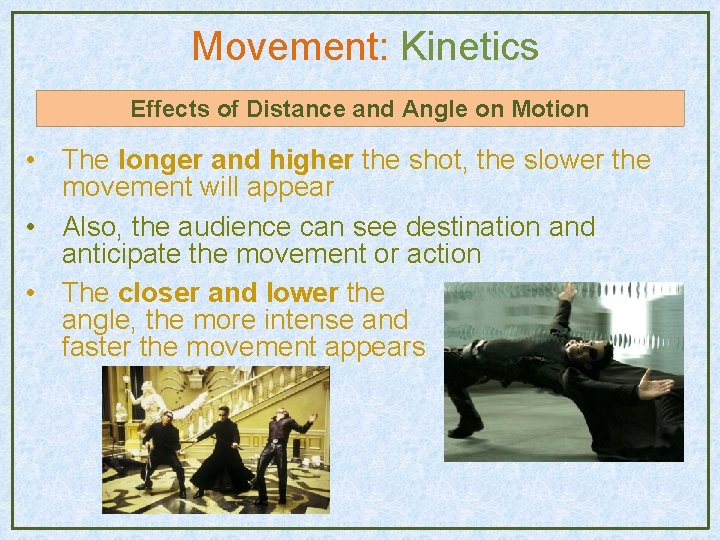
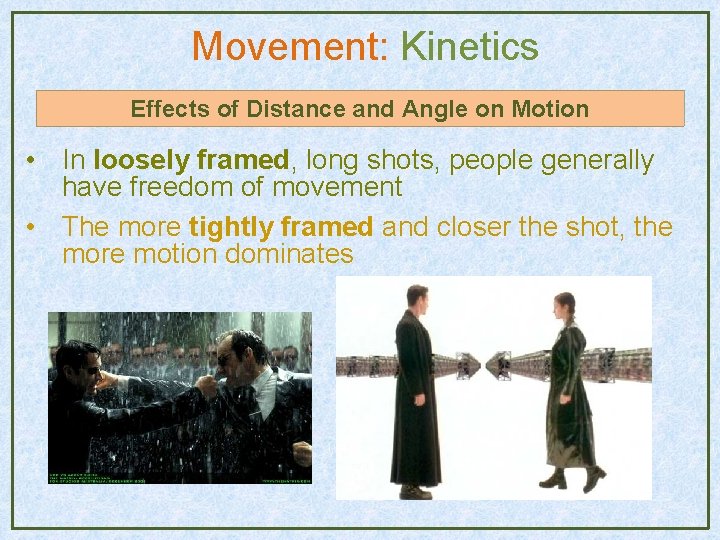
Movement: Kinetics Effects of Distance and Angle on Motion • The longer and higher the shot, the slower the movement will appear • Also, the audience can see destination and anticipate the movement or action • The closer and lower the angle, the more intense and faster the movement appears
Movement: Kinetics Effects of Distance and Angle on Motion • In loosely framed, long shots, people generally have freedom of movement • The more tightly framed and closer the shot, the more motion dominates
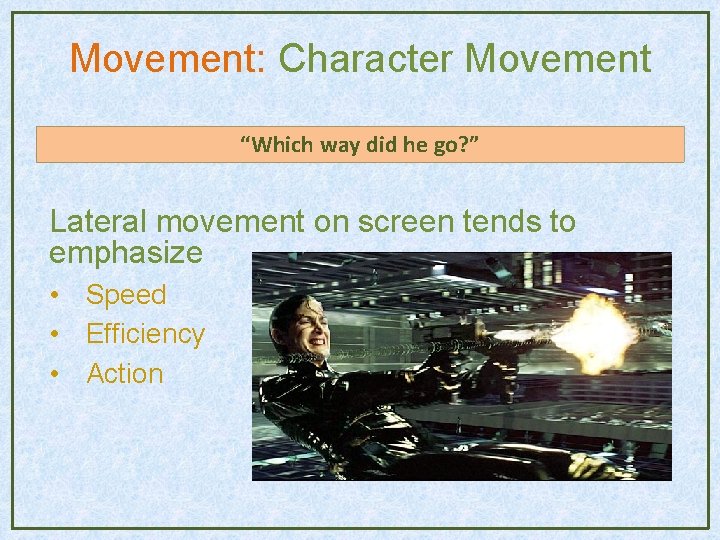
Movement: Character Movement “Which way did he go? ” Lateral movement on screen tends to emphasize • Speed • Efficiency • Action
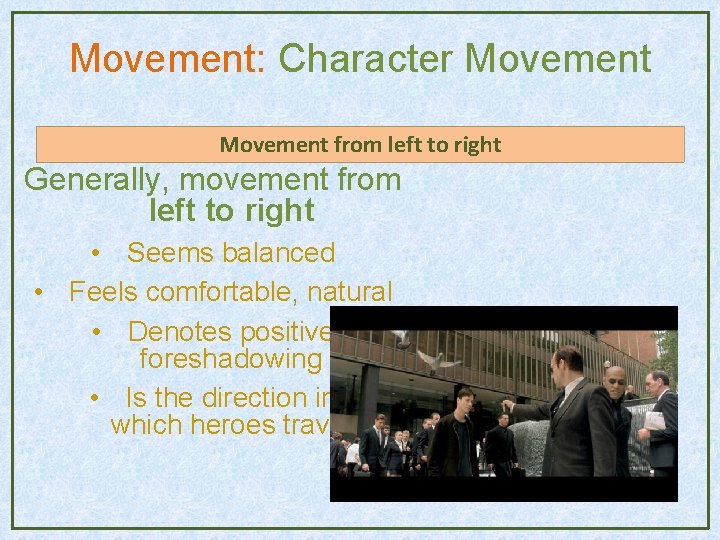
Movement: Character Movement from left to right Generally, movement from left to right • Seems balanced • Feels comfortable, natural • Denotes positive foreshadowing • Is the direction in which heroes travel
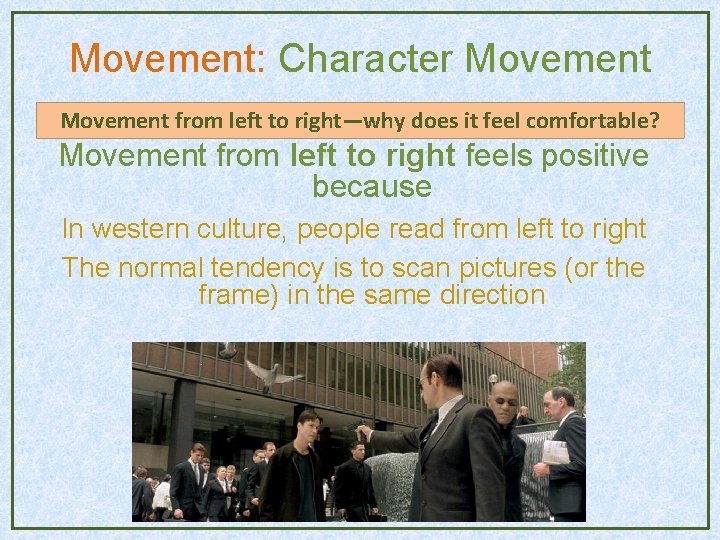
Movement: Character Movement from left to right—why does it feel comfortable? Movement from left to right feels positive because In western culture, people read from left to right The normal tendency is to scan pictures (or the frame) in the same direction
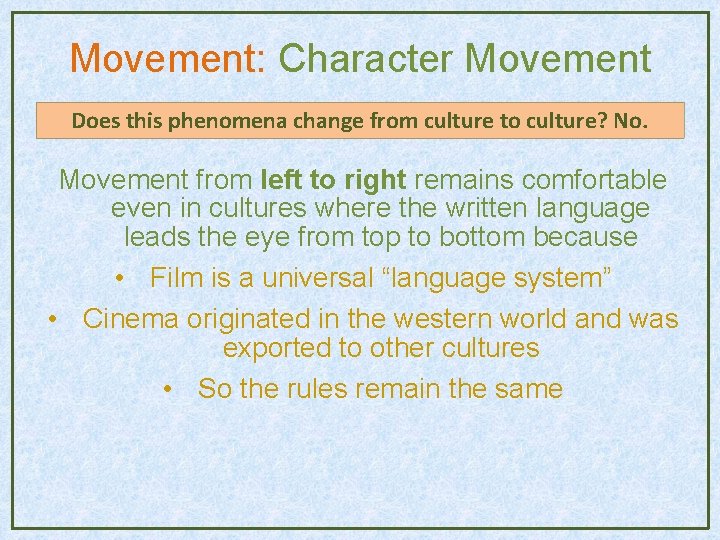
Movement: Character Movement Does this phenomena change from culture to culture? No. Movement from left to right remains comfortable even in cultures where the written language leads the eye from top to bottom because • Film is a universal “language system” • Cinema originated in the western world and was exported to other cultures • So the rules remain the same
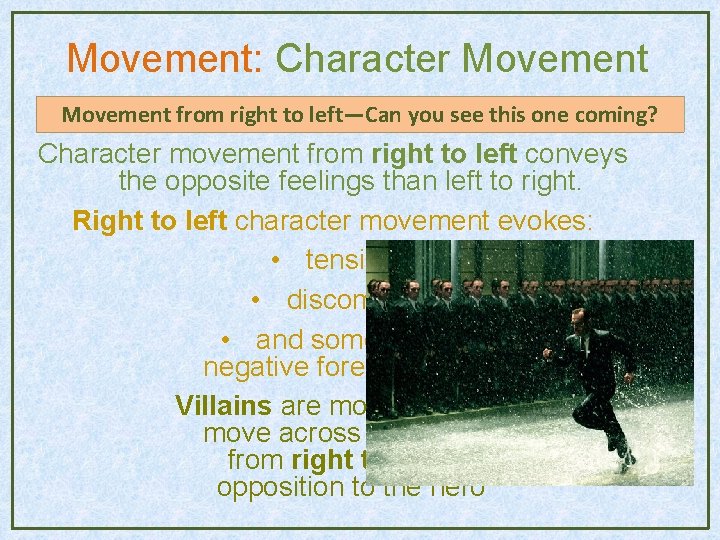
Movement: Character Movement from right to left—Can you see this one coming? Character movement from right to left conveys the opposite feelings than left to right. Right to left character movement evokes: • tension • discomfort • and sometimes negative foreshadowing Villains are most likely to move across the screen from right to left, in opposition to the hero
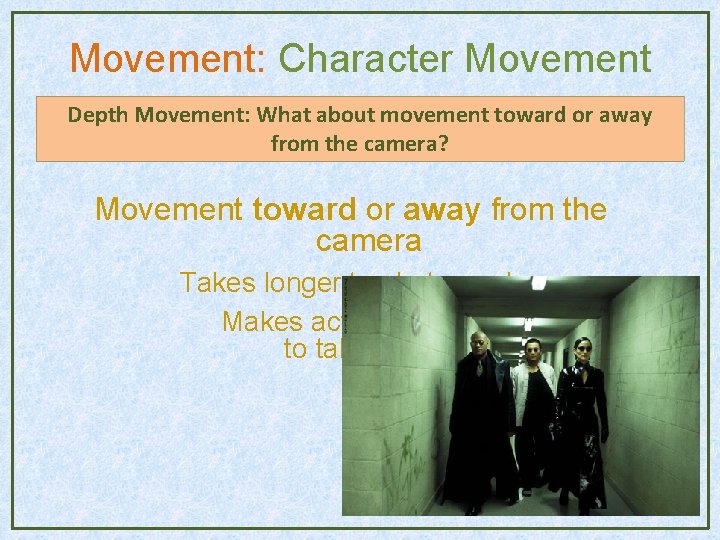
Movement: Character Movement Depth Movement: What about movement toward or away from the camera? Movement toward or away from the camera Takes longer to photograph Makes action appear to take longer
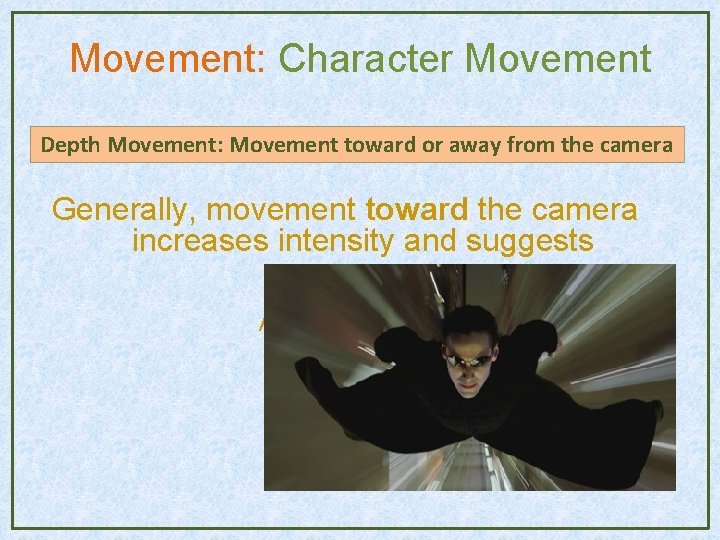
Movement: Character Movement Depth Movement: Movement toward or away from the camera Generally, movement toward the camera increases intensity and suggests Strength Assertiveness Confidence
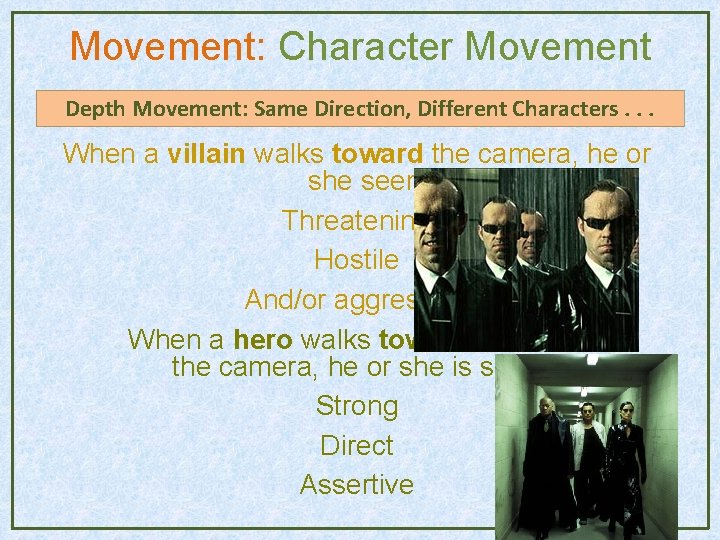
Movement: Character Movement Depth Movement: Same Direction, Different Characters. . . When a villain walks toward the camera, he or she seems Threatening Hostile And/or aggressive When a hero walks toward v the camera, he or she is seen as Strong Direct Assertive
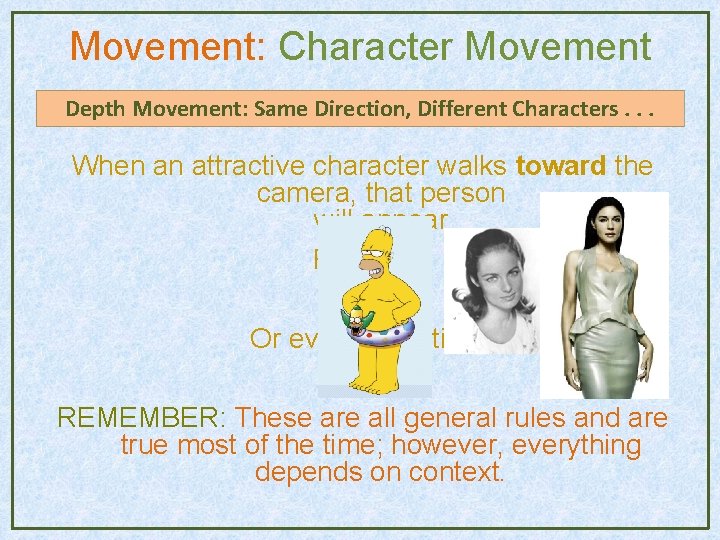
Movement: Character Movement Depth Movement: Same Direction, Different Characters. . . When an attractive character walks toward the camera, that person will appear Friendly Inviting Or even seductive REMEMBER: These are all general rules and are true most of the time; however, everything depends on context.
Movement: Character Movement Depth Movement: Movement away from the camera Generally, movement away from the camera decreases intensity and suggests Remoteness A character drawing away from the audience Frequently, it is simply a cinematic convention to bring closure to the end of a scene or a film For example, in the western genre, characters often ride off “into the sunset”
Movement: The Moving Camera The Seven Basic Moving Camera Shots 1. 2. 3. 4. 5. 6. 7. Pans (horizontal) Tilts (vertical) Crane shots Dolly shots (also called tracking shots) Zoom shots Handheld shots Aerial shots
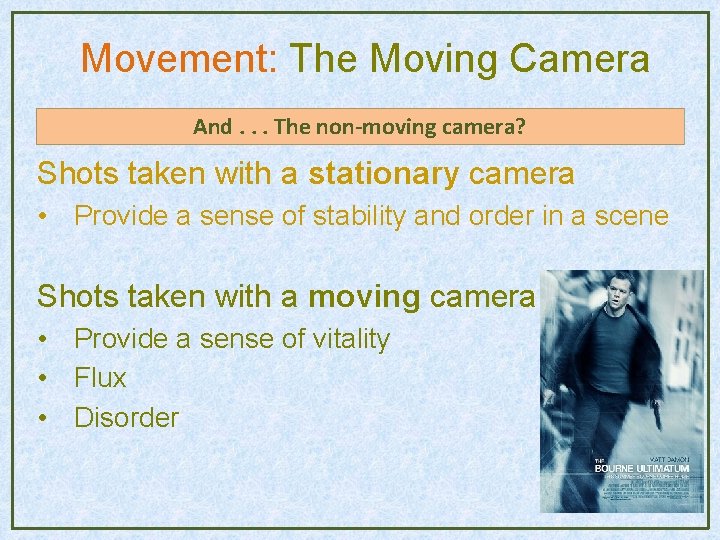
Movement: The Moving Camera And. . . The non-moving camera? Shots taken with a stationary camera • Provide a sense of stability and order in a scene Shots taken with a moving camera • Provide a sense of vitality • Flux • Disorder
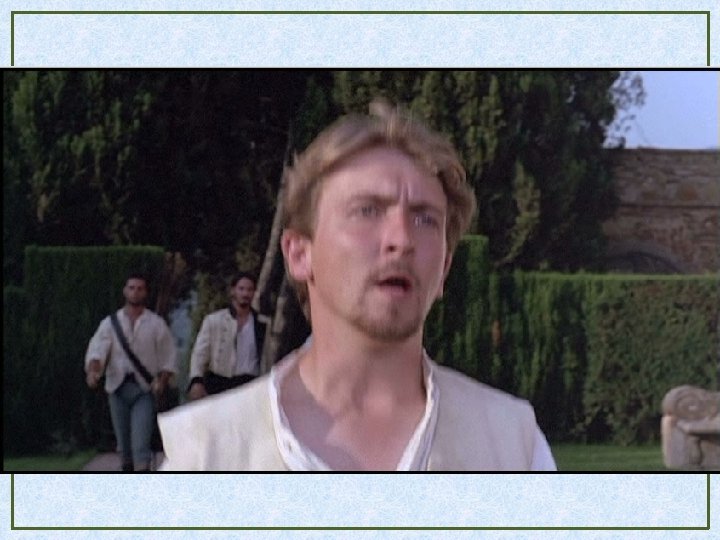
Movement: The Moving Camera Psychological Implications Vertical movement of the camera tends to mean one of the following: • • Aspiration Joy Power Authority Which it means will depend on context
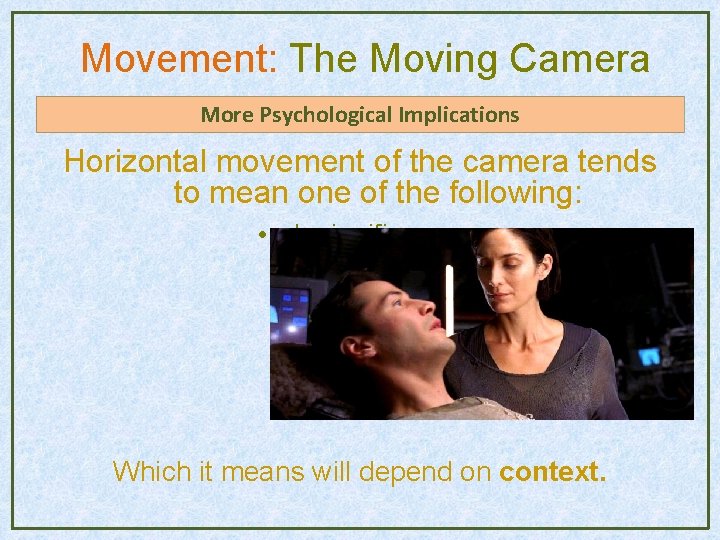
Movement: The Moving Camera More Psychological Implications Horizontal movement of the camera tends to mean one of the following: • Insignificance • Depression • Weakness • Grief • Death Which it means will depend on context.
Movement: Projecting the Film What exactly makes the images appear to be moving? Present day cameras record and project movement at 24 frames per second (24 fps) Peter Jackson is filming The Hobbit(2012) in 48 fps At this speed, the human eye does not see still images divided by thin lines; the human eye sees movement This phenomenon is called PERSISTENCE OF VISION
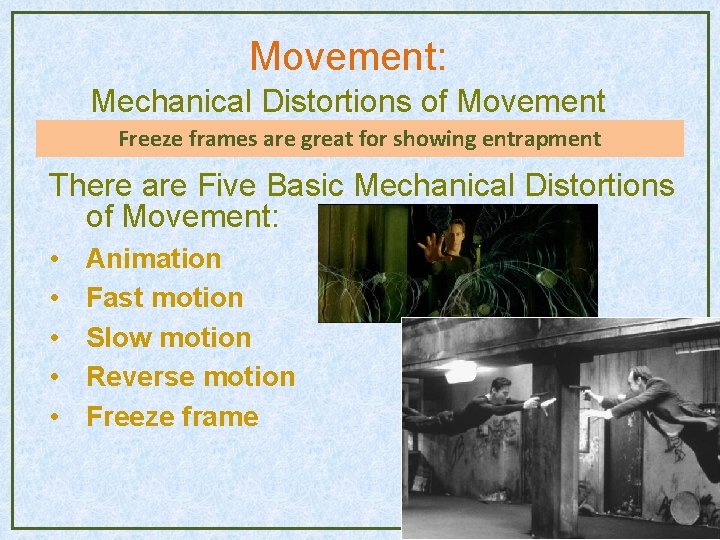
Movement: Mechanical Distortions of Movement Freeze frames are great for showing entrapment There are Five Basic Mechanical Distortions of Movement: • • • Animation Fast motion Slow motion Reverse motion Freeze frame
Movement: Mechanical Distortions of Movement Animation —As Giannetti states, “In an animated movie, thousands of frames are separately photographed. Each frame differs from its neighbor only to an infinitesimal degree. When a sequence of these frames is projected at twentyfour fps, the illusion is that the drawings or objects are moving and, hence, are ‘animated’. ”
Movement: Mechanical Distortions of Movement Fast motion—intensifies the natural speed of a scene Slow motion—photographing events at a faster rate than twenty-four fps and projecting the filmstrip at the standard speed Reverse motion—reversing the film = reversing movement, frequently creating a comic effect
Movement: Mechanical Distortions of Movement Freeze frames can be highly symbolic: stasis, entrapment (no way out), sometimes even death Freeze frame—suspends all movement within the frame, as if the filmstrip just stops. The strip of film cannot, however, just stop. So, the technique is created by reproducing a single image for as many frames as necessary to suggest a moment frozen in time and projecting the film at 24 fps, yet the image never alters, movement ceases.
Movement: Kinetics A Few Review Questions Q: The Greek word for movement is _______. A: Kinetic Q: True or False: Abstract movements, such as those in ballets, musicals, and mime are classified as stylized and lyrical. A: True Q: True of False: Realistic and concrete movement is the most common type found in film, especially in plot-driven films. A: True Q: In classical musicals, the character’s truest emotions are expressed in the song and ______ numbers. A: Dance
Movement: Kinetics A Few Review Questions Q: Generally speaking, the longer and higher the shot, the _____ the movement will appear. A: Slower Q: In loosely framed, long shots, people generally have _____ of movement. A: Freedom Q: The _______ and _______ the angle, the more intense and faster the movement appears. A: Closer and lower
Movement: Character Movement A Few Review Questions Q: Lateral movement on screen tends to emphasize one or more of these three things. What are they? A: Speed, efficiency, action Q: Which directional movement generally feels comfortable and natural, may denote positive foreshadowing, and is frequently the direction in which the film’s hero moves? A: Left to right Q: ________ character movement most often evokes, tension, discomfort, and sometimes indicates negative foreshadowing. Often, villains travel in this direction. A: Right to left
Movement: Character Movement A Few Review Questions Q: Generally, movement toward the camera by the hero signifies A: Strength, directness, and assertiveness Q: Generally, movement toward the camera by the villain seems A: Threatening, hostile, and/or aggressive Q: Movement away from the camera decreases intensity and suggests A: Remoteness between the character and the audience, or it may simply be a genre convention that brings closure to a scene
Movement: The Moving Camera A Few Review Questions Q: How many basic moving camera shots are there? A: Seven Q: Sometimes called an airborne dolly shot, for this shot, the camera is situated on a long mechanical arm-like device which can provide the viewer with a sense of entering or leaving a scene. What type of shot is it? A: Crane Q: This moving camera shot scans a scene horizontally from a stationary axis point such as a tripod. What is it called? A: Pan
Movement: The Moving Camera A Few Review Questions Q: Frequently shaky and unsteady, this shot moves to the same extent that the person holding the camera moves. What is it? A: Hand-held shot Q: Generally, shots taken with a ______ camera provide a sense of stability and order in the scene. A: Stationary Q: Depression, weakness, vulnerability, grief, and sometimes death are feelings that can be associated with this type of camera movement. A: Horizontal
Movement: Projecting the Film A Few Review Questions Q: Present day cameras record (and generally project) movement at how many frames per second? A: Twenty-four Q: At this projection speed, the human eye does not see still images divided by thin lines; the human eye sees movement. What is this phenomenon called? A: Persistence of vision
Movement: Mechanical Distortions of Movement A Few Review Questions Q: How many basic mechanical distortions of movement are there? A: Five Q: Can you name them? A: Animation, fast motion, slow motion, reverse motion, and freeze frame Q: This distortion of movement involves photographing events at a faster rate than twenty-four fps and projecting the filmstrip at the standard speed. What is it? A: Slow motion
Production SPECIAL EFFECTS
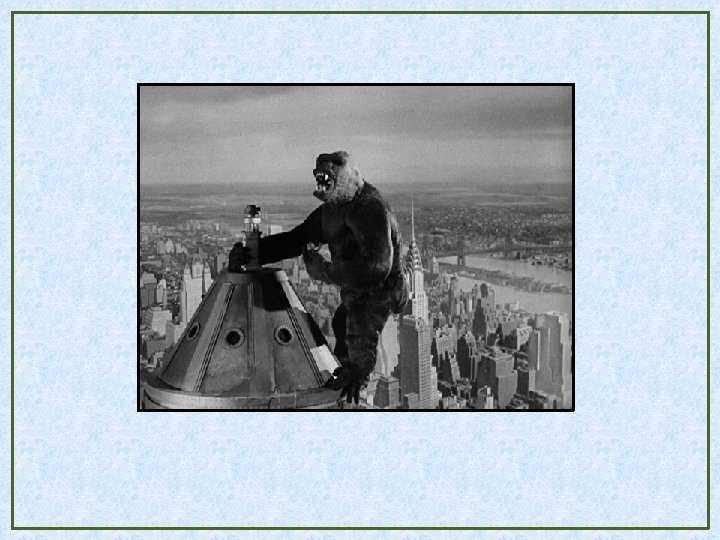
Photography: Special Effects Citizen Kane is a film that utilizes the optical printer to remarkable advantage. • Miniatures and the Optical Printers are traditional means of achieving special effects • Computer Generated Imagery (CGI) can achieve marvelous effects, but often at the cost of story and character
Production CINEMATOGRAPHY: THE “ISMS”
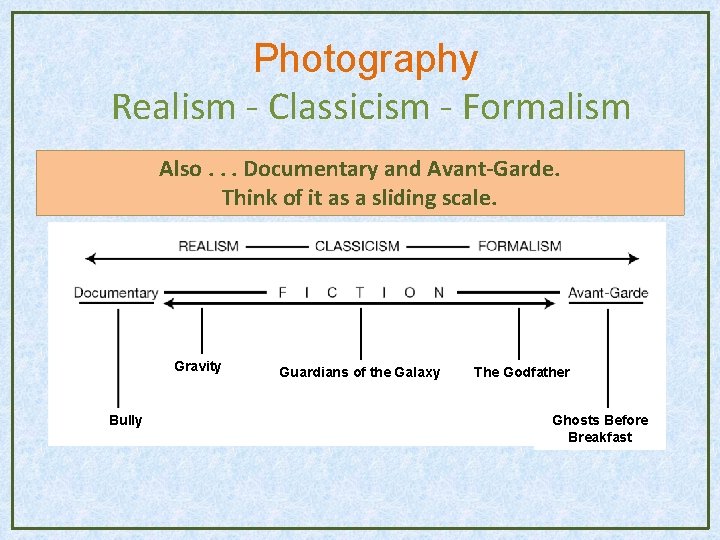
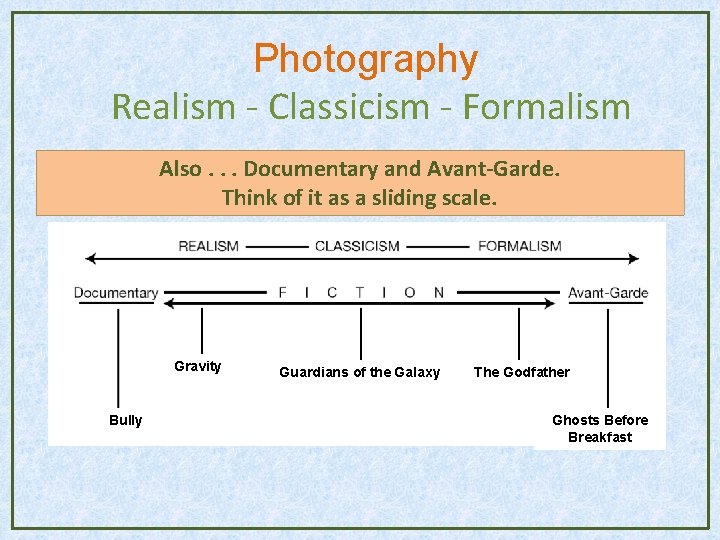
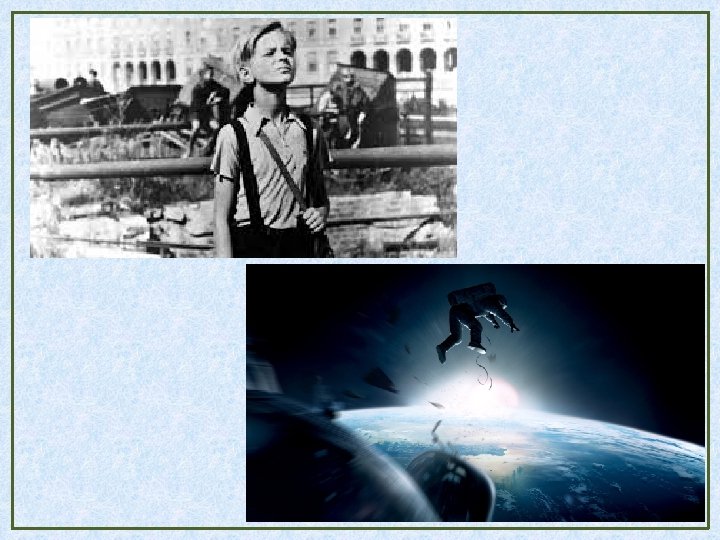
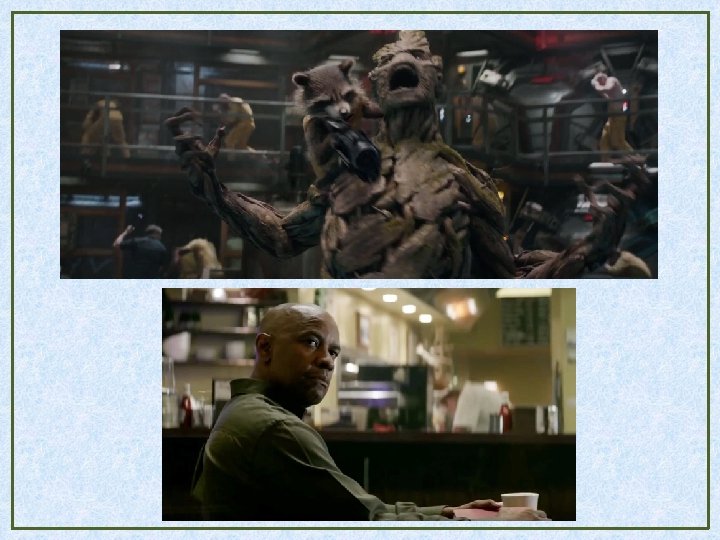
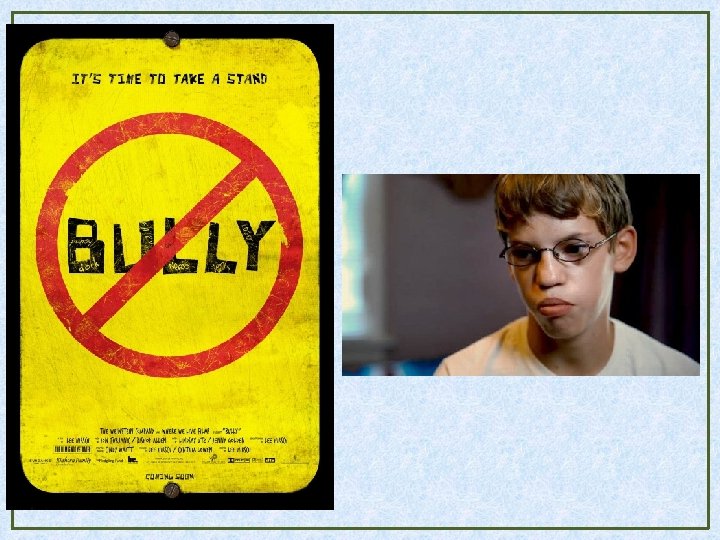
Photography Realism - Classicism - Formalism Also. . . Documentary and Avant-Garde. Think of it as a sliding scale. Gravity Bully Guardians of the Galaxy The Godfather Ghosts Before Breakfast
Putting Stories on Film: Photography People inscribe their histories, beliefs, attitudes, desires and dreams in the images they make. –Robert Hughes, Art Critic
Photography: Language • Frame = 1 picture of film • • Most film is shot at 24 fps (frames per second) word • Shot = 1 uninterrupted segment of film • sentence • Scene = 1 segment of a film that takes place in a specific place and lasts until time or location changes • paragraph
Photography Realism - Classicism - Formalism Also. . . Documentary and Avant-Garde. Think of it as a sliding scale. Gravity Bully Guardians of the Galaxy The Godfather Ghosts Before Breakfast
Photography: Realism Think of the frame as a window to the “real” world. • • • Attempts to capture the spontaneity of events Appears to mirror reality Stresses content over form Avoids extremes of technical manipulation Uses available lighting, hand-held cameras, long shots, and lengthy takes • Frequently makes use of location shooting
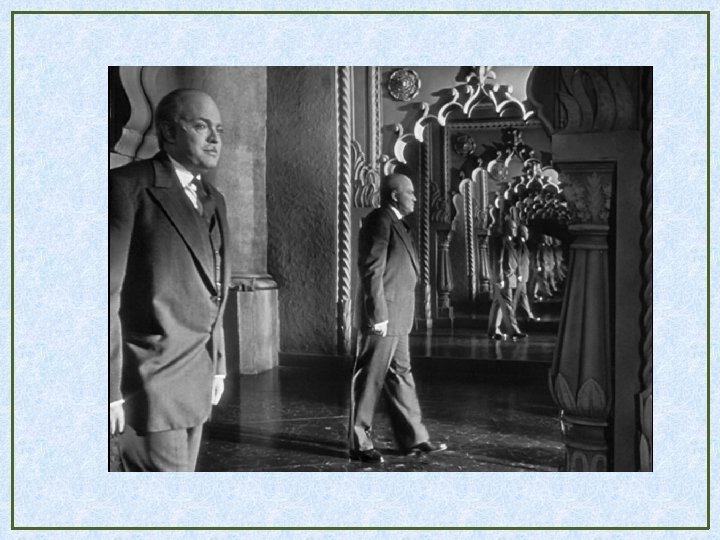
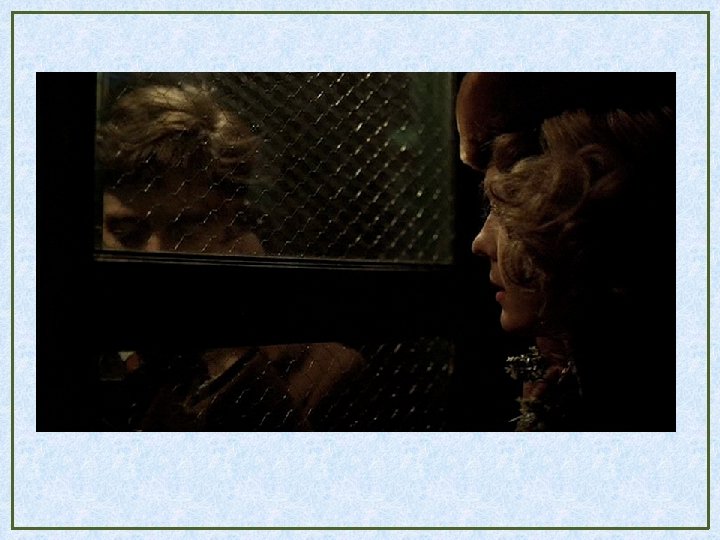
Photography: Formalism Expressionist Cinema • Intentionally stylizes and distorts reality • Tends to be stylistically flamboyant • Expresses a director’s subjective experience or world view • Concerned with spiritual or psychological ideas • Contains a high degree of technical manipulation • Emphasizes form over content
Photography: Classicism Rooting for the good guys. . . Classicism feels familiar to us. • Avoids extremes: Realism and Formalism • Follows the classical paradigm • Tends to be strong on story, star and production value • Shows a high level of technical accomplishment • Employs the conventions of classical editing – Linear timeline, “invisible” transitions, cutting to continuity, etc.
Photography: Documentary Pennebaker, Moore, Burns, Scorsese, et. al. —Reality, what a concept. • The extreme end of realism • Emphasizes actual events, people, natural occurrences, etc. • Not without a point of view • May appear grainy or washed out – Particularly true of earlier documentary films and less frequent today
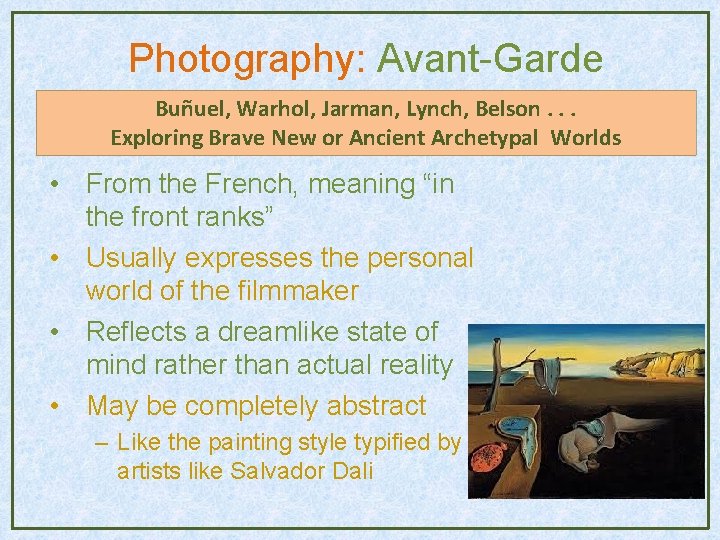
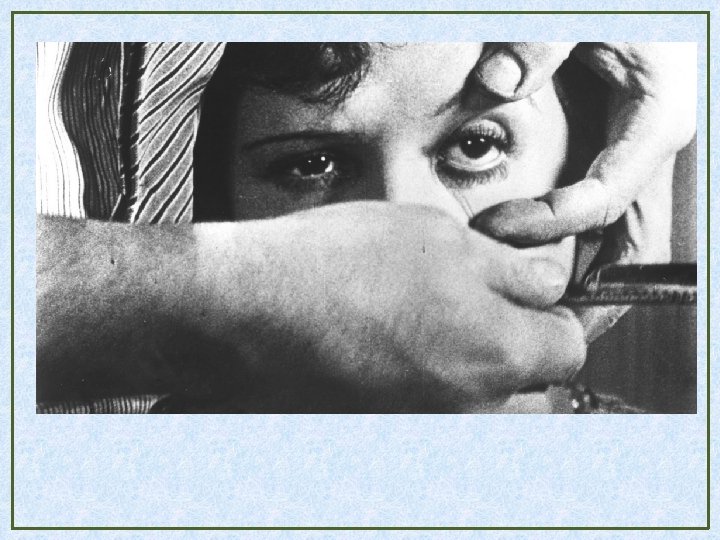
Photography: Avant-Garde Buñuel, Warhol, Jarman, Lynch, Belson. . . Exploring Brave New or Ancient Archetypal Worlds • From the French, meaning “in the front ranks” • Usually expresses the personal world of the filmmaker • Reflects a dreamlike state of mind rather than actual reality • May be completely abstract – Like the painting style typified by artists like Salvador Dali
Photography: The Styles Absolutes in style are the exception, rather than the rule. • Very few films are entirely Realist, Formalist, or Classicist • Filmmakers may use techniques from two or more styles within any given film • Good films succeed at “externalizing the internal” • Filmmakers today work in various styles and few are locked in to one in particular – Herzog and Scorsese
Photography: The Styles Review Questions Q: Avant Garde is from the French and means _______. A: “in the front ranks” Q: On the extreme end of Realism, this style often appears grainy or washed out and concentrates on actual people, events, or natural occurrences. What is it? A: Documentary Q: What cinematic style intentionally distorts reality and often deals with spiritual or psychological ideas? A: Formalism Q: This cinematic style attempts to capture the spontaneity of events as if they were occurring in real life A: Realism
Production CINEMATOGRAPHY: CRITICAL THEORIES
Critique Reviewers, Critics, and Theorists People who critique movies fall into three general classes: Reviewers, Critics, and Theorists 1. Reviewers are generally journalists who describe the contents and general tone of a movie, with only incidental emphasis on aesthetic evaluation
Critique Reviewers, Critics, and Theorists People who critique movies fall into three general classes : Reviewers, Critics, and Theorists 2. Critics are also journalists for the most part, but their emphasis is more on evaluation than on mere content description
Critique Reviewers, Critics, and Theorists People who critique movies fall into three general classes : Reviewers, Critics, and Theorists 3. Theorists are usually professional academics, often the authors of books on how movies can be studied on a more philosophical level
Critique The Film, The Director, The Viewer Traditionally, critics and theorists focus on three areas of inquiry: 1. The work of art 2. The artist 3. The audience
Critique Some Theories of Film To Examine • Realist Theory • Formalist Theory • Auteur Theory • Structuralism and Semiology • Historiography
Critique: Theories of Realism Roberto Rossellini’s Open City (1945) began the Italian neorealist movement. “This is the way things are, ” Rossellini reportedly said after the film’s premiere. Some Assertions of Realist Theory • Subject matter is paramount • Technique should be undetectable or discreet • Most theories of realism have a moral and ethical bias • Many realist theories are rooted in values of Islamic, Christian, or Marxist humanism • Theories place value on photographic qualities of the work
Critique: Theories of Realism De Sica, Zavattini, and Visconti stressed morality as the touchstone of neorealism. The Main Ideological Characteristics of Italian Neo-Realism • New democratic spirit, with emphasis on the value of ordinary people, such as laborers, peasants, and factory workers • Compassionate point of view and a refusal to make facile moral judgments • Preoccupation with Italy’s Fascist past and its aftermath of wartime devastation, poverty, unemployment, prostitution, and the black market • Emphasis on emotions rather than abstract ideas
Critique: Theories of Realism Vittorio De Sica’s The Bicycle Thief (1948) exemplifies the ideology and style of Italian neo-realism. The Stylistic Features of Italian Neo-Realism • An avoidance of neatly plotted stories in favor of loose, episodic structures that evolve organically • A documentary visual style • The use of actual locations, usually exteriors, rather than studio sets • The use of nonprofessional actors • An avoidance of literary dialogue in favor of conversational speech, including dialects • An avoidance of artifice in the editing, camerawork, and lighting
Critique: Formalist Film Theories Formalist theorists believe that reality needs some “fixing up” to become art. • Formalist theorists believe in the aesthetic manipulation of the mise en scène, the frame, camera angles, editing, and so on. • Every cinematic technique at the artist’s disposal can and should be used to create an aesthetic work, an artificial world that is believable through the audience’s willing suspension of disbelief. • The films of Tim Burton and Stanley Kubrick could not be made within the limits of realism. No realist aesthetic would permit the existence of James Cameron’s moon Pandora in Avatar (2009).
Critique: The Auteur Theory Auteur theory stresses the importance of the director as the “author” of the film. • Auteur theory emphasizes the director as the principle creator of a film, stamping the material with his or her own personal vision, style, and thematic concerns. • The word auteur is French for author. The theory does not dispute the fact that film is a collaborative art, but it does favor the view that the director is the main creator, artist, and driving force behind a film. • The theory originated in France and was popularized in the French film journal Cahiers du Cinéma.
Critique: The Auteur Theory While the classical Hollywood studio system discouraged directorial dominance of a film, some directors managed to subvert the system. Douglas Sirk is an example. • The first two recognized originators of theory were André Bazin and François Truffaut, each editors of Cahiers du Cinéma for a time. • In the 1950 s, Truffaut was probably best known as the proponent of the auteur theory; he distinguished Alfred Hitchcock as an auteur par excellence. • In the United States, the film critic for The Village Voice, Andrew Sarris, became the first and best known supporter of the Auteur Theory.
Critique: The Auteur Theory Not every director is an auteur. According to Sarris, there are three criteria that make a director an auteur 1. Technical competence—the minimum requirement 2. A distinguishable “personality” that becomes defined through a recurring cinematic style from film to film 3. Interior meaning—an auteur’s work will reflect personal psychological, social, or other thematic elements that are a part of the director’s personal belief system or obsessions
Critique: Eclectic and Synthesizing Approaches Pluralistic Views Eclecticism has been and continues to be favored by many film critics in the United States including Pauline Kael and Roger Ebert.
Critique: Eclectic and Synthesizing Approaches Eclecticism Sometimes called the tradition of sensibility, eclecticism tends to • Believe that no single film theory can be applied to all films • Analyze films according to their most appropriate contexts • Combine multiple theories when reviewing a film The high level of subjectivity and lack of any formal criteria or agreed upon principles have been cited as the flaws of this approach.
Critique: Structuralism and Semiology Unlike eclecticism, structuralism and semiology were attempts to introduce a scientific rigor to film criticism. • Structuralism is the study of how various codes function within a single structure, within one movie. The theory uses scientific rigor and precise terminology. • Semiology is concerned with the systematic classification of types of codes used in the cinema and how it “signifies. ” (What might the fact that this text is a darker shade than that above or below it signify or mean? Is it pertinent? )
Critique: Historiography Aesthetic film historians delight in analyzing films such a Robert Altman’s Short Cuts. Historiography deals with theory of film’s history —the assumptions, principles, and methodologies of historical study Theorists chart four types of film history 1. Aesthetic film histories—film as art 2. Technological film histories—motion pictures as inventions and machines 3. Economic histories—film as industry 4. Social histories—movies as a reflection of the audience’s values, desires, and fears
End