
Macbeth Context of production and of reception Background
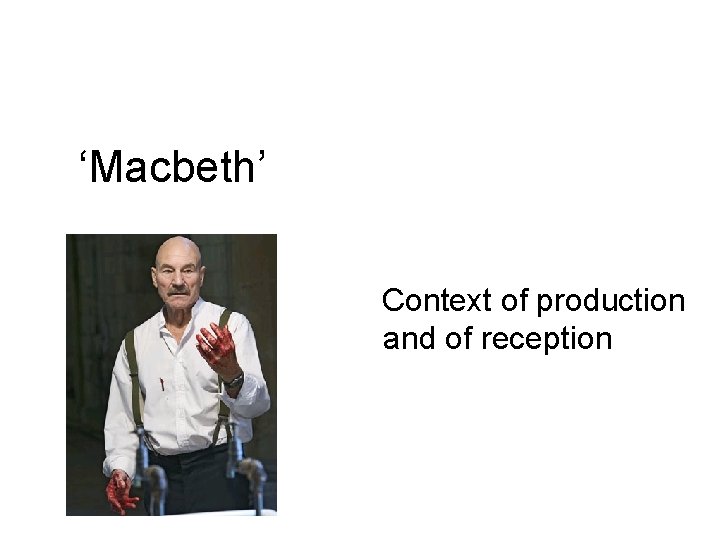
‘Macbeth’ Context of production and of reception
Background • Written in 1606 • King James I came to the throne in 1603 • He elected Shakespeare’s company (the Lord Chamberlain’s Men) as his favoured one – Sh. correspondingly flattered him • Gunpowder Plot of 1605 – classic! • His father and mother were murdered • Elizabethan audiences enjoyed violence and the supernatural – bear-baiting, public hangings. • The audience was sophisticated in part, as this was one of the few sources of narrative of the age • After the Armada, patriotism led to greater knowledge of history through plays as well as law
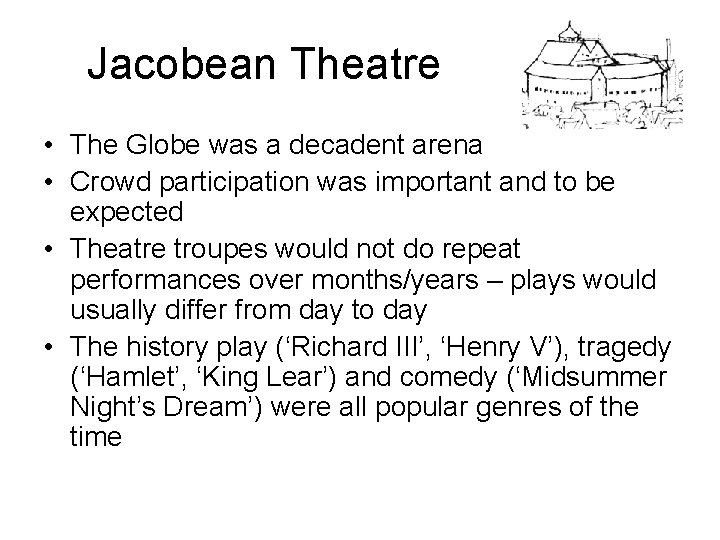
Jacobean Theatre • The Globe was a decadent arena • Crowd participation was important and to be expected • Theatre troupes would not do repeat performances over months/years – plays would usually differ from day to day • The history play (‘Richard III’, ‘Henry V’), tragedy (‘Hamlet’, ‘King Lear’) and comedy (‘Midsummer Night’s Dream’) were all popular genres of the time

James I • James 1 superstition, power and supernatural – wrote a book on witchcraft • Divine right to rule • Had been James VI of Scotland; set in land of ancestors • A descendent of Banquo, who is clearly shown in a role of ‘good’ as opposed to Macbeth’s ‘evil’, an (inaccurate) stylisation of history

The ‘Real’ Macbeth • Actually had quite a solid rule of 14 years with many children • Macbeth was a king of the Scots whose rule was marked by efficient government and the promotion of Christianity • Kills Duncan (actually a weak ruler) in 1040 and is killed by Malcolm (III) in 1057. • He was also a brave leader and made successful forays over the border into Northumbria, England • This illustrates the great écart between him and the Macbeth of ‘Macbeth’

Modern Reception • Often read today rather than watched • The importance of text over image is illustrated in the (filmed) adaptation which places the action in Communist Russia (using Scottish place-names. . ) which still makes sense • More help on the vocabulary although parts of the audience may have also had some trouble understanding Sh’s style • We have emerged out of the superstition of the past so look back on it as something less pertinent to ourselves, unlike ‘R and J’
• Thanks for
- Slides: 7