Chapter 10 The Mole 10 1 10 2



- Slides: 96
Chapter 10 – The Mole 10. 1 10. 2 10. 3 10. 4 10. 5 Measuring Matter Mass and the Moles of Compounds Empirical and Molecular Formulas The Formula for a Hydrate
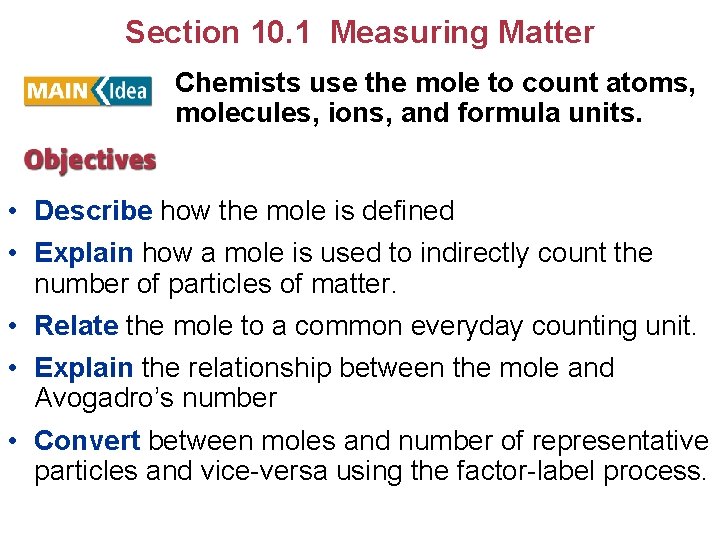
Section 10. 1 Measuring Matter Chemists use the mole to count atoms, molecules, ions, and formula units. • Describe how the mole is defined • Explain how a mole is used to indirectly count the number of particles of matter. • Relate the mole to a common everyday counting unit. • Explain the relationship between the mole and Avogadro’s number • Convert between moles and number of representative particles and vice-versa using the factor-label process.
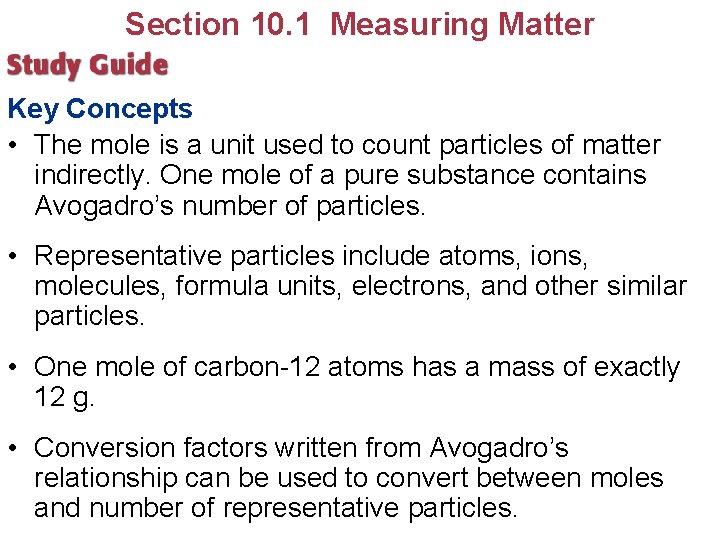
Section 10. 1 Measuring Matter Key Concepts • The mole is a unit used to count particles of matter indirectly. One mole of a pure substance contains Avogadro’s number of particles. • Representative particles include atoms, ions, molecules, formula units, electrons, and other similar particles. • One mole of carbon-12 atoms has a mass of exactly 12 g. • Conversion factors written from Avogadro’s relationship can be used to convert between moles and number of representative particles.
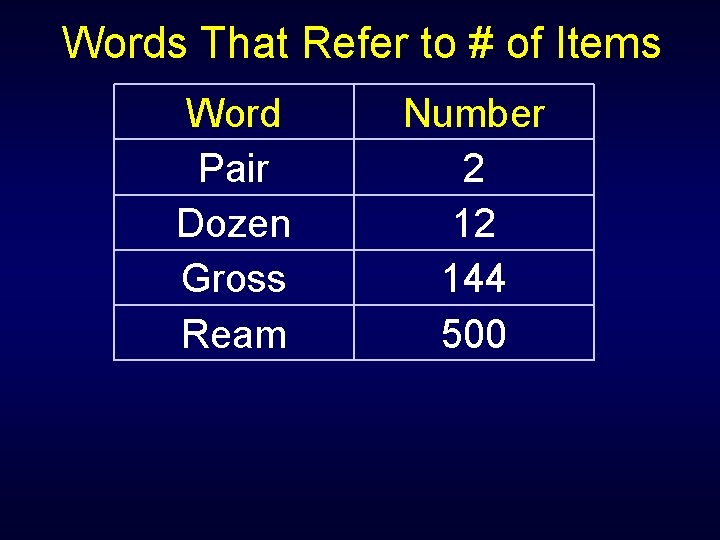
Words That Refer to # of Items Word Pair Dozen Gross Ream Number 2 12 144 500
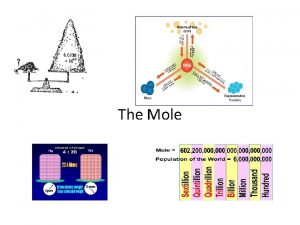
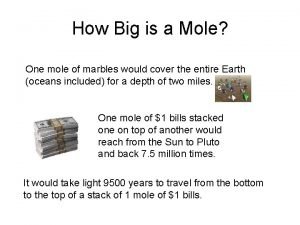
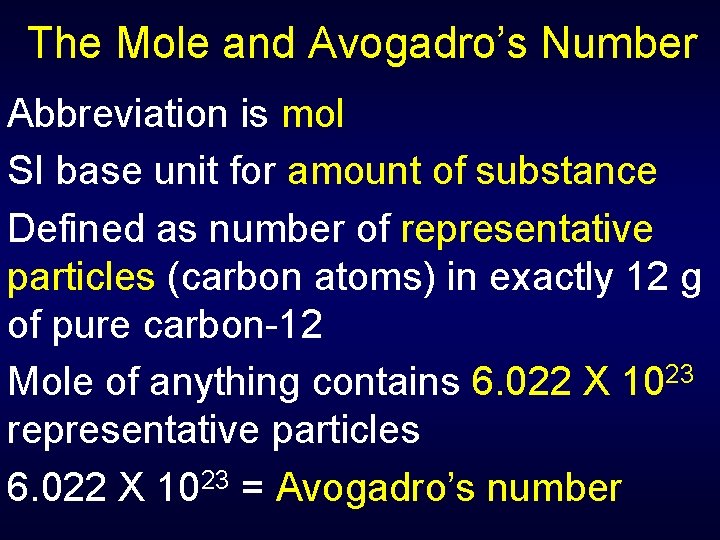
The Mole and Avogadro’s Number Abbreviation is mol SI base unit for amount of substance Defined as number of representative particles (carbon atoms) in exactly 12 g of pure carbon-12 Mole of anything contains 6. 022 X 1023 representative particles 6. 022 X 1023 = Avogadro’s number
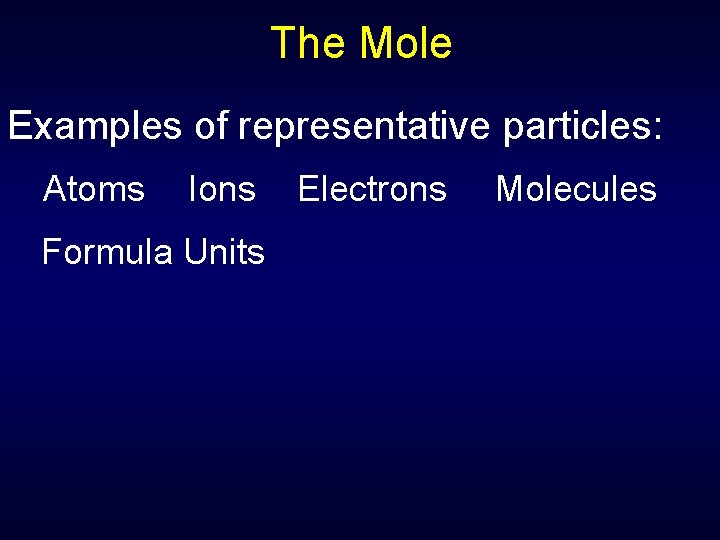
The Mole Examples of representative particles: Atoms Ions Formula Units Electrons Molecules
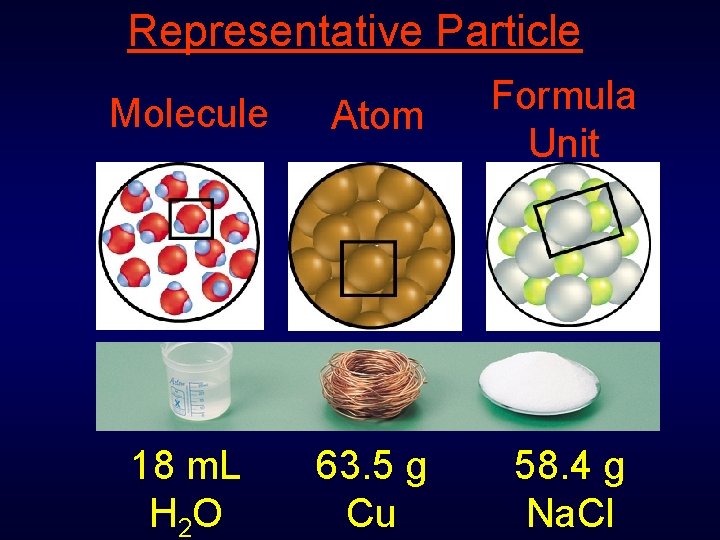
Representative Particle Molecule Atom Formula Unit 18 m. L H 2 O 63. 5 g Cu 58. 4 g Na. Cl
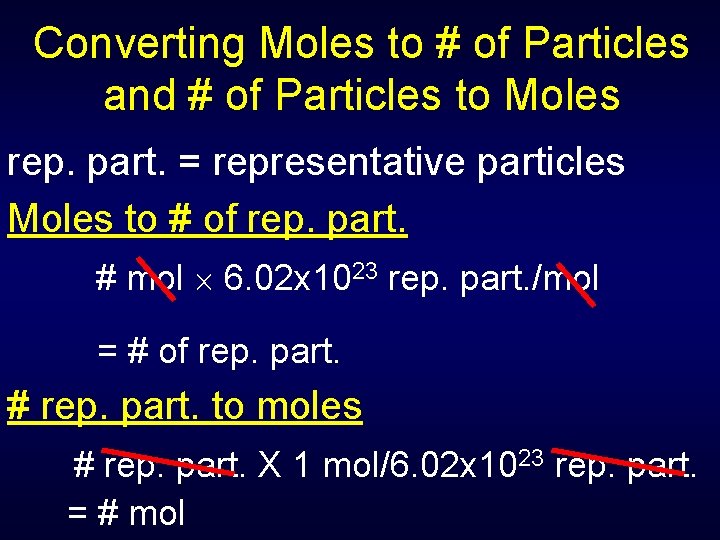
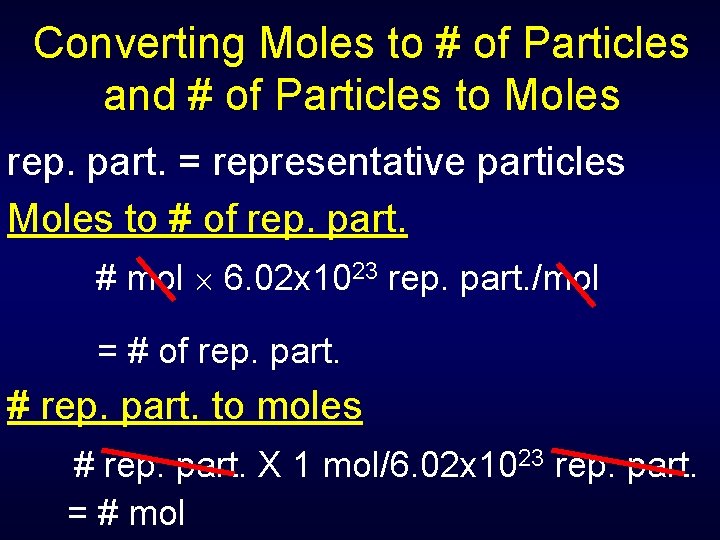
Converting Moles to # of Particles and # of Particles to Moles rep. part. = representative particles Moles to # of rep. part. # mol 6. 02 x 1023 rep. part. /mol = # of rep. part. # rep. part. to moles # rep. part. X 1 mol/6. 02 x 1023 rep. part. = # mol
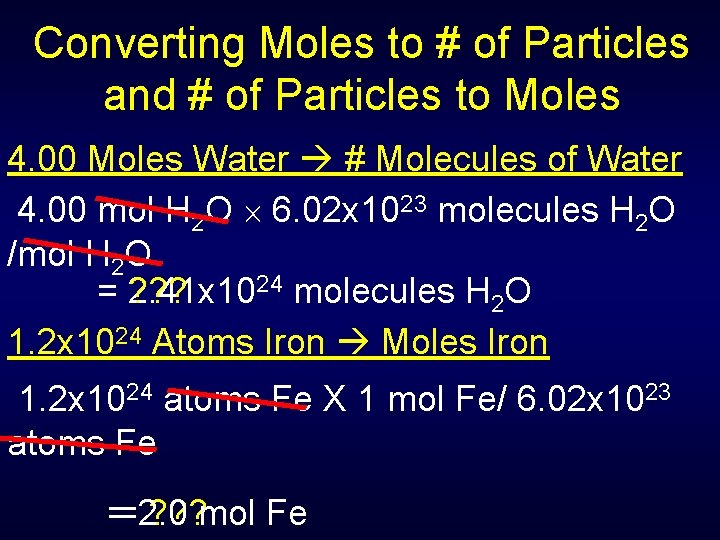
Converting Moles to # of Particles and # of Particles to Moles 4. 00 Moles Water # Molecules of Water 4. 00 mol H 2 O 6. 02 x 1023 molecules H 2 O /mol H 2 O 24 molecules H O = 2. 41 x 10 ? ? ? 2 1. 2 x 1024 Atoms Iron Moles Iron 1. 2 x 1024 atoms Fe X 1 mol Fe/ 6. 02 x 1023 atoms Fe ==2. 0 ? ? ? mol Fe
Practice Problems 1 - 4, page 323 Problems 5 (a-b), 6 (a-b), p 324 (Put up next slide as reference)
Converting Moles to # of Particles and # of Particles to Moles rep. part. = representative particles Moles to # of rep. part. # mol 6. 02 x 1023 rep. part. /mol = # of rep. part. # rep. part. to moles # rep. part. X 1 mol/6. 02 x 1023 rep. part. = # mol
Practice Section Assessment, page 324 Problems 7 - 14 Chapter Assessment, page 358 Problems 90(a-d), 91(a-d), 92(a-d), 93(a-d), 94(a-d), 95(a-c), 96 -101
Chapter 10 – The Mole 10. 1 10. 2 10. 3 10. 4 10. 5 Measuring Matter Mass and the Moles of Compounds Empirical and Molecular Formulas The Formula for a Hydrate
Section 10. 2 Mass and the Mole A mole always contains the same number of particles; however, moles of different substances have different masses. • Determine the molar mass of an element given its atomic mass in amu. • Convert between number of moles and the mass of an element and vice-versa using the factor-label process. • Convert between number of moles and number of atoms of an element and vice-versa using the factorlabel process.
Section 10. 2 Mass and the Mole Key Concepts • The mass in grams of 1 mol of any pure substance is called its molar mass. • The molar mass of an element is numerically equal to its atomic mass. • The molar mass of any substance is the mass in grams of Avogadro’s number of representative particles of the substance. • Molar mass is used to convert from moles to mass. The inverse of molar mass is used to convert from mass to moles.
Mass vs Number of Objects mass 1 dozen limes mass 1 dozen eggs
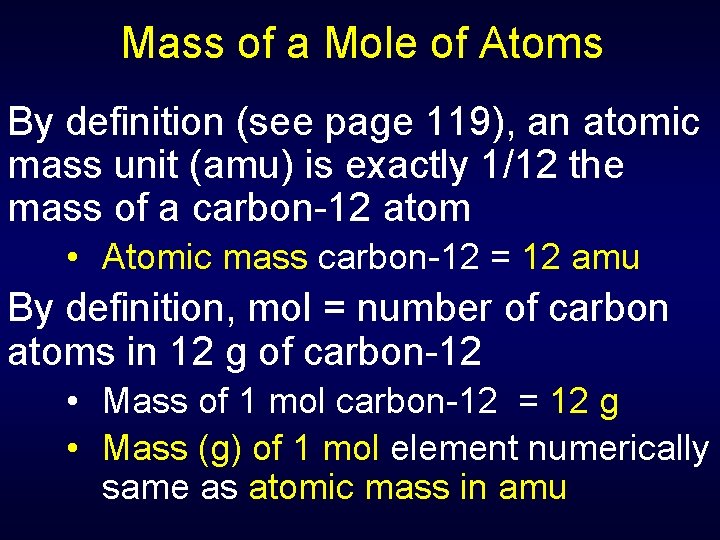
Mass of a Mole of Atoms By definition (see page 119), an atomic mass unit (amu) is exactly 1/12 the mass of a carbon-12 atom • Atomic mass carbon-12 = 12 amu By definition, mol = number of carbon atoms in 12 g of carbon-12 • Mass of 1 mol carbon-12 = 12 g • Mass (g) of 1 mol element numerically same as atomic mass in amu
Molar Mass in grams of one mole of any pure substance Numerically equal to mass of substance in amu Has units of g/mol
Molar Mass Hydrogen (element) • Atomic mass = 1. 01 amu • Molar mass H = 1. 01 g/mol • 6. 02 x 1023 H atoms has mass of 1. 01 g Manganese • Atomic mass = 54. 94 amu • Molar mass Mn = 54. 94 g/mol • 6. 02 x 1023 Mn atoms has mass of 54. 94 g
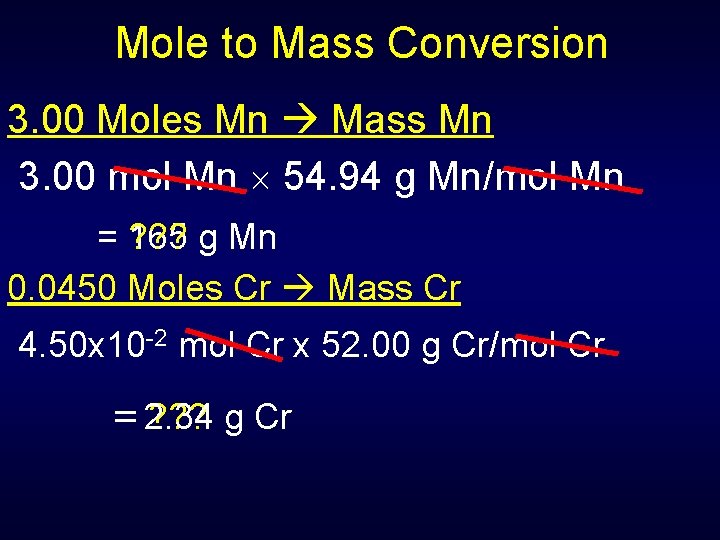
Mole to Mass Conversion 3. 00 Moles Mn Mass Mn 3. 00 mol Mn 54. 94 g Mn/mol Mn = 165 ? ? ? g Mn 0. 0450 Moles Cr Mass Cr 4. 50 x 10 -2 mol Cr x 52. 00 g Cr/mol Cr == 2. 34 ? ? ? g Cr
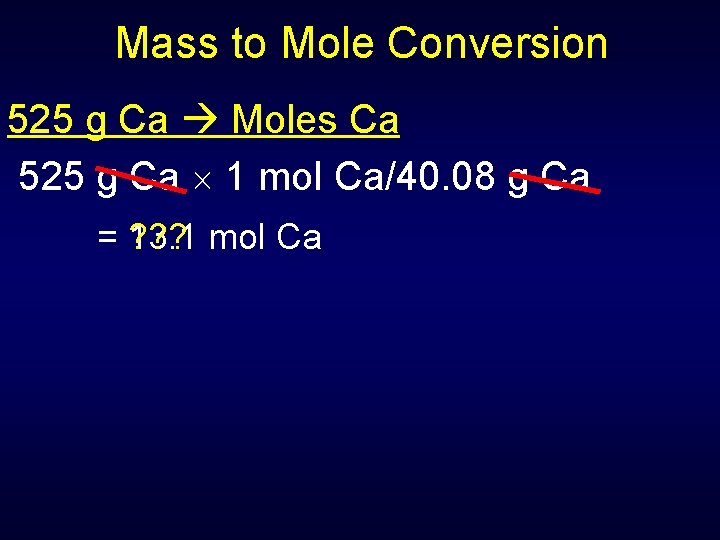
Mass to Mole Conversion 525 g Ca Moles Ca 525 g Ca 1 mol Ca/40. 08 g Ca = 13. 1 ? ? ? mol Ca
Practice Problems 15 (a-b), 16 (a-b) page 328 Problems 17 (a-b), 18 (a-b) page 329
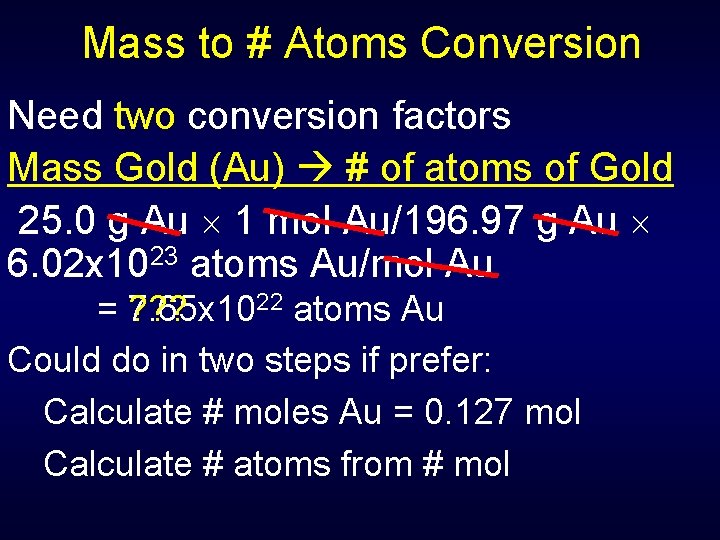
Mass to # Atoms Conversion Need two conversion factors Mass Gold (Au) # of atoms of Gold 25. 0 g Au 1 mol Au/196. 97 g Au 6. 02 x 1023 atoms Au/mol Au 22 atoms Au = 7. 65 x 10 ? ? ? Could do in two steps if prefer: Calculate # moles Au = 0. 127 mol Calculate # atoms from # mol
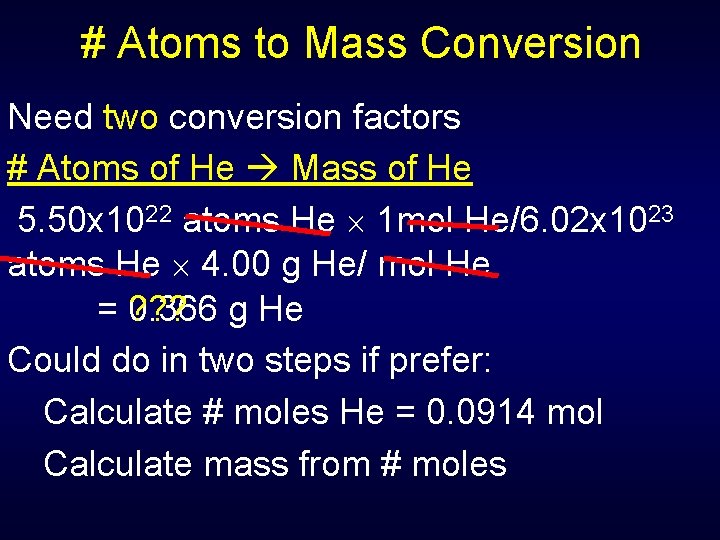
# Atoms to Mass Conversion Need two conversion factors # Atoms of He Mass of He 5. 50 x 1022 atoms He 1 mol He/6. 02 x 1023 atoms He 4. 00 g He/ mol He = 0. 366 ? ? ? g He Could do in two steps if prefer: Calculate # moles He = 0. 0914 mol Calculate mass from # moles
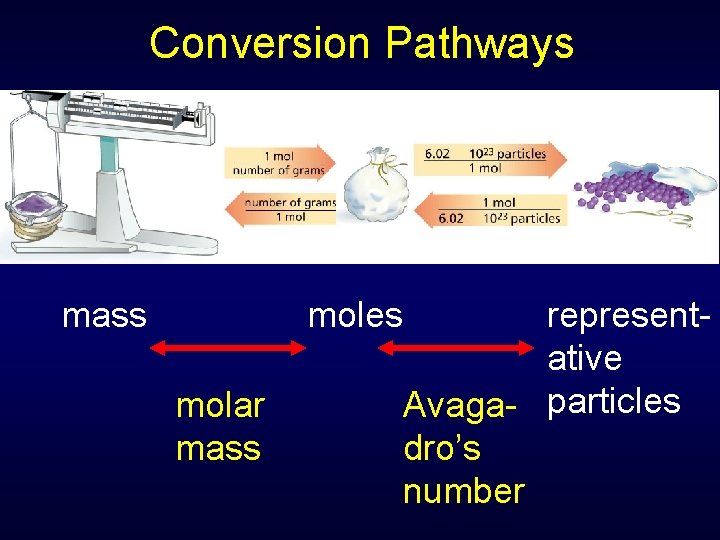
Conversion Pathways mass moles molar mass representative Avaga- particles dro’s number
Practice Problems 19 (a-c), 21 (a-b) page 331 Problems 20 (a-e) page 331
Chapter 10 – The Mole 10. 1 10. 2 10. 3 10. 4 10. 5 Measuring Matter Mass and the Moles of Compounds Empirical and Molecular Formulas The Formula for a Hydrate
Section 10. 3 Moles of Compounds The molar mass of a compound can be calculated from its chemical formula and can be used to convert from mass to moles of that compound. • Recognize the mole relationships shown by a chemical formula. • Calculate the molar mass of a compound. • Convert between the number of moles and mass of a compound and vice-versa using the factor-label process. • Apply conversion factors to determine the number of atoms or ions in a known mass of a compound.
Section 10. 3 Moles of Compounds Key Concepts • Subscripts in a chemical formula indicate how many moles of each element are present in 1 mol of the compound. • The molar mass of a compound is calculated from the molar masses of all of the elements in the compound. • Conversion factors based on a compound’s molar mass are used to convert between moles and mass of a compound.
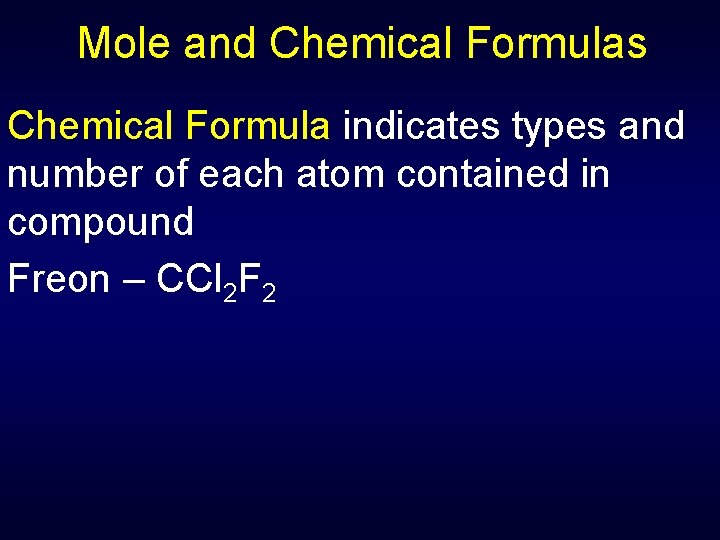
Mole and Chemical Formulas Chemical Formula indicates types and number of each atom contained in compound Freon – CCl 2 F 2
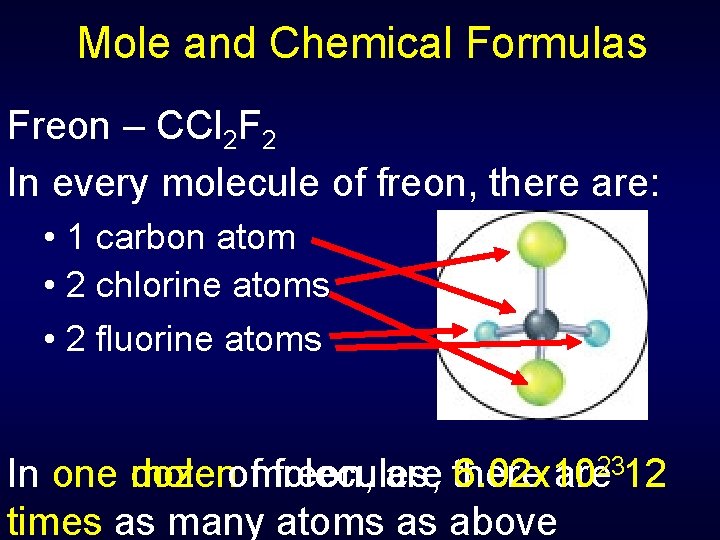
Mole and Chemical Formulas Freon – CCl 2 F 2 In every molecule of freon, there are: • 1 carbon atom • 2 chlorine atoms • 2 fluorine atoms In one mole dozenofmolecules, freon, are there 6. 02 x 10 are 2312 times as many atoms as above
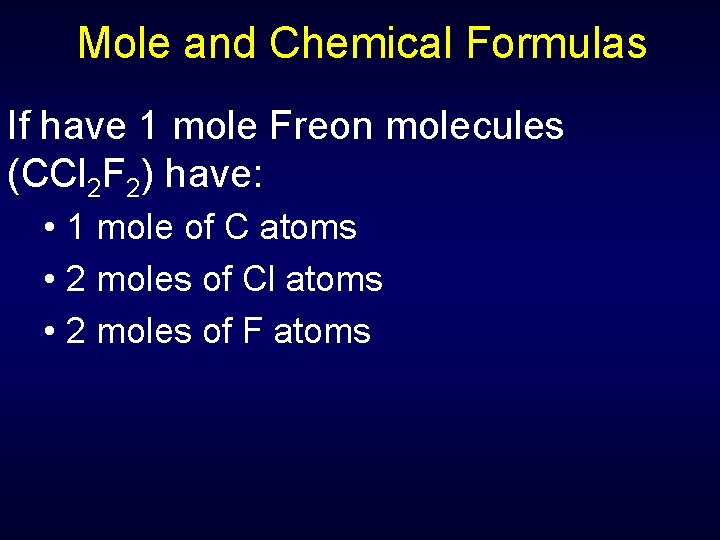
Mole and Chemical Formulas If have 1 mole Freon molecules (CCl 2 F 2) have: • 1 mole of C atoms • 2 moles of Cl atoms • 2 moles of F atoms
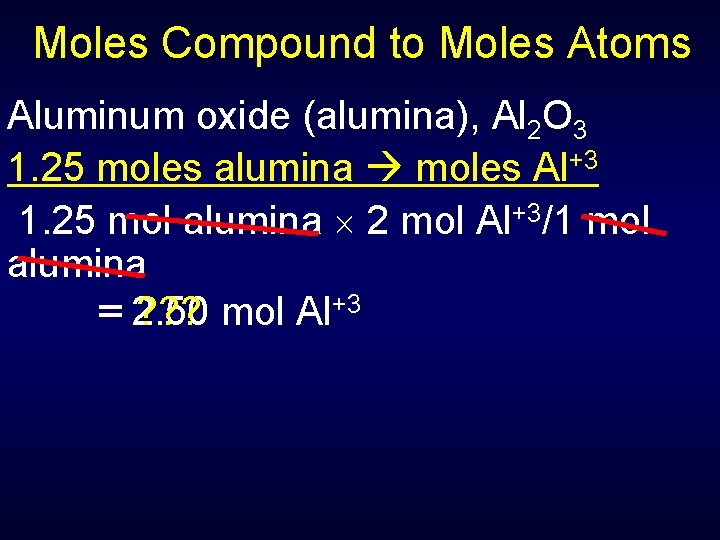
Moles Compound to Moles Atoms Aluminum oxide (alumina), Al 2 O 3 1. 25 moles alumina moles Al+3 1. 25 mol alumina 2 mol Al+3/1 mol alumina = 2. 50 ? ? ? mol Al+3
Practice Problems 29 - 33 page 335
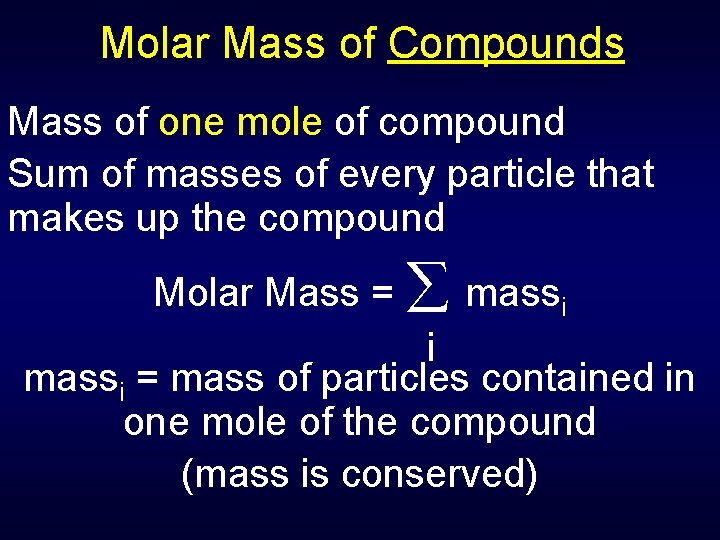
Molar Mass of Compounds Mass of one mole of compound Sum of masses of every particle that makes up the compound Molar Mass = massi i massi = mass of particles contained in one mole of the compound (mass is conserved)
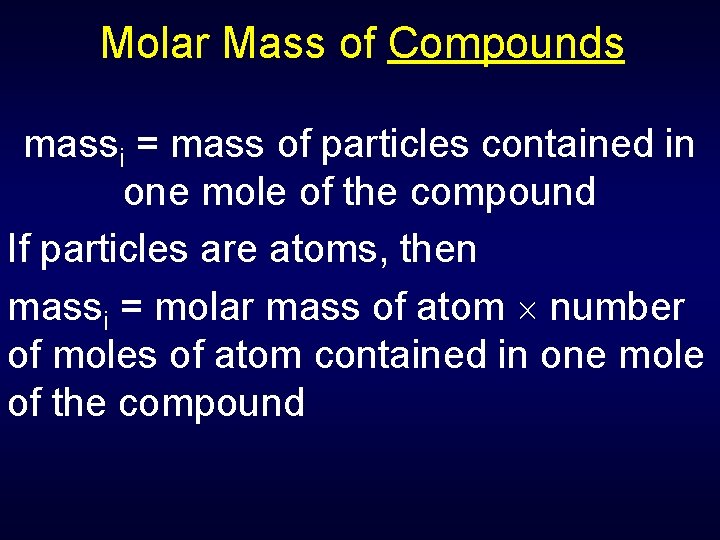
Molar Mass of Compounds massi = mass of particles contained in one mole of the compound If particles are atoms, then massi = molar mass of atom number of moles of atom contained in one mole of the compound
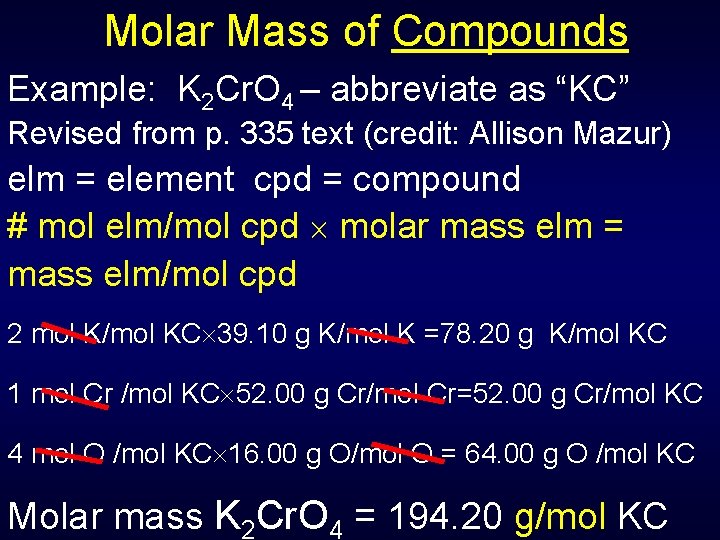
Molar Mass of Compounds Example: K 2 Cr. O 4 – abbreviate as “KC” Revised from p. 335 text (credit: Allison Mazur) elm = element cpd = compound # mol elm/mol cpd molar mass elm = mass elm/mol cpd 2 mol K/mol KC 39. 10 g K/mol K =78. 20 g K/mol KC 1 mol Cr /mol KC 52. 00 g Cr/mol Cr=52. 00 g Cr/mol KC 4 mol O /mol KC 16. 00 g O/mol O = 64. 00 g O /mol KC Molar mass K 2 Cr. O 4 = 194. 20 g/mol KC
Practice Problems 34 - 36 (all are a –c) page 335
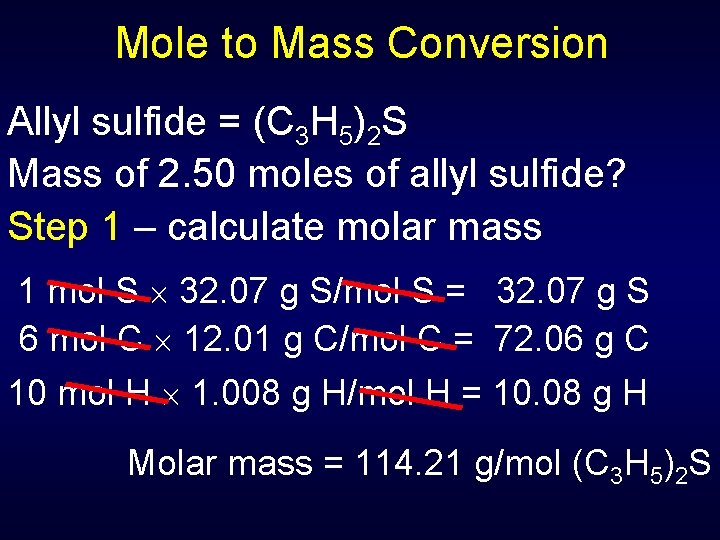
Mole to Mass Conversion Allyl sulfide = (C 3 H 5)2 S Mass of 2. 50 moles of allyl sulfide? Step 1 – calculate molar mass 1 mol S 32. 07 g S/mol S = 32. 07 g S 6 mol C 12. 01 g C/mol C = 72. 06 g C 10 mol H 1. 008 g H/mol H = 10. 08 g H Molar mass = 114. 21 g/mol (C 3 H 5)2 S
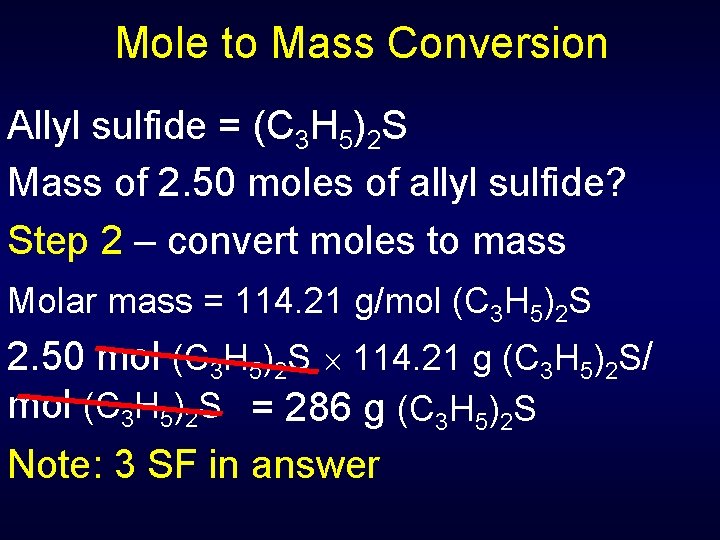
Mole to Mass Conversion Allyl sulfide = (C 3 H 5)2 S Mass of 2. 50 moles of allyl sulfide? Step 2 – convert moles to mass Molar mass = 114. 21 g/mol (C 3 H 5)2 S 2. 50 mol (C 3 H 5)2 S 114. 21 g (C 3 H 5)2 S/ mol (C 3 H 5)2 S = 286 g (C 3 H 5)2 S Note: 3 SF in answer
Practice Problems 37 -39 page 336
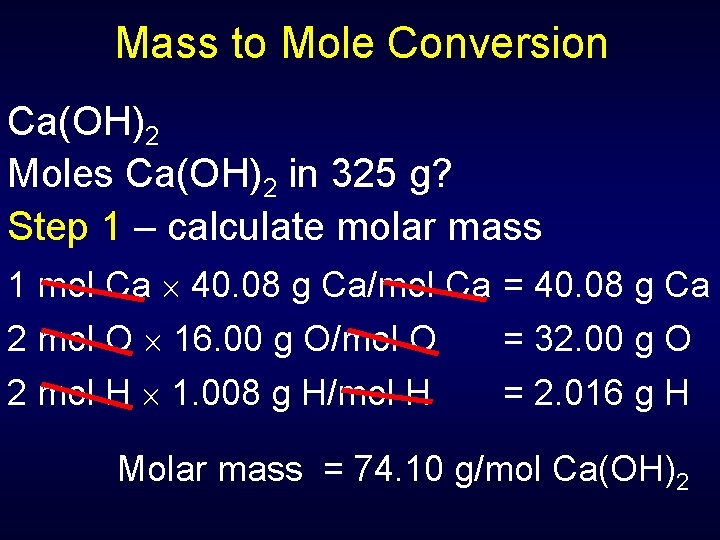
Mass to Mole Conversion Ca(OH)2 Moles Ca(OH)2 in 325 g? Step 1 – calculate molar mass 1 mol Ca 40. 08 g Ca/mol Ca = 40. 08 g Ca 2 mol O 16. 00 g O/mol O = 32. 00 g O 2 mol H 1. 008 g H/mol H = 2. 016 g H Molar mass = 74. 10 g/mol Ca(OH)2
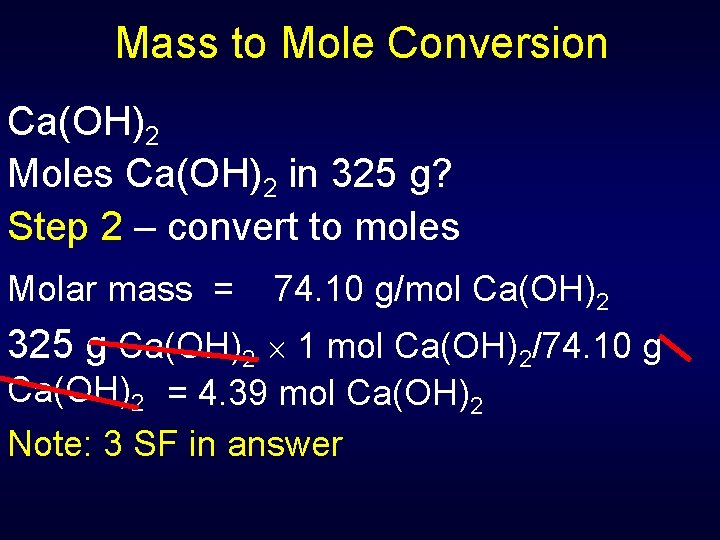
Mass to Mole Conversion Ca(OH)2 Moles Ca(OH)2 in 325 g? Step 2 – convert to moles Molar mass = 74. 10 g/mol Ca(OH)2 325 g Ca(OH)2 1 mol Ca(OH)2/74. 10 g Ca(OH)2 = 4. 39 mol Ca(OH)2 Note: 3 SF in answer
Practice Problems 40(a-c) – 41(a-b) page 337
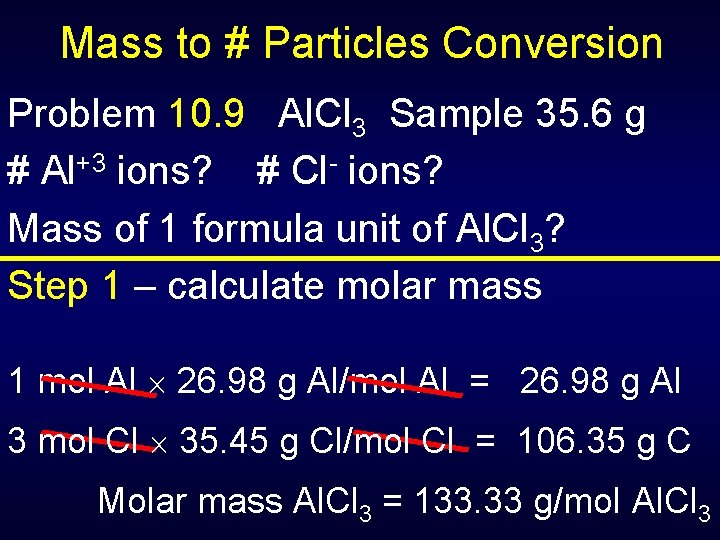
Mass to # Particles Conversion Problem 10. 9 Al. Cl 3 Sample 35. 6 g # Al+3 ions? # Cl- ions? Mass of 1 formula unit of Al. Cl 3? Step 1 – calculate molar mass 1 mol Al 26. 98 g Al/mol Al = 26. 98 g Al 3 mol Cl 35. 45 g Cl/mol Cl = 106. 35 g C Molar mass Al. Cl 3 = 133. 33 g/mol Al. Cl 3
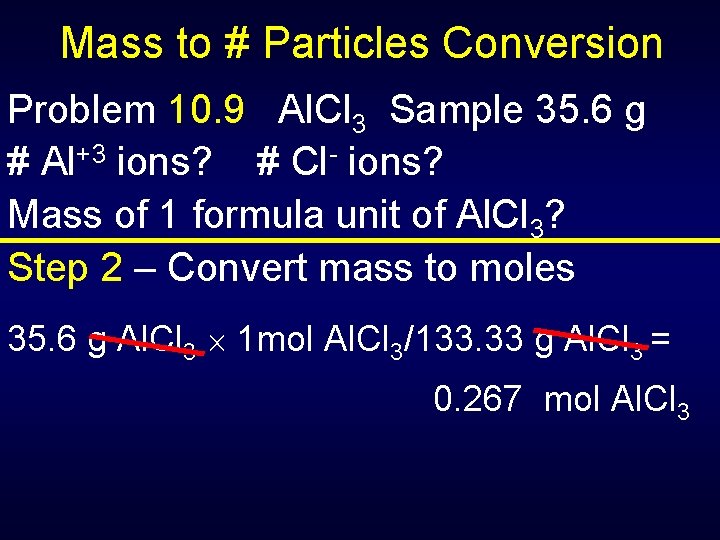
Mass to # Particles Conversion Problem 10. 9 Al. Cl 3 Sample 35. 6 g # Al+3 ions? # Cl- ions? Mass of 1 formula unit of Al. Cl 3? Step 2 – Convert mass to moles 35. 6 g Al. Cl 3 1 mol Al. Cl 3/133. 33 g Al. Cl 3 = 0. 267 mol Al. Cl 3
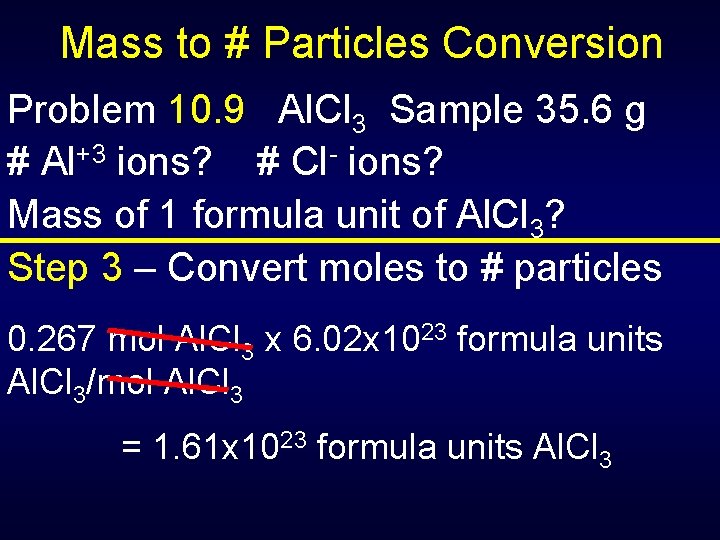
Mass to # Particles Conversion Problem 10. 9 Al. Cl 3 Sample 35. 6 g # Al+3 ions? # Cl- ions? Mass of 1 formula unit of Al. Cl 3? Step 3 – Convert moles to # particles 0. 267 mol Al. Cl 3 x 6. 02 x 1023 formula units Al. Cl 3/mol Al. Cl 3 = 1. 61 x 1023 formula units Al. Cl 3
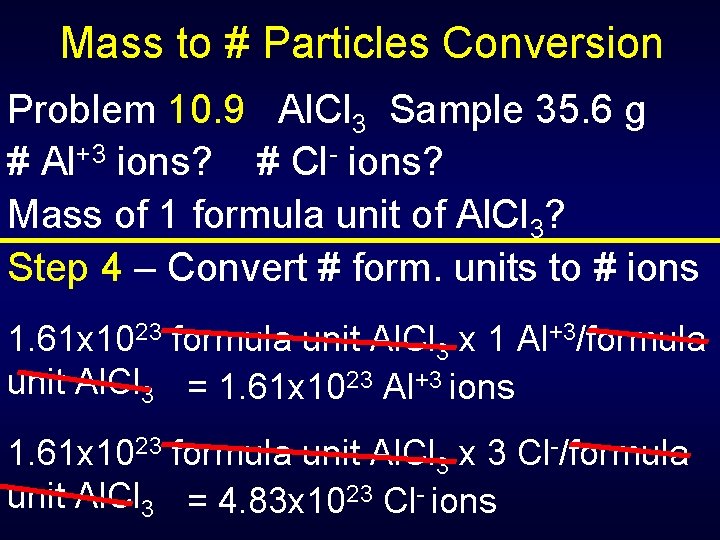
Mass to # Particles Conversion Problem 10. 9 Al. Cl 3 Sample 35. 6 g # Al+3 ions? # Cl- ions? Mass of 1 formula unit of Al. Cl 3? Step 4 – Convert # form. units to # ions 1. 61 x 1023 formula unit Al. Cl 3 x 1 Al+3/formula unit Al. Cl 3 = 1. 61 x 1023 Al+3 ions 1. 61 x 1023 formula unit Al. Cl 3 x 3 Cl-/formula unit Al. Cl 3 = 4. 83 x 1023 Cl- ions
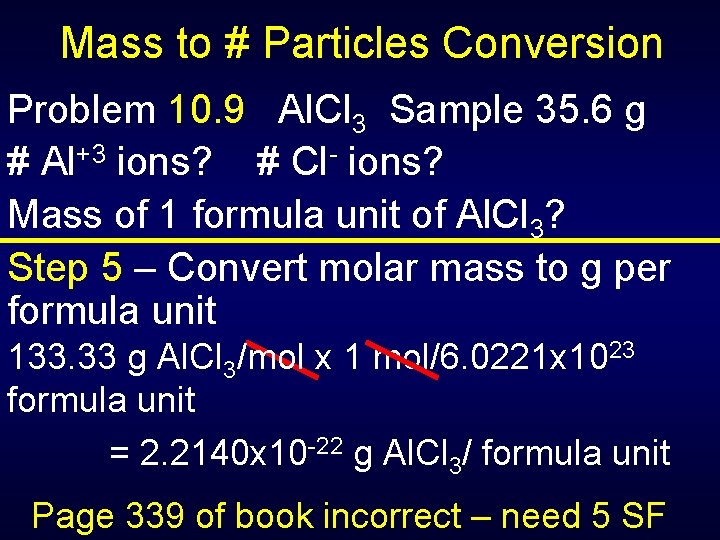
Mass to # Particles Conversion Problem 10. 9 Al. Cl 3 Sample 35. 6 g # Al+3 ions? # Cl- ions? Mass of 1 formula unit of Al. Cl 3? Step 5 – Convert molar mass to g per formula unit 133. 33 g Al. Cl 3/mol x 1 mol/6. 0221 x 1023 formula unit = 2. 2140 x 10 -22 g Al. Cl 3/ formula unit Page 339 of book incorrect – need 5 SF
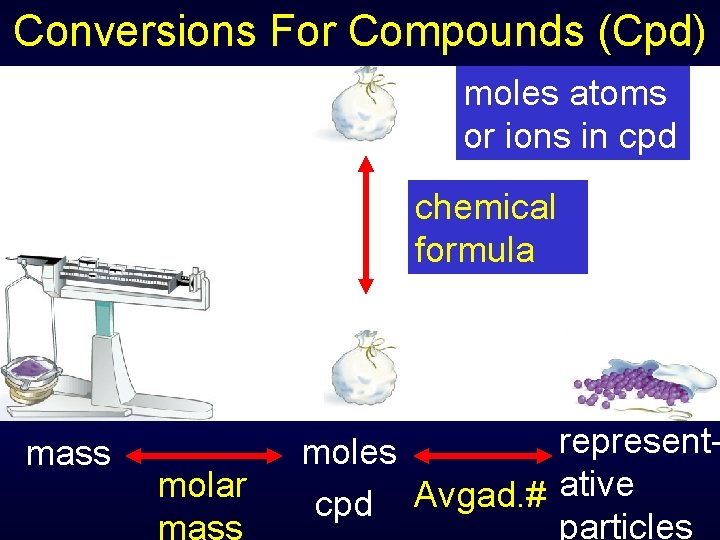
Conversions For Compounds (Cpd) moles atoms or ions in cpd chemical formula mass molar representmoles ative Avgad. # cpd particles
Practice Problems 42 (a-c), 43 (a-c), 44 (a-c), 45, 46 (a-d) page 339 Problems 128 – 152 pages 359 – 60
Chapter 10 – The Mole 10. 1 Measuring Matter 10. 2 Mass and the Mole 10. 3 Moles of Compounds 10. 4 Empirical and Molecular Formulas + Laws of Definite Proportions, Multiple Proportions from section 3. 4 10. 5 The Formula for a Hydrate
Section 3. 4 Elements and Compounds A compound is a combination of two or more elements. • Explain how all compounds obey the laws of definite and multiple proportions. • Demonstrate using calculations that these laws apply to specific compounds.
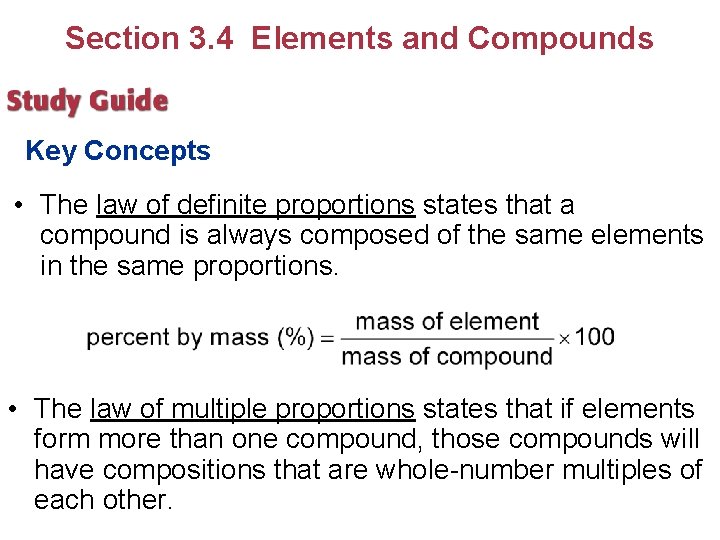
Section 3. 4 Elements and Compounds Key Concepts • The law of definite proportions states that a compound is always composed of the same elements in the same proportions. • The law of multiple proportions states that if elements form more than one compound, those compounds will have compositions that are whole-number multiples of each other.
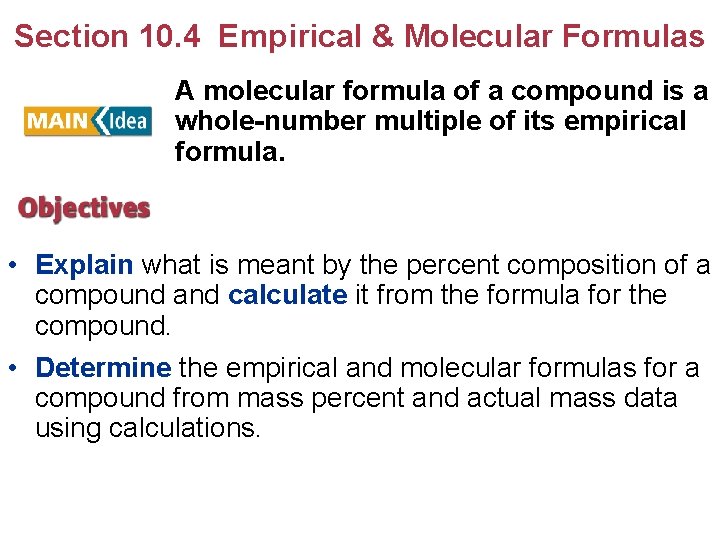
Section 10. 4 Empirical & Molecular Formulas A molecular formula of a compound is a whole-number multiple of its empirical formula. • Explain what is meant by the percent composition of a compound and calculate it from the formula for the compound. • Determine the empirical and molecular formulas for a compound from mass percent and actual mass data using calculations.
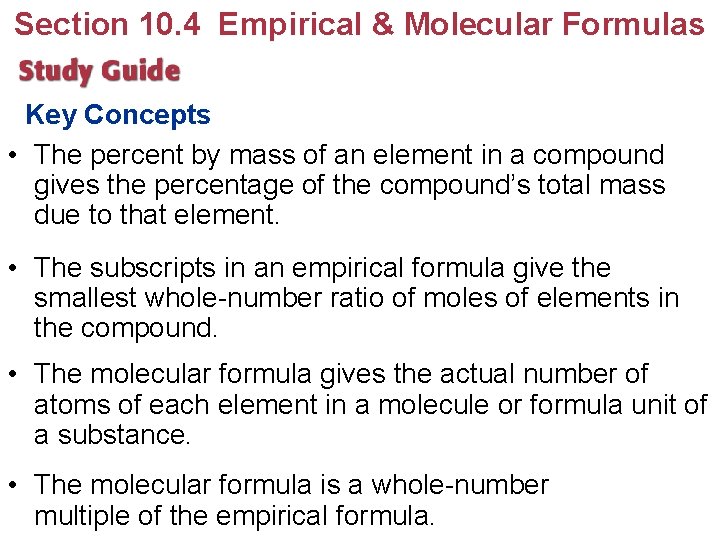
Section 10. 4 Empirical & Molecular Formulas Key Concepts • The percent by mass of an element in a compound gives the percentage of the compound’s total mass due to that element. • The subscripts in an empirical formula give the smallest whole-number ratio of moles of elements in the compound. • The molecular formula gives the actual number of atoms of each element in a molecule or formula unit of a substance. • The molecular formula is a whole-number multiple of the empirical formula.
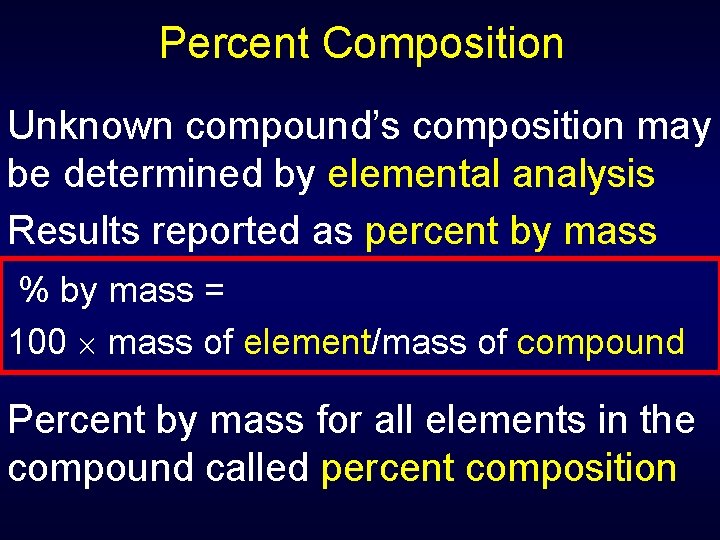
Percent Composition Unknown compound’s composition may be determined by elemental analysis Results reported as percent by mass % by mass = 100 mass of element/mass of compound Percent by mass for all elements in the compound called percent composition
Laws of Definite and Multiple Proportions These laws were developed as result of careful experimental measurements prior to the full development of the mole concept
Law of Definite Proportions Regardless of amount, compound composed of same elements in same proportion by mass statement that compound’s formula doesn’t change with amount of compound present • H 2 O = formula for water no matter how much water you have – proportions always same, mole ratio same, mass ratios same
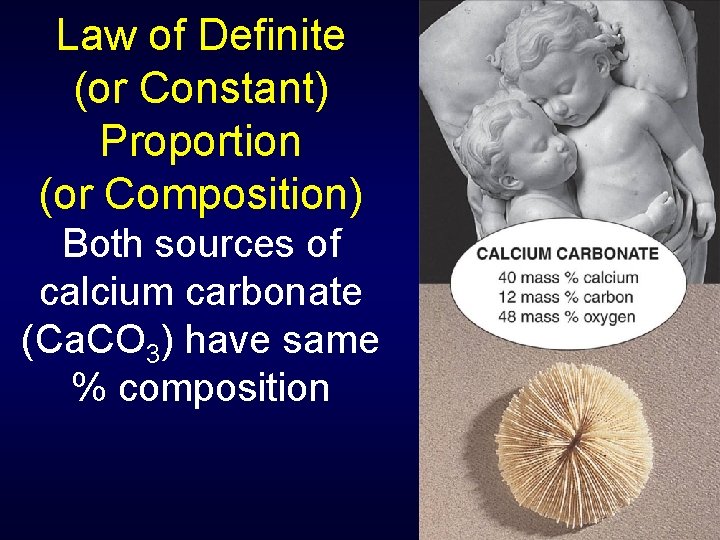
Law of Definite (or Constant) Proportion (or Composition) Both sources of calcium carbonate (Ca. CO 3) have same % composition
Law of Definite Proportions Focus here is % composition from some chemical analysis % by mass = 100 mass element mass compound Masses are given rather than derived from a formula
Law of Definite Proportions % by mass = 100 mass element mass compound Examine analyses of sucrose in table 3. 4, page 88 Analysis of 20. 00 g sample same as analysis of 500. 0 g sample have the same composition Book says same compound (sort of)
Practice Law of Definite Proportions Problems 19 - 23, page 88 Problems 72, 74 -78 , pages 95 - 96 Problem 3, page 977
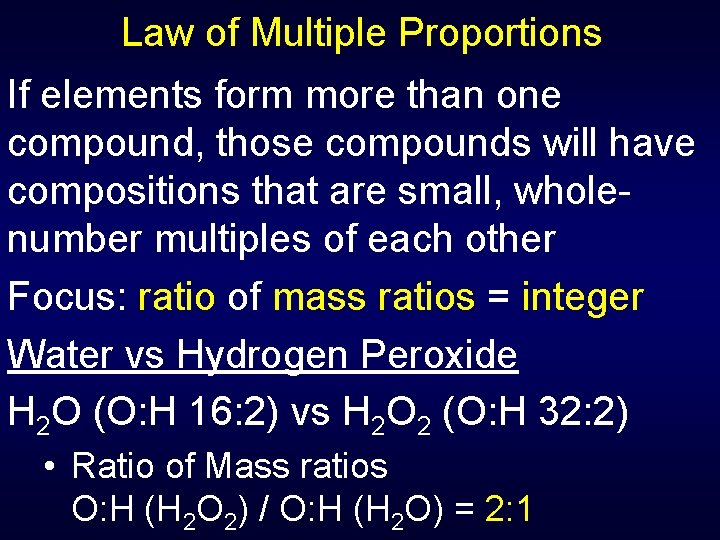
Law of Multiple Proportions If elements form more than one compound, those compounds will have compositions that are small, wholenumber multiples of each other Focus: ratio of mass ratios = integer Water vs Hydrogen Peroxide H 2 O (O: H 16: 2) vs H 2 O 2 (O: H 32: 2) • Ratio of Mass ratios O: H (H 2 O 2) / O: H (H 2 O) = 2: 1
Atomic Basis of the Law of Multiple Proportions
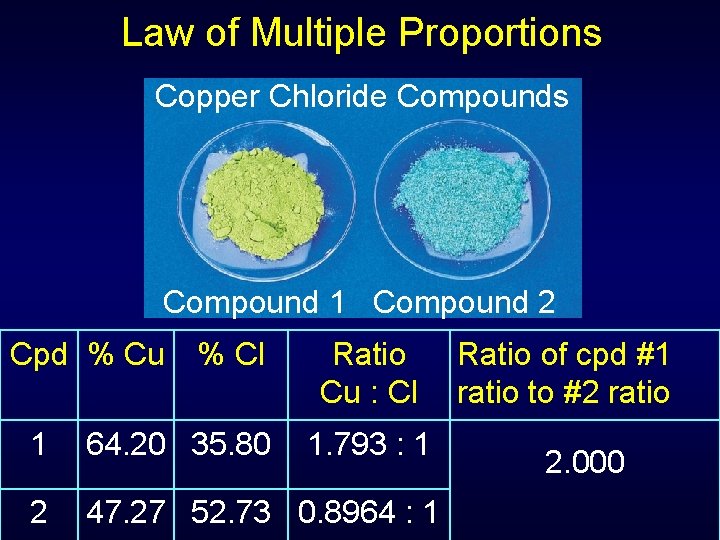
Law of Multiple Proportions Copper Chloride Compounds Compound 1 Compound 2 Cpd % Cu % Cl Ratio Cu : Cl 1 64. 20 35. 80 1. 793 : 1 2 47. 27 52. 73 0. 8964 : 1 Ratio of cpd #1 ratio to #2 ratio 2. 000
Practice Law of Multiple Proportions Problems 73, 79, 80 pages 95 -6 Problem 4, page 977
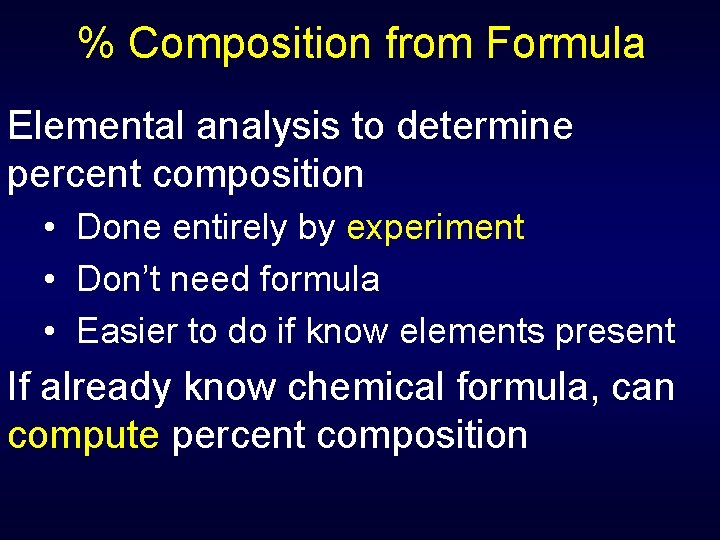
% Composition from Formula Elemental analysis to determine percent composition • Done entirely by experiment • Don’t need formula • Easier to do if know elements present If already know chemical formula, can compute percent composition
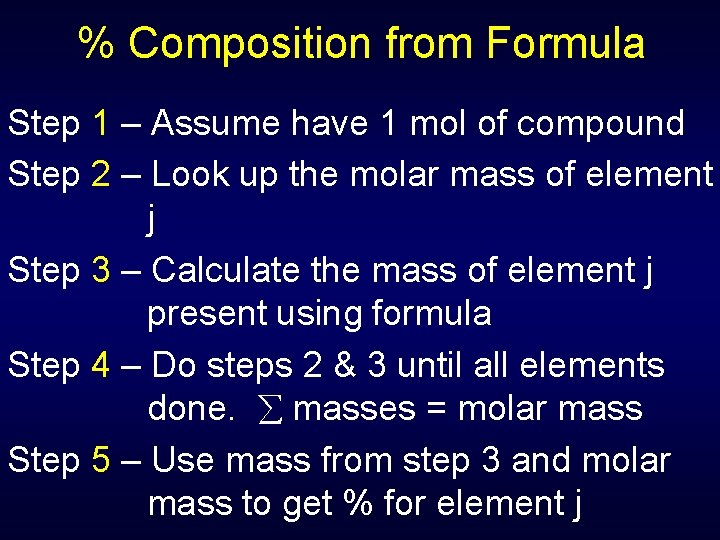
% Composition from Formula Step 1 – Assume have 1 mol of compound Step 2 – Look up the molar mass of element j Step 3 – Calculate the mass of element j present using formula Step 4 – Do steps 2 & 3 until all elements done. masses = molar mass Step 5 – Use mass from step 3 and molar mass to get % for element j
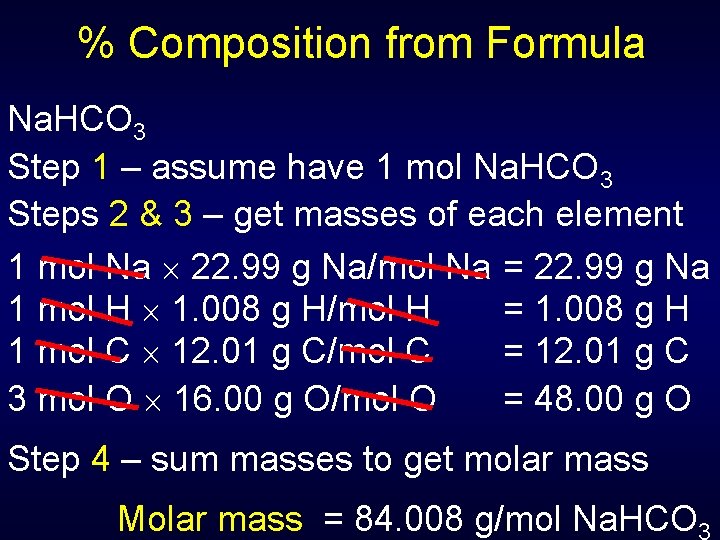
% Composition from Formula Na. HCO 3 Step 1 – assume have 1 mol Na. HCO 3 Steps 2 & 3 – get masses of each element 1 mol Na 22. 99 g Na/mol Na = 22. 99 g Na 1 mol H 1. 008 g H/mol H = 1. 008 g H 1 mol C 12. 01 g C/mol C = 12. 01 g C 3 mol O 16. 00 g O/mol O = 48. 00 g O Step 4 – sum masses to get molar mass Molar mass = 84. 008 g/mol Na. HCO 3
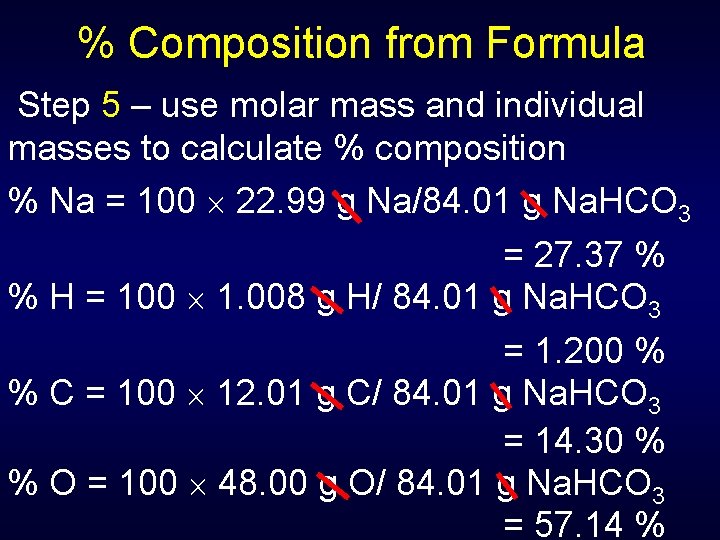
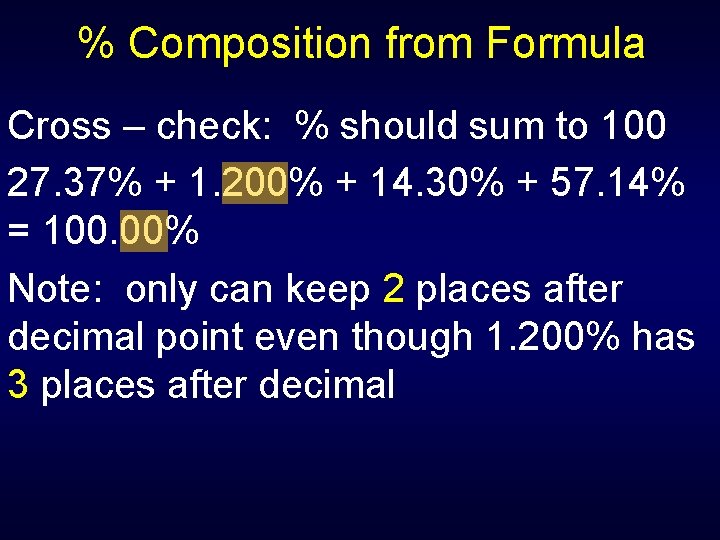
% Composition from Formula Step 5 – use molar mass and individual masses to calculate % composition % Na = 100 22. 99 g Na/84. 01 g Na. HCO 3 = 27. 37 % % H = 100 1. 008 g H/ 84. 01 g Na. HCO 3 = 1. 200 % % C = 100 12. 01 g C/ 84. 01 g Na. HCO 3 = 14. 30 % % O = 100 48. 00 g O/ 84. 01 g Na. HCO 3 = 57. 14 %
% Composition from Formula Cross – check: % should sum to 100 27. 37% + 1. 200% + 14. 30% + 57. 14% = 100. 00% Note: only can keep 2 places after decimal point even though 1. 200% has 3 places after decimal
Practice Problems 54 - 57, page 344 Problems 162, 168 – 171, 174 pages 360 -1
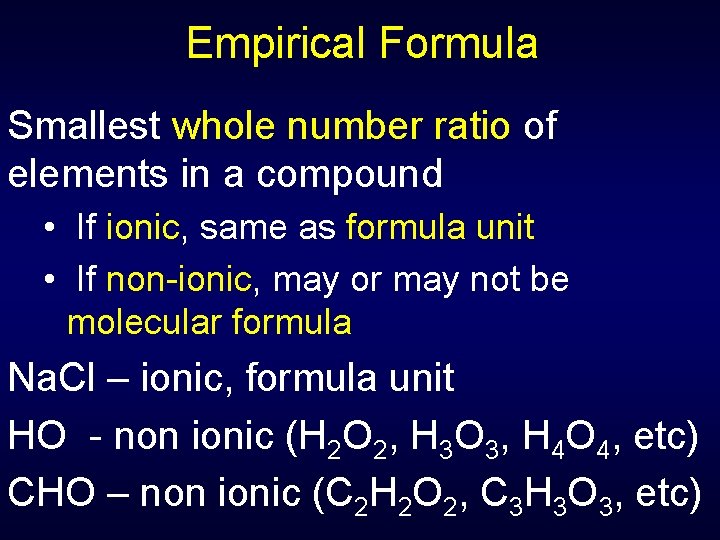
Empirical Formula Smallest whole number ratio of elements in a compound • If ionic, same as formula unit • If non-ionic, may or may not be molecular formula Na. Cl – ionic, formula unit HO - non ionic (H 2 O 2, H 3 O 3, H 4 O 4, etc) CHO – non ionic (C 2 H 2 O 2, C 3 H 3 O 3, etc)
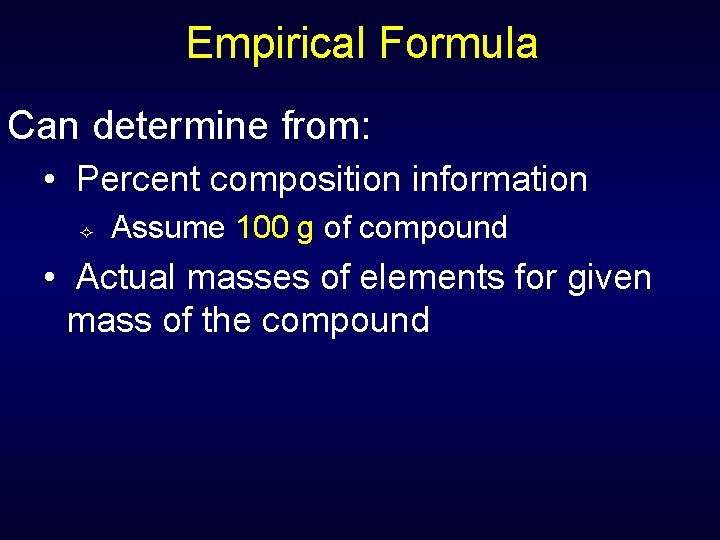
Empirical Formula Can determine from: • Percent composition information ² Assume 100 g of compound • Actual masses of elements for given mass of the compound
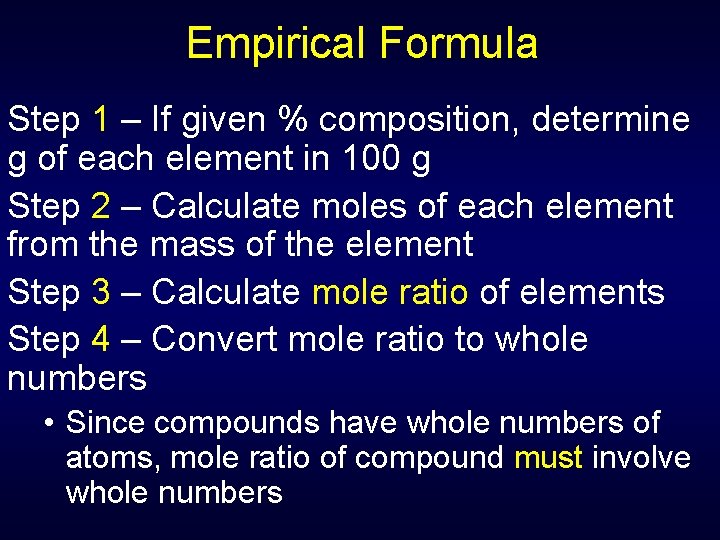
Empirical Formula Step 1 – If given % composition, determine g of each element in 100 g Step 2 – Calculate moles of each element from the mass of the element Step 3 – Calculate mole ratio of elements Step 4 – Convert mole ratio to whole numbers • Since compounds have whole numbers of atoms, mole ratio of compound must involve whole numbers
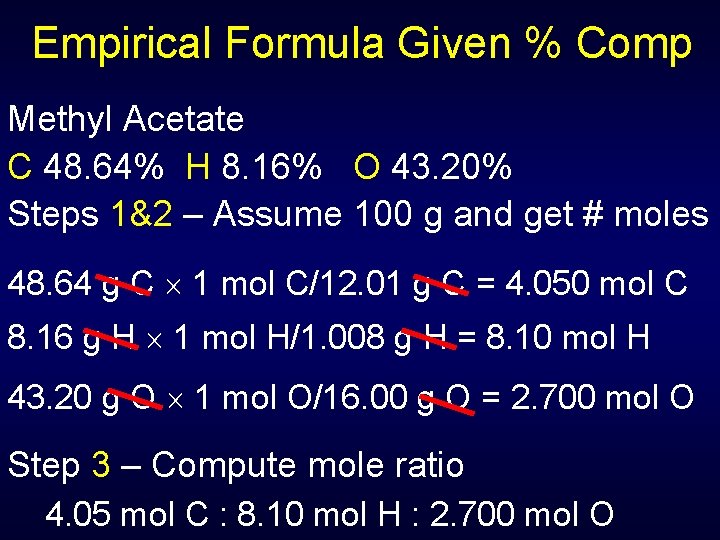
Empirical Formula Given % Comp Methyl Acetate C 48. 64% H 8. 16% O 43. 20% Steps 1&2 – Assume 100 g and get # moles 48. 64 g C 1 mol C/12. 01 g C = 4. 050 mol C 8. 16 g H 1 mol H/1. 008 g H = 8. 10 mol H 43. 20 g O 1 mol O/16. 00 g O = 2. 700 mol O Step 3 – Compute mole ratio 4. 05 mol C : 8. 10 mol H : 2. 700 mol O
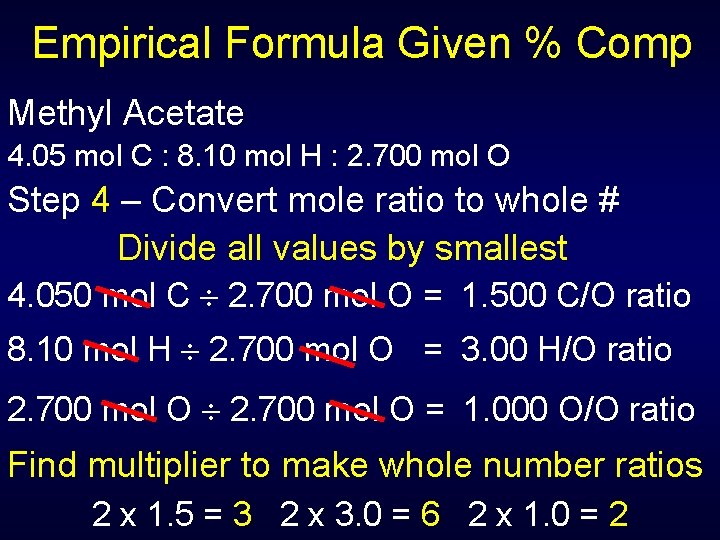
Empirical Formula Given % Comp Methyl Acetate 4. 05 mol C : 8. 10 mol H : 2. 700 mol O Step 4 – Convert mole ratio to whole # Divide all values by smallest 4. 050 mol C 2. 700 mol O = 1. 500 C/O ratio 8. 10 mol H 2. 700 mol O = 3. 00 H/O ratio 2. 700 mol O = 1. 000 O/O ratio Find multiplier to make whole number ratios 2 x 1. 5 = 3 2 x 3. 0 = 6 2 x 1. 0 = 2
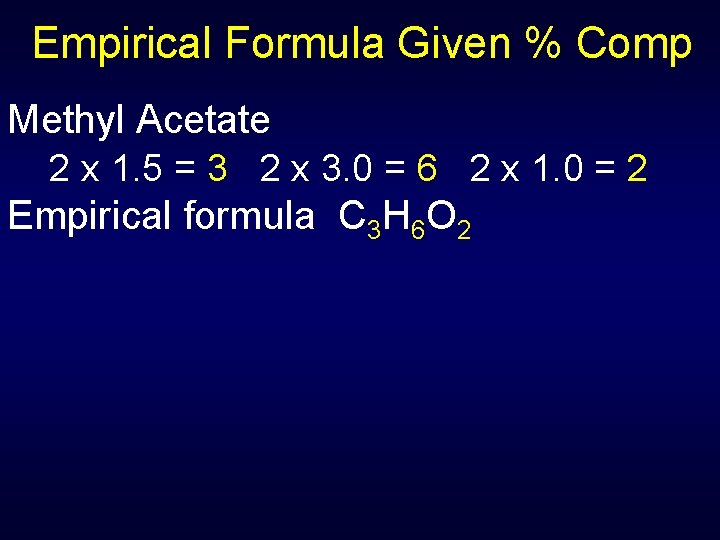
Empirical Formula Given % Comp Methyl Acetate 2 x 1. 5 = 3 2 x 3. 0 = 6 2 x 1. 0 = 2 Empirical formula C 3 H 6 O 2
Practice includes both percent composition given and masses given type problems Problems 58 - 61, page 346 Problems 161, 165, 167, 171 -2 pages 360 -1
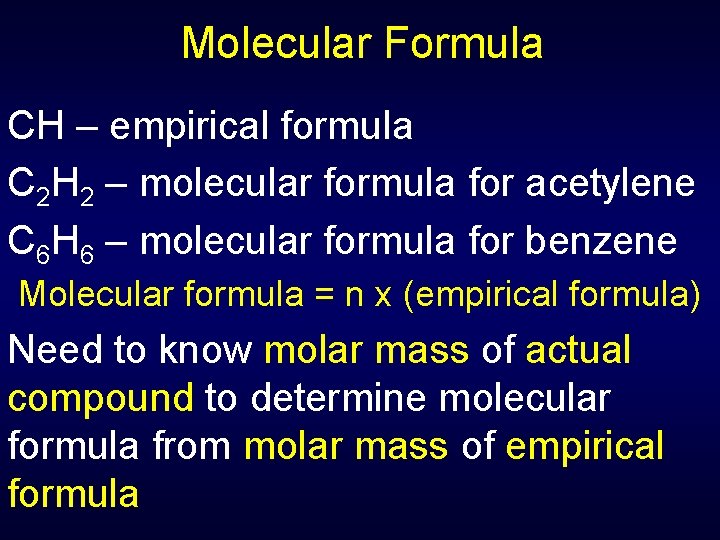
Molecular Formula CH – empirical formula C 2 H 2 – molecular formula for acetylene C 6 H 6 – molecular formula for benzene Molecular formula = n x (empirical formula) Need to know molar mass of actual compound to determine molecular formula from molar mass of empirical formula
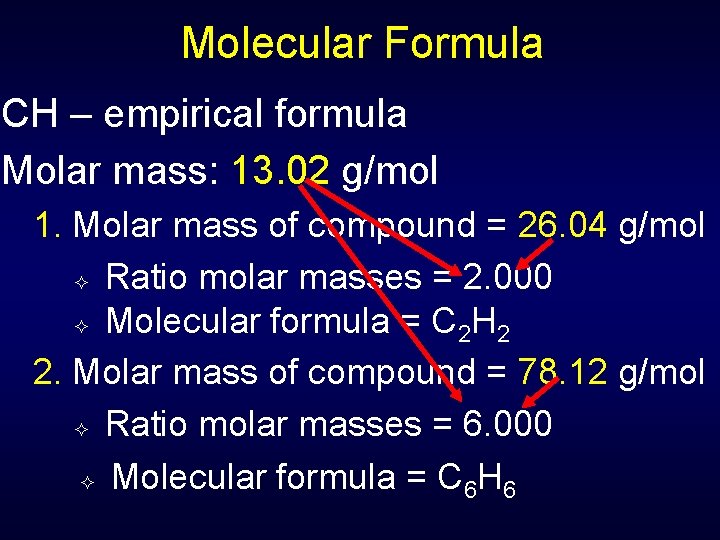
Molecular Formula CH – empirical formula Molar mass: 13. 02 g/mol 1. Molar mass of compound = 26. 04 g/mol ² Ratio molar masses = 2. 000 ² Molecular formula = C 2 H 2 2. Molar mass of compound = 78. 12 g/mol ² Ratio molar masses = 6. 000 ² Molecular formula = C 6 H 6
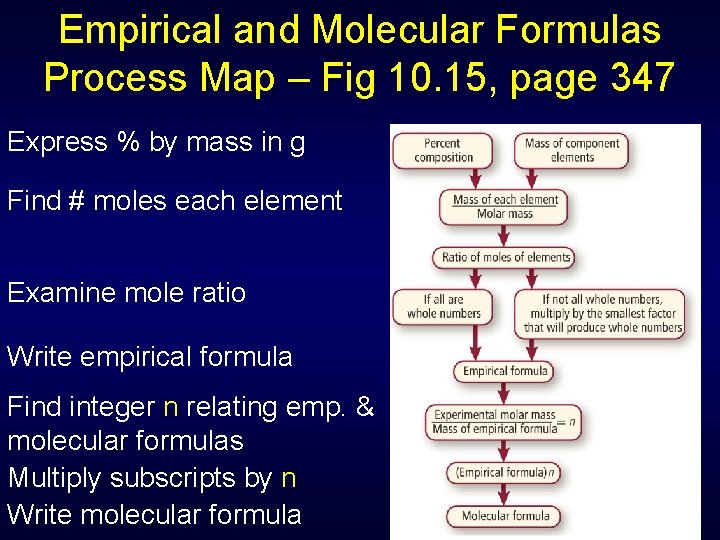
Empirical and Molecular Formulas Process Map – Fig 10. 15, page 347 Express % by mass in g Find # moles each element Examine mole ratio Write empirical formula Find integer n relating emp. & molecular formulas Multiply subscripts by n Write molecular formula
Practice Problems 62 -66, page 350 Problem 164, page 361 Problems 29, 30 page 982
Chapter 10 – The Mole 10. 1 10. 2 10. 3 10. 4 10. 5 Measuring Matter Mass and the Moles of Compounds Empirical and Molecular Formulas The Formula for a Hydrate
Section 10. 5 Formulas of Hydrates are solid ionic compounds in which water molecules are trapped. • Explain what a hydrate is and name a hydrate based on its composition. • Explain what the term anhydrous means. • Determine the formula of a hydrate from laboratory data. • Explain what a desiccant is and how it is used.
Section 10. 5 Formulas of Hydrates Key Concepts • The formula of a hydrate consists of the formula of the ionic compound and the number of water molecules associated with one formula unit. • The name of a hydrate consists of the compound name and the word hydrate with a prefix indicating the number of water molecules in 1 mol of the compound. • Anhydrous compounds are formed when hydrates are heated.
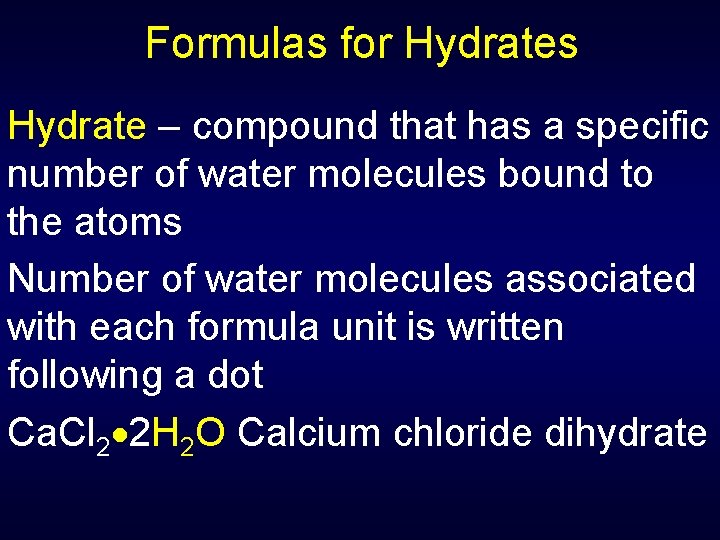
Formulas for Hydrates Hydrate – compound that has a specific number of water molecules bound to the atoms Number of water molecules associated with each formula unit is written following a dot Ca. Cl 2 2 H 2 O Calcium chloride dihydrate
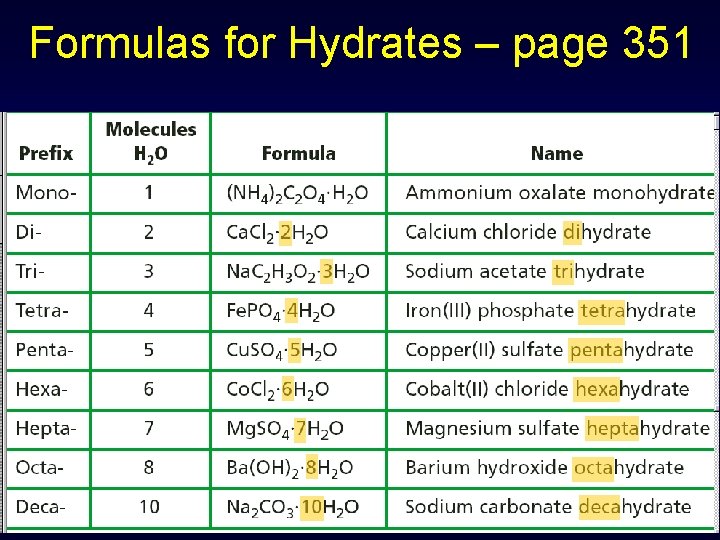
Formulas for Hydrates – page 351
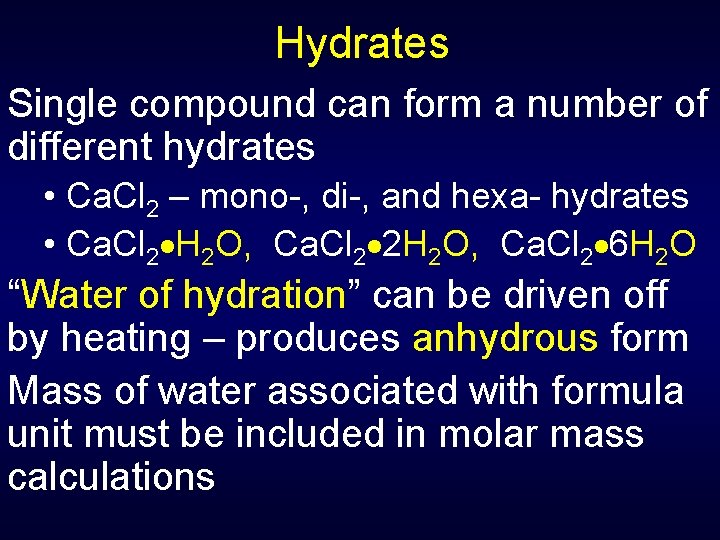
Hydrates Single compound can form a number of different hydrates • Ca. Cl 2 – mono-, di-, and hexa- hydrates • Ca. Cl 2 H 2 O, Ca. Cl 2 2 H 2 O, Ca. Cl 2 6 H 2 O “Water of hydration” can be driven off by heating – produces anhydrous form Mass of water associated with formula unit must be included in molar mass calculations
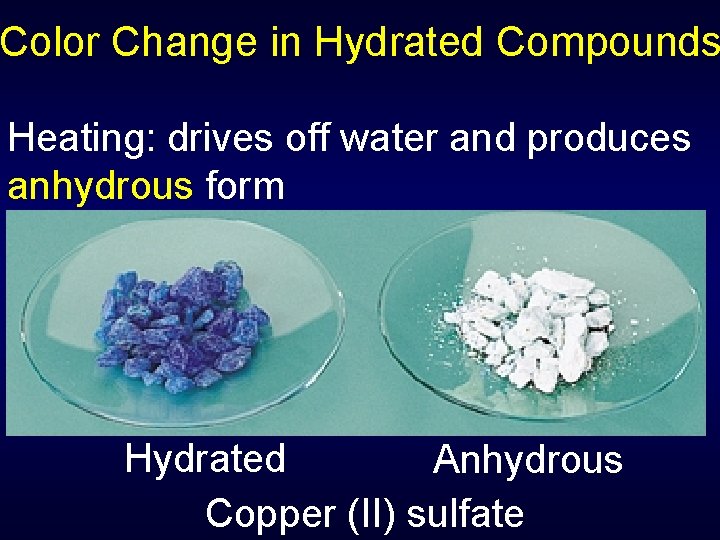
Color Change in Hydrated Compounds Heating: drives off water and produces anhydrous form Hydrated Anhydrous Copper (II) sulfate
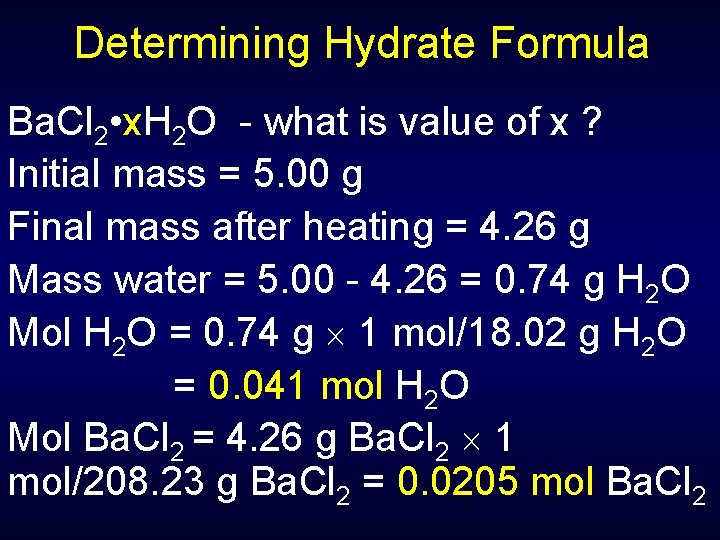
Determining Hydrate Formula Ba. Cl 2 • x. H 2 O - what is value of x ? Initial mass = 5. 00 g Final mass after heating = 4. 26 g Mass water = 5. 00 - 4. 26 = 0. 74 g H 2 O Mol H 2 O = 0. 74 g 1 mol/18. 02 g H 2 O = 0. 041 mol H 2 O Mol Ba. Cl 2 = 4. 26 g Ba. Cl 2 1 mol/208. 23 g Ba. Cl 2 = 0. 0205 mol Ba. Cl 2
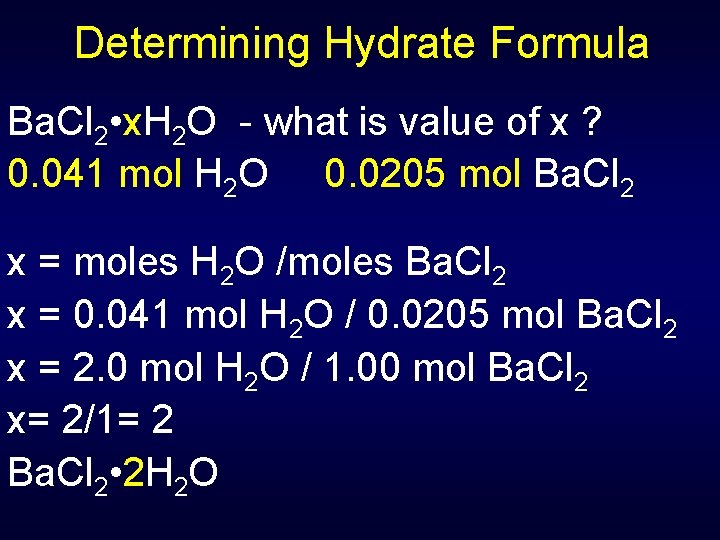
Determining Hydrate Formula Ba. Cl 2 • x. H 2 O - what is value of x ? 0. 041 mol H 2 O 0. 0205 mol Ba. Cl 2 x = moles H 2 O /moles Ba. Cl 2 x = 0. 041 mol H 2 O / 0. 0205 mol Ba. Cl 2 x = 2. 0 mol H 2 O / 1. 00 mol Ba. Cl 2 x= 2/1= 2 Ba. Cl 2 • 2 H 2 O
Practice Problems 74 - 75, page 353 Problems 180 - 187, page 361 Problems 33 - 34, page 982
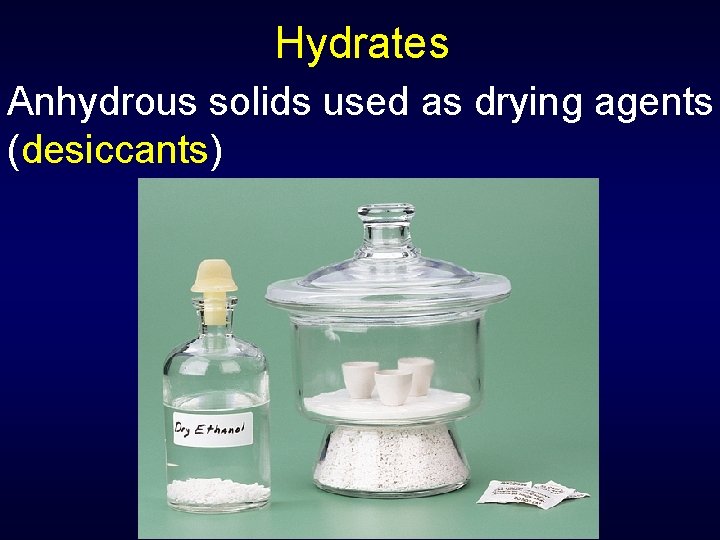
Hydrates Anhydrous solids used as drying agents (desiccants)
End of Chapter Problems 63 -64, page 340 Problems 151 -156, page 349 Problems 33 -34, page 877