Mr Shields Regents Chemistry U 04 L 03
- Slides: 15
Mr. Shields Regents Chemistry U 04 L 03 1
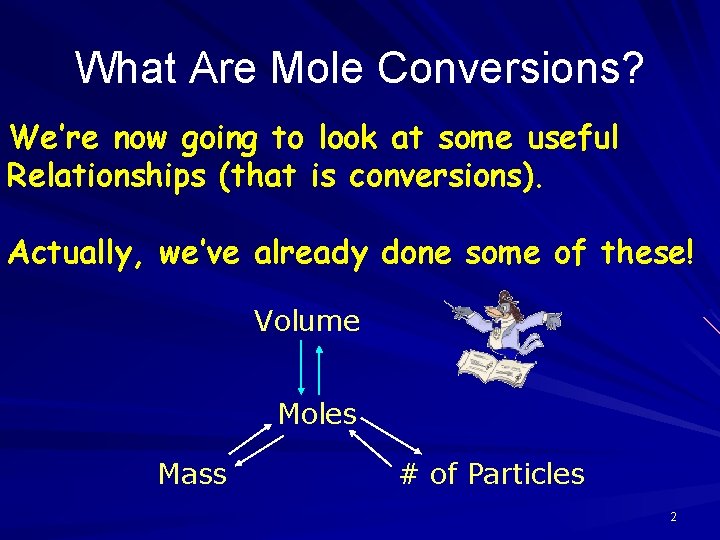
What Are Mole Conversions? We’re now going to look at some useful Relationships (that is conversions). Actually, we’ve already done some of these! Volume Moles Mass # of Particles 2
Chem Conversions We know 1 mole = 6. 023 x 1023 particles This is Avogadro’s number (NA) We also know 1 mole = 22. 4 liters This is the Molar Volume (Vm) We also know that 1 mole = Molar Mass So, “How do we convert from one value to another”? 3
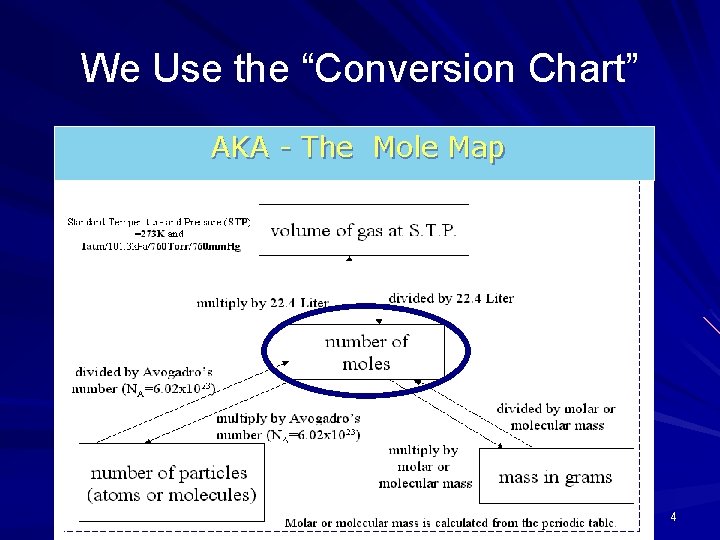
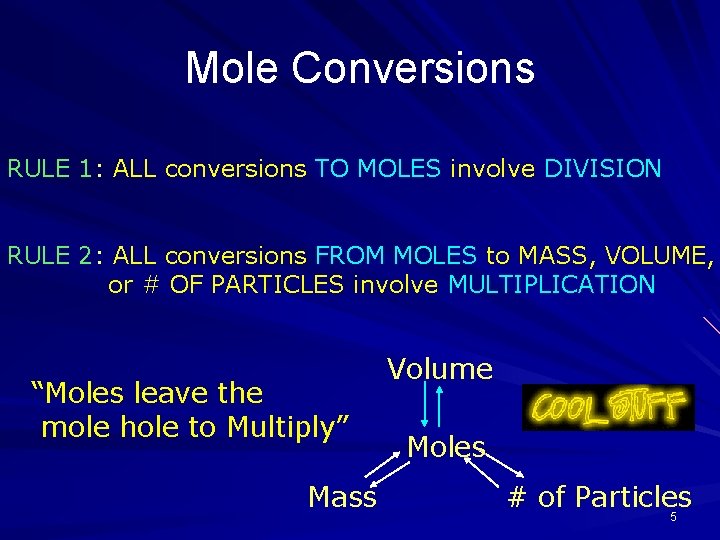
We Use the “Conversion Chart” AKA - The Mole Map 4
Mole Conversions RULE 1: ALL conversions TO MOLES involve DIVISION RULE 2: ALL conversions FROM MOLES to MASS, VOLUME, or # OF PARTICLES involve MULTIPLICATION “Moles leave the mole hole to Multiply” Mass Volume Moles # of Particles 5
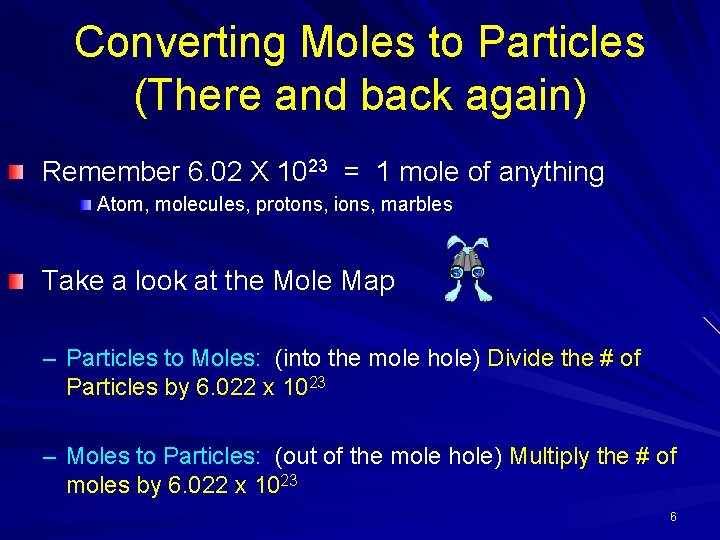
Converting Moles to Particles (There and back again) Remember 6. 02 X 1023 = 1 mole of anything Atom, molecules, protons, ions, marbles Take a look at the Mole Map – Particles to Moles: (into the mole hole) Divide the # of Particles by 6. 022 x 1023 – Moles to Particles: (out of the mole hole) Multiply the # of moles by 6. 022 x 1023 6
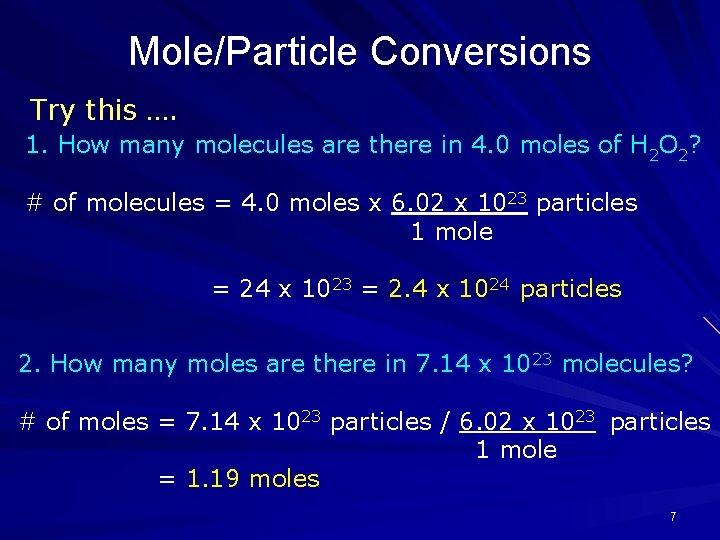
Mole/Particle Conversions Try this …. 1. How many molecules are there in 4. 0 moles of H 2 O 2? # of molecules = 4. 0 moles x 6. 02 x 1023 particles 1 mole = 24 x 1023 = 2. 4 x 1024 particles 2. How many moles are there in 7. 14 x 1023 molecules? # of moles = 7. 14 x 1023 particles / 6. 02 x 1023 particles 1 mole = 1. 19 moles 7
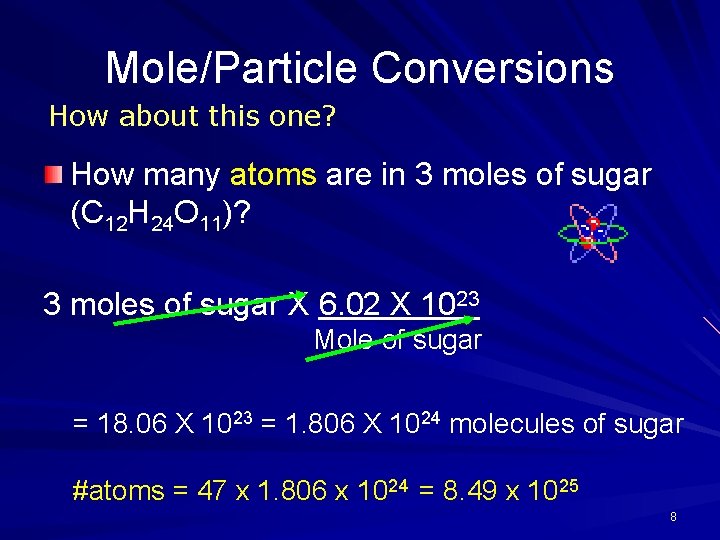
Mole/Particle Conversions How about this one? How many atoms are in 3 moles of sugar (C 12 H 24 O 11)? 3 moles of sugar X 6. 02 X 1023 Mole of sugar = 18. 06 X 1023 = 1. 806 X 1024 molecules of sugar #atoms = 47 x 1. 806 x 1024 = 8. 49 x 1025 8
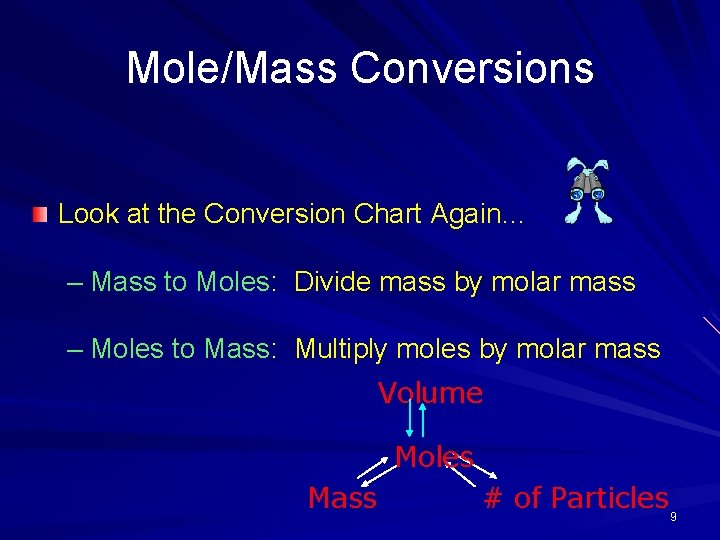
Mole/Mass Conversions Look at the Conversion Chart Again… – Mass to Moles: Divide mass by molar mass – Moles to Mass: Multiply moles by molar mass Volume Moles Mass # of Particles 9
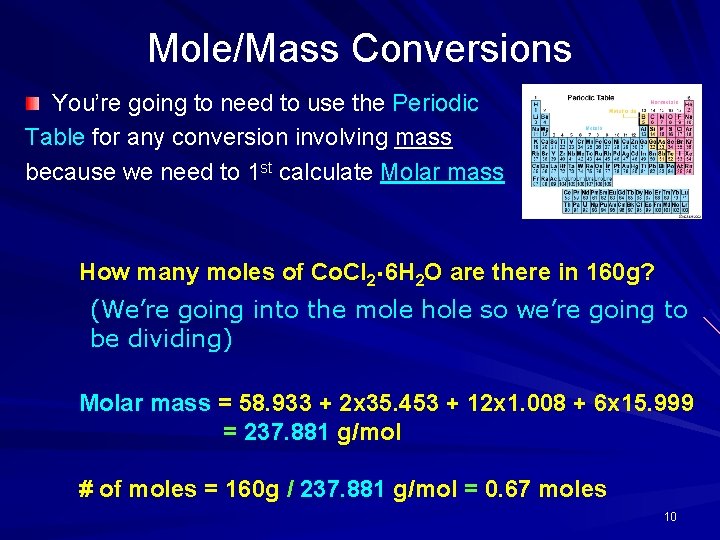
Mole/Mass Conversions You’re going to need to use the Periodic Table for any conversion involving mass because we need to 1 st calculate Molar mass How many moles of Co. Cl 2. 6 H 2 O are there in 160 g? (We’re going into the mole hole so we’re going to be dividing) Molar mass = 58. 933 + 2 x 35. 453 + 12 x 1. 008 + 6 x 15. 999 = 237. 881 g/mol # of moles = 160 g / 237. 881 g/mol = 0. 67 moles 10
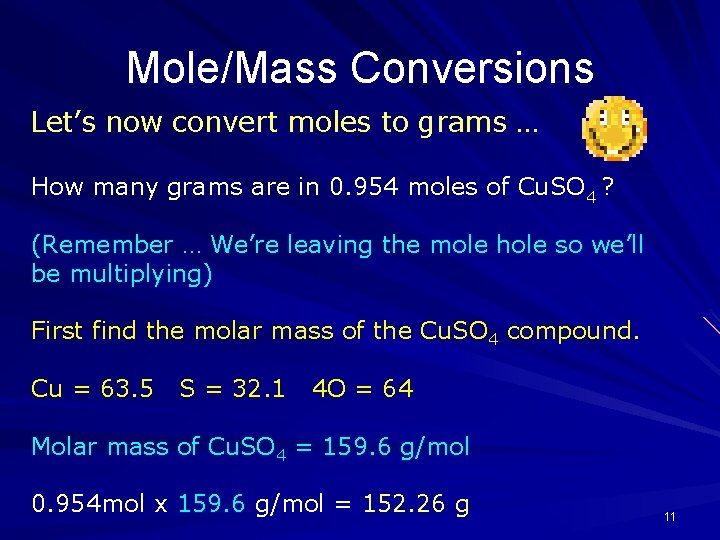
Mole/Mass Conversions Let’s now convert moles to grams … How many grams are in 0. 954 moles of Cu. SO 4 ? (Remember … We’re leaving the mole hole so we’ll be multiplying) First find the molar mass of the Cu. SO 4 compound. Cu = 63. 5 S = 32. 1 4 O = 64 Molar mass of Cu. SO 4 = 159. 6 g/mol 0. 954 mol x 159. 6 g/mol = 152. 26 g 11
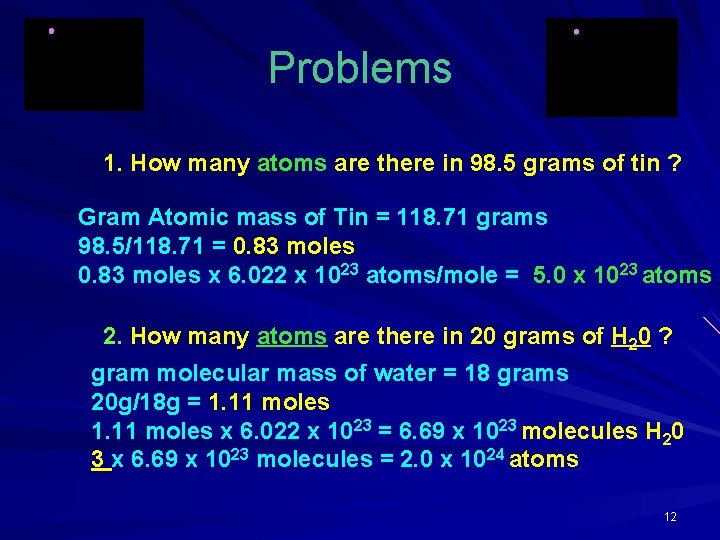
Problems 1. How many atoms are there in 98. 5 grams of tin ? Gram Atomic mass of Tin = 118. 71 grams 98. 5/118. 71 = 0. 83 moles x 6. 022 x 1023 atoms/mole = 5. 0 x 1023 atoms 2. How many atoms are there in 20 grams of H 20 ? gram molecular mass of water = 18 grams 20 g/18 g = 1. 11 moles x 6. 022 x 1023 = 6. 69 x 1023 molecules H 20 3 x 6. 69 x 1023 molecules = 2. 0 x 1024 atoms 12
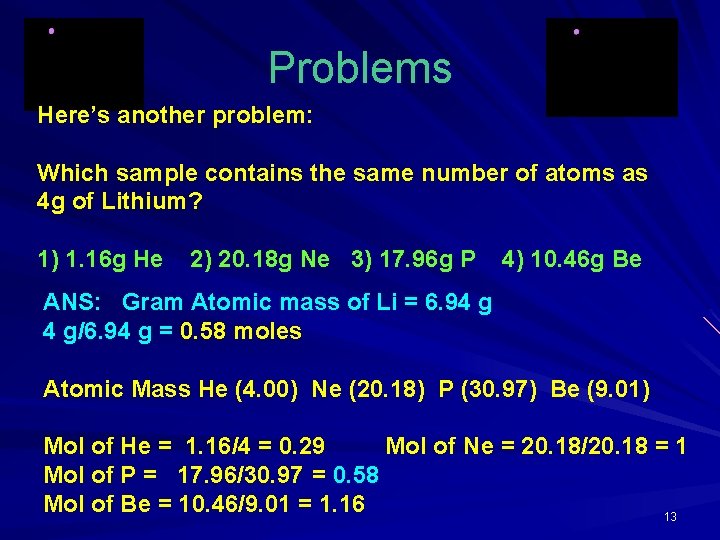
Problems Here’s another problem: Which sample contains the same number of atoms as 4 g of Lithium? 1) 1. 16 g He 2) 20. 18 g Ne 3) 17. 96 g P 4) 10. 46 g Be ANS: Gram Atomic mass of Li = 6. 94 g 4 g/6. 94 g = 0. 58 moles Atomic Mass He (4. 00) Ne (20. 18) P (30. 97) Be (9. 01) Mol of He = 1. 16/4 = 0. 29 Mol of Ne = 20. 18/20. 18 = 1 Mol of P = 17. 96/30. 97 = 0. 58 Mol of Be = 10. 46/9. 01 = 1. 16 13
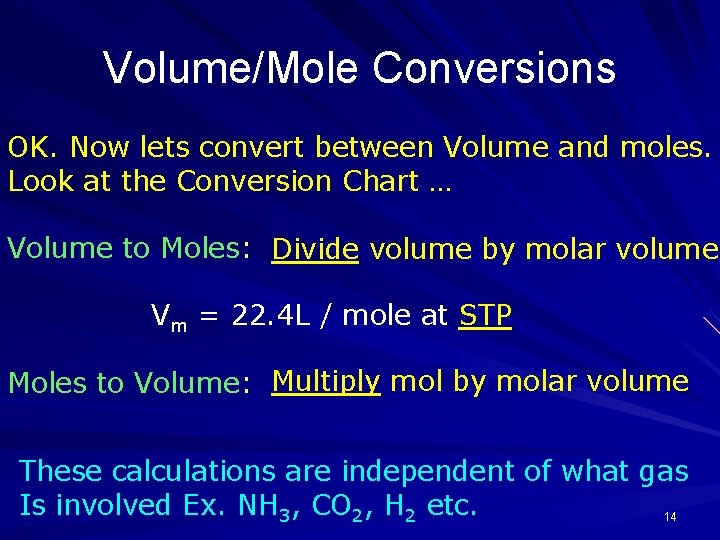
Volume/Mole Conversions OK. Now lets convert between Volume and moles. Look at the Conversion Chart … Volume to Moles: Divide volume by molar volume Vm = 22. 4 L / mole at STP Moles to Volume: Multiply mol by molar volume These calculations are independent of what gas Is involved Ex. NH 3, CO 2, H 2 etc. 14
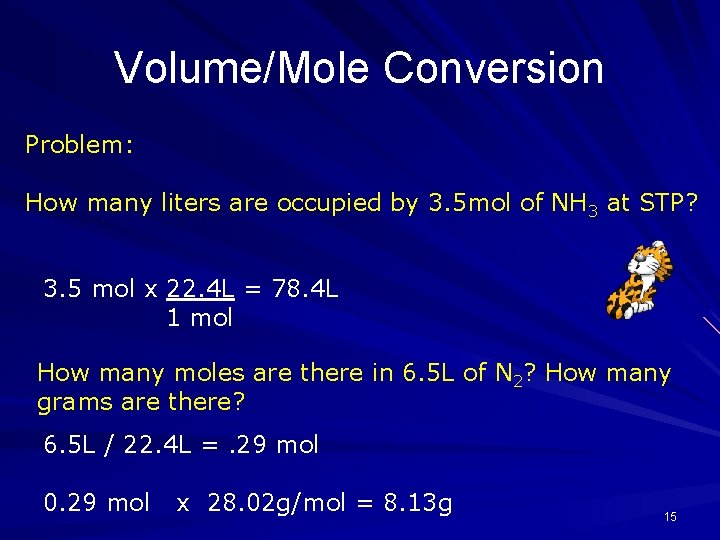
Volume/Mole Conversion Problem: How many liters are occupied by 3. 5 mol of NH 3 at STP? 3. 5 mol x 22. 4 L = 78. 4 L 1 mol How many moles are there in 6. 5 L of N 2? How many grams are there? 6. 5 L / 22. 4 L =. 29 mol 0. 29 mol x 28. 02 g/mol = 8. 13 g 15