Understanding Autism An Introduction to the Characteristics and

- Slides: 118
Understanding Autism An Introduction to the Characteristics and Treatment of Autism Spectrum Disorders Peggy Halliday, M. Ed. , BCBA October 2, 2012 SOMA/COMA Conference, Richmond, VA
CDC reports that an average of 1 in every 88 children has an Autism Spectrum Disorder (ASD) Centers for Disease Control [CDC], (2011)
Questions What is autism? How is it diagnosed? Who has it? What are the characteristics? What are the treatment options?
AUTISM SPECTRUM DISORDER © Virginia Institute of Autism 2011 All Rights Reserved
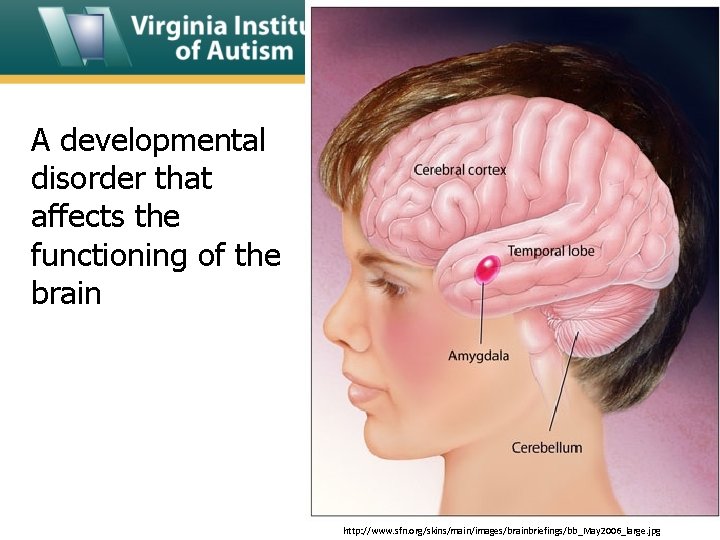
A developmental disorder that affects the functioning of the brain http: //www. sfn. org/skins/main/images/brainbriefings/bb_May 2006_large. jpg
The Autism Spectrum • Autism is used as an umbrella term to include several disorders on the autism spectrum, the most common of which include: – Autistic Disorder (Classic Autism) – PDD-NOS – Asperger Syndrome
Diagnosis of Autism • Based on behavioral evaluation, not medical testing • Diagnostic criteria are in Diagnostic and Statistical Manual of Mental Disorders (DSM-IV-TR) • Can be accurately diagnosed in infants as early as 18 months (APA, 2000; CDC, 2007)
Diagnosis of Autism in Children with Visual Impairments Salt (2010): • No published tools for diagnosing ASD in visually impaired children • Must modify the standard diagnostic criteria to take account of the expected behaviours in visually impaired children • Must involve a multi-disciplinary professional team that has expertise in both visual impairment and ASD • Unusual to diagnose before the age of 5
Diagnosis of Autism in Children with Visual Impairments Macleod and Curtis (2010): • Diagnosis of an ASD can be a relief for parents as it helps them to understand their child more fully • Very important that assessments lead to intervention plans which are implemented • Early assessment for ASD alongside visual impairment can result in interventions at home and school which transform life for the child and the family
Diagnosis of Autism in Children with Visual Impairments Macleod and Curtis (2010): • Diagnosis of an ASD can be a relief for parents • Very important that diagnosis lead to intervention plans which are implemented • Early assessment for ASD alongside visual impairment can result in interventions at home and school which transform life for the child and the family
Diagnosis of Autism • Autism is a developmental disability, it is not caused by parents, it is not induced by blindness • Autism is a spectrum disorder, with a wide range of functional levels and associated behaviors • While symptoms may show improvement, autism is a LIFELONG disorder • Most individuals will continue to need some level of support throughout their life time (APA, 2000; CDC, 2007)
Diagnosis of Autism in Children with Visual Impairments Chess (1971). Journal of Autism and Childhood Schizophrenia • “Nonautistic youngsters … are very alert to their surroundings through their other senses, especially exhibiting alertness and appropriate responsiveness. . . one is impressed by their readiness to respond to appropriately selected and carefully timed overtures. • …the autistic children neither explore alternative sensory modalities nor manifest appropriate responsiveness. They form a distinct group whose distance from people cannot be adequately explained by the degree or combination of visual and auditory loss…. , their affective behaviors do not resemble those of children of their obtained mental age – in fact, there is no mental age for which the behaviors are appropriate. ”
Diagnosis of Autism in Children with Visual Impairments Key Issues: • Visual impairment is usually diagnosed first (at birth or first few months of life) • Children with ASD may start life with sight but lose sight from illness or accident • Children with ASD may lose sight through selfinjury
Autism Facts • • The causes of autism are unknown There is no cure People with autism have normal life expectancies Occurs in all racial, ethnic, and socioeconomic groups around the world (APA, 2000; CDC, 2007)
Autism Spectrum Disorders • 1 in every 88 school age children diagnosed with autism • 5 times more common in boys (estimated 1 in 54 boys) • Autism can be accurately diagnosed in infants as early as 18 months, but most are diagnosed at 4 ½ • 4 th largest primary disability category on the Dec. 2010 child count • Definitive research shows early and intensive supports leads to improved outcomes
Autistic Disorder (Classic Autism) Characterized by serious impairments in social interaction and communication and by unusual behavior and interests (APA, 2000; Centers for Disease Control [CDC], 2007)
Impairments differ in each individual Lifelong
• “Savant “ skills are rare • 40 -50% of people with autism also have diagnosis of an intellectual disability
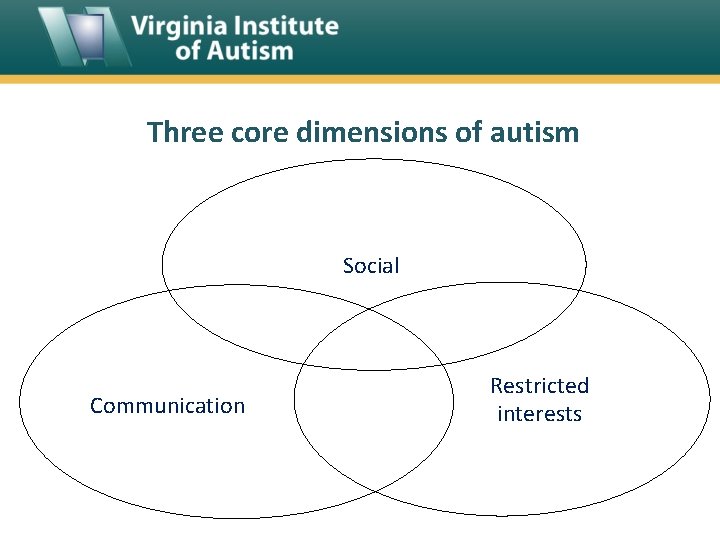
Three core dimensions of autism Social Communication Restricted interests
Social Challenges http: //blog. mlive. com/bctimes/2008/04/autism-registry 01. jpg
May avoid eye contact and want to be alone Lack of facial expression, gestures, nonverbal cues (APA, 2000; CDC, 2007) http: //www. beagooddad. com/wp-content/uploads/2007/06/bagdpookieandpapaw. jpg
• Lack of spontaneous shared attention • Failure to develop peer relationships
Communication Challenges http: //bkmacdaddy. com/blog/wp-content/uploads/2009/12/angry. jpg
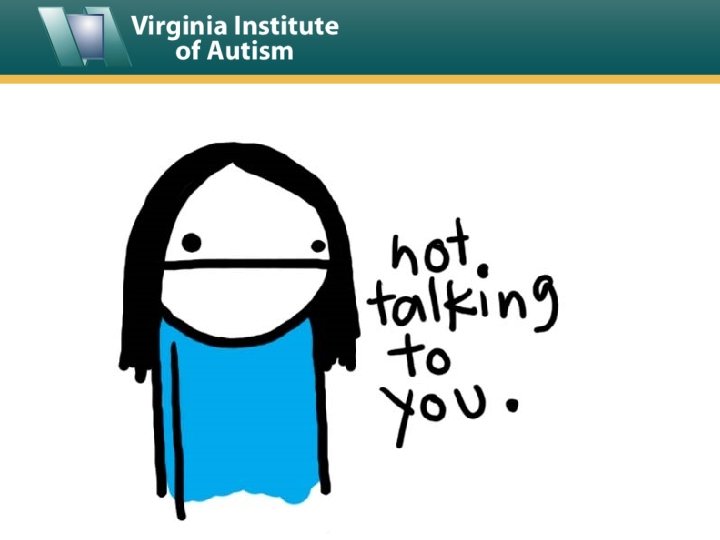
Limited, delayed, or absent speech Stereotypic, repetitive use of language (echolalia) or idiosyncratic language (APA, 2000; CDC, 2007)
May give unrelated answers to questions Literal interpretation of language Problems with personal pronouns Not able to sustain a conversation (APA, 2000; CDC, 2007)
Behavior http: //babble. com/CS/blogs/strollerderby/2007/08/08 -15/tantrum-child. jpg
“Restricted repetitive and stereotyped patterns of behavior, interests, and activities” (APA, 2000, p. 75)
Repetitive, purposeless, driven motor movements May flap their hands, rock their body, or spin in circles (CDC, 2007; APA, 2000, p. 75)
Upset by Changes
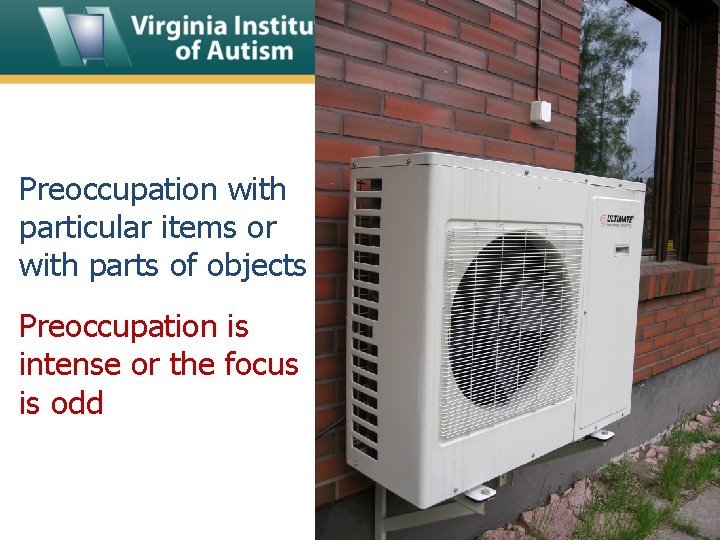
Preoccupation with particular items or with parts of objects Preoccupation is intense or the focus is odd
“Inflexible adherence to specific, nonfunctional routines or rituals” (APA, 2000, p. 75)
There may also be… Hyperactivity Impulsivity Aggressive, self-injurious and/or tantrum behavior (APA, 2000; CDC, 2007)
Abnormal emotional reactions/moods Restricted diets; pica Sleeping difficulties Lack of awareness of dangerous situations Fear of objects that are not dangerous Chronic gastrointestinal problems
Keep in mind… Every Person with Autism is Different
…. and Behaviors are likely to change over time
Asperger’s Syndrome is similar in many ways. . . http: //www. lucasworks. org/autistic-child. jpg
Like classic autism, Asperger Syndrome is a lifelong neurological disorder that affects a person’s ability to communicate and relate to others. Marked by impairments in: • • Socialization Communication Behavior Sensation
Social Challenges • Confused by social cues and subtleties • Focus on obsessive and narrowly defined interests that may not be of interest to others • Difficulty with reciprocal conversation • Tendency to speak bluntly: no regard for impact of words on others • Literal interpretation words
Communication Challenges • Difficulty understanding sarcasm or metaphor • Echolalia • Poor judge of personal space – may stand too close to others • Abnormal inflection and eye contact • Inappropriate facial expressions or gestures • Difficulty interpreting nonverbal communication cues
When visual impairment and autism occur together, each disability impacts the other.
Social Challenges in Children with Visual Impairment and Autism • • May fail to engage in reciprocal interactions May treat others as though they were objects May have no interest in peers May not be able to process multiple sensory stimuli simultaneously
Implications for Parents and Educators • Recognize that the social world is more complex and less predictable for an individual with autism, and therefore more anxiety producing. • Simple exposure to peers will not result in the acquisition of social skills. • A child can be taught to acquire social skills. Begin with something short, structured, teacher directed, and success oriented.
Speech Challenges in Children with Visual Impairment and Autism • Students may seem very verbal but can't follow instructions due to poor receptive language – May use words expressively which they don't really understand (receptive language lower than expressive) • Echolalia (a positive sign in that it shows that the child is at least discriminating among phonemes, sequencing sounds, using working memory) • Pronoun reversal • May be non-verbal
Implications for Parents and Educators • Must check out whether child understands what he/she is saying. • Use limited language: short, concrete phrases with time between statements to allow for processing. • If student has vision, try to provide some information visually; if not, provide information tactually.
Communication Challenges in Children with Visual Impairment and Autism • • May perseverate on one topic May show no interest in other people's interests May be too close or too far away when talking May something unrelated to the conversation May become angry when he hears certain words May have problems with impulse control May not be able to to take the perspective of another, as well as problems shifting attention
• Implications for Parents and Educators • Direct instruction in the actual setting is key (generalization). • Identify clear, concrete rules that the child needs to follow in specific situations. • Social stories can be helpful in providing a child with a script to follow.
Behavioral Challenges with Visual Impairment and Autism • Need for sameness, predictability – Repetitive events are easier to understand – Repetitive behavior may be experienced as soothing • Motor stereotypies • Focuses on parts of objects in play (e. g. , wheels, spins everything, flips handle of basket repeatedly) • Age appropriate pretend play not observed • Restricted and perseverative interest (e. g. , elevators, Xerox machines, CD titles)
• Implications for Parents and Educators • Recognize that the routines and self-stimulatory behavior are things that the child understands best and may serve as a “comfort zone“. • The child's reliance on such behaviors will tend to increase in times of stress and anxiety (e. g. , transition, lack of clear expectation, challenges). • Identify a time when the child can engage in his selfstimulatory behavior; tighten up the structure, schedule, routine to decrease anxiety and increase non-verbal information.
Sensory Challenges in Children with Visual Impairment and Autism • May over-react to certain noises (e. g. , fire-alarms, vacuum cleaner, fan motors) • May find certain tactile experiences aversive (e. g. , certain foods, texture of clothing, soft furry objects, being touched) • May not react to pain (bumping head, falling down, etc. ) • May stop listening to instructions when asked to do something else – May only be able to process one sensory input at a time • May process temperature, texture, multi-sensory things differently
• Implications for Parents and Educators • Be alert to how the sensory environment may be impacting on your student. • Try to keep the environment as low key as possible (e. g. , visually clear, sound absorbing materials, no extraneous noise or conversation; balance lighting needs for children's visual impairment with those of arousal). • Be aware of possible multi-sensory input issues and adjust instruction accordingly. • Teach gradual desensitization to aversive sensory situations
Treatment of ASDs • Early intervention is important and preferred • Most individuals with ASD respond well to highly structured, specialized programs • There are many methods available for treatment and education of people with autism. Most have no peer reviewed research to support them.
Guidelines for Considering New Treatments • Be wary of exaggerated claims of cure • Be wary of treatments requiring intense commitments of money • Be cautious of treatments that could be physically harmful, and always consult a doctor
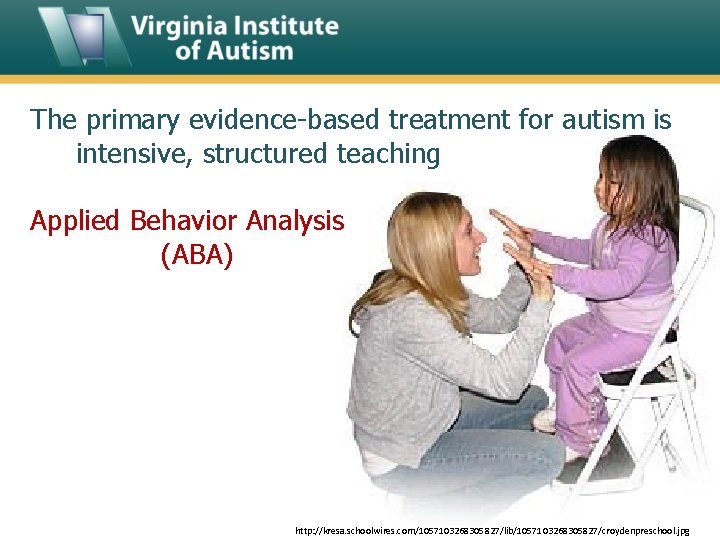
The primary evidence-based treatment for autism is intensive, structured teaching Applied Behavior Analysis (ABA) http: //kresa. schoolwires. com/1057103268305827/lib/1057103268305827/croydenpreschool. jpg
Why Evidenced-based? • It is difficult for families to determine which interventions to pursue, given the many contradicting opinions they will hear • Competing information, competing ideologies, and misinformation • Misinformation: false claims, over-statements, or misleading statements • An informed choice is a freely made choice!
Great Resource • Association for Science in Autism Treatment – www. asatonline. org – Distributing free e-newsletter, Science in Autism Treatment – Facebook page • http: //www. facebook. com/ASATonline
A Few Tips on Best Practice for Students with ASD © Virginia Institute of Autism 2011 All Rights Reserved
ARRANGING THE ENVIRONMENT FOR SUCCESS Please share your ideas! © Virginia Institute of Autism 2011 All Rights Reserved
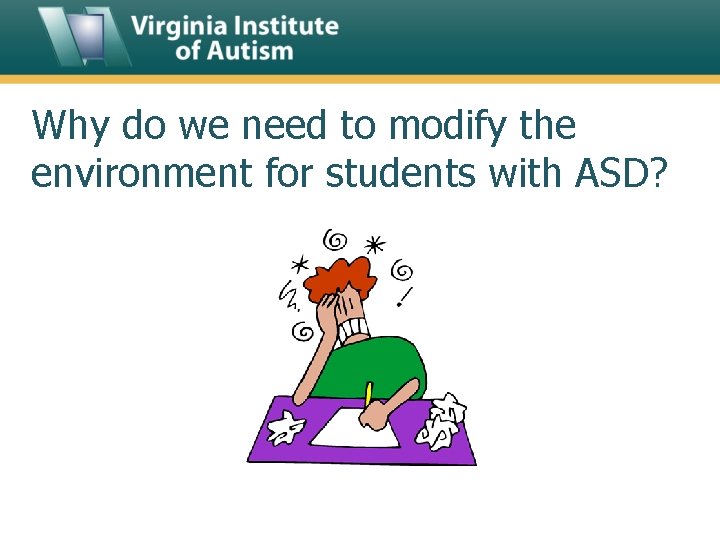
Why do we need to modify the environment for students with ASD?
Specialized Characteristics of Autism (Holtz et al. , 2004) • • Need for sameness/difficulty with transitions Problematic behavior Distracted by sights/sounds Sensitivity to touch Sensitivity to smell Sensitivity to sounds Sensitivity to lights
Prepare Your Space • Use your knowledge of your students’ characteristics to alter physical aspects of the classroom. • Proper classroom / home arrangement will help ensure on-task behavior, increase independence and lessen anxiety.
Accommodating a Need for Sameness • Define classroom areas – 1: 1 teaching, group work , independent work spaces • Keep classroom consistently organized – Free the environment of clutter • Use both classroom and individual schedules
Accommodating a Need for Structure • Define classroom areas: What activity should take place in each area? – 1: 1 teaching, group work , independent work spaces • Keep classroom consistently organized – Free the environment of clutter • Use both classroom and individual schedules
Accommodating Need for Visual Supports • Post classroom schedule in consistent place and reflect any upcoming changes • Individual picture or textual schedule stays with student to show in advance of transitions
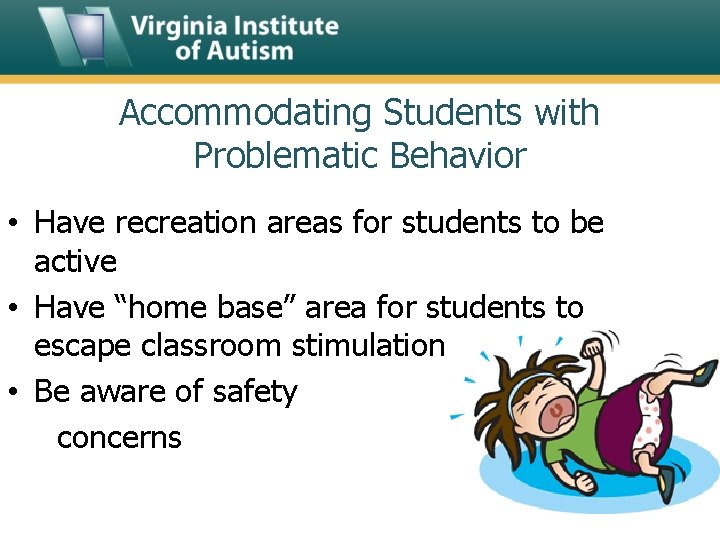
Accommodating Students with Problematic Behavior • Have recreation areas for students to be active • Have “home base” area for students to escape classroom stimulation • Be aware of safety concerns
Accommodating Students who are Easily Distracted • Face desks away from windows and doors, high traffic areas, and play materials • Use carpet / tennis balls on chairs • Cover computer or teach when it is available • Minimize outside distractions • Desensitize to distractions over time • Give SIMPLE directions + visual aids • Make sure schedule is well-rounded with a variety of short activities
Accommodating Sensory Sensitivities • Recognize differences in processing sensory stimuli • Do not force children into aversive sensory situations unless absolutely necessary • Look for environmental accommodations • Use systematic desensitization to teach tolerance • Ensure appropriate sensory activities are available
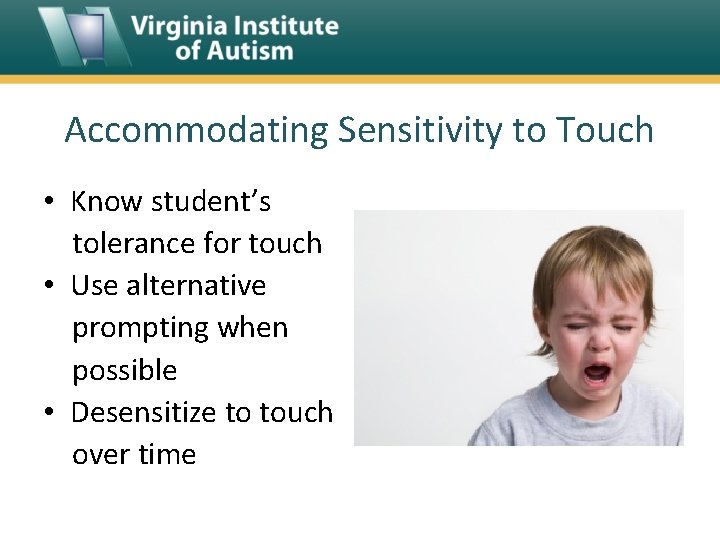
Accommodating Sensitivity to Touch • Know student’s tolerance for touch • Use alternative prompting when possible • Desensitize to touch over time
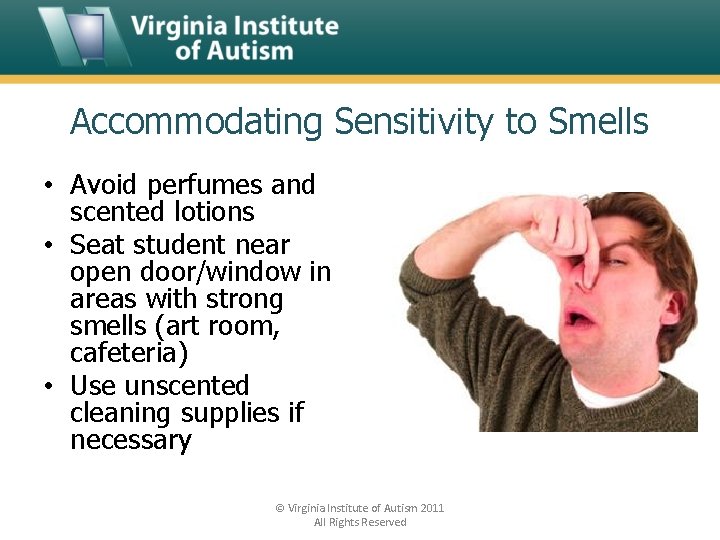
Accommodating Sensitivity to Smells • Avoid perfumes and scented lotions • Seat student near open door/window in areas with strong smells (art room, cafeteria) • Use unscented cleaning supplies if necessary © Virginia Institute of Autism 2011 All Rights Reserved
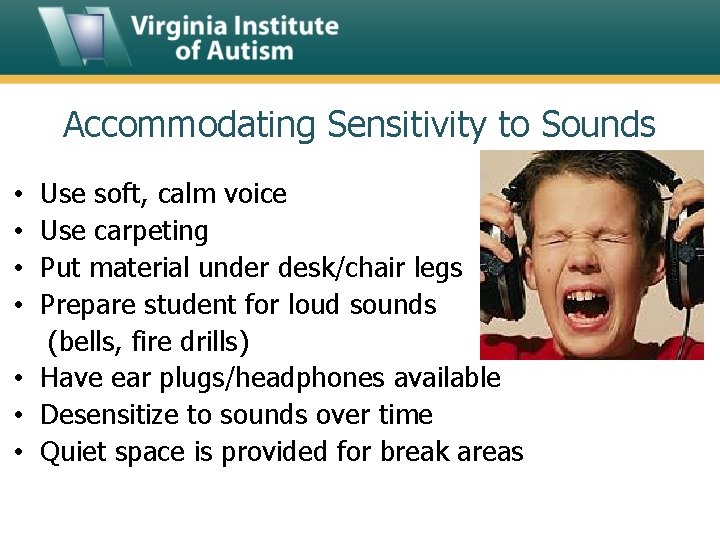
Accommodating Sensitivity to Sounds Use soft, calm voice Use carpeting Put material under desk/chair legs Prepare student for loud sounds (bells, fire drills) • Have ear plugs/headphones available • Desensitize to sounds over time • Quiet space is provided for break areas • •
Accommodating Sensitivity to Lights • Use lamps instead of fluorescent lights • Try lower light or different colors • Offer student sunglasses or baseball cap
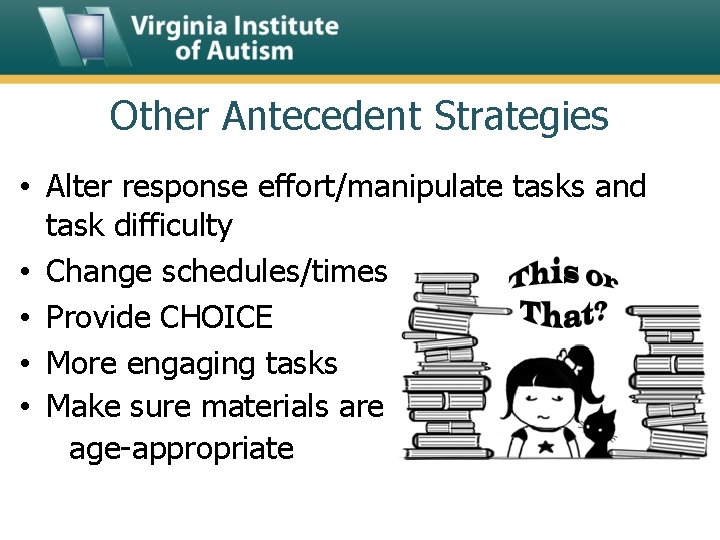
Other Antecedent Strategies • Alter response effort/manipulate tasks and task difficulty • Change schedules/times of day • Provide CHOICE • More engaging tasks • Make sure materials are age-appropriate
Be Consistent Across Child’s Team! • Regular team meetings for updates/troubleshooting • Written plans for teaching, addressing challenging behavior, etc. • Training and observation • Consistency across team regarding: – – Student characteristics Teaching procedures Level of demands Behavior support plans
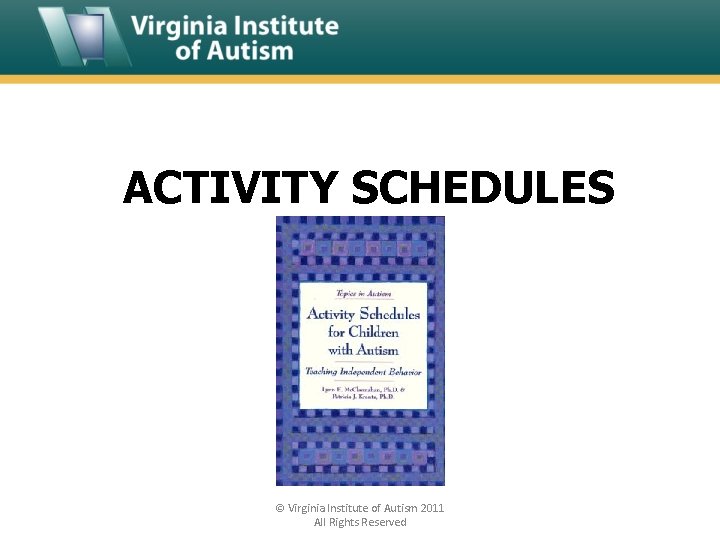
ACTIVITY SCHEDULES © Virginia Institute of Autism 2011 All Rights Reserved
What is an Activity Schedule? • “A set of pictures or words that cues someone to engage in a sequence of activities” (Mc. Clannahan & Krantz, 1999) © Virginia Institute of Autism 2011 All Rights Reserved
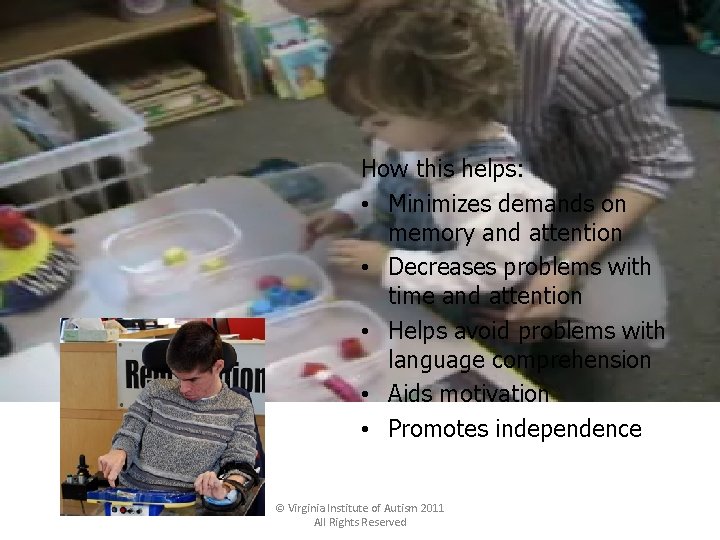
Activity Schedule Tells student: • What I am going to do • For how long? • What comes next? • When will I be finished? How this helps: • Minimizes demands on memory and attention • Decreases problems with time and attention • Helps avoid problems with language comprehension • Aids motivation • Promotes independence © Virginia Institute of Autism 2011 All Rights Reserved
Why use activity schedules? • • Organize the environment Reduce anxiety Help with transitions Increase independence Provide framework for choice Portable Don’t necessarily need to fade
Activity Schedule Uses • • • Individual Daily Schedules Classroom Routines Personal Hygiene Routines Chore Lists Independent Leisure Schedules Vocational Tasks
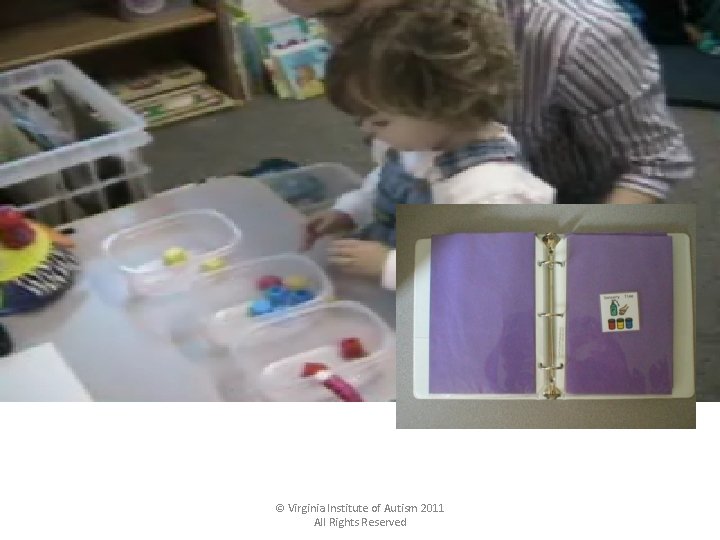
First Independent Activity Schedule • • • Between 2 and 4 activities Mastered, independent activities Preferred or neutral activities Activities with a definite beginning and end End with most preferred activity
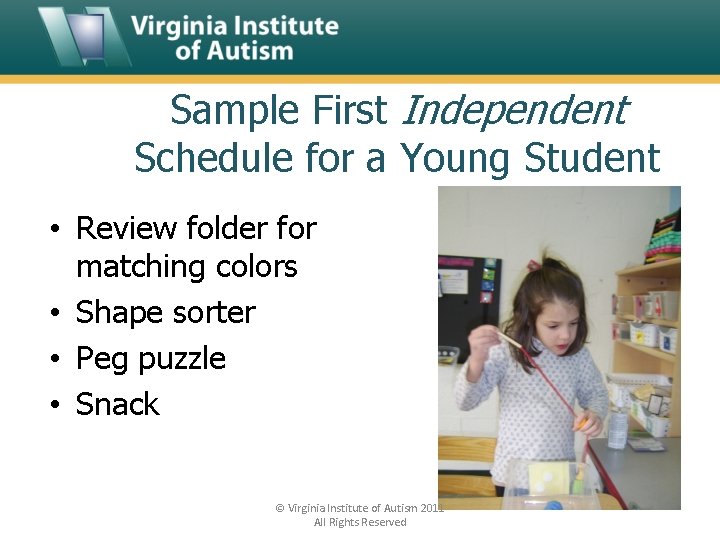
Sample First Independent Schedule for a Young Student • Review folder for matching colors • Shape sorter • Peg puzzle • Snack © Virginia Institute of Autism 2011 All Rights Reserved
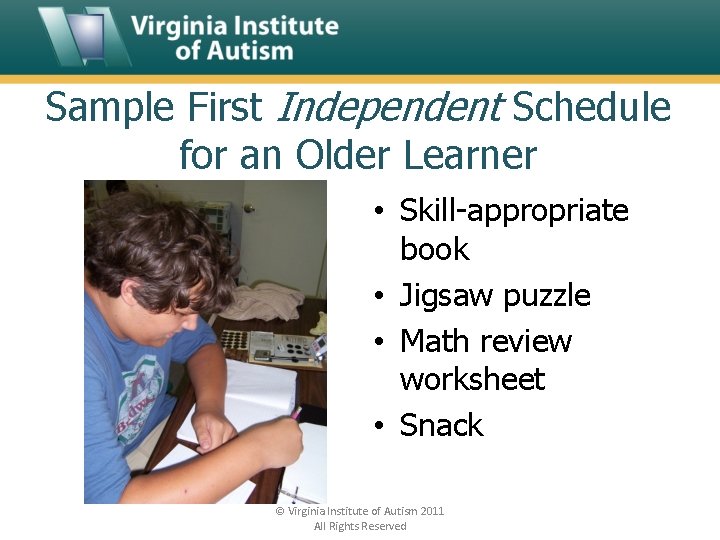
Sample First Independent Schedule for an Older Learner • Skill-appropriate book • Jigsaw puzzle • Math review worksheet • Snack © Virginia Institute of Autism 2011 All Rights Reserved
REINFORCEMENT © Virginia Institute of Autism 2011 All Rights Reserved
“Reinforcement is one of the most critical elements of therapy. ” (Leaf et al. , 1999)
Reinforcement • Definition: A procedure that follows a behavior, and INCREASES the likelihood of the behavior occurring in the future • Defined by its effect, not by your intention
Reinforcement for Children with Autism • Social reinforcers may not be motivating • Typical activities may be stressful because they: – Are new – Are different from the routine – Require social interaction – Involve sensory input that is uncomfortable • Students with ASD may have very little control over their environment
We need to use more direct, tangible reinforcement to motivate and reward students with autism © Virginia Institute of Autism 2011 All Rights Reserved
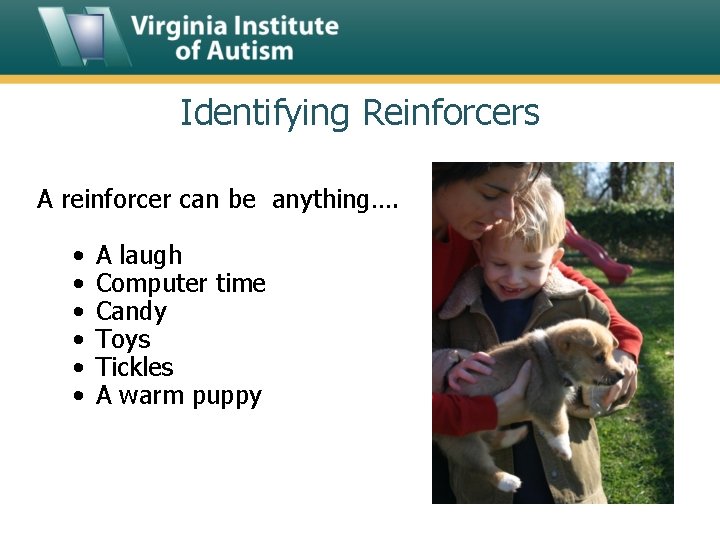
Identifying Reinforcers A reinforcer can be anything…. • • • A laugh Computer time Candy Toys Tickles A warm puppy
A Note of Caution about Reinforcers • Reinforcers need to be determined for each person individually • What is reinforcing for one person may not be reinforcing for another • Reinforcers change from day to day; moment to moment
ADDRESSING CHALLENGING BEHAVIORS
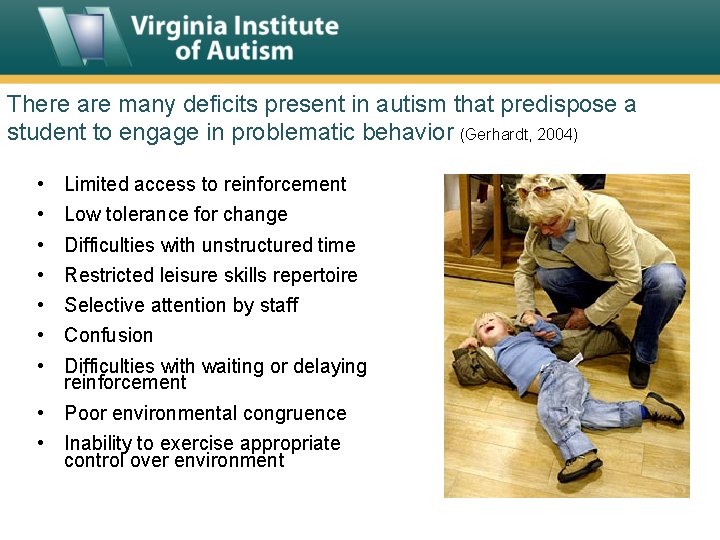
There are many deficits present in autism that predispose a student to engage in problematic behavior (Gerhardt, 2004) • • Limited access to reinforcement Low tolerance for change Difficulties with unstructured time Restricted leisure skills repertoire Selective attention by staff Confusion Difficulties with waiting or delaying reinforcement • Poor environmental congruence • Inability to exercise appropriate control over environment
“Maladaptive” Behavior • All behavior is adaptive for the person engaging in it. • Every behavior serves some purpose. • It is clinically unsound to implement an intervention to decrease a behavior until you know the function of the behavior.
Every behavior has a function, it is our ethical responsibility to do everything we can to discover it.
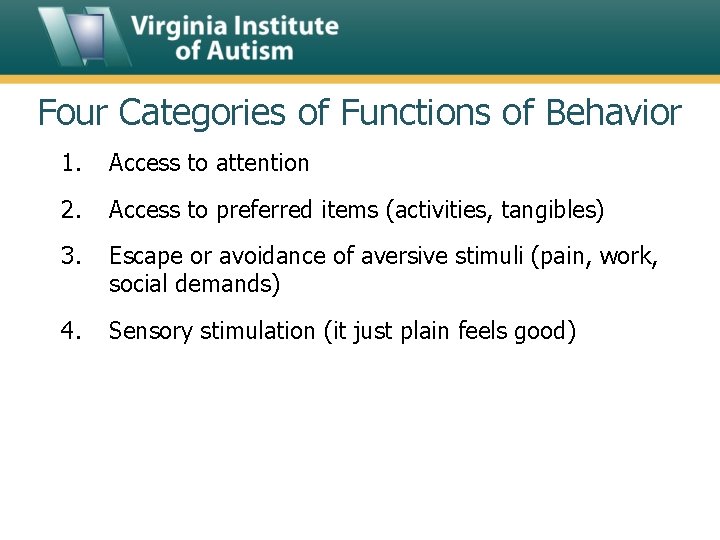
Four Categories of Functions of Behavior 1. Access to attention 2. Access to preferred items (activities, tangibles) 3. Escape or avoidance of aversive stimuli (pain, work, social demands) 4. Sensory stimulation (it just plain feels good)
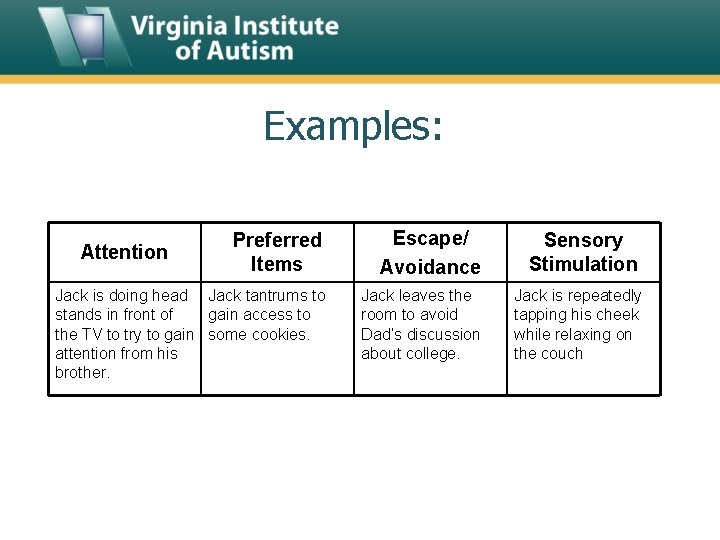
Examples: Preferred Items Escape/ Avoidance Sensory Stimulation Jack is doing head Jack tantrums to stands in front of gain access to the TV to try to gain some cookies. attention from his brother. Jack leaves the room to avoid Dad’s discussion about college. Jack is repeatedly tapping his cheek while relaxing on the couch Attention
To Decrease Problem Behaviors… DON’T REINFORCE THEM!
Reinforcement The tricky thing about reinforcement is: • If a behavior continues to occur, it is being reinforced in some way! © Virginia Institute of Autism 2011 All Rights Reserved
• Reinforce a desirable behavior that the student already has • Teach a new desirable behavior: Ø A replacement that serves the same function and/or… Ø An alternative that doesn’t serve the same function but that allows the student to be reinforced more often
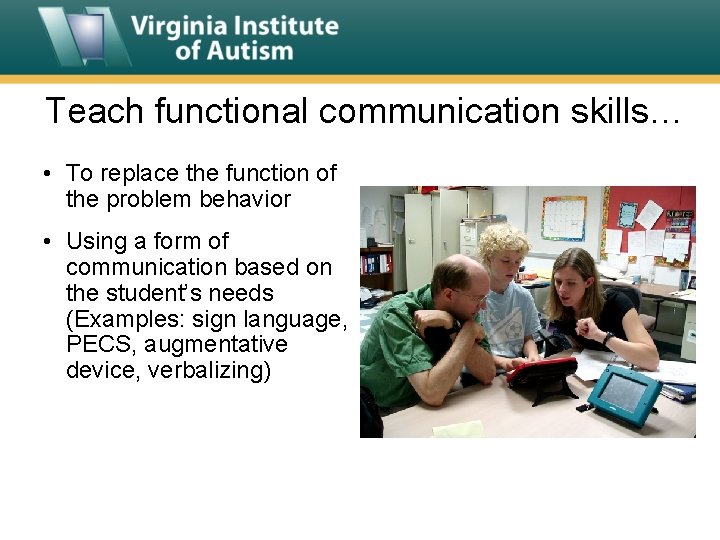
Teach functional communication skills… • To replace the function of the problem behavior • Using a form of communication based on the student’s needs (Examples: sign language, PECS, augmentative device, verbalizing)
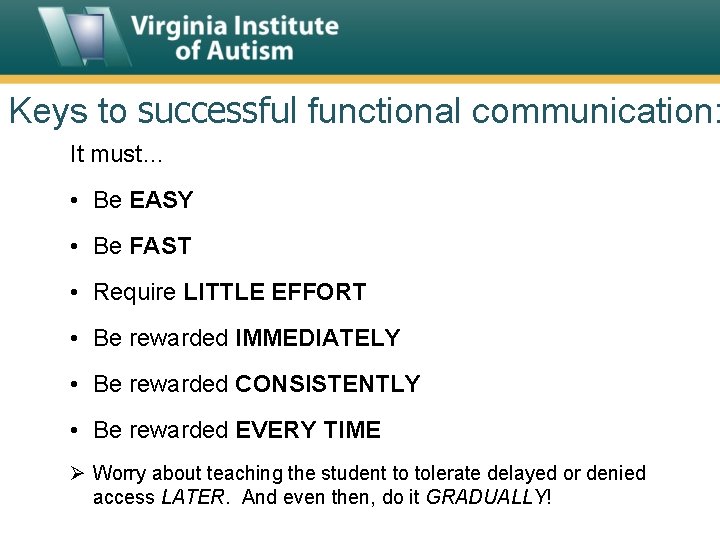
Keys to successful functional communication: It must… • Be EASY • Be FAST • Require LITTLE EFFORT • Be rewarded IMMEDIATELY • Be rewarded CONSISTENTLY • Be rewarded EVERY TIME Ø Worry about teaching the student to tolerate delayed or denied access LATER. And even then, do it GRADUALLY!
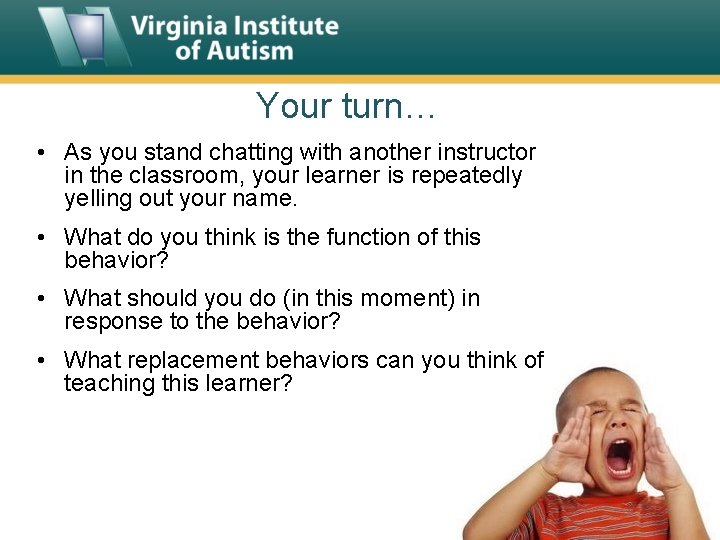
Your turn… • As you stand chatting with another instructor in the classroom, your learner is repeatedly yelling out your name. • What do you think is the function of this behavior? • What should you do (in this moment) in response to the behavior? • What replacement behaviors can you think of teaching this learner?
If you guessed “Attention Seeking” you are correct. Your first intervention would be to withhold your attention. And here are some potential replacement behaviors for this learner: Ø Ø Ø Learning to wait Learning to raise a quiet hand Learning to say “Excuse me” Learning to ask for help Learning to approach an adult and tap them on the shoulder
Generalization
Generalization is… • The exhibition of a skill under novel circumstances • The ability to use a skill independently and in typical settings
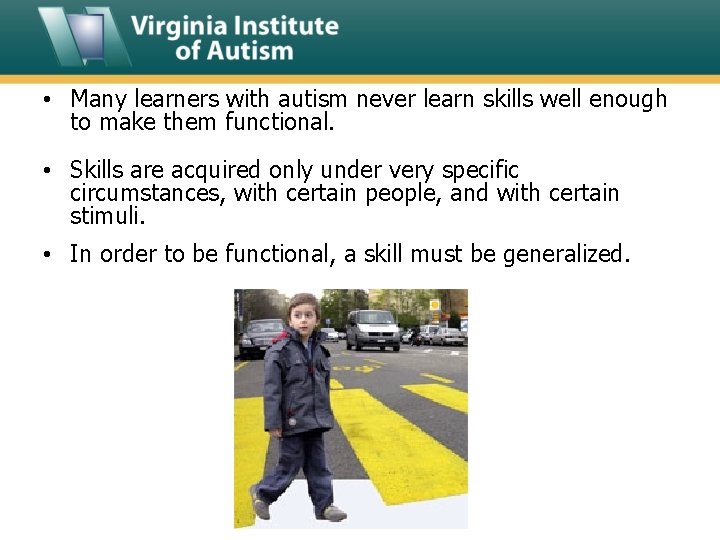
• Many learners with autism never learn skills well enough to make them functional. • Skills are acquired only under very specific circumstances, with certain people, and with certain stimuli. • In order to be functional, a skill must be generalized.
• General Tips: • Use brief statements, moderating the pace of speech; pace of exploration of object. • Control the amount & type of input so child is not over aroused, unable to attend. • Be aware of impact of even subtle noise on child’s stress level and ability to attend.
• General Tips: • Balance social time with alone time. Child may often find social experiences aversive rather than reinforcing. • Social experience is generally not important to child. Praise, “time out, ” are typically not effective motivators.
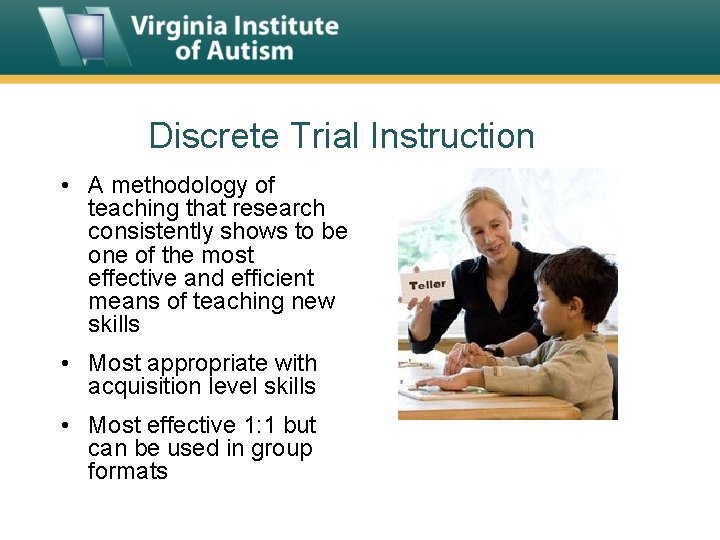
Discrete Trial Instruction • A methodology of teaching that research consistently shows to be one of the most effective and efficient means of teaching new skills • Most appropriate with acquisition level skills • Most effective 1: 1 but can be used in group formats
Discrete Trial Instruction • Skills are broken into smaller parts, with one part taught at a time • Each teaching session involves repeated trials; each trial is “discrete” (has a specific beginning and end) • One trial: instruction or cue (SD), a prompted or independent response, and a consequence (correction or reinforcement) • Correct responses are reinforced, with greater reinforcement for independent responses • Prompts are faded as quickly as possible
Discrete Trial Instruction • Data are collected • Skills may be taught one item at a time or in sets • Errorless teaching or “no-no-prompt” teaching may be used • Massed trials of 15 -30 trials are sometimes used in initial teaching • Once a skill is mastered it may be embedded into the daily schedule and practiced in a variety of settings, including the classroom
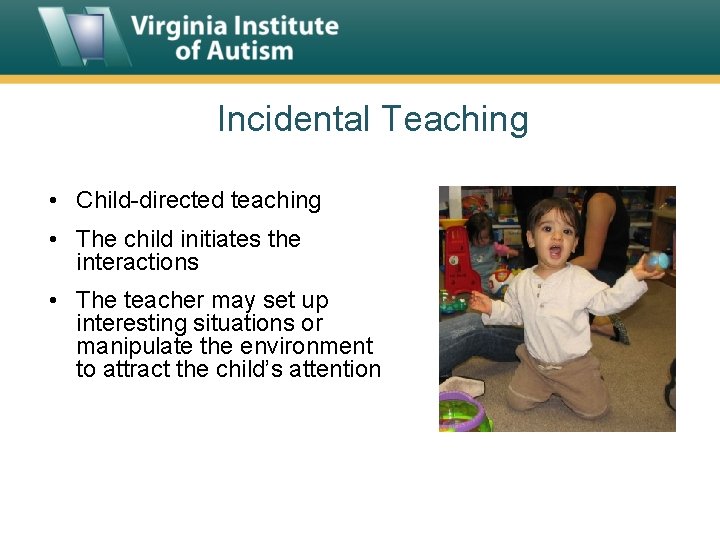
Incidental Teaching • Child-directed teaching • The child initiates the interactions • The teacher may set up interesting situations or manipulate the environment to attract the child’s attention
Incidental Teaching There are 3 necessary elements in incidental teaching: 1. The student initiates communication 1. The adult requests an elaboration 1. The adult reinforces the elaboration or models correct behavior
Incidental Teaching • It appears incidental but is actually highly structured and planned • It can take place in any setting; most often it is used in free play or activity times • Adult responsiveness is critical to its success: the adult must be aware of the student’s performance level, of when to raise the bar and not overaccommodate the learner
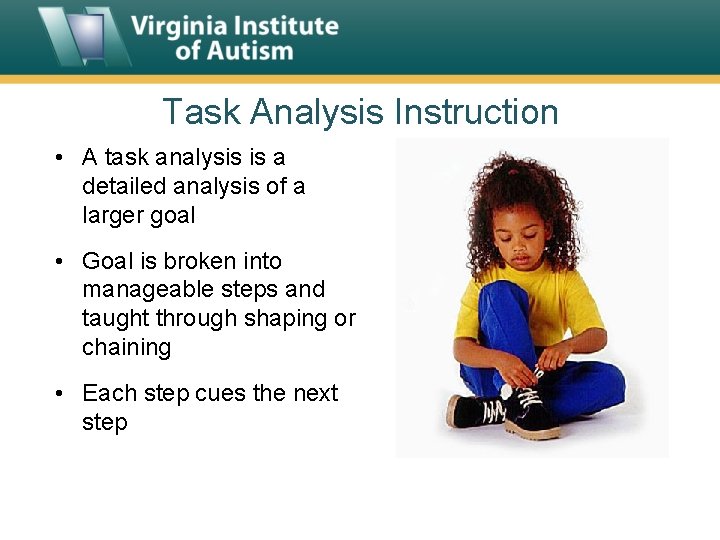
Task Analysis Instruction • A task analysis is a detailed analysis of a larger goal • Goal is broken into manageable steps and taught through shaping or chaining • Each step cues the next step
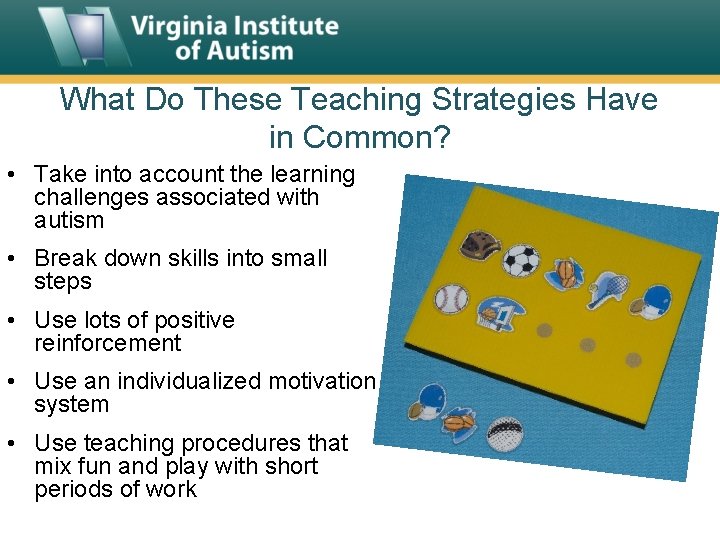
What Do These Teaching Strategies Have in Common? • Take into account the learning challenges associated with autism • Break down skills into small steps • Use lots of positive reinforcement • Use an individualized motivation system • Use teaching procedures that mix fun and play with short periods of work
Discovery Learning • Very popular in regular education settings • Based on the assumption that: – students are observational learners – students are active problem solvers – motivation is largely internal
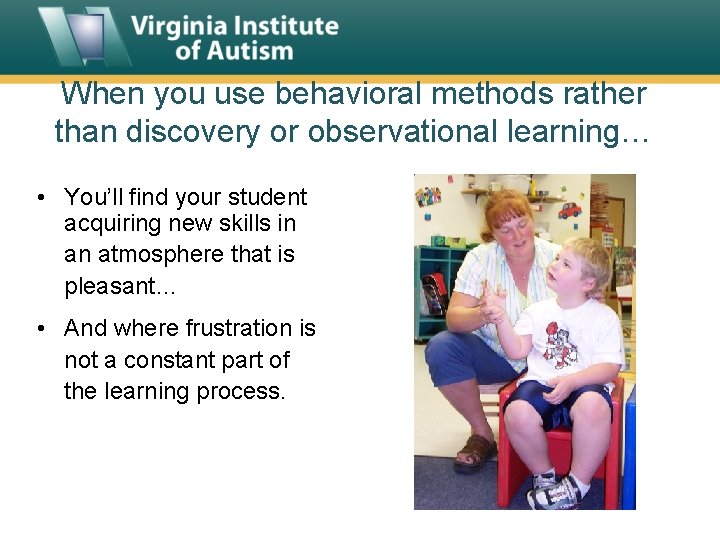
When you use behavioral methods rather than discovery or observational learning… • You’ll find your student acquiring new skills in an atmosphere that is pleasant… • And where frustration is not a constant part of the learning process.
• Thank you! • Peggy Halliday • phalliday@viaschool. org