
AUTISM DIHB 008 Animation as a Learning Socializing
AUTISM DIHB 008 Animation as a Learning, Socializing and Therapeutic Tool of Autistic Cases Prof. d r Violeta Boyanova Chief. assist. Polina Mihova, Ph. D
Overview What is Autism? Is there more than one type of Autism? What causes Autism? How is Autism diagnosed? What are the characteristics of Autism? What are the most effective approaches to treating Autism? Is there a cure?
WHAT IS AUTISM? Very complex, often baffling developmental disability First described by Leo Kanner in 1943 as early infantile autism “Auto” – children are “locked within themselves. ” For next 30 years, considered to be an emotional disturbance
WHAT IS AUTISM? 3 categories for autism in IDEA? Today, autism is a severe form of a broader group of disorders These are referred to as pervasive developmental disorders (later) Typically appears during the first 3 years of life
Autism Can Be Identified Early Most common initial symptom reported by parents is delayed (or abnormal) speech development Social-communicative abnormalities in the first and second year of life: Eye contact Social referencing Imitation Orientation to name Shared attention and affect Early recognition and identification of autism -->early behavioral markers of autism
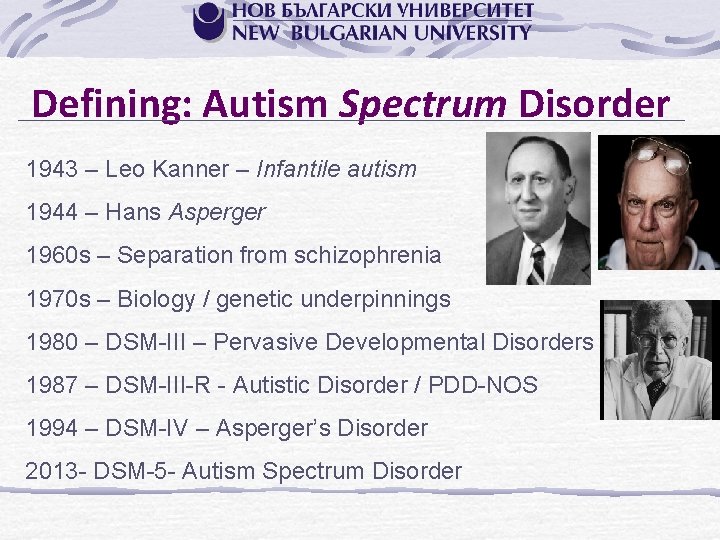
Defining: Autism Spectrum Disorder 1943 – Leo Kanner – Infantile autism 1944 – Hans Asperger 1960 s – Separation from schizophrenia 1970 s – Biology / genetic underpinnings 1980 – DSM-III – Pervasive Developmental Disorders 1987 – DSM-III-R - Autistic Disorder / PDD-NOS 1994 – DSM-IV – Asperger’s Disorder 2013 - DSM-5 - Autism Spectrum Disorder
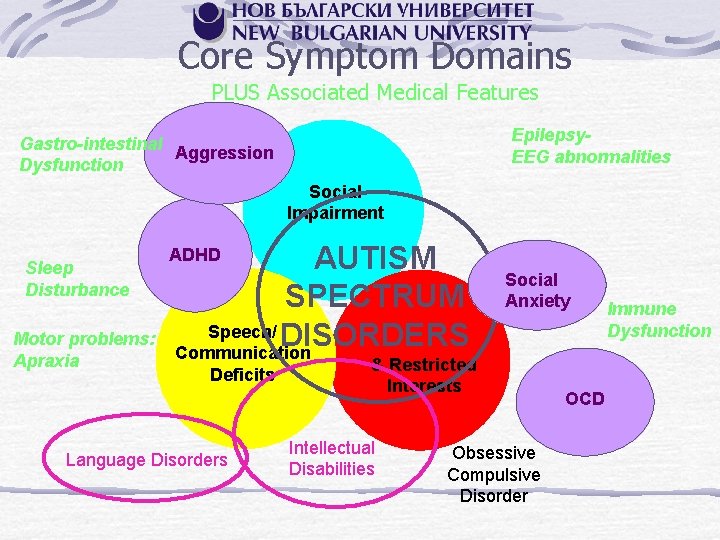
Core Symptom Domains PLUS Associated Medical Features Epilepsy. EEG abnormalities Gastro-intestinal Aggression Dysfunction Social Impairment Sleep Disturbance Motor problems: Apraxia AUTISM SPECTRUM Speech/ DISORDERS Communication ADHD Deficits Language Disorders Social Anxiety & Restricted Interests Intellectual Disabilities Obsessive Compulsive Disorder OCD Immune Dysfunction
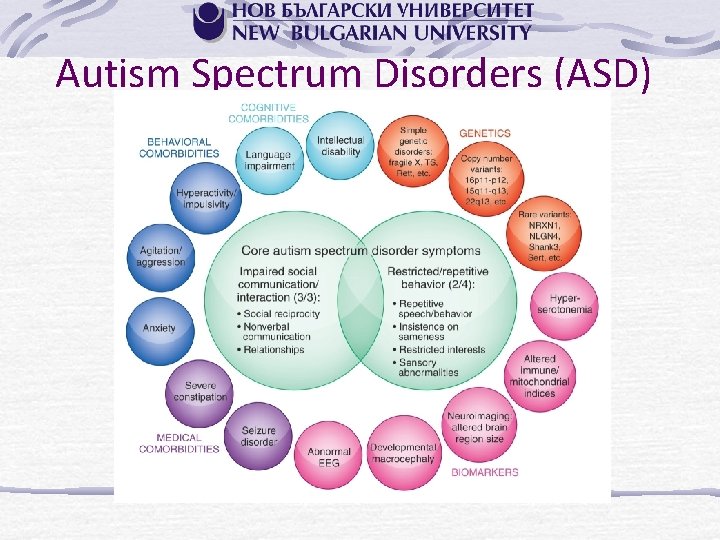
Autism Spectrum Disorders (ASD)
Autism…What We Know �Between 60, 000 and 115, 000 children under 15 years of age in the US meet diagnostic criteria for autism. �The diagnosis of autism often is not made until 2 -to-3 years after symptoms are recognized, primarily due to concerns about labeling or incorrectly diagnosing the child. �Identifying children with autism and initiating intensive, early intervention during the preschool years results in improved outcomes for most young children. Early diagnosis of autism and early intervention facilitates earlier educational planning.
The Basics of Autism Onset during first 3 years of life Chronic lifelong course Male: female ratio = 4: 1 Underlying neurological dysfunction Genetic factors in etiology Spectrum of severity
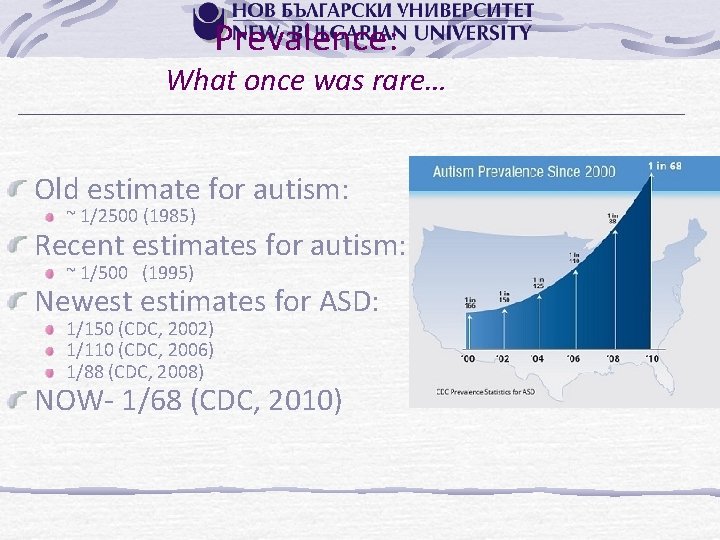
Prevalence: What once was rare… Old estimate for autism: ~ 1/2500 (1985) Recent estimates for autism: ~ 1/500 (1995) Newest estimates for ASD: 1/150 (CDC, 2002) 1/110 (CDC, 2006) 1/88 (CDC, 2008) NOW- 1/68 (CDC, 2010)
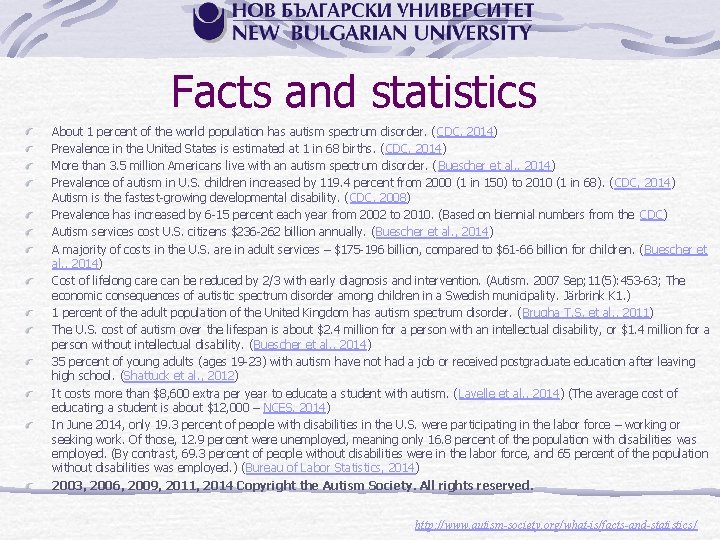
Facts and statistics About 1 percent of the world population has autism spectrum disorder. ( CDC, 2014) Prevalence in the United States is estimated at 1 in 68 births. (CDC, 2014) More than 3. 5 million Americans live with an autism spectrum disorder. ( Buescher et al. , 2014) Prevalence of autism in U. S. children increased by 119. 4 percent from 2000 (1 in 150) to 2010 (1 in 68). (CDC, 2014) Autism is the fastest growing developmental disability. (CDC, 2008) Prevalence has increased by 6 15 percent each year from 2002 to 2010. (Based on biennial numbers from the CDC) Autism services cost U. S. citizens $236 262 billion annually. (Buescher et al. , 2014) A majority of costs in the U. S. are in adult services – $175 196 billion, compared to $61 66 billion for children. (Buescher et al. , 2014) Cost of lifelong care can be reduced by 2/3 with early diagnosis and intervention. (Autism. 2007 Sep; 11(5): 453 63; The economic consequences of autistic spectrum disorder among children in a Swedish municipality. Järbrink K 1. ) 1 percent of the adult population of the United Kingdom has autism spectrum disorder. ( Brugha T. S. et al. , 2011) The U. S. cost of autism over the lifespan is about $2. 4 million for a person with an intellectual disability, or $1. 4 million for a person without intellectual disability. (Buescher et al. , 2014) 35 percent of young adults (ages 19 23) with autism have not had a job or received postgraduate education after leaving high school. (Shattuck et al. , 2012) It costs more than $8, 600 extra per year to educate a student with autism. (Lavelle et al. , 2014) (The average cost of educating a student is about $12, 000 – NCES, 2014) In June 2014, only 19. 3 percent of people with disabilities in the U. S. were participating in the labor force – working or seeking work. Of those, 12. 9 percent were unemployed, meaning only 16. 8 percent of the population with disabilities was employed. (By contrast, 69. 3 percent of people without disabilities were in the labor force, and 65 percent of the population without disabilities was employed. ) (Bureau of Labor Statistics, 2014) 2003, 2006, 2009, 2011, 2014 Copyright the Autism Society. All rights reserved. http: //www. autism-society. org/what-is/facts-and-statistics/
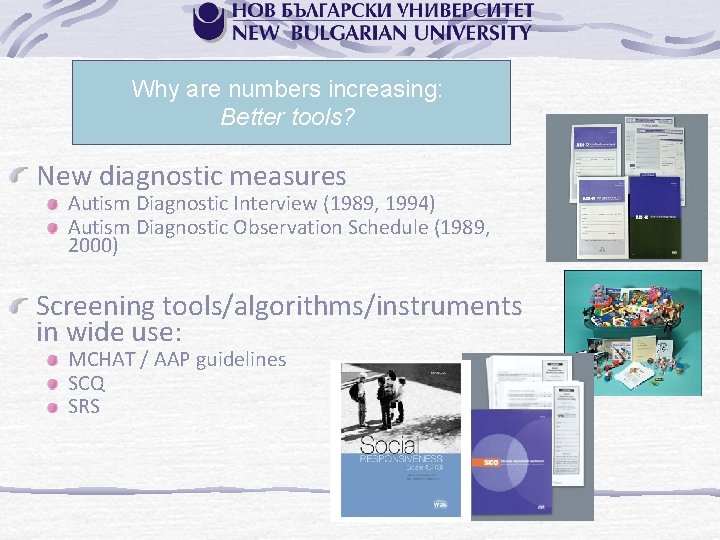
Why are numbers increasing: Better tools? New diagnostic measures Autism Diagnostic Interview (1989, 1994) Autism Diagnostic Observation Schedule (1989, 2000) Screening tools/algorithms/instruments in wide use: MCHAT / AAP guidelines SCQ SRS
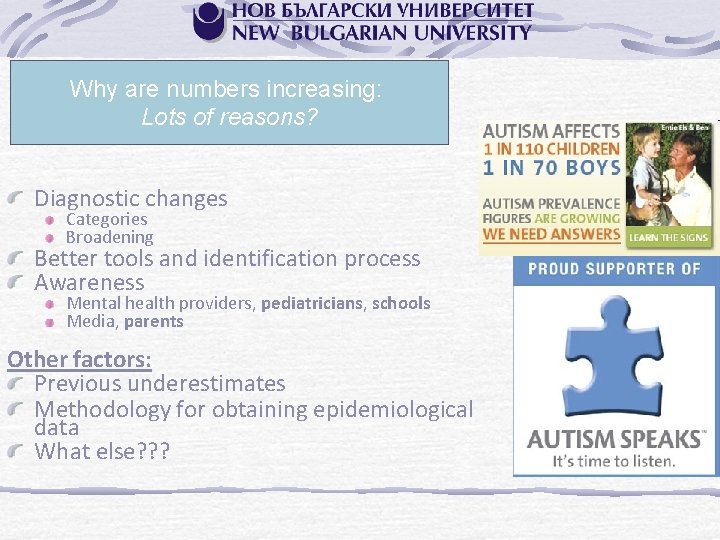
Why are numbers increasing: Lots of reasons? Diagnostic changes Categories Broadening Better tools and identification process Awareness Mental health providers, pediatricians, schools Media, parents Other factors: Previous underestimates Methodology for obtaining epidemiological data What else? ? ?
Autism Basics Kanner’s Description Leo Kanner (1943) classic paper Description of 11 children with previously undescribed syndrome Characteristics Inability to relate to others Failure to use language to convey meaning Obsessive desire for the maintenance of sameness Anxiety Congenital onset Co-morbidity Observations to empirical support
Clinical Features Five specific spectrum diagnoses used by DSM-IV: Autistic disorder Asperger disorder Rett disorder Childhood disintegrative disorder Pervasive developmental disorder-NOS
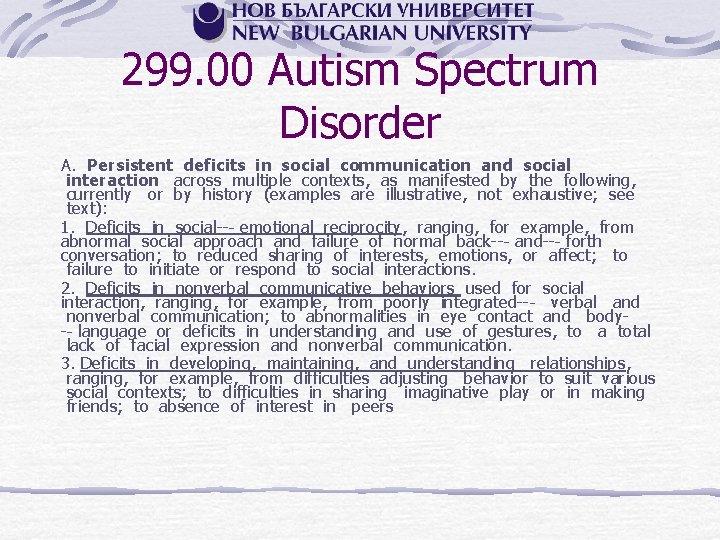
299. 00 Autism Spectrum Disorder A. Persistent deficits in social communication and social interaction across multiple contexts, as manifested by the following, currently or by history (examples are illustrative, not exhaustive; see text): 1. Deficits in social ‐emotional reciprocity, ranging, for example, from abnormal social approach and failure of normal back ‐and ‐forth conversation; to reduced sharing of interests, emotions, or affect; to failure to initiate or respond to social interactions. 2. Deficits in nonverbal communicative behaviors used for social interaction, ranging, for example, from poorly integrated ‐ verbal and nonverbal communication; to abnormalities in eye contact and body ‐language or deficits in understanding and use of gestures, to a total lack of facial expression and nonverbal communication. 3. Deficits in developing, maintaining, and understanding relationships, ranging, for example, from difficulties adjusting behavior to suit various social contexts; to difficulties in sharing imaginative play or in making friends; to absence of interest in peers
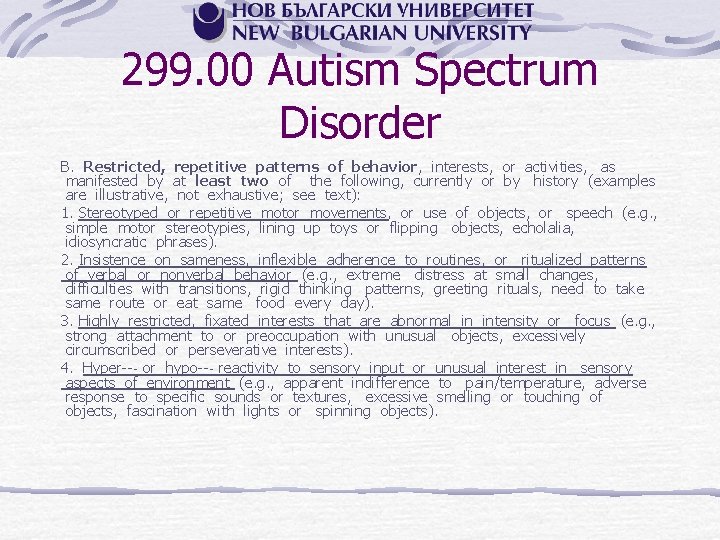
299. 00 Autism Spectrum Disorder B. Restricted, repetitive patterns of behavior, interests, or activities, as manifested by at least two of the following, currently or by history (examples are illustrative, not exhaustive; see text): 1. Stereotyped or repetitive motor movements, or use of objects, or speech (e. g. , simple motor stereotypies, lining up toys or flipping objects, echolalia, idiosyncratic phrases). 2. Insistence on sameness, inflexible adherence to routines, or ritualized patterns of verbal or nonverbal behavior (e. g. , extreme distress at small changes, difficulties with transitions, rigid thinking patterns, greeting rituals, need to take same route or eat same food every day). 3. Highly restricted, fixated interests that are abnormal in intensity or focus (e. g. , strong attachment to or preoccupation with unusual objects, excessively circumscribed or perseverative interests). 4. Hyper ‐or hypo ‐reactivity to sensory input or unusual interest in sensory aspects of environment (e. g. , apparent indifference to pain/temperature, adverse response to specific sounds or textures, excessive smelling or touching of objects, fascination with lights or spinning objects).
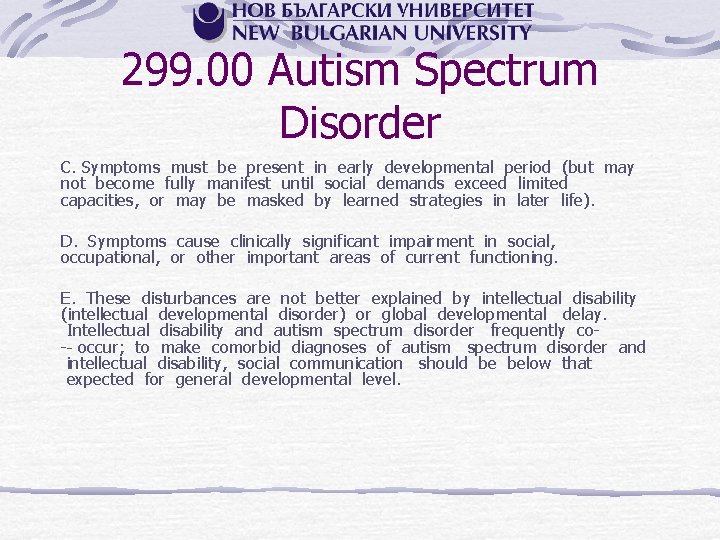
299. 00 Autism Spectrum Disorder C. Symptoms must be present in early developmental period (but may not become fully manifest until social demands exceed limited capacities, or may be masked by learned strategies in later life). D. Symptoms cause clinically significant impairment in social, occupational, or other important areas of current functioning. E. These disturbances are not better explained by intellectual disability (intellectual developmental disorder) or global developmental delay. Intellectual disability and autism spectrum disorder frequently co ‐occur; to make comorbid diagnoses of autism spectrum disorder and intellectual disability, social communication should be below that expected for general developmental level.
WHAT IS AUTISM? Very likely neurological in origin – not emotional, not the refrigerator mom Prevalence is 2 6/1000 individuals (1/2 to 1 ½ million affected) 4 times more prevalent in boys No known racial, ethnic, or social boundaries No relation to family income, lifestyle
WHAT IS AUTISM? Autism impacts normal development of the brain in areas of social interaction and communication skills. Difficult to communicate with others and relate to the outside world. Occasionally, aggressive and/or self injurious behavior may be present.
WHAT IS AUTISM? May exhibit repeated body movements (hand flapping, rocking). Unusual responses to people Attachment to objects Resistance to change in routine Sensory sensitivities
Autism Spectrum Disorders Are Common Increase in prevalence 3 -4 times higher than suggested in 1970 s 1. 5 times higher than thought in 1980 s and 1990 s Proposed explanations: Better identification Sensitive diagnostic tools Broader classification systems Environmental factors
WHAT ARE THE TYPES? Actually, the “umbrella” heading is Pervasive Developmental Disorder (PDD). Autism is one of the 5 PDDs. All have commonalities in communication and social deficits Differ in terms of severity
1. Autistic Disorder Impairments in social interaction, communication, and imaginative play. Apparent before age 3. Also includes stereotyped behaviors, interests, and activities
2. Asperger’s Disorder Impairments in social interactions, and presence of restricted interests and activities No clinically significant general delay in language Average to above average intelligence
3. Pervasive Developmental Disorder – Not Otherwise Specified (PDD NOS) Often referred to as atypical autism Used when a child does not meet the criteria for a specific diagnosis, but there is severe and pervasive impairment in specified behaviors
4. Rett’s Disorder Progressive disorder which, to date, has only occurred in girls. Period of normal development and then the loss of previously acquired skills Also loss of purposeful use of hands, which is replaced by repetitive hand movements Beginning at age of 1 4 years
5. Childhood Disintegrative Disorder Normal development for at least the first 2 years Then significant loss of previously acquired skills
Conclusions on Types Autism is a spectrum disorder This means that symptoms and characteristics can present themselves in wide variety of combinations, from mild to severe Autistic individuals can be very different from each other “Autism” is still commonly used to refer to any of the 5 PDDs
What causes (and doesn’t cause) autism? Good agreement in general that autism is caused by abnormalities in brain development, neurochemistry, and genetic factors Bettleheim’s theory of psychogenesis?
How is Autism Diagnosed? No definitive medical test Team uses interviews, observation, and specific checklists developed for this purpose. Team might include neurologist, psychologist, developmental pediatrician, speech/language therapist, learning consultant, etc. Must rule out MR, hearing impairment, behavior disorders, or eccentric habits
Meeting Criteria For Autism Individual must demonstrate at least 6 of the 12 symptoms At least 2 symptoms from the social domain At least 1 symptom from communication domain At least 1 symptom from the restricted behaviors/interest domain At least 1 symptom must have been present before 36 months of age
CHARACTERISTICS 1. Communication/Language 2. Social Interaction 3. Behaviors 4. Sensory and movement disorders 5. Resistance to change (predictability) 6. Intellectual functioning
1. Communication/language Broad range of abilities, from no verbal communication to quite complex skills Two common impairments: A. Delayed language B. Echolalia
A. Delayed language 50% of autistic individuals will eventually have useful speech (? ) Pronoun reversal: “You want white icing on chocolate cake. ” Difficulty in conversing easily with others Difficulty in shifting topics Look away; poor eye contact Facilitated communication? ? ?
Elements of Facilitated Communication 1. Physical Support 2. Initial training/introduction 3. Maintaining focus 4. Avoiding competence testing 5. Generalization 6. Fading
B. Echolalia Common in very young children (Age 3) Immediate or delayed (even years) Is there communicative intent with echolalia?
2. Social Interaction One of hallmarks of autism is lack of social interaction 1. Impaired use of nonverbal behavior 2. Lack of peer relationships 3. Failure to spontaneously share enjoyment, interests, etc. with others 4. Lack of reciprocity Theory of mind?
3. Behaviors Repetitive behaviors, including obsessions, tics, and perseveration Impeding behaviors (impede their learning or the learning of others) Will need positive behavior supports A. Self-injurious behavior B. Aggression
4. Sensory and movement disorders Very common Over or under sensitive to sensory stimuli Abnormal posture and movements of the face, head, trunk, and limbs Abnormal eye movements Repeated gestures and mannerisms Movement disorders can be detected very early – perhaps at birth
5. Predictability Change in routine is very stressful May insist on particular furniture arrangement, food at meals, TV shows Symmetry is often important Interventions need to focus on preparing students for change if possible
6. Intellectual functioning Autism occurs in children of all levels of intelligence, from those who are gifted to those who have mental retardation In general, majority of individuals with autism are also identified as having mental retardation – 75% below 70 Verbal and reasoning skills are difficult Savant syndrome
Interventions 1. Individualization and early intervention are the keys 2. Include life skills, functional academics, and vocational preparation 3. Positive behavior support 4. Social stories (music therapy? ) 5. Lovaas model
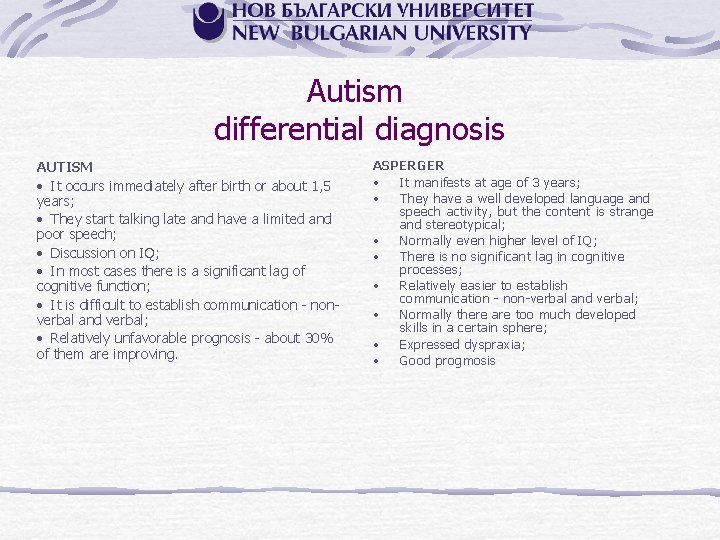
Autism differential diagnosis AUTISM • It occurs immediately after birth or about 1, 5 years; • They start talking late and have a limited and poor speech; • Discussion on IQ; • In most cases there is a significant lag of cognitive function; • It is difficult to establish communication non verbal and verbal; • Relatively unfavorable prognosis about 30% of them are improving. ASPERGER • It manifests at age of 3 years; • They have a well developed language and speech activity, but the content is strange and stereotypical; • Normally even higher level of IQ; • There is no significant lag in cognitive processes; • Relatively easier to establish communication non verbal and verbal; • Normally there are too much developed skills in a certain sphere; • Expressed dyspraxia; • Good progmosis
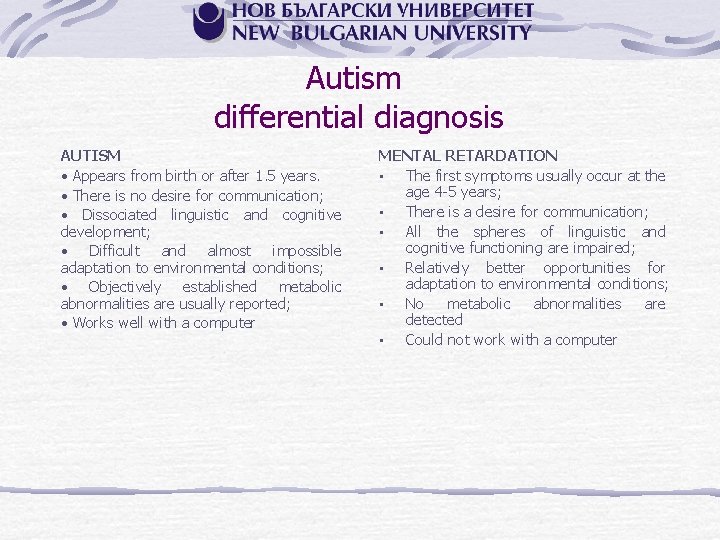
Autism differential diagnosis AUTISM • Appears from birth or after 1. 5 years. • There is no desire for communication; • Dissociated linguistic and cognitive development; • Difficult and almost impossible adaptation to environmental conditions; • Objectively established metabolic abnormalities are usually reported; • Works well with a computer MENTAL RETARDATION • The first symptoms usually occur at the age 4 5 years; • There is a desire for communication; • All the spheres of linguistic and cognitive functioning are impaired; • Relatively better opportunities for adaptation to environmental conditions; • No metabolic abnormalities are detected • Could not work with a computer
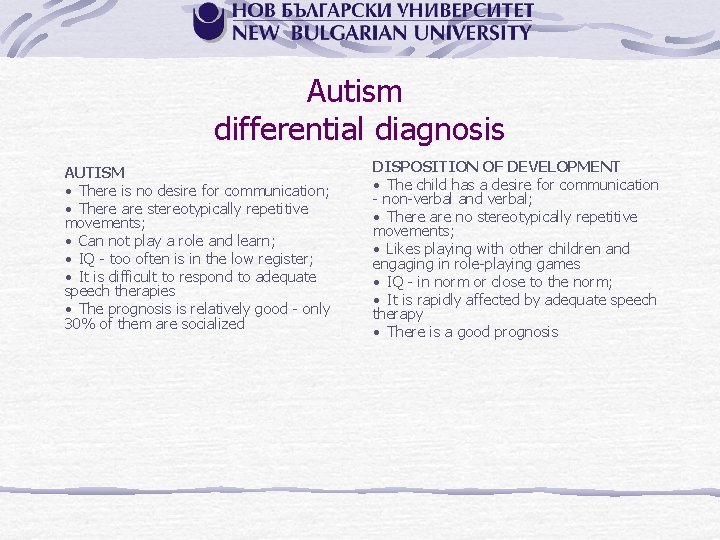
Autism differential diagnosis AUTISM • There is no desire for communication; • There are stereotypically repetitive movements; • Can not play a role and learn; • IQ too often is in the low register; • It is difficult to respond to adequate speech therapies • The prognosis is relatively good only 30% of them are socialized DISPOSITION OF DEVELOPMENT • The child has a desire for communication non verbal and verbal; • There are no stereotypically repetitive movements; • Likes playing with other children and engaging in role playing games • IQ in norm or close to the norm; • It is rapidly affected by adequate speech therapy • There is a good prognosis
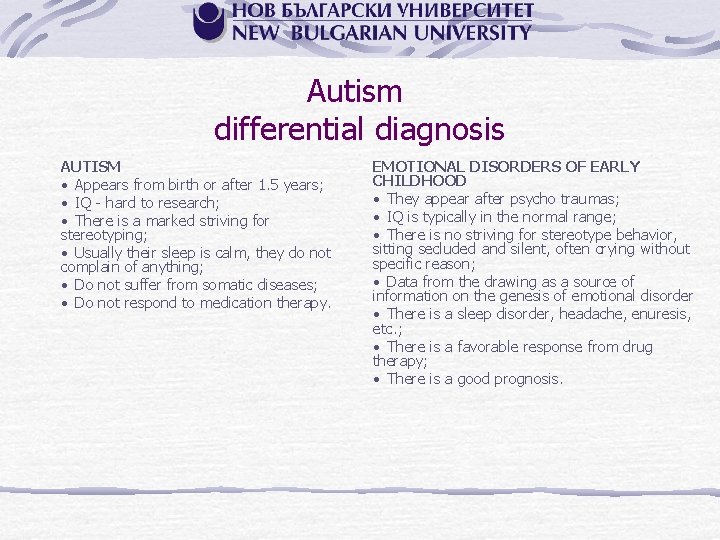
Autism differential diagnosis AUTISM • Appears from birth or after 1. 5 years; • IQ hard to research; • There is a marked striving for stereotyping; • Usually their sleep is calm, they do not complain of anything; • Do not suffer from somatic diseases; • Do not respond to medication therapy. EMOTIONAL DISORDERS OF EARLY CHILDHOOD • They appear after psycho traumas; • IQ is typically in the normal range; • There is no striving for stereotype behavior, sitting secluded and silent, often crying without specific reason; • Data from the drawing as a source of information on the genesis of emotional disorder • There is a sleep disorder, headache, enuresis, etc. ; • There is a favorable response from drug therapy; • There is a good prognosis.
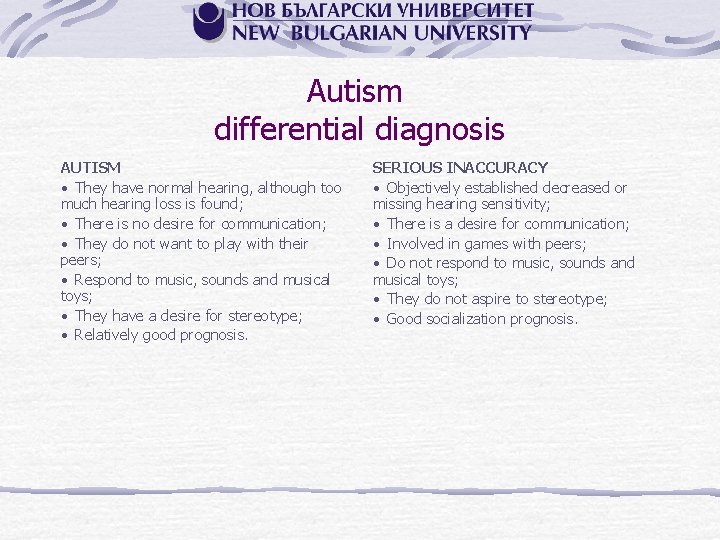
Autism differential diagnosis AUTISM • They have normal hearing, although too much hearing loss is found; • There is no desire for communication; • They do not want to play with their peers; • Respond to music, sounds and musical toys; • They have a desire for stereotype; • Relatively good prognosis. SERIOUS INACCURACY • Objectively established decreased or missing hearing sensitivity; • There is a desire for communication; • Involved in games with peers; • Do not respond to music, sounds and musical toys; • They do not aspire to stereotype; • Good socialization prognosis.
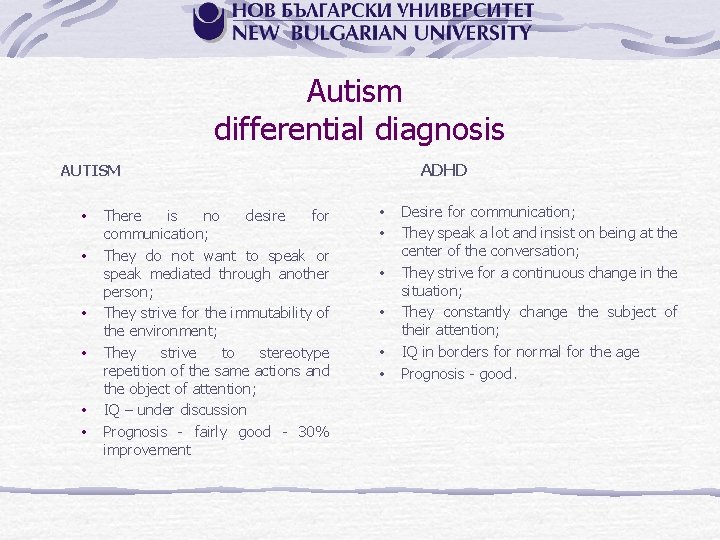
Autism differential diagnosis ADHD AUTISM • • • There is no desire for communication; They do not want to speak or speak mediated through another person; They strive for the immutability of the environment; They strive to stereotype repetition of the same actions and the object of attention; IQ – under discussion Prognosis fairly good 30% improvement • • • Desire for communication; They speak a lot and insist on being at the center of the conversation; They strive for a continuous change in the situation; They constantly change the subject of their attention; IQ in borders for normal for the age Prognosis good.

- Slides: 53