
DAN UNUMB ESQ President Autism Legal Resource Center
DAN UNUMB, ESQ. • President • Autism Legal Resource Center, LLC • www. autismlegalresourcecenter. com • Founder • National Autism Law Center • www. nationalautismlawcenter. org • Danunumb. alrc@gmail. com
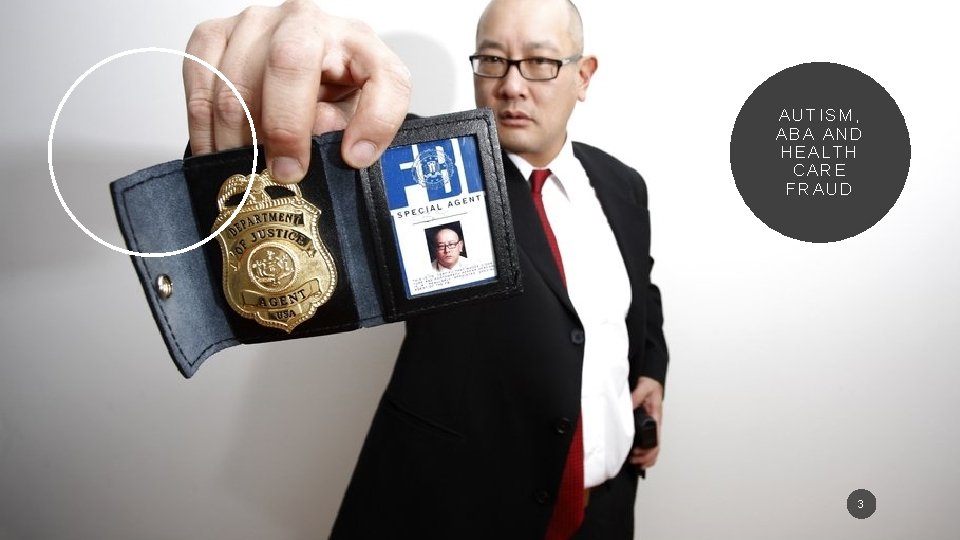
AUTISM, ABA AND HEALTH CARE FRAUD 3
SCRUTINY Expanded, particularly governmental, funding streams come with enhanced scrutiny of your billing practices! 2 South Carolina Women sentenced for Medicaid fraud. https: //www. thestate. com/news/articl e 232236952. html Florida Autism Therapists Accused of Medicaid Fraud. https: //www. miamiherald. com/news/h ealth-care/article 215489530. html 4
Why Are You Here?
MEDICAID/EPSD T • Early • Periodic • Screening • Diagnosis • Treatment • Designed to assure that children (0 -21) receive early detection and care, so that health problems are averted or diagnosed and treated as early as possible. 6
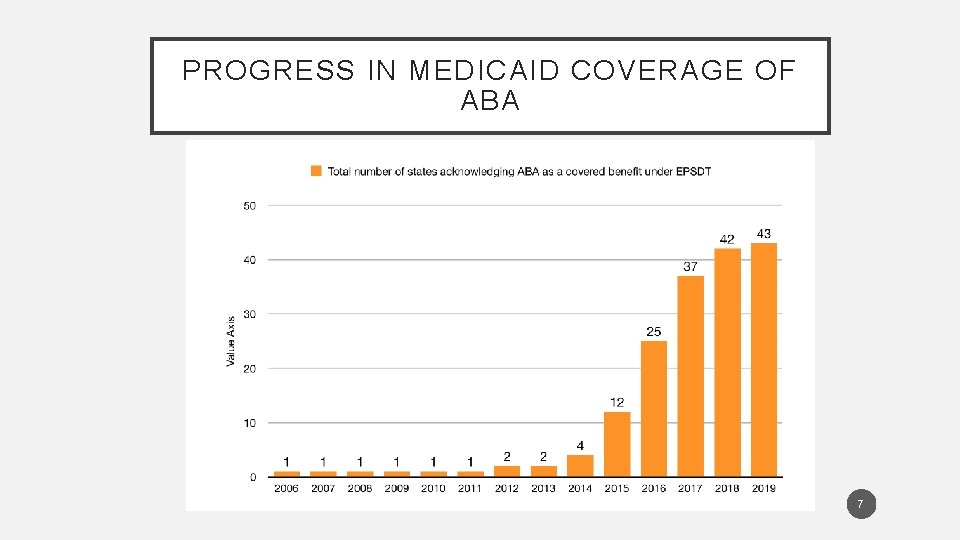
PROGRESS IN MEDICAID COVERAGE OF ABA 7
HEALTH CARE FRAUD • The law for combatting fraud against the government is the False Claims Act (FCA) • 31 United State Code § 3729 • Federal FCA v. State FCAs • (approx. 2/3) • Federal False Claims Act • 1 - What is it? • 2 - Who can bring an FCA action? • 3 - What conduct is prohibited? 8
THE FALSE CLAIMS ACT – WHAT IS IT? • A law that imposes liability on companies and persons who defraud the government • Lincoln’s Law – passed by Congress in 1863 to punish contractors who defrauded the Union army • Has become the government’s primary enforcement vehicle for combatting fraud 9
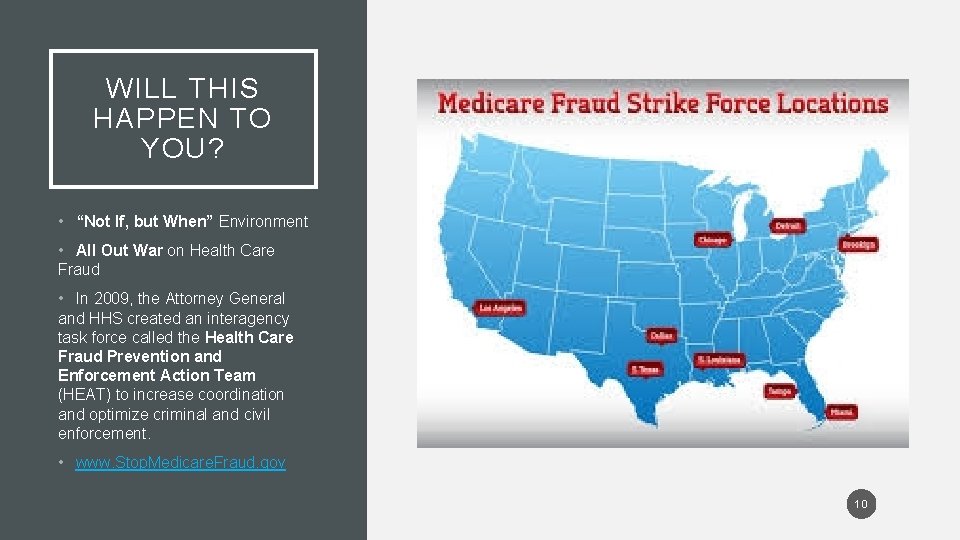
WILL THIS HAPPEN TO YOU? • “Not If, but When” Environment • All Out War on Health Care Fraud • In 2009, the Attorney General and HHS created an interagency task force called the Health Care Fraud Prevention and Enforcement Action Team (HEAT) to increase coordination and optimize criminal and civil enforcement. • www. Stop. Medicare. Fraud. gov 10
HEALTH CARE FRAUD • “Let me be clear: health care fraud is a priority for the Department of Justice. Attorney General Sessions feels very strongly about this. I can tell you that he has expressed this to me personally. The investigation and prosecution of health care fraud will continue; the department will be vigorous in its pursuit of those who violate the law in this area. ” • Acting Assistant Attorney General Kenneth A. Blanco of the Criminal Division 11
THE FALSE CLAIMS ACT – WHO MAY BRING SUIT? • The United States Attorney General and/or private “whistleblowers” may bring suit under the FCA • Whistleblower = relator • Qui Tam – “in the name of the king” 12
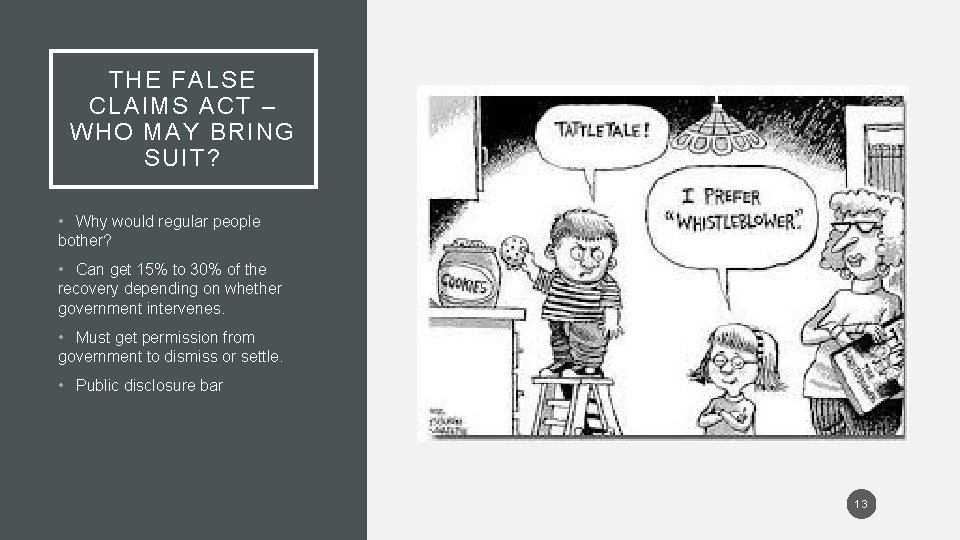
THE FALSE CLAIMS ACT – WHO MAY BRING SUIT? • Why would regular people bother? • Can get 15% to 30% of the recovery depending on whether government intervenes. • Must get permission from government to dismiss or settle. • Public disclosure bar 13
• (A) LIABILITY FOR CERTAIN ACTS (1) In general. — Subject to paragraph (2), any person who — • (A) knowingly presents, or causes to be presented, a false or fraudulent claim for payment or approval; • (B) knowingly makes, uses, or causes to be made or used, a false record or statement material to a false or fraudulent claim; • (C) conspires to commit a violation of subparagraph (A), (B), (D), (E), (F), or (G); • (D) has possession, custody, or control of property or money used, or to be used, by the Government and knowingly delivers, or causes to be delivered, less than all of that money or property; • (E) is authorized to make or deliver a document certifying receipt of property used, or to be used, by the Government and, intending to defraud the Government, makes or delivers the receipt without completely knowing that the information on the receipt is true; • (F) knowingly buys, or receives as a pledge of an obligation or debt, public property from an officer or employee of the Government, or a member of the Armed Forces, who lawfully may not sell or pledge property; or • (G) knowingly makes, uses, or causes to be made or used, a false record or statement material to an obligation to pay or transmit money or property to the Government, or knowingly conceals or knowingly and improperly avoids or decreases an obligation to pay or transmit money or property to the Government, is liable to the United States Government for a civil penalty of not less than $5, 000 and not more than $10, 000, as adjusted by the Federal Civil Penalties Inflation Adjustment Act of 1990, plus 3 times the amount of damages which the Government sustains because of the act of that person. 14
THE FALSE CLAIMS ACT – WHAT CONDUCT IS PROHIBITED? • Most False Claims Act cases involve direct or affirmative false claims – where a person or company knowingly submits a false claim for money to the United States. • To prove that someone has submitted a false claim and is thus liable under the FCA, the government must show 4 things: • Claim • Falsity • Materiality • Knowledge 15
WHAT DOES “FALSE” MEAN? • A claim is generally considered to be false if it seeks money or property to which the claimant is not entitled. • The claimant may be “not entitled” to the money due to a violation of a statute, regulation, or contract. • Examples of false claims in the health care context include claims for unnecessary services or services not actually performed. • “Reverse” False Claims Act violations. Overpayments must be returned within 60 days (ACA). 16
(B) DEFINITIONS FOR PURPOSES OF THIS SECTION • (3) The terms “obligation” • means an established duty, whether or not fixed, arising from an express or implied contractual, grantor-grantee, or licensor-licensee relationship, from a fee-based or similar relationship, from statute or regulation, or from the retention of any overpayment; and • (4) The term “material” • means having a natural tendency to influence, or be capable of influencing, the payment or receipt of money or property. 17
(B) DEFINITIONS FOR PURPOSES OF THIS SECTION • (1) The terms “knowing” and “knowingly” • (A) mean that a person, with respect to information — • (i) has actual knowledge of the information; • (ii) acts in deliberate ignorance of the truth or falsity of the information; or • (iii) acts in reckless disregard of the truth or falsity of the information; and • (B) require no proof of specific intent to defraud; • (2) The term “claim • (A) means any request or demand, whether under a contract or otherwise, for money or property and whether or not the United States has title to the money or property, that— • (i) is presented to an officer, employee, or agent of the United States; or • (ii) is made to a contractor, grantee, or other recipient, if the money or property is to be spent or used on the Government’s behalf or to advance a Government program or interest, and if the United States Government— (I) provides or has provided any portion of the money or property requested or demanded; or • (II) will reimburse such contractor, grantee, or other recipient for any portion of the money or property which is requested or demanded; and • (B) does not include requests or demands for money or property that the Government has paid to an individual as compensation for Federal employment or as an income subsidy with no restrictions on that individual’s use of the money or property; 18
FCA DAMAGES AND PENALTIES • Violations punishable by: • Treble damages of the amount of harm to the government. • Statutory civil penalties just went up to a minimum of $10, 957 and a maximum of $21, 916 per claim. • Over $3. 7 billion recovered by federal government in 2017 alone • Of this, approximately $2 billion was health care fraud • https: //www. azcentral. com/story/money/business/health/2 018/04/12/banner-health-settles-whistleblower-case-18 million/511848002/ 19
(A) LIABILITY FOR CERTAIN ACTS • (2) Reduced damages. — If the courts find that — • (A) the person committing the violation of this subsection furnished officials of the United States responsible for investigating false claims violations with all information known to such person about the violation within 30 days after the date on which the defendant first obtained the information; • (B) such person fully cooperated with any Government investigation of such violation; and • (C) at the time such person furnished the United States with the information about the violation, no criminal prosecution, civil action, or administrative action had commenced under this title with respect to such violation, and the person did not have actual knowledge of the existence of an investigation into such violation, the court may assess not less than 2 times the amount of damages which the Government sustains because of the act of that person. • (3) Costs of civil actions. — A person violating this subsection shall also be liable to the United States Government for the costs of a civil action brought to recover any such penalty or damages. 20
Defendant We Care ABA Services is a non-profit corporation engaged in the business of providing in-home and clinic-based applied behavior analysis services to individuals with autism. We Care regularly bills Medicaid for ABA services provided to Medicaid-eligible children. CASE STUDY We Care advertises a Christmas party/“pictures with Santa” event for clients and their families to be held on a Saturday afternoon from 11: 00 a. m. to 2: 00 p. m. During the Christmas party, children participate in Christmas-themed activities with the assistance of trained behavior technicians, as needed. Parents are welcome to stay at the event or not. We Care bills Medicaid for the time of the behavior technicians during the Christmas party. The government initiates an investigation under the False Claims Act, on theory that the We Care billed for ABA services when no such services were provided during the Christmas party. Analyze. 21
• Defendant Ace ABA Services is a for-profit corporation engaged in the business of providing in-home and clinicbased Applied Behavior Analysis services to individuals with autism. Defendant regularly bills Medicaid for ABA services provided to Medicaid-eligible children. The Medicaid agency in State X routinely authorizes services for a toddler with autistic disorder as follows: • 40 hours per week of implementation by a behavior technician CASE STUDY • 8 hours per week of lead services by a BCa. BA or equivalent, which may be 4 hours of direct services and 4 hours of indirect services • 8 hours per month of BCBA services • In providing home-based ABA services to Susie Smith, Defendant sends a BCa. BA to work with Susie for 6 hours per week – 4 hours of direct services at Susie’s house and 2 hours of indirect services (graphing data, writing programs, etc. ) away from Susie’s house. Defendant utilizes another BCa. BA or equivalent, known as a “Central Lead, ” to work the other two hours of lead services that are authorized for Susie. The Central Lead creates materials to be used in Susie’s and other clients’ programs and performs other general tasks of use in Susie’s and other programs. The government initiates an investigation under the False Claims Act regarding the 2 hours of Central Lead time, alleging that the Defendant fraudulently billed for ABA services not provided to Susie. Analyze. 22
• Defendant Loving Care ABA Services is a non-profit corporation engaged in the business of providing in-home and clinic-based applied behavior analysis services to individuals with autism. Defendant regularly bills Medicaid for ABA services provided to Medicaid-eligible children. The Medicaid agency in State X routinely authorizes services for a toddler with autistic disorder as follows: CASE STUDY • 40 hours per week of implementation by a behavior technician who has passed a criminal background check, possesses a high school diploma, and completes 40 hours of training in ABA and autism • 8 hours per week of lead services by a BCa. BA or equivalent • 8 hours per month of BCBA services • In hiring behavior technicians, Defendant runs background checks, screens applicants to ensure they are high school graduates by requiring submission of an unofficial transcript, and then provides the 40 hours of training in autism and ABA. • In 2013, Defendant hired Johnny Jones, provided him the training, and assigned him to work with Child A. • In 2014, Child A’s parents informed Defendant that Johnny had mentioned that he never graduated from high school and that he had faked the unofficial transcript he submitted to Defendant immediately terminated Johnny Jones and assigned another behavior technician to Child A. • In 2015, the Government brought suit under the False Claims Act against Defendant for billing the services of a behavior technician who did not meet the billing requirements. Analyze Defendant’s liability under the False Claims Act. 23
• Defendant Ace ABA Services is a for-profit corporation engaged in the business of providing in-home and clinicbased Applied Behavior Analysis services to individuals with autism. Defendant regularly bills Medicaid for ABA services provided to Medicaid-eligible children. The Medicaid agency in State X routinely authorizes services for a toddler with autistic disorder as follows: • 40 hours per week of implementation by a Registered Behavior Technician CASE STUDY • 8 hours per week of lead services by a BCa. BA or equivalent • 8 hours per month of BCBA services • In 2013, Defendant hired Chris Chapman, a Registered Behavior Technician (RBT), and assigned him to work with Child A. In 2014, Child A’s parents informed Defendant that Johnny had mentioned that he never graduated from high school and that he had faked the transcript he submitted to the BACB. Defendant immediately terminated Chris Chapman and assigned another behavior technician to Child A. In 2015, the Government brought suit under the False Claims Act against Defendant for billing the services of a technician who did not meet RBT standards. Analyze Defendant’s liability under the False Claims Act. 24
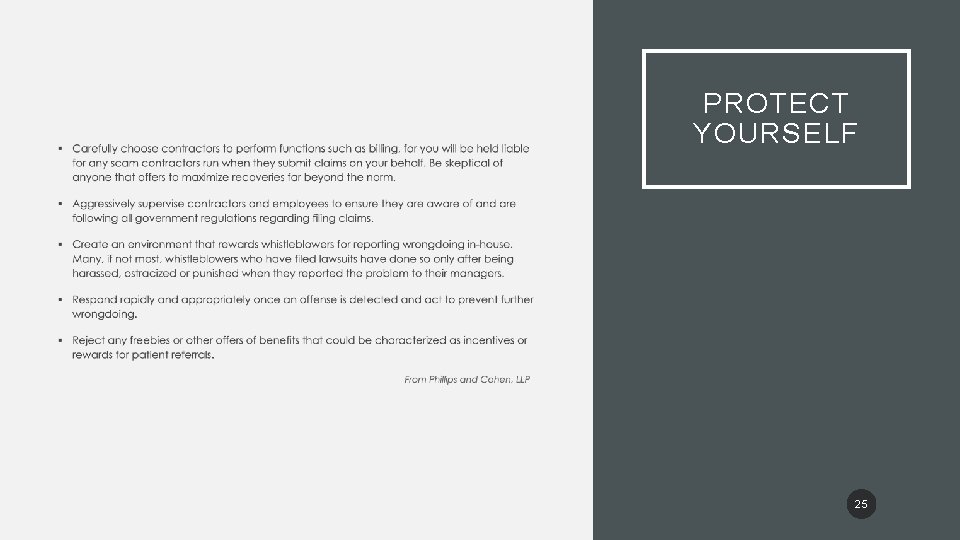
PROTECT YOURSELF 25
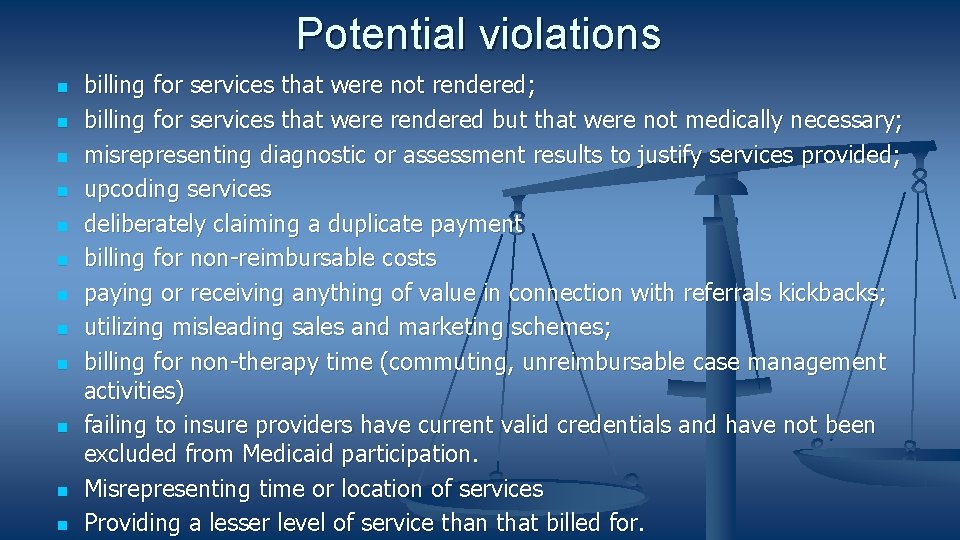
Potential violations n n n billing for services that were not rendered; billing for services that were rendered but that were not medically necessary; misrepresenting diagnostic or assessment results to justify services provided; upcoding services deliberately claiming a duplicate payment billing for non-reimbursable costs paying or receiving anything of value in connection with referrals kickbacks; utilizing misleading sales and marketing schemes; billing for non-therapy time (commuting, unreimbursable case management activities) failing to insure providers have current valid credentials and have not been excluded from Medicaid participation. Misrepresenting time or location of services Providing a lesser level of service than that billed for.
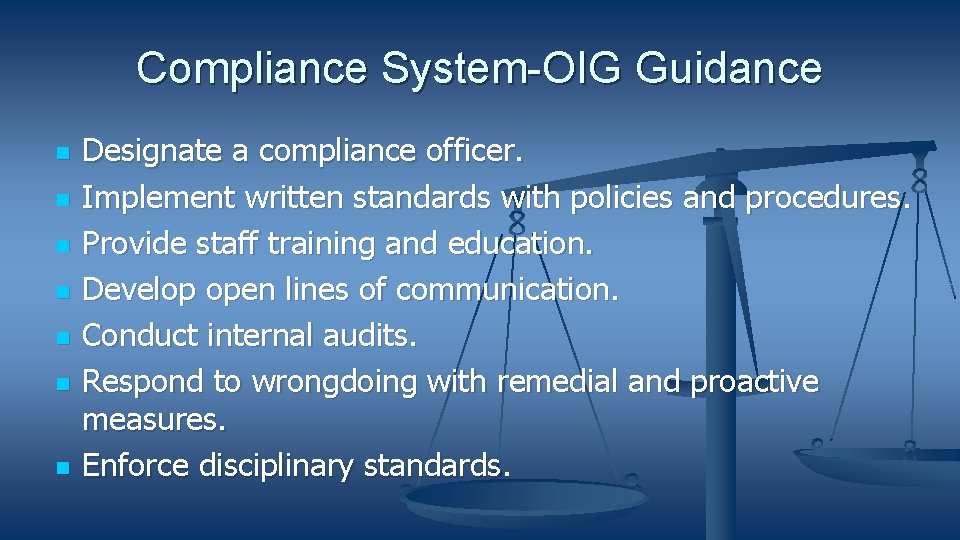
Compliance System-OIG Guidance n n n n Designate a compliance officer. Implement written standards with policies and procedures. Provide staff training and education. Develop open lines of communication. Conduct internal audits. Respond to wrongdoing with remedial and proactive measures. Enforce disciplinary standards.
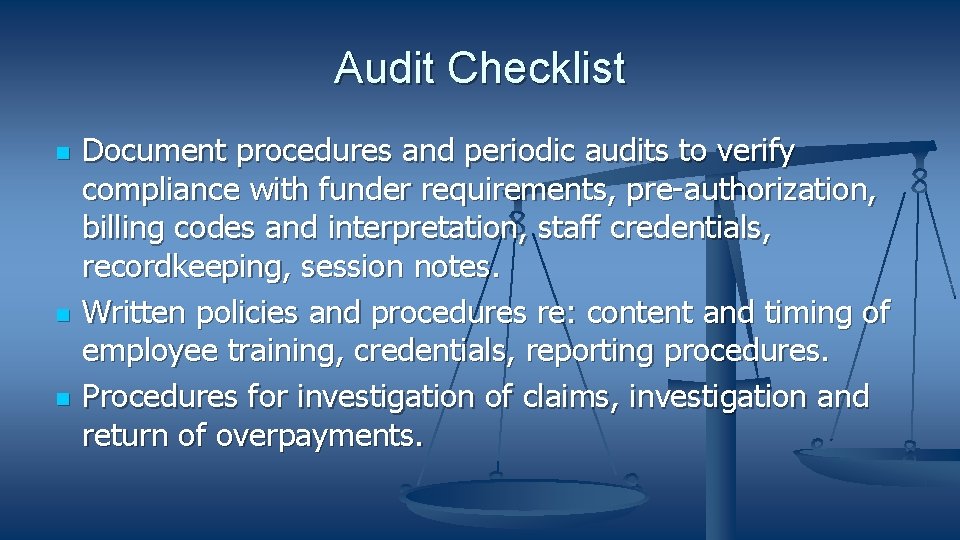
Audit Checklist n n n Document procedures and periodic audits to verify compliance with funder requirements, pre-authorization, billing codes and interpretation, staff credentials, recordkeeping, session notes. Written policies and procedures re: content and timing of employee training, credentials, reporting procedures. Procedures for investigation of claims, investigation and return of overpayments.
EVALUATE YOUR PROCEDURES TRAIN YOUR STAFF 29
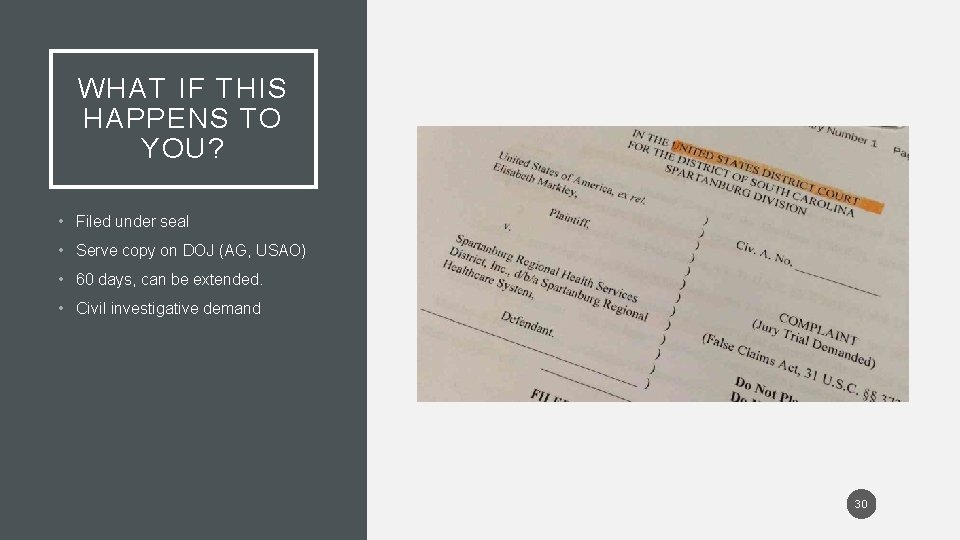
WHAT IF THIS HAPPENS TO YOU? • Filed under seal • Serve copy on DOJ (AG, USAO) • 60 days, can be extended. • Civil investigative demand 30
WHAT IF THIS HAPPENS? • Get a lawyer!! • Find outside civil and criminal counsel • Consider separate counsel for potentially targeted individuals • Corporate vs. Individual liability • Yates Memo – Sept. 2015 • Individual Accountability for Corporate Wrongdoing • “One of the most effective ways to combat corporate misconduct is by seeking accountability from the individuals who perpetrated the wrongdoing. Such accountability is important for several reasons: it deters future illegal activity, it incentivizes changes in corporate behavior, it ensures that the proper parties are held responsible for their actions, and it promotes the public's confidence in our justice system. ” 31
- Slides: 31