
Genetics of Autism Spectrum Disorder Developed by Dr

Genetics of Autism Spectrum Disorder Developed by Dr. Judith Allanson, Dr. June Carroll, Ms. Shawna Morrison and Ms. Safa Yusuf Last updated June 2018
Disclaimer • This presentation is for educational purposes only and should not be used as a substitute for clinical judgement. GEC-KO aims to aid the practicing clinician by providing informed opinions regarding genetic services that have been developed in a rigorous and evidence-based manner. Physicians must use their own clinical judgement in addition to published articles and the information presented herein. GEC-KO assumes no responsibility or liability resulting from the use of information contained herein.
Objectives • Following this session the learner will be able to: – Refer to their local genetics centre and/or order genetic testing appropriately for autism spectrum disorders (ASD) – Understand the features that distinguish non-syndromic from syndromic ASD (ASD plus) – Find high quality genomics educational resources appropriate for primary care

What is autism spectrum disorder? ASD is a complex group of neurodevelopmental disorders autistic disorder childhood disintegrative disorder Asperger syndrome pervasive developmental disorder-not otherwise specified

What is autism spectrum disorder? ASD is a complex group of neurodevelopmental disorders Core features are: Communication impairments Social and behavioral challenges Repetitive behaviors and/or restricted interests
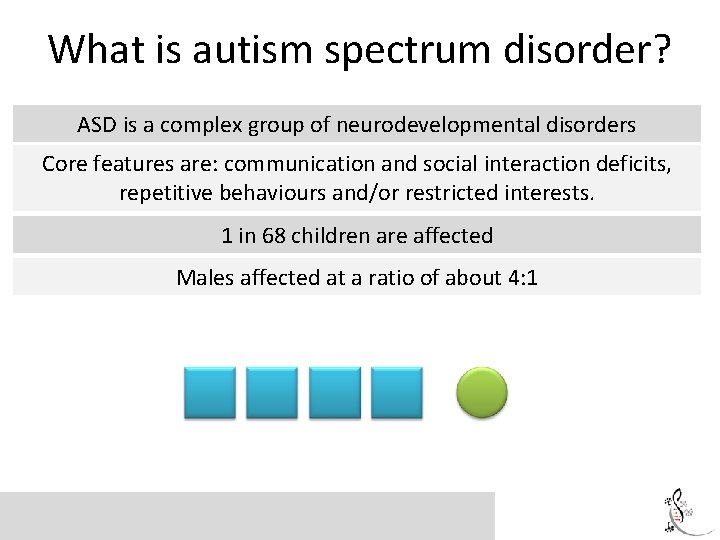
What is autism spectrum disorder? ASD is a complex group of neurodevelopmental disorders Core features are: communication and social interaction deficits, repetitive behaviours and/or restricted interests. 1 in 68 children are affected Males affected at a ratio of about 4: 1
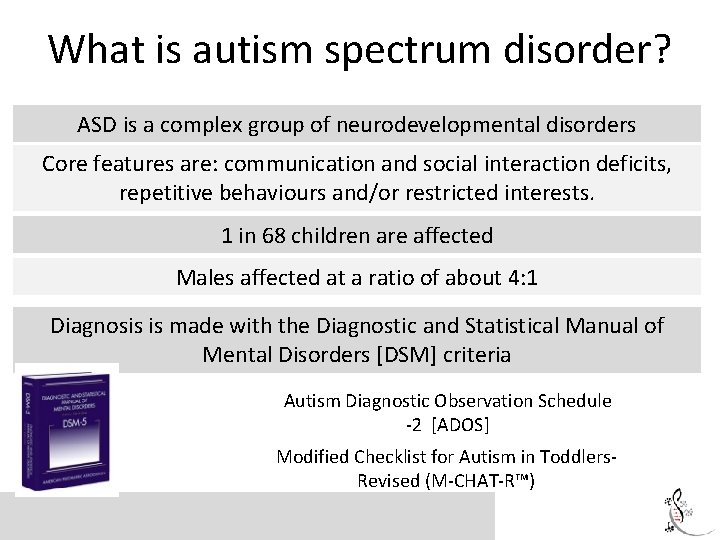
What is autism spectrum disorder? ASD is a complex group of neurodevelopmental disorders Core features are: communication and social interaction deficits, repetitive behaviours and/or restricted interests. 1 in 68 children are affected Males affected at a ratio of about 4: 1 Diagnosis is made with the Diagnostic and Statistical Manual of Mental Disorders [DSM] criteria Autism Diagnostic Observation Schedule -2 [ADOS] Modified Checklist for Autism in Toddlers. Revised (M-CHAT-R™)
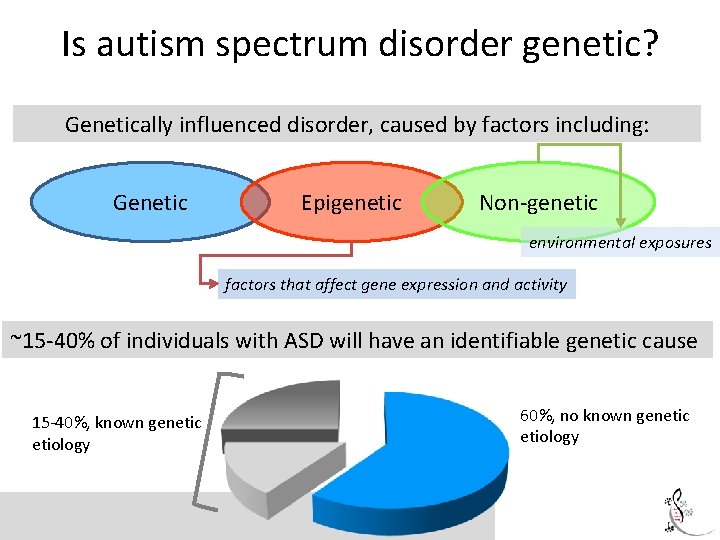
Is autism spectrum disorder genetic? Genetically influenced disorder, caused by factors including: Genetic Epigenetic Non-genetic environmental exposures factors that affect gene expression and activity ~15 -40% of individuals with ASD will have an identifiable genetic cause 15 -40%, known genetic etiology 60%, no known genetic etiology
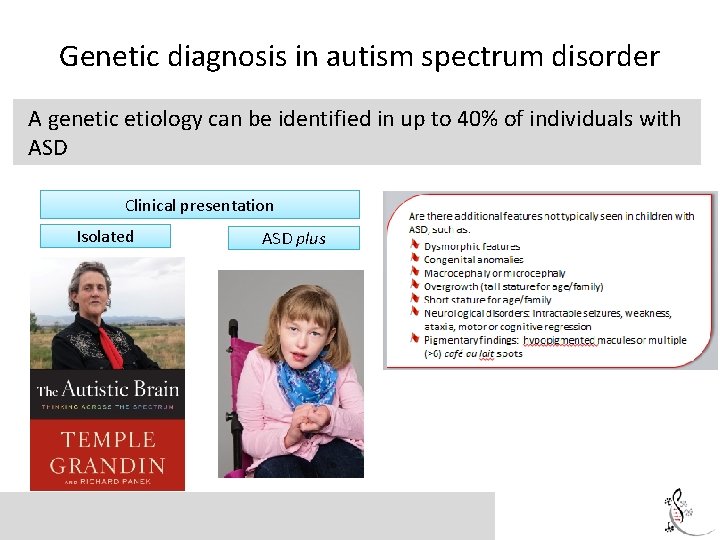
Genetic diagnosis in autism spectrum disorder A genetic etiology can be identified in up to 40% of individuals with ASD Clinical presentation Isolated ASD plus
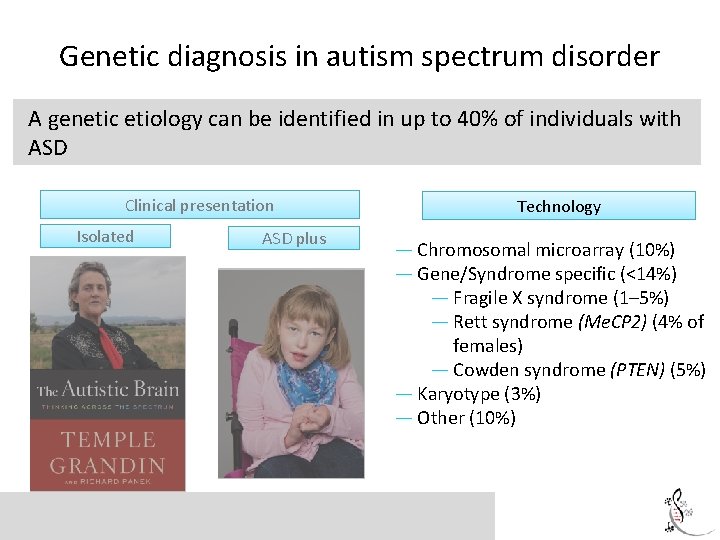
Genetic diagnosis in autism spectrum disorder A genetic etiology can be identified in up to 40% of individuals with ASD Clinical presentation Isolated ASD plus Technology — Chromosomal microarray (10%) — Gene/Syndrome specific (<14%) — Fragile X syndrome (1– 5%) — Rett syndrome (Me. CP 2) (4% of females) — Cowden syndrome (PTEN) (5%) — Karyotype (3%) — Other (10%)
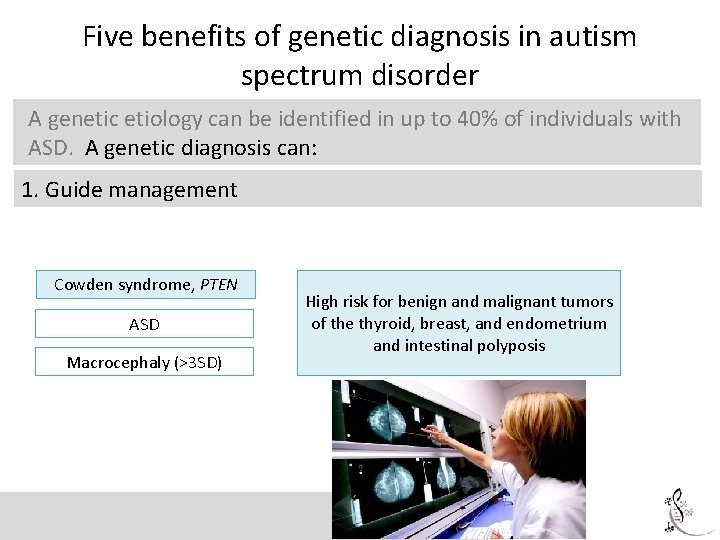
Five benefits of genetic diagnosis in autism spectrum disorder A genetic etiology can be identified in up to 40% of individuals with ASD. A genetic diagnosis can: 1. Guide management Cowden syndrome, PTEN ASD Macrocephaly (>3 SD) High risk for benign and malignant tumors of the thyroid, breast, and endometrium and intestinal polyposis
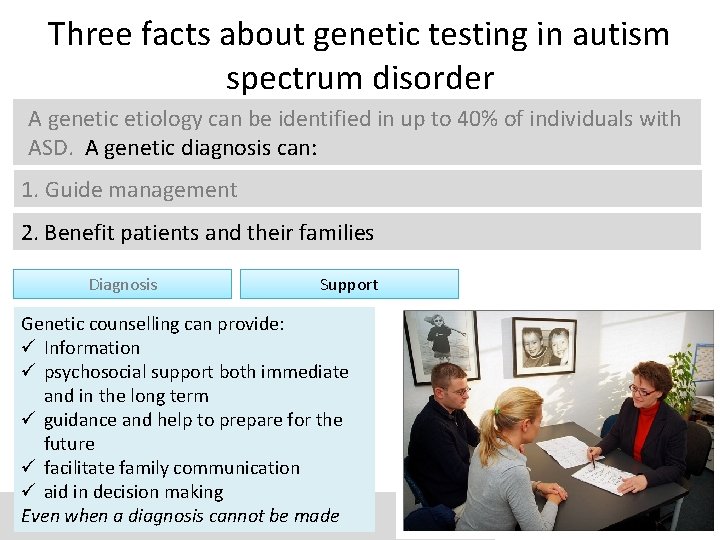
Three facts about genetic testing in autism spectrum disorder A genetic etiology can be identified in up to 40% of individuals with ASD. A genetic diagnosis can: 1. Guide management 2. Benefit patients and their families Diagnosis Support Genetic counselling can provide: ü Information ü psychosocial support both immediate and in the long term ü guidance and help to prepare for the future ü facilitate family communication ü aid in decision making Even when a diagnosis cannot be made

Five benefits of genetic diagnosis in autism spectrum disorder A genetic etiology can be identified in up to 40% of individuals with ASD. A genetic diagnosis can: 1. Guide management 2. Benefit patients and their families Diagnosis Support Genetic Etiology Recurrence risk estimate Unknown 10 -19% (empirical risk) de novo <1% Autosomal recessive 25% Autosomal dominant 50% X-linked Recurrence risk counselling ~32% when 2 children affected 50% different presentation in males and females
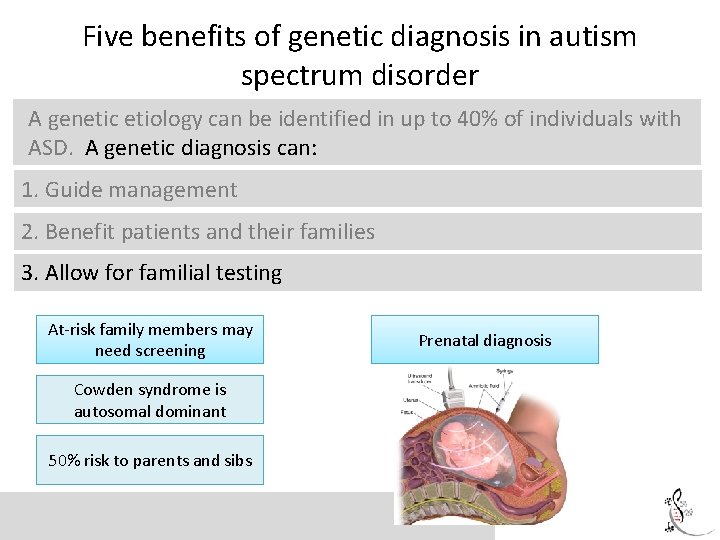
Five benefits of genetic diagnosis in autism spectrum disorder A genetic etiology can be identified in up to 40% of individuals with ASD. A genetic diagnosis can: 1. Guide management 2. Benefit patients and their families 3. Allow for familial testing At-risk family members may need screening Cowden syndrome is autosomal dominant 50% risk to parents and sibs Prenatal diagnosis
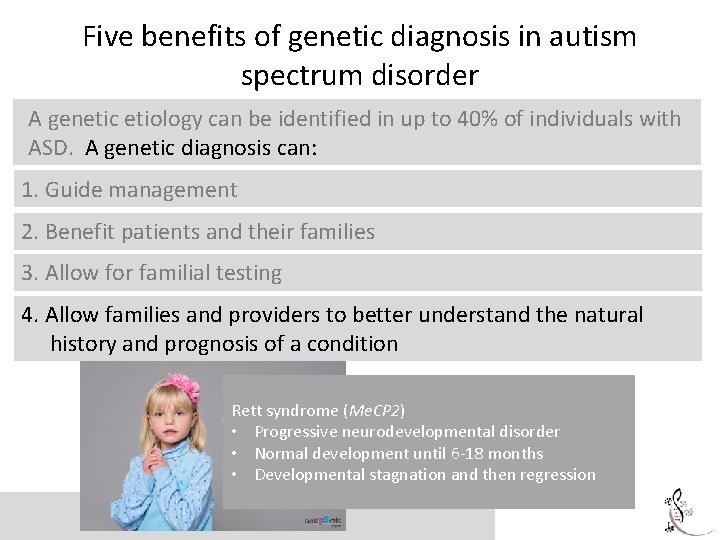
Five benefits of genetic diagnosis in autism spectrum disorder A genetic etiology can be identified in up to 40% of individuals with ASD. A genetic diagnosis can: 1. Guide management 2. Benefit patients and their families 3. Allow for familial testing 4. Allow families and providers to better understand the natural history and prognosis of a condition Rett syndrome (Me. CP 2) • Progressive neurodevelopmental disorder • Normal development until 6 -18 months • Developmental stagnation and then regression
Five benefits of genetic diagnosis in autism spectrum disorder A genetic etiology can be identified in up to 40% of individuals with ASD. A genetic diagnosis can: 1. Guide management 2. Benefit patients and their families 3. Allow for familial testing 4. Allow families and providers to better understand the natural history and prognosis of a condition 5. Allow for access to specialized support
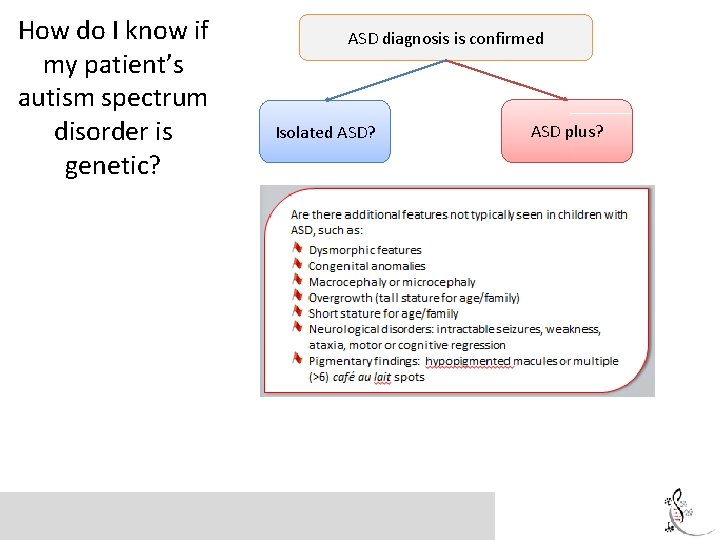
How do I know if my patient’s autism spectrum disorder is genetic? ASD diagnosis is confirmed Isolated ASD? ASD plus?
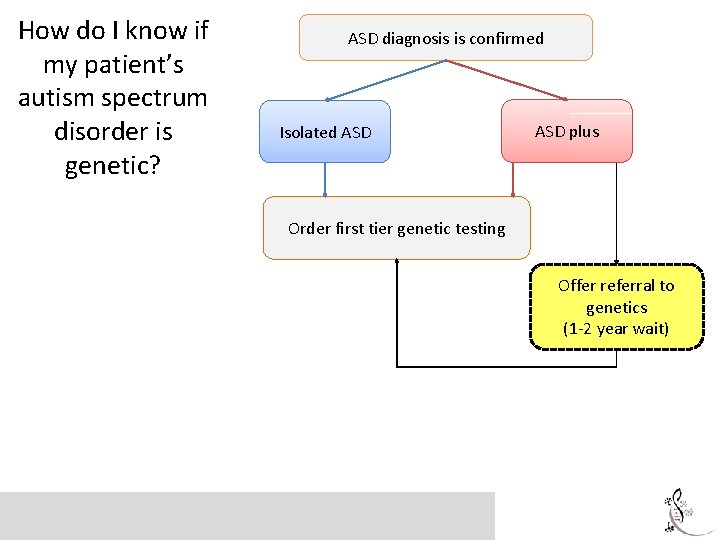
How do I know if my patient’s autism spectrum disorder is genetic? ASD diagnosis is confirmed Isolated ASD plus Order first tier genetic testing Offer referral to genetics (1 -2 year wait)
First tier genetic testing for autism spectrum disorder 1. Chromosomal microarray for ASD may be ordered by primary care providers. To find out more, please call your local genetics lab. If you are unable to order a chromosomal microarray, you may be referred to a pediatrician or developmental pediatrician. 2. Fragile X syndrome testing
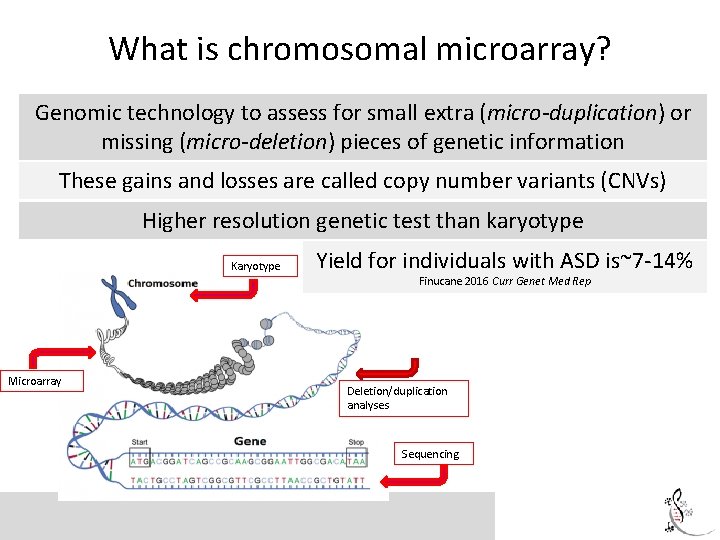
What is chromosomal microarray? Genomic technology to assess for small extra (micro-duplication) or missing (micro-deletion) pieces of genetic information These gains and losses are called copy number variants (CNVs) Higher resolution genetic test than karyotype Karyotype Yield for individuals with ASD is~7 -14% Finucane 2016 Curr Genet Med Rep Microarray Deletion/duplication analyses Sequencing
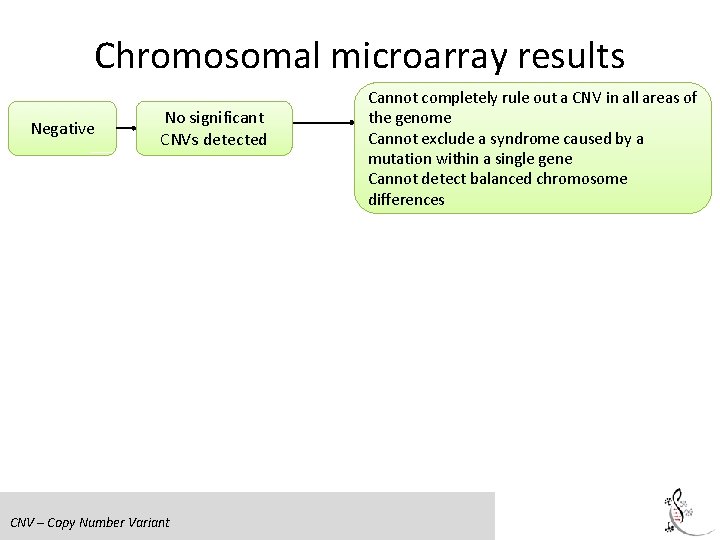
Chromosomal microarray results Negative No significant CNVs detected CNV – Copy Number Variant Cannot completely rule out a CNV in all areas of the genome Cannot exclude a syndrome caused by a mutation within a single gene Cannot detect balanced chromosome differences
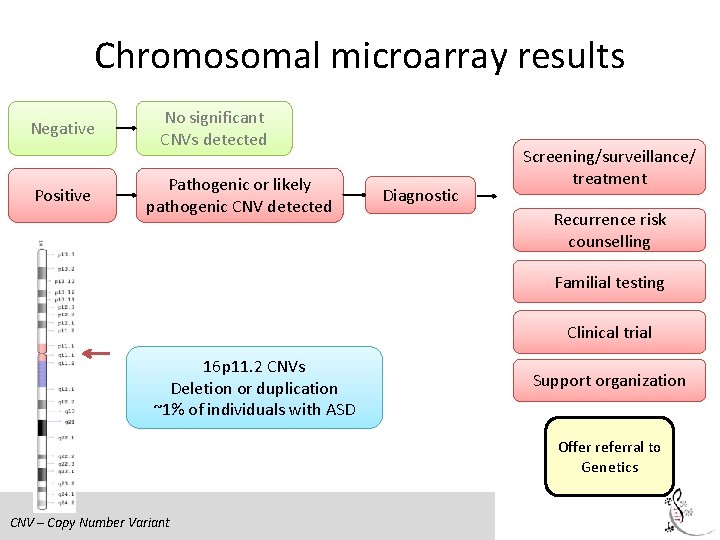
Chromosomal microarray results Negative Positive No significant CNVs detected Pathogenic or likely pathogenic CNV detected Diagnostic Screening/surveillance/ treatment Recurrence risk counselling Familial testing Clinical trial 16 p 11. 2 CNVs Deletion or duplication ~1% of individuals with ASD Support organization Offer referral to Genetics CNV – Copy Number Variant
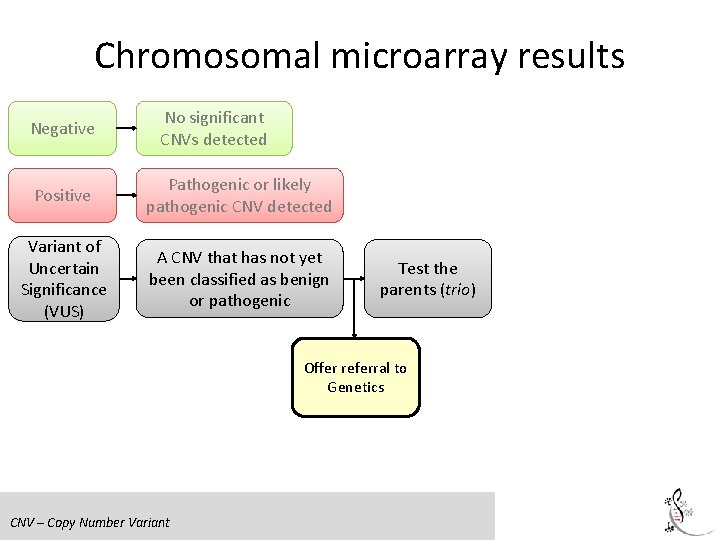
Chromosomal microarray results Negative No significant CNVs detected Positive Pathogenic or likely pathogenic CNV detected Variant of Uncertain Significance (VUS) A CNV that has not yet been classified as benign or pathogenic Test the parents (trio) Offer referral to Genetics CNV – Copy Number Variant
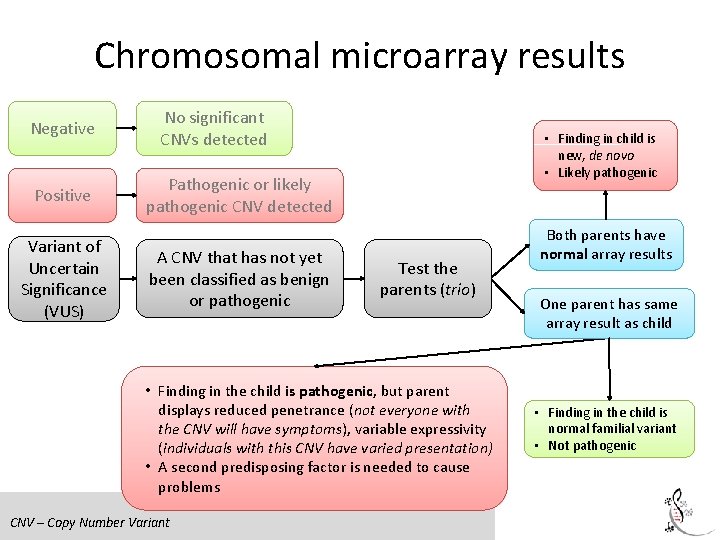
Chromosomal microarray results Negative Positive Variant of Uncertain Significance (VUS) No significant CNVs detected • Finding in child is new, de novo • Likely pathogenic Pathogenic or likely pathogenic CNV detected A CNV that has not yet been classified as benign or pathogenic Test the parents (trio) • Finding in the child is pathogenic, but parent displays reduced penetrance (not everyone with the CNV will have symptoms), variable expressivity (individuals with this CNV have varied presentation) • A second predisposing factor is needed to cause problems CNV – Copy Number Variant Both parents have normal array results One parent has same array result as child • Finding in the child is normal familial variant • Not pathogenic
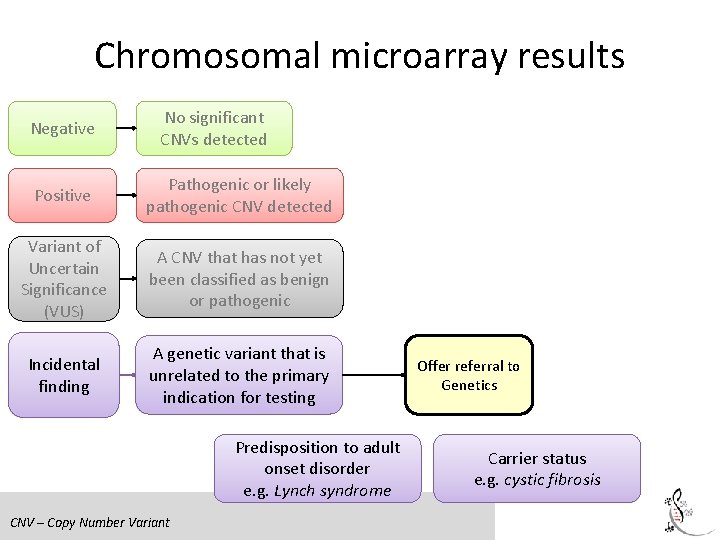
Chromosomal microarray results Negative No significant CNVs detected Positive Pathogenic or likely pathogenic CNV detected Variant of Uncertain Significance (VUS) A CNV that has not yet been classified as benign or pathogenic Incidental finding A genetic variant that is unrelated to the primary indication for testing Predisposition to adult onset disorder e. g. Lynch syndrome CNV – Copy Number Variant Offer referral to Genetics Carrier status e. g. cystic fibrosis
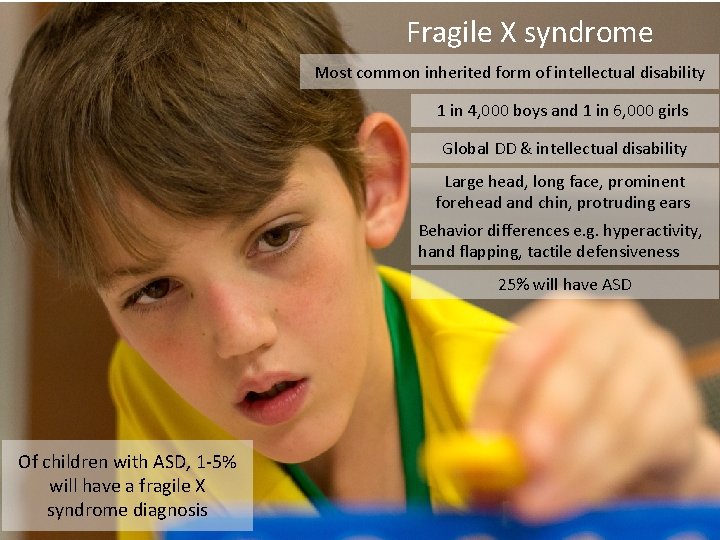
Fragile X syndrome Most common inherited form of intellectual disability 1 in 4, 000 boys and 1 in 6, 000 girls Global DD & intellectual disability Large head, long face, prominent forehead and chin, protruding ears Behavior differences e. g. hyperactivity, hand flapping, tactile defensiveness 25% will have ASD Of children with ASD, 1 -5% will have a fragile X syndrome diagnosis
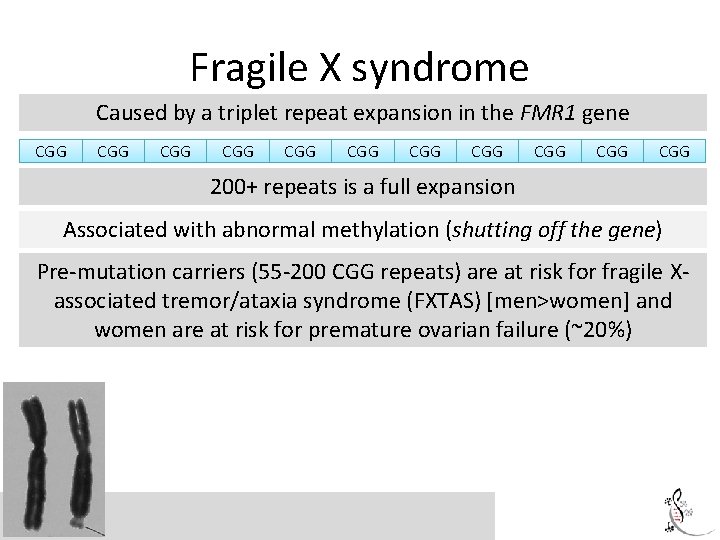
Fragile X syndrome Caused by a triplet repeat expansion in the FMR 1 gene CGG CGG CGG 200+ repeats is a full expansion Associated with abnormal methylation (shutting off the gene) Pre-mutation carriers (55 -200 CGG repeats) are at risk for fragile X- associated tremor/ataxia syndrome (FXTAS) [men>women] and women are at risk for premature ovarian failure (~20%)
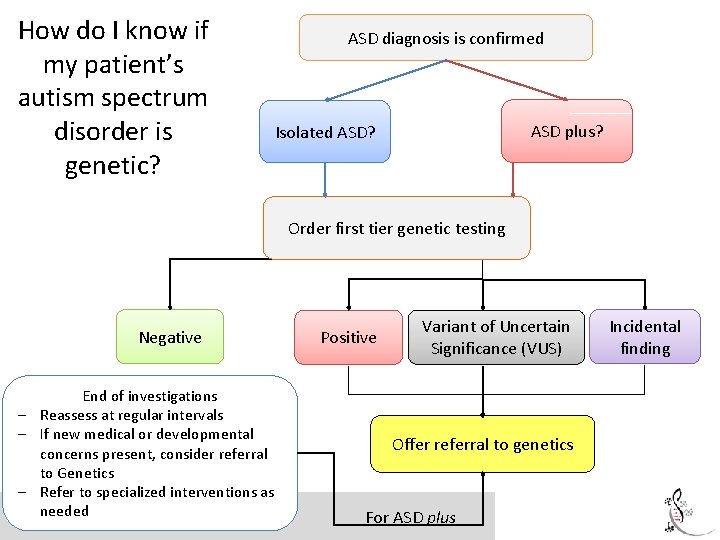
How do I know if my patient’s autism spectrum disorder is genetic? ASD diagnosis is confirmed ASD plus? Isolated ASD? Order first tier genetic testing Negative End of investigations ─ Reassess at regular intervals ─ If new medical or developmental concerns present, consider referral to Genetics ─ Refer to specialized interventions as needed Positive Variant of Uncertain Significance (VUS) Offer referral to genetics For ASD plus Incidental finding
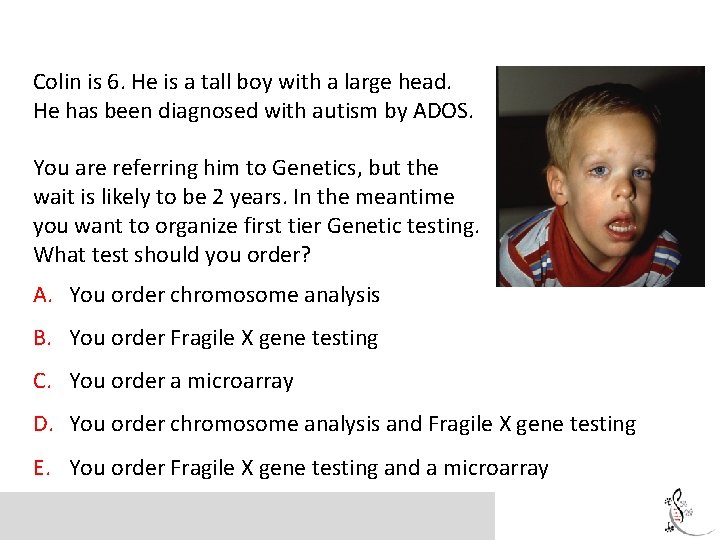
Colin is 6. He is a tall boy with a large head. He has been diagnosed with autism by ADOS. You are referring him to Genetics, but the wait is likely to be 2 years. In the meantime you want to organize first tier Genetic testing. What test should you order? A. You order chromosome analysis B. You order Fragile X gene testing C. You order a microarray D. You order chromosome analysis and Fragile X gene testing E. You order Fragile X gene testing and a microarray
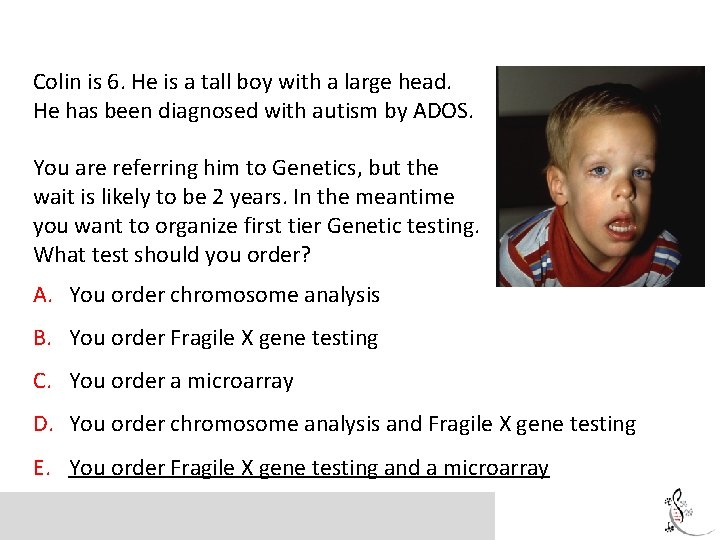
Colin is 6. He is a tall boy with a large head. He has been diagnosed with autism by ADOS. You are referring him to Genetics, but the wait is likely to be 2 years. In the meantime you want to organize first tier Genetic testing. What test should you order? A. You order chromosome analysis B. You order Fragile X gene testing C. You order a microarray D. You order chromosome analysis and Fragile X gene testing E. You order Fragile X gene testing and a microarray
Parents of a child with autism may find which of the following aspects of genetic testing valuable? A. B. C. D. E. F. Confirmation of the diagnosis of autism in their child Knowledge of the cause of autism in their child Understanding of recurrence risk in a future pregnancy All of the above A and B B and C
Parents of a child with autism may find which of the following aspects of genetic testing valuable? A. B. C. D. E. F. Confirmation of the diagnosis of autism in their child Knowledge of the cause of autism in their child Understanding of recurrence risk in a future pregnancy All of the above A and B B and C
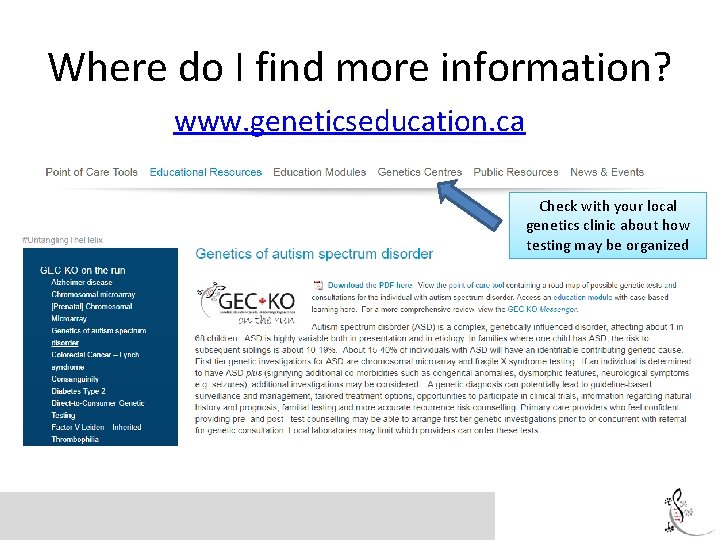
Where do I find more information? www. geneticseducation. ca Check with your local genetics clinic about how testing may be organized
- Slides: 33