
MA Act Early Fall Summit Training Roula Choueiri


- Slides: 39
MA Act Early Fall Summit Training Roula Choueiri, MD Associate Professor of Pediatrics, UMMS Chief , Developmental and Behavioral Pediatrics CDC Act Early Campaign Ambassador to MA UMass Memorial Children’s Medical Center
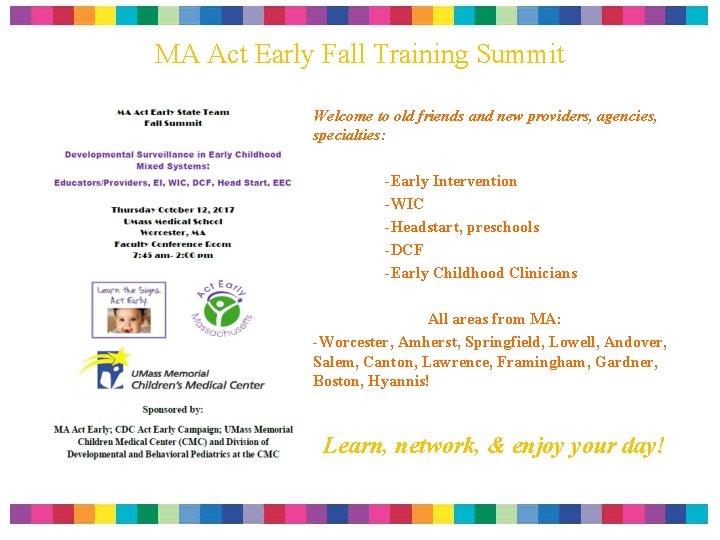
MA Act Early Fall Training Summit Welcome to old friends and new providers, agencies, specialties: -Early Intervention -WIC -Headstart, preschools -DCF -Early Childhood Clinicians All areas from MA: -Worcester, Amherst, Springfield, Lowell, Andover, Salem, Canton, Lawrence, Framingham, Gardner, Boston, Hyannis! Learn, network, & enjoy your day!
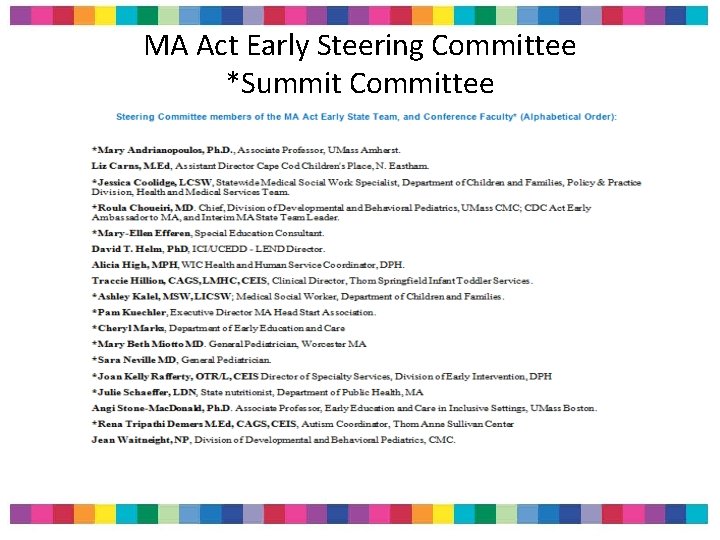
MA Act Early Steering Committee *Summit Committee
Summit Committee- UMass • Meg Sullivan • Andrea Pastick • Ryan Shafer
Housekeeping
Evaluation
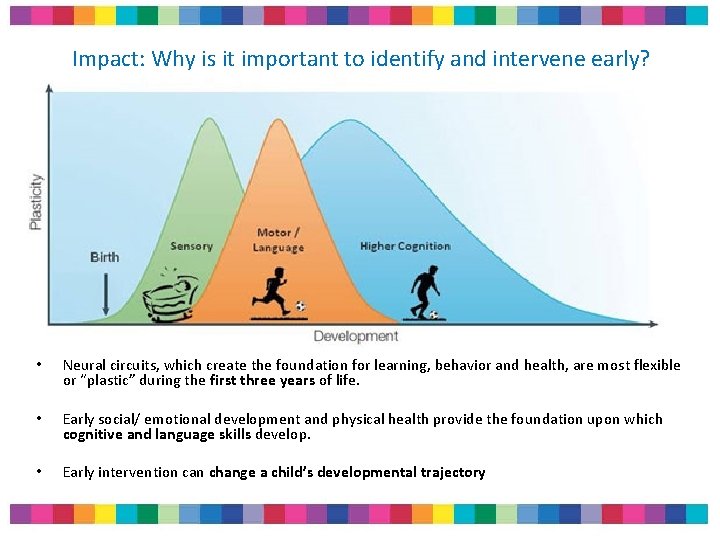
Impact: Why is it important to identify and intervene early? • Neural circuits, which create the foundation for learning, behavior and health, are most flexible or “plastic” during the first three years of life. • Early social/ emotional development and physical health provide the foundation upon which cognitive and language skills develop. • Early intervention can change a child’s developmental trajectory
Impact: Why is early detection important? Outcome Studies • School – Success – Integration • Family – Function – Enhanced knowledge – Harmony • Quality of life – Enhance the child’s personal potential
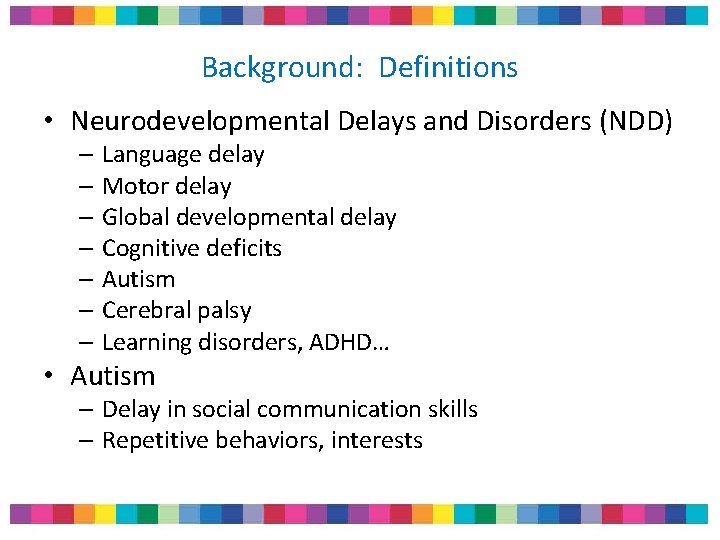
Background: Definitions • Neurodevelopmental Delays and Disorders (NDD) – Language delay – Motor delay – Global developmental delay – Cognitive deficits – Autism – Cerebral palsy – Learning disorders, ADHD… • Autism – Delay in social communication skills – Repetitive behaviors, interests
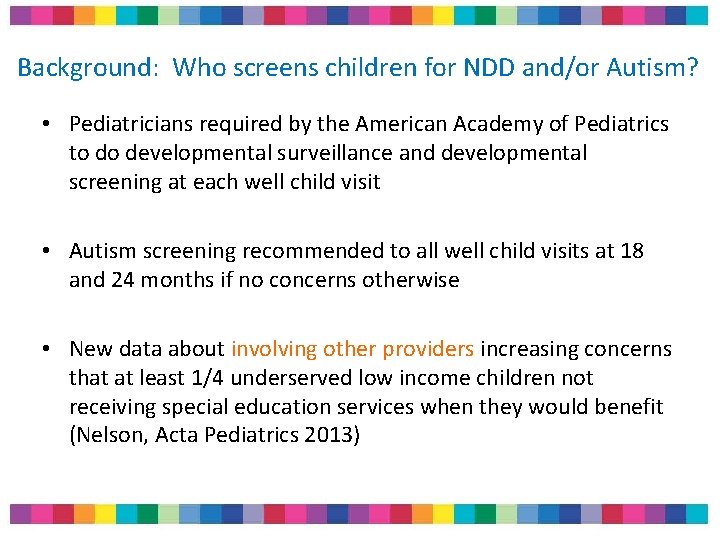
Background: Who screens children for NDD and/or Autism? • Pediatricians required by the American Academy of Pediatrics to do developmental surveillance and developmental screening at each well child visit • Autism screening recommended to all well child visits at 18 and 24 months if no concerns otherwise • New data about involving other providers increasing concerns that at least 1/4 underserved low income children not receiving special education services when they would benefit (Nelson, Acta Pediatrics 2013)
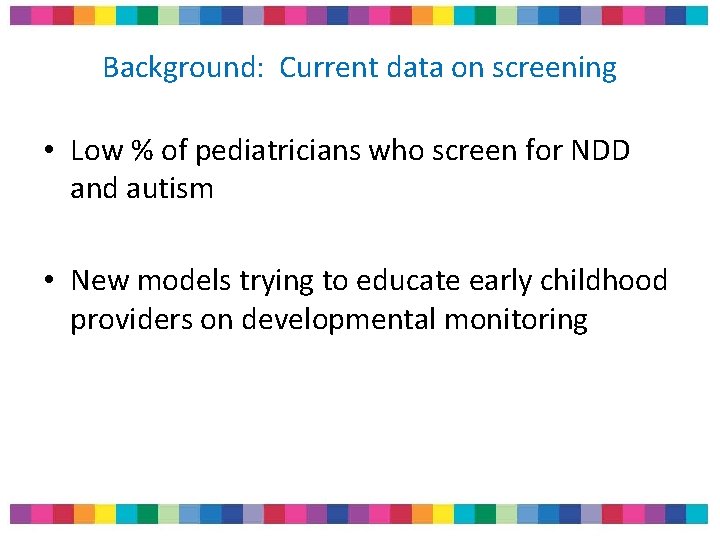
Background: Current data on screening • Low % of pediatricians who screen for NDD and autism • New models trying to educate early childhood providers on developmental monitoring
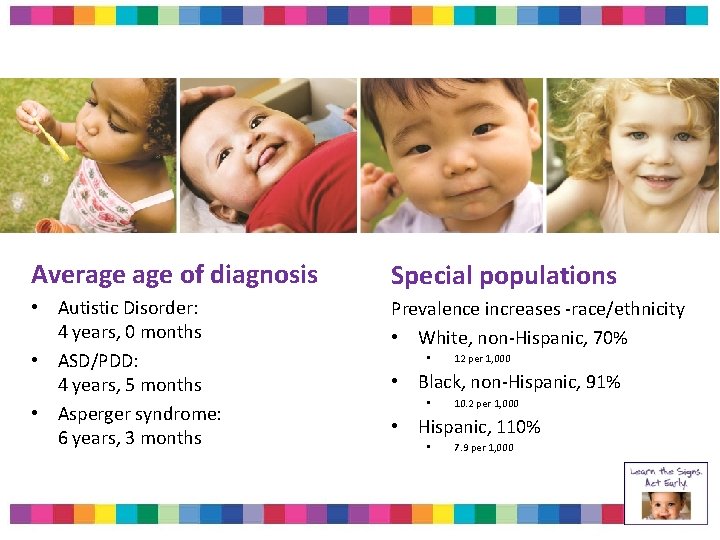
Background: Important numbers
Average of diagnosis Special populations • Autistic Disorder: 4 years, 0 months • ASD/PDD: 4 years, 5 months • Asperger syndrome: 6 years, 3 months Prevalence increases -race/ethnicity • White, non-Hispanic, 70% • 12 per 1, 000 • Black, non-Hispanic, 91% • 10. 2 per 1, 000 • Hispanic, 110% • 7. 9 per 1, 000
Background: Numbers • Over the last 12 years – Prevalence of NDDs has increased 17. 1% – Prevalence of autism increased 289. 5% – Children insured by Medicaid: a nearly two-fold higher prevalence of any NDD compared to those with private insurance – Children from families with income below the federal poverty level had a higher prevalence of NDDs.
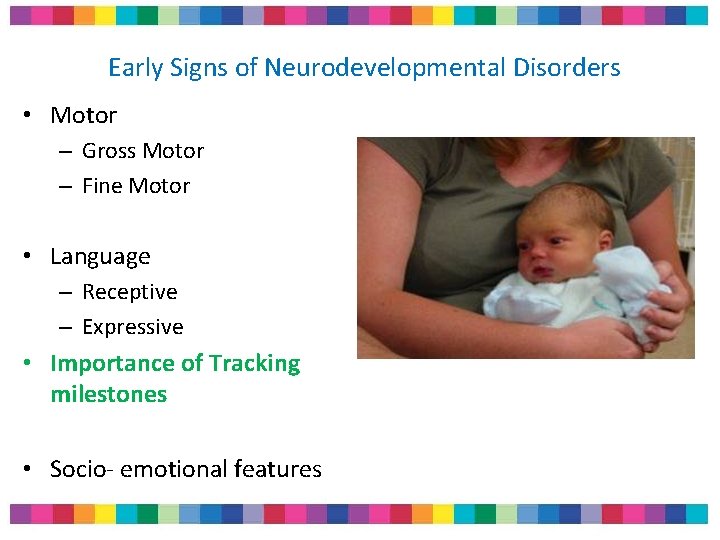
Early Signs of Neurodevelopmental Disorders • Motor – Gross Motor – Fine Motor • Language – Receptive – Expressive • Importance of Tracking milestones • Socio- emotional features
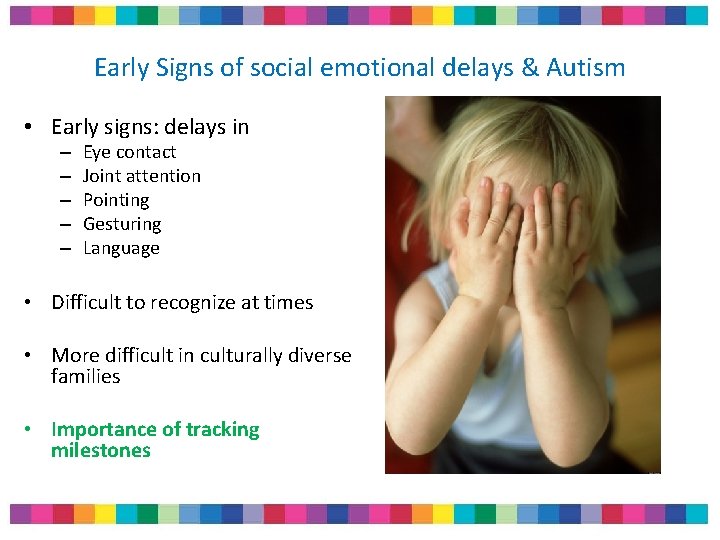
Early Signs of social emotional delays & Autism • Early signs: delays in – – – Eye contact Joint attention Pointing Gesturing Language • Difficult to recognize at times • More difficult in culturally diverse families • Importance of tracking milestones
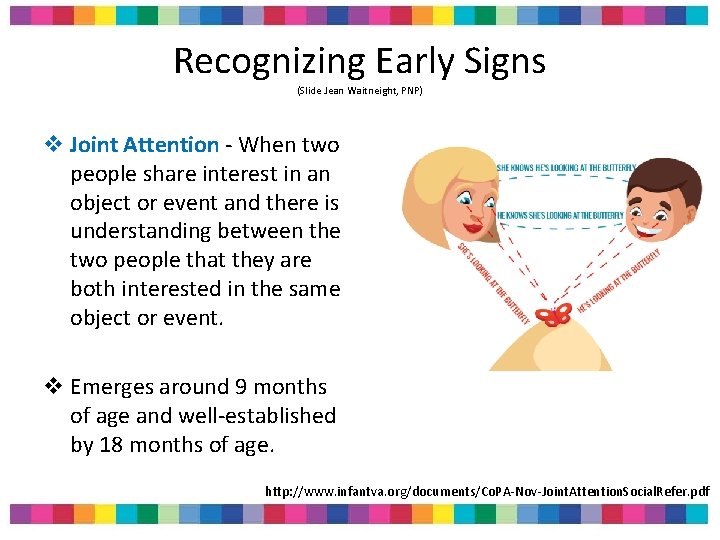
Recognizing Early Signs (Slide Jean Waitneight, PNP) v Joint Attention - When two people share interest in an object or event and there is understanding between the two people that they are both interested in the same object or event. v Emerges around 9 months of age and well-established by 18 months of age. http: //www. infantva. org/documents/Co. PA-Nov-Joint. Attention. Social. Refer. pdf
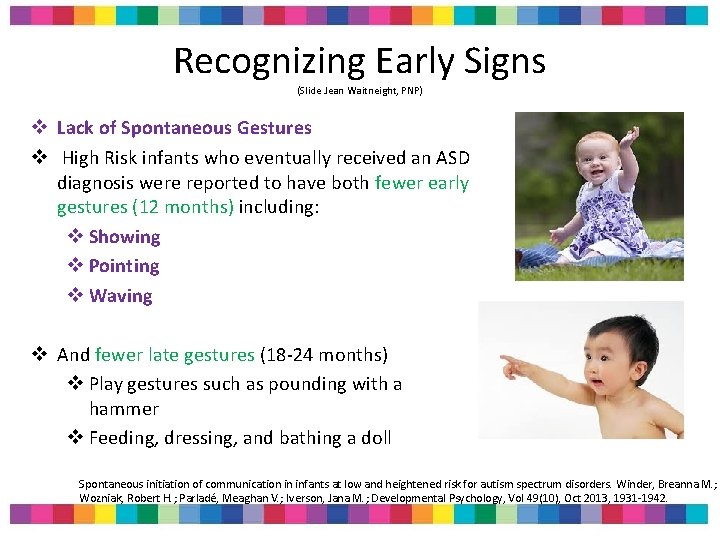
Recognizing Early Signs (Slide Jean Waitneight, PNP) v Lack of Spontaneous Gestures v High Risk infants who eventually received an ASD diagnosis were reported to have both fewer early gestures (12 months) including: v Showing v Pointing v Waving v And fewer late gestures (18 -24 months) v Play gestures such as pounding with a hammer v Feeding, dressing, and bathing a doll Spontaneous initiation of communication in infants at low and heightened risk for autism spectrum disorders. Winder, Breanna M. ; Wozniak, Robert H. ; Parladé, Meaghan V. ; Iverson, Jana M. ; Developmental Psychology, Vol 49(10), Oct 2013, 1931 -1942.
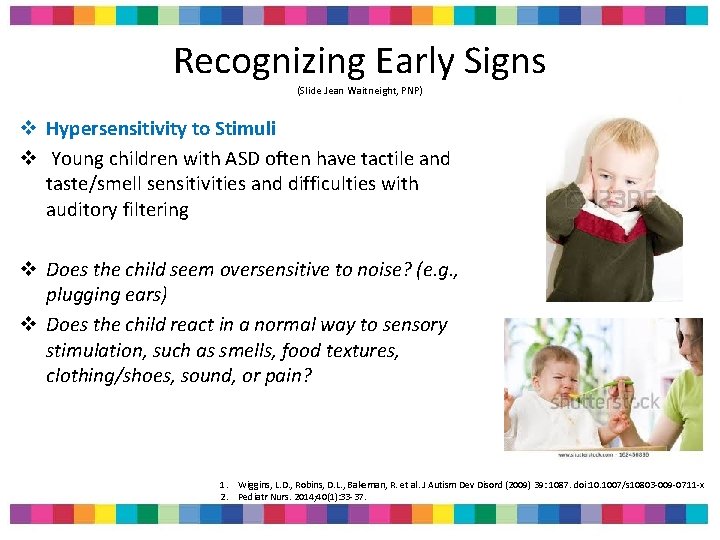
Recognizing Early Signs (Slide Jean Waitneight, PNP) v Hypersensitivity to Stimuli v Young children with ASD often have tactile and taste/smell sensitivities and difficulties with auditory filtering v Does the child seem oversensitive to noise? (e. g. , plugging ears) v Does the child react in a normal way to sensory stimulation, such as smells, food textures, clothing/shoes, sound, or pain? 1. Wiggins, L. D. , Robins, D. L. , Bakeman, R. et al. J Autism Dev Disord (2009) 39: 1087. doi: 10. 1007/s 10803 -009 -0711 -x 2. Pediatr Nurs. 2014; 40(1): 33 -37.
Yes…. but • How will you know if the child in your class or in your care is doing what he/she is supposed to be doing for their age? • When do you need to be concerned • How can you track their development
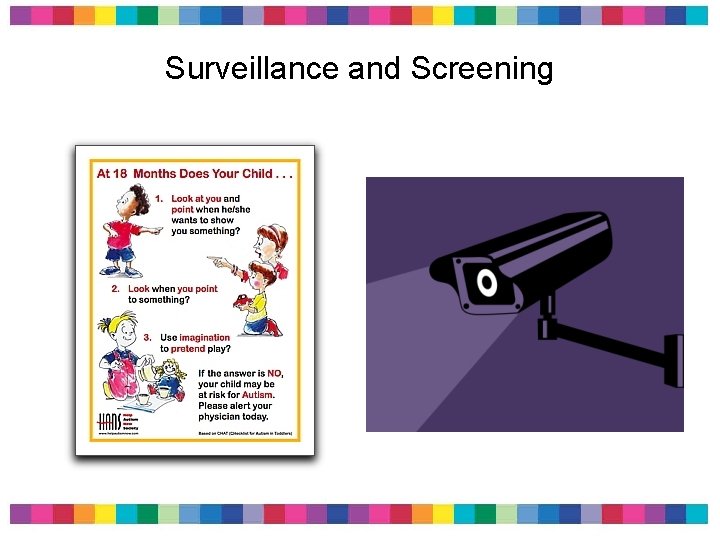
Surveillance and Screening
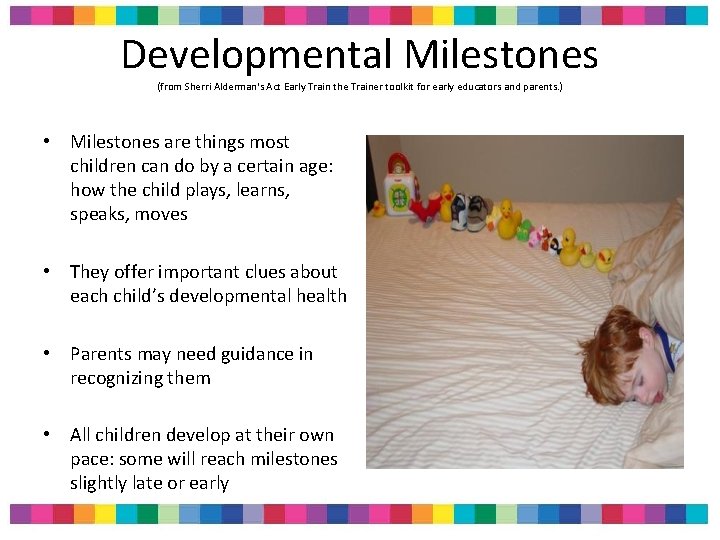
Developmental Milestones (from Sherri Alderman's Act Early Train the Trainer toolkit for early educators and parents. ) • Milestones are things most children can do by a certain age: how the child plays, learns, speaks, moves • They offer important clues about each child’s developmental health • Parents may need guidance in recognizing them • All children develop at their own pace: some will reach milestones slightly late or early
Reflection Activity: Write down your favorite Developmental milestone. What age would you expect it to appear? What would you think if it is delayed? (from Sherri Alderman's Act Early Train the Trainer toolkit for early educators and parents. )
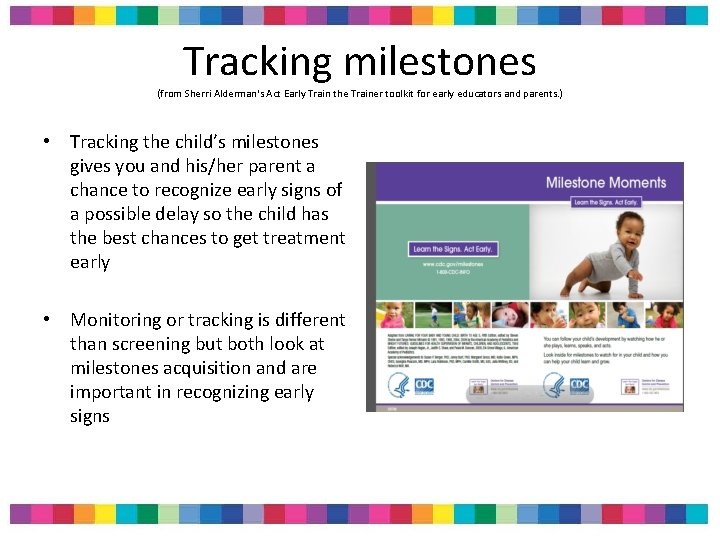
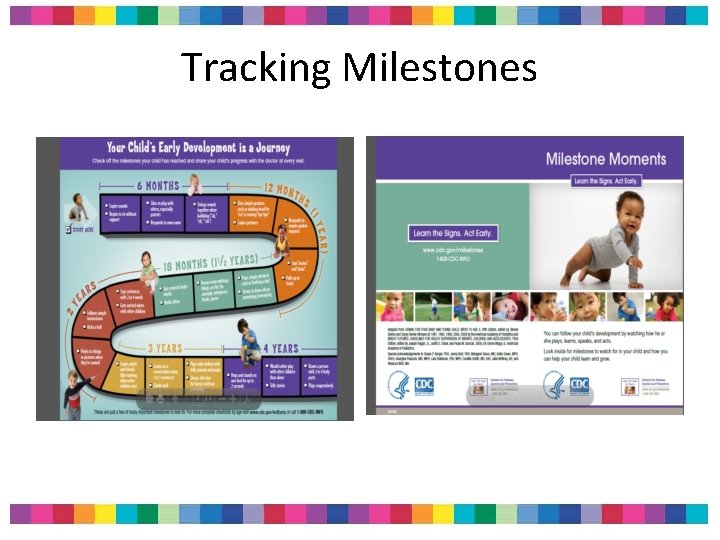
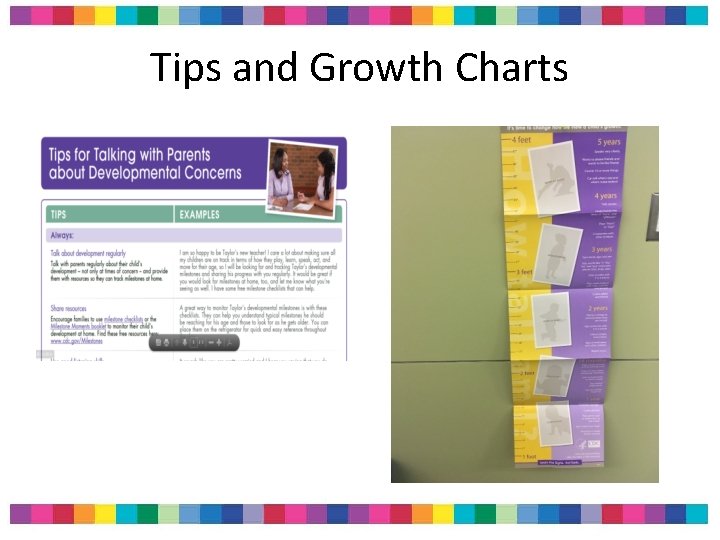
Tracking milestones (from Sherri Alderman's Act Early Train the Trainer toolkit for early educators and parents. ) • Tracking the child’s milestones gives you and his/her parent a chance to recognize early signs of a possible delay so the child has the best chances to get treatment early • Monitoring or tracking is different than screening but both look at milestones acquisition and are important in recognizing early signs
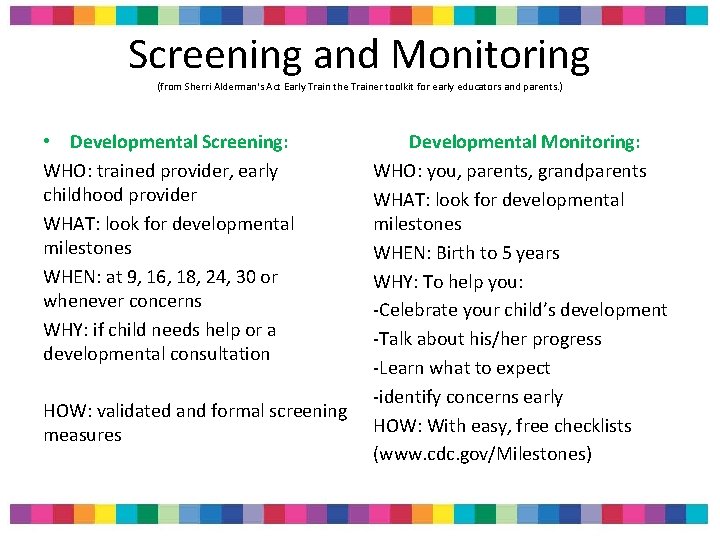
Screening and Monitoring (from Sherri Alderman's Act Early Train the Trainer toolkit for early educators and parents. ) • Developmental Screening: WHO: trained provider, early childhood provider WHAT: look for developmental milestones WHEN: at 9, 16, 18, 24, 30 or whenever concerns WHY: if child needs help or a developmental consultation HOW: validated and formal screening measures Developmental Monitoring: WHO: you, parents, grandparents WHAT: look for developmental milestones WHEN: Birth to 5 years WHY: To help you: -Celebrate your child’s development -Talk about his/her progress -Learn what to expect -identify concerns early HOW: With easy, free checklists (www. cdc. gov/Milestones)
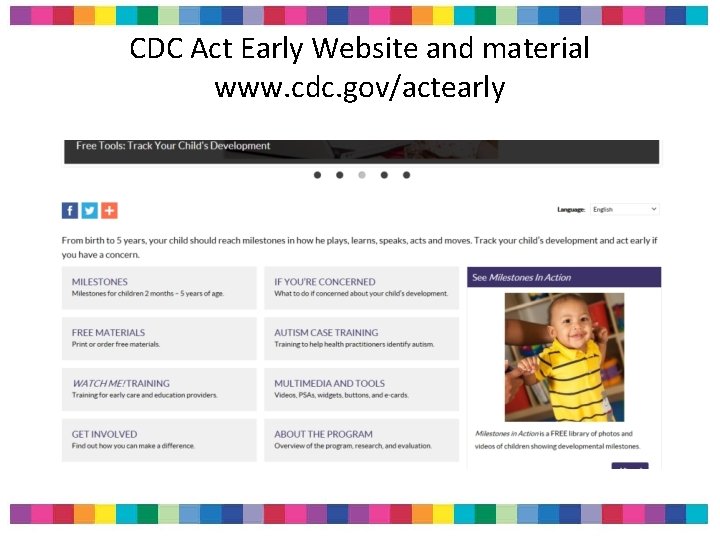
CDC Act Early Website and material www. cdc. gov/actearly
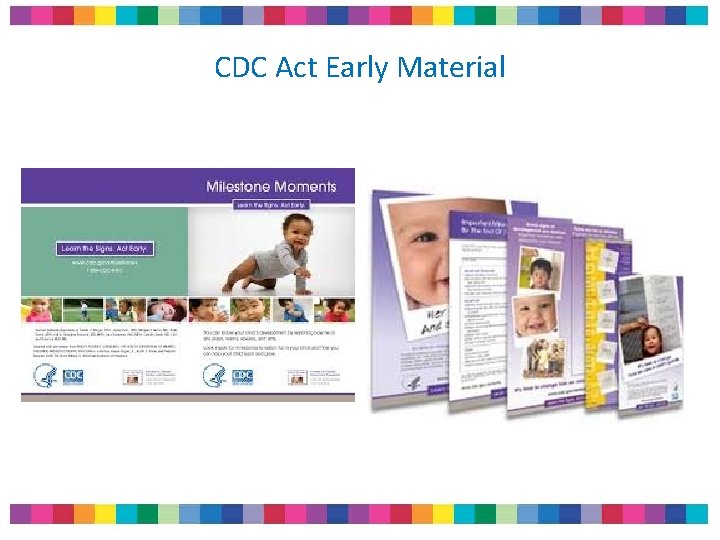
CDC Act Early Material
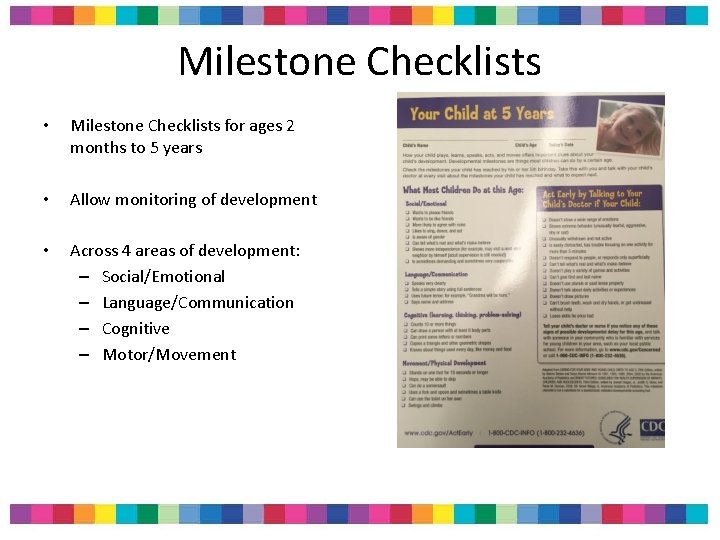
Milestone Checklists • Milestone Checklists for ages 2 months to 5 years • Allow monitoring of development • Across 4 areas of development: – Social/Emotional – Language/Communication – Cognitive – Motor/Movement
Tracking Milestones
Tips and Growth Charts
TYPICAL DEVELOPMENT • http: //www. cdc. gov/ncbddd/actearly/milestones/ind ex. html • 3 Months to 5 Years • Domains: Language, Socio-emotional; Gross Motor; Fine Motor; Cognitive; Speech & Hearing
Special Considerations 1 - Screening for NDD in Culturally diverse families 2 -Children in Foster care
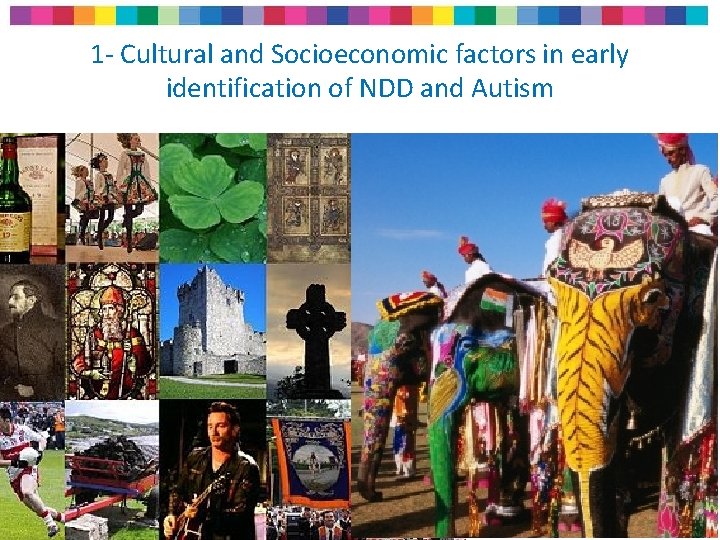
1 - Cultural and Socioeconomic factors in early identification of NDD and Autism
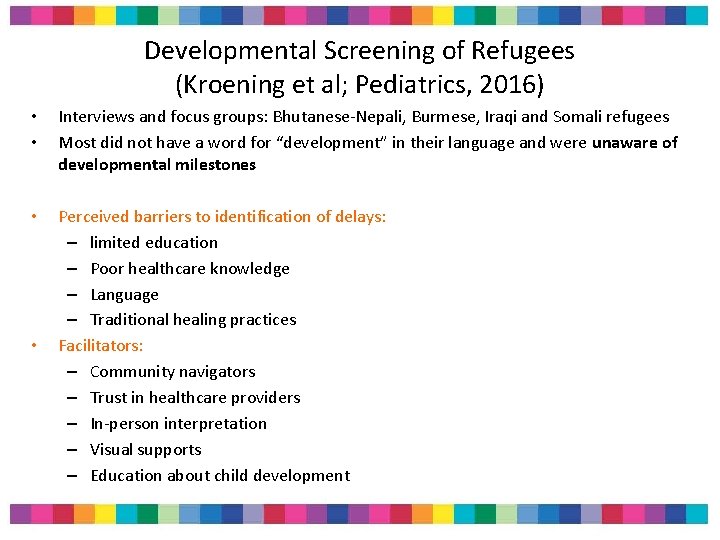
Developmental Screening of Refugees (Kroening et al; Pediatrics, 2016) • • Interviews and focus groups: Bhutanese-Nepali, Burmese, Iraqi and Somali refugees Most did not have a word for “development” in their language and were unaware of developmental milestones • Perceived barriers to identification of delays: – limited education – Poor healthcare knowledge – Language – Traditional healing practices Facilitators: – Community navigators – Trust in healthcare providers – In-person interpretation – Visual supports – Education about child development •
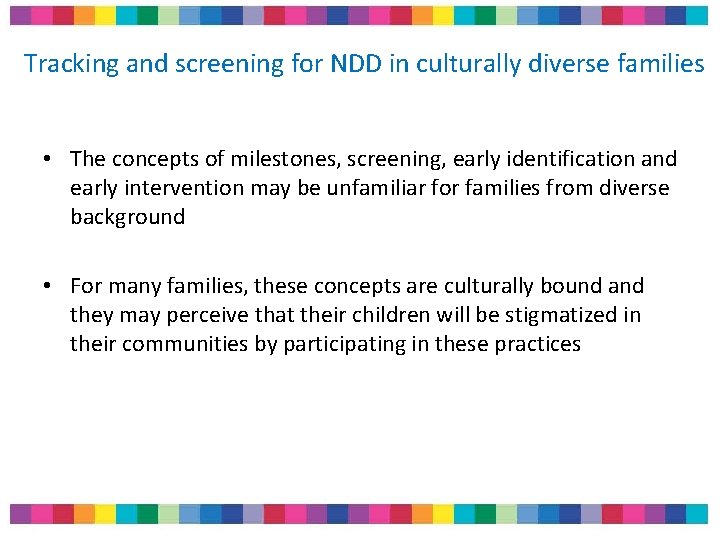
Tracking and screening for NDD in culturally diverse families • The concepts of milestones, screening, early identification and early intervention may be unfamiliar for families from diverse background • For many families, these concepts are culturally bound and they may perceive that their children will be stigmatized in their communities by participating in these practices
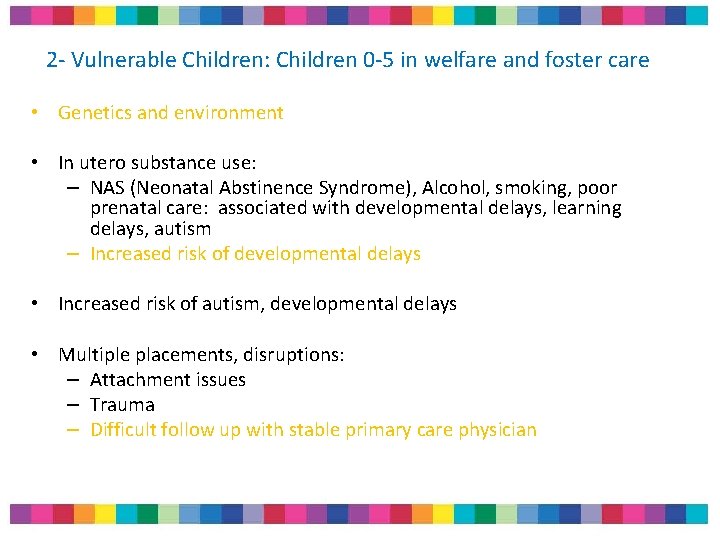
2 - Vulnerable Children: Children 0 -5 in welfare and foster care • Genetics and environment • In utero substance use: – NAS (Neonatal Abstinence Syndrome), Alcohol, smoking, poor prenatal care: associated with developmental delays, learning delays, autism – Increased risk of developmental delays • Increased risk of autism, developmental delays • Multiple placements, disruptions: – Attachment issues – Trauma – Difficult follow up with stable primary care physician
SUMMARY Become familiar with developmental milestones and how to track development Learn how to discuss concerns with families but also celebrate their child’s milestones Become familiar with the CDC Act Early material Think about ways to integrate the CDC Act Early Material into your settings