
How Parents Understand Autism An Individualised Autism Profiler
- Slides: 11
How Parents Understand Autism: An Individualised Autism Profiler for Children and Young Adults Alexandra Karousi Ph. D Candidate Dr Simon Bignell, Dr Sigrid Lipka, Dr Chris Barnes HUMAN SCIENCES RESEARCH CENTRE UNIVERSITY OF DERBY Twitter: @AK_autism
Background Parenting a child on the autism spectrum can be an overwhelming experience for parents and families: ü High levels of stress üPsychological distress (Estes et al. , 2013; Hayes & Watson, 2013) What are the needs of parents of autistic children? ü To ‘make sense’ of the nature of their child’s strengths and challenges ü To secure the necessary services and support An evidence-based tool that can bridge the gap between diagnostic clinical descriptors and unique child’s characteristics is currently absent @AK_autism
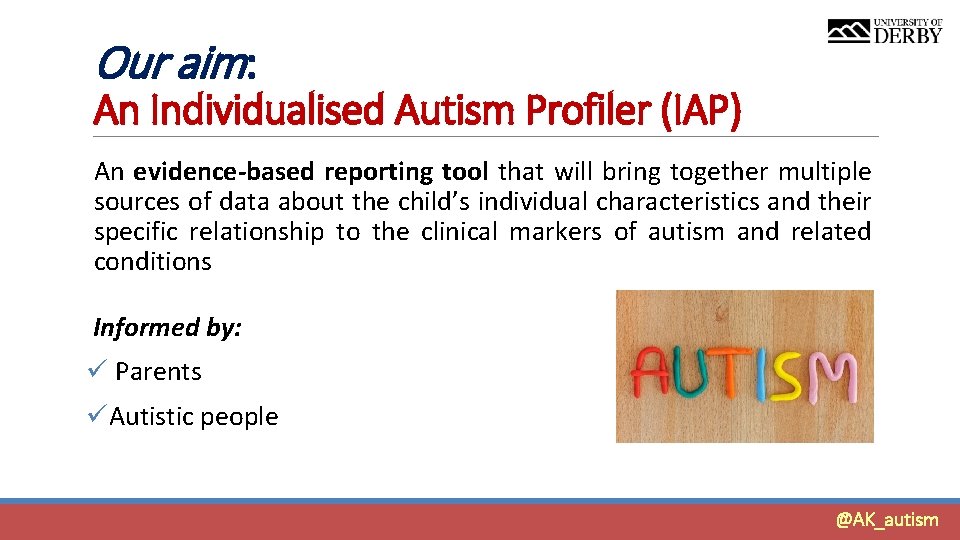
Our aim: An Individualised Autism Profiler (IAP) An evidence-based reporting tool that will bring together multiple sources of data about the child’s individual characteristics and their specific relationship to the clinical markers of autism and related conditions Informed by: ü Parents üAutistic people @AK_autism
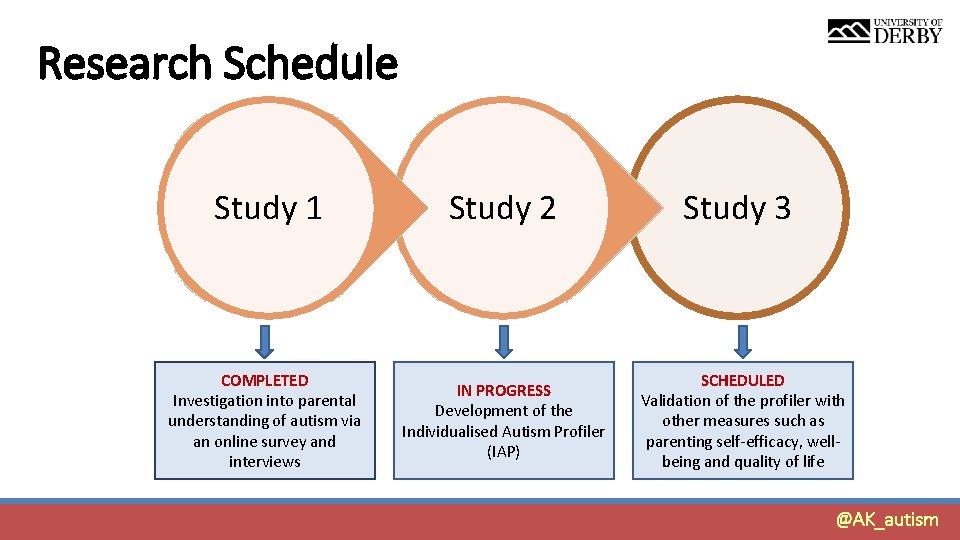
Research Schedule Study 1 Study 2 COMPLETED Investigation into parental understanding of autism via an online survey and interviews IN PROGRESS Development of the Individualised Autism Profiler (IAP) Study 3 SCHEDULED Validation of the profiler with other measures such as parenting self-efficacy, wellbeing and quality of life @AK_autism
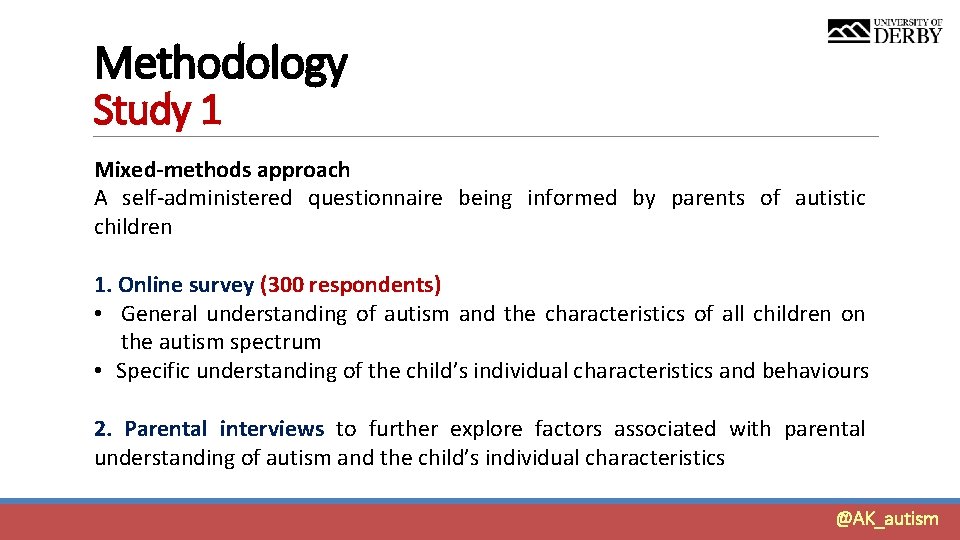
Methodology Study 1 Mixed-methods approach A self-administered questionnaire being informed by parents of autistic children 1. Online survey (300 respondents) • General understanding of autism and the characteristics of all children on the autism spectrum • Specific understanding of the child’s individual characteristics and behaviours 2. Parental interviews to further explore factors associated with parental understanding of autism and the child’s individual characteristics @AK_autism
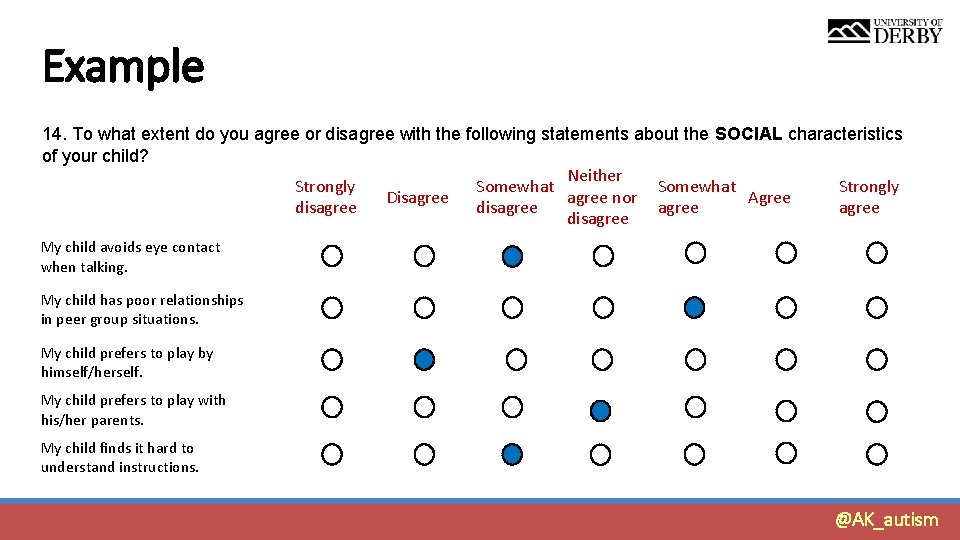
Example 14. To what extent do you agree or disagree with the following statements about the SOCIAL characteristics of your child? Neither Strongly Somewhat Strongly Disagree nor Agree disagree disagree My child avoids eye contact when talking. My child has poor relationships in peer group situations. My child prefers to play by himself/herself. My child prefers to play with his/her parents. My child finds it hard to understand instructions. @AK_autism
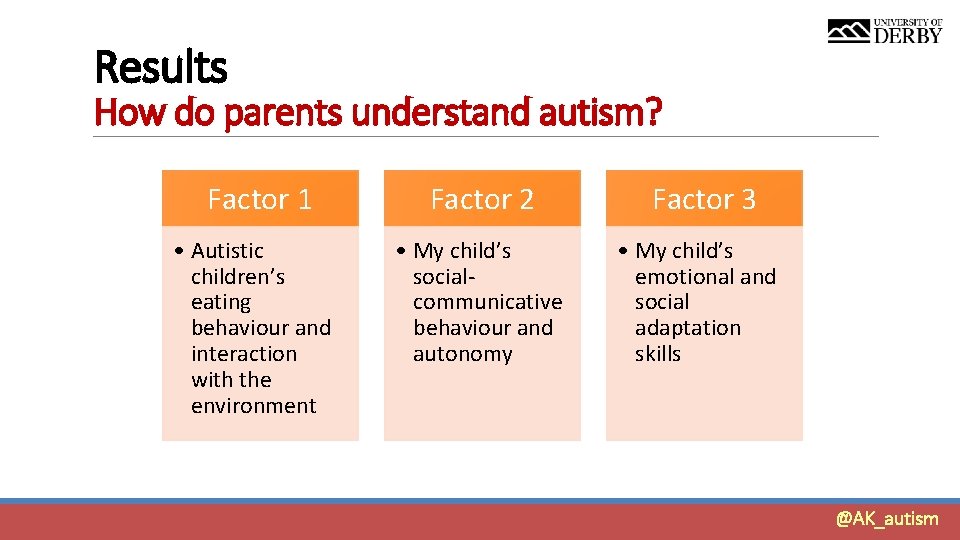
Results How do parents understand autism? Factor 1 • Autistic children’s eating behaviour and interaction with the environment Factor 2 • My child’s socialcommunicative behaviour and autonomy Factor 3 • My child’s emotional and social adaptation skills @AK_autism
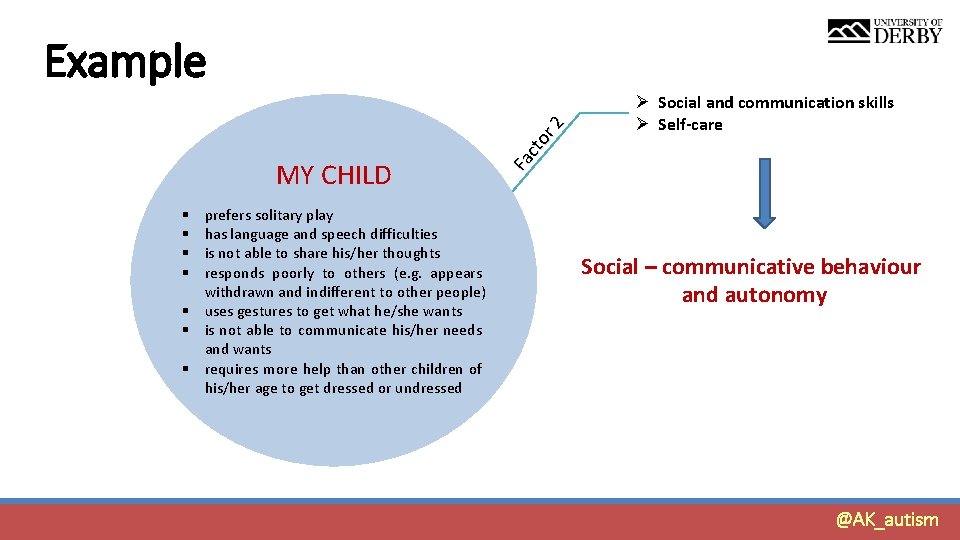
MY CHILD prefers solitary play has language and speech difficulties is not able to share his/her thoughts responds poorly to others (e. g. appears withdrawn and indifferent to other people) § uses gestures to get what he/she wants § is not able to communicate his/her needs and wants § requires more help than other children of his/her age to get dressed or undressed § § Fa c to r 2 Example Ø Social and communication skills Ø Self-care Social – communicative behaviour and autonomy @AK_autism
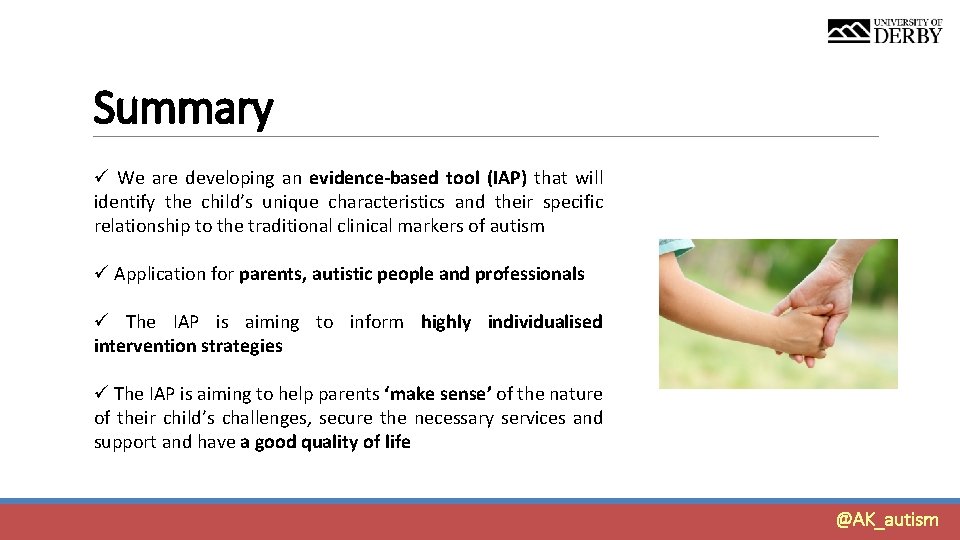
Summary ü We are developing an evidence-based tool (IAP) that will identify the child’s unique characteristics and their specific relationship to the traditional clinical markers of autism ü Application for parents, autistic people and professionals ü The IAP is aiming to inform highly individualised intervention strategies ü The IAP is aiming to help parents ‘make sense’ of the nature of their child’s challenges, secure the necessary services and support and have a good quality of life @AK_autism
Thank you for your attention! Alexandra Karousi Ph. D Candidate under the supervision of Dr Simon Bignell, Dr Sigrid Lipka & Dr Chris Barnes a. karousi@derby. ac. uk @AK_autism @parentsunderstandingasd Questions?
References 1. Estes, A. , Olson, E. , Sullivan, K. , Greenson, J. , Winter, J. , Dawson, G. , & Munson, J. (2013). Parentingrelated stress and psychological distress in mothers of toddlers with autism spectrum disorders. Brain and Development, 35(2), 133– 138. https: //doi. org/10. 1016/j. braindev. 2012. 10. 004 2. Hayes, S. A. , & Watson, S. L. (2013). The Impact of Parenting Stress: A Meta-analysis of Studies Comparing the Experience of Parenting Stress in Parents of Children With and Without Autism Spectrum Disorder. Journal of Autism and Developmental Disorders, 43(3), 629– 642. https: //doi. org/10. 1007/s 10803 -012 -1604 -y 3. van Steensel, F. J. A. , Bögels, S. M. , & de Bruin, E. I. (2013). Psychiatric Comorbidity in Children with Autism Spectrum Disorders: A Comparison with Children with ADHD. Journal of Child and Family Studies, 22(3), 368– 376. https: //doi. org/10. 1007/s 10826 -012 -9587 -z 4. Wainer, A. L. , Hepburn, S. , & Mc. Mahon Griffith, E. (2017). Remembering parents in parent-mediated early intervention: An approach to examining impact on parents and families. Autism, 21(1), 5– 17. @AK_autism