
Inclusive Practices in Red Clay RCCSD BOARD WORKSHOP
Inclusive Practices in Red Clay RCCSD BOARD WORKSHOP MARCH 6, 2018
Shared Vision for Inclusive Practices All members of the Red Clay community will demonstrate the belief and expectation that every student be given equal opportunity and equal access to a high quality inclusive education with the ultimate goal of being college and/or career ready. All Red Clay schools will develop a greater capacity to teach all learners. The Red Clay School District is committed to continuous improvement through examining and realigning appropriate structures, supports and resources for the instructions of all students in all schools.
Guiding Principles for Inclusive Practices 1. Belief & Expectation - Shared ownership of all students; Welcoming & supportive school communities 2. Capacity - Job-embedded professional development; Professional Learning Communities used to facilitate collaboration between teachers 3. Structures, Supports & Resources - School-based continuum of services; Realignment of resources and supports
Committee Recommendations Elementary school ELL students transition to attendance zone school in SY 15 -16. Middle school ELL students transition to their attendance zone school in SY 15 -16. Students attending Richardson Park Learning Center transition to their attendance zone school in SY 15 -16. Students attending Central School transition to their attendance zone school in SY 15 -16.
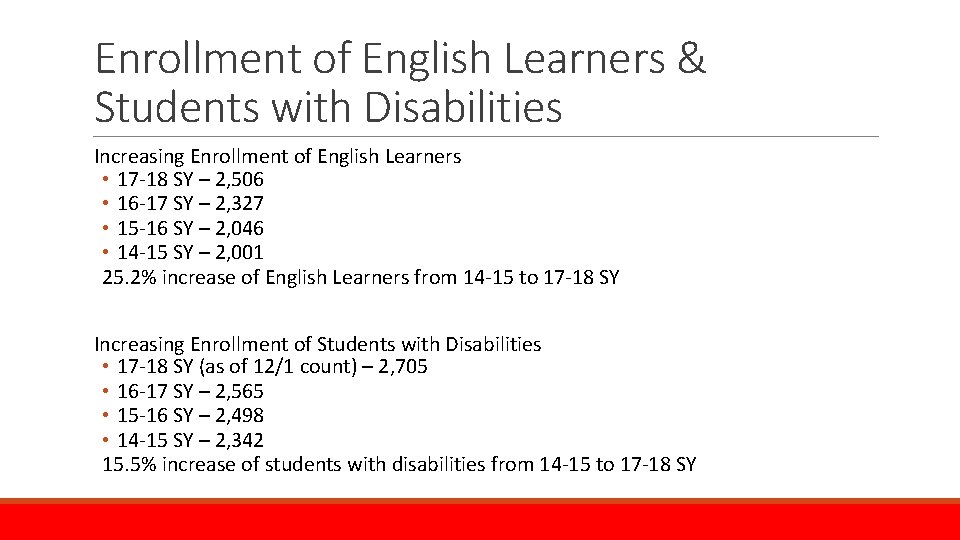
Enrollment of English Learners & Students with Disabilities Increasing Enrollment of English Learners • 17 -18 SY – 2, 506 • 16 -17 SY – 2, 327 • 15 -16 SY – 2, 046 • 14 -15 SY – 2, 001 25. 2% increase of English Learners from 14 -15 to 17 -18 SY Increasing Enrollment of Students with Disabilities • 17 -18 SY (as of 12/1 count) – 2, 705 • 16 -17 SY – 2, 565 • 15 -16 SY – 2, 498 • 14 -15 SY – 2, 342 15. 5% increase of students with disabilities from 14 -15 to 17 -18 SY
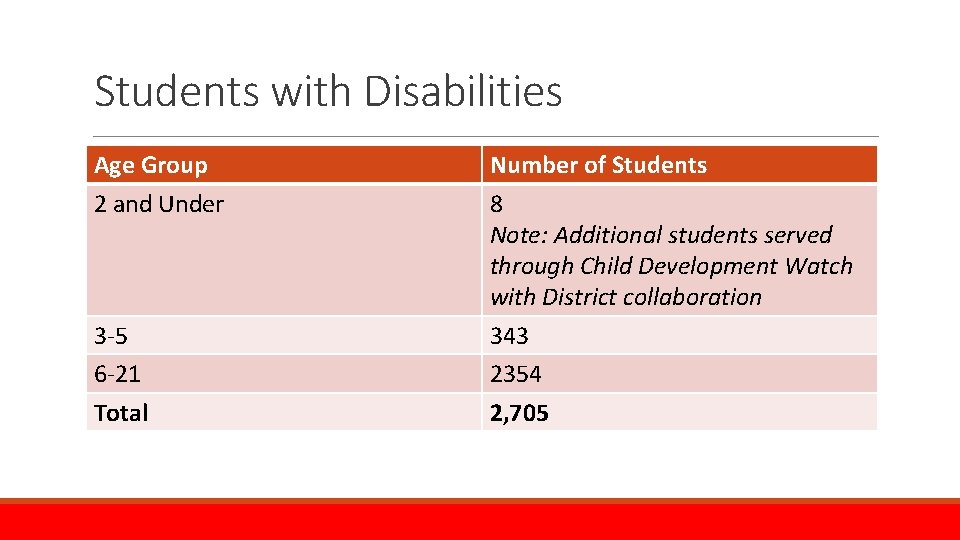
Students with Disabilities Age Group 2 and Under 3 -5 6 -21 Total Number of Students 8 Note: Additional students served through Child Development Watch with District collaboration 343 2354 2, 705
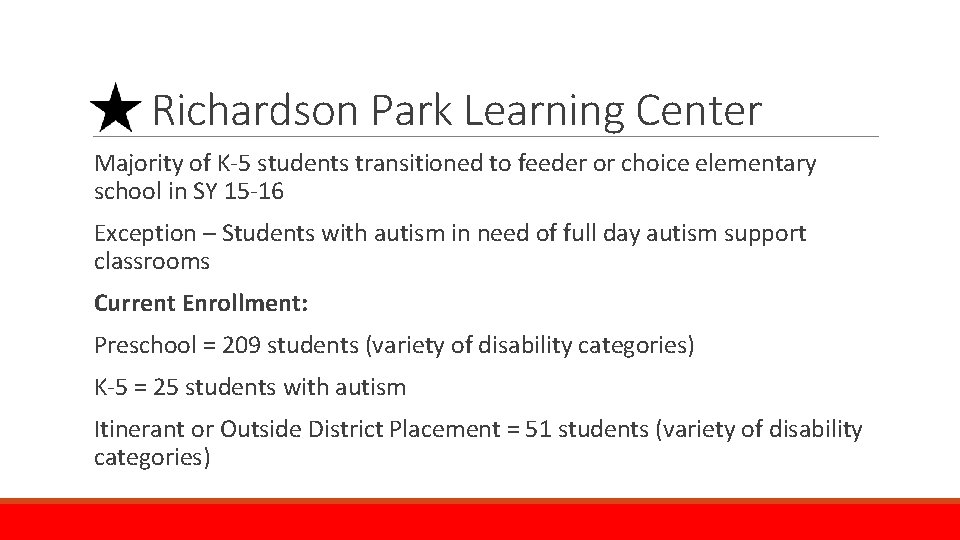
Richardson Park Learning Center Majority of K-5 students transitioned to feeder or choice elementary school in SY 15 -16 Exception – Students with autism in need of full day autism support classrooms Current Enrollment: Preschool = 209 students (variety of disability categories) K-5 = 25 students with autism Itinerant or Outside District Placement = 51 students (variety of disability categories)
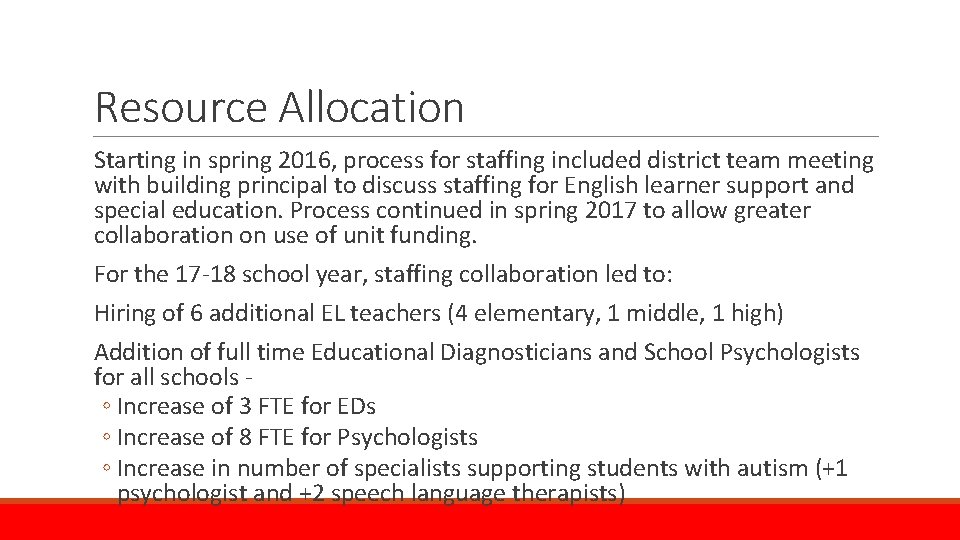
Resource Allocation Starting in spring 2016, process for staffing included district team meeting with building principal to discuss staffing for English learner support and special education. Process continued in spring 2017 to allow greater collaboration on use of unit funding. For the 17 -18 school year, staffing collaboration led to: Hiring of 6 additional EL teachers (4 elementary, 1 middle, 1 high) Addition of full time Educational Diagnosticians and School Psychologists for all schools ◦ Increase of 3 FTE for EDs ◦ Increase of 8 FTE for Psychologists ◦ Increase in number of specialists supporting students with autism (+1 psychologist and +2 speech language therapists)
Resource Allocation Impact Increase of number of EL teachers and amount of ELD instruction provided Increase of special education teachers in targeted schools allowing for development of continuum of services within feeder schools Additional counseling and behavioral support through school psychologist interventions Reduced number of suspensions – 17 -18 SY – 318 suspensions in mid-December (compared to 942 at the same time in the 16 -17 SY)
Focus on Inclusive Practices within RCCSD Strategic Plan • Early Intervention Services and Preschool Sustainability (Goal 1) • Secondary Transition Services (Goal 2) • Inclusive School Culture (Goal 3) • Academic Supports & Interventions (Goal 3) • Social/Emotional Support & Interventions (Goal 3) • Autism Support Expansion (Goal 3) • Family Engagement (Goal 3)
Inclusive School Culture SARAH CELESTIN, SPECIAL SERVICES CAROL BECK, ENGLISH LEARNER SERVICES
Inclusive School Culture 1. Culturally Responsive Practices Professional Development for Administrators – 8/14/17 District EL Conference: Success for All – 10/6/17 District Conference on Equity & Cultural Awareness – 1/26/18 Building Specific Training with community-based partners such as DSEA, UD’s Center for Teaching & Assessment of Learning & Center for Disabilities Studies
Inclusive School Culture 2. Trauma-informed Systems Compassionate Connections in collaboration with DOE – Highlands, Shortlidge & Warner Training on Compassionate Schools model of trauma-informed practices – August team training, December follow-up training Opportunity Grant through DOE for UD’s collaboration with Richardson Park Implementation of screening and Tier 2 intervention for students who have experienced trauma Salisbury State University collaboration with Dickinson on implementation of trauma-informed practices school-wide
Academic Supports & Interventions CAROL BECK, ENGLISH LEARNER SERVICES KENNY OATES, SPECIAL SERVICES
Academic Supports & Interventions 1. Multi-tiered Systems of Support (MTSS) – Academic (aka Response to Intervention) Established District Leadership Team (mtgs started in September 2017) Developing Elementary & Secondary Work Groups including Building & District representatives Administrator Training on MTSS – 10/30 Changes to Middle School scheduling anticipated for 18 -19 SY to better support MTSS implementation Professional Development for Elementary & Middle on Intervention Materials – will continue in June In-service Days
Academic Supports & Interventions 2. English Language Development (ELD) Instruction - Sheltered Instruction Observation Protocol (SIOP) Training: Spring 2017 – Coaches attended 3 day intensive SIOP PD June 2017 – SIOP PD at Mote, Forest Oak & Baltz November 2017 – 2 day walk-throughs/observation in SIOP buildings above; follow-up walk-throughs in February/March - Monthly Training for EL Teachers through PLC - EL/SWD Process for planning service delivery (new collaboration)
Academic Supports & Interventions 2. English Language Development (ELD) Instruction continued -EL Paraprofessionals now tracking service delivery through i. Pad -February 2018 – Google App’s for ELL – Training for 2 ELL and 3 Technology coaches -February-March 2018 – ACCESS Testing – scores to be used for planning for instructional needs -Summer 2018 – Summer Services for English learners – currently planning programming options
Academic Supports & Interventions 3. Specially Designed Instruction (SDI) for Students with Disabilities -Professional Development for Case Managers on IEP Development including development of goals based on diagnostic testing information and designing individualized services/aids/modifications Targeted buildings for 17 -18 SY: Highlands, Lewis, Heritage, Stanton, HB Du. Pont, Dickinson MYP/HS & Cab Calloway -Collaboration with Curriculum & Instruction on Tiered Interventions and inventory of intervention options for Tier 2, Tier 3 & SDI -Professional Development on Reading Horizons Intervention – 10/6 & 9
Social/Emotional Supports & Interventions SARAH CELESTIN, SPECIAL SERVICES
Social/Emotional Supports & Interventions 1. Multi-tiered Systems of Support (MTSS) – Behavior & Social/Emotional Established District Leadership Team – started in January 2017 Initiated Behavior Support Team (2 coaches, 2 analysts) to provide school support – started 16 -17 SY On-going Behavior Coaching in all schools with Tier 1 (school-wide) MTSS team and Tier 2/3 (problem solving/intervention) team Established new Data Service Center app, “i. Tracker Teams, ” to track student interventions electronically
Social/Emotional Supports & Interventions 1. Multi-tiered Systems of Support (MTSS) – Behavior & Social/Emotional continued Provided training at faculty meetings, PLCs and specialist meetings (504, PST team leads, EDs, psychologists related to: Self-care for educators Emotional disabilities & mental health needs De-escalation techniques Classroom management Tier 2 interventions Ramping Up behavioral supports
Social/Emotional Supports & Interventions 1. Multi-tiered Systems of Support (MTSS) – Behavior & Social/Emotional continued Behavior Analysts provide individual student support cross-district for 25 -30 students at a given time (Tier 3 support); most intensive student cases including: Extensive Behavior Support Plan development Data Collection Staff Training, Modeling & Assistance Crisis Intervention Coordination with outside agency services
Social/Emotional Supports & Interventions 1. Multi-tiered Systems of Support (MTSS) – Behavior & Social/Emotional continued Facilitation of Professional Development for Psychologists & Targeted School Teams on: Functional Behavior Assessment & Behavior Support Plan development Prevent-Teach-Reinforce (PTR) process including individual coaching support for selected psychologists Safety Training & Personal Emergency Interventions (over 200+ staff trained so far in 17 -18 SY)
Social/Emotional Supports & Interventions 1. Multi-tiered Systems of Support (MTSS) – Behavior & Social/Emotional continued Coming this winter/spring: Development of District Leadership Team on Crisis Response including Risk Assessment and procedures for building-level and district-level crises Tier 3 Redesign Action Plan – Collaboration with DOE, University of Delaware & University of Florida focused on increasing continuum of services available for students with Tier 3 behavioral needs
Autism Services DOMINICK SQUITTIERE, AUTISM SERVICES
Expansion of Service Delivery Models We currently have three in- district service models for providing supports to students with Autism: 1. Specialized program 2. Building – based 3. Itinerant
Specialized Program Student(s) receive Autism supports within a specialized setting classroom. Services are outside the child’s feeder pattern school. Instruction and supports are delivered by specialized program team member. Currently: Services occur at the Richardson Park Learning Center for students in preschool through grade 5; currently supporting 62 students. Anticipated expansion for the 17 -18 SY including additional pre-school autism support classrooms as well as K classrooms at designated elementary schools.
Building-based Student(s) receive Autism-specific supports within a district neighborhood school Services delivered by an Autism support team based at that school. Emphasis is placed on providing support services within the natural school community. Currently: 11 classrooms in 7 buildings supporting 49 students. 3 Elementary (Mote 1 Kn classroom, Shortlidge 2 Kn classrooms, Brandywine Springs 1 K-5 classroom) 5 middle school classrooms at Skyline (2 classrooms), Stanton (2 classrooms) and HB MS (1 classroom) 1 high school classroom (Mc. Kean) Anticipated expansion for the 18 -19 SY at the elementary and high school levels.
Itinerant Supports Student(s) receive Autism-specific supports within their feeder pattern school in a grade level classroom. Autism support team is not based at a specific school. Are available to the student and their building team on an intermittent basis; Currently: Six Itinerant teachers currently supporting 83 students in 25 schools, K-12. Expansion of psychologists and speech therapists with specialty (one additional psychologist and two additional speech therapists for the 1718 SY).
Autism-Specific Supports The provision of interventions, instructional strategies and other supports that target the unique learner characteristics of students with Autism ◦ Target the collective core, foundational difficulties experienced by these students (e. g. , social reciprocity, communication, restrictive repetitive behavior) ◦ Consist of practices that have been established as Evidence – based ◦ Supports are designed, implemented and/or monitored by specialized staff ◦ Currently: Utilizing tools for identifying and matching student-specific supports to classroom activities ( Classroom Environment Factors Summary, Individualized Support Summary) ◦ Will also be used for training instructional staff.
Key Issues in Autism Services Moving forward: ◦ Continued recruitment of Autism certified teachers for building-based and itinerant services and Specialists (school psychologists, speech/language therapists) with autism background and training ◦ Targeted training areas: Systematic Instruction, both Direct and Incidental Teaching, Developing and implementing Visual Supports, Embedding motivational strategies and Classroom design elements.
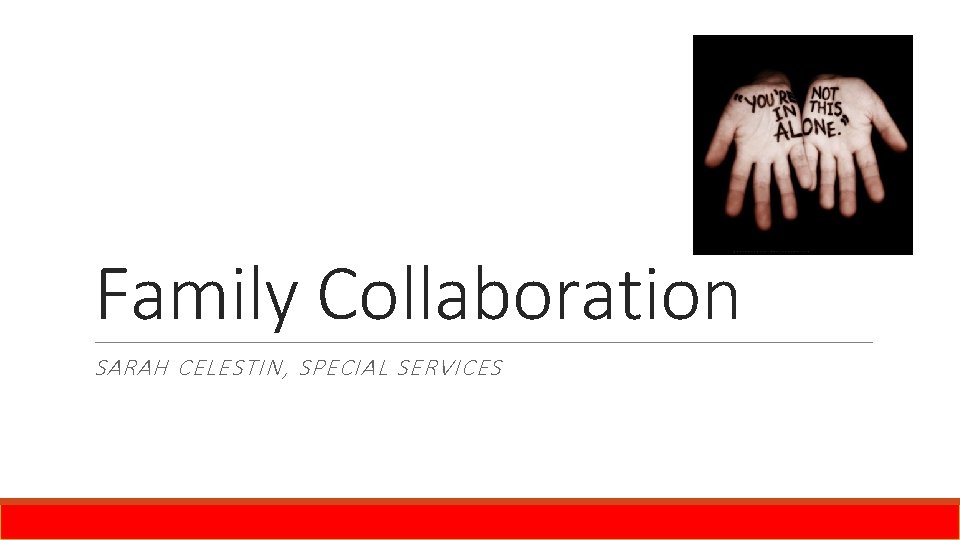
Family Collaboration SARAH CELESTIN, SPECIAL SERVICES
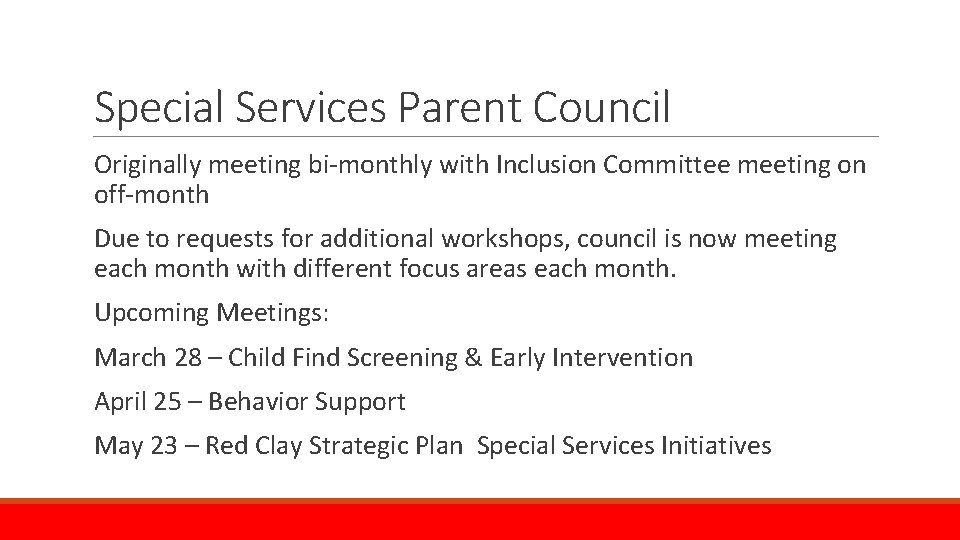
Special Services Parent Council Originally meeting bi-monthly with Inclusion Committee meeting on off-month Due to requests for additional workshops, council is now meeting each month with different focus areas each month. Upcoming Meetings: March 28 – Child Find Screening & Early Intervention April 25 – Behavior Support May 23 – Red Clay Strategic Plan Special Services Initiatives
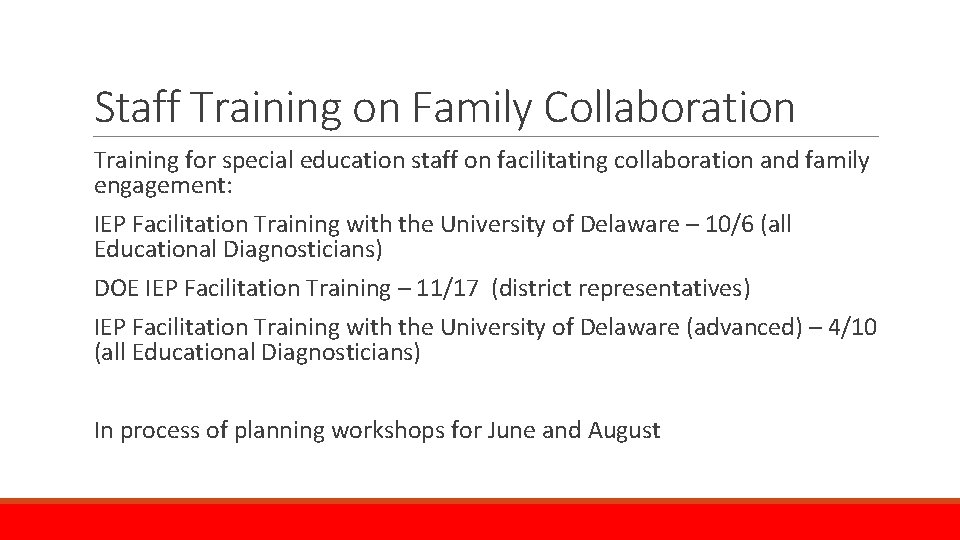
Staff Training on Family Collaboration Training for special education staff on facilitating collaboration and family engagement: IEP Facilitation Training with the University of Delaware – 10/6 (all Educational Diagnosticians) DOE IEP Facilitation Training – 11/17 (district representatives) IEP Facilitation Training with the University of Delaware (advanced) – 4/10 (all Educational Diagnosticians) In process of planning workshops for June and August
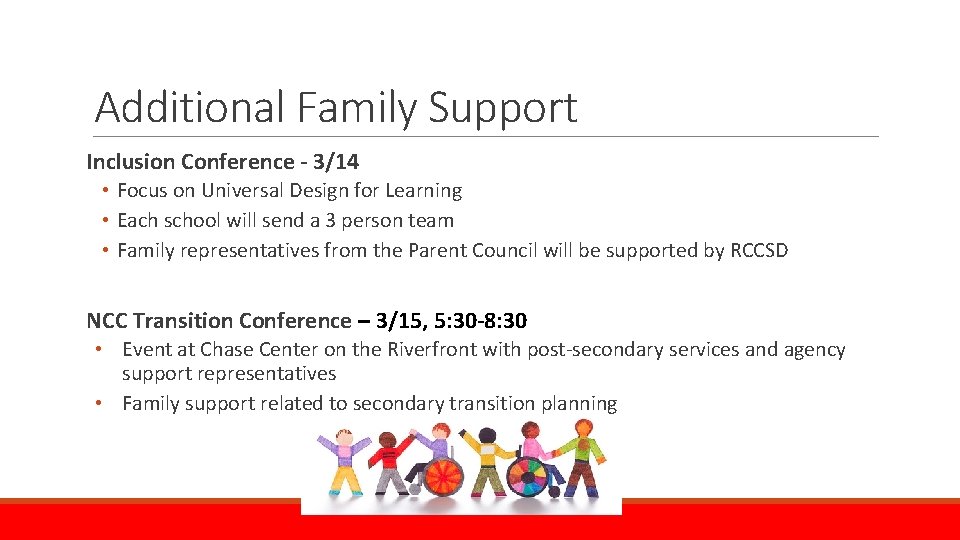
Additional Family Support Inclusion Conference - 3/14 • Focus on Universal Design for Learning • Each school will send a 3 person team • Family representatives from the Parent Council will be supported by RCCSD NCC Transition Conference – 3/15, 5: 30 -8: 30 • Event at Chase Center on the Riverfront with post-secondary services and agency support representatives • Family support related to secondary transition planning
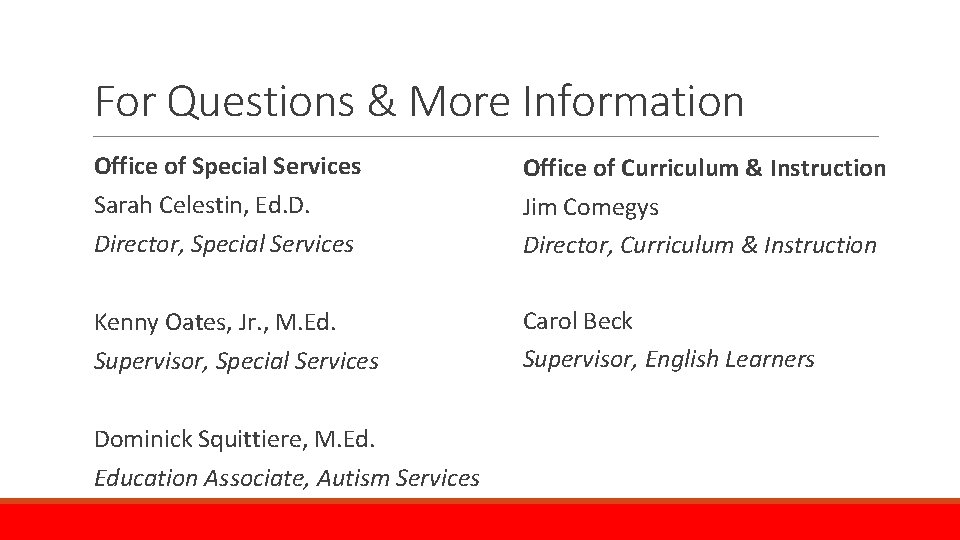
For Questions & More Information Office of Special Services Sarah Celestin, Ed. D. Director, Special Services Office of Curriculum & Instruction Jim Comegys Director, Curriculum & Instruction Kenny Oates, Jr. , M. Ed. Supervisor, Special Services Carol Beck Supervisor, English Learners Dominick Squittiere, M. Education Associate, Autism Services
- Slides: 36