The elements of Axiomatic Design and how to







- Slides: 131
The elements of Axiomatic Design and how to teach them Christopher A. Brown Professor of Mechanical Engineering Worcester Polytechnic Institute Worcester, Massachusetts, USA
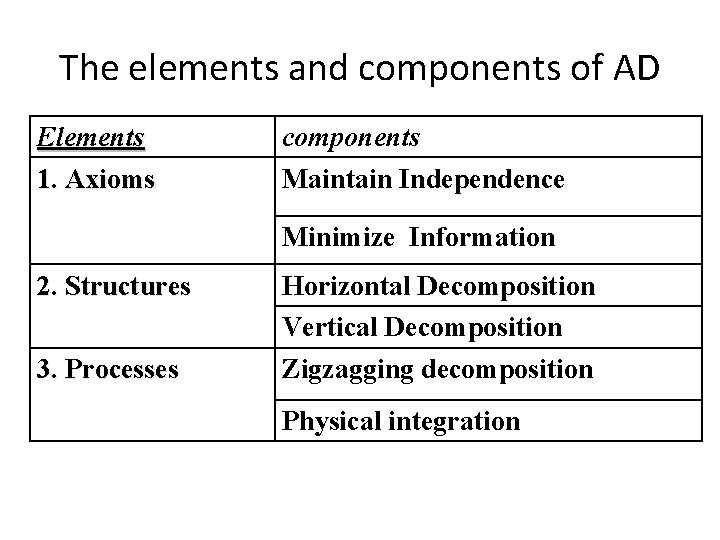
The elements and components of AD Elements 1. Axioms components Maintain Independence Minimize Information 2. Structures 3. Processes Horizontal Decomposition Vertical Decomposition Zigzagging decomposition Physical integration
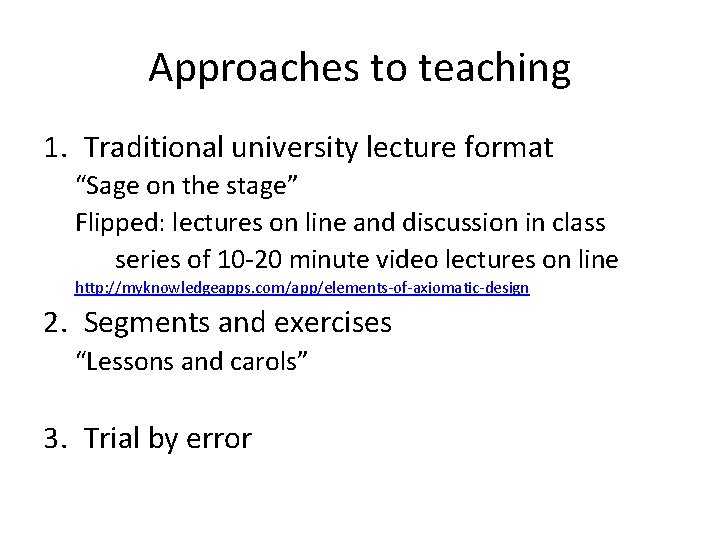
Approaches to teaching 1. Traditional university lecture format “Sage on the stage” Flipped: lectures on line and discussion in class series of 10 -20 minute video lectures on line http: //myknowledgeapps. com/app/elements-of-axiomatic-design 2. Segments and exercises “Lessons and carols” 3. Trial by error
Means – Motivation - Opportunity • Three things needed in learning
Means – Motivation - Opportunity • The knowledge of how it works and how to use it – Instructional materials – the software (Acclaro)
Means – Motivation - Opportunity • Best way to design • Design is what distinguishes engineering
Means – Motivation - Opportunity • Integration into design work • Industry needs buy in from management • general problem solving
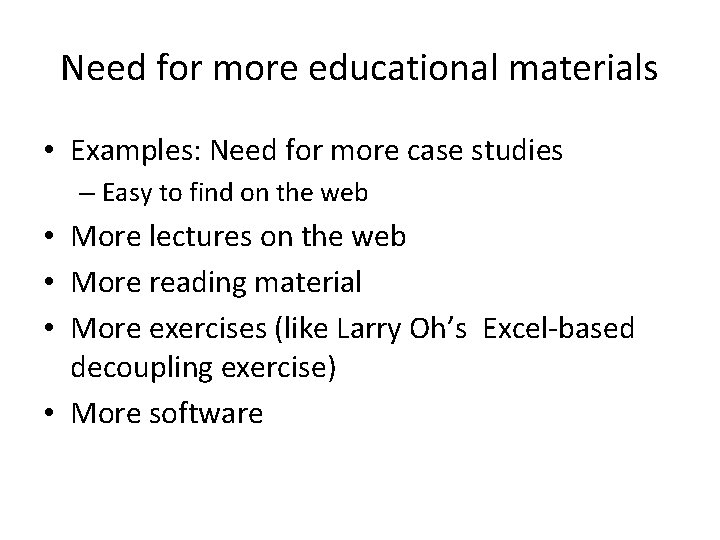
Need for more educational materials • Examples: Need for more case studies – Easy to find on the web • More lectures on the web • More reading material • More exercises (like Larry Oh’s Excel-based decoupling exercise) • More software
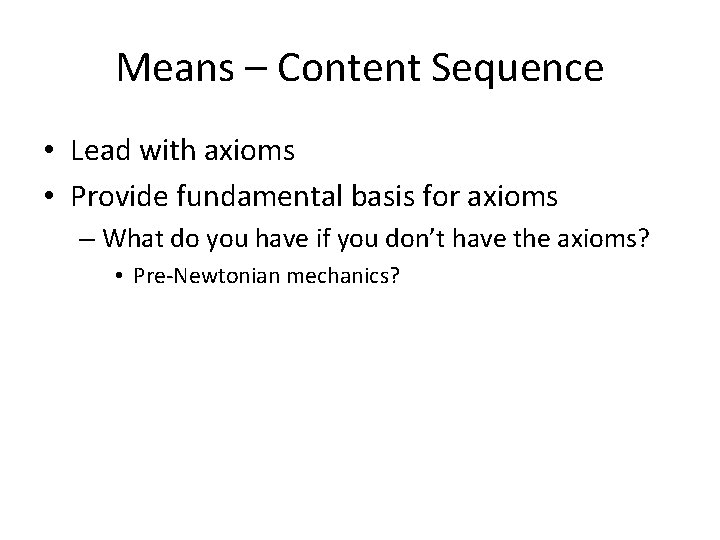
Means – Content Sequence • Lead with axioms • Provide fundamental basis for axioms – What do you have if you don’t have the axioms? • Pre-Newtonian mechanics?
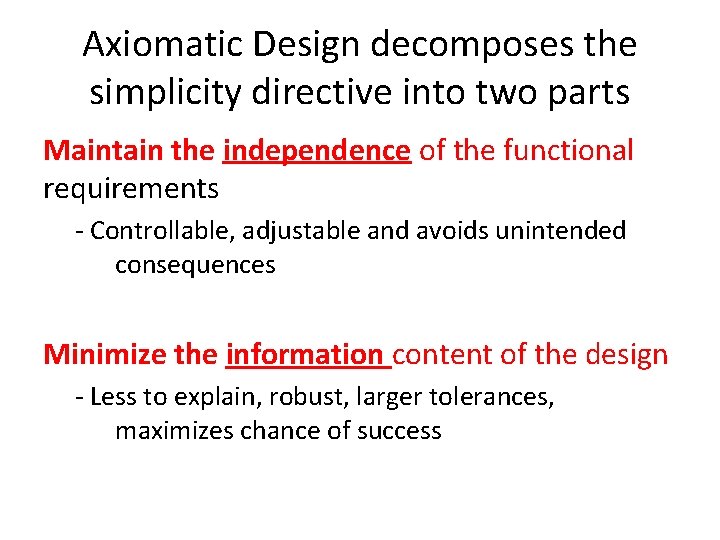
Axiomatic Design decomposes the simplicity directive into two parts Maintain the independence of the functional requirements - Controllable, adjustable and avoids unintended consequences Minimize the information content of the design - Less to explain, robust, larger tolerances, maximizes chance of success
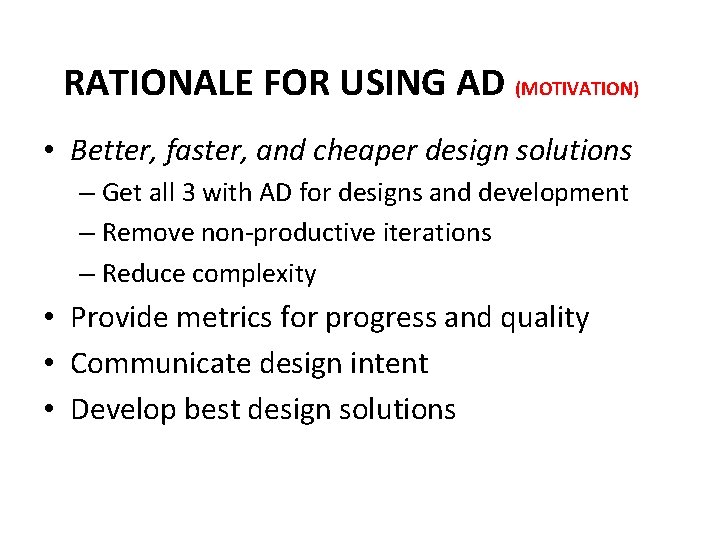
RATIONALE FOR USING AD (MOTIVATION) • Better, faster, and cheaper design solutions – Get all 3 with AD for designs and development – Remove non-productive iterations – Reduce complexity • Provide metrics for progress and quality • Communicate design intent • Develop best design solutions
Defining Engineering design • The process of conceiving of some thing that would function to fulfill a need – The thing could be physical, a process, a system, an organization…. • The design solution is a symbolic representation of the thing and not the thing itself
Most of the content of most engineering courses is analysis • Analysis is not design – Analysis does not create • What is engineering analysis for? – to support design • Asks: will a component function as intended? ? • How do we analyze a design? – How do we know how the design will function? – Does it comply with the axioms?
What is the method you use for your design process? • Has it changed? • Many engineering seniors cannot articulate any fundamental change in their method for design since high school – the differences are mostly in the analyses, • e. g. , stress and deformation • Many methods seem to consist of throwing ideas against a problem until something sticks – Lack good evaluation criteria
Importance of adjustability accommodates change CHANGE IS UBIQUITIOUS • The universe is not in equilibrium – Something is always changing • Weather changes • People change • Needs change – Functions need to be adjusted Why is calculus so important? • because it models change • dy/dx describes how one thing changes with respect to another
What else can we say about engineering design • Dreaming of things that never were – and asking, how? – conceiving, planning, analyzing, comparing, and selecting components and systems • Building a consensus among the stakeholders • Functionally based and objective oriented. • Engineers create value by thinking …. and by communicating their thoughts 16
What is thought? …thought is all about semantics Semantics is equivalent to capturing and exploiting the compact structure of the world. Eric Baum 2004 MIT press This compact structure is exploited through language and mathematics …symbols and their logical manipulation to solve problems 17
What are semantics? …meanings, relationships, argument structure, linking to syntax…integration of elements into a meaningful entity This suggests that we: 1. Develop an appropriate symbolic representation of the design 2. Manipulate the symbols to achieve the best design Note that: The symbol is not the thing 18
Axioms • An axiom, or scientific law, can not be proven, only disproven – Express commonality, exploits the compact nature of the universe • Scientific axioms, or laws, exemplify the compact nature of the universe – Mechanics – Thermodynamics – Electricity and magnetism • All these disciplines have a set of axioms that can be applied to the solution of a wide variety of problems… – What about design?
Basis for scientific laws? What was Newton thinking? Recognizing commonalties?
The axioms make engineering design a scientific discipline • Axiom 1, the independence axiom: Maintain the independence of the functional requirements • Axiom 2, the information axiom: Minimize the information content of the design
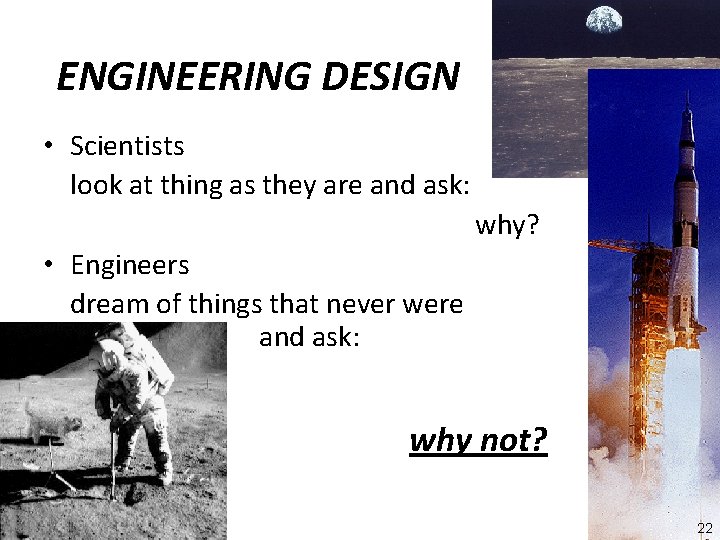
ENGINEERING DESIGN • Scientists look at thing as they are and ask: why? • Engineers dream of things that never were and ask: why not? 22
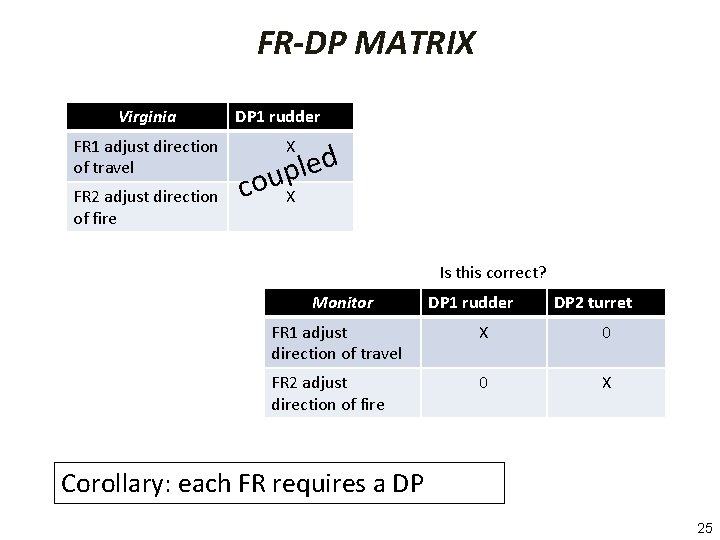
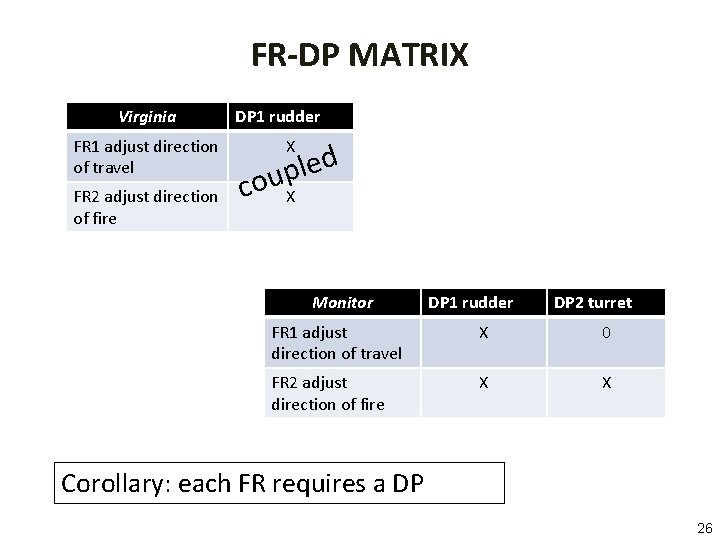
Axiom One and Breakthrough Designs naval warfare - March 1862 American Civil War • Steam power decouples locomotion and wind (Virginia and Monitor) • A swivel turret decouples the direction of travel and the direction of fire (Monitor) • New FR – Adjust Direction of Fire 23
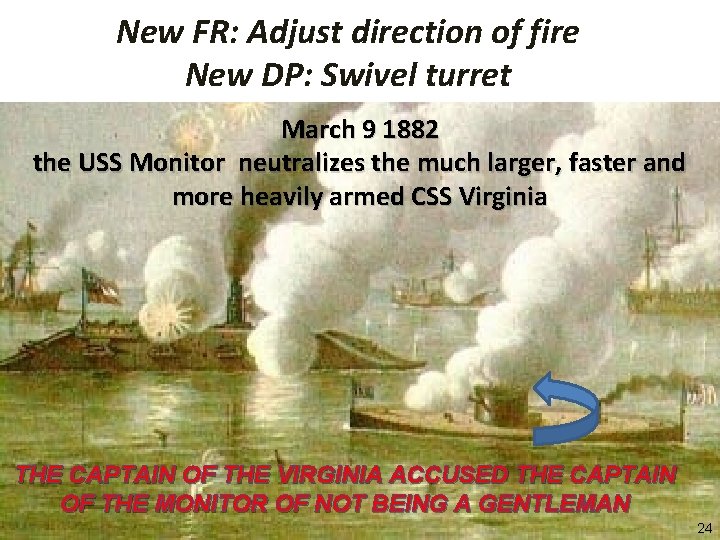
New FR: Adjust direction of fire New DP: Swivel turret March 9 1882 the USS Monitor neutralizes the much larger, faster and more heavily armed CSS Virginia THE CAPTAIN OF THE VIRGINIA ACCUSED THE CAPTAIN OF THE MONITOR OF NOT BEING A GENTLEMAN 24
FR-DP MATRIX Virginia FR 1 adjust direction of travel FR 2 adjust direction of fire DP 1 rudder X d e l p cou X Is this correct? Monitor DP 1 rudder DP 2 turret FR 1 adjust direction of travel X 0 FR 2 adjust direction of fire 0 X Corollary: each FR requires a DP 25
FR-DP MATRIX Virginia FR 1 adjust direction of travel FR 2 adjust direction of fire DP 1 rudder X d e l p cou X Monitor DP 1 rudder DP 2 turret FR 1 adjust direction of travel X 0 FR 2 adjust direction of fire X X Corollary: each FR requires a DP 26
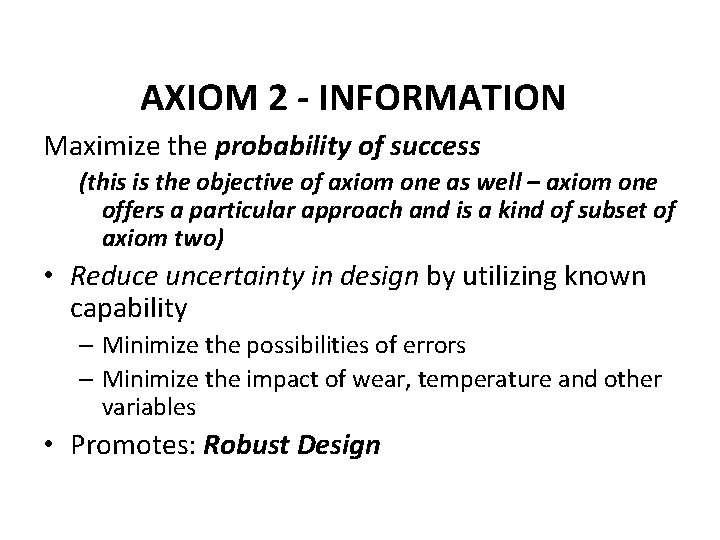
AXIOM 2 - INFORMATION Maximize the probability of success (this is the objective of axiom one as well – axiom one offers a particular approach and is a kind of subset of axiom two) • Reduce uncertainty in design by utilizing known capability – Minimize the possibilities of errors – Minimize the impact of wear, temperature and other variables • Promotes: Robust Design
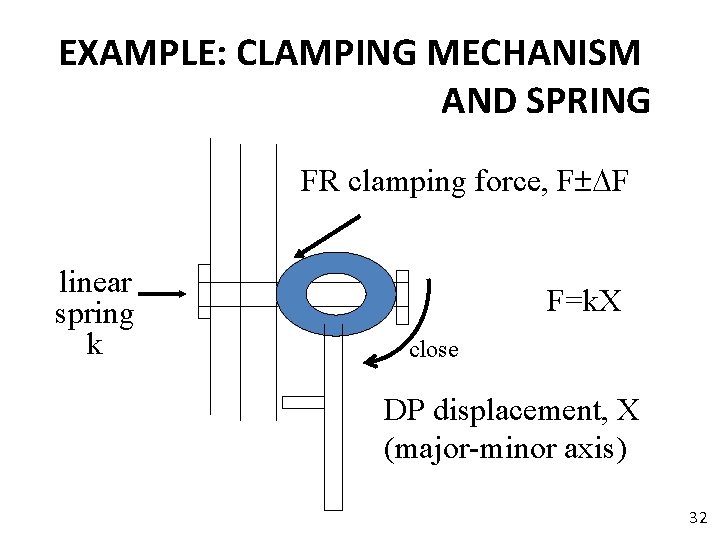
SINGLE FR DESIGNS – OR BRANCHES • Axiom one – “maintain the independence of the functions” is completely satisfied - since there is only one. • It is all about axiom two.
EXAMPLE: CLAMPING MECHANISM AND SPRING FR clamping force, F F linear spring k F=k. X close DP displacement, X (major-minor axis) 32
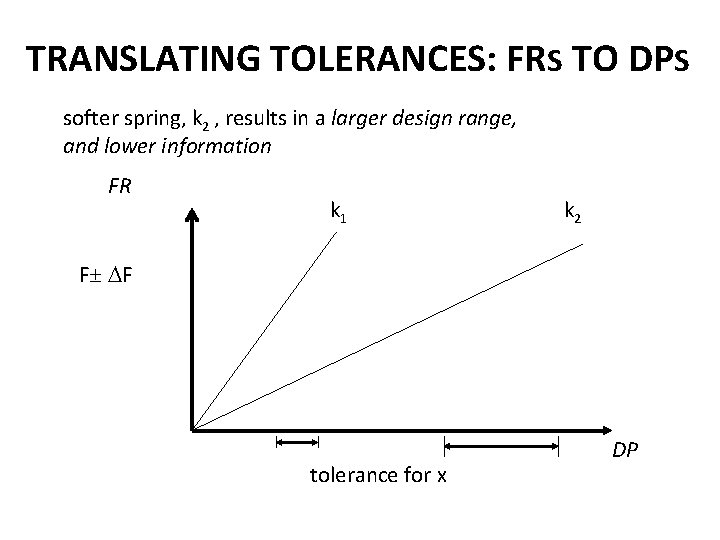
TRANSLATING TOLERANCES: FRS TO DPS softer spring, k 2 , results in a larger design range, and lower information FR k 1 k 2 F F tolerance for x DP
STIFFNESS IN DESIGN • From axiom 2 we can see that the lowest allowable stiffness is the best • Allows for variance in manufacturing • Allows for wear, and temperature change • Accommodates impacts
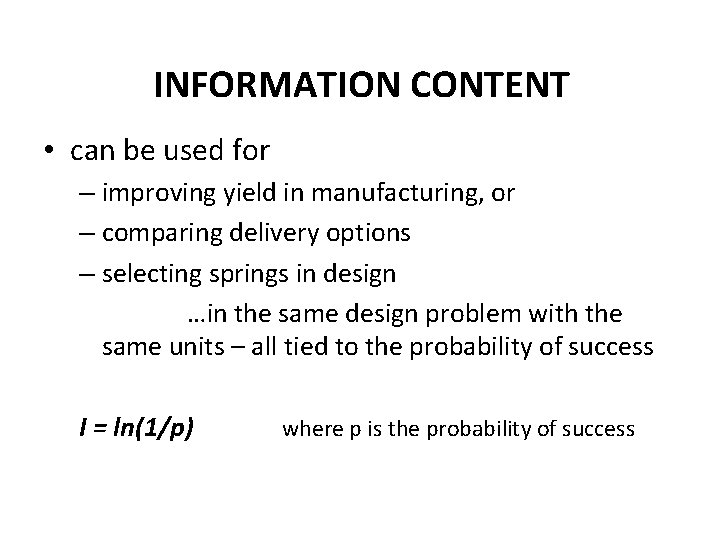
INFORMATION CONTENT • can be used for – improving yield in manufacturing, or – comparing delivery options – selecting springs in design …in the same design problem with the same units – all tied to the probability of success I = ln(1/p) where p is the probability of success
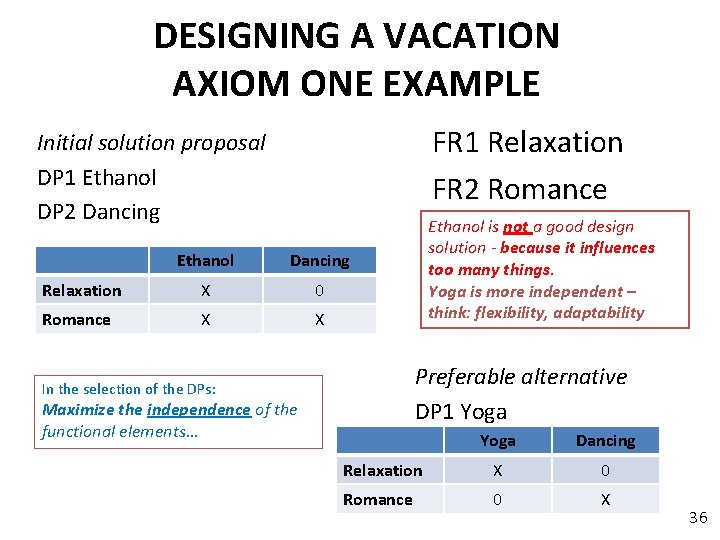
DESIGNING A VACATION AXIOM ONE EXAMPLE FR 1 Relaxation FR 2 Romance Initial solution proposal DP 1 Ethanol DP 2 Dancing Ethanol Dancing Relaxation X 0 Romance X X Ethanol is not a good design solution - because it influences too many things. Yoga is more independent – think: flexibility, adaptability Preferable alternative DP 1 Yoga In the selection of the DPs: Maximize the independence of the functional elements… Yoga Dancing Relaxation X 0 Romance 0 X 36
An Introduction to Axiomatic Design 1. 6 Decomposition examples Prof. Christopher A. Brown, Ph. D, FASME Mechanical Engineering Department Worcester Polytechnic Institute Axiomatic Design of Manufacturing Processes A graduate course in Manufacturing Engineering, Material Science and Engineering, and Mechanical Engineering
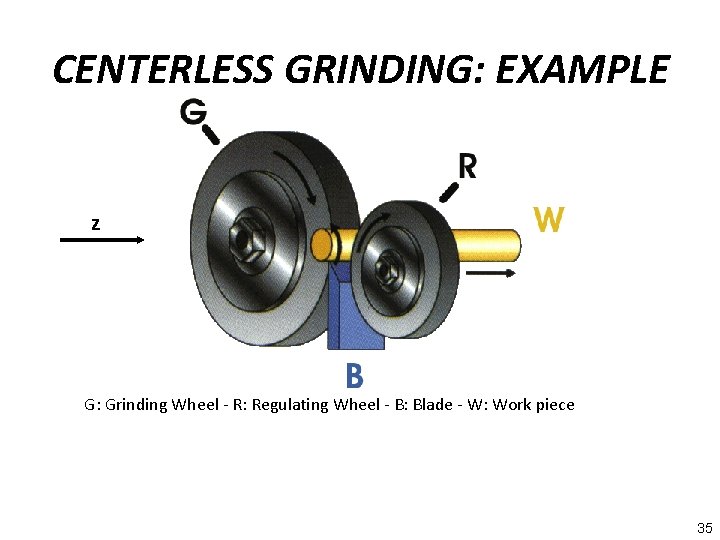
CENTERLESS GRINDING: EXAMPLE z G: Grinding Wheel - R: Regulating Wheel - B: Blade - W: Work piece 35
SITUATION - MEDICAL PART SUPPLIER Manufacturing a tube for arthroscopic surgery • The person left who had been feeding it by hand • No one else can feed it properly – the parts jam and the wheels have to be re-set • The part has a sharp end that people are afraind to handle • They are seriously behind of filling orders • Their engineers are imagining a multi axis robot simulating the hand motion to feed the parts – one month development 36
APPROACH • Develop the minimum number of FRs that are mutually exclusive and collectively exhaustive 37
EXERCISE • List 1 st level FRs and DPs 38
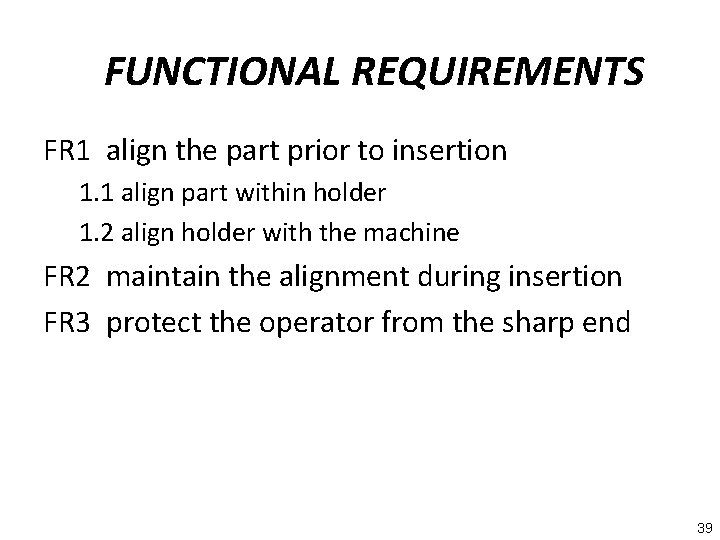
FUNCTIONAL REQUIREMENTS FR 1 align the part prior to insertion 1. 1 align part within holder 1. 2 align holder with the machine FR 2 maintain the alignment during insertion FR 3 protect the operator from the sharp end 39
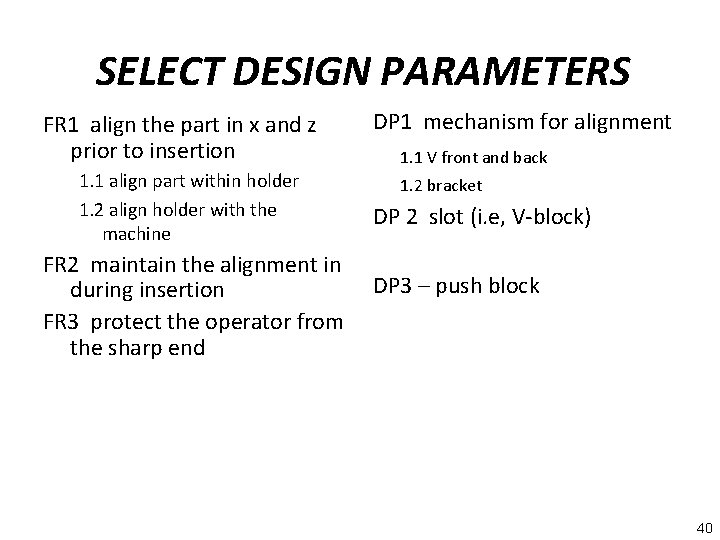
SELECT DESIGN PARAMETERS FR 1 align the part in x and z prior to insertion 1. 1 align part within holder 1. 2 align holder with the machine DP 1 mechanism for alignment 1. 1 V front and back 1. 2 bracket DP 2 slot (i. e, V-block) FR 2 maintain the alignment in DP 3 – push block during insertion FR 3 protect the operator from the sharp end 40
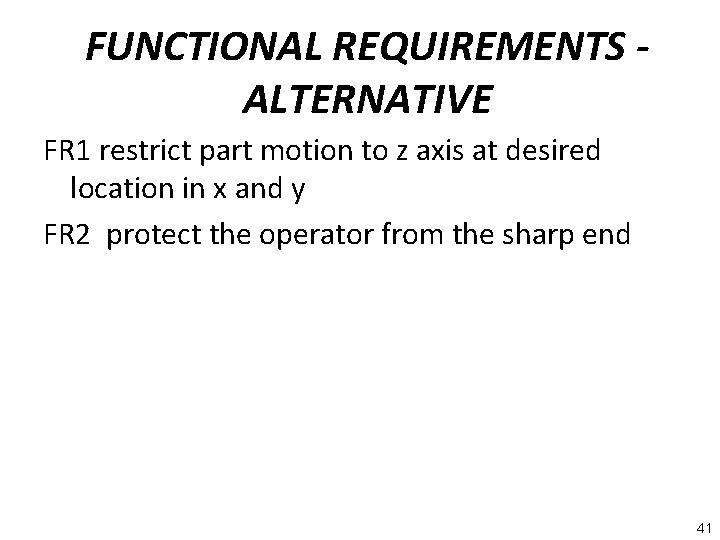
FUNCTIONAL REQUIREMENTS ALTERNATIVE FR 1 restrict part motion to z axis at desired location in x and y FR 2 protect the operator from the sharp end 41
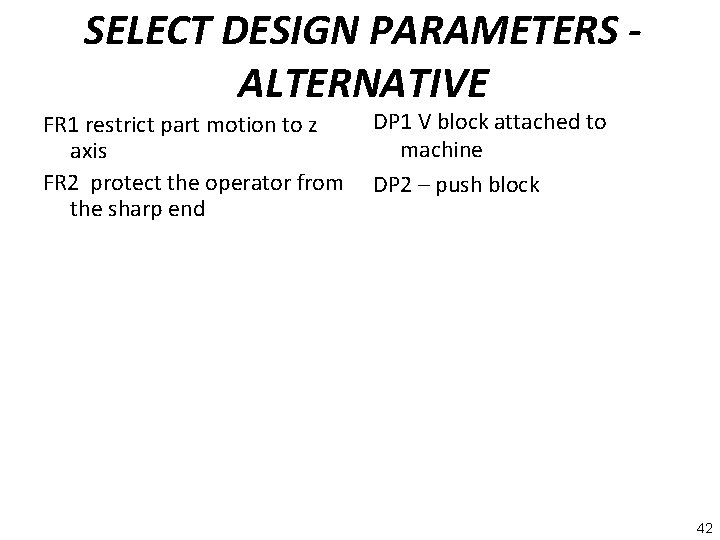
SELECT DESIGN PARAMETERS ALTERNATIVE DP 1 V block attached to FR 1 restrict part motion to z machine axis FR 2 protect the operator from DP 2 – push block the sharp end 42
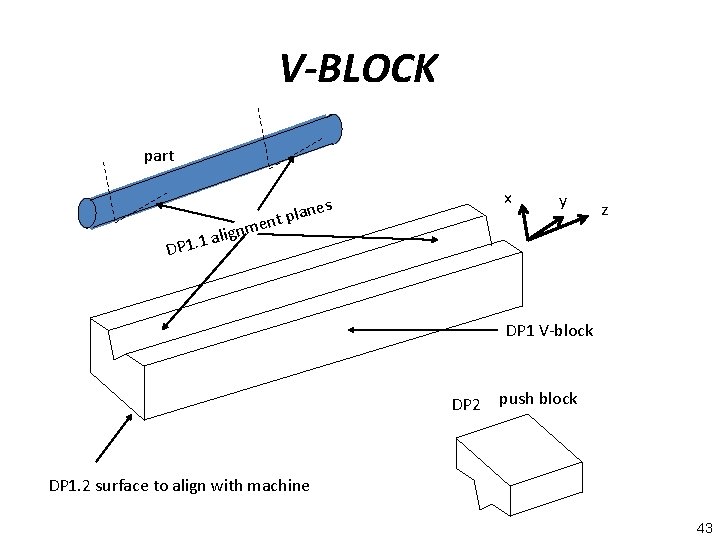
V-BLOCK part x es n a l p ent m n g 1 ali y z DP 1 V-block DP 2 push block DP 1. 2 surface to align with machine 43
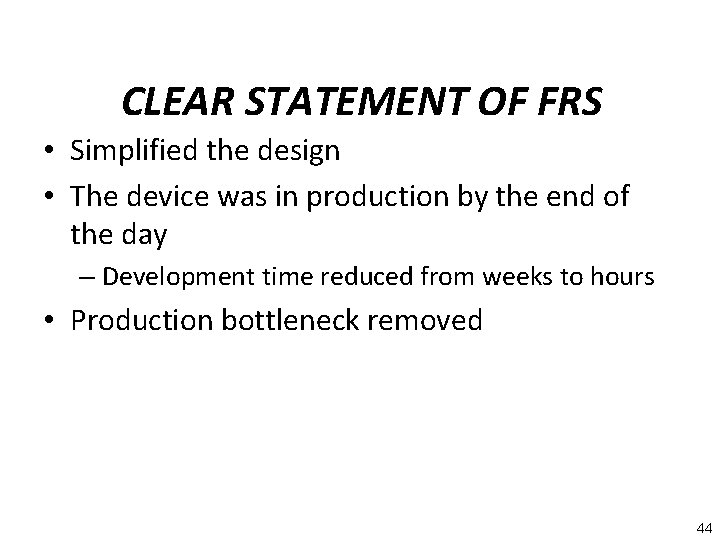
CLEAR STATEMENT OF FRS • Simplified the design • The device was in production by the end of the day – Development time reduced from weeks to hours • Production bottleneck removed 44
Decomposition • Create the structure of the design for applying the axioms
How do we apply the axioms? • How are Newton’s laws applied? – Free body diagrams (FBD) – Decompose the problem into solvable elements – Provides structure • What is the equivalent of a FBD in design? – How do we decompose design solutions? – What is the structure of a design solution? • The structure of the decompositions have some similarities
Objective • Provide a way to represent designs symbolically – so that the axioms can be applied • Application of axioms is through a kind of functional modeling – Improve the design by manipulation of the symbols • Enhance communication of design solution
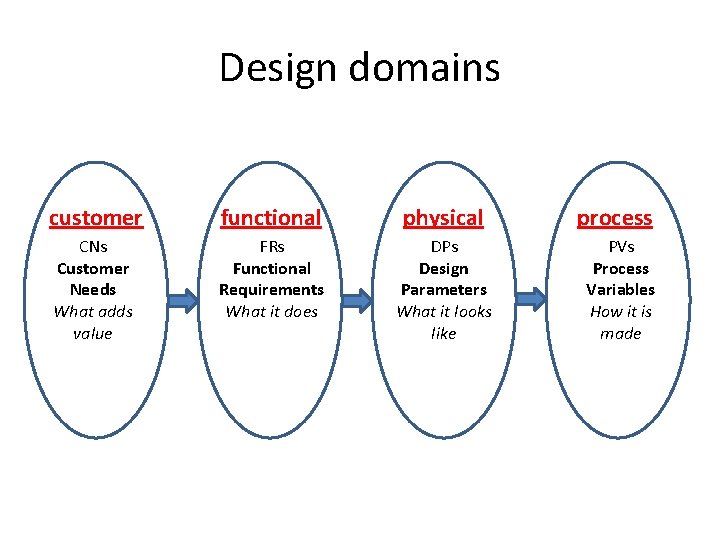
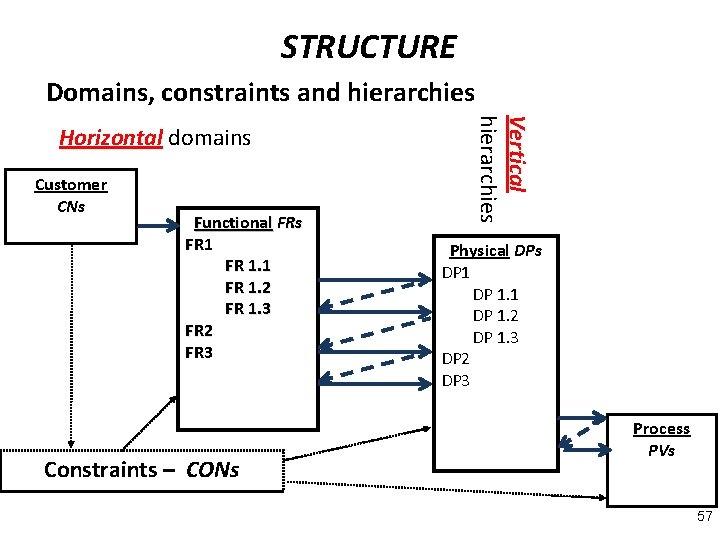
Describing design solutions • Design solution is first described in words • The description decomposes the design solution in two ways – Domains or spaces, • Categories of description from customer to manufacture • Represented horizontally – Hierarchy of detail or abstraction • From general to specific • Represented vertically
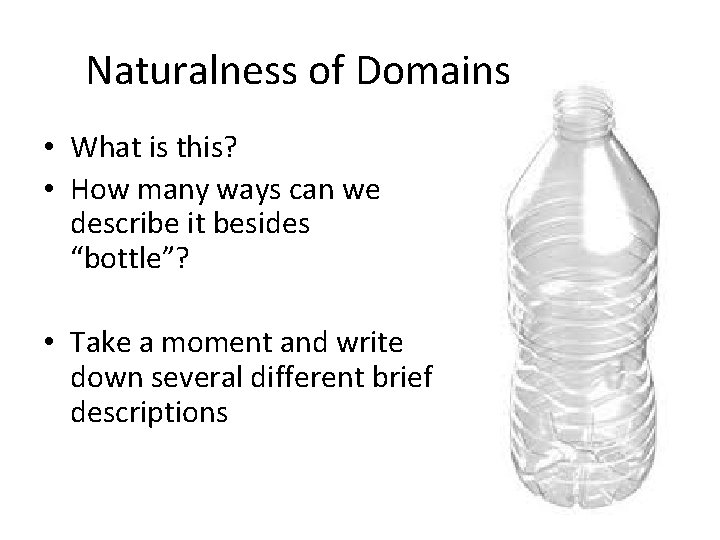
Naturalness of Domains • What is this? • How many ways can we describe it besides “bottle”? • Take a moment and write down several different brief descriptions
Design domains customer functional physical CNs Customer Needs What adds value FRs Functional Requirements What it does DPs Design Parameters What it looks like process PVs Process Variables How it is made
Your descriptions and the domains • Look at how you described the bottle and see how your descriptions fit into the domains • For example – Customer domain CNs: have something to drink handy (beverage container) – Functional domain FRs: hold liquids for travel – Physical domain DPs: closeable water-tight container – Process domain: blow molded plastic
Customer Domain - CNs what adds value (see Thompson CIRP 2013) • The beginning of the value chain – Captures what the customer wants, often in nonengineering terms, e. g. , can’t be too slippery • Usually will relate to highest level FRs • Can contain many kinds of things at many levels – constraints which would apply to elements in other domains • e. g. , manufactured in the US, avoid toxic substances, legal, cost, time, weight
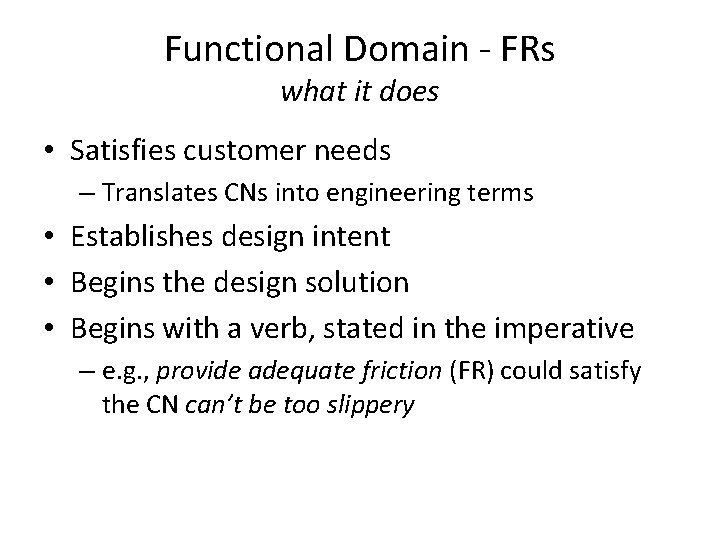
Functional Domain - FRs what it does • Satisfies customer needs – Translates CNs into engineering terms • Establishes design intent • Begins the design solution • Begins with a verb, stated in the imperative – e. g. , provide adequate friction (FR) could satisfy the CN can’t be too slippery
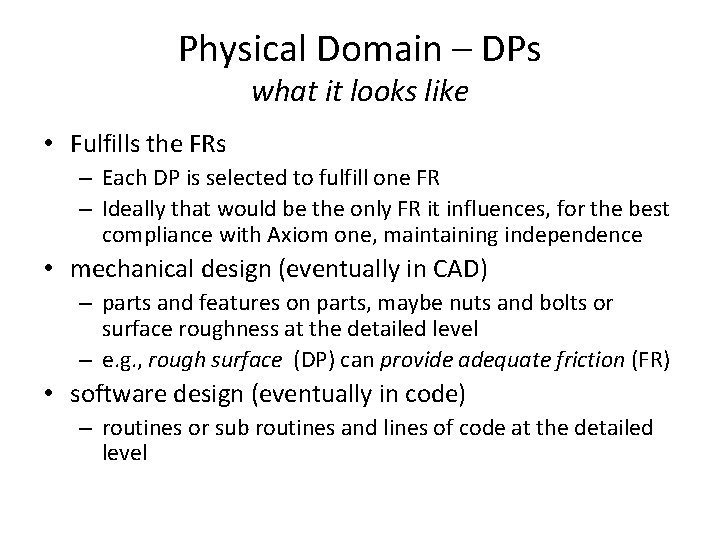
Physical Domain – DPs what it looks like • Fulfills the FRs – Each DP is selected to fulfill one FR – Ideally that would be the only FR it influences, for the best compliance with Axiom one, maintaining independence • mechanical design (eventually in CAD) – parts and features on parts, maybe nuts and bolts or surface roughness at the detailed level – e. g. , rough surface (DP) can provide adequate friction (FR) • software design (eventually in code) – routines or sub routines and lines of code at the detailed level
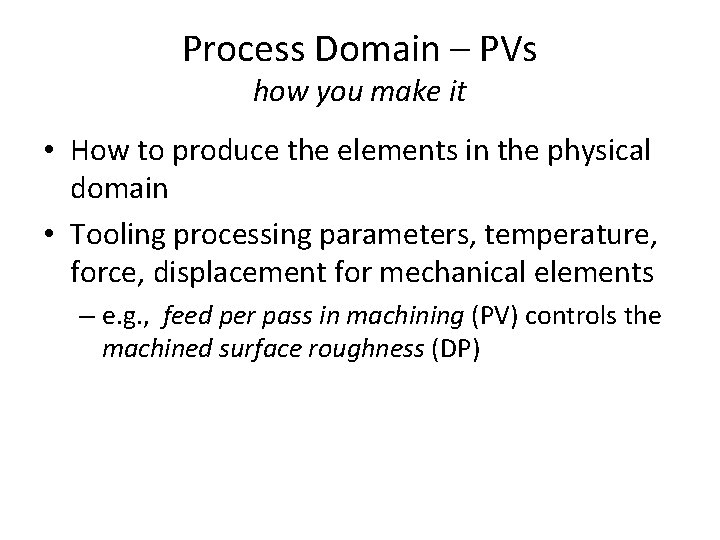
Process Domain – PVs how you make it • How to produce the elements in the physical domain • Tooling processing parameters, temperature, force, displacement for mechanical elements – e. g. , feed per pass in machining (PV) controls the machined surface roughness (DP)
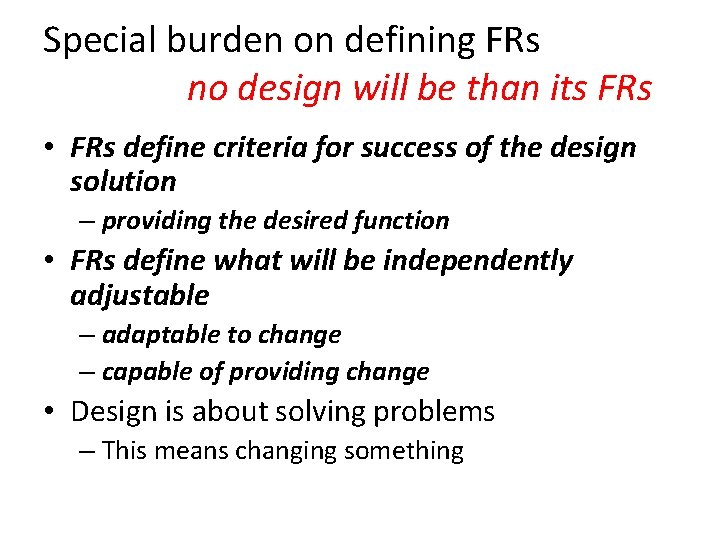
Special burden on defining FRs no design will be than its FRs • FRs define criteria for success of the design solution – providing the desired function • FRs define what will be independently adjustable – adaptable to change – capable of providing change • Design is about solving problems – This means changing something
STRUCTURE Domains, constraints and hierarchies Customer CNs Functional FRs FR 1. 1 FR 1. 2 FR 1. 3 FR 2 FR 3 Constraints – CONs Vertical hierarchies Horizontal domains Physical DPs DP 1. 1 DP 1. 2 DP 1. 3 DP 2 DP 3 Process PVs 57
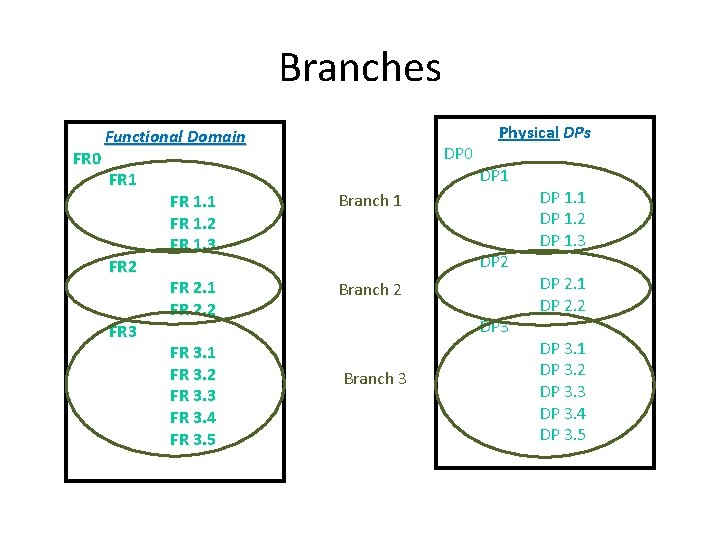
Branches FR 0 Functional Domain FR 1 FR 2 FR 3 DP 0 FR 1. 1 FR 1. 2 FR 1. 3 Branch 1 FR 2. 2 Branch 2 FR 3. 1 FR 3. 2 FR 3. 3 FR 3. 4 FR 3. 5 Physical DPs DP 1 DP 2 DP 3 Branch 3 DP 1. 1 DP 1. 2 DP 1. 3 DP 2. 1 DP 2. 2 DP 3. 1 DP 3. 2 DP 3. 3 DP 3. 4 DP 3. 5
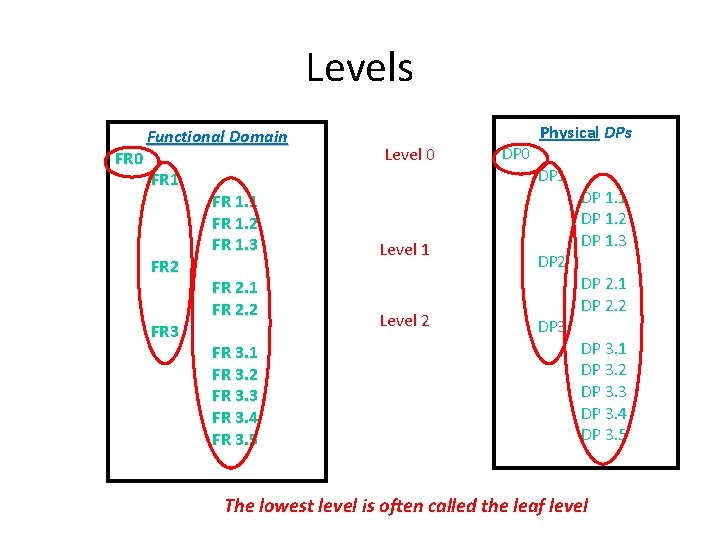
Levels FR 0 Functional Domain FR 1 FR 2 FR 3 FR 1. 1 FR 1. 2 FR 1. 3 FR 2. 1 FR 2. 2 FR 3. 1 FR 3. 2 FR 3. 3 FR 3. 4 FR 3. 5 Level 0 Level 1 Level 2 DP 0 Physical DPs DP 1 DP 2 DP 3 DP 1. 1 DP 1. 2 DP 1. 3 DP 2. 1 DP 2. 2 DP 3. 1 DP 3. 2 DP 3. 3 DP 3. 4 DP 3. 5 The lowest level is often called the leaf level
constraints • Can influence elements in functional, physical and process domains • Do not take DPs • Can influence several FRs • Bottle – Recyclable material – Shock resistant
Decomposition Rules
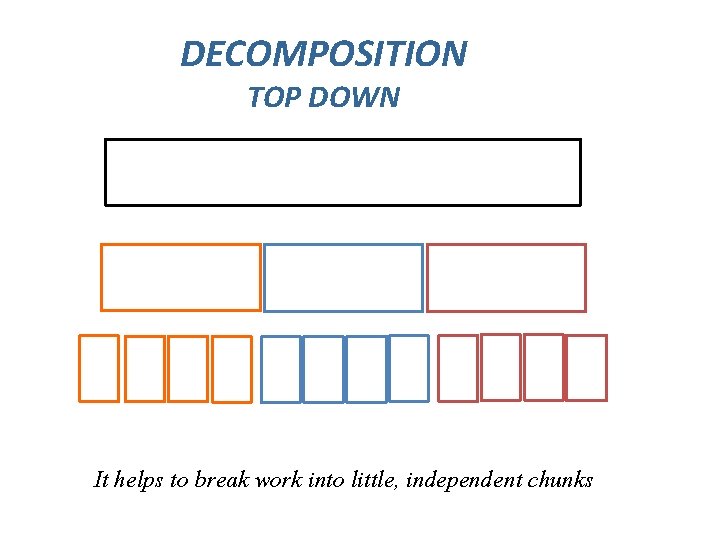
DECOMPOSITION TOP DOWN It helps to break work into little, independent chunks
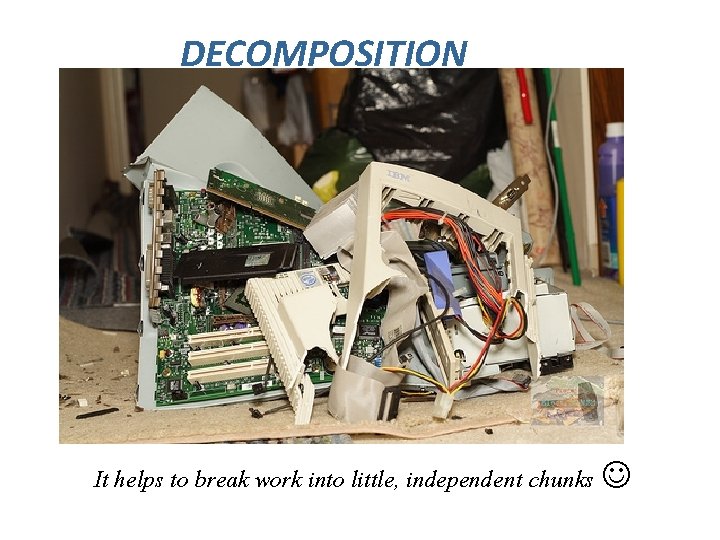
DECOMPOSITION It helps to break work into little, independent chunks
Objectives • Understand the decomposition process – Developing the design solution • across the domains and down the hierarchy • How to build the “decomp” – A decomposition process produces a decomp
Note 1 • The ability to decompose a problem into smaller elements is one of the most important parts of solving large and complex problems – those beyond an obvious solution • Decompose until the solution to each of the decomposed parts is obvious – Integrate the partial solutions into the larger integrated solution
Note 2 • Start with developing the FRs – Assume that the FRs have a basis in the CNs and are appropriately in the value chain – Developing the CNs will be discussed in a later lecture • The FRs – establish the function, the design intent – are essential to innovation and a good design • For now the discussion is primarily about FRs – DPs, PVs will be considered in more depth later
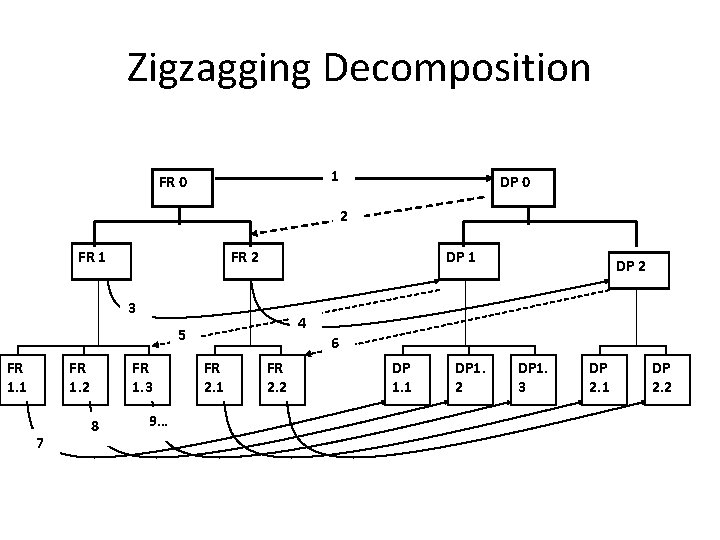
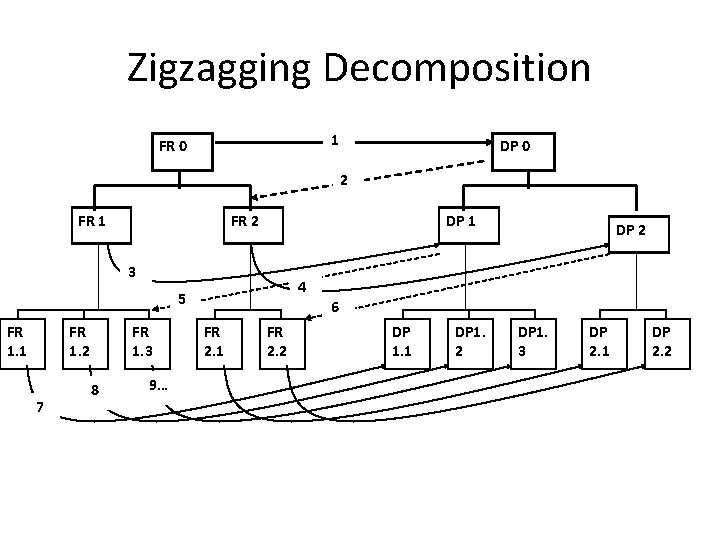
The structure of the design is developed during the decomposition process • Zigzagging – Between domains – From abstract (general, conceptual) to specific (leaf level, nuts and bolts, nitty-gritty) – Until the solution is obvious 67
Zigzagging Decomposition 1 FR 0 DP 0 2 FR 1 FR 2 DP 1 3 4 5 FR 1. 1 FR 1. 2 7 FR 1. 3 8 9… DP 2 6 FR 2. 1 FR 2. 2 DP 1. 1 DP 1. 2 DP 1. 3 DP 2. 1 DP 2. 2
At each level and each branch • The FRs are developed first – Based on CNs and the parents
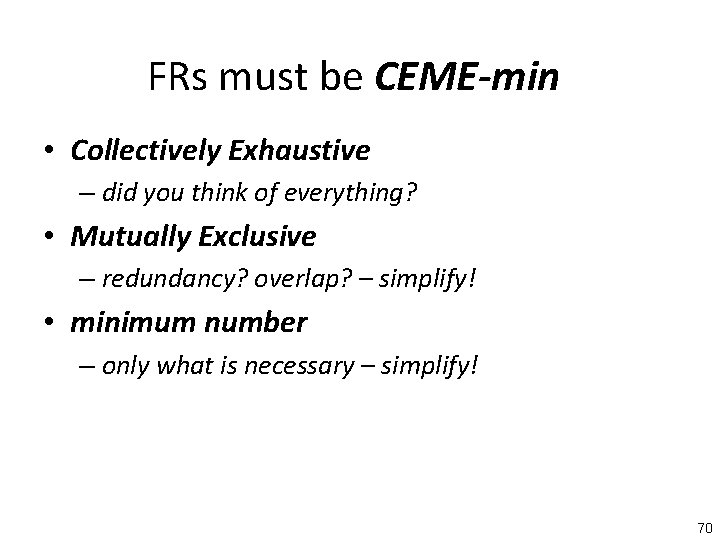
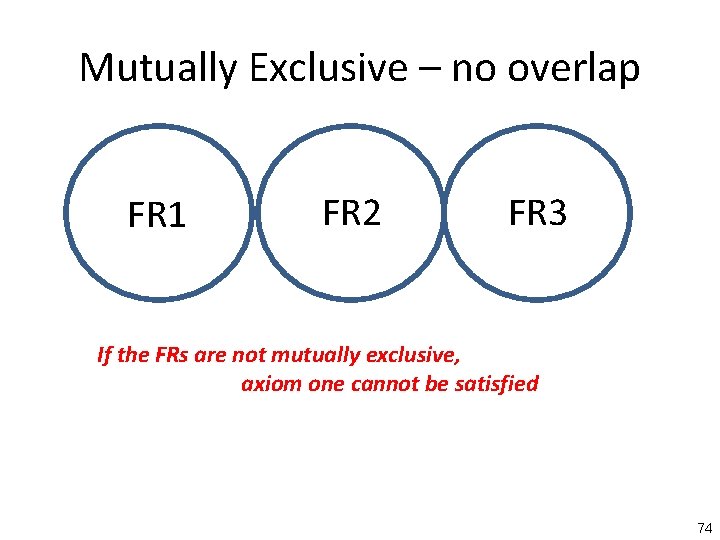
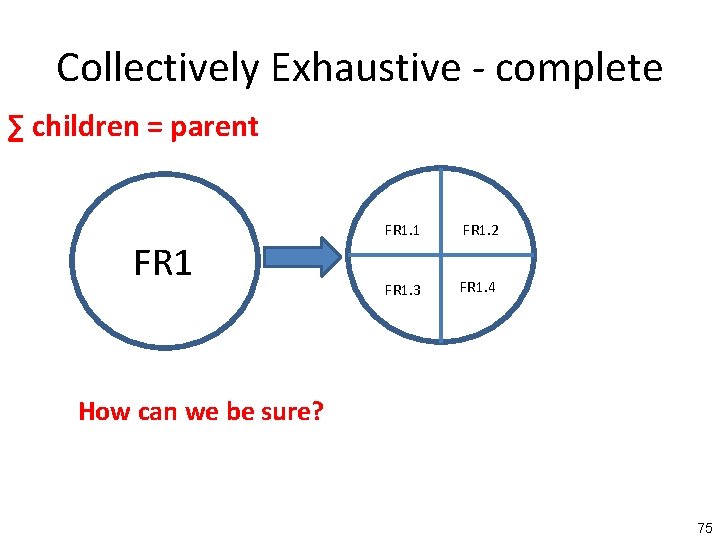
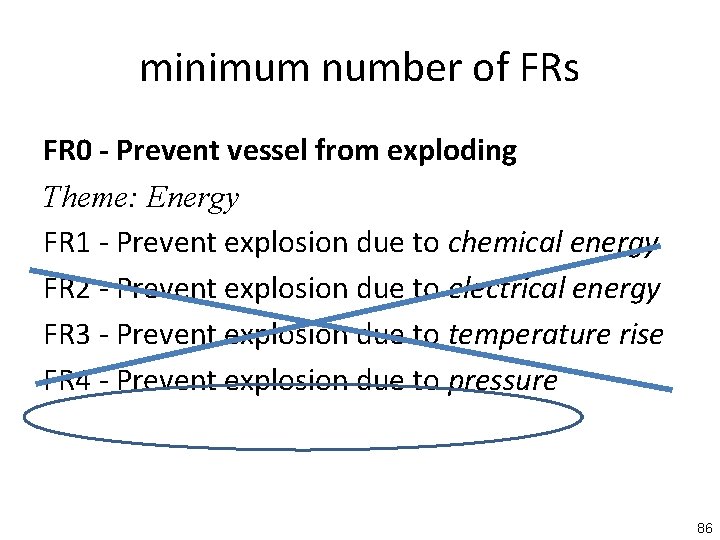
FRs must be CEME-min • Collectively Exhaustive – did you think of everything? • Mutually Exclusive – redundancy? overlap? – simplify! • minimum number – only what is necessary – simplify! 70
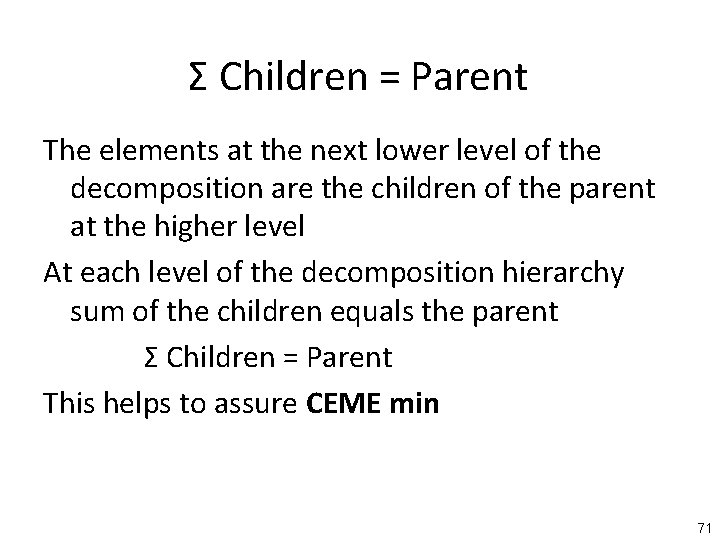
Σ Children = Parent The elements at the next lower level of the decomposition are the children of the parent at the higher level At each level of the decomposition hierarchy sum of the children equals the parent Σ Children = Parent This helps to assure CEME min 71
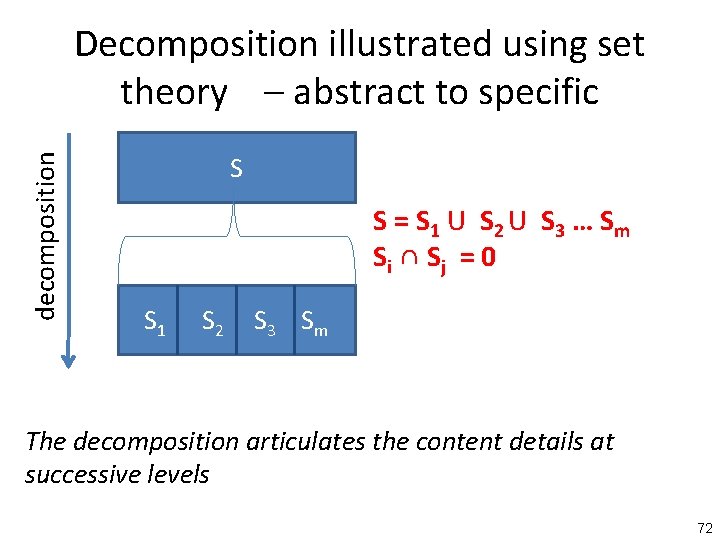
decomposition Decomposition illustrated using set theory – abstract to specific S S = S 1 U S 2 U S 3 … S m Si ∩ Sj = 0 S 1 S 2 S 3 Sm The decomposition articulates the content details at successive levels 72
No single child decompositions • All parents must have at least two siblings – Otherwise it has been decomposed • If you can only think of one then – Maybe all you did was to restate the parent • Often adding more detail – Move the detail up – Maybe you are missing a child • Look for it in theme and the language of the parent
Mutually Exclusive – no overlap FR 1 FR 2 FR 3 If the FRs are not mutually exclusive, axiom one cannot be satisfied 74
Collectively Exhaustive - complete ∑ children = parent FR 1. 1 FR 1. 2 FR 1. 3 FR 1. 4 How can we be sure? 75
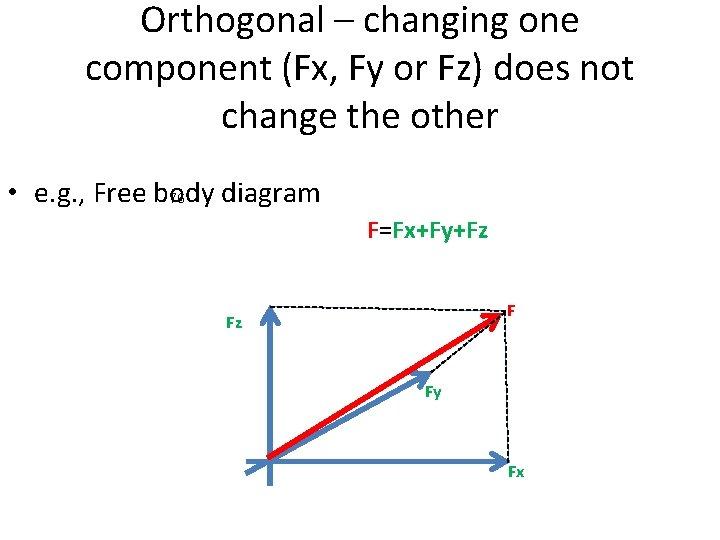
Orthogonal – changing one component (Fx, Fy or Fz) does not change the other • e. g. , Free body diagram 76 F=Fx+Fy+Fz Fy Fx
FR formulation (see Thompson 2013 ICAD) • Translate CNs into engineering terms • Capable of having performance tolerances • Created in a solution neutral environment (don’t jump the gun on the DPs) Formulating good FRs takes time and adds value to the design • Often overlooked in the quest to find a “solution” • Describe where you want to go • Necessary to know when you’ve arrived 77
High level FRs and DPs require care • FR 0 defines the direction – sets theme – Plan on investing some time at the top of the hierarchy – Recognize the value of a good upper levels in the hierarchy • High level DPs constrain the lower levels – To get started you can use generic “place holders” terms e. g. , system, device, mechanism – Add adjectives later, e. g. , hydraulic, electrical, pneumatic 78
FRs • Begin with verbs - Imperative form For example: Limit motion to x direction Transmit loads Provide stability Create features Transform microstructure Apply force 79
Themes for decomposition • Assist in – Collectively exhaustive • How do we know we thought of everything? – Mutually exclusive • How do we know the things are distinct or separate? – Minimum number • How do we know we don’t have more than we need? 80
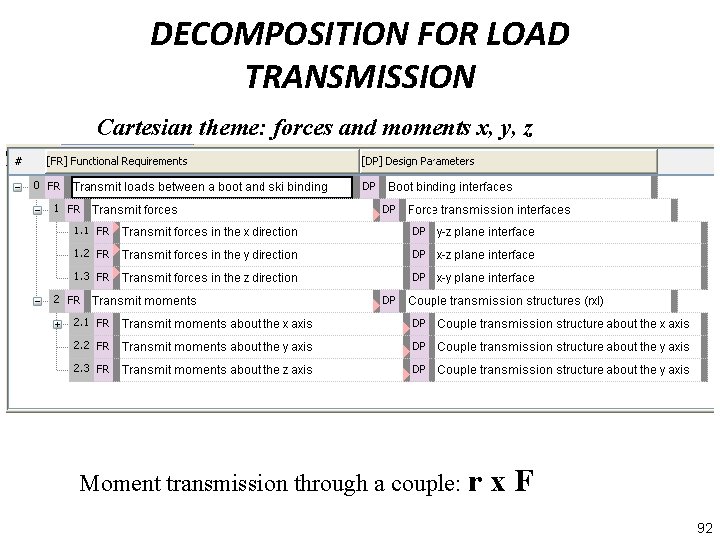
THEMES IN MECHANICAL DESIGN • Work-energy • Cartesian – Position – Load transmission – Motion control 81
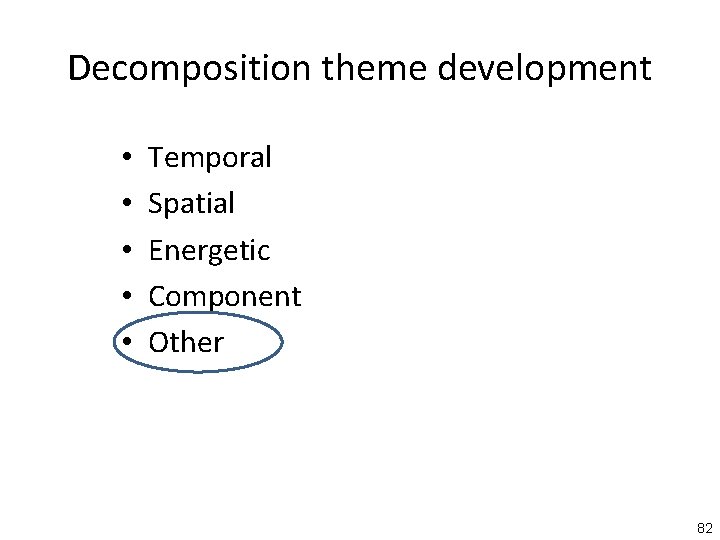
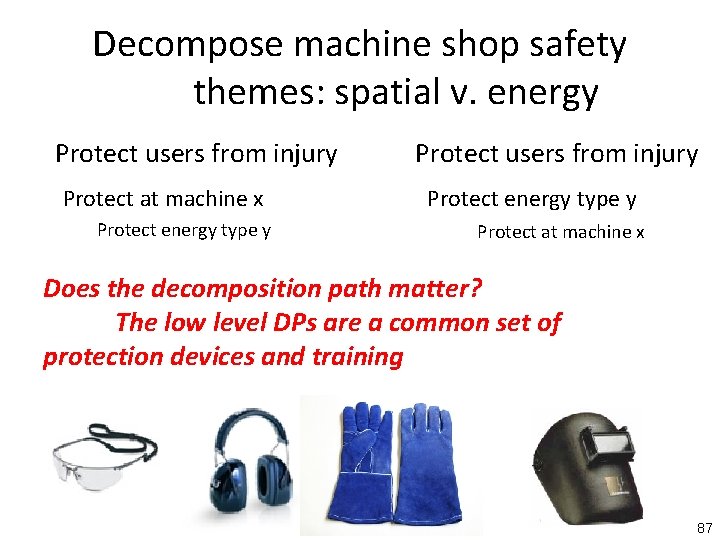
Decomposition theme development • • • Temporal Spatial Energetic Component Other 82
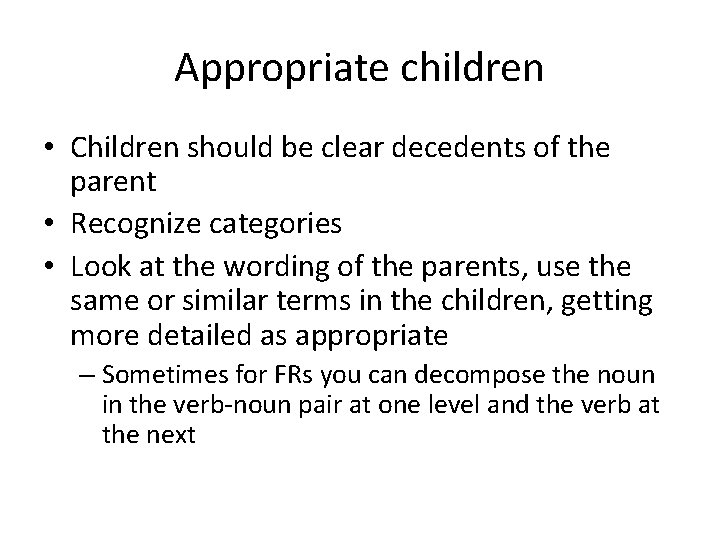
Appropriate children • Children should be clear decedents of the parent • Recognize categories • Look at the wording of the parents, use the same or similar terms in the children, getting more detailed as appropriate – Sometimes for FRs you can decompose the noun in the verb-noun pair at one level and the verb at the next
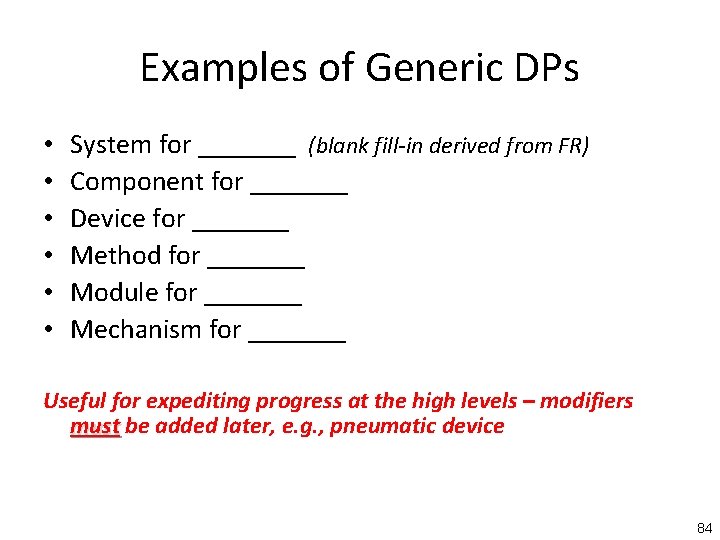
Examples of Generic DPs • • • System for _______ (blank fill-in derived from FR) Component for _______ Device for _______ Method for _______ Module for _______ Mechanism for _______ Useful for expediting progress at the high levels – modifiers must be added later, e. g. , pneumatic device 84
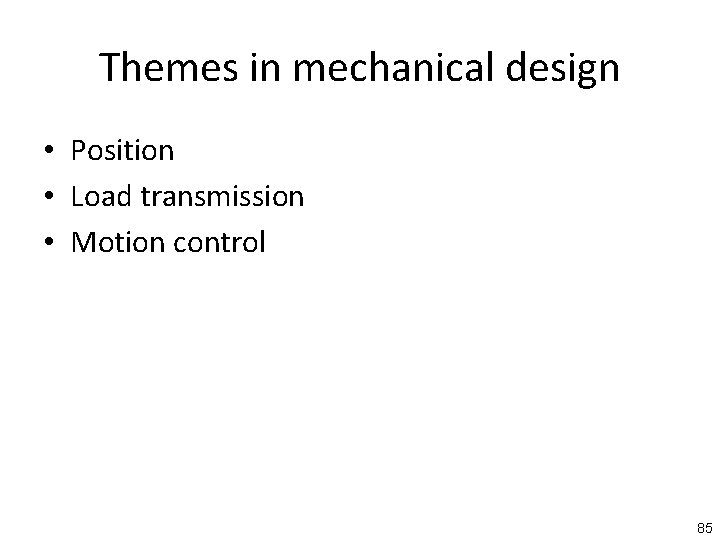
Themes in mechanical design • Position • Load transmission • Motion control 85
minimum number of FRs FR 0 - Prevent vessel from exploding Theme: Energy FR 1 - Prevent explosion due to chemical energy FR 2 - Prevent explosion due to electrical energy FR 3 - Prevent explosion due to temperature rise FR 4 - Prevent explosion due to pressure 86
Decompose machine shop safety themes: spatial v. energy Protect users from injury Protect at machine x Protect energy type y Protect users from injury Protect energy type y Protect at machine x Does the decomposition path matter? The low level DPs are a common set of protection devices and training 87
Zigzagging Decomposition 1 FR 0 DP 0 2 FR 1 FR 2 DP 1 3 4 5 FR 1. 1 FR 1. 2 7 FR 1. 3 8 9… DP 2 6 FR 2. 1 FR 2. 2 DP 1. 1 DP 1. 2 DP 1. 3 DP 2. 1 DP 2. 2
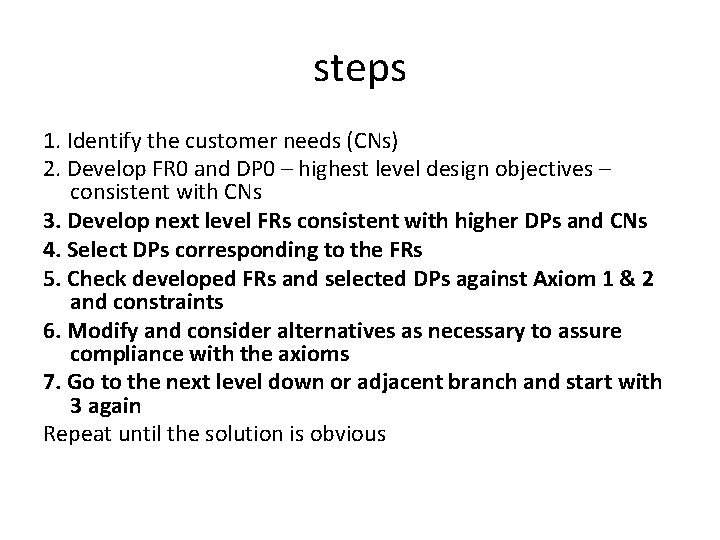
steps 1. Identify the customer needs (CNs) 2. Develop FR 0 and DP 0 – highest level design objectives – consistent with CNs 3. Develop next level FRs consistent with higher DPs and CNs 4. Select DPs corresponding to the FRs 5. Check developed FRs and selected DPs against Axiom 1 & 2 and constraints 6. Modify and consider alternatives as necessary to assure compliance with the axioms 7. Go to the next level down or adjacent branch and start with 3 again Repeat until the solution is obvious
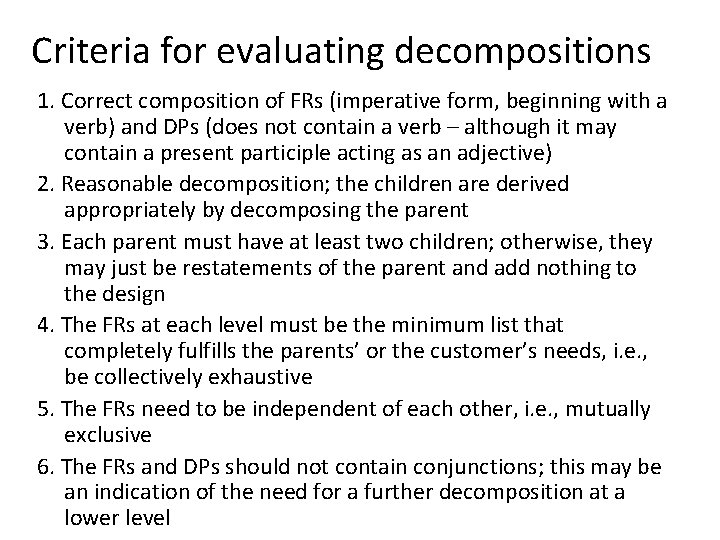
Criteria for evaluating decompositions 1. Correct composition of FRs (imperative form, beginning with a verb) and DPs (does not contain a verb – although it may contain a present participle acting as an adjective) 2. Reasonable decomposition; the children are derived appropriately by decomposing the parent 3. Each parent must have at least two children; otherwise, they may just be restatements of the parent and add nothing to the design 4. The FRs at each level must be the minimum list that completely fulfills the parents’ or the customer’s needs, i. e. , be collectively exhaustive 5. The FRs need to be independent of each other, i. e. , mutually exclusive 6. The FRs and DPs should not contain conjunctions; this may be an indication of the need for a further decomposition at a lower level
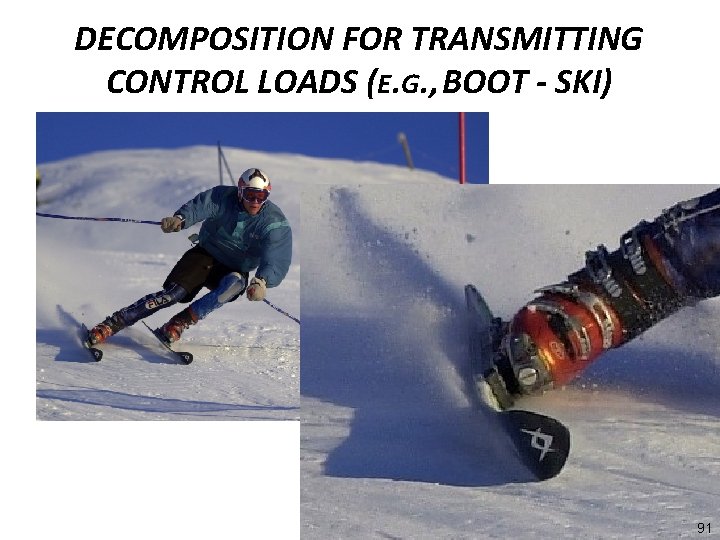
DECOMPOSITION FOR TRANSMITTING CONTROL LOADS (E. G. , BOOT - SKI) 91
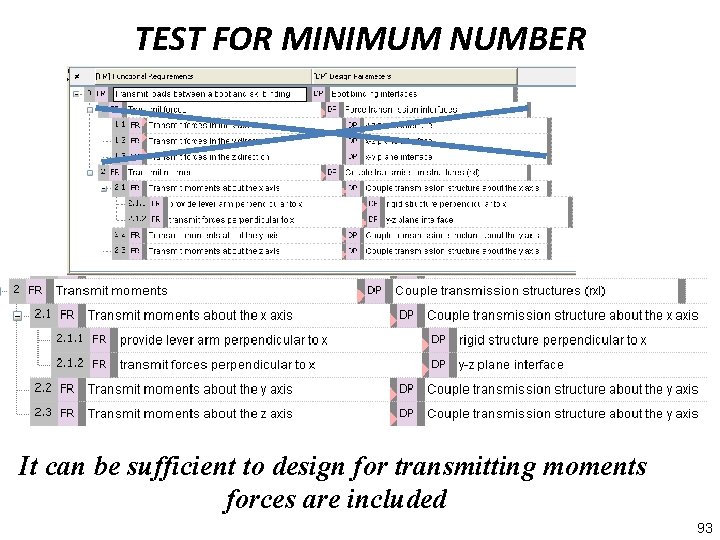
DECOMPOSITION FOR LOAD TRANSMISSION Cartesian theme: forces and moments x, y, z Moment transmission through a couple: r x. F 92
TEST FOR MINIMUM NUMBER It can be sufficient to design for transmitting moments forces are included 93
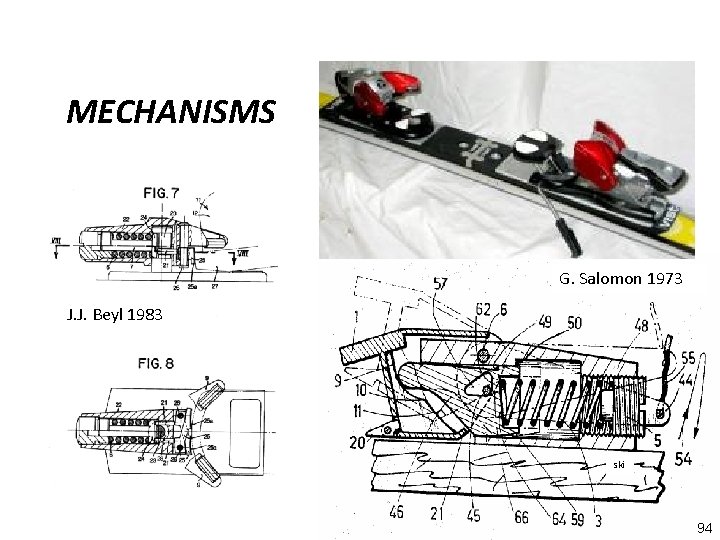
MECHANISMS G. Salomon 1973 J. J. Beyl 1983 ski 94
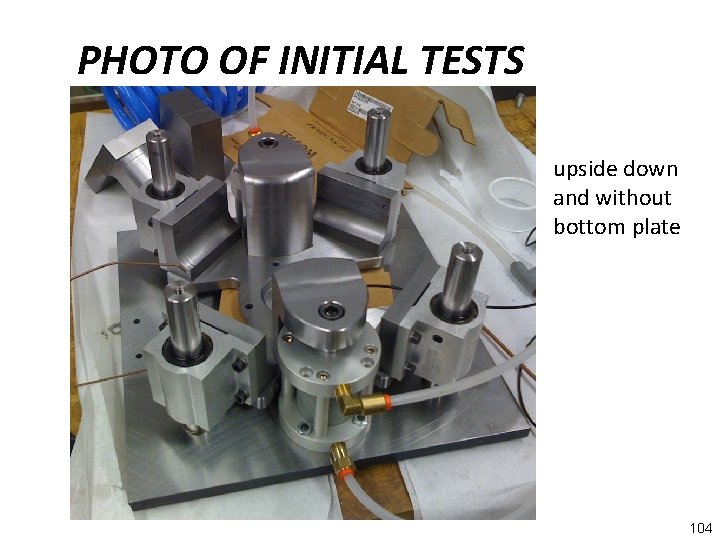
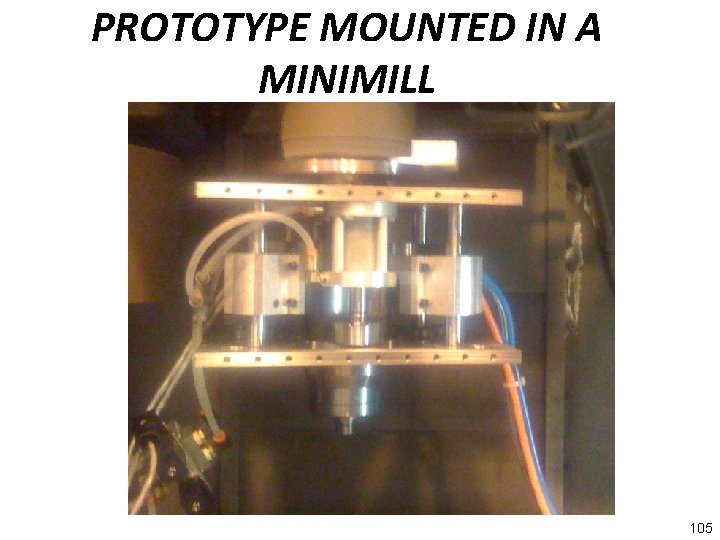
NEW DESIGN EXAMPLE JIG GRINDER ATTACHMENT WPI undergrad summer project for St. Gobain 95
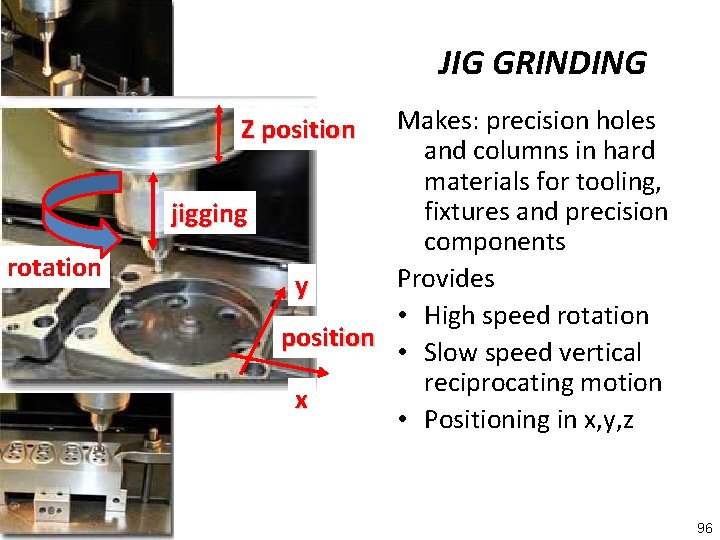
JIG GRINDING Makes: precision holes and columns in hard materials for tooling, fixtures and precision components Provides y • High speed rotation position • Slow speed vertical reciprocating motion x • Positioning in x, y, z Z position jigging rotation 96
MOORE JIG GRINDER 97
JIGGER – CUSTOMER NEEDS • CNs • Make attachment for Haas minimill to supply jigging motion • Use a high speed air spindle • Attach the device to the Haas Spindle 98
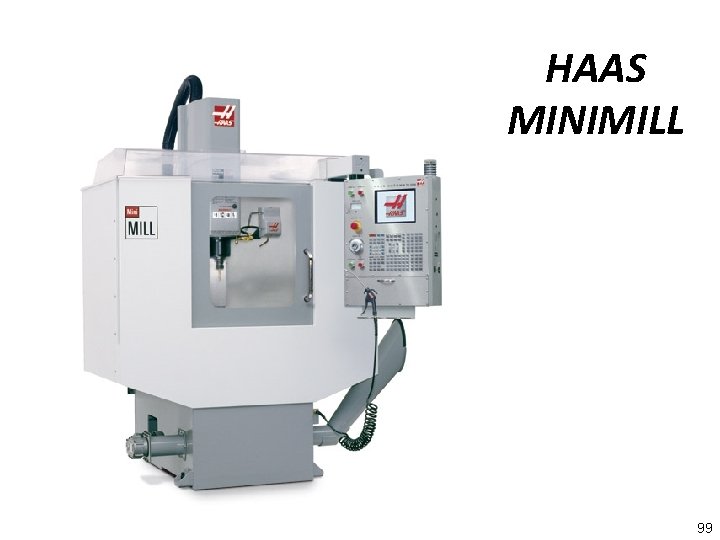
HAAS MINIMILL 99
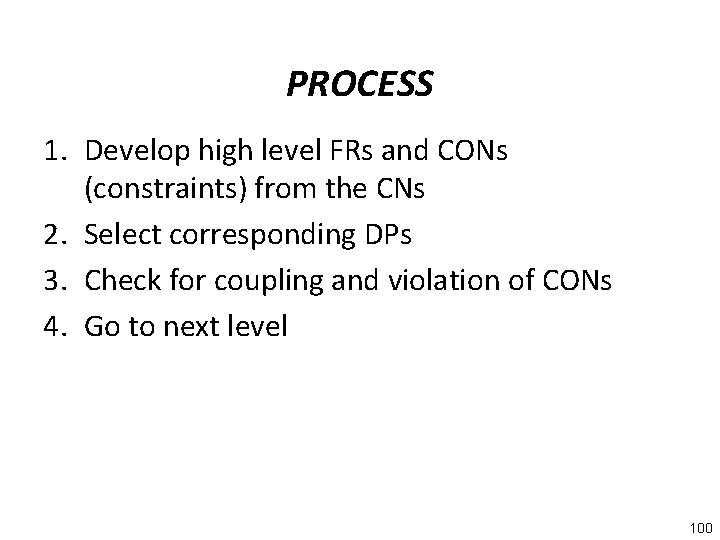
PROCESS 1. Develop high level FRs and CONs (constraints) from the CNs 2. Select corresponding DPs 3. Check for coupling and violation of CONs 4. Go to next level 100
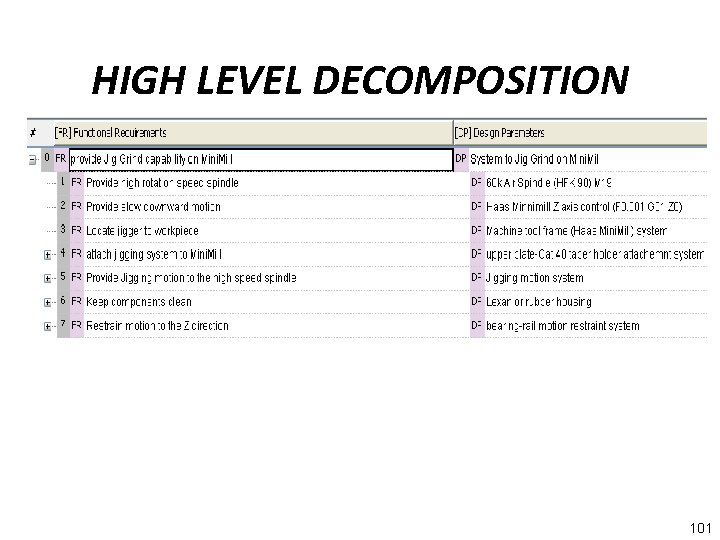
HIGH LEVEL DECOMPOSITION 101
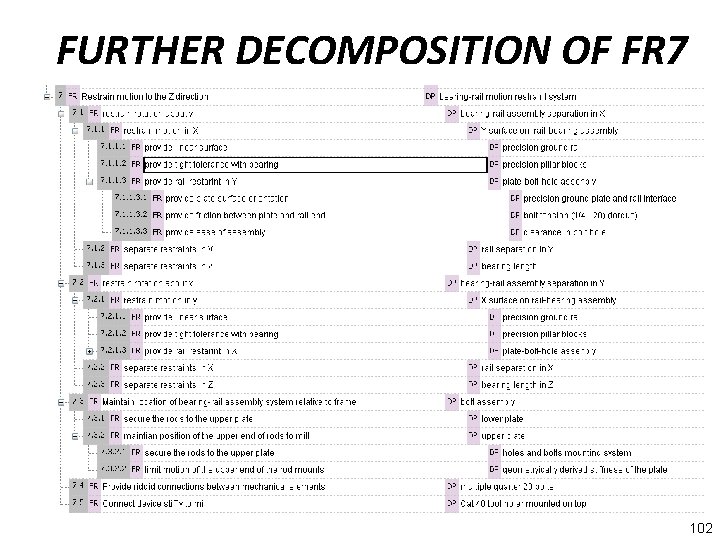
FURTHER DECOMPOSITION OF FR 7 102
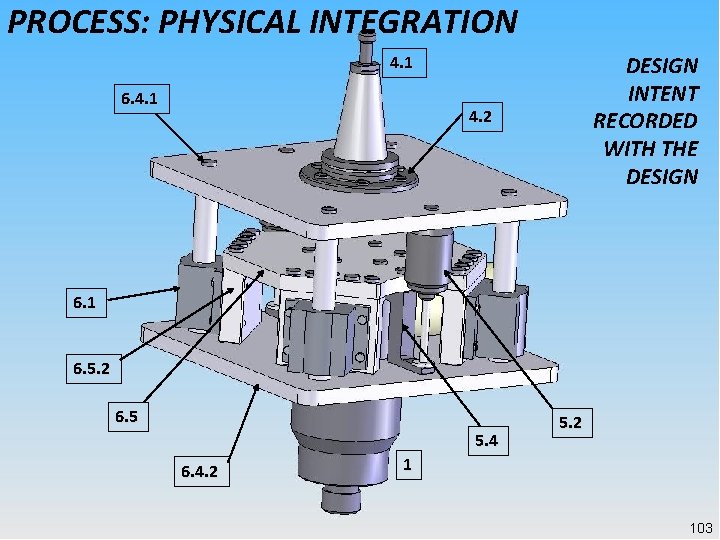
PROCESS: PHYSICAL INTEGRATION DESIGN INTENT RECORDED WITH THE DESIGN 4. 1 6. 4. 1 4. 2 6. 1 6. 5. 2 6. 5 5. 4 6. 4. 2 5. 2 1 103
PHOTO OF INITIAL TESTS upside down and without bottom plate 104
PROTOTYPE MOUNTED IN A MINIMILL 105
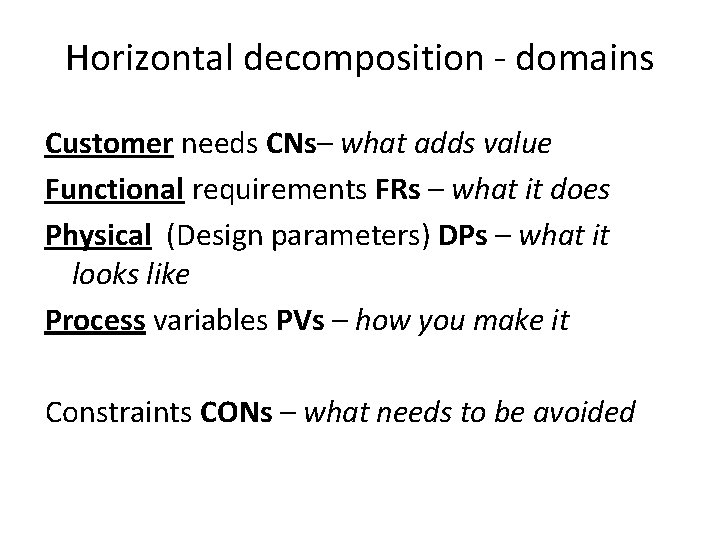
Horizontal decomposition - domains Customer needs CNs– what adds value Functional requirements FRs – what it does Physical (Design parameters) DPs – what it looks like Process variables PVs – how you make it Constraints CONs – what needs to be avoided
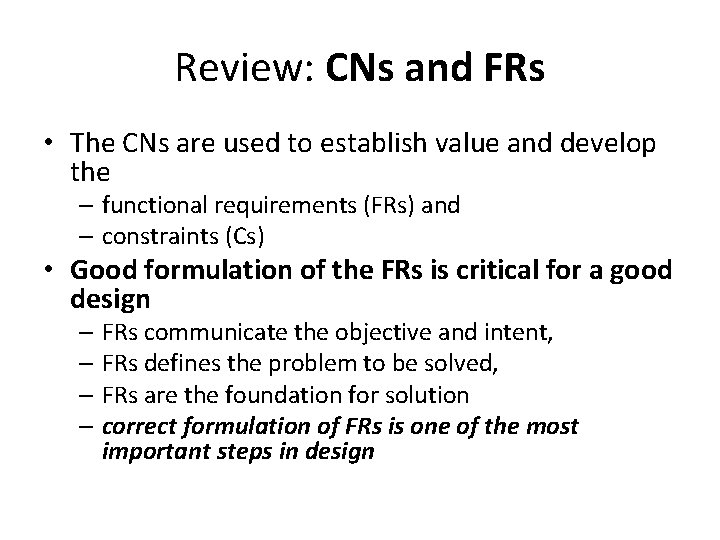
Review: CNs and FRs • The CNs are used to establish value and develop the – functional requirements (FRs) and – constraints (Cs) • Good formulation of the FRs is critical for a good design – FRs communicate the objective and intent, – FRs defines the problem to be solved, – FRs are the foundation for solution – correct formulation of FRs is one of the most important steps in design
Note • Some students call the decomposition (decomp) the axiomatic design – this is not necessarily correct – Decomps can be applied to other types problems that have nothing to do with axiomatic design • Literally the design is axiomatic if – it complies with the axioms, • which it may if the decomp has been developed according to the procedures that will be developed in the following lectures
Where from here? • Build the decomposition – the design process • Learn how to apply the axioms – Design and process matrices and their manipulation
Design Reviews
Design Engineers • design your design process! Design review • Evaluating and modifying a design solution • Done in a group
Objectives • Exploit the potential of teams in design work – Collaborative negotiations in addressing design options. • Learn how to manage a design review – effectively critique design projects
Design as Collaborative Negotiation Design reviews… • Iteration – monitor the discussion are there excessive iterations? • Convergence – does the discussion seem to be converging? • Consensus?
Consensus • The objective of the design review is to build consensus among the key people for advancing the design
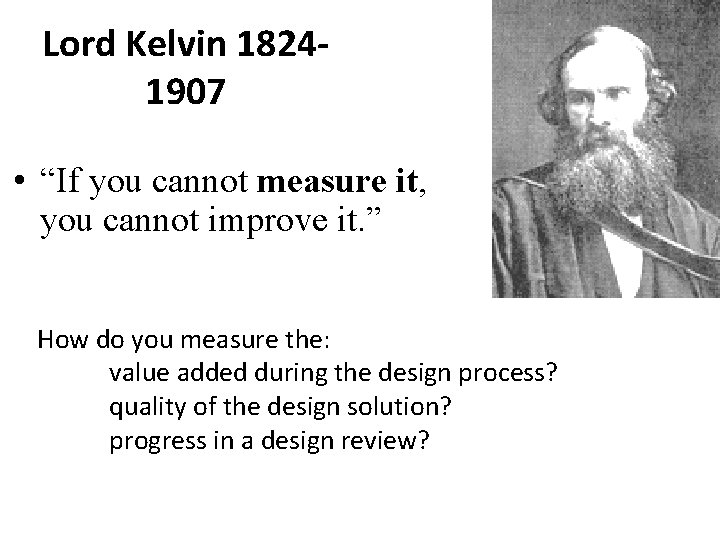
Lord Kelvin 18241907 • “If you cannot measure it, you cannot improve it. ” How do you measure the: value added during the design process? quality of the design solution? progress in a design review?
Value of measuring of design quality • Select the best design solution early in the development process – Reduce the uncertainty in predicting the success of a design solution – Avoid rushing to particular design solutions that might not be best – Focus resources on the best design solution early in the process – Build consensus • Reduce cost – Better product (the most expensive product is a bad one) • Reduced time to market
What to measure for the quality of the design solution? compliance with the axioms progress in a design solution? level of the decomposition
Design progress Traditional • Check lists – Prints – Signatures – Time tables AD • Decomposition extent • Compliance with axioms
The foundation for Consensus Agree on AD • the evaluation criteria (compliance with axioms) • the structure or architecture (domains and hierarchies) • measure progress by the decomp Then go with simple steps and clear
Communication • Design intent – good formulation of FRs – Worth the effort – Often seems non-productive • Themes • Definitions – design solution specific dictionary • Sufficient “Bandwidth”
Design review tips • Have a leader and a “coach” – keeps order – monitors progress (change in decomp or notes added) • Project the decomposition – Have someone dedicated to the keyboard – reflect the discussion – Build consensus by modifying FRs and DPs or adding notes • Give people a chance to express themselves – Provide “bandwidth” • Smart people get bored easily – Plenty of white board and pens • Write and draw while others are talking – Extra projectors – Everyone has a computer
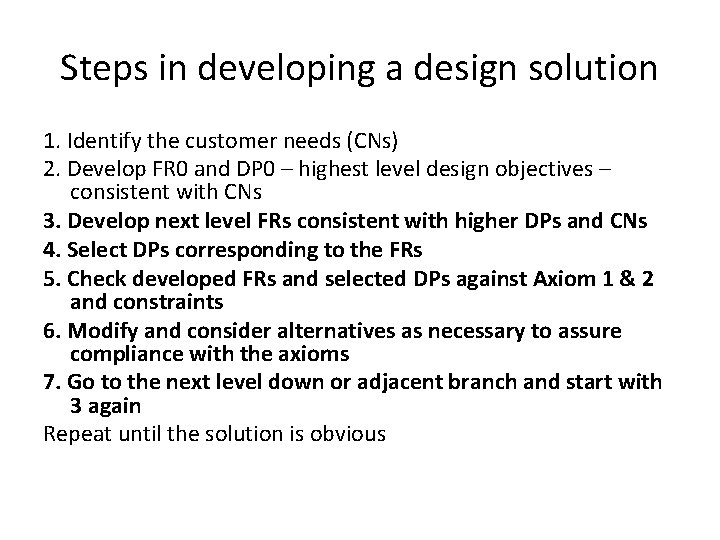
Steps in developing a design solution 1. Identify the customer needs (CNs) 2. Develop FR 0 and DP 0 – highest level design objectives – consistent with CNs 3. Develop next level FRs consistent with higher DPs and CNs 4. Select DPs corresponding to the FRs 5. Check developed FRs and selected DPs against Axiom 1 & 2 and constraints 6. Modify and consider alternatives as necessary to assure compliance with the axioms 7. Go to the next level down or adjacent branch and start with 3 again Repeat until the solution is obvious
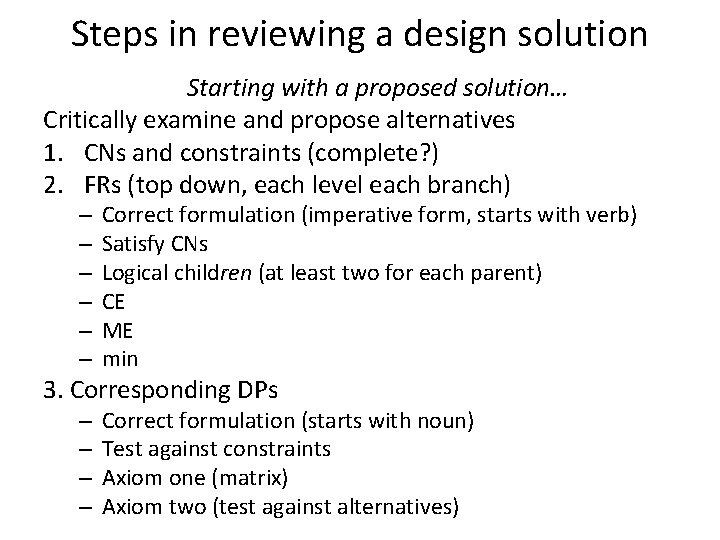
Steps in reviewing a design solution Starting with a proposed solution… Critically examine and propose alternatives 1. CNs and constraints (complete? ) 2. FRs (top down, each level each branch) – – – Correct formulation (imperative form, starts with verb) Satisfy CNs Logical children (at least two for each parent) CE ME min 3. Corresponding DPs – – Correct formulation (starts with noun) Test against constraints Axiom one (matrix) Axiom two (test against alternatives)
Measuring progress during the review • Has consensus been reached on the proposed design? – If not, has the design decomp changed? • at least, has the dictionary developed? • If none of these, then no apparent progress and no value added.
Prolonged discussion problems • Lost focus – Designing equipment or mission? • Discussion outside scope? • Need to acknowledge concerns (notes) • Need to assign special problems for more work outside of the meeting
Collaborative negotiation tactics • Ask - How will you know when the problem has been solved? • Record points of dispute for resolution later • Check definitions
Concluding remarks Value needs to be assigned to progress in the design • Value should be based on – good decompositions – compliance with the axioms • Promote good communication and consensus building – bandwidth – design rules (axioms) – clear communication of design intent, – clear links to design features (DPs)
Designs are like babies - they look good to the people that made them “axiomatic design takes you from argument to analysis in design evaluation” (Dr. E. M. Shipulski) The axioms are objective criteria for evaluating designs are necessary to avoid prolonged nonproductive discussion
Teaching resources on the web • Nam Suh’s keynote from ICAD 2013 – http: //www. youtube. com/watch? v=x. SI 8 Ux. Si 5 e. M • Introductory lecture that I gave at WPI before WPI hosted the 7 th International Conference on Axiomatic Design: http: //www. youtube. com/watch? v=Wiimzx. RJh. Ws • Video books for purchase from Retrieve. com (10 -20 minute segments) – http: //myknowledgeapps. com/app/elements-of-axiomatic-design/ • instructional videos on youtube (long segments): – – part 1 http: //www. youtube. com/watch? v=x. Ccys. LQ 0 d. Gk part 2 http: //www. youtube. com/watch? v=g. FGZz 3 Qt. VJ 8 part 3 http: //www. youtube. com/watch? v=0 mm 7 x_g. Jy. K 8 part 4 http: //www. youtube. com/watch? v=q. URM 1 A 1 BZJw • Links to a workshop I gave to pre-University teachers: http: //www. youtube. com/watch? v=b. FIMa. Hr. J 8 No ; http: //www. youtube. com/watch? v=h. N 1 S 1 ba. Qyo 0; http: //www. youtube. com/watch? v=e. AGOGjpo. QRI; … there are something like 8 of these
Thank you for your kind attention