
Lexical Semantics Chapter 19 Lecture 13 November 2012
Lexical Semantics Chapter 19 Lecture #13 November 2012 Largely based on Kathy Mckeown’s lecture which was based on Dan Jurafsky, Jim Martin, and Chris Manning 1
Three Perspectives on Meaning 1. Lexical Semantics – The meanings of individual words 2. Formal Semantics (or Compositional Semantics or Sentential Semantics) – How those meanings combine to make meanings for individual sentences or utterances 3. Discourse or Pragmatics – – How those meanings combine with each other and with other facts about various kinds of context to make meanings for a text or discourse. Dialog or Conversation is often lumped together with Discourse. 2
Outline: Computational Lexical Semantics • Introduction to Lexical Semantics – Word relations such as Homonymy, Polysemy, Synonymy – Online resources: Word. Net • Computational Lexical Semantics – Word Sense Disambiguation • Supervised • Semi-supervised – Word Similarity • Thesaurus-based • Distributional 3
Preliminaries • What’s a word? – Definitions we’ve used over the class: Types, tokens, stems, roots, uninflected forms, etc… • Lexeme: An entry in a lexicon consisting of a pairing of a form with a single meaning representation • Lexicon: A collection of lexemes • Lemma – citation form – uninflected form (used to represent a lexeme). Need to do morphological parsing to get from wordform to lemma (lemmatization) • Lemma is part-of-speech specific (e. g. , table N and V) 4

Relationships between word meanings • • Homonymy Polysemy Synonymy Antonymy Hypernomy Hyponomy Meronomy 5
Homonymy • Lexemes that share a form – Phonological, orthographic or both • But have unrelated, distinct meanings • Clear example: – Bat (wooden stick-like thing) vs – Bat (flying scary mammal thing) – Or bank (financial institution) versus bank (riverside) • Can be homophones, homographs, or both – Homophones: • Write and right • Piece and peace 6
Homonymy causes problems for NLP applications • Text-to-Speech – Same orthographic form but different phonological form • Bass vs bass • Bow vs bow • Record vs record • Information retrieval – Different meanings same orthographic form • QUERY: bat care • Machine Translation • Speech recognition 7
Polysemy • The bank is constructed from red brick I withdrew the money from the bank • Are those the same sense? • What about river bank? • What about: The food bank is having a donation drive next week. • Different senses but some more related than others… • When two senses are related semantically we call it polysemy (rather than homonymy) 8
Polysemy • A single lexeme with multiple related meanings (bank the building, bank the financial institution) • Most non-rare words have multiple meanings – The number of meanings is related to its frequency – Verbs tend more to polysemy – Distinguishing polysemy from homonymy isn’t always easy (or necessary) 9
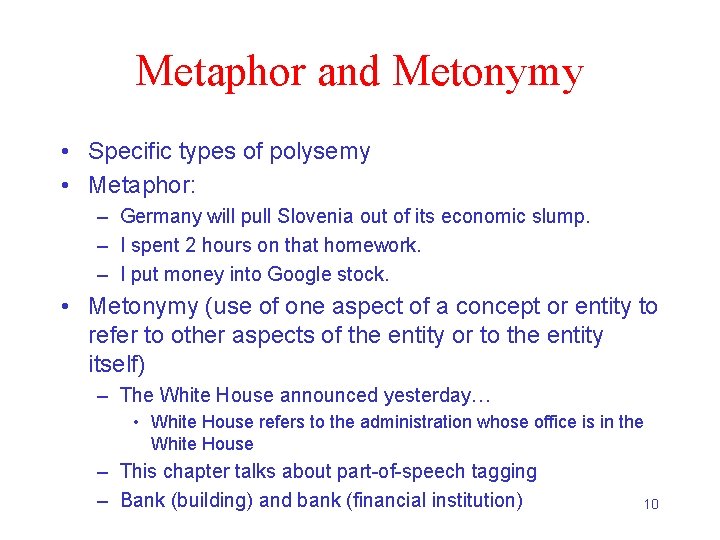
Metaphor and Metonymy • Specific types of polysemy • Metaphor: – Germany will pull Slovenia out of its economic slump. – I spent 2 hours on that homework. – I put money into Google stock. • Metonymy (use of one aspect of a concept or entity to refer to other aspects of the entity or to the entity itself) – The White House announced yesterday… • White House refers to the administration whose office is in the White House – This chapter talks about part-of-speech tagging – Bank (building) and bank (financial institution) 10
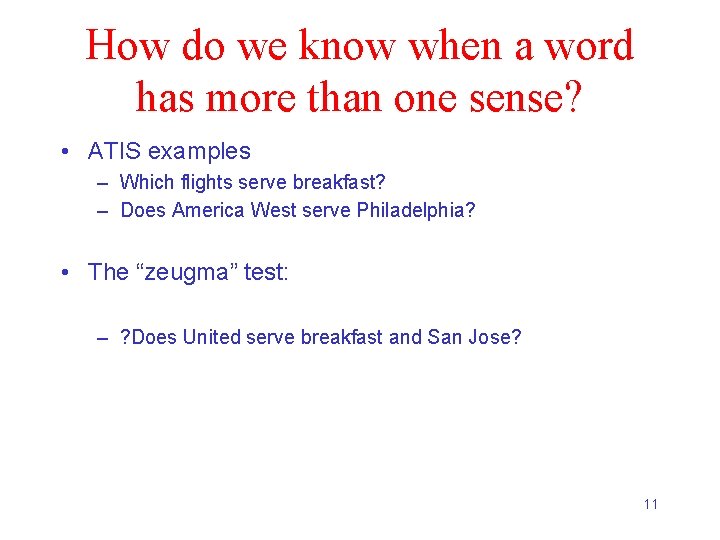
How do we know when a word has more than one sense? • ATIS examples – Which flights serve breakfast? – Does America West serve Philadelphia? • The “zeugma” test: – ? Does United serve breakfast and San Jose? 11
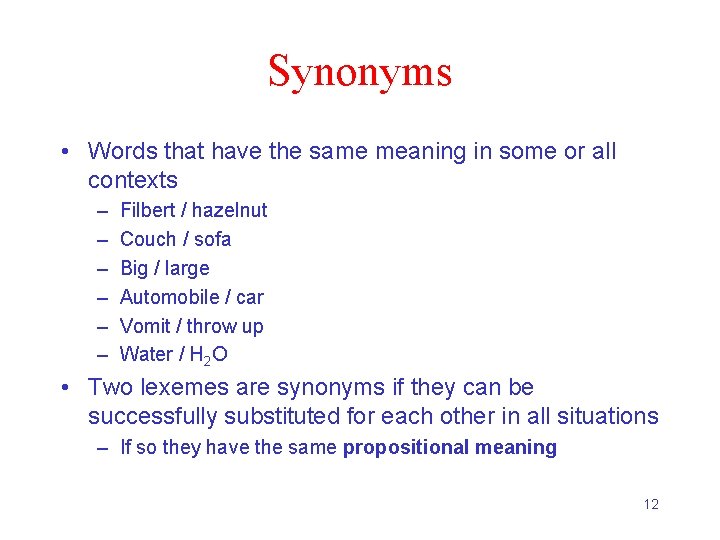
Synonyms • Words that have the same meaning in some or all contexts – – – Filbert / hazelnut Couch / sofa Big / large Automobile / car Vomit / throw up Water / H 2 O • Two lexemes are synonyms if they can be successfully substituted for each other in all situations – If so they have the same propositional meaning 12
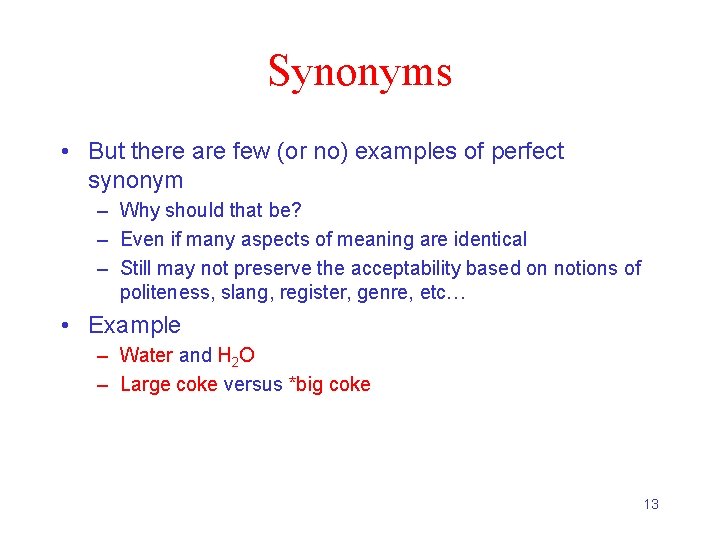
Synonyms • But there are few (or no) examples of perfect synonym – Why should that be? – Even if many aspects of meaning are identical – Still may not preserve the acceptability based on notions of politeness, slang, register, genre, etc… • Example – Water and H 2 O – Large coke versus *big coke 13
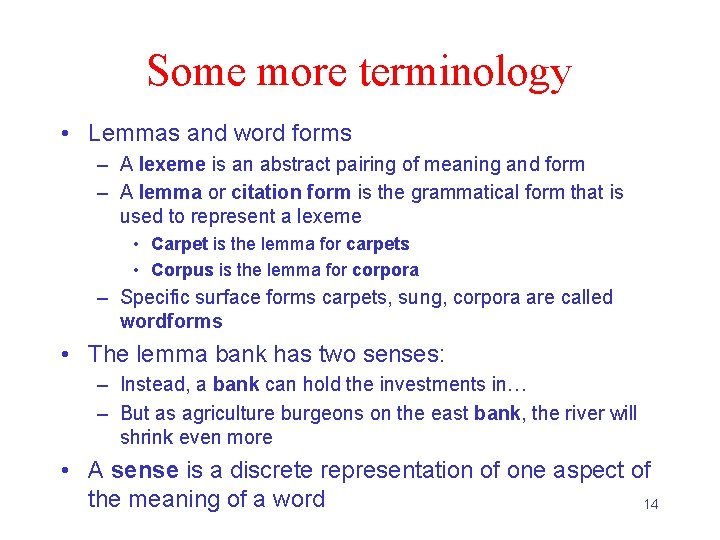
Some more terminology • Lemmas and word forms – A lexeme is an abstract pairing of meaning and form – A lemma or citation form is the grammatical form that is used to represent a lexeme • Carpet is the lemma for carpets • Corpus is the lemma for corpora – Specific surface forms carpets, sung, corpora are called wordforms • The lemma bank has two senses: – Instead, a bank can hold the investments in… – But as agriculture burgeons on the east bank, the river will shrink even more • A sense is a discrete representation of one aspect of the meaning of a word 14
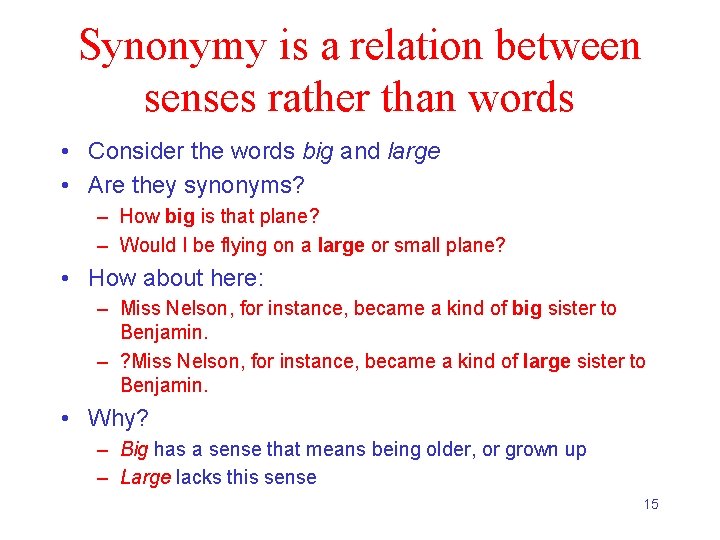
Synonymy is a relation between senses rather than words • Consider the words big and large • Are they synonyms? – How big is that plane? – Would I be flying on a large or small plane? • How about here: – Miss Nelson, for instance, became a kind of big sister to Benjamin. – ? Miss Nelson, for instance, became a kind of large sister to Benjamin. • Why? – Big has a sense that means being older, or grown up – Large lacks this sense 15
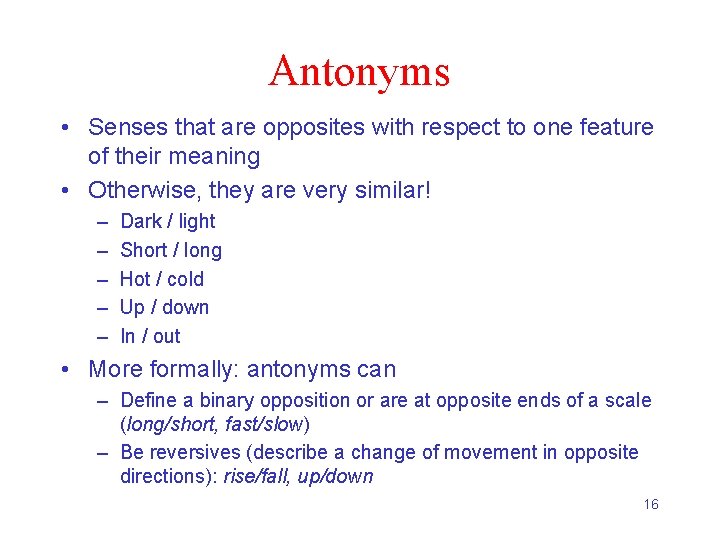
Antonyms • Senses that are opposites with respect to one feature of their meaning • Otherwise, they are very similar! – – – Dark / light Short / long Hot / cold Up / down In / out • More formally: antonyms can – Define a binary opposition or are at opposite ends of a scale (long/short, fast/slow) – Be reversives (describe a change of movement in opposite directions): rise/fall, up/down 16
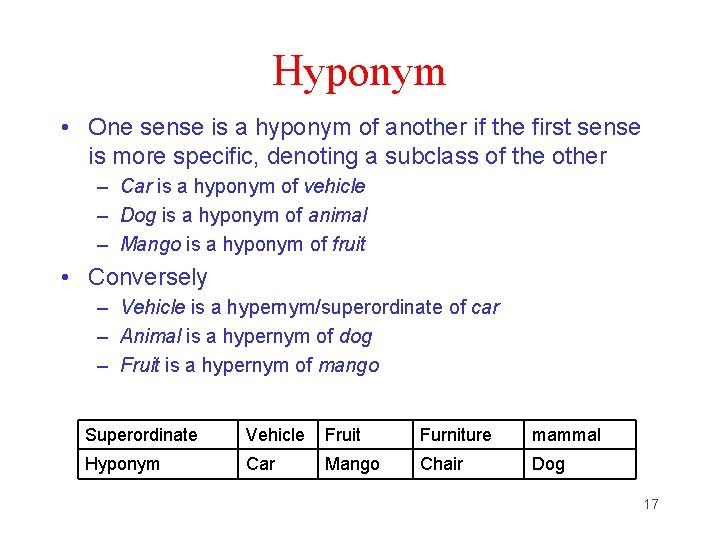
Hyponym • One sense is a hyponym of another if the first sense is more specific, denoting a subclass of the other – Car is a hyponym of vehicle – Dog is a hyponym of animal – Mango is a hyponym of fruit • Conversely – Vehicle is a hypernym/superordinate of car – Animal is a hypernym of dog – Fruit is a hypernym of mango Superordinate Vehicle Fruit Furniture mammal Hyponym Car Mango Chair Dog 17
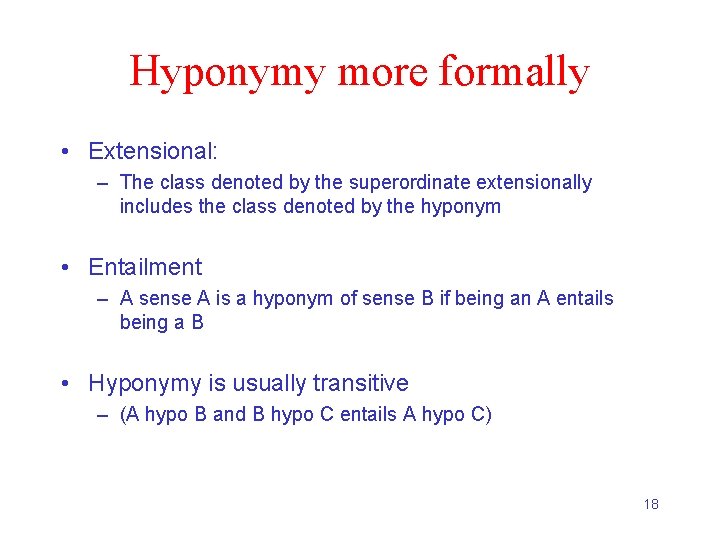
Hyponymy more formally • Extensional: – The class denoted by the superordinate extensionally includes the class denoted by the hyponym • Entailment – A sense A is a hyponym of sense B if being an A entails being a B • Hyponymy is usually transitive – (A hypo B and B hypo C entails A hypo C) 18
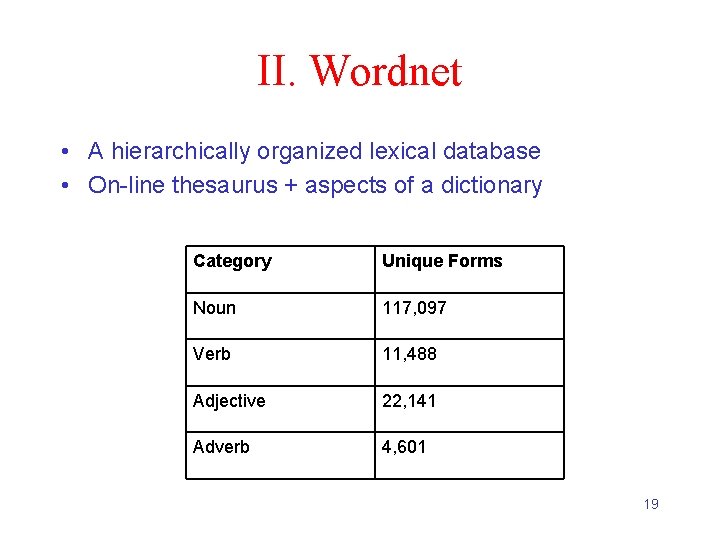
II. Wordnet • A hierarchically organized lexical database • On-line thesaurus + aspects of a dictionary Category Unique Forms Noun 117, 097 Verb 11, 488 Adjective 22, 141 Adverb 4, 601 19
Wordnet • Where it is: • http: //wordnetweb. princeton. edu/perl/webwn 20
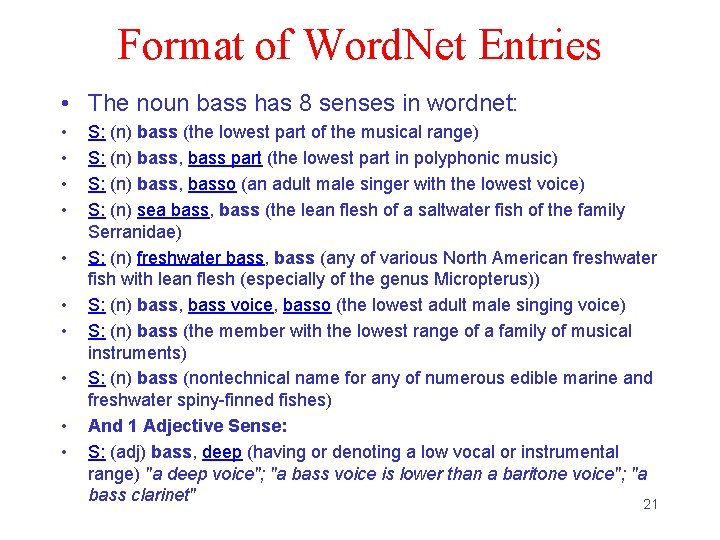
Format of Word. Net Entries • The noun bass has 8 senses in wordnet: • • • S: (n) bass (the lowest part of the musical range) S: (n) bass, bass part (the lowest part in polyphonic music) S: (n) bass, basso (an adult male singer with the lowest voice) S: (n) sea bass, bass (the lean flesh of a saltwater fish of the family Serranidae) S: (n) freshwater bass, bass (any of various North American freshwater fish with lean flesh (especially of the genus Micropterus)) S: (n) bass, bass voice, basso (the lowest adult male singing voice) S: (n) bass (the member with the lowest range of a family of musical instruments) S: (n) bass (nontechnical name for any of numerous edible marine and freshwater spiny-finned fishes) And 1 Adjective Sense: S: (adj) bass, deep (having or denoting a low vocal or instrumental range) "a deep voice"; "a bass voice is lower than a baritone voice"; "a bass clarinet" 21
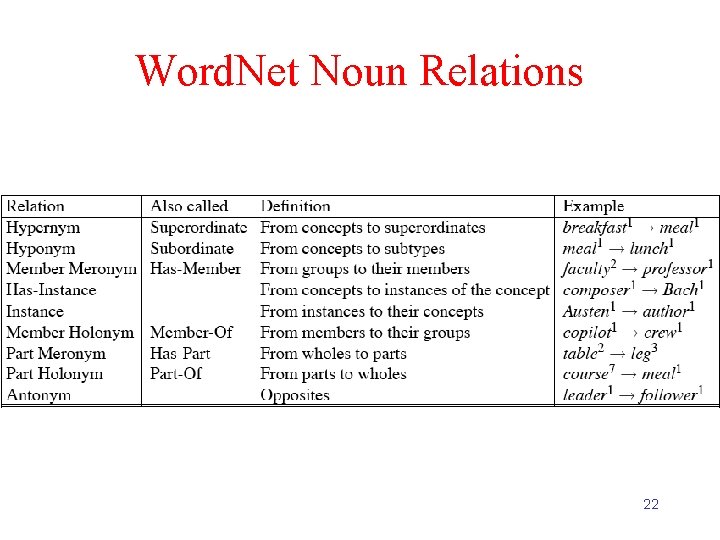
Word. Net Noun Relations 22
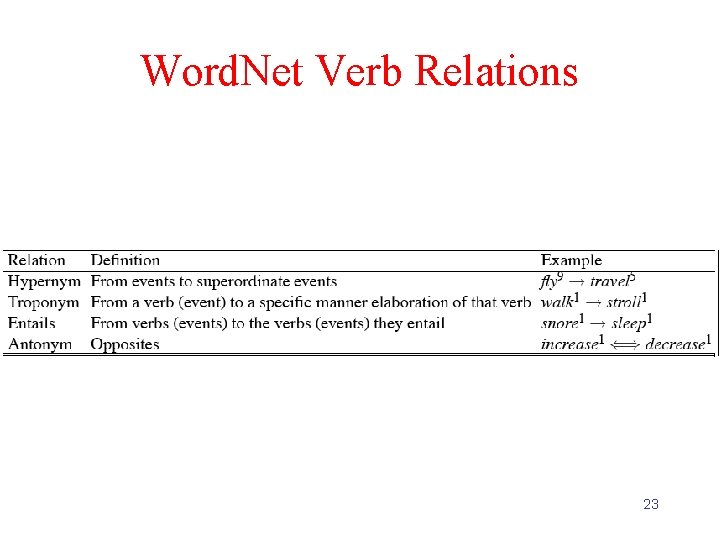
Word. Net Verb Relations 23

24
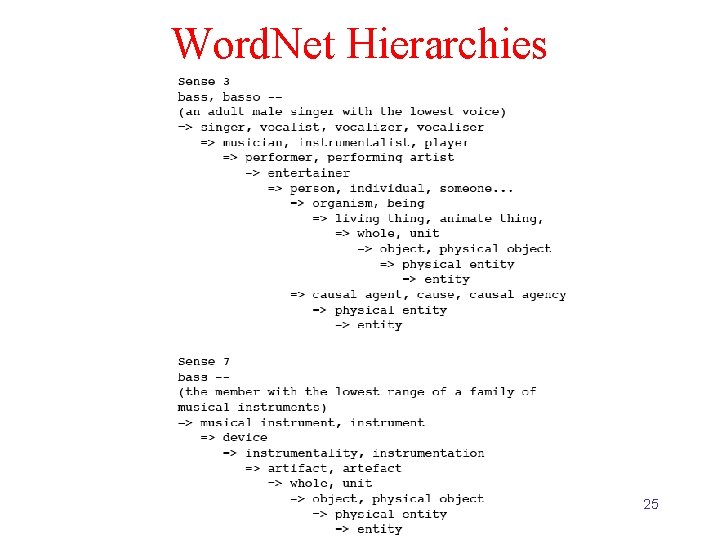
Word. Net Hierarchies 25

How is “sense” defined in Word. Net? • The set of near-synonyms for a Word. Net sense is called a synset (synonym set); it’s their version of a sense or a concept. • Example: chump as a noun to mean – ‘a person who is gullible and easy to take advantage of’ – chump#1, fool#2, gull#1, mark#9, patsy#1, fall guy#1, sucker#1, soft touch#1, mug#2 (a person who is gullible and easy to take advantage of) • Each of these senses share this same gloss • Thus, for Word. Net, the meaning of this sense of chump is this list. 26
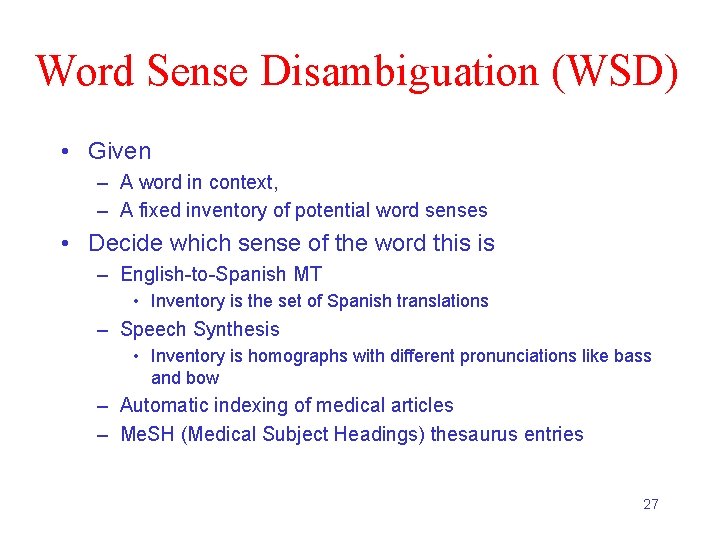
Word Sense Disambiguation (WSD) • Given – A word in context, – A fixed inventory of potential word senses • Decide which sense of the word this is – English-to-Spanish MT • Inventory is the set of Spanish translations – Speech Synthesis • Inventory is homographs with different pronunciations like bass and bow – Automatic indexing of medical articles – Me. SH (Medical Subject Headings) thesaurus entries 27
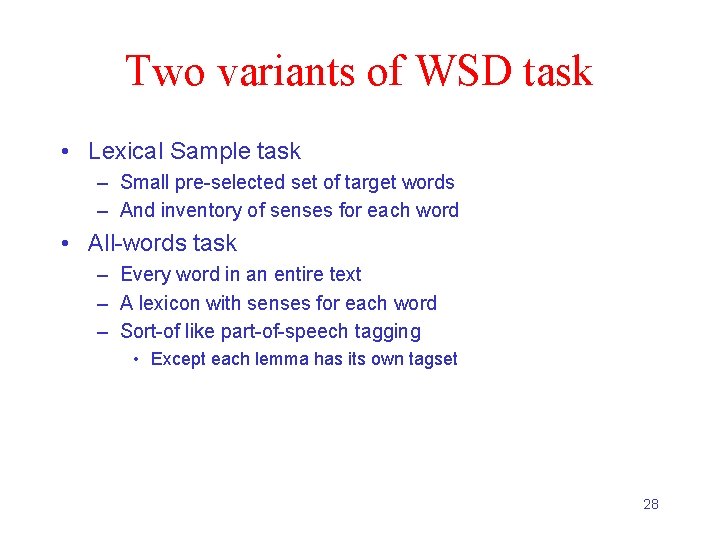
Two variants of WSD task • Lexical Sample task – Small pre-selected set of target words – And inventory of senses for each word • All-words task – Every word in an entire text – A lexicon with senses for each word – Sort-of like part-of-speech tagging • Except each lemma has its own tagset 28
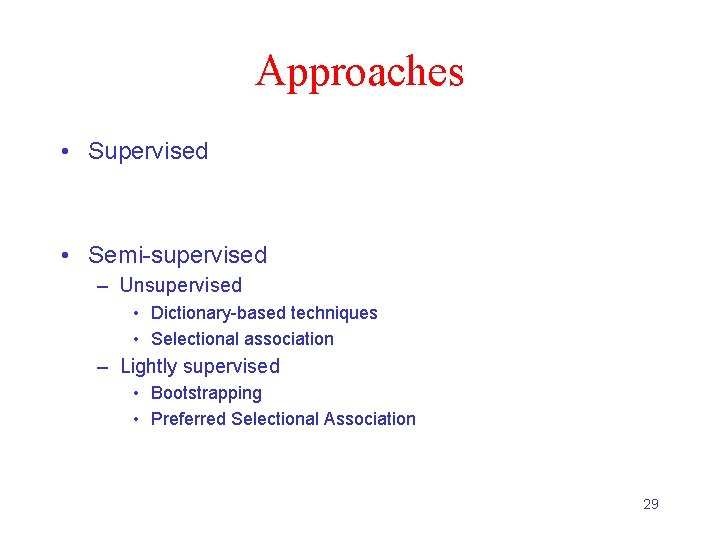
Approaches • Supervised • Semi-supervised – Unsupervised • Dictionary-based techniques • Selectional association – Lightly supervised • Bootstrapping • Preferred Selectional Association 29
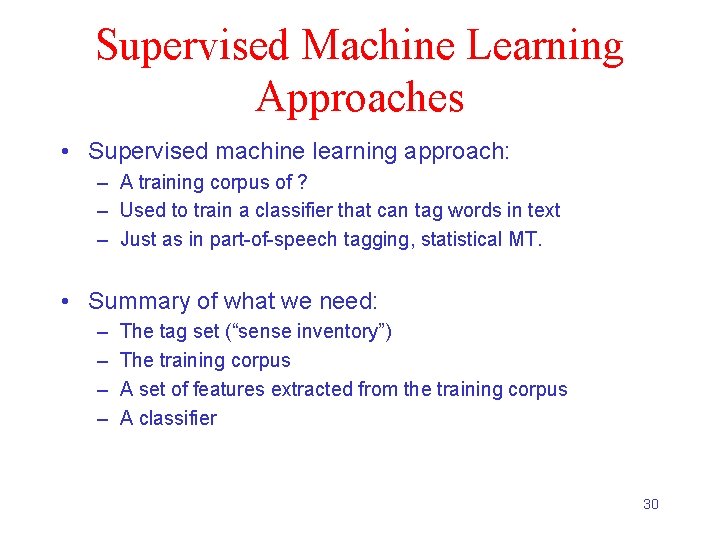
Supervised Machine Learning Approaches • Supervised machine learning approach: – A training corpus of ? – Used to train a classifier that can tag words in text – Just as in part-of-speech tagging, statistical MT. • Summary of what we need: – – The tag set (“sense inventory”) The training corpus A set of features extracted from the training corpus A classifier 30
Supervised WSD 1: WSD Tag • What’s a tag? 31
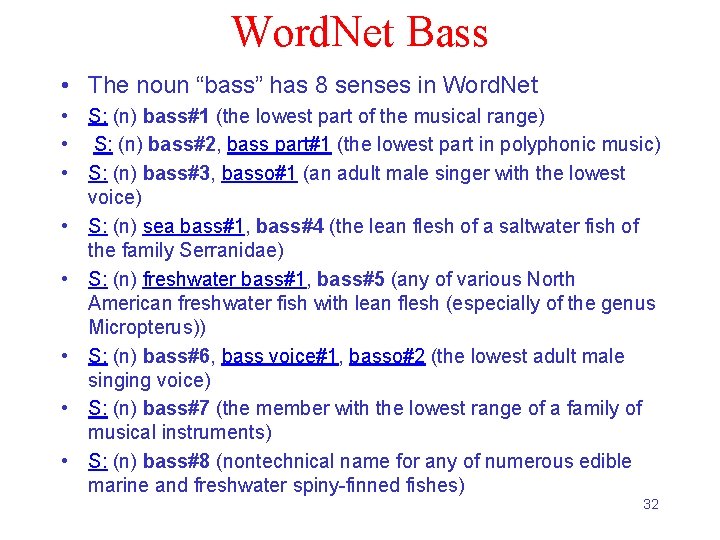
Word. Net Bass • The noun “bass” has 8 senses in Word. Net • S: (n) bass#1 (the lowest part of the musical range) • S: (n) bass#2, bass part#1 (the lowest part in polyphonic music) • S: (n) bass#3, basso#1 (an adult male singer with the lowest voice) • S: (n) sea bass#1, bass#4 (the lean flesh of a saltwater fish of the family Serranidae) • S: (n) freshwater bass#1, bass#5 (any of various North American freshwater fish with lean flesh (especially of the genus Micropterus)) • S: (n) bass#6, bass voice#1, basso#2 (the lowest adult male singing voice) • S: (n) bass#7 (the member with the lowest range of a family of musical instruments) • S: (n) bass#8 (nontechnical name for any of numerous edible marine and freshwater spiny-finned fishes) 32
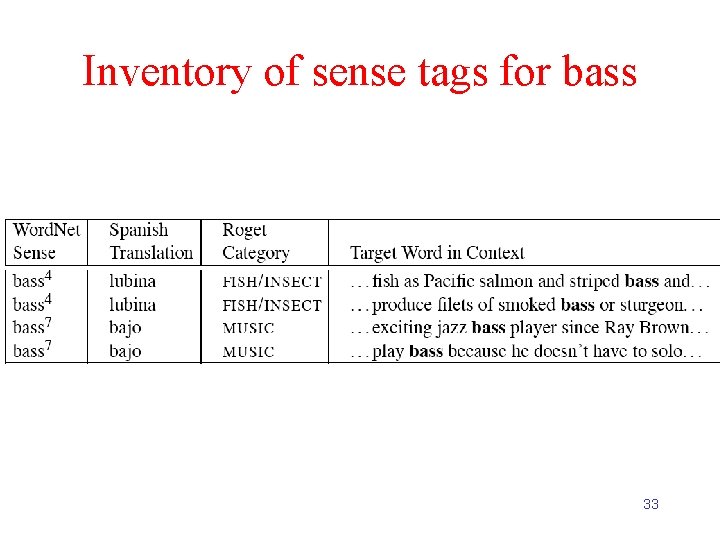
Inventory of sense tags for bass 33
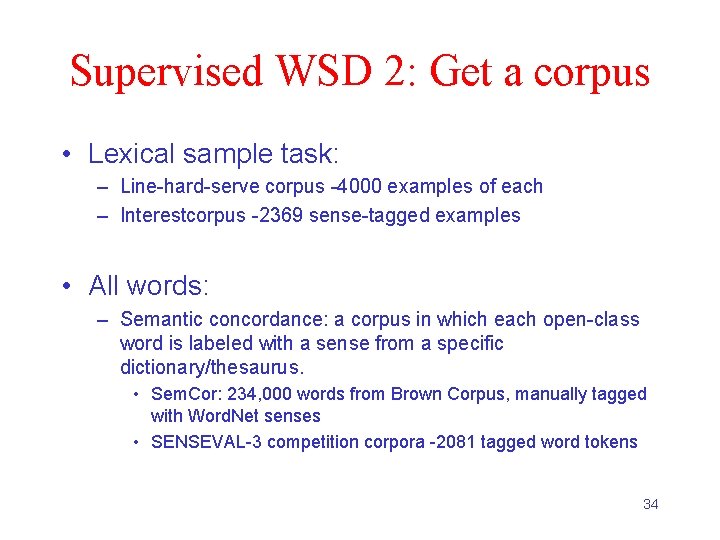
Supervised WSD 2: Get a corpus • Lexical sample task: – Line-hard-serve corpus -4000 examples of each – Interestcorpus -2369 sense-tagged examples • All words: – Semantic concordance: a corpus in which each open-class word is labeled with a sense from a specific dictionary/thesaurus. • Sem. Cor: 234, 000 words from Brown Corpus, manually tagged with Word. Net senses • SENSEVAL-3 competition corpora -2081 tagged word tokens 34
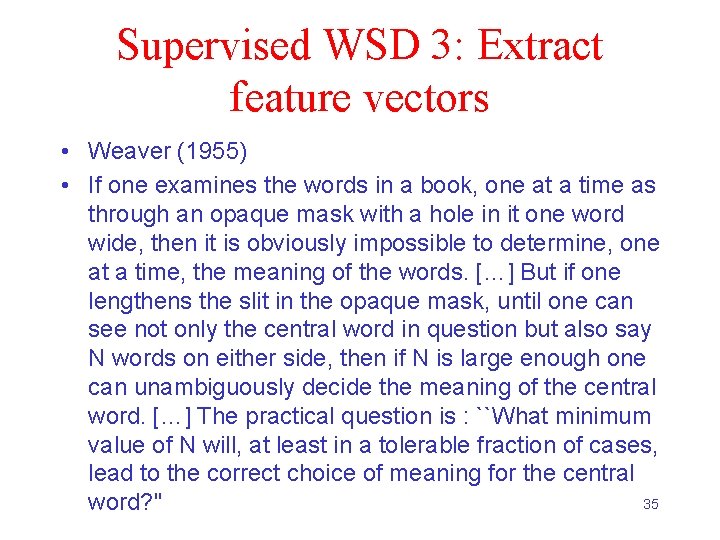
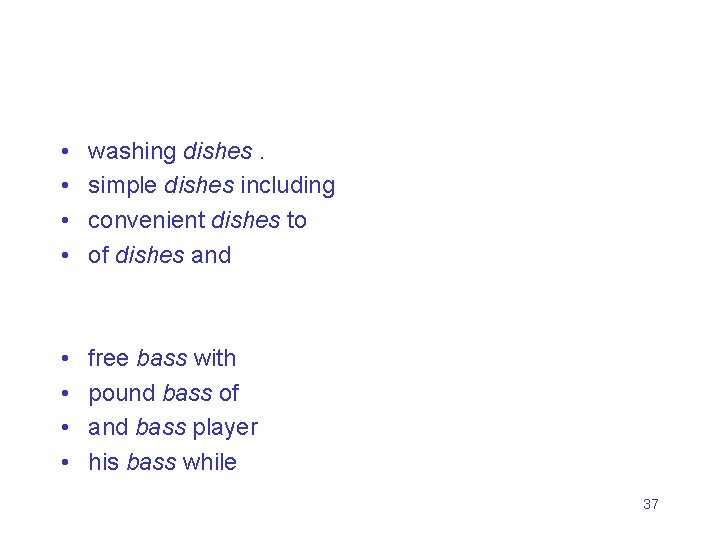
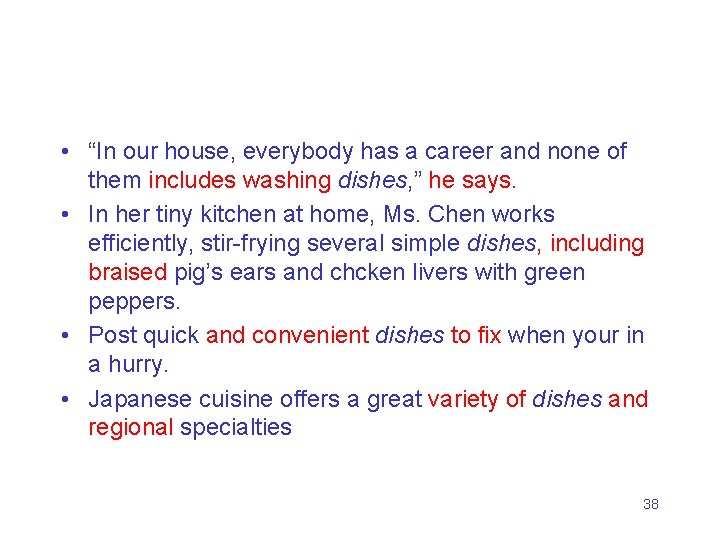
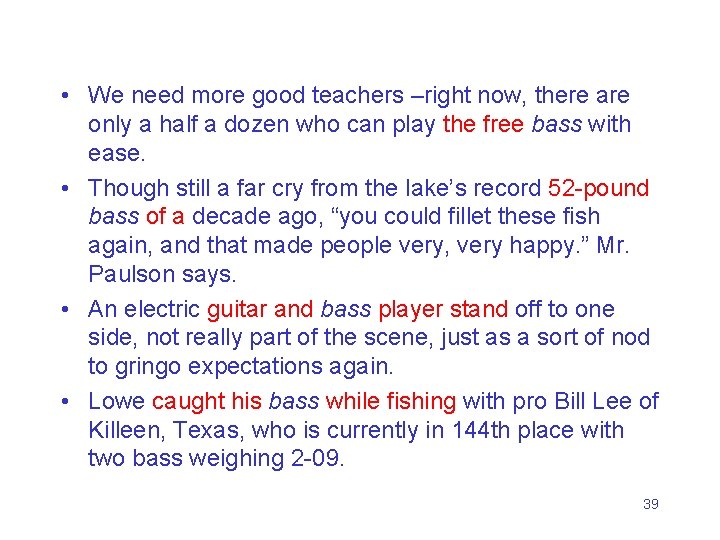
Supervised WSD 3: Extract feature vectors • Weaver (1955) • If one examines the words in a book, one at a time as through an opaque mask with a hole in it one word wide, then it is obviously impossible to determine, one at a time, the meaning of the words. […] But if one lengthens the slit in the opaque mask, until one can see not only the central word in question but also say N words on either side, then if N is large enough one can unambiguously decide the meaning of the central word. […] The practical question is : ``What minimum value of N will, at least in a tolerable fraction of cases, lead to the correct choice of meaning for the central 35 word? ''
• Dishes • Bass 36
• • washing dishes. simple dishes including convenient dishes to of dishes and • • free bass with pound bass of and bass player his bass while 37
• “In our house, everybody has a career and none of them includes washing dishes, ” he says. • In her tiny kitchen at home, Ms. Chen works efficiently, stir-frying several simple dishes, including braised pig’s ears and chcken livers with green peppers. • Post quick and convenient dishes to fix when your in a hurry. • Japanese cuisine offers a great variety of dishes and regional specialties 38
• We need more good teachers –right now, there are only a half a dozen who can play the free bass with ease. • Though still a far cry from the lake’s record 52 -pound bass of a decade ago, “you could fillet these fish again, and that made people very, very happy. ” Mr. Paulson says. • An electric guitar and bass player stand off to one side, not really part of the scene, just as a sort of nod to gringo expectations again. • Lowe caught his bass while fishing with pro Bill Lee of Killeen, Texas, who is currently in 144 th place with two bass weighing 2 -09. 39
Feature Vectors • A simple representation for each observation (each instance of a target word) – Vectors of sets of feature/value pairs – I. e. files of comma-separated values • These vectors should represent the window of words around the target How big should that window be? 40
Two kinds of features in the vectors • Collocational features and bag-of-words features – Collocational • Features about words at specific positions near target word • Often limited to just word identity and POS – Bag-of-words – Features about words that occur anywhere in the window (regardless of position) – Typically limited to frequency counts 41
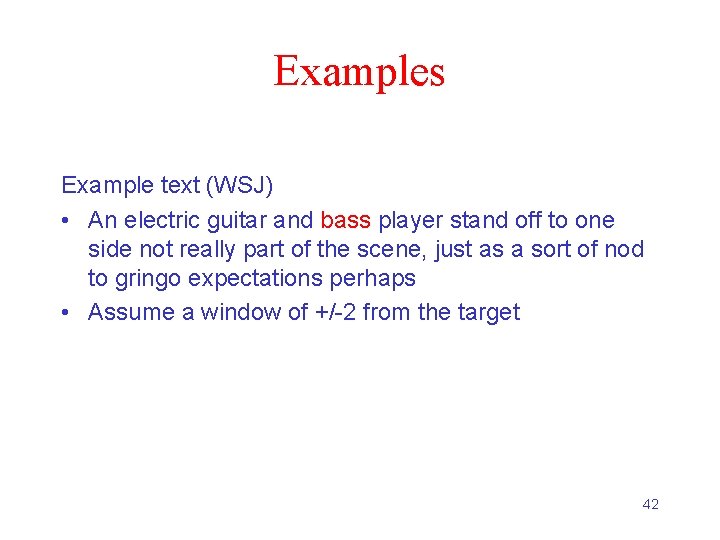
Examples Example text (WSJ) • An electric guitar and bass player stand off to one side not really part of the scene, just as a sort of nod to gringo expectations perhaps • Assume a window of +/-2 from the target 42
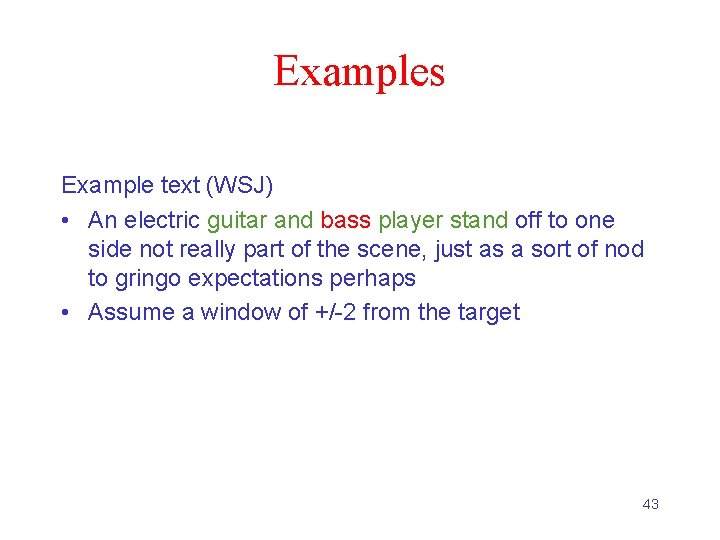
Examples Example text (WSJ) • An electric guitar and bass player stand off to one side not really part of the scene, just as a sort of nod to gringo expectations perhaps • Assume a window of +/-2 from the target 43
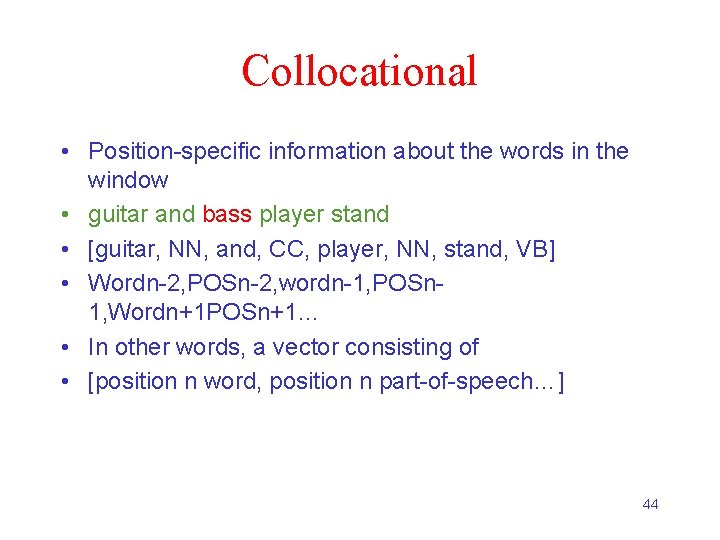
Collocational • Position-specific information about the words in the window • guitar and bass player stand • [guitar, NN, and, CC, player, NN, stand, VB] • Wordn-2, POSn-2, wordn-1, POSn 1, Wordn+1 POSn+1… • In other words, a vector consisting of • [position n word, position n part-of-speech…] 44
Bag-of-words • Information about the words that occur within the window. • First derive a set of terms to place in the vector. • Then note how often each of those terms occurs in a given window. 45
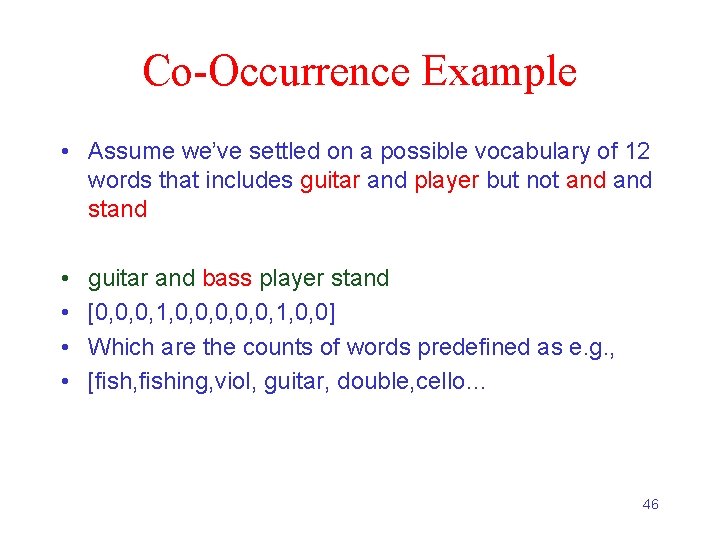
Co-Occurrence Example • Assume we’ve settled on a possible vocabulary of 12 words that includes guitar and player but not and stand • • guitar and bass player stand [0, 0, 0, 1, 0, 0] Which are the counts of words predefined as e. g. , [fish, fishing, viol, guitar, double, cello… 46
Classifiers • Once we cast the WSD problem as a classification problem, then all sorts of techniques are possible – – – Naïve Bayes (the easiest thing to try first) Decision lists Decision trees Neural nets Support vector machines Nearest neighbor methods… 47
WSD Evaluations and Baselines • In vivo (end-to-end, extrinsic, task-based) versus in vitro (intrinsic as if a stand-alone system) evaluation – In vitro evaluation is most common now • Exact match accuracy • % of words tagged identically with manual sense tags • Usually evaluate using held-out data from same labeled corpus – Problems? – Why do we do it anyhow? • Baselines – Most frequent sense – The Lesk algorithm (choose the sense whose dictionary gloss or definition shares the most words with the target word’s neighborhood. 48
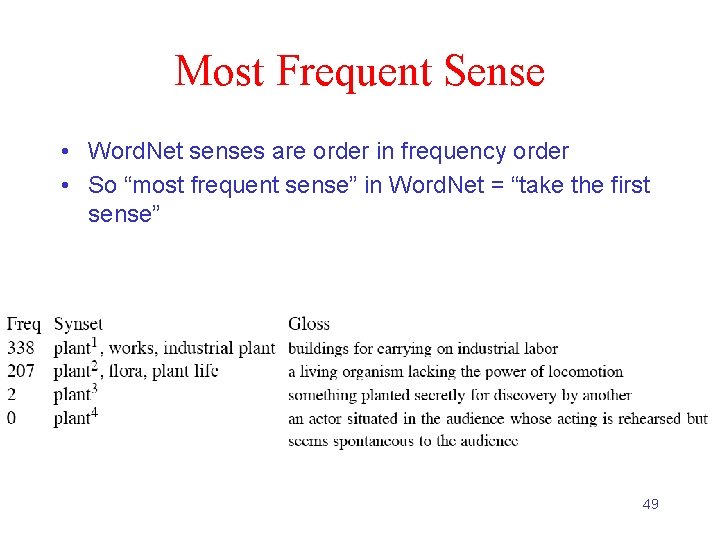
Most Frequent Sense • Word. Net senses are order in frequency order • So “most frequent sense” in Word. Net = “take the first sense” 49
Ceiling • Human-inter-annotator agreement – Compare annotations of two humans – On same data – Given same tagging guidelines • Human agreements on all-words corpora with Word. Net style senses – 75%-80% 50
- Slides: 50