
Science Ch 3 Elements and the Periodic table
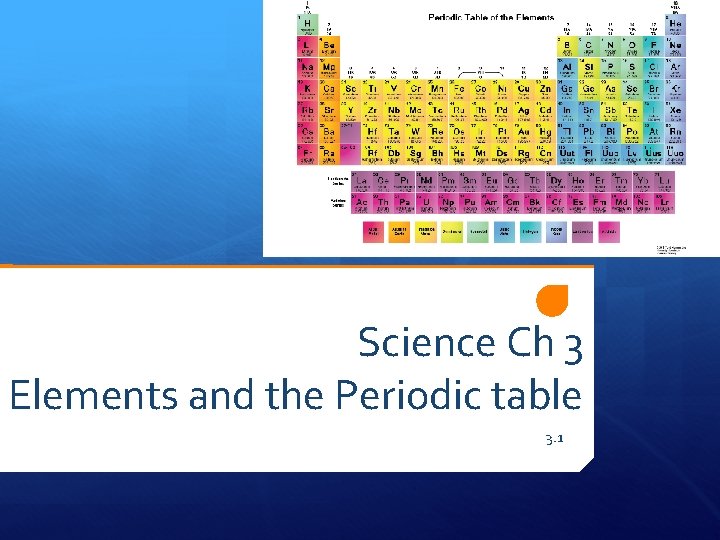
Science Ch 3 Elements and the Periodic table 3. 1
Starting Activity Imagine you have a 5 drawer cabinet You need to organize all the stuff in the pink bin(provided by teacher) into 5 categories(drawers) Ex: Size, color, shape, use

Scientist also have to organize. . BUT…. Before we get to that we need to start back at the beginning with…. . ATOMS!!!

How did the Atomic Theory Develop? It’s hard to study atoms because they are so SMALL Over the years, scientists have made models to help us study the smallest particle
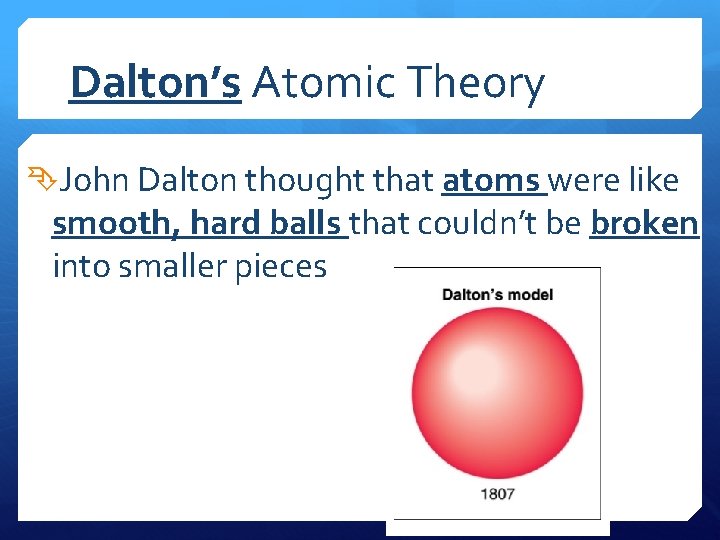
Dalton’s Atomic Theory John Dalton thought that atoms were like smooth, hard balls that couldn’t be broken into smaller pieces

Dalton’s Atomic Theory cnt. 1. Atoms can’t be divided 2. All atoms are the same 3. You can’t change atoms into another substance
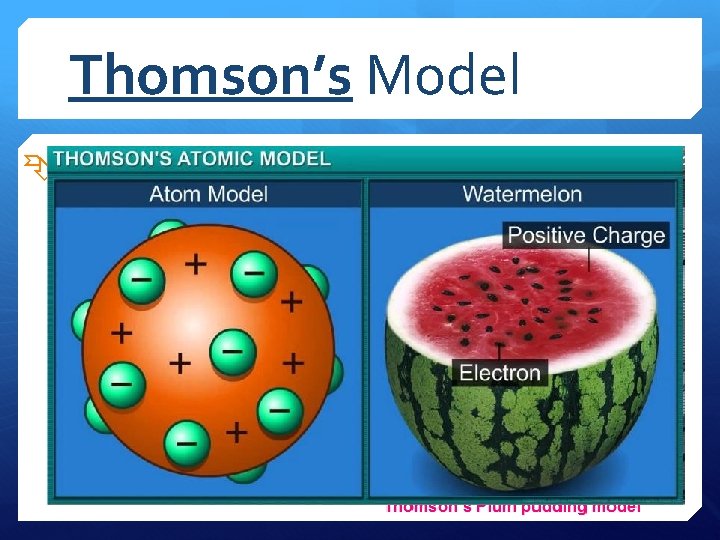
Thomson’s Model In 1897 Thomson discovered that atoms have negatively charged particles called electrons floating in a positive charge
Rutherford’s Model In 1911 (Thomson’s student) Rutherford did a GOLD foil experiments on the atom https: //www. youtube. com/v/5 p. Zj 0 u_XMbc https: //www. youtube. com/v/ecsg. C 1 w. Sp 5 I
Shot light towards a gold foil Some particles went straight through and others bounced back at large angles This showed that there must have been something in the atoms of the gold foil big enough to bounce back a particle
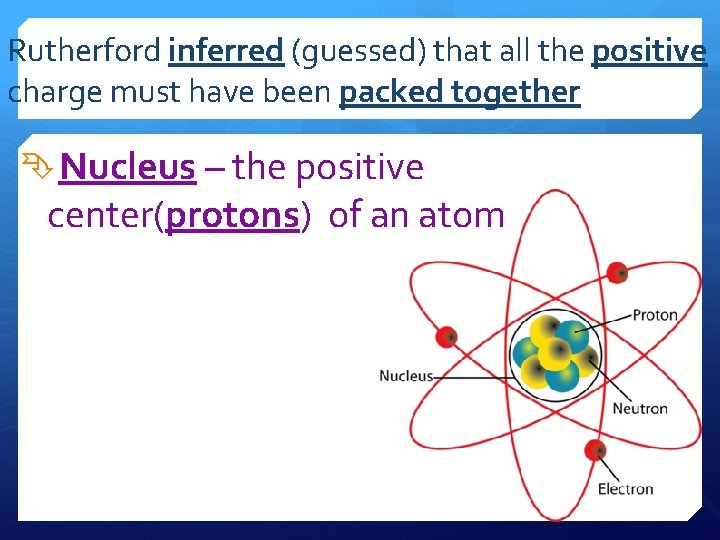
Rutherford inferred (guessed) that all the positive charge must have been packed together Nucleus – the positive center(protons) of an atom

Rutherford’s hypothesis was WRONG

Bohr’s Model In 1913, Bohr suggested that the electrons have a specific orbit around the nucleus

Cloud Model In 1920’s, scientists said electrons move freely in a cloudlike region The electron’s movement is based on the amount of energy it has

Modern Model In 1932, James Chadwick discovered the neutron (neutral particle with no charge) The center of an atom is the nucleus with protons and neutrons. Electrons move around a cloudlike region.
Science Learning the Structure of Matter (3. 1 cnt. )

Comparing Particle Masses What are the 3 particles Symbol 1. Electron 2. Proton 3. Neutron Charge Mass (amu)
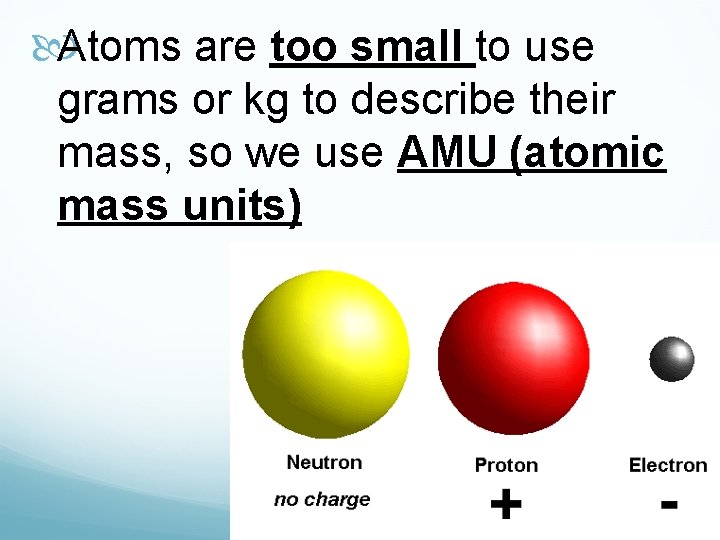
Atoms are too small to use grams or kg to describe their mass, so we use AMU (atomic mass units)
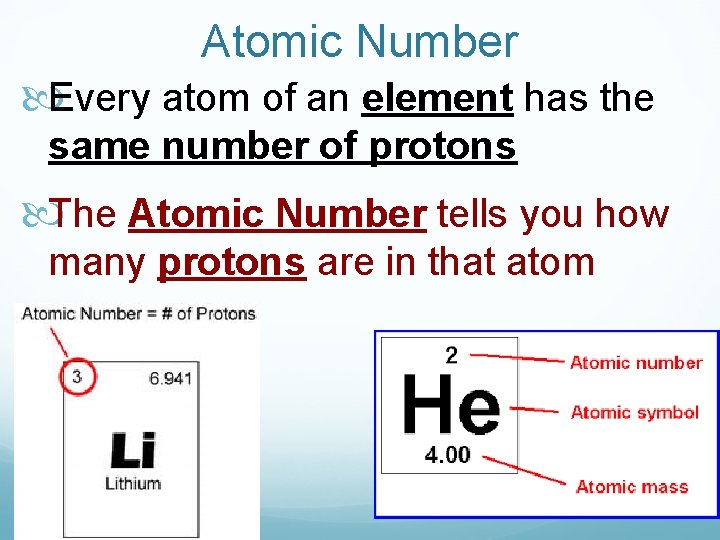
Atomic Number Every atom of an element has the same number of protons The Atomic Number tells you how many protons are in that atom
Game: How many Protons are in. . Potassium Iron Aluminum Lithium
What is the mass of… Titanium? Flourine? An element with 16 protons and 17 NEUTRONS? 17 protons and 18 NEURONS? WHAT DO YOU ADD TOGETHER to get the MASS?

Isotopes All atoms of an element have the same number of ______ BUT, the number of neutrons can change--- that gives us an isotope
Get familiar with the element http: //www. sheppardsoft ware. com/Elementsgam es. htm
Organizing the Periodic Table 3. 2 S

Mendeleev created the first periodic table S A Russian scientists who arranged the elements by their atomic mass S The atomic mass of an element is the average mass off all the isotopes
Mendeleev noticed a pattern of properties in the elements S What happened when each element was put in water?
The first periodic table in 1869 S It is arranged to show a pattern with their properties S The first one has many missing/blank spots
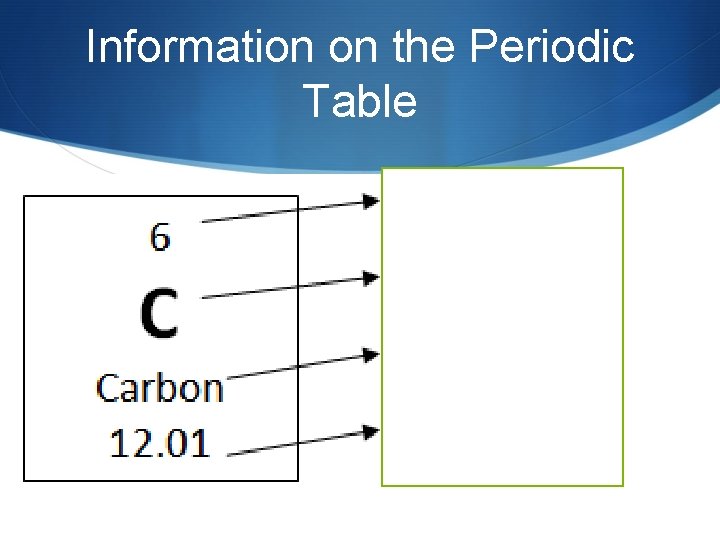
Information on the Periodic Table
How is the Periodic Table Useful? 3. 2 CNT.

• An element’s properties can predict where it will go on the periodic table • **Rows are called periods

From Left Right • Metals Metalloids Nonmetals
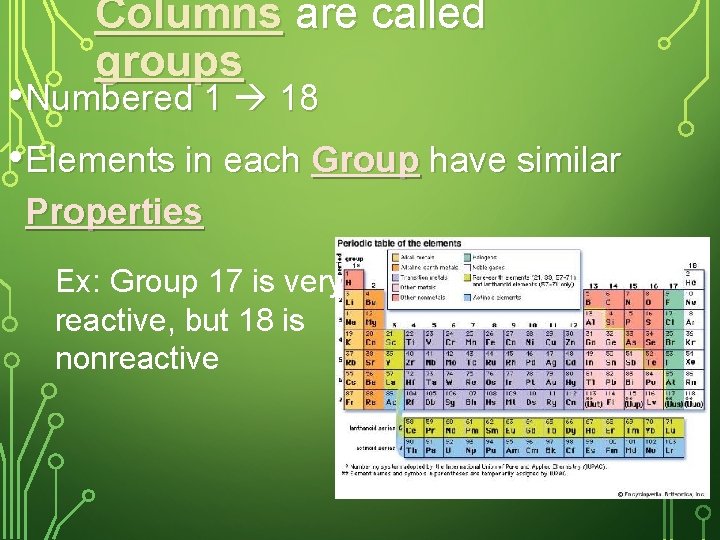
Columns are called groups • Numbered 1 18 • Elements in each Group have similar Properties Ex: Group 17 is very reactive, but 18 is nonreactive
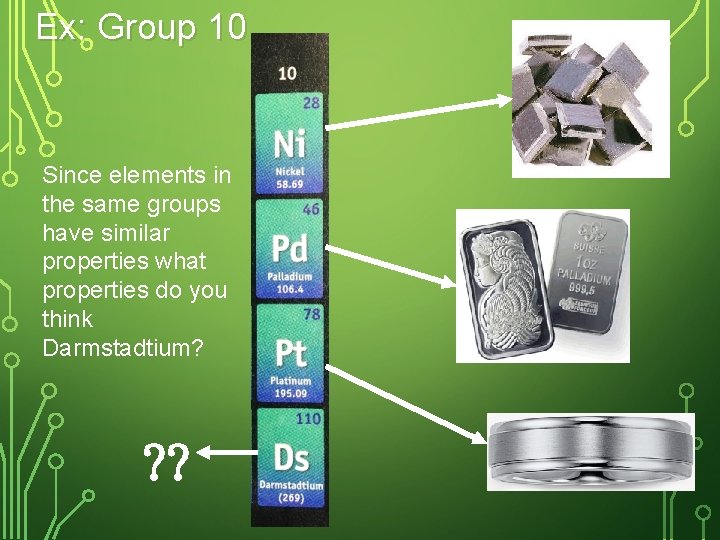
Ex: Group 10 Since elements in the same groups have similar properties what properties do you think Darmstadtium? ? ?
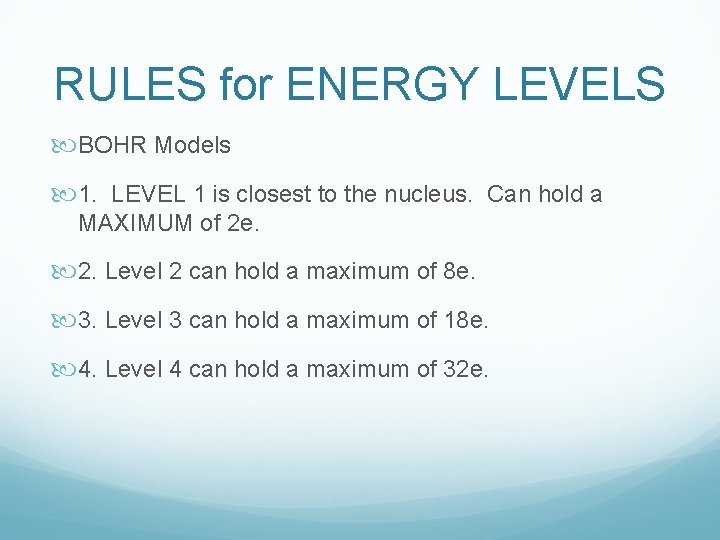
RULES for ENERGY LEVELS BOHR Models 1. LEVEL 1 is closest to the nucleus. Can hold a MAXIMUM of 2 e. 2. Level 2 can hold a maximum of 8 e. 3. Level 3 can hold a maximum of 18 e. 4. Level 4 can hold a maximum of 32 e.
Research Time!!! • Pick 2 of the groups from the periodic table (#1 -18) and make a list of properties that they all have in common

Science Stations S Today you will be moving to 5 different stations to help you practice all the information that we have learned so far in this chapter Expectations: Voice Level: 2 Participation: Work together with your partners Work: Complete all the work at each station (Don’t waster your time) Leave the station like you found it (neat and organized and NO writing on the cards/direction sheet) Movement: Move quietly when the timer rings
S Station #1 : S Station #2: S Station #3: S Station #4: S Station #5:
Science Quiz Tomorrow Ch 3. 1 -3. 2
1. What is the basic building block of matter? Atoms
2. _____ model of the atom was like a chocolate chip cookie Thomson’s
3. What are negatively charged particles? Electrons
4. Who’s model of the atom was just a circle? Dalton
5. What particle has no charge? Neutron
6. What 2 particles are in the nucleus? Protons and Neutrons
7. Who did a gold foil experiment? Rutherford
8. Who’s model has rings like a tree to represent energy levels ? Bohr’s
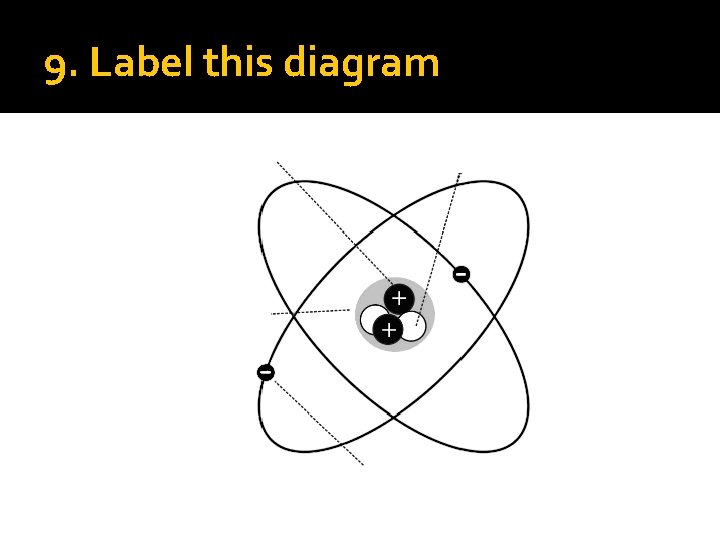
9. Label this diagram
10. How do I know how many protons are in an element? Look at the atomic number
11. Who was the first one to organize the periodic table? Mendeleev
12. What was wrong with the first periodic table? It wasn’t complete Missing elements
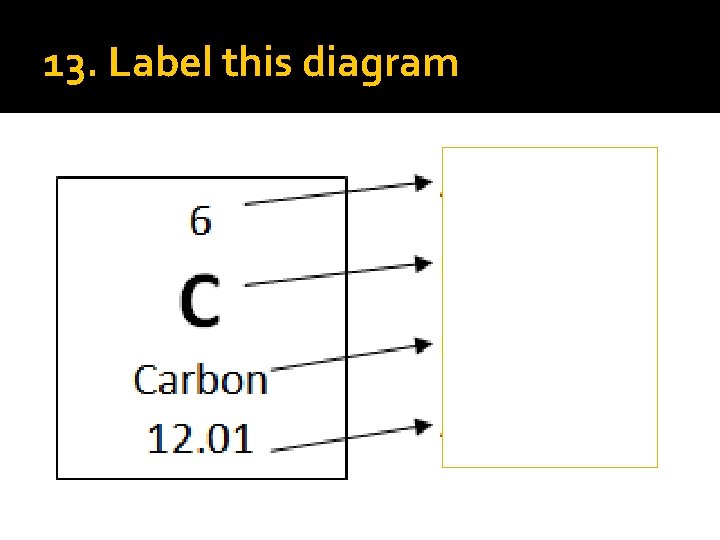
13. Label this diagram
14. Elements in the same family have _____ Similar Characteristics
15. Rows on the periodic table are called _______ Periods
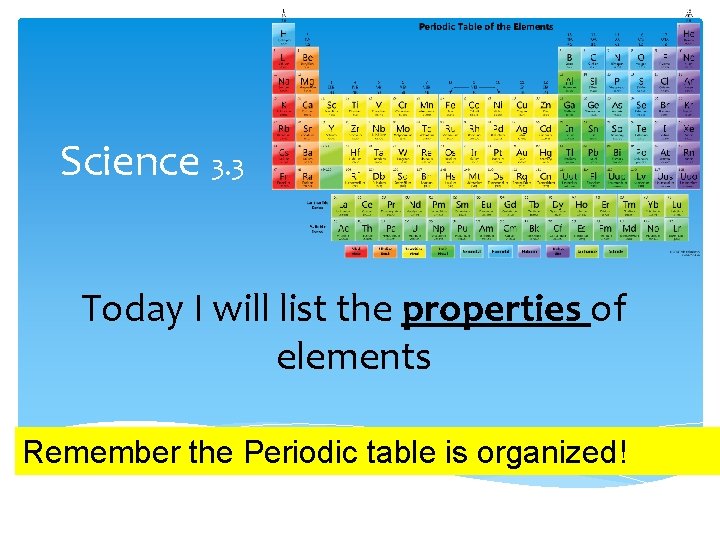
Science 3. 3 Today I will list the properties of elements Remember the Periodic table is organized!
Metals https: //www. youtube. com/watch? v=z. WJe 6 Xv. Mamc It’s hard to imagine life without Metals Make a list of the ways we use metals in this classroom
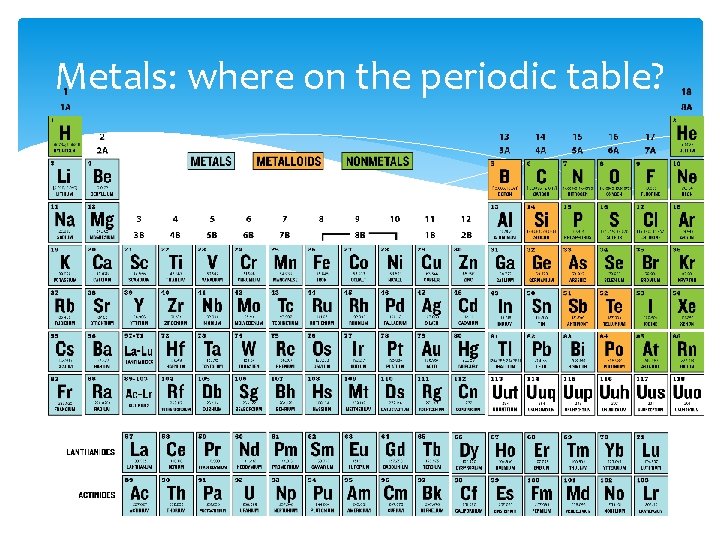
Metals: where on the periodic table?
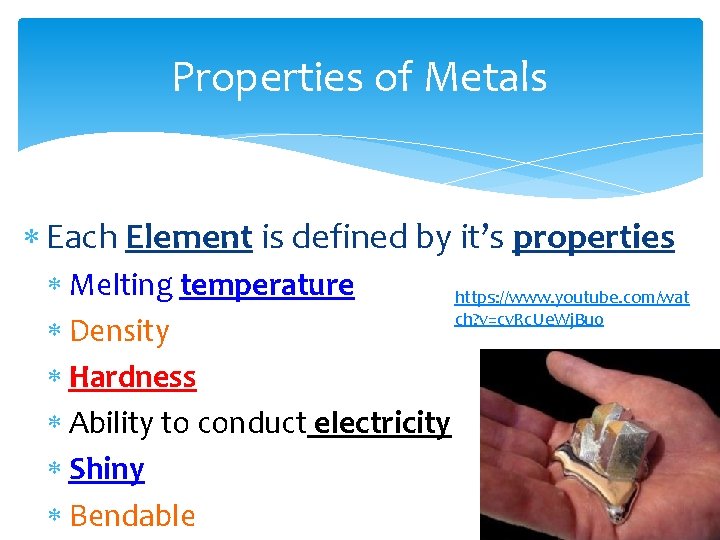
Properties of Metals Each Element is defined by it’s properties Melting temperature https: //www. youtube. com/wat ch? v=cv. Rc. Ue. Wj. Bu 0 Density Hardness Ability to conduct electricity Shiny Bendable
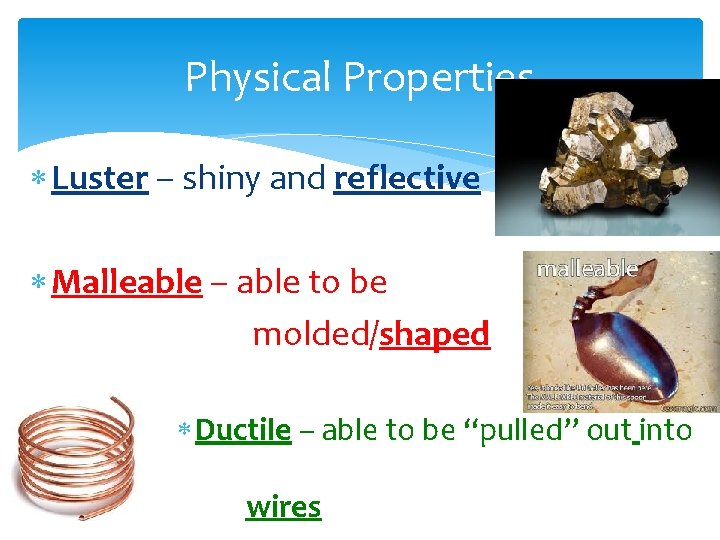
Physical Properties Luster – shiny and reflective Malleable – able to be molded/shaped Ductile – able to be “pulled” out into wires
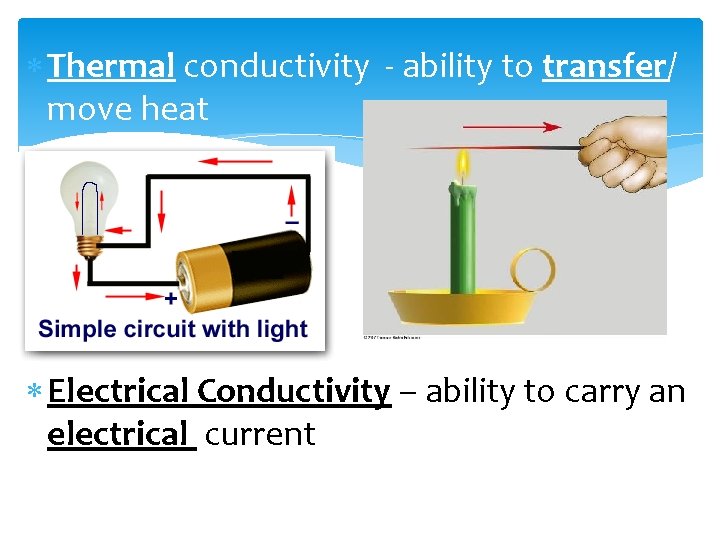
Thermal conductivity - ability to transfer/ move heat Electrical Conductivity – ability to carry an electrical current
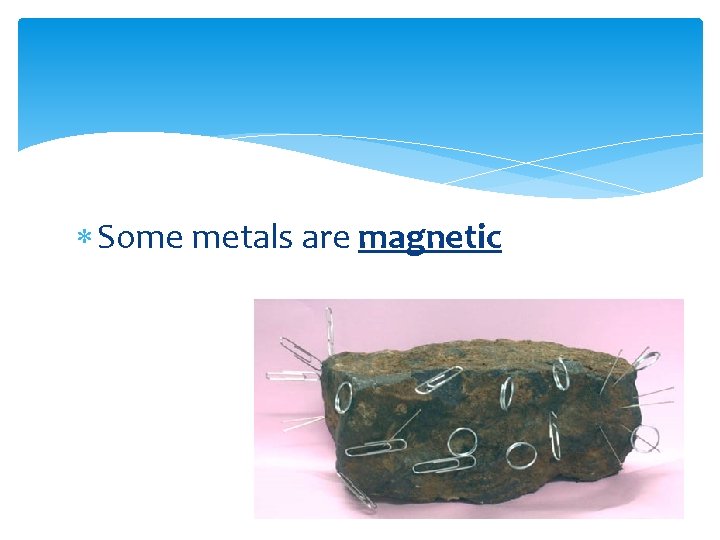
Some metals are magnetic
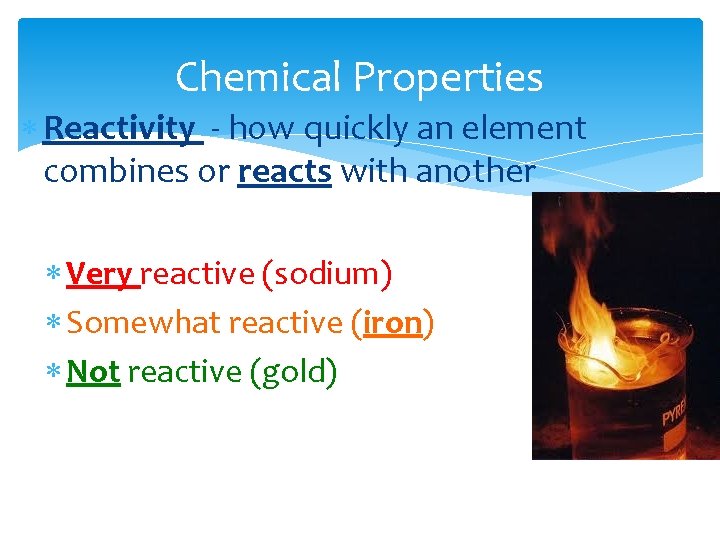
Chemical Properties Reactivity - how quickly an element combines or reacts with another Very reactive (sodium) Somewhat reactive (iron) Not reactive (gold)
These metals are very valuable People hunt through garbage for these metals. https: //www. youtube. com/watch? v=Jn 7 o. NH 2 -nqc
SCIENCE (3. 3 CNT) How are Metals
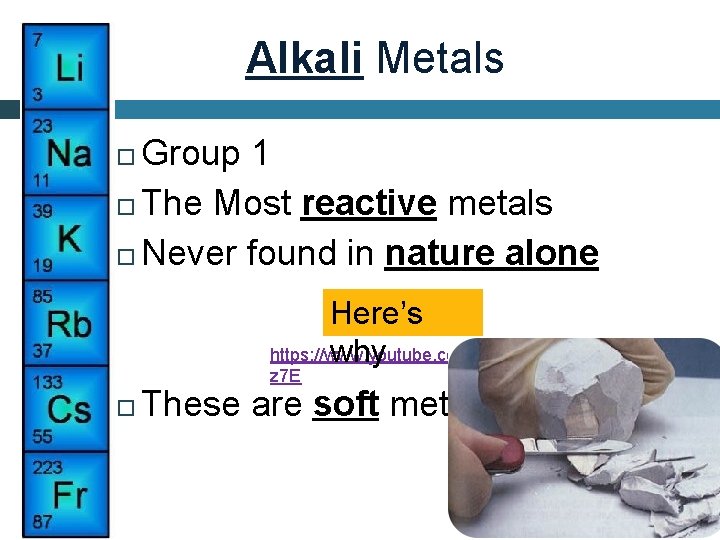
Alkali Metals Group 1 The Most reactive metals Never found in nature alone Here’s https: //www. youtube. com/watch? v=cqe. VEFFz why z 7 E These are soft metals
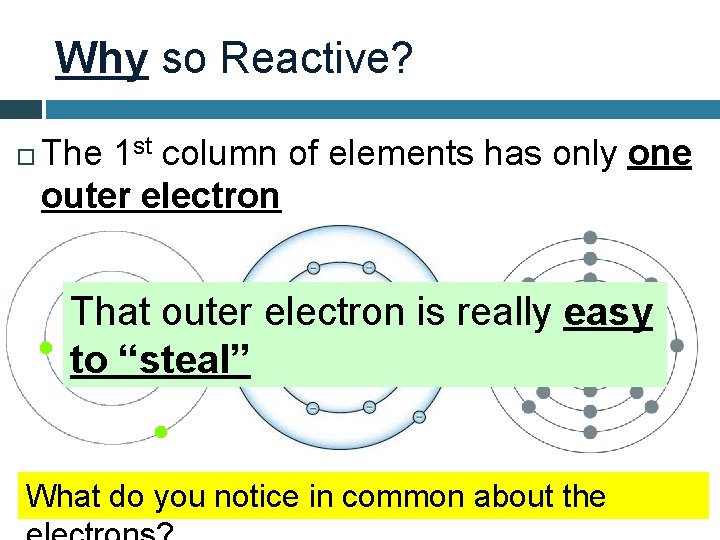
Why so Reactive? The 1 st column of elements has only one outer electron That outer electron is really easy to “steal” What do you notice in common about the
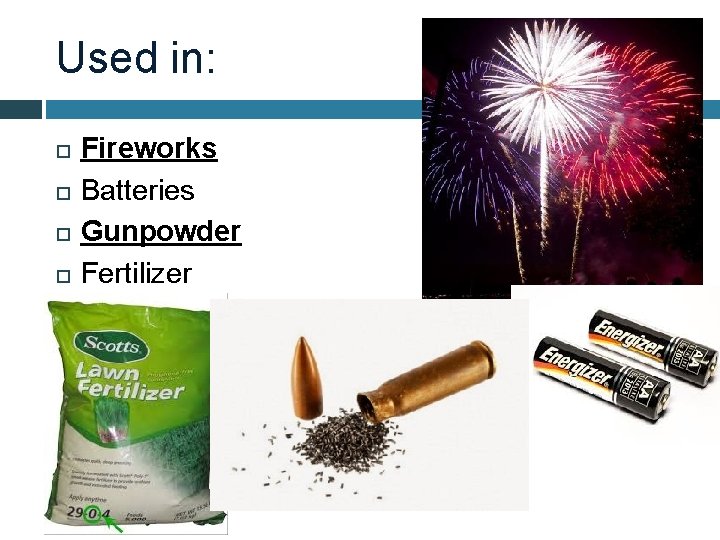
Used in: Fireworks Batteries Gunpowder Fertilizer
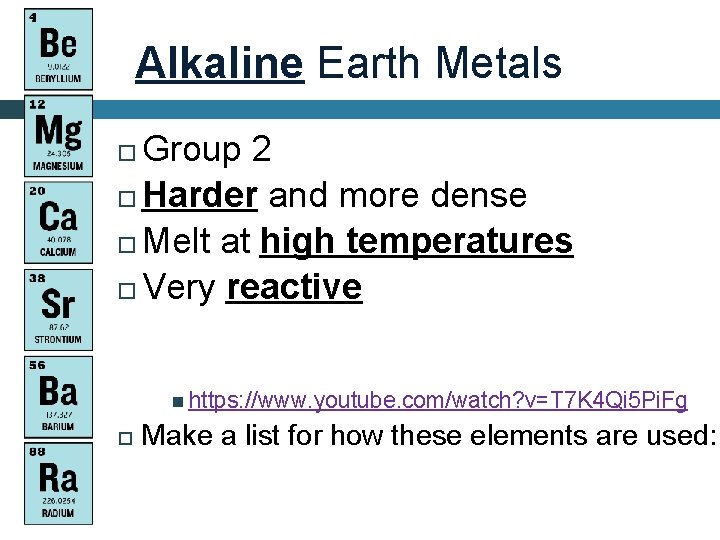
Alkaline Earth Metals Group 2 Harder and more dense Melt at high temperatures Very reactive https: //www. youtube. com/watch? v=T 7 K 4 Qi 5 Pi. Fg Make a list for how these elements are used:

Transition Metals Groups 3 -12 Most are hard and shiny High melting temperatures (except Mercury)
Science 3. 4 The periodic Table https: //www. youtube. com/watch? v=Vg. VQKCcfwn. U Have your books out to help look for properties about each group
Today I will: List the properties of elements (metals, nonmetals, and metalloids) Why does that matter?
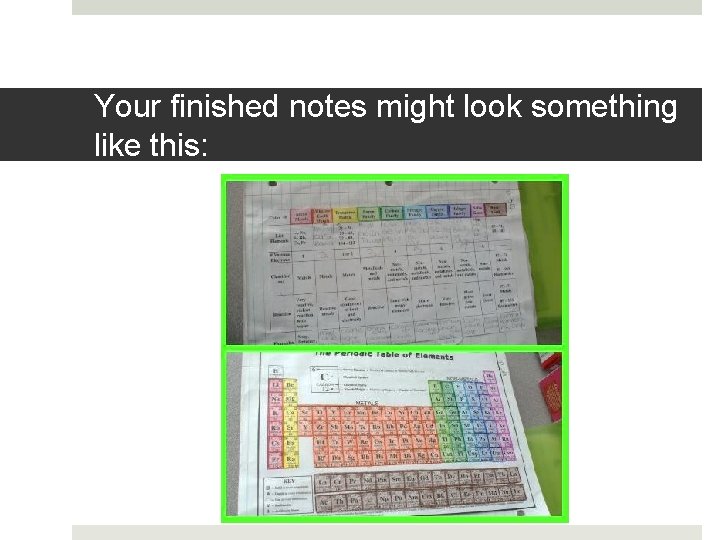
Your finished notes might look something like this:
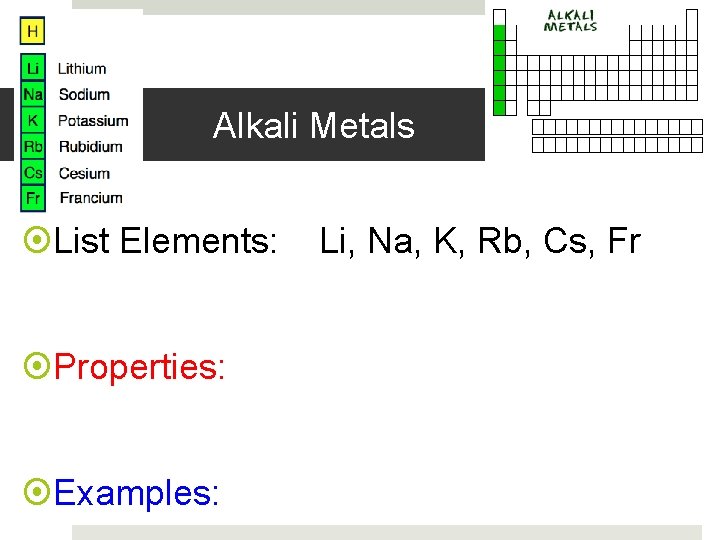
Alkali Metals List Elements: Properties: Examples: Li, Na, K, Rb, Cs, Fr
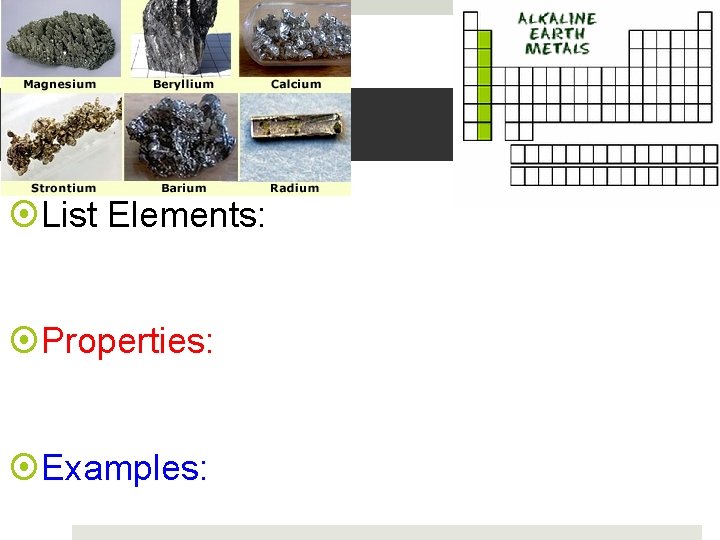
Alkaline Ea List Elements: Properties: Examples:
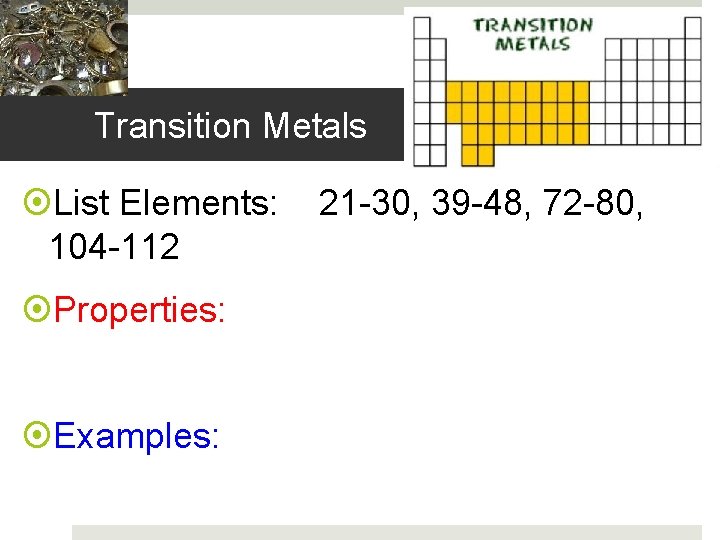
Transition Metals List Elements: 104 -112 Properties: Examples: 21 -30, 39 -48, 72 -80,
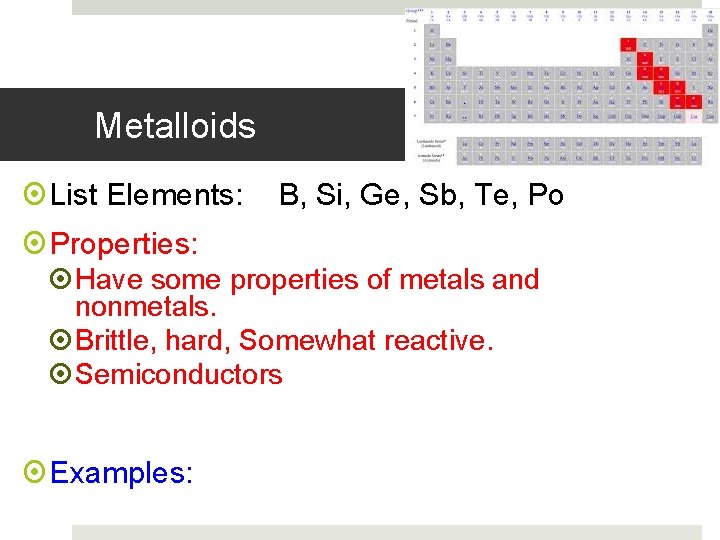
Metalloids List Elements: B, Si, Ge, Sb, Te, Po Properties: Have some properties of metals and nonmetals. Brittle, hard, Somewhat reactive. Semiconductors Examples:
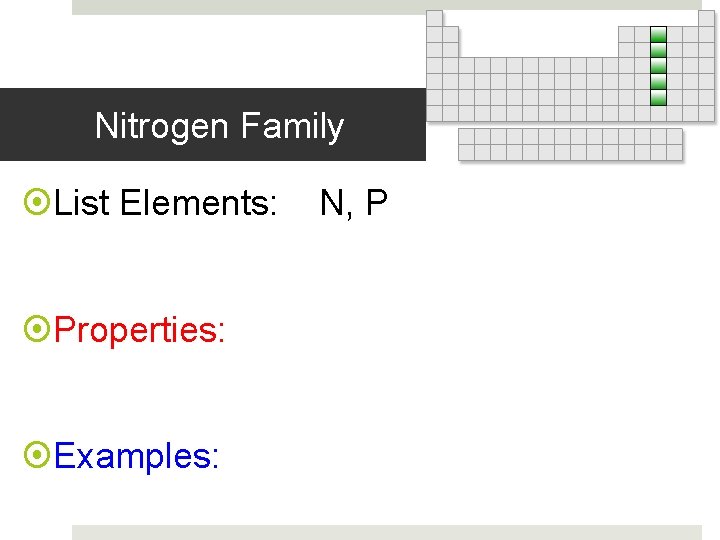
Nitrogen Family List Elements: Properties: Examples: N, P
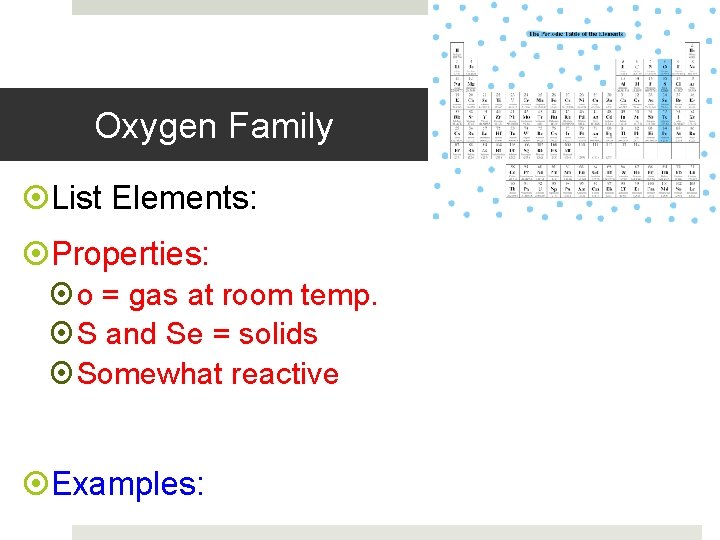
Oxygen Family List Elements: Properties: o = gas at room temp. S and Se = solids Somewhat reactive Examples:
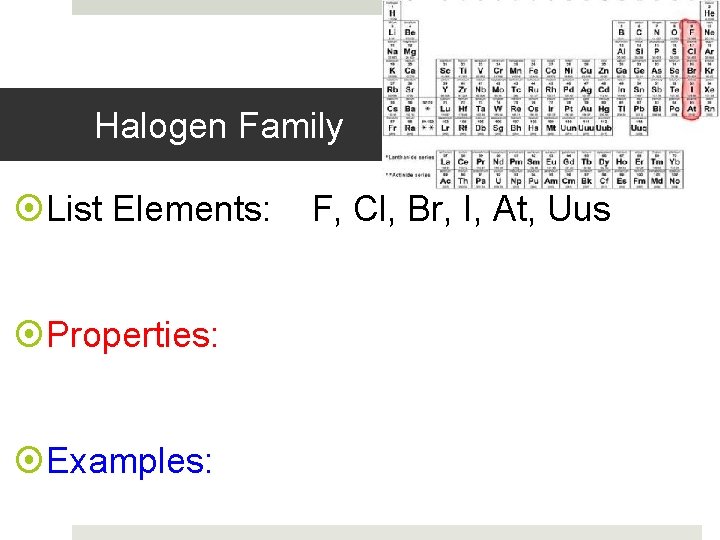
Halogen Family List Elements: Properties: Examples: F, Cl, Br, I, At, Uus

Nobel Gases List Elements: Properties: They don’t usually form compounds. Not reactive Examples:
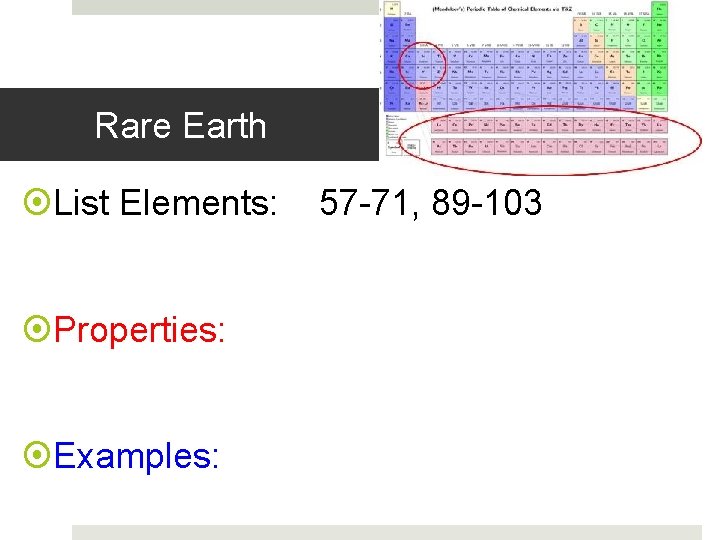
Rare Earth List Elements: Properties: Examples: 57 -71, 89 -103
What were we supposed to learn today? List the properties of elements (metals, nonmetals, and metalloids)
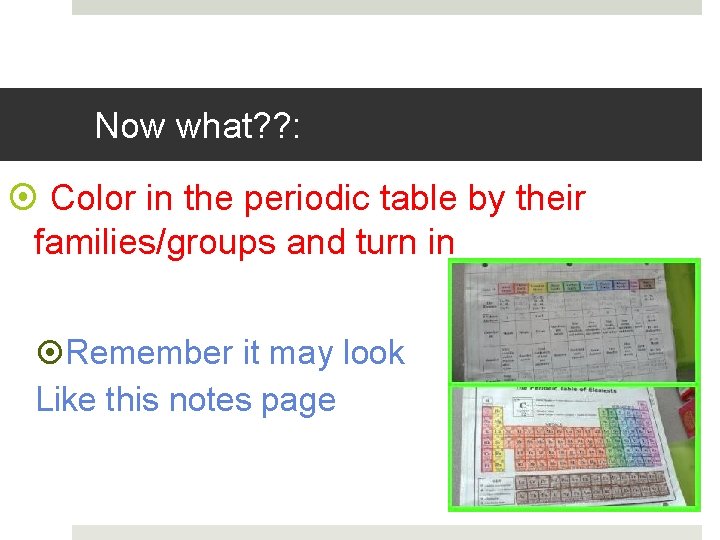
Now what? ? : Color in the periodic table by their families/groups and turn in Remember it may look Like this notes page
Science Test Tomorrow Ch 3
1. What is the basic building block of matter? Atoms
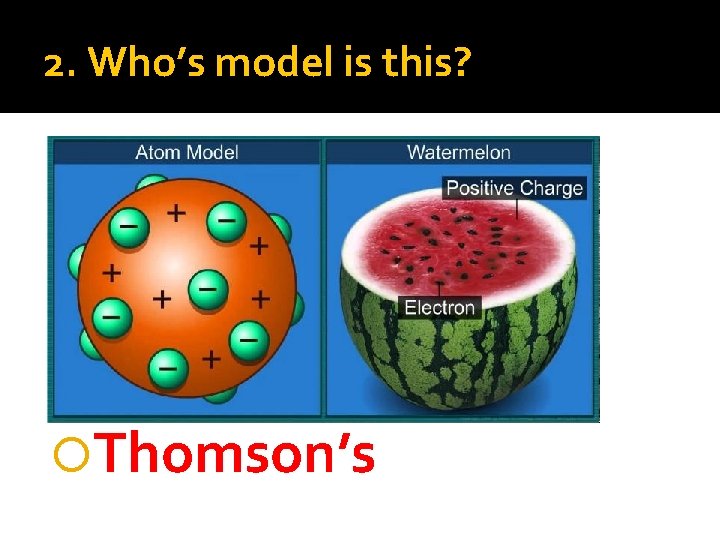
2. Who’s model is this? Thomson’s
3. What are negatively charged particles? Electrons
4. What particle has no charge? Neutron
5. What 2 particles are in the nucleus? Protons and Neutrons
6. Who did a gold foil experiment? Rutherford

7. Label this diagram
8. How do I know how many protons are in an element? Look at the atomic number
9. Who was the first one to organize the periodic table? Mendeleev
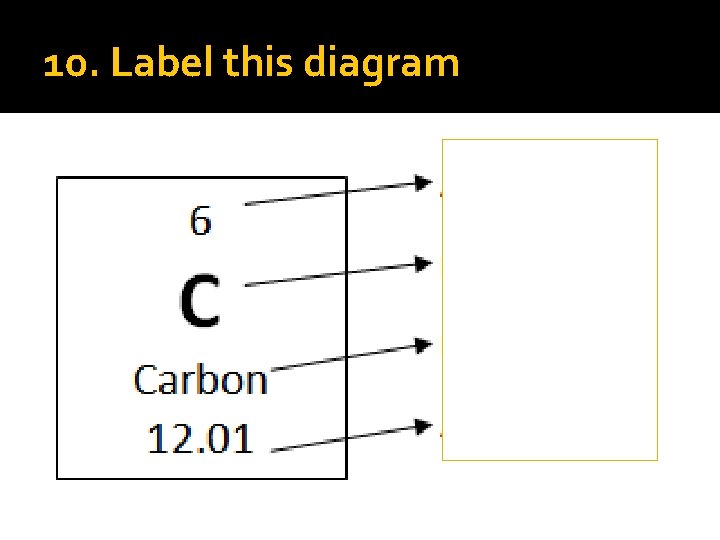
10. Label this diagram
11. Rows on the periodic table are called _______ Periods
12. If at metal can be bent into a different shape we call that Malleability
13. We call how shiny or reflective a metal is ____ Luster
14. Which Elements are the most reactive? (name the column) The st 1 group
15. Electrical conductivity means ____ Able to carry an electrical current
16. Thermal conductivity means ____ Able to transfer/move heat
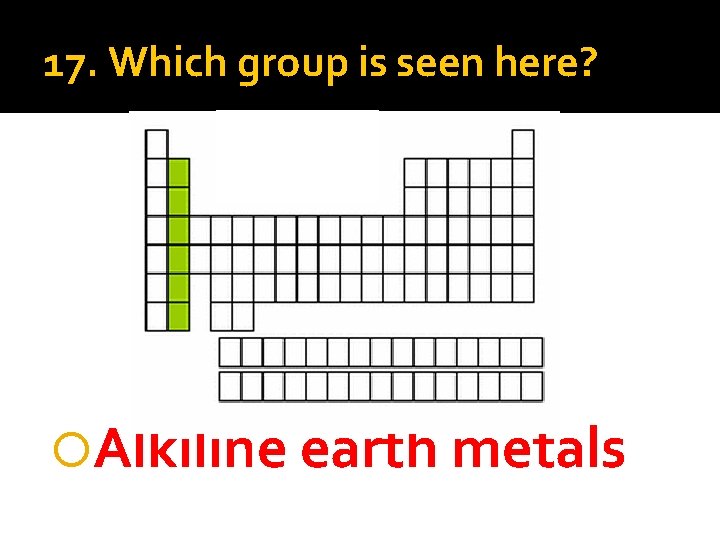
17. Which group is seen here? Alkiline earth metals
18. Name one property for Transition metals. Shiny, hard
19. What is one use/example for the halogen family? Signs,
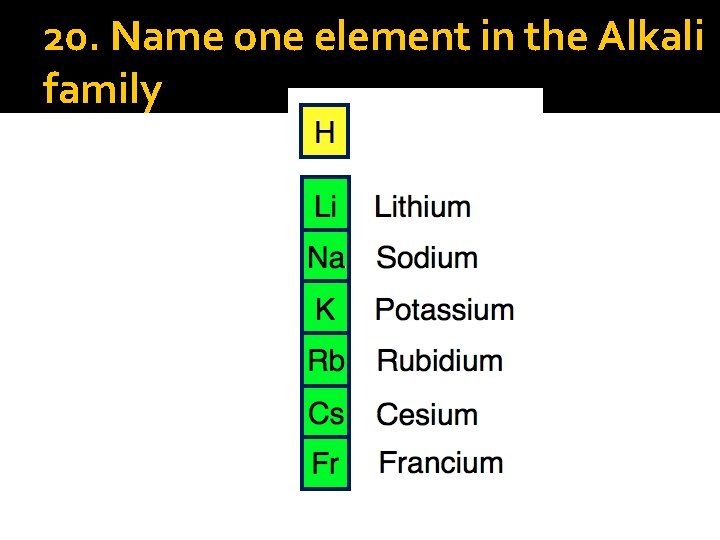
20. Name one element in the Alkali family

Extra Thinking
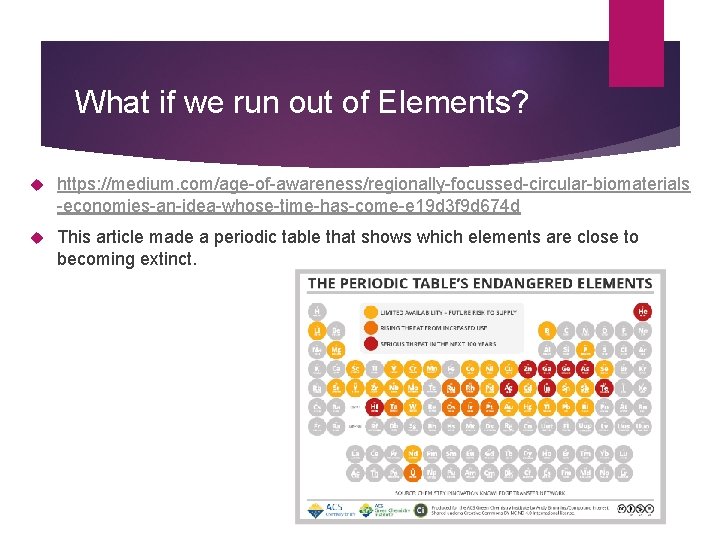
What if we run out of Elements? https: //medium. com/age-of-awareness/regionally-focussed-circular-biomaterials -economies-an-idea-whose-time-has-come-e 19 d 3 f 9 d 674 d This article made a periodic table that shows which elements are close to becoming extinct.
Thought Questions: Where do our elements come from? Why do you think some elements are becoming extinct? What could we do to prevent that? What would happen if one element DOES go extinct? How does that affect industry? Technology? Transpiration? How could you make a difference in saving the elements?
This article actually shows how all the elements are used. Great resource for students. http: //boredomtherapy. com/periodic-table-of-elements/ Article and Explanation http: //elements. wlonk. com/Elements. Table. htm interactive periodic table
Which country discovered each element? https: //www. reddit. com/r/dataisbeautiful/comments/6 muapc/the_periodic _table_with_country_and_date_of/ Very interesting to look at and realize who the large “science” countries were.
- Slides: 107