Chemistry A Molecular Approach 2 nd Ed Nivaldo






- Slides: 120
Chemistry: A Molecular Approach, 2 nd Ed. Nivaldo Tro Chapter 9 Chemical Bonding I: Lewis Theory Roy Kennedy Massachusetts Bay Community College Wellesley Hills, MA Copyright 2011 Pearson Education, Inc.
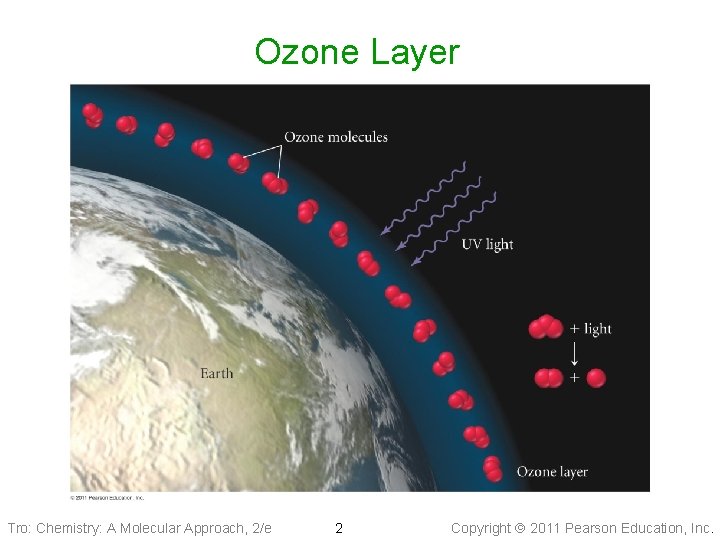
Ozone Layer Tro: Chemistry: A Molecular Approach, 2/e 2 Copyright 2011 Pearson Education, Inc.
HIV-Protease • HIV-protease is a protein synthesized by the • • • human immunodeficiency virus (HIV). This particular protein is crucial to the virus’s ability to multiply and cause AIDS Pharmaceutical companies designed molecules that would disable HIV-protease by sticking to the molecule’s active site – protease inhibitors To design such a molecule, researchers used bonding theories to simulate the shape of potential drug molecules and how they would interact with the protease molecule Tro: Chemistry: A Molecular Approach, 2/e 3 Copyright 2011 Pearson Education, Inc.
Bonding Theories • Explain how and why atoms attach • • • together to form molecules Explain why some combinations of atoms are stable and others are not üwhy is water H 2 O, not HO or H 3 O Can be used to predict the shapes of molecules Can be used to predict the chemical and physical properties of compounds Tro: Chemistry: A Molecular Approach, 2/e 4 Copyright 2011 Pearson Education, Inc.
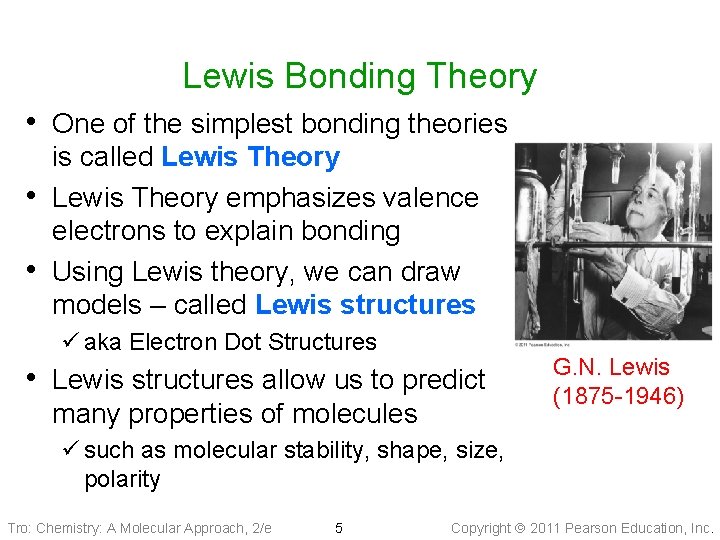
Lewis Bonding Theory • One of the simplest bonding theories • • is called Lewis Theory emphasizes valence electrons to explain bonding Using Lewis theory, we can draw models – called Lewis structures ü aka Electron Dot Structures • Lewis structures allow us to predict many properties of molecules G. N. Lewis (1875 -1946) ü such as molecular stability, shape, size, polarity Tro: Chemistry: A Molecular Approach, 2/e 5 Copyright 2011 Pearson Education, Inc.
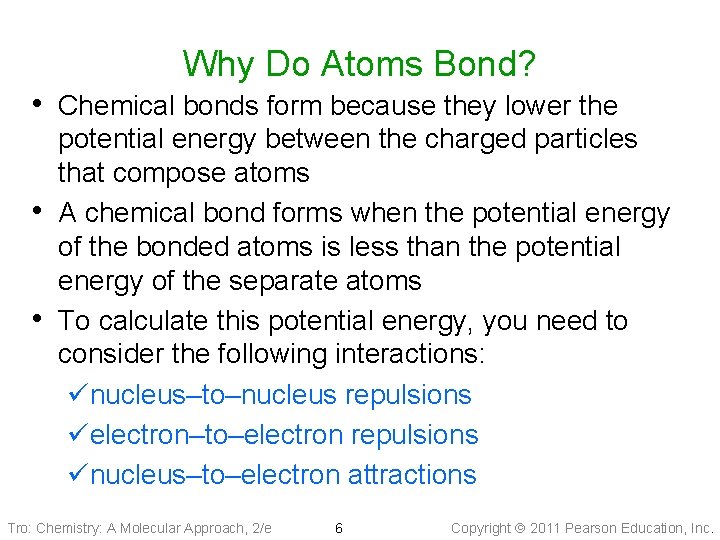
Why Do Atoms Bond? • Chemical bonds form because they lower the • • potential energy between the charged particles that compose atoms A chemical bond forms when the potential energy of the bonded atoms is less than the potential energy of the separate atoms To calculate this potential energy, you need to consider the following interactions: ünucleus–to–nucleus repulsions üelectron–to–electron repulsions ünucleus–to–electron attractions Tro: Chemistry: A Molecular Approach, 2/e 6 Copyright 2011 Pearson Education, Inc.
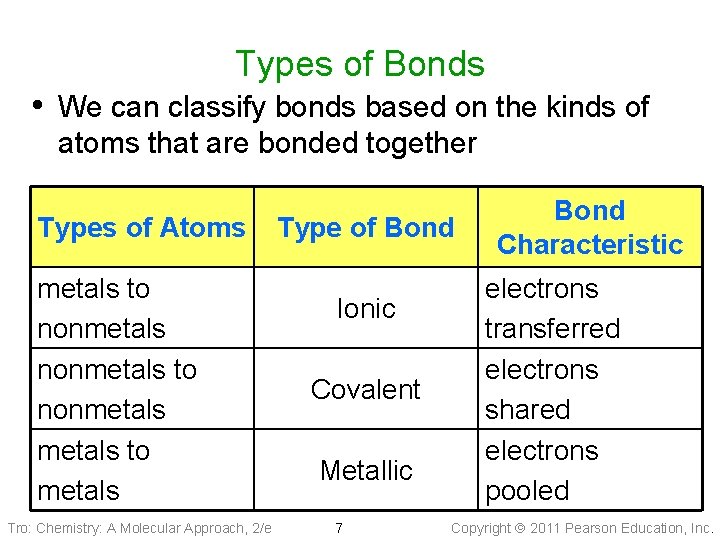
Types of Bonds • We can classify bonds based on the kinds of atoms that are bonded together Types of Atoms metals to nonmetals to metals Tro: Chemistry: A Molecular Approach, 2/e Type of Bond Ionic Covalent Metallic 7 Bond Characteristic electrons transferred electrons shared electrons pooled Copyright 2011 Pearson Education, Inc.
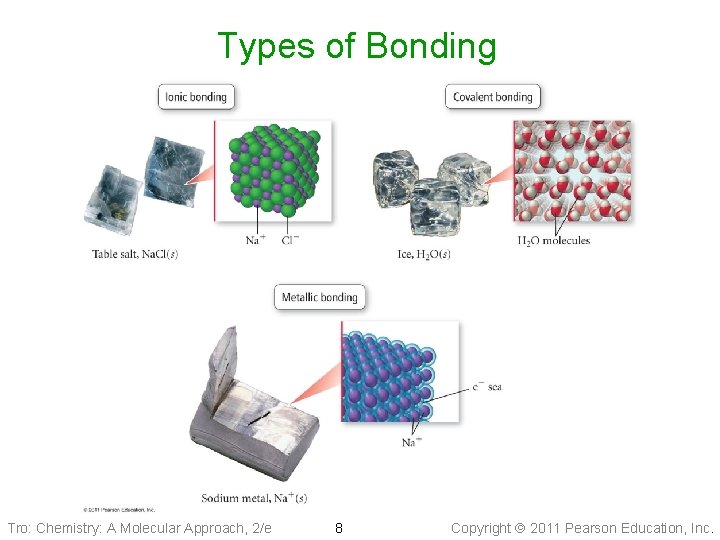
Types of Bonding Tro: Chemistry: A Molecular Approach, 2/e 8 Copyright 2011 Pearson Education, Inc.
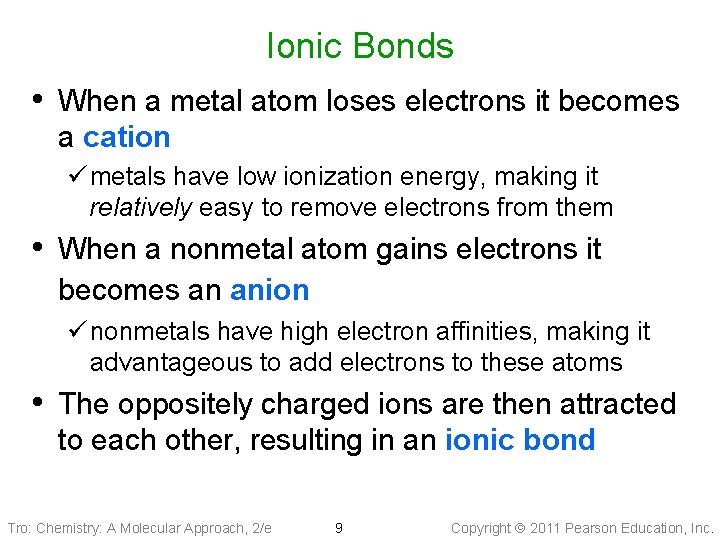
Ionic Bonds • When a metal atom loses electrons it becomes a cation ü metals have low ionization energy, making it relatively easy to remove electrons from them • When a nonmetal atom gains electrons it becomes an anion ü nonmetals have high electron affinities, making it advantageous to add electrons to these atoms • The oppositely charged ions are then attracted to each other, resulting in an ionic bond Tro: Chemistry: A Molecular Approach, 2/e 9 Copyright 2011 Pearson Education, Inc.
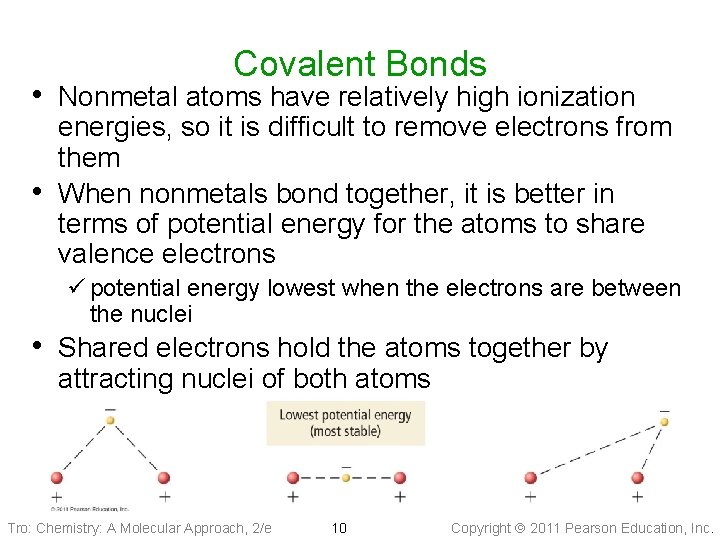
Covalent Bonds • Nonmetal atoms have relatively high ionization • energies, so it is difficult to remove electrons from them When nonmetals bond together, it is better in terms of potential energy for the atoms to share valence electrons ü potential energy lowest when the electrons are between the nuclei • Shared electrons hold the atoms together by attracting nuclei of both atoms Tro: Chemistry: A Molecular Approach, 2/e 10 Copyright 2011 Pearson Education, Inc.
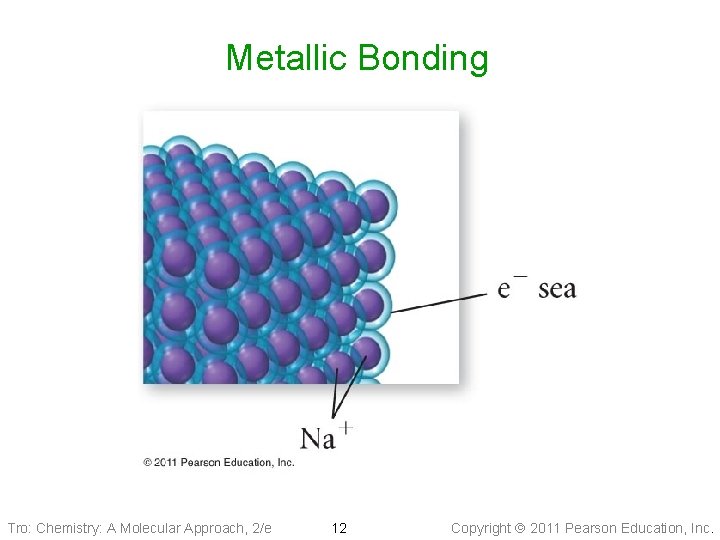
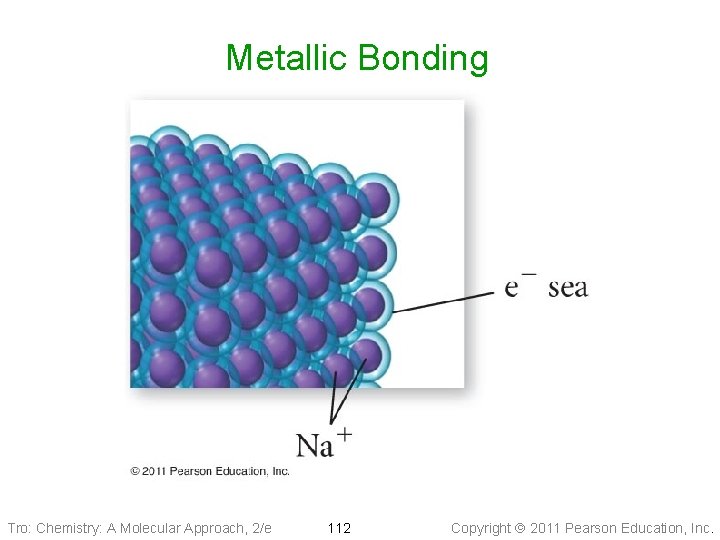
Metallic Bonds • The relatively low ionization energy of metals • allows them to lose electrons easily The simplest theory of metallic bonding involves the metal atoms releasing their valence electrons to be shared as a pool by all the atoms/ions in the metal ü an organization of metal cation islands in a sea of electrons ü electrons delocalized throughout the metal structure • Bonding results from attraction of cation for the delocalized electrons Tro: Chemistry: A Molecular Approach, 2/e 11 Copyright 2011 Pearson Education, Inc.
Metallic Bonding Tro: Chemistry: A Molecular Approach, 2/e 12 Copyright 2011 Pearson Education, Inc.
Valence Electrons & Bonding • Because valence electrons are held most • • • loosely, and Because chemical bonding involves the transfer or sharing of electrons between two or more atoms, Valence electrons are most important in bonding Lewis theory focuses on the behavior of the valence electrons Tro: Chemistry: A Molecular Approach, 2/e 13 Copyright 2011 Pearson Education, Inc.
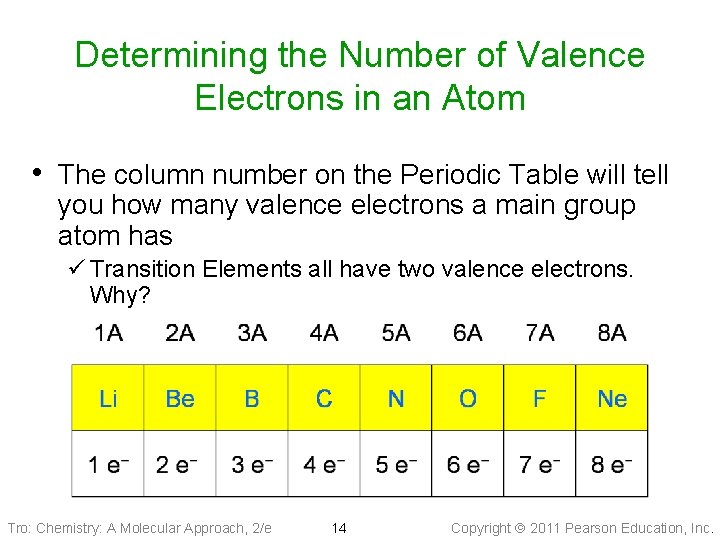
Determining the Number of Valence Electrons in an Atom • The column number on the Periodic Table will tell you how many valence electrons a main group atom has ü Transition Elements all have two valence electrons. Why? Tro: Chemistry: A Molecular Approach, 2/e 14 Copyright 2011 Pearson Education, Inc.
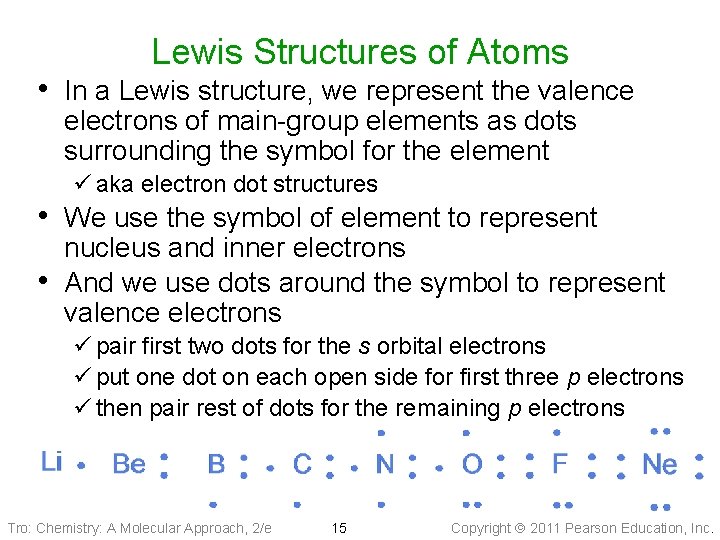
Lewis Structures of Atoms • In a Lewis structure, we represent the valence electrons of main-group elements as dots surrounding the symbol for the element ü aka electron dot structures • We use the symbol of element to represent • nucleus and inner electrons And we use dots around the symbol to represent valence electrons ü pair first two dots for the s orbital electrons ü put one dot on each open side for first three p electrons ü then pair rest of dots for the remaining p electrons Tro: Chemistry: A Molecular Approach, 2/e 15 Copyright 2011 Pearson Education, Inc.
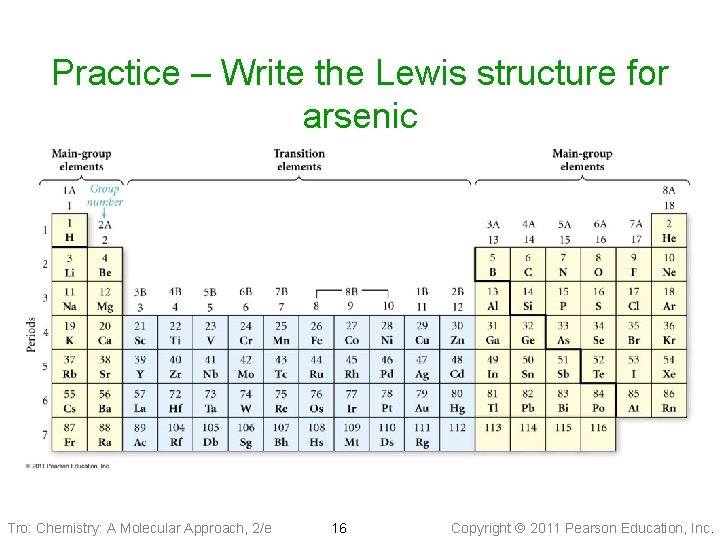
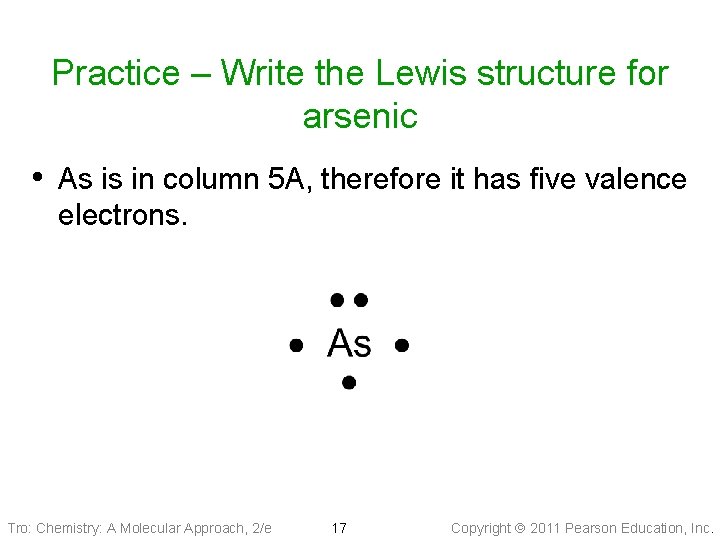
Practice – Write the Lewis structure for arsenic Tro: Chemistry: A Molecular Approach, 2/e 16 Copyright 2011 Pearson Education, Inc.
Practice – Write the Lewis structure for arsenic • As is in column 5 A, therefore it has five valence electrons. Tro: Chemistry: A Molecular Approach, 2/e 17 Copyright 2011 Pearson Education, Inc.
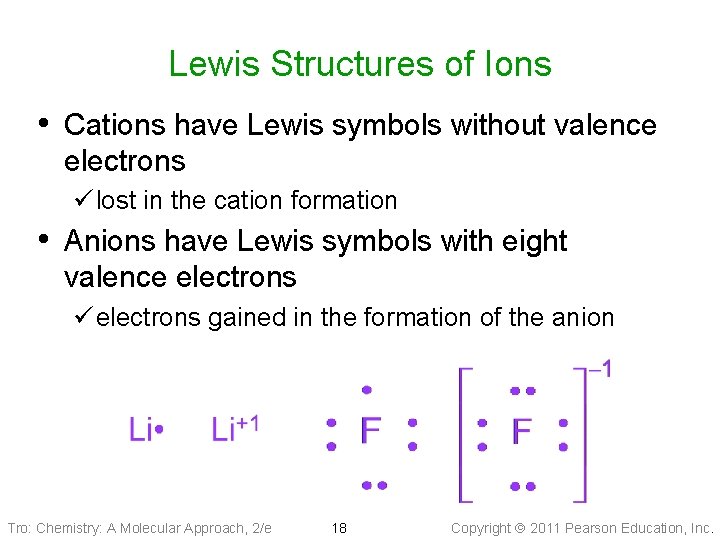
Lewis Structures of Ions • Cations have Lewis symbols without valence electrons ü lost in the cation formation • Anions have Lewis symbols with eight valence electrons ü electrons gained in the formation of the anion Tro: Chemistry: A Molecular Approach, 2/e 18 Copyright 2011 Pearson Education, Inc.
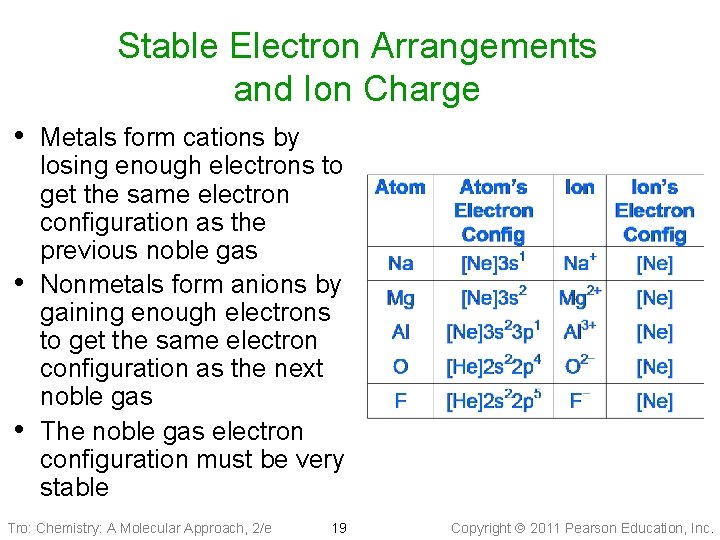
Stable Electron Arrangements and Ion Charge • Metals form cations by • • losing enough electrons to get the same electron configuration as the previous noble gas Nonmetals form anions by gaining enough electrons to get the same electron configuration as the next noble gas The noble gas electron configuration must be very stable Tro: Chemistry: A Molecular Approach, 2/e 19 Copyright 2011 Pearson Education, Inc.
Lewis Bonding Theory • Atoms bond because it results in a more stable electron configuration. ü more stable = lower potential energy • Atoms bond together by either transferring or • sharing electrons Usually this results in all atoms obtaining an outer shell with eight electrons ü octet rule ü there are some exceptions to this rule—the key to remember is to try to get an electron configuration like a noble gas Tro: Chemistry: A Molecular Approach, 2/e 20 Copyright 2011 Pearson Education, Inc.
Octet Rule • When atoms bond, they tend to gain, lose, or share • electrons to result in eight valence electrons ns 2 np 6 ü noble gas configuration • Many exceptions ü H, Li, Be, B attain an electron configuration like He Ø He = two valence electrons, a duet Ø Li loses its one valence electron Ø H shares or gains one electron o though it commonly loses its one electron to become H+ Ø Be loses two electrons to become Be 2+ o though it commonly shares its two electrons in covalent bonds, resulting in four valence electrons Ø B loses three electrons to become B 3+ o though it commonly shares its three electrons in covalent bonds, resulting in six valence electrons ü expanded octets for elements in Period 3 or below Ø using empty valence d orbitals Tro: Chemistry: A Molecular Approach, 2/e 21 Copyright 2011 Pearson Education, Inc.
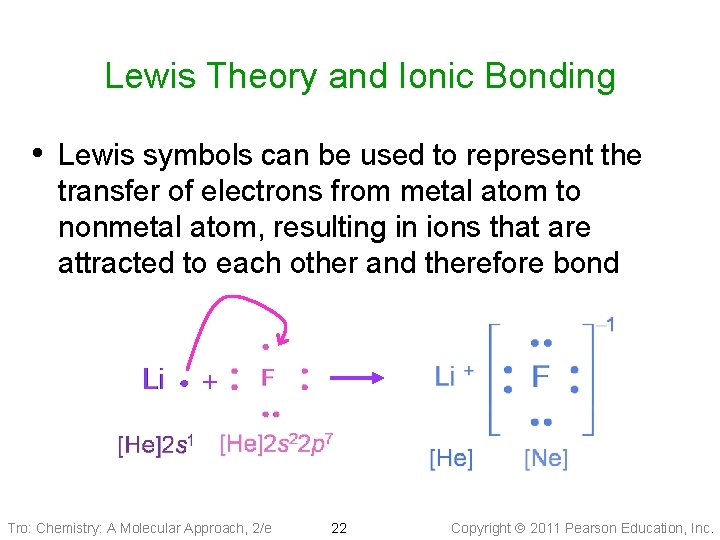
Lewis Theory and Ionic Bonding • Lewis symbols can be used to represent the transfer of electrons from metal atom to nonmetal atom, resulting in ions that are attracted to each other and therefore bond + Tro: Chemistry: A Molecular Approach, 2/e 22 Copyright 2011 Pearson Education, Inc.
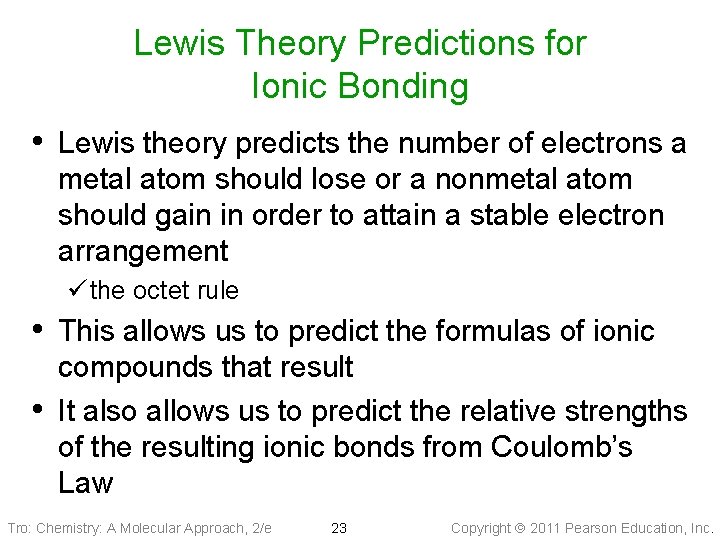
Lewis Theory Predictions for Ionic Bonding • Lewis theory predicts the number of electrons a metal atom should lose or a nonmetal atom should gain in order to attain a stable electron arrangement ü the octet rule • This allows us to predict the formulas of ionic • compounds that result It also allows us to predict the relative strengths of the resulting ionic bonds from Coulomb’s Law Tro: Chemistry: A Molecular Approach, 2/e 23 Copyright 2011 Pearson Education, Inc.
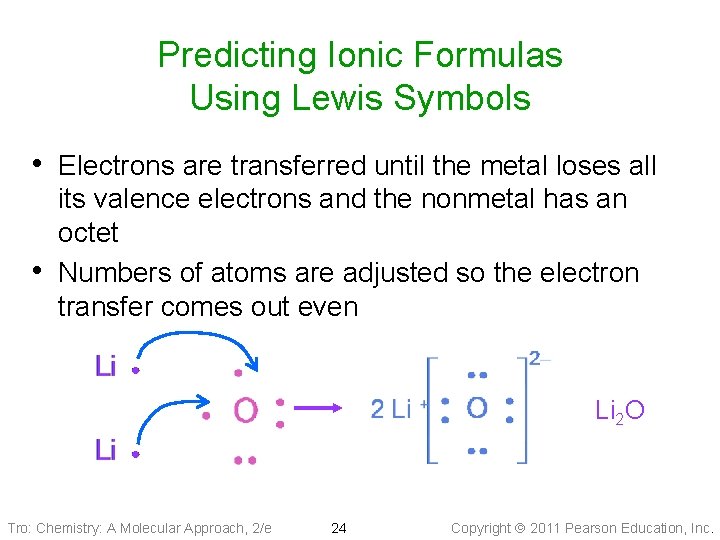
Predicting Ionic Formulas Using Lewis Symbols • Electrons are transferred until the metal loses all • its valence electrons and the nonmetal has an octet Numbers of atoms are adjusted so the electron transfer comes out even Li 2 O Tro: Chemistry: A Molecular Approach, 2/e 24 Copyright 2011 Pearson Education, Inc.
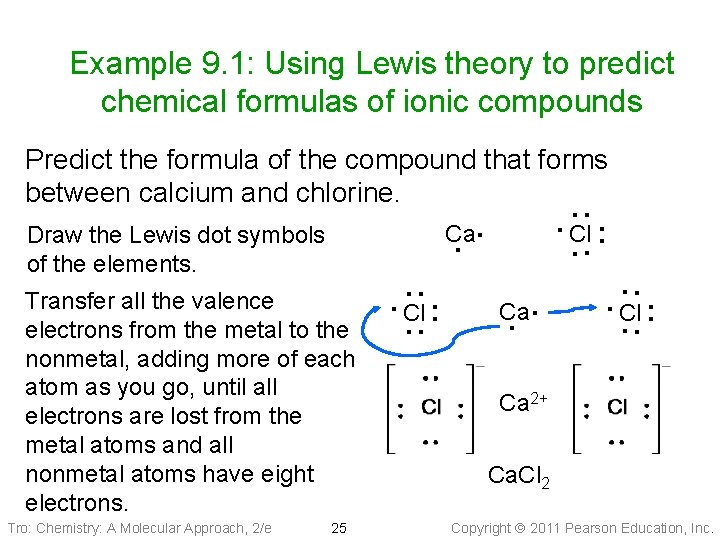
Example 9. 1: Using Lewis theory to predict chemical formulas of ionic compounds Predict the formula of the compound that forms between calcium and chlorine. 25 ∙∙ ∙∙ ∙∙ Ca ∙ Cl ∙∙ ∙∙ ∙∙ Transfer all the valence electrons from the metal to the nonmetal, adding more of each atom as you go, until all electrons are lost from the metal atoms and all nonmetal atoms have eight electrons. Tro: Chemistry: A Molecular Approach, 2/e ∙ Cl ∙∙ ∙ ∙ Ca Draw the Lewis dot symbols of the elements. Ca 2+ Ca. Cl 2 Copyright 2011 Pearson Education, Inc.
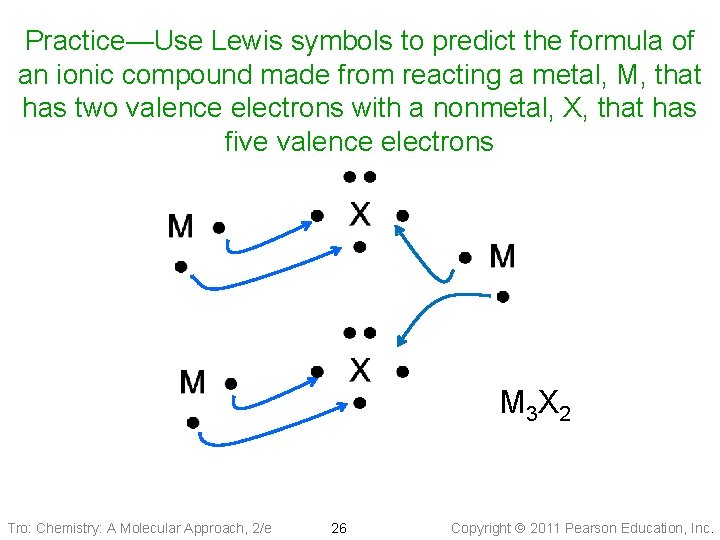
Practice—Use Lewis symbols to predict the formula of an ionic compound made from reacting a metal, M, that has two valence electrons with a nonmetal, X, that has five valence electrons M 3 X 2 Tro: Chemistry: A Molecular Approach, 2/e 26 Copyright 2011 Pearson Education, Inc.
Energetics of Ionic Bond Formation • The ionization energy of the metal is endothermic ü Na(s) → Na+(g) + 1 e ─ DH° = +496 k. J/mol • The electron affinity of the nonmetal is exothermic ü ½Cl 2(g) + 1 e ─ → Cl─(g) DH° = − 244 k. J/mol • Generally, the ionization energy of the metal is • larger than the electron affinity of the nonmetal, therefore the formation of the ionic compound should be endothermic But the heat of formation of most ionic compounds is exothermic and generally large. Why? ü Na(s) + ½Cl 2(g) → Na. Cl(s) DH°f = − 411 k. J/mol Tro: Chemistry: A Molecular Approach, 2/e 27 Copyright 2011 Pearson Education, Inc.
Ionic Bonding & the Crystal Lattice • The extra energy that is released comes from • • • the formation of a structure in which every cation is surrounded by anions, and vice versa This structure is called a crystal lattice The crystal lattice is held together by the electrostatic attraction of the cations for all the surrounding anions The crystal lattice maximizes the attractions between cations and anions, leading to the most stable arrangement Tro: Chemistry: A Molecular Approach, 2/e 28 Copyright 2011 Pearson Education, Inc.
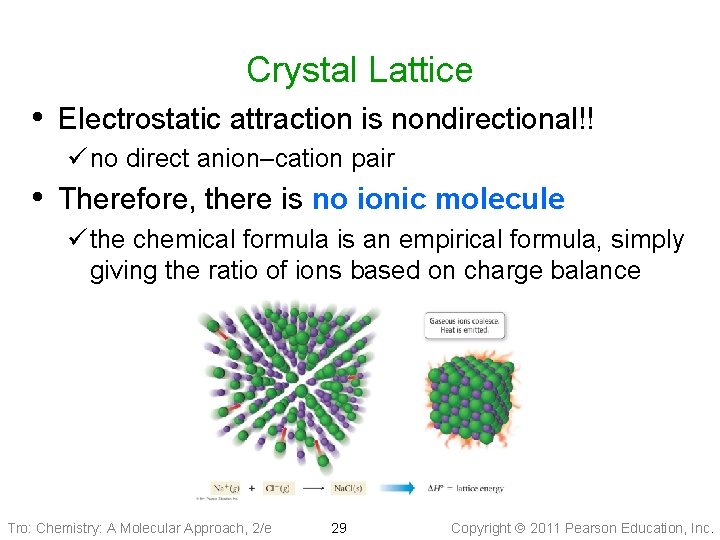
Crystal Lattice • Electrostatic attraction is nondirectional!! ü no direct anion–cation pair • Therefore, there is no ionic molecule ü the chemical formula is an empirical formula, simply giving the ratio of ions based on charge balance Tro: Chemistry: A Molecular Approach, 2/e 29 Copyright 2011 Pearson Education, Inc.
Lattice Energy • The extra stability that accompanies the • formation of the crystal lattice is measured as the lattice energy The lattice energy is the energy released when the solid crystal forms from separate ions in the gas state ü always exothermic ü hard to measure directly, but can be calculated from knowledge of other processes • Lattice energy depends directly on size of charges and inversely on distance between ions Tro: Chemistry: A Molecular Approach, 2/e 30 Copyright 2011 Pearson Education, Inc.
Determining Lattice Energy The Born–Haber Cycle • The Born–Haber Cycle is a hypothetical series • of reactions that represents the formation of an ionic compound from its constituent elements The reactions are chosen so that the change in enthalpy of each reaction is known except for the last one, which is the lattice energy Tro: Chemistry: A Molecular Approach, 2/e 31 Copyright 2011 Pearson Education, Inc.
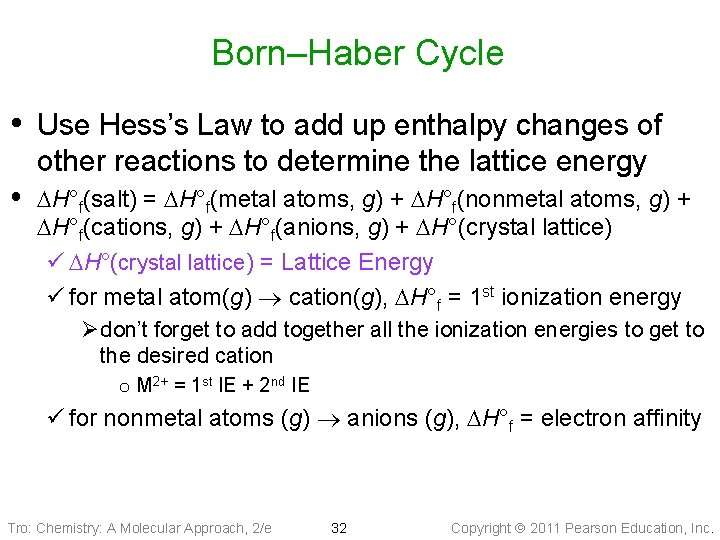
Born–Haber Cycle • Use Hess’s Law to add up enthalpy changes of other reactions to determine the lattice energy DH°f(salt) = DH°f(metal atoms, g) + DH°f(nonmetal atoms, g) + DH°f(cations, g) + DH°f(anions, g) + DH°(crystal lattice) ü DH°(crystal lattice) = Lattice Energy ü for metal atom(g) cation(g), DH°f = 1 st ionization energy Ødon’t forget to add together all the ionization energies to get to the desired cation o M 2+ = 1 st IE + 2 nd IE ü for nonmetal atoms (g) anions (g), DH°f = electron affinity Tro: Chemistry: A Molecular Approach, 2/e 32 Copyright 2011 Pearson Education, Inc.
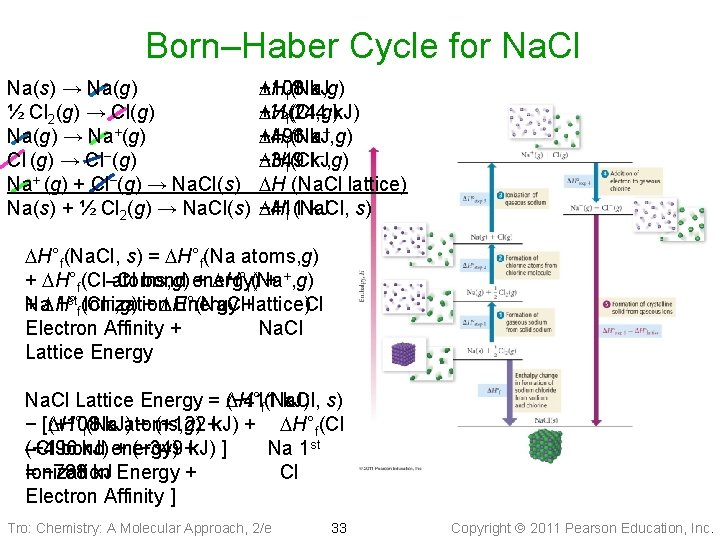
Born–Haber Cycle for Na. Cl Na(s) → Na(g) ½ Cl 2(g) → Cl(g) Na(g) → Na+(g) Cl (g) → Cl−(g) Na+ (g) + Cl−(g) → Na. Cl(s) Na(s) + ½ Cl 2(g) → Na. Cl(s) +108 DH k. J f(Na, g) DHf(Cl, g)k. J) +½(244 DHf(Na +496 k. J+, g) −, g) DHf(Clk. J − 349 DH (Na. Cl lattice) DHf (Na. Cl, − 411 k. J s) DH°f(Na. Cl, s) = DH°f(Na atoms, g) (Cl atoms, g) + DH°f(Na + DH°f(Cl–Cl bond energy) + +, g) −, g) + DH°(Na. Cl + DH° Na 1 stf(Cl Ionization Energy +lattice)Cl Electron Affinity + Na. Cl Lattice Energy = (− 411 DH°f(Na. Cl, k. J) s) − [(+108 [DH°f(Na k. J)atoms, g) + (+122 +k. J) + DH°f(Cl –Cl bond (+496 k. J) energy) + (− 349+k. J) ] Na 1 st Ionization = − 788 k. J Energy + Cl Electron Affinity ] Tro: Chemistry: A Molecular Approach, 2/e 33 Copyright 2011 Pearson Education, Inc.
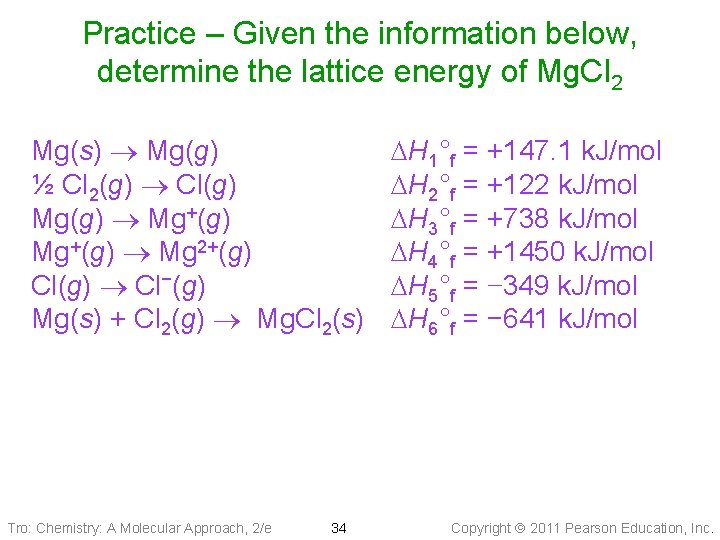
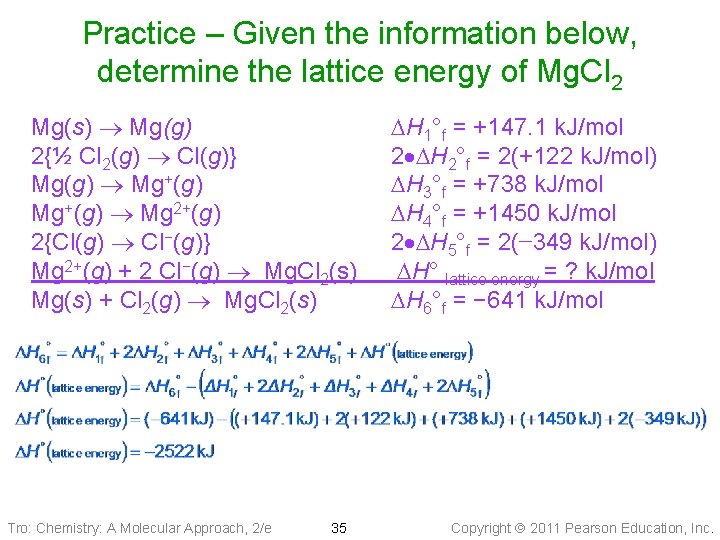
Practice – Given the information below, determine the lattice energy of Mg. Cl 2 Mg(s) Mg(g) ½ Cl 2(g) Cl(g) Mg(g) Mg+(g) Mg 2+(g) Cl(g) Cl−(g) Mg(s) + Cl 2(g) Mg. Cl 2(s) Tro: Chemistry: A Molecular Approach, 2/e 34 DH 1°f = +147. 1 k. J/mol DH 2°f = +122 k. J/mol DH 3°f = +738 k. J/mol DH 4°f = +1450 k. J/mol DH 5°f = − 349 k. J/mol DH 6°f = − 641 k. J/mol Copyright 2011 Pearson Education, Inc.
Practice – Given the information below, determine the lattice energy of Mg. Cl 2 Mg(s) Mg(g) 2{½ Cl 2(g) Cl(g)} Mg(g) Mg+(g) Mg 2+(g) 2{Cl(g) Cl−(g)} Mg 2+(g) + 2 Cl−(g) Mg. Cl 2(s) Mg(s) + Cl 2(g) Mg. Cl 2(s) Tro: Chemistry: A Molecular Approach, 2/e 35 DH 1°f = +147. 1 k. J/mol 2 DH 2°f = 2(+122 k. J/mol) DH 3°f = +738 k. J/mol DH 4°f = +1450 k. J/mol 2 DH 5°f = 2(− 349 k. J/mol) DH° lattice energy = ? k. J/mol DH 6°f = − 641 k. J/mol Copyright 2011 Pearson Education, Inc.
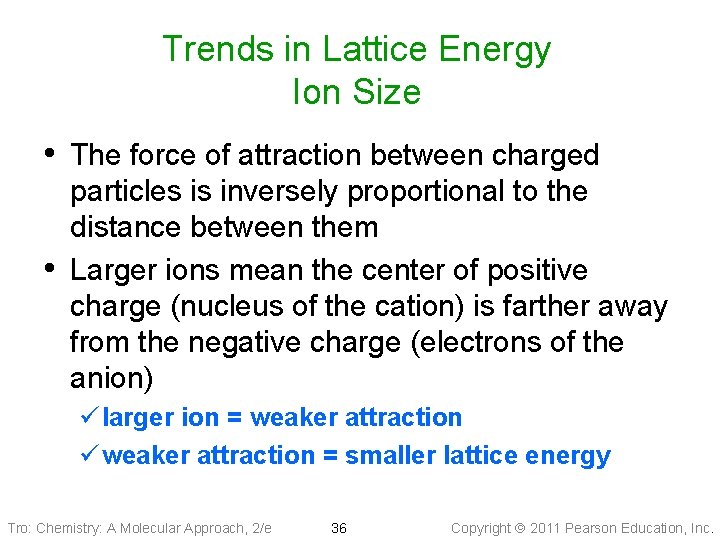
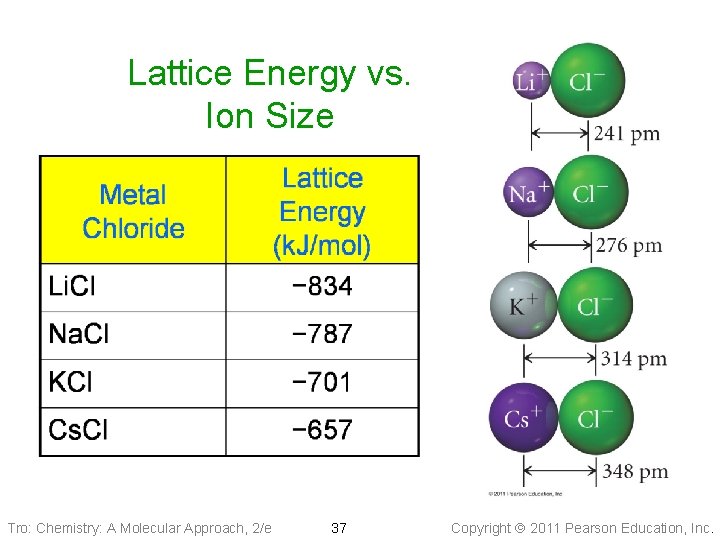
Trends in Lattice Energy Ion Size • The force of attraction between charged • particles is inversely proportional to the distance between them Larger ions mean the center of positive charge (nucleus of the cation) is farther away from the negative charge (electrons of the anion) ü larger ion = weaker attraction ü weaker attraction = smaller lattice energy Tro: Chemistry: A Molecular Approach, 2/e 36 Copyright 2011 Pearson Education, Inc.
Lattice Energy vs. Ion Size Tro: Chemistry: A Molecular Approach, 2/e 37 Copyright 2011 Pearson Education, Inc.
Trends in Lattice Energy Ion Charge • The force of attraction between • oppositely charged particles is directly proportional to the product of the charges Larger charge means the ions are more strongly attracted ü larger charge = stronger attraction ü stronger attraction = larger lattice energy • Of the two factors, ion charge is Lattice Energy = − 910 k. J/mol Lattice Energy = − 3414 k. J/mol generally more important Tro: Chemistry: A Molecular Approach, 2/e 38 Copyright 2011 Pearson Education, Inc.
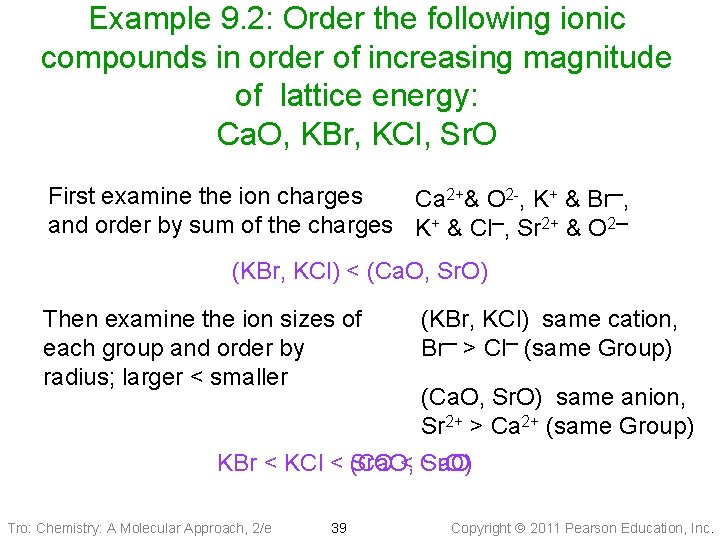
Example 9. 2: Order the following ionic compounds in order of increasing magnitude of lattice energy: Ca. O, KBr, KCl, Sr. O First examine the ion charges Ca 2+& O 2 -, K+ & Br─, and order by sum of the charges K+ & Cl─, Sr 2+ & O 2─ (KBr, KCl) < (Ca. O, Sr. O) Then examine the ion sizes of each group and order by radius; larger < smaller (KBr, KCl) same cation, Br─ > Cl─ (same Group) (Ca. O, Sr. O) same anion, Sr 2+ > Ca 2+ (same Group) KBr < KCl < Sr. O (Ca. O, < Ca. O Sr. O) Tro: Chemistry: A Molecular Approach, 2/e 39 Copyright 2011 Pearson Education, Inc.
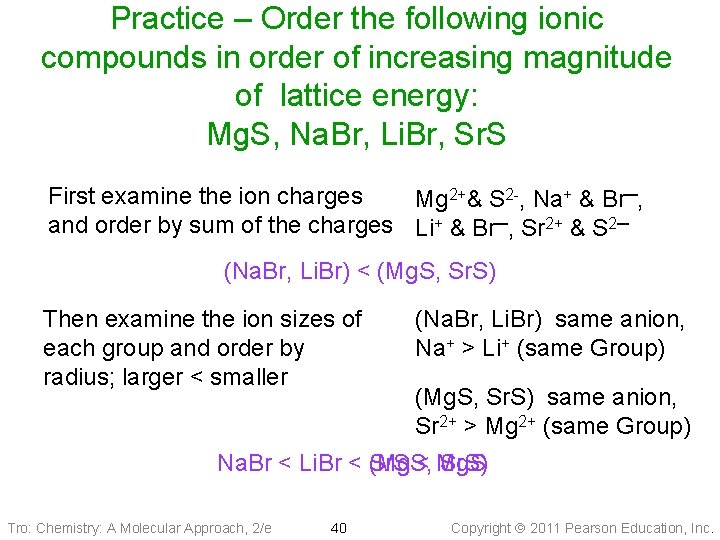
Practice – Order the following ionic compounds in order of increasing magnitude of lattice energy: Mg. S, Na. Br, Li. Br, Sr. S First examine the ion charges Mg 2+& S 2 -, Na+ & Br─, and order by sum of the charges Li+ & Br─, Sr 2+ & S 2─ (Na. Br, Li. Br) < (Mg. S, Sr. S) Then examine the ion sizes of each group and order by radius; larger < smaller (Na. Br, Li. Br) same anion, Na+ > Li+ (same Group) (Mg. S, Sr. S) same anion, Sr 2+ > Mg 2+ (same Group) Na. Br < Li. Br < Sr. S (Mg. S, < Mg. S Sr. S) Tro: Chemistry: A Molecular Approach, 2/e 40 Copyright 2011 Pearson Education, Inc.
Ionic Bonding Model vs. Reality • Lewis theory implies that the attractions • between ions are strong Lewis theory predicts ionic compounds should have high melting points and boiling points because breaking down the crystal should require a lot of energy ü the stronger the attraction (larger the lattice energy), the higher the melting point • Ionic compounds have high melting points and boiling points ü MP generally > 300 °C ü all ionic compounds are solids at room temperature Tro: Chemistry: A Molecular Approach, 2/e 41 Copyright 2011 Pearson Education, Inc.
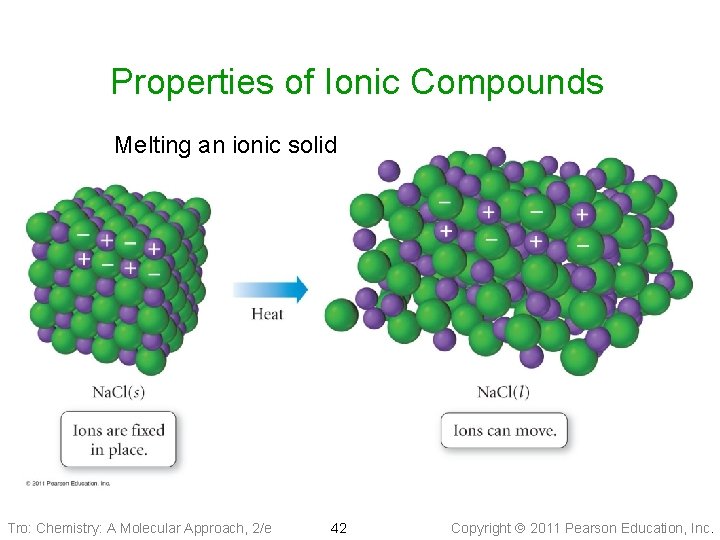
Properties of Ionic Compounds Melting an ionic solid • Hard and brittle crystalline solids ü all are solids at room temperature • Melting points generally > 300 C • The liquid state conducts electricity ü the solid state does not conduct electricity • Many are soluble in water ü the solution conducts electricity well Tro: Chemistry: A Molecular Approach, 2/e 42 Copyright 2011 Pearson Education, Inc.
Practice – Which ionic compound below has the highest melting point? • KBr (734 ºC) • Ca. Cl 2 (772 ºC) • Mg. F 2 (1261 ºC) Tro: Chemistry: A Molecular Approach, 2/e 43 Copyright 2011 Pearson Education, Inc.
Ionic Bonding Model vs. Reality • Lewis theory implies that the positions of the • ions in the crystal lattice are critical to the stability of the structure Lewis theory predicts that moving ions out of position should therefore be difficult, and ionic solids should be hard ü hardness is measured by rubbing two materials together and seeing which “streaks” or cuts the other ü the harder material is the one that cuts or doesn’t streak • Ionic solids are relatively hard ü compared to most molecular solids Tro: Chemistry: A Molecular Approach, 2/e 44 Copyright 2011 Pearson Education, Inc.
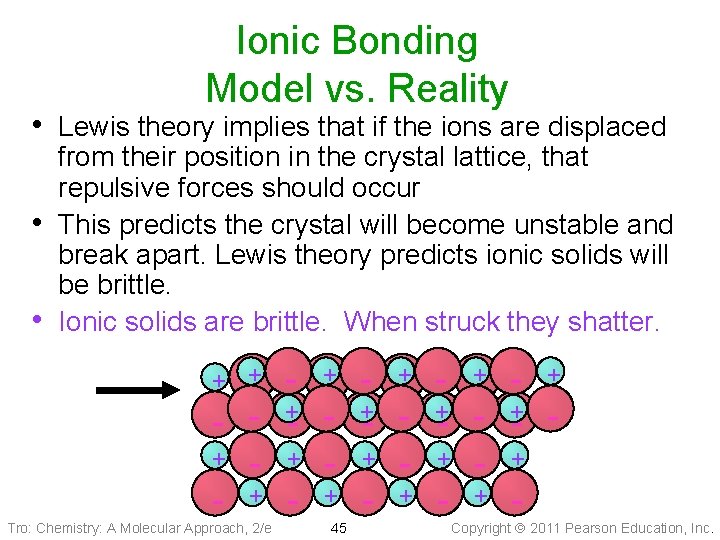
Ionic Bonding Model vs. Reality • Lewis theory implies that if the ions are displaced • • from their position in the crystal lattice, that repulsive forces should occur This predicts the crystal will become unstable and break apart. Lewis theory predicts ionic solids will be brittle. Ionic solids are brittle. When struck they shatter. -+ +- -+ + - -+ +- + - + - + + + - Tro: Chemistry: A Molecular Approach, 2/e 45 Copyright 2011 Pearson Education, Inc.
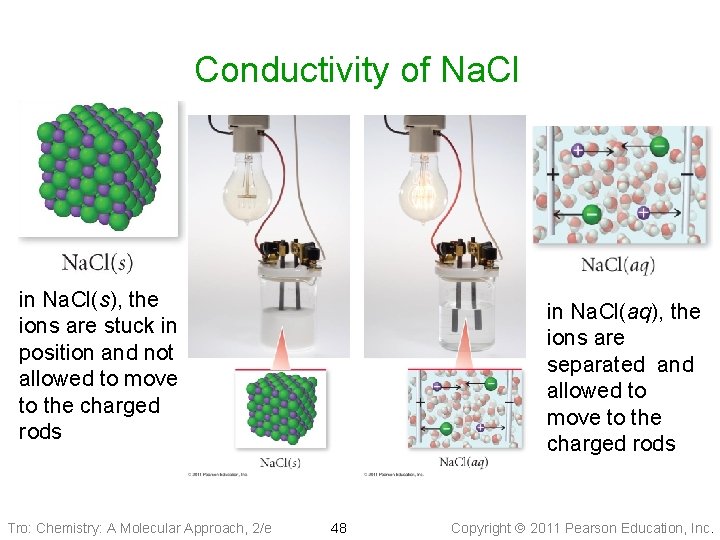
Ionic Bonding Model vs. Reality • To conduct electricity, a material must have • • • charged particles that are able to flow through the material Lewis theory implies that, in the ionic solid, the ions are locked in position and cannot move around Lewis theory predicts that ionic solids should not conduct electricity Ionic solids do not conduct electricity Tro: Chemistry: A Molecular Approach, 2/e 46 Copyright 2011 Pearson Education, Inc.
Ionic Bonding Model vs. Reality • Lewis theory implies that, in the liquid state or • • when dissolved in water, the ions will have the ability to move around Lewis theory predicts that both a liquid ionic compound an ionic compound dissolved in water should conduct electricity Ionic compounds conduct electricity in the liquid state or when dissolved in water Tro: Chemistry: A Molecular Approach, 2/e 47 Copyright 2011 Pearson Education, Inc.
Conductivity of Na. Cl in Na. Cl(s), the ions are stuck in position and not allowed to move to the charged rods Tro: Chemistry: A Molecular Approach, 2/e in Na. Cl(aq), the ions are separated and allowed to move to the charged rods 48 Copyright 2011 Pearson Education, Inc.
Lewis Theory of Covalent Bonding • Lewis theory implies that another way atoms • • can achieve an octet of valence electrons is to share their valence electrons with other atoms The shared electrons would then count toward each atom’s octet The sharing of valence electrons is called covalent bonding Tro: Chemistry: A Molecular Approach, 2/e 49 Copyright 2011 Pearson Education, Inc.
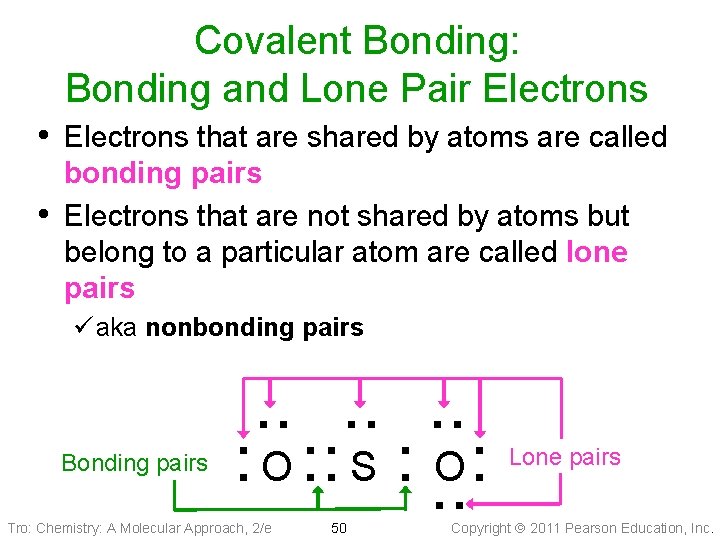
Covalent Bonding: Bonding and Lone Pair Electrons • Electrons that are shared by atoms are called • bonding pairs Electrons that are not shared by atoms but belong to a particular atom are called lone pairs ü aka nonbonding pairs Bonding pairs . . . . O. . S. . O. . Tro: Chemistry: A Molecular Approach, 2/e 50 Lone pairs Copyright 2011 Pearson Education, Inc.
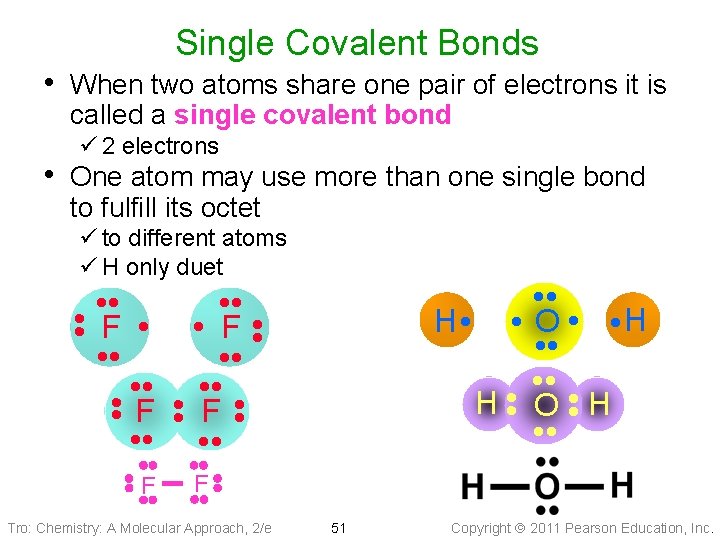
Single Covalent Bonds • When two atoms share one pair of electrons it is called a single covalent bond ü 2 electrons • One atom may use more than one single bond to fulfill its octet ü to different atoms ü H only duet • • F F • • F • • • F • • • F • • • H • • O • H • • H O H • • F Tro: Chemistry: A Molecular Approach, 2/e 51 Copyright 2011 Pearson Education, Inc.
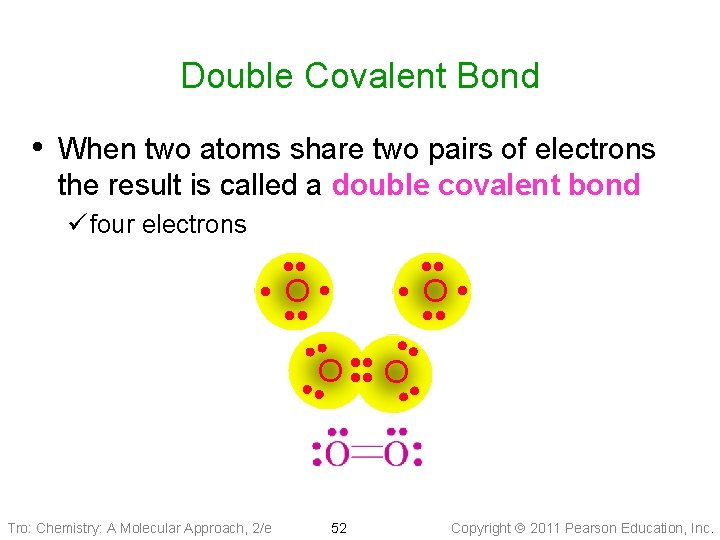
Double Covalent Bond • When two atoms share two pairs of electrons the result is called a double covalent bond ü four electrons Tro: Chemistry: A Molecular Approach, 2/e 52 • • • O • • • O O • • Copyright 2011 Pearson Education, Inc.
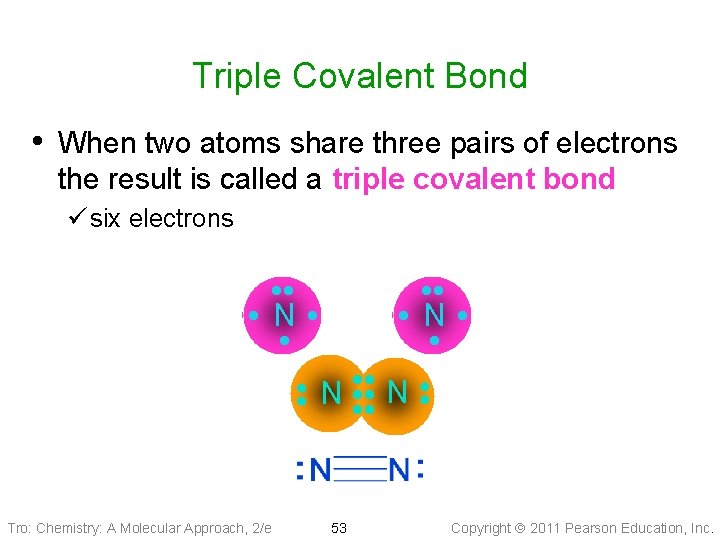
Triple Covalent Bond • When two atoms share three pairs of electrons the result is called a triple covalent bond ü six electrons • • N • • N • • 53 • • Tro: Chemistry: A Molecular Approach, 2/e • • N • Copyright 2011 Pearson Education, Inc.
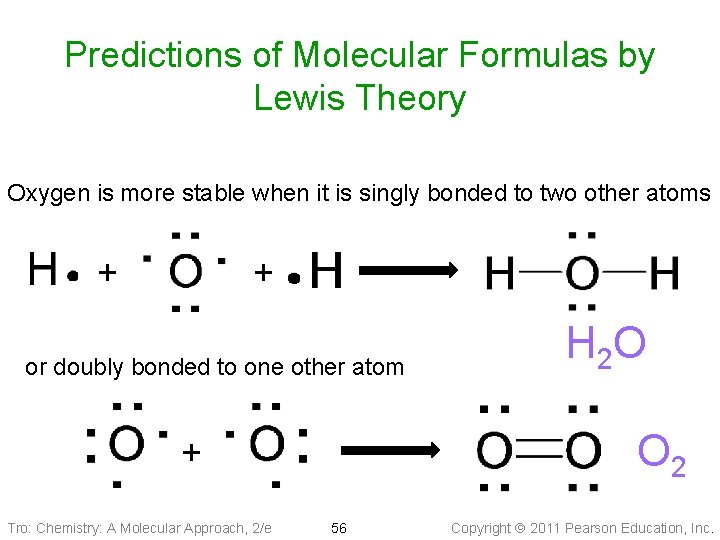
Covalent Bonding Model vs. Reality • Lewis theory implies that some combinations should be stable, whereas others should not ü because the stable combinations result in “octets” • using these ideas of Lewis theory allows us to • • predict the formulas of molecules of covalently bonded substances Hydrogen and the halogens are all diatomic molecular elements, as predicted by Lewis theory Oxygen generally forms either two single bonds or a double bond in its molecular compounds, as predicted by Lewis theory ü though, as we’ll see, there are some stable compounds in which oxygen has one single bond another where it has a triple bond, but it still has an octet Tro: Chemistry: A Molecular Approach, 2/e 54 Copyright 2011 Pearson Education, Inc.
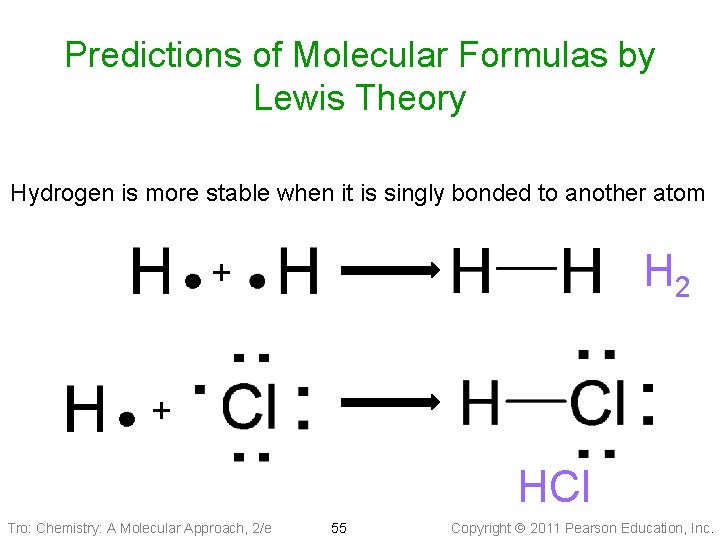
Predictions of Molecular Formulas by Lewis Theory Hydrogen is more stable when it is singly bonded to another atom H 2 + + HCl Tro: Chemistry: A Molecular Approach, 2/e 55 Copyright 2011 Pearson Education, Inc.
Predictions of Molecular Formulas by Lewis Theory Oxygen is more stable when it is singly bonded to two other atoms + + or doubly bonded to one other atom O 2 + Tro: Chemistry: A Molecular Approach, 2/e H 2 O 56 Copyright 2011 Pearson Education, Inc.
Covalent Bonding Model vs. Reality • Lewis theory of covalent bonding implies that the attractions between atoms are directional ü the shared electrons are most stable between the bonding atoms • Therefore Lewis theory predicts covalently bonded compounds will be found as individual molecules ü rather than an array like ionic compounds • Compounds of nonmetals are made of individual molecule units Tro: Chemistry: A Molecular Approach, 2/e 57 Copyright 2011 Pearson Education, Inc.
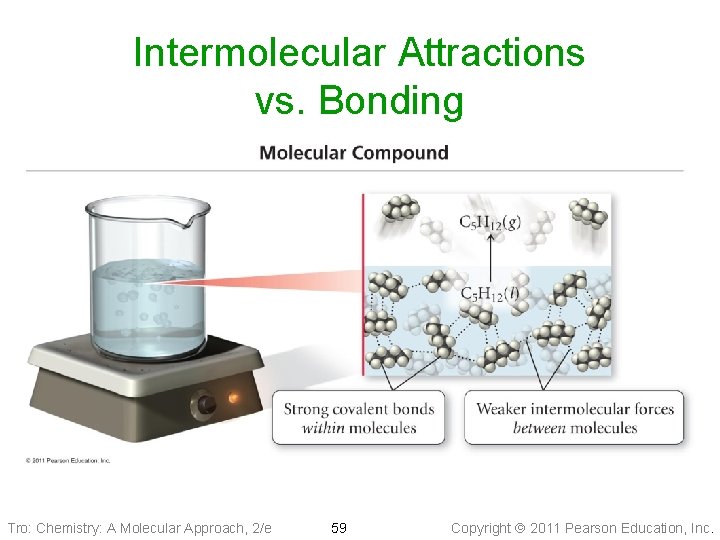
Covalent Bonding Model vs. Reality • Lewis theory predicts the melting and boiling points of molecular compounds should be relatively low ü involves breaking the attractions between the molecules, but not the bonds between the atoms ü the covalent bonds are strong, but the attractions between the molecules are generally weak • Molecular compounds have low melting points and boiling points ü MP generally < 300 °C ü molecular compounds are found in all three states at room temperature Tro: Chemistry: A Molecular Approach, 2/e 58 Copyright 2011 Pearson Education, Inc.
Intermolecular Attractions vs. Bonding Tro: Chemistry: A Molecular Approach, 2/e 59 Copyright 2011 Pearson Education, Inc.
Covalent Bonding Model vs. Reality • Lewis theory predicts that the hardness and brittleness of molecular compounds should vary depending on the strength of intermolecular attractive forces ü the kind and strength of the intermolecular attractions varies based on many factors • Some molecular solids are brittle and hard, but many are soft and waxy Tro: Chemistry: A Molecular Approach, 2/e 60 Copyright 2011 Pearson Education, Inc.
Covalent Bonding Model vs. Reality • Lewis theory predicts that neither molecular solids nor liquids should conduct electricity ü there are no charged particles around to allow the material to conduct • Molecular compounds do not conduct electricity in • the solid or liquid state Molecular acids conduct electricity when dissolved in water, but not in the solid or liquid state, due to them being ionized by the water Tro: Chemistry: A Molecular Approach, 2/e 61 Copyright 2011 Pearson Education, Inc.
Covalent Bonding Model vs. Reality • Lewis theory predicts that the more electrons two • • atoms share, the stronger the bond should be Bond strength is measured by how much energy must be added into the bond to break it in half In general, triple bonds are stronger than double bonds, and double bonds are stronger than single bonds ü however, Lewis theory would predict double bonds are twice as strong as single bonds, but the reality is they are less than twice as strong Tro: Chemistry: A Molecular Approach, 2/e 62 Copyright 2011 Pearson Education, Inc.
Covalent Bonding Model vs. Reality • Lewis theory predicts that the more electrons two atoms share, the shorter the bond should be ü when comparing bonds to like atoms • Bond length is determined by measuring the • distance between the nuclei of bonded atoms In general, triple bonds are shorter than double bonds, and double bonds are shorter than single bonds Tro: Chemistry: A Molecular Approach, 2/e 63 Copyright 2011 Pearson Education, Inc.
Polar Covalent Bonding • Covalent bonding between unlike atoms results in unequal sharing of the electrons ü one atom pulls the electrons in the bond closer to its side ü one end of the bond has larger electron density than the other • The result is a polar covalent bond ü bond polarity ü the end with the larger electron density gets a partial negative charge ü the end that is electron deficient gets a partial positive charge Tro: Chemistry: A Molecular Approach, 2/e 64 Copyright 2011 Pearson Education, Inc.
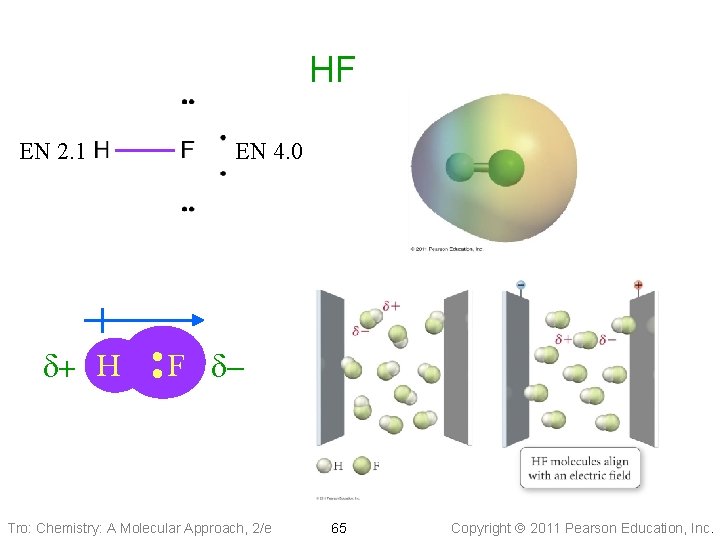
HF EN 2. 1 EN 4. 0 d+ H • • F d- Tro: Chemistry: A Molecular Approach, 2/e 65 Copyright 2011 Pearson Education, Inc.
Bond Polarity • Most bonds have some degree of sharing and • • some degree of ion formation to them Bonds are classified as covalent if the amount of electron transfer is insufficient for the material to display the classic properties of ionic compounds If the sharing is unequal enough to produce a dipole in the bond, the bond is classified as polar covalent Tro: Chemistry: A Molecular Approach, 2/e 66 Copyright 2011 Pearson Education, Inc.
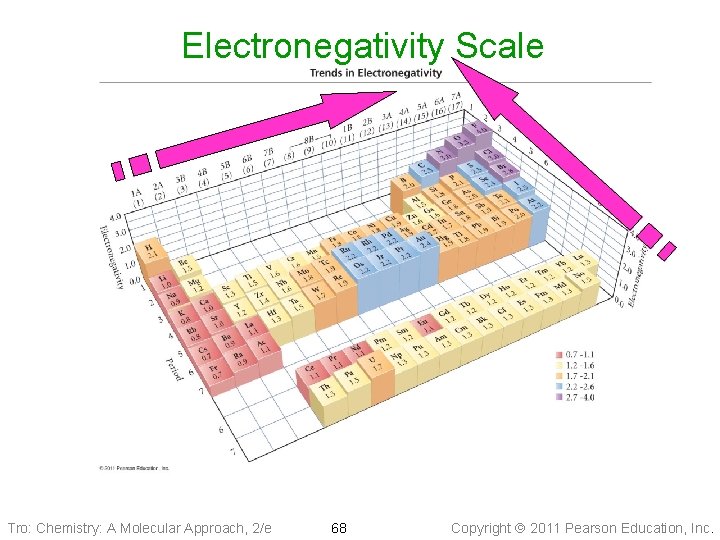
Electronegativity • The ability of an atom to attract bonding • • electrons to itself is called electronegativity Increases across period (left to right) and Decreases down group (top to bottom) ü fluorine is the most electronegative element ü francium is the least electronegative element ü noble gas atoms are not assigned values ü opposite of atomic size trend • The larger the difference in electronegativity, the more polar the bond ü negative end toward more electronegative atom Tro: Chemistry: A Molecular Approach, 2/e 67 Copyright 2011 Pearson Education, Inc.
Electronegativity Scale Tro: Chemistry: A Molecular Approach, 2/e 68 Copyright 2011 Pearson Education, Inc.
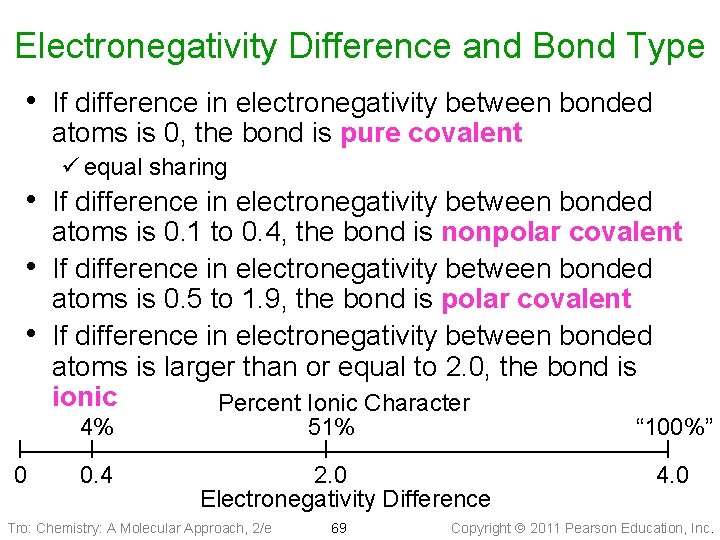
Electronegativity Difference and Bond Type • If difference in electronegativity between bonded atoms is 0, the bond is pure covalent ü equal sharing • If difference in electronegativity between bonded • • atoms is 0. 1 to 0. 4, the bond is nonpolar covalent If difference in electronegativity between bonded atoms is 0. 5 to 1. 9, the bond is polar covalent If difference in electronegativity between bonded atoms is larger than or equal to 2. 0, the bond is ionic Percent Ionic Character 4% 0 0. 4 “ 100%” 51% 2. 0 Electronegativity Difference Tro: Chemistry: A Molecular Approach, 2/e 69 4. 0 Copyright 2011 Pearson Education, Inc.
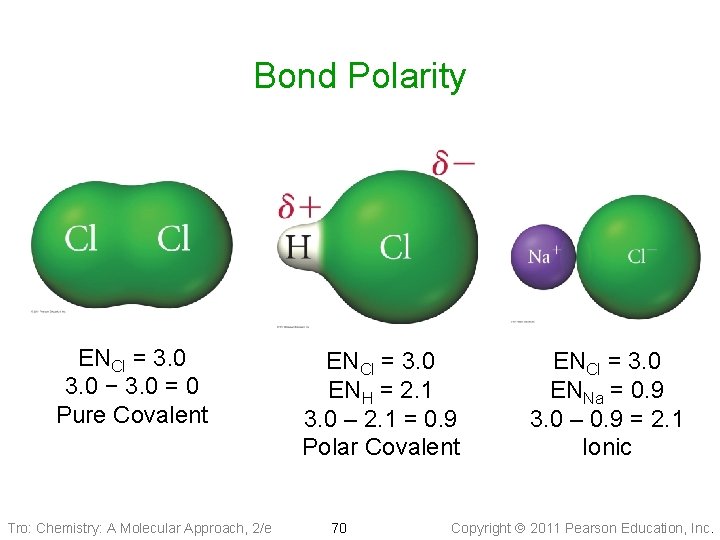
Bond Polarity ENCl = 3. 0 − 3. 0 = 0 Pure Covalent Tro: Chemistry: A Molecular Approach, 2/e ENCl = 3. 0 ENH = 2. 1 3. 0 – 2. 1 = 0. 9 Polar Covalent 70 ENCl = 3. 0 ENNa = 0. 9 3. 0 – 0. 9 = 2. 1 Ionic Copyright 2011 Pearson Education, Inc.
Water – a Polar Molecule stream of water attracted to a charged glass rod Tro: Chemistry: A Molecular Approach, 2/e stream of hexane not attracted to a charged glass rod 71 Copyright 2011 Pearson Education, Inc.
Tro: Chemistry: A Molecular Approach, 2/e 72 Copyright 2011 Pearson Education, Inc.
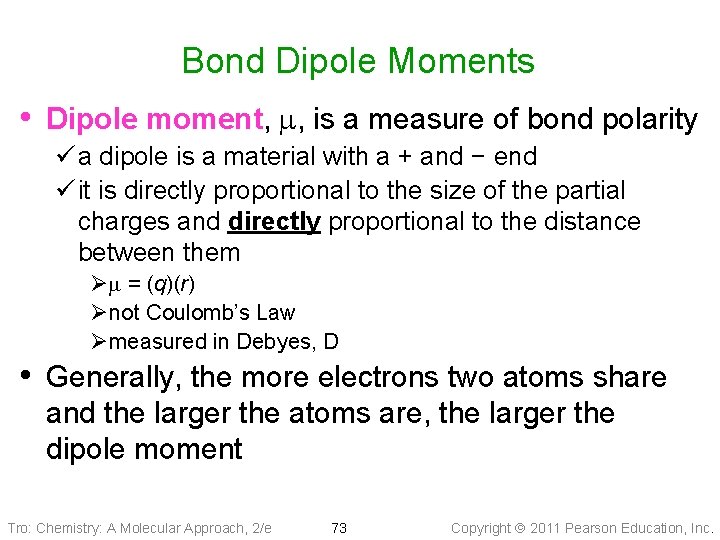
Bond Dipole Moments • Dipole moment, m, is a measure of bond polarity ü a dipole is a material with a + and − end ü it is directly proportional to the size of the partial charges and directly proportional to the distance between them Øm = (q)(r) Ønot Coulomb’s Law Ømeasured in Debyes, D • Generally, the more electrons two atoms share and the larger the atoms are, the larger the dipole moment Tro: Chemistry: A Molecular Approach, 2/e 73 Copyright 2011 Pearson Education, Inc.
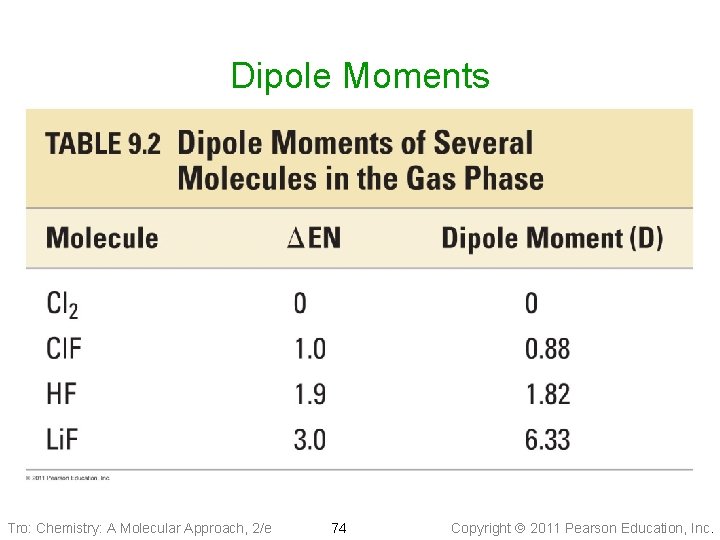
Dipole Moments Tro: Chemistry: A Molecular Approach, 2/e 74 Copyright 2011 Pearson Education, Inc.
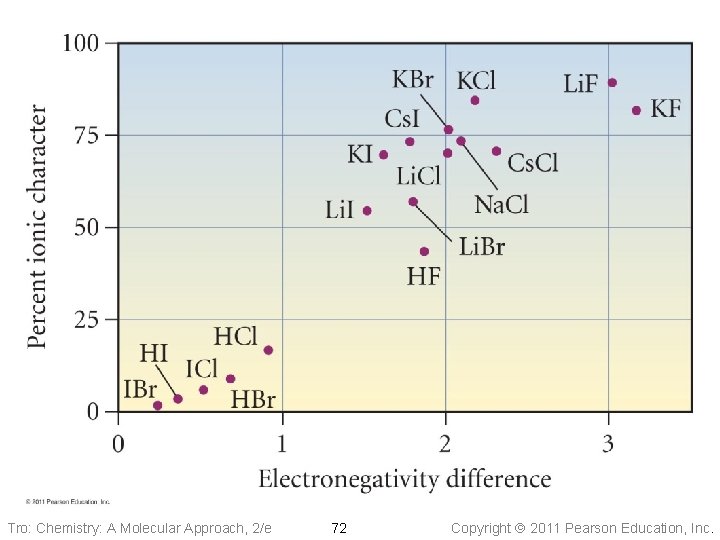
Percent Ionic Character • The percent ionic character is the • percentage of a bond’s measured dipole moment compared to what it would be if the electrons were completely transferred The percent ionic character indicates the degree to which the electron is transferred Tro: Chemistry: A Molecular Approach, 2/e 75 Copyright 2011 Pearson Education, Inc.
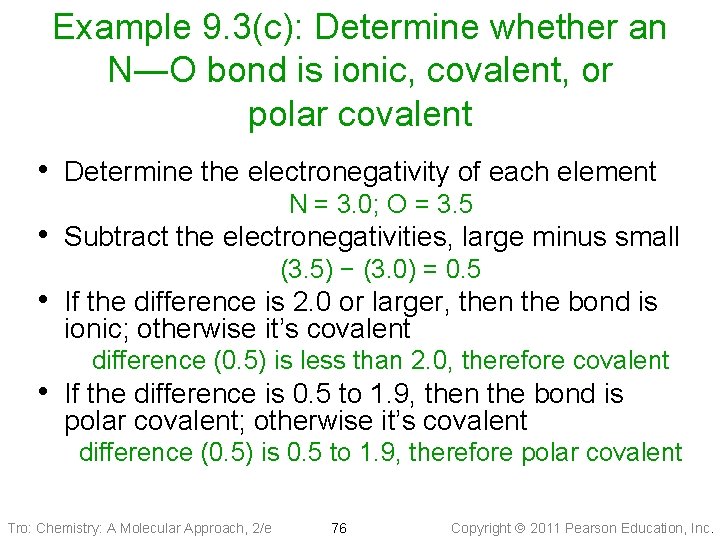
Example 9. 3(c): Determine whether an N―O bond is ionic, covalent, or polar covalent • Determine the electronegativity of each element N = 3. 0; O = 3. 5 • Subtract the electronegativities, large minus small (3. 5) − (3. 0) = 0. 5 • If the difference is 2. 0 or larger, then the bond is ionic; otherwise it’s covalent difference (0. 5) is less than 2. 0, therefore covalent • If the difference is 0. 5 to 1. 9, then the bond is polar covalent; otherwise it’s covalent difference (0. 5) is 0. 5 to 1. 9, therefore polar covalent Tro: Chemistry: A Molecular Approach, 2/e 76 Copyright 2011 Pearson Education, Inc.
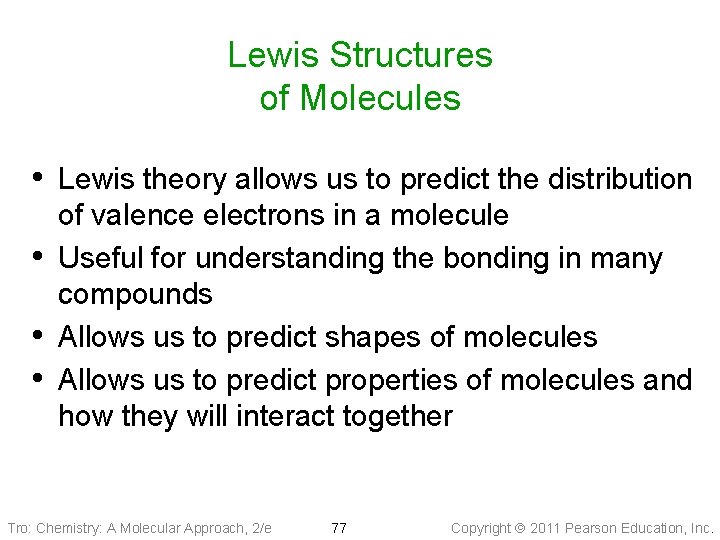
Lewis Structures of Molecules • Lewis theory allows us to predict the distribution • • • of valence electrons in a molecule Useful for understanding the bonding in many compounds Allows us to predict shapes of molecules Allows us to predict properties of molecules and how they will interact together Tro: Chemistry: A Molecular Approach, 2/e 77 Copyright 2011 Pearson Education, Inc.
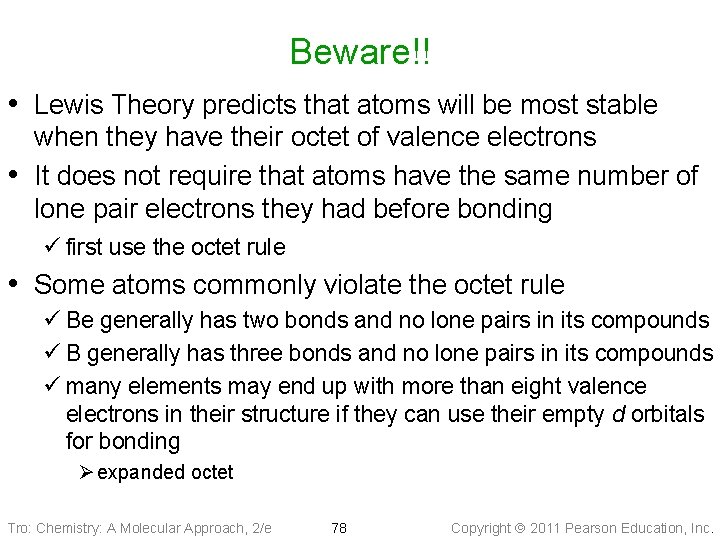
Beware!! • Lewis Theory predicts that atoms will be most stable • when they have their octet of valence electrons It does not require that atoms have the same number of lone pair electrons they had before bonding ü first use the octet rule • Some atoms commonly violate the octet rule ü Be generally has two bonds and no lone pairs in its compounds ü B generally has three bonds and no lone pairs in its compounds ü many elements may end up with more than eight valence electrons in their structure if they can use their empty d orbitals for bonding Ø expanded octet Tro: Chemistry: A Molecular Approach, Approach 2/e 78 Copyright 2011 Pearson Education, Inc.
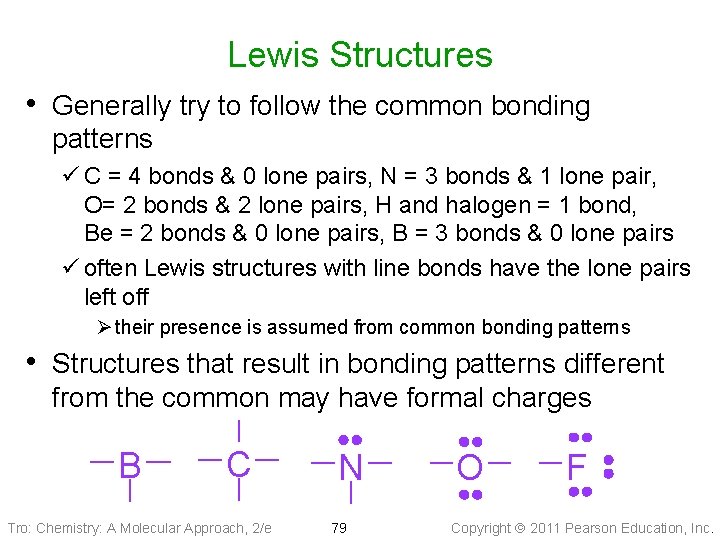
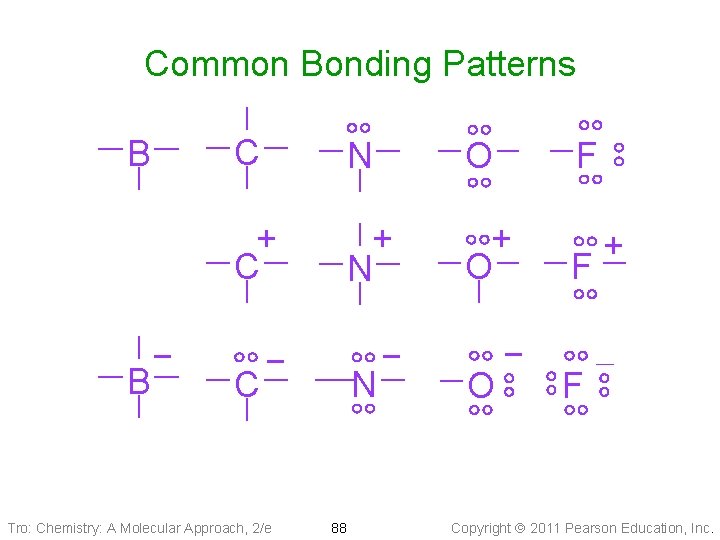
Lewis Structures • Generally try to follow the common bonding patterns ü C = 4 bonds & 0 lone pairs, N = 3 bonds & 1 lone pair, O= 2 bonds & 2 lone pairs, H and halogen = 1 bond, Be = 2 bonds & 0 lone pairs, B = 3 bonds & 0 lone pairs ü often Lewis structures with line bonds have the lone pairs left off Ø their presence is assumed from common bonding patterns • Structures that result in bonding patterns different from the common may have formal charges B C Tro: Chemistry: A Molecular Approach, 2/e N 79 O F Copyright 2011 Pearson Education, Inc.
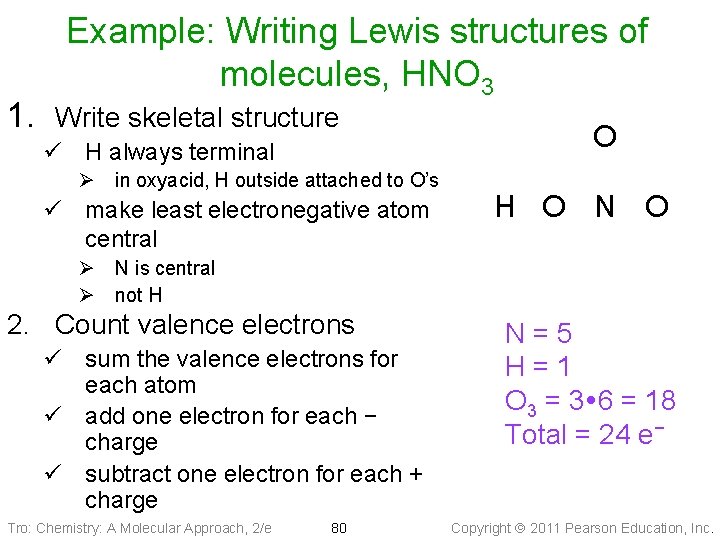
Example: Writing Lewis structures of molecules, HNO 3 1. Write skeletal structure ü H always terminal Ø in oxyacid, H outside attached to O’s ü make least electronegative atom central O H O N O Ø N is central Ø not H 2. Count valence electrons ü sum the valence electrons for each atom ü add one electron for each − charge ü subtract one electron for each + charge Tro: Chemistry: A Molecular Approach, 2/e 80 N=5 H=1 O 3 = 3 6 = 18 Total = 24 e− Copyright 2011 Pearson Education, Inc.
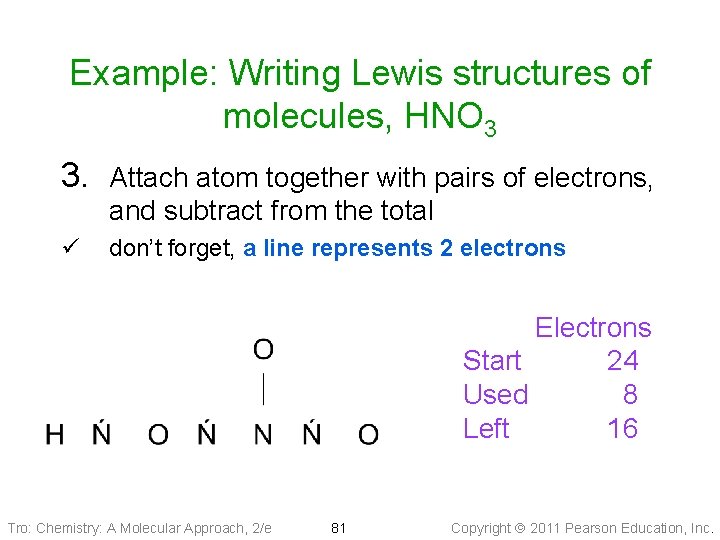
Example: Writing Lewis structures of molecules, HNO 3 3. Attach atom together with pairs of electrons, and subtract from the total ü don’t forget, a line represents 2 electrons Electrons Start 24 Used 8 Left 16 Tro: Chemistry: A Molecular Approach, 2/e 81 Copyright 2011 Pearson Education, Inc.
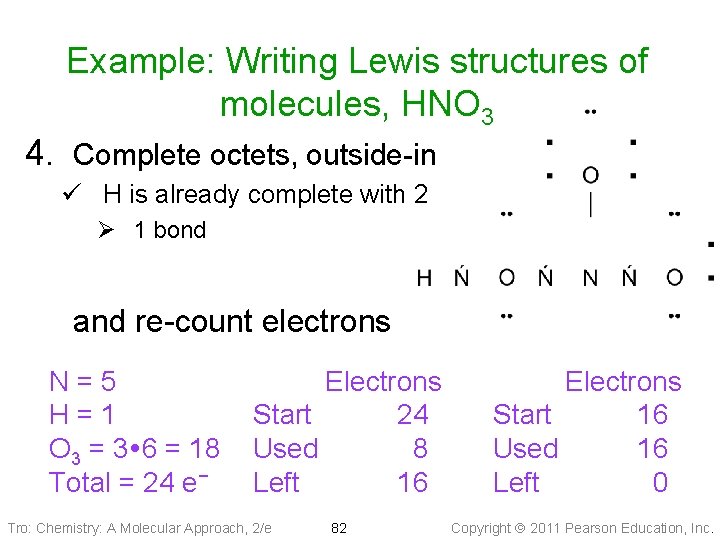
Example: Writing Lewis structures of molecules, HNO 3 4. Complete octets, outside-in ü H is already complete with 2 Ø 1 bond and re-count electrons N=5 H=1 O 3 = 3 6 = 18 Total = 24 e− Electrons Start 24 Used 8 Left 16 Tro: Chemistry: A Molecular Approach, 2/e 82 Electrons Start 16 Used 16 Left 0 Copyright 2011 Pearson Education, Inc.
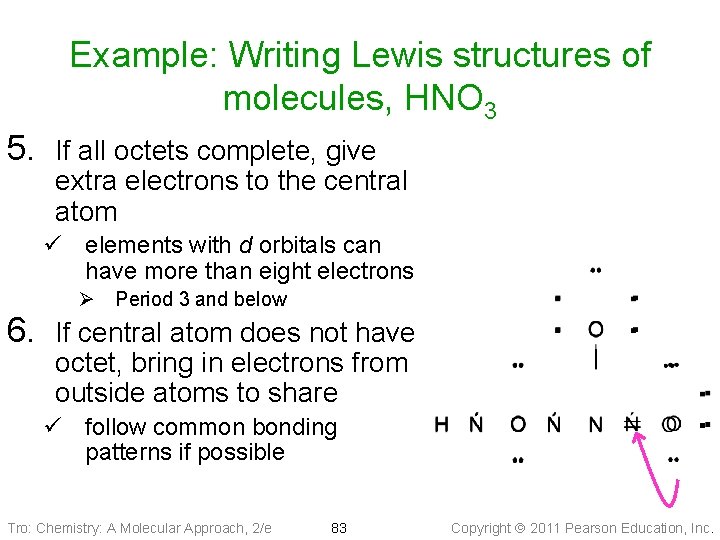
Example: Writing Lewis structures of molecules, HNO 3 5. If all octets complete, give extra electrons to the central atom ü elements with d orbitals can have more than eight electrons Ø Period 3 and below 6. If central atom does not have octet, bring in electrons from outside atoms to share ü follow common bonding patterns if possible Tro: Chemistry: A Molecular Approach, 2/e 83 Copyright 2011 Pearson Education, Inc.
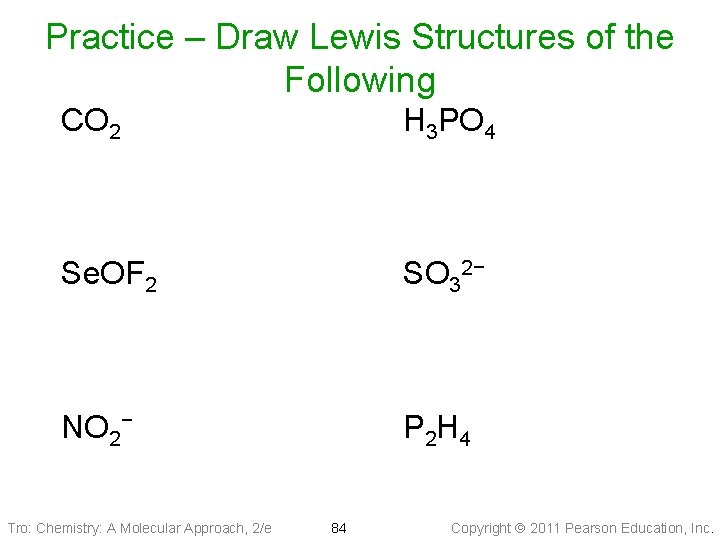
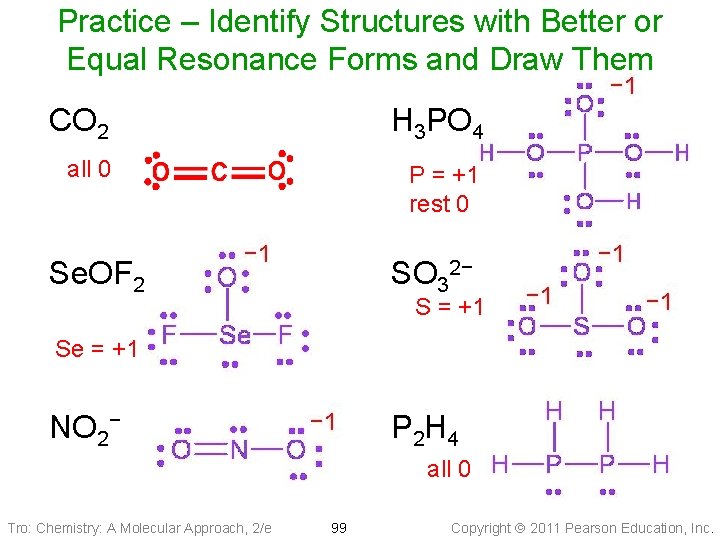
Practice – Draw Lewis Structures of the Following CO 2 H 3 PO 4 Se. OF 2 SO 32− NO 2− P 2 H 4 Tro: Chemistry: A Molecular Approach, 2/e 84 Copyright 2011 Pearson Education, Inc.
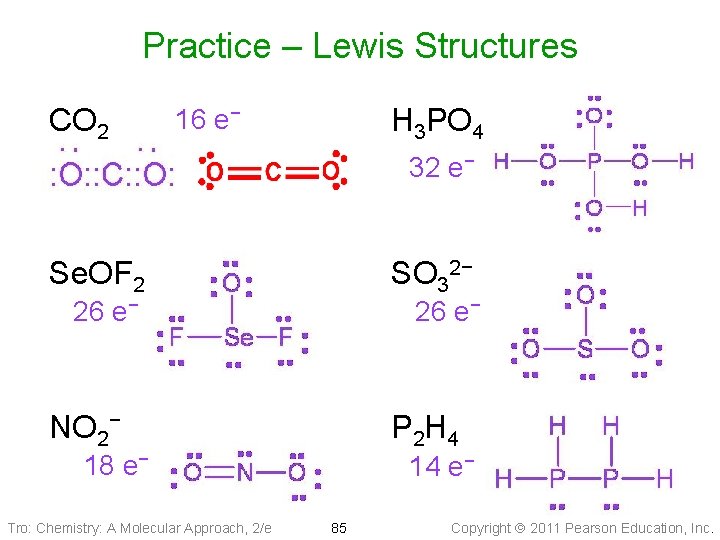
Practice – Lewis Structures CO 2 H 3 PO 4 16 e− 32 e− Se. OF 2 SO 32− NO 2− P 2 H 4 26 e− 18 e− Tro: Chemistry: A Molecular Approach, 2/e 14 e− 85 Copyright 2011 Pearson Education, Inc.
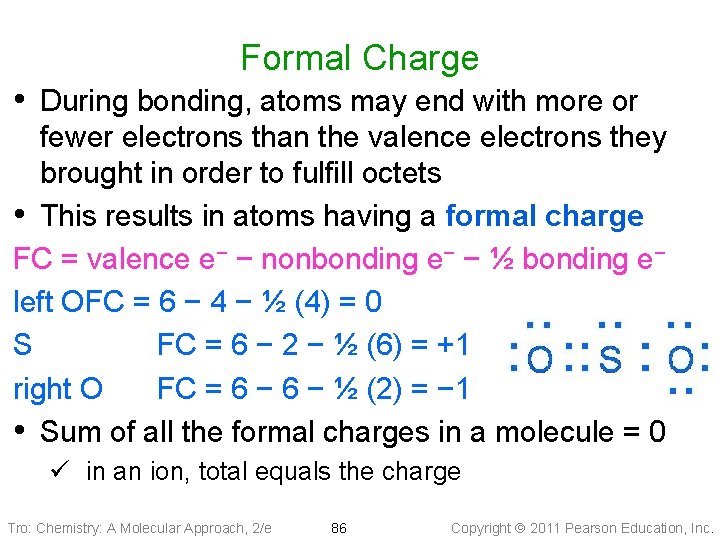
Formal Charge • During bonding, atoms may end with more or fewer electrons than the valence electrons they brought in order to fulfill octets • This results in atoms having a formal charge FC = valence e− − nonbonding e− − ½ bonding e− left OFC = 6 − 4 − ½ (4) = 0 S FC = 6 − 2 − ½ (6) = +1 right O FC = 6 − ½ (2) = − 1 • Sum of all the formal charges in a molecule = 0 ü in an ion, total equals the charge Tro: Chemistry: A Molecular Approach, 2/e 86 Copyright 2011 Pearson Education, Inc.
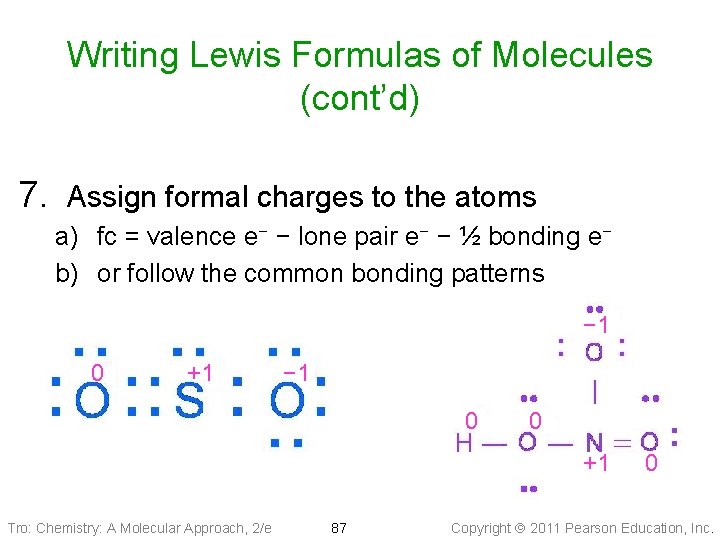
Writing Lewis Formulas of Molecules (cont’d) 7. Assign formal charges to the atoms a) fc = valence e− − lone pair e− − ½ bonding e− b) or follow the common bonding patterns − 1 0 +1 − 1 0 0 +1 Tro: Chemistry: A Molecular Approach, 2/e 87 0 Copyright 2011 Pearson Education, Inc.
Common Bonding Patterns B B − C N O + C + N + O − − C Tro: Chemistry: A Molecular Approach, 2/e N 88 O F − F F + − Copyright 2011 Pearson Education, Inc.
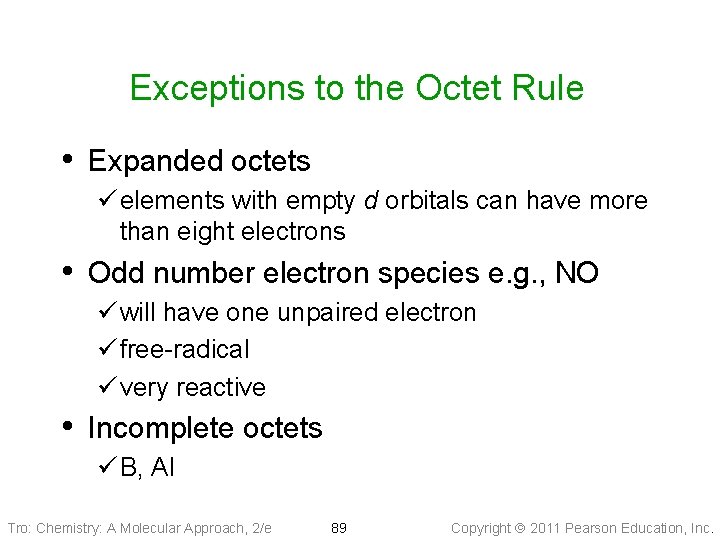
Exceptions to the Octet Rule • Expanded octets ü elements with empty d orbitals can have more than eight electrons • Odd number electron species e. g. , NO ü will have one unpaired electron ü free-radical ü very reactive • Incomplete octets ü B, Al Tro: Chemistry: A Molecular Approach, 2/e 89 Copyright 2011 Pearson Education, Inc.
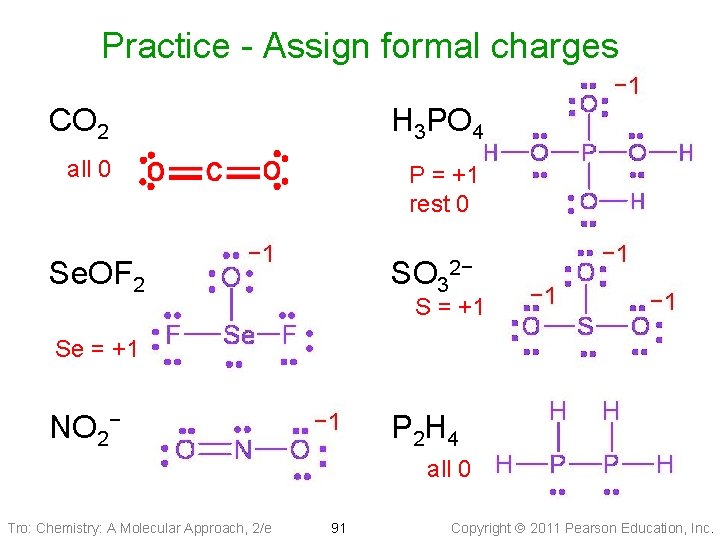
Practice – Assign formal charges CO 2 H 3 PO 4 Se. OF 2 SO 32− NO 2− P 2 H 4 Tro: Chemistry: A Molecular Approach, 2/e 90 Copyright 2011 Pearson Education, Inc.
Practice - Assign formal charges CO 2 H 3 PO 4 all 0 P = +1 rest 0 SO 32− Se. OF 2 S = +1 Se = +1 P 2 H 4 NO 2− all 0 Tro: Chemistry: A Molecular Approach, 2/e 91 Copyright 2011 Pearson Education, Inc.
Resonance • Lewis theory localizes the electrons between • • the atoms that are bonding together Extensions of Lewis theory suggest that there is some degree of delocalization of the electrons – we call this concept resonance Delocalization of charge helps to stabilize the molecule Tro: Chemistry: A Molecular Approach, 2/e 92 Copyright 2011 Pearson Education, Inc.
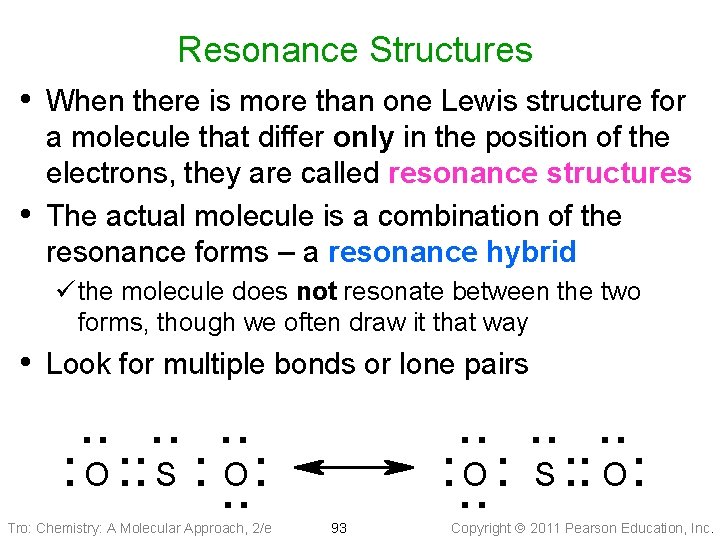
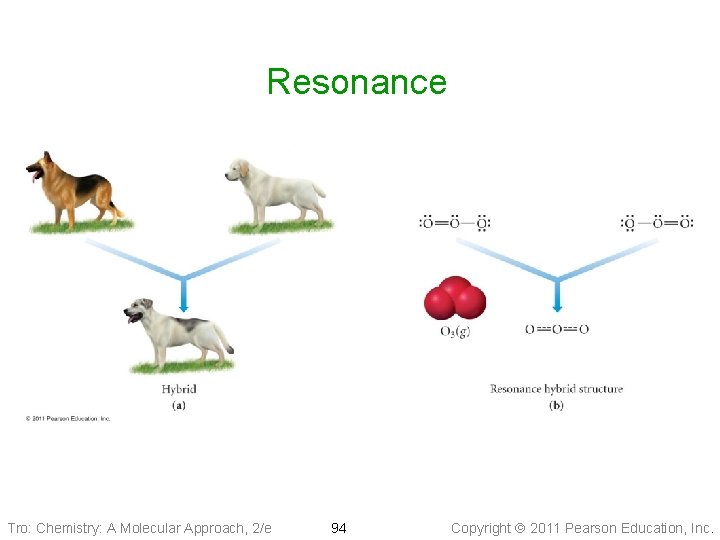
Resonance Structures • When there is more than one Lewis structure for • a molecule that differ only in the position of the electrons, they are called resonance structures The actual molecule is a combination of the resonance forms – a resonance hybrid ü the molecule does not resonate between the two forms, though we often draw it that way • Look for multiple bonds or lone pairs . . . . O. . S. . O. . Tro: Chemistry: A Molecular Approach, 2/e 93 . . . . O. . S. . O. . Copyright 2011 Pearson Education, Inc.
Resonance Tro: Chemistry: A Molecular Approach, 2/e 94 Copyright 2011 Pearson Education, Inc.
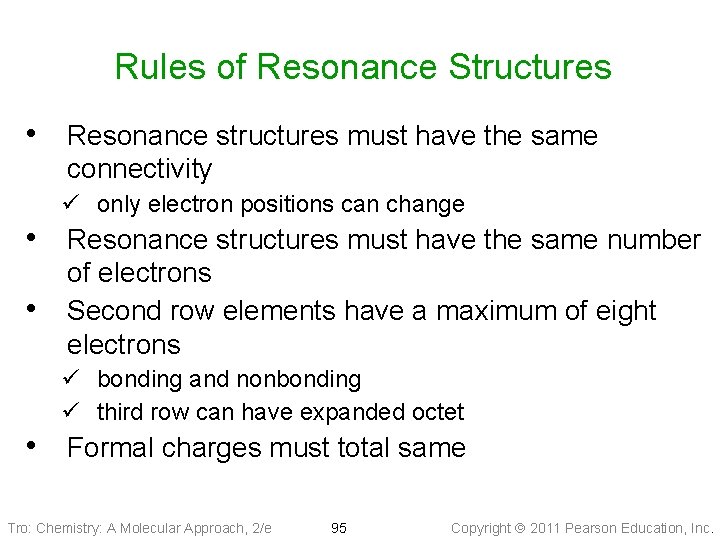
Rules of Resonance Structures • Resonance structures must have the same connectivity ü only electron positions can change • Resonance structures must have the same number • of electrons Second row elements have a maximum of eight electrons ü bonding and nonbonding ü third row can have expanded octet • Formal charges must total same Tro: Chemistry: A Molecular Approach, 2/e 95 Copyright 2011 Pearson Education, Inc.
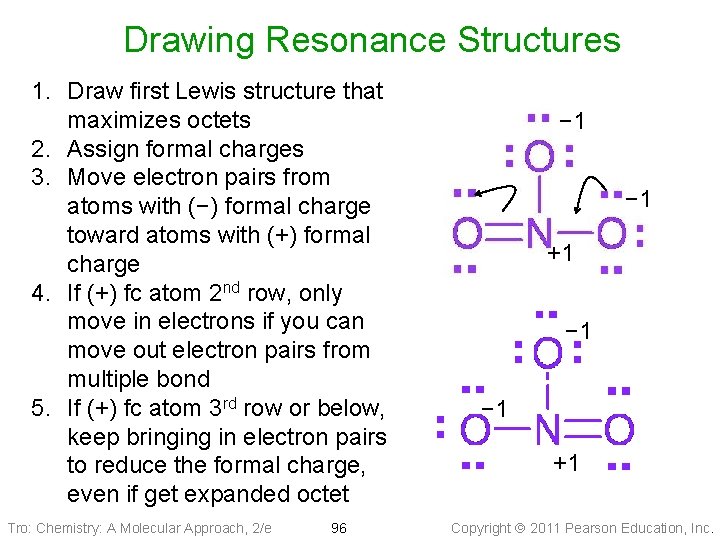
Drawing Resonance Structures 1. Draw first Lewis structure that maximizes octets 2. Assign formal charges 3. Move electron pairs from atoms with (−) formal charge toward atoms with (+) formal charge 4. If (+) fc atom 2 nd row, only move in electrons if you can move out electron pairs from multiple bond 5. If (+) fc atom 3 rd row or below, keep bringing in electron pairs to reduce the formal charge, even if get expanded octet Tro: Chemistry: A Molecular Approach, 2/e 96 − 1 − 1 +1 Copyright 2011 Pearson Education, Inc.
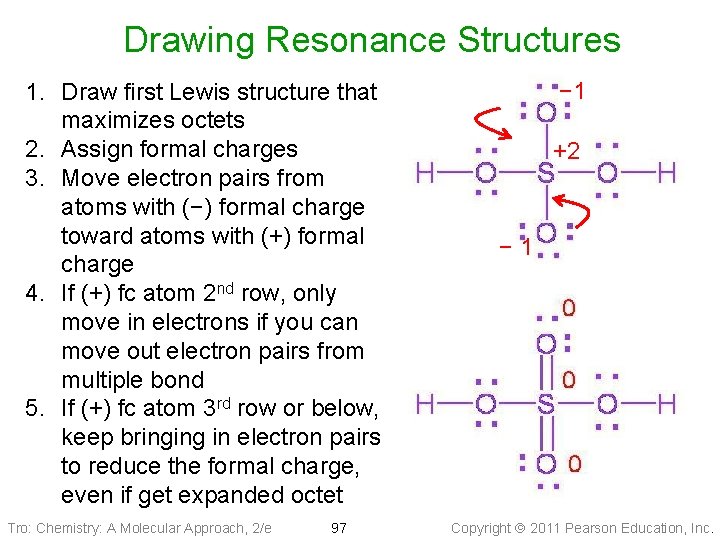
Drawing Resonance Structures 1. Draw first Lewis structure that maximizes octets 2. Assign formal charges 3. Move electron pairs from atoms with (−) formal charge toward atoms with (+) formal charge 4. If (+) fc atom 2 nd row, only move in electrons if you can move out electron pairs from multiple bond 5. If (+) fc atom 3 rd row or below, keep bringing in electron pairs to reduce the formal charge, even if get expanded octet Tro: Chemistry: A Molecular Approach, 2/e 97 − 1 +2 − 1 Copyright 2011 Pearson Education, Inc.
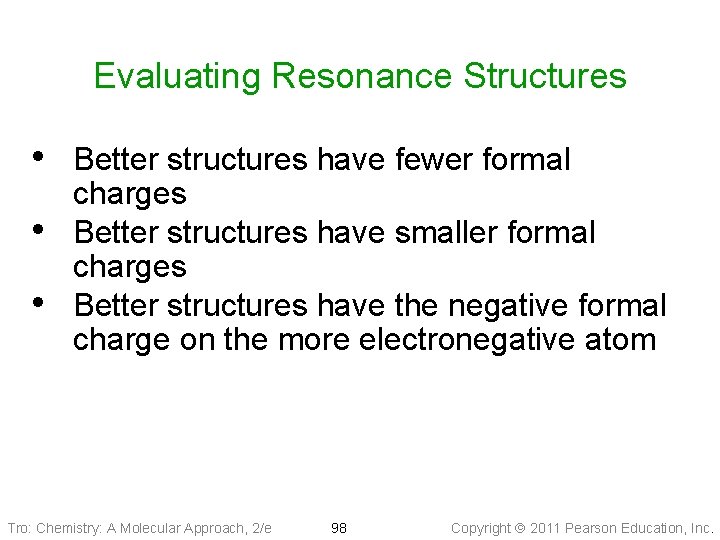
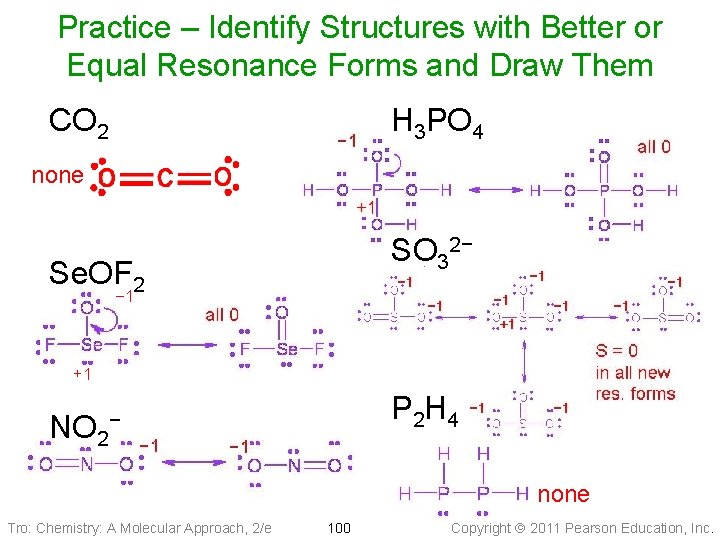
Evaluating Resonance Structures • Better structures have fewer formal • • charges Better structures have smaller formal charges Better structures have the negative formal charge on the more electronegative atom Tro: Chemistry: A Molecular Approach, 2/e 98 Copyright 2011 Pearson Education, Inc.
Practice – Identify Structures with Better or Equal Resonance Forms and Draw Them CO 2 H 3 PO 4 all 0 P = +1 rest 0 SO 32− Se. OF 2 S = +1 Se = +1 P 2 H 4 NO 2− all 0 Tro: Chemistry: A Molecular Approach, 2/e 99 Copyright 2011 Pearson Education, Inc.
Practice – Identify Structures with Better or Equal Resonance Forms and Draw Them H 3 PO 4 CO 2 none SO 32− Se. OF 2 − 1 +1 NO 2 P 2 H 4 − none Tro: Chemistry: A Molecular Approach, 2/e 100 Copyright 2011 Pearson Education, Inc.
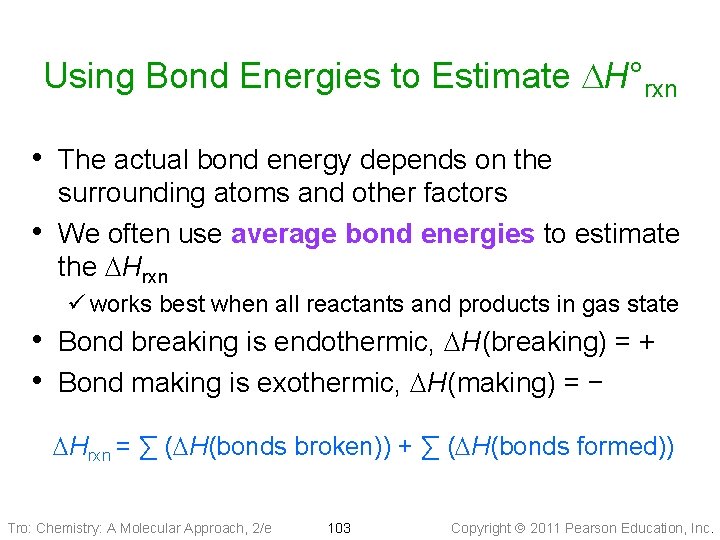
Bond Energies • Chemical reactions involve breaking bonds in • • reactant molecules and making new bonds to create the products The DH°reaction can be estimated by comparing the cost of breaking old bonds to the income from making new bonds The amount of energy it takes to break one mole of a bond in a compound is called the bond energy ü in the gas state ü homolytically – each atom gets ½ bonding electrons Tro: Chemistry: A Molecular Approach, 2/e 101 Copyright 2011 Pearson Education, Inc.
Trends in Bond Energies • In general, the more electrons two atoms share, the stronger the covalent bond ü must be comparing bonds between like atoms ü C≡C (837 k. J) > C=C (611 k. J) > C−C (347 k. J) ü C≡N (891 k. J) > C=N (615 k. J) > C−N (305 k. J) • In general, the shorter the covalent bond, the stronger the bond ü must be comparing similar types of bonds ü Br−F (237 k. J) > Br−Cl (218 k. J) > Br−Br (193 k. J) ü bonds get weaker down the column ü bonds get stronger across the period Tro: Chemistry: A Molecular Approach, 2/e 102 Copyright 2011 Pearson Education, Inc.
Using Bond Energies to Estimate DH°rxn • The actual bond energy depends on the • surrounding atoms and other factors We often use average bond energies to estimate the DHrxn ü works best when all reactants and products in gas state • Bond breaking is endothermic, DH(breaking) = + • Bond making is exothermic, DH(making) = − DHrxn = ∑ (DH(bonds broken)) + ∑ (DH(bonds formed)) Tro: Chemistry: A Molecular Approach, 2/e 103 Copyright 2011 Pearson Education, Inc.
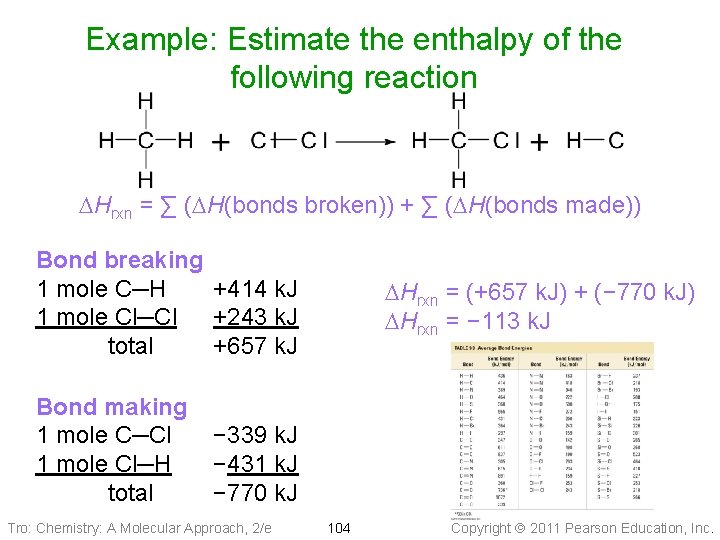
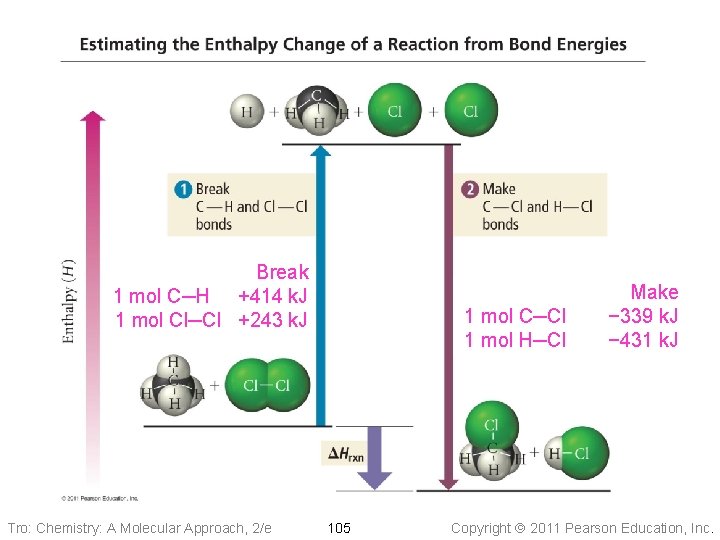
Example: Estimate the enthalpy of the following reaction DHrxn = ∑ (DH(bonds broken)) + ∑ (DH(bonds made)) Bond breaking 1 mole C─H +414 k. J 1 mole Cl─Cl +243 k. J total +657 k. J Bond making 1 mole C─Cl 1 mole Cl─H total DHrxn = (+657 k. J) + (− 770 k. J) DHrxn = − 113 k. J − 339 k. J − 431 k. J − 770 k. J Tro: Chemistry: A Molecular Approach, 2/e 104 Copyright 2011 Pearson Education, Inc.
Break 1 mol C─H +414 k. J 1 mol Cl─Cl +243 k. J Tro: Chemistry: A Molecular Approach, 2/e 1 mol C─Cl 1 mol H─Cl 105 Make − 339 k. J − 431 k. J Copyright 2011 Pearson Education, Inc.
Practice – Estimate the enthalpy of the following reaction H H + O Tro: Chemistry: A Molecular Approach, 2/e O H 106 O O H Copyright 2011 Pearson Education, Inc.
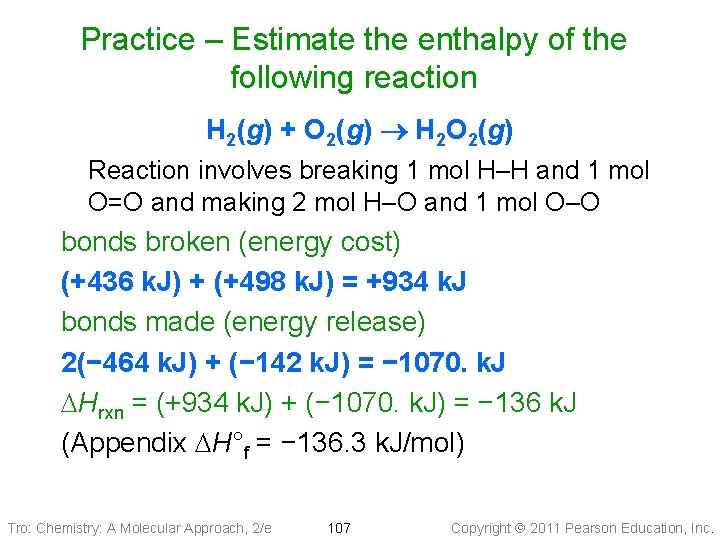
Practice – Estimate the enthalpy of the following reaction H 2(g) + O 2(g) ® H 2 O 2(g) Reaction involves breaking 1 mol H–H and 1 mol O=O and making 2 mol H–O and 1 mol O–O bonds broken (energy cost) (+436 k. J) + (+498 k. J) = +934 k. J bonds made (energy release) 2(− 464 k. J) + (− 142 k. J) = − 1070. k. J DHrxn = (+934 k. J) + (− 1070. k. J) = − 136 k. J (Appendix DH°f = − 136. 3 k. J/mol) Tro: Chemistry: A Molecular Approach, 2/e 107 Copyright 2011 Pearson Education, Inc.
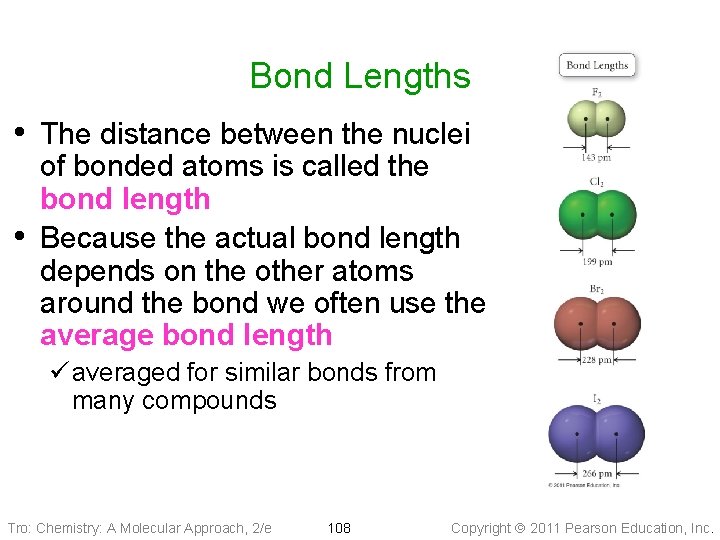
Bond Lengths • The distance between the nuclei • of bonded atoms is called the bond length Because the actual bond length depends on the other atoms around the bond we often use the average bond length ü averaged for similar bonds from many compounds Tro: Chemistry: A Molecular Approach, 2/e 108 Copyright 2011 Pearson Education, Inc.
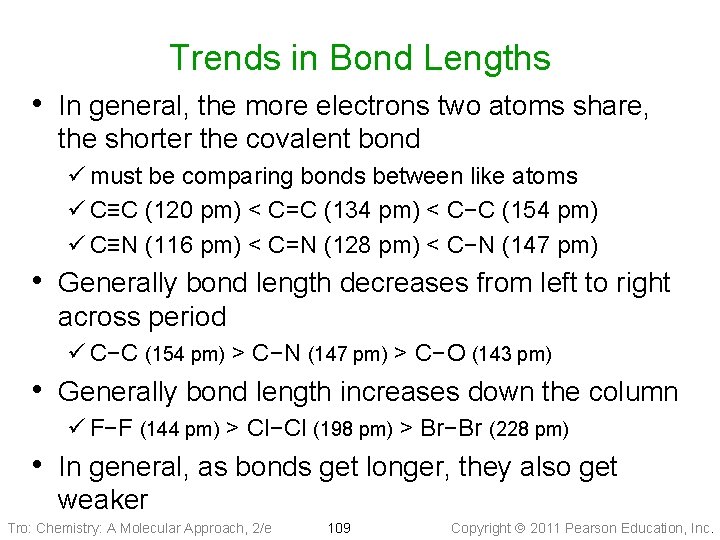
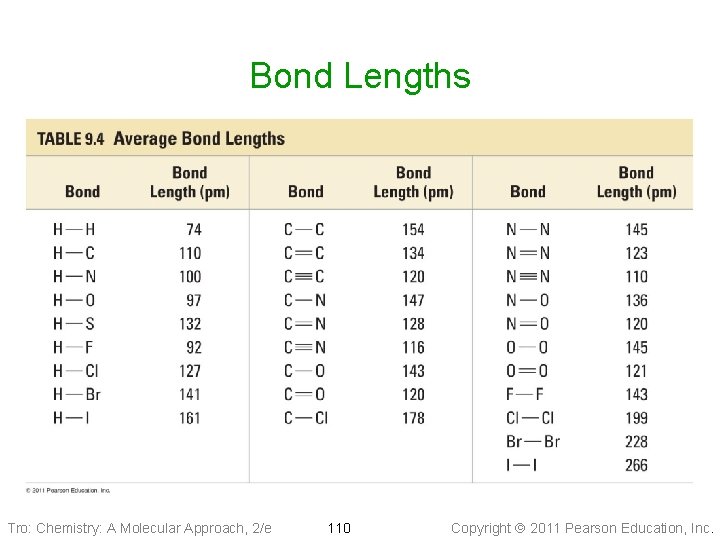
Trends in Bond Lengths • In general, the more electrons two atoms share, the shorter the covalent bond ü must be comparing bonds between like atoms ü C≡C (120 pm) < C=C (134 pm) < C−C (154 pm) ü C≡N (116 pm) < C=N (128 pm) < C−N (147 pm) • Generally bond length decreases from left to right across period ü C−C (154 pm) > C−N (147 pm) > C−O (143 pm) • Generally bond length increases down the column ü F−F (144 pm) > Cl−Cl (198 pm) > Br−Br (228 pm) • In general, as bonds get longer, they also get weaker Tro: Chemistry: A Molecular Approach, 2/e 109 Copyright 2011 Pearson Education, Inc.
Bond Lengths Tro: Chemistry: A Molecular Approach, 2/e 110 Copyright 2011 Pearson Education, Inc.
Metallic Bonds • The low ionization energy of metals allows • them to lose electrons easily The simplest theory of metallic bonding involves the metal atoms releasing their valence electrons to be shared by all to atoms/ions in the metal ü an organization of metal cation islands in a sea of electrons ü electrons delocalized throughout the metal structure • Bonding results from attraction of the cations for the delocalized electrons Tro: Chemistry: A Molecular Approach, 2/e 111 Copyright 2011 Pearson Education, Inc.
Metallic Bonding Tro: Chemistry: A Molecular Approach, 2/e 112 Copyright 2011 Pearson Education, Inc.
Metallic Bonding Model vs. Reality • This theory implies that because the • • electrons are delocalized, they are able to move through the metallic crystal Because electrical conductivity takes place when charged particles (such as electrons) are able to move through the structure, this model predicts metallic solids should conduct electricity well Metallic solids do conduct electricity well Tro: Chemistry: A Molecular Approach, 2/e 113 Copyright 2011 Pearson Education, Inc.
Metallic Bonding Model vs. Reality • This theory implies heating will cause the metal • • • ions to vibrate faster Heating will therefore make it more difficult for the electrons to travel through the crystal This theory predicts the conductivity of a metal should decrease as its temperature increases As temperature increases, the electrical conductivity of metals decreases Tro: Chemistry: A Molecular Approach, 2/e 114 Copyright 2011 Pearson Education, Inc.
Metallic Bonding Model vs. Reality • Heat is a form of kinetic energy • Collisions between particles transfer Kinetic Energy • • • from one particle to the next This model implies that the small, light electrons moving through the metallic solid can transfer kinetic energy quicker than larger particles locked into position, which are only able to collide via vibrational collision This model predicts metallic solids should conduct heat well Metallic solids do conduct heat well Tro: Chemistry: A Molecular Approach, 2/e 115 Copyright 2011 Pearson Education, Inc.
Metallic Bonding Model vs. Reality • Atoms emit light when electrons jump from higher • • energy levels to lower energy levels This model implies that the delocalized electrons will share a set of orbitals that belong to the entire metallic crystal This model implies that the delocalized electrons on the surface can absorb the outside light and then emit it at the same frequency This model predicts that the surface of a metallic solid should reflect light Metallic solids do reflect light Tro: Chemistry: A Molecular Approach, 2/e 116 Copyright 2011 Pearson Education, Inc.
Metallic Bonding Model vs. Reality • According to this model, the attractive forces • that hold the metal structure together result from the attraction of the metal atom cores for the delocalized electrons This model implies the attractive forces should not break if positions of the atom cores shift ü because the mobility of the electrons should allow the attractions to be maintained • This model predicts metallic solids should be • malleable and ductile Metallic solids are malleable and ductile Tro: Chemistry: A Molecular Approach, 2/e 117 Copyright 2011 Pearson Education, Inc.
Metallic Bonding Model vs. Reality • This model says the attractions of the core • • • atoms for the delocalized electrons is strong because it involves full charges In order to melt, some of the attractions holding the metallic crystal together must be broken. In order to boil, all the attractions must be broken. This model predicts that metals should have high melting points and boiling points Metals generally have high melting points and boiling points ü all but Hg are solids at room temperature Tro: Chemistry: A Molecular Approach, 2/e 118 Copyright 2011 Pearson Education, Inc.
Metallic Bonding Model vs. Reality • This model implies the attractions of the atom • • cores for the delocalized electrons will be stronger when there are more delocalized electrons This model implies the attractions of the atom cores for the delocalized electrons will be stronger when the charge on the atom core is larger This model predicts that the melting point of metals should increase as the charge on the cation increases ü left-to-right across the period • Melting points of metal generally increase left-to • right across period Na (97. 72 ºC) < Mg (650 ºC) < Al (660. 32 ºC) Tro: Chemistry: A Molecular Approach, 2/e 119 Copyright 2011 Pearson Education, Inc.
Metallic Bonding Model vs. Reality • Metal ions get larger as you traverse down a • • • column This model implies the attractions of the atom cores for the delocalized electrons will be stronger when the atom cores are smaller This model predicts that smaller metal ions should have higher melting points This model predicts that the melting points of metals should decrease down a column Melting points of metals generally decrease down column Li (180. 54 ºC) > Na (97. 72 ºC) > K (63. 38 ºC) Tro: Chemistry: A Molecular Approach, 2/e 120 Copyright 2011 Pearson Education, Inc.