
Lewis ElectronDot Symbols n n A Lewis electrondot
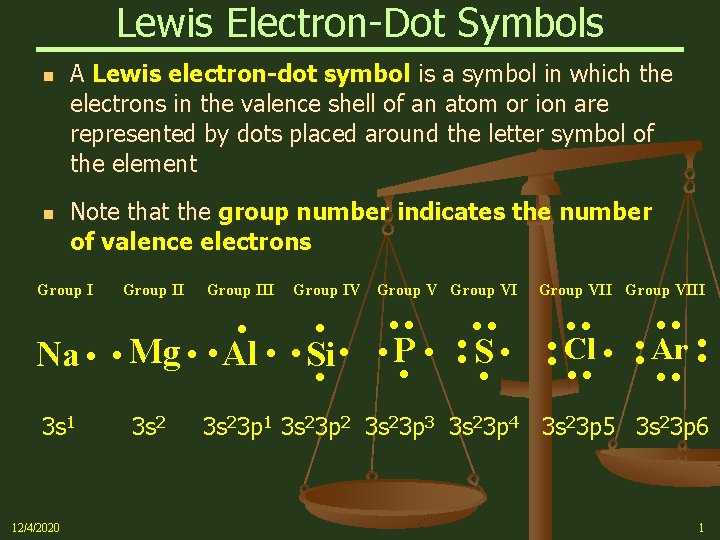
Lewis Electron-Dot Symbols n n A Lewis electron-dot symbol is a symbol in which the electrons in the valence shell of an atom or ion are represented by dots placed around the letter symbol of the element Note that the group number indicates the number of valence electrons Group III Group IV Group VIII : : 12/4/2020 3 s 2 : 3 s 1 : . . . P. . : S. : Cl. : Ar : Na. . Mg. . Al. . Si. . . 3 s 23 p 1 3 s 23 p 2 3 s 23 p 3 3 s 23 p 4 3 s 23 p 5 3 s 23 p 6 1
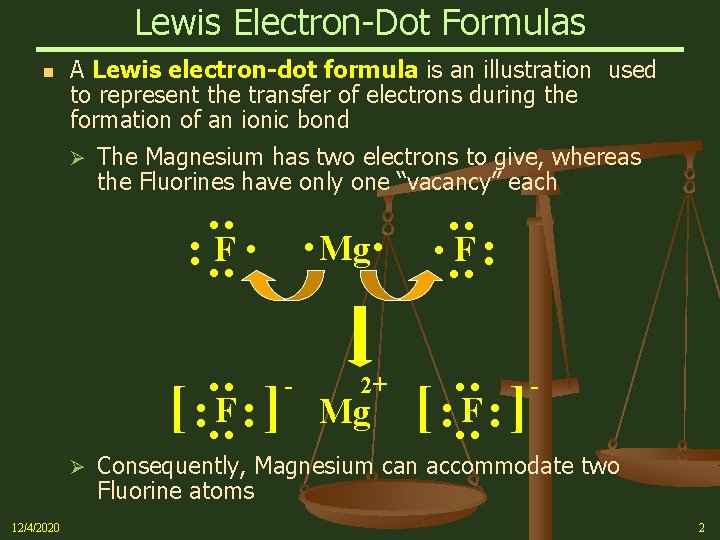
Lewis Electron-Dot Formulas n A Lewis electron-dot formula is an illustration used to represent the transfer of electrons during the formation of an ionic bond Ø The Magnesium has two electrons to give, whereas the Fluorines have only one “vacancy” each Ø 12/4/2020 2+ Mg [: F: ] : : [: F: ] - . F: : : : F. . Mg. - Consequently, Magnesium can accommodate two Fluorine atoms 2
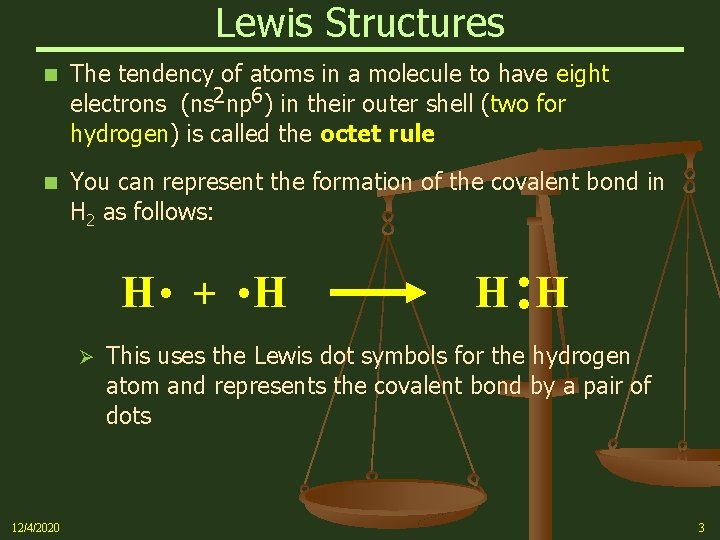
Lewis Structures n The tendency of atoms in a molecule to have eight electrons (ns 2 np 6) in their outer shell (two for hydrogen) is called the octet rule n You can represent the formation of the covalent bond in H 2 as follows: H + H Ø 12/4/2020 H H This uses the Lewis dot symbols for the hydrogen atom and represents the covalent bond by a pair of dots 3
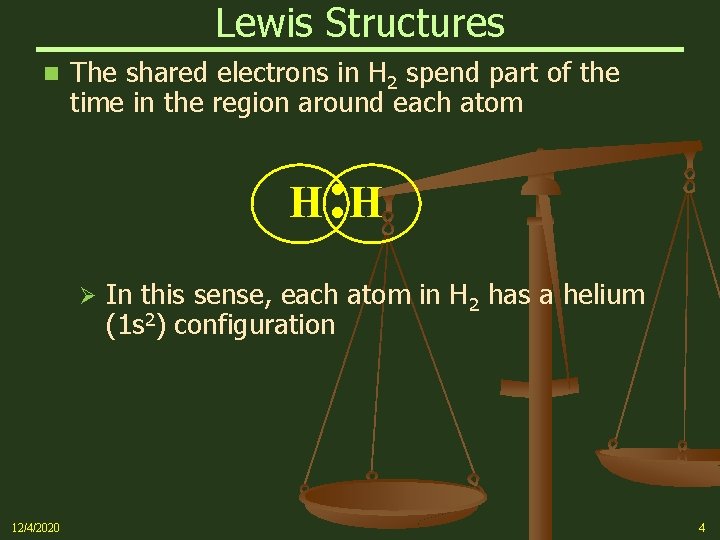
Lewis Structures n The shared electrons in H 2 spend part of the time in the region around each atom : H H Ø 12/4/2020 In this sense, each atom in H 2 has a helium (1 s 2) configuration 4

Lewis Structures n The formation of a bond between H and Cl to give an HCl molecule can be represented in a similar way. Cl : : Ø 12/4/2020 H : Cl : : + : : H. Thus, hydrogen has two valence electrons about it (as in He) and Cl has eight valence electrons about it (as in Ar) 5

Lewis Structures n Formulas such as these are referred to as Lewis electron-dot formulas or Lewis structures : : H Cl Ø An electron pair is either a: § bonding pair (shared between two atoms) § lone pair (electron pair that is not shared) Hydrogen has no unbonded pairs Chlorine has 3 unbonded pairs 12/4/2020 6
Lewis Structures n Rules for obtaining Lewis electron dot formulas Ø 12/4/2020 Calculate the number of valence electrons for the molecule from: group # for each atom (1 -8) add the charge of Anion subtract the charge of a Cation Ø Put atom with the lowest group number and lowest electronegativity as the central atom Ø Arrange the other elements (ligands) around the central atom 7
Lewis Structures n 12/4/2020 Rules for Lewis Dot Formulas Ø Distribute electrons to atoms surrounding the central atom to satisfy the octet rule for each atom Ø Distribute the remaining electrons as pairs to the central atom Ø If the Central atom is deficient in electrons to complete the octet; move electron pairs from surrounding atoms to complete central atom valence electron needs, that is form one or more double bonds (possibly triple bonds) around the central atom 8
Practice Problem n Write a lewis structure for CCl 2 F 2 Step 1: Arrange Atoms (Carbon is “Central Atom” because is has the lowest group number and lowest electronegativity Step 2: Determine total number of valence electrons 1 x C(4) + 2 x Cl(7) + 2 x F(7) = 32 Step 3: Draw single bonds to central atom and subtract
Writing Lewis Dot Formulas n 12/4/2020 The Lewis electron-dot formula of a covalent compound is a simple two-dimensional representation of the positions of electrons in a molecule Ø Bonding electron pairs are indicated by either two dots or a dash Ø In addition, these formulas show the positions of lone pairs of electrons 10
Writing Lewis Dot Formulas n The following rules allow you to write electrondot formulas even when the central atom does not follow the octet rule Ø To illustrate, draw the structure of: Phosphorus Trichloride Con’t on next slide 12/4/2020 11

Writing Lewis Dot Formulas n Step 1: Total all valence electrons in the molecular formula. That is, total the group numbers of all the atoms in the formula P 3 s 23 p 3 5 e- (7 e-) x 3 Cl 3 s 23 p 5 (2+3) + 3 x(2+5) = 5+21 26 total electrons Ø For a polyatomic anion, add the number of negative charges to this total Ø For a polyatomic cation, subtract the number of positive charges from this total Con’t on next slide 12/4/2020 12
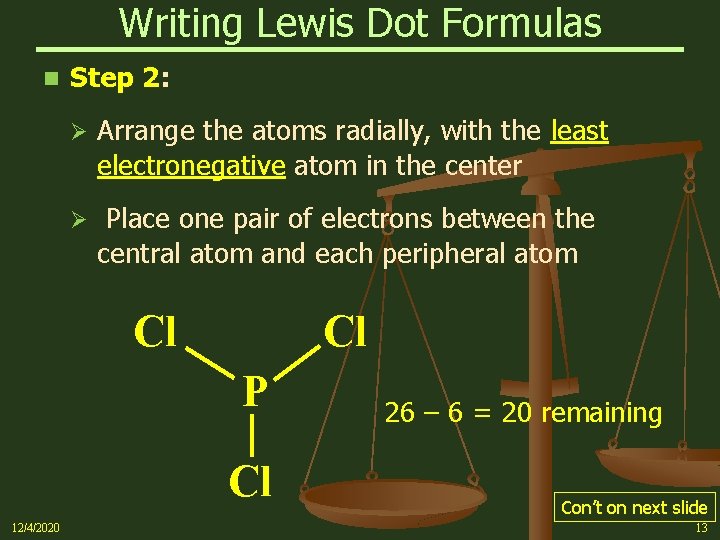
Writing Lewis Dot Formulas n Step 2: Ø Arrange the atoms radially, with the least electronegative atom in the center Ø Place one pair of electrons between the central atom and each peripheral atom Cl Cl P Cl 12/4/2020 26 – 6 = 20 remaining Con’t on next slide 13

Writing Lewis Dot Formulas : Cl Cl P : : Step 3: Distribute the remaining electrons to the peripheral atoms to satisfy the octet rule : n : : Cl : 26 – (3 x 6 + 6) = 2 remaining Con’t on next slide 12/4/2020 14
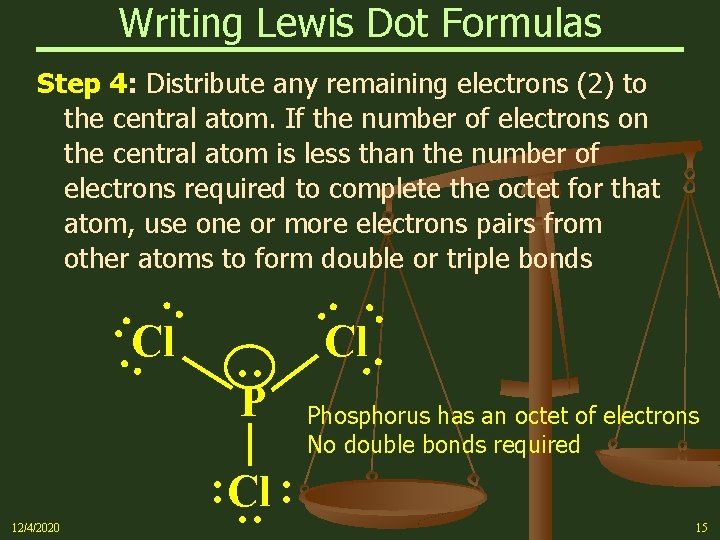
Writing Lewis Dot Formulas Cl P : : : Cl : : Step 4: Distribute any remaining electrons (2) to the central atom. If the number of electrons on the central atom is less than the number of electrons required to complete the octet for that atom, use one or more electrons pairs from other atoms to form double or triple bonds Phosphorus has an octet of electrons No double bonds required 12/4/2020 : : Cl : 15
Exceptions to the Octet Rule n 12/4/2020 Although many molecules obey the octet rule, there are exceptions where the central atom has more than eight electrons Ø Generally, if a nonmetal is in the third period or greater it can accommodate as many as twelve electrons, if it is the central atom Ø These elements have unfilled “d” subshells that can be used for bonding 16
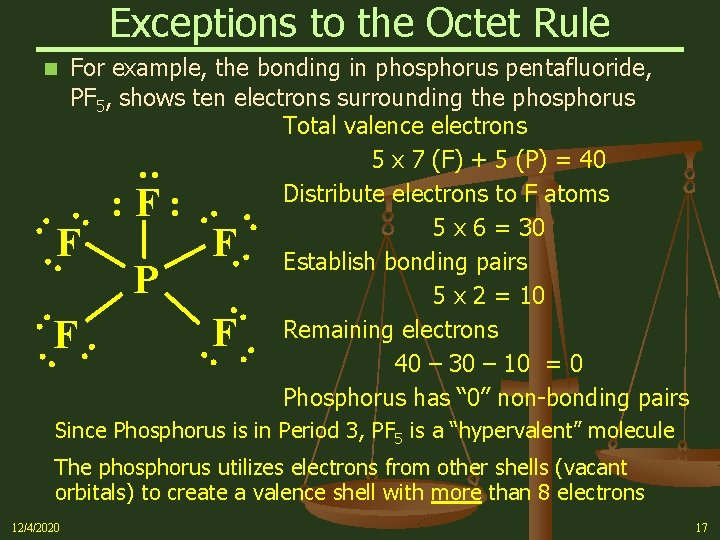
Exceptions to the Octet Rule n : F: P F : : : F: : : For example, the bonding in phosphorus pentafluoride, PF 5, shows ten electrons surrounding the phosphorus Total valence electrons 5 x 7 (F) + 5 (P) = 40 Distribute electrons to F atoms 5 x 6 = 30 Establish bonding pairs 5 x 2 = 10 Remaining electrons 40 – 30 – 10 = 0 Phosphorus has “ 0” non-bonding pairs Since Phosphorus is in Period 3, PF 5 is a “hypervalent” molecule The phosphorus utilizes electrons from other shells (vacant orbitals) to create a valence shell with more than 8 electrons 12/4/2020 17
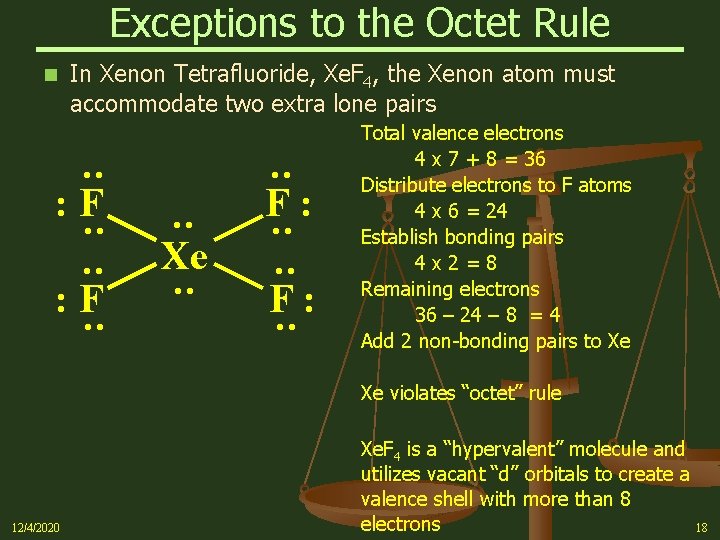
Exceptions to the Octet Rule n In Xenon Tetrafluoride, Xe. F 4, the Xenon atom must accommodate two extra lone pairs Xe F: : : F : : : F F: : : Total valence electrons 4 x 7 + 8 = 36 Distribute electrons to F atoms 4 x 6 = 24 Establish bonding pairs 4 x 2=8 Remaining electrons 36 – 24 – 8 = 4 Add 2 non-bonding pairs to Xe Xe violates “octet” rule 12/4/2020 Xe. F 4 is a “hypervalent” molecule and utilizes vacant “d” orbitals to create a valence shell with more than 8 electrons 18
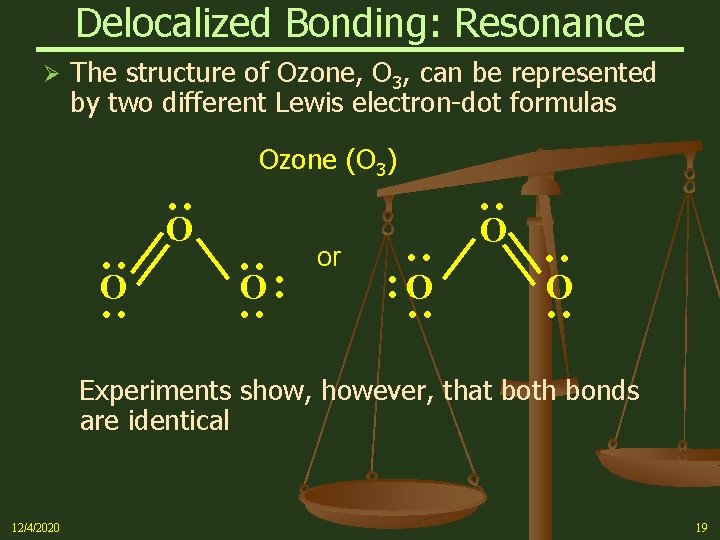
Delocalized Bonding: Resonance Ø The structure of Ozone, O 3, can be represented by two different Lewis electron-dot formulas Ozone (O 3) : : : O : : O: : : O or O : : O O Experiments show, however, that both bonds are identical 12/4/2020 19

Delocalized Bonding: Resonance n According to Resonance Theory, these two equal bonds are represented as one pair of bonding electrons spread over the region of all three atoms Ozone (O 3) O O n 12/4/2020 O This is called delocalized bonding, in which a bonding pair of electrons is spread over a number of atoms 20
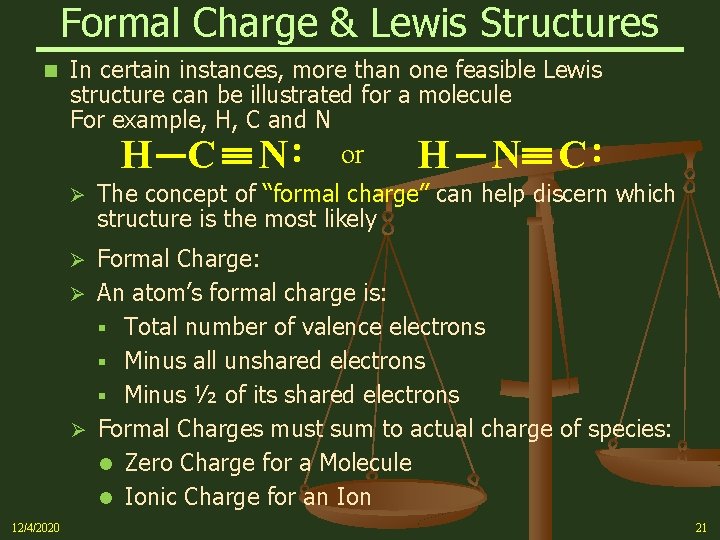
Formal Charge & Lewis Structures n In certain instances, more than one feasible Lewis structure can be illustrated for a molecule For example, H, C and N H C Ø N: or H N C: The concept of “formal charge” can help discern which structure is the most likely Formal Charge: Ø An atom’s formal charge is: § Total number of valence electrons § Minus all unshared electrons § Minus ½ of its shared electrons Ø Formal Charges must sum to actual charge of species: Zero Charge for a Molecule Ionic Charge for an Ion Ø 12/4/2020 21
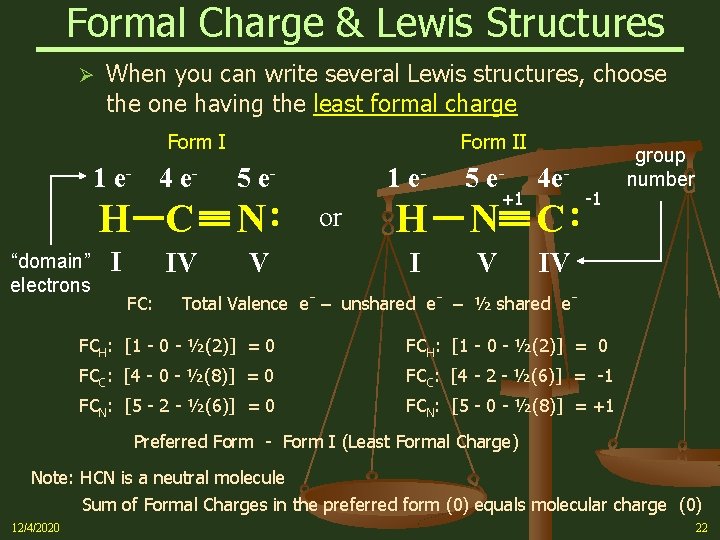
Formal Charge & Lewis Structures Ø When you can write several Lewis structures, choose the one having the least formal charge Form I 1 e- 4 e- H C “domain” electrons I IV FC: Form II 5 e- N: V 1 eor H I 5 e- 4 e- V IV +1 N C: -1 group number Total Valence e- – unshared e- – ½ shared e- FCH: [1 - 0 - ½(2)] = 0 FCC: [4 - 0 - ½(8)] = 0 FCC: [4 - 2 - ½(6)] = -1 FCN: [5 - 2 - ½(6)] = 0 FCN: [5 - 0 - ½(8)] = +1 Preferred Form - Form I (Least Formal Charge) Note: HCN is a neutral molecule Sum of Formal Charges in the preferred form (0) equals molecular charge (0) 12/4/2020 22
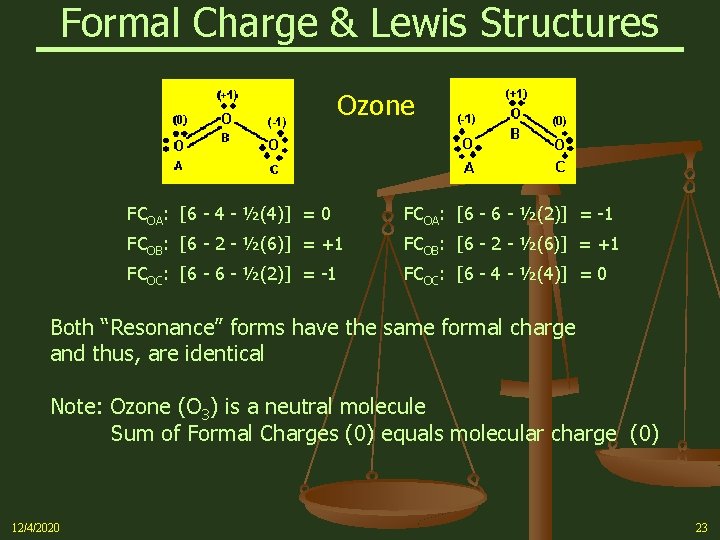
Formal Charge & Lewis Structures Ozone FCOA: [6 - 4 - ½(4)] = 0 FCOA: [6 - ½(2)] = -1 FCOB: [6 - 2 - ½(6)] = +1 FCOC: [6 - ½(2)] = -1 FCOC: [6 - 4 - ½(4)] = 0 Both “Resonance” forms have the same formal charge and thus, are identical Note: Ozone (O 3) is a neutral molecule Sum of Formal Charges (0) equals molecular charge (0) 12/4/2020 23
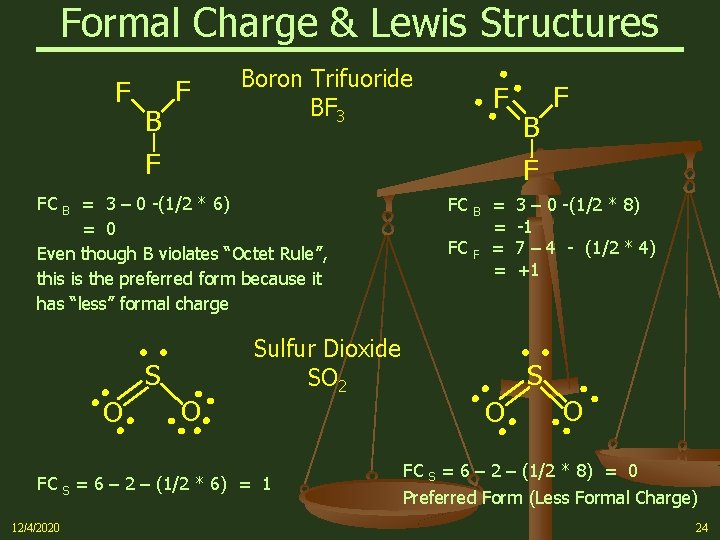
Formal Charge & Lewis Structures F B B F F F O S Sulfur Dioxide SO 2 FC S = 6 – 2 – (1/2 * 6) = 1 12/4/2020 B FC F = = 3 – 0 -(1/2 * 8) -1 7 – 4 - (1/2 * 4) +1 S O FC O = 3 – 0 -(1/2 * 6) = 0 Even though B violates “Octet Rule”, this is the preferred form because it has “less” formal charge B FC F F Boron Trifuoride BF 3 FC S = 6 – 2 – (1/2 * 8) = 0 Preferred Form (Less Formal Charge) 24

Resonance/Formal Charge – Nitrate Ion § Total Valence electrons - 3 x 6 (O) + 1 x 5 (N) + 1 (ion charge) = 24 § Add 1 pair electrons between central atom and each other atom – 3 x 2 = 6 § Add electrons to oxygen atoms to complete octet § Nitrogen still missing 2 electrons to complete octet § Borrow 2 electrons from one oxygen to form double bond § Formal Charge – Nitrogen: 5 – (0 + ½*8) = 5 – 4 = +1 § Formal Charge – Single bonded Oxygen: 6 – (6 + ½*2) = 6 – 7 = -1 x 2 = -2 § Formal Charge – Double bonded Oxygen: 6 – (4 + ½*4) = 6 – 6 = 0 § Net Charge of ion is: +1 +(-2) = -1 12/4/2020 25
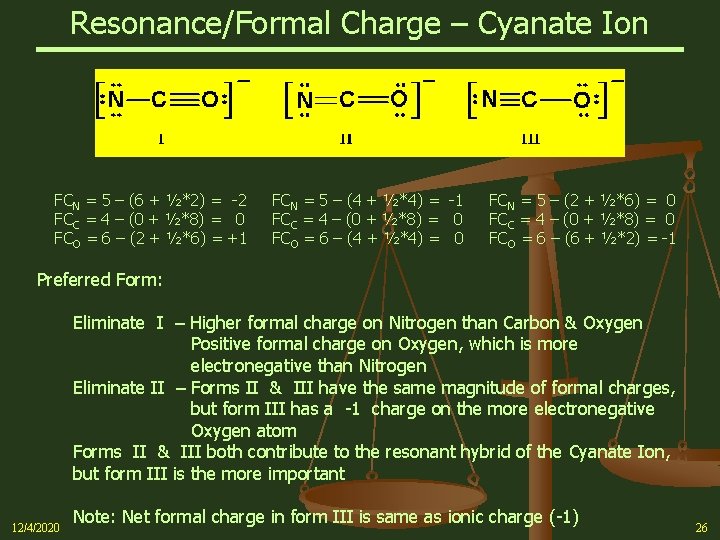
Resonance/Formal Charge – Cyanate Ion FCN = 5 – (6 + ½*2) = -2 FCC = 4 – (0 + ½*8) = 0 FCO = 6 – (2 + ½*6) = +1 FCN = 5 – (4 + ½*4) = -1 FCC = 4 – (0 + ½*8) = 0 FCO = 6 – (4 + ½*4) = 0 FCN = 5 – (2 + ½*6) = 0 FCC = 4 – (0 + ½*8) = 0 FCO = 6 – (6 + ½*2) = -1 Preferred Form: Eliminate I – Higher formal charge on Nitrogen than Carbon & Oxygen Positive formal charge on Oxygen, which is more electronegative than Nitrogen Eliminate II – Forms II & III have the same magnitude of formal charges, but form III has a -1 charge on the more electronegative Oxygen atom Forms II & III both contribute to the resonant hybrid of the Cyanate Ion, but form III is the more important 12/4/2020 Note: Net formal charge in form III is same as ionic charge (-1) 26

Formal Charge vs Oxidation No n “Formal Charge” is used to examine resonance hybrid structures , whereas “Oxidation Number” is used to monitor “REDOX” reactions Ø Formal Charge - Bonding electrons are assigned equally to the atoms as if the bonding were “Nonpolar” covalent, i. e. , each atom has half the electrons making up the bond Ø Oxidation Number - Bonding electrons are transferred completely to the more electronegative atom, as if the bonding were “Ionic” 12/4/2020 Formal Charge = valence e- – (unbonded e- + ½ bonding e-) Oxidation No. = valence e- – (unbonded e- + bonding e-) 27
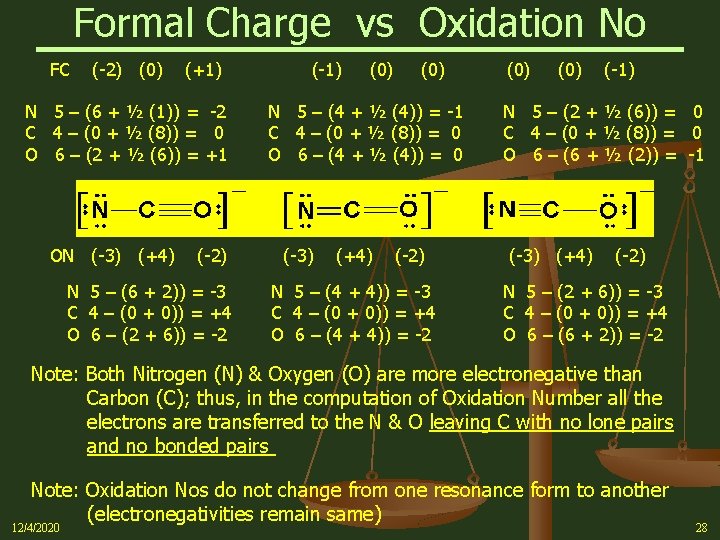
Formal Charge vs Oxidation No FC (-2) (0) (+1) N 5 – (6 + ½ (1)) = -2 C 4 – (0 + ½ (8)) = 0 O 6 – (2 + ½ (6)) = +1 ON (-3) (+4) (-2) N 5 – (6 + 2)) = -3 C 4 – (0 + 0)) = +4 O 6 – (2 + 6)) = -2 (-1) (0) N 5 – (4 + ½ (4)) = -1 C 4 – (0 + ½ (8)) = 0 O 6 – (4 + ½ (4)) = 0 (-3) (+4) (-2) N 5 – (4 + 4)) = -3 C 4 – (0 + 0)) = +4 O 6 – (4 + 4)) = -2 (0) (-1) N 5 – (2 + ½ (6)) = 0 C 4 – (0 + ½ (8)) = 0 O 6 – (6 + ½ (2)) = -1 (-3) (+4) (-2) N 5 – (2 + 6)) = -3 C 4 – (0 + 0)) = +4 O 6 – (6 + 2)) = -2 Note: Both Nitrogen (N) & Oxygen (O) are more electronegative than Carbon (C); thus, in the computation of Oxidation Number all the electrons are transferred to the N & O leaving C with no lone pairs and no bonded pairs Note: Oxidation Nos do not change from one resonance form to another (electronegativities remain same) 12/4/2020 28
The Valence-Shell Electron Pair Repulsion Model (VSEPR) n The Valence-Shell Electron Pair Repulsion (VSEPR) model predicts the shapes of molecules and ions by assuming that the valence shell electron pairs are arranged as far from one another as possible § Molecular geometry – The shape of a molecule is determined by the positions of atomic nuclei relative to each other, i. e. , angular arrangement § Central Atom 12/4/2020 Ø Place atom with “Lower Group Number” in center (N in NF 3 needs more electrons to complete octet) Ø If atoms have same group number (SO 3 or Cl. F 3), place the atom with the “Higher Period Number” in the center (Sulfur & Chlorine) 29
VSEPR Model of Molecular Shapes n 12/4/2020 The following rules and figures will help discern electron pair arrangements Ø Select the Central Atom (Least Electronegative Atom) Ø Draw the Lewis structure Ø Determine how many bonding electron pairs are around the central atom. Ø Determine the number of non-bonding electron pairs Ø Count a multiple bond as “one pair” Ø Arrange the electron pairs as far apart as possible to minimize electron repulsions Ø Note the number of bonding and lone pairs 30
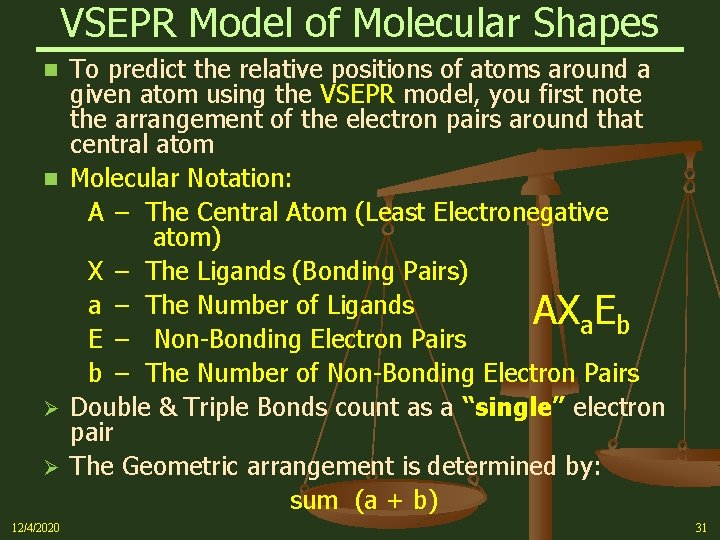
VSEPR Model of Molecular Shapes To predict the relative positions of atoms around a given atom using the VSEPR model, you first note the arrangement of the electron pairs around that central atom n Molecular Notation: A – The Central Atom (Least Electronegative atom) X – The Ligands (Bonding Pairs) a – The Number of Ligands AXa. Eb E – Non-Bonding Electron Pairs b – The Number of Non-Bonding Electron Pairs Ø Double & Triple Bonds count as a “single” electron pair Ø The Geometric arrangement is determined by: sum (a + b) n 12/4/2020 31
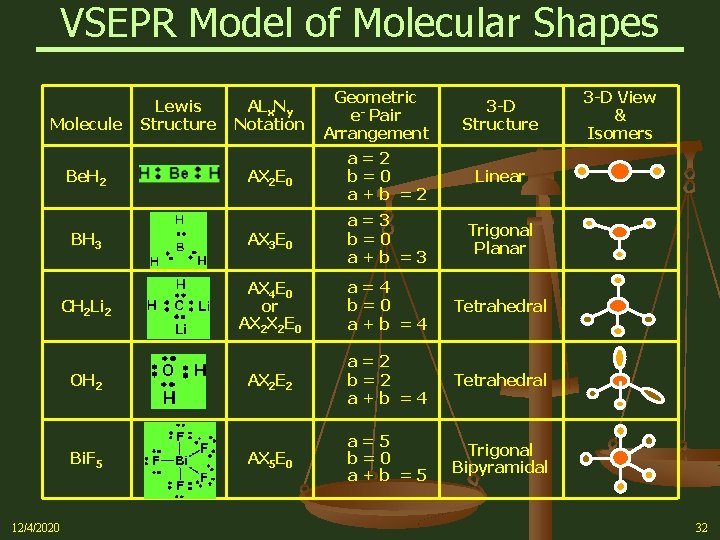
VSEPR Model of Molecular Shapes Molecule ALx. Ny Notation Geometric e- Pair Arrangement 3 -D Structure AX 2 E 0 a=2 b=0 a+b =2 Linear BH 3 AX 3 E 0 a=3 b=0 a+b =3 Trigonal Planar CH 2 Li 2 AX 4 E 0 or AX 2 X 2 E 0 a=4 b=0 a+b =4 Tetrahedral AX 2 E 2 a=2 b=2 a+b =4 Tetrahedral AX 5 E 0 a=5 b=0 a+b =5 Trigonal Bipyramidal Be. H 2 OH 2 Bi. F 5 12/4/2020 Lewis Structure 3 -D View & Isomers 32
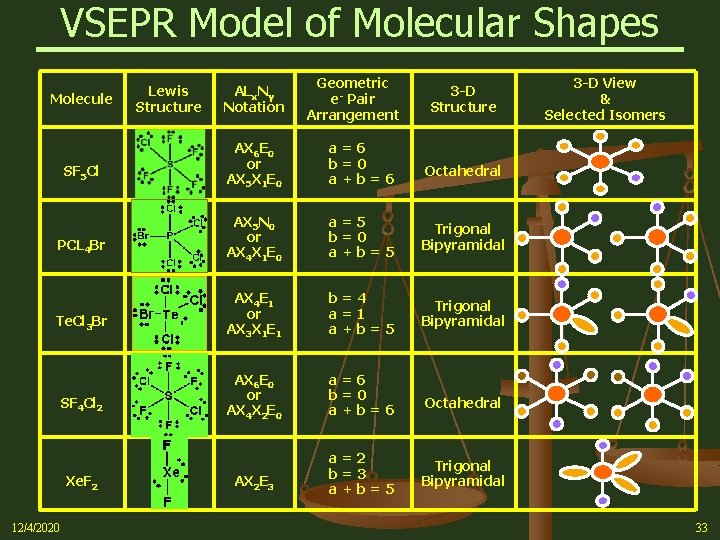
VSEPR Model of Molecular Shapes Molecule SF 5 Cl PCL 4 Br Te. Cl 3 Br SF 4 Cl 2 Xe. F 2 12/4/2020 Lewis Structure ALx. Ny Notation Geometric e- Pair Arrangement 3 -D Structure AX 6 E 0 or AX 5 X 1 E 0 a=6 b=0 a+b=6 AX 5 N 0 or AX 4 X 1 E 0 a=5 b=0 a+b=5 Trigonal Bipyramidal AX 4 E 1 or AX 3 X 1 E 1 b=4 a=1 a+b=5 Trigonal Bipyramidal AX 6 E 0 or AX 4 X 2 E 0 a=6 b=0 a+b=6 AX 2 E 3 a=2 b=3 a+b=5 3 -D View & Selected Isomers Octahedral Trigonal Bipyramidal 33
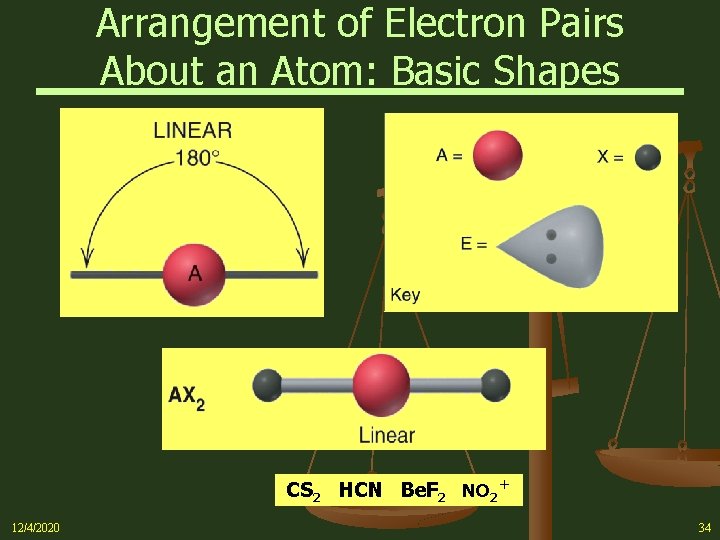
Arrangement of Electron Pairs About an Atom: Basic Shapes CS 2 HCN Be. F 2 NO 2+ 12/4/2020 34
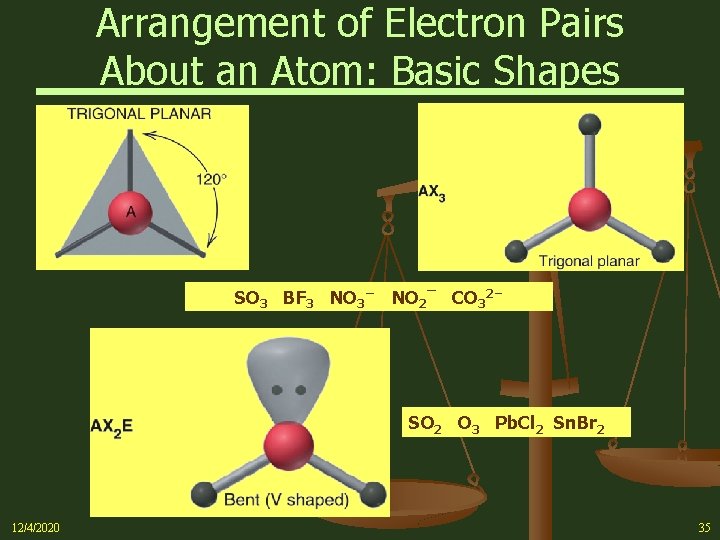
Arrangement of Electron Pairs About an Atom: Basic Shapes SO 3 BF 3 NO 3− NO 2– CO 32− SO 2 O 3 Pb. Cl 2 Sn. Br 2 12/4/2020 35

Arrangement of Electron Pairs About an Atom: Basic Shapes CH 4 Si. Cl 4 SO 42 - Cl. O 4 - NH 3 PF 3 Cl. O 3 H 3 O+ 12/4/2020 H 2 O OF 2 SCl 2 36
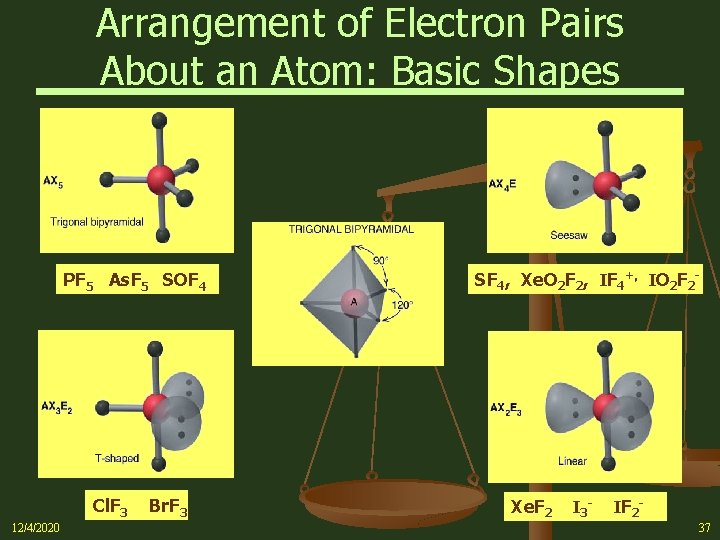
Arrangement of Electron Pairs About an Atom: Basic Shapes PF 5 As. F 5 SOF 4 Cl. F 3 12/4/2020 Br. F 3 SF 4, Xe. O 2 F 2, IF 4+, IO 2 F 2 - Xe. F 2 I 3 - IF 237
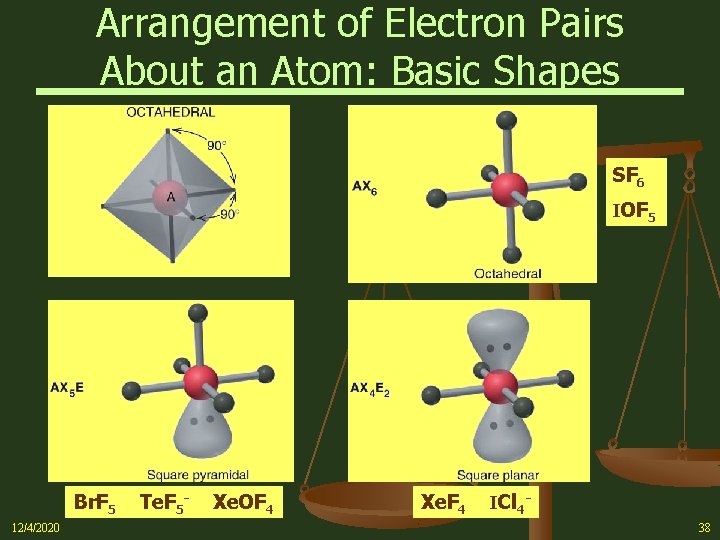
Arrangement of Electron Pairs About an Atom: Basic Shapes SF 6 IOF 5 Br. F 5 12/4/2020 Te. F 5 - Xe. OF 4 Xe. F 4 ICl 438
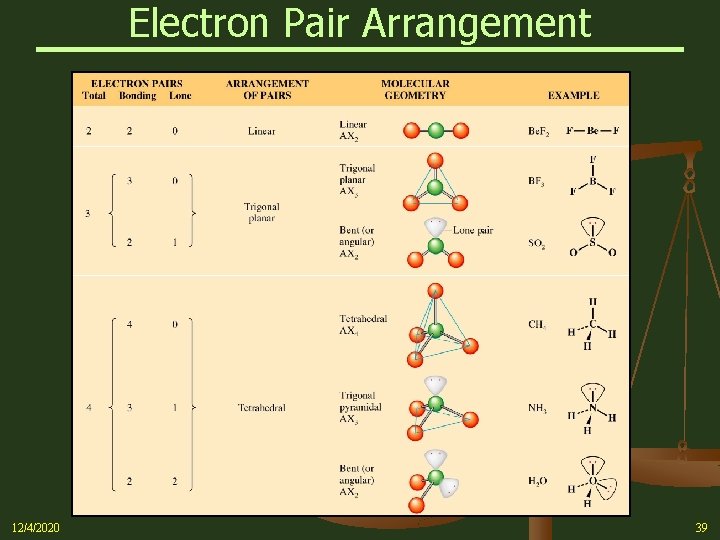
Electron Pair Arrangement 12/4/2020 39
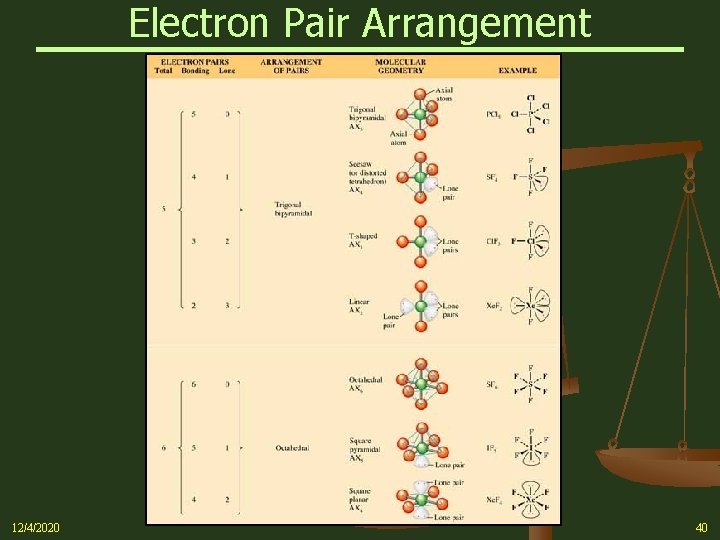
Electron Pair Arrangement 12/4/2020 40
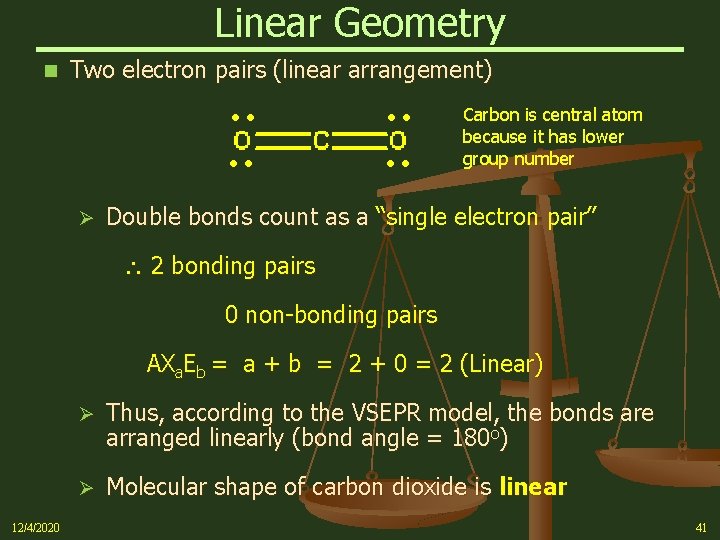
Linear Geometry n Two electron pairs (linear arrangement) : : Ø Carbon is central atom because it has lower group number Double bonds count as a “single electron pair” 2 bonding pairs 0 non-bonding pairs AXa. Eb = a + b = 2 + 0 = 2 (Linear) 12/4/2020 Ø Thus, according to the VSEPR model, the bonds are arranged linearly (bond angle = 180 o) Ø Molecular shape of carbon dioxide is linear 41
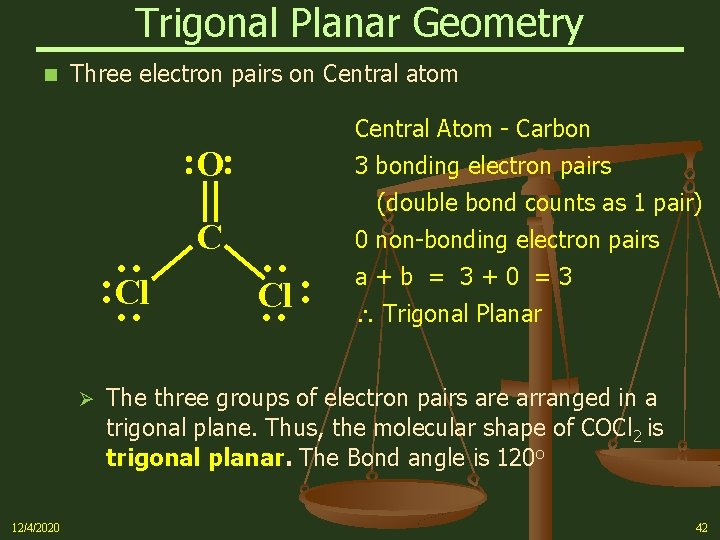
Trigonal Planar Geometry n Three electron pairs on Central atom Central Atom - Carbon : O: 3 bonding electron pairs (double bond counts as 1 pair) C Ø 12/4/2020 : : : Cl 0 non-bonding electron pairs Cl : a+b = 3+0 =3 Trigonal Planar The three groups of electron pairs are arranged in a trigonal plane. Thus, the molecular shape of COCl 2 is trigonal planar. The Bond angle is 120 o 42
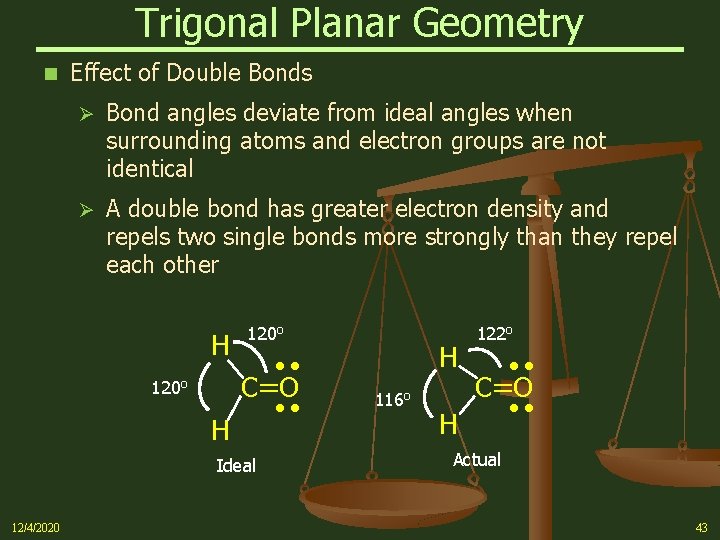
Trigonal Planar Geometry n Effect of Double Bonds Ø Bond angles deviate from ideal angles when surrounding atoms and electron groups are not identical Ø A double bond has greater electron density and repels two single bonds more strongly than they repel each other H 120 o C O H Ideal 12/4/2020 H 116 o 122 o C O H Actual 43
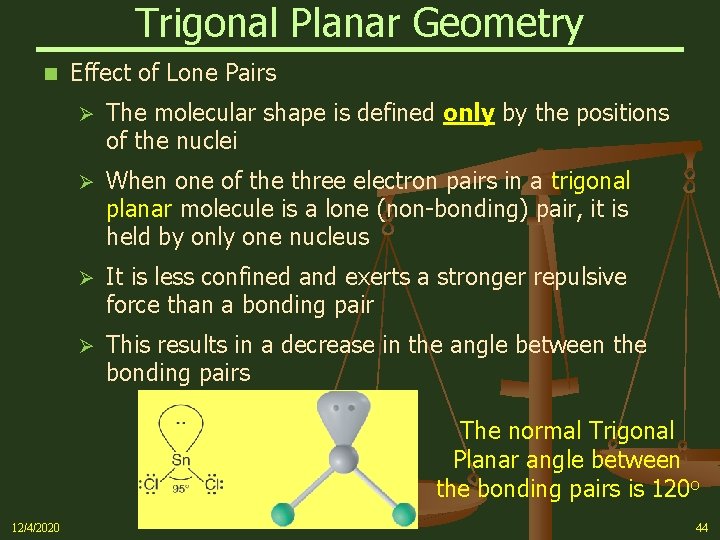
Trigonal Planar Geometry n Effect of Lone Pairs Ø The molecular shape is defined only by the positions of the nuclei Ø When one of the three electron pairs in a trigonal planar molecule is a lone (non-bonding) pair, it is held by only one nucleus Ø It is less confined and exerts a stronger repulsive force than a bonding pair Ø This results in a decrease in the angle between the bonding pairs The normal Trigonal Planar angle between the bonding pairs is 120 o 12/4/2020 44

Trigonal Planar Geometry n Three electron pairs (Effect of ‘Lone’ pairs) (trigonal planar arrangement) : SO 3 O: : : O <120 o : O BF 3 NO 3 - : CO 32 - Ø Ozone has two bonding electron pairs about the central oxygen (double bond counts as 1 pair) Ø There is one non-bonding lone pair Ø These groups have a: Trigonal Planar arrangement AXa. Eb Ø 12/4/2020 (a + b) = 2 + 1 = 3 Since one of the groups is a lone pair, the molecular geometry is described as bent or angular 45

Tetrahedral Geometry n Four electron pairs (Tetrahedral Arrangement) : H : Cl: : : : Cl C Cl: H : O : : : Cl: : N H H H Four electron pairs about the central atom lead to three different molecular geometries a+b=4+0 =4 12/4/2020 a+b=3+1 =4 a+b=2+2 =4 46
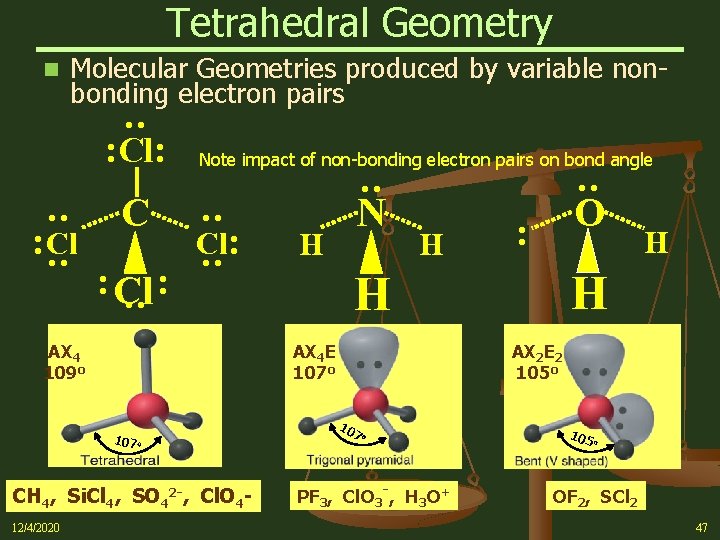
Tetrahedral Geometry n Molecular Geometries produced by variable nonbonding electron pairs : H AX 4 109 o H CH 4, Si. Cl 4, SO 42 -, Cl. O 4 - O : H H H AX 4 E 107 o 107 o 12/4/2020 : Cl: N : : Cl : : Cl C Note impact of non-bonding electron pairs on bond angle : : Cl: AX 2 E 2 105 o 10 7 o PF 3, Cl. O 3 -, H 3 O+ 105 o OF 2, SCl 2 47
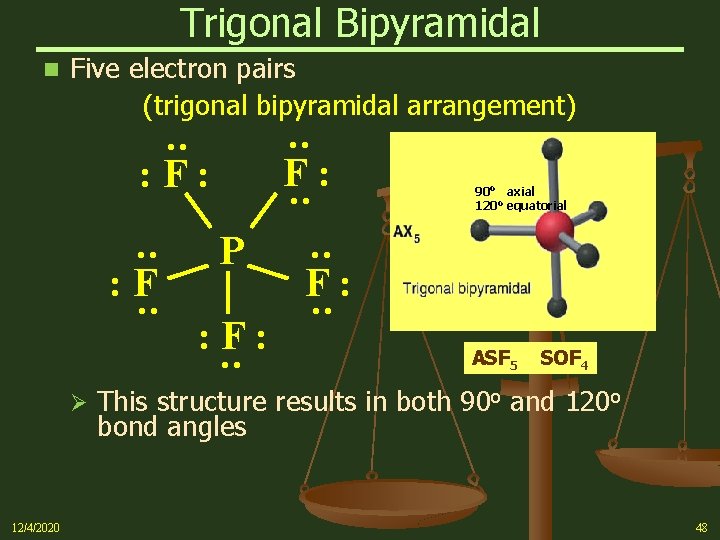
Trigonal Bipyramidal n Five electron pairs (trigonal bipyramidal arrangement) : : F: P : Ø 12/4/2020 F: : F: 90 o axial 120 o equatorial : : : F: ASF 5 SOF 4 This structure results in both 90 o and 120 o bond angles 48
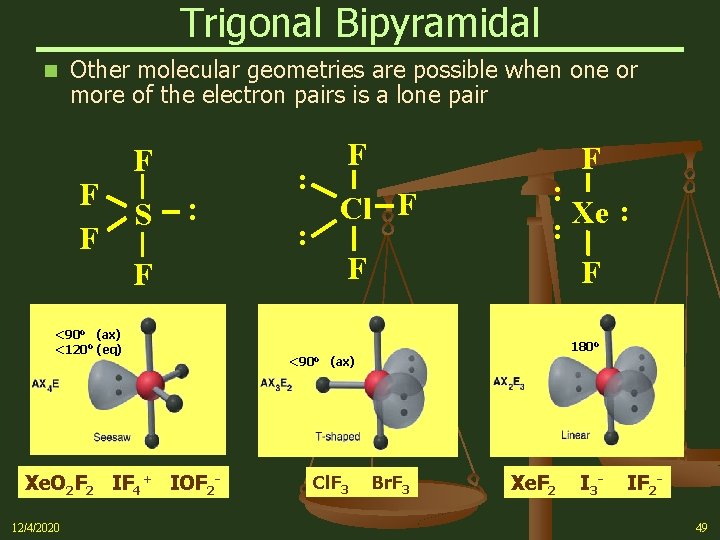
Trigonal Bipyramidal n Other molecular geometries are possible when one or more of the electron pairs is a lone pair F F F S : F <90 o (ax) <120 o (eq) Xe. O 2 F 2 IF 4+ IOF 212/4/2020 : : F F Cl F F : Xe : : F 180 o <90 o (ax) Cl. F 3 Br. F 3 Xe. F 2 I 3 - IF 249
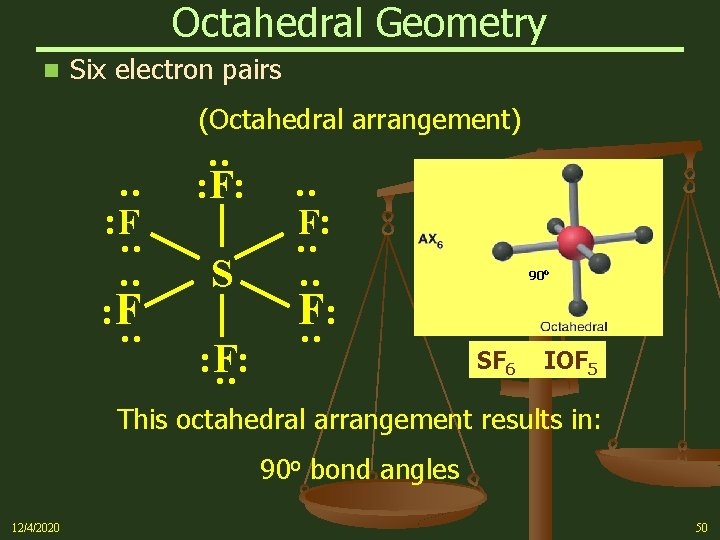
Octahedral Geometry n Six electron pairs (Octahedral arrangement) : : : S : : : : F: : F : F F: 90 o F: : SF 6 IOF 5 This octahedral arrangement results in: 90 o bond angles 12/4/2020 50
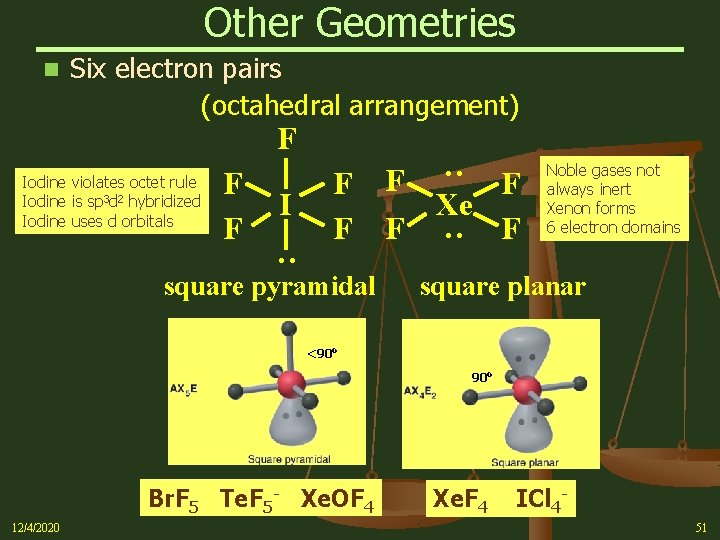
Other Geometries n Six electron pairs (octahedral arrangement) F I F F Xe F F : Iodine violates octet rule Iodine is sp 3 d 2 hybridized Iodine uses d orbitals Noble gases not always inert Xenon forms 6 electron domains square pyramidal square planar <90 o Br. F 5 Te. F 5 - Xe. OF 4 12/4/2020 Xe. F 4 ICl 451
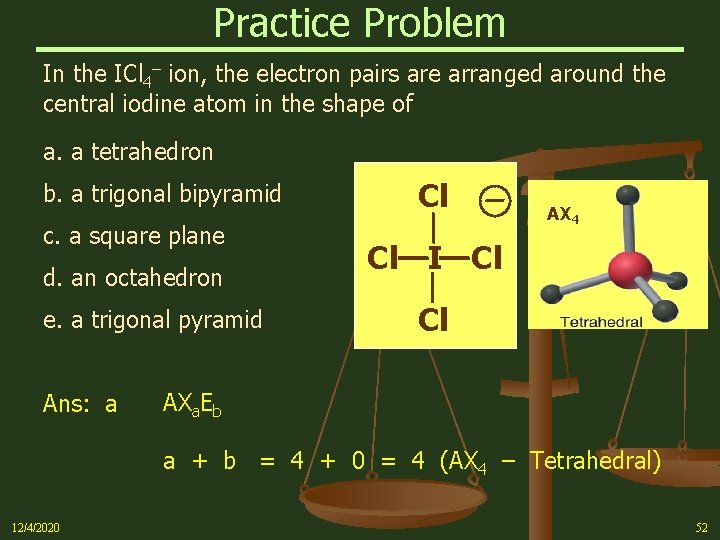
Practice Problem In the ICl 4– ion, the electron pairs are arranged around the central iodine atom in the shape of a. a tetrahedron b. a trigonal bipyramid c. a square plane d. an octahedron e. a trigonal pyramid Ans: a Cl AX 4 Cl I Cl Cl AXa. Eb a + b = 4 + 0 = 4 (AX 4 – Tetrahedral) 12/4/2020 52
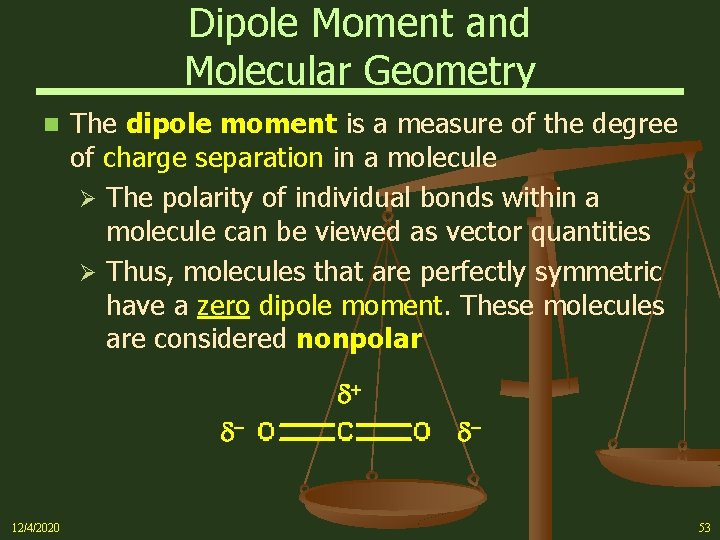
Dipole Moment and Molecular Geometry n The dipole moment is a measure of the degree of charge separation in a molecule Ø The polarity of individual bonds within a molecule can be viewed as vector quantities Ø Thus, molecules that are perfectly symmetric have a zero dipole moment. These molecules are considered nonpolar d+ d- 12/4/2020 d- 53

Dipole Moment and Molecular Geometry n However, molecules that exhibit any asymmetry in the arrangement of electron pairs would have a nonzero dipole moment. These molecules are considered polar : d- H N H H d+ NH 3 12/4/2020 PF 3 Cl. O 3 H 3 O+ 54
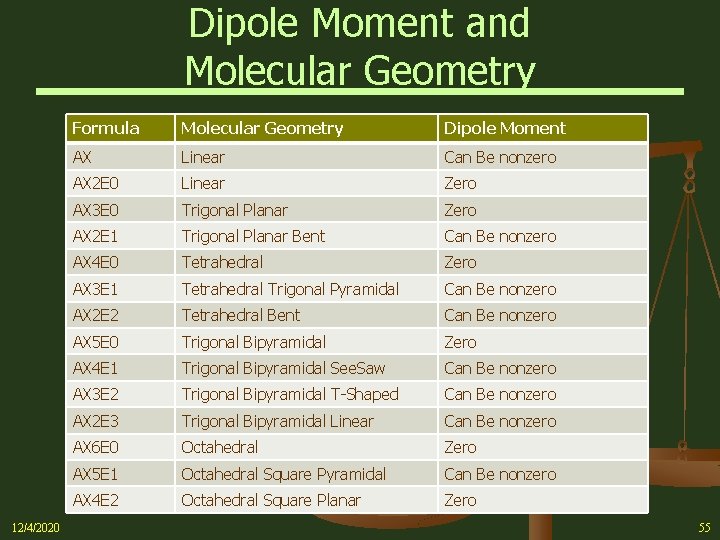
Dipole Moment and Molecular Geometry 12/4/2020 Formula Molecular Geometry Dipole Moment AX Linear Can Be nonzero AX 2 E 0 Linear Zero AX 3 E 0 Trigonal Planar Zero AX 2 E 1 Trigonal Planar Bent Can Be nonzero AX 4 E 0 Tetrahedral Zero AX 3 E 1 Tetrahedral Trigonal Pyramidal Can Be nonzero AX 2 E 2 Tetrahedral Bent Can Be nonzero AX 5 E 0 Trigonal Bipyramidal Zero AX 4 E 1 Trigonal Bipyramidal See. Saw Can Be nonzero AX 3 E 2 Trigonal Bipyramidal T-Shaped Can Be nonzero AX 2 E 3 Trigonal Bipyramidal Linear Can Be nonzero AX 6 E 0 Octahedral Zero AX 5 E 1 Octahedral Square Pyramidal Can Be nonzero AX 4 E 2 Octahedral Square Planar Zero 55
Practice Problem The Nitrogen atom would be expected to have the positive end of the dipole in the species a. NH 4+ b. Ca 3 N 2 c. HCN d. Al. N e. NO+ N is more Electronegative than H N is more EN than Ca N is more EN than C N is more EN than Al O is more EN than Nitrogen Ans: e 12/4/2020 56
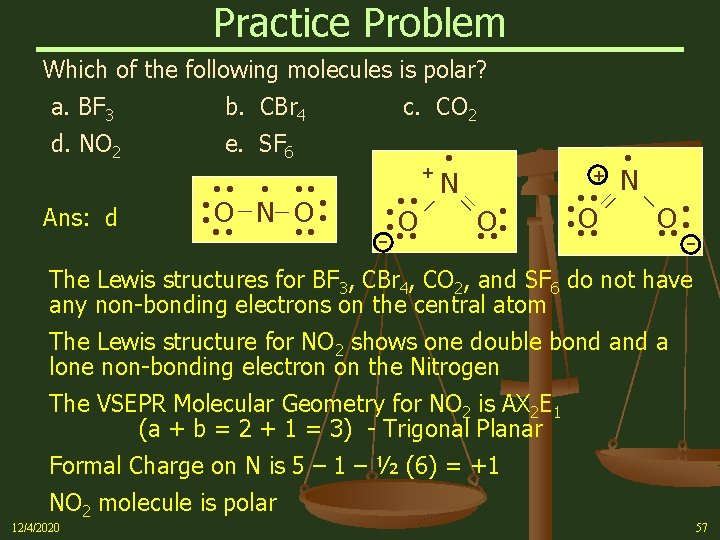
Practice Problem Which of the following molecules is polar? d. NO 2 e. SF 6 ● ●● ●● ● ● - ●● O ●● + N O ●● ● ● ●● O ●● ● N O ●● ● O N O● ●● + ● Ans: d ● ● ●● c. CO 2 b. CBr 4 a. BF 3 ● ● - The Lewis structures for BF 3, CBr 4, CO 2, and SF 6 do not have any non-bonding electrons on the central atom The Lewis structure for NO 2 shows one double bond a lone non-bonding electron on the Nitrogen The VSEPR Molecular Geometry for NO 2 is AX 2 E 1 (a + b = 2 + 1 = 3) - Trigonal Planar Formal Charge on N is 5 – 1 – ½ (6) = +1 NO 2 molecule is polar 12/4/2020 57
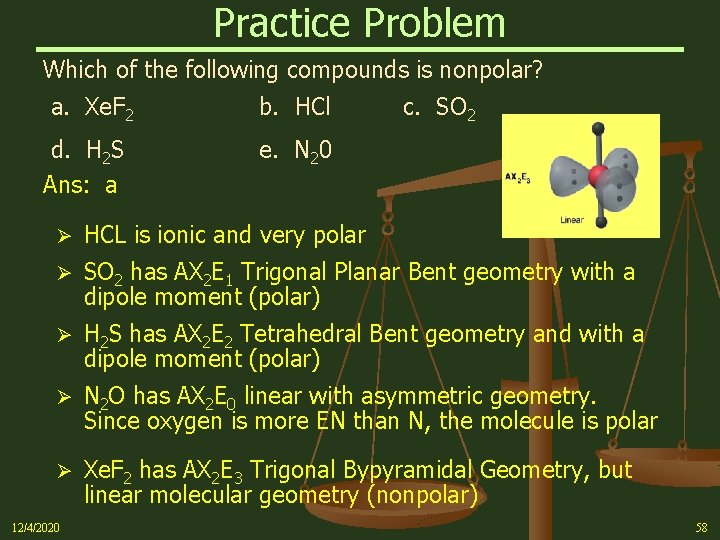
Practice Problem Which of the following compounds is nonpolar? a. Xe. F 2 d. H 2 S Ans: a b. HCl c. SO 2 e. N 20 Ø HCL is ionic and very polar Ø SO 2 has AX 2 E 1 Trigonal Planar Bent geometry with a dipole moment (polar) Ø H 2 S has AX 2 E 2 Tetrahedral Bent geometry and with a dipole moment (polar) Ø N 2 O has AX 2 E 0 linear with asymmetric geometry. Since oxygen is more EN than N, the molecule is polar Ø Xe. F 2 has AX 2 E 3 Trigonal Bypyramidal Geometry, but linear molecular geometry (nonpolar) 12/4/2020 58
- Slides: 58