Developed in association with the European Thoracic Oncology

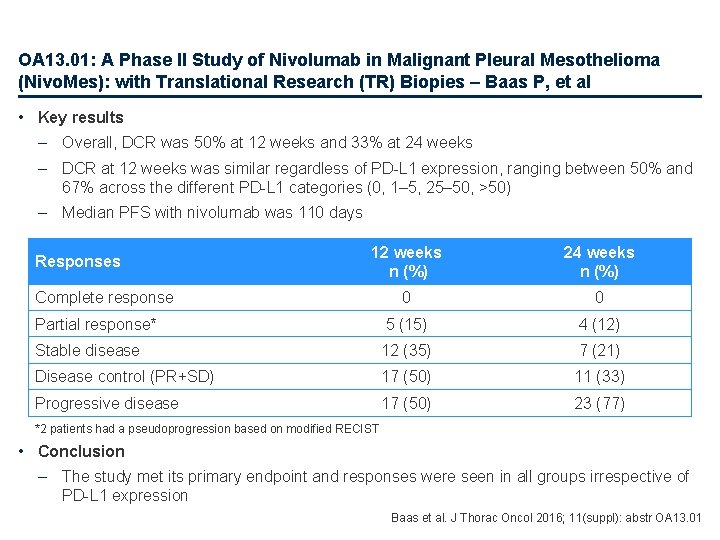
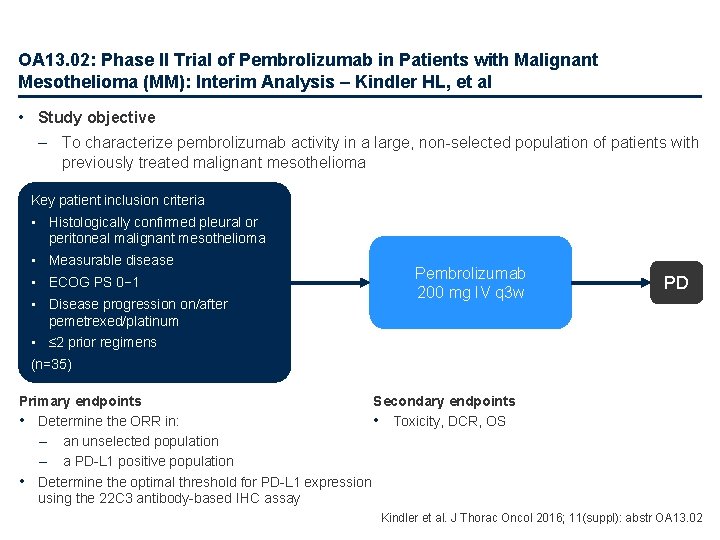

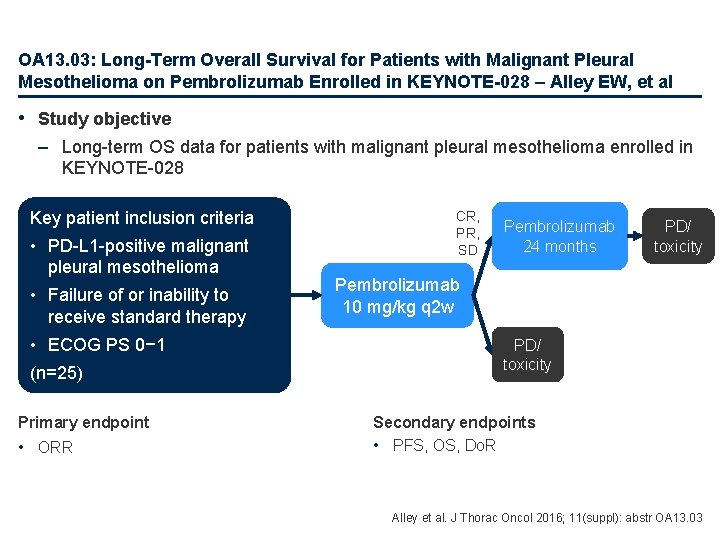
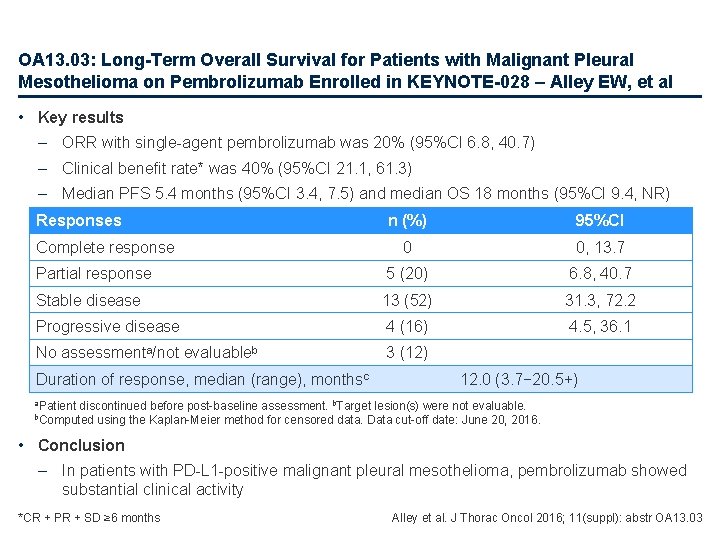
- Slides: 104
Developed in association with the European Thoracic Oncology Platform IASLC 17 th World Conference on Lung Cancer December 4– 7, 2016 Vienna, Austria Supported by Eli Lilly and Company has not influenced the content of this publication
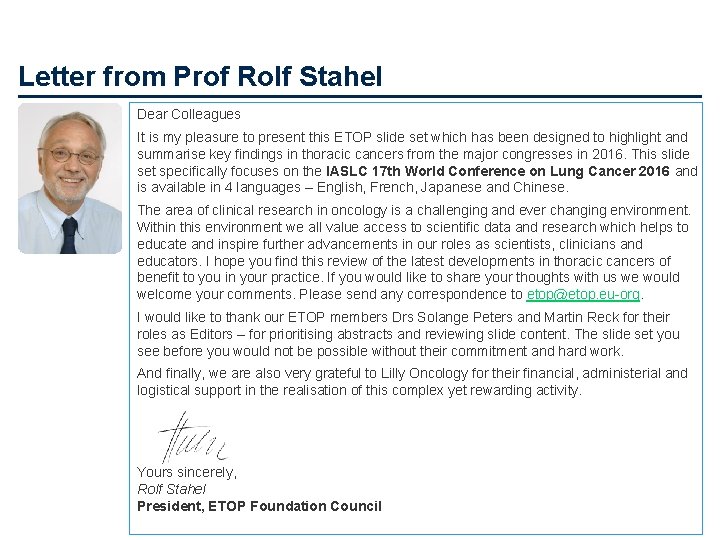
Letter from Prof Rolf Stahel Dear Colleagues It is my pleasure to present this ETOP slide set which has been designed to highlight and summarise key findings in thoracic cancers from the major congresses in 2016. This slide set specifically focuses on the IASLC 17 th World Conference on Lung Cancer 2016 and is available in 4 languages – English, French, Japanese and Chinese. The area of clinical research in oncology is a challenging and ever changing environment. Within this environment we all value access to scientific data and research which helps to educate and inspire further advancements in our roles as scientists, clinicians and educators. I hope you find this review of the latest developments in thoracic cancers of benefit to you in your practice. If you would like to share your thoughts with us we would welcome your comments. Please send any correspondence to etop@etop. eu-org. I would like to thank our ETOP members Drs Solange Peters and Martin Reck for their roles as Editors – for prioritising abstracts and reviewing slide content. The slide set you see before you would not be possible without their commitment and hard work. And finally, we are also very grateful to Lilly Oncology for their financial, administerial and logistical support in the realisation of this complex yet rewarding activity. Yours sincerely, Rolf Stahel President, ETOP Foundation Council
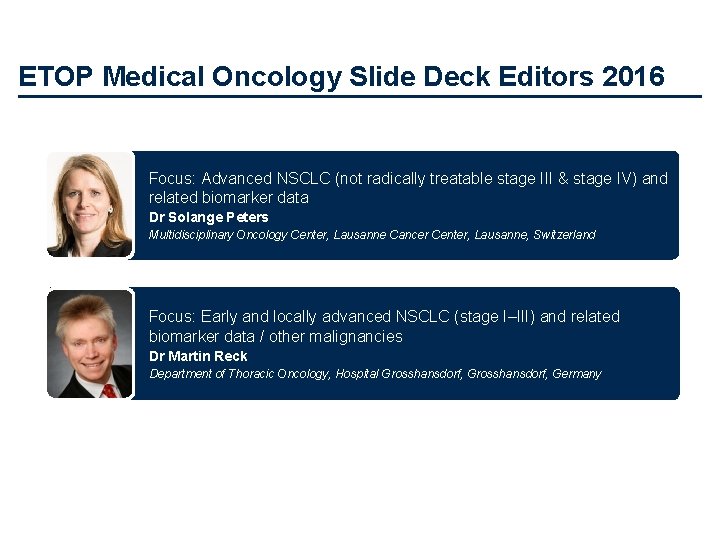
ETOP Medical Oncology Slide Deck Editors 2016 Focus: Advanced NSCLC (not radically treatable stage III & stage IV) and related biomarker data Dr Solange Peters Multidisciplinary Oncology Center, Lausanne Cancer Center, Lausanne, Switzerland Focus: Early and locally advanced NSCLC (stage I–III) and related biomarker data / other malignancies Dr Martin Reck Department of Thoracic Oncology, Hospital Grosshansdorf, Germany
Contents • Biomarkers and screening • Early stage and locally advanced NSCLC – Stages I, II and III • Advanced NSCLC – Not radically treatable stage III and stage IV – 1 st line – Later lines • Other malignancies – SCLC and mesothelioma – Rare tumours
Biomarkers and screening
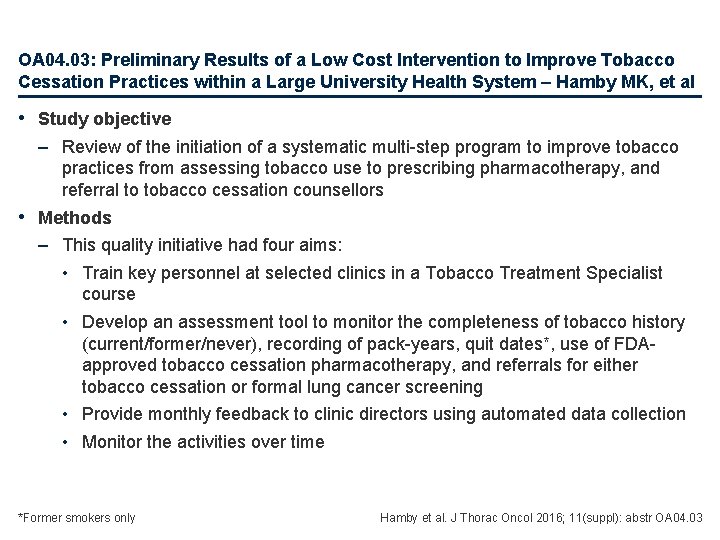
OA 04. 03: Preliminary Results of a Low Cost Intervention to Improve Tobacco Cessation Practices within a Large University Health System – Hamby MK, et al • Study objective – Review of the initiation of a systematic multi-step program to improve tobacco practices from assessing tobacco use to prescribing pharmacotherapy, and referral to tobacco cessation counsellors • Methods – This quality initiative had four aims: • Train key personnel at selected clinics in a Tobacco Treatment Specialist course • Develop an assessment tool to monitor the completeness of tobacco history (current/former/never), recording of pack-years, quit dates*, use of FDAapproved tobacco cessation pharmacotherapy, and referrals for either tobacco cessation or formal lung cancer screening • Provide monthly feedback to clinic directors using automated data collection • Monitor the activities over time *Former smokers only Hamby et al. J Thorac Oncol 2016; 11(suppl): abstr OA 04. 03
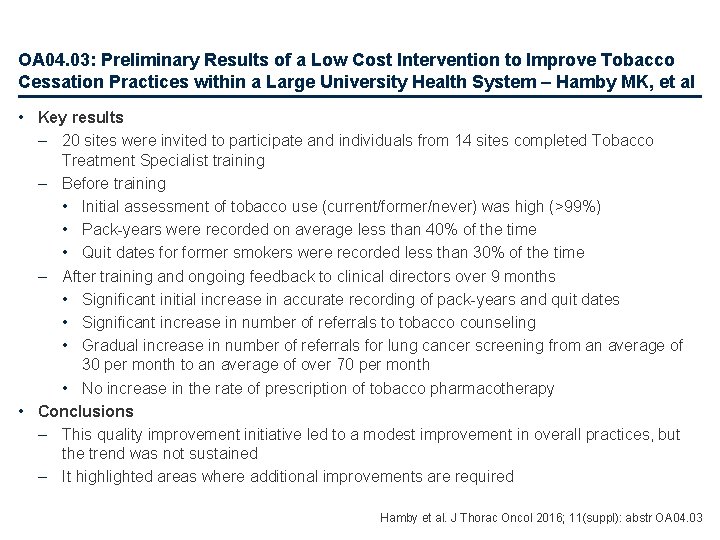
OA 04. 03: Preliminary Results of a Low Cost Intervention to Improve Tobacco Cessation Practices within a Large University Health System – Hamby MK, et al • Key results – 20 sites were invited to participate and individuals from 14 sites completed Tobacco Treatment Specialist training – Before training • Initial assessment of tobacco use (current/former/never) was high (>99%) • Pack-years were recorded on average less than 40% of the time • Quit dates former smokers were recorded less than 30% of the time – After training and ongoing feedback to clinical directors over 9 months • Significant initial increase in accurate recording of pack-years and quit dates • Significant increase in number of referrals to tobacco counseling • Gradual increase in number of referrals for lung cancer screening from an average of 30 per month to an average of over 70 per month • No increase in the rate of prescription of tobacco pharmacotherapy • Conclusions – This quality improvement initiative led to a modest improvement in overall practices, but the trend was not sustained – It highlighted areas where additional improvements are required Hamby et al. J Thorac Oncol 2016; 11(suppl): abstr OA 04. 03
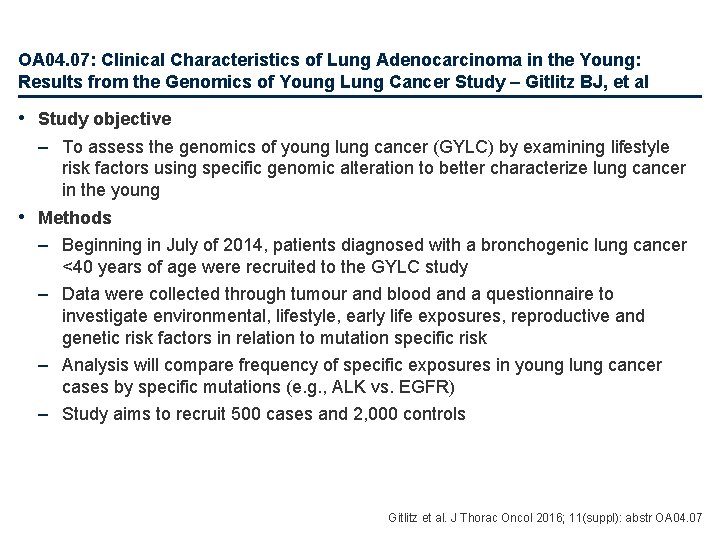
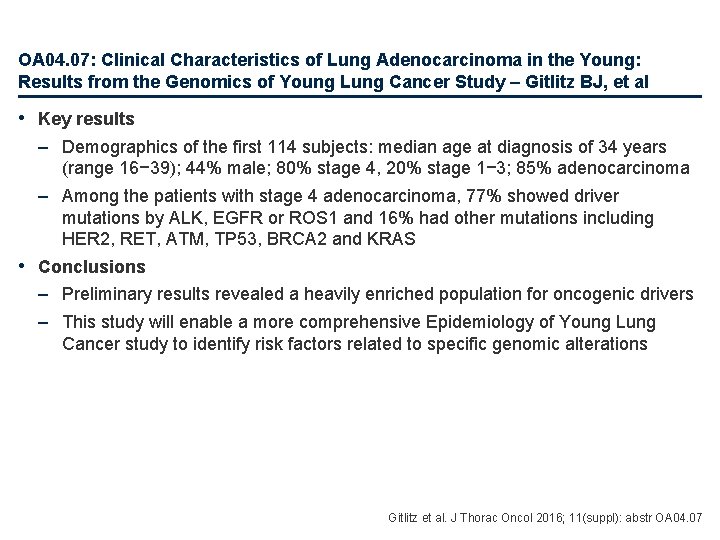
OA 04. 07: Clinical Characteristics of Lung Adenocarcinoma in the Young: Results from the Genomics of Young Lung Cancer Study – Gitlitz BJ, et al • Study objective – To assess the genomics of young lung cancer (GYLC) by examining lifestyle risk factors using specific genomic alteration to better characterize lung cancer in the young • Methods – Beginning in July of 2014, patients diagnosed with a bronchogenic lung cancer <40 years of age were recruited to the GYLC study – Data were collected through tumour and blood and a questionnaire to investigate environmental, lifestyle, early life exposures, reproductive and genetic risk factors in relation to mutation specific risk – Analysis will compare frequency of specific exposures in young lung cancer cases by specific mutations (e. g. , ALK vs. EGFR) – Study aims to recruit 500 cases and 2, 000 controls Gitlitz et al. J Thorac Oncol 2016; 11(suppl): abstr OA 04. 07
OA 04. 07: Clinical Characteristics of Lung Adenocarcinoma in the Young: Results from the Genomics of Young Lung Cancer Study – Gitlitz BJ, et al • Key results – Demographics of the first 114 subjects: median age at diagnosis of 34 years (range 16− 39); 44% male; 80% stage 4, 20% stage 1− 3; 85% adenocarcinoma – Among the patients with stage 4 adenocarcinoma, 77% showed driver mutations by ALK, EGFR or ROS 1 and 16% had other mutations including HER 2, RET, ATM, TP 53, BRCA 2 and KRAS • Conclusions – Preliminary results revealed a heavily enriched population for oncogenic drivers – This study will enable a more comprehensive Epidemiology of Young Lung Cancer study to identify risk factors related to specific genomic alterations Gitlitz et al. J Thorac Oncol 2016; 11(suppl): abstr OA 04. 07
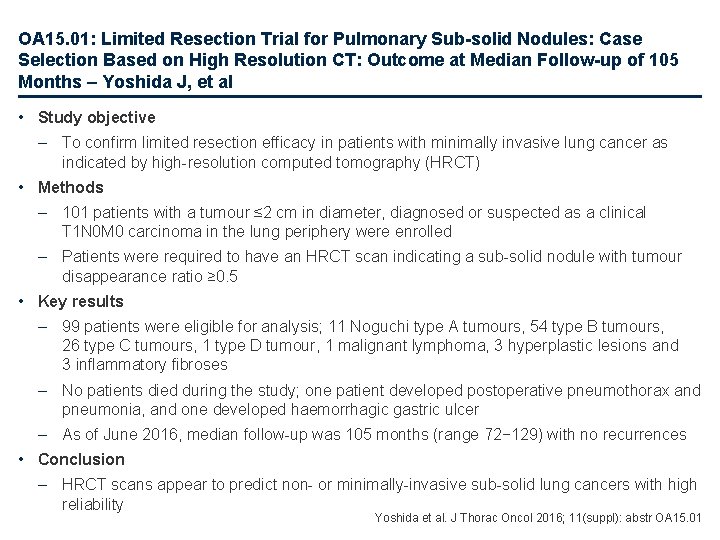
OA 15. 01: Limited Resection Trial for Pulmonary Sub-solid Nodules: Case Selection Based on High Resolution CT: Outcome at Median Follow-up of 105 Months – Yoshida J, et al • Study objective – To confirm limited resection efficacy in patients with minimally invasive lung cancer as indicated by high-resolution computed tomography (HRCT) • Methods – 101 patients with a tumour ≤ 2 cm in diameter, diagnosed or suspected as a clinical T 1 N 0 M 0 carcinoma in the lung periphery were enrolled – Patients were required to have an HRCT scan indicating a sub-solid nodule with tumour disappearance ratio ≥ 0. 5 • Key results – 99 patients were eligible for analysis; 11 Noguchi type A tumours, 54 type B tumours, 26 type C tumours, 1 type D tumour, 1 malignant lymphoma, 3 hyperplastic lesions and 3 inflammatory fibroses – No patients died during the study; one patient developed postoperative pneumothorax and pneumonia, and one developed haemorrhagic gastric ulcer – As of June 2016, median follow-up was 105 months (range 72− 129) with no recurrences • Conclusion – HRCT scans appear to predict non- or minimally-invasive sub-solid lung cancers with high reliability Yoshida et al. J Thorac Oncol 2016; 11(suppl): abstr OA 15. 01
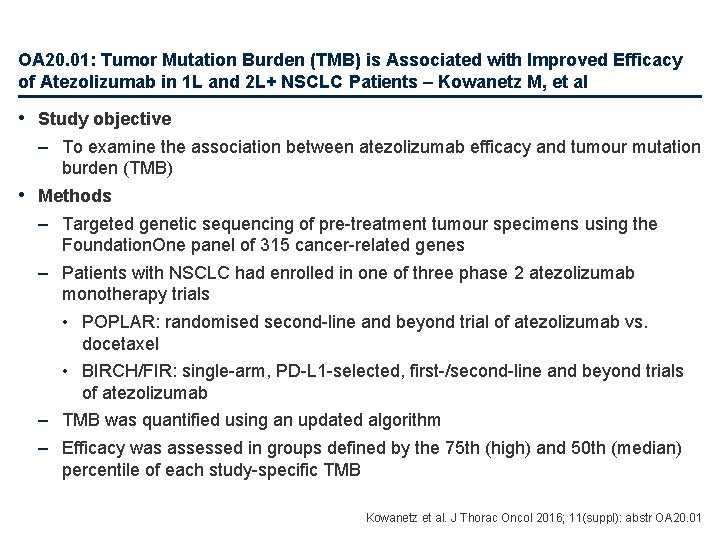
OA 20. 01: Tumor Mutation Burden (TMB) is Associated with Improved Efficacy of Atezolizumab in 1 L and 2 L+ NSCLC Patients – Kowanetz M, et al • Study objective – To examine the association between atezolizumab efficacy and tumour mutation burden (TMB) • Methods – Targeted genetic sequencing of pre-treatment tumour specimens using the Foundation. One panel of 315 cancer-related genes – Patients with NSCLC had enrolled in one of three phase 2 atezolizumab monotherapy trials • POPLAR: randomised second-line and beyond trial of atezolizumab vs. docetaxel • BIRCH/FIR: single-arm, PD-L 1 -selected, first-/second-line and beyond trials of atezolizumab – TMB was quantified using an updated algorithm – Efficacy was assessed in groups defined by the 75 th (high) and 50 th (median) percentile of each study-specific TMB Kowanetz et al. J Thorac Oncol 2016; 11(suppl): abstr OA 20. 01
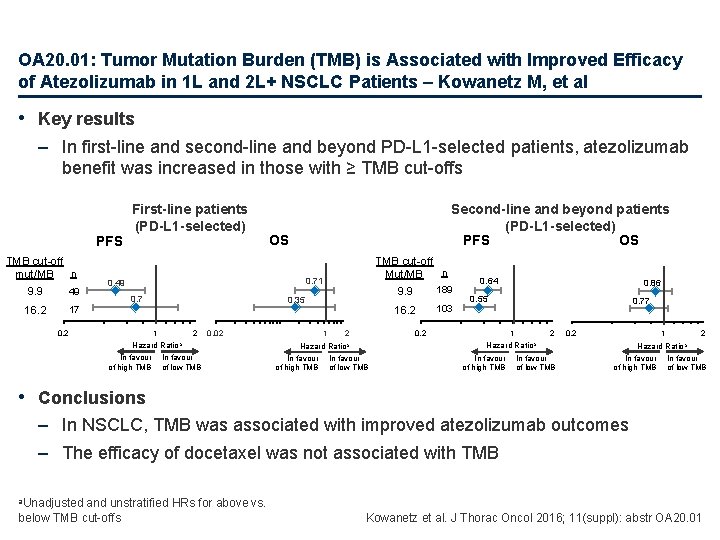
OA 20. 01: Tumor Mutation Burden (TMB) is Associated with Improved Efficacy of Atezolizumab in 1 L and 2 L+ NSCLC Patients – Kowanetz M, et al • Key results – In first-line and second-line and beyond PD-L 1 -selected patients, atezolizumab benefit was increased in those with ≥ TMB cut-offs PFS TMB cut-off n mut/MB 9. 9 49 16. 2 17 First-line patients (PD-L 1 -selected) Second-line and beyond patients (PD-L 1 -selected) OS PFS OS TMB cut-off n Mut/MB 0. 71 0. 49 0. 7 0. 35 0. 2 1 2 0. 02 1 2 0. 2 Hazard Ratioa In favour of high TMB of low TMB 9. 9 189 16. 2 103 0. 64 0. 86 0. 55 0. 77 0. 2 1 2 0. 2 a Hazard Ratioa In favour of high TMB of low TMB Hazard Ratioa In favour of high TMB of low TMB • Conclusions – In NSCLC, TMB was associated with improved atezolizumab outcomes – The efficacy of docetaxel was not associated with TMB a. Unadjusted and unstratified HRs for above vs. below TMB cut-offs Kowanetz et al. J Thorac Oncol 2016; 11(suppl): abstr OA 20. 01
OA 20. 02: Neoantigen Targeting in NSCLC Patients with Complete Response to Anti-PD-1 Immunotherapy – Smith K, et al • Study objective – To investigate the mechanisms underlying response to anti-PD-1 therapy in NSCLC • Methods – Tumour sections from 2 patients with advanced NSCLC who had complete responses to nivolumab had whole exome sequencing and mutation-associated neoantigen (MANA) prediction performed – Peptides representing MANAs were synthesised and tested against PBMC – Reactive MANAs were assessed in binding and stability assays – TCR sequencing was performed on reactive cell cultures and on DNA obtained from tumour resections to match TCR clones with those infiltrating the tumour PBMC, peripheral blood mononuclear cell Smith et al. J Thorac Oncol 2016; 11(suppl): abstr OA 20. 02
OA 20. 02: Neoantigen Targeting in NSCLC Patients with Complete Response to Anti-PD-1 Immunotherapy – Smith K, et al • Key results – Patient 1 had 30 sequence alterations and patient 2 had 314 – Despite the difference in mutational load, MANA reactivity was detected in peripheral blood of both patients >1 year after being declared cancer-free – TCR clones of MANA-reactive peripheral T cells were detected in tumour resections and were expanded in MANA-stimulated T cell cultures – Binding and stability assays confirmed that these MANAs bind to their cognate HLA with high affinity and stability • Conclusions – Quality of mutations may be more influential in immunogenicity than the overall quantity of mutations – MANA reactivity may be the underlying mechanism by which T cells eliminate tumour following anti-PD-1 immunotherapy Smith et al. J Thorac Oncol 2016; 11(suppl): abstr OA 20. 02
MA 15. 02: Non-Synonymous Mutation Burden in Lung Carcinoma is Associated with Durable Clinical Response to Immune Checkpoint Blockade – Mahadevan NR, et al • Study objective – To retrospectively analyse the relationship of lung carcinoma mutation burden, PD-L 1 expression and immune infiltrates with clinical response in patients receiving immune checkpoint blockade • Methods – Tumour non-synonymous mutation data derived from clinical targeted next generation sequencing (309 genes) of lung carcinomas from 85 patients treated with immune checkpoint inhibitors was correlated with clinical outcomes including: durable clinical benefit (DCB; >6 months partial or stable response) and PFS – Samples were considered PD-L 1 positive if ≥ 1% of tumour cells and/or tumourinfiltrating immune cells stained – PU. 1, CD 3, and FOXP 3 immunohistochemistry were manually quantified to highlight tumour-associated macrophages and non-regulatory and regulatory T cell populations Mahadevan et al. J Thorac Oncol 2016; 11(suppl): abstr MA 15. 02
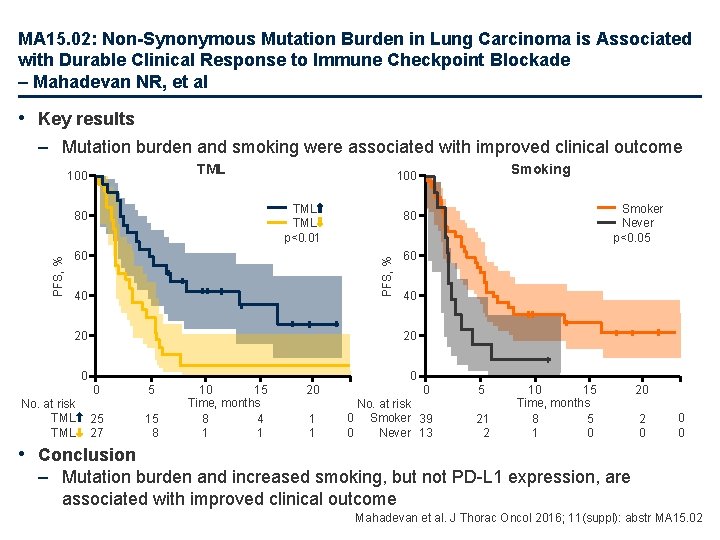
MA 15. 02: Non-Synonymous Mutation Burden in Lung Carcinoma is Associated with Durable Clinical Response to Immune Checkpoint Blockade – Mahadevan NR, et al • Key results – Mutation burden and smoking were associated with improved clinical outcome TML 100 TML p<0. 01 60 40 20 Smoker Never p<0. 05 80 PFS, % 80 Smoking 100 60 40 20 0 5 No. at risk TML 25 TML 27 15 8 10 15 Time, months 8 4 1 1 20 1 1 0 No. at risk 0 Smoker 39 Never 13 0 5 21 2 10 15 Time, months 8 5 1 0 20 2 0 0 0 • Conclusion – Mutation burden and increased smoking, but not PD-L 1 expression, are associated with improved clinical outcome Mahadevan et al. J Thorac Oncol 2016; 11(suppl): abstr MA 15. 02
Early and locally advanced NSCLC Stages I, II and III
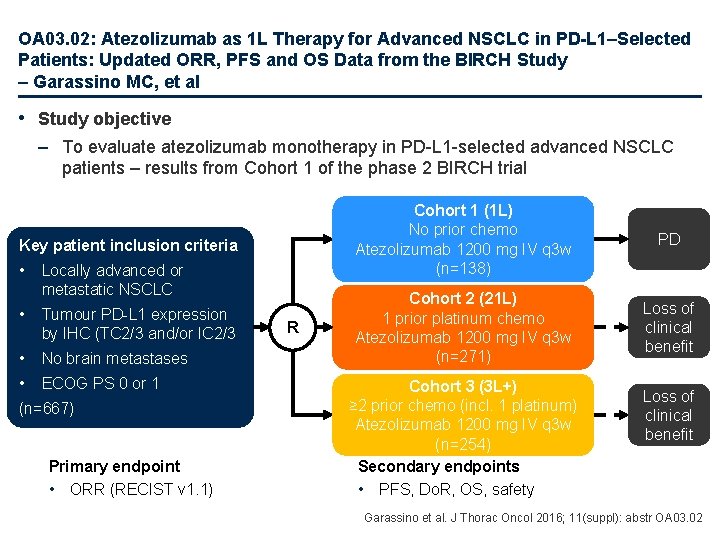
OA 03. 02: Atezolizumab as 1 L Therapy for Advanced NSCLC in PD-L 1–Selected Patients: Updated ORR, PFS and OS Data from the BIRCH Study – Garassino MC, et al • Study objective – To evaluate atezolizumab monotherapy in PD-L 1 -selected advanced NSCLC patients – results from Cohort 1 of the phase 2 BIRCH trial Key patient inclusion criteria • Locally advanced or metastatic NSCLC • Tumour PD-L 1 expression by IHC (TC 2/3 and/or IC 2/3 • No brain metastases • ECOG PS 0 or 1 (n=667) Primary endpoint • ORR (RECIST v 1. 1) R Cohort 1 (1 L) No prior chemo Atezolizumab 1200 mg IV q 3 w (n=138) PD Cohort 2 (21 L) 1 prior platinum chemo Atezolizumab 1200 mg IV q 3 w (n=271) Loss of clinical benefit Cohort 3 (3 L+) ≥ 2 prior chemo (incl. 1 platinum) Atezolizumab 1200 mg IV q 3 w (n=254) Secondary endpoints • PFS, Do. R, OS, safety Loss of clinical benefit Garassino et al. J Thorac Oncol 2016; 11(suppl): abstr OA 03. 02
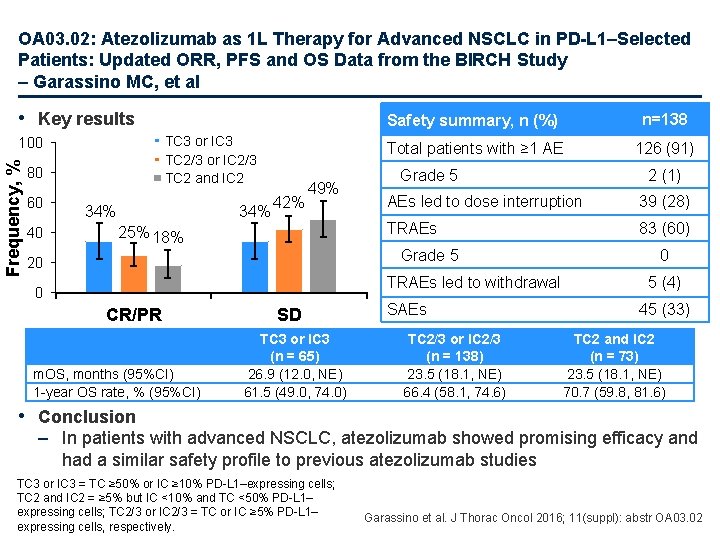
OA 03. 02: Atezolizumab as 1 L Therapy for Advanced NSCLC in PD-L 1–Selected Patients: Updated ORR, PFS and OS Data from the BIRCH Study – Garassino MC, et al • Key results TC 3 or IC 3 TC 2/3 or IC 2/3 TC 2 and IC 2 Frequency, % 100 80 60 40 34% 42% 49% 25% 18% Safety summary, n (%) n=138 Total patients with ≥ 1 AE 126 (91) Grade 5 AEs led to dose interruption 39 (28) TRAEs 83 (60) Grade 5 20 TRAEs led to withdrawal 0 CR/PR m. OS, months (95%CI) 1 -year OS rate, % (95%CI) SD TC 3 or IC 3 (n = 65) 26. 9 (12. 0, NE) 61. 5 (49. 0, 74. 0) 2 (1) SAEs TC 2/3 or IC 2/3 (n = 138) 23. 5 (18. 1, NE) 66. 4 (58. 1, 74. 6) 0 5 (4) 45 (33) TC 2 and IC 2 (n = 73) 23. 5 (18. 1, NE) 70. 7 (59. 8, 81. 6) • Conclusion – In patients with advanced NSCLC, atezolizumab showed promising efficacy and had a similar safety profile to previous atezolizumab studies TC 3 or IC 3 = TC ≥ 50% or IC ≥ 10% PD-L 1–expressing cells; TC 2 and IC 2 = ≥ 5% but IC <10% and TC <50% PD-L 1– expressing cells; TC 2/3 or IC 2/3 = TC or IC ≥ 5% PD-L 1– expressing cells, respectively. Garassino et al. J Thorac Oncol 2016; 11(suppl): abstr OA 03. 02
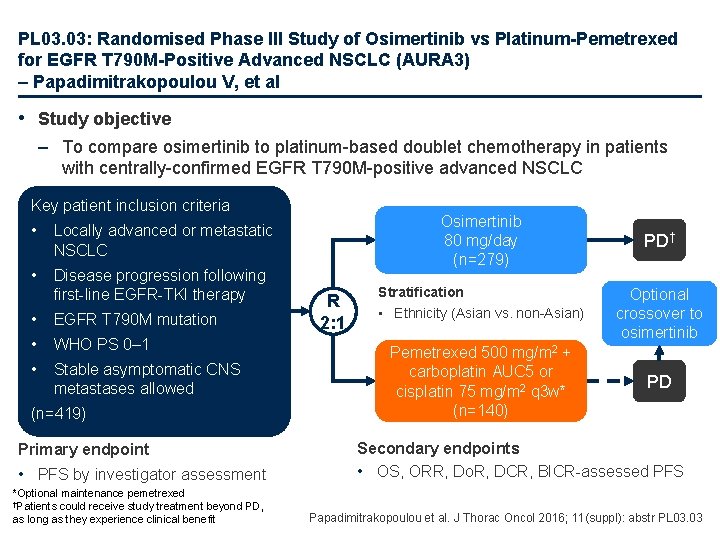
PL 03. 03: Randomised Phase III Study of Osimertinib vs Platinum-Pemetrexed for EGFR T 790 M-Positive Advanced NSCLC (AURA 3) – Papadimitrakopoulou V, et al • Study objective – To compare osimertinib to platinum-based doublet chemotherapy in patients with centrally-confirmed EGFR T 790 M-positive advanced NSCLC Key patient inclusion criteria • Locally advanced or metastatic NSCLC • Disease progression following first-line EGFR-TKI therapy • EGFR T 790 M mutation • WHO PS 0– 1 • Stable asymptomatic CNS metastases allowed (n=419) Primary endpoint • PFS by investigator assessment *Optional maintenance pemetrexed †Patients could receive study treatment beyond PD, as long as they experience clinical benefit Osimertinib 80 mg/day (n=279) R 2: 1 Stratification • Ethnicity (Asian vs. non-Asian) Pemetrexed 500 mg/m 2 + carboplatin AUC 5 or cisplatin 75 mg/m 2 q 3 w* (n=140) PD† Optional crossover to osimertinib PD Secondary endpoints • OS, ORR, Do. R, DCR, BICR-assessed PFS Papadimitrakopoulou et al. J Thorac Oncol 2016; 11(suppl): abstr PL 03. 03
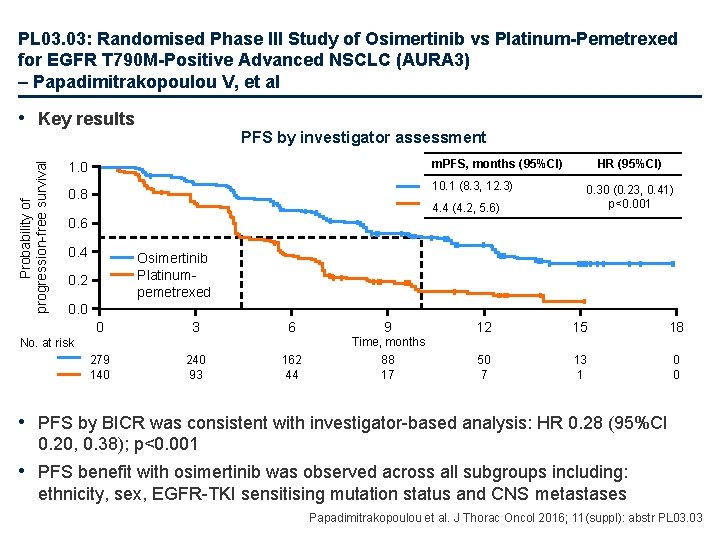
PL 03. 03: Randomised Phase III Study of Osimertinib vs Platinum-Pemetrexed for EGFR T 790 M-Positive Advanced NSCLC (AURA 3) – Papadimitrakopoulou V, et al Probability of progression-free survival • Key results PFS by investigator assessment m. PFS, months (95%CI) 1. 0 10. 1 (8. 3, 12. 3) 0. 8 4. 4 (4. 2, 5. 6) HR (95%CI) 0. 30 (0. 23, 0. 41) p<0. 001 0. 6 0. 4 Osimertinib Platinumpemetrexed 0. 2 0. 0 0 3 6 279 140 240 93 162 44 No. at risk 9 12 15 18 88 17 50 7 13 1 0 0 Time, months • PFS by BICR was consistent with investigator-based analysis: HR 0. 28 (95%CI 0. 20, 0. 38); p<0. 001 • PFS benefit with osimertinib was observed across all subgroups including: ethnicity, sex, EGFR-TKI sensitising mutation status and CNS metastases Papadimitrakopoulou et al. J Thorac Oncol 2016; 11(suppl): abstr PL 03. 03
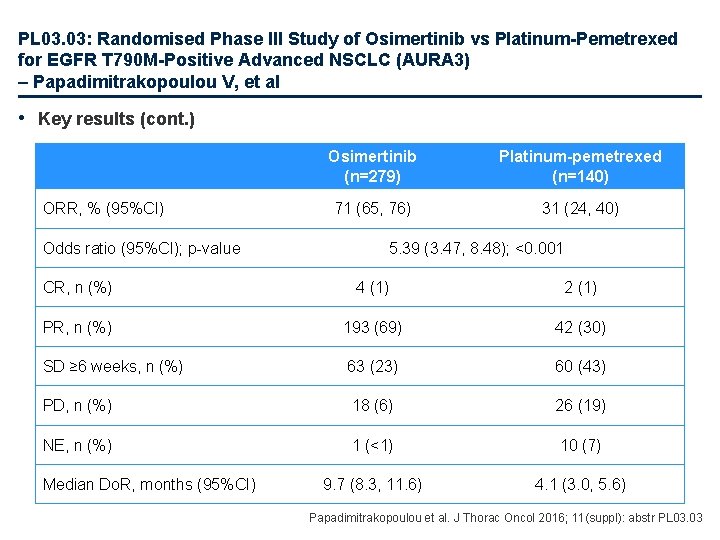
PL 03. 03: Randomised Phase III Study of Osimertinib vs Platinum-Pemetrexed for EGFR T 790 M-Positive Advanced NSCLC (AURA 3) – Papadimitrakopoulou V, et al • Key results (cont. ) ORR, % (95%CI) Odds ratio (95%CI); p-value Osimertinib (n=279) Platinum-pemetrexed (n=140) 71 (65, 76) 31 (24, 40) 5. 39 (3. 47, 8. 48); <0. 001 CR, n (%) 4 (1) 2 (1) PR, n (%) 193 (69) 42 (30) SD ≥ 6 weeks, n (%) 63 (23) 60 (43) PD, n (%) 18 (6) 26 (19) NE, n (%) 1 (<1) 10 (7) 9. 7 (8. 3, 11. 6) 4. 1 (3. 0, 5. 6) Median Do. R, months (95%CI) Papadimitrakopoulou et al. J Thorac Oncol 2016; 11(suppl): abstr PL 03. 03
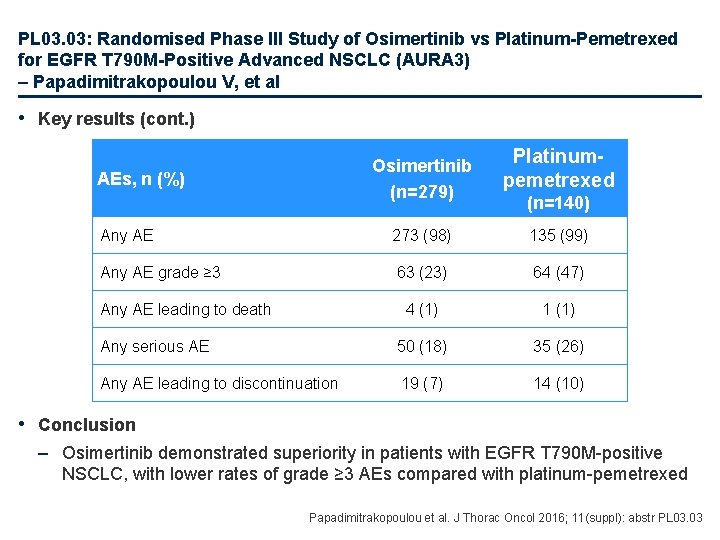
PL 03. 03: Randomised Phase III Study of Osimertinib vs Platinum-Pemetrexed for EGFR T 790 M-Positive Advanced NSCLC (AURA 3) – Papadimitrakopoulou V, et al • Key results (cont. ) Osimertinib (n=279) AEs, n (%) Platinumpemetrexed (n=140) Any AE 273 (98) 135 (99) Any AE grade ≥ 3 63 (23) 64 (47) 4 (1) 1 (1) Any serious AE 50 (18) 35 (26) Any AE leading to discontinuation 19 (7) 14 (10) Any AE leading to death • Conclusion – Osimertinib demonstrated superiority in patients with EGFR T 790 M-positive NSCLC, with lower rates of grade ≥ 3 AEs compared with platinum-pemetrexed Papadimitrakopoulou et al. J Thorac Oncol 2016; 11(suppl): abstr PL 03. 03
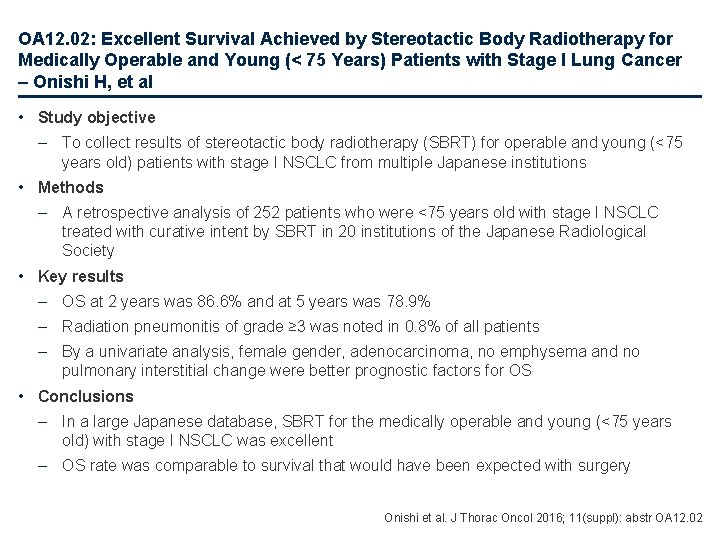
OA 12. 02: Excellent Survival Achieved by Stereotactic Body Radiotherapy for Medically Operable and Young (< 75 Years) Patients with Stage I Lung Cancer – Onishi H, et al • Study objective – To collect results of stereotactic body radiotherapy (SBRT) for operable and young (<75 years old) patients with stage I NSCLC from multiple Japanese institutions • Methods – A retrospective analysis of 252 patients who were <75 years old with stage I NSCLC treated with curative intent by SBRT in 20 institutions of the Japanese Radiological Society • Key results – OS at 2 years was 86. 6% and at 5 years was 78. 9% – Radiation pneumonitis of grade ≥ 3 was noted in 0. 8% of all patients – By a univariate analysis, female gender, adenocarcinoma, no emphysema and no pulmonary interstitial change were better prognostic factors for OS • Conclusions – In a large Japanese database, SBRT for the medically operable and young (<75 years old) with stage I NSCLC was excellent – OS rate was comparable to survival that would have been expected with surgery Onishi et al. J Thorac Oncol 2016; 11(suppl): abstr OA 12. 02
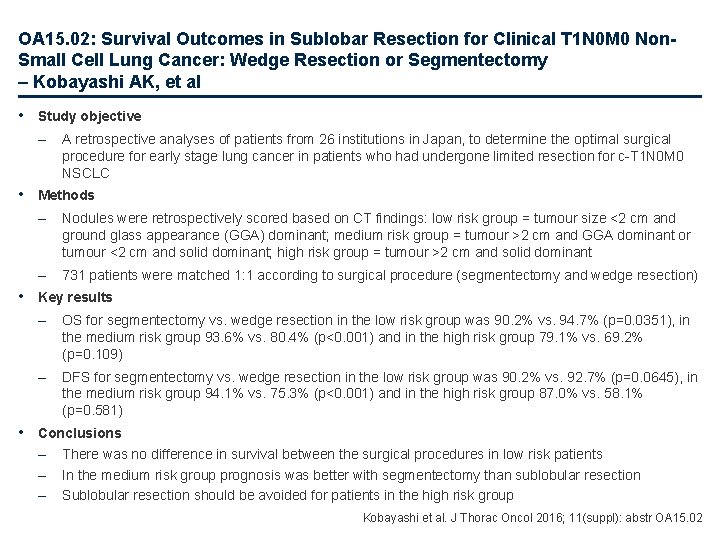
OA 15. 02: Survival Outcomes in Sublobar Resection for Clinical T 1 N 0 M 0 Non. Small Cell Lung Cancer: Wedge Resection or Segmentectomy – Kobayashi AK, et al • Study objective – A retrospective analyses of patients from 26 institutions in Japan, to determine the optimal surgical procedure for early stage lung cancer in patients who had undergone limited resection for c-T 1 N 0 M 0 NSCLC • Methods – Nodules were retrospectively scored based on CT findings: low risk group = tumour size <2 cm and ground glass appearance (GGA) dominant; medium risk group = tumour >2 cm and GGA dominant or tumour <2 cm and solid dominant; high risk group = tumour >2 cm and solid dominant – 731 patients were matched 1: 1 according to surgical procedure (segmentectomy and wedge resection) • Key results – OS for segmentectomy vs. wedge resection in the low risk group was 90. 2% vs. 94. 7% (p=0. 0351), in the medium risk group 93. 6% vs. 80. 4% (p<0. 001) and in the high risk group 79. 1% vs. 69. 2% (p=0. 109) – DFS for segmentectomy vs. wedge resection in the low risk group was 90. 2% vs. 92. 7% (p=0. 0645), in the medium risk group 94. 1% vs. 75. 3% (p<0. 001) and in the high risk group 87. 0% vs. 58. 1% (p=0. 581) • Conclusions – – – There was no difference in survival between the surgical procedures in low risk patients In the medium risk group prognosis was better with segmentectomy than sublobular resection Sublobular resection should be avoided for patients in the high risk group Kobayashi et al. J Thorac Oncol 2016; 11(suppl): abstr OA 15. 02
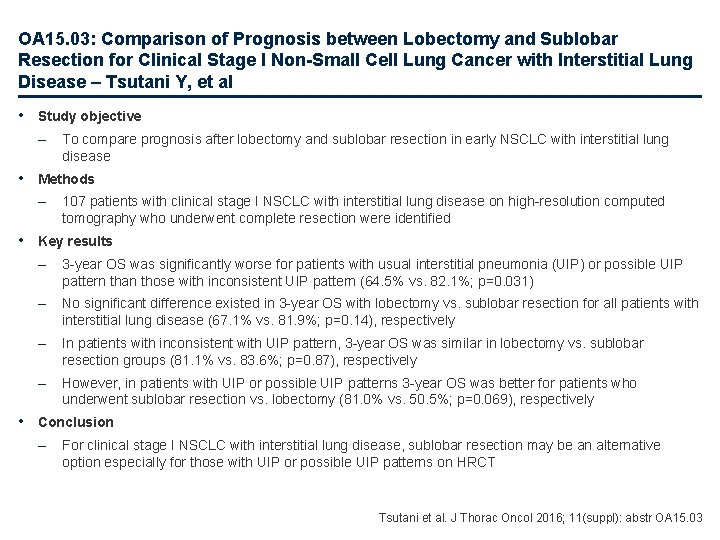
OA 15. 03: Comparison of Prognosis between Lobectomy and Sublobar Resection for Clinical Stage I Non-Small Cell Lung Cancer with Interstitial Lung Disease – Tsutani Y, et al • Study objective – To compare prognosis after lobectomy and sublobar resection in early NSCLC with interstitial lung disease • Methods – 107 patients with clinical stage I NSCLC with interstitial lung disease on high-resolution computed tomography who underwent complete resection were identified • Key results – 3 -year OS was significantly worse for patients with usual interstitial pneumonia (UIP) or possible UIP pattern than those with inconsistent UIP pattern (64. 5% vs. 82. 1%; p=0. 031) – No significant difference existed in 3 -year OS with lobectomy vs. sublobar resection for all patients with interstitial lung disease (67. 1% vs. 81. 9%; p=0. 14), respectively – In patients with inconsistent with UIP pattern, 3 -year OS was similar in lobectomy vs. sublobar resection groups (81. 1% vs. 83. 6%; p=0. 87), respectively – However, in patients with UIP or possible UIP patterns 3 -year OS was better for patients who underwent sublobar resection vs. lobectomy (81. 0% vs. 50. 5%; p=0. 069), respectively • Conclusion – For clinical stage I NSCLC with interstitial lung disease, sublobar resection may be an alternative option especially for those with UIP or possible UIP patterns on HRCT Tsutani et al. J Thorac Oncol 2016; 11(suppl): abstr OA 15. 03
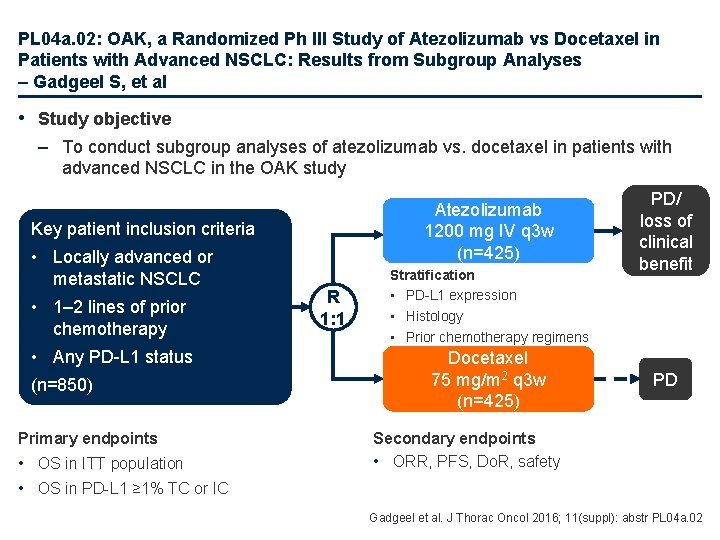
PL 04 a. 02: OAK, a Randomized Ph III Study of Atezolizumab vs Docetaxel in Patients with Advanced NSCLC: Results from Subgroup Analyses – Gadgeel S, et al • Study objective – To conduct subgroup analyses of atezolizumab vs. docetaxel in patients with advanced NSCLC in the OAK study Atezolizumab 1200 mg IV q 3 w (n=425) Key patient inclusion criteria • Locally advanced or metastatic NSCLC • 1– 2 lines of prior chemotherapy • Any PD-L 1 status (n=850) Primary endpoints • OS in ITT population • OS in PD-L 1 ≥ 1% TC or IC R 1: 1 Stratification • PD-L 1 expression • Histology • Prior chemotherapy regimens Docetaxel 75 mg/m 2 q 3 w (n=425) PD/ loss of clinical benefit PD Secondary endpoints • ORR, PFS, Do. R, safety Gadgeel et al. J Thorac Oncol 2016; 11(suppl): abstr PL 04 a. 02
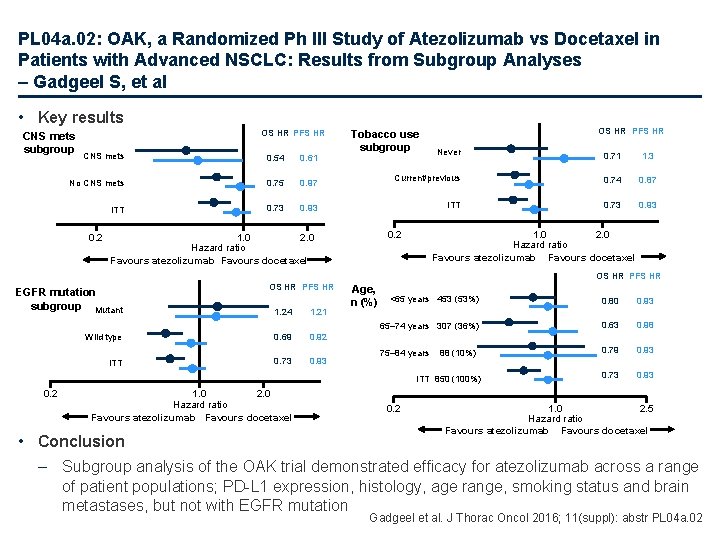
PL 04 a. 02: OAK, a Randomized Ph III Study of Atezolizumab vs Docetaxel in Patients with Advanced NSCLC: Results from Subgroup Analyses – Gadgeel S, et al • Key results CNS mets subgroup OS HR PFS HR CNS mets 0. 54 0. 61 No CNS mets 0. 75 0. 97 ITT 0. 73 0. 93 0. 2 Tobacco use subgroup Never 0. 71 1. 3 Current/previous 0. 74 0. 87 ITT 0. 73 0. 93 0. 2 1. 0 2. 0 Hazard ratio Favours atezolizumab Favours docetaxel OS HR PFS HR EGFR mutation subgroup Mutant OS HR PFS HR 1. 24 1. 21 Wild type 0. 69 0. 92 ITT 0. 73 0. 93 Age, n (%) <65 years 453 (53%) 0. 80 0. 93 65– 74 years 307 (36%) 0. 63 0. 98 75– 84 years 0. 79 0. 93 0. 73 0. 93 88 (10%) ITT 850 (100%) 0. 2 1. 0 2. 0 Hazard ratio Favours atezolizumab Favours docetaxel • Conclusion 0. 2 1. 0 2. 5 Hazard ratio Favours atezolizumab Favours docetaxel – Subgroup analysis of the OAK trial demonstrated efficacy for atezolizumab across a range of patient populations; PD-L 1 expression, histology, age range, smoking status and brain metastases, but not with EGFR mutation Gadgeel et al. J Thorac Oncol 2016; 11(suppl): abstr PL 04 a. 02
Advanced NSCLC Not radically treatable stage III and stage IV 1 st line
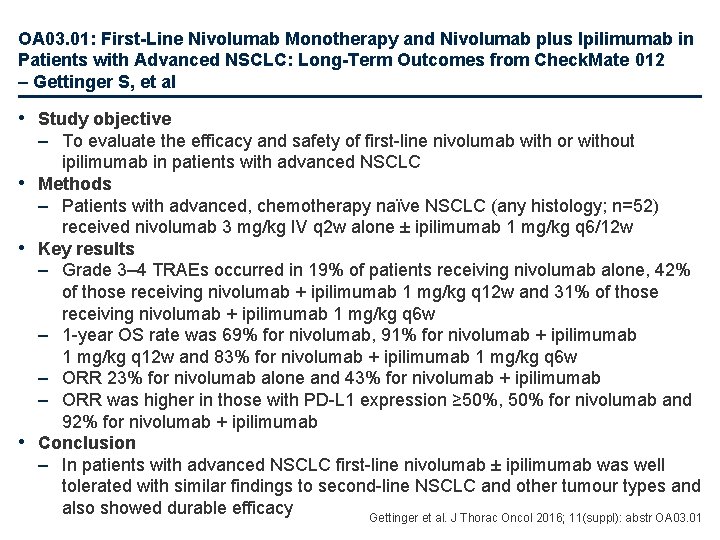
OA 03. 01: First-Line Nivolumab Monotherapy and Nivolumab plus Ipilimumab in Patients with Advanced NSCLC: Long-Term Outcomes from Check. Mate 012 – Gettinger S, et al • Study objective – To evaluate the efficacy and safety of first-line nivolumab with or without ipilimumab in patients with advanced NSCLC • Methods – Patients with advanced, chemotherapy naïve NSCLC (any histology; n=52) received nivolumab 3 mg/kg IV q 2 w alone ± ipilimumab 1 mg/kg q 6/12 w • Key results – Grade 3– 4 TRAEs occurred in 19% of patients receiving nivolumab alone, 42% of those receiving nivolumab + ipilimumab 1 mg/kg q 12 w and 31% of those receiving nivolumab + ipilimumab 1 mg/kg q 6 w – 1 -year OS rate was 69% for nivolumab, 91% for nivolumab + ipilimumab 1 mg/kg q 12 w and 83% for nivolumab + ipilimumab 1 mg/kg q 6 w – ORR 23% for nivolumab alone and 43% for nivolumab + ipilimumab – ORR was higher in those with PD-L 1 expression ≥ 50%, 50% for nivolumab and 92% for nivolumab + ipilimumab • Conclusion – In patients with advanced NSCLC first-line nivolumab ± ipilimumab was well tolerated with similar findings to second-line NSCLC and other tumour types and also showed durable efficacy Gettinger et al. J Thorac Oncol 2016; 11(suppl): abstr OA 03. 01
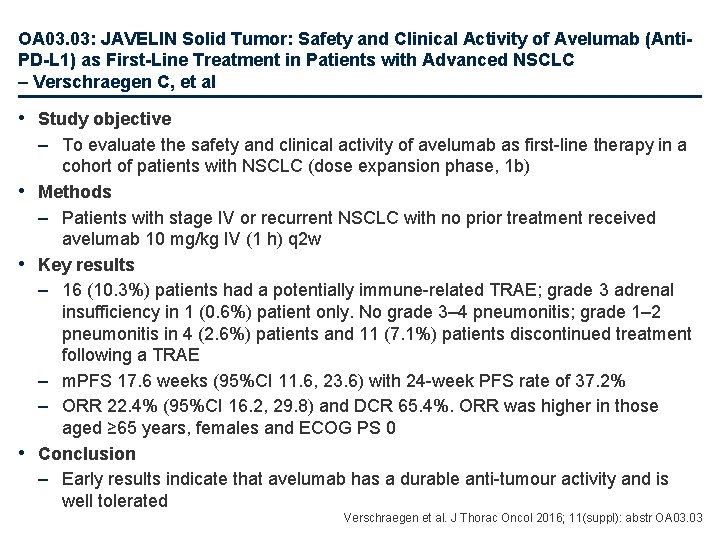
OA 03. 03: JAVELIN Solid Tumor: Safety and Clinical Activity of Avelumab (Anti. PD-L 1) as First-Line Treatment in Patients with Advanced NSCLC – Verschraegen C, et al • Study objective – To evaluate the safety and clinical activity of avelumab as first-line therapy in a cohort of patients with NSCLC (dose expansion phase, 1 b) • Methods – Patients with stage IV or recurrent NSCLC with no prior treatment received avelumab 10 mg/kg IV (1 h) q 2 w • Key results – 16 (10. 3%) patients had a potentially immune-related TRAE; grade 3 adrenal insufficiency in 1 (0. 6%) patient only. No grade 3– 4 pneumonitis; grade 1– 2 pneumonitis in 4 (2. 6%) patients and 11 (7. 1%) patients discontinued treatment following a TRAE – m. PFS 17. 6 weeks (95%CI 11. 6, 23. 6) with 24 -week PFS rate of 37. 2% – ORR 22. 4% (95%CI 16. 2, 29. 8) and DCR 65. 4%. ORR was higher in those aged ≥ 65 years, females and ECOG PS 0 • Conclusion – Early results indicate that avelumab has a durable anti-tumour activity and is well tolerated Verschraegen et al. J Thorac Oncol 2016; 11(suppl): abstr OA 03. 03
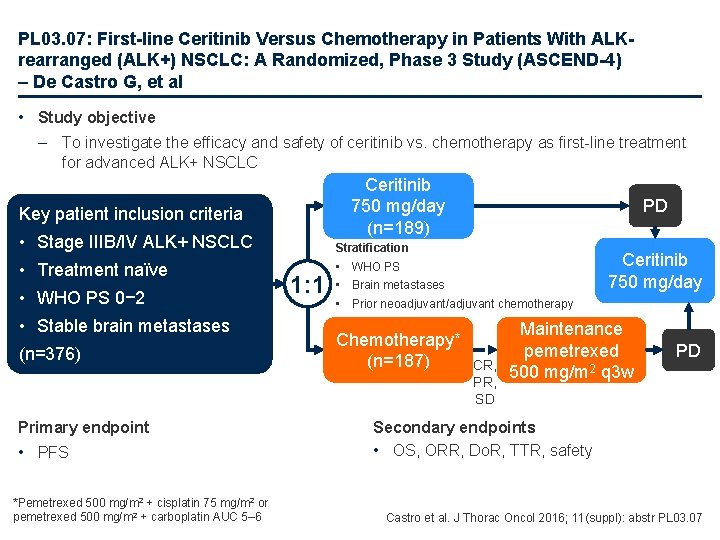
PL 03. 07: First-line Ceritinib Versus Chemotherapy in Patients With ALKrearranged (ALK+) NSCLC: A Randomized, Phase 3 Study (ASCEND-4) – De Castro G, et al • Study objective – To investigate the efficacy and safety of ceritinib vs. chemotherapy as first-line treatment for advanced ALK+ NSCLC Ceritinib 750 mg/day (n=189) Key patient inclusion criteria • Stage IIIB/IV ALK+ NSCLC • Treatment naïve • WHO PS 0− 2 • Stable brain metastases (n=376) Primary endpoint • PFS *Pemetrexed 500 mg/m 2 + cisplatin 75 mg/m 2 or pemetrexed 500 mg/m 2 + carboplatin AUC 5– 6 PD Stratification 1: 1 • WHO PS • Brain metastases • Prior neoadjuvant/adjuvant chemotherapy Chemotherapy* (n=187) CR, PR, SD Ceritinib 750 mg/day Maintenance pemetrexed 500 mg/m 2 q 3 w PD Secondary endpoints • OS, ORR, Do. R, TTR, safety Castro et al. J Thorac Oncol 2016; 11(suppl): abstr PL 03. 07
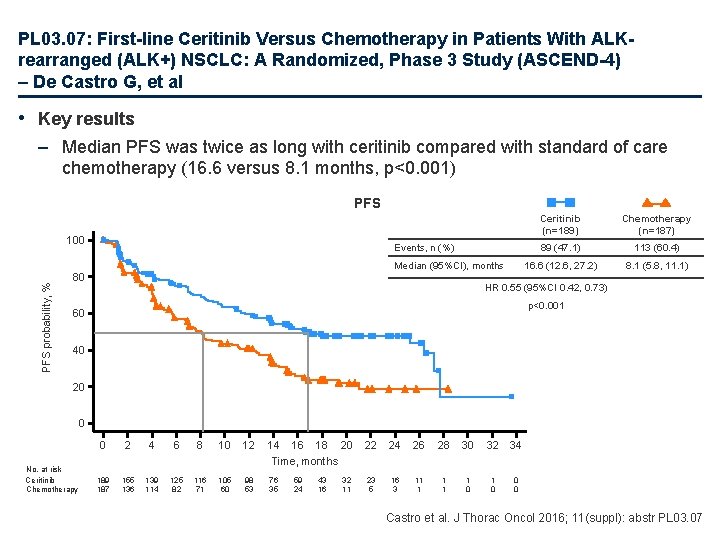
PL 03. 07: First-line Ceritinib Versus Chemotherapy in Patients With ALKrearranged (ALK+) NSCLC: A Randomized, Phase 3 Study (ASCEND-4) – De Castro G, et al • Key results – Median PFS was twice as long with ceritinib compared with standard of care chemotherapy (16. 6 versus 8. 1 months, p<0. 001) PFS probability, % 100 Events, n (%) Median (95%CI), months 80 Ceritinib (n=189) Chemotherapy (n=187) 89 (47. 1) 113 (60. 4) 16. 6 (12. 6, 27. 2) 8. 1 (5. 8, 11. 1) HR 0. 55 (95%CI 0. 42, 0. 73) p<0. 001 60 40 20 0 No. at risk Ceritinib Chemotherapy 0 2 4 6 8 10 12 14 16 18 20 Time, months 22 24 26 28 30 32 34 189 187 155 136 139 114 125 82 116 71 105 60 98 53 76 35 23 5 16 3 11 1 1 0 0 0 59 24 43 16 32 11 Castro et al. J Thorac Oncol 2016; 11(suppl): abstr PL 03. 07
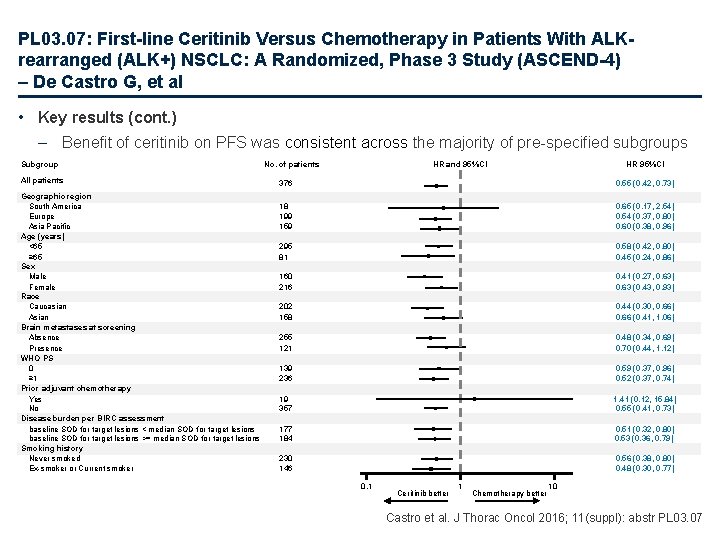
PL 03. 07: First-line Ceritinib Versus Chemotherapy in Patients With ALKrearranged (ALK+) NSCLC: A Randomized, Phase 3 Study (ASCEND-4) – De Castro G, et al • Key results (cont. ) – Benefit of ceritinib on PFS was consistent across the majority of pre-specified subgroups Subgroup All patients Geographic region South America Europe Asia Pacific Age (years) <65 ≥ 65 Sex Male Female Race Caucasian Asian Brain metastases at screening Absence Presence WHO PS 0 ≥ 1 Prior adjuvant chemotherapy Yes No Disease burden per BIRC assessment baseline SOD for target lesions < median SOD for target lesions baseline SOD for target lesions >= median SOD for target lesions Smoking history Never smoked Ex-smoker or Current smoker No. of patients HR and 95%CI HR 95%CI 376 0. 55 (0. 42, 0. 73) 18 199 159 0. 65 (0. 17, 2. 54) 0. 54 (0. 37, 0. 80) 0. 60 (0. 38, 0. 96) 295 81 0. 58 (0. 42, 0. 80) 0. 45 (0. 24, 0. 86) 160 216 0. 41 (0. 27, 0. 63) 0. 63 (0. 43, 0. 93) 202 158 0. 44 (0. 30, 0. 66) 0. 66 (0. 41, 1. 06) 255 121 0. 48 (0. 34, 0. 69) 0. 70 (0. 44, 1. 12) 139 236 0. 59 (0. 37, 0. 96) 0. 52 (0. 37, 0. 74) 19 357 1. 41 (0. 12, 15. 84) 0. 55 (0. 41, 0. 73) 177 184 0. 51 (0. 32, 0. 80) 0. 53 (0. 36, 0. 79) 230 146 0. 56 (0. 38, 0. 80) 0. 48 (0. 30, 0. 77) 0. 1 Ceritinib better 1 Chemotherapy better 10 Castro et al. J Thorac Oncol 2016; 11(suppl): abstr PL 03. 07
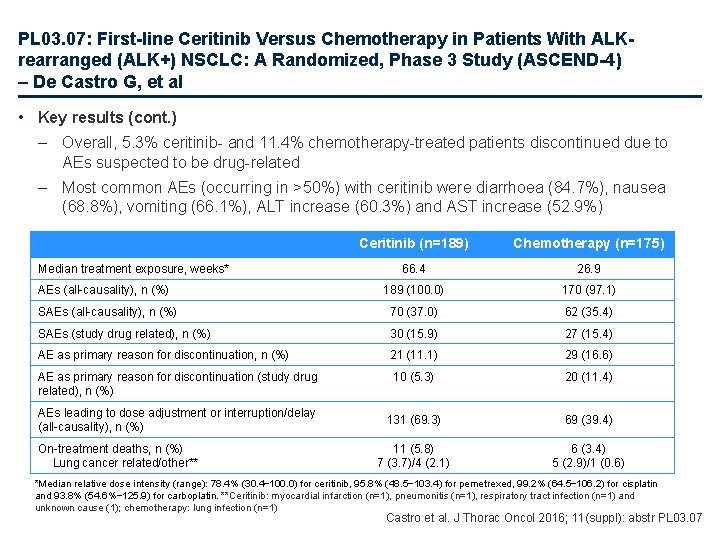
PL 03. 07: First-line Ceritinib Versus Chemotherapy in Patients With ALKrearranged (ALK+) NSCLC: A Randomized, Phase 3 Study (ASCEND-4) – De Castro G, et al • Key results (cont. ) – Overall, 5. 3% ceritinib- and 11. 4% chemotherapy-treated patients discontinued due to AEs suspected to be drug-related – Most common AEs (occurring in >50%) with ceritinib were diarrhoea (84. 7%), nausea (68. 8%), vomiting (66. 1%), ALT increase (60. 3%) and AST increase (52. 9%) Ceritinib (n=189) Chemotherapy (n=175) 66. 4 26. 9 189 (100. 0) 170 (97. 1) SAEs (all-causality), n (%) 70 (37. 0) 62 (35. 4) SAEs (study drug related), n (%) 30 (15. 9) 27 (15. 4) AE as primary reason for discontinuation, n (%) 21 (11. 1) 29 (16. 6) AE as primary reason for discontinuation (study drug related), n (%) 10 (5. 3) 20 (11. 4) 131 (69. 3) 69 (39. 4) 11 (5. 8) 7 (3. 7)/4 (2. 1) 6 (3. 4) 5 (2. 9)/1 (0. 6) Median treatment exposure, weeks* AEs (all-causality), n (%) AEs leading to dose adjustment or interruption/delay (all-causality), n (%) On-treatment deaths, n (%) Lung cancer related/other** *Median relative dose intensity (range): 78. 4% (30. 4− 100. 0) for ceritinib, 95. 8% (48. 5− 103. 4) for pemetrexed, 99. 2% (64. 5− 106. 2) for cisplatin and 93. 8% (54. 6%− 125. 9) for carboplatin. **Ceritinib: myocardial infarction (n=1), pneumonitis (n=1), respiratory tract infection (n=1) and unknown cause (1); chemotherapy: lung infection (n=1) Castro et al. J Thorac Oncol 2016; 11(suppl): abstr PL 03. 07
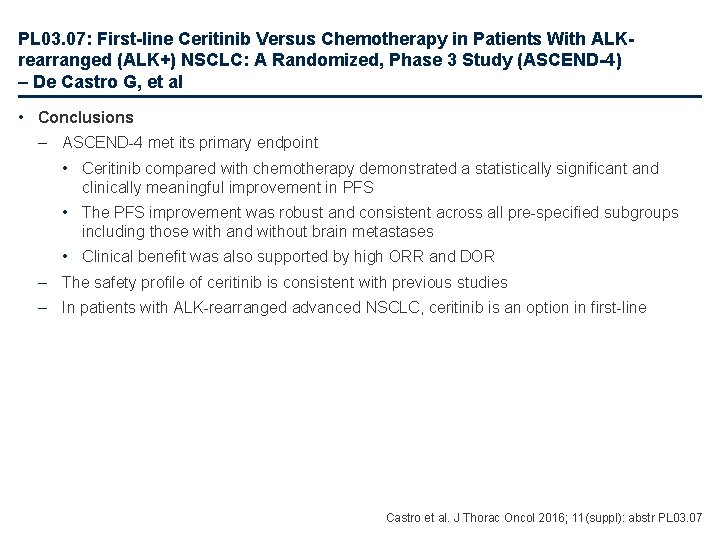
PL 03. 07: First-line Ceritinib Versus Chemotherapy in Patients With ALKrearranged (ALK+) NSCLC: A Randomized, Phase 3 Study (ASCEND-4) – De Castro G, et al • Conclusions – ASCEND-4 met its primary endpoint • Ceritinib compared with chemotherapy demonstrated a statistically significant and clinically meaningful improvement in PFS • The PFS improvement was robust and consistent across all pre-specified subgroups including those with and without brain metastases • Clinical benefit was also supported by high ORR and DOR – The safety profile of ceritinib is consistent with previous studies – In patients with ALK-rearranged advanced NSCLC, ceritinib is an option in first-line Castro et al. J Thorac Oncol 2016; 11(suppl): abstr PL 03. 07
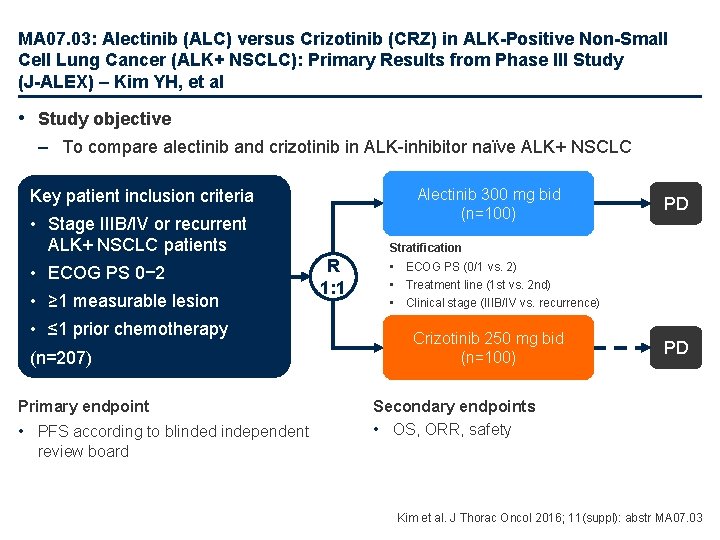
MA 07. 03: Alectinib (ALC) versus Crizotinib (CRZ) in ALK-Positive Non-Small Cell Lung Cancer (ALK+ NSCLC): Primary Results from Phase III Study (J-ALEX) – Kim YH, et al • Study objective – To compare alectinib and crizotinib in ALK-inhibitor naïve ALK+ NSCLC Key patient inclusion criteria Alectinib 300 mg bid (n=100) • Stage IIIB/IV or recurrent ALK+ NSCLC patients • ECOG PS 0− 2 • ≥ 1 measurable lesion • ≤ 1 prior chemotherapy (n=207) Primary endpoint • PFS according to blinded independent PD Stratification R 1: 1 • ECOG PS (0/1 vs. 2) • Treatment line (1 st vs. 2 nd) • Clinical stage (IIIB/IV vs. recurrence) Crizotinib 250 mg bid (n=100) PD Secondary endpoints • OS, ORR, safety review board Kim et al. J Thorac Oncol 2016; 11(suppl): abstr MA 07. 03
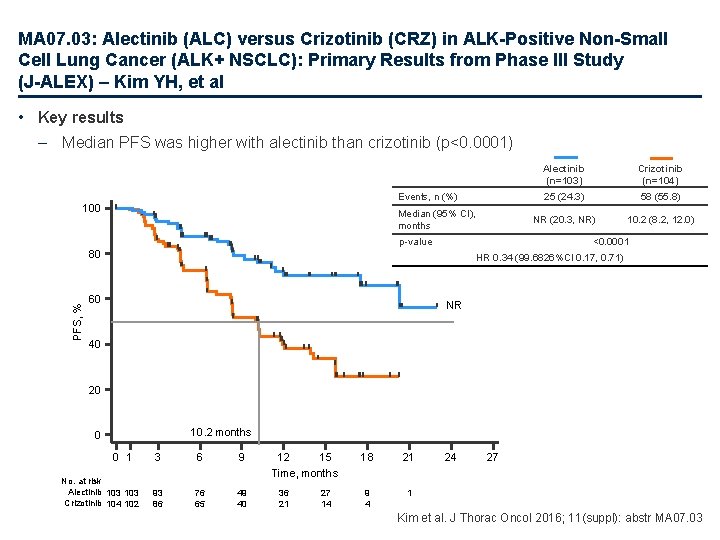
MA 07. 03: Alectinib (ALC) versus Crizotinib (CRZ) in ALK-Positive Non-Small Cell Lung Cancer (ALK+ NSCLC): Primary Results from Phase III Study (J-ALEX) – Kim YH, et al • Key results – Median PFS was higher with alectinib than crizotinib (p<0. 0001) Events, n (%) 100 Median (95% CI), months p-value Crizotinib (n=104) 25 (24. 3) 58 (55. 8) NR (20. 3, NR) 10. 2 (8. 2, 12. 0) <0. 0001 80 PFS, % Alectinib (n=103) HR 0. 34 (99. 6826%CI 0. 17, 0. 71) 60 NR 40 20 10. 2 months 0 0 1 No. at risk Alectinib 103 Crizotinib 104 102 3 6 9 93 86 76 65 49 40 12 15 Time, months 36 21 27 14 18 21 9 4 1 24 27 Kim et al. J Thorac Oncol 2016; 11(suppl): abstr MA 07. 03
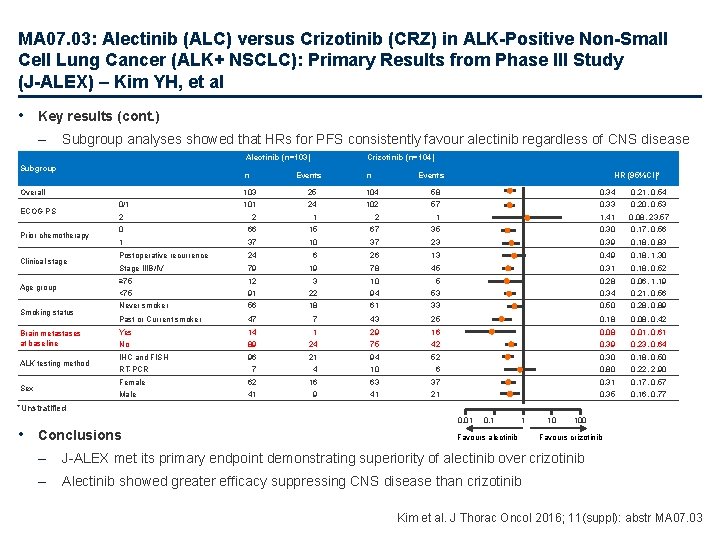
MA 07. 03: Alectinib (ALC) versus Crizotinib (CRZ) in ALK-Positive Non-Small Cell Lung Cancer (ALK+ NSCLC): Primary Results from Phase III Study (J-ALEX) – Kim YH, et al • Key results (cont. ) – Subgroup analyses showed that HRs for PFS consistently favour alectinib regardless of CNS disease Subgroup Overall Prior chemotherapy Clinical stage Age group Smoking status Brain metastases at baseline ALK testing method Sex Crizotinib (n=104) n n Events HR (95%CI)* 103 25 104 58 0. 34 101 24 102 57 0. 33 0. 20, 0. 53 2 2 1 1. 41 0. 08, 23. 57 0 66 15 67 35 0. 30 0. 17, 0. 56 1 37 10 37 23 0. 39 0. 18, 0. 83 Postoperative recurrence 24 6 26 13 0. 49 0. 18, 1. 30 Stage IIIB/IV 79 19 78 45 0. 31 0. 18, 0. 52 ≥ 75 12 3 10 5 0. 28 0. 06, 1. 19 <75 91 22 94 53 0. 34 0. 21, 0. 56 Never smoker 56 18 61 33 0. 50 0. 28, 0. 89 Past or Current smoker 47 7 43 25 0. 18 0. 08, 0. 42 Yes 14 1 29 16 0. 08 0. 01, 0. 61 No 89 24 75 42 0. 39 0. 23, 0. 64 IHC and FISH 96 21 94 52 0. 30 0. 18, 0. 50 0/1 ECOG PS Alectinib (n=103) 0. 21, 0. 54 RT-PCR 7 4 10 6 0. 80 0. 22, 2. 90 Female 62 16 63 37 0. 31 0. 17, 0. 57 Male 41 9 41 21 0. 35 0. 16, 0. 77 *Unstratified 0. 01 • Conclusions 0. 1 1 Favours alectinib 10 100 Favours crizotinib – J-ALEX met its primary endpoint demonstrating superiority of alectinib over crizotinib – Alectinib showed greater efficacy suppressing CNS disease than crizotinib Kim et al. J Thorac Oncol 2016; 11(suppl): abstr MA 07. 03
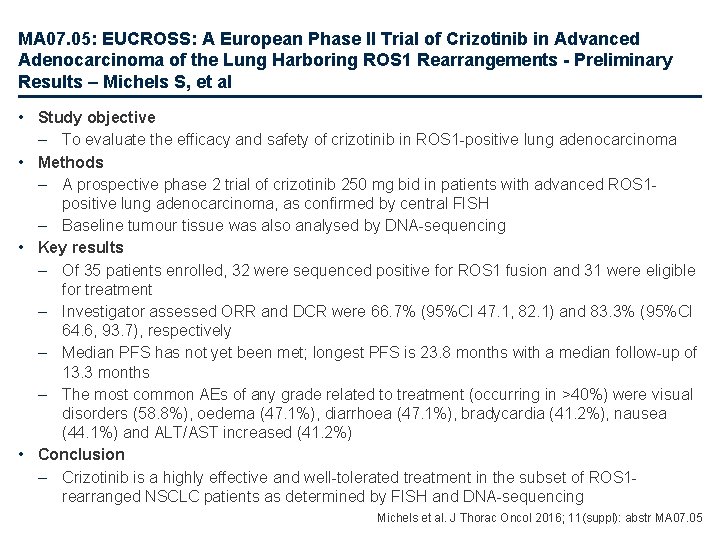
MA 07. 05: EUCROSS: A European Phase II Trial of Crizotinib in Advanced Adenocarcinoma of the Lung Harboring ROS 1 Rearrangements - Preliminary Results – Michels S, et al • Study objective – To evaluate the efficacy and safety of crizotinib in ROS 1 -positive lung adenocarcinoma • Methods – A prospective phase 2 trial of crizotinib 250 mg bid in patients with advanced ROS 1 positive lung adenocarcinoma, as confirmed by central FISH – Baseline tumour tissue was also analysed by DNA-sequencing • Key results – Of 35 patients enrolled, 32 were sequenced positive for ROS 1 fusion and 31 were eligible for treatment – Investigator assessed ORR and DCR were 66. 7% (95%CI 47. 1, 82. 1) and 83. 3% (95%CI 64. 6, 93. 7), respectively – Median PFS has not yet been met; longest PFS is 23. 8 months with a median follow-up of 13. 3 months – The most common AEs of any grade related to treatment (occurring in >40%) were visual disorders (58. 8%), oedema (47. 1%), diarrhoea (47. 1%), bradycardia (41. 2%), nausea (44. 1%) and ALT/AST increased (41. 2%) • Conclusion – Crizotinib is a highly effective and well-tolerated treatment in the subset of ROS 1 rearranged NSCLC patients as determined by FISH and DNA-sequencing Michels et al. J Thorac Oncol 2016; 11(suppl): abstr MA 07. 05
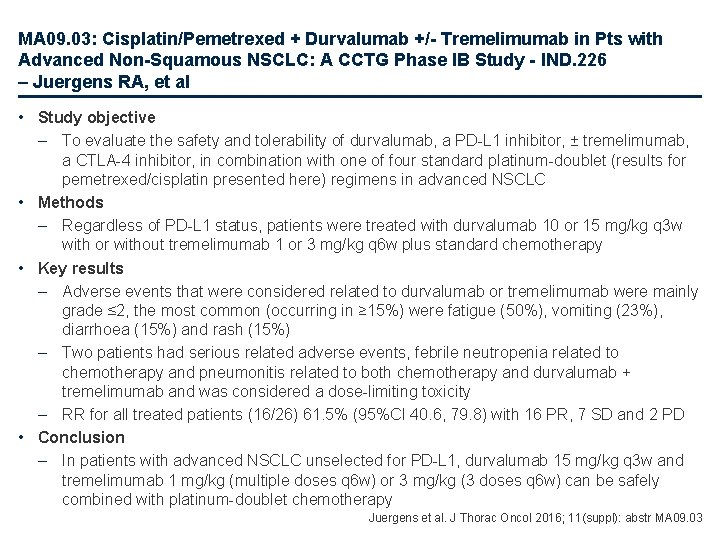
MA 09. 03: Cisplatin/Pemetrexed + Durvalumab +/- Tremelimumab in Pts with Advanced Non-Squamous NSCLC: A CCTG Phase IB Study - IND. 226 – Juergens RA, et al • Study objective – To evaluate the safety and tolerability of durvalumab, a PD-L 1 inhibitor, ± tremelimumab, a CTLA-4 inhibitor, in combination with one of four standard platinum-doublet (results for pemetrexed/cisplatin presented here) regimens in advanced NSCLC • Methods – Regardless of PD-L 1 status, patients were treated with durvalumab 10 or 15 mg/kg q 3 w with or without tremelimumab 1 or 3 mg/kg q 6 w plus standard chemotherapy • Key results – Adverse events that were considered related to durvalumab or tremelimumab were mainly grade ≤ 2, the most common (occurring in ≥ 15%) were fatigue (50%), vomiting (23%), diarrhoea (15%) and rash (15%) – Two patients had serious related adverse events, febrile neutropenia related to chemotherapy and pneumonitis related to both chemotherapy and durvalumab + tremelimumab and was considered a dose-limiting toxicity – RR for all treated patients (16/26) 61. 5% (95%CI 40. 6, 79. 8) with 16 PR, 7 SD and 2 PD • Conclusion – In patients with advanced NSCLC unselected for PD-L 1, durvalumab 15 mg/kg q 3 w and tremelimumab 1 mg/kg (multiple doses q 6 w) or 3 mg/kg (3 doses q 6 w) can be safely combined with platinum-doublet chemotherapy Juergens et al. J Thorac Oncol 2016; 11(suppl): abstr MA 09. 03
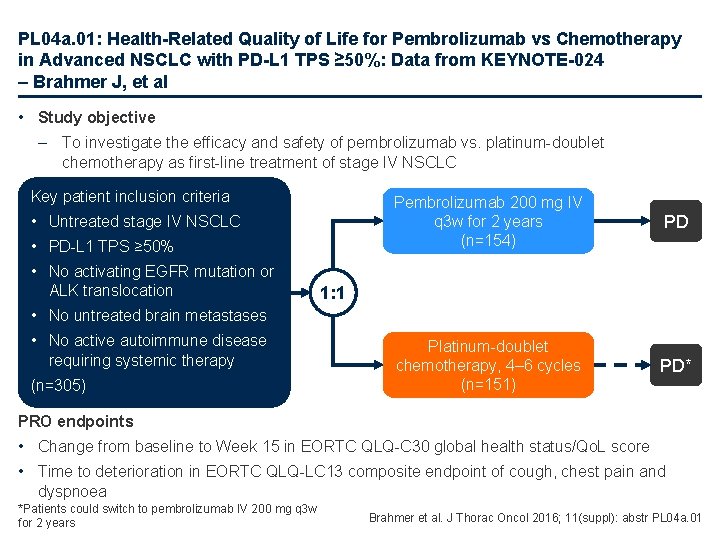
PL 04 a. 01: Health-Related Quality of Life for Pembrolizumab vs Chemotherapy in Advanced NSCLC with PD-L 1 TPS ≥ 50%: Data from KEYNOTE-024 – Brahmer J, et al • Study objective – To investigate the efficacy and safety of pembrolizumab vs. platinum-doublet chemotherapy as first-line treatment of stage IV NSCLC Key patient inclusion criteria • Untreated stage IV NSCLC • PD-L 1 TPS ≥ 50% • No activating EGFR mutation or ALK translocation Pembrolizumab 200 mg IV q 3 w for 2 years (n=154) PD Platinum-doublet chemotherapy, 4– 6 cycles (n=151) PD* 1: 1 • No untreated brain metastases • No active autoimmune disease requiring systemic therapy (n=305) PRO endpoints • Change from baseline to Week 15 in EORTC QLQ-C 30 global health status/Qo. L score • Time to deterioration in EORTC QLQ-LC 13 composite endpoint of cough, chest pain and dyspnoea *Patients could switch to pembrolizumab IV 200 mg q 3 w for 2 years Brahmer et al. J Thorac Oncol 2016; 11(suppl): abstr PL 04 a. 01
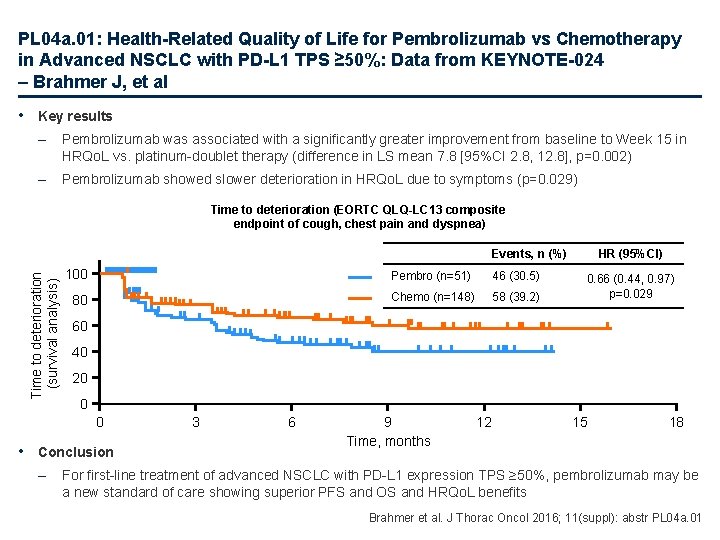
PL 04 a. 01: Health-Related Quality of Life for Pembrolizumab vs Chemotherapy in Advanced NSCLC with PD-L 1 TPS ≥ 50%: Data from KEYNOTE-024 – Brahmer J, et al • Key results – Pembrolizumab was associated with a significantly greater improvement from baseline to Week 15 in HRQo. L vs. platinum-doublet therapy (difference in LS mean 7. 8 [95%CI 2. 8, 12. 8], p=0. 002) – Pembrolizumab showed slower deterioration in HRQo. L due to symptoms (p=0. 029) Time to deterioration (EORTC QLQ-LC 13 composite endpoint of cough, chest pain and dyspnea) Time to deterioration (survival analysis) Events, n (%) 100 Pembro (n=51) 46 (30. 5) 80 Chemo (n=148) 58 (39. 2) 0. 66 (0. 44, 0. 97) p=0. 029 60 40 20 0 0 • Conclusion – HR (95%CI) 3 6 9 Time, months 12 15 18 For first-line treatment of advanced NSCLC with PD-L 1 expression TPS ≥ 50%, pembrolizumab may be a new standard of care showing superior PFS and OS and HRQo. L benefits Brahmer et al. J Thorac Oncol 2016; 11(suppl): abstr PL 04 a. 01
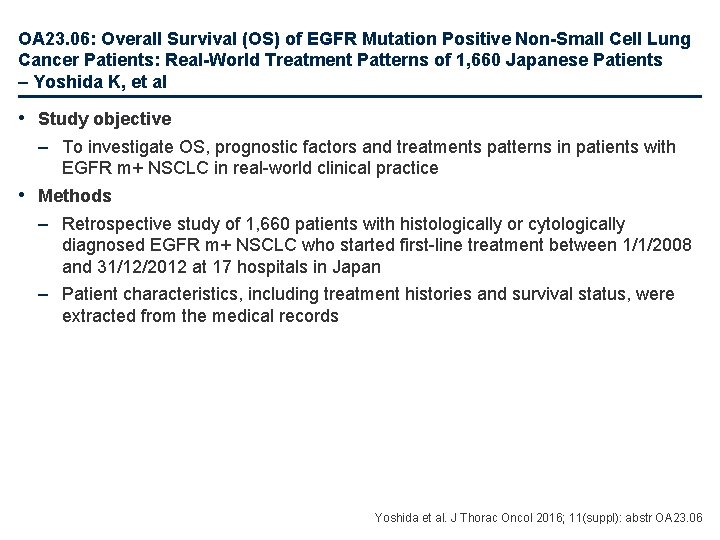
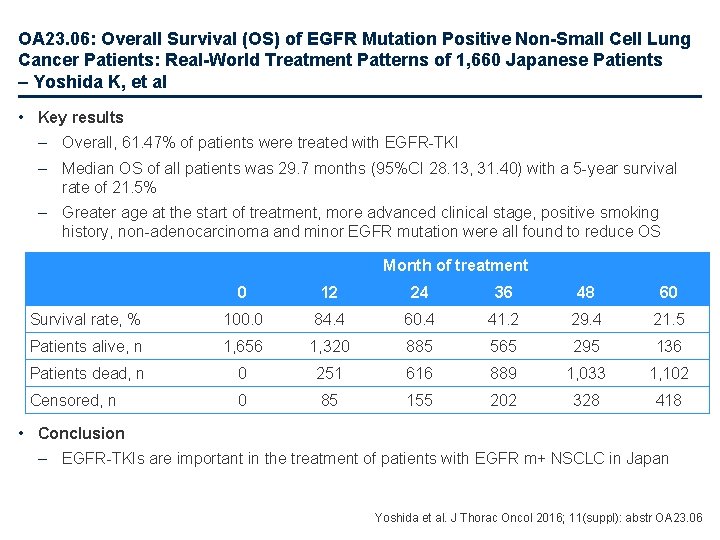
OA 23. 06: Overall Survival (OS) of EGFR Mutation Positive Non-Small Cell Lung Cancer Patients: Real-World Treatment Patterns of 1, 660 Japanese Patients – Yoshida K, et al • Study objective – To investigate OS, prognostic factors and treatments patterns in patients with EGFR m+ NSCLC in real-world clinical practice • Methods – Retrospective study of 1, 660 patients with histologically or cytologically diagnosed EGFR m+ NSCLC who started first-line treatment between 1/1/2008 and 31/12/2012 at 17 hospitals in Japan – Patient characteristics, including treatment histories and survival status, were extracted from the medical records Yoshida et al. J Thorac Oncol 2016; 11(suppl): abstr OA 23. 06
OA 23. 06: Overall Survival (OS) of EGFR Mutation Positive Non-Small Cell Lung Cancer Patients: Real-World Treatment Patterns of 1, 660 Japanese Patients – Yoshida K, et al • Key results – Overall, 61. 47% of patients were treated with EGFR-TKI – Median OS of all patients was 29. 7 months (95%CI 28. 13, 31. 40) with a 5 -year survival rate of 21. 5% – Greater age at the start of treatment, more advanced clinical stage, positive smoking history, non-adenocarcinoma and minor EGFR mutation were all found to reduce OS Month of treatment 0 12 24 36 48 60 Survival rate, % 100. 0 84. 4 60. 4 41. 2 29. 4 21. 5 Patients alive, n 1, 656 1, 320 885 565 295 136 Patients dead, n 0 251 616 889 1, 033 1, 102 Censored, n 0 85 155 202 328 418 • Conclusion – EGFR-TKIs are important in the treatment of patients with EGFR m+ NSCLC in Japan Yoshida et al. J Thorac Oncol 2016; 11(suppl): abstr OA 23. 06
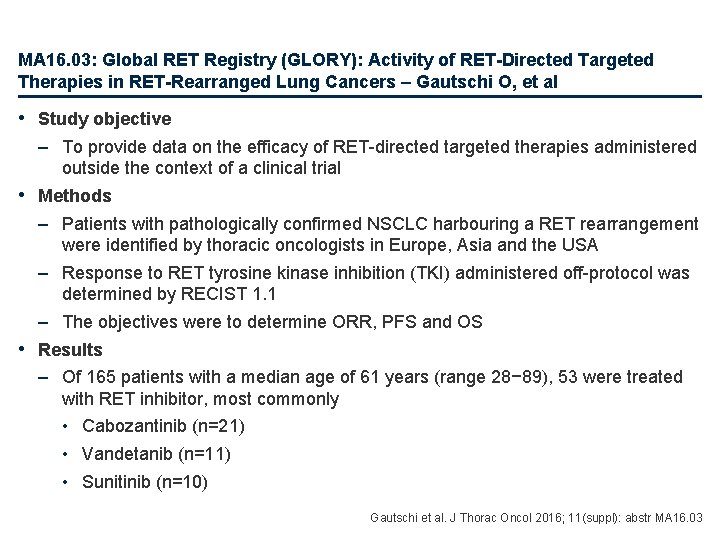
MA 16. 03: Global RET Registry (GLORY): Activity of RET-Directed Targeted Therapies in RET-Rearranged Lung Cancers – Gautschi O, et al • Study objective – To provide data on the efficacy of RET-directed targeted therapies administered outside the context of a clinical trial • Methods – Patients with pathologically confirmed NSCLC harbouring a RET rearrangement were identified by thoracic oncologists in Europe, Asia and the USA – Response to RET tyrosine kinase inhibition (TKI) administered off-protocol was determined by RECIST 1. 1 – The objectives were to determine ORR, PFS and OS • Results – Of 165 patients with a median age of 61 years (range 28− 89), 53 were treated with RET inhibitor, most commonly • Cabozantinib (n=21) • Vandetanib (n=11) • Sunitinib (n=10) Gautschi et al. J Thorac Oncol 2016; 11(suppl): abstr MA 16. 03
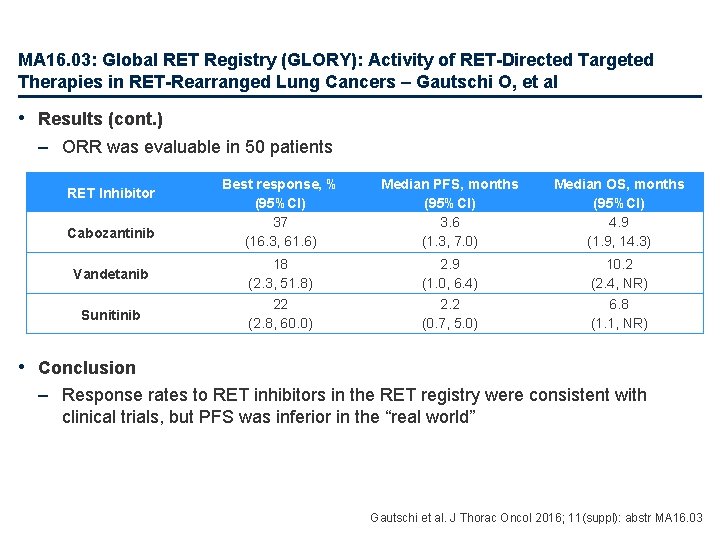
MA 16. 03: Global RET Registry (GLORY): Activity of RET-Directed Targeted Therapies in RET-Rearranged Lung Cancers – Gautschi O, et al • Results (cont. ) – ORR was evaluable in 50 patients Best response, % (95%CI) 37 (16. 3, 61. 6) Median PFS, months (95%CI) 3. 6 (1. 3, 7. 0) Median OS, months (95%CI) 4. 9 (1. 9, 14. 3) Vandetanib 18 (2. 3, 51. 8) 2. 9 (1. 0, 6. 4) 10. 2 (2. 4, NR) Sunitinib 22 (2. 8, 60. 0) 2. 2 (0. 7, 5. 0) 6. 8 (1. 1, NR) RET Inhibitor Cabozantinib • Conclusion – Response rates to RET inhibitors in the RET registry were consistent with clinical trials, but PFS was inferior in the “real world” Gautschi et al. J Thorac Oncol 2016; 11(suppl): abstr MA 16. 03
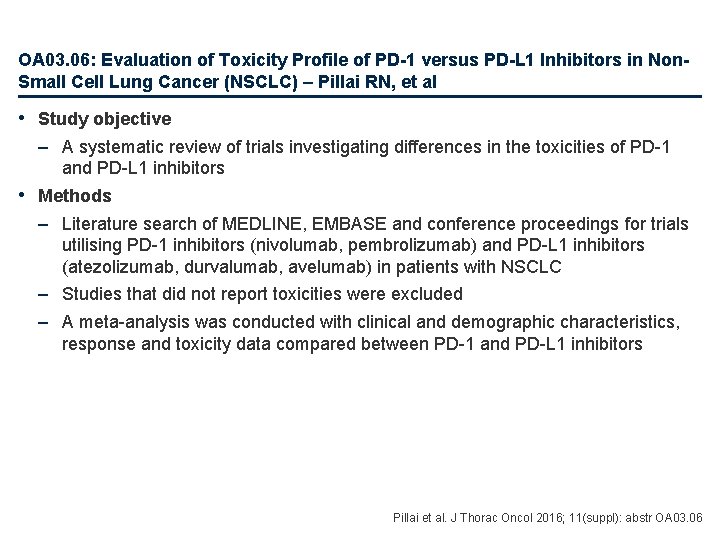
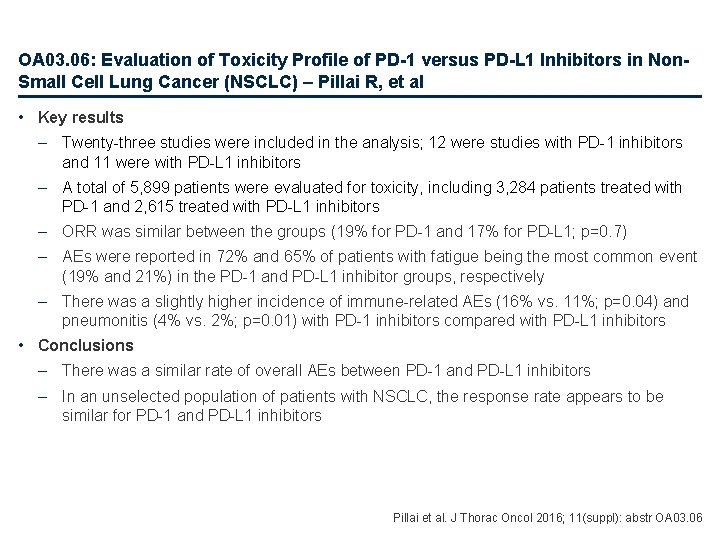
OA 03. 06: Evaluation of Toxicity Profile of PD-1 versus PD-L 1 Inhibitors in Non. Small Cell Lung Cancer (NSCLC) – Pillai RN, et al • Study objective – A systematic review of trials investigating differences in the toxicities of PD-1 and PD-L 1 inhibitors • Methods – Literature search of MEDLINE, EMBASE and conference proceedings for trials utilising PD-1 inhibitors (nivolumab, pembrolizumab) and PD-L 1 inhibitors (atezolizumab, durvalumab, avelumab) in patients with NSCLC – Studies that did not report toxicities were excluded – A meta-analysis was conducted with clinical and demographic characteristics, response and toxicity data compared between PD-1 and PD-L 1 inhibitors Pillai et al. J Thorac Oncol 2016; 11(suppl): abstr OA 03. 06
OA 03. 06: Evaluation of Toxicity Profile of PD-1 versus PD-L 1 Inhibitors in Non. Small Cell Lung Cancer (NSCLC) – Pillai R, et al • Key results – Twenty-three studies were included in the analysis; 12 were studies with PD-1 inhibitors and 11 were with PD-L 1 inhibitors – A total of 5, 899 patients were evaluated for toxicity, including 3, 284 patients treated with PD-1 and 2, 615 treated with PD-L 1 inhibitors – ORR was similar between the groups (19% for PD-1 and 17% for PD-L 1; p=0. 7) – AEs were reported in 72% and 65% of patients with fatigue being the most common event (19% and 21%) in the PD-1 and PD-L 1 inhibitor groups, respectively – There was a slightly higher incidence of immune-related AEs (16% vs. 11%; p=0. 04) and pneumonitis (4% vs. 2%; p=0. 01) with PD-1 inhibitors compared with PD-L 1 inhibitors • Conclusions – There was a similar rate of overall AEs between PD-1 and PD-L 1 inhibitors – In an unselected population of patients with NSCLC, the response rate appears to be similar for PD-1 and PD-L 1 inhibitors Pillai et al. J Thorac Oncol 2016; 11(suppl): abstr OA 03. 06
Advanced NSCLC Not radically treatable stage III and stage IV Later lines
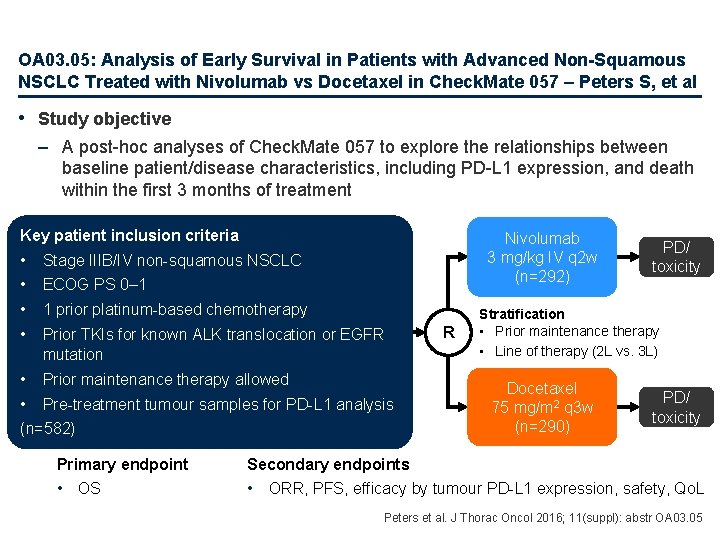
OA 03. 05: Analysis of Early Survival in Patients with Advanced Non-Squamous NSCLC Treated with Nivolumab vs Docetaxel in Check. Mate 057 – Peters S, et al • Study objective – A post-hoc analyses of Check. Mate 057 to explore the relationships between baseline patient/disease characteristics, including PD-L 1 expression, and death within the first 3 months of treatment Key patient inclusion criteria Nivolumab 3 mg/kg IV q 2 w (n=292) • Stage IIIB/IV non-squamous NSCLC • ECOG PS 0– 1 • 1 prior platinum-based chemotherapy • Prior TKIs for known ALK translocation or EGFR mutation • Prior maintenance therapy allowed • Pre-treatment tumour samples for PD-L 1 analysis (n=582) Primary endpoint • OS R PD/ toxicity Stratification • Prior maintenance therapy • Line of therapy (2 L vs. 3 L) Docetaxel 75 mg/m 2 q 3 w (n=290) PD/ toxicity Secondary endpoints • ORR, PFS, efficacy by tumour PD-L 1 expression, safety, Qo. L Peters et al. J Thorac Oncol 2016; 11(suppl): abstr OA 03. 05
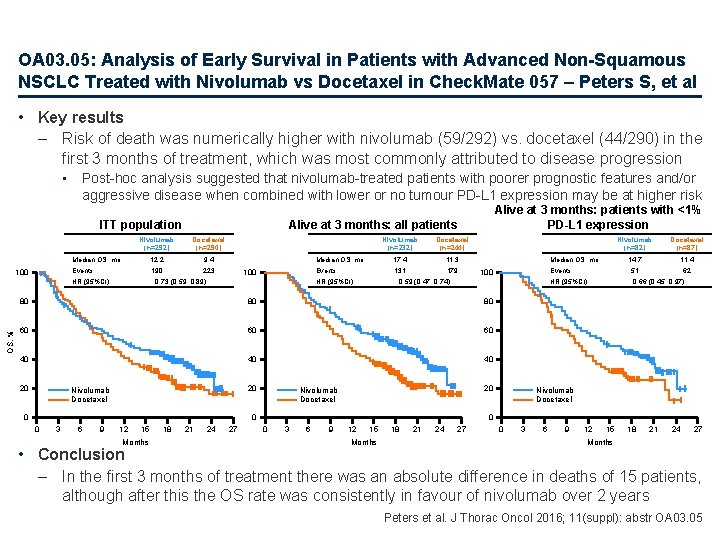
OA 03. 05: Analysis of Early Survival in Patients with Advanced Non-Squamous NSCLC Treated with Nivolumab vs Docetaxel in Check. Mate 057 – Peters S, et al • Key results – Risk of death was numerically higher with nivolumab (59/292) vs. docetaxel (44/290) in the first 3 months of treatment, which was most commonly attributed to disease progression • Post-hoc analysis suggested that nivolumab-treated patients with poorer prognostic features and/or aggressive disease when combined with lower or no tumour PD-L 1 expression may be at higher risk ITT population Nivolumab (n=292) 100 OS, % Alive at 3 months: all patients Docetaxel (n=290) Median OS, mo 12. 2 9. 4 Events 190 223 HR (95%CI) Alive at 3 months: patients with <1% PD-L 1 expression 100 0. 73 (0. 59, 0. 89) Nivolumab (n=232) Docetaxel (n=244) Median OS, mo 17. 4 11. 3 Events 131 179 HR (95%CI) Median OS, mo 0. 59 (0. 47, 0. 74) HR (95%CI) 80 80 80 60 60 60 40 40 40 20 20 Nivolumab Docetaxel 0 0 3 6 9 12 15 Months • Conclusion 18 21 24 27 Events 100 Nivolumab (n=82) Docetaxel (n=87) 14. 7 11. 4 51 62 0. 66 (0. 45, 0. 97) Nivolumab Docetaxel 0 0 3 6 9 12 15 Months 18 21 24 27 0 3 6 9 12 15 18 21 24 27 Months – In the first 3 months of treatment there was an absolute difference in deaths of 15 patients, although after this the OS rate was consistently in favour of nivolumab over 2 years Peters et al. J Thorac Oncol 2016; 11(suppl): abstr OA 03. 05
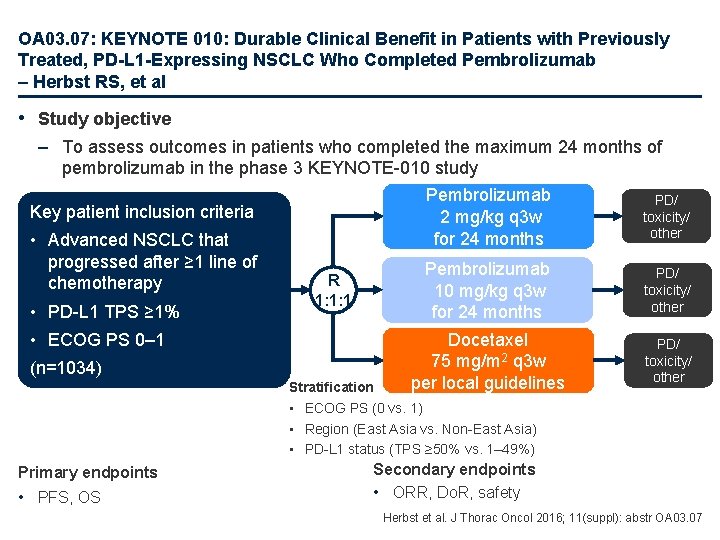
OA 03. 07: KEYNOTE 010: Durable Clinical Benefit in Patients with Previously Treated, PD-L 1 -Expressing NSCLC Who Completed Pembrolizumab – Herbst RS, et al • Study objective – To assess outcomes in patients who completed the maximum 24 months of pembrolizumab in the phase 3 KEYNOTE-010 study Pembrolizumab PD/ Key patient inclusion criteria toxicity/ 2 mg/kg q 3 w other for 24 months • Advanced NSCLC that progressed after ≥ 1 line of Pembrolizumab PD/ R chemotherapy toxicity/ 10 mg/kg q 3 w • PD-L 1 TPS ≥ 1% • ECOG PS 0– 1 (n=1034) 1: 1: 1 for 24 months other Docetaxel 75 mg/m 2 q 3 w per local guidelines PD/ toxicity/ other Stratification • ECOG PS (0 vs. 1) • Region (East Asia vs. Non-East Asia) • PD-L 1 status (TPS ≥ 50% vs. 1– 49%) Primary endpoints • PFS, OS Secondary endpoints • ORR, Do. R, safety Herbst et al. J Thorac Oncol 2016; 11(suppl): abstr OA 03. 07
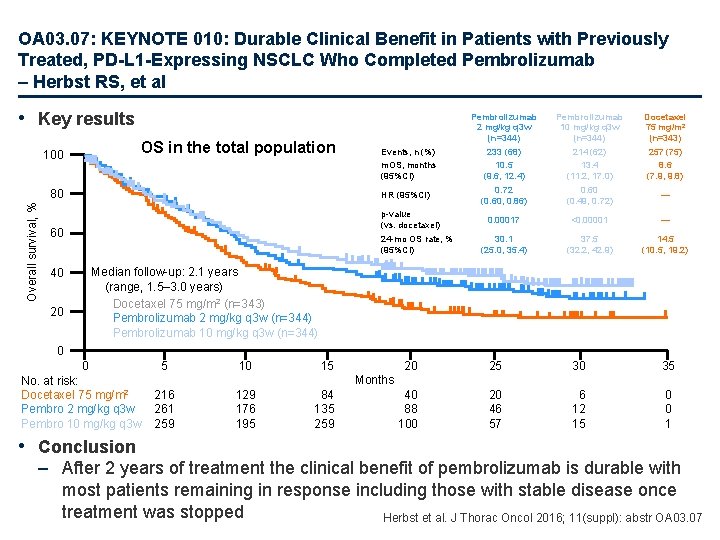
OA 03. 07: KEYNOTE 010: Durable Clinical Benefit in Patients with Previously Treated, PD-L 1 -Expressing NSCLC Who Completed Pembrolizumab – Herbst RS, et al • Key results OS in the total population 100 Overall survival, % 80 Pembrolizumab 2 mg/kg q 3 w (n=344) Pembrolizumab 10 mg/kg q 3 w (n=344) Docetaxel 75 mg/m 2 (n=343) Events, n (%) 233 (68) 214 (62) 257 (75) m. OS, months (95%CI) 10. 5 (9. 6, 12. 4) 13. 4 (11. 2, 17. 0) 8. 6 (7. 9, 9. 8) HR (95%CI) 0. 72 (0. 60, 0. 86) 0. 60 (0. 49, 0. 72) — 0. 00017 <0. 00001 — 30. 1 (25. 0, 35. 4) 37. 5 (32. 2, 42. 9) 14. 5 (10. 5, 19. 2) p-value (vs. docetaxel) 60 24 -mo OS rate, % (95%CI) Median follow-up: 2. 1 years (range, 1. 5– 3. 0 years) Docetaxel 75 mg/m 2 (n=343) Pembrolizumab 2 mg/kg q 3 w (n=344) Pembrolizumab 10 mg/kg q 3 w (n=344) 40 20 0 0 No. at risk: Docetaxel 75 mg/m 2 Pembro 2 mg/kg q 3 w Pembro 10 mg/kg q 3 w 5 10 15 216 261 259 129 176 195 84 135 259 20 25 30 35 40 88 100 20 46 57 6 12 15 0 0 1 Months • Conclusion – After 2 years of treatment the clinical benefit of pembrolizumab is durable with most patients remaining in response including those with stable disease once treatment was stopped Herbst et al. J Thorac Oncol 2016; 11(suppl): abstr OA 03. 07
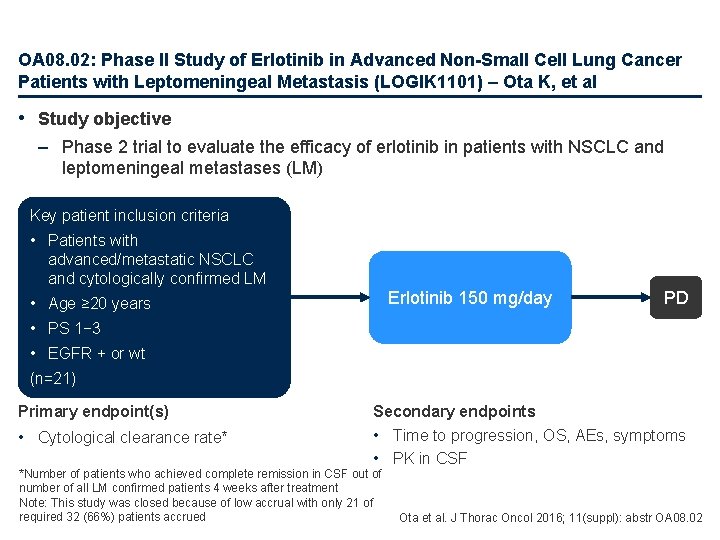
OA 08. 02: Phase II Study of Erlotinib in Advanced Non-Small Cell Lung Cancer Patients with Leptomeningeal Metastasis (LOGIK 1101) – Ota K, et al • Study objective – Phase 2 trial to evaluate the efficacy of erlotinib in patients with NSCLC and leptomeningeal metastases (LM) Key patient inclusion criteria • Patients with advanced/metastatic NSCLC and cytologically confirmed LM Erlotinib 150 mg/day • Age ≥ 20 years PD • PS 1− 3 • EGFR + or wt (n=21) Primary endpoint(s) • Cytological clearance rate* Secondary endpoints • Time to progression, OS, AEs, symptoms • PK in CSF *Number of patients who achieved complete remission in CSF out of number of all LM confirmed patients 4 weeks after treatment Note: This study was closed because of low accrual with only 21 of required 32 (66%) patients accrued Ota et al. J Thorac Oncol 2016; 11(suppl): abstr OA 08. 02
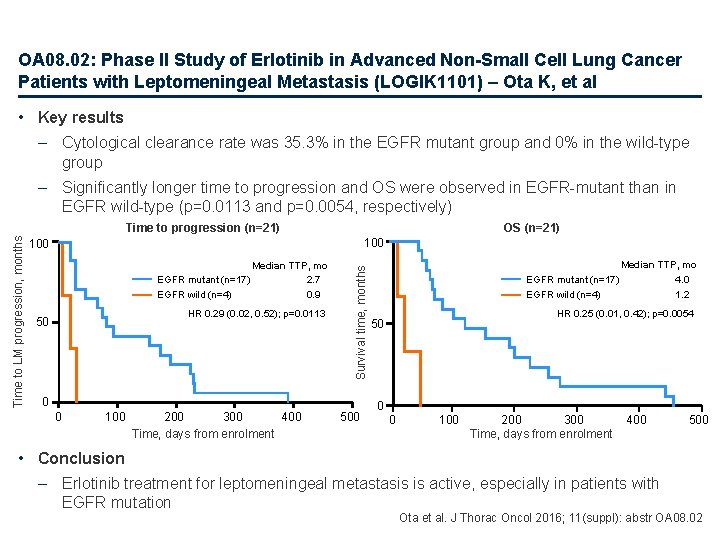
OA 08. 02: Phase II Study of Erlotinib in Advanced Non-Small Cell Lung Cancer Patients with Leptomeningeal Metastasis (LOGIK 1101) – Ota K, et al • Key results – Cytological clearance rate was 35. 3% in the EGFR mutant group and 0% in the wild-type group – Significantly longer time to progression and OS were observed in EGFR-mutant than in EGFR wild-type (p=0. 0113 and p=0. 0054, respectively) OS (n=21) 100 EGFR mutant (n=17) EGFR wild (n=4) Median TTP, mo 2. 7 0. 9 HR 0. 29 (0. 02, 0. 52); p=0. 0113 50 Survival time, months Time to LM progression, months Time to progression (n=21) 0 0 100 200 300 400 Time, days from enrolment 500 EGFR mutant (n=17) EGFR wild (n=4) Median TTP, mo 4. 0 1. 2 HR 0. 25 (0. 01, 0. 42); p=0. 0054 50 0 0 100 200 300 Time, days from enrolment 400 500 • Conclusion – Erlotinib treatment for leptomeningeal metastasis is active, especially in patients with EGFR mutation Ota et al. J Thorac Oncol 2016; 11(suppl): abstr OA 08. 02
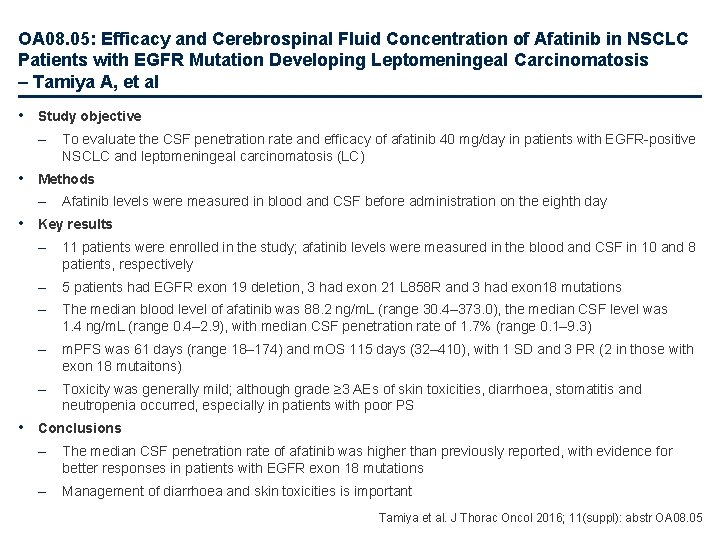
OA 08. 05: Efficacy and Cerebrospinal Fluid Concentration of Afatinib in NSCLC Patients with EGFR Mutation Developing Leptomeningeal Carcinomatosis – Tamiya A, et al • Study objective – To evaluate the CSF penetration rate and efficacy of afatinib 40 mg/day in patients with EGFR-positive NSCLC and leptomeningeal carcinomatosis (LC) • Methods – Afatinib levels were measured in blood and CSF before administration on the eighth day • Key results – 11 patients were enrolled in the study; afatinib levels were measured in the blood and CSF in 10 and 8 patients, respectively – 5 patients had EGFR exon 19 deletion, 3 had exon 21 L 858 R and 3 had exon 18 mutations – The median blood level of afatinib was 88. 2 ng/m. L (range 30. 4– 373. 0), the median CSF level was 1. 4 ng/m. L (range 0. 4– 2. 9), with median CSF penetration rate of 1. 7% (range 0. 1– 9. 3) – m. PFS was 61 days (range 18– 174) and m. OS 115 days (32– 410), with 1 SD and 3 PR (2 in those with exon 18 mutaitons) – Toxicity was generally mild; although grade ≥ 3 AEs of skin toxicities, diarrhoea, stomatitis and neutropenia occurred, especially in patients with poor PS • Conclusions – The median CSF penetration rate of afatinib was higher than previously reported, with evidence for better responses in patients with EGFR exon 18 mutations – Management of diarrhoea and skin toxicities is important Tamiya et al. J Thorac Oncol 2016; 11(suppl): abstr OA 08. 05
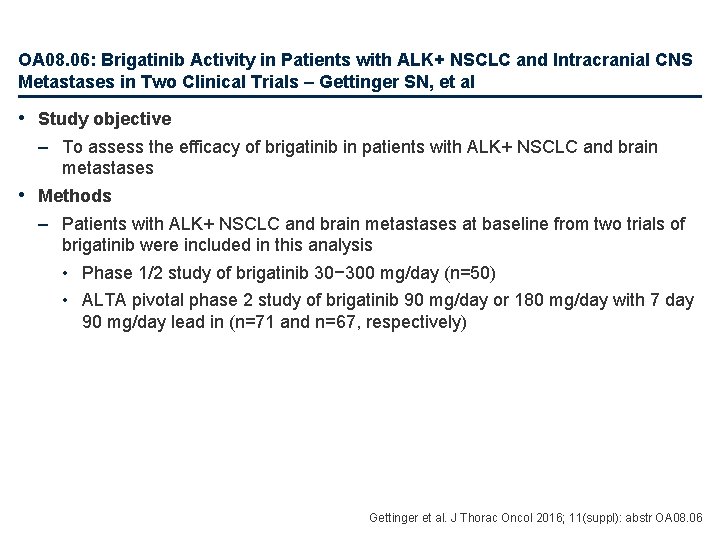
OA 08. 06: Brigatinib Activity in Patients with ALK+ NSCLC and Intracranial CNS Metastases in Two Clinical Trials – Gettinger SN, et al • Study objective – To assess the efficacy of brigatinib in patients with ALK+ NSCLC and brain metastases • Methods – Patients with ALK+ NSCLC and brain metastases at baseline from two trials of brigatinib were included in this analysis • Phase 1/2 study of brigatinib 30− 300 mg/day (n=50) • ALTA pivotal phase 2 study of brigatinib 90 mg/day or 180 mg/day with 7 day 90 mg/day lead in (n=71 and n=67, respectively) Gettinger et al. J Thorac Oncol 2016; 11(suppl): abstr OA 08. 06
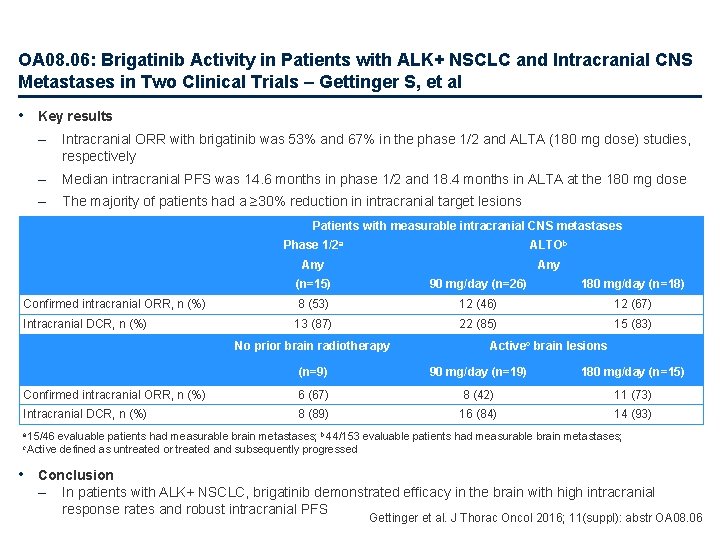
OA 08. 06: Brigatinib Activity in Patients with ALK+ NSCLC and Intracranial CNS Metastases in Two Clinical Trials – Gettinger S, et al • Key results – Intracranial ORR with brigatinib was 53% and 67% in the phase 1/2 and ALTA (180 mg dose) studies, respectively – Median intracranial PFS was 14. 6 months in phase 1/2 and 18. 4 months in ALTA at the 180 mg dose – The majority of patients had a ≥ 30% reduction in intracranial target lesions Patients with measurable intracranial CNS metastases Phase 1/2 a ALTOb Any (n=15) 90 mg/day (n=26) 180 mg/day (n=18) Confirmed intracranial ORR, n (%) 8 (53) 12 (46) 12 (67) Intracranial DCR, n (%) 13 (87) 22 (85) 15 (83) No prior brain radiotherapy Activec brain lesions (n=9) 90 mg/day (n=19) 180 mg/day (n=15) Confirmed intracranial ORR, n (%) 6 (67) 8 (42) 11 (73) Intracranial DCR, n (%) 8 (89) 16 (84) 14 (93) a 15/46 evaluable patients had measurable brain metastases; b 44/153 evaluable patients had measurable brain metastases; c Active defined as untreated or treated and subsequently progressed • Conclusion – In patients with ALK+ NSCLC, brigatinib demonstrated efficacy in the brain with high intracranial response rates and robust intracranial PFS Gettinger et al. J Thorac Oncol 2016; 11(suppl): abstr OA 08. 06
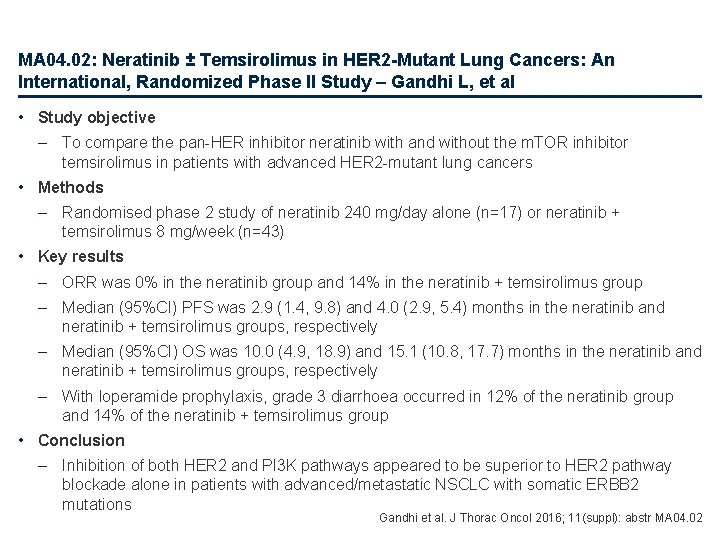
MA 04. 02: Neratinib ± Temsirolimus in HER 2 -Mutant Lung Cancers: An International, Randomized Phase II Study – Gandhi L, et al • Study objective – To compare the pan-HER inhibitor neratinib with and without the m. TOR inhibitor temsirolimus in patients with advanced HER 2 -mutant lung cancers • Methods – Randomised phase 2 study of neratinib 240 mg/day alone (n=17) or neratinib + temsirolimus 8 mg/week (n=43) • Key results – ORR was 0% in the neratinib group and 14% in the neratinib + temsirolimus group – Median (95%CI) PFS was 2. 9 (1. 4, 9. 8) and 4. 0 (2. 9, 5. 4) months in the neratinib and neratinib + temsirolimus groups, respectively – Median (95%CI) OS was 10. 0 (4. 9, 18. 9) and 15. 1 (10. 8, 17. 7) months in the neratinib and neratinib + temsirolimus groups, respectively – With loperamide prophylaxis, grade 3 diarrhoea occurred in 12% of the neratinib group and 14% of the neratinib + temsirolimus group • Conclusion – Inhibition of both HER 2 and PI 3 K pathways appeared to be superior to HER 2 pathway blockade alone in patients with advanced/metastatic NSCLC with somatic ERBB 2 mutations Gandhi et al. J Thorac Oncol 2016; 11(suppl): abstr MA 04. 02
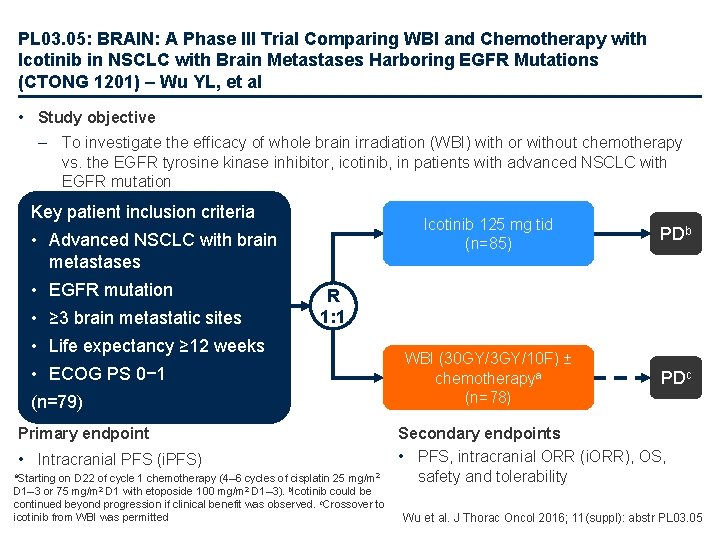
PL 03. 05: BRAIN: A Phase III Trial Comparing WBI and Chemotherapy with Icotinib in NSCLC with Brain Metastases Harboring EGFR Mutations (CTONG 1201) – Wu YL, et al • Study objective – To investigate the efficacy of whole brain irradiation (WBI) with or without chemotherapy vs. the EGFR tyrosine kinase inhibitor, icotinib, in patients with advanced NSCLC with EGFR mutation Key patient inclusion criteria • Advanced NSCLC with brain metastases • EGFR mutation • ≥ 3 brain metastatic sites Icotinib 125 mg tid (n=85) PDb WBI (30 GY/3 GY/10 F) ± chemotherapya (n=78) PDc R 1: 1 • Life expectancy ≥ 12 weeks • ECOG PS 0− 1 (n=79) Primary endpoint • Intracranial PFS (i. PFS) a. Starting on D 22 of cycle 1 chemotherapy (4– 6 cycles of cisplatin 25 mg/m 2 D 1– 3 or 75 mg/m 2 D 1 with etoposide 100 mg/m 2 D 1– 3). b. Icotinib could be continued beyond progression if clinical benefit was observed. c. Crossover to icotinib from WBI was permitted Secondary endpoints • PFS, intracranial ORR (i. ORR), OS, safety and tolerability Wu et al. J Thorac Oncol 2016; 11(suppl): abstr PL 03. 05
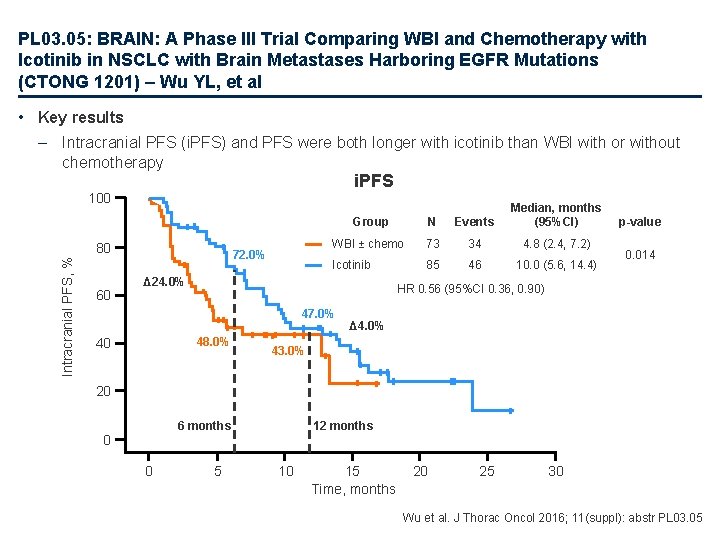
PL 03. 05: BRAIN: A Phase III Trial Comparing WBI and Chemotherapy with Icotinib in NSCLC with Brain Metastases Harboring EGFR Mutations (CTONG 1201) – Wu YL, et al • Key results – Intracranial PFS (i. PFS) and PFS were both longer with icotinib than WBI with or without chemotherapy i. PFS 100 Intracranial PFS, % 80 60 72. 0% Group N Events Median, months (95%CI) WBI ± chemo 73 34 4. 8 (2. 4, 7. 2) Icotinib 85 46 10. 0 (5. 6, 14. 4) Δ 24. 0% 0. 014 HR 0. 56 (95%CI 0. 36, 0. 90) 47. 0% 48. 0% 40 p-value 43. 0% Δ 4. 0% 43. 0% 20 6 months 0 0 5 12 months 10 15 Time, months 20 25 30 Wu et al. J Thorac Oncol 2016; 11(suppl): abstr PL 03. 05
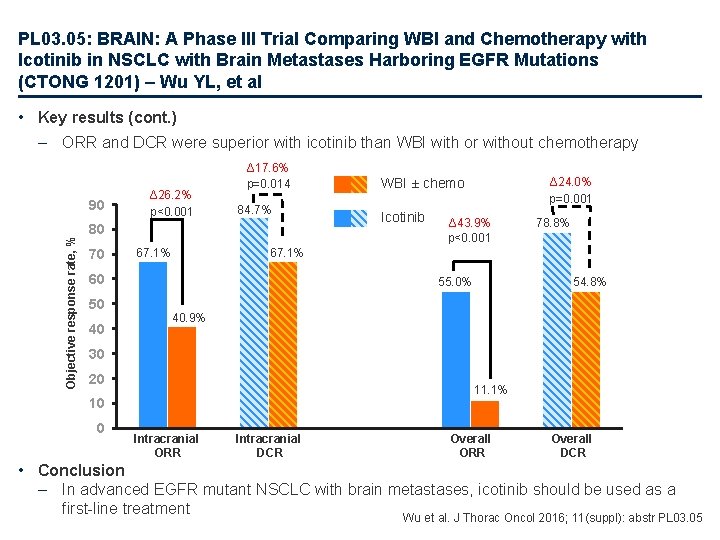
PL 03. 05: BRAIN: A Phase III Trial Comparing WBI and Chemotherapy with Icotinib in NSCLC with Brain Metastases Harboring EGFR Mutations (CTONG 1201) – Wu YL, et al • Key results (cont. ) – ORR and DCR were superior with icotinib than WBI with or without chemotherapy Objective response rate, % 90 Δ 26. 2% p<0. 001 Δ 17. 6% p=0. 014 84. 7% 80 70 40 Icotinib Δ 43. 9% p<0. 001 78. 8% 67. 1% 60 50 Δ 24. 0% p=0. 001 WBI ± chemo 54. 8% 55. 0% 40. 9% 30 20 11. 1% 10 0 Intracranial ORR Intracranial DCR Overall ORR Overall DCR • Conclusion – In advanced EGFR mutant NSCLC with brain metastases, icotinib should be used as a first-line treatment Wu et al. J Thorac Oncol 2016; 11(suppl): abstr PL 03. 05
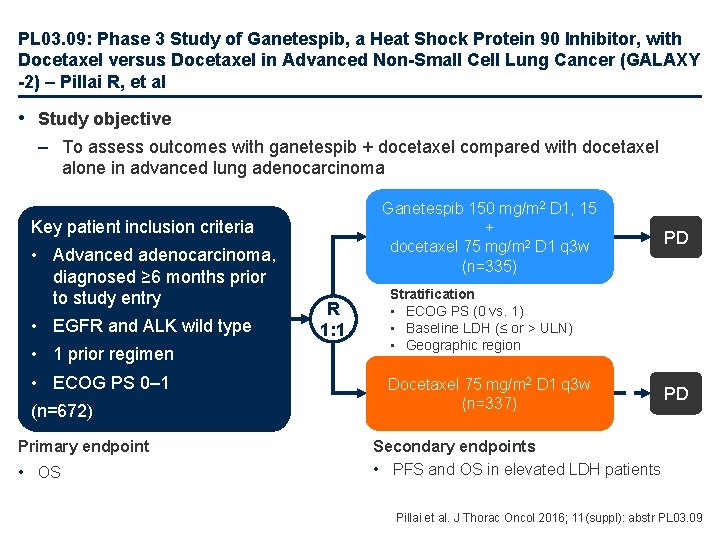
PL 03. 09: Phase 3 Study of Ganetespib, a Heat Shock Protein 90 Inhibitor, with Docetaxel versus Docetaxel in Advanced Non-Small Cell Lung Cancer (GALAXY -2) – Pillai R, et al • Study objective – To assess outcomes with ganetespib + docetaxel compared with docetaxel alone in advanced lung adenocarcinoma Ganetespib 150 mg/m 2 D 1, 15 + docetaxel 75 mg/m 2 D 1 q 3 w (n=335) Key patient inclusion criteria • Advanced adenocarcinoma, diagnosed ≥ 6 months prior to study entry • EGFR and ALK wild type • 1 prior regimen • ECOG PS 0– 1 (n=672) Primary endpoint • OS R 1: 1 PD Stratification • ECOG PS (0 vs. 1) • Baseline LDH (≤ or > ULN) • Geographic region Docetaxel 75 mg/m 2 D 1 q 3 w (n=337) PD Secondary endpoints • PFS and OS in elevated LDH patients Pillai et al. J Thorac Oncol 2016; 11(suppl): abstr PL 03. 09
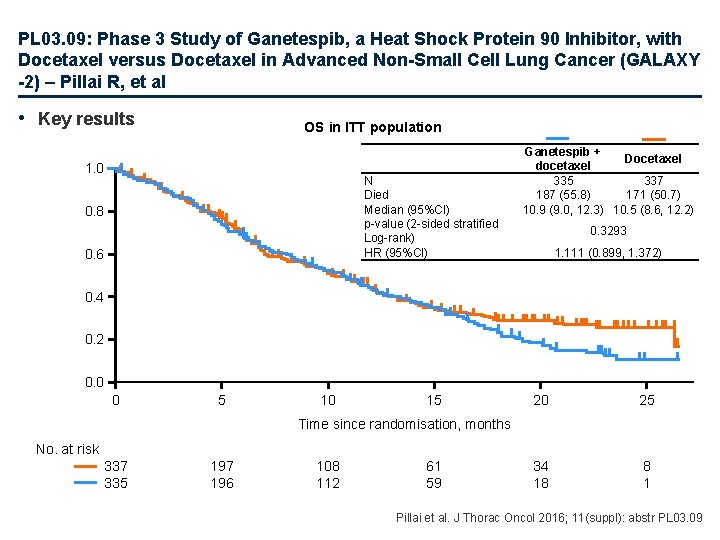
PL 03. 09: Phase 3 Study of Ganetespib, a Heat Shock Protein 90 Inhibitor, with Docetaxel versus Docetaxel in Advanced Non-Small Cell Lung Cancer (GALAXY -2) – Pillai R, et al • Key results OS in ITT population 1. 0 N Died Median (95%CI) p-value (2 -sided stratified Log-rank) HR (95%CI) 0. 8 0. 6 Ganetespib + Docetaxel docetaxel 335 337 187 (55. 8) 171 (50. 7) 10. 9 (9. 0, 12. 3) 10. 5 (8. 6, 12. 2) 0. 3293 1. 111 (0. 899, 1. 372) 0. 4 0. 2 0. 0 0 5 10 15 20 25 34 18 8 1 Time since randomisation, months No. at risk 337 335 197 196 108 112 61 59 Pillai et al. J Thorac Oncol 2016; 11(suppl): abstr PL 03. 09
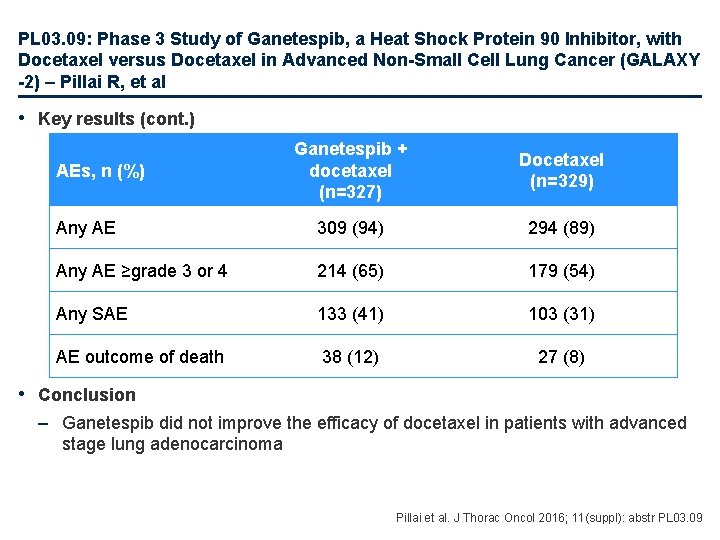
PL 03. 09: Phase 3 Study of Ganetespib, a Heat Shock Protein 90 Inhibitor, with Docetaxel versus Docetaxel in Advanced Non-Small Cell Lung Cancer (GALAXY -2) – Pillai R, et al • Key results (cont. ) Ganetespib + docetaxel (n=327) Docetaxel (n=329) Any AE 309 (94) 294 (89) Any AE ≥grade 3 or 4 214 (65) 179 (54) Any SAE 133 (41) 103 (31) AE outcome of death 38 (12) 27 (8) AEs, n (%) • Conclusion – Ganetespib did not improve the efficacy of docetaxel in patients with advanced stage lung adenocarcinoma Pillai et al. J Thorac Oncol 2016; 11(suppl): abstr PL 03. 09
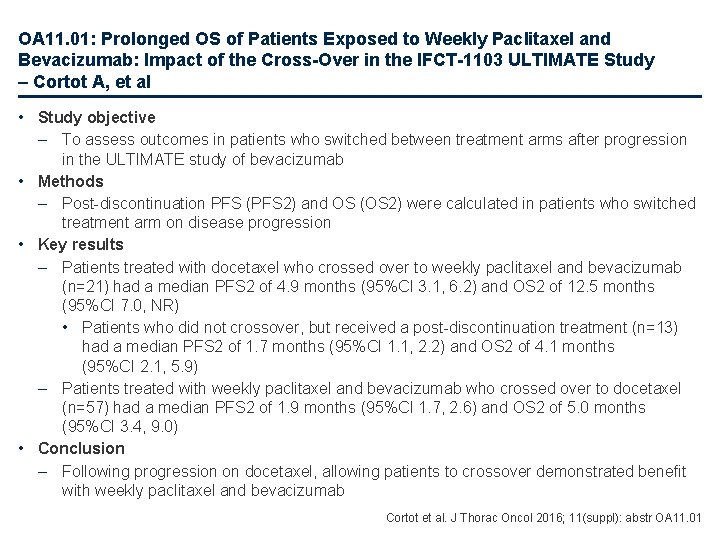
OA 11. 01: Prolonged OS of Patients Exposed to Weekly Paclitaxel and Bevacizumab: Impact of the Cross-Over in the IFCT-1103 ULTIMATE Study – Cortot A, et al • Study objective – To assess outcomes in patients who switched between treatment arms after progression in the ULTIMATE study of bevacizumab • Methods – Post-discontinuation PFS (PFS 2) and OS (OS 2) were calculated in patients who switched treatment arm on disease progression • Key results – Patients treated with docetaxel who crossed over to weekly paclitaxel and bevacizumab (n=21) had a median PFS 2 of 4. 9 months (95%CI 3. 1, 6. 2) and OS 2 of 12. 5 months (95%CI 7. 0, NR) • Patients who did not crossover, but received a post-discontinuation treatment (n=13) had a median PFS 2 of 1. 7 months (95%CI 1. 1, 2. 2) and OS 2 of 4. 1 months (95%CI 2. 1, 5. 9) – Patients treated with weekly paclitaxel and bevacizumab who crossed over to docetaxel (n=57) had a median PFS 2 of 1. 9 months (95%CI 1. 7, 2. 6) and OS 2 of 5. 0 months (95%CI 3. 4, 9. 0) • Conclusion – Following progression on docetaxel, allowing patients to crossover demonstrated benefit with weekly paclitaxel and bevacizumab Cortot et al. J Thorac Oncol 2016; 11(suppl): abstr OA 11. 01
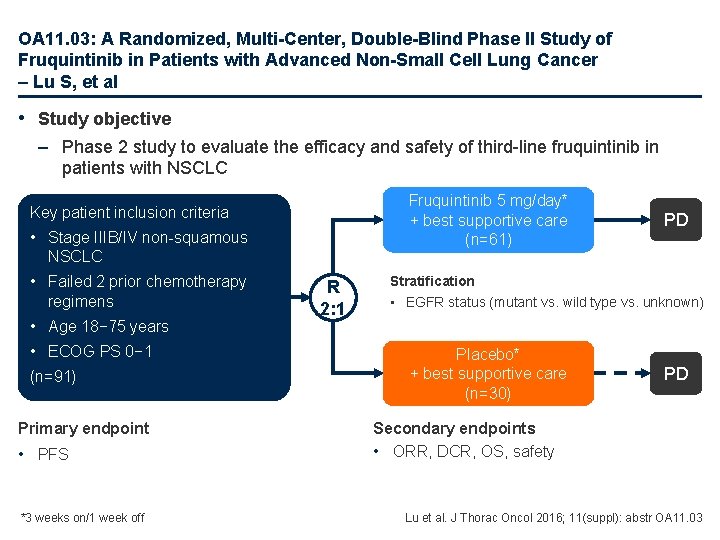
OA 11. 03: A Randomized, Multi-Center, Double-Blind Phase II Study of Fruquintinib in Patients with Advanced Non-Small Cell Lung Cancer – Lu S, et al • Study objective – Phase 2 study to evaluate the efficacy and safety of third-line fruquintinib in patients with NSCLC Fruquintinib 5 mg/day* + best supportive care (n=61) Key patient inclusion criteria • Stage IIIB/IV non-squamous NSCLC • Failed 2 prior chemotherapy regimens • Age 18− 75 years • ECOG PS 0− 1 (n=91) Primary endpoint • PFS *3 weeks on/1 week off R 2: 1 PD Stratification • EGFR status (mutant vs. wild type vs. unknown) Placebo* + best supportive care (n=30) PD Secondary endpoints • ORR, DCR, OS, safety Lu et al. J Thorac Oncol 2016; 11(suppl): abstr OA 11. 03
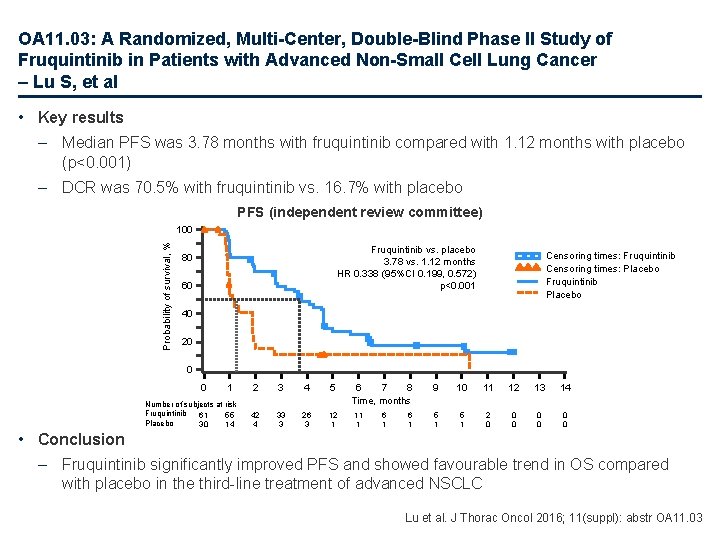
OA 11. 03: A Randomized, Multi-Center, Double-Blind Phase II Study of Fruquintinib in Patients with Advanced Non-Small Cell Lung Cancer – Lu S, et al • Key results – Median PFS was 3. 78 months with fruquintinib compared with 1. 12 months with placebo (p<0. 001) – DCR was 70. 5% with fruquintinib vs. 16. 7% with placebo PFS (independent review committee) Probability of survival, % 100 Fruquintinib vs. placebo 3. 78 vs. 1. 12 months HR 0. 338 (95%CI 0. 199, 0. 572) p<0. 001 80 60 Censoring times: Fruquintinib Censoring times: Placebo Fruquintinib Placebo 40 20 0 0 • Conclusion 1 Number of subjects at risk Fruquintinib 61 55 Placebo 30 14 2 3 4 5 42 4 33 3 26 3 12 1 6 7 8 Time, months 11 1 6 1 9 10 11 12 13 14 5 1 2 0 0 0 0 – Fruquintinib significantly improved PFS and showed favourable trend in OS compared with placebo in the third-line treatment of advanced NSCLC Lu et al. J Thorac Oncol 2016; 11(suppl): abstr OA 11. 03
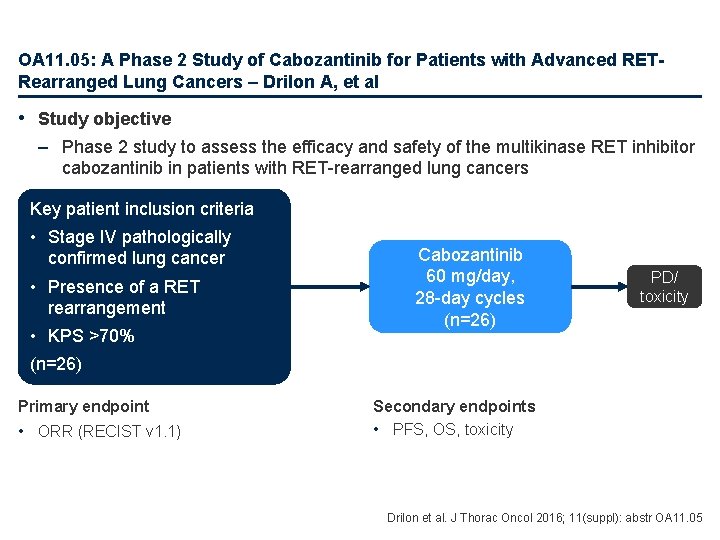
OA 11. 05: A Phase 2 Study of Cabozantinib for Patients with Advanced RETRearranged Lung Cancers – Drilon A, et al • Study objective – Phase 2 study to assess the efficacy and safety of the multikinase RET inhibitor cabozantinib in patients with RET-rearranged lung cancers Key patient inclusion criteria • Stage IV pathologically confirmed lung cancer • Presence of a RET rearrangement • KPS >70% Cabozantinib 60 mg/day, 28 -day cycles (n=26) PD/ toxicity (n=26) Primary endpoint • ORR (RECIST v 1. 1) Secondary endpoints • PFS, OS, toxicity Drilon et al. J Thorac Oncol 2016; 11(suppl): abstr OA 11. 05
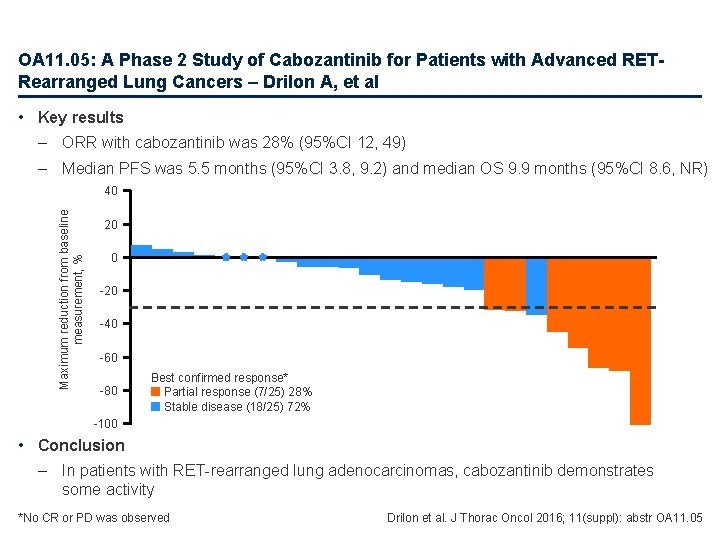
OA 11. 05: A Phase 2 Study of Cabozantinib for Patients with Advanced RETRearranged Lung Cancers – Drilon A, et al • Key results – ORR with cabozantinib was 28% (95%CI 12, 49) – Median PFS was 5. 5 months (95%CI 3. 8, 9. 2) and median OS 9. 9 months (95%CI 8. 6, NR) Maximum reduction from baseline measurement, % 40 20 0 -20 -40 -60 -80 Best confirmed response* Partial response (7/25) 28% Stable disease (18/25) 72% -100 • Conclusion – In patients with RET-rearranged lung adenocarcinomas, cabozantinib demonstrates some activity *No CR or PD was observed Drilon et al. J Thorac Oncol 2016; 11(suppl): abstr OA 11. 05
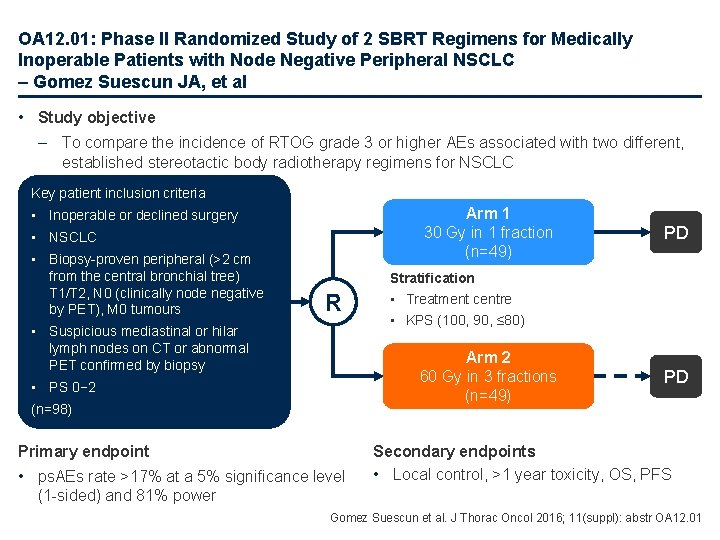
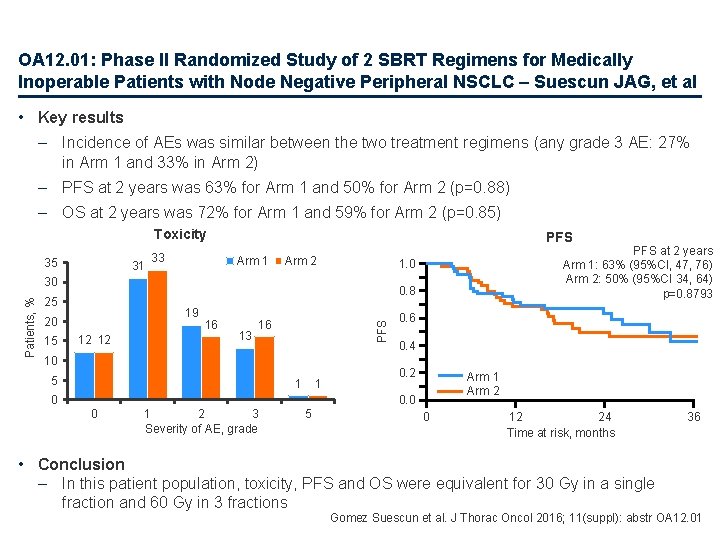
OA 12. 01: Phase II Randomized Study of 2 SBRT Regimens for Medically Inoperable Patients with Node Negative Peripheral NSCLC – Gomez Suescun JA, et al • Study objective – To compare the incidence of RTOG grade 3 or higher AEs associated with two different, established stereotactic body radiotherapy regimens for NSCLC Key patient inclusion criteria Arm 1 30 Gy in 1 fraction (n=49) • Inoperable or declined surgery • NSCLC • Biopsy-proven peripheral (>2 cm from the central bronchial tree) T 1/T 2, N 0 (clinically node negative by PET), M 0 tumours R • Suspicious mediastinal or hilar lymph nodes on CT or abnormal PET confirmed by biopsy Stratification • Treatment centre • KPS (100, 90, ≤ 80) Arm 2 60 Gy in 3 fractions (n=49) • PS 0− 2 (n=98) Primary endpoint • ps. AEs rate >17% at a 5% significance level PD PD Secondary endpoints • Local control, >1 year toxicity, OS, PFS (1 -sided) and 81% power Gomez Suescun et al. J Thorac Oncol 2016; 11(suppl): abstr OA 12. 01
OA 12. 01: Phase II Randomized Study of 2 SBRT Regimens for Medically Inoperable Patients with Node Negative Peripheral NSCLC – Suescun JAG, et al • Key results – Incidence of AEs was similar between the two treatment regimens (any grade 3 AE: 27% in Arm 1 and 33% in Arm 2) – PFS at 2 years was 63% for Arm 1 and 50% for Arm 2 (p=0. 88) – OS at 2 years was 72% for Arm 1 and 59% for Arm 2 (p=0. 85) Toxicity 35 31 33 PFS Arm 1 Arm 2 0. 8 25 19 20 12 12 16 13 16 PFS Patients, % 30 15 PFS at 2 years Arm 1: 63% (95%CI, 47, 76) Arm 2: 50% (95%CI 34, 64) p=0. 8793 1. 0 10 5 1 1 0 0. 6 0. 4 0. 2 Arm 1 Arm 2 0. 0 0 1 2 3 Severity of AE, grade 5 0 12 24 Time at risk, months 36 • Conclusion – In this patient population, toxicity, PFS and OS were equivalent for 30 Gy in a single fraction and 60 Gy in 3 fractions Gomez Suescun et al. J Thorac Oncol 2016; 11(suppl): abstr OA 12. 01
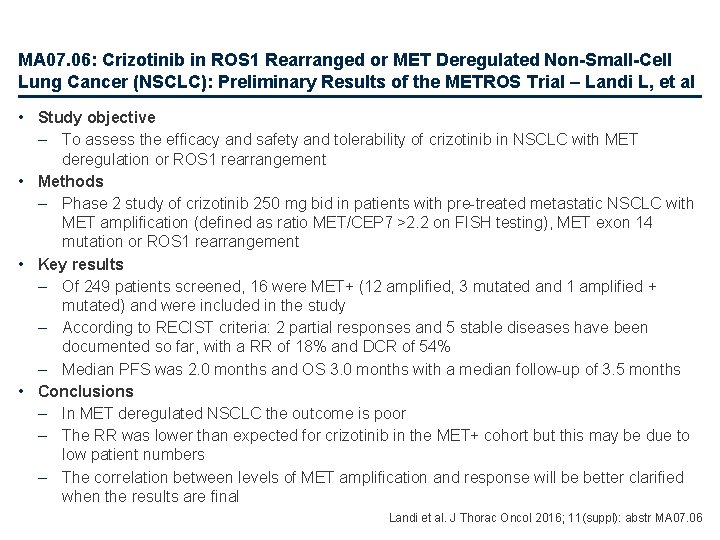
MA 07. 06: Crizotinib in ROS 1 Rearranged or MET Deregulated Non-Small-Cell Lung Cancer (NSCLC): Preliminary Results of the METROS Trial – Landi L, et al • Study objective – To assess the efficacy and safety and tolerability of crizotinib in NSCLC with MET deregulation or ROS 1 rearrangement • Methods – Phase 2 study of crizotinib 250 mg bid in patients with pre-treated metastatic NSCLC with MET amplification (defined as ratio MET/CEP 7 >2. 2 on FISH testing), MET exon 14 mutation or ROS 1 rearrangement • Key results – Of 249 patients screened, 16 were MET+ (12 amplified, 3 mutated and 1 amplified + mutated) and were included in the study – According to RECIST criteria: 2 partial responses and 5 stable diseases have been documented so far, with a RR of 18% and DCR of 54% – Median PFS was 2. 0 months and OS 3. 0 months with a median follow-up of 3. 5 months • Conclusions – In MET deregulated NSCLC the outcome is poor – The RR was lower than expected for crizotinib in the MET+ cohort but this may be due to low patient numbers – The correlation between levels of MET amplification and response will be better clarified when the results are final Landi et al. J Thorac Oncol 2016; 11(suppl): abstr MA 07. 06
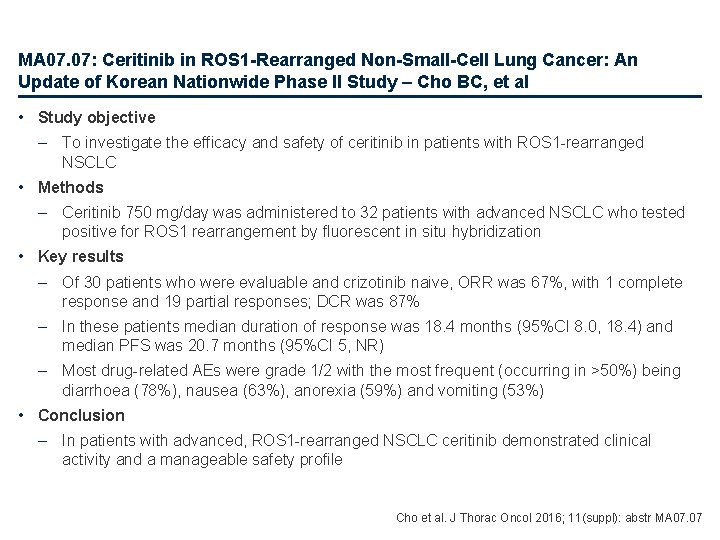
MA 07. 07: Ceritinib in ROS 1 -Rearranged Non-Small-Cell Lung Cancer: An Update of Korean Nationwide Phase II Study – Cho BC, et al • Study objective – To investigate the efficacy and safety of ceritinib in patients with ROS 1 -rearranged NSCLC • Methods – Ceritinib 750 mg/day was administered to 32 patients with advanced NSCLC who tested positive for ROS 1 rearrangement by fluorescent in situ hybridization • Key results – Of 30 patients who were evaluable and crizotinib naive, ORR was 67%, with 1 complete response and 19 partial responses; DCR was 87% – In these patients median duration of response was 18. 4 months (95%CI 8. 0, 18. 4) and median PFS was 20. 7 months (95%CI 5, NR) – Most drug-related AEs were grade 1/2 with the most frequent (occurring in >50%) being diarrhoea (78%), nausea (63%), anorexia (59%) and vomiting (53%) • Conclusion – In patients with advanced, ROS 1 -rearranged NSCLC ceritinib demonstrated clinical activity and a manageable safety profile Cho et al. J Thorac Oncol 2016; 11(suppl): abstr MA 07. 07
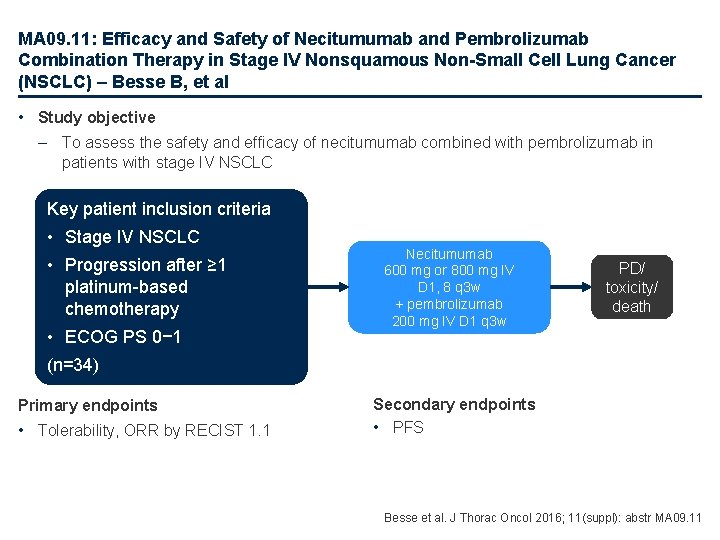
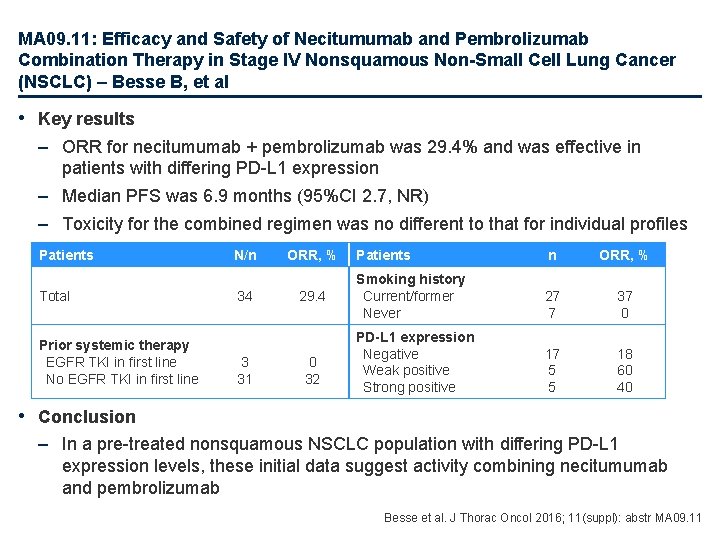
MA 09. 11: Efficacy and Safety of Necitumumab and Pembrolizumab Combination Therapy in Stage IV Nonsquamous Non-Small Cell Lung Cancer (NSCLC) – Besse B, et al • Study objective – To assess the safety and efficacy of necitumumab combined with pembrolizumab in patients with stage IV NSCLC Key patient inclusion criteria • Stage IV NSCLC • Progression after ≥ 1 platinum-based chemotherapy • ECOG PS 0− 1 Necitumumab 600 mg or 800 mg IV D 1, 8 q 3 w + pembrolizumab 200 mg IV D 1 q 3 w PD/ toxicity/ death (n=34) Primary endpoints • Tolerability, ORR by RECIST 1. 1 Secondary endpoints • PFS Besse et al. J Thorac Oncol 2016; 11(suppl): abstr MA 09. 11
MA 09. 11: Efficacy and Safety of Necitumumab and Pembrolizumab Combination Therapy in Stage IV Nonsquamous Non-Small Cell Lung Cancer (NSCLC) – Besse B, et al • Key results – ORR for necitumumab + pembrolizumab was 29. 4% and was effective in patients with differing PD-L 1 expression – Median PFS was 6. 9 months (95%CI 2. 7, NR) – Toxicity for the combined regimen was no different to that for individual profiles Patients Total Prior systemic therapy EGFR TKI in first line No EGFR TKI in first line N/n 34 3 31 ORR, % 29. 4 0 32 Patients n ORR, % Smoking history Current/former Never 27 7 37 0 PD-L 1 expression Negative Weak positive Strong positive 17 5 5 18 60 40 • Conclusion – In a pre-treated nonsquamous NSCLC population with differing PD-L 1 expression levels, these initial data suggest activity combining necitumumab and pembrolizumab Besse et al. J Thorac Oncol 2016; 11(suppl): abstr MA 09. 11
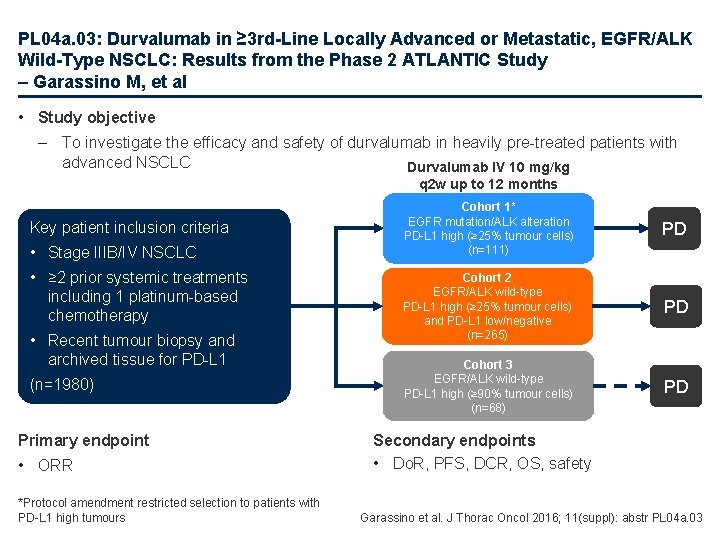
PL 04 a. 03: Durvalumab in ≥ 3 rd-Line Locally Advanced or Metastatic, EGFR/ALK Wild-Type NSCLC: Results from the Phase 2 ATLANTIC Study – Garassino M, et al • Study objective – To investigate the efficacy and safety of durvalumab in heavily pre-treated patients with advanced NSCLC Durvalumab IV 10 mg/kg q 2 w up to 12 months Key patient inclusion criteria • Stage IIIB/IV NSCLC • ≥ 2 prior systemic treatments including 1 platinum-based chemotherapy • Recent tumour biopsy and archived tissue for PD-L 1 (n=1980) Primary endpoint • ORR *Protocol amendment restricted selection to patients with PD-L 1 high tumours Cohort 1* EGFR mutation/ALK alteration PD-L 1 high (≥ 25% tumour cells) (n=111) PD Cohort 2 EGFR/ALK wild-type PD-L 1 high (≥ 25% tumour cells) and PD-L 1 low/negative (n=265) PD Cohort 3 EGFR/ALK wild-type PD-L 1 high (≥ 90% tumour cells) (n=68) PD Secondary endpoints • Do. R, PFS, DCR, OS, safety Garassino et al. J Thorac Oncol 2016; 11(suppl): abstr PL 04 a. 03
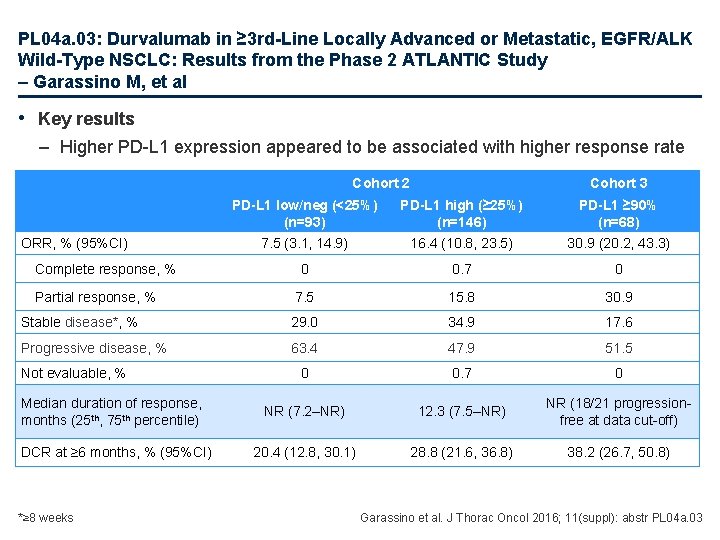
PL 04 a. 03: Durvalumab in ≥ 3 rd-Line Locally Advanced or Metastatic, EGFR/ALK Wild-Type NSCLC: Results from the Phase 2 ATLANTIC Study – Garassino M, et al • Key results – Higher PD-L 1 expression appeared to be associated with higher response rate Cohort 2 Cohort 3 PD-L 1 low/neg (<25%) (n=93) PD-L 1 high (≥ 25%) (n=146) PD-L 1 ≥ 90% (n=68) 7. 5 (3. 1, 14. 9) 16. 4 (10. 8, 23. 5) 30. 9 (20. 2, 43. 3) 0 0. 7 0 7. 5 15. 8 30. 9 Stable disease*, % 29. 0 34. 9 17. 6 Progressive disease, % 63. 4 47. 9 51. 5 0 0. 7 0 Median duration of response, months (25 th, 75 th percentile) NR (7. 2–NR) 12. 3 (7. 5–NR) NR (18/21 progressionfree at data cut-off) DCR at ≥ 6 months, % (95%CI) 20. 4 (12. 8, 30. 1) 28. 8 (21. 6, 36. 8) 38. 2 (26. 7, 50. 8) ORR, % (95%CI) Complete response, % Partial response, % Not evaluable, % *≥ 8 weeks Garassino et al. J Thorac Oncol 2016; 11(suppl): abstr PL 04 a. 03
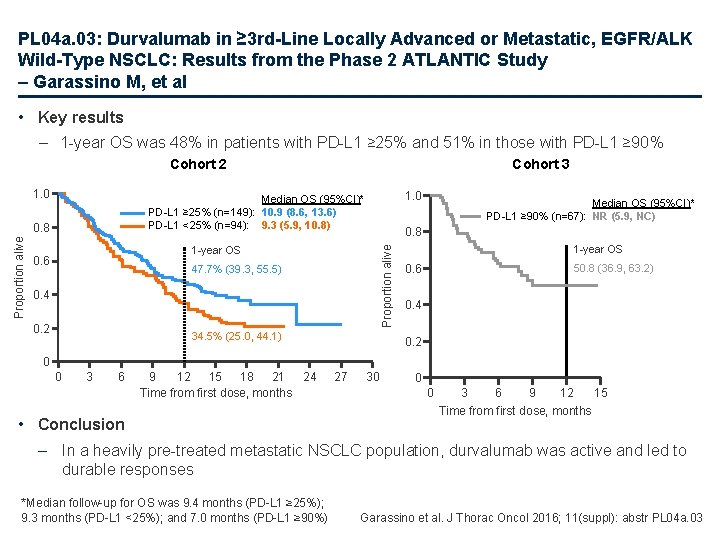
PL 04 a. 03: Durvalumab in ≥ 3 rd-Line Locally Advanced or Metastatic, EGFR/ALK Wild-Type NSCLC: Results from the Phase 2 ATLANTIC Study – Garassino M, et al • Key results – 1 -year OS was 48% in patients with PD-L 1 ≥ 25% and 51% in those with PD-L 1 ≥ 90% Cohort 2 1. 0 Median OS (95%CI)* PD-L 1 ≥ 25% (n=149): 10. 9 (8. 6, 13. 6) PD-L 1 <25% (n=94): 9. 3 (5. 9, 10. 8) 0. 8 1 -year OS 0. 6 47. 7% (39. 3, 55. 5) 0. 4 0. 2 Median OS (95%CI)* PD-L 1 ≥ 90% (n=67): NR (5. 9, NC) 0. 8 Proportion alive Cohort 3 34. 5% (25. 0, 44. 1) 1 -year OS 0. 6 50. 8 (36. 9, 63. 2) 0. 4 0. 2 0 0 3 6 9 12 15 18 21 24 Time from first dose, months • Conclusion 27 30 0 0 3 6 9 12 15 Time from first dose, months – In a heavily pre-treated metastatic NSCLC population, durvalumab was active and led to durable responses *Median follow-up for OS was 9. 4 months (PD-L 1 ≥ 25%); 9. 3 months (PD-L 1 <25%); and 7. 0 months (PD-L 1 ≥ 90%) Garassino et al. J Thorac Oncol 2016; 11(suppl): abstr PL 04 a. 03
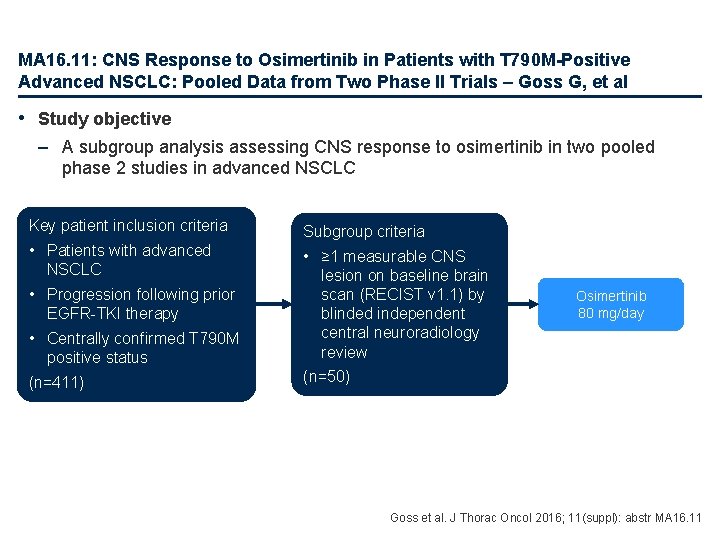
MA 16. 11: CNS Response to Osimertinib in Patients with T 790 M-Positive Advanced NSCLC: Pooled Data from Two Phase II Trials – Goss G, et al • Study objective – A subgroup analysis assessing CNS response to osimertinib in two pooled phase 2 studies in advanced NSCLC Key patient inclusion criteria Subgroup criteria • Patients with advanced NSCLC • Centrally confirmed T 790 M positive status • ≥ 1 measurable CNS lesion on baseline brain scan (RECIST v 1. 1) by blinded independent central neuroradiology review (n=411) (n=50) • Progression following prior EGFR-TKI therapy Osimertinib 80 mg/day Goss et al. J Thorac Oncol 2016; 11(suppl): abstr MA 16. 11
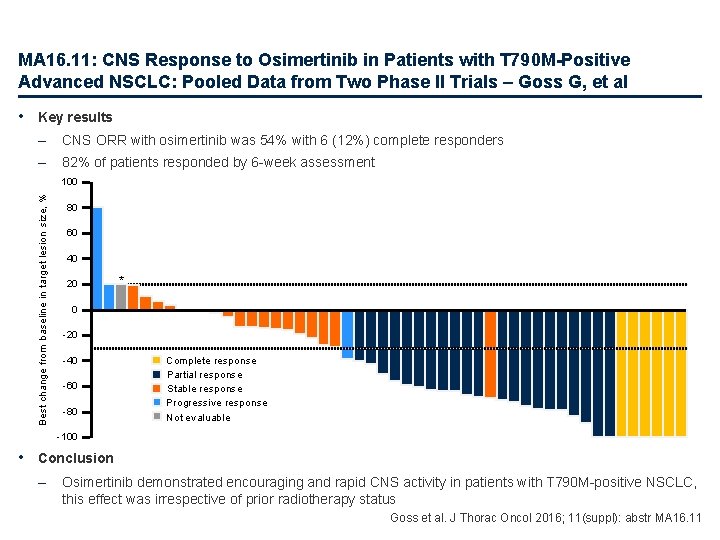
MA 16. 11: CNS Response to Osimertinib in Patients with T 790 M-Positive Advanced NSCLC: Pooled Data from Two Phase II Trials – Goss G, et al • Key results – CNS ORR with osimertinib was 54% with 6 (12%) complete responders – 82% of patients responded by 6 -week assessment Best change from baseline in target lesion size, % 100 80 60 40 20 * 0 -20 -40 -60 -80 Complete response Partial response Stable response Progressive response Not evaluable -100 • Conclusion – Osimertinib demonstrated encouraging and rapid CNS activity in patients with T 790 M-positive NSCLC, this effect was irrespective of prior radiotherapy status Goss et al. J Thorac Oncol 2016; 11(suppl): abstr MA 16. 11
Other malignancies SCLC and mesothelioma
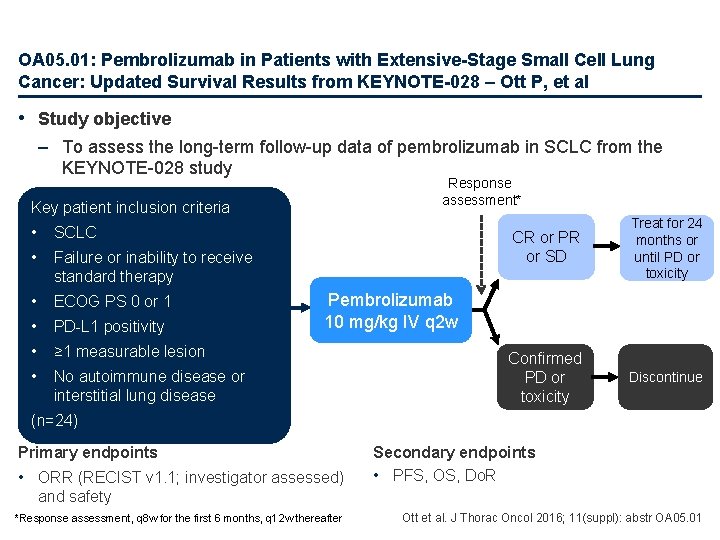
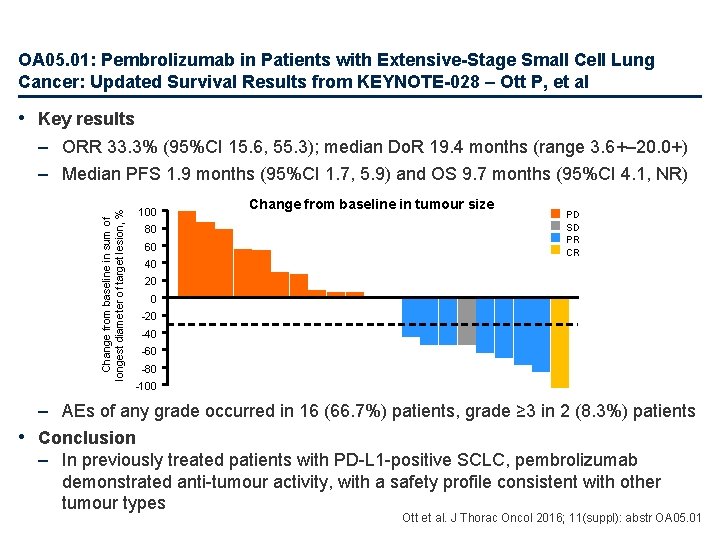
OA 05. 01: Pembrolizumab in Patients with Extensive-Stage Small Cell Lung Cancer: Updated Survival Results from KEYNOTE-028 – Ott P, et al • Study objective – To assess the long-term follow-up data of pembrolizumab in SCLC from the KEYNOTE-028 study Response assessment* Key patient inclusion criteria • SCLC • Failure or inability to receive standard therapy • ECOG PS 0 or 1 • PD-L 1 positivity • ≥ 1 measurable lesion • No autoimmune disease or interstitial lung disease CR or PR or SD Treat for 24 months or until PD or toxicity Confirmed PD or toxicity Discontinue Pembrolizumab 10 mg/kg IV q 2 w (n=24) Primary endpoints • ORR (RECIST v 1. 1; investigator assessed) Secondary endpoints • PFS, OS, Do. R and safety *Response assessment, q 8 w for the first 6 months, q 12 w thereafter Ott et al. J Thorac Oncol 2016; 11(suppl): abstr OA 05. 01
OA 05. 01: Pembrolizumab in Patients with Extensive-Stage Small Cell Lung Cancer: Updated Survival Results from KEYNOTE-028 – Ott P, et al • Key results Change from baseline in sum of longest diameter of target lesion, % – ORR 33. 3% (95%CI 15. 6, 55. 3); median Do. R 19. 4 months (range 3. 6+– 20. 0+) – Median PFS 1. 9 months (95%CI 1. 7, 5. 9) and OS 9. 7 months (95%CI 4. 1, NR) 100 80 60 Change from baseline in tumour size PD SD PR CR 40 20 0 -20 -40 -60 -80 -100 – AEs of any grade occurred in 16 (66. 7%) patients, grade ≥ 3 in 2 (8. 3%) patients • Conclusion – In previously treated patients with PD-L 1 -positive SCLC, pembrolizumab demonstrated anti-tumour activity, with a safety profile consistent with other tumour types Ott et al. J Thorac Oncol 2016; 11(suppl): abstr OA 05. 01
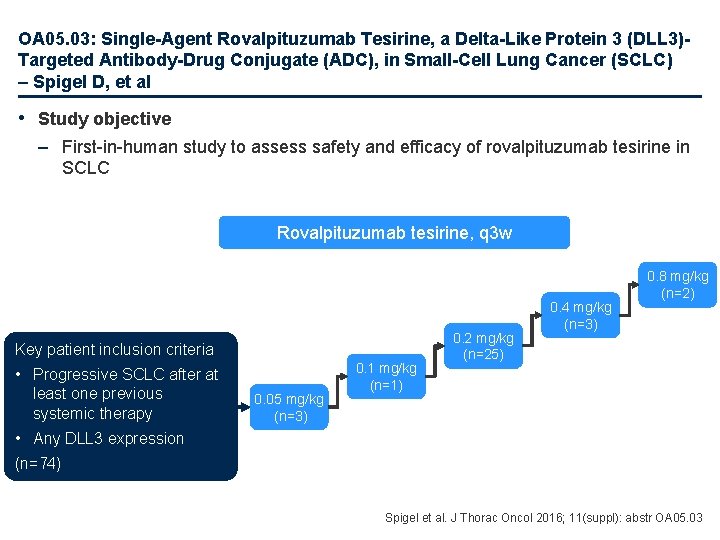
OA 05. 03: Single-Agent Rovalpituzumab Tesirine, a Delta-Like Protein 3 (DLL 3)Targeted Antibody-Drug Conjugate (ADC), in Small-Cell Lung Cancer (SCLC) – Spigel D, et al • Study objective – First-in-human study to assess safety and efficacy of rovalpituzumab tesirine in SCLC Rovalpituzumab tesirine, q 3 w Key patient inclusion criteria • Progressive SCLC after at least one previous systemic therapy 0. 05 mg/kg (n=3) 0. 1 mg/kg (n=1) 0. 2 mg/kg (n=25) 0. 4 mg/kg (n=3) 0. 8 mg/kg (n=2) • Any DLL 3 expression (n=74) Spigel et al. J Thorac Oncol 2016; 11(suppl): abstr OA 05. 03
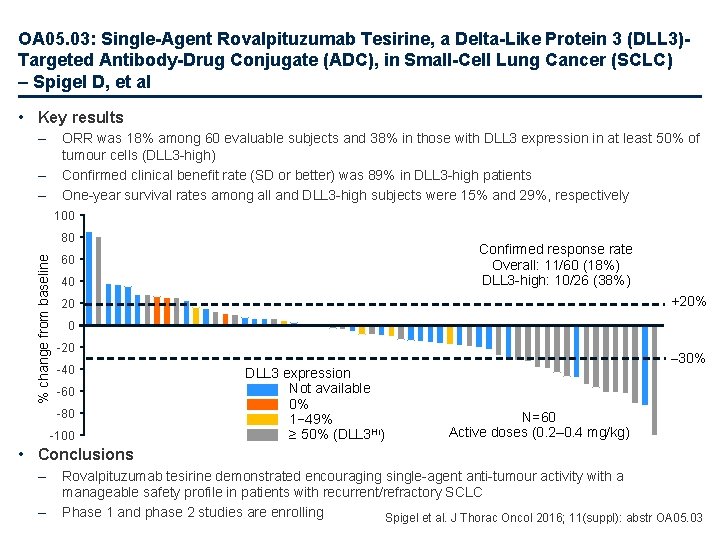
OA 05. 03: Single-Agent Rovalpituzumab Tesirine, a Delta-Like Protein 3 (DLL 3)Targeted Antibody-Drug Conjugate (ADC), in Small-Cell Lung Cancer (SCLC) – Spigel D, et al • Key results – ORR was 18% among 60 evaluable subjects and 38% in those with DLL 3 expression in at least 50% of tumour cells (DLL 3 -high) Confirmed clinical benefit rate (SD or better) was 89% in DLL 3 -high patients One-year survival rates among all and DLL 3 -high subjects were 15% and 29%, respectively – – 100 % change from baseline 80 Confirmed response rate Overall: 11/60 (18%) DLL 3 -high: 10/26 (38%) 60 40 +20% 20 0 -20 -40 -60 -80 -100 DLL 3 expression Not available 0% 1− 49% ≥ 50% (DLL 3 Hi) – 30% N=60 Active doses (0. 2– 0. 4 mg/kg) • Conclusions – – Rovalpituzumab tesirine demonstrated encouraging single-agent anti-tumour activity with a manageable safety profile in patients with recurrent/refractory SCLC Phase 1 and phase 2 studies are enrolling Spigel et al. J Thorac Oncol 2016; 11(suppl): abstr OA 05. 03
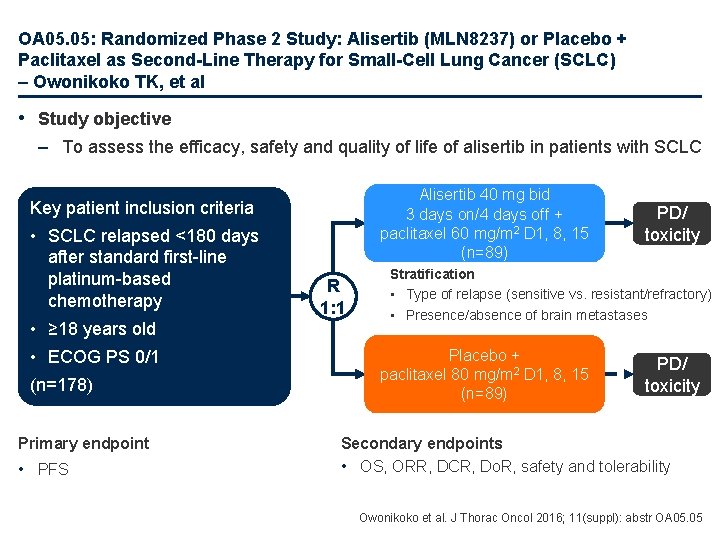
OA 05. 05: Randomized Phase 2 Study: Alisertib (MLN 8237) or Placebo + Paclitaxel as Second-Line Therapy for Small-Cell Lung Cancer (SCLC) – Owonikoko TK, et al • Study objective – To assess the efficacy, safety and quality of life of alisertib in patients with SCLC Alisertib 40 mg bid 3 days on/4 days off + paclitaxel 60 mg/m 2 D 1, 8, 15 (n=89) Key patient inclusion criteria • SCLC relapsed <180 days after standard first-line platinum-based chemotherapy • ≥ 18 years old • ECOG PS 0/1 (n=178) Primary endpoint • PFS R 1: 1 PD/ toxicity Stratification • Type of relapse (sensitive vs. resistant/refractory) • Presence/absence of brain metastases Placebo + paclitaxel 80 mg/m 2 D 1, 8, 15 (n=89) PD/ toxicity Secondary endpoints • OS, ORR, DCR, Do. R, safety and tolerability Owonikoko et al. J Thorac Oncol 2016; 11(suppl): abstr OA 05. 05
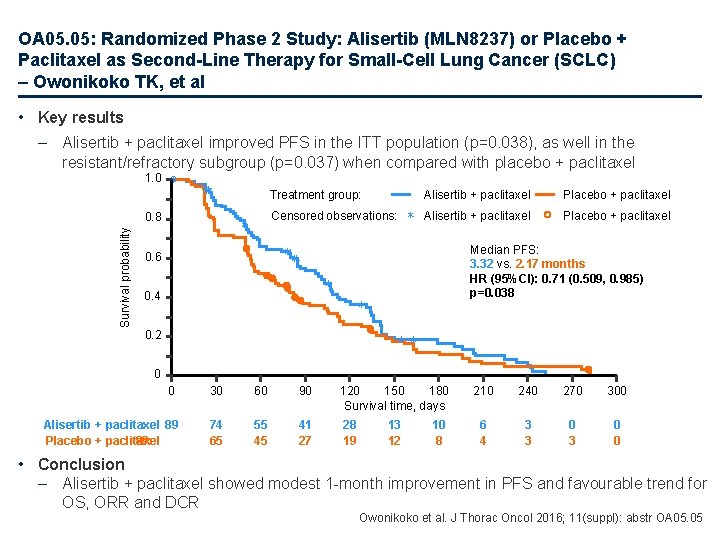
OA 05. 05: Randomized Phase 2 Study: Alisertib (MLN 8237) or Placebo + Paclitaxel as Second-Line Therapy for Small-Cell Lung Cancer (SCLC) – Owonikoko TK, et al • Key results – Alisertib + paclitaxel improved PFS in the ITT population (p=0. 038), as well in the resistant/refractory subgroup (p=0. 037) when compared with placebo + paclitaxel 1. 0 Survival probability 0. 8 Treatment group: Alisertib + paclitaxel Placebo + paclitaxel Censored observations: Alisertib + paclitaxel Placebo + paclitaxel Median PFS: 3. 32 vs. 2. 17 months HR (95%CI): 0. 71 (0. 509, 0. 985) p=0. 038 0. 6 0. 4 0. 2 0 0 30 60 90 120 150 180 Survival time, days Alisertib + paclitaxel 89 Placebo + paclitaxel 89 74 65 55 45 41 27 28 19 13 12 10 8 210 240 270 300 6 4 3 3 0 0 • Conclusion – Alisertib + paclitaxel showed modest 1 -month improvement in PFS and favourable trend for OS, ORR and DCR Owonikoko et al. J Thorac Oncol 2016; 11(suppl): abstr OA 05. 05
OA 05. 07: Prognostic Value of Circulating Tumour Cells in Limited-Disease Small Cell Lung Cancer Patients Treated on the CONVERT Trial – Fernandez-Gutierrez F, et al • Study objective – To assess the impact of circulating tumour cell (CTC) count on outcome in a subgroup of patients in the Concurrent ONce-daily VErsus Twice-daily Radio. Therapy (CONVERT) trial Key patient inclusion criteria • Limited stage disease (LD)SCLC • CTC analysed • ≥ 18 years of age • ECOG PS 0– 1 (or 2 at discretion of local investigator) • FEV 1 >1 L or >40% predicted (n=79) 45 Gy in 30 twice-daily fractions over 3 weeks* (n=41) PD 66 Gy in 33 once-daily fractions over 6. 5 weeks* (n=38) PD R 1: 1 Primary endpoint CTC analysis • OS • Blood samples (7. 5 m. L) were collected at baseline, prior to any treatment • CTCs were enumerated prospectively using the Cellsearch platform *Starting on D 22 of cycle 1 chemotherapy (4 to 6 cycles of cisplatin 25 mg/m 2 D 1− 3 or 75 mg/m 2 D 1 with etoposide 100 mg/m 2 D 1− 3) Fernandez-Gutierrez et al. J Thorac Oncol 2016; 11(suppl): abstr OA 05. 07
OA 05. 07: Prognostic Value of Circulating Tumour Cells in Limited-Disease Small Cell Lung Cancer Patients Treated on the CONVERT Trial – Fernandez-Gutierrez F, et al • Key results – CTC count was associated with poor OS and PFS regardless of PET staging at all CTC thresholds – 15 CTCs at baseline was the optimal threshold for prognosis Overall survival, % OS 100 <15 CTCs, No PET <15 CTCs, PET ≥ 15 CTCs, No PET ≥ 15 CTCs, PET 75 50 N % Median 95%CI 36 22 12 5 48 29 16 7 28. 75 25. 40 9. 27 4. 33 17. 77, 77. 97 18. 37, 39. 27 0. 30, 13. 17 1. 37, NA p<0. 001 25 0 0 • Conclusion 6 12 18 24 30 36 42 48 54 Time, months 60 66 72 78 84 – In LD-SCLC, CTC count is highly prognostic for poor survival and independent of other relevant clinical factors Fernandez-Gutierrez et al. J Thorac Oncol 2016; 11(suppl): abstr OA 05. 07
OA 13. 01: A Phase II Study of Nivolumab in Malignant Pleural Mesothelioma (Nivo. Mes): with Translational Research (TR) Biopies – Baas P, et al • Study objective – To investigate the efficacy and safety of nivolumab in patients with malignant pleural mesothelioma Key patient inclusion criteria • Malignant pleural mesothelioma • PD after ≥ 1 line of therapy • Accessible tumour for biopsies Nivolumab 3 mg/kg q 2 w PD (n=34) Primary endpoint • DCR at 12 weeks Secondary endpoints • OS, PFS, ORR, AEs Baas et al. J Thorac Oncol 2016; 11(suppl): abstr OA 13. 01
OA 13. 01: A Phase II Study of Nivolumab in Malignant Pleural Mesothelioma (Nivo. Mes): with Translational Research (TR) Biopies – Baas P, et al • Key results – Overall, DCR was 50% at 12 weeks and 33% at 24 weeks – DCR at 12 weeks was similar regardless of PD-L 1 expression, ranging between 50% and 67% across the different PD-L 1 categories (0, 1– 5, 25– 50, >50) – Median PFS with nivolumab was 110 days 12 weeks n (%) 24 weeks n (%) 0 0 Partial response* 5 (15) 4 (12) Stable disease 12 (35) 7 (21) Disease control (PR+SD) 17 (50) 11 (33) Progressive disease 17 (50) 23 (77) Responses Complete response *2 patients had a pseudoprogression based on modified RECIST • Conclusion – The study met its primary endpoint and responses were seen in all groups irrespective of PD-L 1 expression Baas et al. J Thorac Oncol 2016; 11(suppl): abstr OA 13. 01
OA 13. 02: Phase II Trial of Pembrolizumab in Patients with Malignant Mesothelioma (MM): Interim Analysis – Kindler HL, et al • Study objective – To characterize pembrolizumab activity in a large, non-selected population of patients with previously treated malignant mesothelioma Key patient inclusion criteria • Histologically confirmed pleural or peritoneal malignant mesothelioma • Measurable disease • ECOG PS 0− 1 • Disease progression on/after pemetrexed/platinum Pembrolizumab 200 mg IV q 3 w PD • ≤ 2 prior regimens (n=35) Secondary endpoints Primary endpoints • Toxicity, DCR, OS • Determine the ORR in: – an unselected population – a PD-L 1 positive population • Determine the optimal threshold for PD-L 1 expression using the 22 C 3 antibody-based IHC assay Kindler et al. J Thorac Oncol 2016; 11(suppl): abstr OA 13. 02
OA 13. 02: Phase II Trial of Pembrolizumab in Patients with Malignant Mesothelioma (MM): Interim Analysis – Kindler HL, et al • Key results – Response rate with pembrolizumab was 21% and DCR was 80% – Median PFS was 6. 2 months and median OS 11. 9 months (95%CI 6. 4, NR) PFS n (%) Partial response 7 (21) Stable disease 20 (59) Disease control rate Median duration of response* 27 (80) NR *6 of the 7 responders remain alive and free from progression • Conclusion 1. 00 Median PFS 6. 2 months (95%CI 3. 1, 8. 2) 0. 75 PFS Responses 0. 50 0. 25 0. 00 0 3 6 9 12 Time, months 15 18 – In previously treated PD-L 1 unselected patients with malignant mesothelioma, pembrolizumab has robust activity Kindler et al. J Thorac Oncol 2016; 11(suppl): abstr OA 13. 02
OA 13. 03: Long-Term Overall Survival for Patients with Malignant Pleural Mesothelioma on Pembrolizumab Enrolled in KEYNOTE-028 – Alley EW, et al • Study objective – Long-term OS data for patients with malignant pleural mesothelioma enrolled in KEYNOTE-028 Key patient inclusion criteria • PD-L 1 -positive malignant pleural mesothelioma • Failure of or inability to receive standard therapy • ECOG PS 0− 1 (n=25) Primary endpoint • ORR CR, PR, SD Pembrolizumab 24 months PD/ toxicity Pembrolizumab 10 mg/kg q 2 w PD/ toxicity Secondary endpoints • PFS, OS, Do. R Alley et al. J Thorac Oncol 2016; 11(suppl): abstr OA 13. 03
OA 13. 03: Long-Term Overall Survival for Patients with Malignant Pleural Mesothelioma on Pembrolizumab Enrolled in KEYNOTE-028 – Alley EW, et al • Key results – ORR with single-agent pembrolizumab was 20% (95%CI 6. 8, 40. 7) – Clinical benefit rate* was 40% (95%CI 21. 1, 61. 3) – Median PFS 5. 4 months (95%CI 3. 4, 7. 5) and median OS 18 months (95%CI 9. 4, NR) Responses n (%) 95%CI 0 0, 13. 7 Partial response 5 (20) 6. 8, 40. 7 Stable disease 13 (52) 31. 3, 72. 2 Progressive disease 4 (16) 4. 5, 36. 1 No assessmenta/not evaluableb 3 (12) Complete response Duration of response, median (range), monthsc 12. 0 (3. 7− 20. 5+) a. Patient discontinued before post-baseline assessment. b. Target lesion(s) were not evaluable. b. Computed using the Kaplan-Meier method for censored data. Data cut-off date: June 20, 2016. • Conclusion – In patients with PD-L 1 -positive malignant pleural mesothelioma, pembrolizumab showed substantial clinical activity *CR + PR + SD ≥ 6 months Alley et al. J Thorac Oncol 2016; 11(suppl): abstr OA 13. 03
OA 22. 02: Nintedanib plus Pemetrexed/Cisplatin in Patients with MPM: Phase II Findings from the Placebo-Controlled LUME-Meso Trial – Grosso F, et al • Study objective – To evaluate the efficacy and safety of nintedanib plus pemetrexed/cisplatin in patients with advanced malignant pleural mesothelioma Nintedanib 200 mg bid + pemetrexed/cisplatin* (n=44) Key patient inclusion criteria • Unresectable malignant pleural mesothelioma • Epithelioid and biphasic histology • Chemotherapy naïve • ECOG PS 0– 1 (n=87) Primary endpoint • PFS (investigator assessment) *500 mg/m 2/75 mg/m 2 IV q 3 w. Maximum treatment duration: 6 cycles R 1: 1 Non-PD Nintedanib maintenance PD Stratification • Histology (epithelioid vs. biphasic) Placebo 200 mg bid + pemetrexed/cisplatin* (n=43) Non-PD Placebo maintenance PD Secondary endpoints • OS, ORR (investigator assessment) Grosso et al. J Thorac Oncol 2016; 11(suppl): abstr OA 22. 02
OA 22. 02: Nintedanib plus Pemetrexed/Cisplatin in Patients with MPM: Phase II Findings from the Placebo-Controlled LUME-Meso Trial – Grosso F, et al • Key results – ORR was 59% vs. 44% with nintedanib vs. placebo PFS 100 PFS, % 80 Median PFS (95%CI), months Nintedanib Placebo 9. 4 (6. 7, 11. 2) 5. 7 (5. 5, 7. 0) HR (95%CI); p-value 60 0. 56 (0. 34, 0. 91); p=0. 017 40 20 0 0 Patients at risk 44 43 2 4 6 8 10 12 14 16 18 20 22 24 0 1 0 26 28 Time from randomisation, months 38 38 35 32 27 16 22 9 15 4 12 3 4 2 2 1 1 1 • Conclusion – Addition of nintedanib to pemetrexed/cisplatin in malignant pleural mesothelioma led to an improvement in PFS with a safety profile consistent with other studies Grosso et al. J Thorac Oncol 2016; 11(suppl): abstr OA 22. 02
Other malignancies Rare tumours
OA 18. 01: Postoperative Radiotherapy in Thymic Epithelial Tumors: Insights from the RYTHMIC Prospective Cohort – Basse C, et al • Study objective – To review the cases of thymic epithelial tumours for which postoperative radiotherapy was discussed by the RYTHMIC multidisciplinary tumour board (MTB) • Methods – Retrospective analysis of 274 consecutive patients for whom postoperative adjuvant radiotherapy (PORT) was discussed at the RYTHMIC MTB from 2012 to 2015 – Investigated four aspects • Consistency of MTB approach with national and international guidelines • Implementation of the MTB decision • Stage as a driver in the indication of PORT • Quality criteria of radiotherapy Basse et al. J Thorac Oncol 2016; 11(suppl): abstr OA 18. 01
OA 18. 01: Postoperative Radiotherapy in Thymic Epithelial Tumors: Insights from the RYTHMIC Prospective Cohort – Basse C, et al • Key results – Decisions of the MTB over use of PORT were consistent with the guidelines for 92% of patients RYTHMIC guidelines MTB decision Total PORT No PORT 84 7 81 No PORT 13 137 150 97 144 241 – PORT was achieved where indicated in 82% of patients – There was a median delay of 71 days between surgery and beginning of PORT • Conclusions – RYTHMIC recommendations regarding PORT are closely following national and international guidelines and are being implemented in routine practice – Quality criteria of PORT are met within RYTHMIC Basse et al. J Thorac Oncol 2016; 11(suppl): abstr OA 18. 01
OA 18. 03: Safety and Clinical Activity of Avelumab (MSB 0010718 C; Anti-PD-L 1) in Patients with Advanced Thymic Epithelial Tumors (TETs) – Rajan A, et al • Study objective – To assess the safety and clinical activity of avelumab in patients with relapsed thymic epithelial tumours Key patient inclusion criteria • Thymoma or thymic carcinoma • Previously treated with ≥ 1 standard therapies • No prior immune checkpoint inhibitors • No history of autoimmune disease Avelumab 10 mg/kg q 2 w (n=5)a PD / toxicity Avelumab 20 mg/kg q 2 w (n=3)b PD / toxicity (n=8) Primary endpoint • ORR by RECIST 1. 1 a 4 patients with thymoma and 1 patient with thymic carcinoma b. All thymoma Secondary endpoints • Evaluation of tumour cell PD-L 1 expression • Peripheral blood immune subset analysis Note: Based on data from abstract only Rajan et al. J Thorac Oncol 2016; 11(suppl): abstr OA 18. 03
OA 18. 03: Safety and Clinical Activity of Avelumab (MSB 0010718 C; Anti-PD-L 1) in Patients with Advanced Thymic Epithelial Tumors (TETs) – Rajan A, et al • Key results – Among the thymoma patients, 2 (29%) had a confirmed PR (1 at 20 mg/kg and 1 at 10 mg/kg); 2 (29%) had unconfirmed PR, 2 (29%) had SD and 1 (14%) had PD – The patient with thymic carcinoma had SD – Most AEs were mild (grade 1 or 2) – Grade 3 and 4 AEs were observed in 3 (38%) patients each and included immune-related AEs (ir. AEs) in 5 cases – ir. AEs occurred in all 4 patients who responded to treatment • Conclusions – In patients with recurrent thymoma, avelumab is active – In patients with thymoma, strategies need to be developed to lessen the risk of development of ir. AEs in response to immune checkpoint inhibitor therapy Rajan et al. J Thorac Oncol 2016; 11(suppl): abstr OA 18. 03