Learning Education Essential Skills for Managers Day 1
- Slides: 111
Learning & Education Essential Skills for Managers Day 1 You and your team
Domestic arrangements 11/9/2020 2
Programme aims Introduce, and help you apply, common but often taken-for-granted management skills. Day 1 will cover key principles of communication (team and individual) and how to be more effective in organising and delegating. Day 2 focuses on your role in supporting and managing change and supporting improvement in the workplace including problem solving and decision making. This programme may link to your KSF Outline in the following dimensions, C 1 – Communication, C 2 – Personal & People Development, C 3 - Health, Safety & Security, C 5 – Quality, C 6 - Equality & Diversity, G 6 – People Management 11/9/2020 3
Your objectives Throughout the programme you will be prompted to reflect on the objectives you identified in the preprogramme questionnaire and to think about ways in which you can apply learning in your workplace. These include, • key personal learning points • any immediate impact of the programme (personally and/or on the service) • action planning (proposed impact) The accompanying workbook will also support your reflections and provide further resources. 11/9/2020 4
Evaluation • Pre-programme questionnaire. • Post-programme survey asking for feedback on content, delivery and you initial plans. • We will contact you and your manager approximately 12 weeks after the programme to gather feedback on how your learning has been applied. 11/9/2020 5
Essential Skills for Managers Session 1 Communicating and Influencing 11/9/2020 6
Communicating and Influencing By the end of this session you will, • Understand the nature and importance of the communication process in the workplace • Understand the advantages and disadvantages of commonly used methods of communication • Be able to assess own effectiveness in communicating with and influencing others • Be ready to use tools and techniques to support more effective communication • Know about NHSGGC organisational goals and values 11/9/2020 7
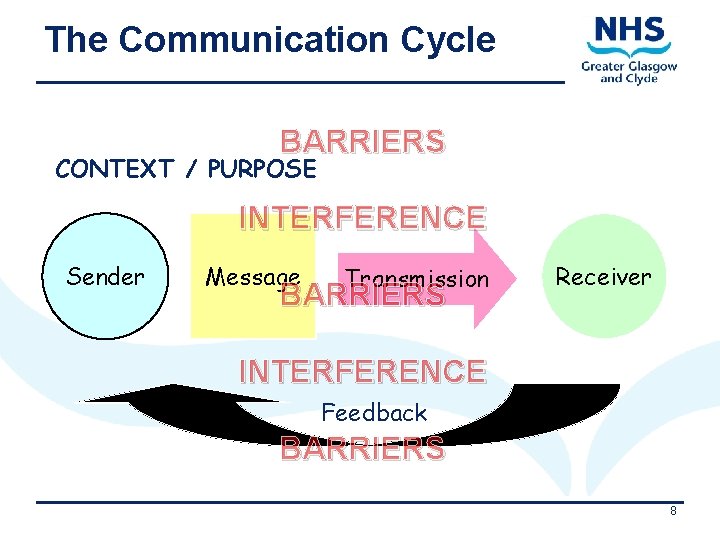
The Communication Cycle BARRIERS CONTEXT / PURPOSE INTERFERENCE Sender Message Transmission BARRIERS Receiver INTERFERENCE Feedback BARRIERS 11/9/2020 8
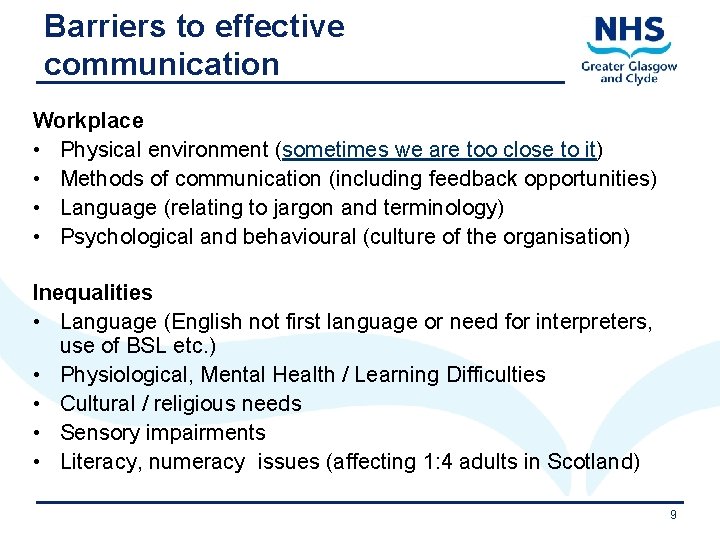
Barriers to effective communication Workplace • Physical environment (sometimes we are too close to it) • Methods of communication (including feedback opportunities) • Language (relating to jargon and terminology) • Psychological and behavioural (culture of the organisation) Inequalities • Language (English not first language or need for interpreters, use of BSL etc. ) • Physiological, Mental Health / Learning Difficulties • Cultural / religious needs • Sensory impairments • Literacy, numeracy issues (affecting 1: 4 adults in Scotland) 11/9/2020 9
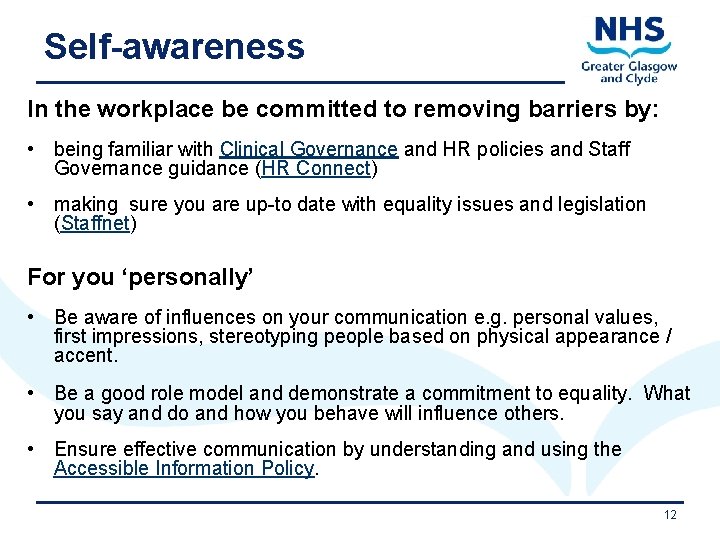
Self-awareness In the workplace be committed to removing barriers by: • being familiar with Clinical Governance and HR policies and Staff Governance guidance (HR Connect) • making sure you are up-to date with equality issues and legislation (Staffnet) For you ‘personally’ • Be aware of influences on your communication e. g. personal values, first impressions, stereotyping people based on physical appearance / accent. • Be a good role model and demonstrate a commitment to equality. What you say and do and how you behave will influence others. • Ensure effective communication by understanding and using the Accessible Information Policy. 11/9/2020 12
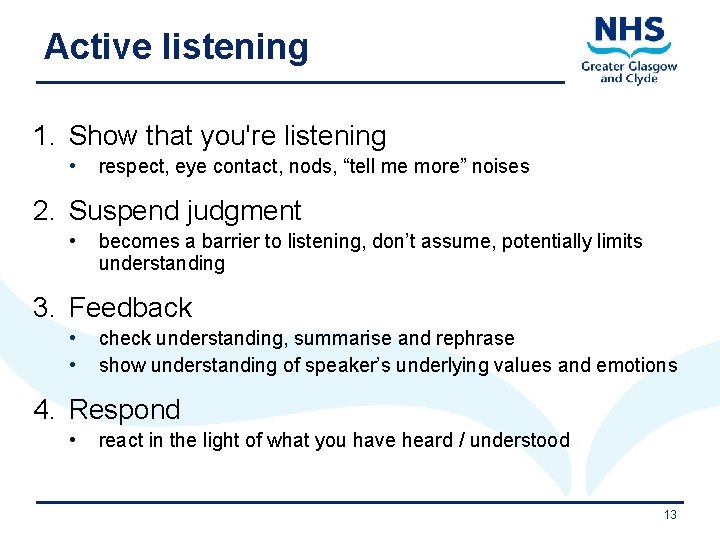
Active listening 1. Show that you're listening • respect, eye contact, nods, “tell me more” noises 2. Suspend judgment • becomes a barrier to listening, don’t assume, potentially limits understanding 3. Feedback • • check understanding, summarise and rephrase show understanding of speaker’s underlying values and emotions 4. Respond • react in the light of what you have heard / understood 11/9/2020 13
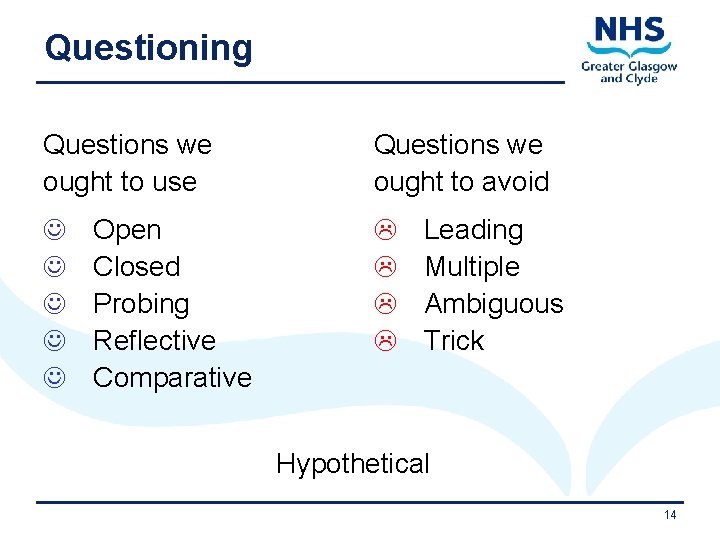
Questioning Questions we ought to use Questions we ought to avoid J Open J Closed J Probing J Reflective J Comparative L Leading L Multiple L Ambiguous L Trick Hypothetical 11/9/2020 14
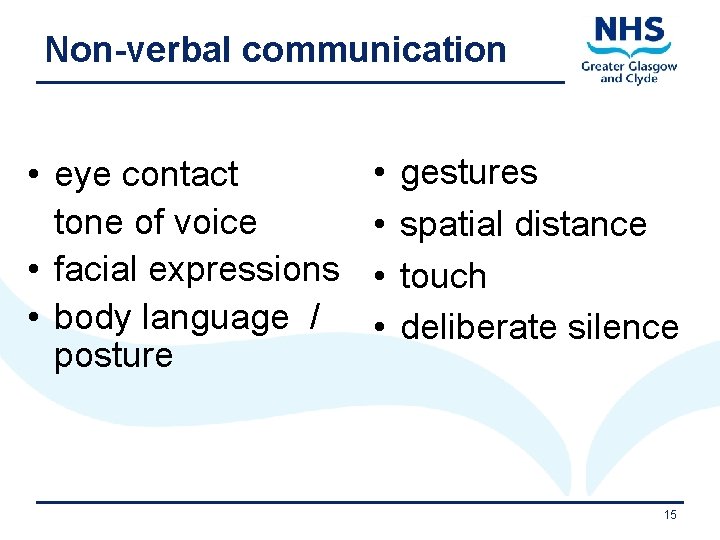
Non-verbal communication • • eye contact tone of voice facial expressions body language / posture 11/9/2020 • • gestures spatial distance touch deliberate silence 15
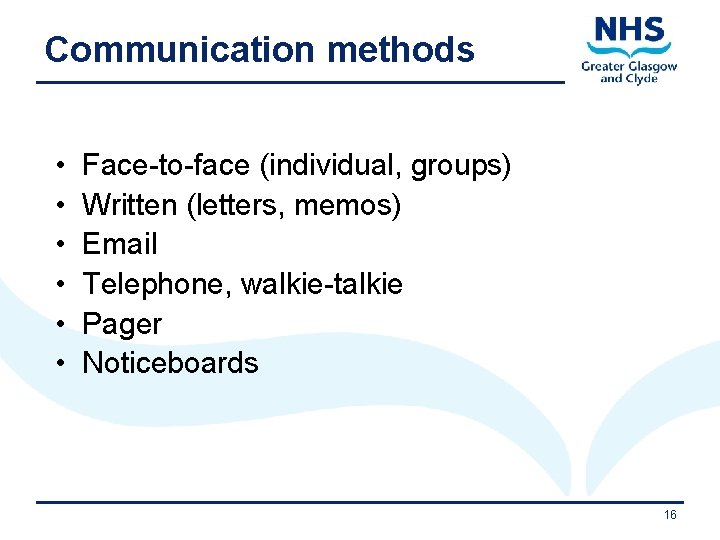
Communication methods • • • Face-to-face (individual, groups) Written (letters, memos) Email Telephone, walkie-talkie Pager Noticeboards 11/9/2020 16
Underpinning principles of good communication • Support equality and diversity • Support the rights of people to communicate in their preferred way, media and language • Are ethical and adhere to codes of practice relevant to your work • Respect other people’s ideas, values and principles • Ensure people’s dignity and rights when overcoming barriers to communication 11/9/2020 17 17
Good Communicators Know what they want to say and why they want to say it Recognise potential barriers Understand others perspective Establish and maintain relationships Ask questions - clarify messages Are active listeners 11/9/2020 18
Self-assessment • Feedback from peers. • Reflective practice, (possibly a journal to help you reflect ‘in and on’ action). • What worked / didn’t work (what did you learn from both)? • Am I doing what the policies / guidelines say? • Am I up-to-date with current developments? • Find out what's available (Staffnet, L&E Calendar or additional training opportunities, link with L&E advisors, look at Learn. Pro modules etc). • Workbook activity and on-line resource 11/9/2020 19
Engaging and communicating with staff • • • 1 -2 -1 Team meetings Huddles Team / Core Brief i. Matter Small Change Matters 11/9/2020 20
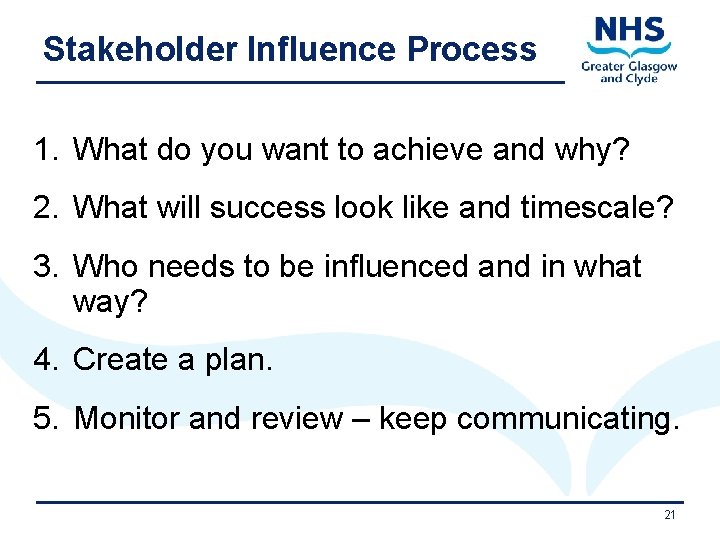
Stakeholder Influence Process 1. What do you want to achieve and why? 2. What will success look like and timescale? 3. Who needs to be influenced and in what way? 4. Create a plan. 5. Monitor and review – keep communicating. 11/9/2020 21
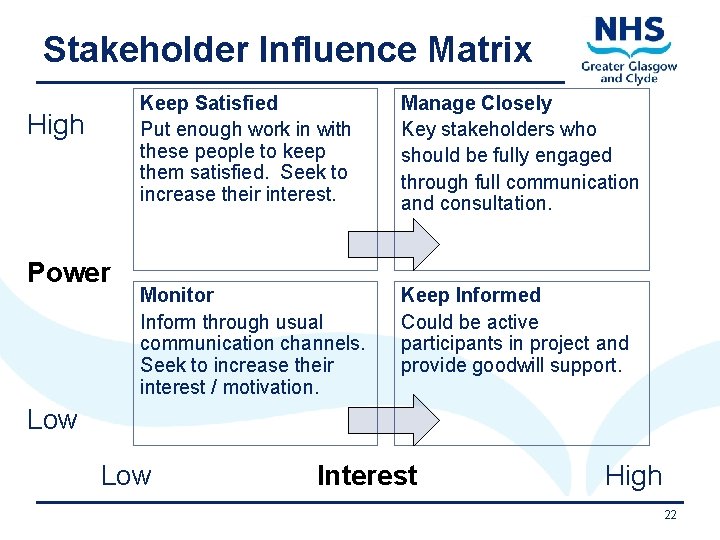
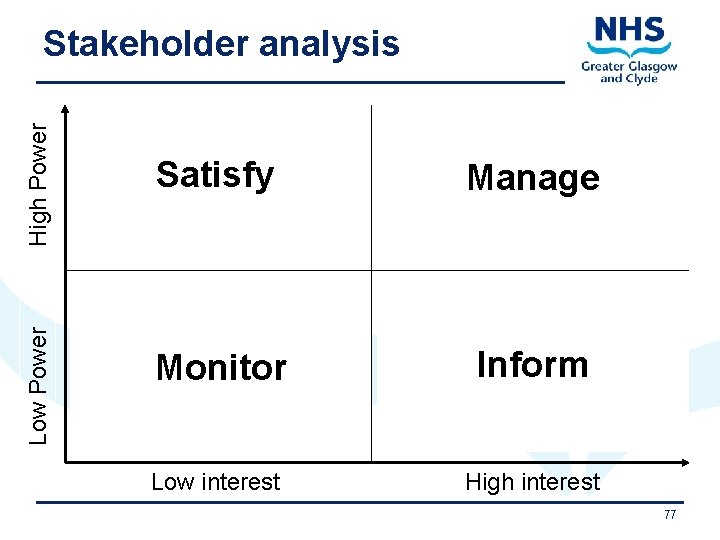
Stakeholder Influence Matrix High Power Keep Satisfied Put enough work in with these people to keep them satisfied. Seek to increase their interest. Manage Closely Key stakeholders who should be fully engaged through full communication and consultation. Monitor Inform through usual communication channels. Seek to increase their interest / motivation. Keep Informed Could be active participants in project and provide goodwill support. Low 11/9/2020 Interest High 22
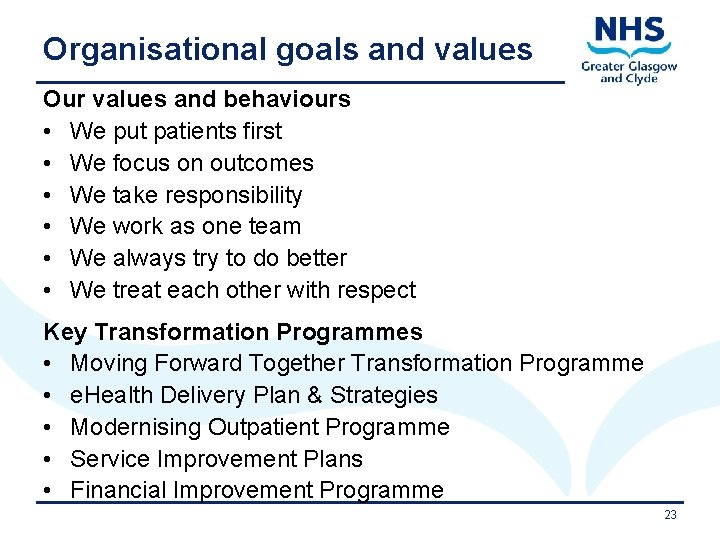
Organisational goals and values Our values and behaviours • We put patients first • We focus on outcomes • We take responsibility • We work as one team • We always try to do better • We treat each other with respect Key Transformation Programmes • Moving Forward Together Transformation Programme • e. Health Delivery Plan & Strategies • Modernising Outpatient Programme • Service Improvement Plans • 11/9/2020 Financial Improvement Programme 23
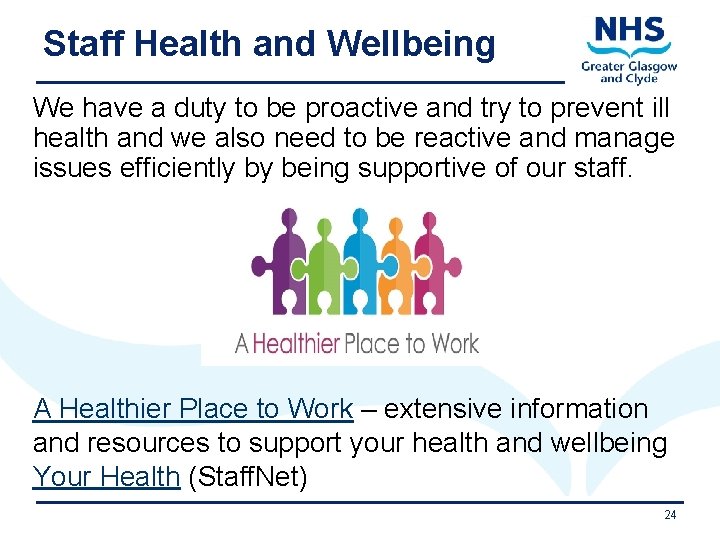
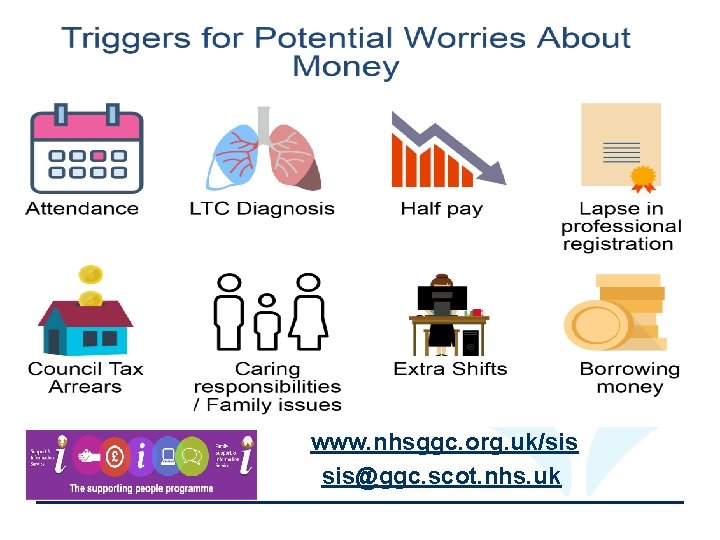
Staff Health and Wellbeing We have a duty to be proactive and try to prevent ill health and we also need to be reactive and manage issues efficiently by being supportive of our staff. A Healthier Place to Work – extensive information and resources to support your health and wellbeing Your Health (Staff. Net) 11/9/2020 24
www. nhsggc. org. uk/sis sis@ggc. scot. nhs. uk 11/9/2020
Activities (Workbook) 11/9/2020 26
Essential Skills for Managers Session 2 Organising and Delegating 11/9/2020 27
Organising and delegating By the end of this session you will, • Recognise importance of shared objectives, team purpose and staff development • Understand key principles of delegation • Be ready to monitor and review delegated activity 11/9/2020 28
Leadership and management – what is the difference? Management • concerned with planning, budgeting, organising, staffing, controlling and problem-solving Leadership • involves establishing direction, aligning people, motivating and inspiring (Kotter 1996). Leadership is the art of motivating people toward a common goal or vision, and management is getting the job done. The King’s Fund report (2011) 11/9/2020 29
What kind of manager are you? 11/9/2020 30
Effective teams • Meaningful, clearly defined task / goal • Clear set of objectives • Team members should have unique and meaningful tasks / roles • Performance of individual team members needs assessment and feedback • Leader should give regular feedback on how well the team is meeting its objectives • Reflect on how well they are achieving the objectives that they have been set or they have set for themselves • Full participation by team members • Communication 11/9/2020 Firth-Cozens, Jenny, (1998) 31
Your team • What are your objectives? Are they shared with the team? • What are your team’s objectives (service provision)? • How will these be achieved? • What resources are available? • Who can do it? • How will you know that objectives have been achieved? 11/9/2020 532
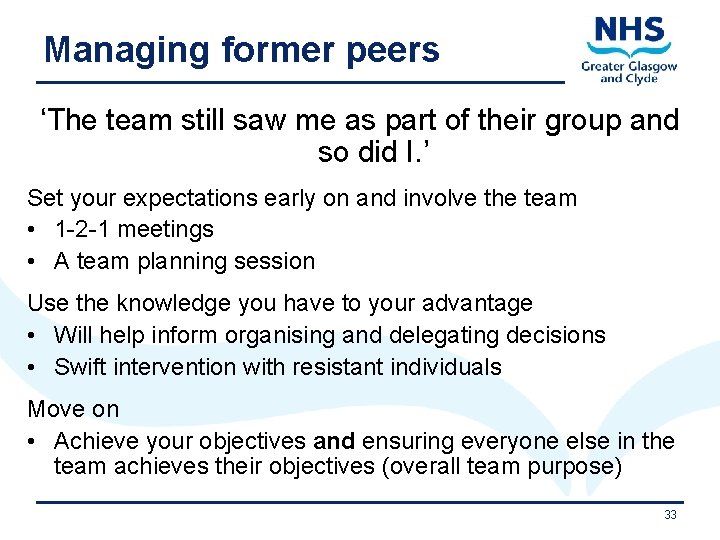
Managing former peers ‘The team still saw me as part of their group and so did I. ’ Set your expectations early on and involve the team • 1 -2 -1 meetings • A team planning session Use the knowledge you have to your advantage • Will help inform organising and delegating decisions • Swift intervention with resistant individuals Move on • Achieve your objectives and ensuring everyone else in the team achieves their objectives (overall team purpose) 11/9/2020 33
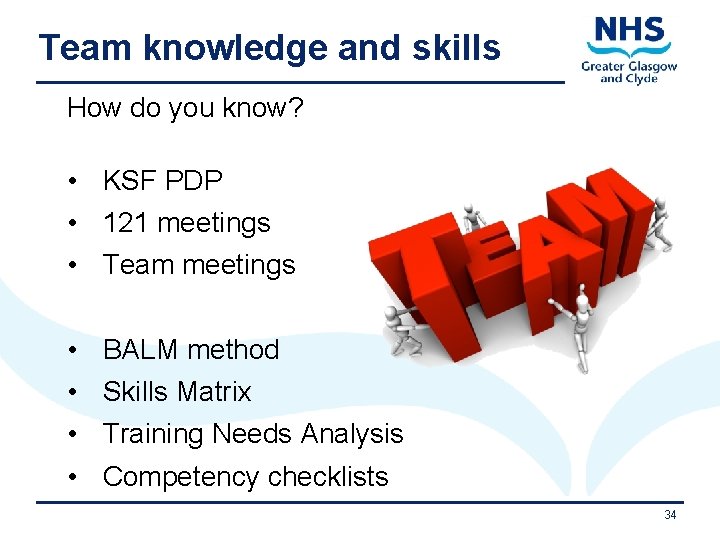
Team knowledge and skills How do you know? • KSF PDP • 121 meetings • Team meetings • • BALM method Skills Matrix Training Needs Analysis Competency checklists 11/9/2020 34
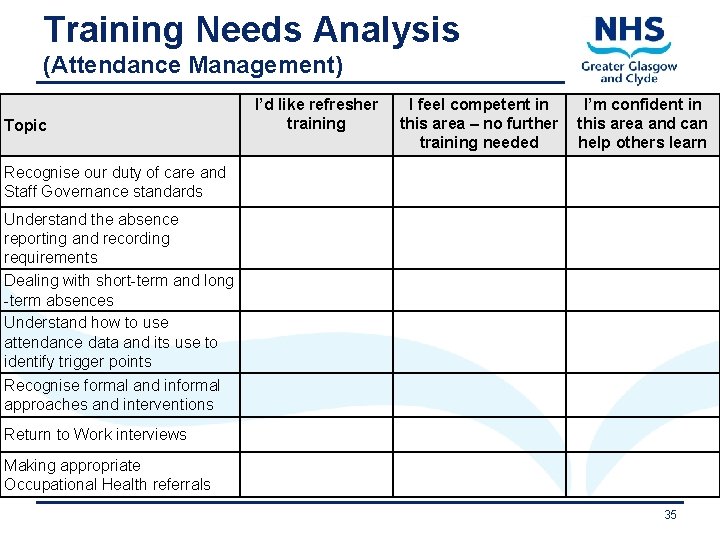
Training Needs Analysis (Attendance Management) I’d like refresher training Topic I feel competent in this area – no further training needed I’m confident in this area and can help others learn Recognise our duty of care and Staff Governance standards Understand the absence reporting and recording requirements Dealing with short-term and long -term absences Understand how to use attendance data and its use to identify trigger points Recognise formal and informal approaches and interventions Return to Work interviews Making appropriate Occupational Health referrals 11/9/2020 35
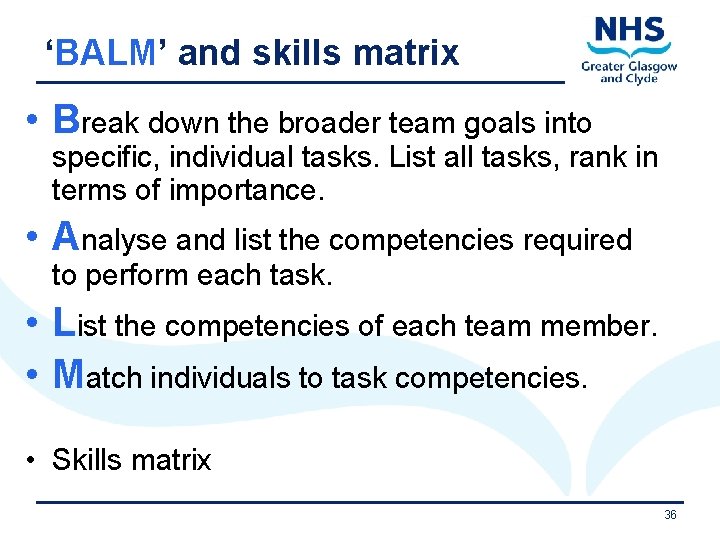
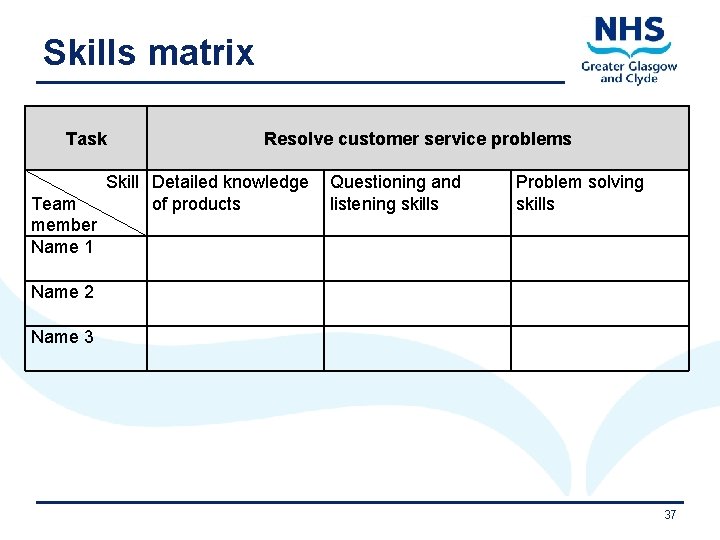
‘BALM’ and skills matrix • Break down the broader team goals into specific, individual tasks. List all tasks, rank in terms of importance. • Analyse and list the competencies required to perform each task. • List the competencies of each team member. • Match individuals to task competencies. • Skills matrix 11/9/2020 36
Skills matrix Task Resolve customer service problems Skill Detailed knowledge Questioning and Team of products listening skills member Name 1 Problem solving skills Name 2 Name 3 11/9/2020 37
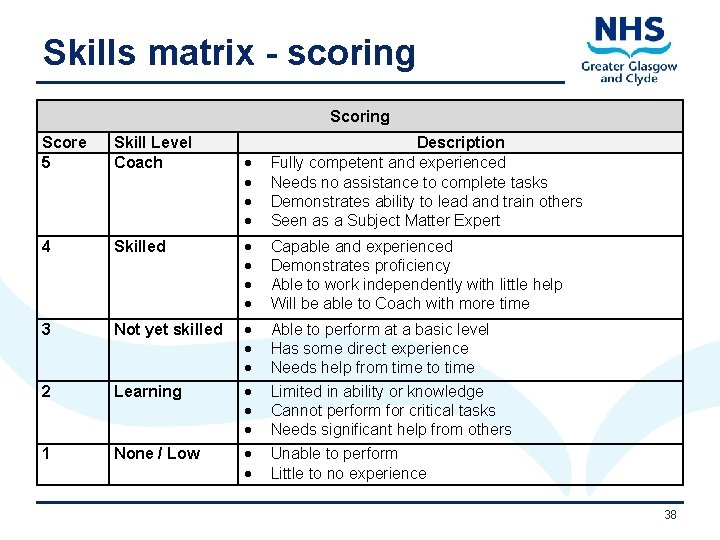
Skills matrix - scoring Score 5 Skill Level Coach Description Fully competent and experienced Needs no assistance to complete tasks Demonstrates ability to lead and train others Seen as a Subject Matter Expert 4 Skilled Capable and experienced Demonstrates proficiency Able to work independently with little help Will be able to Coach with more time 3 Not yet skilled 2 Learning 1 None / Low Able to perform at a basic level Has some direct experience Needs help from time to time Limited in ability or knowledge Cannot perform for critical tasks Needs significant help from others Unable to perform Little to no experience 11/9/2020 38
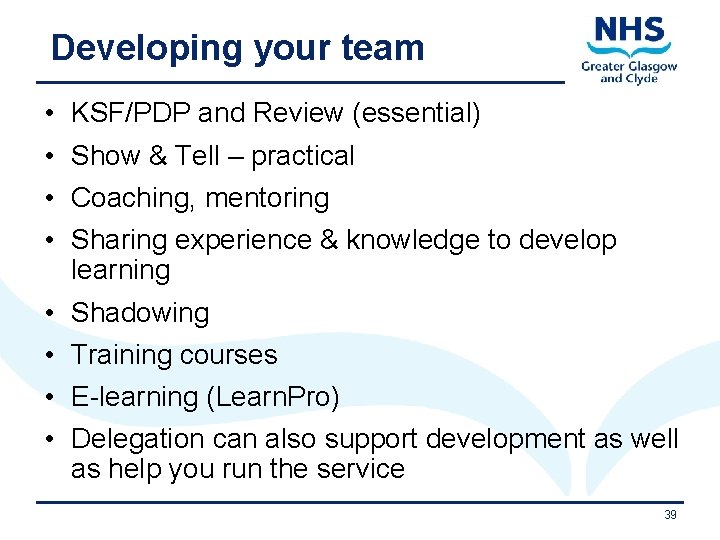
Developing your team • • KSF/PDP and Review (essential) • • Shadowing Show & Tell – practical Coaching, mentoring Sharing experience & knowledge to develop learning Training courses E-learning (Learn. Pro) Delegation can also support development as well as help you run the service 11/9/2020 939
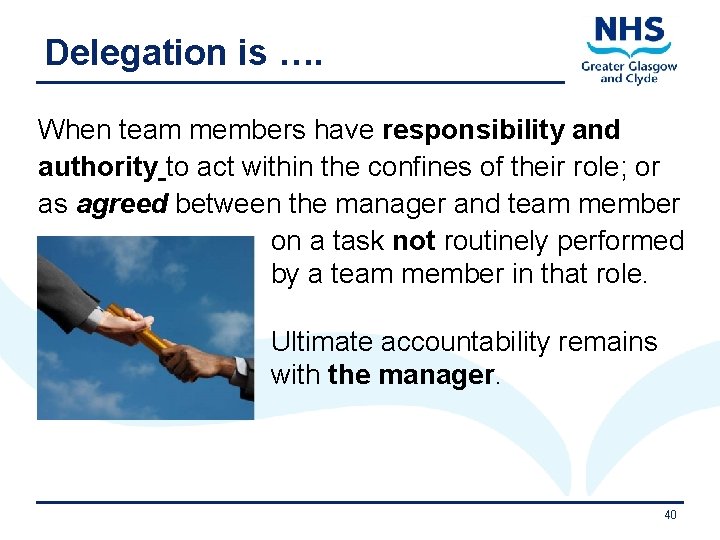
Delegation is …. When team members have responsibility and authority to act within the confines of their role; or as agreed between the manager and team member on a task not routinely performed by a team member in that role. Ultimate accountability remains with the manager. 11/9/2020 40
Delegation • What are the advantages of delegation? • What are the barriers to delegation? 11/9/2020 1541
Advantages of delegation • Relieves you of routine and less critical tasks • Allows you to plan for the future rather than organise for the present • Encourages decision-making • Increases motivation • Develops the capacity of staff 11/9/2020 1642
Barriers to delegation ‘If you want a job done properly, do it yourself. ’ • • • It’s my job What to delegate? Time to explain Will it be done right? They might do it better than me • Information is power • Personalities 11/9/2020 • It’s too risky • But I enjoy doing it myself • I like to be on top of everything. If I delegate work I’ll lose some of this contact • They might not like me for giving them work. 43
Suitable for delegation • Routine tasks • Time consuming tasks • Specialist tasks 11/9/2020 44 20
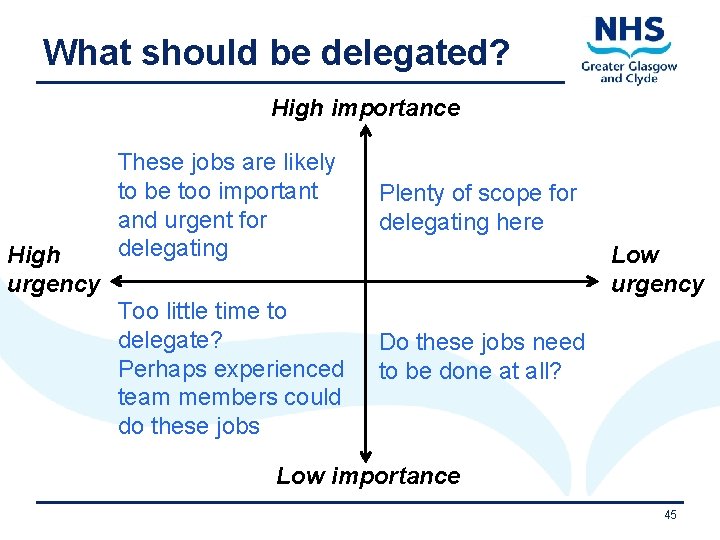
What should be delegated? High importance High urgency These jobs are likely to be too important and urgent for delegating Too little time to delegate? Perhaps experienced team members could do these jobs Plenty of scope for delegating here Low urgency Do these jobs need to be done at all? Low importance 11/9/2020 45
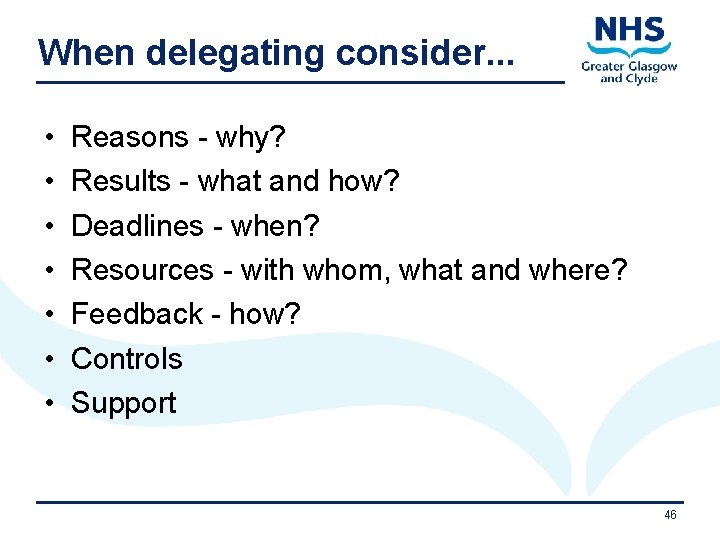
When delegating consider. . . • • Reasons - why? Results - what and how? Deadlines - when? Resources - with whom, what and where? Feedback - how? Controls Support 11/9/2020 46 21
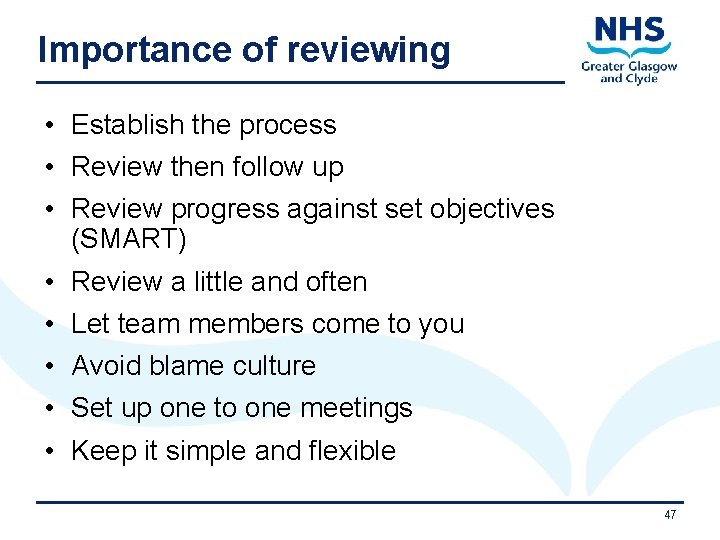
Importance of reviewing • Establish the process • Review then follow up • Review progress against set objectives (SMART) • Review a little and often • Let team members come to you • Avoid blame culture • Set up one to one meetings • Keep it simple and flexible 11/9/2020 47
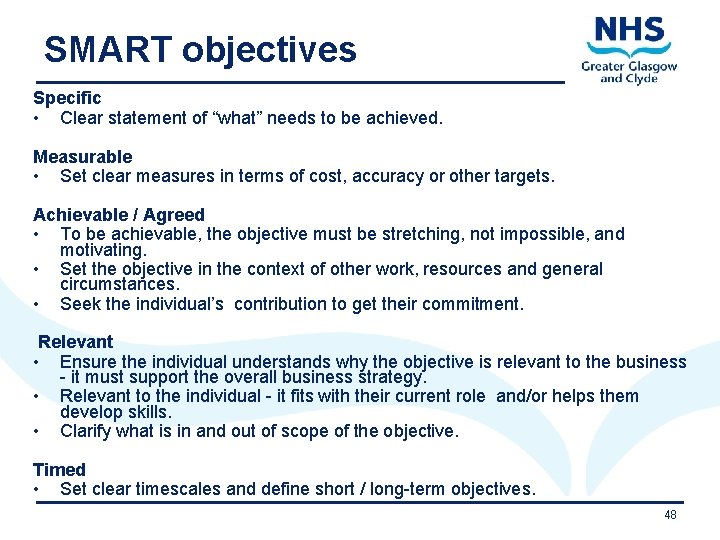
SMART objectives Specific • Clear statement of “what” needs to be achieved. Measurable • Set clear measures in terms of cost, accuracy or other targets. Achievable / Agreed • To be achievable, the objective must be stretching, not impossible, and motivating. • Set the objective in the context of other work, resources and general circumstances. • Seek the individual’s contribution to get their commitment. Relevant • Ensure the individual understands why the objective is relevant to the business - it must support the overall business strategy. • Relevant to the individual - it fits with their current role and/or helps them develop skills. • Clarify what is in and out of scope of the objective. Timed • Set clear timescales and define short / long-term objectives. 11/9/2020 48
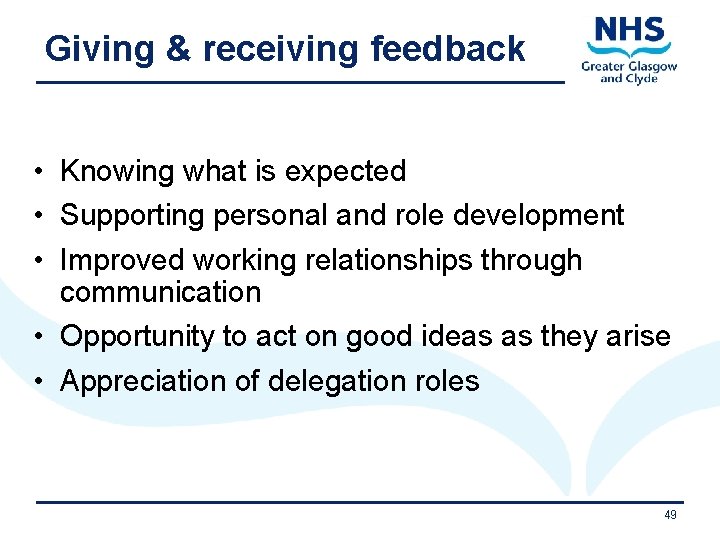
Giving & receiving feedback • Knowing what is expected • Supporting personal and role development • Improved working relationships through communication • Opportunity to act on good ideas as they arise • Appreciation of delegation roles 11/9/2020 49 25
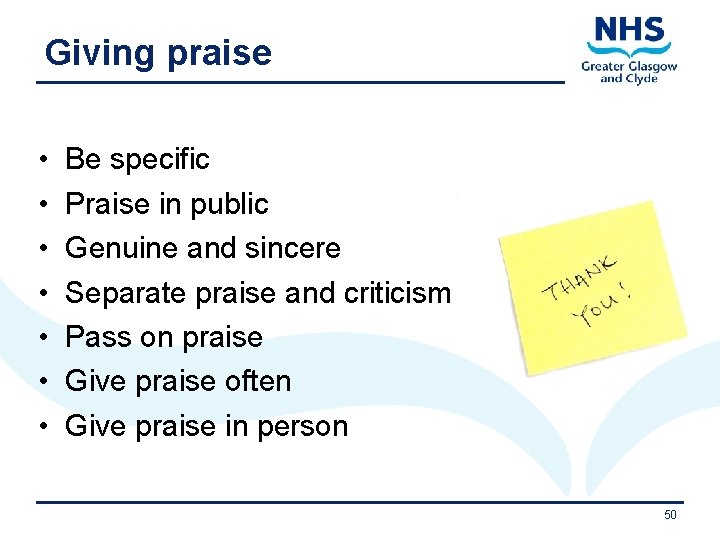
Giving praise • • Be specific Praise in public Genuine and sincere Separate praise and criticism Pass on praise Give praise often Give praise in person 11/9/2020 50 27
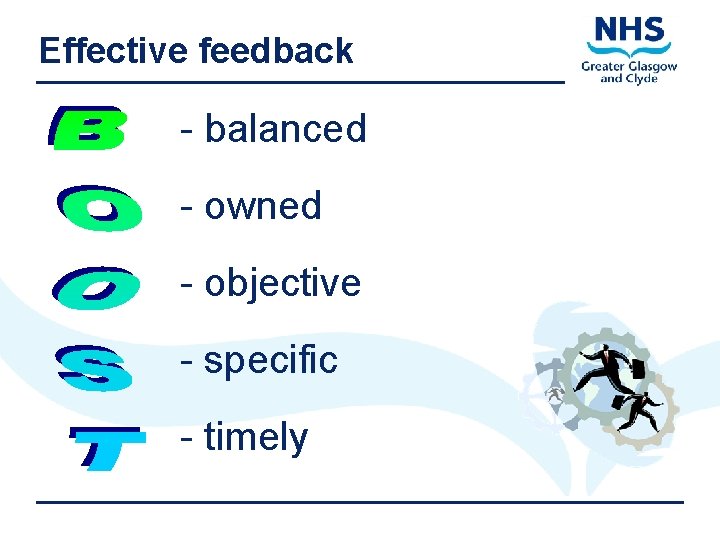
Effective feedback - balanced - owned - objective - specific - timely 11/9/2020 • 28
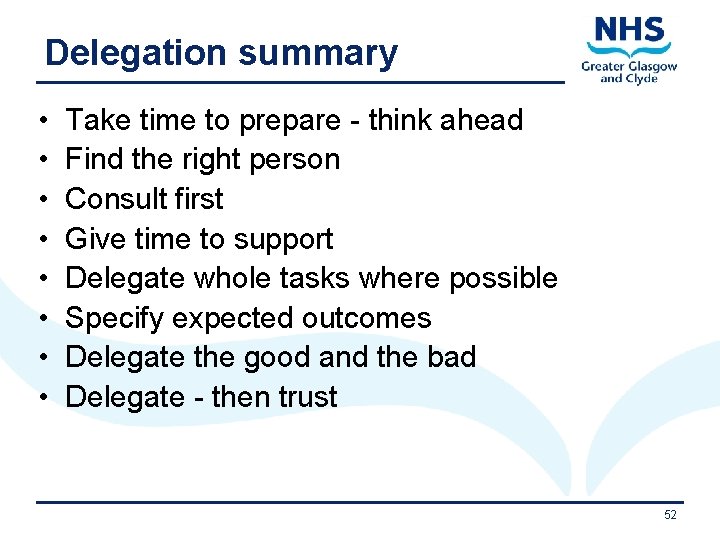
Delegation summary • • Take time to prepare - think ahead Find the right person Consult first Give time to support Delegate whole tasks where possible Specify expected outcomes Delegate the good and the bad Delegate - then trust 11/9/2020 29 52
Activities (Workbook) 11/9/2020 53
Essential Skills for Managers Day 2 You and the service you manage 11/9/2020 54
Essential Skills for Managers Session 3 Managing Change 11/9/2020 55
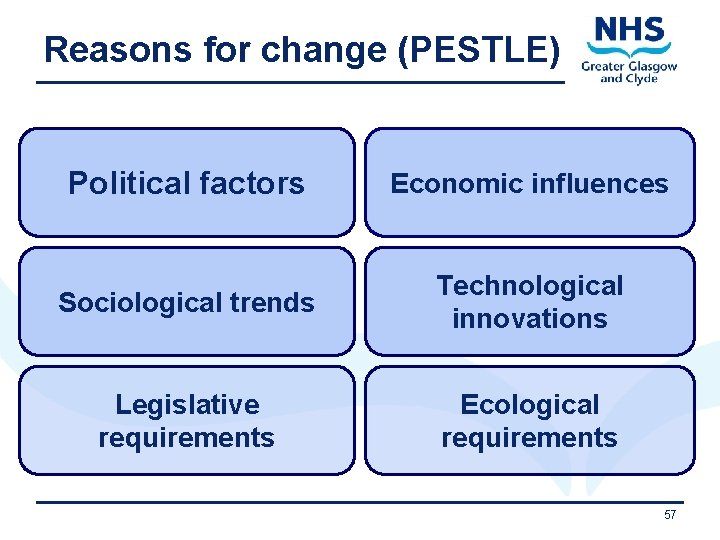
Managing change By the end of this session you will, • Understand the forces for change in an organisation and common barriers • Recognise and know how to apply key principles of change management • Recognise and be ready to use a range of tools to support the management of change 11/9/2020 56
Reasons for change (PESTLE) Political factors Economic influences Sociological trends Technological innovations Legislative requirements Ecological requirements 11/9/2020 57
What is change management? • Identifying and understanding the various natural barriers to change in organisations. • Producing practical strategies to move through these more quickly. • Enabling faster more sustainable change in the longer term. What is your experience of the implementation of change in your area of the organisation? • What has worked well? • What have been the issues ? 11/9/2020 58
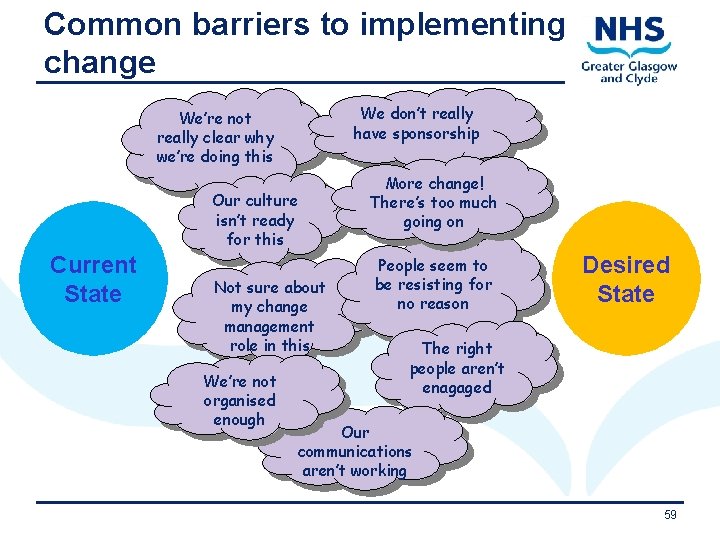
Common barriers to implementing change We don’t really have sponsorship We’re not really clear why we’re doing this Our culture isn’t ready for this Current State Not sure about my change management role in this We’re not organised enough 11/9/2020 More change! There’s too much going on People seem to be resisting for no reason Desired State The right people aren’t enagaged Our communications aren’t working 59
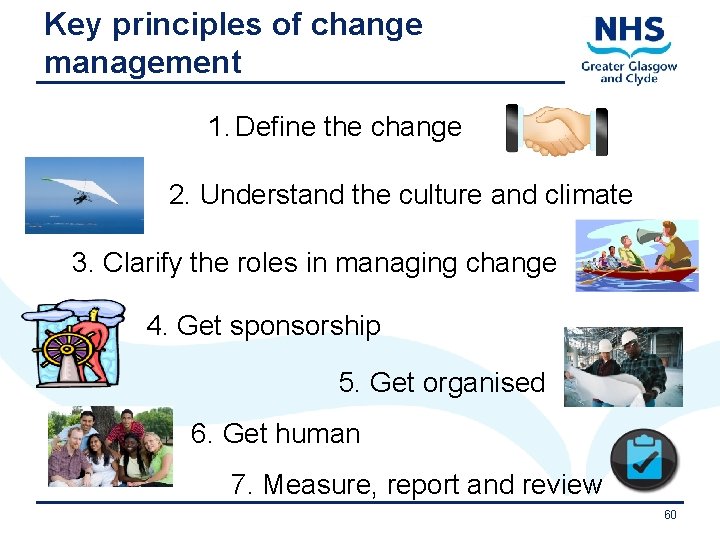
Key principles of change management 1. Define the change 2. Understand the culture and climate 3. Clarify the roles in managing change 4. Get sponsorship 5. Get organised 6. Get human 11/9/2020 7. Measure, report and review 60
1. Define the change Clear vision – exactly what and why, when, how, plan. Impact – who will this impact on and in what way. How will this impact be managed. NB Partnership working – early involvement of union and/or professional bodies is strongly advised. Benefits - and costs. Involvement – who needs to be involved and when. Identify a sponsor. Risk management - Agreement – between sponsor and change agents. Communication – at all stages 11/9/2020
Financial factors • Budget • Savings • Development costs (one-off) • Operational costs (recurring) 11/9/2020 62
Communicating Change • Majority of employees report major organisational change ongoing • Employees not generally hostile but major change e. g. leading to redundancy causes negative attitude • Change is reportedly badly managed • Employees trust has declined making change more difficult to manage ‘Users, management and other stakeholders will demand honest, consistent and up to date information whether the news is good, bad or unremarkable. ’ CIPD report 11/9/2020 63
Communication strategy • Who (audiences) – directly and indirectly affected (includes reporting progress) • What and Why (message) – raise awareness, explain purpose, provide information, promote benefits, encourage support, meet statutory / mandatory requirements, show progress – recognise culture and climate • When (timing) – consistent, throughout the process, key element of any project plan (timeline) • Who (messengers) – consider most appropriate source for each communication e. g. sponsor, change agent, champion • How (methods) – Meetings / events (local, central), flyers, email, letters, notice boards, 1 -to-1, change agents 11/9/2020 64
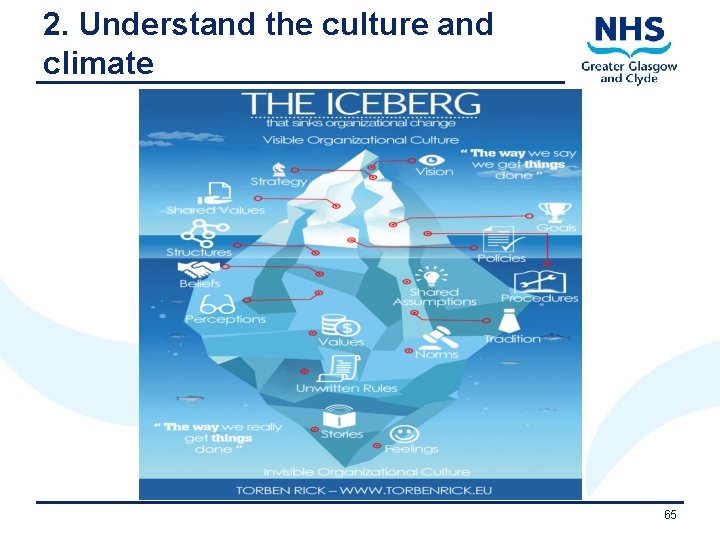
2. Understand the culture and climate 11/9/2020 65
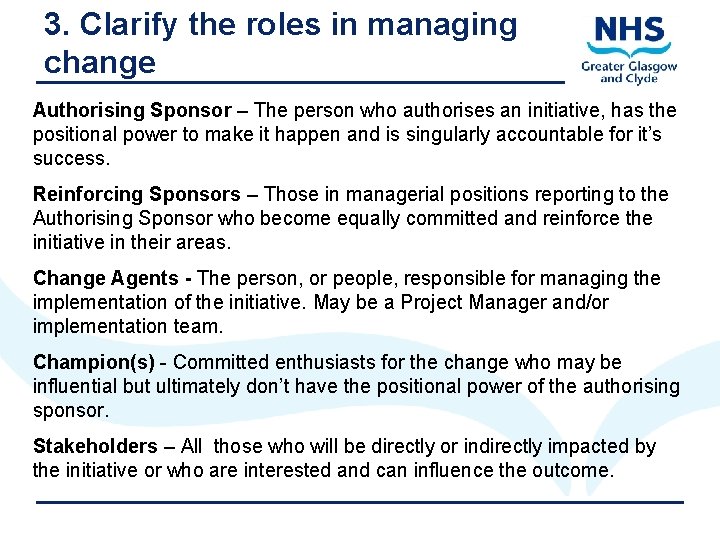
3. Clarify the roles in managing change Authorising Sponsor – The person who authorises an initiative, has the positional power to make it happen and is singularly accountable for it’s success. Reinforcing Sponsors – Those in managerial positions reporting to the Authorising Sponsor who become equally committed and reinforce the initiative in their areas. Change Agents - The person, or people, responsible for managing the implementation of the initiative. May be a Project Manager and/or implementation team. Champion(s) - Committed enthusiasts for the change who may be influential but ultimately don’t have the positional power of the authorising sponsor. Stakeholders – All those who will be directly or indirectly impacted by the initiative or who are interested and can influence the outcome. 11/9/2020
Involving others • What needs to be done? • Who do you need to involve? • What support will they require? • How will you get them on board? • At what stages do you need their input? 11/9/2020 67
4. Get sponsorship Authorising Sponsor Rule of Thumb – The person at the lowest point in the organisation to which all impacted employees report. The authorising sponsors role: • Agrees and authorises the definition and scope of the change initiative. • Appoints the right change agent(s). • Releases required resources. (budget, people, facilities etc. ) • Defines and applies the appropriate change strategy. • Sets progress targets for the change. • Authorises other key support required (functional, technical) • Builds commitment amongst ‘reinforcing sponsors’. (Express, Model, Reinforce) • Steers and motivates the Change Agents. • Monitors and reviews progress of the initiative and the benefits/outcomes against target. 11/9/2020
5. Get organised Implementation Structure – Steering Group. Project team. Wider projects may also need local implementation groups. Involvement of other functions – Professional, HR, L&E, Finance, Planning, IT, OD, Communications Planning – Larger projects may require activities to be split into workstreams where more detailed planning may sit. Identify workstream leads, milestones and critical path. Issues and risks log for larger projects. 11/9/2020
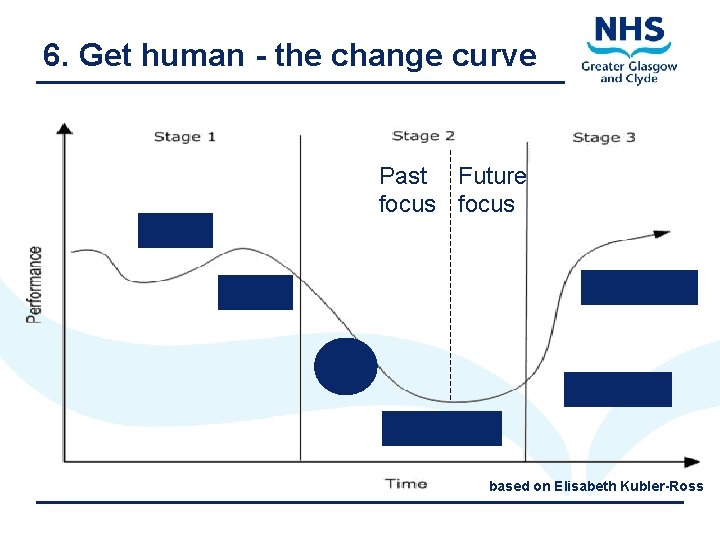
6. Get human - the change curve Past Future focus based on Elisabeth Kubler-Ross 11/9/2020
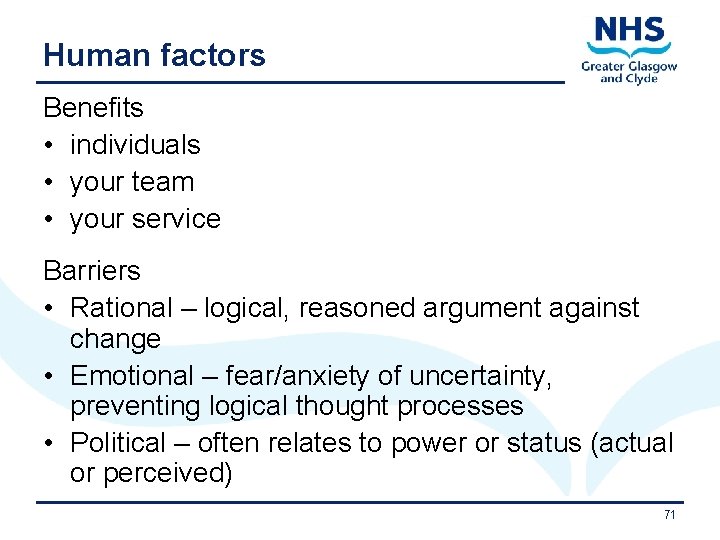
Human factors Benefits • individuals • your team • your service Barriers • Rational – logical, reasoned argument against change • Emotional – fear/anxiety of uncertainty, preventing logical thought processes • Political – often relates to power or status (actual or perceived) 11/9/2020 71
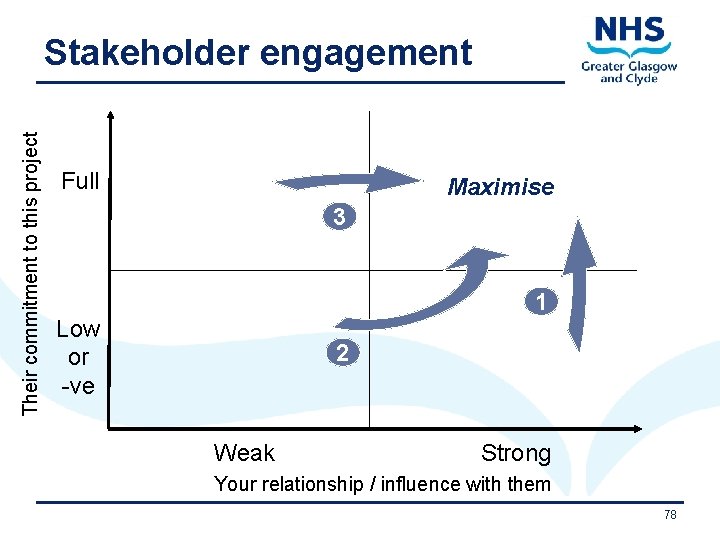
7. Measure, report and review Stakeholder Analysis – Identify key stakeholder groups and individuals and assess to what extent they have committed to the change vs where you need them to be. Is commitment moving in the right direction? Are the changes being adopted? Deliverables and outcomes – Important that deliverables are being progressed as planned but more importantly are the desired outcomes being achieved? Make sure the right measures and review processes are in place. Reporting – Typically this is progress reporting and escalating issues and risks to the authorising sponsor and steering group. Also, progress and highlights to wider stakeholders. Define who needs to know what and when. 11/9/2020 72
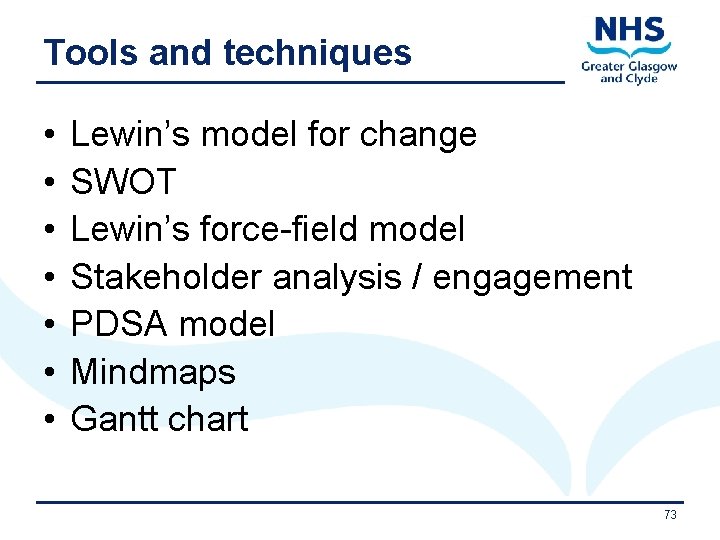
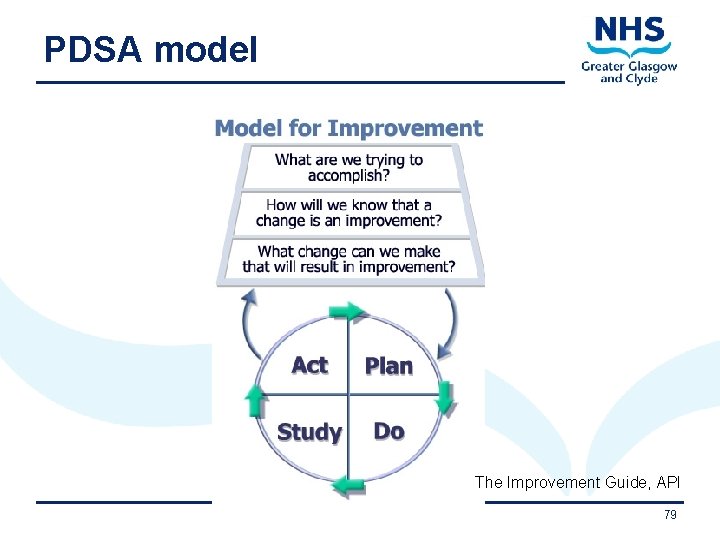
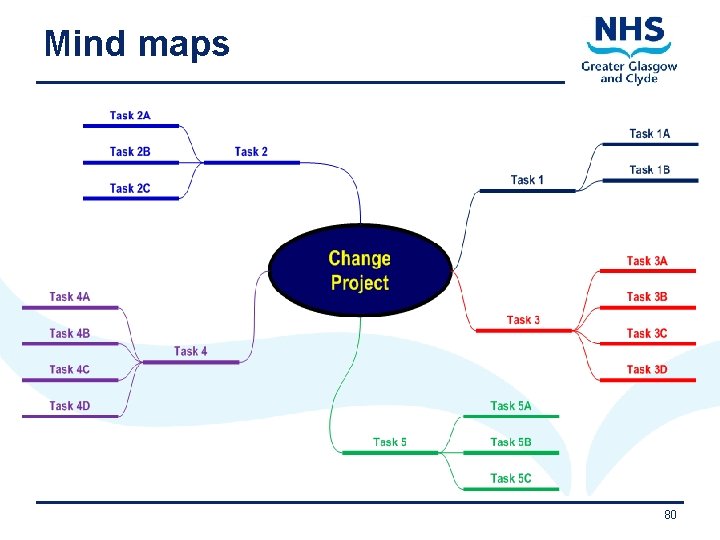
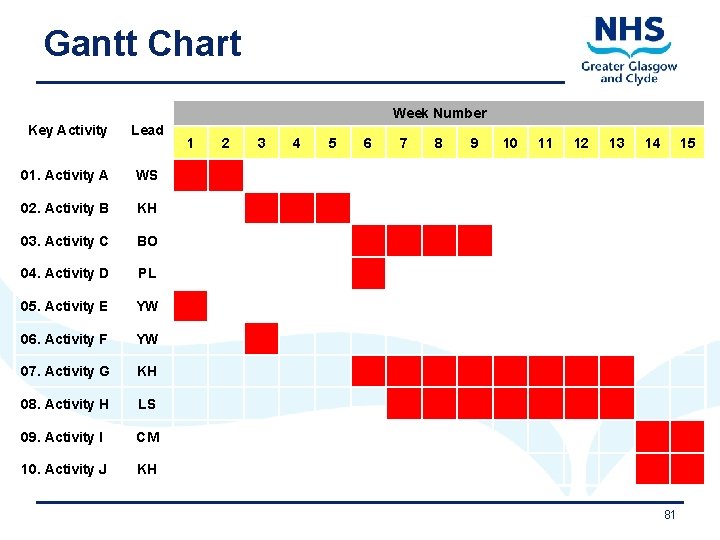
Tools and techniques • • Lewin’s model for change SWOT Lewin’s force-field model Stakeholder analysis / engagement PDSA model Mindmaps Gantt chart 11/9/2020 73
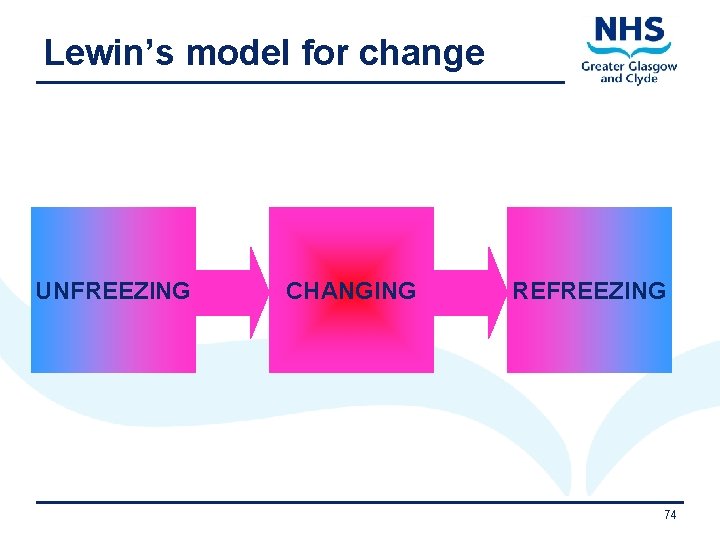
Lewin’s model for change UNFREEZING 11/9/2020 CHANGING REFREEZING 74
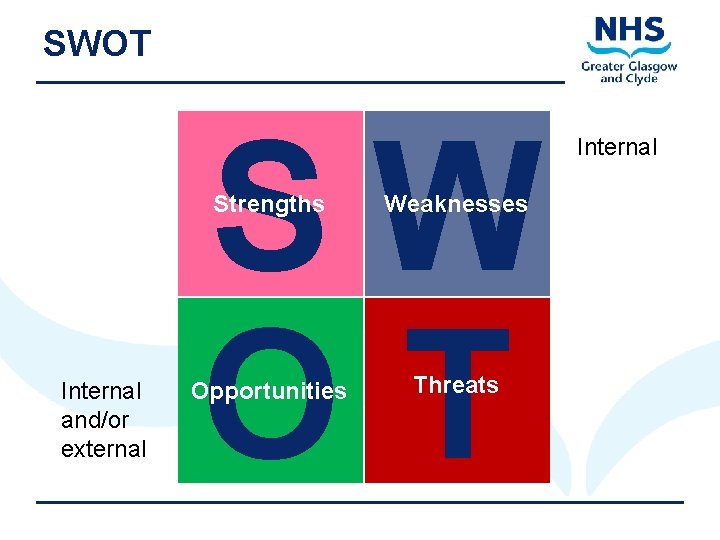
SWOT Internal and/or external 11/9/2020 SW OT Strengths Weaknesses Opportunities Threats Internal
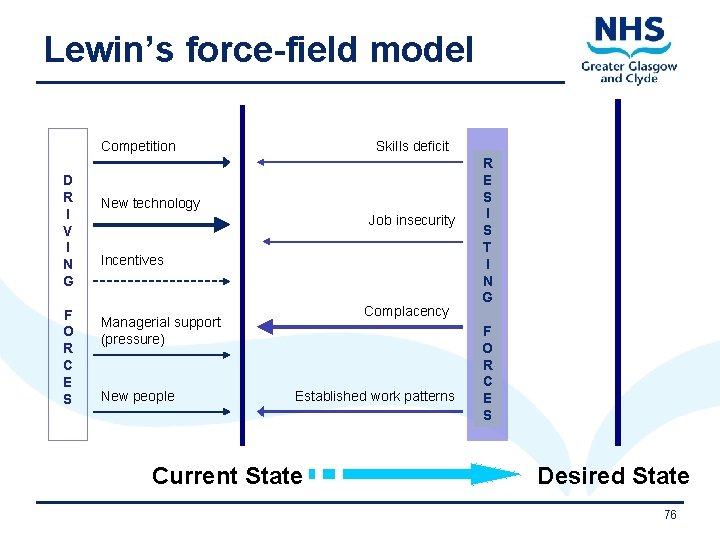
Lewin’s force-field model Competition D R I V I N G F O R C E S Skills deficit New technology Job insecurity Incentives Complacency Managerial support (pressure) New people Established work patterns Current State 11/9/2020 R E S I S T I N G F O R C E S Desired State 76
Low Power High Power Stakeholder analysis Opinion formers. Keep them satisfied Satisfy with what is happening and review your analysis of their position regularly. Key stakeholders who should be fully engaged Manage through full communication and consultation. This group requires the least effort if time and Monitor resources are stretched. Patients often fall into this category. It may be helpful to take steps to increase their influence by organising them into groups or active consultative work. Low interest High interest 11/9/2020 Inform 77
Their commitment to this project Stakeholder engagement Full Maximise 3 1 Low or -ve 2 Weak Strong Your relationship / influence with them 11/9/2020 78
PDSA model The Improvement Guide, API 11/9/2020 79
Mind maps 11/9/2020 80
Gantt Chart Week Number Key Activity Lead 01. Activity A WS 02. Activity B KH 03. Activity C BO 04. Activity D PL 05. Activity E YW 06. Activity F YW 07. Activity G KH 08. Activity H LS 09. Activity I CM 10. Activity J KH 11/9/2020 1 2 3 4 5 6 7 8 9 10 11 12 13 14 15 81
Activities (Workbook) 11/9/2020 82
Essential Skills for Managers Session 4 Problem Solving and Decision Making 11/9/2020 83
Problem solving and decision making By the end of this session you will, • understand the value of adopting a culture of improvement • recognise a range of tools and techniques that support problem solving and decision making • be ready to use a 6 -step approach to problem solving 11/9/2020 84
What counts as a problem? Deviation - where something has gone wrong and corrective action is needed e. g. equipment malfunction, absence within the team, complaint. Potential - where problems may be arising for the future and preventive action is needed e. g. growing staff turnover, increased demand on current resources. Improvement - where problems centre on how to be more productive, efficient and responsive in the future e. g. installing a new system, changes procedures to meet new standards. 11/9/2020 85
Improvement Quality Improvement "The combined and unceasing efforts of everyone to make the changes that will lead to better patient outcomes (health), better system performance (care) and better professional development (learning)". (Batalden and Davidoff, 2007). Continuous Improvement A method for identifying opportunities for streamlining work and reducing waste. 11/9/2020 86
Common mistakes • Tackling the ‘wrong’ problem • Making assumptions • Jumping to solutions • Failing to seek expert advice 11/9/2020 87
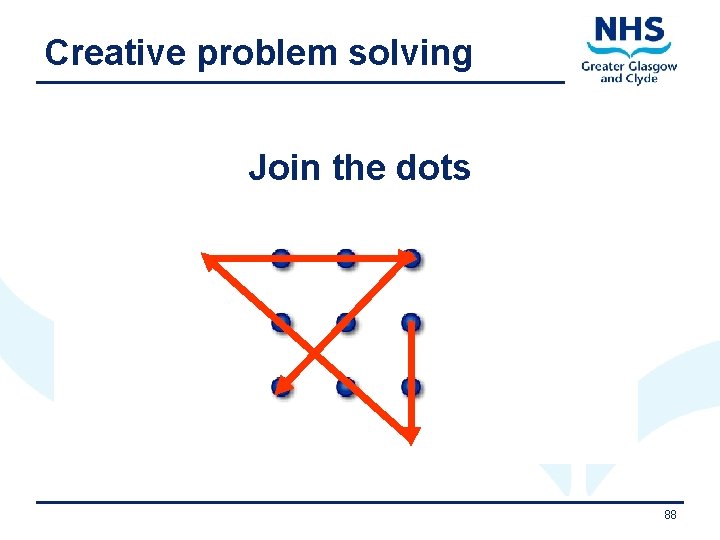
Creative problem solving Join the dots 11/9/2020 88
Systematic approach – Step 1 Identify the problem 11/9/2020 89
Step 1 – Identify the problem 1. How do you know there is a problem? 2. What is the impact of the problem? 3. Is the problem stated objectively? 4. What is the scope of the problem? 5. Is there an implied solution in your problem or goal statement that you need to remove? 11/9/2020 90
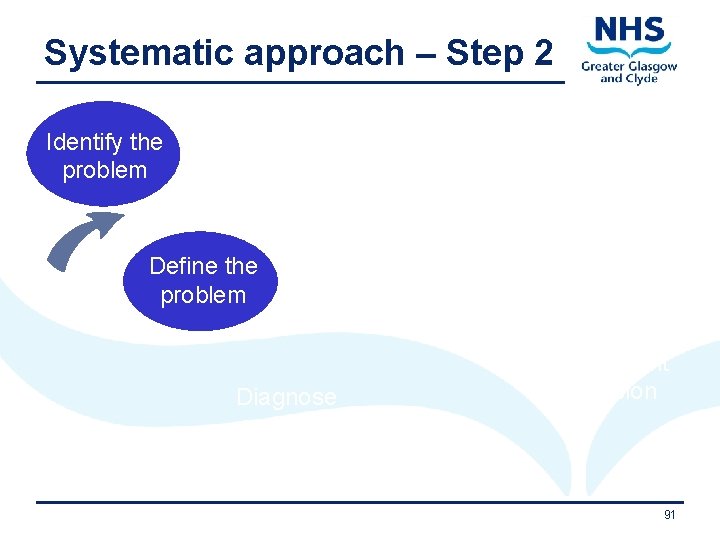
Systematic approach – Step 2 Identify the problem Choose best option Define the problem Diagnose cause(s) 11/9/2020 Generate solutions Implement decision 91
Step 2 – Define the problem A. Involve stakeholders B. Gather and analyse information C. Talk with people who are familiar with the problem D. Clarify what it is / is not - problem definition tool 11/9/2020 92
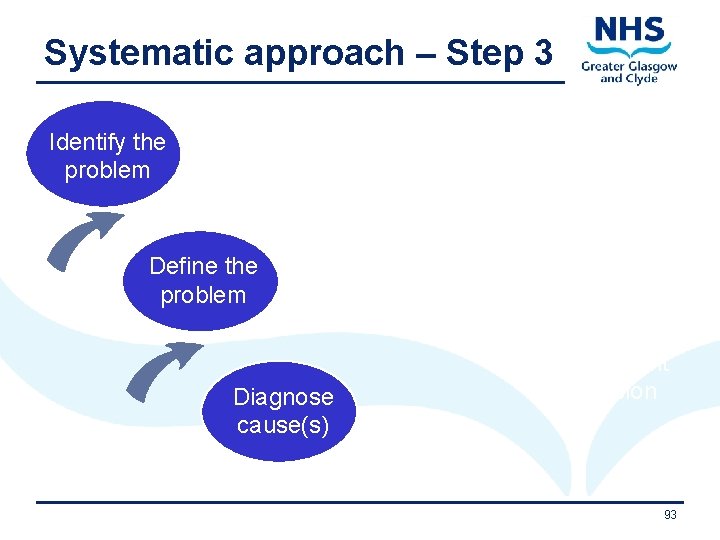
Systematic approach – Step 3 Identify the problem Choose best option Define the problem Diagnose cause(s) 11/9/2020 Generate solutions Implement decision 93
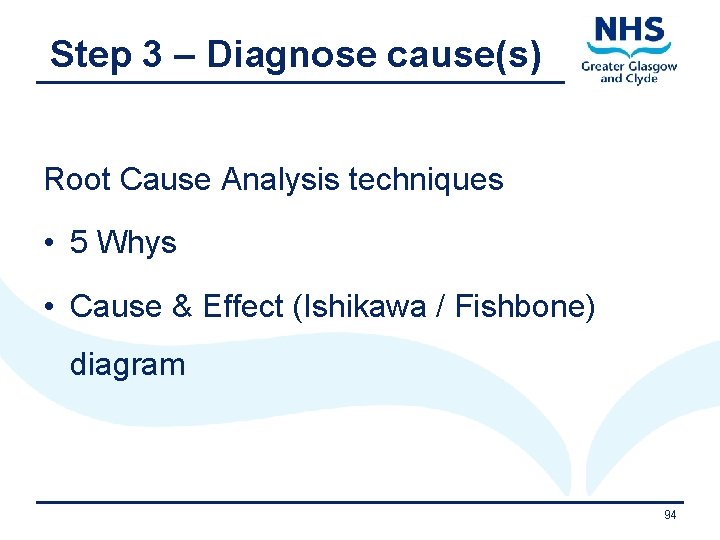
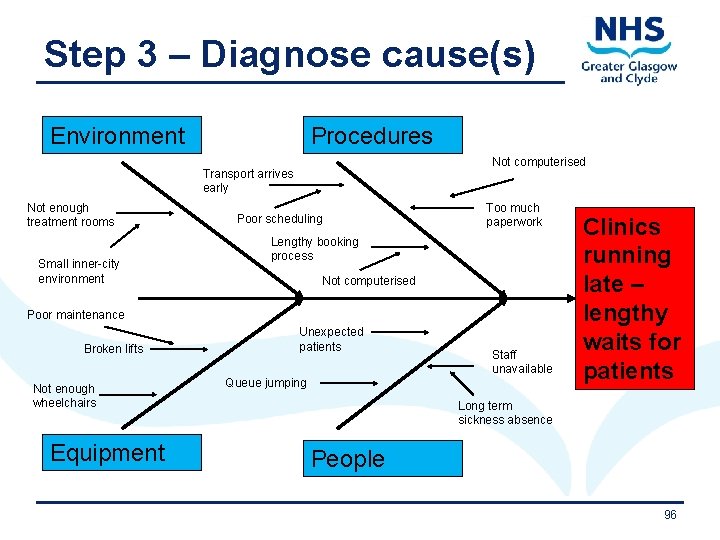
Step 3 – Diagnose cause(s) Root Cause Analysis techniques • 5 Whys • Cause & Effect (Ishikawa / Fishbone) diagram 11/9/2020 94
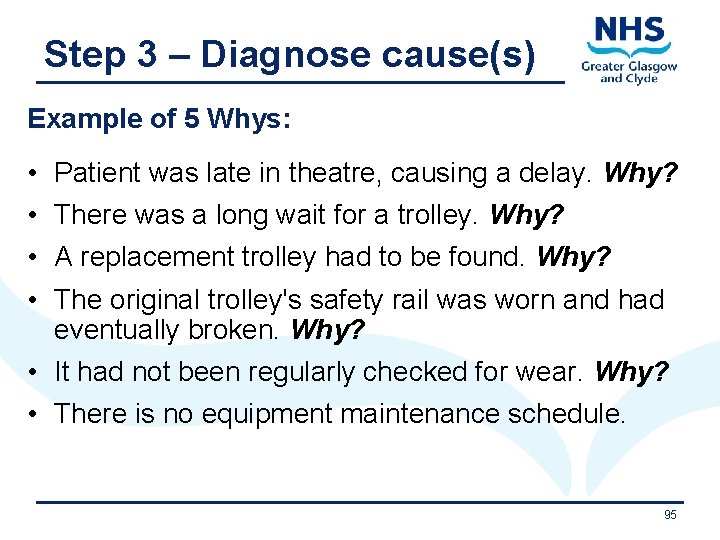
Step 3 – Diagnose cause(s) Example of 5 Whys: • • Patient was late in theatre, causing a delay. Why? There was a long wait for a trolley. Why? A replacement trolley had to be found. Why? The original trolley's safety rail was worn and had eventually broken. Why? • It had not been regularly checked for wear. Why? • There is no equipment maintenance schedule. 11/9/2020 95
Step 3 – Diagnose cause(s) Environment Procedures Not computerised Transport arrives early Not enough treatment rooms Small inner-city environment Poor scheduling Too much paperwork Lengthy booking process Not computerised Poor maintenance Broken lifts Not enough wheelchairs Equipment 11/9/2020 Unexpected patients Staff unavailable Queue jumping Clinics running late – lengthy waits for patients Long term sickness absence People 96
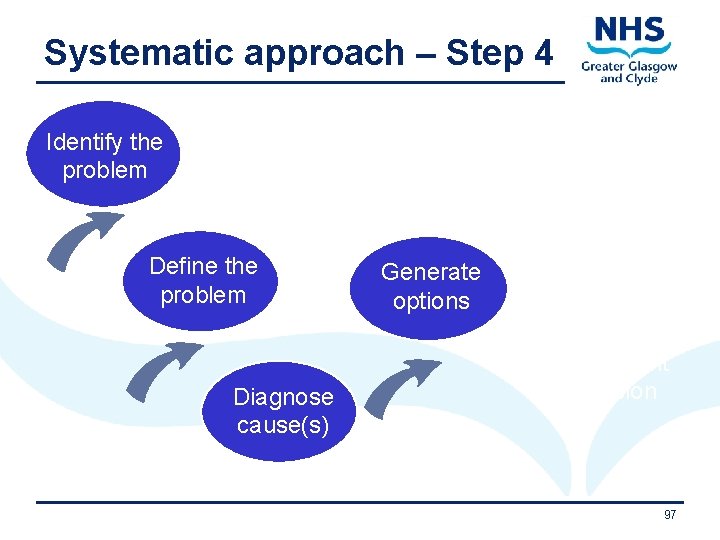
Systematic approach – Step 4 Identify the problem Choose best option Define the problem Diagnose cause(s) 11/9/2020 Generate options Implement decision 97
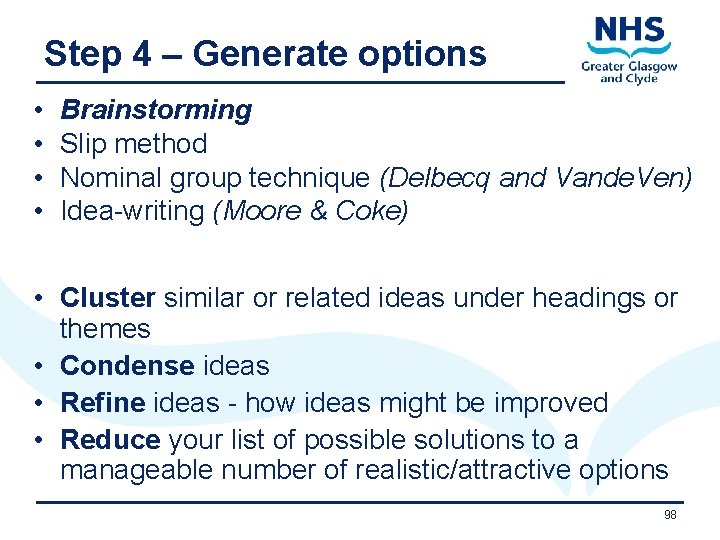
Step 4 – Generate options • • Brainstorming Slip method Nominal group technique (Delbecq and Vande. Ven) Idea-writing (Moore & Coke) • Cluster similar or related ideas under headings or themes • Condense ideas • Refine ideas - how ideas might be improved • Reduce your list of possible solutions to a manageable number of realistic/attractive options 11/9/2020 98
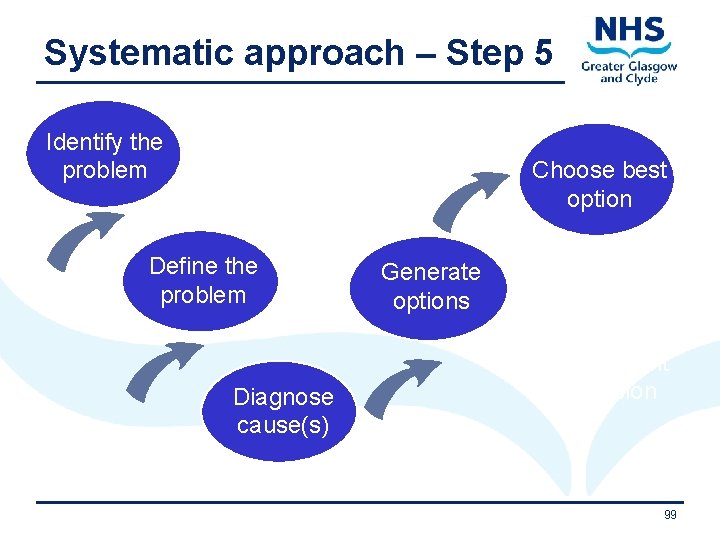
Systematic approach – Step 5 Identify the problem Choose best option Define the problem Diagnose cause(s) 11/9/2020 Generate options Implement decision 99
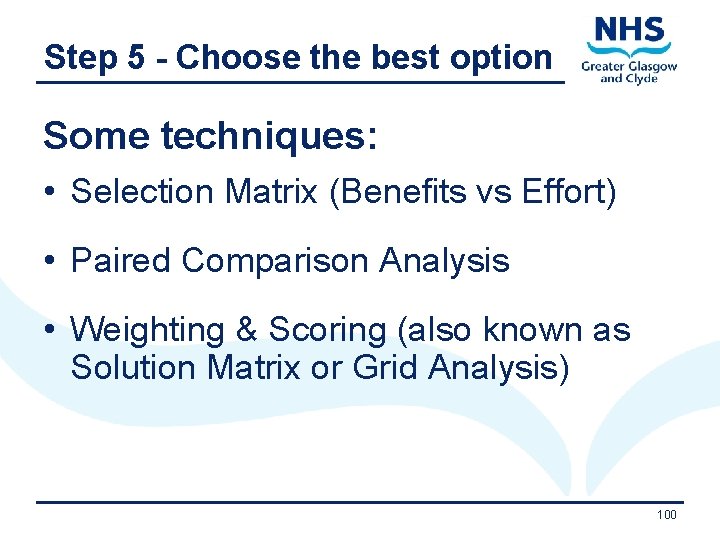
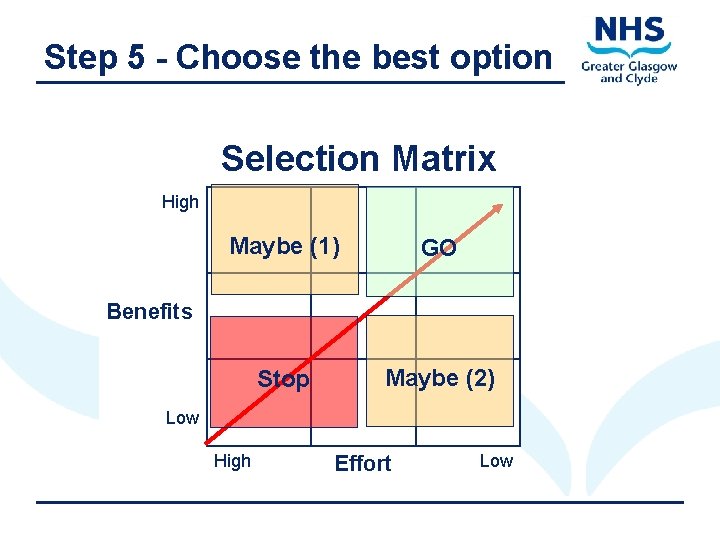
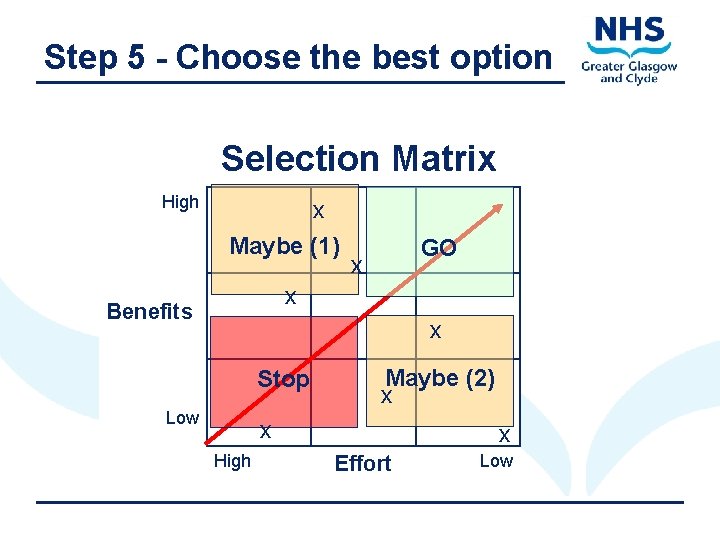
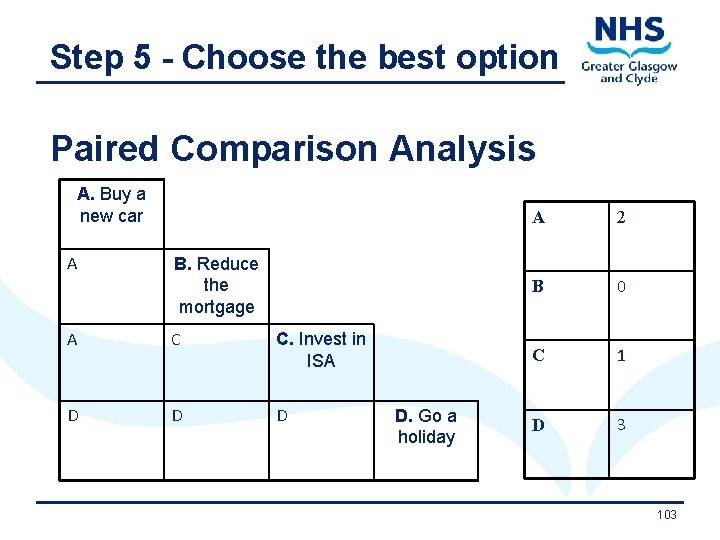
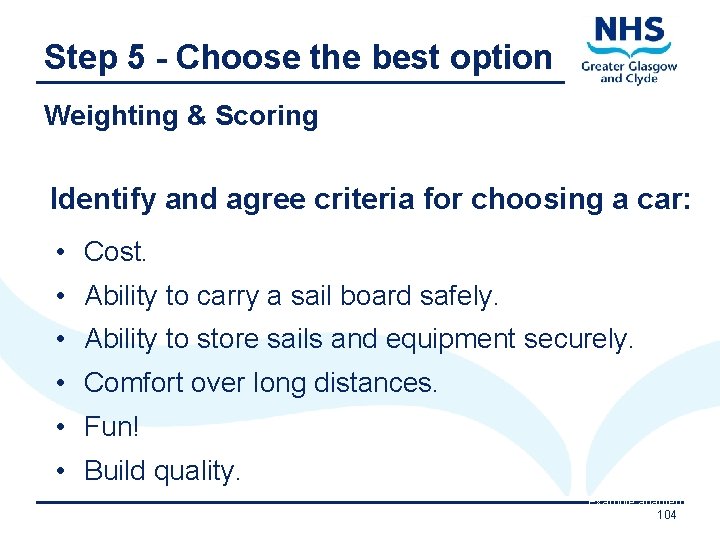
Step 5 - Choose the best option Some techniques: • Selection Matrix (Benefits vs Effort) • Paired Comparison Analysis • Weighting & Scoring (also known as Solution Matrix or Grid Analysis) 11/9/2020 100
Step 5 - Choose the best option Selection Matrix High Maybe (1) GO Stop Maybe (2) Benefits Low High 11/9/2020 Effort Low
Step 5 - Choose the best option Selection Matrix High x Maybe (1) x x Benefits x Stop Low Maybe (2) x x High 11/9/2020 GO x Effort Low
Step 5 - Choose the best option Paired Comparison Analysis A. Buy a new car A B. Reduce the mortgage A C C. Invest in ISA D D D 11/9/2020 D. Go a holiday A 2 B 0 C 1 D 3 103
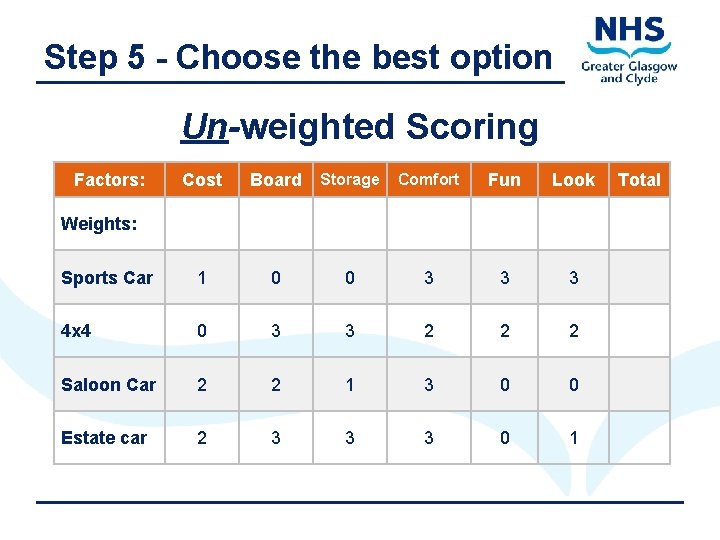
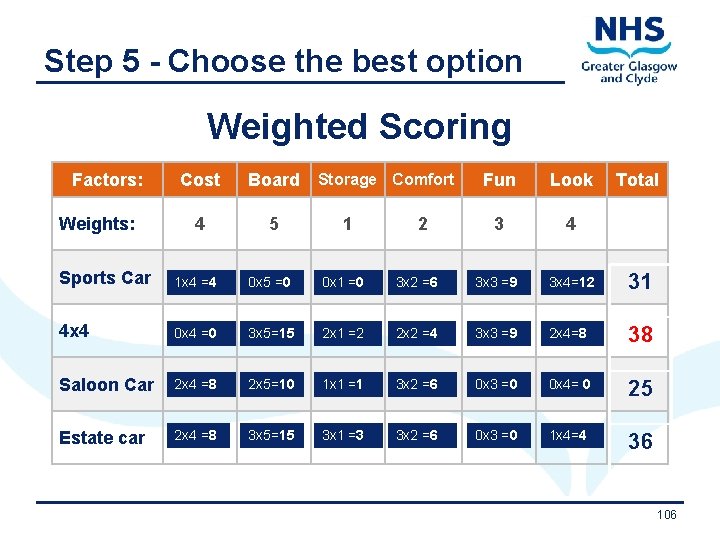
Step 5 - Choose the best option Weighting & Scoring Identify and agree criteria for choosing a car: • Cost. • Ability to carry a sail board safely. • Ability to store sails and equipment securely. • Comfort over long distances. • Fun! • Build quality. 11/9/2020 Example adapted from 104 http: //www. mindtools. com/pages/article/new. TED_03. htm
Step 5 - Choose the best option Un-weighted Scoring Factors: Cost Board Storage Comfort Fun Look Sports Car 1 0 0 3 3 3 4 x 4 0 3 3 2 2 2 Saloon Car 2 2 1 3 0 0 Estate car 2 3 3 3 0 1 Total Weights: 11/9/2020 Example adapted from http: //www. mindtools. com/pages/article/new. TED_03. htm
Step 5 - Choose the best option Weighted Scoring Factors: Cost Board 4 5 1 Sports Car 1 1 x 4 =4 0 0 x 5 =0 0 0 x 1 =0 4 x 4 0 0 x 4 =0 3 3 x 5=15 Saloon Car 2 x 4 =8 2 Estate car 2 x 4 =8 2 Weights: 11/9/2020 Fun Look 3 4 3 3 x 2 =6 3 3 x 3 =9 3 3 x 4=12 31 3 2 x 1 =2 2 2 x 2 =4 2 3 x 3 =9 2 2 x 4=8 38 2 x 5=10 2 1 x 1 =1 1 3 x 2 =6 3 0 x 3 =0 0 0 x 4= 0 0 25 3 x 5=15 3 3 x 1 =3 3 3 x 2 =6 3 0 x 3 =0 0 1 x 4=4 1 36 Storage Comfort 2 Total 106
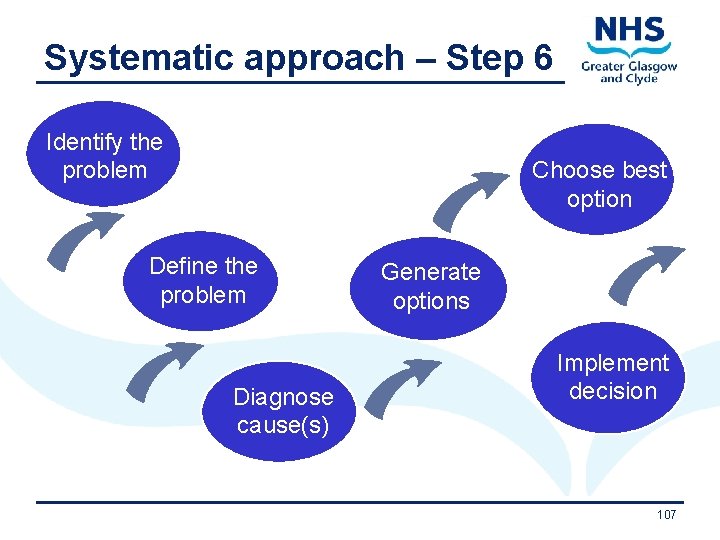
Systematic approach – Step 6 Identify the problem Choose best option Define the problem Diagnose cause(s) 11/9/2020 Generate options Implement decision 107
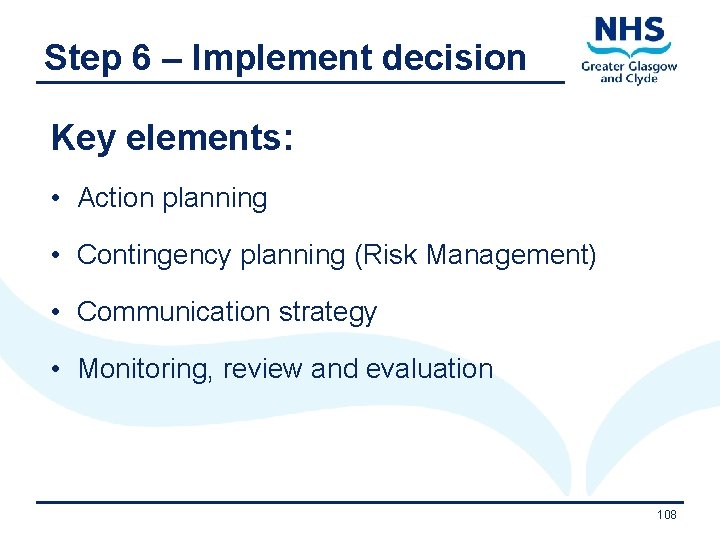
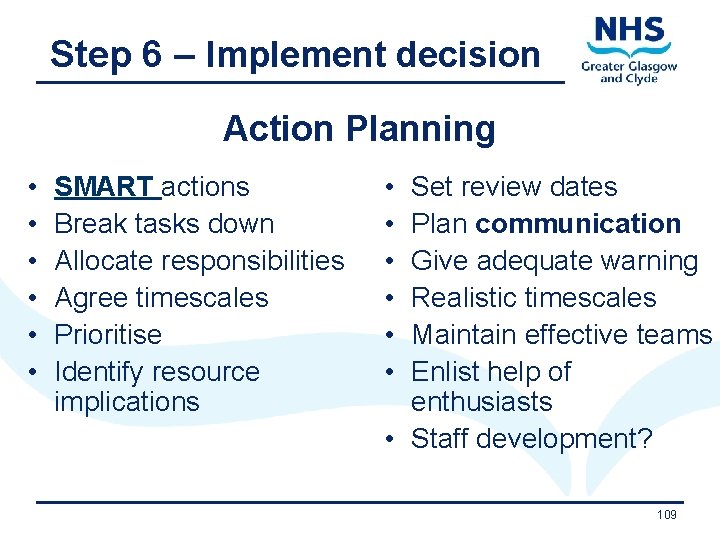
Step 6 – Implement decision Key elements: • Action planning • Contingency planning (Risk Management) • Communication strategy • Monitoring, review and evaluation 11/9/2020 108
Step 6 – Implement decision Action Planning • • • SMART actions Break tasks down Allocate responsibilities Agree timescales Prioritise Identify resource implications 11/9/2020 • • • Set review dates Plan communication Give adequate warning Realistic timescales Maintain effective teams Enlist help of enthusiasts • Staff development? 109
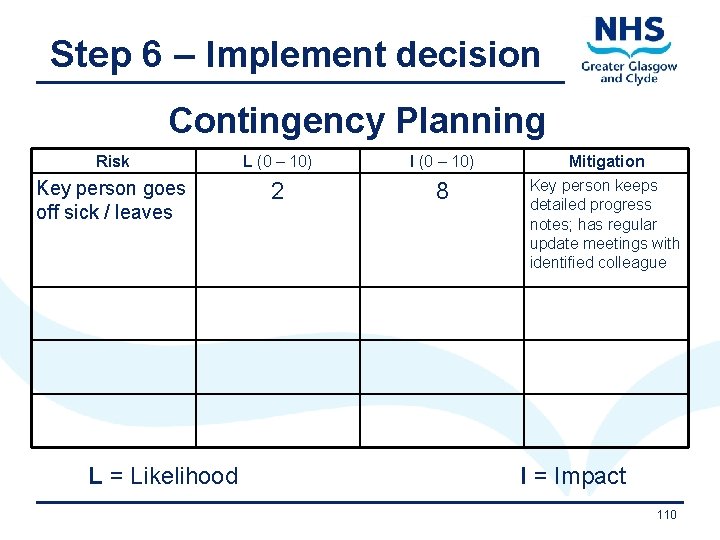
Step 6 – Implement decision Contingency Planning Risk L (0 – 10) I (0 – 10) Mitigation Key person goes off sick / leaves 2 8 Key person keeps detailed progress notes; has regular update meetings with identified colleague L = Likelihood 11/9/2020 I = Impact 110
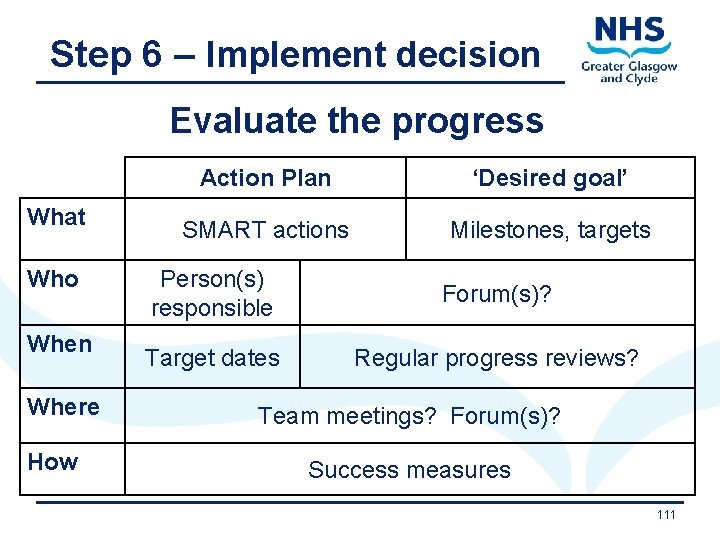
Step 6 – Implement decision Evaluate the progress What Who When Where How 11/9/2020 Action Plan ‘Desired goal’ SMART actions Milestones, targets Person(s) responsible Forum(s)? Target dates Regular progress reviews? Team meetings? Forum(s)? Success measures 111
Activities (Workbook) 11/9/2020 112
Close 11/9/2020 113