Dr Willie Van Der Merwe DMin MA MTh









- Slides: 121
Dr Willie Van Der Merwe DMin MA MTh (Clinical/Pastoral/Consulting Psychologist) Professional website: www. namibpsychologist. com Office: +264 64 463731 Mobile: +264 81 742 1000 Email: drwillievandermerwe@gmail. com www. Mission 4 x 4 Africa. com www. HRMatrix. Consulting. com
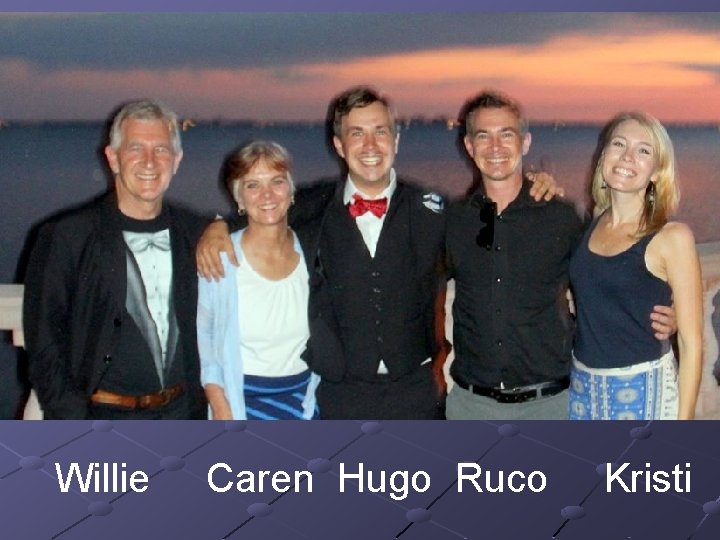
Willie Caren Hugo Ruco Kristi
COTTAGE AVE, SWAKOPMUND, NAMIBIA
Dealing with Grief and Loss in Care Homes Prepared by: Dr. Dr Willie Van der Merwe Clinical Psychologist
The Losses
Most elderly people seems to be most vulnerable to psychological dysfunction when they experience change. Affective function refers to the mood, emotions (such as happiness, sadness, fear, pain, anger, and confusion). Cognitive function refers to memory, learning, and intelligence. Cognitive and affective functioning affects the person’s self-esteem.
Affective functioning It is influenced by the way an individual views the world and self. A positive view of self and surrounding environment promotes positive expression of mood and emotions.
1 - Self-esteem It is the way a person views himself/herself. A positive view of self promotes health and enables the person to cope better with the changes and challenges of growing older.
Factors that contribute to a decreased in self-esteem Age related changes. losses that occur with aging Chronic diseases. Increased dependency. Functional impairment. Lack of control over the person environment
2 - Personality The basic personality does not change as a result of aging process. The personality will be consistent with that of earlier years.
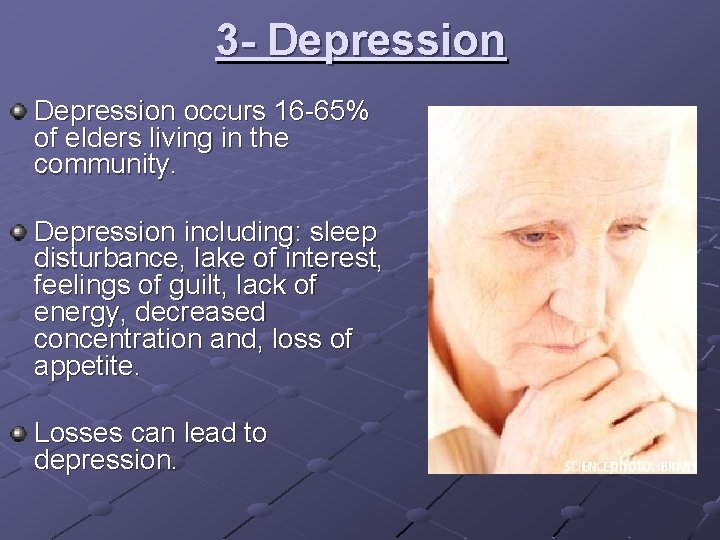
3 - Depression occurs 16 -65% of elders living in the community. Depression including: sleep disturbance, lake of interest, feelings of guilt, lack of energy, decreased concentration and, loss of appetite. Losses can lead to depression.
Cognitive functioning Intelligence, learning, attention and memory are all related to cognitive functioning and how well the mind is able to reason and make sound judgments.
1 - Intelligence is a mental alertness and includes the ability to learn new material, make wise decisions, and deal with stressful situation. Intelligence does not become less with age. IQ test performance of older adults may be hindered because of sensory deficits or the stress of being tested. These factors must be considered when assessing
2 - Memory Recent memory (Short Term) is defined as a recall of items learned more than a few minutes earlier, e. g. the day's new events, what was eaten for breakfast, the date. Recent memory generally declines with age. Remote memory (Long Term) is defined as a recall of items learned many years earlier, e. g. the dates of wars, names of presidents, remote memory does not experience significant change with age.
3 - Learning is the acquisition of new knowledge or skills. The ability of the mind to learn and retain new information remains unaltered, particularly when mind is stimulated through regular use. The ability to solve complex problems decline with age. Hearing and visual deficits related to aging process can affect learning.
4 - Attentionspan There is decrease in vigilance performance. Vigilance performance is the ability to retain attention longer than 45 minutes. The elderly is more liable to distract (divert) attention by irrelevant information and stimuli. Deficits in attention may affect learning and memory.
Social Changes/Losses The social changes that come with life are change in life style, loss of other family members, neighbors and friends. The main social problems, which confront elderly persons, are: - social isolation - finance - loneliness - rejection and loss of purpose in life. - deterioration in housing standard and poor nutritional level.
1 -Retirement A change in work role comes with retirement. It changes the way time is managed and daily activities are carried out. Retirement alters identity, status, financial problems/difficulties, lack of self-satisfaction and self-esteem and sometimes friendships.
2 - Widowhood A common event that alters family life for the aged is the death of a spouse. The spousal role composed of many sub roles, such as companion, sexual partner, confidante, cook, house-keeping, and care provider. Loss of spouse is a highly stressful experience. Death of a spouse affects more women than men because most older men will marry again.
3 - Loneliness is the feeling of emotional isolation, being locked inside oneself and unable to obtain the warmth and comfort from others. Any loss that creates a deficit in intimacy and inner personal relationships can lead to loneliness.
4 - Role change (role reversal) Numerous role changes occur with the aging process, but the transitions expected by most older people are related to the work role and the role of spouse or partner.
5 - Multiple losses Aging is associated with major physical, psychological and sociologic losses as well as a reduced ability to adapt and compensate for stressors.
Examples of some losses Loss of job (retirement) Loss of status Change role Loss related to normal age-related changes Decreased income Increase expenditure on medical services Loss of significant person Loss of housing Decreased the ability to adapt and compensate for stressors Limitations impose as a result of multiple chronic diseases
Awareness of Mortality Widowhood, death of friends, and the recognition of declining functions make older person more aware of the reality of their own death. Attitudes about death vary with aging. The elderly tend to think and talk about death, some of them might find the prospect of death less or more frightening.
Psychosocial problems Poor adjustment to role changes Poor adjustment to lifestyle changes Family relationship problems Grief Low self-esteem Anxiety and depression Aggressive behavior Loneliness Isolation Problems with sexuality Elderly abuse Withdrawing and having a negative attitude toward life in general
Developmental tasks needed for successful aging 1. Adjusting to declining health and physical strength. 2. 3. 4. Adjusting to retirement and reduce income Adjusting to death of a spouse. Establish associations with others in the same age. 5. Maintaining a satisfactory living arrangement. 6. Adapting to changes in social roles.
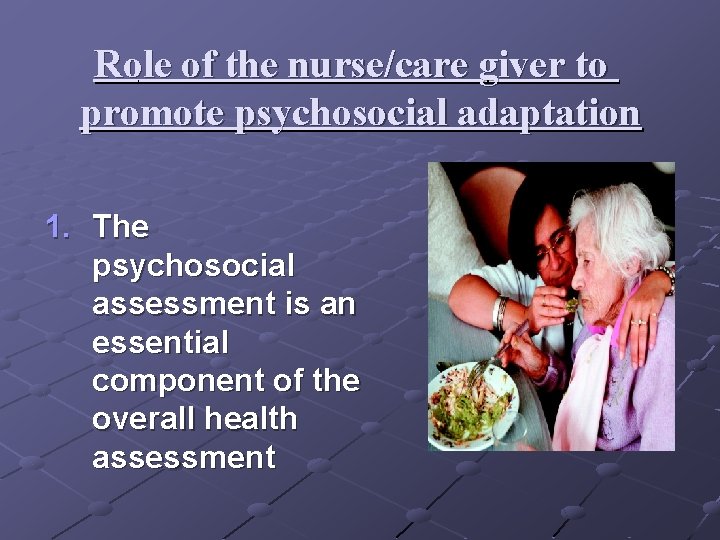
Role of the nurse/care giver to promote psychosocial adaptation 1. The psychosocial assessment is an essential component of the overall health assessment
2 - Caregiver’s intervention to enhance mental alertness Allow the client to do as many tasks for himself as possible. Encourage use of the mind in problem solving. Encourage use of numbers and calculations. Encourage creative activities (e. g. painting, story telling). Encourage the discovery of new talents and abilities.
3 - Care giver’s intervention when caring for a client with a short-term memory loss Identify yourself each time there is an interaction with the client. Give instructions in simple, direct terms. Repeat instructions several times. Explain every thing that is happening, even if the client does not seem to understand. Perform only one activity at a time.
4 - Care Giver’s intervention when teaching an older person new information Assess current knowledge. Evaluate for any visual or hearing deficit. Make sure the hearing aid is working or glasses are available, if indicated. Determine the person's ability to learn. Identify any language barrier. Determine if the information to be taught is thought to be important or relevant to the elderly person.
Begin by reviewing familiar information and then more to new information. Teach the spouse or family member as well as the elderly person if possible. Plan teaching over several days, with small increments of information presented at one time. Actively involve the client in the learning process. Allow time for feed back to evaluate knowledge
5 - Care Giver’s role to increased selfesteem Develop a trusting relationship Treat the elderly with dignity and respect Allow sufficient time for the performance of daily activities of self-care Encourage verbalization Practice active listening
Give positive reinforcement for progress. Use reminiscence therapy (encourage the elderly to recall or remember past events). Be alert for opportunities to include the patient in decision making. Use verbal and non verbal communication Encourage socialization.
6 - Intervention that foster positive personality traits in elderly Accept the older person. n Identify the positive characteristic of each person. n Encourage verbalization. n Reward positive behavior. n Avoid a judgmental attitude. n
7 - Adjusting to retirement It is easier if activities that will become prominent after retirement are begun during the working years. Therefore, adjustments to retirement are influenced by pre-retirement plan and engaging in other activities before withdrawing completely from their work.
8 - Find a new role Such as a grandparent role. The grandparent role is generally one that brings great satisfaction and contentment.
10 - Facilitating maximum independence Make sure that the person has access to all necessary assisting devices and personal accessories. Allow enough time for the person to perform tasks at her or his own place Make sure that the environment has been adapted as much as possible to compensate for sensory losses and other functional impairments.
11 - Intervention that promotes social support Use interventions to deal with hearing impairments and other communication barriers. Encourage participation in group activities. For people in wheelchairs, especially those who cannot move independently, position the chairs in a way that promotes social interaction. For nursing home residents, plan tables and room arrangements in such a way that social relationships are fostered
What Is Grief? Grief is the emotion people feel when they experience a loss. There are many different types of loss, and not all of them are related to death. Grief is a natural reaction to the loss of someone important to you. Grief is also the name for the healing process that a person goes through after someone close has died. The grieving process takes time, and the healing usually happens gradually.
Although everyone experiences grief when they lose someone, grieving affects people in different ways. Depends on relationship with person. Circumstances under which they died.
“Losing someone suddenly can be extremely traumatic, though, no matter how old that person is. Maybe someone you know died unexpectedly - as a result of violence or a car accident, for example. It can take a long time to overcome a sudden loss because you may feel caught off guard by the event and the intense feelings that are associated with it. ”
Knowing someone is going to die can give us time to prepare. If they were suffering, it can mean a sense of relief. If the person that died was young, we may feel it was unfair. Grief can make us feel guilty. Some people might blame themselves or think they could have done something to stop the death.
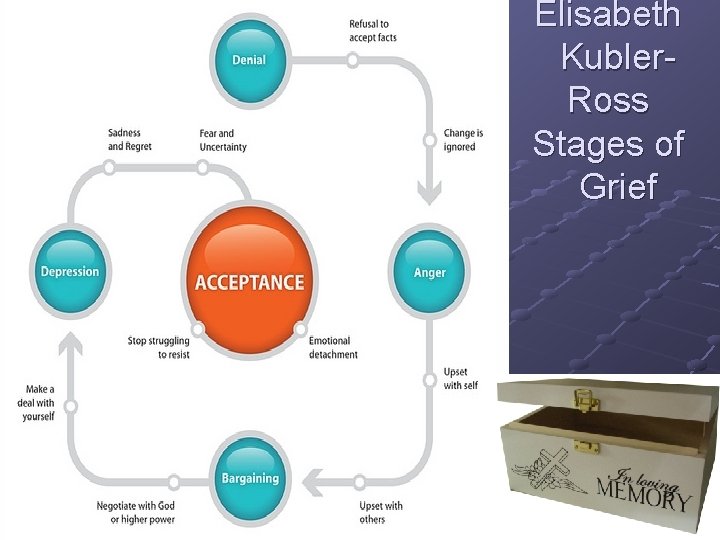
Five Stages of Grief
Elisabeth Kubler. Ross Stages of Grief
Stages (cont. ) The stages are tools to help us frame and identify what we may be feeling. Different for everyone. Doesn’t always happen in exact order, may revert before moving forward. KESSLER
Coping With Grief “The grieving process is very personal and individual - each person goes through his or her grief differently. Some people reach out for support from others and find comfort in good memories. ”
Assisting the patient to “Live well” and “Die well” Caring for the terminally ill patient Palliative Care Supportive Care End of Life Care after death Caring for Care givers
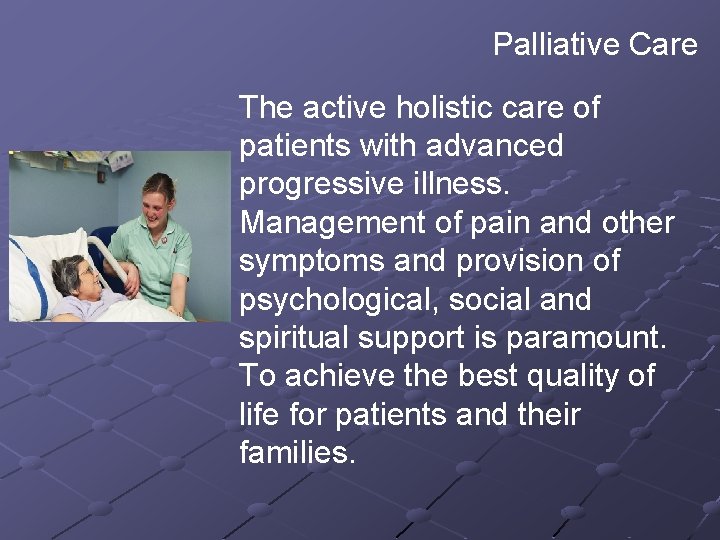
Palliative Care The active holistic care of patients with advanced progressive illness. Management of pain and other symptoms and provision of psychological, social and spiritual support is paramount. To achieve the best quality of life for patients and their families.
What is Supportive Care… Helps the patient and their family to cope with their condition and treatment of it – from pre-diagnosis, through the process of diagnosis and treatment, to cure, continuing illness or death and into bereavement. It helps the patient to maximise the benefits of treatment and to live as well as possible with the effects of the disease. It is given equal priority alongside diagnosis and treatment.
Cultural Issues Religious beliefs and attitudes regarding death. Towards the End of Life, people often become more aware of Religious beliefs or spiritual feelings. Death can challenge what we believe in, in so many ways. Some people find that, often for the first time in their lives, they feel the need to think about and discuss the meaning of life, their own experience and relationships. People with strong religious faith, often find comfort in prayers of meditation. Many people gain a lot of support from knowing that other people are praying for them.
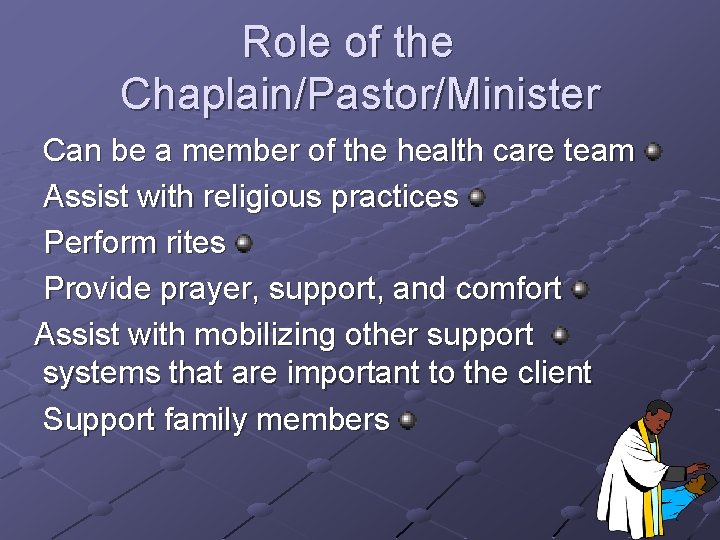
Role of the Chaplain/Pastor/Minister Can be a member of the health care team Assist with religious practices Perform rites Provide prayer, support, and comfort Assist with mobilizing other support systems that are important to the client Support family members
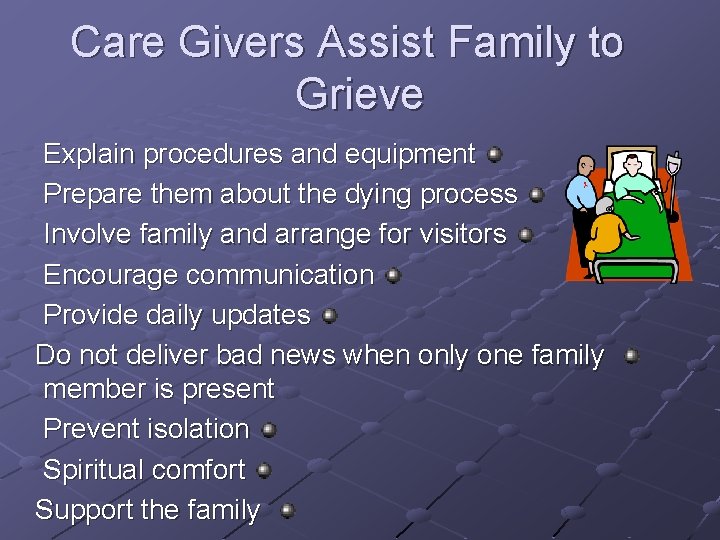
Care Givers Assist Family to Grieve Explain procedures and equipment Prepare them about the dying process Involve family and arrange for visitors Encourage communication Provide daily updates Do not deliver bad news when only one family member is present Prevent isolation Spiritual comfort Support the family
Nursing/Care Giving after death Best thing you can say? Actually best thing is to just listen…
If you HAVE to say something… DON’T SAY: I understand how you feel. Death was a blessing. You’re still young/ have whole life ahead of you. It’s time to put it behind you. Be strong! Time heals all wounds. Think about the good times. God needed another (angel, plumber, teacher, coach, etc. ) in heaven. Something good will come of this. She/he led a full life.
Caring for the caregivers Nurse/Care Giver grieves also Nurse/Care Giver need to come to terms with personal meanings of life and death Develop personal/professional support systems Maybe at times caregivers should be given the opportunity to be debriefed by a psychologist individually or in group setting Debriefing is important for the care givers not to suffering from compassion fatigue.
Thank you
Any questions The End
Nursing/Care Giving after death Autopsy: examination performed after a person’s death to confirm or determine cause of death Remove equipment Remove supplies Change soiled linens and cleanse patient Use room deodorizer Place patient in supine position, with small pillow under head Insert dentures Remove valuables and give to family Stay with family, if requested
Quick Survey by show of hands How many of you have had experienced the death of a patient? How many of you have had a friend who has experienced the death of someone close? How many of you knew exactly what to say to help the patient’s family or your friend with their grief?
Quick Survey How many of you have ever had first hand experience dealing with the death of someone close to you? During your grief, how many of you had someone tell you something (maybe in an effort to try to help you) that was NOT helpful, or even hurtful?
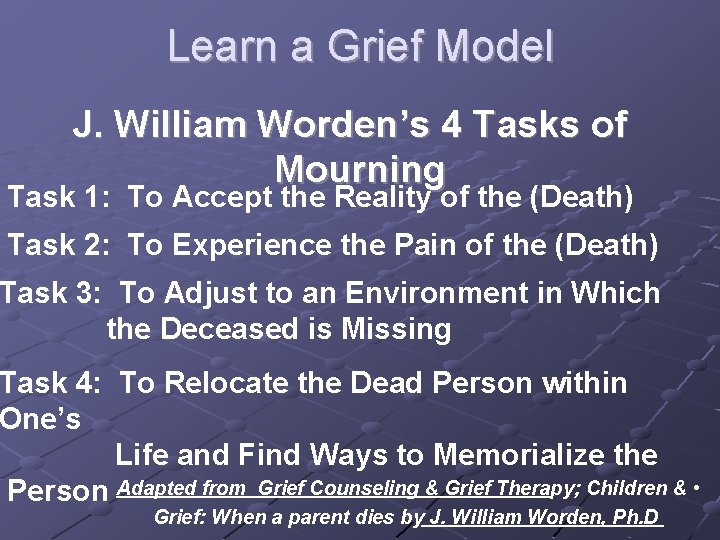
Learn a Grief Model J. William Worden’s 4 Tasks of Mourning Task 1: To Accept the Reality of the (Death) Task 2: To Experience the Pain of the (Death) Task 3: To Adjust to an Environment in Which the Deceased is Missing Task 4: To Relocate the Dead Person within One’s Life and Find Ways to Memorialize the Person Adapted from Grief Counseling & Grief Therapy; Children & • Grief: When a parent dies by J. William Worden, Ph. D
J. William Worden’s 4 Tasks of Mourning Task 1: To Accept the Reality of the (Death) Adapted from Grief Counseling & Grief Therapy; Children & • Grief: When a parent dies by J. William Worden, Ph. D
Task 1: To Accept the Reality of the (Death) The griever begins to grasp that the person has actually died. Even when the death was expected, there is still often a sense that it hasn’t really happened. Intellectual vs. emotional acceptance of the death. Intellectual acceptance may come long before emotional acceptance.
Task 1: To Accept the Reality of the (Death) Traditional rituals (funerals/memorials) assist the bereaved in moving toward acceptance of the death as real. ** Include children!
Task 1: To Accept the Reality of the (Death) Belief and disbelief come and go over time. Examples: Misidentify another person as the one who has died or think they see or hear them. "I still hear his keys in the door". n "I expect to see her cooking in the n kitchen".
Task 1: To Accept the Reality of the (Death) Families will need to repeat their stories many times. Ask questions that ask for details surrounding the death
Task 1: To Accept the Reality of the (Death) The death becomes more of a reality as each "first" occurs without the deceased 1 st birthdays, death markers/dates, etc. 1 st holiday season. Ask about the last holiday and what they think they will do for the next one.
If you HAVE to say something… Try… I’m sorry/ I’m sorry you are going through this. How are you doing with all this? What can I do for you? I’m here and I want to listen. What’s the hardest part for you? I’ll call tomorrow/Friday/in an hour. I can imagine how much this hurts. It isn’t fair, is it? Take all the time you need.
J. William Worden’s 4 Tasks of Mourning Task 2: To Experience The Pain Of The (Death)
What is the pain of “Normal” Grief? If ‘Normal’ Grief can last years, what are the symptoms? See “Potential Symptoms of Grief” Handouts
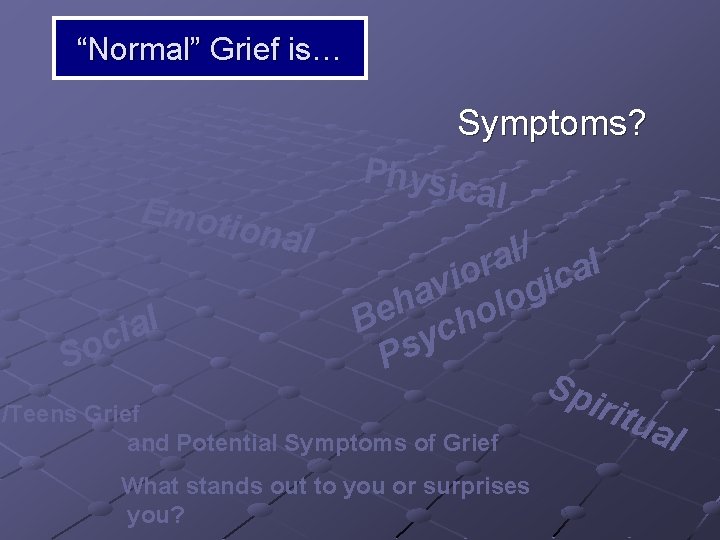
“Normal” Grief is… Symptoms? Emoti o Physic nal S l a i oc al / l a l r a o i c i v g a o h l Be ycho Ps Sp ir s/Teens Grief and Potential Symptoms of Grief What stands out to you or surprises you? itua l
Task 2: To Experience The Pain Of The (Death) Pain will vary in intensity from person • to person and may come and go. Friends, culture, and society may • interfere with the successful completion of this task by not allowing the griever to grieve. “Think about the good times”“Be strong”-
Task 2: To Experience The Pain Of The (Death) Avoidance = drugs, alcohol, travel, • relocation, constant work, or quickly entering into a new relationship. Avoidance hinder one’s ability to heal. • The pain will eventually reappear.
Task 2: To Experience The Pain Of The (Death) WHAT IS ABNORMAL GRIEF? Active Suicidal/Homicidal Ideation, • Plan, Intention, Means I don’t know how I will go on! – Normal • I wish I could be reunited/wish my pain • was over/wouldn’t care if I died – Normal I’m going to kill myself! - Abnormal •
Task 2: To Experience The Pain Of The (Death) WHAT IS ABNORMAL GRIEF? =Command hallucinations I thought I saw him walking down the • street. – Normal I felt her presence in the room – • Normal I heard him tell me to trash my • mother’s house/join her in heaven – Abnormal!
J. William Worden’s 4 Tasks of Mourning Task 3: To Adjust to an Environment in Which the Deceased is Missing Adapted from Grief Counseling & Grief Therapy; Children & • Grief: When a parent dies by J. William Worden, Ph. D
J. William Worden’s Task 3: To Adjust to an Environment in Which the Deceased is Missing The grieving person may need to learn new • skills, and perform functions that the person who died had previously taken care of. This happens just at a time when they are burdened with acute grief and the least capable of doing so. The bereaved tries to gain a sense of control • over his or her life. Help them to brainstorm who can help with • daily activities for themselves/family (baby sitting, picking up kids, cooking, etc. )
J. William Worden’s Task 3: To Adjust to an Environment in Which the Deceased is Missing Not only is the relationship gone, but also that part of the grieving person’s identity. “Who am I if I am no longer John’s wife? ” “Am I still a parent if my only child has died? ” “What do I say when people ask me how many children do I have? ” -Give them permission to answer these questions differently or the same as they did before the death.
J. William Worden’s 4 Tasks of Mourning Task 4: To Relocate the Dead Person within One’s Life and Find Ways to Memorialize the Person Adapted from Children & Grief: When a parent dies by J. William Worden, Ph. D • Michelle A. Post, MA, LMFT , (310) 927 -5611 , Email: michpost@ca. rr. com
J. William Worden’s 4 Tasks of Mourning Task 4: To Relocate the Dead Person within One’s Life and Find Ways to Memorialize the Person Assist grievers in finding a new place, • internally, for their relationship with the person who died. Grievers find ways to create a new "normal". • The griever re-invests in their current life, • while maintaining continuing bonds with the person who died. Adapted from Children & Grief: When a parent dies by J. William Worden, Ph. D • Michelle A. Post, MA, LMFT , (310) 927 -5611 , Email: mpost@onelegacy. org
J. William Worden’s 4 Tasks of Mourning Task 4: To Relocate the Dead Person within One’s Life and Find Ways to Memorialize the Person Grievers create or continue traditions and rituals which allow them to honor the memory of the person Some make a pact with themselves never to love again Many go on to form new attachments and relationships Adapted from Children & Grief: When a parent dies by J. William Worden, Ph. D • Michelle A. Post, MA, LMFT , (310) 927 -5611 , Email: mpost@onelegacy. org
J. William Worden’s 4 Tasks of Mourning Task 4: To Relocate the Dead Person within One’s Life and Find Ways to Memorialize the Person Help with Remembering Help the family start thinking about the “legacy” their loved one will leave Encourage story telling Opportunity to share a part of their life with you and to introduce you to the person they loved through memories Help facilitate the process strengthens rapport and trust comforting and reassuring n n Memory Boxes Hand Molds, Scrapbooks, Web-pages
Personal Care Various items of equipment may be available to assist people at home, such as pressurerelieving mattress or a commode. A baby monitor can allow the carer, to stay aware of how the client is, whilst they get on with other activities. Other items such a drinking straws, non-spill beakers, a urine bottle or bedpan. Washing It is important to maintain personal hygiene, for comfort and preventing infection. It is important to be gentle, especially with the presence of sores. v Soap must be rinsed off completely, and skin should be tried gently. v The water must be changes several times during the wash v Only thee parts of the body being washed should be exposed. v Moisturising creams may be applied gentle to dry areas such as your elbows, heels and v soles of the feet. An occasional alternative using wet wipes If the client does not feel up to it. v Using dry shampoos as well. v A no-rinse, waterless hair-washing cap which allows a shampoo without water. v Remember: Appearance can have a positive affect on how your client feels, Fresh clothes, A shave, Make-up or wearing jewellery can make a huge difference. Imagine if this was you.
Mouth Care Many people who are seriously ill have problems with their mouth such as: Dryness • Ulcers • Bleeding Gums • Excess Saliva • Altered taste • A soft baby toothbrush is best if your clients mouth is sore and use only a small amount of tooth paste. Rinse with water, a saline solution (1 tsp salt in pint of water) or a mouth wash. Do not use bicarbonate of soda or baking powder. False teeth should be cleaned as usual. Reliving a dry mouth with ice cubes, frozen fruit, lemonade or tonic water. Tinned, unsweetened pineapple can cleanse the mouth and help with dryness. Oral thrust is common in people who are ill. Which causes a very sore mouth and tongue, and white patches on tongue, gum and inside of cheek. Report to DN. Inform their GP, Nurse or Specialist for suitable medication.
Breathlessness Breathless can occur during illness can occur at a much lower level of physical exertion. Even crossing a room can be a struggle. It is important to understand the changes in the breathing, and taking everything at a pace. Breathing Control… A method of taking normal breaths v Slower, controlled breathing that doesn’t involve taking deeper breaths. v Breathing using the lower chest whilst keeping the upper chest and shoulders relaxed v To reduce the effort of breathing To obtain a sense of control over breathing Improve the efficiency of all respiratory muscles Improve tolerance. How do you do it? By sitting in a chair and place one hand on upper chest and abdomen, take a normal breath and feel the hand on abdomen rise up and out. If in bed, try propping up with pillows (high sided lying)
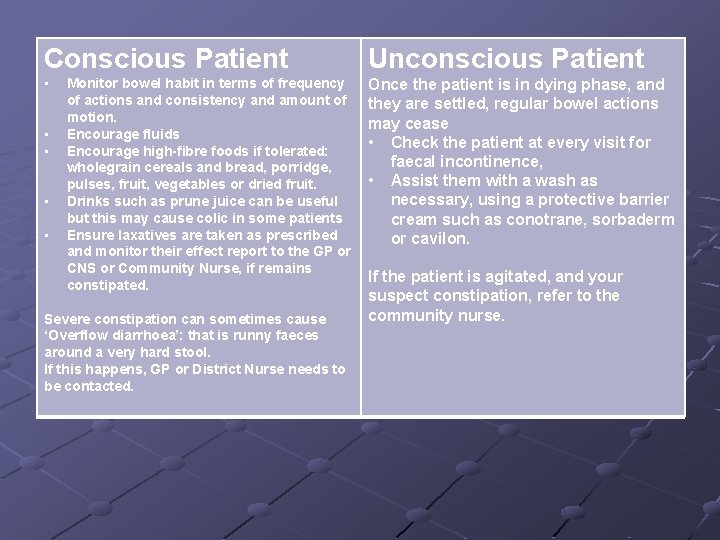
Constipation is one of the most common digestive problems due to insufficient water in the stools, leaving them dry, hard and difficult to pass. Symptoms include Going to the toilet to pass stools less often ü A feeling that the bowel is not empty after going to the toilet ü Having to strain to pass ü Faeces that are dry and hard and look like rabbit pellets ü Loss of appetite or feeling bloated ü Stomach ache, and cramps, sometimes accompanied by headache and nausea. ü A furred tongue ü Fatigue. ü Sometimes constipation can alternate with diarrhoea. When this happens, the diarrhoea is an overflow of liquid stools that passes around the hard stools and is mistaken for diarrhoea.
Loss of Appetite Loss of appetite is very common from your clients condition, treatment of medication. Changes in the taste buds v Changes in the stomach- making them feel fuller v Nausea, retching or gagging. v Swallowing difficulties It is recommended by Marie Curie. Eat little and often, v Large portions can be off putting v Eating breakfast, when appetite Is normally best v Try new foods and flavours. v Small glass of sherry or brandy to stimulate appetite (check with GP) v Finger foods or supply of snacks v Do not rush and rest afterwards. v Have food for pleasure, rather than survival! v
Loss of Appetite There are nourishment alternatives such as fluids and soft foods: Full fat milk or home made smoothies v Full fat yoghurts or milk puddings v Ice cream- put in drinks or milk puddings. v Soups which can be liquidised v Commercial supplements such as Complans and Ensures which can be v available on prescription.
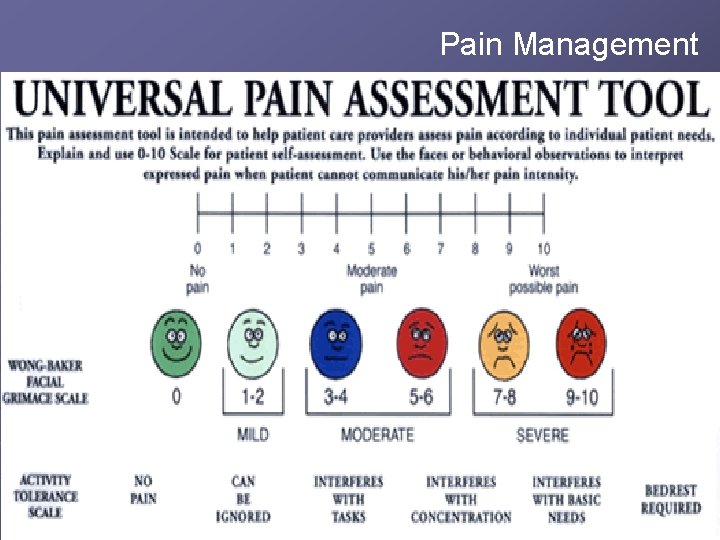
Pain Management Care workers are key to good pain control for clients, as you are the most regular and frequent visitors. You role is to assess pain control at each visit, encourage compliance with taking their prescribed painkillers, and liaising with GP if pain is not adequately controlled.
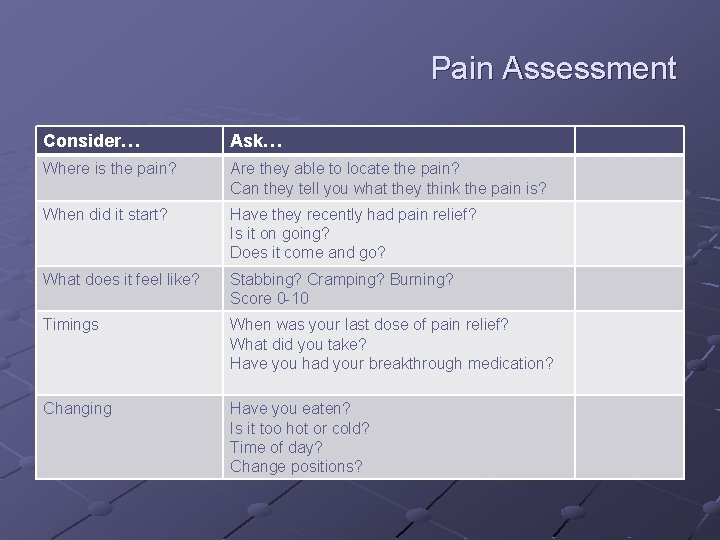
Pain Assessment Consider… Ask… Where is the pain? Are they able to locate the pain? Can they tell you what they think the pain is? When did it start? Have they recently had pain relief? Is it on going? Does it come and go? What does it feel like? Stabbing? Cramping? Burning? Score 0 -10 Timings When was your last dose of pain relief? What did you take? Have you had your breakthrough medication? Changing Have you eaten? Is it too hot or cold? Time of day? Change positions?
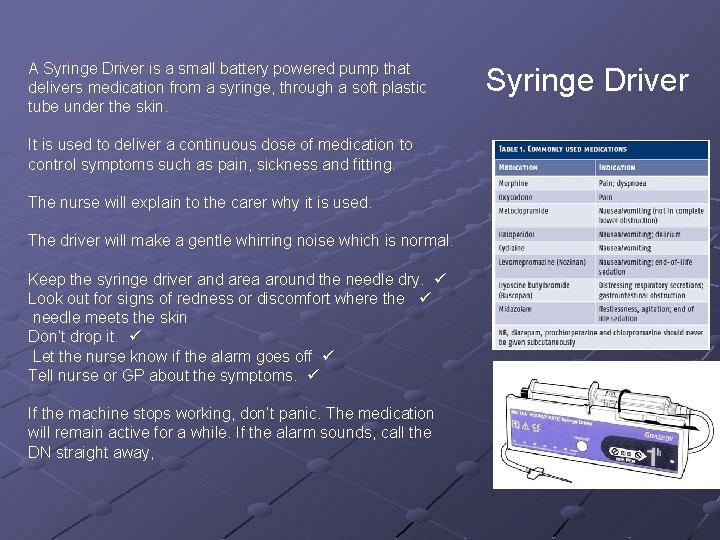
A Syringe Driver is a small battery powered pump that delivers medication from a syringe, through a soft plastic tube under the skin. It is used to deliver a continuous dose of medication to control symptoms such as pain, sickness and fitting. The nurse will explain to the carer why it is used. The driver will make a gentle whirring noise which is normal. Keep the syringe driver and area around the needle dry. ü Look out for signs of redness or discomfort where the ü needle meets the skin Don’t drop it. ü Let the nurse know if the alarm goes off ü Tell nurse or GP about the symptoms. ü If the machine stops working, don’t panic. The medication will remain active for a while. If the alarm sounds, call the DN straight away, Syringe Driver
Pain Management
Conscious Patient Unconscious Patient • Once the patient is in dying phase, and they are settled, regular bowel actions may cease • Check the patient at every visit for faecal incontinence, • Assist them with a wash as necessary, using a protective barrier cream such as conotrane, sorbaderm or cavilon. • • Monitor bowel habit in terms of frequency of actions and consistency and amount of motion. Encourage fluids Encourage high-fibre foods if tolerated: wholegrain cereals and bread, porridge, pulses, fruit, vegetables or dried fruit. Drinks such as prune juice can be useful but this may cause colic in some patients Ensure laxatives are taken as prescribed and monitor their effect report to the GP or CNS or Community Nurse, if remains constipated. Severe constipation can sometimes cause ‘Overflow diarrhoea’: that is runny faeces around a very hard stool. If this happens, GP or District Nurse needs to be contacted. If the patient is agitated, and your suspect constipation, refer to the community nurse.
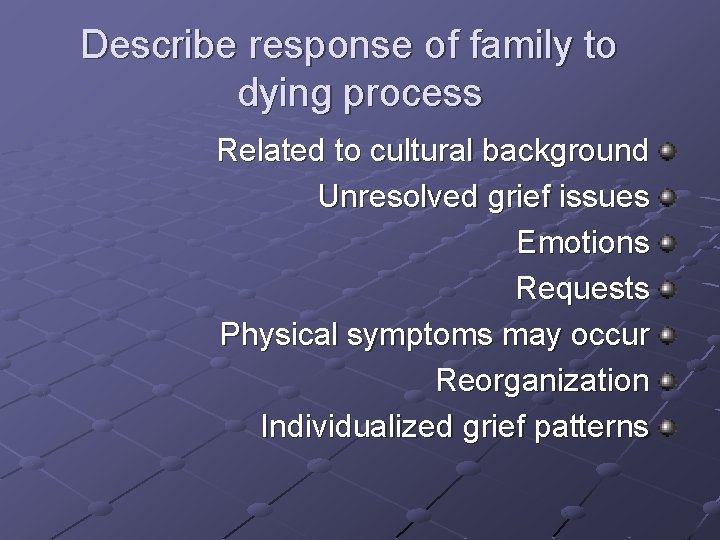
Describe response of family to dying process Related to cultural background Unresolved grief issues Emotions Requests Physical symptoms may occur Reorganization Individualized grief patterns
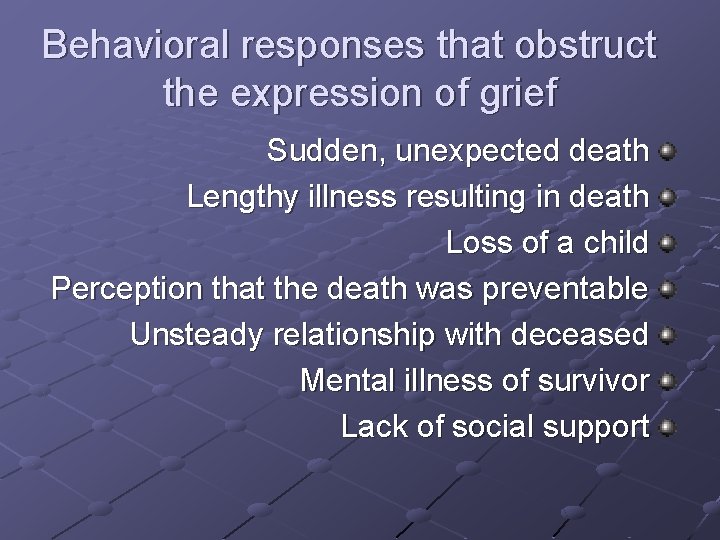
Behavioral responses that obstruct the expression of grief Sudden, unexpected death Lengthy illness resulting in death Loss of a child Perception that the death was preventable Unsteady relationship with deceased Mental illness of survivor Lack of social support
Topics to cover What is grief Five stages of grief Fears of the patient Caring Palliative Care Supportive Care End Of Life Care after Death Caring for Care Givers n n n
Common fears of the dying patient Fear of Loneliness Distancing by support people and caregivers can occur Debilitation, pain, and incapacitation Hospital, a place that can be very lonely Fear of dying alone n n
Fears of the dying patient Fear of Sorrow Sadness Letting go of hopes, dreams, the future Awareness of own mortality Grief about future losses Anticipatory grief that involves mourning, coping skills Grief related to diagnosis that has a long term effect on the body such as cancer Patient may feel well at time of diagnosis n n n n
Fears of the dying patient Fear of the unknown: Death is an unknown state What will happen after death? What will happen to loved ones, those left behind n n n
Fears of the dying patient Loss of self concept and body integrity Body image changes Loss of role or status Loss of standard of living n n n
Fears of the dying patient Fear of Regression Physical deterioration may occur n Mental deterioration may occur n Unable to care for self n Become dependent on others for care n
Fears of the dying patient Fear of Loss of Self Control Loose ability to control life decisions Loose ability to control ADL’s (Activities of daily living) routine activities that people tend do everyday without needing assistance like: eating, bathing, dressing, toileting, walking and continence Loss of control of emotions Loss of independence n n
Fears of the dying patient Fear of Suffering and Pain May be many different types of pain or suffering such as physical, emotional, social, or spiritual in nature Altered relationships with others Anxiety related to the disease and consequences of the disease n n n
Rationale for Communicating Truthfully about Terminal Illness Right to know Time frame Nurse/Care Giver needs to assess whether or not the patient/family have been told and what was told to them THE DOCTOR/PHYSICIAN WILL TELL THE CLIENT FIRST, NOT THE Nurse/Care Giver
It's only when we truly know and understand that we have a limited time on earth -- and that we have no way of knowing when our time is up, we will then begin to live each day to the fullest, as if it was the only one we had. ~Dr. Elisabeth Kübler-Ross
Communicating Terminal Illness, continued The Nurse/Care Giver: Clarifies what was said Listens to concerns Fosters communication between MD, patient, and family Allows patient to express loss Facilitate grief through Nursing/Care Giving process Be available for patient Assist patient to identify needs/hopes for remainder of life Connect patient with proper resources n n n n
Nursing/Care Giving strategies appropriate for grieving persons Open ended statements Patient sets the pace Accept any grief reaction Be aware—Nurse/Care Giver may be target of anger Remove barriers Avoid giving advice Allow patient to talk Allow patient to express signs of hope Support hope by helping focus
Choices of Care Setting Families have choices of where to care for the dying loved one Ask the patient and family preferences Support whatever the choice Hospital, Home/Hospice
Elements of Hospice Care Home care coordinated with hospital Control of symptoms holistically Physician directed care Utilization of variety of health care professionals Bereavement follow up care
End of Life Care (Nursing/Care Giving strategies to meet physical and psychosocial needs of the dying patient) End of life care is about caring for people • who have an advanced, progressive and incurable illness so they can live as well as possible until they die. It is about providing support that meets the v needs of both the person who is dying and the people close to them. This care has a strong focus on managing v symptoms to keep a person comfortable, helping them to adapt to the changes in lifestyle and cope with the emotional impact of their illness.
End of Life Care End of life means different things to different people but v generally refers to the last weeks and days in life when the person’s illness becomes too much for their body to cope with and death can no longer be postponed through treatments. Changes occur as a person’s illness progresses because of the impact of the illness on the body’s ability to function normally. GP’s and Nurses monitor the persons physical condition and symptoms. The impact that symptoms are having on a person’s well being v Increasing weakness of muscles and dependency on others. v Loss of appetite and inability to swallow tablets v Level of consciousness. v
During the last few days or hours: Generally become weaker and sleepier (it is good to talk v to them to reassure and comfort them) Nil by mouth- people generally do not want to eat v Nauseas. v May lapse into unconsciousness. v Passing less urine, or it is darker in colour. Incontinence v can occur. Skin changes- hot, cold, dry, moist or clammy. Skin may v look bluish or patchy, the underside may become dark as a result of blood circulation slowing down.
Restlessness, agitate or confusion due to v dehydration. Unusual behaviour. Breathing may become difficult, or the pattern v may change. Being shallow or irregular. Long pauses, and the abdomen may rise and fall. Decrease Blood Pressure Jaw and Facial muscles relax Thorough pain control Maintain independence MOST POSITIVE SIGN OF DEATH=Absence of brain waves