Promoting Inquiry in Mathematics And Science education Henk
- Slides: 24
Promoting Inquiry in Mathematics And Science education Henk van der Kooij Michiel Doorman Dédé de Haan Mieke Abels Ad Mooldijk Freudenthal Instituut, Universiteit Utrecht
Aim of Primas (01/2010 – 12/2013) • A widespread uptake of inquiry-based learning in day -to-day mathematics and science lessons across Europe • Inquiry Based Learning approaches aim at fostering inquiring minds and attitudes in our students. A question not asked is a door not opened!
HOW DO WE TRY TO ACHIEVE THIS AIM?
Multi-level-dissemination-plan Dissemination through 1. 2. 3. 4. 5. Classroom materials and their national adaptation Professional development (long-term) Information for teachers in one-day-events Initial teacher training Evaluation (to optimize strategies)
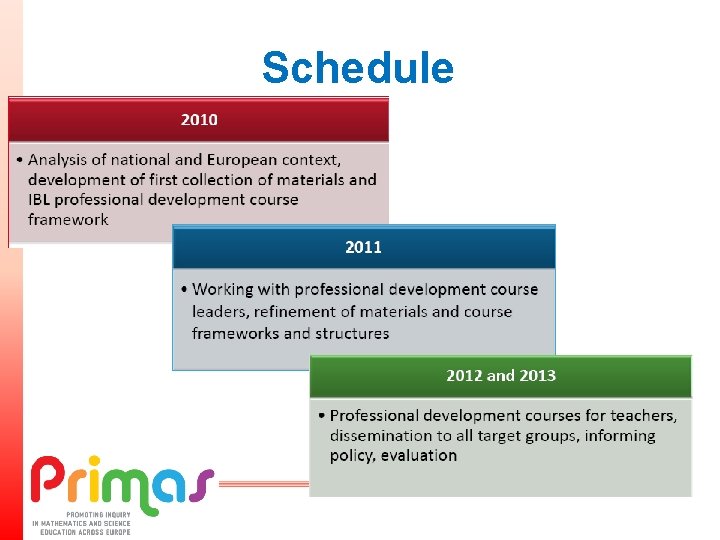
Schedule
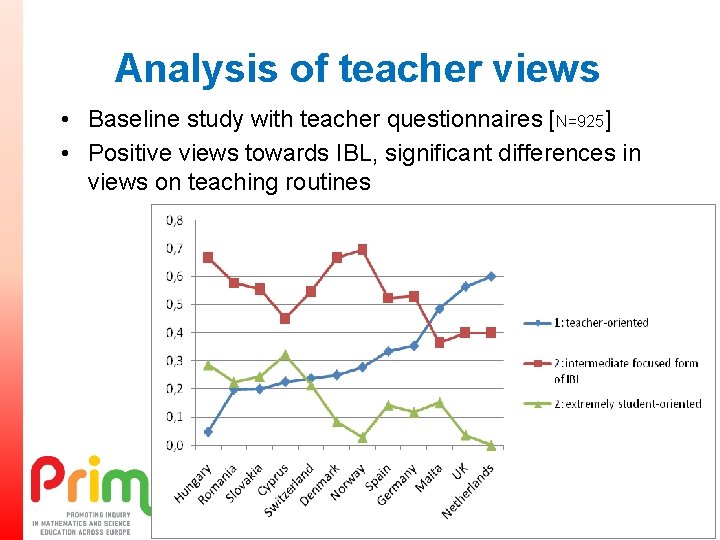
Analysis of teacher views • Baseline study with teacher questionnaires [N=925] • Positive views towards IBL, significant differences in views on teaching routines
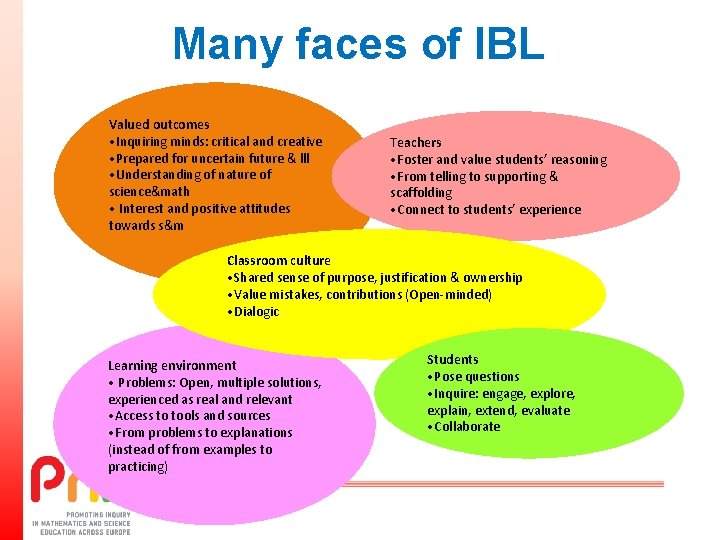
Many faces of IBL Valued outcomes • Inquiring minds: critical and creative • Prepared for uncertain future & lll • Understanding of nature of science&math • Interest and positive attitudes towards s&m Wat? Teachers • Foster and value students’ reasoning • From telling to supporting & scaffolding • Connect to students’ experience Classroom culture • Shared sense of purpose, justification & ownership • Value mistakes, contributions (Open-minded) • Dialogic Learning environment • Problems: Open, multiple solutions, experienced as real and relevant • Access to tools and sources • From problems to explanations (instead of from examples to practicing) Students • Pose questions • Inquire: engage, explore, explain, extend, evaluate • Collaborate
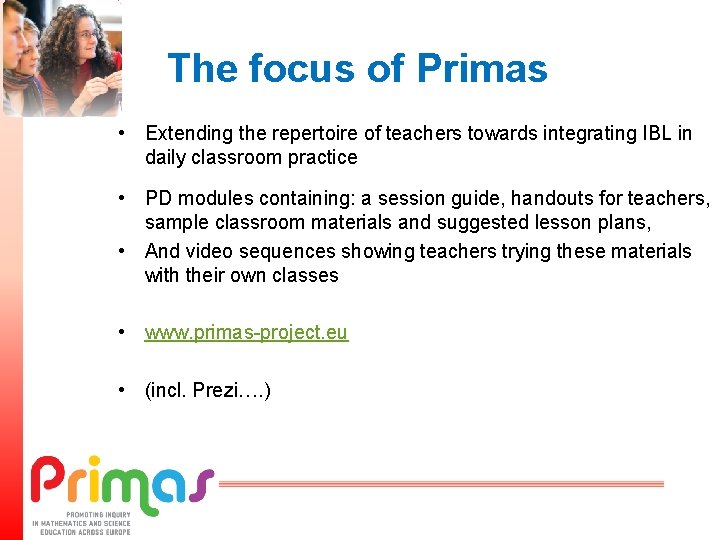
The focus of Primas • Extending the repertoire of teachers towards integrating IBL in daily classroom practice • PD modules containing: a session guide, handouts for teachers, sample classroom materials and suggested lesson plans, • And video sequences showing teachers trying these materials with their own classes • www. primas-project. eu • (incl. Prezi…. )
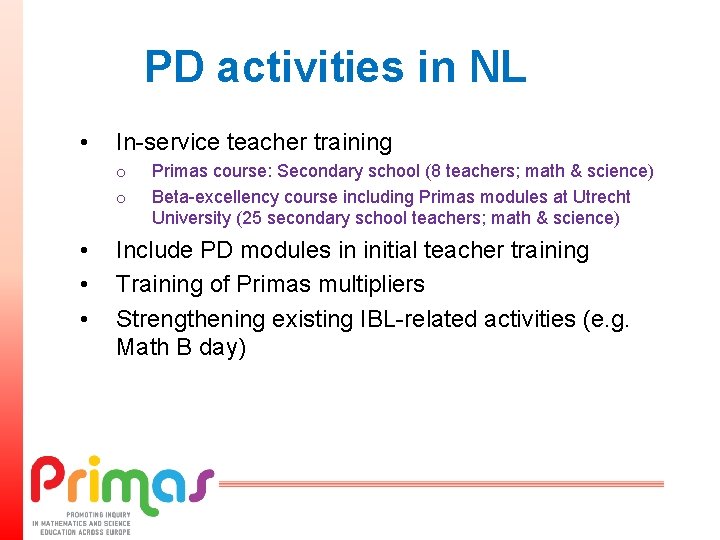
PD activities in NL • In-service teacher training o o • • • Primas course: Secondary school (8 teachers; math & science) Beta-excellency course including Primas modules at Utrecht University (25 secondary school teachers; math & science) Include PD modules in initial teacher training Training of Primas multipliers Strengthening existing IBL-related activities (e. g. Math B day)
Experiences in NL
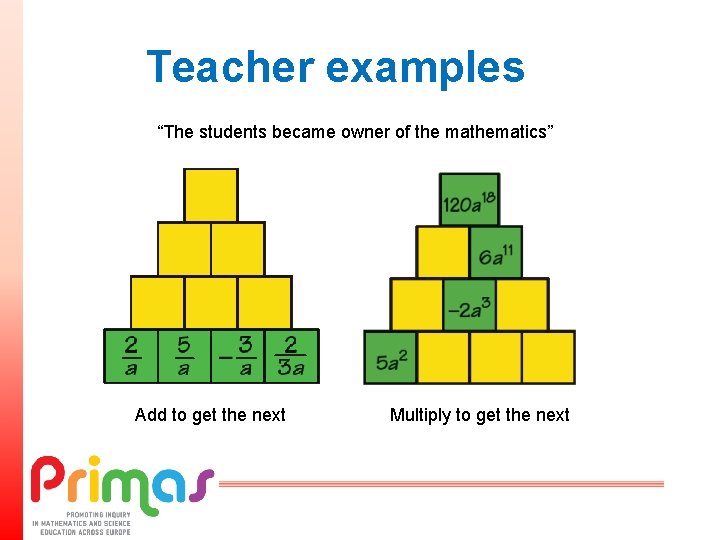
Teacher examples “The students became owner of the mathematics” Add to get the next Multiply to get the next
Teacher examples “The new and open task triggered curiosity and inquiry. In one class it went much better than in the other. I don’t know why. ”
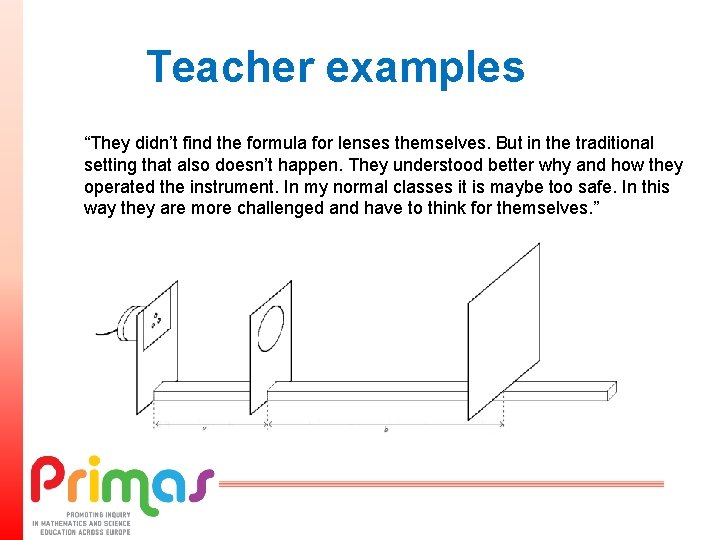
Teacher examples “They didn’t find the formula for lenses themselves. But in the traditional setting that also doesn’t happen. They understood better why and how they operated the instrument. In my normal classes it is maybe too safe. In this way they are more challenged and have to think for themselves. ”
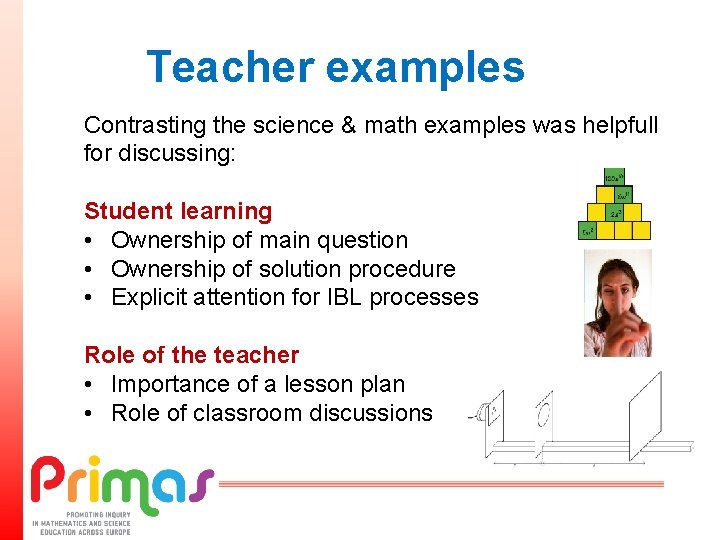
Teacher examples Contrasting the science & math examples was helpfull for discussing: Student learning • Ownership of main question • Ownership of solution procedure • Explicit attention for IBL processes Role of the teacher • Importance of a lesson plan • Role of classroom discussions
Your experiences • Are these Primas examples valuable, useful, … for you? • • • Think Pair Share
Teachers about Primas in NL
About students • They are more active. One can see they are thinking and looking more critical to the results • Especially the enthusiasm of the students was very pleasant • It became a student activity instead of following my guidelines, they really wanted to know • Now students have to think: ‘How am I going to measure. . ? What do I know about. . ? ’ Normally this was included in the task. 18 18
About students • Less listening and more communication than usual • The students are now more producers than consumers • The students are not used to work in this way yet • The students asked more questions • A shift from doing to thinking 19 19
Teacher • My role now was more acting as a guide, giving support, this is different from what I usually do: presenting • This asks for more preparation time • I think you have to do actually all practical assignments in this way • A good preparation and a clear assignment is a must 20 20
Teacher • Less one-way traffic • I learned by not valuing students’ responses, I can ask more students the same question • For me it is very difficult not to value students’ responses immediately • I made an agreement: No fingers, think first and write your answers down 21 21
Teacher • I have learned that I need to think in advance about what questions I may expect and what questions I can possibly ask • Many students didn’t really understood the concept of distance, I didn’t expect that, due to this lesson I was able to notice this 22 22
Two review studies • Why inquiry-based teaching failed 1. Direct instruction and repeated practice effect long term memory 2. In “pure-discovery method’s” students get frustrated and mislead 3. IBL only works when students are educated and motivated enough to guide themselves • Respond: IBL works, when enough support is available 1. IBL ≠ ‘minimal guided instruction’ 2. Support and scaffolding is needed for: • Students’ development of discipline-related knowledge and strategies • Transfering expert knowledge • Structuring complex and open activities 3. Offer support with structured lesson plans, process support, worksheets, . . .
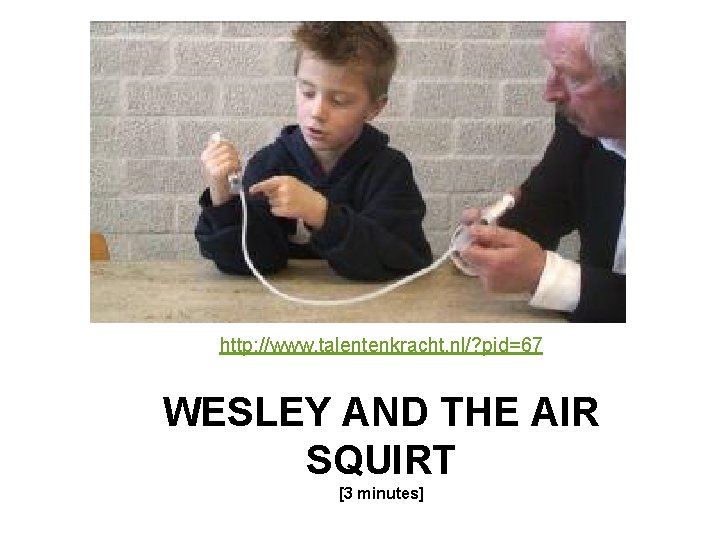
http: //www. talentenkracht. nl/? pid=67 WESLEY AND THE AIR SQUIRT [3 minutes]