
HOOFDSTUK 3 EPISTEMOLOGISCHE BEGINSELEN Prof dr Henk Roose
HOOFDSTUK 3 EPISTEMOLOGISCHE BEGINSELEN Prof. dr. Henk Roose UNIVERSITEIT GENT Methodologie van de Sociale Wetenschappen, AJ 2018 -2019 1 ste bachelor Politieke & Sociale Wetenschappen
2
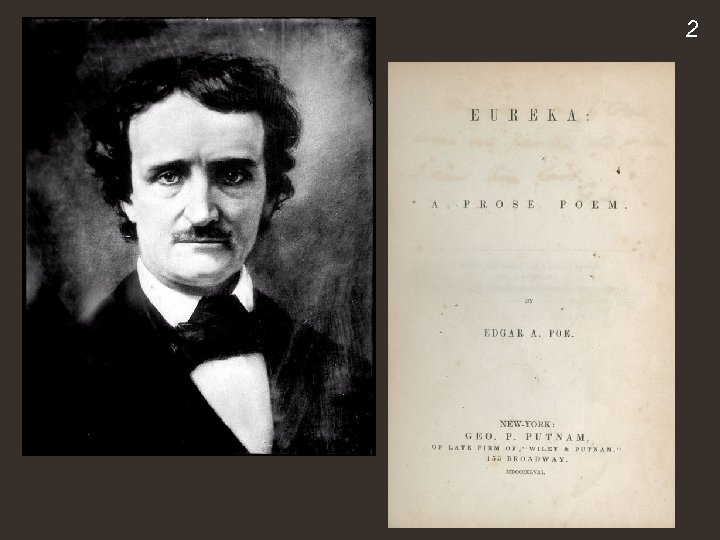
3 “Do you know that it is scarcely more than eight or nine hundred years ago since the metaphysicians first consented to relieve the people of the singular fancy that there exist but two practicable roads to Truth? Believe it if you can! It appears, however, that long, long ago, in the night of Time, there lived a Turkish philosopher called Aries and surnamed Tottle. ” “[He was] the principal propagator, of what was termed the de ductive or a priori philosophy. He started with what he maintained to be axioms, or self-evident truths […]. From axioms he proceeded, logically, to results. ” “[…] until the advent of one Hog, who preached an entirely different system, which he called the a posteriori or in ductive. He proceeded by observing, analyzing, and classifying facts and arranging them into general laws. ”
INLEIDING • bouwstenen wetenschap • theorie/empirie • deductie/inductie • > cyclus empirisch onderzoek • hoe komen tot kennisopbouw? • epistemologie, kennistheorie: wat is kennis? • vanuit ‘historisch’ overzicht • > inzicht analytische principes 4
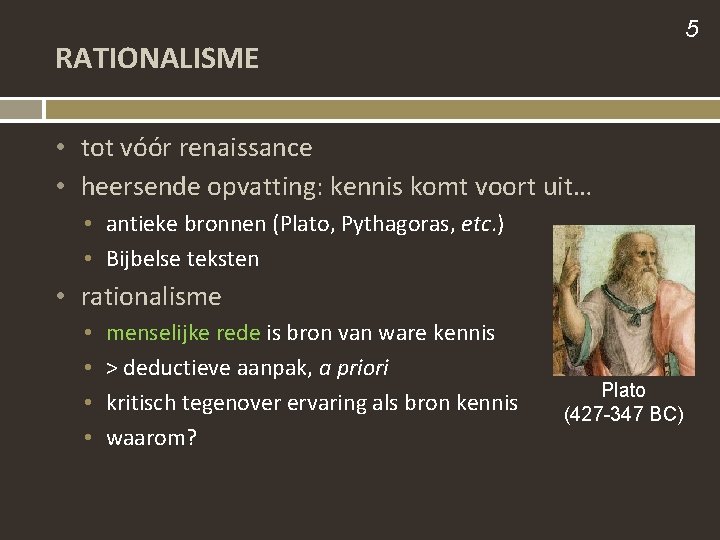
5 RATIONALISME • tot vóór renaissance • heersende opvatting: kennis komt voort uit… • antieke bronnen (Plato, Pythagoras, etc. ) • Bijbelse teksten • rationalisme • • menselijke rede is bron van ware kennis > deductieve aanpak, a priori kritisch tegenover ervaring als bron kennis waarom? Plato (427 -347 BC)
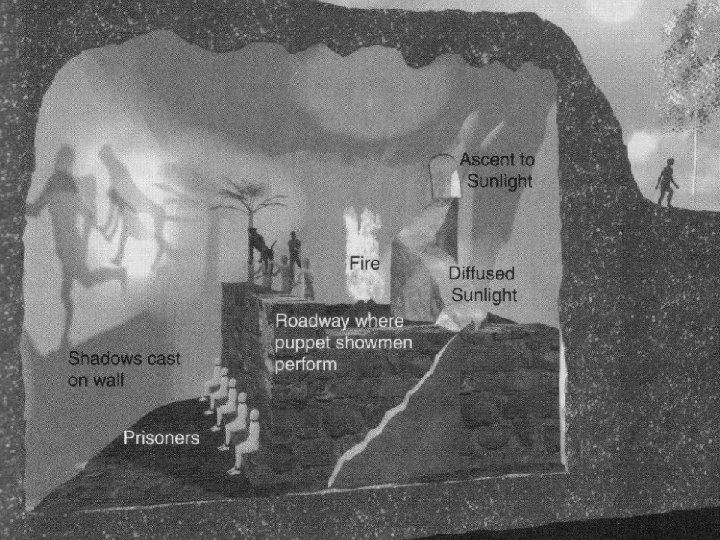
PLATO’S ALLEGORIE VAN DE GROT 6
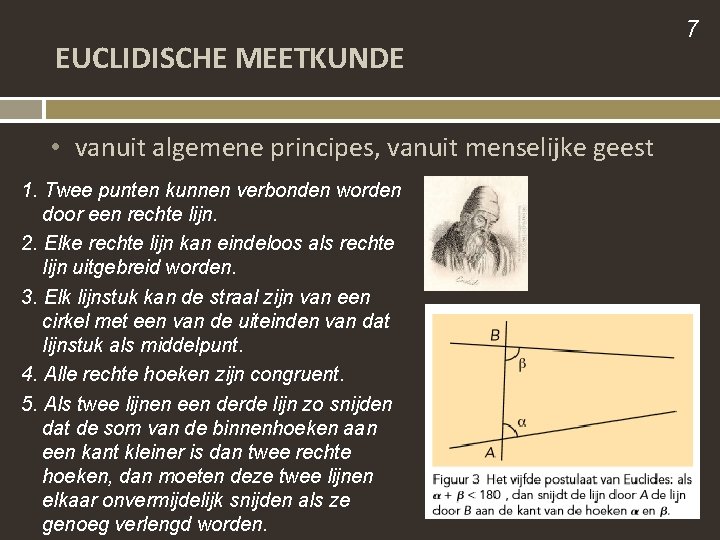
EUCLIDISCHE MEETKUNDE • vanuit algemene principes, vanuit menselijke geest 1. Twee punten kunnen verbonden worden door een rechte lijn. 2. Elke rechte lijn kan eindeloos als rechte lijn uitgebreid worden. 3. Elk lijnstuk kan de straal zijn van een cirkel met een van de uiteinden van dat lijnstuk als middelpunt. 4. Alle rechte hoeken zijn congruent. 5. Als twee lijnen een derde lijn zo snijden dat de som van de binnenhoeken aan een kant kleiner is dan twee rechte hoeken, dan moeten deze twee lijnen elkaar onvermijdelijk snijden als ze genoeg verlengd worden. 7
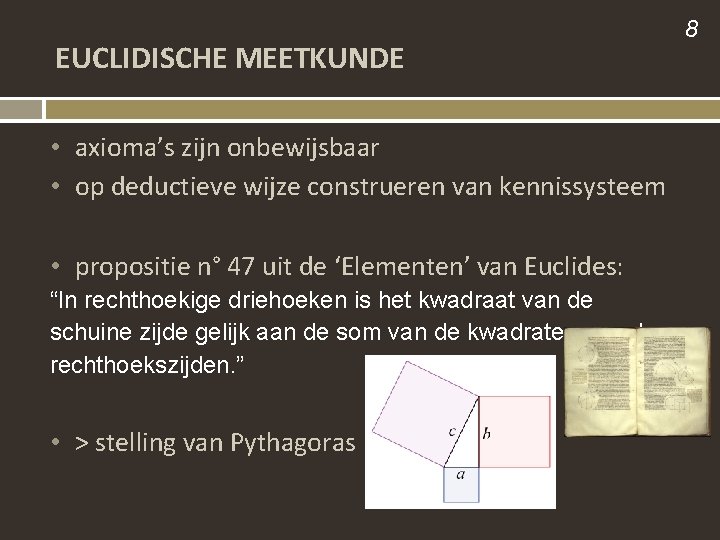
EUCLIDISCHE MEETKUNDE • axioma’s zijn onbewijsbaar • op deductieve wijze construeren van kennissysteem • propositie n° 47 uit de ‘Elementen’ van Euclides: “In rechthoekige driehoeken is het kwadraat van de schuine zijde gelijk aan de som van de kwadraten van de rechthoekszijden. ” • > stelling van Pythagoras 8
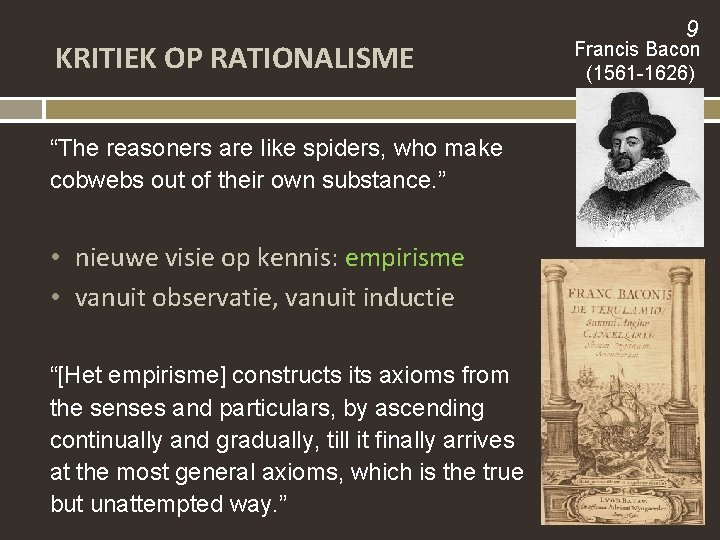
KRITIEK OP RATIONALISME “The reasoners are like spiders, who make cobwebs out of their own substance. ” • nieuwe visie op kennis: empirisme • vanuit observatie, vanuit inductie “[Het empirisme] constructs its axioms from the senses and particulars, by ascending continually and gradually, till it finally arrives at the most general axioms, which is the true but unattempted way. ” 9 Francis Bacon (1561 -1626)
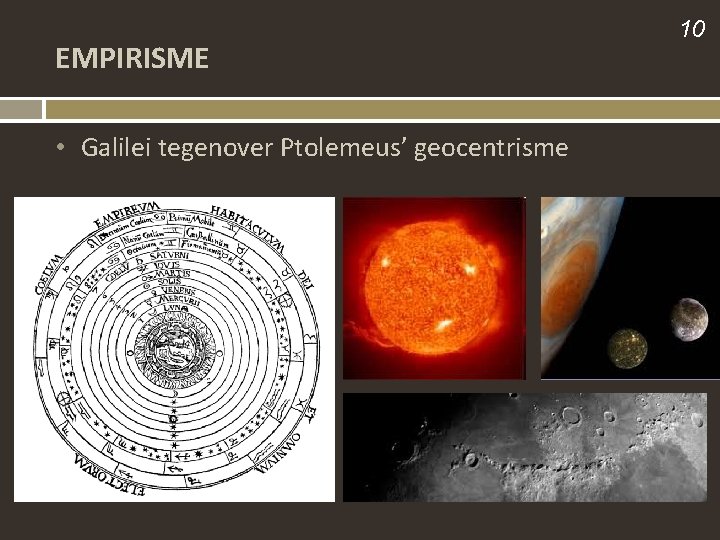
EMPIRISME • Galilei tegenover Ptolemeus’ geocentrisme 10
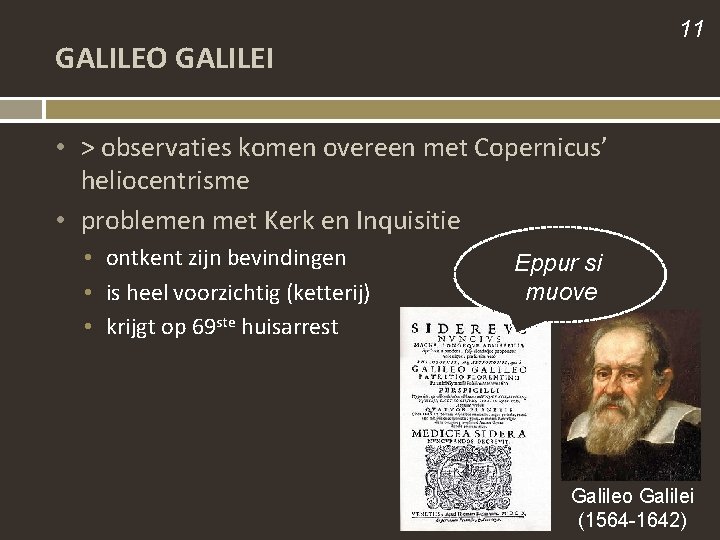
11 GALILEO GALILEI • > observaties komen overeen met Copernicus’ heliocentrisme • problemen met Kerk en Inquisitie • ontkent zijn bevindingen • is heel voorzichtig (ketterij) • krijgt op 69 ste huisarrest Eppur si muove Galileo Galilei (1564 -1642)
EMPIRISME (2) • ervaring/observatie als bron van kennis • menselijke geest = ‘tabula rasa’ • correspondentietheorie • > wetenschap is niet louter observeren! “The men of experiment are like the ant, they only collect and use. ” (Bacon, 1901[1620]: 76) • > cyclus empirisch onderzoek 12
EMPIRISME (3) “the bee extracts matter from the flowers of the garden and of the field, but transforms and digests it by a power of its own. The true business of philosophy [i. e. de wetenschappen] resembles hers: for it neither relies solely or chiefly on the powers of the mind, nor does it take the matter which it gathers from natural history and mechanical experiments and lay it up in the memory in its raw state, but lays it up in the understanding altered and digested. Therefore from a closer and purer alliance between these two faculties, the experimental and the rational (such as has never yet been made), much may be hoped. ” (Bacon, 1901 [1620]: 76 -77). 13
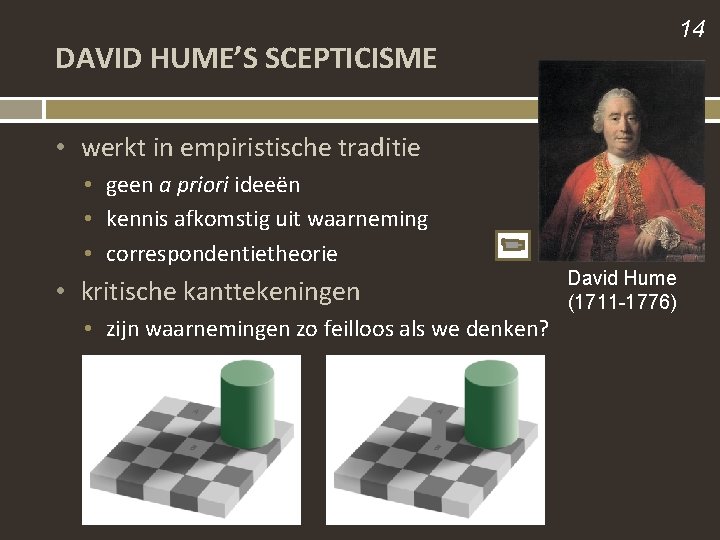
14 DAVID HUME’S SCEPTICISME • werkt in empiristische traditie • geen a priori ideeën • kennis afkomstig uit waarneming • correspondentietheorie • kritische kanttekeningen • zijn waarnemingen zo feilloos als we denken? David Hume (1711 -1776)
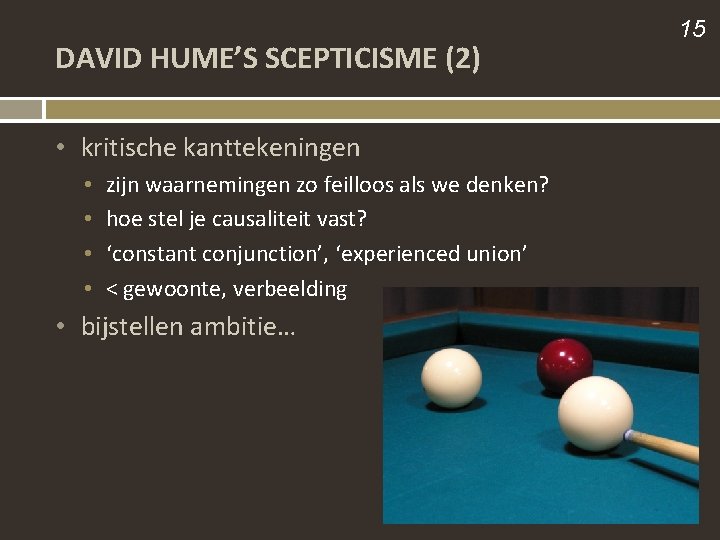
DAVID HUME’S SCEPTICISME (2) • kritische kanttekeningen • • zijn waarnemingen zo feilloos als we denken? hoe stel je causaliteit vast? ‘constant conjunction’, ‘experienced union’ < gewoonte, verbeelding • bijstellen ambitie… 15
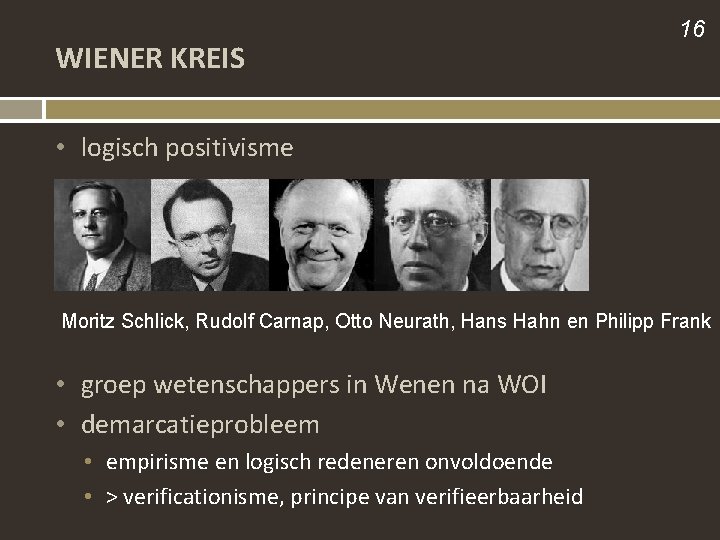
WIENER KREIS 16 • logisch positivisme Moritz Schlick, Rudolf Carnap, Otto Neurath, Hans Hahn en Philipp Frank • groep wetenschappers in Wenen na WOI • demarcatieprobleem • empirisme en logisch redeneren onvoldoende • > verificationisme, principe van verifieerbaarheid
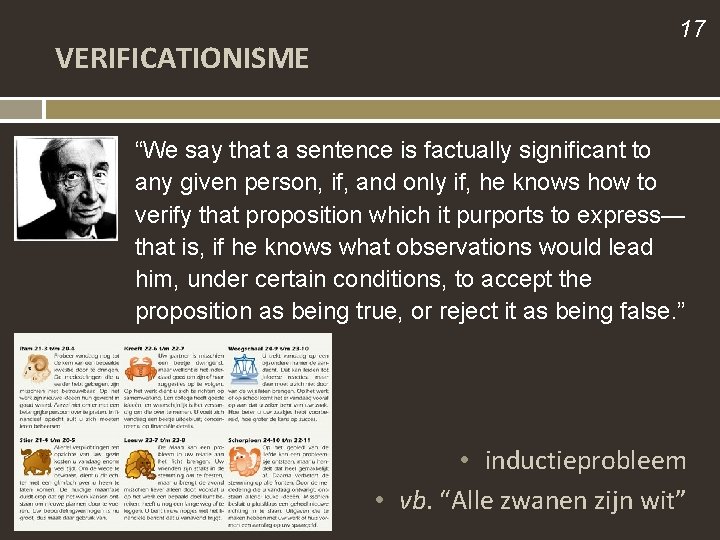
VERIFICATIONISME 17 “We say that a sentence is factually significant to any given person, if, and only if, he knows how to verify that proposition which it purports to express— that is, if he knows what observations would lead him, under certain conditions, to accept the proposition as being true, or reject it as being false. ” (Ayer, 1936: 6) • inductieprobleem • vb. “Alle zwanen zijn wit”
KARL POPPER’S FALSIFICATIE 18 • kritiek op Wiener Kreis • (1) observatie niet vanuit cognitief vacuüm • tabula rasa? • kritische ingesteldheid • onbewezen voorkennis Karl Popper (1902 -1994) • (2) principe verificatie onhoudbaar • pseudowetenschap als waar (Marx, Freud) “A marxist could not open a newspaper without finding on every page confirming evidence for his interpretation of history; not only in the news, but also in its presentation— which revealed the class bias of the paper. ” (Popper, 1969:
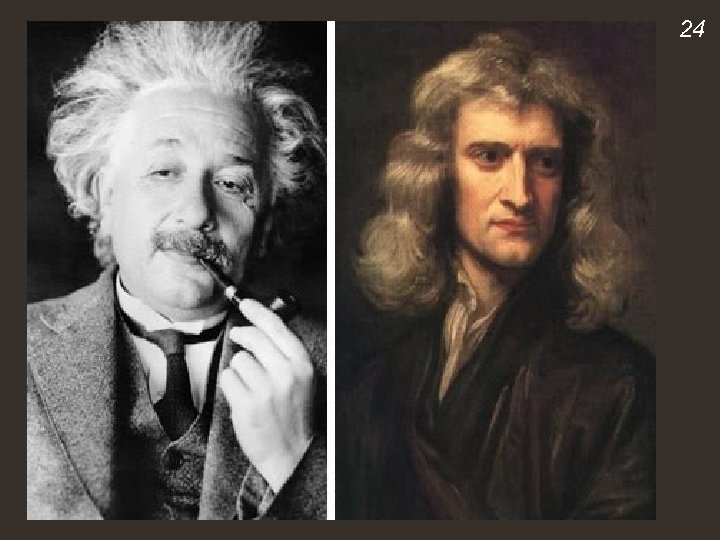
KARL POPPER’S FALSIFICATIE (2) • weerlegbaarheid staat centraal • wetenschappelijke kennis is nooit bewezen • theorie is nooit onwrikbaar bewezen • cf. Newton vs. Einstein • alleen ontkrachting theorie geeft zekerheid • zoeken naar tegensprekelijke voorbeelden • niet-falsifieerbare uitspraken zijn niet wetenschappelijk • idem met ontbreken van een tijdslimiet bij voorspelling • zekerheid en waarschijnlijkheid • hypothese verwerpen: zekerheid theorie problematisch • hypothese aanvaarden: waarschijnlijk theorie kloppen 19
THOMAS KUHN’S PARADIGMATA • stelt vragen bij correspondentietheorie Thomas Kuhn (1922 -1996) • zit waarheid enkel in overeenkomst? • wetenschappers zijn niet de vrije, kritische geesten (< Popper) • > psychologische, sociale processen • zekere vasthoudendheid • gooien niet onmiddellijk theorieën overboord • vastgeroeste routines/assumpties • één tegensprekelijk voorbeeld? • > paradigma wissel 20
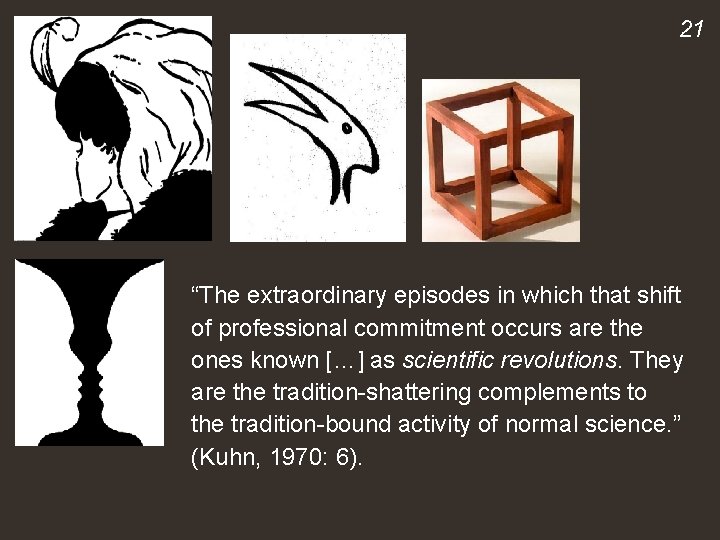
21 “The extraordinary episodes in which that shift of professional commitment occurs are the ones known […] as scientific revolutions. They are the tradition-shattering complements to the tradition-bound activity of normal science. ” (Kuhn, 1970: 6).
22 THEORIE MET MEERINHOUD • synthese van Popper en Kuhn • niet falsifiëren één tegensprekelijk voorbeeld • > wetenschappers neiging theorie te ‘redden’ • test van geïsoleerde hypothese onmogelijk Imre Lakatos (1922 -1974) • = test van alle hulp-assumpties binnen theorie • = Duhem-Quine stelling • theorie is conjunctie van uitspraken (h 1, h 2, h 3, …) • h 1 = draad breekt indien belast met gewicht > reksterkte • h 2 = reksterkte = 500 g. • h 3 = draad belast met gewicht 1 kg. • O = draad breekt niet
THEORIE MET MEERINHOUD 23 • theorie T wordt pas weerlegd als er een alternatieve theorie T’ bestaat met volgende eigenschappen • meerinhoud van T’ > T’ heeft meer empirische inhoud dan T, i. e. T’ verklaart nieuwe feiten die volgens T onwaarschijnlijk of zelfs onmogelijk waren • partiële inclusie van T > alle onweerlegbare inhoud van T zit in T’ vervat • meerinhoud van T’ wordt empirisch bevestigd • belang van kringloop, van cyclisch karakter empirisch onderzoek
THEORIE MET MEERINHOUD 24
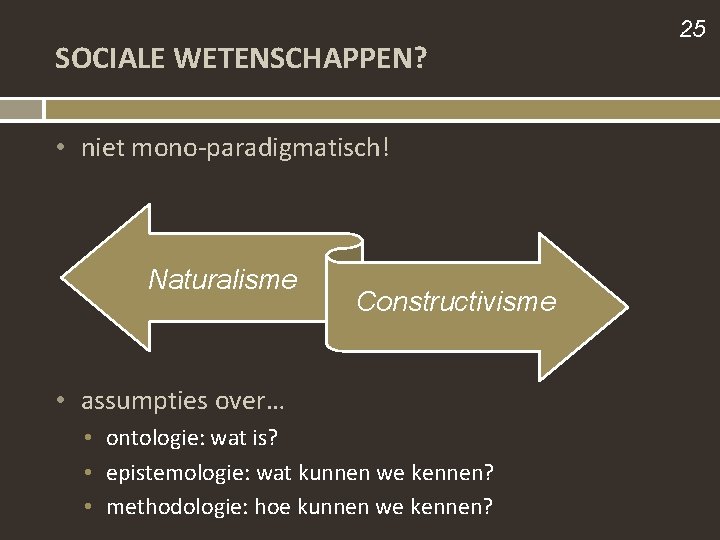
SOCIALE WETENSCHAPPEN? • niet mono-paradigmatisch! Naturalisme Constructivisme • assumpties over… • ontologie: wat is? • epistemologie: wat kunnen we kennen? • methodologie: hoe kunnen we kennen? 25
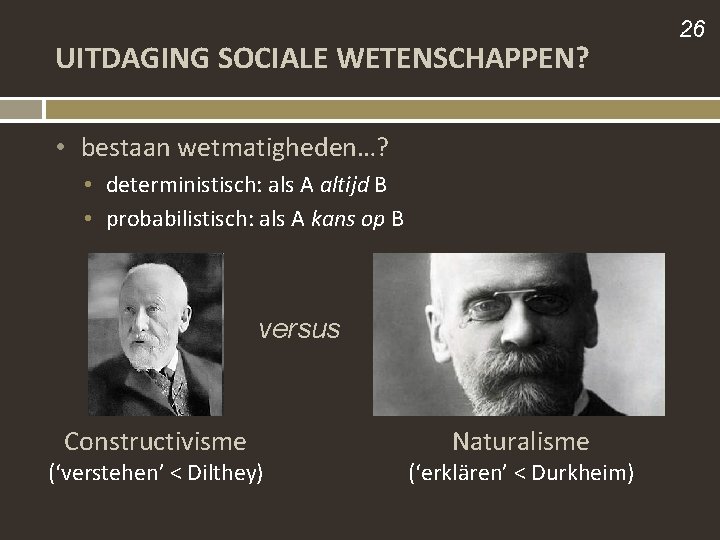
UITDAGING SOCIALE WETENSCHAPPEN? • bestaan wetmatigheden…? • deterministisch: als A altijd B • probabilistisch: als A kans op B versus Constructivisme (‘verstehen’ < Dilthey) Naturalisme (‘erklären’ < Durkheim) 26
NATURALISME (OF POSITIVISME) 27 • “there is a real world out there…” • sociale realiteit = onafhankelijk van onderzoeker • = empirisch realisme, objectivisme • sociale wereld lijkt complex, maar is in essentie eenvoudig: simpele onderliggende wetten (oorzaak-gevolg) • via observatie en zoeken van associaties kunnen we deze wetten ontdekken • ultieme doel van de wetenschap: regelmatigheden te ontdekken en te presenteren als wetten: ‘erklären’ • = empirisme • vb. “Wat genereert stress op het werk? ”
28
CONSTRUCTIVISME 29 • “people—unlike particles—think…” • kan de sociale wereld worden bestudeerd zoals de natuur? • zijn er wel wetten die het menselijke handelen bepalen? • wat met ‘vrije wil’? • uniek sociaal gedrag ‘van binnenuit’ proberen te begrijpen in relatie tot context waarbinnen dit gedrag wordt gesteld • handelen moeilijk voorspelbaar: ’verstehen’ in context • > geen algemene wetmatigheden (Dilthey) • > hermeneutiek
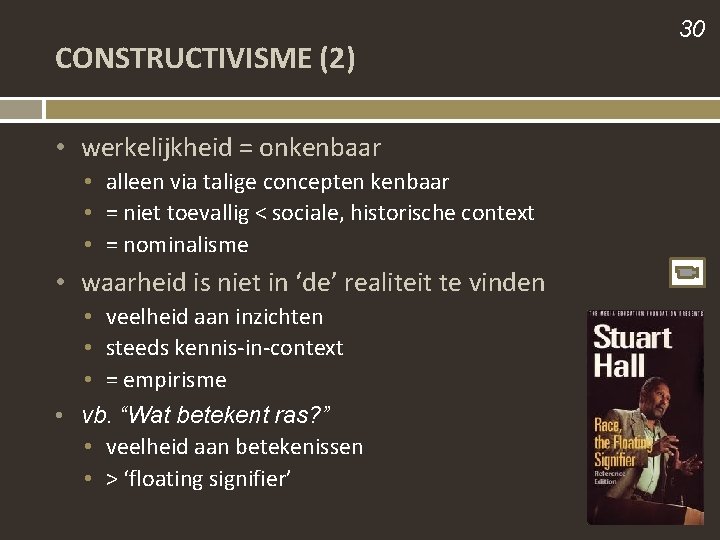
CONSTRUCTIVISME (2) • werkelijkheid = onkenbaar • alleen via talige concepten kenbaar • = niet toevallig < sociale, historische context • = nominalisme • waarheid is niet in ‘de’ realiteit te vinden • veelheid aan inzichten • steeds kennis-in-context • = empirisme • vb. “Wat betekent ras? ” • veelheid aan betekenissen • > ‘floating signifier’ 30
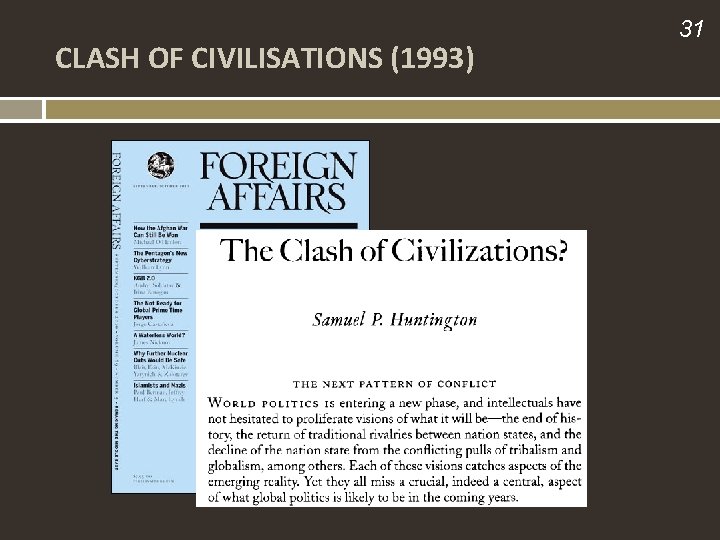
CLASH OF CIVILISATIONS (1993) 31
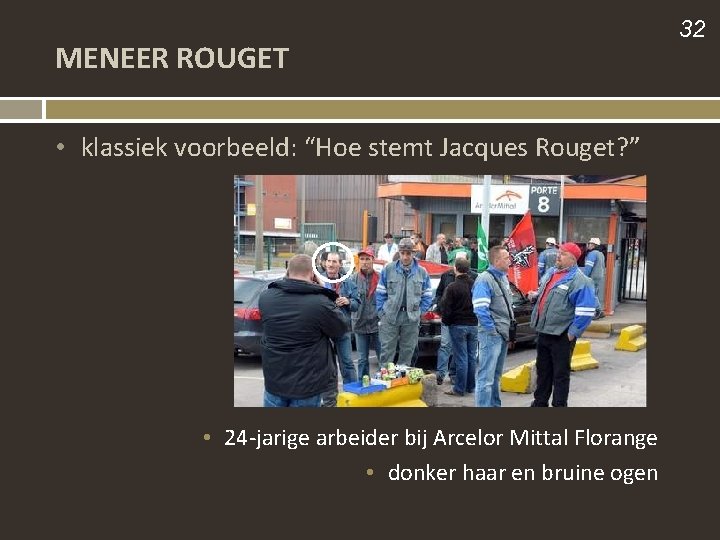
MENEER ROUGET • klassiek voorbeeld: “Hoe stemt Jacques Rouget? ” • 24 -jarige arbeider bij Arcelor Mittal Florange • donker haar en bruine ogen 32
NATURALISTEN? 33 • < naturalisme: theorie over stemgedrag “One out of every two workers votes Communist; and employees of large organizations vote Communist more often than employees of small organizations; and young people vote Communist more often than older people. ” “M. Rouget is a worker and works in a large factory and is young. ” “Therefore, it is likely that M. Rouget will vote Communist. ”
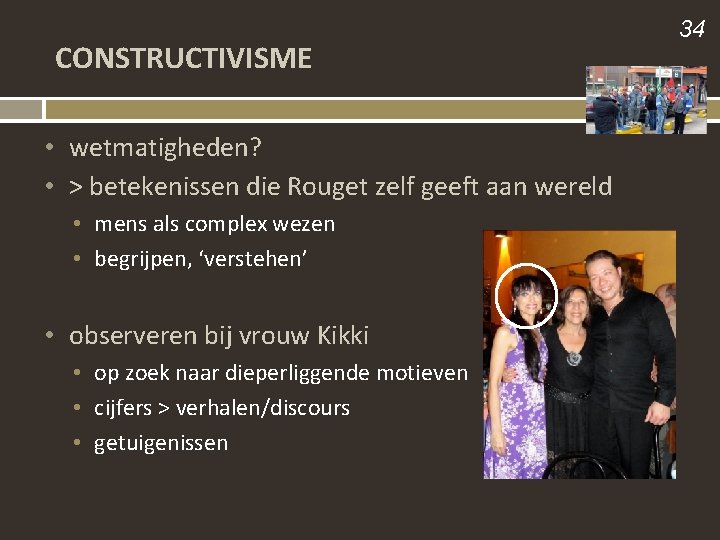
CONSTRUCTIVISME • wetmatigheden? • > betekenissen die Rouget zelf geeft aan wereld • mens als complex wezen • begrijpen, ‘verstehen’ • observeren bij vrouw Kikki • op zoek naar dieperliggende motieven • cijfers > verhalen/discours • getuigenissen 34
KIKKI? 35 “Kikki has lived with Jacques for the past six years in a small flat in a middle-class suburb just north of Paris. Jacques drives a BMW that he cannot afford and appreciates the finer things in life. As a result, Kikki and Jacques are always short of money—which Jacques blames on the French state’s passion for taxing his small factory salary. From Kikki we learn that her husband’s main passion in life is football. This is, we learn, the main reason for joining the factory union: it was a prerequisite for playing on the team.
KIKKI? (2) 36 In addition, we learn that Jacques has become increasingly conservative in his view of the world, especially his political view, since his father has died three years ago. When we ask Kikki, she could tell us with complete certainty that Jacques will vote Gaullist (RPR = Rassemblement pour la République) in the next election. ”
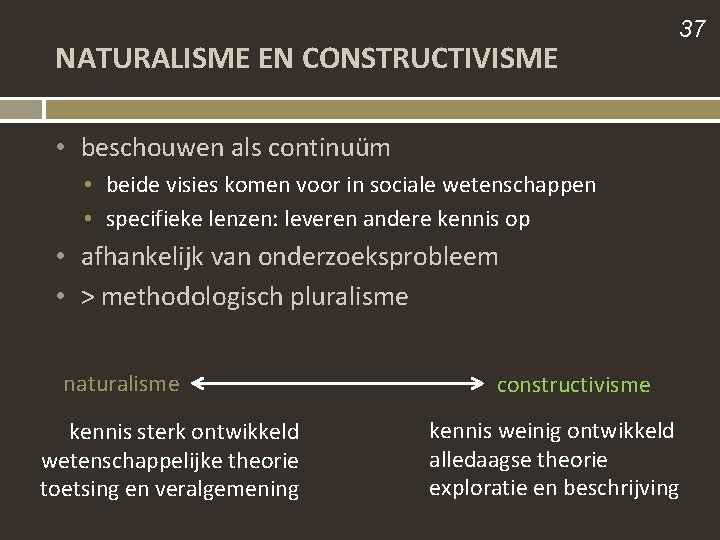
NATURALISME EN CONSTRUCTIVISME 37 • beschouwen als continuüm • beide visies komen voor in sociale wetenschappen • specifieke lenzen: leveren andere kennis op • afhankelijk van onderzoeksprobleem • > methodologisch pluralisme naturalisme kennis sterk ontwikkeld wetenschappelijke theorie toetsing en veralgemening constructivisme kennis weinig ontwikkeld alledaagse theorie exploratie en beschrijving

38
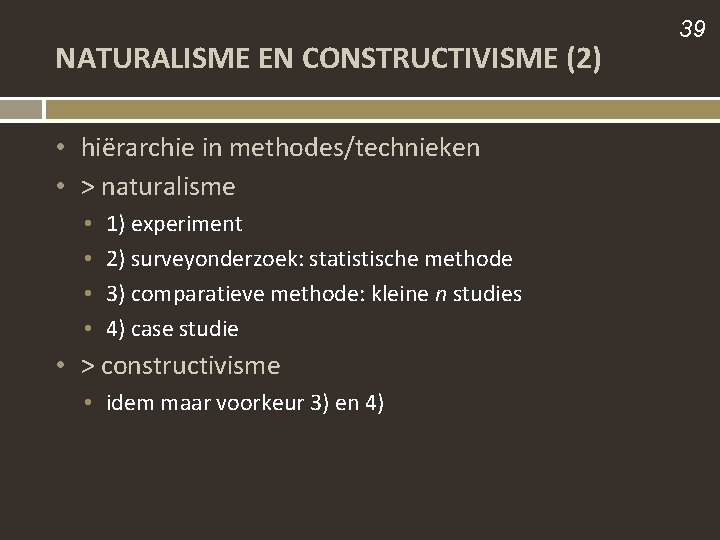
NATURALISME EN CONSTRUCTIVISME (2) • hiërarchie in methodes/technieken • > naturalisme • • 1) experiment 2) surveyonderzoek: statistische methode 3) comparatieve methode: kleine n studies 4) case studie • > constructivisme • idem maar voorkeur 3) en 4) 39
- Slides: 39