COMPUTER INTEGRATED MANUFACTURING CIM CADCAMCAE DEFINATION The Society



- Slides: 117
COMPUTER INTEGRATED MANUFACTURING (CIM) CAD/CAM/CAE
DEFINATION The Society of Manufacturing Engineers (SME) defined CIM as ‘CIM is the integration of the total manufacturing enterprise through the use of integrated systems and data communications coupled with new managerial philosophies which results in the improvement of personnel or organizational efficiencies.
INTRODUCTION Manufacturing can be considered in three broad areas: (i) continuous process production, (ii) mass production, and (iii) job-shop production. Among these three, mass production and job-shop production can be categorized as discrete- item production.
INTRODUCTION Continuous Process Production • Such type of product flows continuously in the manufacturing system, e. g. petroleum, cement, steel rolling, petrochemical and paper production etc. • Equipment used here are only applicable for small group of similar products.
INTRODUCTION Mass Production • It includes the production of discrete unit at very high rate of speed. • Discrete item production is used for goods such as automobiles, refrigerators, televisions, electronic component and so on.
INTRODUCTION Job Shop Production • A manufacturing facility that produces a large number of different discrete items and requires different sequences among the production equipments is called job shop. • Scheduling and routine problems are the essential features of job shop. • So automation is been restricted to individual component of job shop.
INTRODUCTION • Continuous flow process cannot be automated fully as it only consists of a small percentage of manufacturing system. • Mass production of discrete items is included in this category, where segments of production line are largely automated but not the entire line. • Job shop facilities have used automated machines, but transfer of work among these machines is a difficult task.
INTRODUCTION • Major component of the automated information that needs to be made available to the manufacturing operation must come from product design. • This allows a plant to be automated and integrated. • However, manufacturing is more concerned with process design rather than product design.
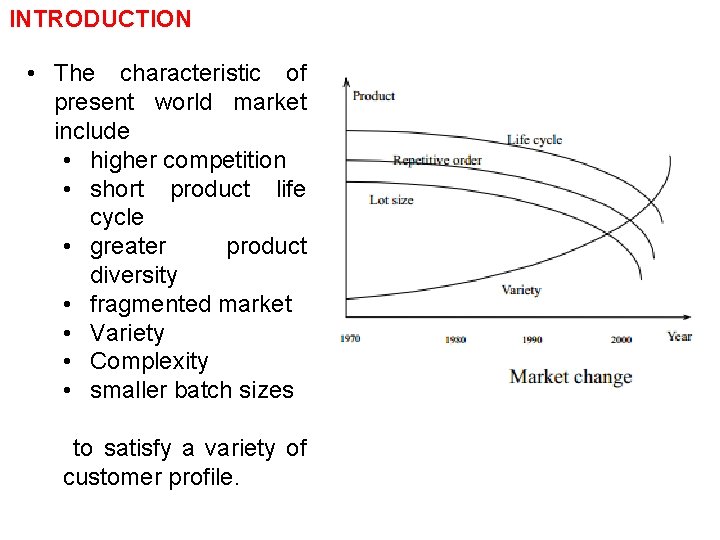
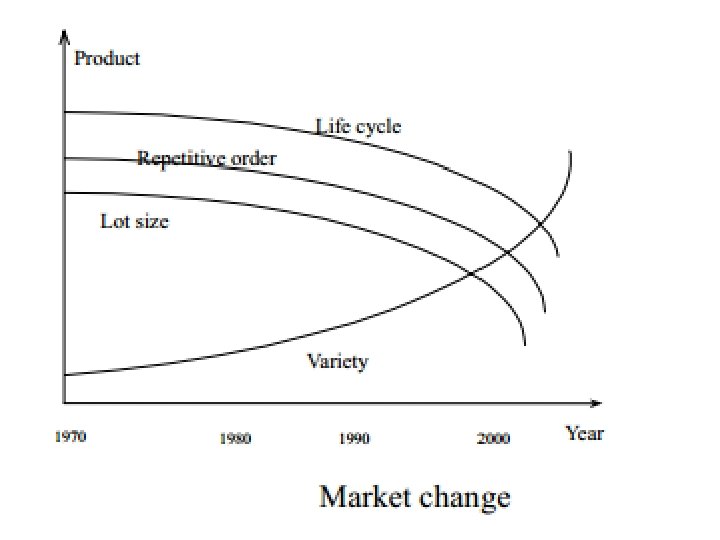
INTRODUCTION • The characteristic of present world market include • higher competition • short product life cycle • greater product diversity • fragmented market • Variety • Complexity • smaller batch sizes to satisfy a variety of customer profile.
INTRODUCTION • Furthermore, non price factors such as quality of product design, innovation and delivery services are the preliminary determinant for the success of product. • In today‟s global arena, to achieve these requirements manufacturing company needs to be flexible, adaptable and responsive to changes and be able to produce a variety of products in short time and at lower cost. • These issues attract manufacturing industries to search for some advanced technology, which can overcome these difficulties. • Computer integrated manufacturing (CIM), which emerged in 1970, was the outcome of this search.
INTRODUCTION • CIM involves a fundamental strategy of integrating manufacturing facilities and systems in an enterprise through the computer and its peripheral. • CIM can be defined in different ways depending upon its application. • CIM involves integration of advanced technologies in various functional units of an enterprise, in an effective manner to achieve the success of the manufacturing industries. • A deep knowledge and understanding of all the technology is required for an effective integration.
INTRODUCTION • At first integration of advanced manufacturing technology (AMT) is required to get success in the application of CIM. • Computers act as a subordinate to the technologies. • Computers help, organize, and restore information in order to achieve high accuracy and speed. • Their basic aim is to achieve the goals of the objectives within limited available capital. • Traditionally, all the efforts were focused on achieving single goal to improve the effectiveness and competitiveness of the organization.
INTRODUCTION • But they failed because they didn‟t satisfy the overall objectives of the manufacturing companies. • So, a multiple goal selection was proposed to make the CIM an effective tool to improve the economy of the company. • This new approach should improve the existing multi-criteria optimization mechanism, so that CIM can be realized globally. • In addition, global integration approach should be applied to make globally distributed company as a single entity.
INTRODUCTION • This concept is applied to make virtual CIM more effective and hence helps in meeting the present global economic circumstances using intelligent manufacturing. • Therefore, manufacturing technology should be blended with intelligence. • This will help manufacturing enterprise to produce better quality. • It will also facilitate the manufacturing equipment to solve problems posed during normal course of the operations.
INTRODUCTION • CIM basically involves the integration of advanced technologies such as CAD, CAM, CNC, robots, AMHS. • Today CIM has moved a step ahead by including and integrating the business improvement activities such as customer satisfaction, total quality and continuous improvement. • These activities are now managed by computers. • Business and marketing teams continuously give the customer feedback to the design and production teams by using the networking systems.
INTRODUCTION • Based on the customer requirements, design and manufacturing teams can immediately improve the existing product design or can develop an entirely new product. • Thus, the use of computers and automation technologies made the manufacturing industry capable to provide rapid response to the changing needs of customers.
INTRODUCTION • CIM encompasses the entire range of product development and manufacturing activities. • And all the functions are being carried out with the help of dedicated software packages. • The data required for various functions are passed from one application software to another in a seamless manner.
INTRODUCTION • For example, the product data created during design is transferred from the modeling software to manufacturing software without any loss of data. • CIM uses a common database and communication technologies to integrate design, manufacturing and associated business functions that combine the automated segments of a factory or a manufacturing facility.
INTRODUCTION • CIM reduces the human component of manufacturing and thereby relieves the process of its slow, expensive and errorprone component. • CIM stands for a holistic and methodological approach to the activities of the manufacturing enterprise in order to achieve vast improvement in its performance.
INTRODUCTION • This methodological approach is applied to all activities from the design of the product to customer support in an integrated way, using various methods, means and techniques in order to achieve production improvement, cost reduction, fulfillment of scheduled delivery dates, quality improvement and total flexibility in the manufacturing system. • CIM requires all those associated with a company to involve totally in the process of product development and manufacture.
INTRODUCTION • CIM also encompasses the whole lot of enabling technologies including total quality management, business process reengineering, concurrent engineering, workflow automation, enterprise resource planning and flexible manufacturing. • A distinct feature of manufacturing today is mass customization.
INTRODUCTION • This implies that though the products are manufactured in large quantities, products must incorporate customer-specific changes to satisfy the diverse requirements of the customers. • This requires extremely high flexibility in the manufacturing system.
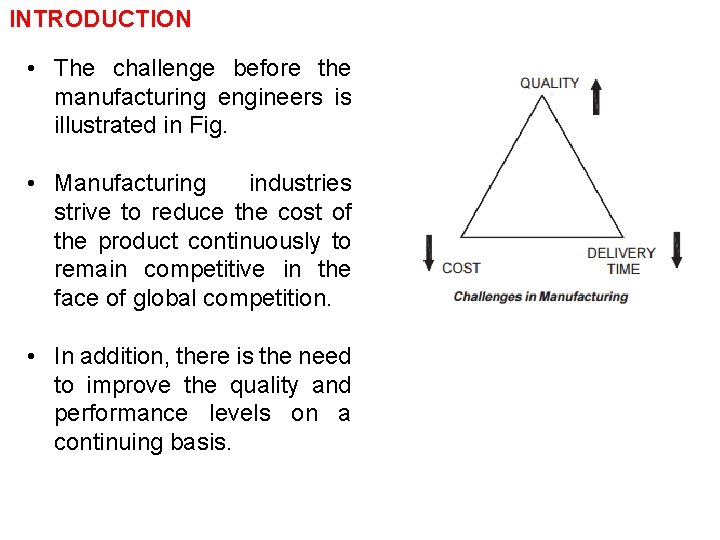
INTRODUCTION • The challenge before the manufacturing engineers is illustrated in Fig. • Manufacturing industries strive to reduce the cost of the product continuously to remain competitive in the face of global competition. • In addition, there is the need to improve the quality and performance levels on a continuing basis.
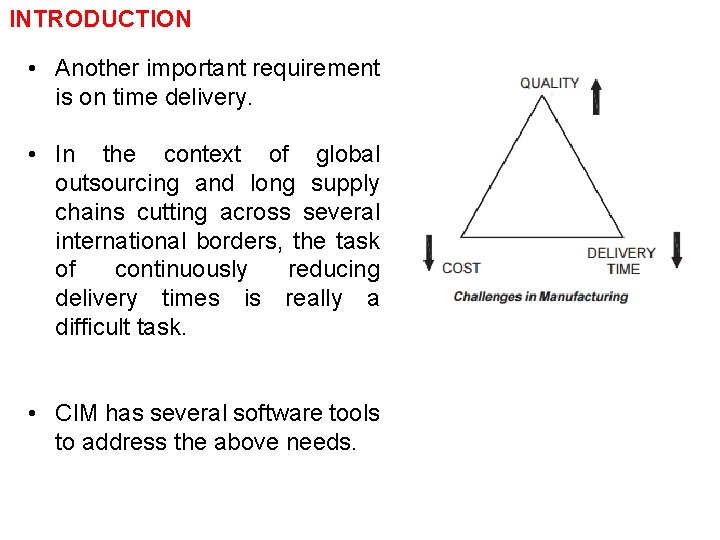
INTRODUCTION • Another important requirement is on time delivery. • In the context of global outsourcing and long supply chains cutting across several international borders, the task of continuously reducing delivery times is really a difficult task. • CIM has several software tools to address the above needs.
INTRODUCTION • Manufacturing engineers are required to achieve the following objectives to be competitive in a global context. • Reduction in inventory • Lower the cost of the product • Reduce waste • Improve quality • Increase flexibility in manufacturing to achieve immediate and rapid response to: • Product changes • Production changes • Process change • Equipment change • Change of personnel • CIM technology is an enabling technology to meet the above challenges to the manufacturing.
EVOLUTION OF CIM • CIM is considered a natural evolution of the technology of CAD/CAM which by itself evolved by the integration of CAD and CAM. • MIT (Massachusetts Institute of Technology, USA) is credited with pioneering the development in both CAD and CAM. • The need to meet the design and manufacturing requirements of aerospace industries after the Second World War necessitated the development of these technologies.
EVOLUTION OF CIM • The manufacturing technology available during late 40's and early 50's could not meet the design and manufacturing challenges arising out of the need to develop sophisticated aircraft and satellite launch vehicles. • This prompted the US Air Force to approach MIT to develop suitable control systems, drives and programming techniques for machine tools using electronic control.
EVOLUTION OF CIM • 1950’s • The first major innovation in machine control is the Numerical Control (NC), demonstrated at MIT in 1952. • Early NC Systems were all basically hardwired systems, since these were built with discrete systems • Early NC machines used paper tape as an input medium. • Every NC machine was fitted with a tape reader to read paper tape and transfer the program to the memory of the machine tool block by block.
EVOLUTION OF CIM • 1960’s • Mainframe computers were used to control a group of NC machines by mid 60's. • It was then called as DNC as the computer bypassed the tape reader to transfer the program data to the machine controller. • By late 60's mini computers were being commonly used to control NC machines. • At this stage NC became truly soft wired with the facilities of mass program storage, offline editing and software logic control and processing. • This development is called Computer Numerical Control (CNC).
EVOLUTION OF CIM • 1970’s • Since 70's, NC’s are being designed around microprocessors, resulting in compact CNC systems. • A further development to this technology is the distributed numerical control (also called DNC) in which processing of NC program is carried out in different computers operating at different hierarchical levels - • typically from mainframe host computers to plant computers to the machine controller. • Today CNCs are built around 32 bit and 64 bit microprocessors.
EVOLUTION OF CIM • Late 1970’s • Manufacturing engineers also started using computers for such tasks like inventory control, demand forecasting, PPC etc. • CNC technology was adapted in the development of CMMs which automated inspection. • Robots were introduced to automate several tasks like machine loading, materials handling, welding, painting and assembly. • These developments led to the evolution of FMC and FMS in late 70's.
EVOLUTION OF CIM • Evolution of CAD, on the other hand was to cater to the geometric modeling needs of automobile and aeronautical industries. • The developments in computers, design workstations, graphic cards, display devices and graphic input and output devices during the last ten years have been phenomenal. • This coupled with the development of operating system with graphic user interfaces and user friendly software packages for modeling, drafting, analysis and optimization provides the necessary tools to automate the design process.
EVOLUTION OF CIM • CAD in fact owes its development to the APT language project at MIT in early 50's. • Several clones of APT were introduced in 80's to automatically develop NC codes from the geometric model of the component. • Today anyone can model, draft, analyze, simulate, modify, optimize and create the NC code to manufacture a component and simulate the machining operation sitting at a computer workstation.
EVOLUTION OF CIM • If we review the manufacturing scenario during 80's we will find that the manufacturing is characterized by a few islands of automation. • In the case of design, the task is well automated. • In the case of manufacture, CNC machines, DNC systems, FMC, FMS etc provide tightly controlled automation systems.
EVOLUTION OF CIM • Similarly computer control has been implemented in several areas like manufacturing resource planning, accounting, sales, • marketing and purchase. • Yet the full potential of computerization could not be obtained unless all the segments of manufacturing are integrated, permitting the transfer of data across various functional modules.
EVOLUTION OF CIM • This realization led to the concept of computer integrated manufacturing. • Thus the implementation of CIM required the development of whole lot of computer technologies related to hardware and software.
BENEFITS OF CIM plays a vital role in the economy of the manufacturing system or enterprise. The benefits of CIM are indicated as follows: (i) Products quality improvement. (ii) Shorter time in launching new product in the market. (iii) Flow time minimized. (iv) Inventory level reduced. (v) Competitiveness increases.
BENEFITS OF CIM (vi) Improved scheduling performance. (vii) Shorter vendor lead time. (viii) Improved customer service. (ix) Increase in flexibility and responsiveness. (x) Total cost minimized. (xi) Long term profitability increases. (xii) Customers lead time minimized. (xiii) Manufacturing productivity increases. (xiv) Work in process inventory decreases.
CIM HARDWARE AND CIM SOFTWARE • CIM Hardware comprises the following: i. Manufacturing equipment such as • CNC machines or computerized work centers, • robotic work cells, • DNC/FMS systems, • work handling and tool handling devices, • storage devices, • sensors, • shop floor data collection devices, • inspection machines etc.
CIM HARDWARE AND CIM SOFTWARE • CIM Hardware comprises the following: ii. Drawing equipment such as • Computers, • controllers, • CAD/CAM systems, • workstations / terminals, • data entry terminals, • bar code readers, • RFID tags, printers, plotters and other peripheral devices, modems, cables, connectors etc. ,
CIM HARDWARE AND CIM SOFTWARE CIM software comprises computer programmes to carry out the following functions: • Analysis • Business Process Engineering (redesign & analysis of existing work flow) • Communications • Device Drivers • Database Management • Finance • Inventory Control
CIM HARDWARE AND CIM SOFTWARE • Job Tracking • Manufacturing Area Control • Marketing • Materials Handling • Management Information System (MIS) • Modeling and Design • Monitoring • Manufacturing Facilities Planning
CIM HARDWARE AND CIM SOFTWARE • Network Management • Order Entry • Process Planning • Production Control • Quality Management • Sales • Shop Floor Data Collection • Simulation • Work Flow Automation
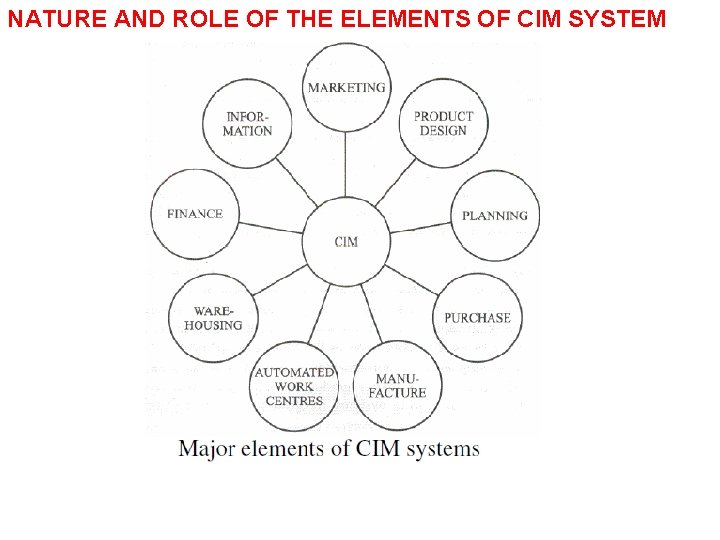
NATURE AND ROLE OF THE ELEMENTS OF CIM SYSTEM Nine major elements of a CIM system are shown in Figure. • Marketing • Product Design • Planning • Purchase • Manufacturing Engineering • Factory Automation Hardware • Warehousing • Finance • Information Management
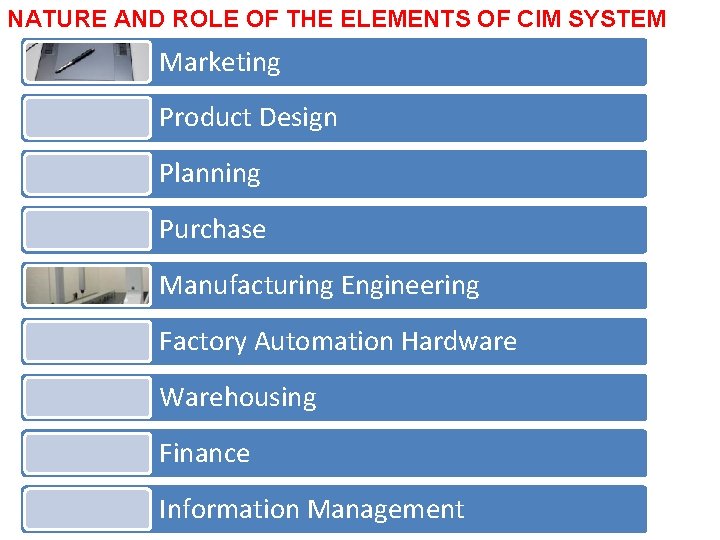
NATURE AND ROLE OF THE ELEMENTS OF CIM SYSTEM Marketing Product Design Planning Purchase Manufacturing Engineering Factory Automation Hardware Warehousing Finance Information Management
NATURE AND ROLE OF THE ELEMENTS OF CIM SYSTEM
NATURE AND ROLE OF THE ELEMENTS OF CIM SYSTEM i. Marketing: • The need for a product is identified by the marketing division. • Marketing department decides • Specifications of the product, • Projection of manufacturing quantities • Marketing strategy for the product. • Marketing also works out the manufacturing costs to assess the economic viability of the product.
NATURE AND ROLE OF THE ELEMENTS OF CIM SYSTEM ii. Product Design: • Design department of the company establishes the initial database for production of a proposed product. • Product Design is accomplished through activities such as GM and CAD while considering the product requirements and concepts generated by the creativity of the design engineer. • Configuration management (consistency) is an important activity in many designs.
NATURE AND ROLE OF THE ELEMENTS OF CIM SYSTEM ii. Product Design: • Complex designs are usually carried out by several teams working simultaneously, located often in different parts of the world. • The design process is constrained by the costs that will be incurred in actual production and by the capabilities of the available production equipment and processes. • The design process creates the database required to manufacture the part.
NATURE AND ROLE OF THE ELEMENTS OF CIM SYSTEM iii. Planning: • Input is : database established by the design department • Process : enriches it with production data and information to produce a plan for the production of the product. • Constrain : The planning process should be constrained by the production costs and by the production equipment and process capability, in order to generate an optimized plan.
NATURE AND ROLE OF THE ELEMENTS OF CIM SYSTEM iii. Planning: • Involves several subsystems: dealing with • materials, • facility, • process, • tools, • manpower, • capacity, • scheduling, • outsourcing, • assembly, inspection, logistics etc.
NATURE AND ROLE OF THE ELEMENTS OF CIM SYSTEM iv. Purchase: • The purchase departments is responsible for • placing the purchase orders and follow up • ensure quality in the procurement process • receive the items • arrange for inspection • supply the items to the stores • arrange timely delivery of items depending on the production schedule for eventual supply to manufacture and assembly.
NATURE AND ROLE OF THE ELEMENTS OF CIM SYSTEM v. Manufacturing Engineering: • ME is the activity of carrying out the production of the product. • ME further enrich the database with performance data and information about the production equipment and processes. • CIM requires activities like • CNC programming, • simulation • computer aided scheduling of the production activity.
NATURE AND ROLE OF THE ELEMENTS OF CIM SYSTEM v. Manufacturing Engineering: • ME include • online dynamic scheduling and • control based on the real time performance of the equipment and processes to assure continuous production activity. • The need to meet fluctuating market demand requires the manufacturing system to be flexible and agile.
NATURE AND ROLE OF THE ELEMENTS OF CIM SYSTEM vi. Factory Automation Hardware: • Factory automation equipment further enriches the database with equipment and process data to carry out the production process. • In CIM system this consists of computer controlled process machinery such as • CNC machine tools, flexible manufacturing systems (FMS), Computer controlled robots, material handling systems (MHS), computer controlled assembly systems, automated inspection systems and so on.
NATURE AND ROLE OF THE ELEMENTS OF CIM SYSTEM vii. Warehousing: • Warehousing is the function involving storage and retrieval of raw materials, components, finished goods as well as shipment of items. • In today's complex outsourcing scenario and the need for just -in-time supply of components and subsystems, logistics and supply chain management assume great importance.
NATURE AND ROLE OF THE ELEMENTS OF CIM SYSTEM viii. Finance: • Finance deals with the resources pertaining to money. • Major tasks of the finance department are: • Planning of investment, • working capital, (Arrangement) • cash flow control, • realization of receipts, • allocation of funds • accounting
NATURE AND ROLE OF THE ELEMENTS OF CIM SYSTEM ix. Information Management: • Information Management is the most crucial tasks in CIM. • This involves: • master production scheduling, • database management, • communication, • manufacturing systems integration • management information systems.
CIM WHEEL
CIM WHEEL
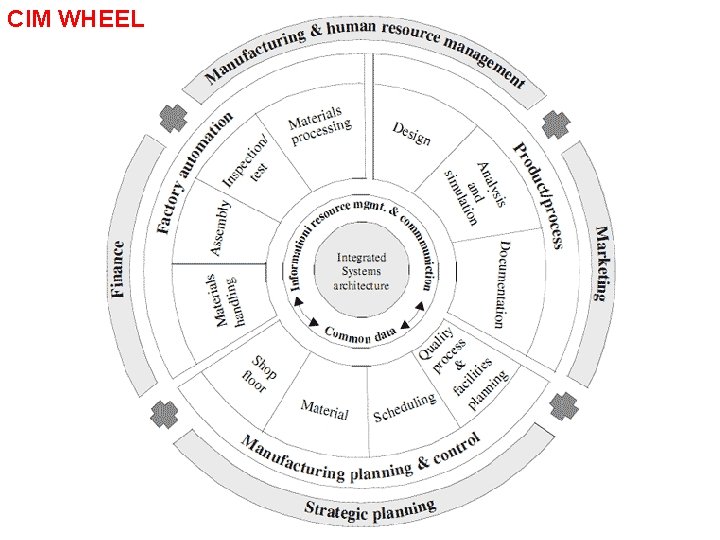
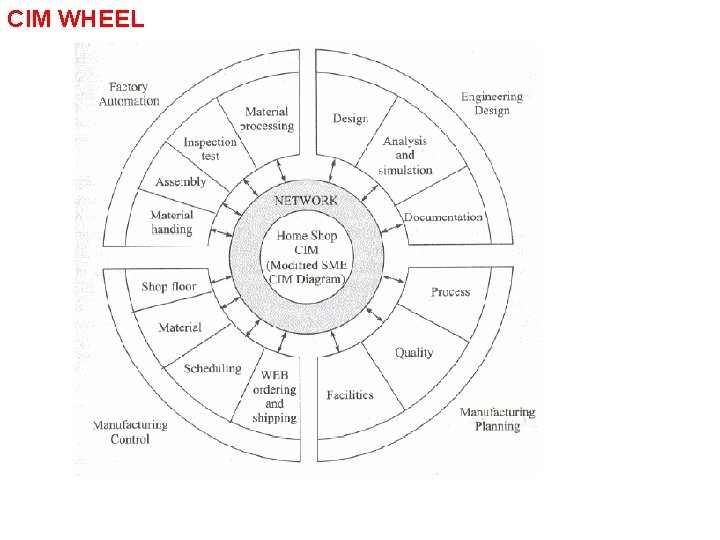
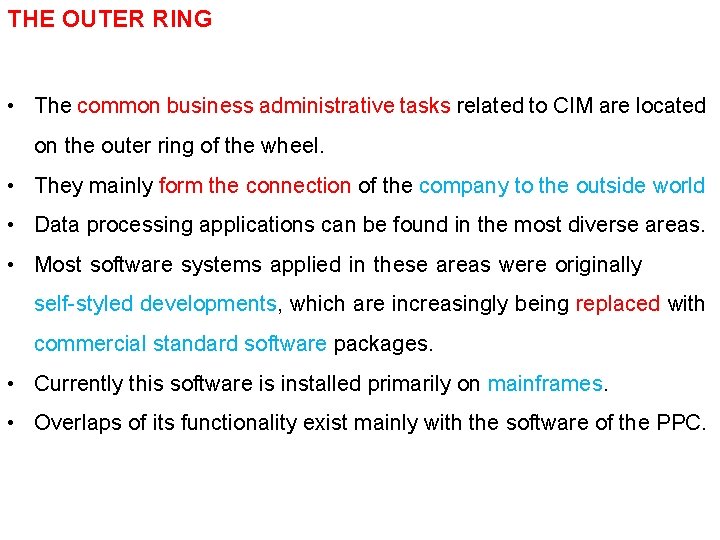
THE OUTER RING • The common business administrative tasks related to CIM are located on the outer ring of the wheel. • They mainly form the connection of the company to the outside world • Data processing applications can be found in the most diverse areas. • Most software systems applied in these areas were originally self-styled developments, which are increasingly being replaced with commercial standard software packages. • Currently this software is installed primarily on mainframes. • Overlaps of its functionality exist mainly with the software of the PPC.
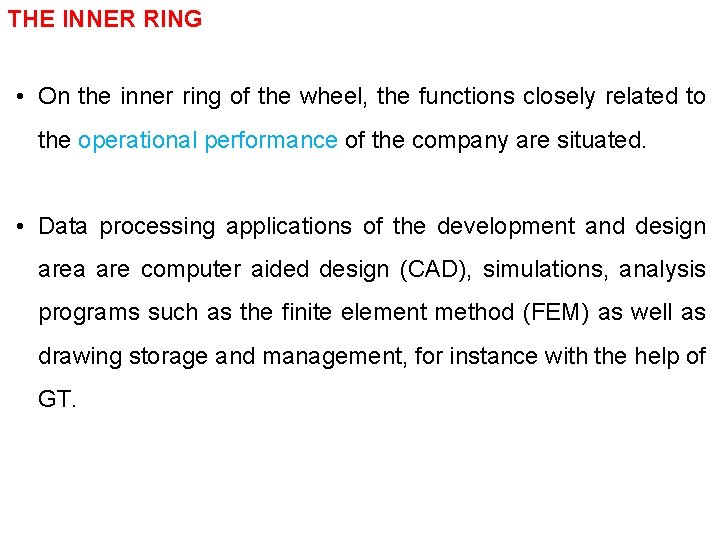
THE INNER RING • On the inner ring of the wheel, the functions closely related to the operational performance of the company are situated. • Data processing applications of the development and design area are computer aided design (CAD), simulations, analysis programs such as the finite element method (FEM) as well as drawing storage and management, for instance with the help of GT.
THE INNER RING • The types of data found in this area are diverse: • drawings, technical specifications, and bills of material. • In manufacturing companies, the data itself are often in considerable disorder. • Frequently there are several types of part numbers, more than one group technology system, many kinds of bills of material, a number of different CAD systems each having its own sort of computer internal representation of geometric data, etc. • The applied software rarely runs on the same hardware, resulting also in a large number of different hardware systems.
THE INNER RING • The second group is attributed to process planning and PPC. • It comprises tasks such as routing generation, resource planning, material requirements planning, capacity planning, order distribution and supervision, but also the planning of quality assurance. • As in the common business administrative area, the software packages-which at least are integrated within themselves-have a modular structure and their single components can also be bought and applied.
THE INNER RING • Therefore a company rarely has purchased and installed all modules of such a package, which in turn frequently results in functional overlaps and data redundancy.
THE INNER RING • Third group on the inner ring includes the automation of the manufacturing installations. • Examples are robots, NC machines, FMS and computer aided measuring and testing methods. • This area is characterized by the extreme heterogeneity of the systems involved, the diversity of which being much more pronounced than in the previously mentioned groups of functions.
THE HUB • At present within these groups of applications there are serious hindrances with regard to integration. • There are few suppliers covering all three sectors. • Therefore little or nothing has been done by the suppliers with regard to interfaces, not to mention the integration of the various groups of applications. • Information and communication management, represented by the hub of the wheel which links everything, is intended to serve as the information management and communication control function between the single areas. • It operates on a common, integrated database.
BENEFITS OF CIM Many of the firms that are currently using CIM have reported a number of improvements including: • 15 -30 % reduction in engineering design cost, • 30 -60 % reduction in overall lead times, • 40 -70% gain in overall production, • 200 -500 % gain in quality • 30 -60 % reduction in working progress.
OBJECTIVE OF CIM • In the competitive business at globalization era, a company faces many challenges from business world wide also competitive from other company and its business strategies as well. • Therefore company should come out with a good planning and strategy. • Thus, with implementing CIM system at company several things could be improved.
OBJECTIVE OF CIM • Simplify production processes, product design and factory organisation, as these are vital foundation to automation and integration • To reduce lead time, costs and inventory • Automate production processes • And automate business functions that support them with computers, machines and robots. • To coordinate and organize data effectively
OBJECTIVE OF CIM • To eliminate paper and the costs associated with its use • To automate communication within a factory and increases its speed • To facilitate simultaneous engineering • Integrate all, production and support processes using computer networks, cross-functional business software and other information technologies.
DATABASE REQUIREMENTS FOR CIM • Information is needed by mfg. company • To carry a task needs certain amount of skill. • E. g. machining of casting • Machining data should be known • If not known has to consult supervisor or handbook • Handbook does not provide failure data • Following information may be required • Serial number of faulty part • Scheduled maintenance of XY machine • Company profit of last year • Stress value of grey cast iron • How many days ABC was absent • What is approx cutting speed for machining of new ceramic part?
DATABASE REQUIREMENTS FOR CIM • Product Design and Manufacturing process increasingly requires access to substantial technical information in various stages like • Design • Analysis • manufacturing. • It also needs smooth co-ordination among the many functions constituting an enterprise. • Manufacturing organizations may waste a considerable portion of their resources due to delayed or error prone communication from one segment to another. • It would therefore be desirable to have one single central database that would contain all information.
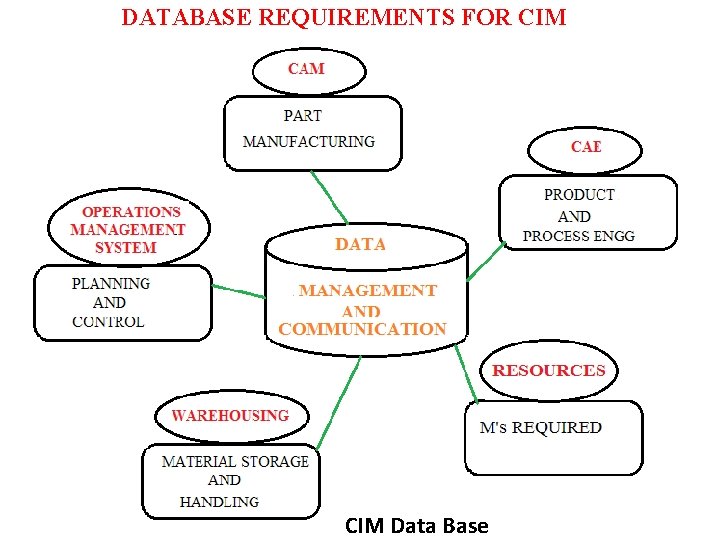
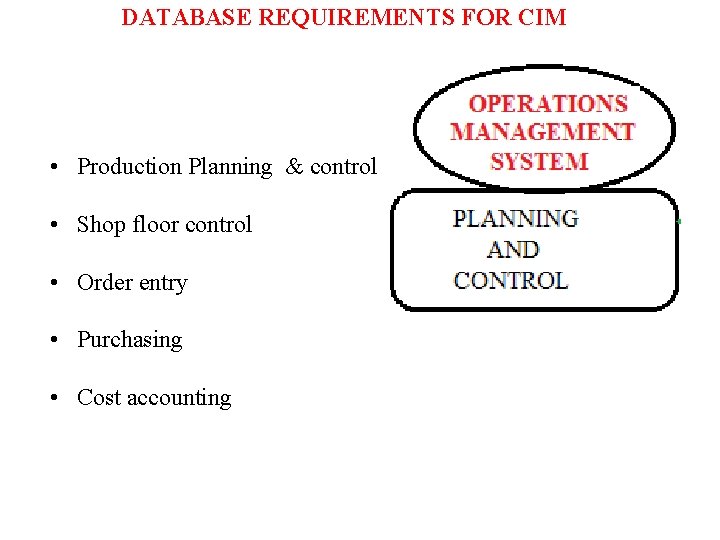
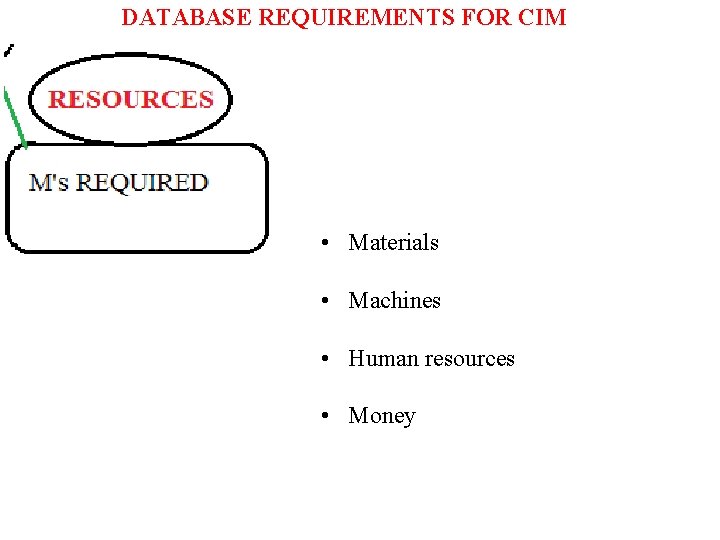
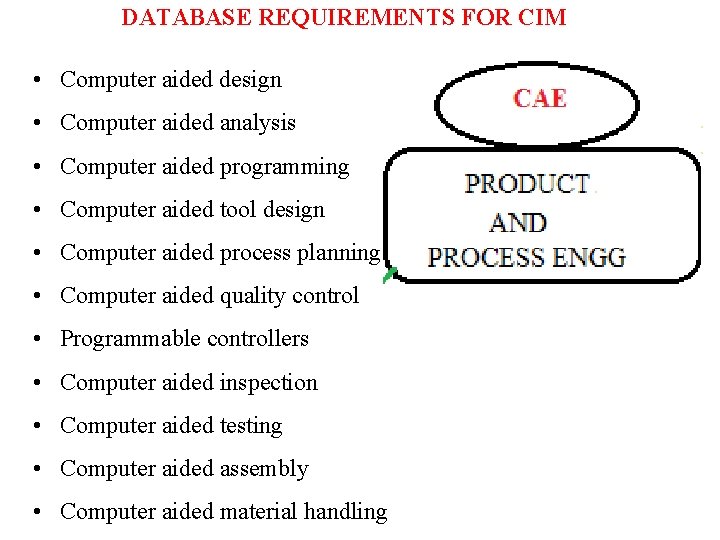
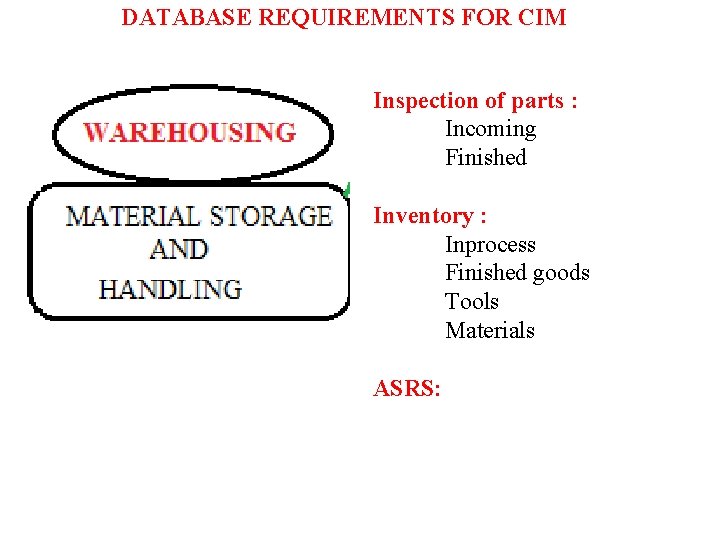
DATABASE REQUIREMENTS FOR CIM The CIM database comprises basically following classes of data: i. Product Data: Data about parts to be manufactured It includes text and geometry data ii. Manufacturing / Production Data: Information on how parts are to be manufactured iii. Engineering Data: Information on use of computer in analysis, inspection, testing iv. Operational Data: Describes the things specific to production: lot size, schedule, assembly sequence etc. v. Resource Data: Describes resources involved in operations: materials, machines, human resources and money.
DATABASE REQUIREMENTS FOR CIM Data Base
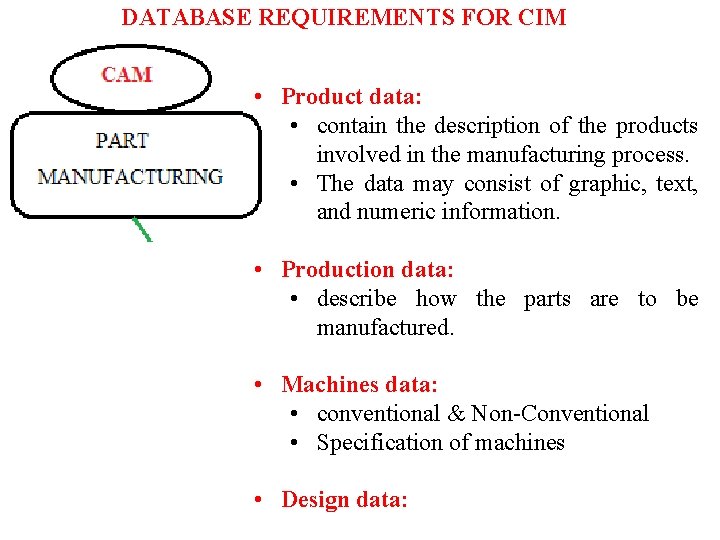
DATABASE REQUIREMENTS FOR CIM • Product data: • contain the description of the products involved in the manufacturing process. • The data may consist of graphic, text, and numeric information. • Production data: • describe how the parts are to be manufactured. • Machines data: • conventional & Non-Conventional • Specification of machines • Design data:
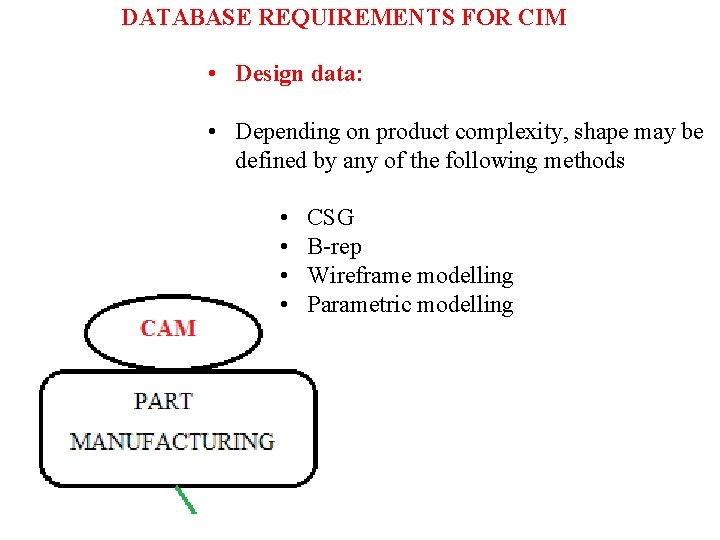
DATABASE REQUIREMENTS FOR CIM • Design data: • Depending on product complexity, shape may be defined by any of the following methods • • CSG B-rep Wireframe modelling Parametric modelling
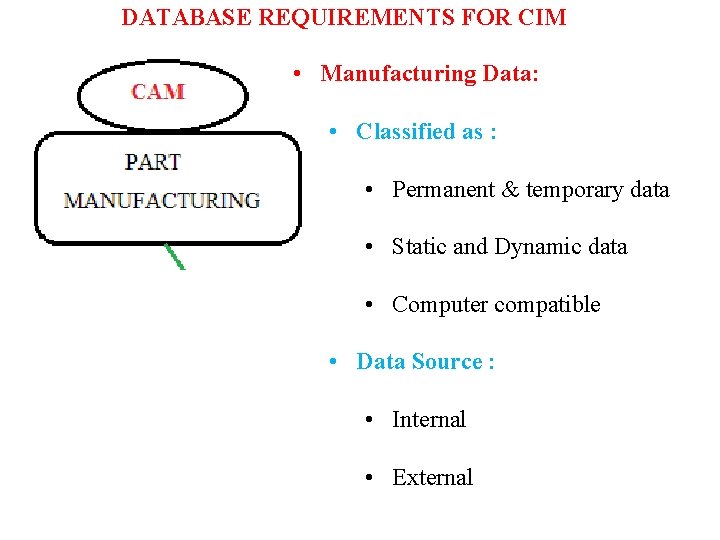
DATABASE REQUIREMENTS FOR CIM • Manufacturing Data: • Classified as : • Permanent & temporary data • Static and Dynamic data • Computer compatible • Data Source : • Internal • External
DATABASE REQUIREMENTS FOR CIM • Production Planning & control • Shop floor control • Order entry • Purchasing • Cost accounting
DATABASE REQUIREMENTS FOR CIM • Materials • Machines • Human resources • Money
DATABASE REQUIREMENTS FOR CIM • Computer aided design • Computer aided analysis • Computer aided programming • Computer aided tool design • Computer aided process planning • Computer aided quality control • Programmable controllers • Computer aided inspection • Computer aided testing • Computer aided assembly • Computer aided material handling
DATABASE REQUIREMENTS FOR CIM Inspection of parts : Incoming Finished Inventory : Inprocess Finished goods Tools Materials ASRS:
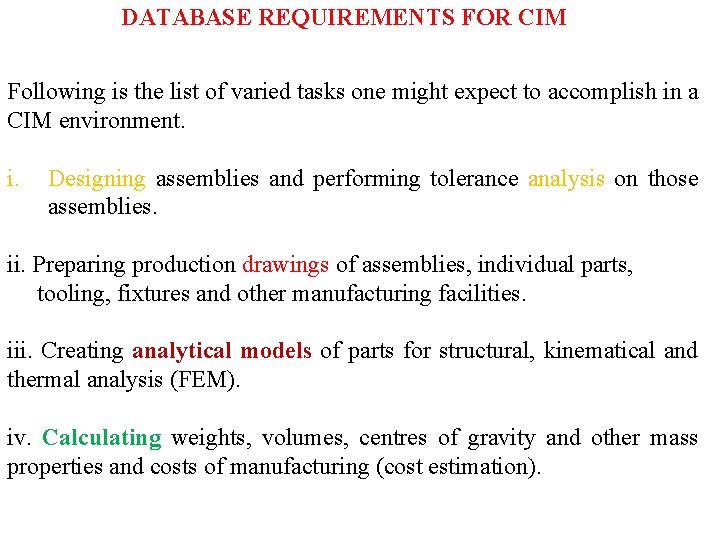
DATABASE REQUIREMENTS FOR CIM Following is the list of varied tasks one might expect to accomplish in a CIM environment. i. Designing assemblies and performing tolerance analysis on those assemblies. ii. Preparing production drawings of assemblies, individual parts, tooling, fixtures and other manufacturing facilities. iii. Creating analytical models of parts for structural, kinematical and thermal analysis (FEM). iv. Calculating weights, volumes, centres of gravity and other mass properties and costs of manufacturing (cost estimation).
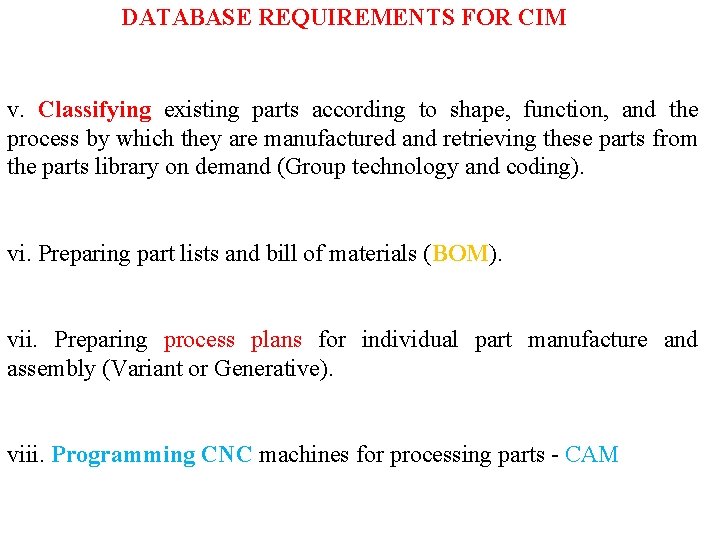
DATABASE REQUIREMENTS FOR CIM v. Classifying existing parts according to shape, function, and the process by which they are manufactured and retrieving these parts from the parts library on demand (Group technology and coding). vi. Preparing part lists and bill of materials (BOM). vii. Preparing process plans for individual part manufacture and assembly (Variant or Generative). viii. Programming CNC machines for processing parts - CAM
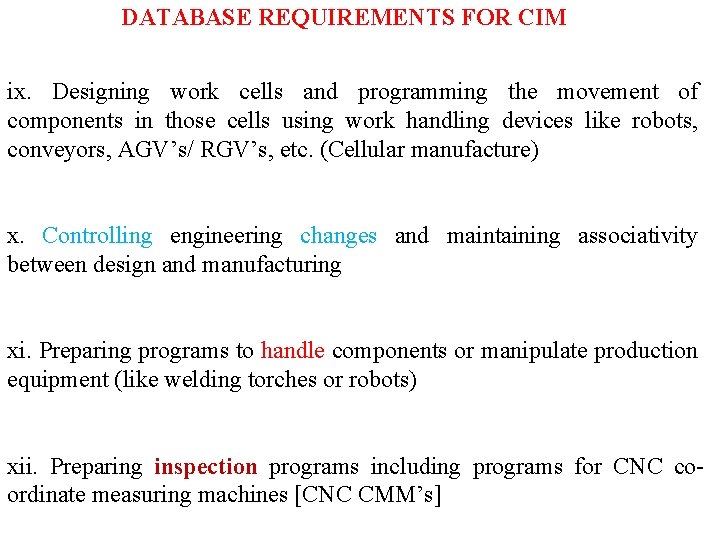
DATABASE REQUIREMENTS FOR CIM ix. Designing work cells and programming the movement of components in those cells using work handling devices like robots, conveyors, AGV’s/ RGV’s, etc. (Cellular manufacture) x. Controlling engineering changes and maintaining associativity between design and manufacturing xi. Preparing programs to handle components or manipulate production equipment (like welding torches or robots) xii. Preparing inspection programs including programs for CNC coordinate measuring machines [CNC CMM’s]
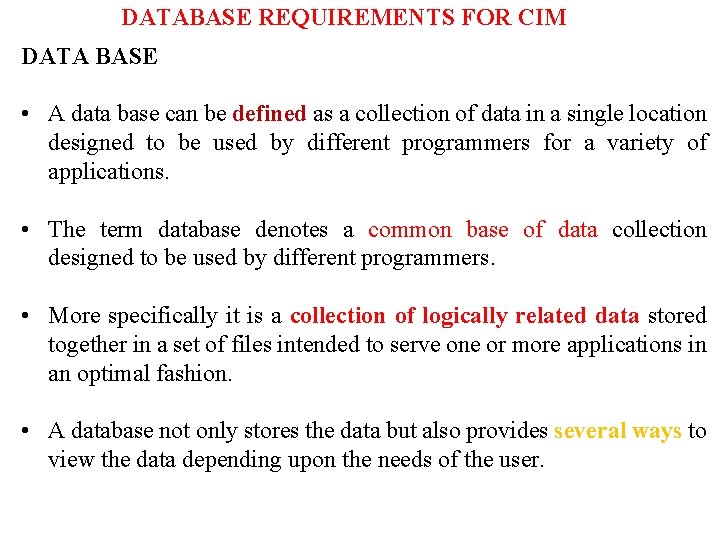
DATABASE REQUIREMENTS FOR CIM DATA BASE • A data base can be defined as a collection of data in a single location designed to be used by different programmers for a variety of applications. • The term database denotes a common base of data collection designed to be used by different programmers. • More specifically it is a collection of logically related data stored together in a set of files intended to serve one or more applications in an optimal fashion. • A database not only stores the data but also provides several ways to view the data depending upon the needs of the user.
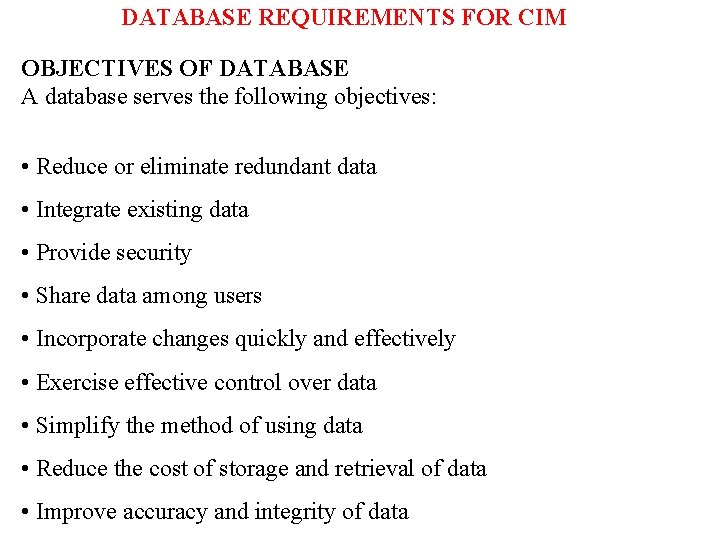
DATABASE REQUIREMENTS FOR CIM OBJECTIVES OF DATABASE A database serves the following objectives: • Reduce or eliminate redundant data • Integrate existing data • Provide security • Share data among users • Incorporate changes quickly and effectively • Exercise effective control over data • Simplify the method of using data • Reduce the cost of storage and retrieval of data • Improve accuracy and integrity of data
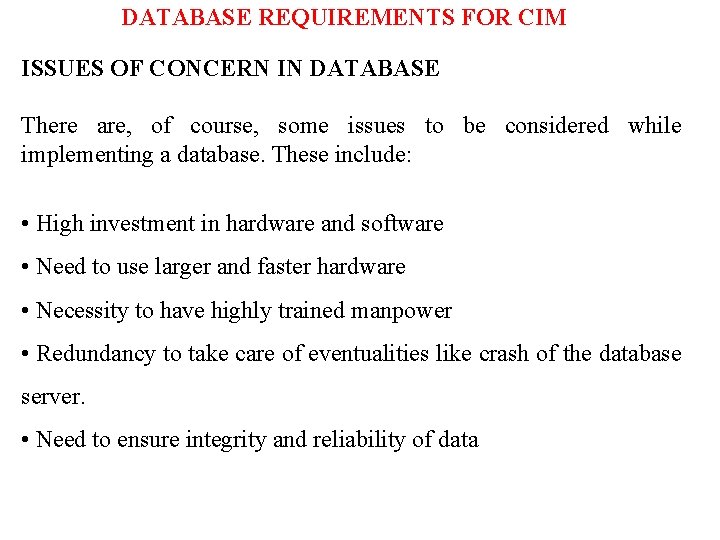
DATABASE REQUIREMENTS FOR CIM ISSUES OF CONCERN IN DATABASE There are, of course, some issues to be considered while implementing a database. These include: • High investment in hardware and software • Need to use larger and faster hardware • Necessity to have highly trained manpower • Redundancy to take care of eventualities like crash of the database server. • Need to ensure integrity and reliability of data
ROLE OF CAD/CAM IN CIM
ROLE OF CAD/CAM IN CIM
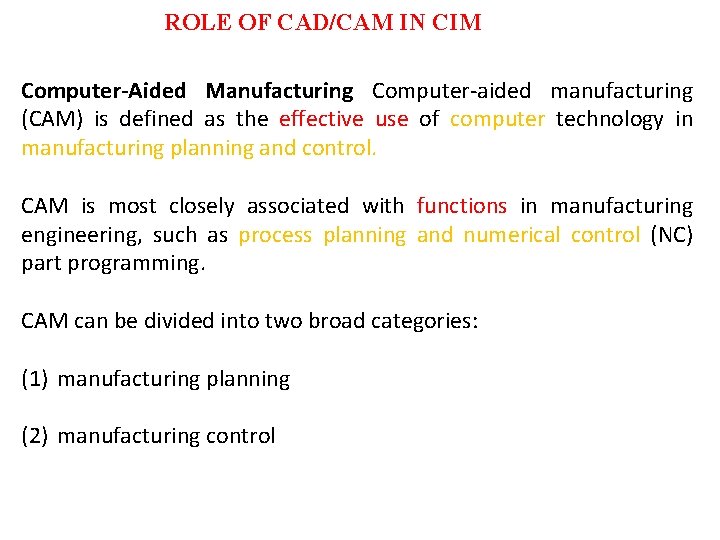
ROLE OF CAD/CAM IN CIM Computer-Aided Manufacturing Computer-aided manufacturing (CAM) is defined as the effective use of computer technology in manufacturing planning and control. CAM is most closely associated with functions in manufacturing engineering, such as process planning and numerical control (NC) part programming. CAM can be divided into two broad categories: (1) manufacturing planning (2) manufacturing control
ROLE OF CAD/CAM IN CIM a) Manufacturing Planning • CAM applications for manufacturing planning are those in which the computer is used indirectly to support the production function, but there is no direct connection between the computer and the process. • The computer is used "off-line" to provide information for the effective planning and management of production activities. • The Manufacturing planning areas include: • Computer-aided process planning (CAPP) • Computer-assisted NC part programming • Computerized machinability data systems. • Development of work standards. • Cost estimating, • Production and inventory planning. • Computer-aided line balancing.
ROLE OF CAD/CAM IN CIM b) Manufacturing Control. • The second category of CAM application is concerned with developing computer systems to implement the manufacturing control function. • Manufacturing control is concerned with managing and controlling the physical operations in the factory • These management and control areas include: • • • Process monitoring and control Quality control Shop floor control Inventory control Just-in-time production systems
ROLE OF CAD/CAM IN CIM MANUFACTURING PLANNING Computer-aided process planning (CAPP): • Process planning is concerned with the preparation of route sheets that list the sequence of operations and work centers required to produce the product and its components. • CAPP systems are available today to prepare these route sheets. Computer-assisted NC part programming: • For complex part geometries, CAPP represents a much more efficient method of generating the control instructions for the machine tool than manual part programming
ROLE OF CAD/CAM IN CIM MANUFACTURING PLANNING Computerized machinability data systems: • One of the problems in operating a metal cutting machine tool is determining the speeds and feeds that should be used to machine a given work part. • Computer programs have been written to recommend the appropriate cutting conditions to use for different materials. • The calculations are based on data that have been obtained either in the factory or laboratory that relate tool life to cutting conditions.
ROLE OF CAD/CAM IN CIM Development of work standards. MANUFACTURING PLANNING • The time study department has the responsibility for setting time standards on direct labor jobs performed in the factory. • Establishing standards for direct time study can be a tedious and time-consuming task. • There are several computer packages for setting work standards. • These computer programs use standard time data that have been developed for basic work elements that comprise any manual task.
ROLE OF CAD/CAM IN CIM MANUFACTURING PLANNING Cost estimating: • The task of estimating the cost of a new product has been simplified by computerizing several of the key steps required to prepare the estimate. • The computer is programmed to apply the appropriate labor and overhead rates to the sequence of planned operations for the components of new products. • The program then sums the individual component costs from the engineering bill of materials to determine the overall product cost.
ROLE OF CAD/CAM IN CIM MANUFACTURING PLANNING Production and inventory planning: • The computer has found widespread use in many of the functions in production and inventory planning. • These functions include: • maintenance of inventory records • automatic reordering of stock items when inventory is depicted • production scheduling • maintaining current priorities for the different procurement orders • material requirements planning MRP • capacity planning
ROLE OF CAD/CAM IN CIM MANUFACTURING PLANNING Computer-aided line balancing: • Finding the best allocation of work elements among stations on an assembly line is a large and difficult problem if the line is of significant size. • Computer programs have been developed to assist in the solution of this problem
ROLE OF CAD/CAM IN CIM MANUFACTURING CONTROL Process monitoring and control: • Process monitoring and control is concerned with observing and regulating the production equipment and manufacturing processes in the plant. • The applications of computer process control are common today in automated production systems. • They include transfer lines, assembly systems, NC, robotic, material handling and flexible manufacturing systems Quality control: • Quality control includes a variety of approaches to ensure the highest possible quality levels to the manufactured product.
ROLE OF CAD/CAM IN CIM MANUFACTURING CONTROL • Shop floor control: • Shop floor control refers to production management techniques for collection of data from factory operations and using the data to help control production and inventory of the factory. • Inventory control: • Inventory control is concerned with maintaining the most appropriate levels of inventory in the face of two opposing objectives: • minimizing the investment and storage costs of holding inventory • maximizing service to customers
ROLE OF CAD/CAM IN CIM MANUFACTURING CONTROL Just-in-time production systems: • The term just-in-time refers to a production system that is organized to deliver exactly the right number of each component to downstream workstations in the manufacturing sequence just at the time when that component is needed. • The term applies not only to production operations but to supplier delivery operations as well.
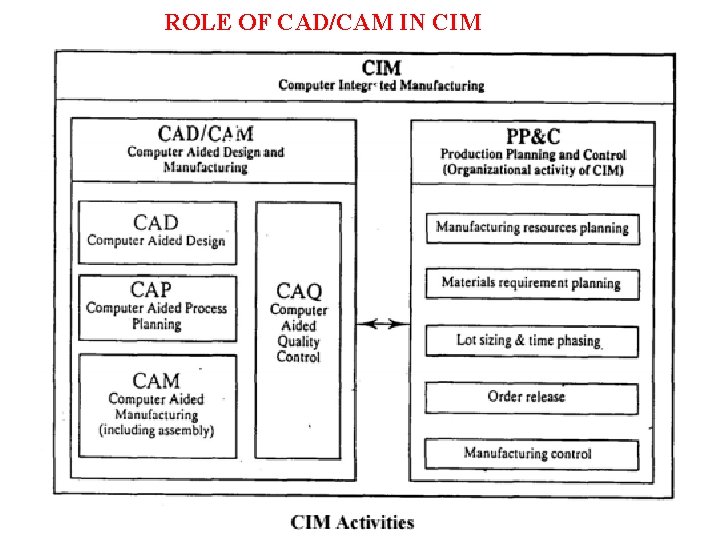
ROLE OF CAD/CAM IN CIM CAD/CAM • CAD/CAM is concerned with the engineering functions in both design and manufacturing. • Product design, engineering analysis, and documentation of the design (e. g. drafting) represent engineering activities in design. • Process planning, NC part programming, and other activities associated with CAM represent engineering activities in manufacturing. • The CAD/CAM systems developed during the 1970 s and early 1980 s were designed primarily to address these types of engineering problems.
ROLE OF CAD/CAM IN CIM CAD/CAM • In addition, CAM has evolved to include many other functions in manufacturing, such as • material requirements planning (MRP) • production scheduling • computer production monitoring • computer process control. • It should also be noted that CAD/CAM denotes an integration of design and manufacturing activities by means of computer systems. • The method of manufacturing a product is a direct function of its design.
ROLE OF CAD/CAM IN CIM CAD/CAM • With conventional procedures practiced for so many years in industry, engineering drawings were prepared by design draftsmen and later used by manufacturing engineers to develop the process plan. • The activities involved in designing the product were separated from the activities associated with process planning. • Essentially a two-step procedure was employed. • This was time-consuming and involved duplication of effort by design and manufacturing personnel.
ROLE OF CAD/CAM IN CIM • Using CAD/CAM technology, it is possible to establish a direct link between product design and manufacturing engineering. • In effect, CAD/CAM is one of the enabling technologies for concurrent engineering CE. • It is the goal of CAD/CAM to • automate certain phases of design and manufacturing • and also to automate the transition from design to manufacturing.
ROLE OF CAD/CAM IN CIM • In the ideal CAD/CAM system, it is possible to convert the design specification of the product it into a process plan • This conversion is done automatically by the CAD/CAM system. • As part of the process plan, the NC part program is generated automatically by CAD/CAM. • The CAD/CAM system downloads the NC program directly to the machine tool by means of a telecommunications network. • Thus in CAD/CAM, product design, NC programming, and physical production are all implemented by computer.
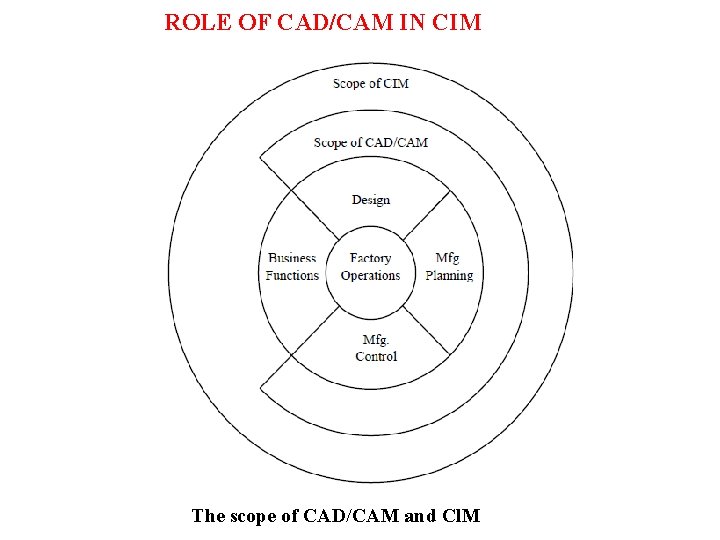
ROLE OF CAD/CAM IN CIM Computer Integrated Manufacturing • CIM includes all the engineering functions of CAD/CAM, and also includes the firm's business functions that are related to manufacturing. • The ideal CIM system applies computer and communications technology to all of the operational functions and information processing functions in manufacturing from 1) order receipt, through 2) design and 3) production, to product 4) shipment. • The scope of CIM, compared with the more limited scope of CAD/CAM, is depicted in Figure.
ROLE OF CAD/CAM IN CIM The scope of CAD/CAM and Cl. M
ROLE OF CAD/CAM IN CIM • CIM concept: • All firm's operations related to production are incorporated in an integrated computer system to automate the operations. • The computer system be pervasive throughout the firm, touching all activities that support manufacturing. • In this integrated computer system, the output of one activity serves as the input to the next activity, through the chain of events. • Chain starts with the sales order and culminates with shipment of the product.
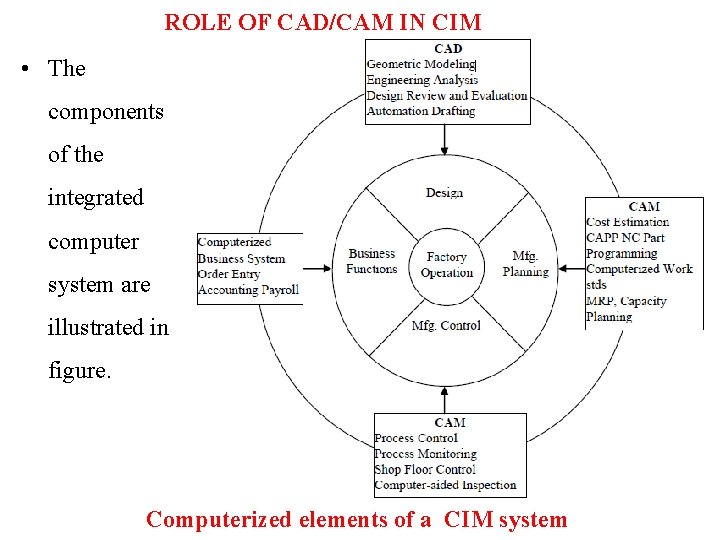
ROLE OF CAD/CAM IN CIM • The components of the integrated computer system are illustrated in figure. Computerized elements of a CIM system
ROLE OF CAD/CAM IN CIM • Customer orders are initially entered by the company's sales force into a computerized order entry system. • The orders contain the specifications describing the product. • Specifications serve as the input to the product design department.
ROLE OF CAD/CAM IN CIM • New products are designed on a CAD system. • Components that comprise the product are designed, • the bill of materials BOM is compiled, • and assembly drawings are prepared. • Output of the design department serves as the input to manufacturing engineering, • where process planning. tool design, and similar activities are accomplished to prepare for production.
ROLE OF CAD/CAM IN CIM • Process planning is performed using CAPP. • Tool and fixture design is done on a CAD system, making use of the product model generated during product design. • The output from manufacturing engineering provides the input to production planning and control, • where material requirements planning and scheduling are performed using the computer system.
ROLE OF CAD/CAM IN CIM • And so it goes. through each step in the manufacturing cycle. • Implementation of CIM results in the automation of the information flow through every aspect of the company's organization.
OBSTACLES TO CIM • Cost • Time • Technical skills of support staff • Management commitment • Nature of business • Integration of components from different suppliers • Data Integrity • Process Control