
CIM and 61850 UML Overview Terry Saxton Xtensible
CIM and 61850 UML Overview Terry Saxton Xtensible Solutions tsaxton@xtensible. net 1
GWAC* Stack and the CIM Standards CIM *GWAC – Grid. Wise Architecture Council 2
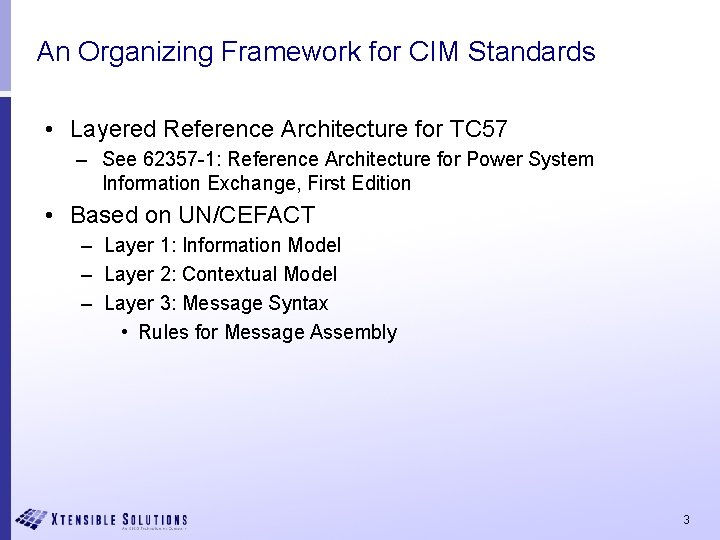
An Organizing Framework for CIM Standards • Layered Reference Architecture for TC 57 – See 62357 -1: Reference Architecture for Power System Information Exchange, First Edition • Based on UN/CEFACT – Layer 1: Information Model – Layer 2: Contextual Model – Layer 3: Message Syntax • Rules for Message Assembly 3
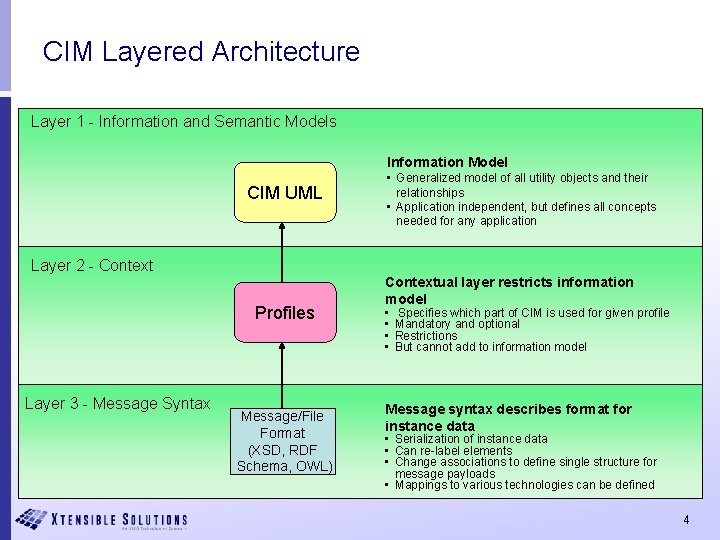
CIM Layered Architecture Layer 1 - Information and Semantic Models Information Model CIM UML • Generalized model of all utility objects and their relationships • Application independent, but defines all concepts needed for any application Layer 2 - Context Profiles Layer 3 - Message Syntax Message/File Format (XSD, RDF Schema, OWL) Contextual layer restricts information model • • Specifies which part of CIM is used for given profile Mandatory and optional Restrictions But cannot add to information model Message syntax describes format for instance data • Serialization of instance data • Can re-label elements • Change associations to define single structure for message payloads • Mappings to various technologies can be defined 4
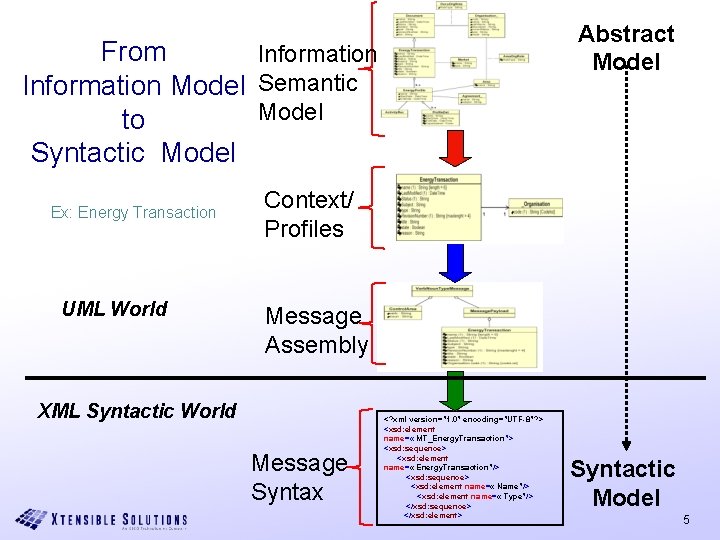
From Information/ Information Model Semantic Model to Syntactic Model Ex: Energy Transaction UML World Abstract Model Context/ Profiles Message Assembly XML Syntactic World Message Syntax <? xml version="1. 0" encoding="UTF-8"? > <xsd: element name= « MT_Energy. Transaction"> <xsd: sequence> <xsd: element name= « Energy. Transaction"/> <xsd: sequence> <xsd: element name= « Name"/> <xsd: element name= « Type"/> </xsd: sequence> </xsd: element> Syntactic Model 5

Layered Architecture for CIM Standards 6
What is the CIM? • • It’s more than a set of standards – it’s a solution! UML model can be customized or tailored to fit specific utility data requirements – Private extensions – Merging and harmonizing with other standard models – Subset can be published as a standard from a different SDO • Example: NAESB Open Field Message Bus (Open. FMB) based on combined CIM and 61850 object models • New interface profiles can defined for information exchange • New design artifacts (e. g. , XSDs) can be generated with same tools used to develop the CIM standards 7
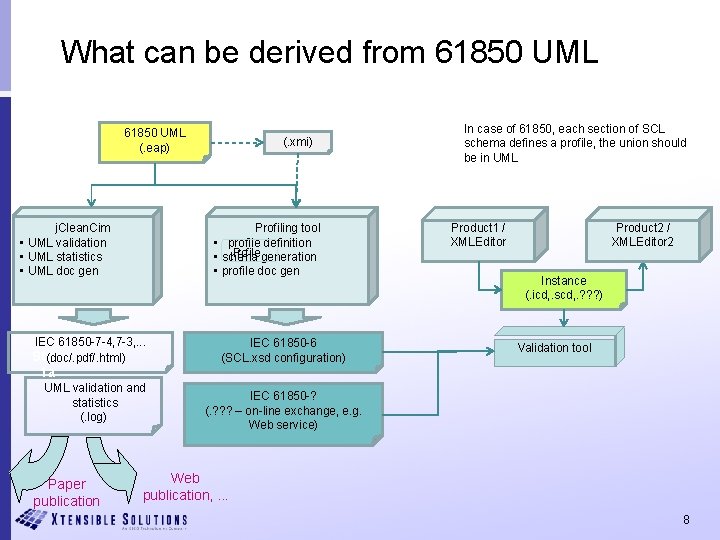
What can be derived from 61850 UML (. eap) j. Clean. Cim • UML validation • UML statistics • UML doc gen (. xmi) Profiling tool • profile definition Pro legeneration • sche mfia • profile doc gen IEC 61850 -7 -4, 7 -3, . . . Ste (doc/. pdf/. html). p IEC 61850 -6 (SCL. xsd configuration) In case of 61850, each section of SCL schema defines a profile, the union should be in UML Product 1 / XMLEditor Product 2 / XMLEditor 2 Instance (. icd, . scd, . ? ? ? ) Validation tool 1 a UML validation and statistics (. log) Paper publication IEC 61850 -? (. ? ? ? – on-line exchange, e. g. Web service) Web publication, . . . 8
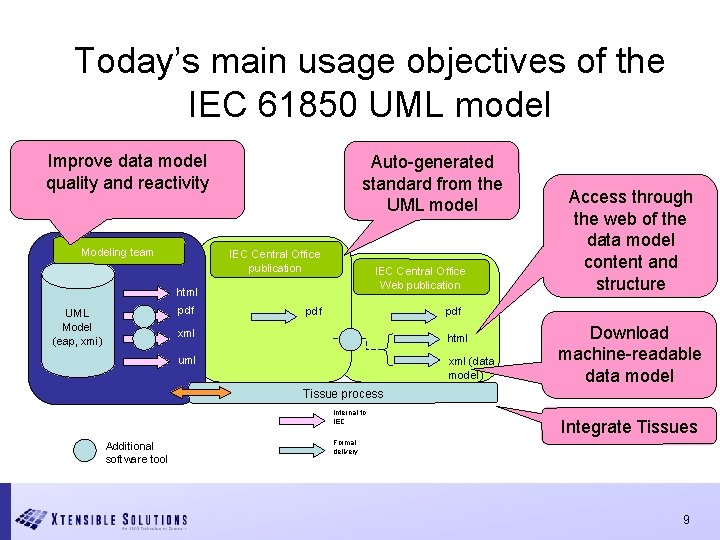
Today’s main usage objectives of the IEC 61850 UML model (reminder) IEC 61850 UML model Improve data model quality anddata reactivity Improve model quality and reactivity Mo M od de eli lin ng g ea te tam m Modeling team tml htm hl UML UM L Model (eap. UML , xmi) Model (eap, xmi) pdf html xm lpdf Auto-generated standard from the Auto-generated UML model standard from the UML model IEC Centra al Offi ffice pu ub pbli lic ca attion io n IEC Central Office publication IEC Centra al Offi ffice W eb publilica cattion IEC Central Office Web publication pdf pdf tml htm hpdf l um ml ul xml uml Tissue process Internal to Tissue process EC I Additional softw ware tool Additional software tool Internal to Fo or Fma rm all. IEC delivery xml xm l (data html model) xml (data model) Access through the web through of the Access dataweb model the of the content and data model structureand content structure Download machine-readable Download data model machine-readable data model Integrate Tissues Formal delivery 9
CIM UML • UML was developed first in 1996 as Foundation layer – Existed before first IEC CIM standard documents were published • Complete normalized model of utility operations • Via profiling, subset of UML can be defined as a message payload • From beginning, recognized that the UML was useful for not only generating IEC standards (e. g. , XSDs) but also with extensions for – Generating standards for other SDOs (e. g. , NAESB ESPI and Zib. Bee) – Generating enterprise semantic models and message payloads for utility projects (e. g. , ENTSO-E CGMES) – Auto-generation of Word documents fir IEC using JClean. CIM • For many years CIM UML has been publicly available on the CIM User’s Group Share. Point site – Consequence: Cannot be copyrighted 10
61850 UML • Reverse engineered from the published IEC 61850 standards about 3 years ago, using data tables and XSDs primarily for SCL (Substation Configuration Language) used to configure IEDs – Content of UML is/was limited to only what is required for each XSD – “UML is primarily union of SCL schemas” – No comprehensive model like CIM behind 61850 UML • Primary purpose for 61850 UML is to improve – quality of the data models – Auto-generate XSDs for SCL (may be additional XSDs – not sure), and – ease of maintenance of Word documents (via auto-generation from the UML using j. Clean. CIM tool • Never intended that 61850 UML would be used for anything but generation of their standard models, XML schemas, and IEC MS Word documents. Consequence: – No customization/extension of UML for other purposes was envisioned – Thus no customization of XSDs – use 100% of 61850 XSD or use none of it – Usable parts of 61850 for product developers are the standard XSDs 11
61850 UML and Copyrights • 61850 UML appears to be copyrighted by IEC – Current understanding of Christoph Brunner, WG 10 Convener, who was responsible for initial development of 61850 standards and later for generation of 61850 UML • However, adding data types to the Open. FMB model that map 1: 1 to 61850 data types should be permissible, as long as compliance to 61850 standards is not claimed. Way Forward • For logical reasons, precedent-setting applications and perhaps legal reasons as well, it seems best to start with the CIM UML that would be expected to have most of the classes, attributes, and associations needed to define the contents of the Open. FMb message payload XSDs. • Then extend the CIM base as needed based on use case requirements from 61850 equivalent data types or other properties. 12

Questions? 13
- Slides: 13