Listening Skill The Nature of the Skill and







- Slides: 134
Listening Skill The Nature of the Skill and its Teaching
Nature According to Rost, the term ‘listening’ is used to refer to a complex process that allows us to understand spoken language. It is not only a skill area in lge performance, but is also a critical means of acquiring a second lge.
Also It is the channel in which we process lge in real timeemploying pacing, units of encoding and pausing that are unique to spoken lge.
As a Goal-Oriented Activity listening involves ‘ bottom-up’ processing (in which listeners attend to data in the incoming speech signals) and ‘top-down’ processing (in which listeners utilize prior knowledge and expectations to create meaning).
A. The bottom-up processing : assumes that listening is a process of decoding the sounds that one hears in a linear fashion, from the smallest meaningful units (phonemes) to complete texts.
Anderson and Lynch (1988) call this the ‘ listener as tape-recorder view’ of listening because it assumes that the listener takes in and stores messages in much the same way as a tape recorder, sequentially, one sound, word, phrase, and utterance at a time’.
B. The top-down View : it suggests that the listener actively constructs (or more accurately reconstructs) the original meaning of the speaker using incoming sounds as clues. In this reconstruction process, the listener uses prior knowledge of the context and situation in which the listening takes place to make sense of what s/he hears.
Schema Theory An important theoretical underpinning to the top-down approach. The term ‘schema’ was first used by the psychologist Bartlett (1932). Bartlett argued that the knowledge we carry around in our heads is organized into interrelated patterns.
During the course of our lives we build up literally hundreds of mental schemas, and they help us make sense of the many situations we find our selves in during the day, from catching the train to work, to taking part in a business, to having a meal.
Particularly in crosscultural situations, when we apply the wrong or inappropriate scheme to a situation it can get us into trouble.
Types of listening Many different types that can be classified according to a number of variables : listening purpose, the role of the listener, and the type of text being listened to.
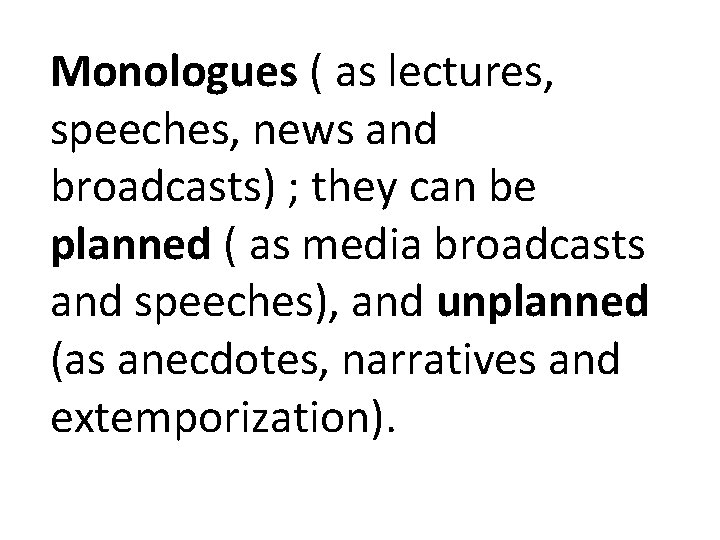
Monologues ( as lectures, speeches, news and broadcasts) ; they can be planned ( as media broadcasts and speeches), and unplanned (as anecdotes, narratives and extemporization).
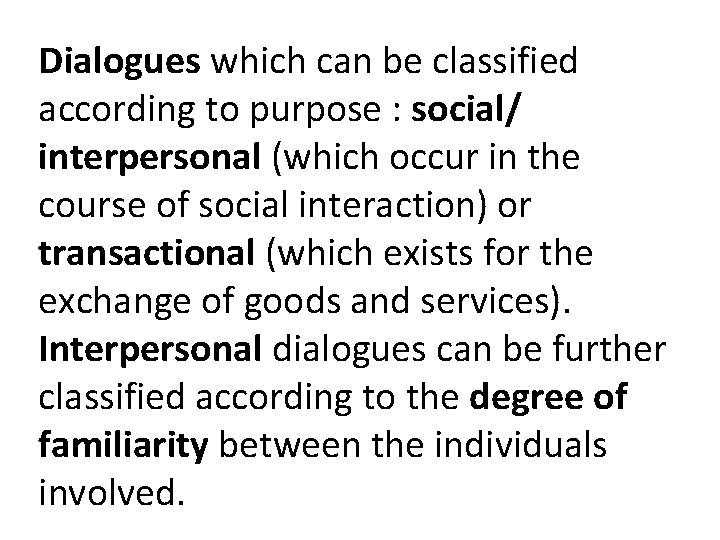
Dialogues which can be classified according to purpose : social/ interpersonal (which occur in the course of social interaction) or transactional (which exists for the exchange of goods and services). Interpersonal dialogues can be further classified according to the degree of familiarity between the individuals involved.
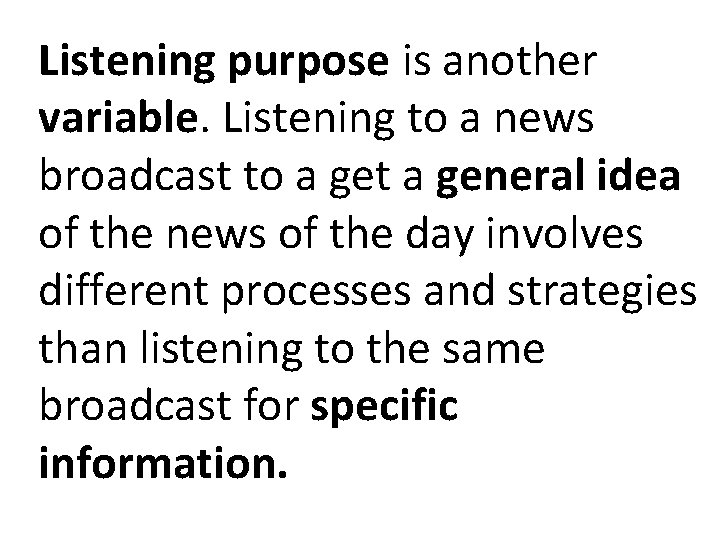
Listening purpose is another variable. Listening to a news broadcast to a get a general idea of the news of the day involves different processes and strategies than listening to the same broadcast for specific information.
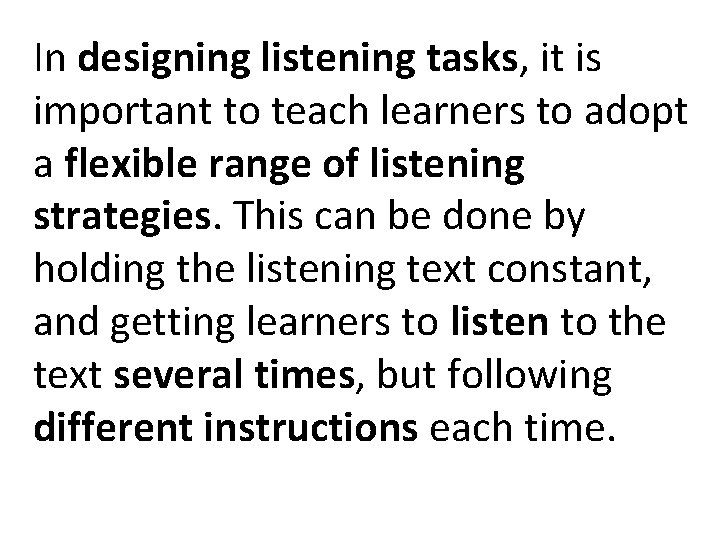
In designing listening tasks, it is important to teach learners to adopt a flexible range of listening strategies. This can be done by holding the listening text constant, and getting learners to listen to the text several times, but following different instructions each time.
They might, in the first instant, be required to listen for gist. The second time they might be required to listen for detail (Skimming and scanning).
Another way of characterizing listening is in terms of whether the listener is also required to take place in the interaction. This is known as reciprocal listening. In the real world, it is rare for the listener to be cast in the role of nonreciprocal ‘eavesdropper’ on a conversation.
Research into Listening According to Rost (1990), four areas affecting listening into L 2 pedagogy :
Listening in SLA In SLA research, it is the ‘linguistic environment’ that serves as the stage for SLA.
In order to acquire the lge, LLs must come to understand the language in these situations.
This accessibility is made possible in part through accommodations made by native speakers to make lge comprehension possible.
Building on the research that showed a relationship between input adjustments and message comprehension, Krashen (1982) claimed that ‘ comprehensible input’ was a necessary condition for lge learning. Krashen claimed that comprehension is necessary in order for input to become ‘intake’.
Speech Processing Several factors are activated in speech perception (phonetic quality, prosodic patterns, pausing and speed of input), all of which influence the comprehensibility of input.
Research in spoken-lge recognition shows that each lge has its own ‘preferred strategies’ for aural decoding, which are readily acquired by the L 1 child, but often only partially acquired by the L 2 learner.
Preferred strategies involve four fundamental properties of spoken lge :
A. The phonological system : the phonemes used in a particular lge, typically only 30 or 40 out of hundreds of possible phonemes. B. Phonotactic rules : the sound sequences that a lge allows to make up syllables.
C. Tone melodies : the characteristic variations in high, low, rising, and falling tones to indicate lexical and discourse meanings.
D. The stress system : the way in which lexical stress is fixed within an utterance. As in bounded/ syllable-timed lges (Spanish and Japanese) stress is fixed at fixed distances from the boundaries of words. In unbounded/ stress-timed lges (English and Arabic) the stress is pulled towards an utterance’s focal syllable.
Differences in L 1 and L 2 with respect to any of these possible distinctions are likely to cause difficulties in spoken-word recognition, at least initially and until ample attention is devoted to learning new strategies. Similarities are likely to allow the learner greater ease and success with listening, and with word recognition in particular.
Listening in interactive settings 1. Such issues have been researched at the discourse analysis level, looking at how control and distribution of power is routinely employed through the structure of interaction.
2. Research in cross-cultural pragmatics shows that cultures differ in their use of key conversation features (as when to talk, how much to say, pacing and pausing in and between speaking turns, intonational emphasis, use of formulaic expressions, and indirecteness (Tannen, 1984).
C. Conversation analysis is used to explore problems that L 2 listeners experience.
Bremer et al. (1996) domument many of the social procedures that L 2 listeners must come to use as they become more successful listeners and participants in conversations.
These procedures include identification of topic shifts, providing backchanneling or listenership cues, participating in conversational routines, shifting to topic initiator role, initiating queries and repair of communication problems.
Strategy Use Listening strategies are conscious plans to deal with incoming speech, particularly when the listener knows that s/he must compensate for incomplete input or partial understanding.
A. Rost and Ross’s (1991) study of paused texts found that more proficient listeners tend to use more ‘hypothesis testing’ rather than ‘lexical pushdowns’ and ‘global reprises’.
B. Kasper’s (1984) study using ‘think aloud’ protocols found that L 2 listeners tend to form an initial interpretation of a topic (a frame) and then stick to it, trying to fit incoming words and propositions into that frame.
Practice Effective listening teaching involves :
A. Careful selection of input sources (authentic, interesting, varied, challenging).
of. B. Creative design tasks (well-structured, opportunities for learners to activate their own knowledge and experience and to monitor what they are doing).
C. Assisstance to help learners enact effective listening strategies (cognitive, metacognitive, social)
D. Integration of listening with other learning purposes (appropriate links to speaking, reading and writing).
What makes listening difficult ? Andersen and Lynch (1988) propose these textual factors:
A. The organization of information B. The familiarity of the topic C. The explicitness and sufficiency of the information D. The type of referring expressions used E. Whether the text describes a ‘static’ or ‘dynamic’ relationship.
Watson and Smeltzer (1984) suggest that factors internal to the learner, as attentiveness, motivation, interest in and knowledge of the topic, can have a marked bearing on listening success.
Brown and Yule (1983) suggest that there are four principal sets of factors affecting the difficulty of listening :
A. Speaker factors : how many speakers are there ? how quickly do they speak ? what type of accent do they have ?
B. Listener factors : what’s the listener’s role (eavesdropper or participant) ? what level of response is required ? how interested is the listener in the subject ?
C. The content : how complex is the grammar, vocabulary, and information structure ? what background knowledge is assumed ?
D. Support : how much support is provided in terms of pictures, diagrams, or other visual aids ?
Designing of Exercises for Listening Comprehension According to Rivers(1968), Speaking does not itself constitute communication unless what is said is comprehended by another person. Teaching the comprehension of spoken lge is therefore of primary importance if the communication aim is to be achieved.
Stage 1 : Identification Students need practice in discrimination of sounds and in the elements of meaning conveyed by stress, pitch, and intonation. Dialogue learning is particularly appropriate to this stage.
Stage 2 : Identification and Selection without Retention At this stage the student listens to a connected sequence with a development of thought which he tries to follow.
The teacher and the student are satisfied if he has followed the passage as delivered without worring about ability to recount or discuss what he has heard.
Materials used : simple plays, sketches, dramatic readings, conversations. In lab work, the same tape should be repeated several times to give students further practice with the same material.
Stage 3 : Identification and Guided Selection with Short-Term Retention Material similar to that of stage 2 may be used, with clearly distinctive voices and lively themes.
The student is given some questions beforehand, not a great number, and he listens for the answers which he marks on a question sheet as he hears them, or, at a more advanced stage, after he has listened to the whole passage.
The passage should be repeated so that the student may have further practice in listening and selecting, and may have an opportunity to verify his answers.
Stage 4 : Identification, Selection, and Long-Term Retention The student is encouraged to listen freely to all kinds of material (literary extracts, plays, poems, lectures, news bulletins, discussions, songs, film scenarios) for his own pleasure.
After a period of listening, the student is expected to be able to talk or write about what he has heard.
Summary of Possible Activities for Four Stages of Listening Comprehension
1. Elementary Level
Identification
A. Sound and short-phrase discrimination B. Listening to dialogues already learned C. Identification of phrases and statements from reading material studied D. Games involving identification of words and phrases heard.
Identification and selection without retention
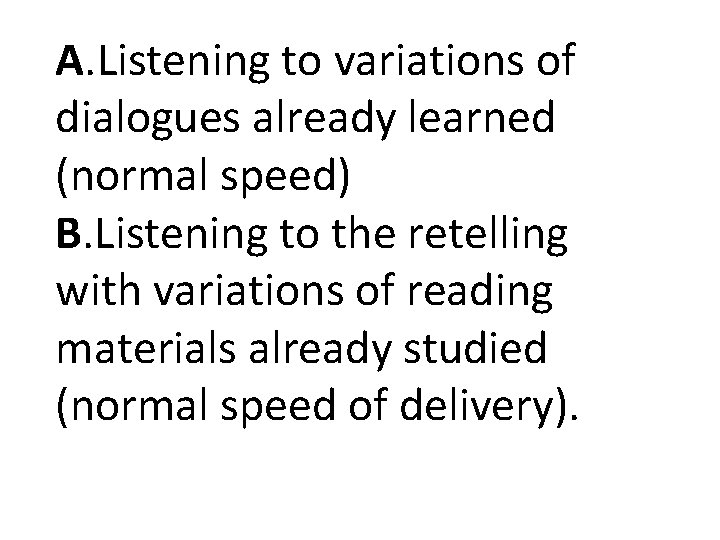
A. Listening to variations of dialogues already learned (normal speed) B. Listening to the retelling with variations of reading materials already studied (normal speed of delivery).
Identification and Guided Selection with Short-Term Retention
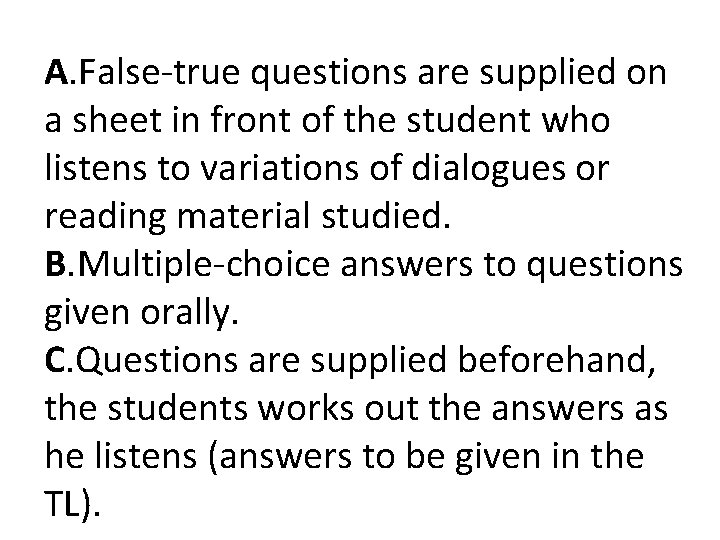
A. False-true questions are supplied on a sheet in front of the student who listens to variations of dialogues or reading material studied. B. Multiple-choice answers to questions given orally. C. Questions are supplied beforehand, the students works out the answers as he listens (answers to be given in the TL).
Identification, Selection, and Long. Term Retention
A. Similar activities of the previous stage, but the student is expected to answer questions which are provided for him on paper or asked orally after he has listened.
2. Intermediate Level
Identification
A. More advanced work of the elementary level
Identification and selection without retention
A. More advanced work of the elementary stage B. The teacher gives a short account of an amusing incident which occurred on his way to school or to the CR. The teacher begins the lesson with some interesting background facts or news items, or the students tell prepared news items ( without referring to a script).
C. The teacher and/or a group of students give dramatic readings of stories which contain a great deal of conversation. The other students listen with books closed. D. Listening to group conversations prepared by two or three students.
Identification and Guided Selection with Short-Term Retention
A. More advanced work of the elementary stage B. Listening to carefully graded foreign-lge films specially prepared for teaching purposes.
C. The students guess the name of a person or place described by the teacher or by another student. D. Completion of sentences given orall (definitions, supplementary information as time, season, occupation). The answers are chosen from a multiplechoice list supplied to the student, or are given orally.
Identification, Selection, and Long. Term Retention
A. Similar activities of the elementary level, but the student is expected to be able to tell in his own words un the TL what he has heard (this leads to oral/ written composition).
Advanced Level
Identification
A. Aural discrimination of slight distinction in sound which alter the meaning of sentences (as : negations, inversions, tense distinctions).
Identification and selection without retention
A. More advanced work on listening and retelling (elementary level) B. More advanced work of the previous stage C. The students listen with books closed while the teacher reads expressively the complete story they have already studied in sections.
D. Listening to simulated telephone conversations between two students (prepared) E. Students and teacher) prepare accounts of amusing incidents (LLs do not read from a script).
F. Groups of students prepare CR sessions of well-known TV games or competitions. G. Listening to record of poems and plays already studied.
Identification and Guided Selection with Short-Term Retention
A. More advanced work of the two previous levels B. Sentence completion at the end of longer sequences, with choice of answer from multiplechoice items (students must explain circumstances, reasons, or situation).
C. Answering in the TL D. Link with dictation (subjects of cultural interest). To prepare for the dictation, the teacher gives an account in the TL of personalities and background, with pictures, and discussion, and then dictates a relevant passage.
Identification, Selection, and Long-Term Retention
A. Longer passages (anecdotes, short stories, informational material) are read and students answer questions. Suggested order of develompent :
• LLs are required to answer true-false questions on a list supplied beforehand • LLs select answers from multiple-choice items which have been supplied beforehand. • As the two preceding activities but question papers are supplied after the second reading • Answers in the TL • TL answers which lead to composition practice
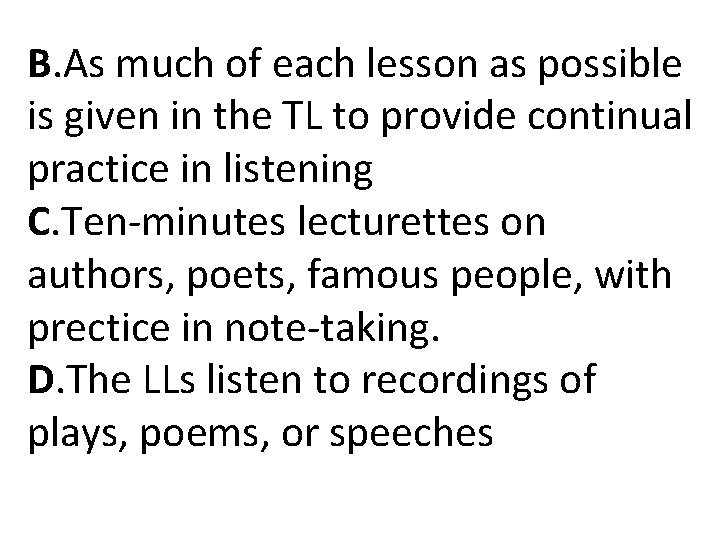
B. As much of each lesson as possible is given in the TL to provide continual practice in listening C. Ten-minutes lecturettes on authors, poets, famous people, with prectice in note-taking. D. The LLs listen to recordings of plays, poems, or speeches
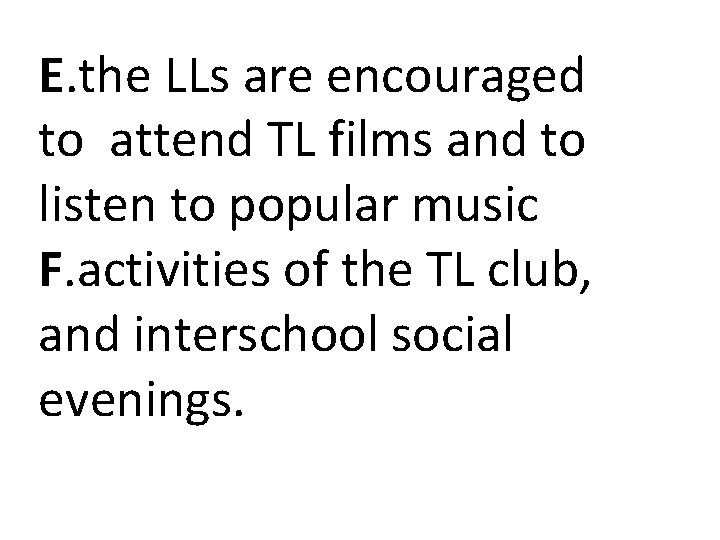
E. the LLs are encouraged to attend TL films and to listen to popular music F. activities of the TL club, and interschool social evenings.
Celce-Murcia (2001)
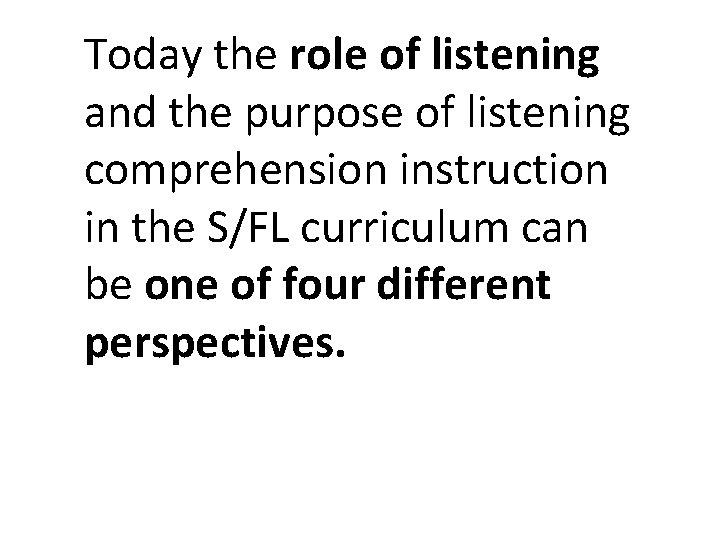
Today the role of listening and the purpose of listening comprehension instruction in the S/FL curriculum can be one of four different perspectives.
Model One : Listening and Repeating LG : to pattern-match, to listen and imitate, to memorize. Instructional Material : dialogue memorization, based on hearingand-pattern-matching model.
Procedure : ask LLs to listen (word, phrase, sentence) ; repeat it (imitate it) ; memorize it (not always). Value : enables LLs to pattern drills, to repeat dialogues, to use memorized prefabricated patterns in conversation ; to imitate pronunciation patterns.
Model Two : Listening and Answering Comprehension Questions LG : to process discrete-point information, to listen and answer comprehension questions. Instructional Materials : features a student response pattern based on a listening-and-question-answering model with occational variations on this theme.
Procedure : ask LLs to listen to a text along a continuum (sentence to lecture length) ; answer first factual questions (using a quizshow format of teaching).
Value : enables LLs to manipulate discrete pieces of information ; increase LLs’ stock of vocabulary units and grammar constructions ; not two-way communication ; does not require LLs to make use of the information for any real communication purpose beyong answering the questions.
Model Three : Task Listening LG : to process spoken discourse for functional purposes ; to listen and do something with the information ; i. e, carry out real tasks using the information received.
Instructional Material : the student’s response is based on a listening-andusing (listen and do) model. LLs listen then immediately do something with the information received (follow the directions given ; complete a task ; solve a problem ; transmit the gist of the information orally or in writing ; listen and take lecture notes ; etc).
Procedure : ask LLs to listen then use the orally transmitted lge input immediately to complete a task. Value : it is task-oriented not question-oriented ; using the informational content presented in the spoken discourse, not just in answering questions about it.
Types of Tasks : A. lge use tasks : designed to give LLs practice in listening to get meaning from the input with the purpose of making functional use of it immediately. B. Lge analysis tasks : designed to help LLs develop cognitive and metacognitive learning strategies to guide them toward personal intellectual involvement in their own learning).
Model Four : Interactive Listening LG : to develop aural/ oral skills in semiformal interactive academic communication ; to develop critical listening ; critical thinking ; and effective speaking abilities.
Instructional Material : real/time (real/life) give-and-take of academic communication. A variety of student presentation and discussion activities ; individual and smallgroup panel reports ; includes attention to group bonding and CR discourse rules (taking the floor ; yielding the floor ; turn taking ; interrupting ; comprehension checks ; topic shifting ; agreeing, questioning, challenging and the like).
Procedure : ask LLs to participate in discussion activities that enable them to develop all three phases of the speech act : speech decoding ; critical thinking ; and speech encoding. These phases involve :
A. Continuous online decoding of spoken discourse B. Simultaneous cognitive acting/ reacting upon the information received (critical analysis and synthesis) C. Instant-response encoding (producing personal propositional lge responses appropriate to the situation).
Value : the focus is communicative/competence-oriented as well as task-oriented. LLs have opportunities to engage in and develop the complex array of communicative skills in the four competency areas : linguistic, discourse, sociolinguistic, and strategic competence ( Canale and Swain, 1980).
Communicative Outcomes
Listen-and-do format (information gathering and information using) is recommended for listening instructional activities in the ESL and EFL curriculum. Listen-to-Do in the listening comprehension context implies an outcome ‘objective’. What is an ‘outcome’ ?
According to Sinclair (1984), an outcome is a realistic task that people can envision themselves doing or accomplishing something.
Six broad categories are discussed below :
Outcome 1 : Listening and performing actions and operations They include responses to directions, instructions and descriptions.
A. Drawing a picture, figure, design. B. Locating routes of specific points on a map C. Selecting/ identifying a picture of a person, place, or thing from description D. Performing hand body movements as in songs and games E. Operating a piece of equipment as a camera, a recorder, etc. F. Carring out steps in a process as a math problem, a science experiment, a cooking sequence.
Outcome 2 : listening and transferring information Two kinds of information transfer are featured : spokento-written (hearing information and writing it) and spoken-tospoken (hearing information and transmitting it in speech).
Activities for spoken-towritten practice
A. Listening and taking a message by transcribing the entire message word for word if the text is short or by writing down a list of the important items. B. Listening and filling in blanks in a gapped story game to complete the story C. Listening and completing a form or chart
D. Listening and summarizing the gist of a short story, report, or talk. E. Listening to a ‘how to’ talk and writing an outline (as how to cook sth, etc). F. Listening to a talk or lecture and taking notes (jigsaw listening by Geddes and Sturtridge, 1979).
Activities for spoken-tospoken practice
A. jigsaw listening can be used too. B. Listening to directions then passing them along to a third person. C. Listening to part of a story and repeating it to others
Outcome 3 : listening and solving problems
A. Word games in which the answers must be derived from verbal clues B. Number games and ‘story’ arithmetic problems C. Asking questions in order to identify sth D. mysteries that can be followed by small work in which LLs formulate solutions E. A jigsaw mystery
Outcome 4 : listening, evaluating, and manipulating information
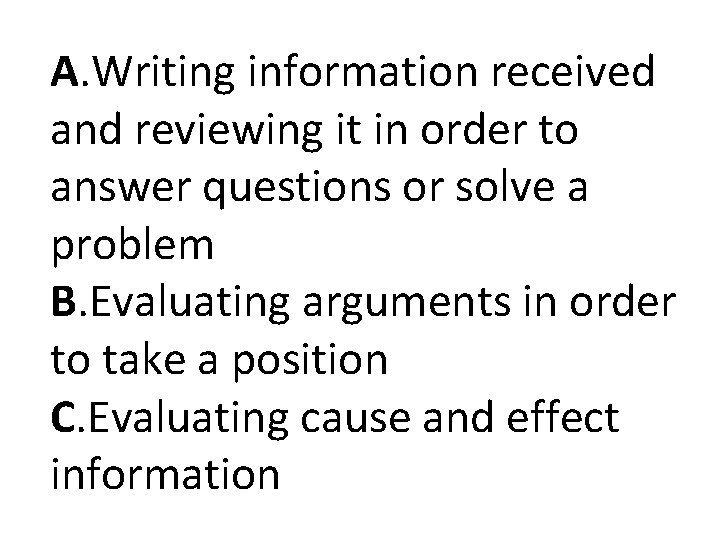
A. Writing information received and reviewing it in order to answer questions or solve a problem B. Evaluating arguments in order to take a position C. Evaluating cause and effect information
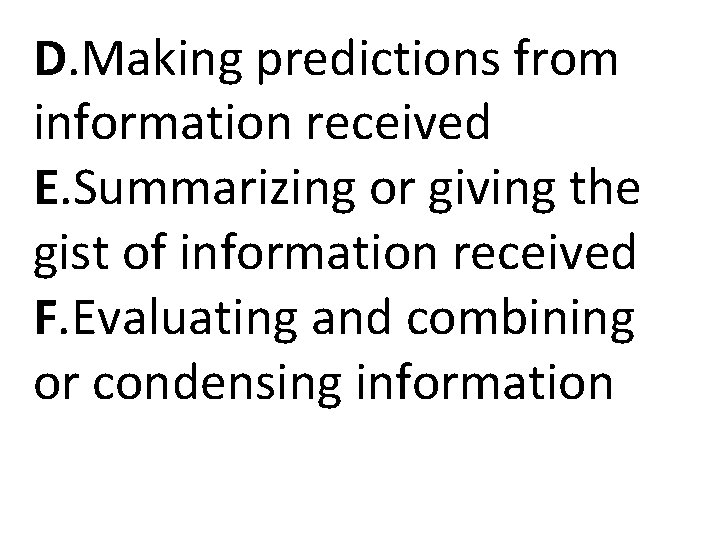
D. Making predictions from information received E. Summarizing or giving the gist of information received F. Evaluating and combining or condensing information
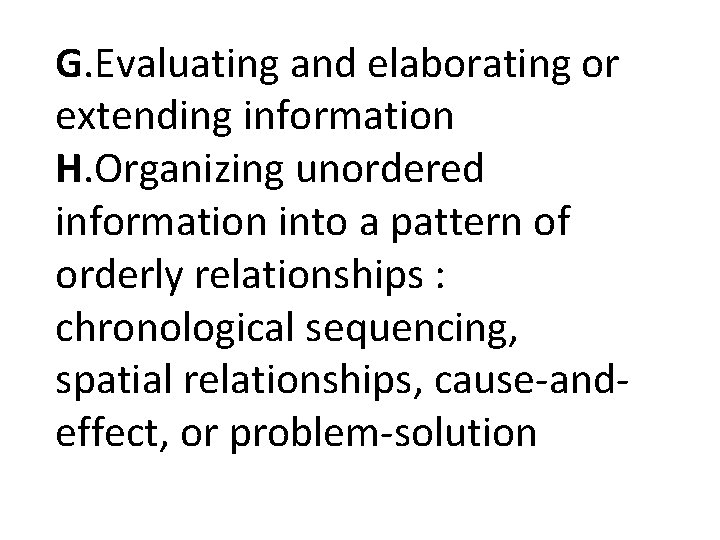
G. Evaluating and elaborating or extending information H. Organizing unordered information into a pattern of orderly relationships : chronological sequencing, spatial relationships, cause-andeffect, or problem-solution
Outcome 5 : interactive listening-and-speaking : negotiating meaning through questioning/ answering routines
A. Repetition : verbatim repetition of information. B. Paraphrase : restatement in different words C. Verification : seeking confirmation ( understanding a piece of information)
D. Clarification : seeking more details or an explanation E. Elaboration : asking for additional information on a point introduces in the presentation F. Extension : asking for information on a new point, one that was not introduced in the presentation. G. Challenge : questions that challenge points given or conclusions drawn.
Outcome 6 : listening for enjoyment, pleasure, and sociability A. Listening to songs, plays, poems, jokes, anecdotes, a chat by the teacher (Ur, 1984) which will lead to student-talk.