Atoms Molecules and Ions Chapter 2 Copyright The


- Slides: 70
Atoms, Molecules, and Ions Chapter 2 Copyright © The Mc. Graw-Hill Companies, Inc. Permission required for reproduction or display.
Chapter 2 2. 3 2. 4 2. 5 2. 6 2. 7 Atoms, Molecules, and Ions Atomic Number, Mass Number, and Isotopes The Periodic Table Molecules and Ions Chemical Formulas Naming Compounds 2
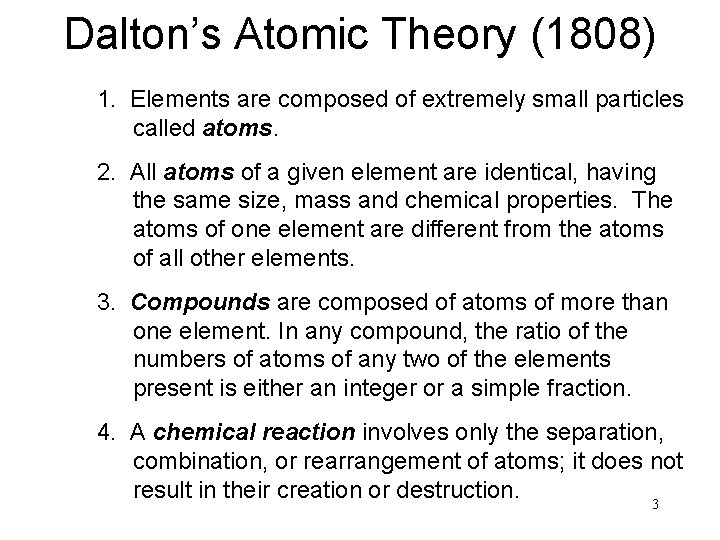
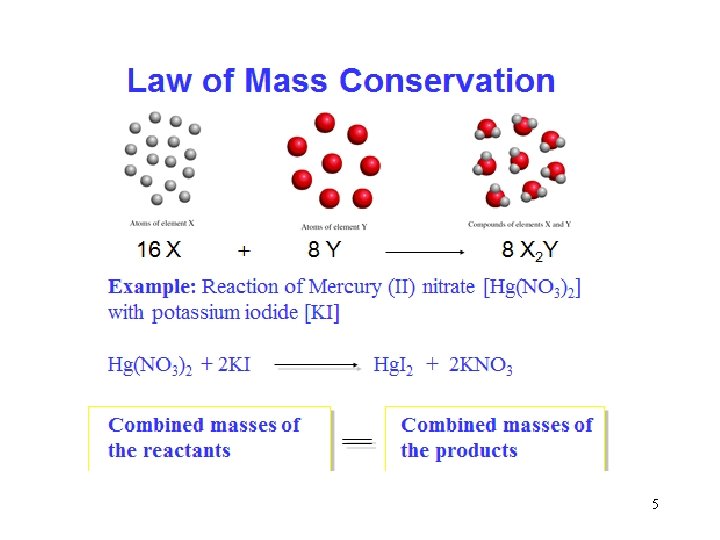
Dalton’s Atomic Theory (1808) 1. Elements are composed of extremely small particles called atoms. 2. All atoms of a given element are identical, having the same size, mass and chemical properties. The atoms of one element are different from the atoms of all other elements. 3. Compounds are composed of atoms of more than one element. In any compound, the ratio of the numbers of atoms of any two of the elements present is either an integer or a simple fraction. 4. A chemical reaction involves only the separation, combination, or rearrangement of atoms; it does not result in their creation or destruction. 3
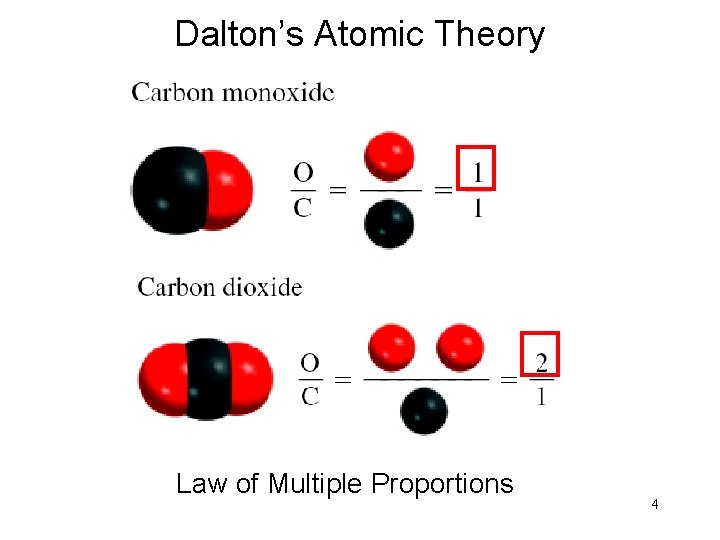
Dalton’s Atomic Theory Law of Multiple Proportions 4
5
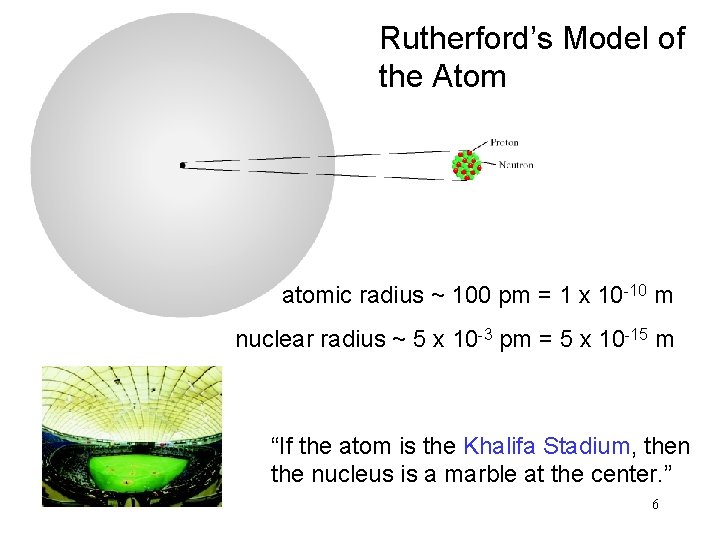
Rutherford’s Model of the Atom atomic radius ~ 100 pm = 1 x 10 -10 m nuclear radius ~ 5 x 10 -3 pm = 5 x 10 -15 m “If the atom is the Khalifa Stadium, then the nucleus is a marble at the center. ” 6
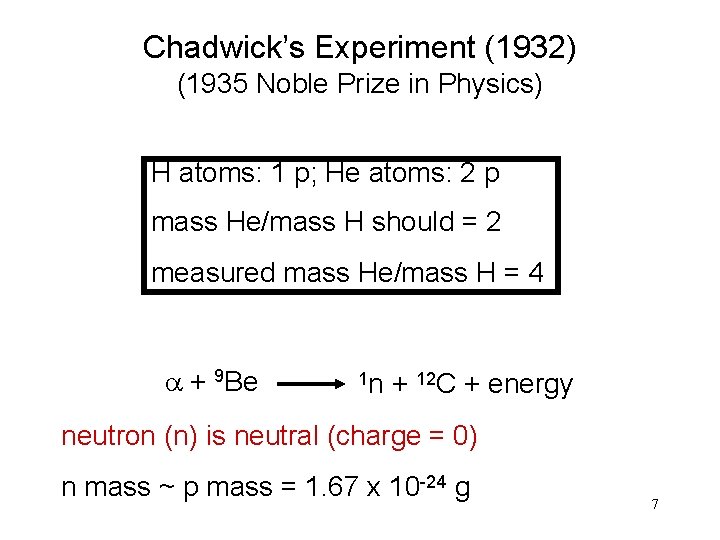
Chadwick’s Experiment (1932) (1935 Noble Prize in Physics) H atoms: 1 p; He atoms: 2 p mass He/mass H should = 2 measured mass He/mass H = 4 + 9 Be 1 n + 12 C + energy neutron (n) is neutral (charge = 0) n mass ~ p mass = 1. 67 x 10 -24 g 7
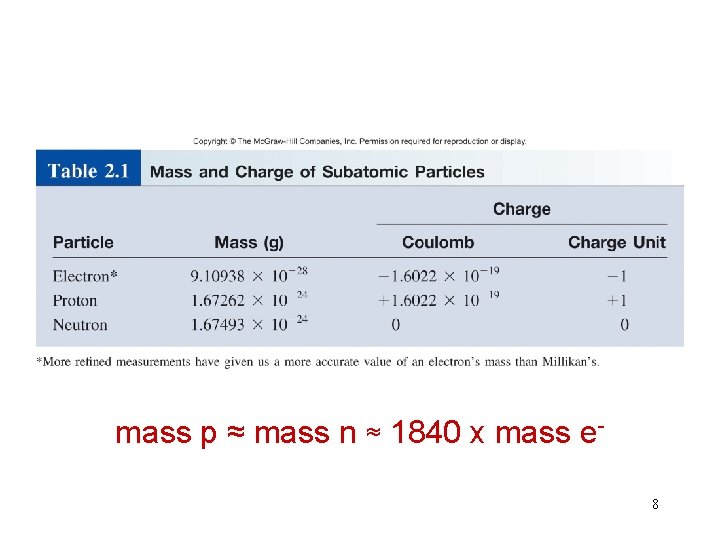
mass p ≈ mass n ≈ 1840 x mass e 8
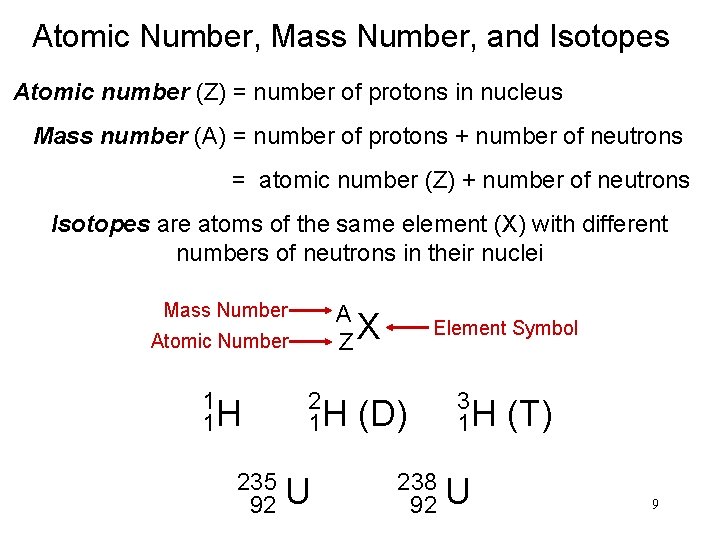
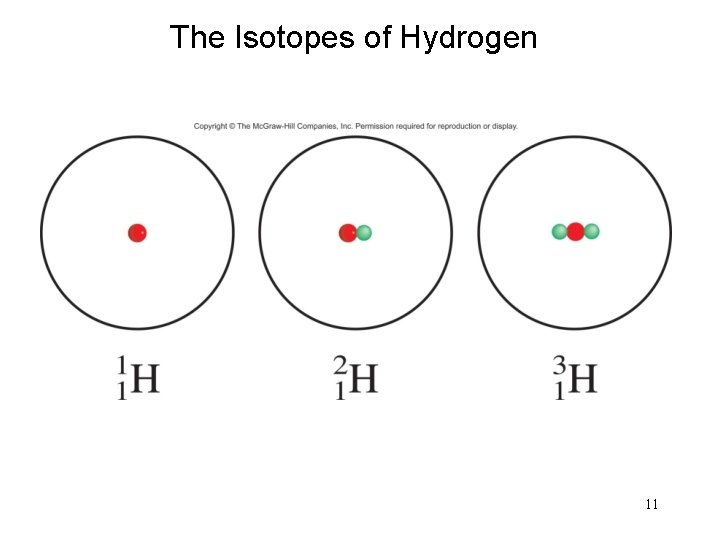
Atomic Number, Mass Number, and Isotopes Atomic number (Z) = number of protons in nucleus Mass number (A) = number of protons + number of neutrons = atomic number (Z) + number of neutrons Isotopes are atoms of the same element (X) with different numbers of neutrons in their nuclei Mass Number Atomic Number A ZX Element Symbol 1 1 H 2 1 H (D) 3 1 H (T) 235 92 U 238 92 U 9
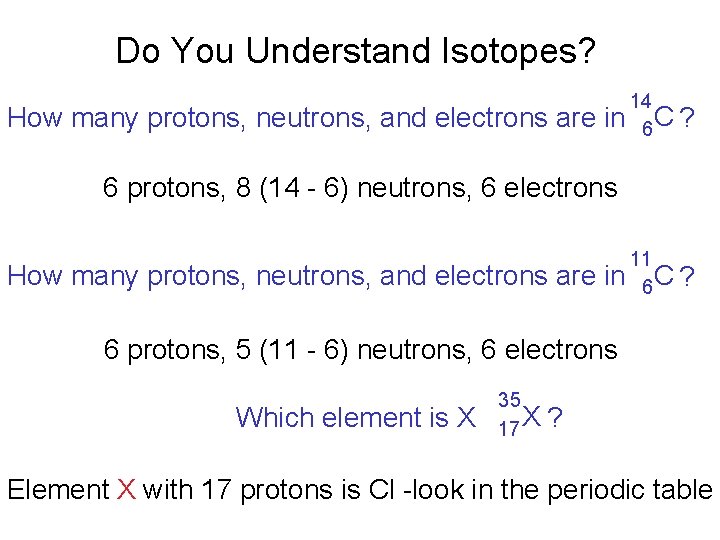
Do You Understand Isotopes? 14 How many protons, neutrons, and electrons are in 6 C ? 6 protons, 8 (14 - 6) neutrons, 6 electrons 11 How many protons, neutrons, and electrons are in 6 C ? 6 protons, 5 (11 - 6) neutrons, 6 electrons Which element is X 35 17 X ? Element X with 17 protons is Cl -look in the periodic table
The Isotopes of Hydrogen 11
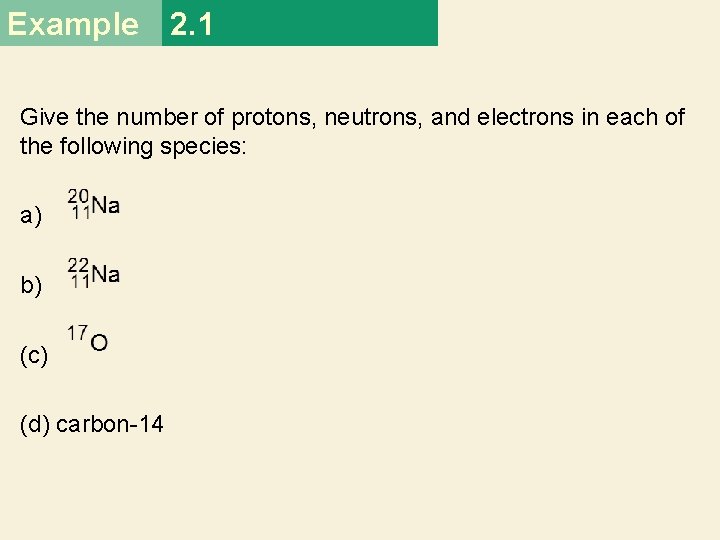
Example 2. 1 Give the number of protons, neutrons, and electrons in each of the following species: a) b) (c) (d) carbon-14
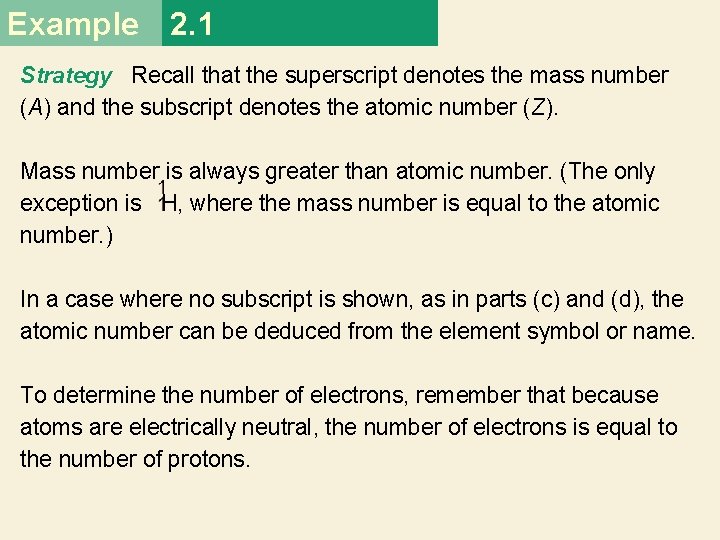
Example 2. 1 Strategy Recall that the superscript denotes the mass number (A) and the subscript denotes the atomic number (Z). Mass number is always greater than atomic number. (The only exception is H, where the mass number is equal to the atomic number. ) In a case where no subscript is shown, as in parts (c) and (d), the atomic number can be deduced from the element symbol or name. To determine the number of electrons, remember that because atoms are electrically neutral, the number of electrons is equal to the number of protons.
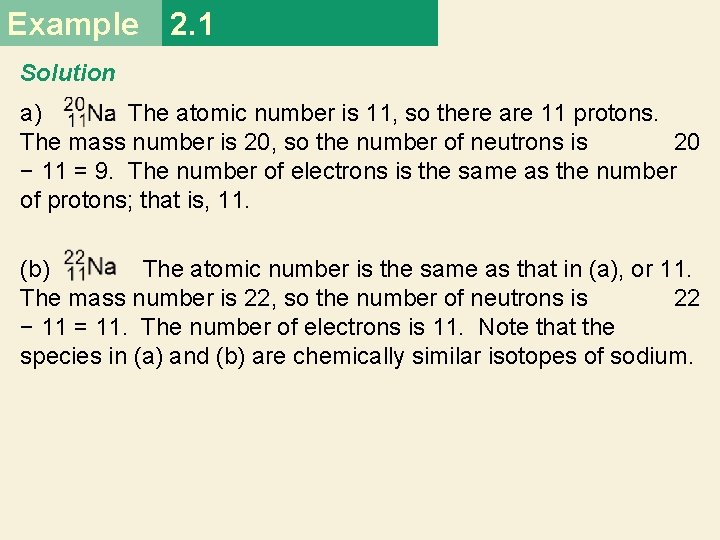
Example 2. 1 Solution a) The atomic number is 11, so there are 11 protons. The mass number is 20, so the number of neutrons is 20 − 11 = 9. The number of electrons is the same as the number of protons; that is, 11. (b) The atomic number is the same as that in (a), or 11. The mass number is 22, so the number of neutrons is 22 − 11 = 11. The number of electrons is 11. Note that the species in (a) and (b) are chemically similar isotopes of sodium.
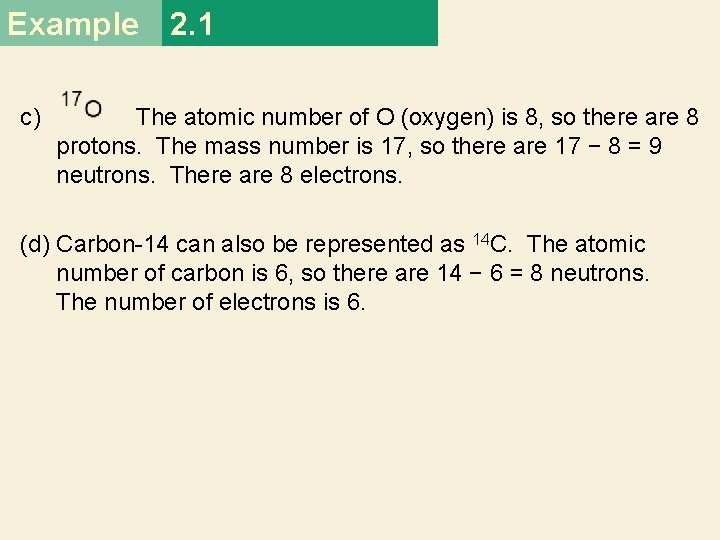
Example 2. 1 c) The atomic number of O (oxygen) is 8, so there are 8 protons. The mass number is 17, so there are 17 − 8 = 9 neutrons. There are 8 electrons. (d) Carbon-14 can also be represented as 14 C. The atomic number of carbon is 6, so there are 14 − 6 = 8 neutrons. The number of electrons is 6.
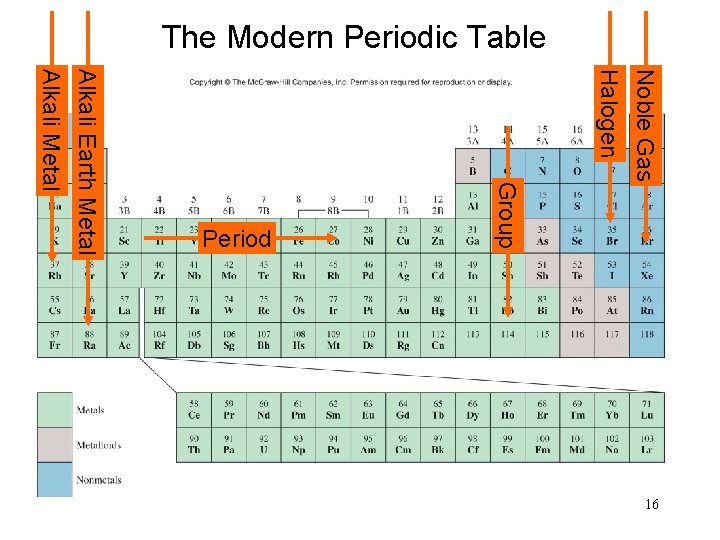
The Modern Periodic Table Noble Gas Halogen Group Alkali Earth Metal Alkali Metal Period 16
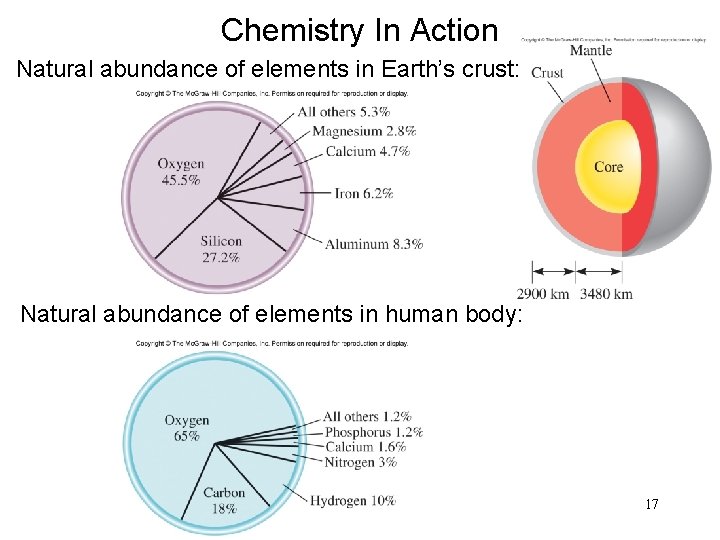
Chemistry In Action Natural abundance of elements in Earth’s crust: Natural abundance of elements in human body: 17
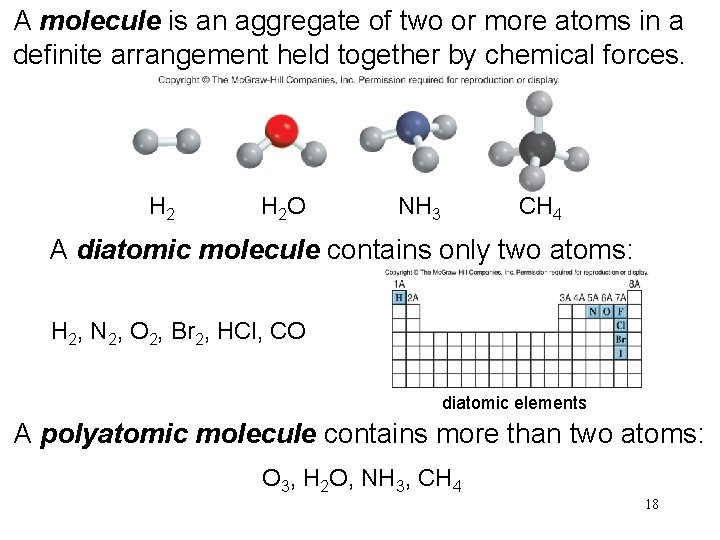
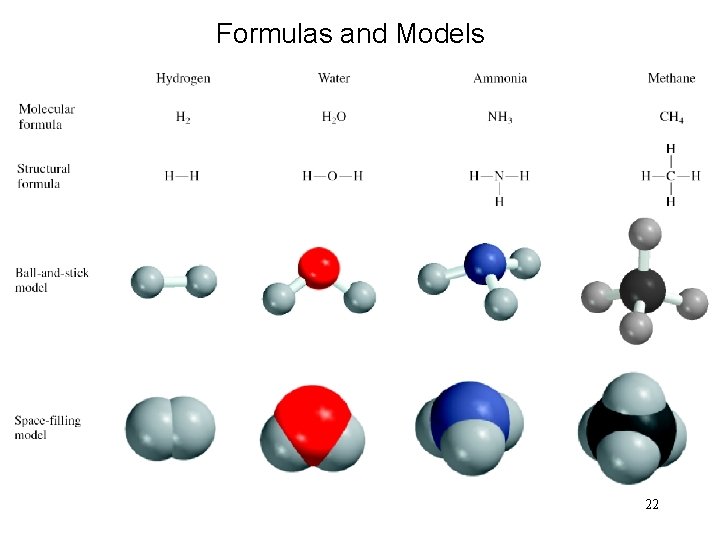
A molecule is an aggregate of two or more atoms in a definite arrangement held together by chemical forces. H 2 O NH 3 CH 4 A diatomic molecule contains only two atoms: H 2, N 2, O 2, Br 2, HCl, CO diatomic elements A polyatomic molecule contains more than two atoms: O 3, H 2 O, NH 3, CH 4 18
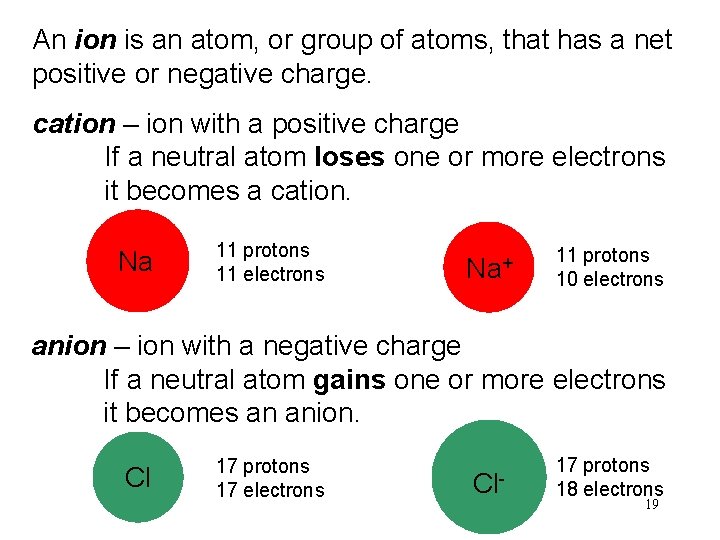
An ion is an atom, or group of atoms, that has a net positive or negative charge. cation – ion with a positive charge If a neutral atom loses one or more electrons it becomes a cation. Na 11 protons 11 electrons Na+ 11 protons 10 electrons anion – ion with a negative charge If a neutral atom gains one or more electrons it becomes an anion. Cl 17 protons 17 electrons Cl- 17 protons 18 electrons 19
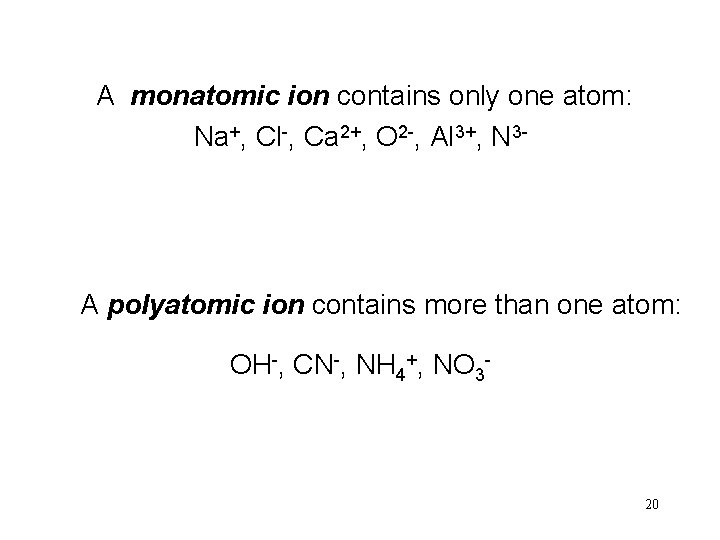
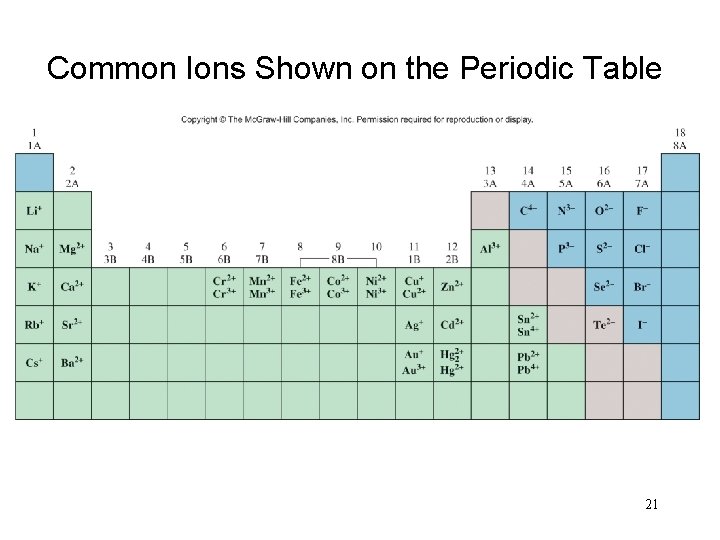
A monatomic ion contains only one atom: Na+, Cl-, Ca 2+, O 2 -, Al 3+, N 3 - A polyatomic ion contains more than one atom: OH-, CN-, NH 4+, NO 3 - 20
Common Ions Shown on the Periodic Table 21
Formulas and Models 22
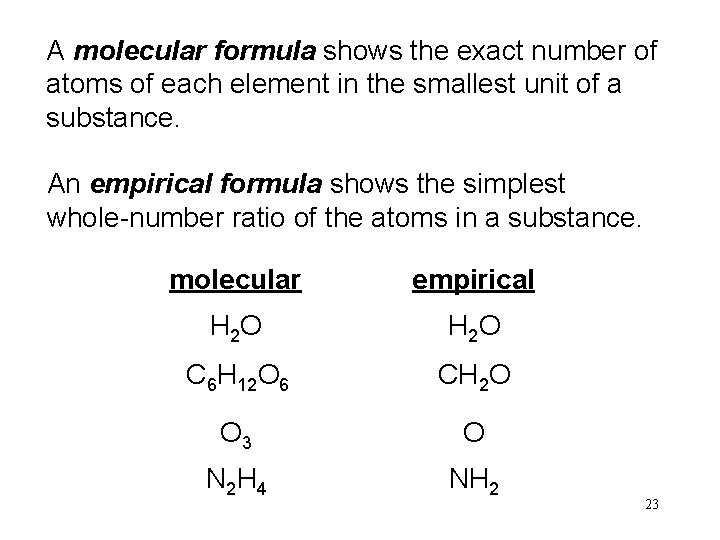
A molecular formula shows the exact number of atoms of each element in the smallest unit of a substance. An empirical formula shows the simplest whole-number ratio of the atoms in a substance. molecular empirical H 2 O C 6 H 12 O 6 CH 2 O O 3 O N 2 H 4 NH 2 23
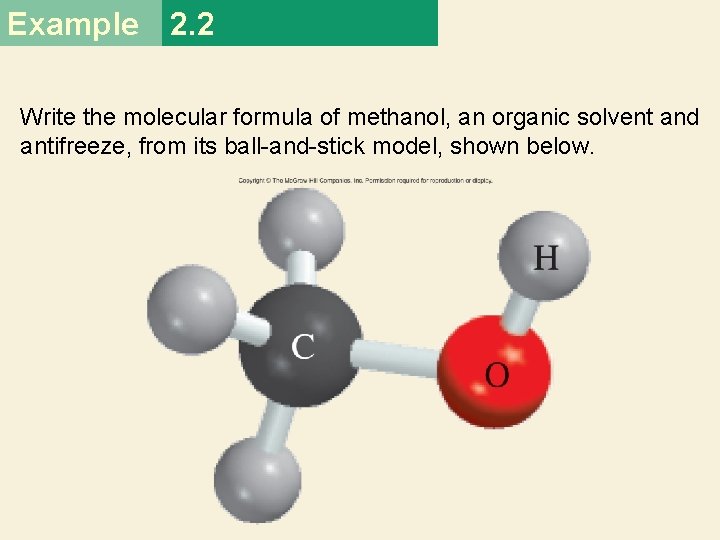
Example 2. 2 Write the molecular formula of methanol, an organic solvent and antifreeze, from its ball-and-stick model, shown below.
Example 2. 2 Solution Refer to the labels (also see back endpapers). There are four H atoms, one C atom, and one O atom. Therefore, the molecular formula is CH 4 O. However, the standard way of writing the molecular formula for methanol is CH 3 OH because it shows how the atoms are joined in the molecule.
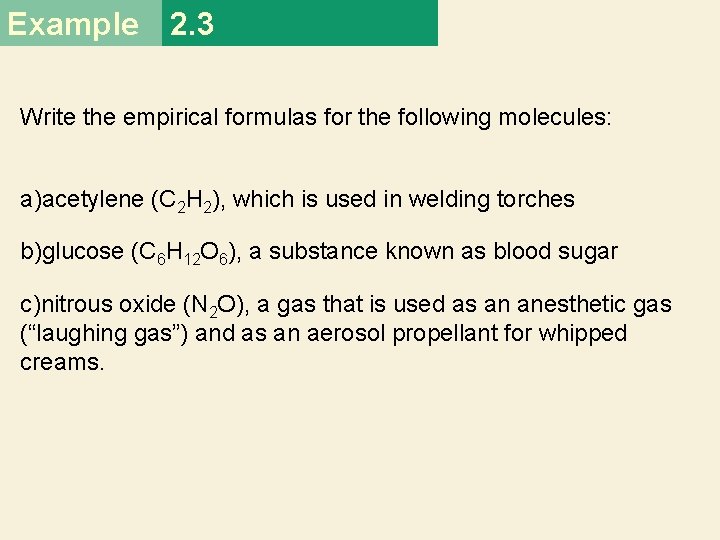
Example 2. 3 Write the empirical formulas for the following molecules: a)acetylene (C 2 H 2), which is used in welding torches b)glucose (C 6 H 12 O 6), a substance known as blood sugar c)nitrous oxide (N 2 O), a gas that is used as an anesthetic gas (“laughing gas”) and as an aerosol propellant for whipped creams.
Example 2. 3 Strategy Recall that to write the empirical formula, the subscripts in the molecular formula must be converted to the smallest possible whole numbers.
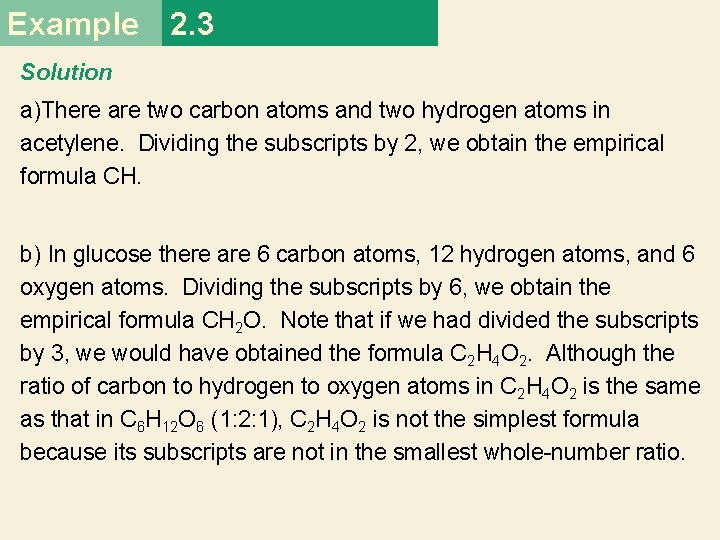
Example 2. 3 Solution a)There are two carbon atoms and two hydrogen atoms in acetylene. Dividing the subscripts by 2, we obtain the empirical formula CH. b) In glucose there are 6 carbon atoms, 12 hydrogen atoms, and 6 oxygen atoms. Dividing the subscripts by 6, we obtain the empirical formula CH 2 O. Note that if we had divided the subscripts by 3, we would have obtained the formula C 2 H 4 O 2. Although the ratio of carbon to hydrogen to oxygen atoms in C 2 H 4 O 2 is the same as that in C 6 H 12 O 6 (1: 2: 1), C 2 H 4 O 2 is not the simplest formula because its subscripts are not in the smallest whole-number ratio.
Example 2. 3 (c) Because the subscripts in N 2 O are already the smallest possible whole numbers, the empirical formula for nitrous oxide is the same as its molecular formula.
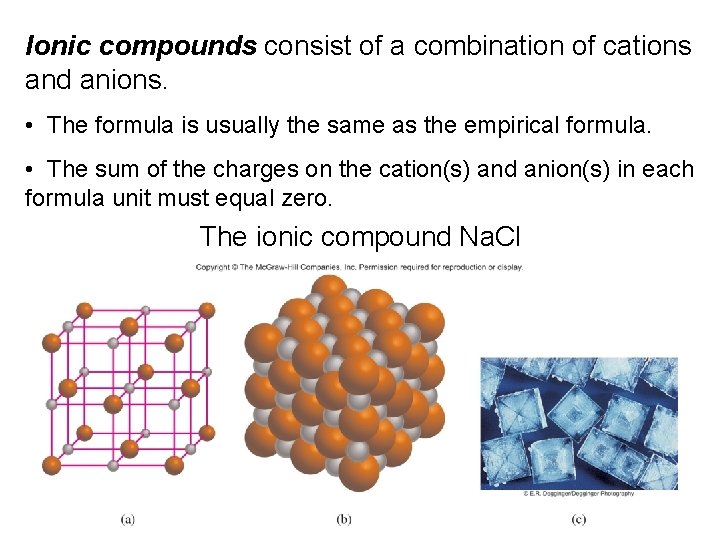
Ionic compounds consist of a combination of cations and anions. • The formula is usually the same as the empirical formula. • The sum of the charges on the cation(s) and anion(s) in each formula unit must equal zero. The ionic compound Na. Cl 30
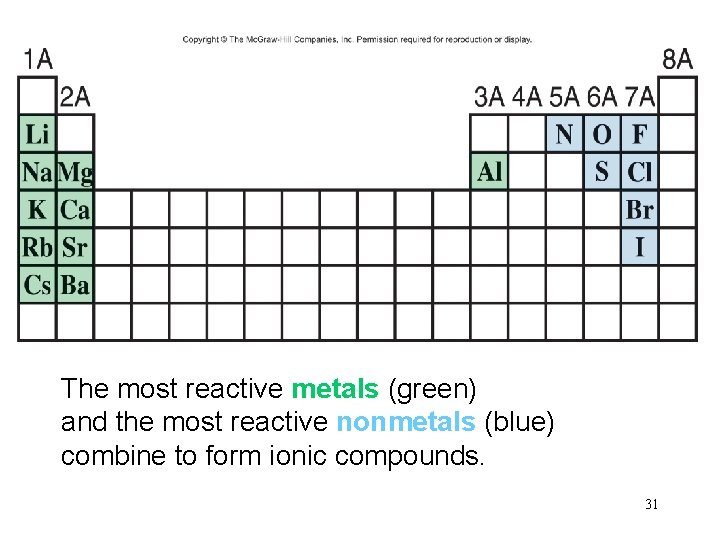
The most reactive metals (green) and the most reactive nonmetals (blue) combine to form ionic compounds. 31
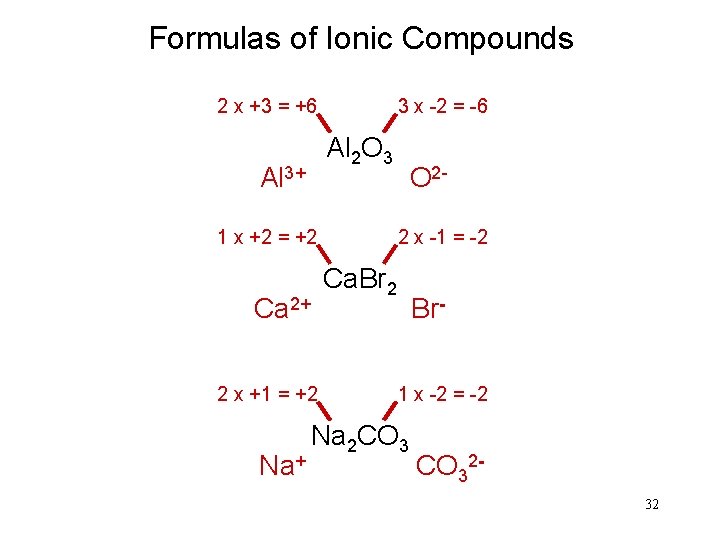
Formulas of Ionic Compounds 2 x +3 = +6 3 x -2 = -6 Al 2 O 3 Al 3+ 1 x +2 = +2 Ca 2+ 2 x +1 = +2 Na+ O 22 x -1 = -2 Ca. Br 2 Br 1 x -2 = -2 Na 2 CO 3232
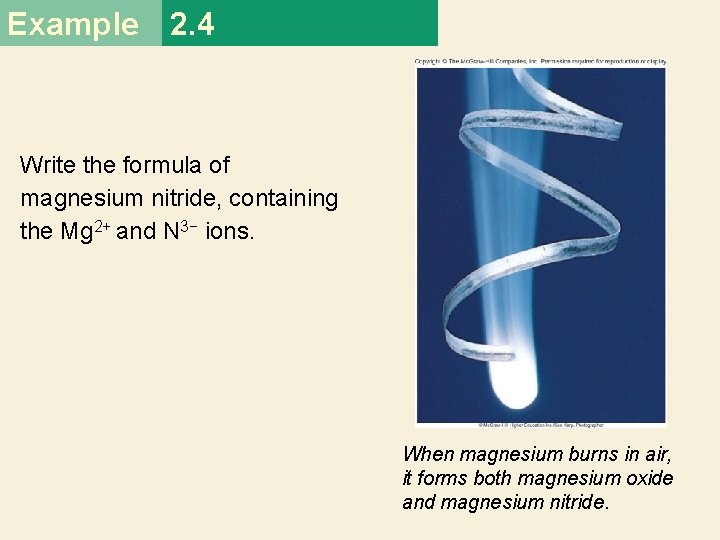
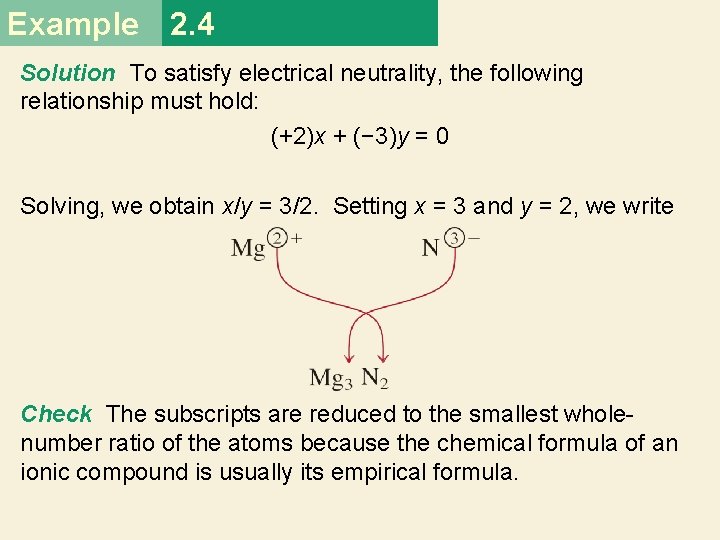
Example 2. 4 Write the formula of magnesium nitride, containing the Mg 2+ and N 3− ions. When magnesium burns in air, it forms both magnesium oxide and magnesium nitride.
Example 2. 4 Solution To satisfy electrical neutrality, the following relationship must hold: (+2)x + (− 3)y = 0 Solving, we obtain x/y = 3/2. Setting x = 3 and y = 2, we write Check The subscripts are reduced to the smallest whole- number ratio of the atoms because the chemical formula of an ionic compound is usually its empirical formula.
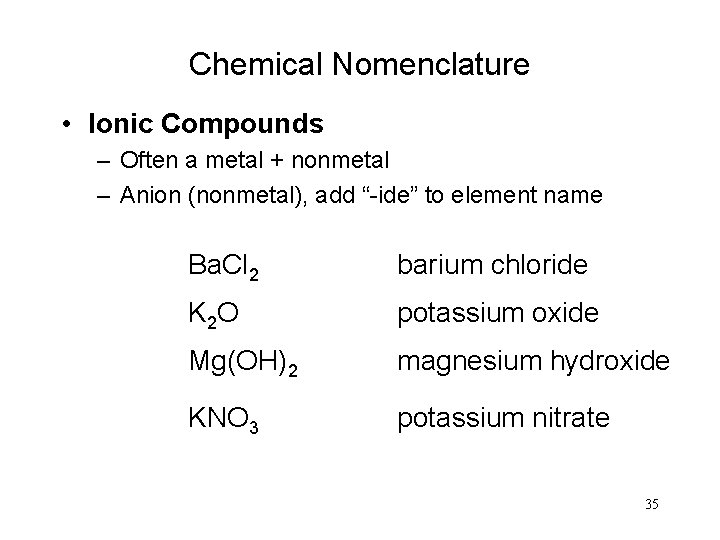
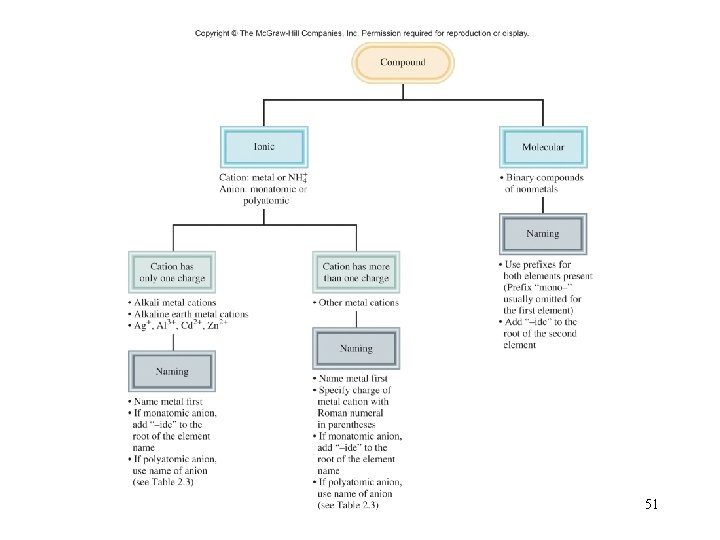
Chemical Nomenclature • Ionic Compounds – Often a metal + nonmetal – Anion (nonmetal), add “-ide” to element name Ba. Cl 2 barium chloride K 2 O potassium oxide Mg(OH)2 magnesium hydroxide KNO 3 potassium nitrate 35
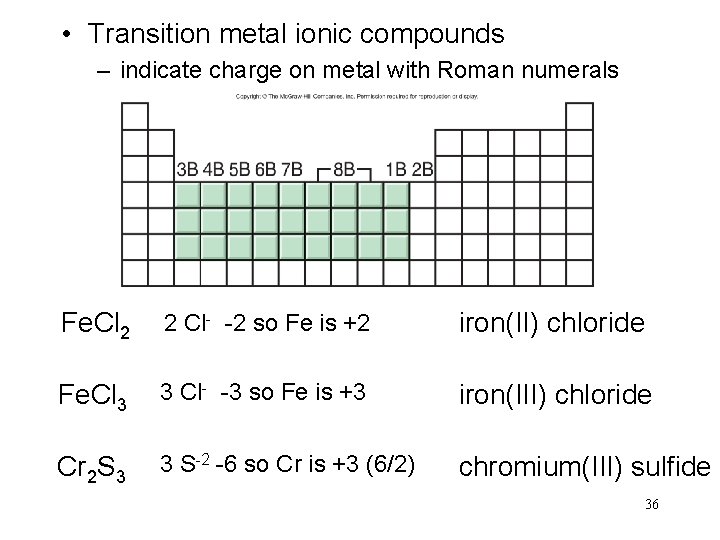
• Transition metal ionic compounds – indicate charge on metal with Roman numerals Fe. Cl 2 2 Cl- -2 so Fe is +2 iron(II) chloride Fe. Cl 3 3 Cl- -3 so Fe is +3 iron(III) chloride Cr 2 S 3 3 S-2 -6 so Cr is +3 (6/2) chromium(III) sulfide 36
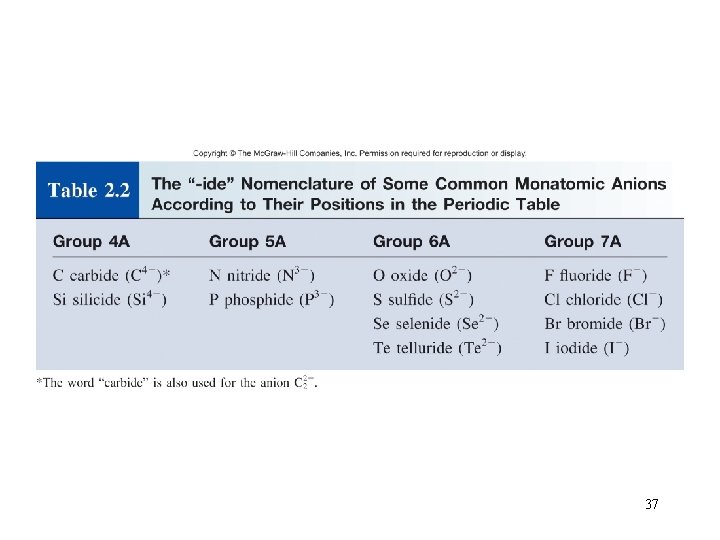
37
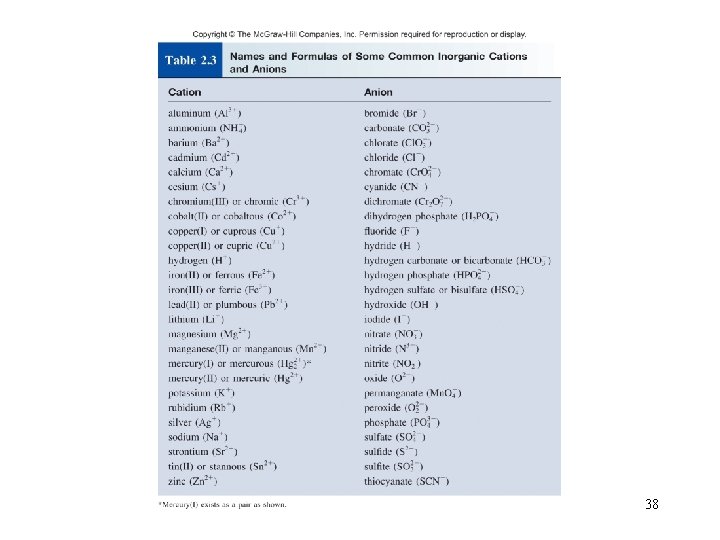
38
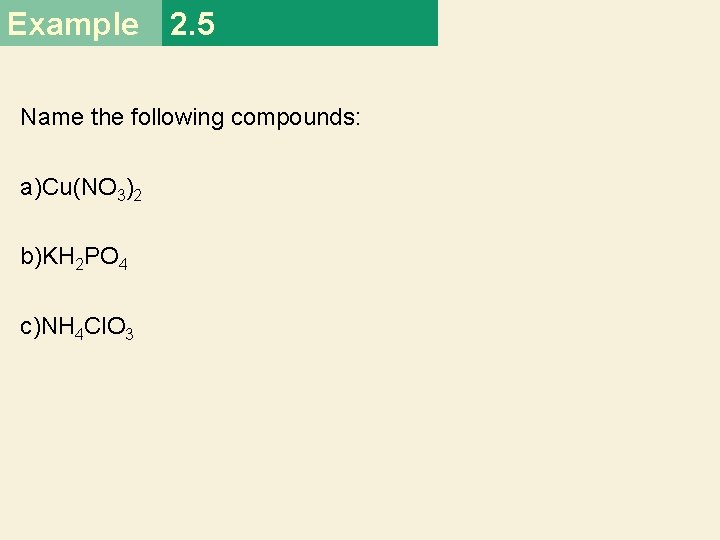
Example 2. 5 Name the following compounds: a)Cu(NO 3)2 b)KH 2 PO 4 c)NH 4 Cl. O 3
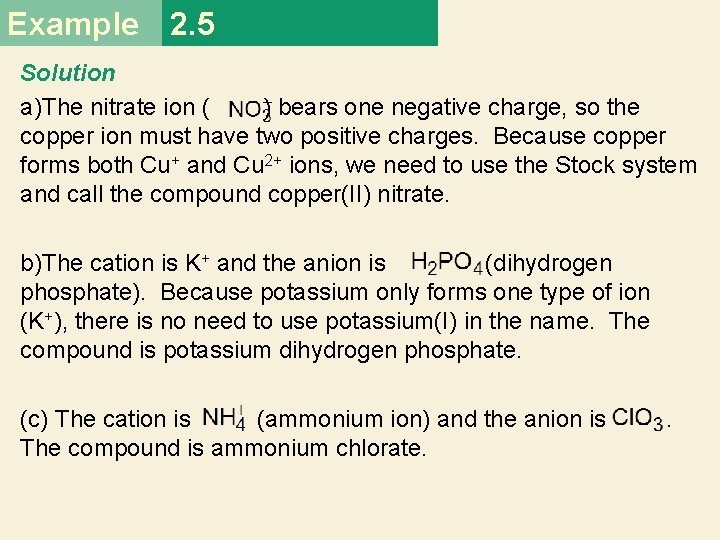
Example 2. 5 Solution a)The nitrate ion ( ) bears one negative charge, so the copper ion must have two positive charges. Because copper forms both Cu+ and Cu 2+ ions, we need to use the Stock system and call the compound copper(II) nitrate. b)The cation is K+ and the anion is (dihydrogen phosphate). Because potassium only forms one type of ion (K+), there is no need to use potassium(I) in the name. The compound is potassium dihydrogen phosphate. (c) The cation is (ammonium ion) and the anion is . The compound is ammonium chlorate.
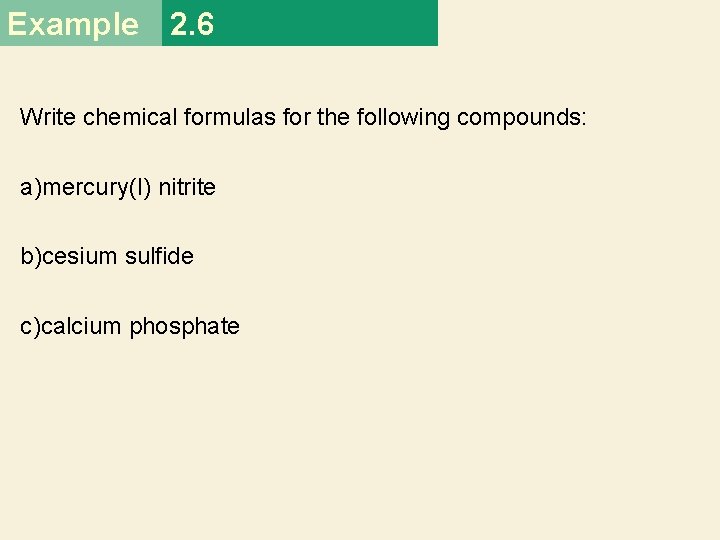
Example 2. 6 Write chemical formulas for the following compounds: a)mercury(I) nitrite b)cesium sulfide c)calcium phosphate
Example 2. 6 Strategy We refer to Table 2. 3 for the formulas of cations and anions. Recall that the Roman numerals in the Stock system provide useful information about the charges of the cation.
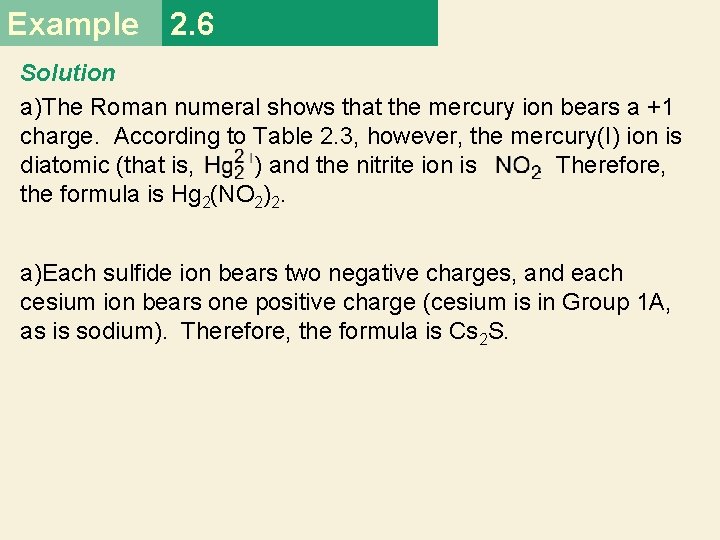
Example 2. 6 Solution a)The Roman numeral shows that the mercury ion bears a +1 charge. According to Table 2. 3, however, the mercury(I) ion is diatomic (that is, ) and the nitrite ion is . Therefore, the formula is Hg 2(NO 2)2. a)Each sulfide ion bears two negative charges, and each cesium ion bears one positive charge (cesium is in Group 1 A, as is sodium). Therefore, the formula is Cs 2 S.
Example 2. 6 (c) Each calcium ion (Ca 2+) bears two positive charges, and each phosphate ion ( ) bears three negative charges. To make the sum of the charges equal zero, we must adjust the numbers of cations and anions: 3(+2) + 2(− 3) = 0 Thus, the formula is Ca 3(PO 4)2.
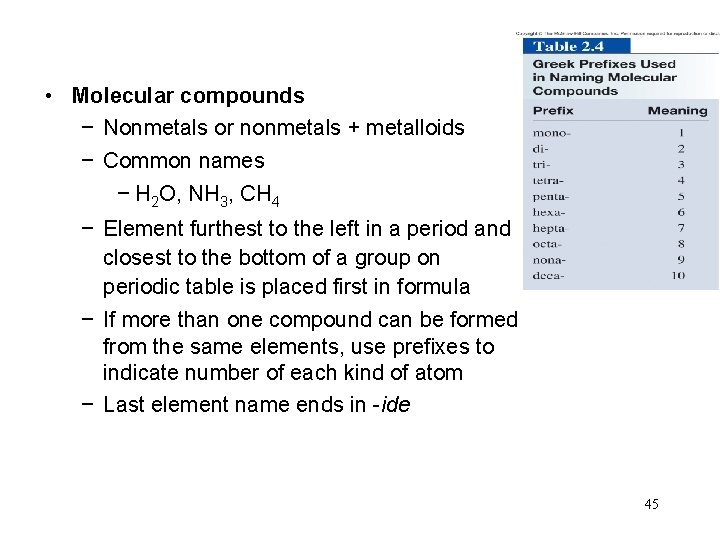
• Molecular compounds − Nonmetals or nonmetals + metalloids − Common names − H 2 O, NH 3, CH 4 − Element furthest to the left in a period and closest to the bottom of a group on periodic table is placed first in formula − If more than one compound can be formed from the same elements, use prefixes to indicate number of each kind of atom − Last element name ends in -ide 45
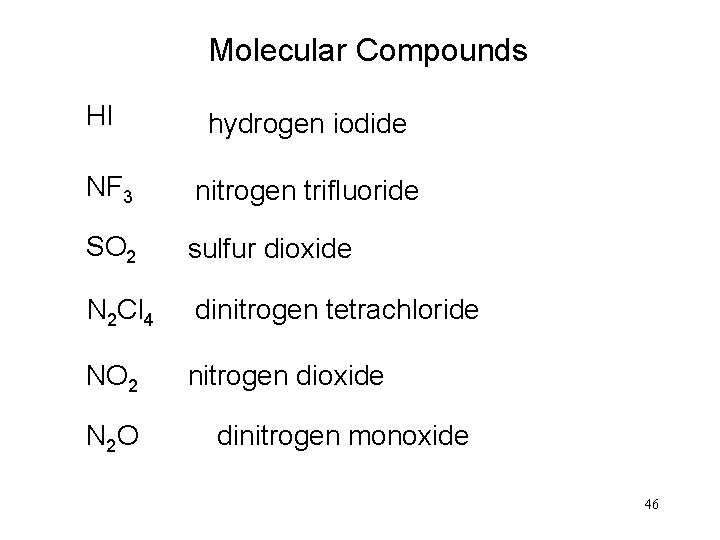
Molecular Compounds HI hydrogen iodide NF 3 nitrogen trifluoride SO 2 sulfur dioxide N 2 Cl 4 dinitrogen tetrachloride NO 2 nitrogen dioxide N 2 O dinitrogen monoxide 46
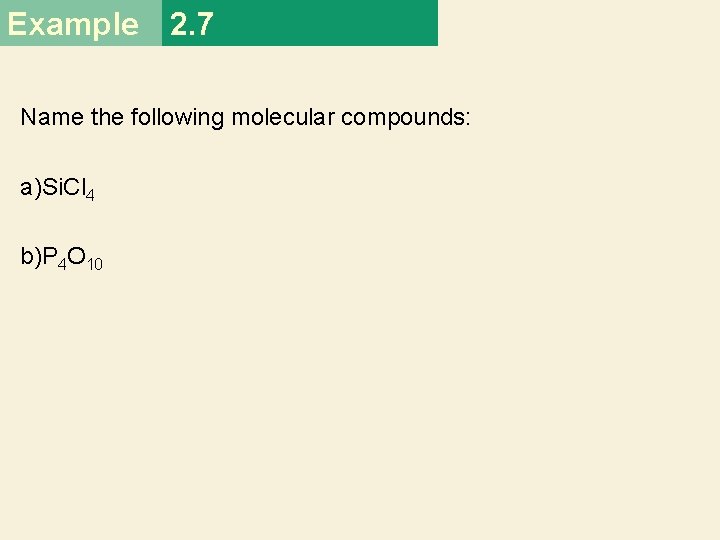
Example 2. 7 Name the following molecular compounds: a)Si. Cl 4 b)P 4 O 10
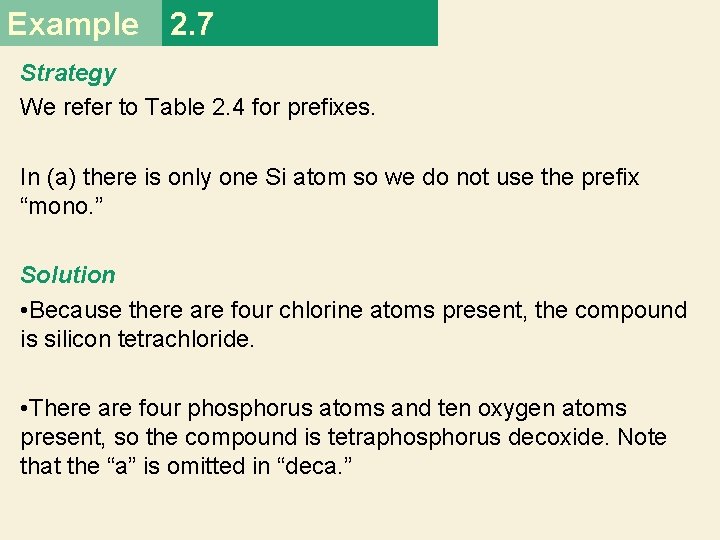
Example 2. 7 Strategy We refer to Table 2. 4 for prefixes. In (a) there is only one Si atom so we do not use the prefix “mono. ” Solution • Because there are four chlorine atoms present, the compound is silicon tetrachloride. • There are four phosphorus atoms and ten oxygen atoms present, so the compound is tetraphosphorus decoxide. Note that the “a” is omitted in “deca. ”
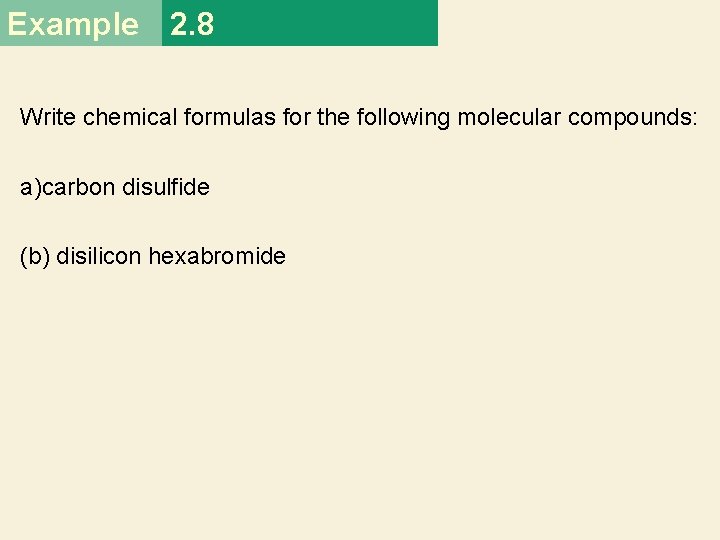
Example 2. 8 Write chemical formulas for the following molecular compounds: a)carbon disulfide (b) disilicon hexabromide
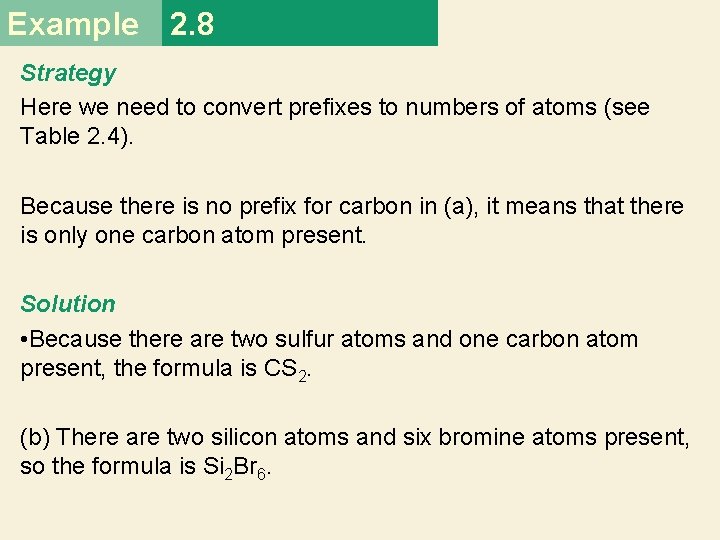
Example 2. 8 Strategy Here we need to convert prefixes to numbers of atoms (see Table 2. 4). Because there is no prefix for carbon in (a), it means that there is only one carbon atom present. Solution • Because there are two sulfur atoms and one carbon atom present, the formula is CS 2. (b) There are two silicon atoms and six bromine atoms present, so the formula is Si 2 Br 6.
51
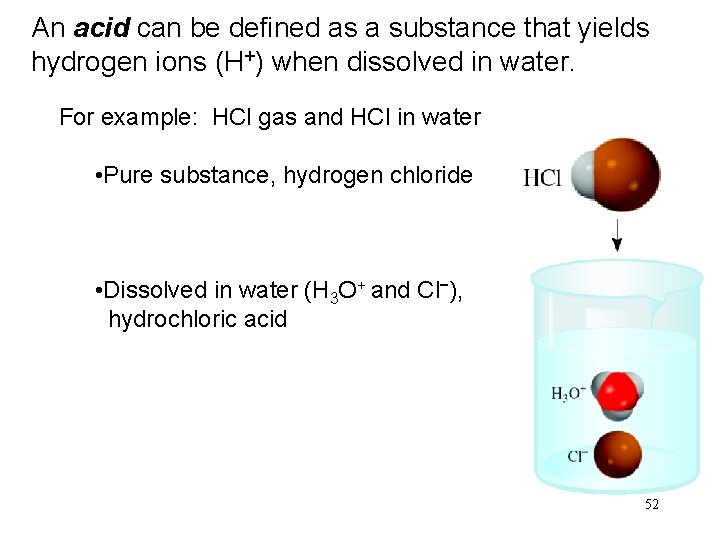
An acid can be defined as a substance that yields hydrogen ions (H+) when dissolved in water. For example: HCl gas and HCl in water • Pure substance, hydrogen chloride • Dissolved in water (H 3 O+ and Cl−), hydrochloric acid 52
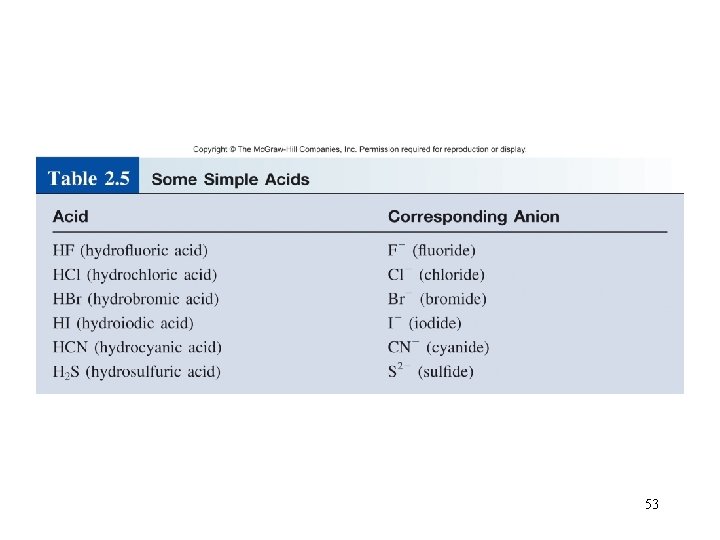
53
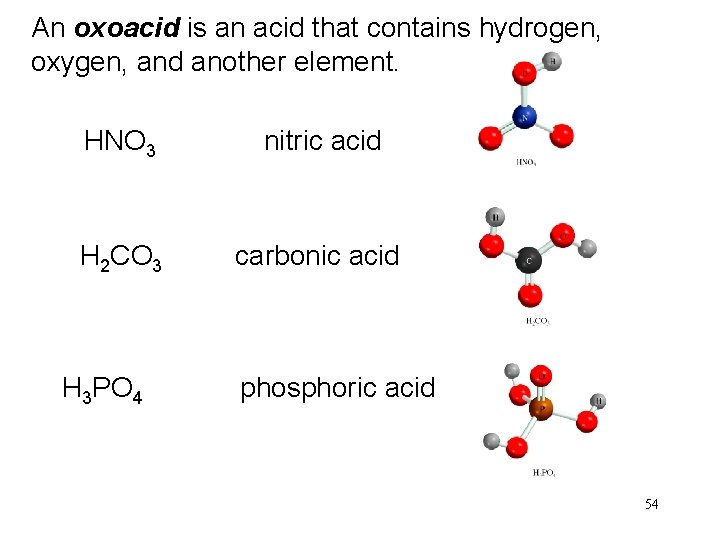
An oxoacid is an acid that contains hydrogen, oxygen, and another element. HNO 3 nitric acid H 2 CO 3 carbonic acid H 3 PO 4 phosphoric acid 54
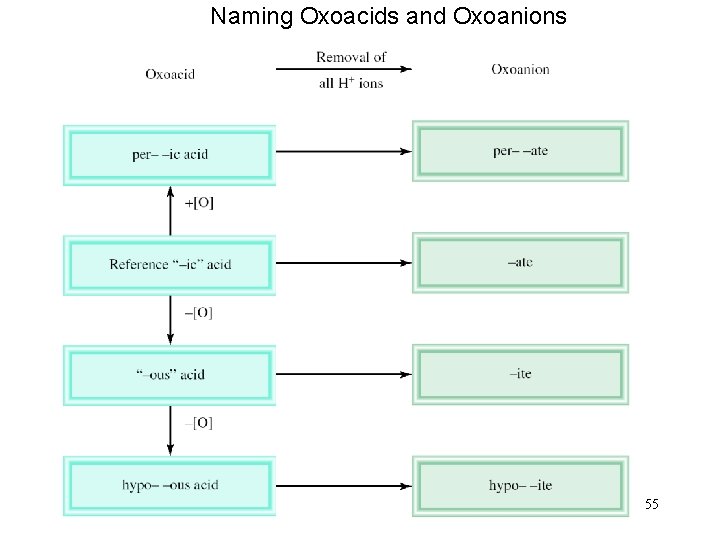
Naming Oxoacids and Oxoanions 55
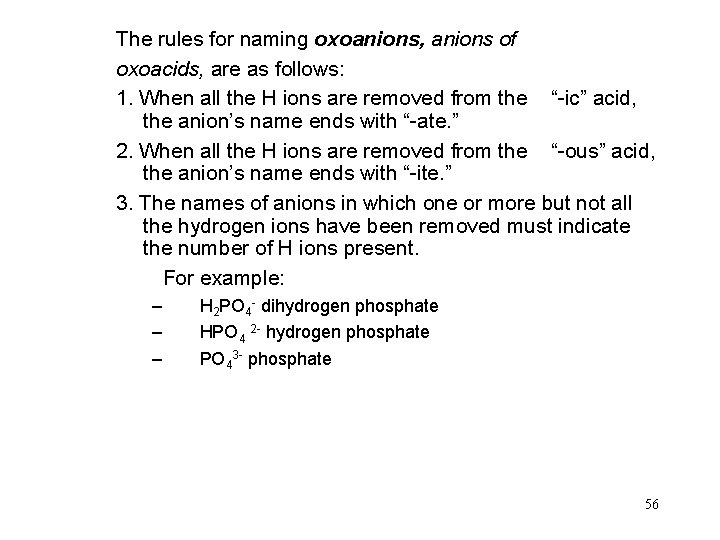
The rules for naming oxoanions, anions of oxoacids, are as follows: 1. When all the H ions are removed from the “-ic” acid, the anion’s name ends with “-ate. ” 2. When all the H ions are removed from the “-ous” acid, the anion’s name ends with “-ite. ” 3. The names of anions in which one or more but not all the hydrogen ions have been removed must indicate the number of H ions present. For example: – H 2 PO 4 - dihydrogen phosphate – HPO 4 2 - hydrogen phosphate – PO 43 - phosphate 56
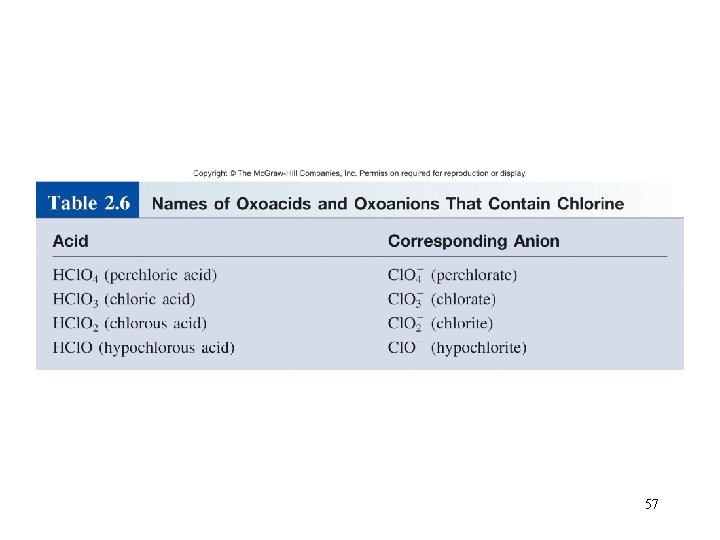
57
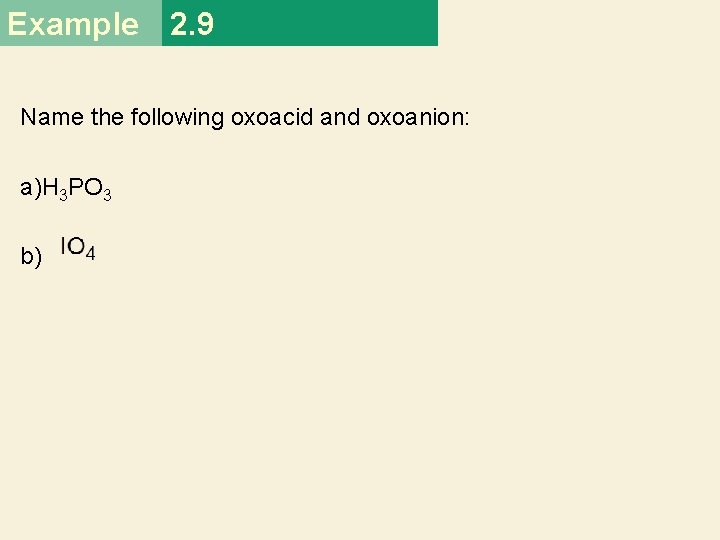
Example 2. 9 Name the following oxoacid and oxoanion: a)H 3 PO 3 b)
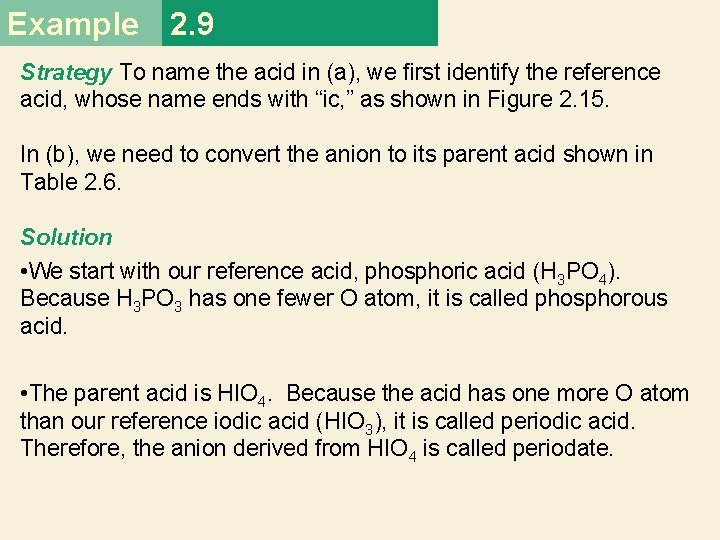
Example 2. 9 Strategy To name the acid in (a), we first identify the reference acid, whose name ends with “ic, ” as shown in Figure 2. 15. In (b), we need to convert the anion to its parent acid shown in Table 2. 6. Solution • We start with our reference acid, phosphoric acid (H 3 PO 4). Because H 3 PO 3 has one fewer O atom, it is called phosphorous acid. • The parent acid is HIO 4. Because the acid has one more O atom than our reference iodic acid (HIO 3), it is called periodic acid. Therefore, the anion derived from HIO 4 is called periodate.
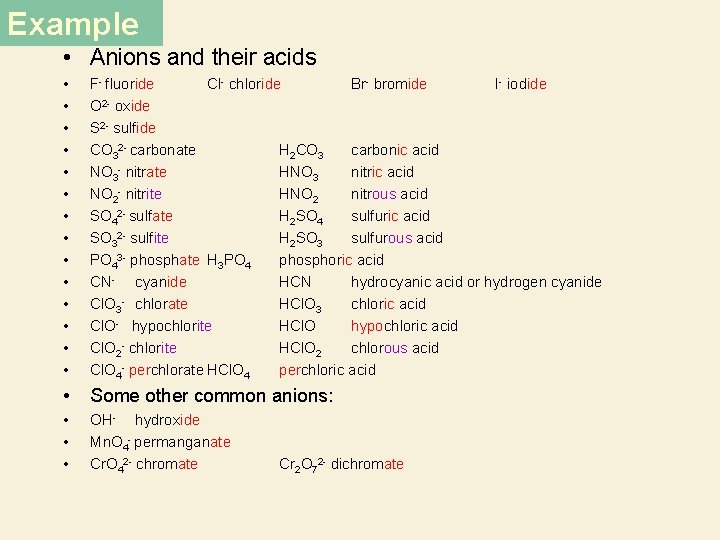
Example • Anions and their acids • • • • F- fluoride Cl- chloride Br- bromide I- iodide O 2 - oxide S 2 - sulfide CO 32 - carbonate H 2 CO 3 carbonic acid NO 3 - nitrate HNO 3 nitric acid NO 2 - nitrite HNO 2 nitrous acid SO 42 - sulfate H 2 SO 4 sulfuric acid SO 32 - sulfite H 2 SO 3 sulfurous acid PO 43 - phosphate H 3 PO 4 phosphoric acid CN- cyanide HCN hydrocyanic acid or hydrogen cyanide Cl. O 3 - chlorate HCl. O 3 chloric acid Cl. O- hypochlorite HCl. O hypochloric acid Cl. O 2 - chlorite HCl. O 2 chlorous acid Cl. O 4 - perchlorate HCl. O 4 perchloric acid • Some other common anions: • • • OH- hydroxide Mn. O 4 - permanganate Cr. O 42 - chromate Cr 2 O 72 - dichromate
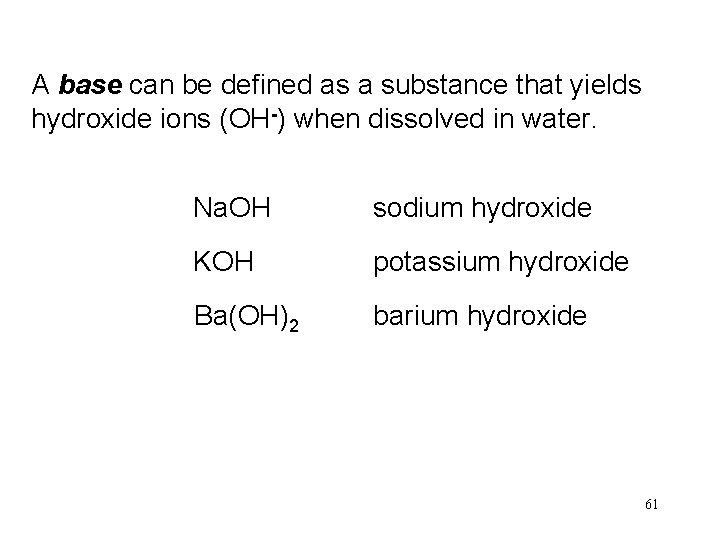
A base can be defined as a substance that yields hydroxide ions (OH-) when dissolved in water. Na. OH sodium hydroxide KOH potassium hydroxide Ba(OH)2 barium hydroxide 61
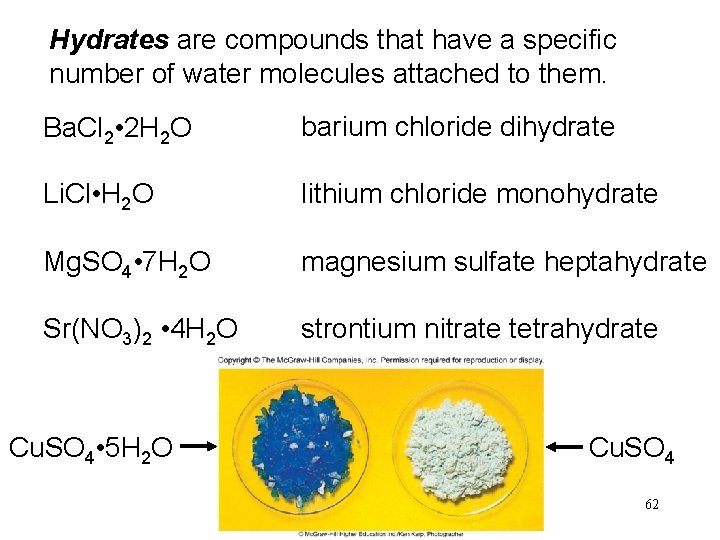
Hydrates are compounds that have a specific number of water molecules attached to them. Ba. Cl 2 • 2 H 2 O barium chloride dihydrate Li. Cl • H 2 O lithium chloride monohydrate Mg. SO 4 • 7 H 2 O magnesium sulfate heptahydrate Sr(NO 3)2 • 4 H 2 O strontium nitrate tetrahydrate Cu. SO 4 • 5 H 2 O Cu. SO 4 62
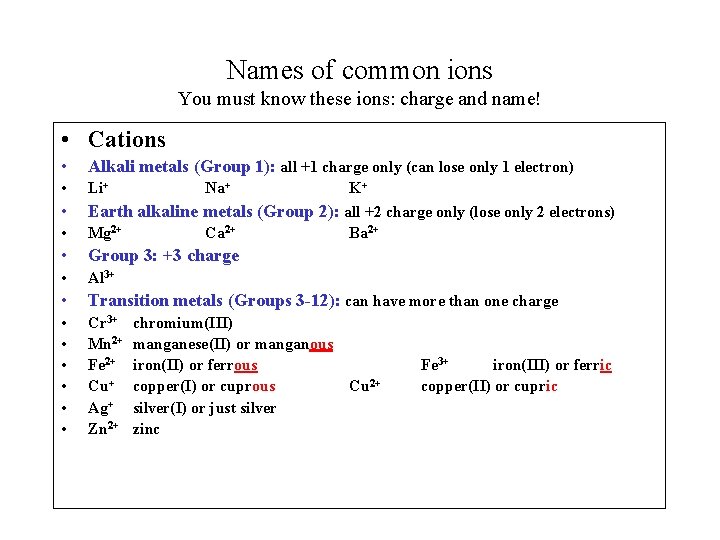
Names of common ions You must know these ions: charge and name! • Cations • Alkali metals (Group 1): all +1 charge only (can lose only 1 electron) • Li+ • K+ Earth alkaline metals (Group 2): all +2 charge only (lose only 2 electrons) Mg 2+ Ca 2+ Ba 2+ • Group 3: +3 charge • Al 3+ • Transition metals (Groups 3 -12): can have more than one charge • • • Cr 3+ Mn 2+ Fe 2+ Cu+ Ag+ Zn 2+ • Na+ chromium(III) manganese(II) or manganous iron(II) or ferrous copper(I) or cuprous silver(I) or just silver zinc Cu 2+ Fe 3+ iron(III) or ferric copper(II) or cupric
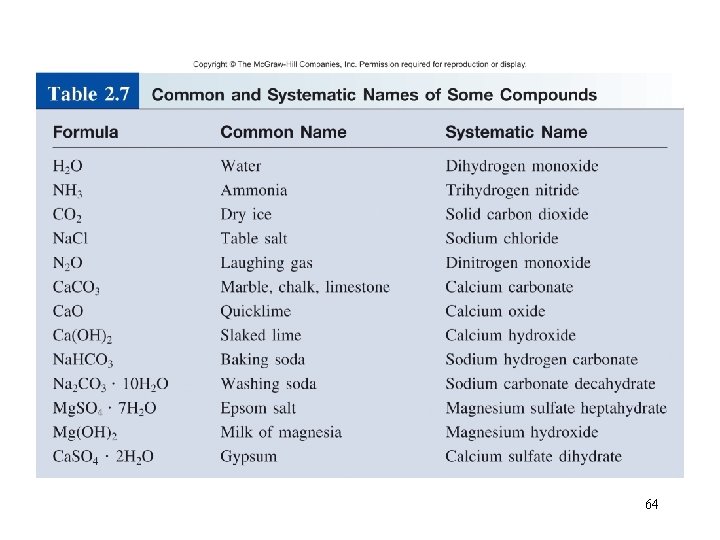
64
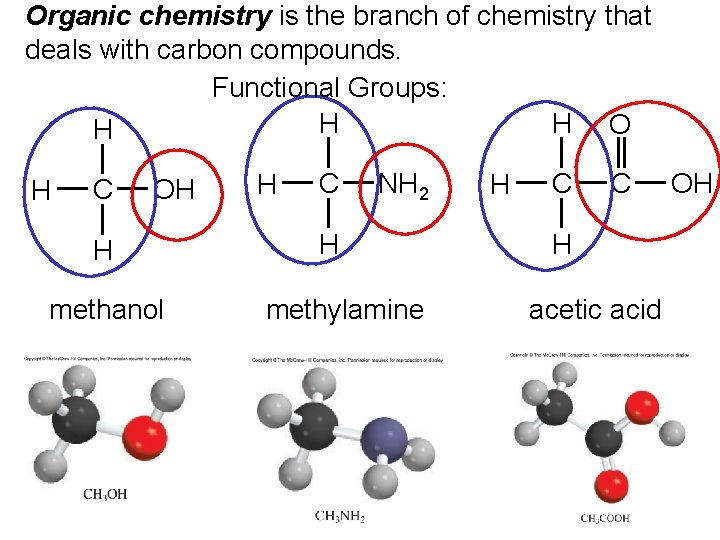
Organic chemistry is the branch of chemistry that deals with carbon compounds. Functional Groups: H H O H H C OH H methanol H C NH 2 H methylamine H C C OH H acetic acid 65
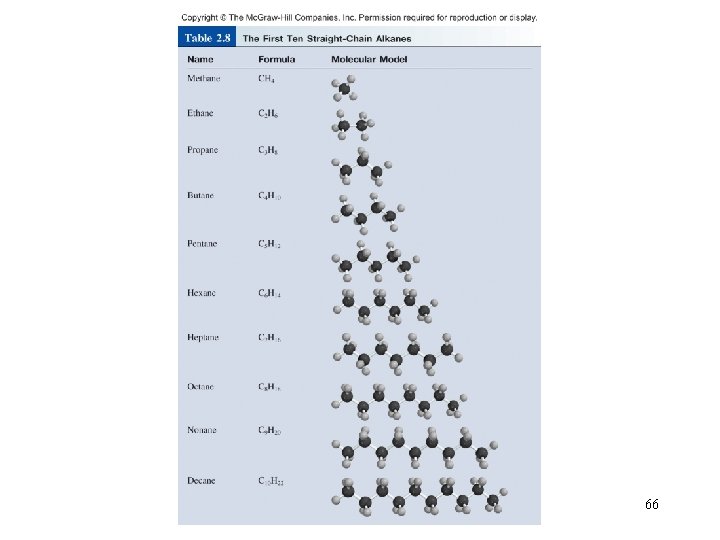
66
The Structure of Atoms • Cathode rays are deflected by magnetic and electric field • Thomson proposed that cathode rays must consist of a stream of negatively charged particles, which we now call electrons. • Thomson calculated the electron’s charge to mass ratio: 1. 758820 x 108 Coulombs per gram.
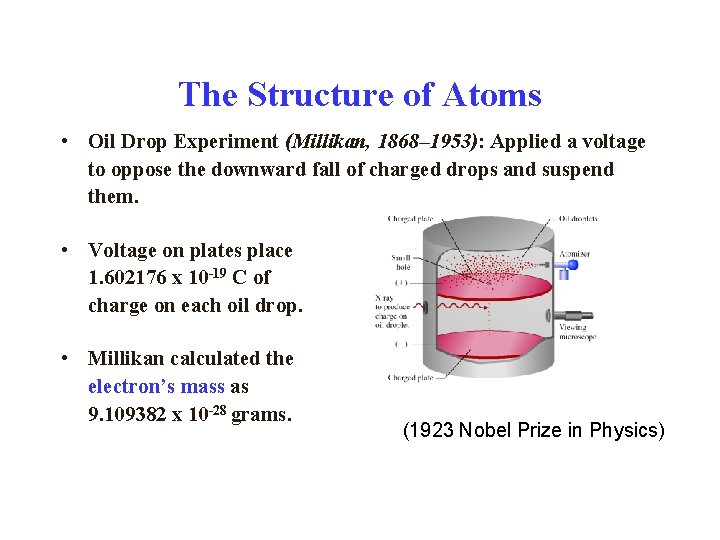
The Structure of Atoms • Oil Drop Experiment (Millikan, 1868– 1953): Applied a voltage to oppose the downward fall of charged drops and suspend them. • Voltage on plates place 1. 602176 x 10 -19 C of charge on each oil drop. • Millikan calculated the electron’s mass as 9. 109382 x 10 -28 grams. (1923 Nobel Prize in Physics)
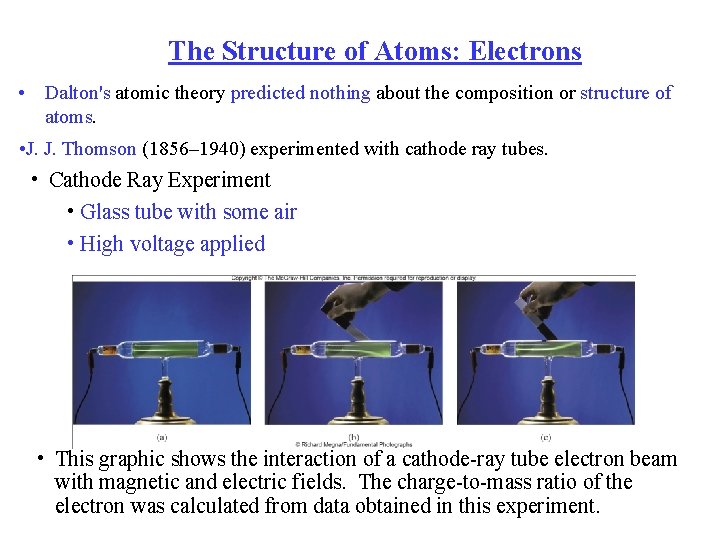
The Structure of Atoms: Electrons • Dalton's atomic theory predicted nothing about the composition or structure of atoms. • J. J. Thomson (1856– 1940) experimented with cathode ray tubes. • Cathode Ray Experiment • Glass tube with some air • High voltage applied • This graphic shows the interaction of a cathode-ray tube electron beam with magnetic and electric fields. The charge-to-mass ratio of the electron was calculated from data obtained in this experiment.
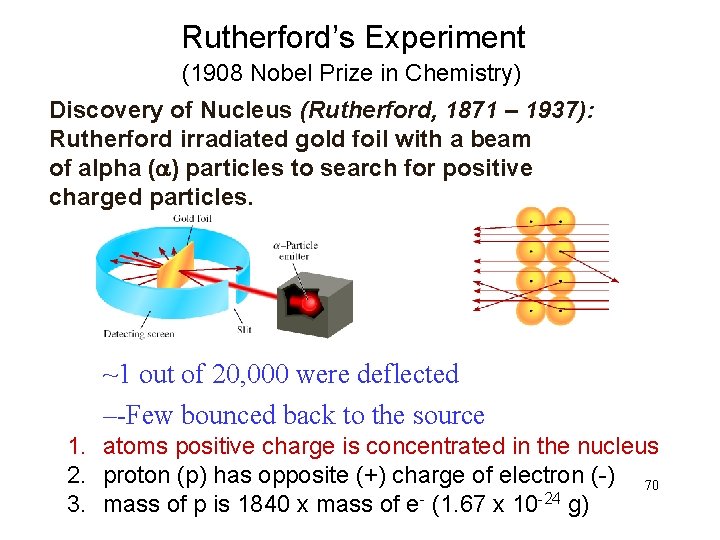
Rutherford’s Experiment (1908 Nobel Prize in Chemistry) Discovery of Nucleus (Rutherford, 1871 – 1937): Rutherford irradiated gold foil with a beam of alpha ( ) particles to search for positive charged particles. ~1 out of 20, 000 were deflected –-Few bounced back to the source 1. atoms positive charge is concentrated in the nucleus 2. proton (p) has opposite (+) charge of electron (-) 70 3. mass of p is 1840 x mass of e- (1. 67 x 10 -24 g)