
Early Atomic Theory Atoms Molecules and Ions Preparation

- Slides: 48
Early Atomic Theory Atoms, Molecules, and Ions Preparation for College Chemistry Luis Avila Columbia University Department of Chemistry
Atoms Atomic theory Components of the Atomic Number Mass Number Isotopes
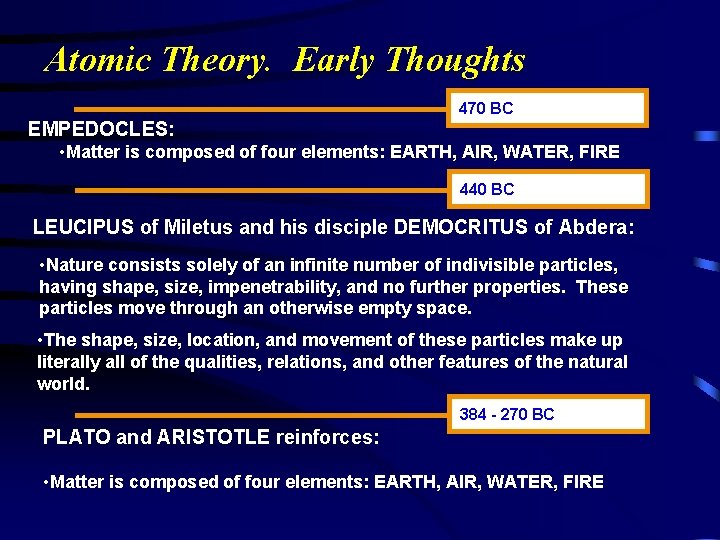
Atomic Theory. Early Thoughts EMPEDOCLES: 470 BC • Matter is composed of four elements: EARTH, AIR, WATER, FIRE 440 BC LEUCIPUS of Miletus and his disciple DEMOCRITUS of Abdera: • Nature consists solely of an infinite number of indivisible particles, having shape, size, impenetrability, and no further properties. These particles move through an otherwise empty space. • The shape, size, location, and movement of these particles make up literally all of the qualities, relations, and other features of the natural world. 384 - 270 BC PLATO and ARISTOTLE reinforces: • Matter is composed of four elements: EARTH, AIR, WATER, FIRE
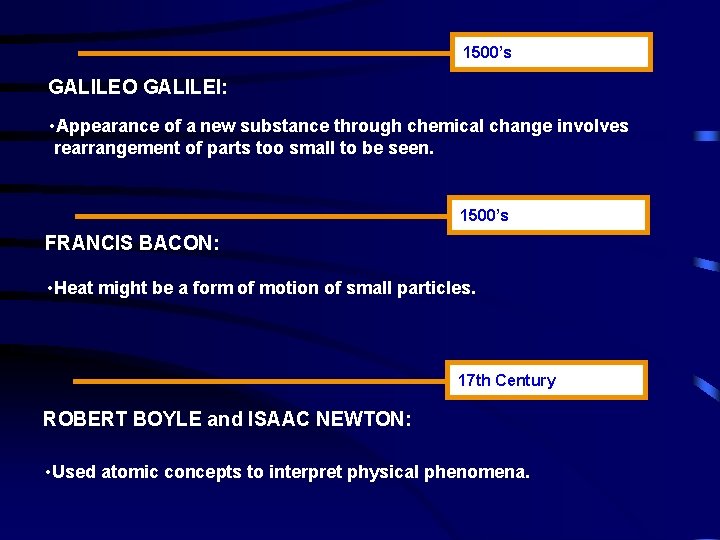
1500’s GALILEO GALILEI: • Appearance of a new substance through chemical change involves rearrangement of parts too small to be seen. 1500’s FRANCIS BACON: • Heat might be a form of motion of small particles. 17 th Century ROBERT BOYLE and ISAAC NEWTON: • Used atomic concepts to interpret physical phenomena.
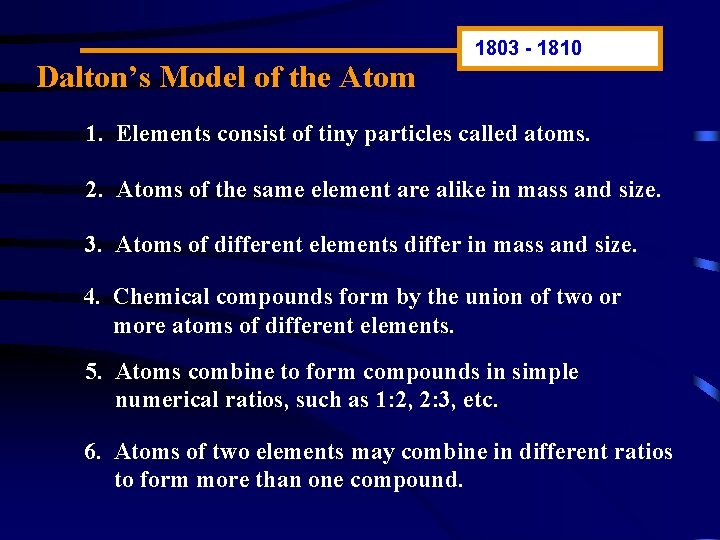
Dalton’s Model of the Atom 1803 - 1810 1. Elements consist of tiny particles called atoms. 2. Atoms of the same element are alike in mass and size. 3. Atoms of different elements differ in mass and size. 4. Chemical compounds form by the union of two or more atoms of different elements. 5. Atoms combine to form compounds in simple numerical ratios, such as 1: 2, 2: 3, etc. 6. Atoms of two elements may combine in different ratios to form more than one compound.
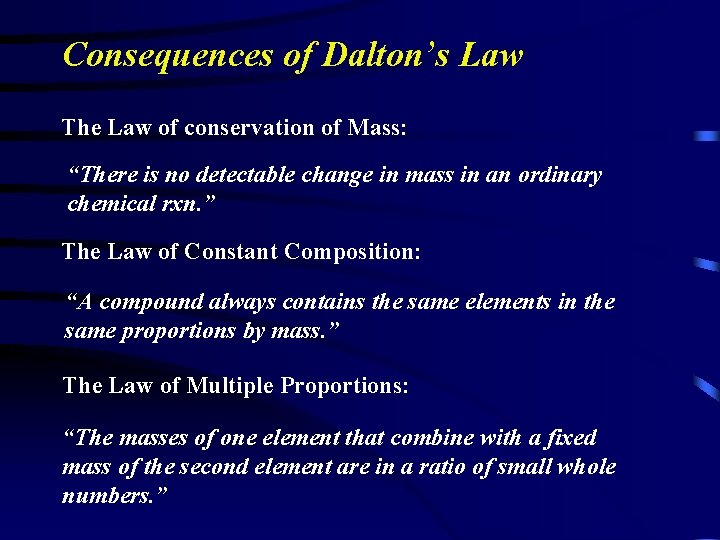
Consequences of Dalton’s Law The Law of conservation of Mass: “There is no detectable change in mass in an ordinary chemical rxn. ” The Law of Constant Composition: “A compound always contains the same elements in the same proportions by mass. ” The Law of Multiple Proportions: “The masses of one element that combine with a fixed mass of the second element are in a ratio of small whole numbers. ”
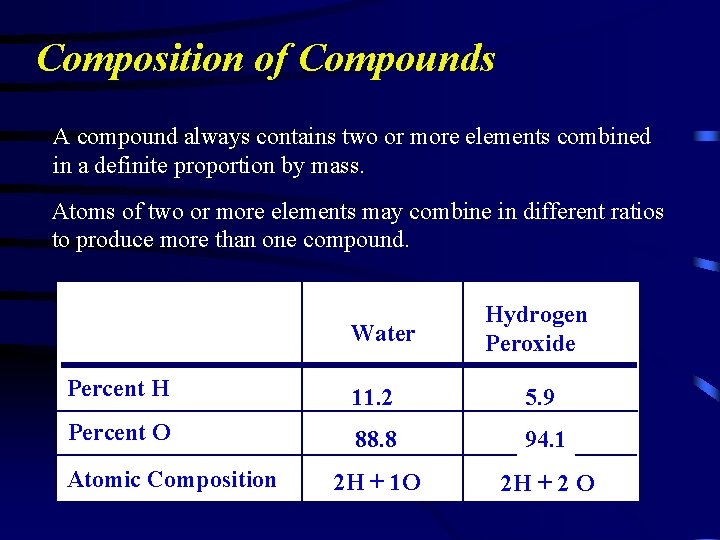
Composition of Compounds A compound always contains two or more elements combined in a definite proportion by mass. Atoms of two or more elements may combine in different ratios to produce more than one compound. Water Hydrogen Peroxide Percent H 11. 2 5. 9 Percent O 88. 8 94. 1 2 H + 1 O 2 H + 2 O Atomic Composition
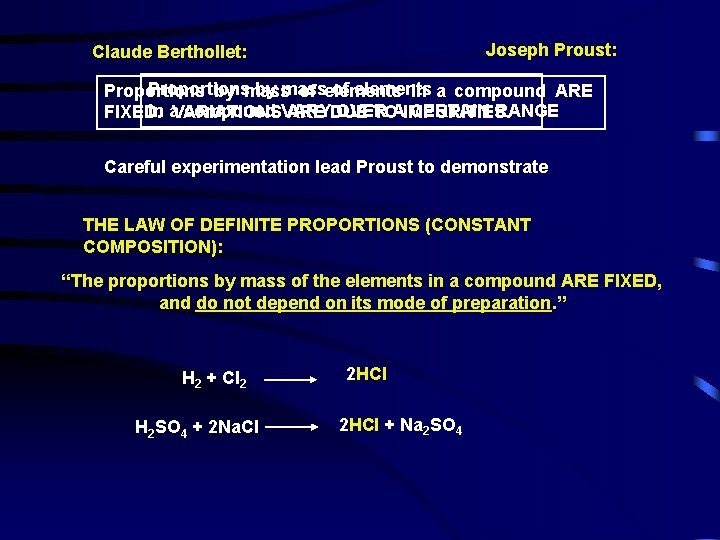
Joseph Proust: Claude Berthollet: Proportions by mass of elements in a compound ARE in a. VARIATIONS compound VARY OVER CERTAIN RANGE FIXED. ARE DUE TOAIMPURITIES. Careful experimentation lead Proust to demonstrate THE LAW OF DEFINITE PROPORTIONS (CONSTANT COMPOSITION): “The proportions by mass of the elements in a compound ARE FIXED, and do not depend on its mode of preparation. ” H 2 + Cl 2 H 2 SO 4 + 2 Na. Cl 2 HCl + Na 2 SO 4
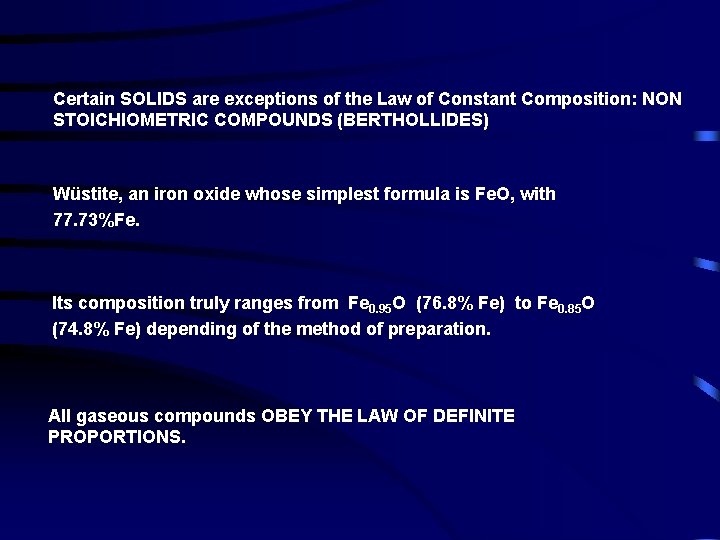
Certain SOLIDS are exceptions of the Law of Constant Composition: NON STOICHIOMETRIC COMPOUNDS (BERTHOLLIDES) Wüstite, an iron oxide whose simplest formula is Fe. O, with 77. 73%Fe. Its composition truly ranges from Fe 0. 95 O (76. 8% Fe) to Fe 0. 85 O (74. 8% Fe) depending of the method of preparation. All gaseous compounds OBEY THE LAW OF DEFINITE PROPORTIONS.
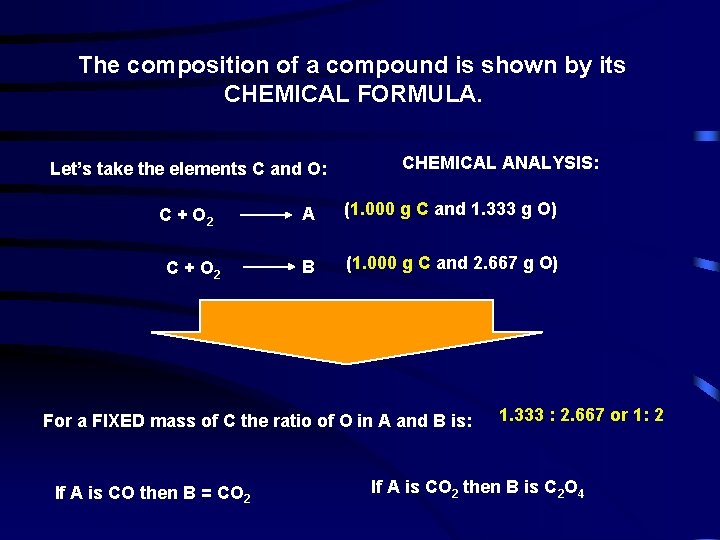
The composition of a compound is shown by its CHEMICAL FORMULA. Let’s take the elements C and O: C + O 2 CHEMICAL ANALYSIS: A (1. 000 g C and 1. 333 g O) B (1. 000 g C and 2. 667 g O) For a FIXED mass of C the ratio of O in A and B is: If A is CO then B = CO 2 1. 333 : 2. 667 or 1: 2 If A is CO 2 then B is C 2 O 4
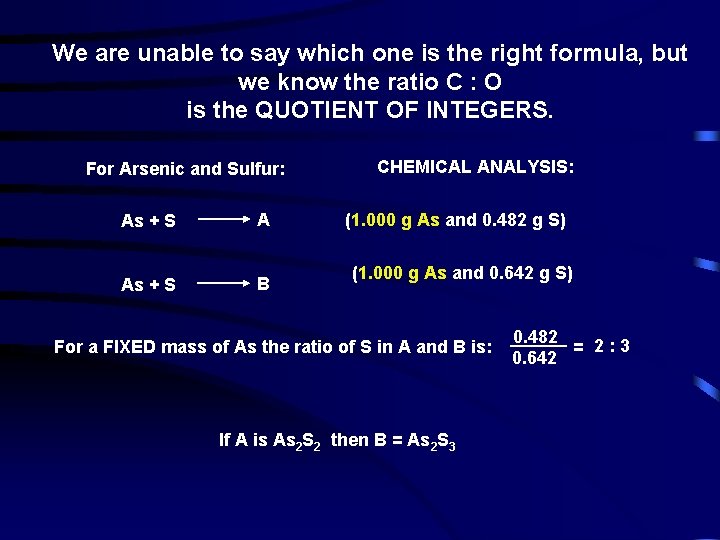
We are unable to say which one is the right formula, but we know the ratio C : O is the QUOTIENT OF INTEGERS. For Arsenic and Sulfur: As + S A As + S B CHEMICAL ANALYSIS: (1. 000 g As and 0. 482 g S) (1. 000 g As and 0. 642 g S) For a FIXED mass of As the ratio of S in A and B is: If A is As 2 S 2 then B = As 2 S 3 0. 482 = 2: 3 0. 642
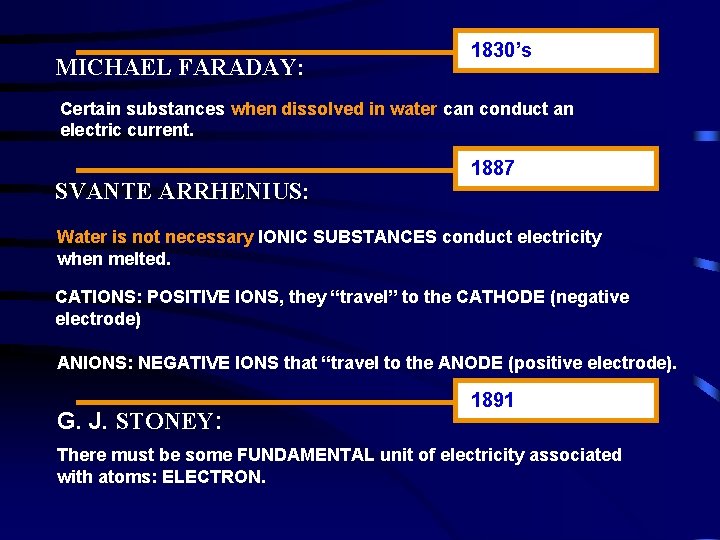
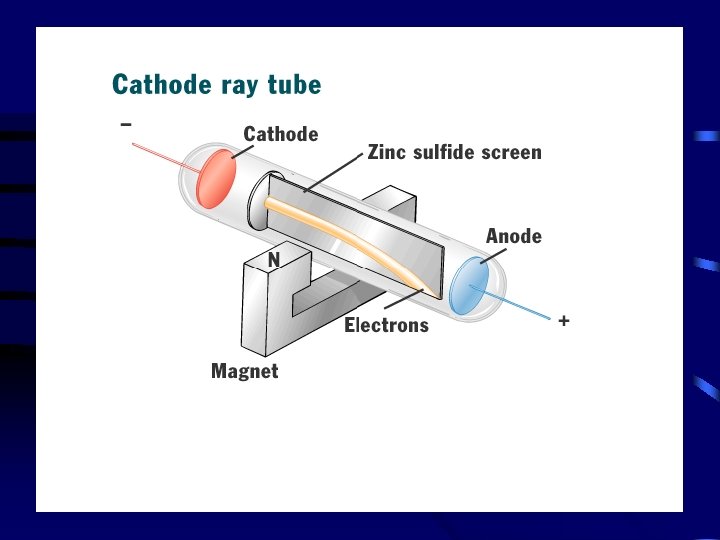
MICHAEL FARADAY: 1830’s Certain substances when dissolved in water can conduct an electric current. SVANTE ARRHENIUS: 1887 Water is not necessary IONIC SUBSTANCES conduct electricity when melted. CATIONS: POSITIVE IONS, they “travel” to the CATHODE (negative electrode) ANIONS: NEGATIVE IONS that “travel to the ANODE (positive electrode). G. J. STONEY: 1891 There must be some FUNDAMENTAL unit of electricity associated with atoms: ELECTRON.
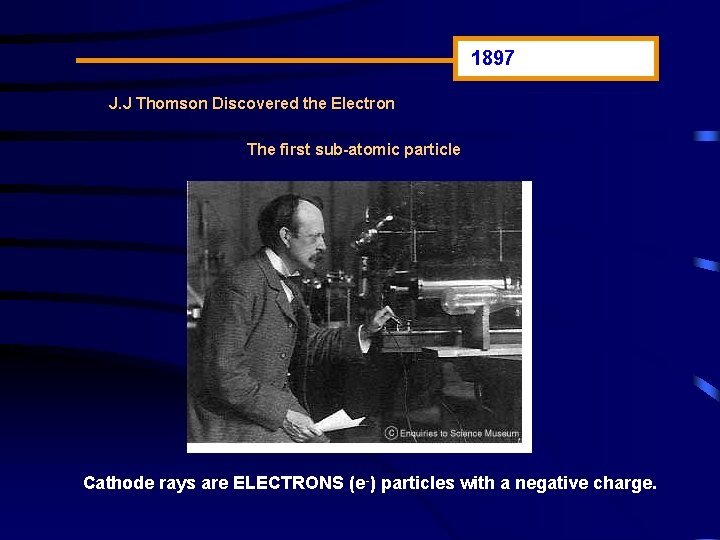
1897 J. J Thomson Discovered the Electron The first sub-atomic particle Cathode rays are ELECTRONS (e-) particles with a negative charge.
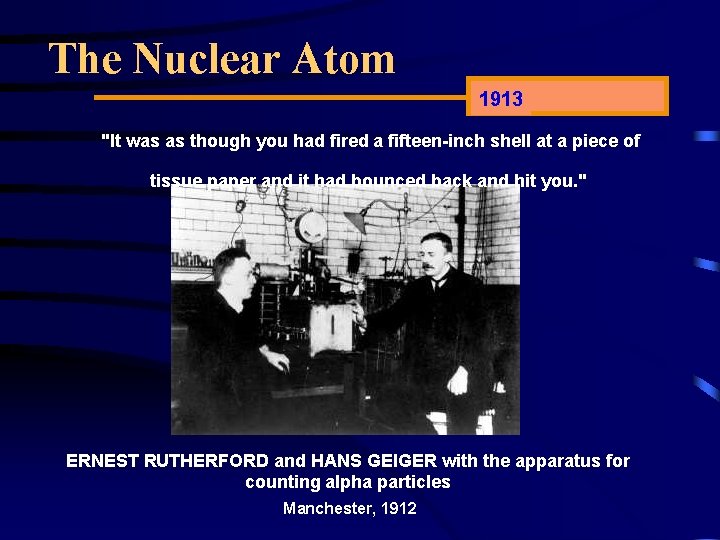
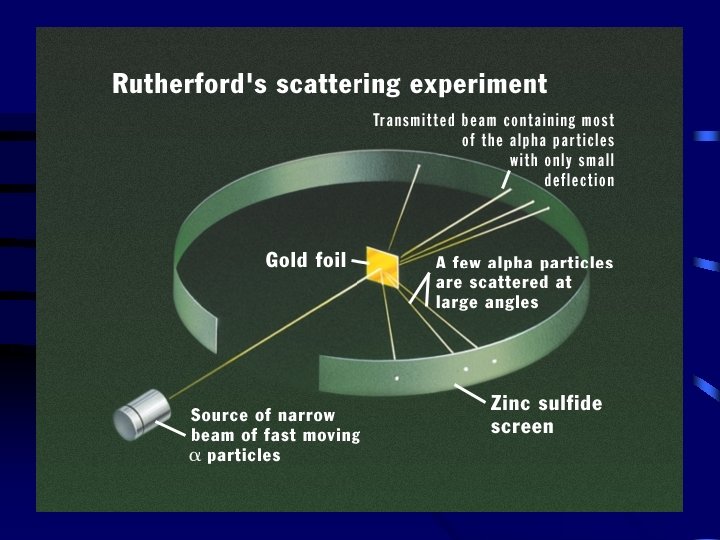
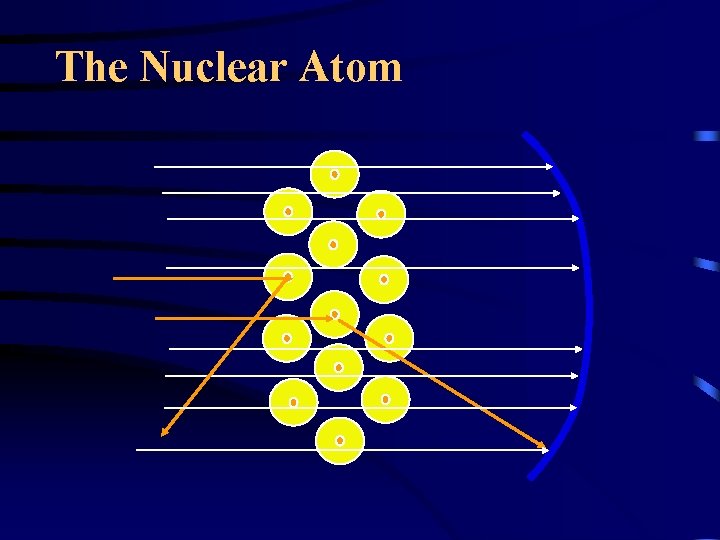
The Nuclear Atom 1913 "It was as though you had fired a fifteen-inch shell at a piece of tissue paper and it had bounced back and hit you. " ERNEST RUTHERFORD and HANS GEIGER with the apparatus for counting alpha particles Manchester, 1912
The Nuclear Atom
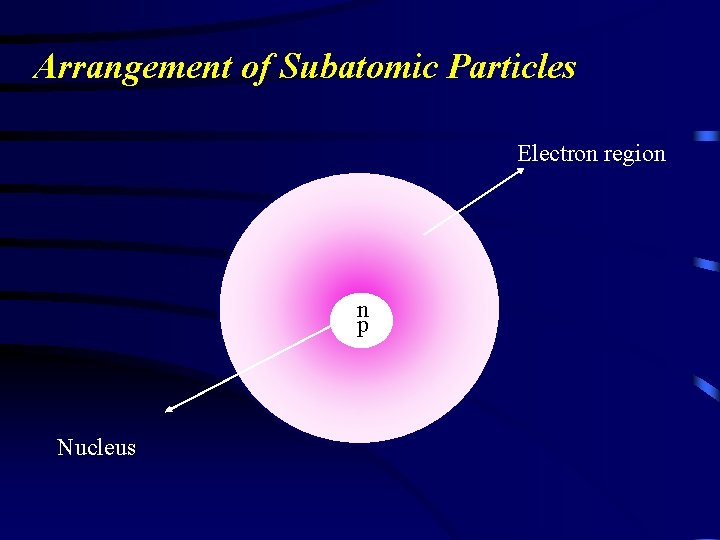
Arrangement of Subatomic Particles Electron region n p Nucleus
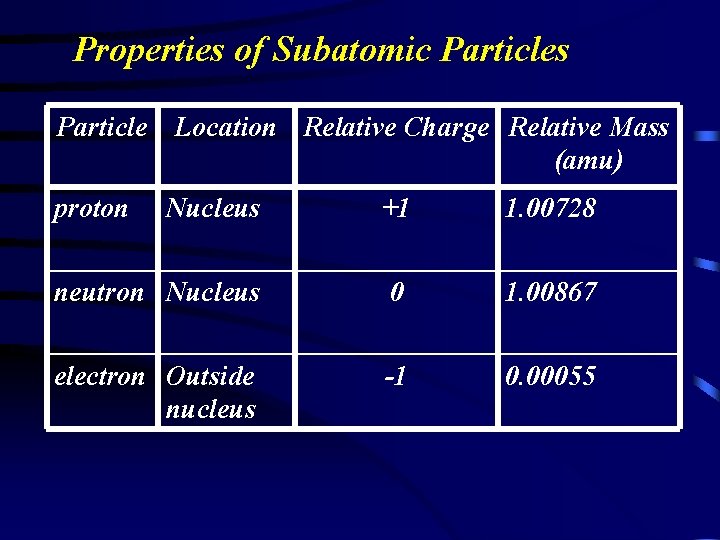
Properties of Subatomic Particles Particle Location Relative Charge Relative Mass (amu) proton Nucleus +1 1. 00728 neutron Nucleus 0 1. 00867 electron Outside nucleus -1 0. 00055
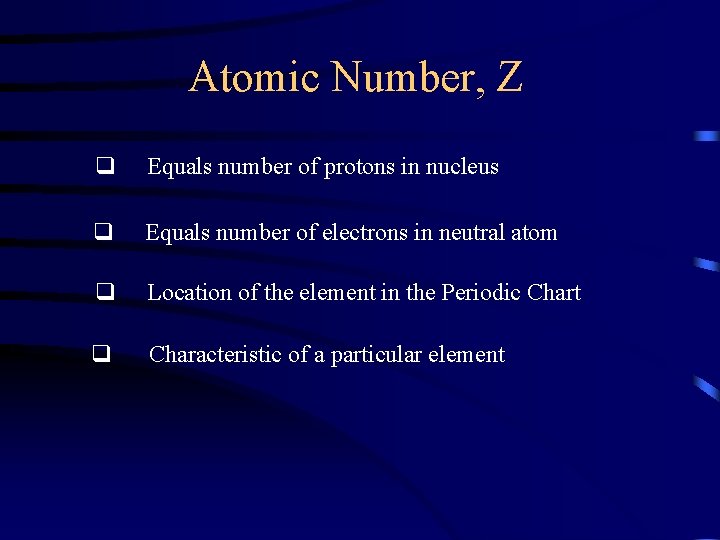
Atomic Number, Z q Equals number of protons in nucleus q Equals number of electrons in neutral atom q Location of the element in the Periodic Chart q Characteristic of a particular element
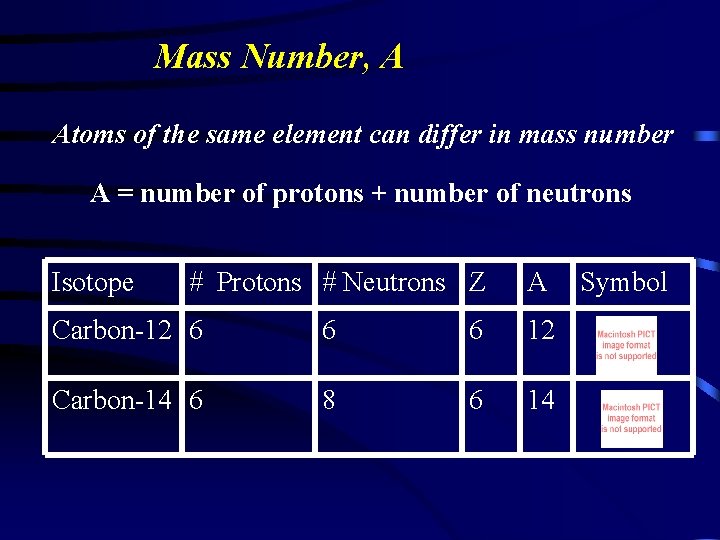
Mass Number, A Atoms of the same element can differ in mass number A = number of protons + number of neutrons Isotope # Protons # Neutrons Z A Carbon-12 6 6 6 12 Carbon-14 6 8 6 14 Symbol
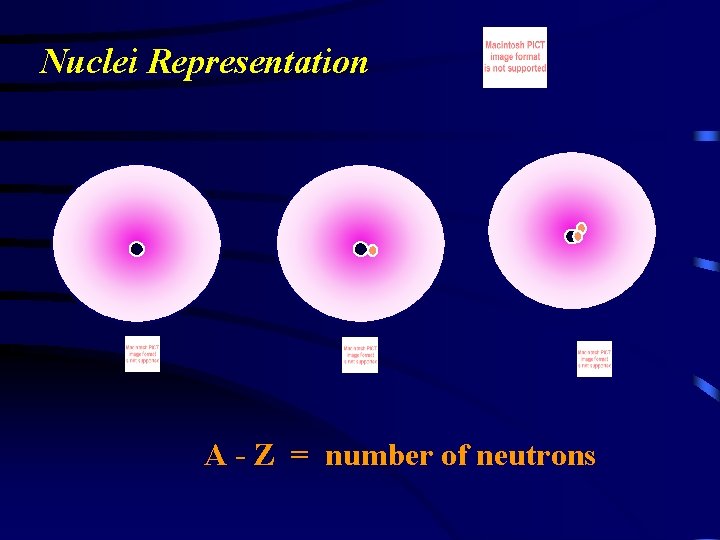
Nuclei Representation A - Z = number of neutrons
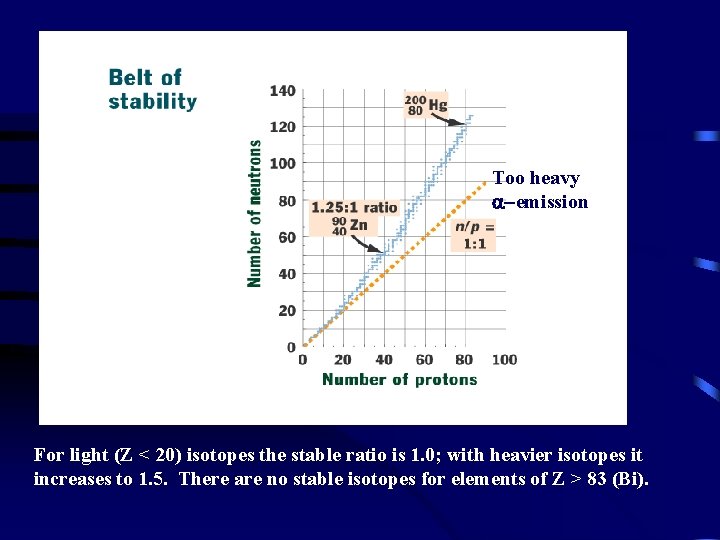
Too heavy a-emission For light (Z < 20) isotopes the stable ratio is 1. 0; with heavier isotopes it increases to 1. 5. There are no stable isotopes for elements of Z > 83 (Bi).
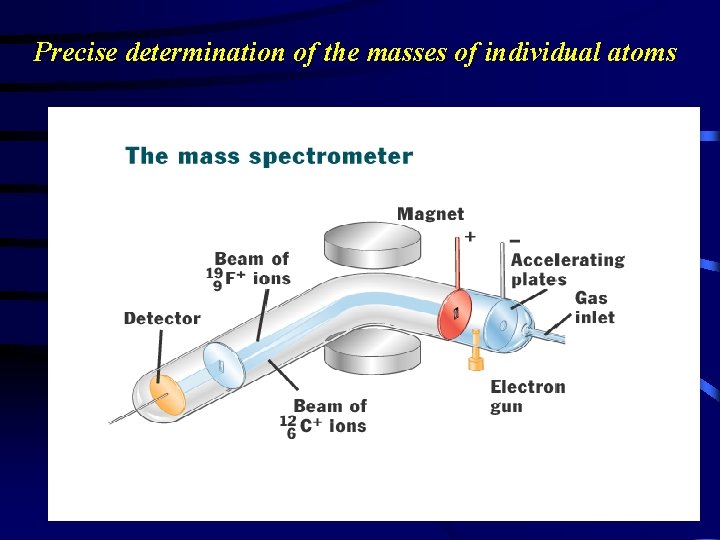
Precise determination of the masses of individual atoms
Meaning of Atomic Masses • Give relative masses of atoms based on C– 12 scale. • The Most common isotope of carbon is assigned an atomic mass of 12 amu. • The amu is defined as 1/12 of the mass of one neutral carbon atom
Meaning of Atomic Masses A nickel atom is 58. 69 / 40. 08 = 1. 464 times as heavy as a calcium ion It is 58. 69 / 10. 81 = 5. 29 times as heavy as a boron ion
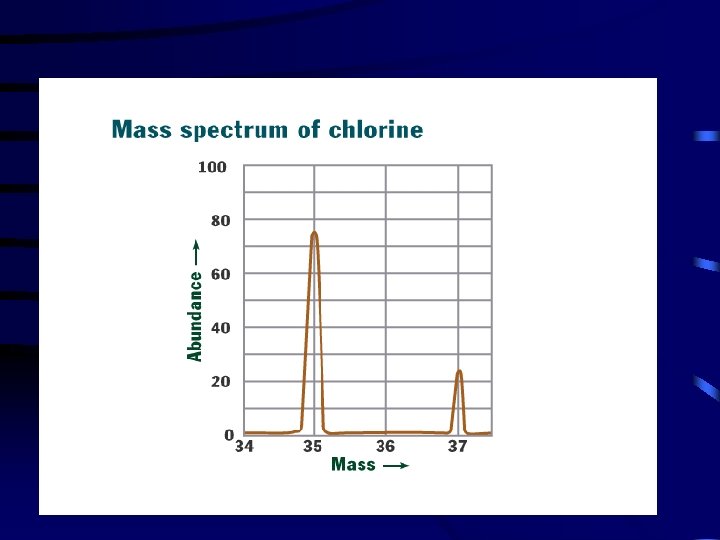
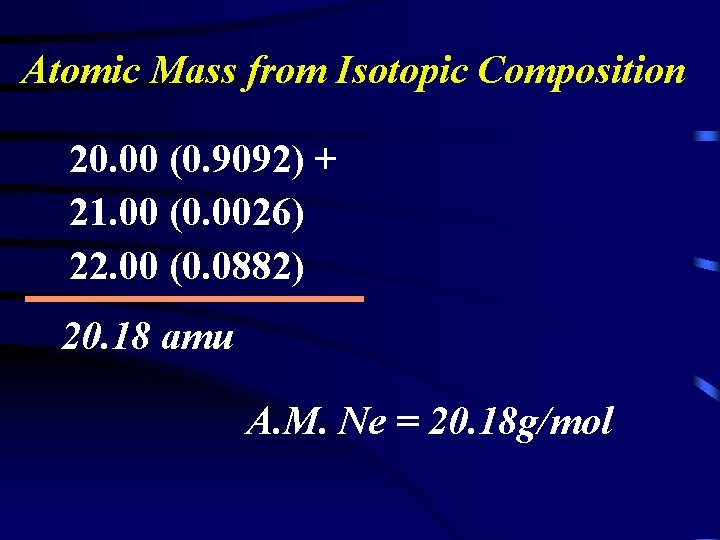
Atomic Mass from Isotopic Composition
Atomic Mass from Isotopic Composition 20. 00 (0. 9092) + 21. 00 (0. 0026) 22. 00 (0. 0882) 20. 18 amu A. M. Ne = 20. 18 g/mol
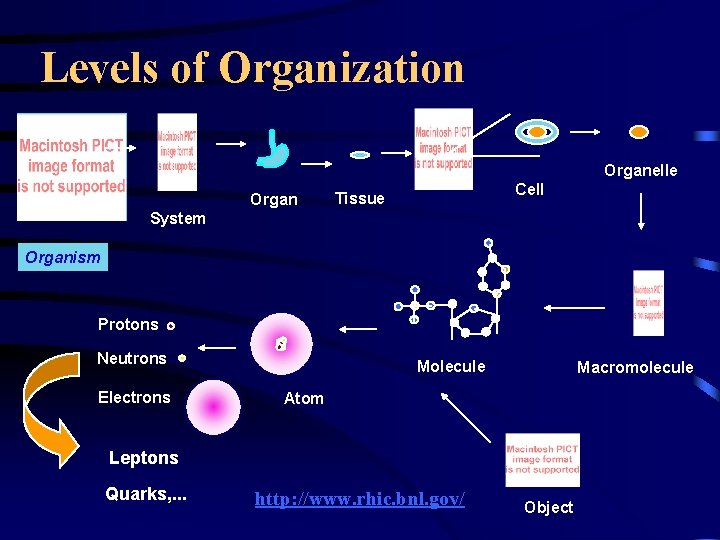
Levels of Organization Organelle Organ Cell Tissue System Organism Protons Neutrons Electrons Molecule Macromolecule Atom Leptons Quarks, . . . http: //www. rhic. bnl. gov/ Object
Molecules Composition Types of Formulas
Composition Held together by covalent bonds Usually made up of nonmetal atoms
Types of Formulas Empirical CH 3 Molecular C 2 H 6 Structural
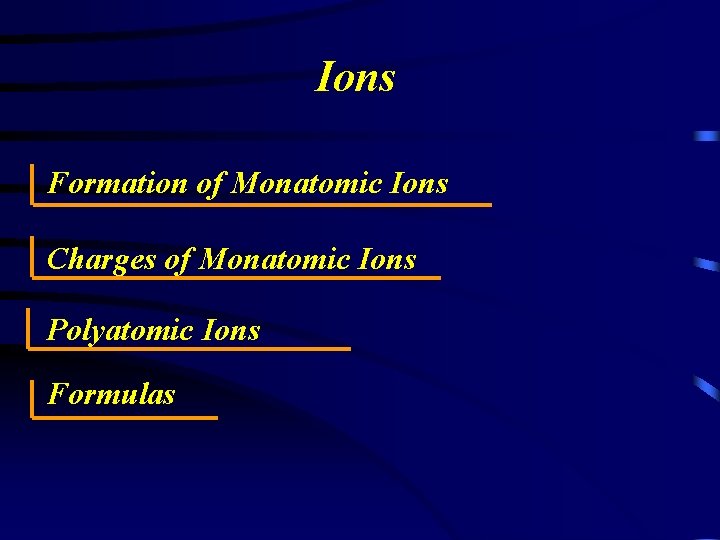
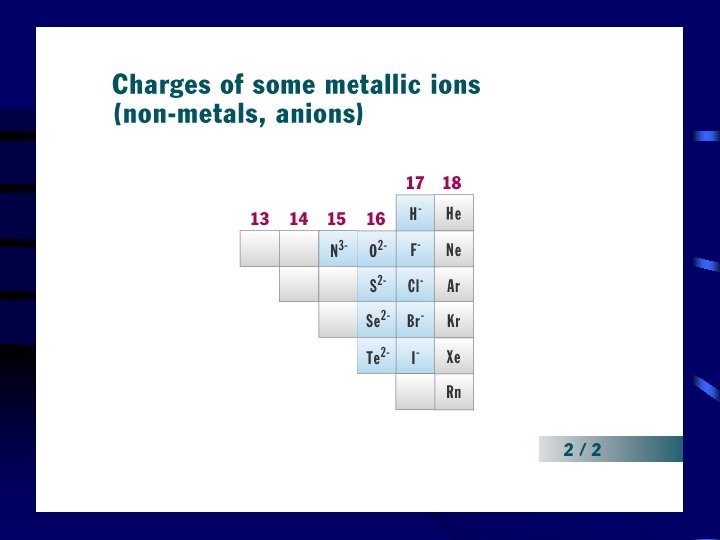
Ions Formation of Monatomic Ions Charges of Monatomic Ions Polyatomic Ions Formulas
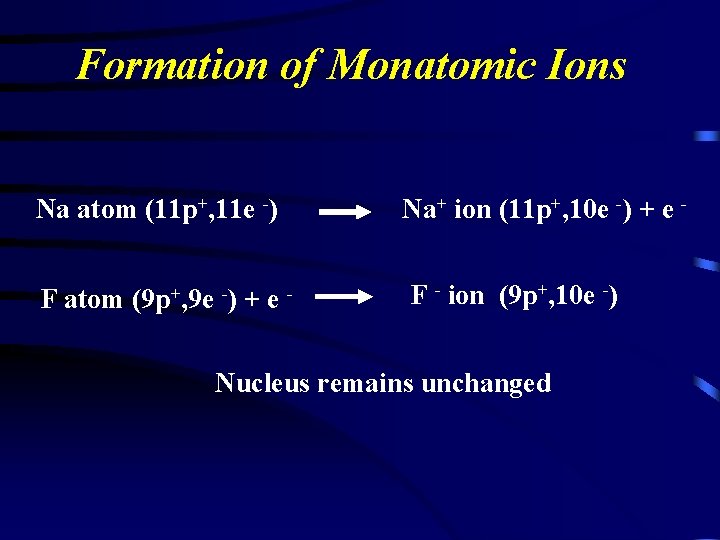
Formation of Monatomic Ions Na atom (11 p+, 11 e -) Na+ ion (11 p+, 10 e -) + e - F atom (9 p+, 9 e -) + e - F - ion (9 p+, 10 e -) Nucleus remains unchanged
Polyatomic Ions Names and formulas General structure
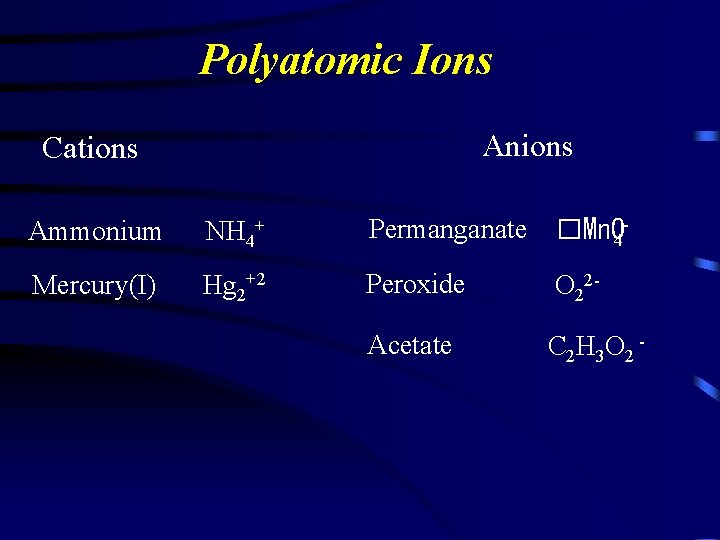
Polyatomic Ions Anions Cations Ammonium NH 4+ Permanganate �Mn. O 4 - Mercury(I) Hg 2+2 Peroxide O 22 - Acetate C 2 H 3 O 2 -
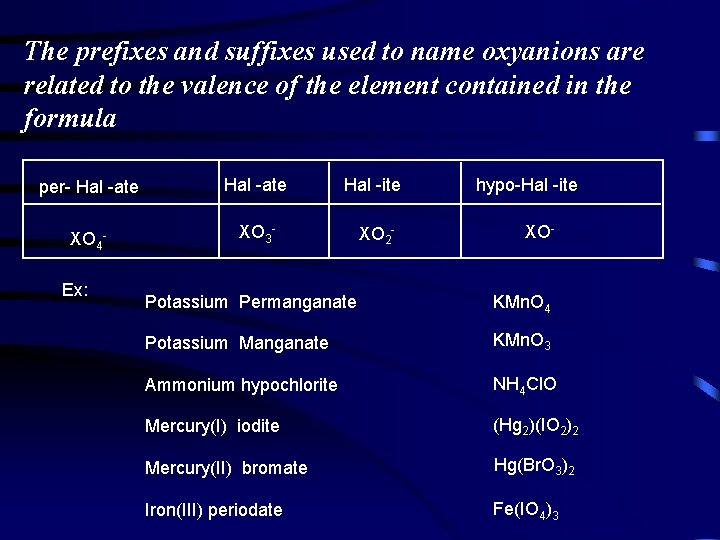
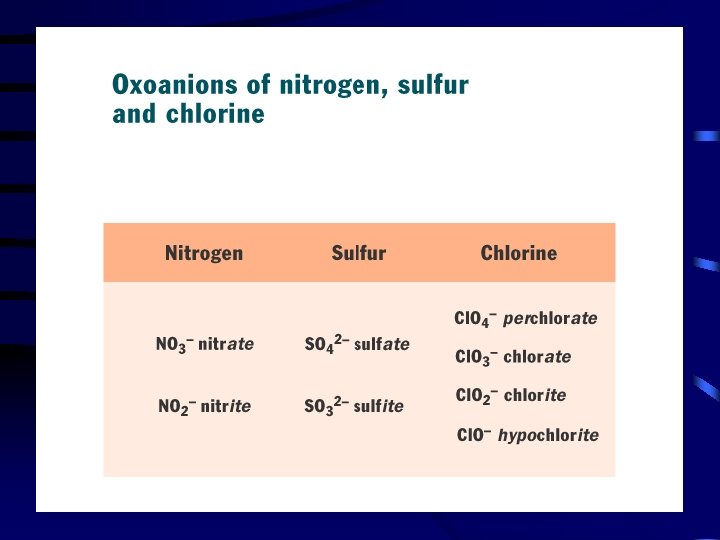
The prefixes and suffixes used to name oxyanions are related to the valence of the element contained in the formula per- Hal -ate Hal -ite XO 4 - XO 3 - XO 2 - Ex: hypo-Hal -ite XO- Potassium Permanganate KMn. O 4 Potassium Manganate KMn. O 3 Ammonium hypochlorite NH 4 Cl. O Mercury(I) iodite (Hg 2)(IO 2)2 Mercury(II) bromate Hg(Br. O 3)2 Iron(III) periodate Fe(IO 4)3
Writing Ionic Compound Formulas Apply principle of electrical neutrality
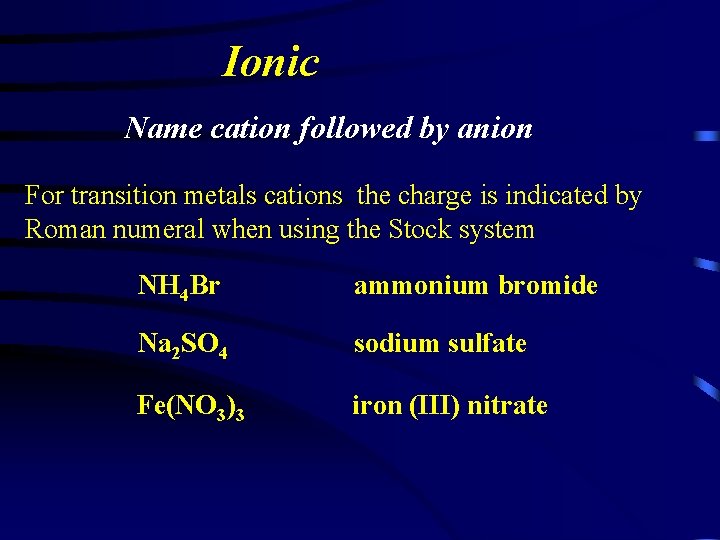
Ionic Name cation followed by anion For transition metals cations the charge is indicated by Roman numeral when using the Stock system NH 4 Br ammonium bromide Na 2 SO 4 sodium sulfate Fe(NO 3)3 iron (III) nitrate
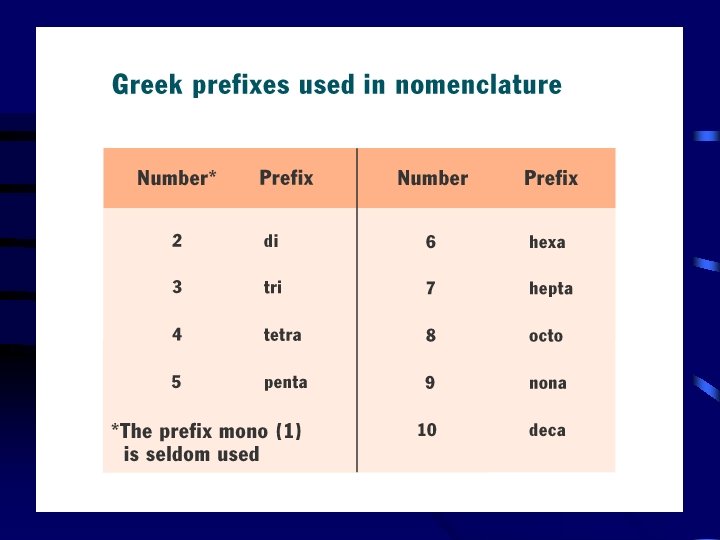
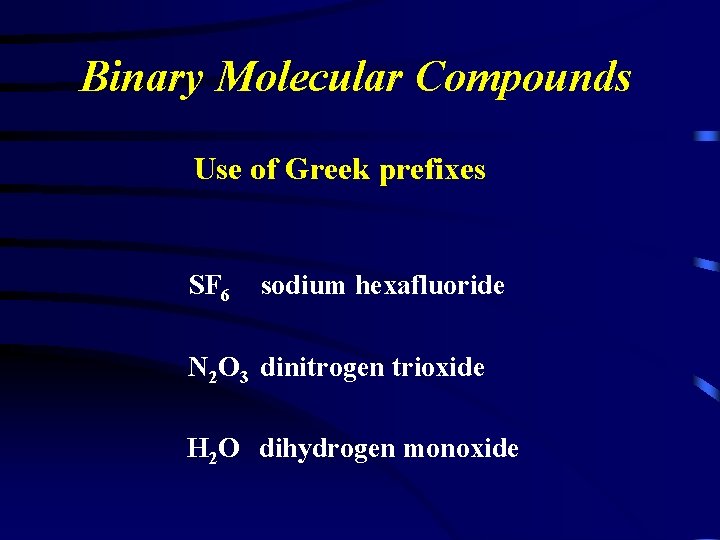
Binary Molecular Compounds Use of Greek prefixes SF 6 sodium hexafluoride N 2 O 3 dinitrogen trioxide H 2 O dihydrogen monoxide
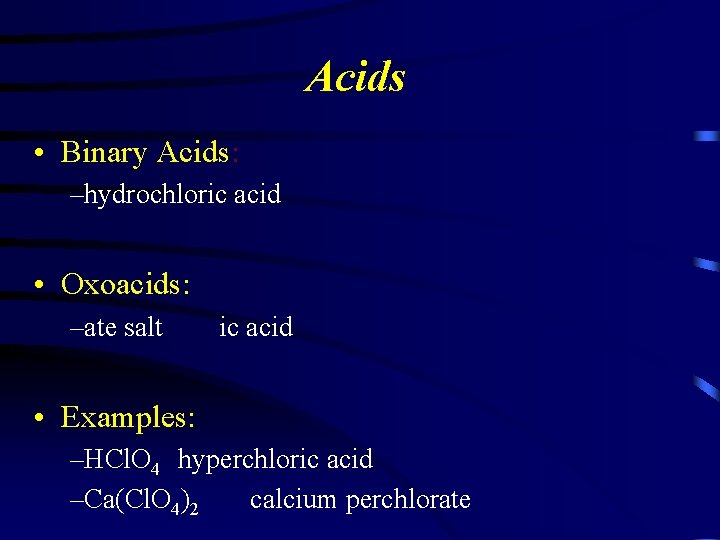
Acids • Binary Acids: –hydrochloric acid • Oxoacids: –ate salt ic acid • Examples: –HCl. O 4 hyperchloric acid –Ca(Cl. O 4)2 calcium perchlorate
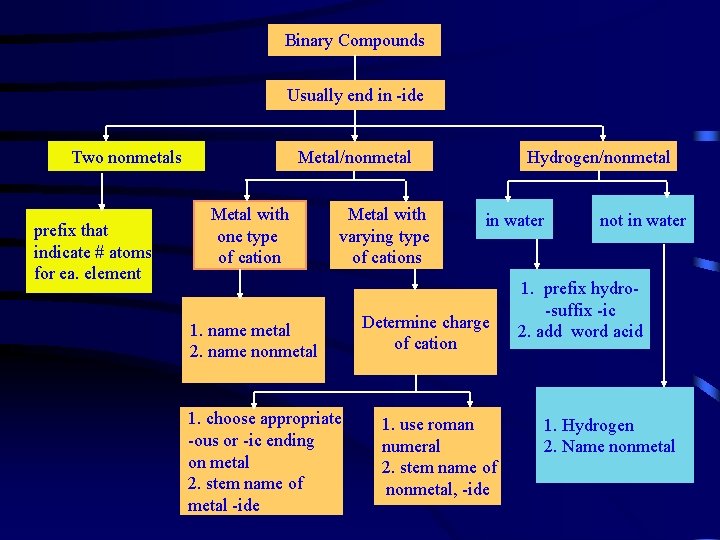
Binary Compounds Usually end in -ide Two nonmetals prefix that indicate # atoms for ea. element Metal/nonmetal Metal with one type of cation Metal with varying type of cations 1. name metal 2. name nonmetal 1. choose appropriate -ous or -ic ending on metal 2. stem name of metal -ide Hydrogen/nonmetal in water Determine charge of cation 1. use roman numeral 2. stem name of nonmetal, -ide not in water 1. prefix hydro-suffix -ic 2. add word acid 1. Hydrogen 2. Name nonmetal