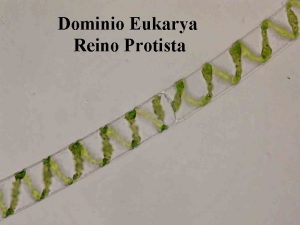
Introduction Protists Domain Eukarya is the third domain

- Slides: 82
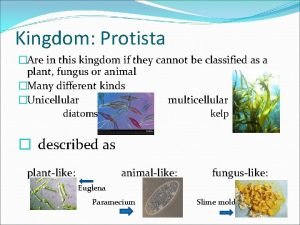
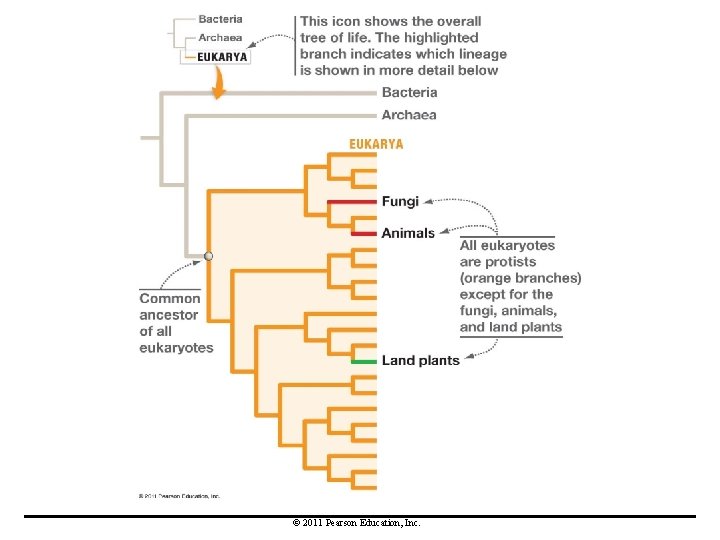
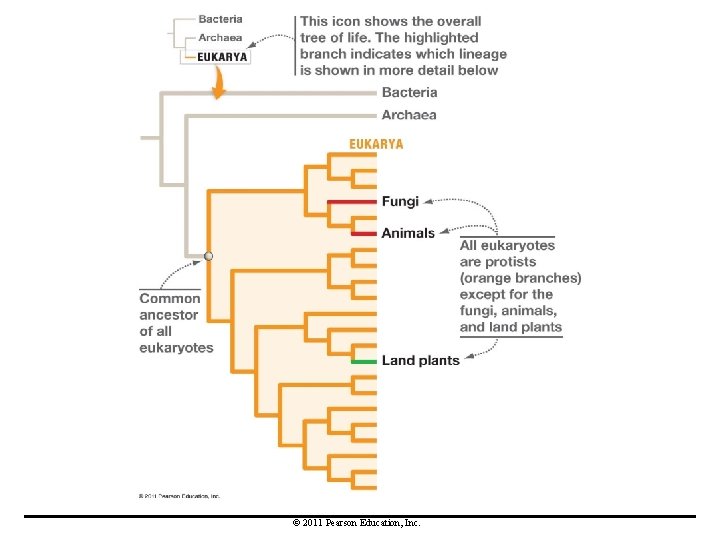
Introduction: Protists! • Domain Eukarya is the third domain on the tree of life, with Bacteria and Archaea. Eukaryotes range from single-celled organisms the size of bacteria to sequoia trees and blue whales. • Protists are a diverse group of organisms that includes all eukaryotes except the land plants, fungi, and animals. © 2011 Pearson Education, Inc.
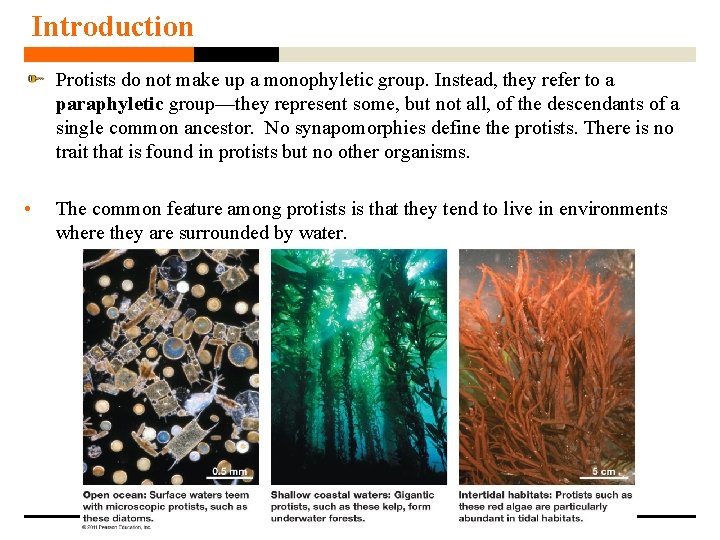
Introduction Protists do not make up a monophyletic group. Instead, they refer to a paraphyletic group—they represent some, but not all, of the descendants of a single common ancestor. No synapomorphies define the protists. There is no trait that is found in protists but no other organisms. • The common feature among protists is that they tend to live in environments where they are surrounded by water. © 2011 Pearson Education, Inc.
© 2011 Pearson Education, Inc.
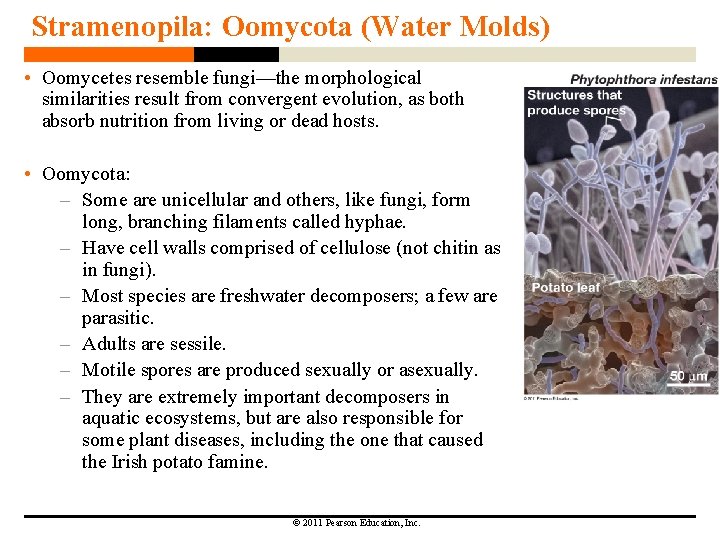
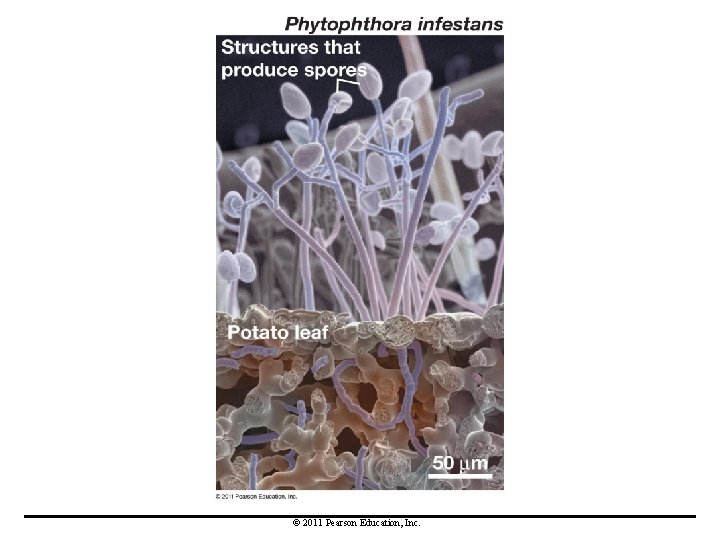
Impacts on Human Health and Welfare • Several types of protists can cause human disease, and some also cause disease in our crops. – For example, the most spectacular crop failure in history, the Irish potato famine of 1845, was caused by the protist Phytophthora infestans. © 2011 Pearson Education, Inc.
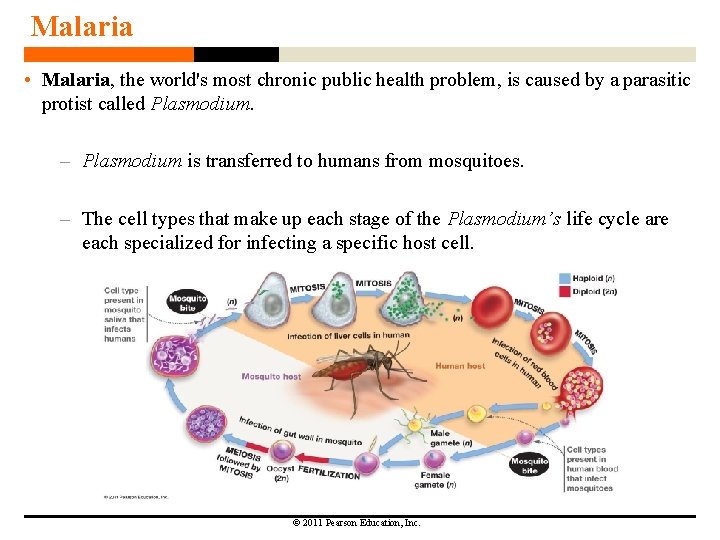
Malaria • Malaria, the world's most chronic public health problem, is caused by a parasitic protist called Plasmodium. – Plasmodium is transferred to humans from mosquitoes. – The cell types that make up each stage of the Plasmodium’s life cycle are each specialized for infecting a specific host cell. © 2011 Pearson Education, Inc.
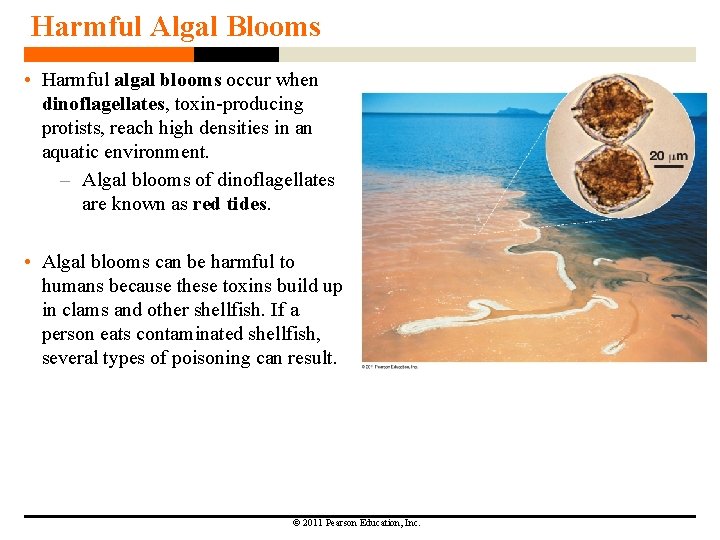
Harmful Algal Blooms • Harmful algal blooms occur when dinoflagellates, toxin-producing protists, reach high densities in an aquatic environment. – Algal blooms of dinoflagellates are known as red tides. • Algal blooms can be harmful to humans because these toxins build up in clams and other shellfish. If a person eats contaminated shellfish, several types of poisoning can result. © 2011 Pearson Education, Inc.
Ecological Importance of Protists • Protists represent just 10 percent of the named eukaryotic species and have relatively low species diversity, but they are extraordinarily abundant. © 2011 Pearson Education, Inc.
Protists Play a Key Role in Aquatic Food Chains • Species that produce chemical energy by photosynthesis are called primary producers. • Production of organic molecules by protists living in the world’s oceans represents almost half of the total carbon dioxide that is fixed on Earth. • Diatoms and other small organisms that live near the surface of oceans or lakes and that drift along or swim only short distances are called plankton. • The organic compounds produced by phytoplankton (photosynthetic plankton) are the basis of food chains in freshwater and marine environments. © 2011 Pearson Education, Inc.
Protists Play a Key Role in Aquatic Food Chains • A food chain describes nutritional relationships among organisms. – Many of the species at the base of food chains in aquatic environments are protists. Without protists, most food chains in freshwater and marine habitats would collapse. © 2011 Pearson Education, Inc.
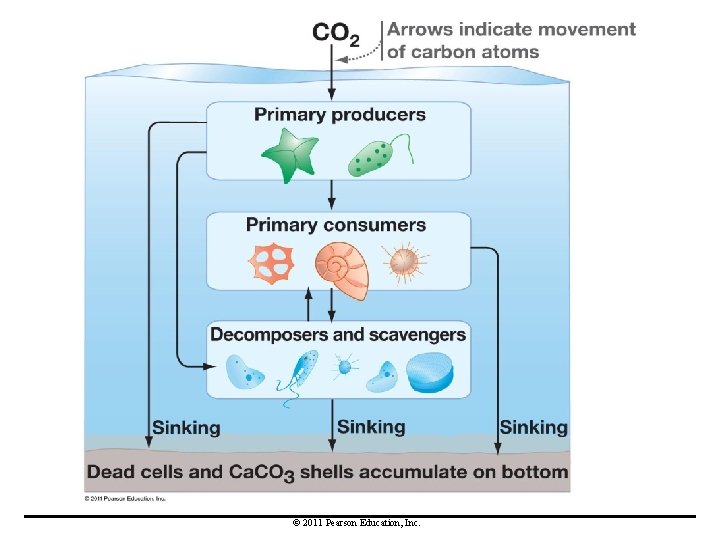
Could Protists Help Reduce Global Warming? • The movement of carbon atoms from carbon dioxide molecules in the atmosphere to organisms in the soil or the ocean and then back to the atmosphere is called the global carbon cycle. • Protists play a key role in the global carbon cycle and act as carbon sinks that could help reduce global warming. • A carbon sink is a long-lived carbon reservoir. Carbon sinks produced by protists can be either: – Sedimentary rocks. – Petroleum. © 2011 Pearson Education, Inc.
© 2011 Pearson Education, Inc.
© 2011 Pearson Education, Inc.
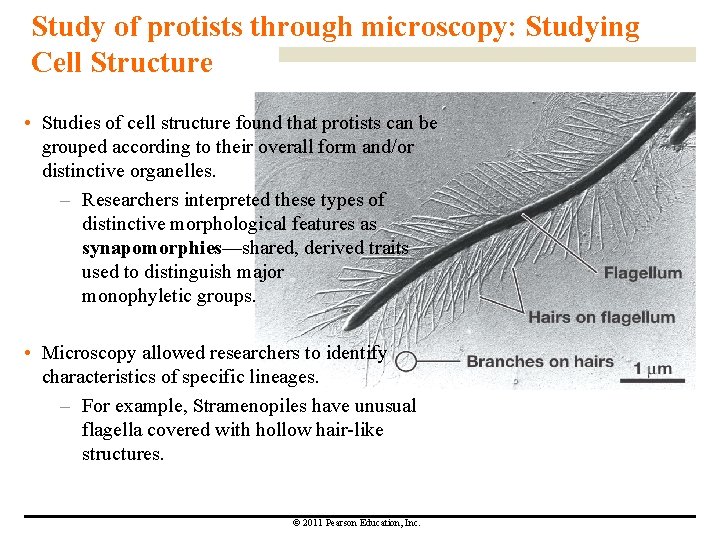
Study of protists through microscopy: Studying Cell Structure • Studies of cell structure found that protists can be grouped according to their overall form and/or distinctive organelles. – Researchers interpreted these types of distinctive morphological features as synapomorphies—shared, derived traits used to distinguish major monophyletic groups. • Microscopy allowed researchers to identify characteristics of specific lineages. – For example, Stramenopiles have unusual flagella covered with hollow hair-like structures. © 2011 Pearson Education, Inc.
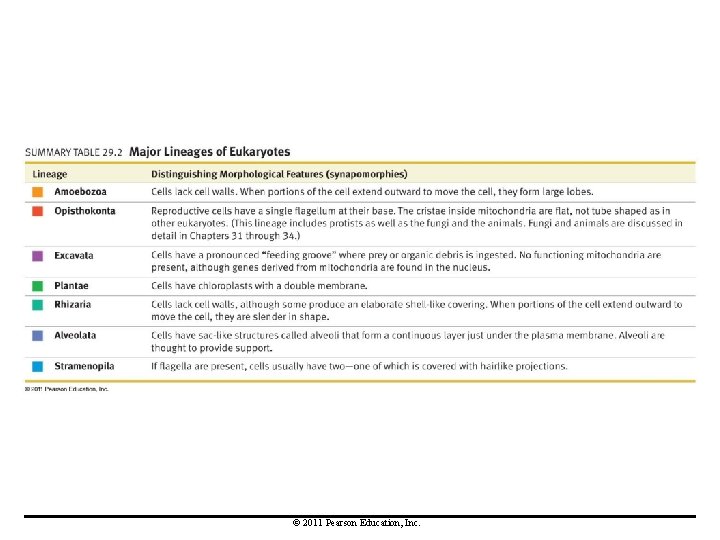
Microscopy: Studying Cell Structure • Seven major groups of eukaryotes came to be identified on the basis of diagnostic morphological characteristics. – Of these, the group Plantae includes the green plants, and the group Opisthokonta includes the fungi and animals. © 2011 Pearson Education, Inc.
© 2011 Pearson Education, Inc.
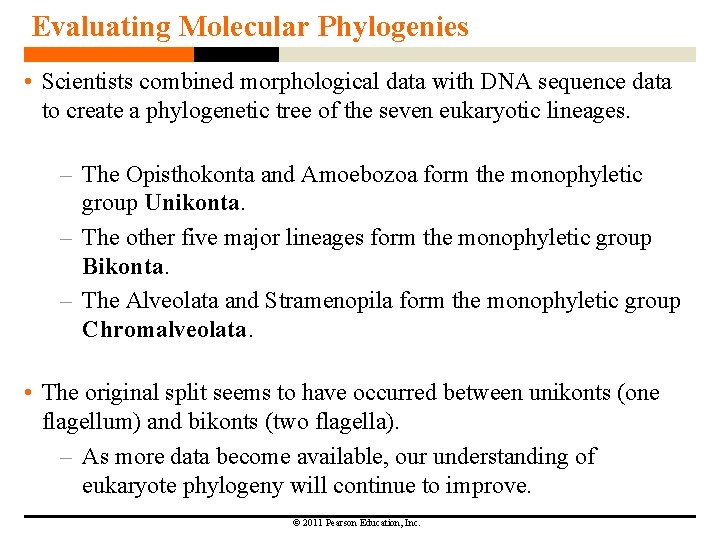
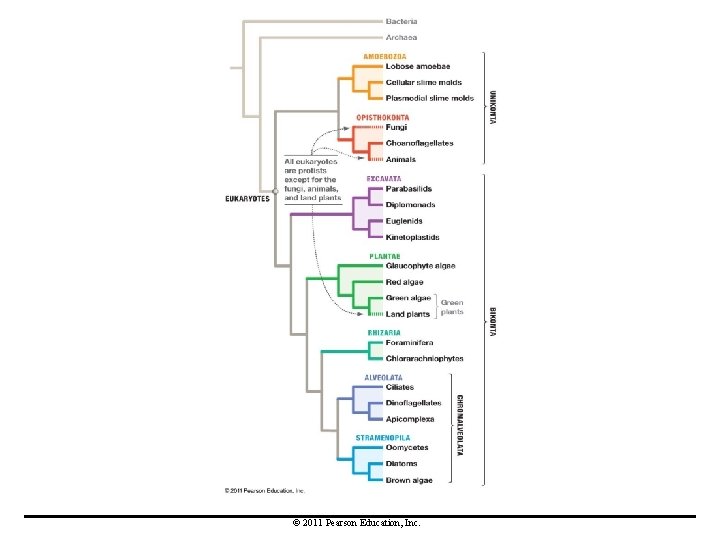
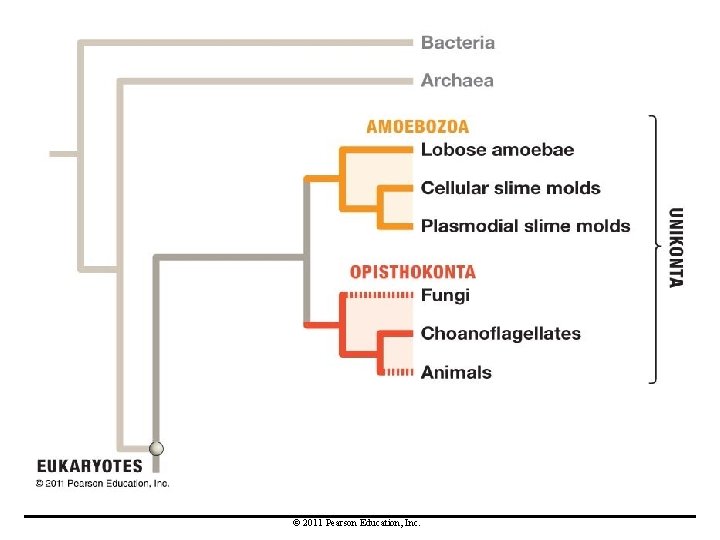
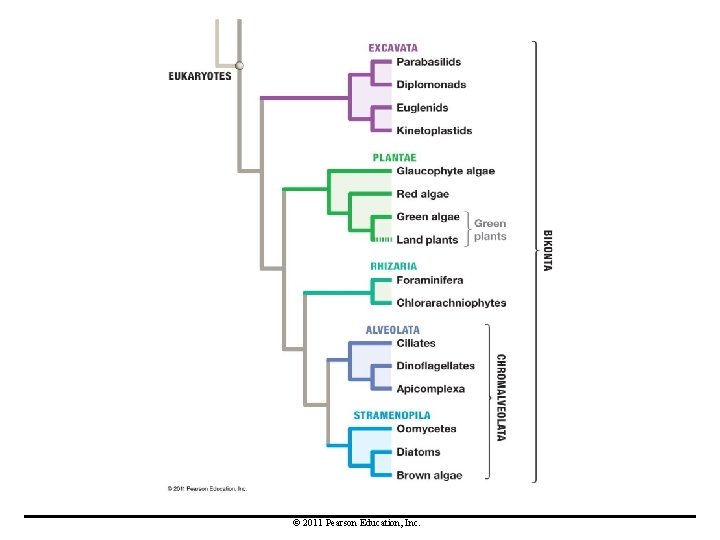
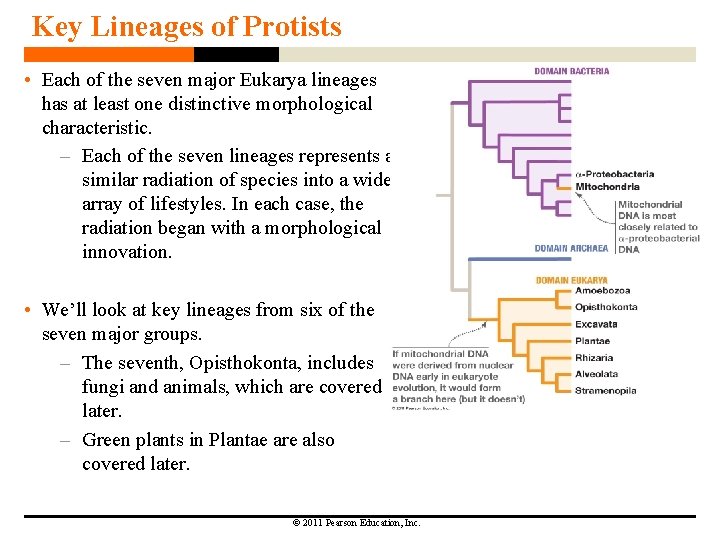
Evaluating Molecular Phylogenies • Scientists combined morphological data with DNA sequence data to create a phylogenetic tree of the seven eukaryotic lineages. – The Opisthokonta and Amoebozoa form the monophyletic group Unikonta. – The other five major lineages form the monophyletic group Bikonta. – The Alveolata and Stramenopila form the monophyletic group Chromalveolata. • The original split seems to have occurred between unikonts (one flagellum) and bikonts (two flagella). – As more data become available, our understanding of eukaryote phylogeny will continue to improve. © 2011 Pearson Education, Inc.
© 2011 Pearson Education, Inc.
© 2011 Pearson Education, Inc.
© 2011 Pearson Education, Inc.
Themes in the Diversification of Protists • Because protists are a paraphyletic group, they do not share derived characteristics that set them apart from all other lineages on the tree of life. • But there have been novel morphological traits that occurred as they evolved. • These innovations triggered the evolution of species that live in a wide array of habitats and make a living in diverse ways. © 2011 Pearson Education, Inc.
What Morphological Innovations Evolved in Protists? • The earliest eukaryotes were probably single-celled organisms with – a nucleus and endomembrane system, – mitochondria, – a cytoskeleton, – but no cell wall. • These cells probably swam using a novel type of flagellum. © 2011 Pearson Education, Inc.
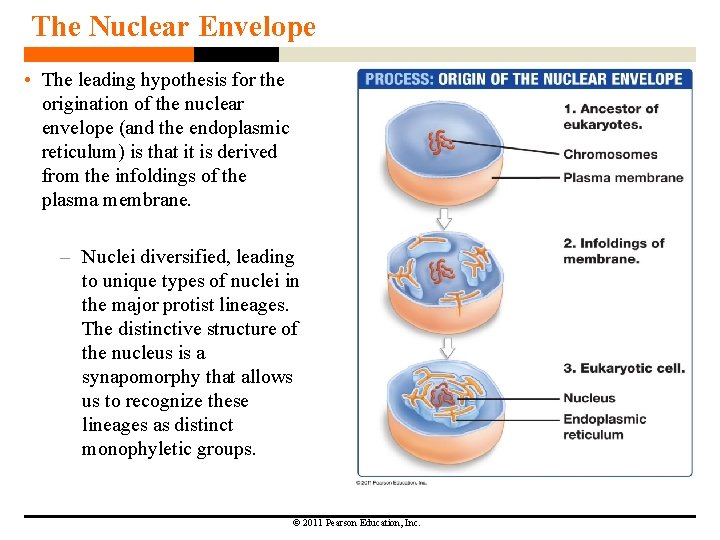
The Nuclear Envelope • The leading hypothesis for the origination of the nuclear envelope (and the endoplasmic reticulum) is that it is derived from the infoldings of the plasma membrane. – Nuclei diversified, leading to unique types of nuclei in the major protist lineages. The distinctive structure of the nucleus is a synapomorphy that allows us to recognize these lineages as distinct monophyletic groups. © 2011 Pearson Education, Inc.
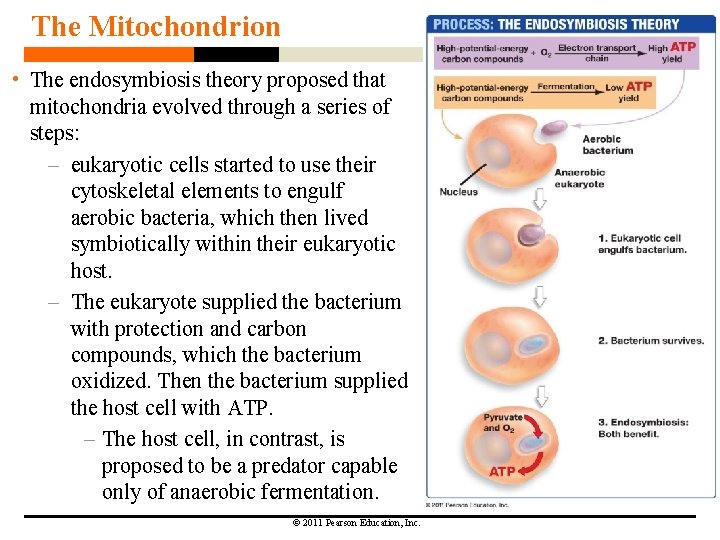
Endosymbiosis and the Origin of the Mitochondrion • Mitochondria are organelles that generate ATP. • The endosymbiosis theory proposes that mitochondria originated when a bacterial cell took up residence inside a eukaryote about 2 billion years ago. • Symbiosis occurs when individuals of two different species live in physical contact. • Endosymbiosis occurs when an organism of one species lives inside an organism of another species – e. g. , lactobacilli in humans © 2011 Pearson Education, Inc.
The Mitochondrion • The endosymbiosis theory proposed that mitochondria evolved through a series of steps: – eukaryotic cells started to use their cytoskeletal elements to engulf aerobic bacteria, which then lived symbiotically within their eukaryotic host. – The eukaryote supplied the bacterium with protection and carbon compounds, which the bacterium oxidized. Then the bacterium supplied the host cell with ATP. – The host cell, in contrast, is proposed to be a predator capable only of anaerobic fermentation. © 2011 Pearson Education, Inc.
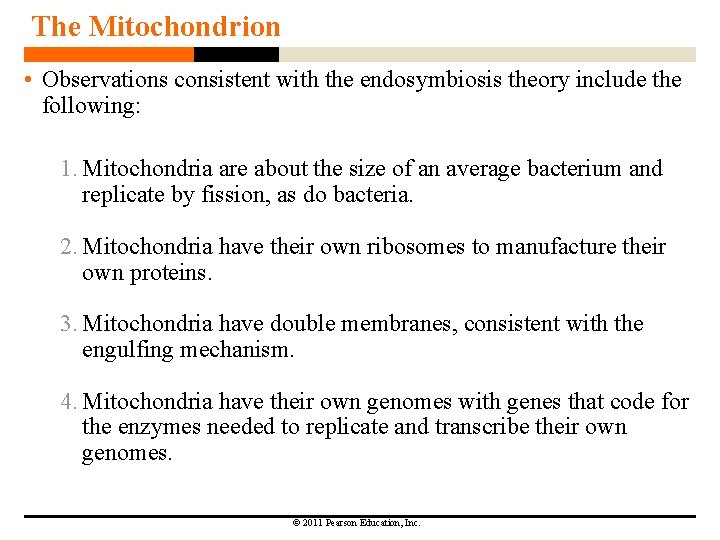
The Mitochondrion • Observations consistent with the endosymbiosis theory include the following: 1. Mitochondria are about the size of an average bacterium and replicate by fission, as do bacteria. 2. Mitochondria have their own ribosomes to manufacture their own proteins. 3. Mitochondria have double membranes, consistent with the engulfing mechanism. 4. Mitochondria have their own genomes with genes that code for the enzymes needed to replicate and transcribe their own genomes. © 2011 Pearson Education, Inc.
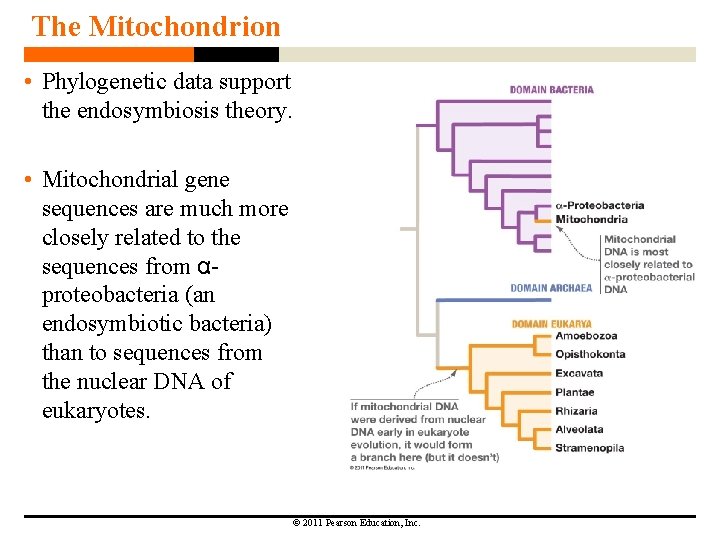
The Mitochondrion • Phylogenetic data support the endosymbiosis theory. • Mitochondrial gene sequences are much more closely related to the sequences from αproteobacteria (an endosymbiotic bacteria) than to sequences from the nuclear DNA of eukaryotes. © 2011 Pearson Education, Inc.
Protist Structures for Support and Protection • The basic structure of the cytoskeleton does not vary much among protists. • What does vary: the presence and nature of other structures that provide support and protection for the cell: – Some protists have cell walls / hard external structures called a shell / rigid structures inside the plasma membrane. • In many cases, the diversification of protists has been associated with the evolution of innovative structures for support and protection. © 2011 Pearson Education, Inc.
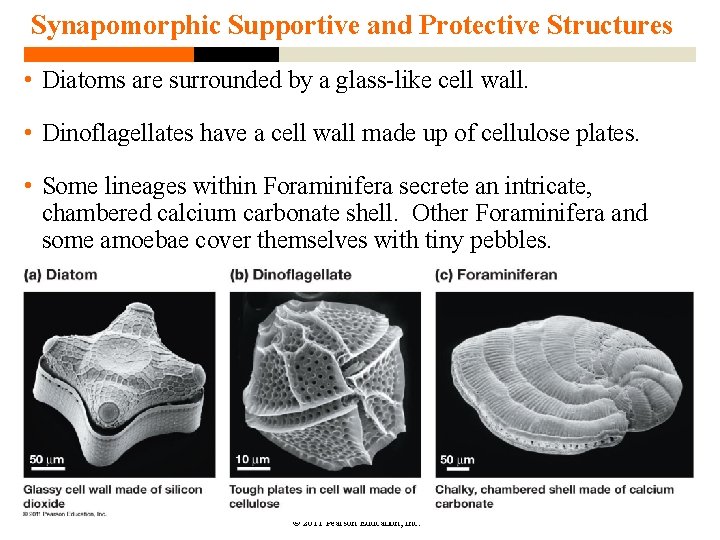
Synapomorphic Supportive and Protective Structures • Diatoms are surrounded by a glass-like cell wall. • Dinoflagellates have a cell wall made up of cellulose plates. • Some lineages within Foraminifera secrete an intricate, chambered calcium carbonate shell. Other Foraminifera and some amoebae cover themselves with tiny pebbles. © 2011 Pearson Education, Inc.
Synapomorphic Supportive and Protective Structures • The parabasalids have a unique internal support rod. • The euglenids have a collection of protein strips located just under the plasma membrane. • The alveolates have distinctive sac-like structures called alveoli that help stiffen the cell. © 2011 Pearson Education, Inc.
Multicellularity: key morphological innovation • Multicellularity arose independently in a wide array of eukaryotic lineages: the green plants, fungi, animals, brown algae, slime molds, and red algae. © 2011 Pearson Education, Inc.
How Do Protists Find Food? • One of the most important stories in the diversification of protists was the evolution of novel methods for finding food. – Many protists ingest their food—they eat bacteria, archaea, or even other protists whole. When ingestive feeding occurs, an individual takes in packets of food much larger than individual molecules. Thus, protists feed by: 1. Ingesting packets of food. 2. Absorbing organic molecules directly from the environment. 3. Performing photosynthesis. © 2011 Pearson Education, Inc.
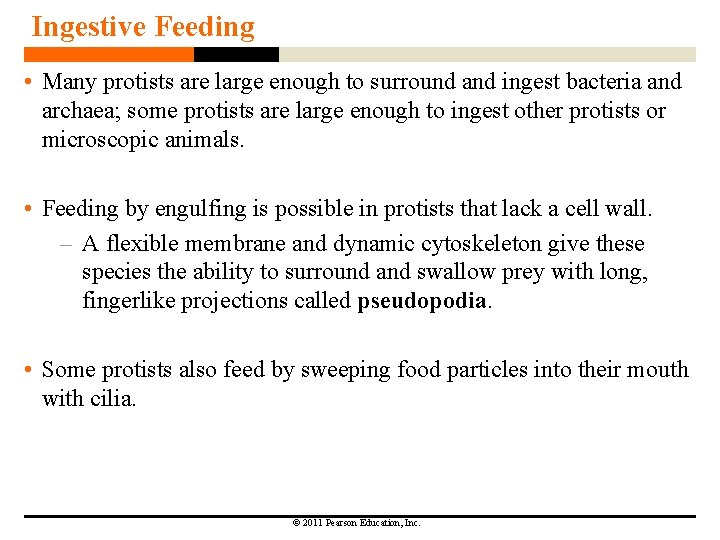
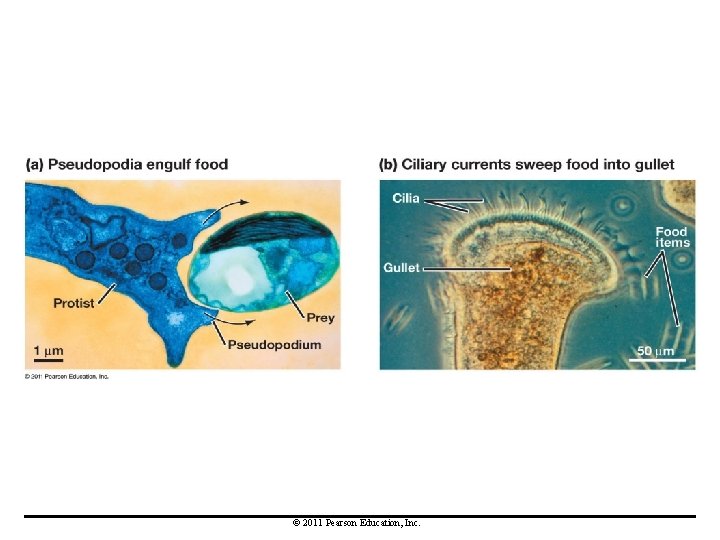
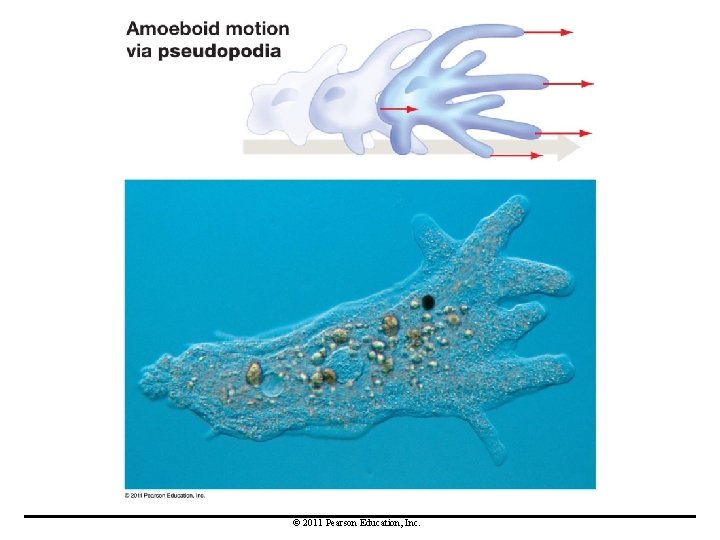
Ingestive Feeding • Many protists are large enough to surround and ingest bacteria and archaea; some protists are large enough to ingest other protists or microscopic animals. • Feeding by engulfing is possible in protists that lack a cell wall. – A flexible membrane and dynamic cytoskeleton give these species the ability to surround and swallow prey with long, fingerlike projections called pseudopodia. • Some protists also feed by sweeping food particles into their mouth with cilia. © 2011 Pearson Education, Inc.
© 2011 Pearson Education, Inc.
Absorptive Feeding • nutrients are taken up directly from the environment, across the plasma membrane. • Some protists that live by absorptive feeding are decomposers, feeding on dead organic matter, or detritus. • Many other protists are parasites that live inside other organisms and absorb their nutrition directly from the environment inside their host, causing damage to the host. © 2011 Pearson Education, Inc.
Photosynthesis and the Endosymbiosis Theory • The endosymbiosis theory contends that • the chloroplast (photosynthesis) originated when a protist engulfed a cyanobacterium. Once inside the protist, the photosynthetic bacterium provided its eukaryotic host with oxygen and glucose in exchange for protection and access to light. – The evidence for an endosymbiotic origin for the chloroplast is even more persuasive than that for mitochondria. © 2011 Pearson Education, Inc.
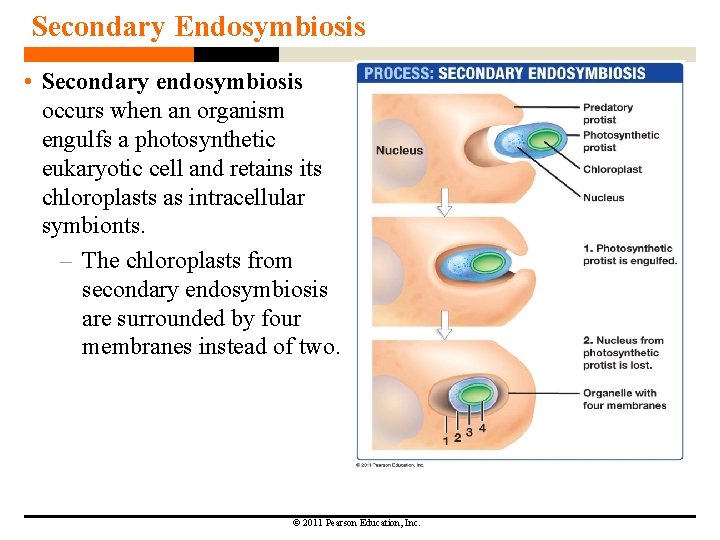
Secondary Endosymbiosis • Secondary endosymbiosis occurs when an organism engulfs a photosynthetic eukaryotic cell and retains its chloroplasts as intracellular symbionts. – The chloroplasts from secondary endosymbiosis are surrounded by four membranes instead of two. © 2011 Pearson Education, Inc.
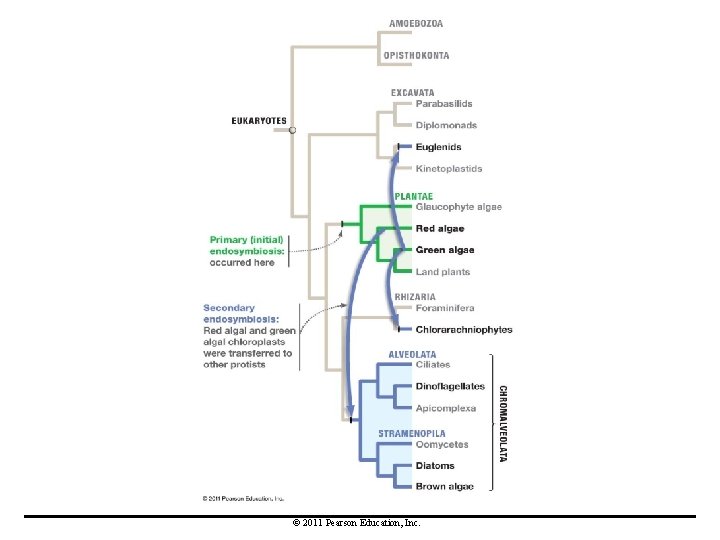
Photosynthesis • Phylogenetic analysis shows that photosynthesis arose in protists by primary endosymbiosis, then spread among lineages via secondary endosymbiosis. • The major photosynthetic groups of protists are distinguished by the pigments they contain. – A particular photosynthetic pigment absorbs specific wavelengths of light. Different pigments indicate that different species absorb different wavelengths in the electromagnetic spectrum. – The diversity of pigments allowed eukaryotic species to harvest unique wavelengths of light and avoid competition. © 2011 Pearson Education, Inc.
© 2011 Pearson Education, Inc.
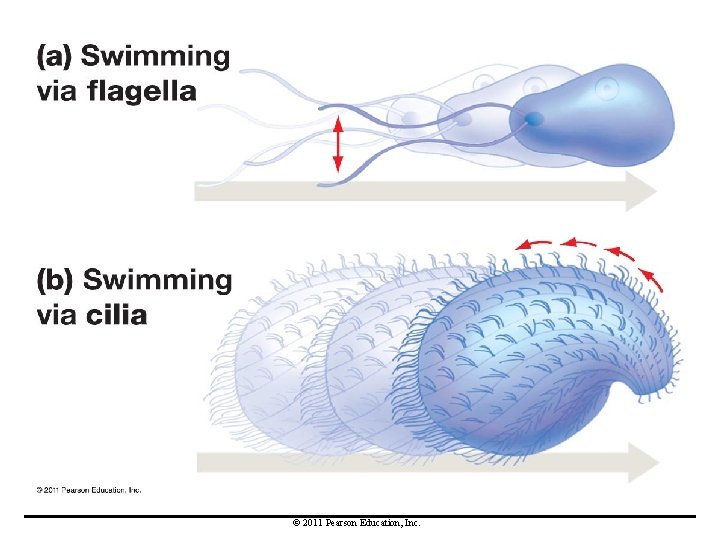
How Do Protists Move? • Many protists actively move to find food or light. • Amoeboid motion is a sliding movement observed in some protists that is accomplished by streaming of pseudopodia. • The other major mode of locomotion involves swimming via flagella or cilia. – Flagella and cilia have identical structures, but flagella are long and are usually found alone or in pairs, whereas cilia are short and numerous. © 2011 Pearson Education, Inc.
© 2011 Pearson Education, Inc.
© 2011 Pearson Education, Inc.
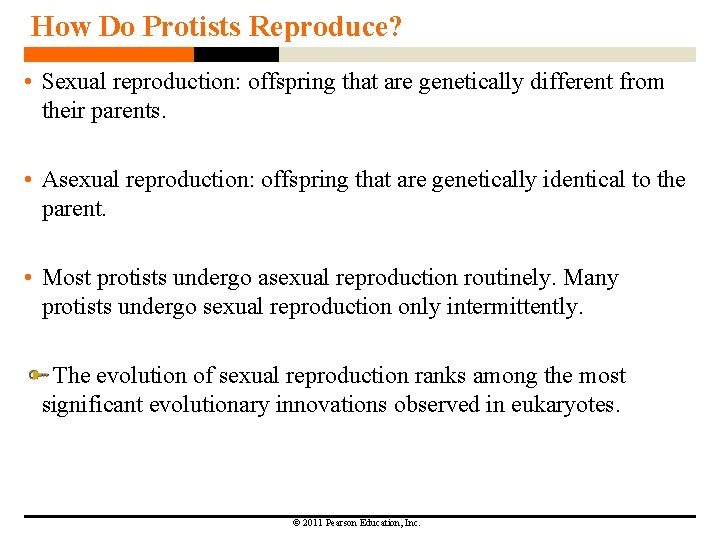
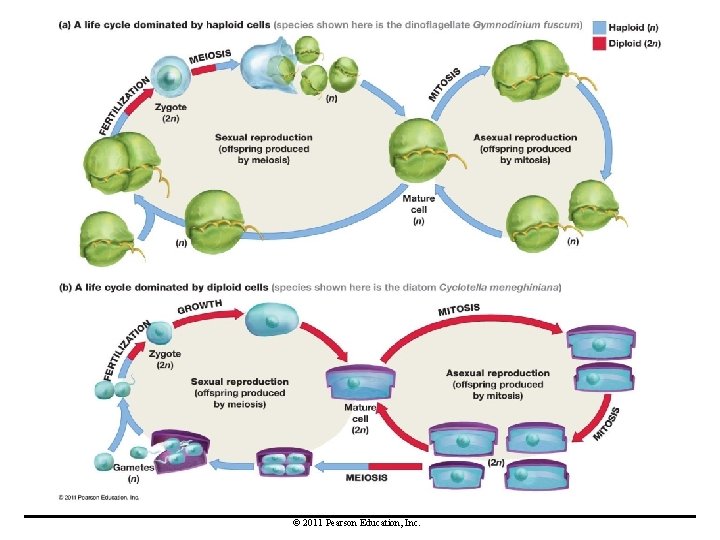
How Do Protists Reproduce? • Sexual reproduction: offspring that are genetically different from their parents. • Asexual reproduction: offspring that are genetically identical to the parent. • Most protists undergo asexual reproduction routinely. Many protists undergo sexual reproduction only intermittently. The evolution of sexual reproduction ranks among the most significant evolutionary innovations observed in eukaryotes. © 2011 Pearson Education, Inc.
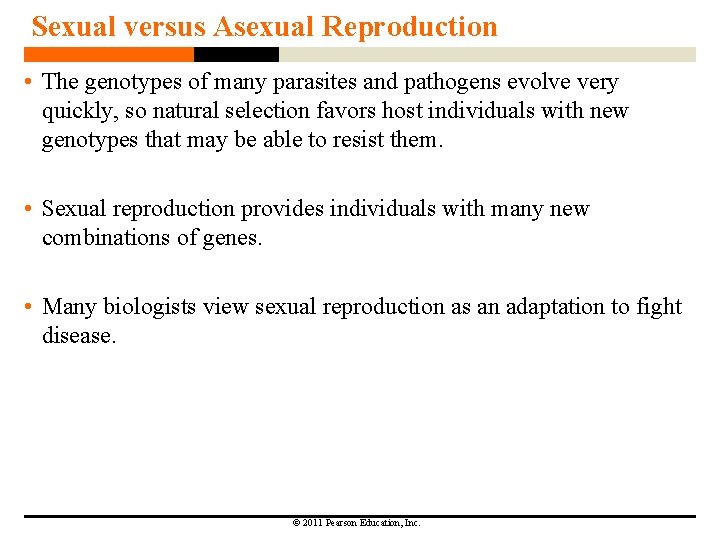
Sexual versus Asexual Reproduction • The genotypes of many parasites and pathogens evolve very quickly, so natural selection favors host individuals with new genotypes that may be able to resist them. • Sexual reproduction provides individuals with many new combinations of genes. • Many biologists view sexual reproduction as an adaptation to fight disease. © 2011 Pearson Education, Inc.
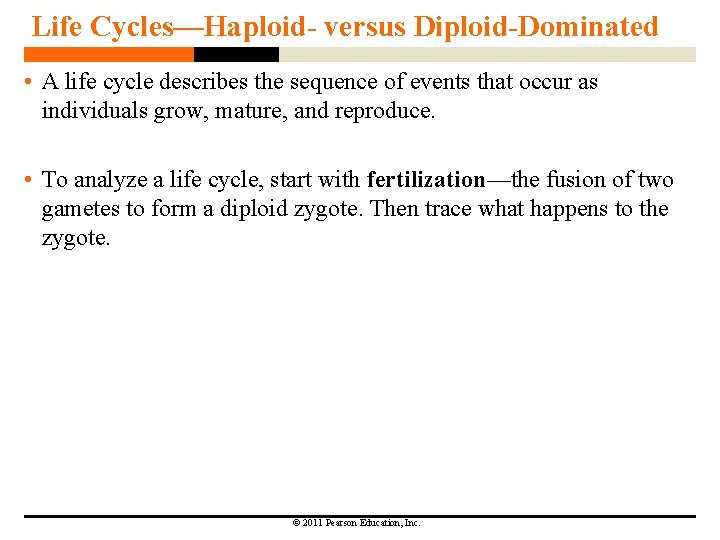
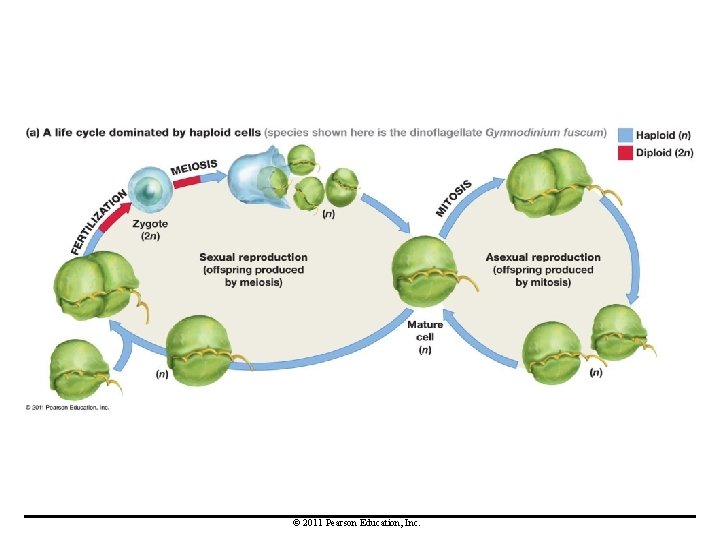
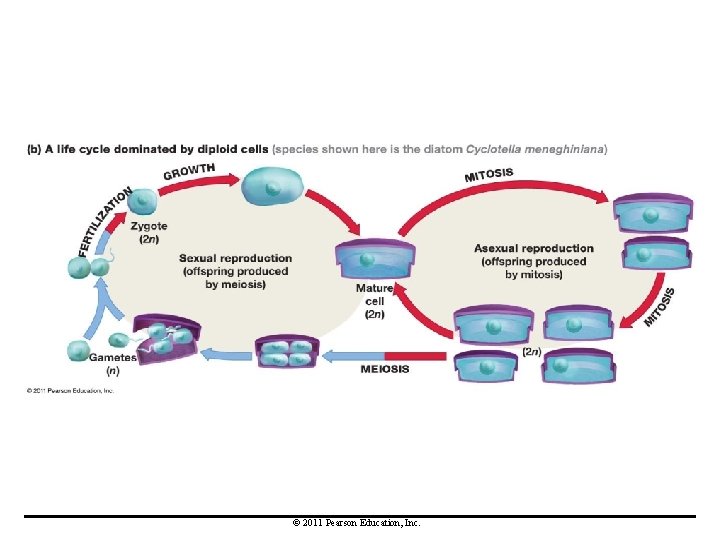
Life Cycles—Haploid- versus Diploid-Dominated • A life cycle describes the sequence of events that occur as individuals grow, mature, and reproduce. • To analyze a life cycle, start with fertilization—the fusion of two gametes to form a diploid zygote. Then trace what happens to the zygote. © 2011 Pearson Education, Inc.
© 2011 Pearson Education, Inc.
© 2011 Pearson Education, Inc.
© 2011 Pearson Education, Inc.
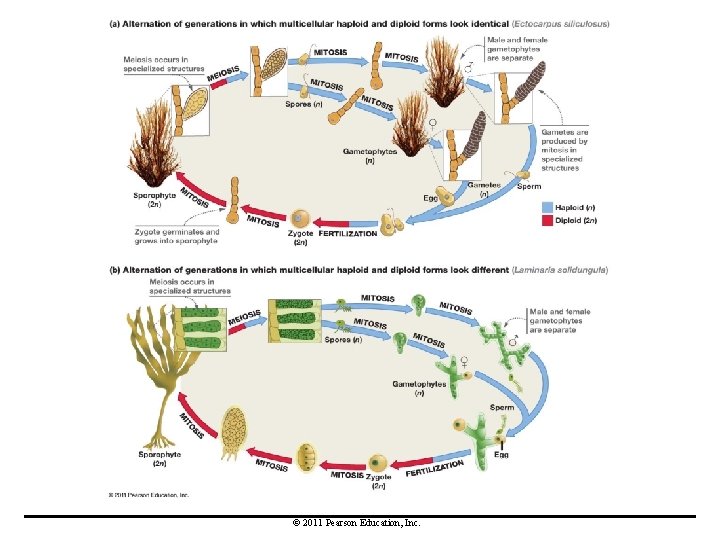
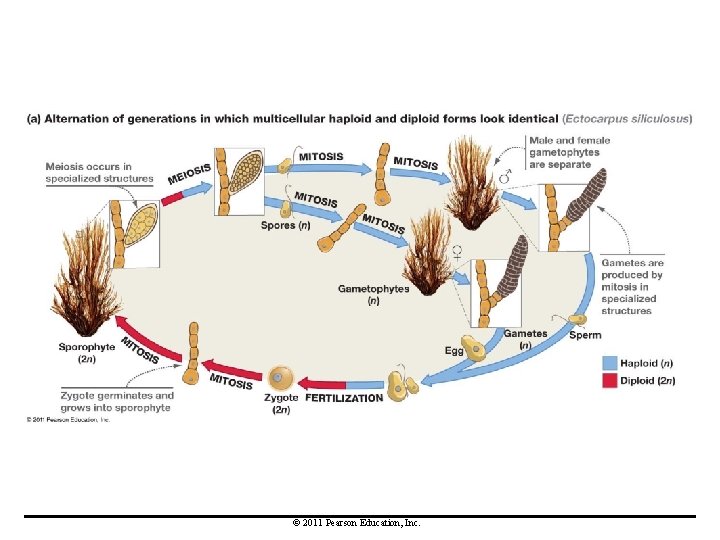
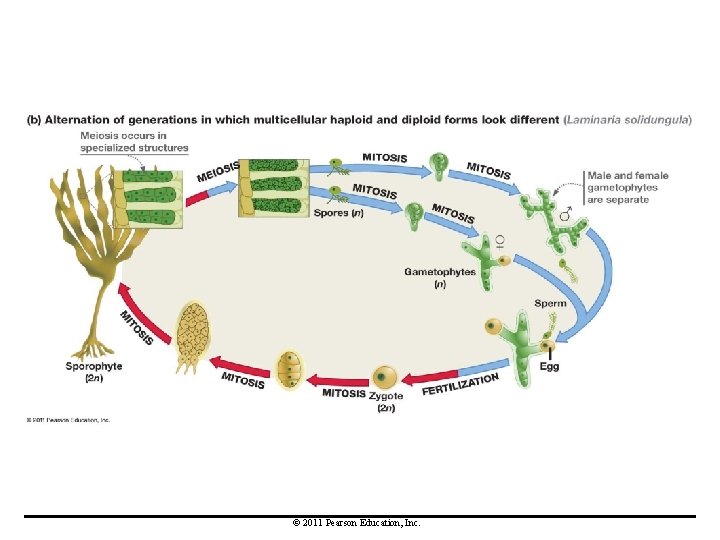
Life Cycles—Alternation of Generations • Many multicellular protists have one phase of their life cycle that is based on a haploid form and another that is based on a diploid form. This phenomenon is known as alternation of generations. • The multicellular haploid form is called a gametophyte, because specialized cells in this form produce gametes by mitosis. • The multicellular diploid form is a sporophyte, because it has specialized cells that undergo meiosis to produce haploid cells called spores. © 2011 Pearson Education, Inc.
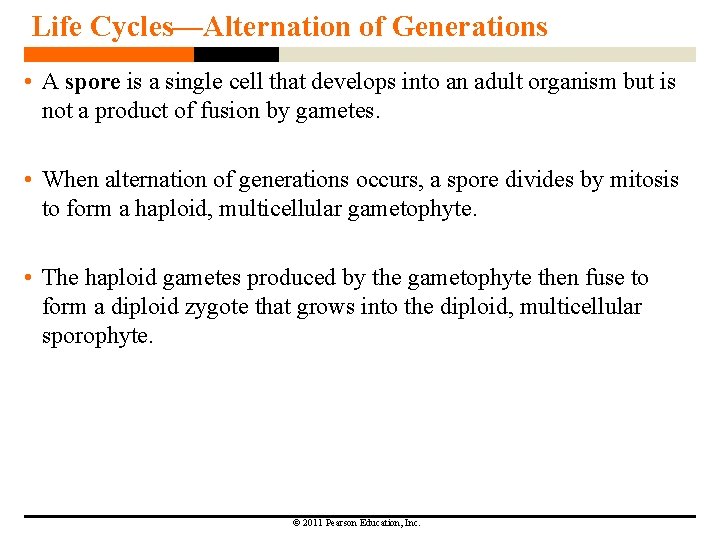
Life Cycles—Alternation of Generations • A spore is a single cell that develops into an adult organism but is not a product of fusion by gametes. • When alternation of generations occurs, a spore divides by mitosis to form a haploid, multicellular gametophyte. • The haploid gametes produced by the gametophyte then fuse to form a diploid zygote that grows into the diploid, multicellular sporophyte. © 2011 Pearson Education, Inc.
© 2011 Pearson Education, Inc.
© 2011 Pearson Education, Inc.
© 2011 Pearson Education, Inc.
Key Lineages of Protists • Each of the seven major Eukarya lineages has at least one distinctive morphological characteristic. – Each of the seven lineages represents a similar radiation of species into a wide array of lifestyles. In each case, the radiation began with a morphological innovation. • We’ll look at key lineages from six of the seven major groups. – The seventh, Opisthokonta, includes fungi and animals, which are covered later. – Green plants in Plantae are also covered later. © 2011 Pearson Education, Inc.
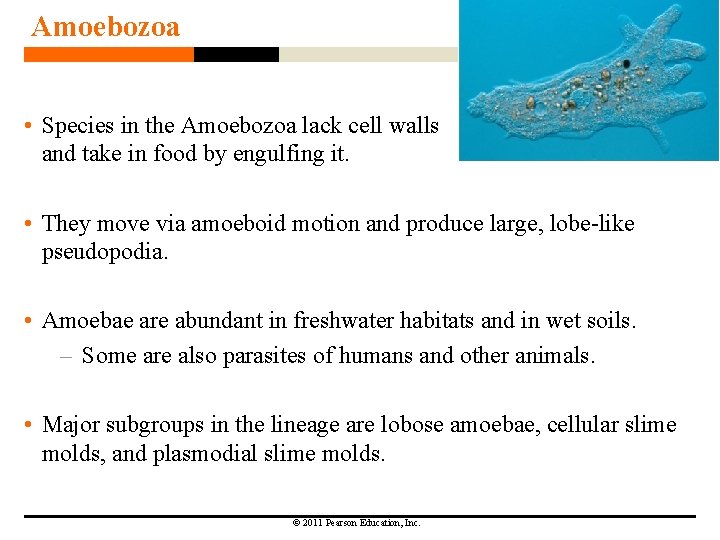
Amoebozoa • Species in the Amoebozoa lack cell walls and take in food by engulfing it. • They move via amoeboid motion and produce large, lobe-like pseudopodia. • Amoebae are abundant in freshwater habitats and in wet soils. – Some are also parasites of humans and other animals. • Major subgroups in the lineage are lobose amoebae, cellular slime molds, and plasmodial slime molds. © 2011 Pearson Education, Inc.
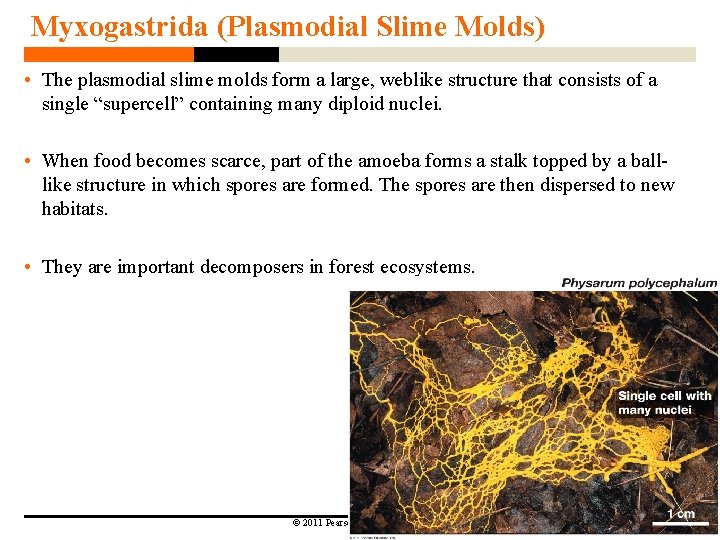
Myxogastrida (Plasmodial Slime Molds) • The plasmodial slime molds form a large, weblike structure that consists of a single “supercell” containing many diploid nuclei. • When food becomes scarce, part of the amoeba forms a stalk topped by a balllike structure in which spores are formed. The spores are then dispersed to new habitats. • They are important decomposers in forest ecosystems. © 2011 Pearson Education, Inc.
Excavata • The excavates are named for the “excavated” feeding groove found on one side of the cell. • The excavates lack mitochondria, but their ancestors are thought to have had them. – Excavates have either vestigial mitochondria or the genes that are normally found in mitochondria. © 2011 Pearson Education, Inc.
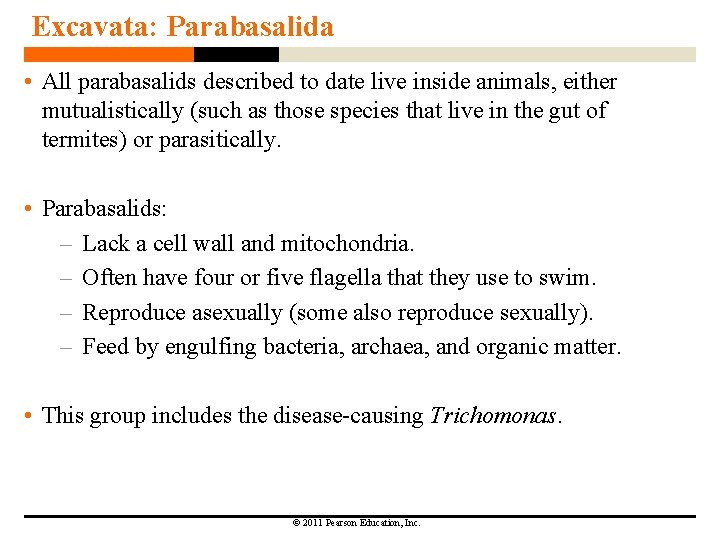
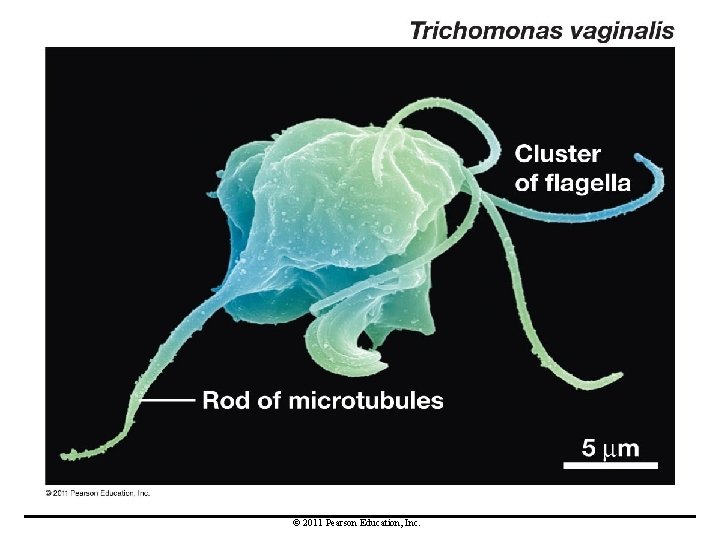
Excavata: Parabasalida • All parabasalids described to date live inside animals, either mutualistically (such as those species that live in the gut of termites) or parasitically. • Parabasalids: – Lack a cell wall and mitochondria. – Often have four or five flagella that they use to swim. – Reproduce asexually (some also reproduce sexually). – Feed by engulfing bacteria, archaea, and organic matter. • This group includes the disease-causing Trichomonas. © 2011 Pearson Education, Inc.
© 2011 Pearson Education, Inc.
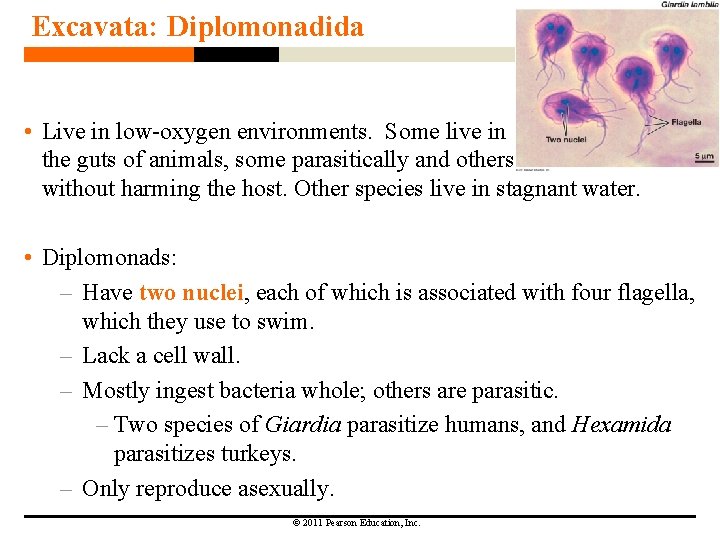
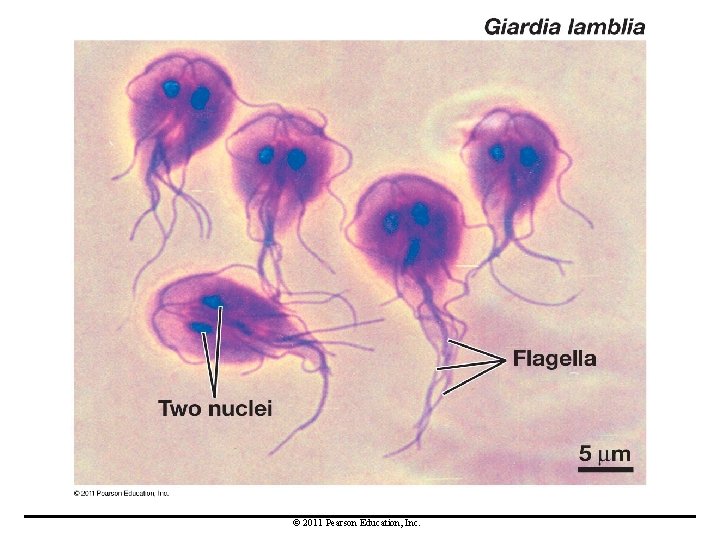
Excavata: Diplomonadida • Live in low-oxygen environments. Some live in the guts of animals, some parasitically and others without harming the host. Other species live in stagnant water. • Diplomonads: – Have two nuclei, each of which is associated with four flagella, which they use to swim. – Lack a cell wall. – Mostly ingest bacteria whole; others are parasitic. – Two species of Giardia parasitize humans, and Hexamida parasitizes turkeys. – Only reproduce asexually. © 2011 Pearson Education, Inc.
© 2011 Pearson Education, Inc.
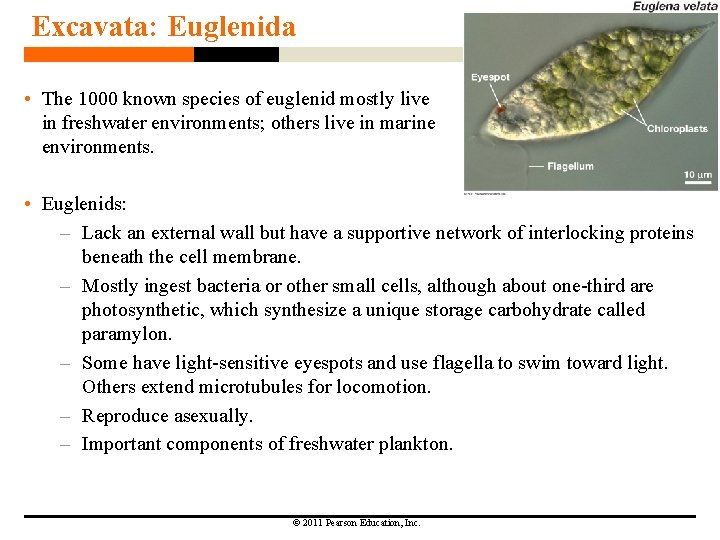
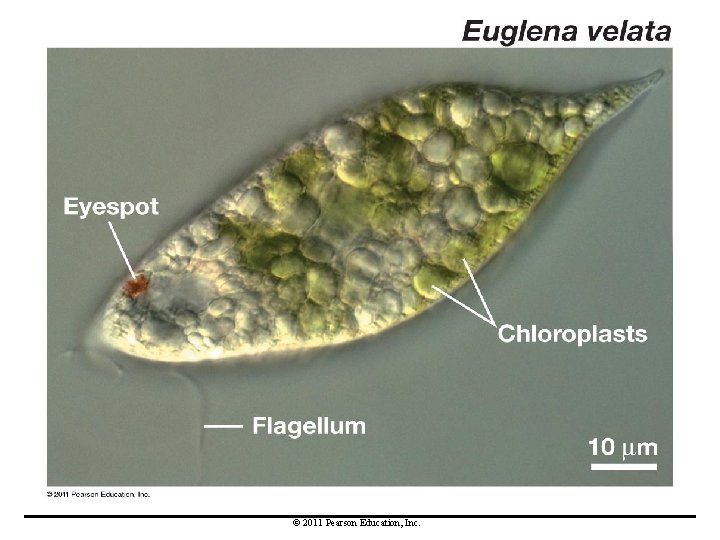
Excavata: Euglenida • The 1000 known species of euglenid mostly live in freshwater environments; others live in marine environments. • Euglenids: – Lack an external wall but have a supportive network of interlocking proteins beneath the cell membrane. – Mostly ingest bacteria or other small cells, although about one-third are photosynthetic, which synthesize a unique storage carbohydrate called paramylon. – Some have light-sensitive eyespots and use flagella to swim toward light. Others extend microtubules for locomotion. – Reproduce asexually. – Important components of freshwater plankton. © 2011 Pearson Education, Inc.
© 2011 Pearson Education, Inc.
Plantae • Plantae refers to the monophyletic group that includes red algae, green algae, land plants, and glaucophyte algae. • All of these lineages are descended from a common ancestor of today’s glaucophyte algae that engulfed a cyanobacterium, beginning the endosymbiosis that led to the evolution of the chloroplast. – There are several similarities between cyanobacteria and the chloroplasts in glaucophyte algae. © 2011 Pearson Education, Inc.
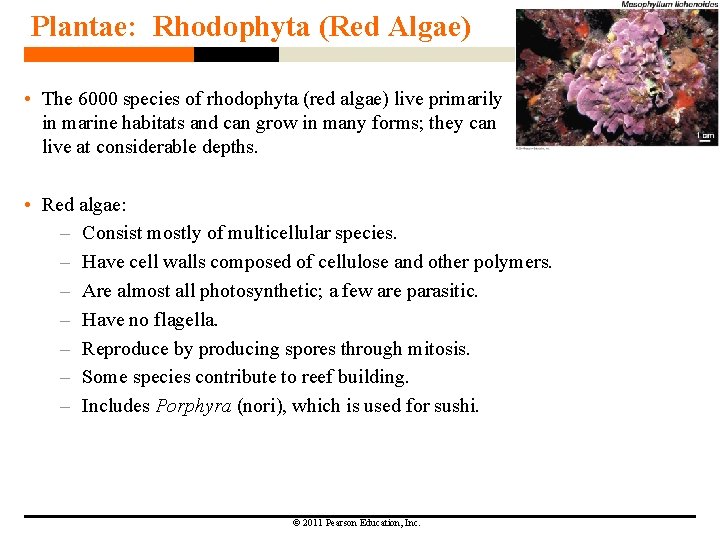
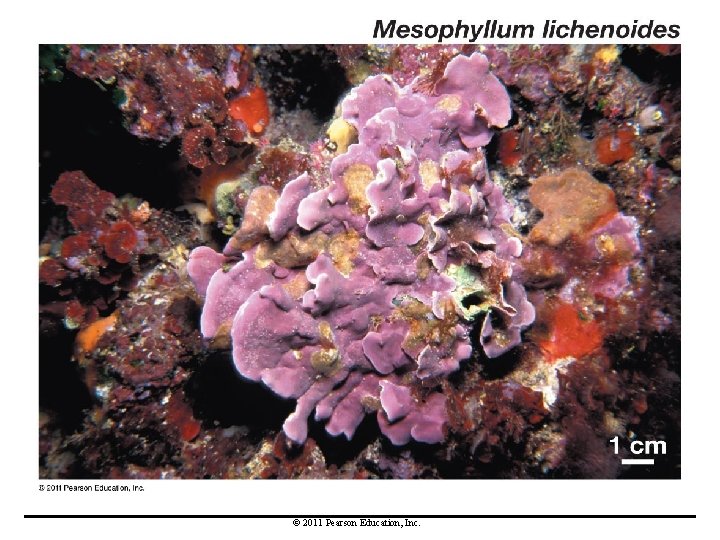
Plantae: Rhodophyta (Red Algae) • The 6000 species of rhodophyta (red algae) live primarily in marine habitats and can grow in many forms; they can live at considerable depths. • Red algae: – Consist mostly of multicellular species. – Have cell walls composed of cellulose and other polymers. – Are almost all photosynthetic; a few are parasitic. – Have no flagella. – Reproduce by producing spores through mitosis. – Some species contribute to reef building. – Includes Porphyra (nori), which is used for sushi. © 2011 Pearson Education, Inc.
© 2011 Pearson Education, Inc.
Rhizaria • Rhizarians are single-celled amoebae that lack cell walls. – Some species produce elaborate shell-like coverings. • They move by amoeboid motion and produce long, slender pseudopodia. • Rhizaria include over 11 major subgroups, including planktonic actinopods. © 2011 Pearson Education, Inc.
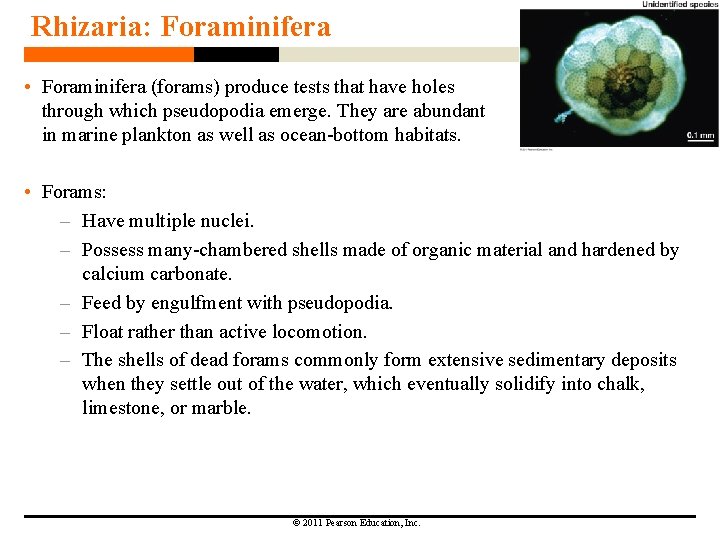
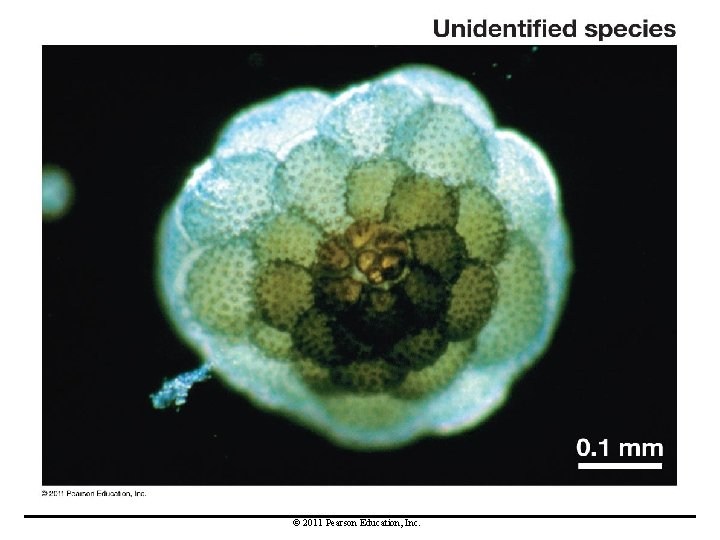
Rhizaria: Foraminifera • Foraminifera (forams) produce tests that have holes through which pseudopodia emerge. They are abundant in marine plankton as well as ocean-bottom habitats. • Forams: – Have multiple nuclei. – Possess many-chambered shells made of organic material and hardened by calcium carbonate. – Feed by engulfment with pseudopodia. – Float rather than active locomotion. – The shells of dead forams commonly form extensive sedimentary deposits when they settle out of the water, which eventually solidify into chalk, limestone, or marble. © 2011 Pearson Education, Inc.
© 2011 Pearson Education, Inc.
Alveolata • Alveolates are distinguished by small sacs, called alveoli, that are located just under their plasma membranes. • All members of this lineage are unicellular but they are diverse in morphology and lifestyle. • Alveolates form a monophyletic group. © 2011 Pearson Education, Inc.
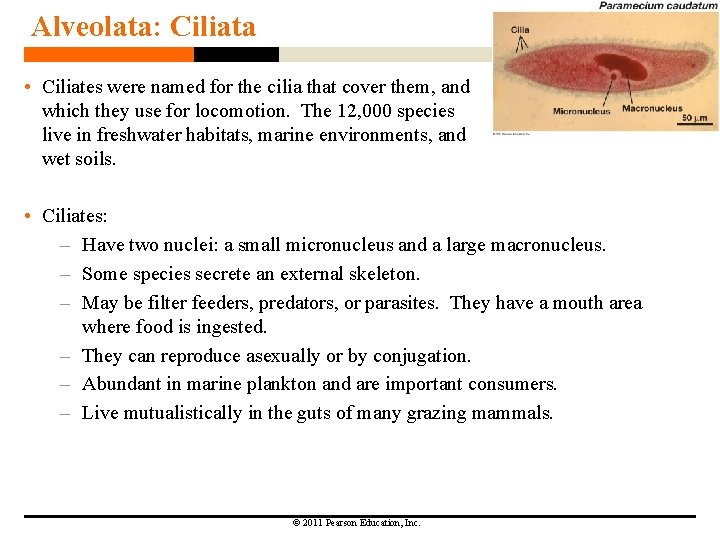
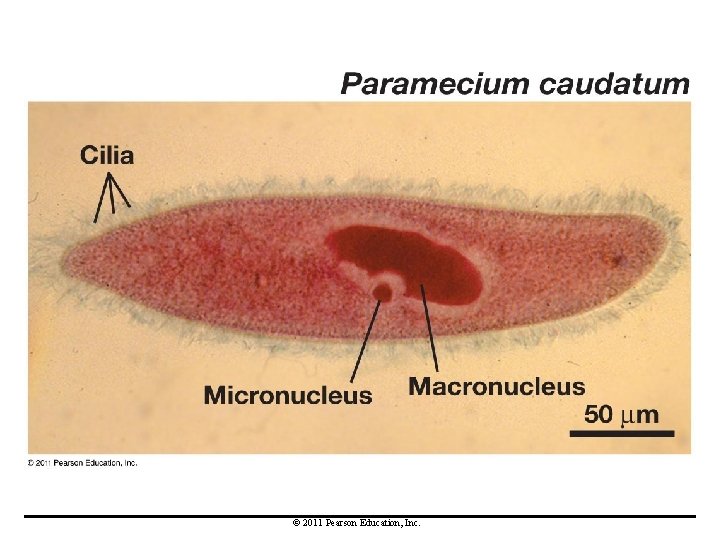
Alveolata: Ciliata • Ciliates were named for the cilia that cover them, and which they use for locomotion. The 12, 000 species live in freshwater habitats, marine environments, and wet soils. • Ciliates: – Have two nuclei: a small micronucleus and a large macronucleus. – Some species secrete an external skeleton. – May be filter feeders, predators, or parasites. They have a mouth area where food is ingested. – They can reproduce asexually or by conjugation. – Abundant in marine plankton and are important consumers. – Live mutualistically in the guts of many grazing mammals. © 2011 Pearson Education, Inc.
© 2011 Pearson Education, Inc.
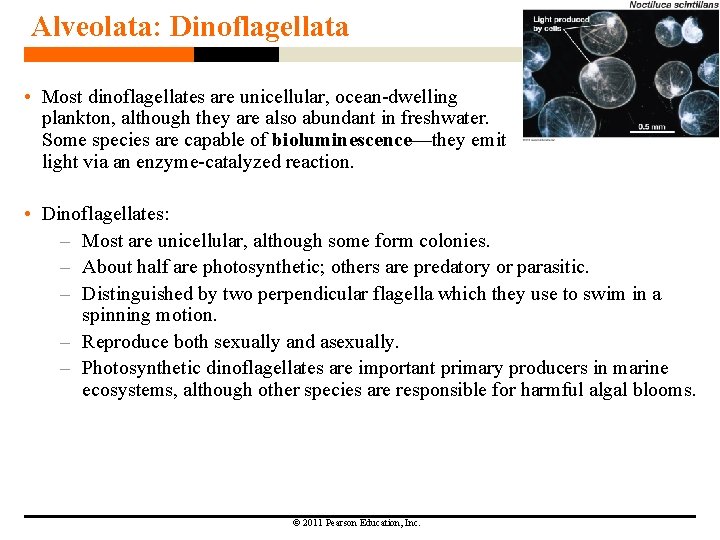
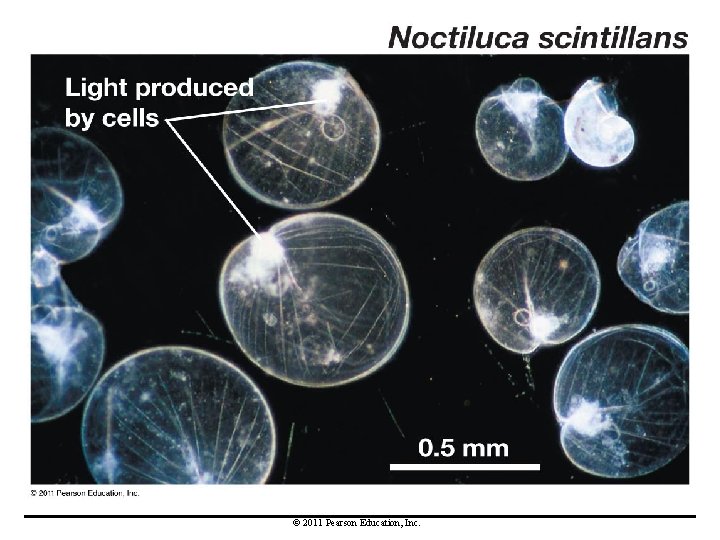
Alveolata: Dinoflagellata • Most dinoflagellates are unicellular, ocean-dwelling plankton, although they are also abundant in freshwater. Some species are capable of bioluminescence—they emit light via an enzyme-catalyzed reaction. • Dinoflagellates: – Most are unicellular, although some form colonies. – About half are photosynthetic; others are predatory or parasitic. – Distinguished by two perpendicular flagella which they use to swim in a spinning motion. – Reproduce both sexually and asexually. – Photosynthetic dinoflagellates are important primary producers in marine ecosystems, although other species are responsible for harmful algal blooms. © 2011 Pearson Education, Inc.
© 2011 Pearson Education, Inc.
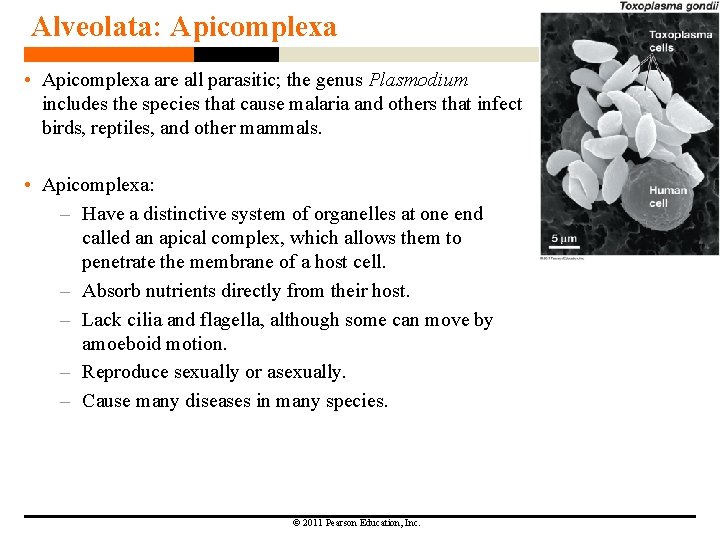
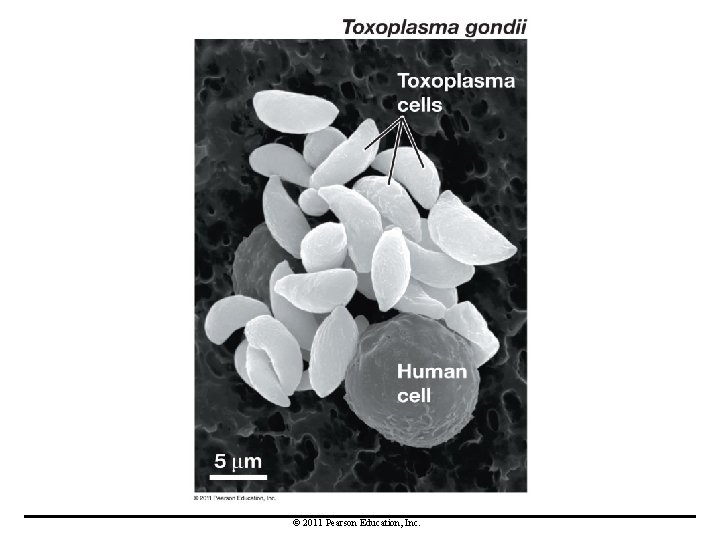
Alveolata: Apicomplexa • Apicomplexa are all parasitic; the genus Plasmodium includes the species that cause malaria and others that infect birds, reptiles, and other mammals. • Apicomplexa: – Have a distinctive system of organelles at one end called an apical complex, which allows them to penetrate the membrane of a host cell. – Absorb nutrients directly from their host. – Lack cilia and flagella, although some can move by amoeboid motion. – Reproduce sexually or asexually. – Cause many diseases in many species. © 2011 Pearson Education, Inc.
© 2011 Pearson Education, Inc.
Stramenopila (Heterokonta) • At some stage of their life cycle, all stramenopiles have flagella that are covered with distinctive hollow hairs. • This lineage includes a large number of unicellular forms, but some are multicellular. • Stramenopila form a monophyletic group. © 2011 Pearson Education, Inc.
Stramenopila: Oomycota (Water Molds) • Oomycetes resemble fungi—the morphological similarities result from convergent evolution, as both absorb nutrition from living or dead hosts. • Oomycota: – Some are unicellular and others, like fungi, form long, branching filaments called hyphae. – Have cell walls comprised of cellulose (not chitin as in fungi). – Most species are freshwater decomposers; a few are parasitic. – Adults are sessile. – Motile spores are produced sexually or asexually. – They are extremely important decomposers in aquatic ecosystems, but are also responsible for some plant diseases, including the one that caused the Irish potato famine. © 2011 Pearson Education, Inc.
© 2011 Pearson Education, Inc.
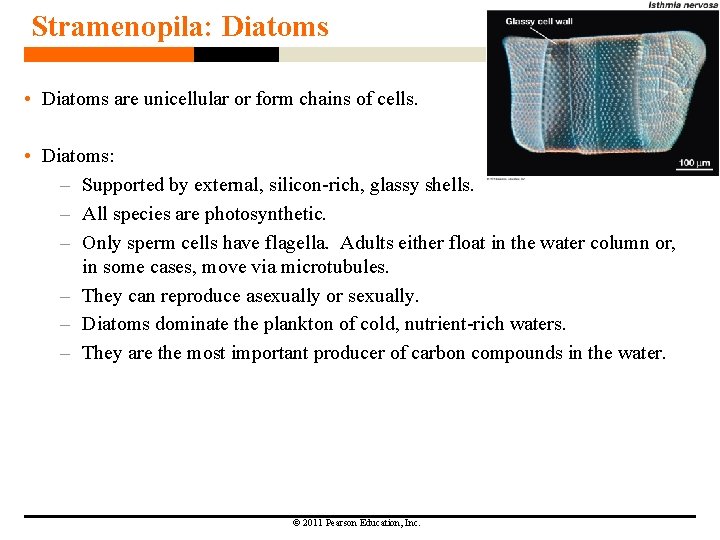
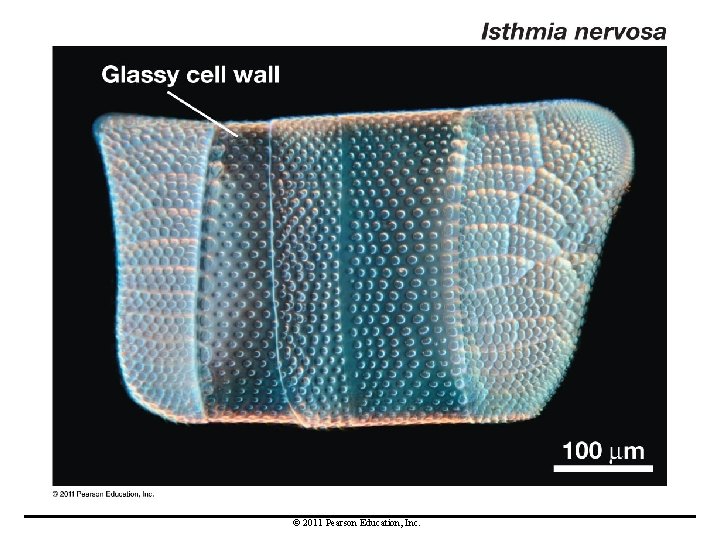
Stramenopila: Diatoms • Diatoms are unicellular or form chains of cells. • Diatoms: – Supported by external, silicon-rich, glassy shells. – All species are photosynthetic. – Only sperm cells have flagella. Adults either float in the water column or, in some cases, move via microtubules. – They can reproduce asexually or sexually. – Diatoms dominate the plankton of cold, nutrient-rich waters. – They are the most important producer of carbon compounds in the water. © 2011 Pearson Education, Inc.
© 2011 Pearson Education, Inc.
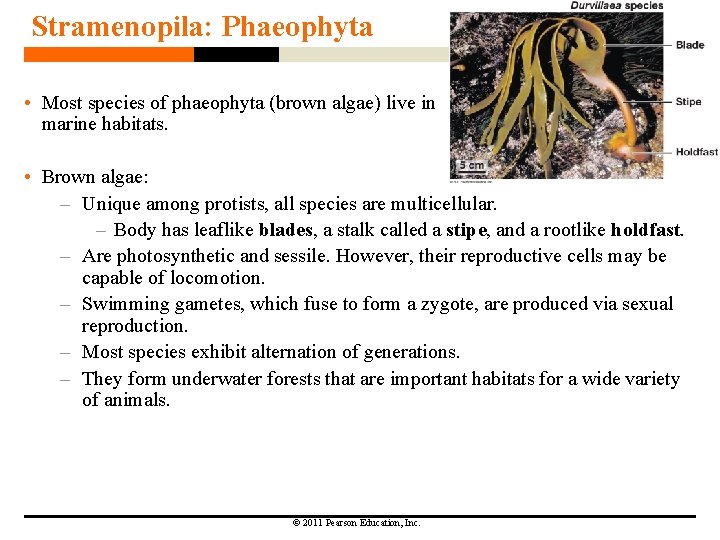
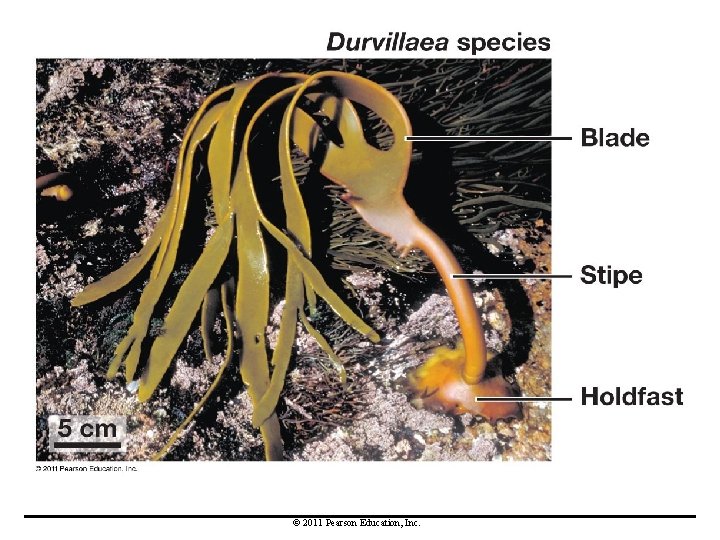
Stramenopila: Phaeophyta • Most species of phaeophyta (brown algae) live in marine habitats. • Brown algae: – Unique among protists, all species are multicellular. – Body has leaflike blades, a stalk called a stipe, and a rootlike holdfast. – Are photosynthetic and sessile. However, their reproductive cells may be capable of locomotion. – Swimming gametes, which fuse to form a zygote, are produced via sexual reproduction. – Most species exhibit alternation of generations. – They form underwater forests that are important habitats for a wide variety of animals. © 2011 Pearson Education, Inc.
© 2011 Pearson Education, Inc.