Hacking IPv 6 Networks Fernando Gont UTNFRH Argentina












- Slides: 167
Hacking IPv 6 Networks Fernando Gont (UTN/FRH, Argentina) Hack In Paris 2011 Paris, France. June 14 -17, 2011
Agenda (I) Objectives of this training Motivation for IPv 6 Brief comparision between IPv 6 and IPv 4 IPv 6 Addressing Architecture IPv 6 Header Fields IPv 6 Extension Headers IPv 6 Options Internet Control Message Protocol version 6 (ICMPv 6) Neighbor Discovery for IPv 6 Address Resolution Stateless Address Auto-configuration (SLAAC)
Agenda (II) IPsec Multicast Listener Discovery Dynamic Host Configuration Protocol version 6 (DHCPv 6) DNS support for IPv 6 firewalls Transition/co-existence technologies (6 to 4, Teredo, ISATAP, etc. ) Network reconnaissance in IPv 6 Security Implications of IPv 6 on IPv 4 -only networks IPv 6 deployment considerations
Objetives of this training Provide an Introduction to IPv 6 Provide an objetive discussion of IPv 6 security issues Identify and analyze a number of security aspects that must be considered before deploying IPv 6 Identify an analyze the security implications of IPv 6 on IPv 4 networks Identify areas in which further work is needed Draw some conclusions regarding IPv 6 security
Some general considerations about IPv 6 security
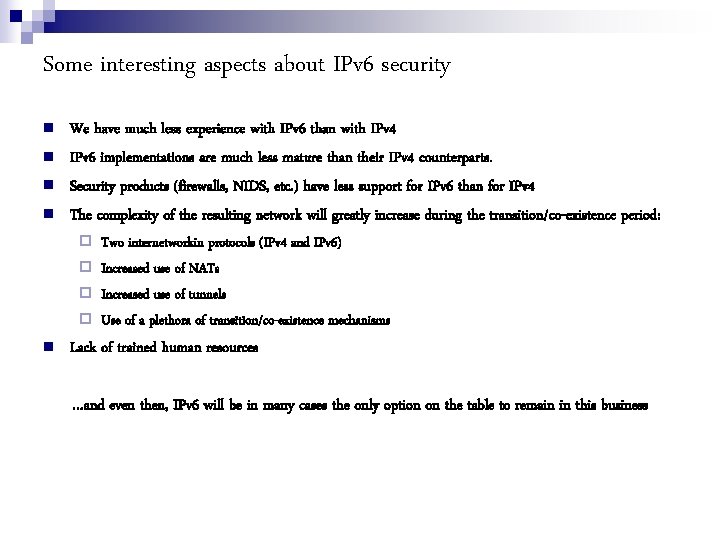
Some interesting aspects about IPv 6 security We have much less experience with IPv 6 than with IPv 4 IPv 6 implementations are much less mature than their IPv 4 counterparts. Security products (firewalls, NIDS, etc. ) have less support for IPv 6 than for IPv 4 The complexity of the resulting network will greatly increase during the transition/co-existence period: Two internetworkin protocols (IPv 4 and IPv 6) Increased use of NATs Increased use of tunnels Use of a plethora of transition/co-existence mechanisms Lack of trained human resources …and even then, IPv 6 will be in many cases the only option on the table to remain in this business
Brief comparision between IPv 6 and IPv 4
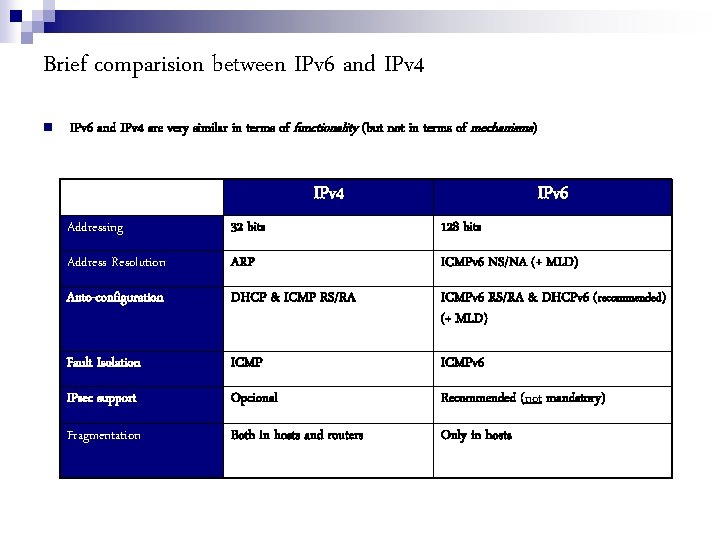
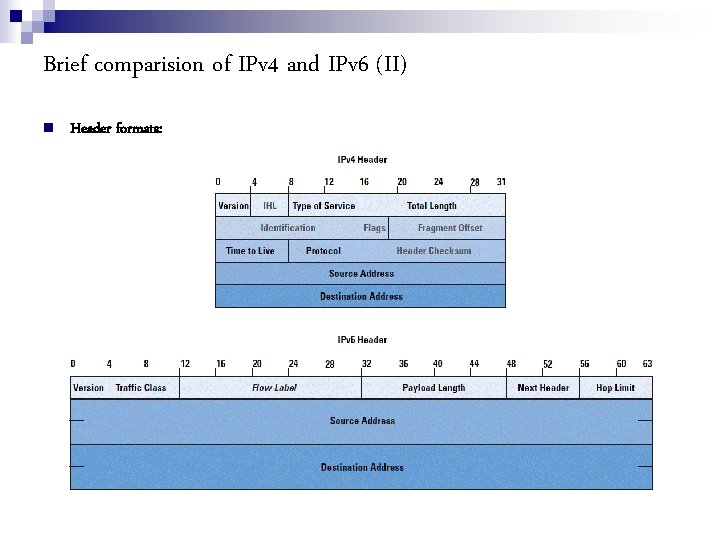
Brief comparision between IPv 6 and IPv 4 are very similar in terms of functionality (but not in terms of mechanisms) IPv 4 IPv 6 Addressing 32 bits 128 bits Address Resolution ARP ICMPv 6 NS/NA (+ MLD) Auto-configuration DHCP & ICMP RS/RA ICMPv 6 RS/RA & DHCPv 6 (recommended) (+ MLD) Fault Isolation ICMPv 6 IPsec support Opcional Recommended (not mandatory) Fragmentation Both in hosts and routers Only in hosts
Brief comparision of IPv 4 and IPv 6 (II) Header formats:
IPv 6 header fields
IPv 6 header fields Basic header fields
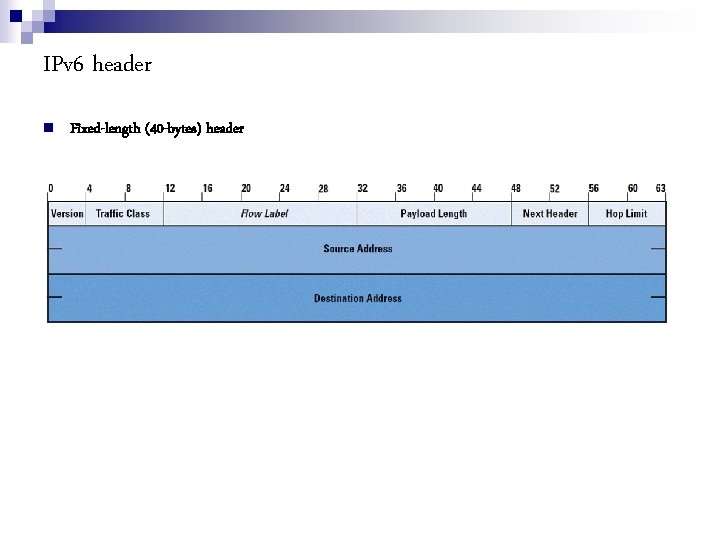
IPv 6 header Fixed-length (40 -bytes) header
Version Identifies the Internet Protocol version number (“ 6” for IPv 6) It should match the “Protocol” specified by the underlying link-layer protocol If not, link-layer access controls could be bypassed
Traffic Class Same as IPv 4’s “Differentiated Services” No additional “Quality of Service” (Qo. S) feature in IPv 6, sorry “Traffic Class” could be leveraged to receive differentiated service This field should be policed at the network edge
Flow Label The three-tuple {Source Address, Destination Address, Flow Label} was meant to identify a communication flow. Currently unused by many stacks – others use it improperly Speficication of this header field, together with possible uses, is “work in progress” at the IETF. Potential vulnerabilities depend on the ongoing work at the IETF, but if the Flow Label is predictable: Might be leveraged to perform “dumb” (stealth) address scans Might be leveraged to perform Denial of Service attacks
Payload Length Specifies the length of the IPv 6 packet (without including the length of the fixed IPv 6 header) Maximum IPv 6 packet is 65855 bytes. However, IPv 6 “Jumbograms” can be specified. Among the basic checks: The IPv 6 Payload Length cannot be larger than the “payload size” reported by the link-layer protocol
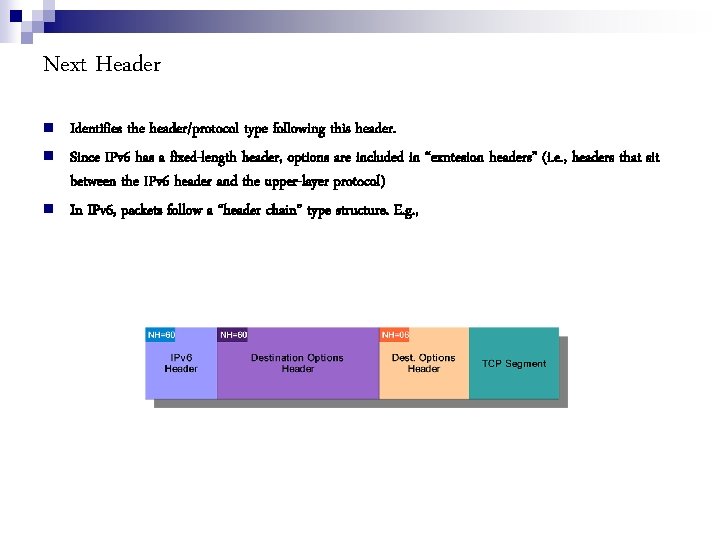
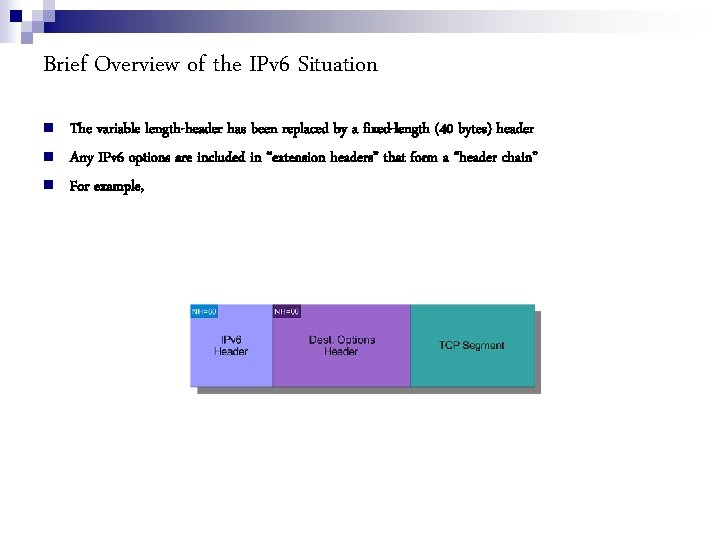
Next Header Identifies the header/protocol type following this header. Since IPv 6 has a fixed-length header, options are included in “exntesion headers” (i. e. , headers that sit between the IPv 6 header and the upper-layer protocol) In IPv 6, packets follow a “header chain” type structure. E. g. ,
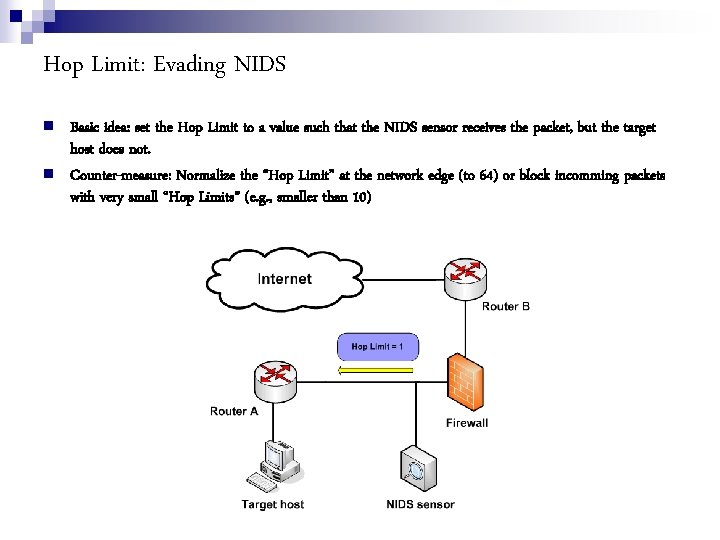
Hop Limit Analogous to IPv 4’s “Time to Live” (TTL) Identifies the number of network links the packet may traverse Packets are discarded when the Hop Limit is decremented to 0. Could be leveraged for: Detecting the Operating System of a remote node Fingerprinting a remote physical device Locating a node in the network topology Evading Network Intrusion Detection Systems (NIDS) Reducing the attack exposure of some hosts/applications
Hop Limit: Fingerprinting Devices or OSes Different Oses use different defaults for the “Hop Limit” (typically a power of two: 64, 128, etc. ) If packets originating from the same IPv 6 addresses contain very different “Hop Limits”, they might be originated by different devices. E. g. : Packets from FTP server 2001: db 8: : 1 arrive with a “Hop Limit” of 60 Packets from web server 2001: db 8: : : 2 arrive with a “Hop Limit” of 124 We infer: Note: mostly useless, since: FTP server sets the Hop Limit to 64, and is 4 “routers” away Web server sets the Hop Limit to 128, and is 4 “routers” away Detecting the Operating System of a remote node It requires different OSes behind the “middle-box” There is only a reduced number of default “Hop Limit” values Depending on the inferred original “Hop Limit”, the possible OS could be guess (again, mostly useless)
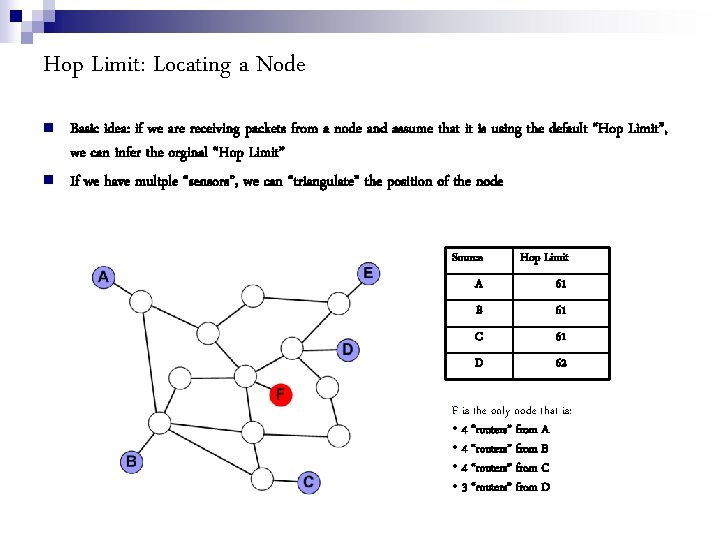
Hop Limit: Locating a Node Basic idea: if we are receiving packets from a node and assume that it is using the default “Hop Limit”, we can infer the orginal “Hop Limit” If we have multple “sensors”, we can “triangulate” the position of the node Source Hop Limit A 61 B 61 C 61 D 62 F is the only node that is: • 4 “routers” from A • 4 “routers” from B • 4 “routers” from C • 3 “routers” from D
Hop Limit: Evading NIDS Basic idea: set the Hop Limit to a value such that the NIDS sensor receives the packet, but the target host does not. Counter-measure: Normalize the “Hop Limit” at the network edge (to 64) or block incomming packets with very small “Hop Limits” (e. g. , smaller than 10)
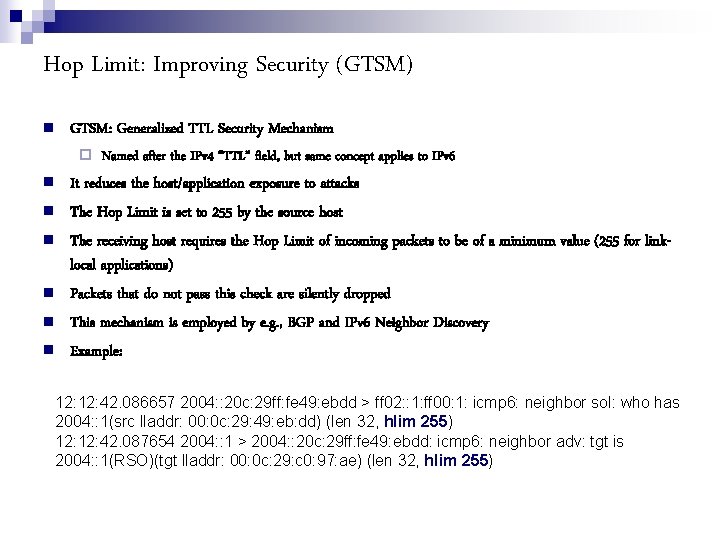
Hop Limit: Improving Security (GTSM) GTSM: Generalized TTL Security Mechanism Named after the IPv 4 “TTL” field, but same concept applies to IPv 6 It reduces the host/application exposure to attacks The Hop Limit is set to 255 by the source host The receiving host requires the Hop Limit of incoming packets to be of a minimum value (255 for linklocal applications) Packets that do not pass this check are silently dropped This mechanism is employed by e. g. , BGP and IPv 6 Neighbor Discovery Example: 12: 42. 086657 2004: : 20 c: 29 ff: fe 49: ebdd > ff 02: : 1: ff 00: 1: icmp 6: neighbor sol: who has 2004: : 1(src lladdr: 00: 0 c: 29: 49: eb: dd) (len 32, hlim 255) 12: 42. 087654 2004: : 1 > 2004: : 20 c: 29 ff: fe 49: ebdd: icmp 6: neighbor adv: tgt is 2004: : 1(RSO)(tgt lladdr: 00: 0 c: 29: c 0: 97: ae) (len 32, hlim 255)
IPv 6 Addressing Architecture
Brief Overview The main driver for IPv 6 is its increased address space IPv 6 uses 128 -bit addresses Similarly to IPv 4, Addresses are aggregated into “prefixes” (for routing purposes) There are different address types (unicast, anycast, and multicast) There are different address scopes (link-local, global, etc. ) It’s common for a node to be using, at any given time, several addresses, of multiple types and scopes. For example, One or more unicast link-local address One or more global unicast address One or more link-local address
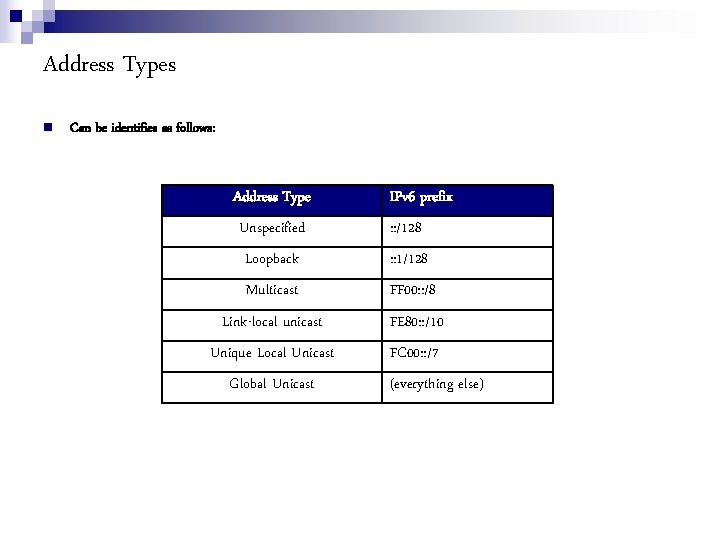
Address Types Can be identifies as follows: Address Type IPv 6 prefix Unspecified : : /128 Loopback : : 1/128 Multicast FF 00: : /8 Link-local unicast FE 80: : /10 Unique Local Unicast FC 00: : /7 Global Unicast (everything else)
IPv 6 Address Types Unicast Addresses
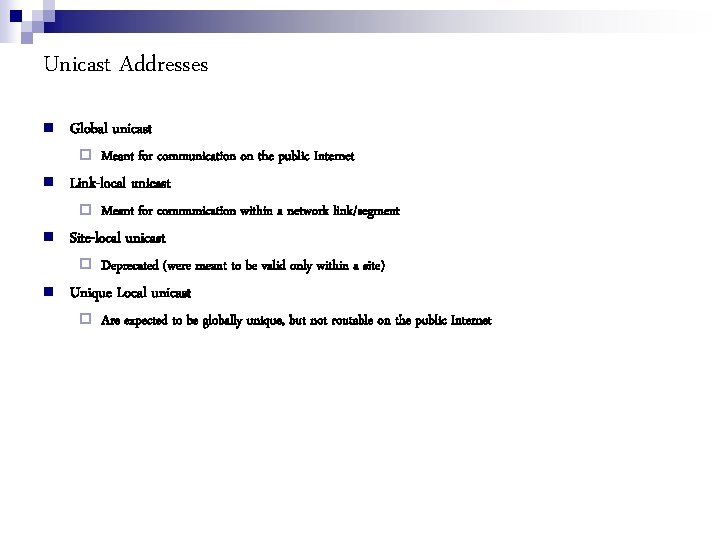
Unicast Addresses Global unicast Link-local unicast Meant for communication within a network link/segment Site-local unicast Meant for communication on the public Internet Deprecated (were meant to be valid only within a site) Unique Local unicast Are expected to be globally unique, but not routable on the public Internet
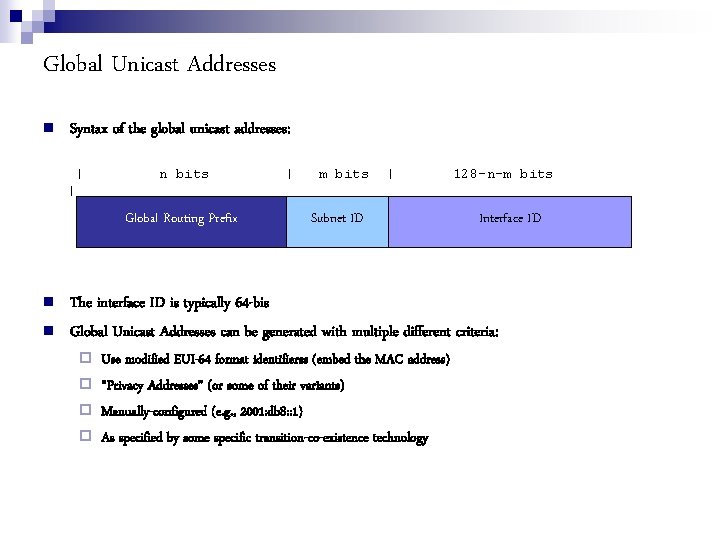
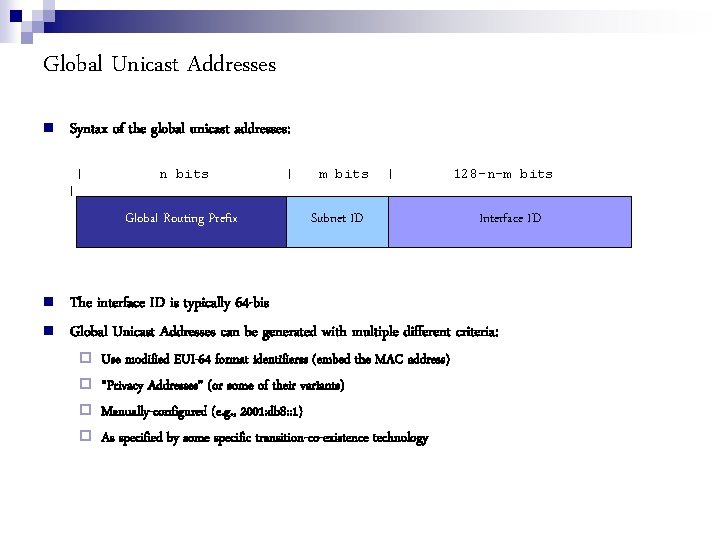
Global Unicast Addresses Syntax of the global unicast addresses: | n bits | m bits | 128 -n-m bits | Global Routing Prefix Subnet ID Interface ID The interface ID is typically 64 -bis Global Unicast Addresses can be generated with multiple different criteria: Use modified EUI-64 format identifierss (embed the MAC address) “Privacy Addresses” (or some of their variants) Manually-configured (e. g. , 2001: db 8: : 1) As specified by some specific transition-co-existence technology
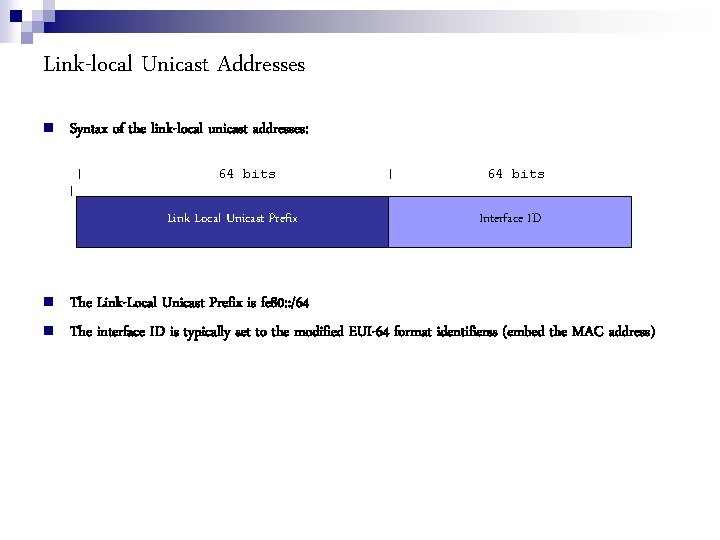
Link-local Unicast Addresses Syntax of the link-local unicast addresses: | 64 bits | Link Local Unicast Prefix Interface ID The Link-Local Unicast Prefix is fe 80: : /64 The interface ID is typically set to the modified EUI-64 format identifierss (embed the MAC address)
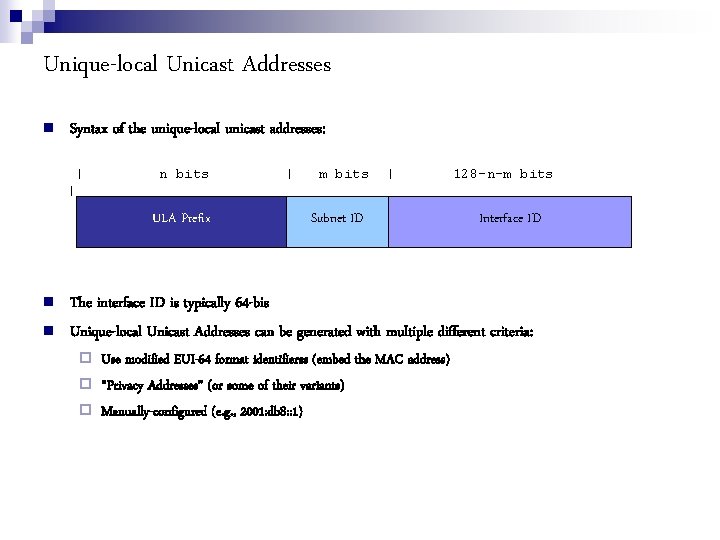
Unique-local Unicast Addresses Syntax of the unique-local unicast addresses: | n bits | m bits | 128 -n-m bits | ULA Prefix Subnet ID Interface ID The interface ID is typically 64 -bis Unique-local Unicast Addresses can be generated with multiple different criteria: Use modified EUI-64 format identifierss (embed the MAC address) “Privacy Addresses” (or some of their variants) Manually-configured (e. g. , 2001: db 8: : 1)
IPv 6 Address Types Multicast Addresses
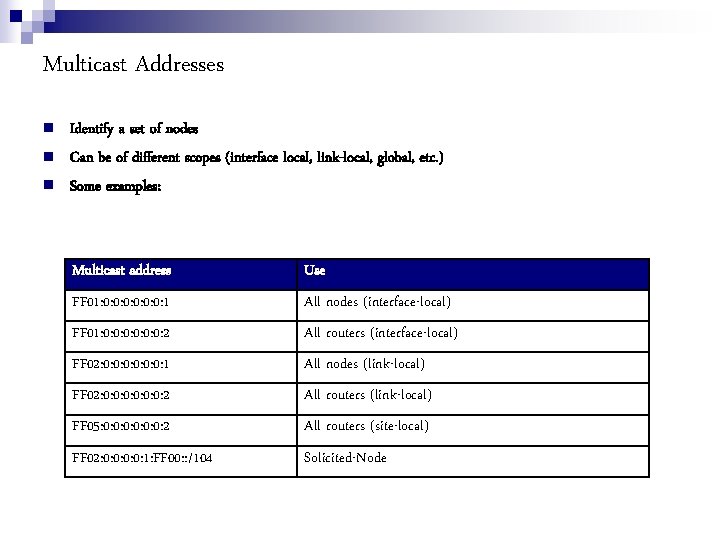
Multicast Addresses Identify a set of nodes Can be of different scopes (interface local, link-local, global, etc. ) Some examples: Multicast address Use FF 01: 0: 0: 0: 1 All nodes (interface-local) FF 01: 0: 0: 0: 2 All routers (interface-local) FF 02: 0: 0: 0: 1 All nodes (link-local) FF 02: 0: 0: 0: 2 All routers (link-local) FF 05: 0: 0: 0: 2 All routers (site-local) FF 02: 0: 0: 1: FF 00: : /104 Solicited-Node
IPv 6 Address Types Anycast Addresses
Anycast Addresses Identify a node belonging to a set of nodes (e. g. , some DNS server, some DHCP server, etc. ) Packets sent to an anycast address are sent only to one of those nodes (the nearest one, as from the point of view of the routing protocols). Only a few anycast addresses have been specified: Subnet-router
IPv 6 Addressing Implications on End-to-End Conectivity
Brief Overview Because of the increased IPv 6 address space, it is expected that each device connected to the Internet will have a unique address It is also assumed that this will “return” the “End-to-end Principle” to the Internet: The network is transparent to the communication of any two nodes (e. g. , intermmediate nodes do not modify the TCP port numbers, etc. ) Any node can establish a communication node with any other node in the network (e. g. , the network does not filter “incoming connections”) It is usually argued that the “end-to-end principle” allows for Innovation
Some Considerations Even if each device has a unique address, that does not necessarily imply “end-to-end” connectivity This is not necessarily a desired property in a production network Thus, a typical IPv 6 subnet will be protected by a stateful firewall that only allows “return traffic” (i. e. , communications can only be initiated from the inside network) In practice, most production networks don’t really care about innovation, but rather about getting work done. And the users of these networks expect to use the same services currently available for IPv 4 without “end -to-end” connectivity(web, email, social networks, etc. )
IPv 6 Extension Headers
IPv 6 Extension Headers Fragment Header
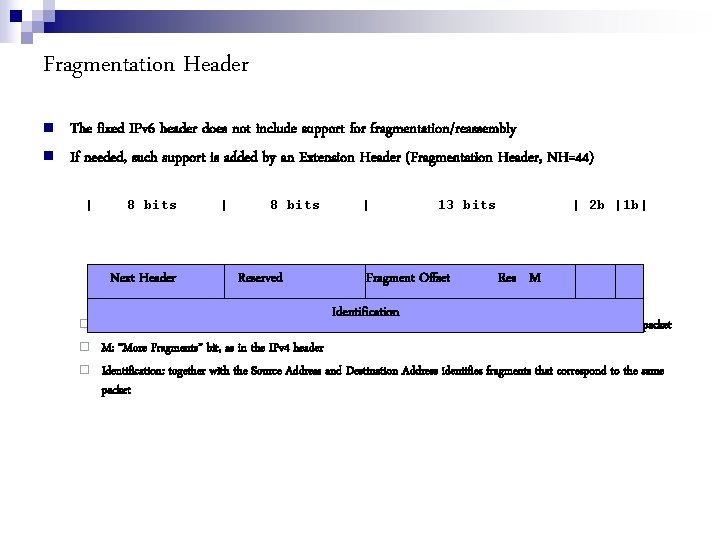
Fragmentation Header The fixed IPv 6 header does not include support for fragmentation/reassembly If needed, such support is added by an Extension Header (Fragmentation Header, NH=44) | 8 bits Next Header | 8 bits Reserved | 13 bits Fragment Offset Identification | 2 b |1 b| Res M Fragment Offset: offset of the data following this header, relative to the start of the fragmentable part of the original packet M: “More Fragments” bit, as in the IPv 4 header Identification: together with the Source Address and Destination Address identifies fragments that correspond to the same packet
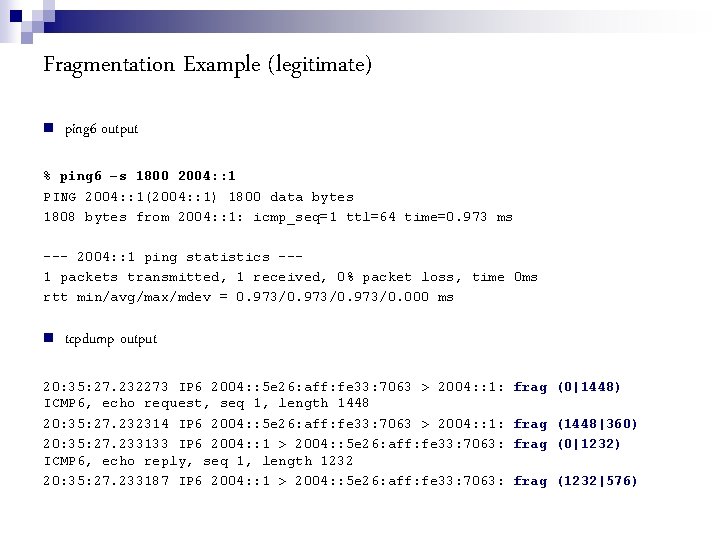
Fragmentation Example (legitimate) ping 6 output % ping 6 –s 1800 2004: : 1 PING 2004: : 1(2004: : 1) 1800 data bytes 1808 bytes from 2004: : 1: icmp_seq=1 ttl=64 time=0. 973 ms --- 2004: : 1 ping statistics --1 packets transmitted, 1 received, 0% packet loss, time 0 ms rtt min/avg/max/mdev = 0. 973/0. 000 ms tcpdump output 20: 35: 27. 232273 IP 6 2004: : 5 e 26: aff: fe 33: 7063 > 2004: : 1: ICMP 6, echo request, seq 1, length 1448 20: 35: 27. 232314 IP 6 2004: : 5 e 26: aff: fe 33: 7063 > 2004: : 1: 20: 35: 27. 233133 IP 6 2004: : 1 > 2004: : 5 e 26: aff: fe 33: 7063: ICMP 6, echo reply, seq 1, length 1232 20: 35: 27. 233187 IP 6 2004: : 1 > 2004: : 5 e 26: aff: fe 33: 7063: frag (0|1448) frag (1448|360) frag (0|1232) frag (1232|576)
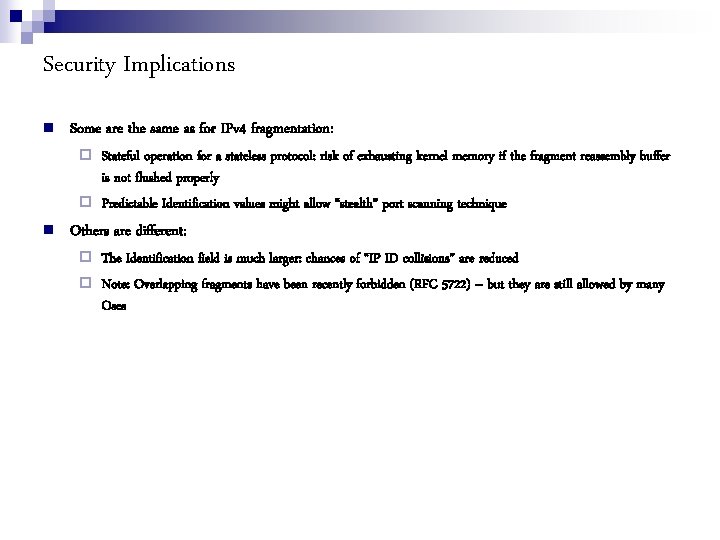
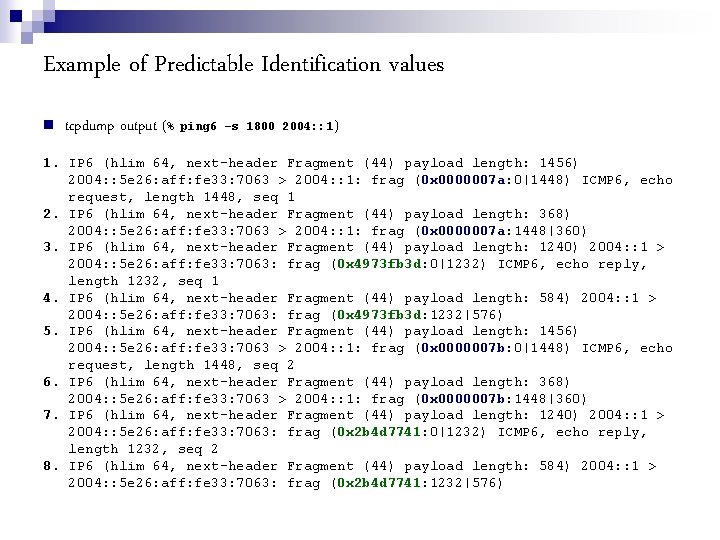
Security Implications Some are the same as for IPv 4 fragmentation: Stateful operation for a stateless protocol: risk of exhausting kernel memory if the fragment reassembly buffer is not flushed properly Predictable Identification values might allow “stealth” port scanning technique Others are different: The Identification field is much larger: chances of “IP ID collisions” are reduced Note: Overlapping fragments have been recently forbidden (RFC 5722) – but they are still allowed by many Oses
Fragment Header IPv 6 idle scan?
Example of Predictable Identification values tcpdump output (% ping 6 –s 1800 2004: : 1 ) 1. IP 6 (hlim 64, next-header Fragment (44) payload length: 1456) 2004: : 5 e 26: aff: fe 33: 7063 > 2004: : 1: frag (0 x 0000007 a: 0|1448) ICMP 6, echo request, length 1448, seq 1 2. IP 6 (hlim 64, next-header Fragment (44) payload length: 368) 2004: : 5 e 26: aff: fe 33: 7063 > 2004: : 1: frag (0 x 0000007 a: 1448|360) 3. IP 6 (hlim 64, next-header Fragment (44) payload length: 1240) 2004: : 1 > 2004: : 5 e 26: aff: fe 33: 7063: frag (0 x 4973 fb 3 d: 0|1232) ICMP 6, echo reply, length 1232, seq 1 4. IP 6 (hlim 64, next-header Fragment (44) payload length: 584) 2004: : 1 > 2004: : 5 e 26: aff: fe 33: 7063: frag (0 x 4973 fb 3 d: 1232|576) 5. IP 6 (hlim 64, next-header Fragment (44) payload length: 1456) 2004: : 5 e 26: aff: fe 33: 7063 > 2004: : 1: frag (0 x 0000007 b: 0|1448) ICMP 6, echo request, length 1448, seq 2 6. IP 6 (hlim 64, next-header Fragment (44) payload length: 368) 2004: : 5 e 26: aff: fe 33: 7063 > 2004: : 1: frag (0 x 0000007 b: 1448|360) 7. IP 6 (hlim 64, next-header Fragment (44) payload length: 1240) 2004: : 1 > 2004: : 5 e 26: aff: fe 33: 7063: frag (0 x 2 b 4 d 7741: 0|1232) ICMP 6, echo reply, length 1232, seq 2 8. IP 6 (hlim 64, next-header Fragment (44) payload length: 584) 2004: : 1 > 2004: : 5 e 26: aff: fe 33: 7063: frag (0 x 2 b 4 d 7741: 1232|576)
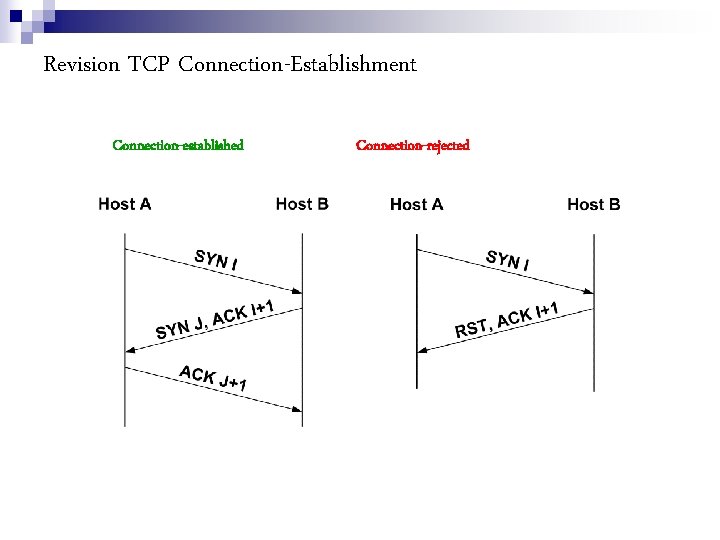
Revision TCP Connection-Establishment Connection-established Connection-rejected
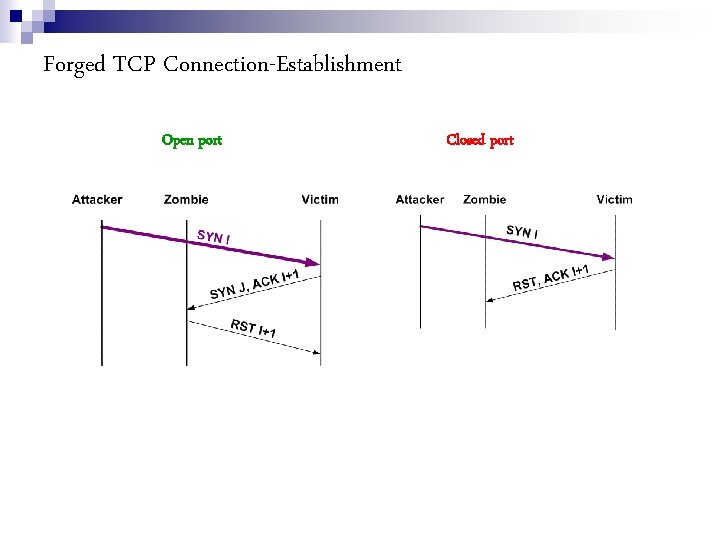
Forged TCP Connection-Establishment Open port Closed port
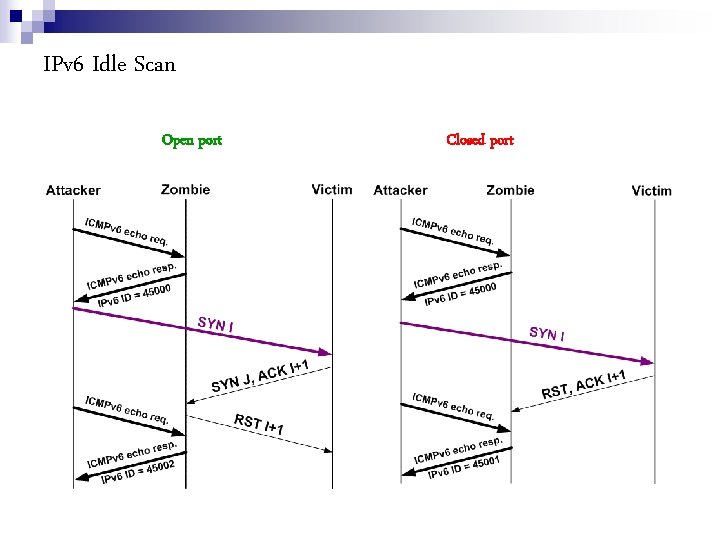
IPv 6 Idle Scan Open port Closed port
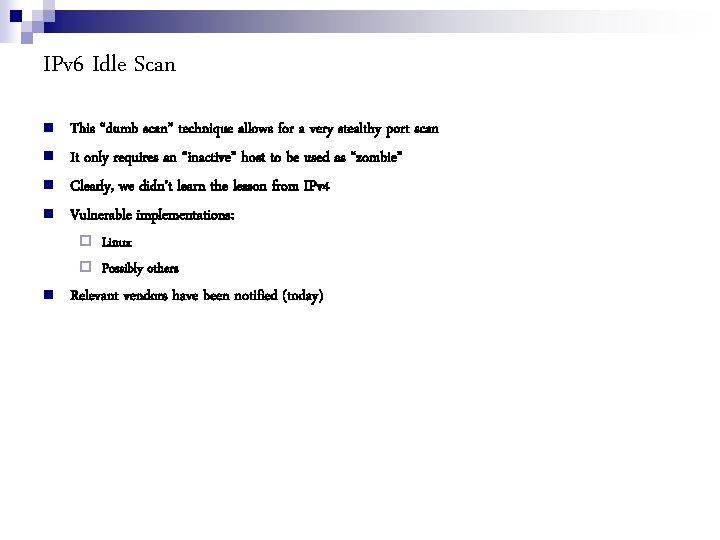
IPv 6 Idle Scan This “dumb scan” technique allows for a very stealthy port scan It only requires an “inactive” host to be used as “zombie” Clearly, we didn’t learn the lesson from IPv 4 Vulnerable implementations: Linux Possibly others Relevant vendors have been notified (today)
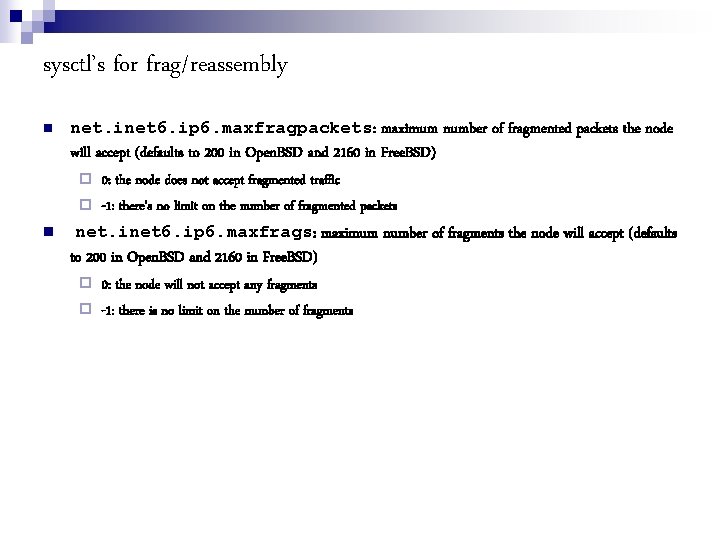
sysctl’s for frag/reassembly net. inet 6. ip 6. maxfragpackets: maximum number of fragmented packets the node will accept (defaults to 200 in Open. BSD and 2160 in Free. BSD) 0: the node does not accept fragmented traffic -1: there’s no limit on the number of fragmented packets net. inet 6. ip 6. maxfrags: maximum number of fragments the node will accept (defaults to 200 in Open. BSD and 2160 in Free. BSD) 0: the node will not accept any fragments -1: there is no limit on the number of fragments
IPv 6 Extension Headers Implications on Firewalls
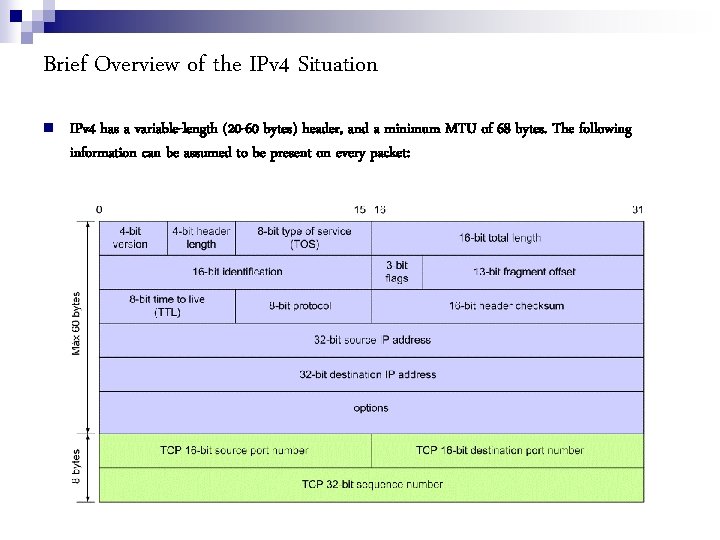
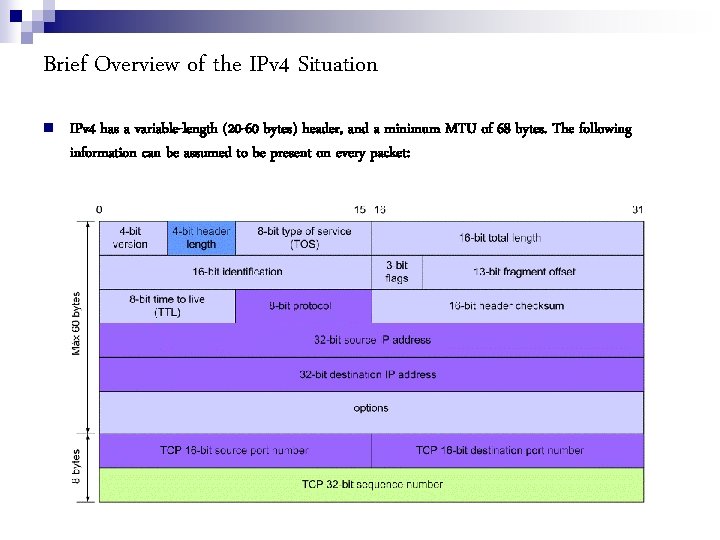
Brief Overview of the IPv 4 Situation IPv 4 has a variable-length (20 -60 bytes) header, and a minimum MTU of 68 bytes. The following information can be assumed to be present on every packet:
Brief Overview of the IPv 4 Situation IPv 4 has a variable-length (20 -60 bytes) header, and a minimum MTU of 68 bytes. The following information can be assumed to be present on every packet:
Brief Overview of the IPv 6 Situation The variable length-header has been replaced by a fixed-length (40 bytes) header Any IPv 6 options are included in “extension headers” that form a “header chain” For example,
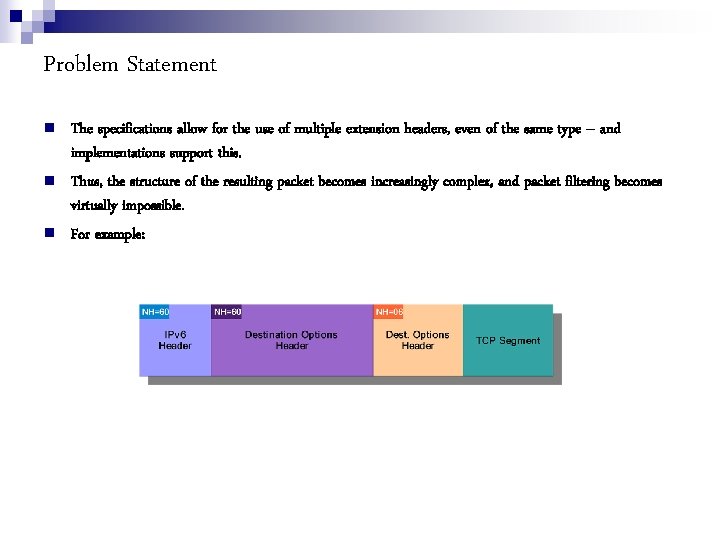
Problem Statement The specifications allow for the use of multiple extension headers, even of the same type – and implementations support this. Thus, the structure of the resulting packet becomes increasingly complex, and packet filtering becomes virtually impossible. For example:
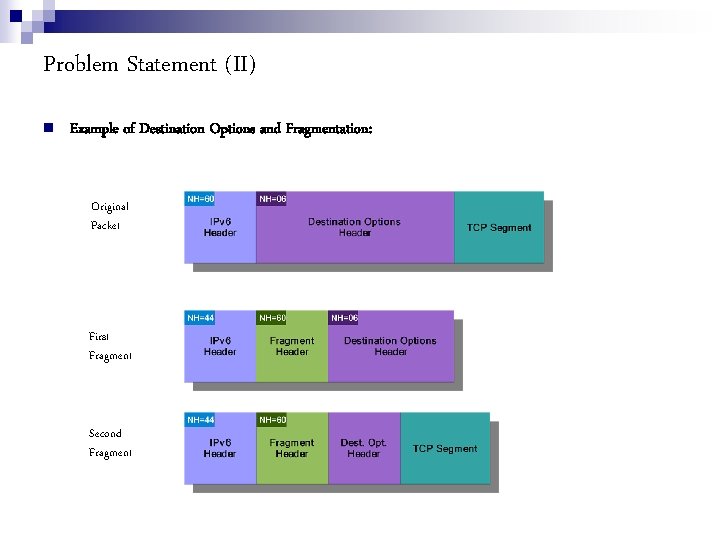
Problem Statement (II) Example of Destination Options and Fragmentation: Original Packet First Fragment Second Fragment
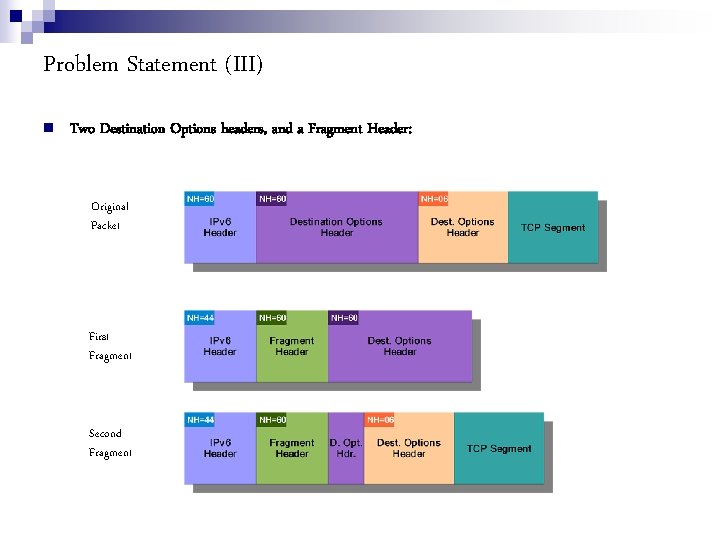
Problem Statement (III) Two Destination Options headers, and a Fragment Header: Original Packet First Fragment Second Fragment
Possible Countermeasures Use a stateful firewall that reassembles the fragments, and then applies the packet filtering rules Filter (in firewalls and/or hosts) packets with specific combinations of extension headers: Packets with multiple extension headers (e. g. , more than 5) Packets that combine fragmentation and other extension headers The possible countermeasures are reduced if filtering is to be performed in layer-2 devices (e. g. , RAGuard)
Some Conclusions IPv 6 can be easily leveraged for evading firewalls. Most likely, firewalls will block packets with extension headers. Es muy probable que se haga común el filtrado (en firewalls) de paquetes que contengan en encabezados de extensión The result will be: less flexibility, possibly preventing any use of IPv 6 exntesion headers
Internet Control Message Protocol version 6 (ICMPv 6)
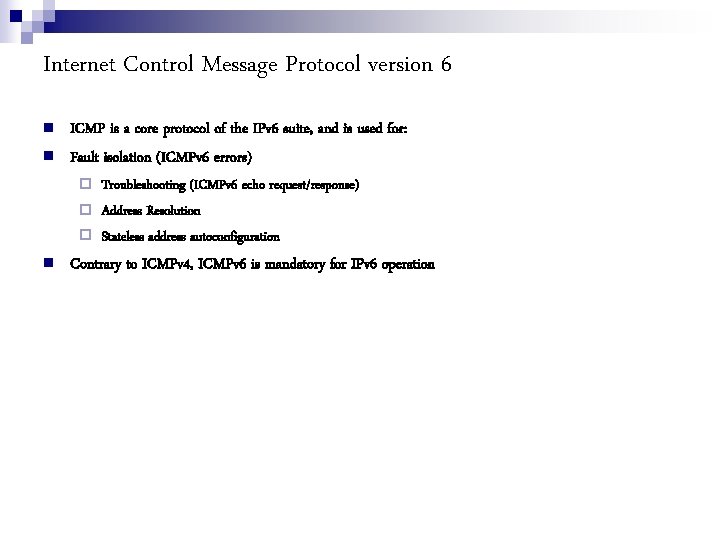
Internet Control Message Protocol version 6 ICMP is a core protocol of the IPv 6 suite, and is used for: Fault isolation (ICMPv 6 errors) Troubleshooting (ICMPv 6 echo request/response) Address Resolution Stateless address autoconfiguration Contrary to ICMPv 4, ICMPv 6 is mandatory for IPv 6 operation
ICMPv 6 Error Messages
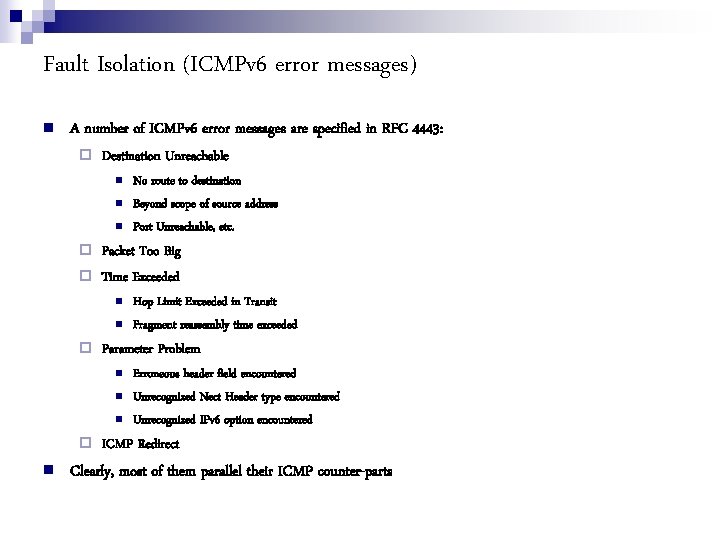
Fault Isolation (ICMPv 6 error messages) A number of ICMPv 6 error messages are specified in RFC 4443: Destination Unreachable No route to destination Beyond scope of source address Port Unreachable, etc. Packet Too Big Time Exceeded Parameter Problem Hop Limit Exceeded in Transit Fragment reassembly time exceeded Erroneous header field encountered Unrecognized Nect Header type encountered Unrecognized IPv 6 option encountered ICMP Redirect Clearly, most of them parallel their ICMP counter-parts
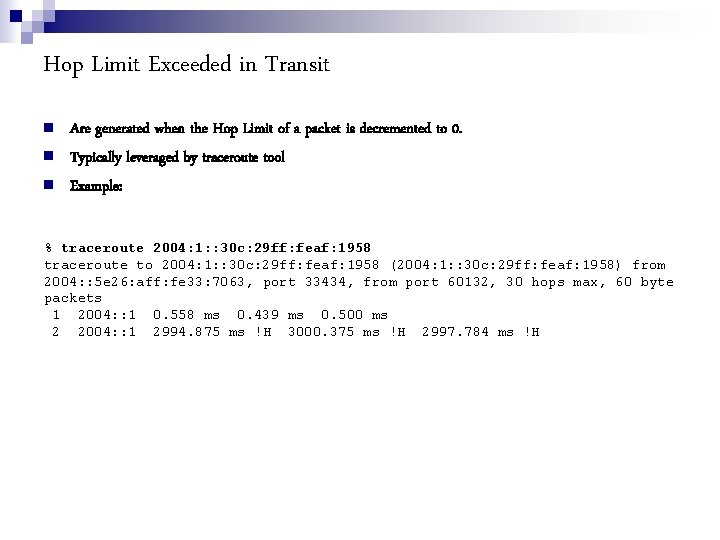
Hop Limit Exceeded in Transit Are generated when the Hop Limit of a packet is decremented to 0. Typically leveraged by traceroute tool Example: % traceroute 2004: 1: : 30 c: 29 ff: feaf: 1958 traceroute to 2004: 1: : 30 c: 29 ff: feaf: 1958 (2004: 1: : 30 c: 29 ff: feaf: 1958) from 2004: : 5 e 26: aff: fe 33: 7063, port 33434, from port 60132, 30 hops max, 60 byte packets 1 2004: : 1 0. 558 ms 0. 439 ms 0. 500 ms 2 2004: : 1 2994. 875 ms !H 3000. 375 ms !H 2997. 784 ms !H
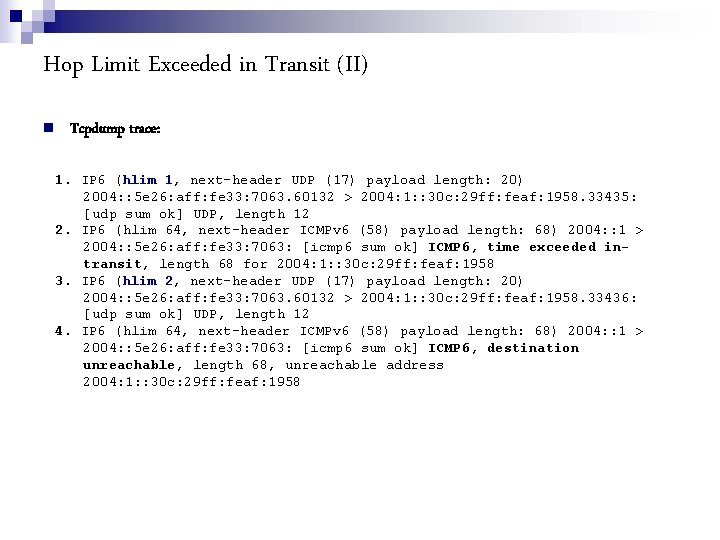
Hop Limit Exceeded in Transit (II) Tcpdump trace: 1. IP 6 (hlim 1, next-header UDP (17) payload length: 20) 2004: : 5 e 26: aff: fe 33: 7063. 60132 > 2004: 1: : 30 c: 29 ff: feaf: 1958. 33435: [udp sum ok] UDP, length 12 2. IP 6 (hlim 64, next-header ICMPv 6 (58) payload length: 68) 2004: : 1 > 2004: : 5 e 26: aff: fe 33: 7063: [icmp 6 sum ok] ICMP 6, time exceeded intransit, length 68 for 2004: 1: : 30 c: 29 ff: feaf: 1958 3. IP 6 (hlim 2, next-header UDP (17) payload length: 20) 2004: : 5 e 26: aff: fe 33: 7063. 60132 > 2004: 1: : 30 c: 29 ff: feaf: 1958. 33436: [udp sum ok] UDP, length 12 4. IP 6 (hlim 64, next-header ICMPv 6 (58) payload length: 68) 2004: : 1 > 2004: : 5 e 26: aff: fe 33: 7063: [icmp 6 sum ok] ICMP 6, destination unreachable, length 68, unreachable address 2004: 1: : 30 c: 29 ff: feaf: 1958
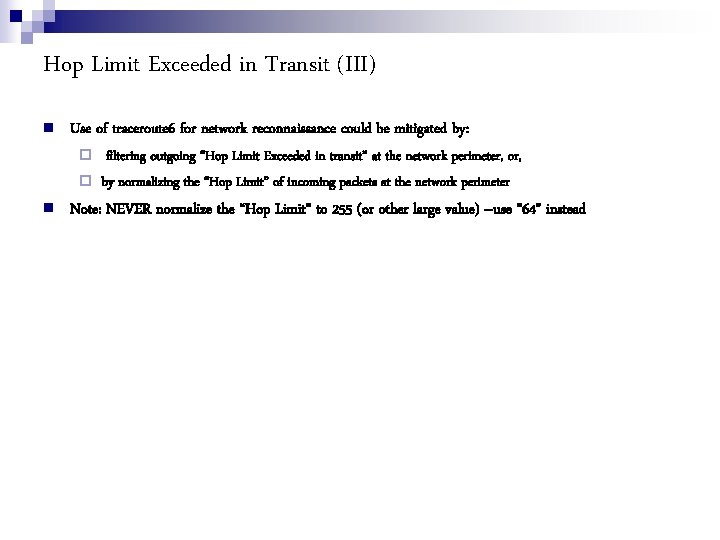
Hop Limit Exceeded in Transit (III) Use of traceroute 6 for network reconnaissance could be mitigated by: filtering outgoing “Hop Limit Exceeded in transit” at the network perimeter, or, by normalizing the “Hop Limit” of incoming packets at the network perimeter Note: NEVER normalize the “Hop Limit” to 255 (or other large value) –use “ 64” instead
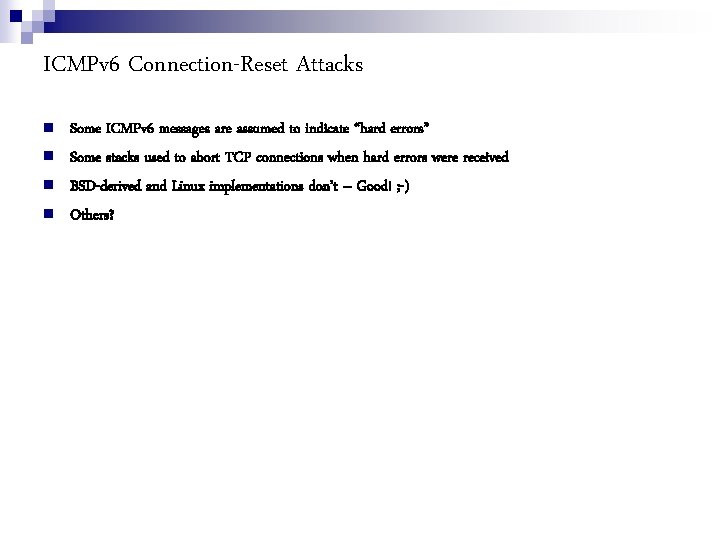
ICMPv 6 Connection-Reset Attacks Some ICMPv 6 messages are assumed to indicate “hard errors” Some stacks used to abort TCP connections when hard errors were received BSD-derived and Linux implementations don’t – Good! ; -) Others?
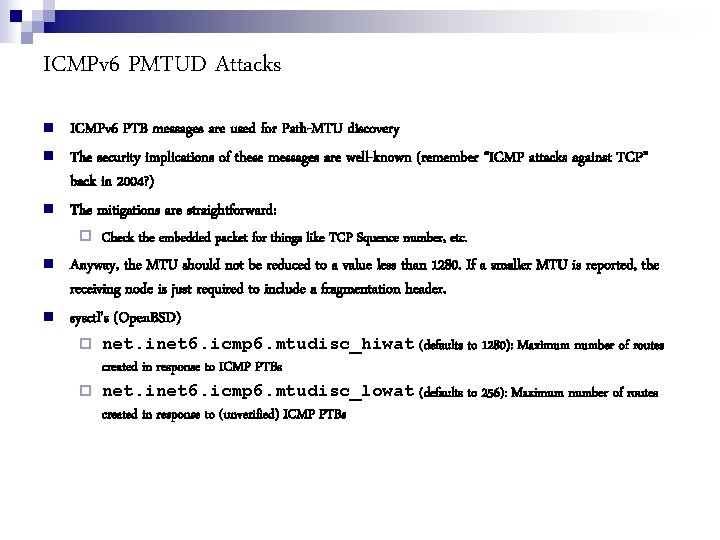
ICMPv 6 PMTUD Attacks ICMPv 6 PTB messages are used for Path-MTU discovery The security implications of these messages are well-known (remember “ICMP attacks against TCP” back in 2004? ) The mitigations are straightforward: Check the embedded packet for things like TCP Squence number, etc. Anyway, the MTU should not be reduced to a value less than 1280. If a smaller MTU is reported, the receiving node is just required to include a fragmentation header. sysctl’s (Open. BSD) net. inet 6. icmp 6. mtudisc_hiwat (defaults to 1280): Maximum number of routes created in response to ICMP PTBs net. inet 6. icmp 6. mtudisc_lowat (defaults to 256): Maximum number of routes created in response to (unverified) ICMP PTBs
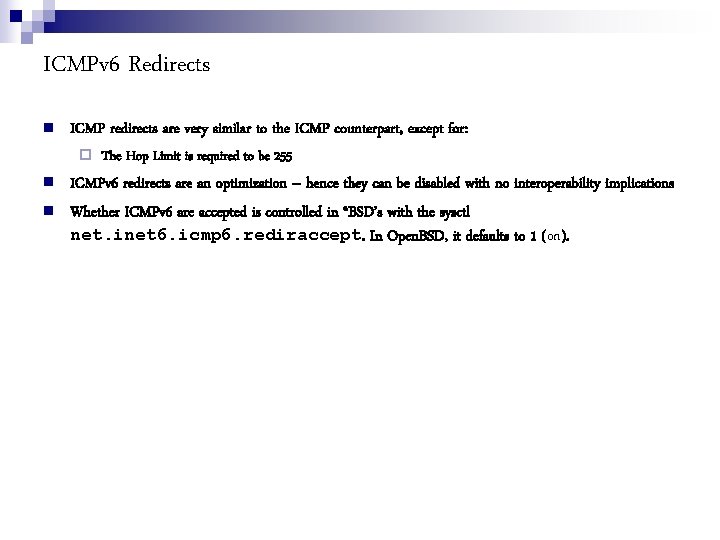
ICMPv 6 Redirects ICMP redirects are very similar to the ICMP counterpart, except for: The Hop Limit is required to be 255 ICMPv 6 redirects are an optimization – hence they can be disabled with no interoperability implications Whether ICMPv 6 are accepted is controlled in *BSD’s with the sysctl net. inet 6. icmp 6. rediraccept. In Open. BSD, it defaults to 1 (on).
ICMPv 6 Informational Messages
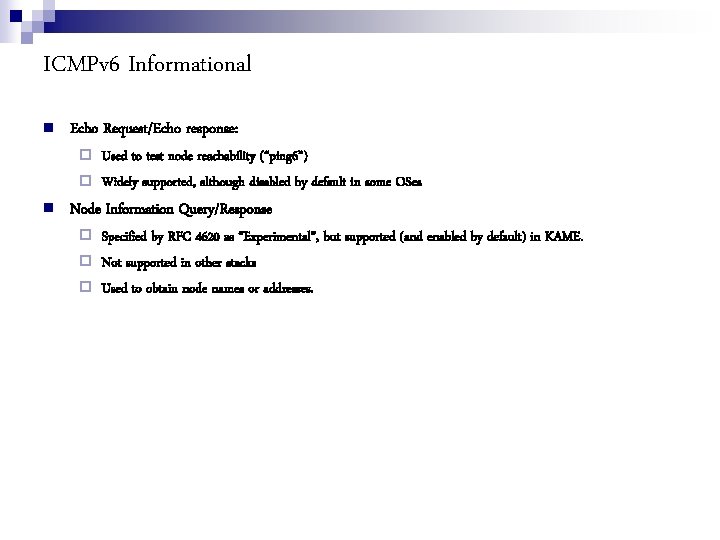
ICMPv 6 Informational Echo Request/Echo response: Used to test node reachability (“ping 6”) Widely supported, although disabled by default in some OSes Node Information Query/Response Specified by RFC 4620 as “Experimental”, but supported (and enabled by default) in KAME. Not supported in other stacks Used to obtain node names or addresses.
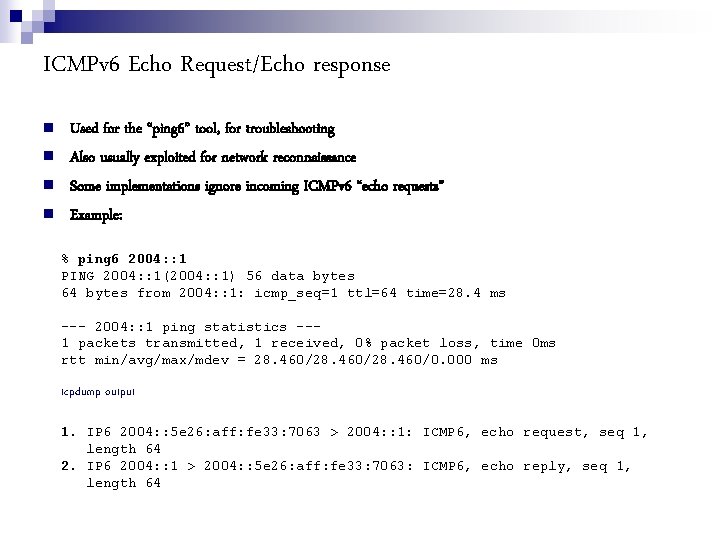
ICMPv 6 Echo Request/Echo response Used for the “ping 6” tool, for troubleshooting Also usually exploited for network reconnaissance Some implementations ignore incoming ICMPv 6 “echo requests” Example: % ping 6 2004: : 1 PING 2004: : 1(2004: : 1) 56 data bytes 64 bytes from 2004: : 1: icmp_seq=1 ttl=64 time=28. 4 ms --- 2004: : 1 ping statistics --1 packets transmitted, 1 received, 0% packet loss, time 0 ms rtt min/avg/max/mdev = 28. 460/28. 460/0. 000 ms tcpdump output 1. IP 6 2004: : 5 e 26: aff: fe 33: 7063 > 2004: : 1: ICMP 6, echo request, seq 1, length 64 2. IP 6 2004: : 1 > 2004: : 5 e 26: aff: fe 33: 7063: ICMP 6, echo reply, seq 1, length 64
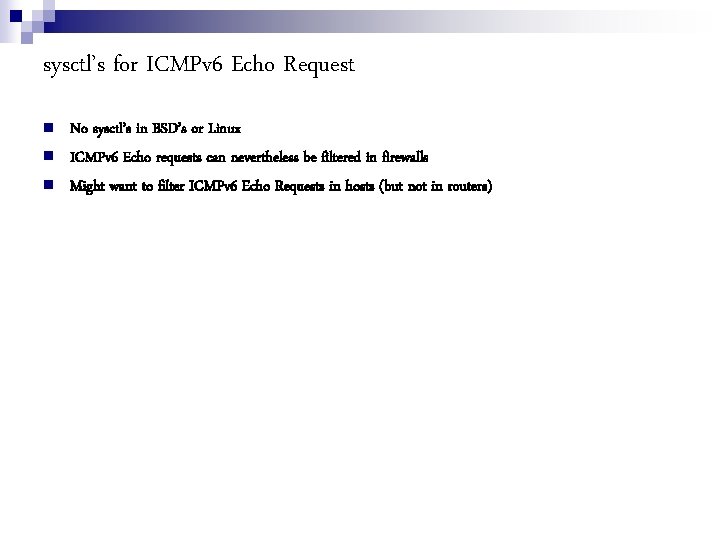
sysctl’s for ICMPv 6 Echo Request No sysctl’s in BSD’s or Linux ICMPv 6 Echo requests can nevertheless be filtered in firewalls Might want to filter ICMPv 6 Echo Requests in hosts (but not in routers)
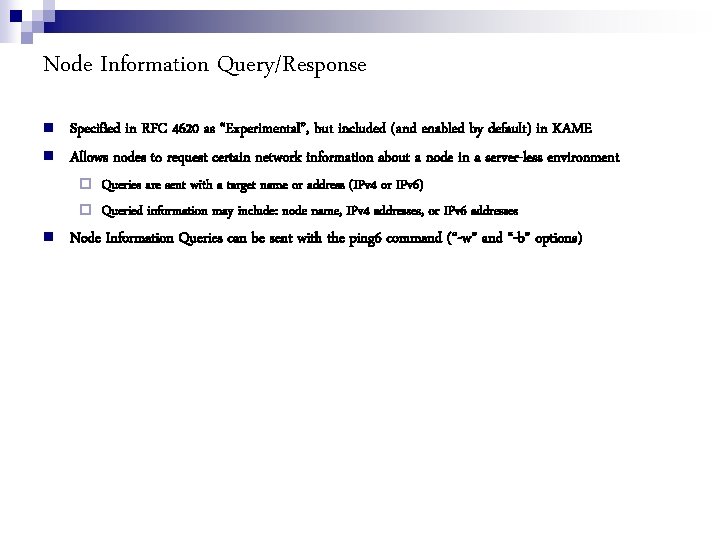
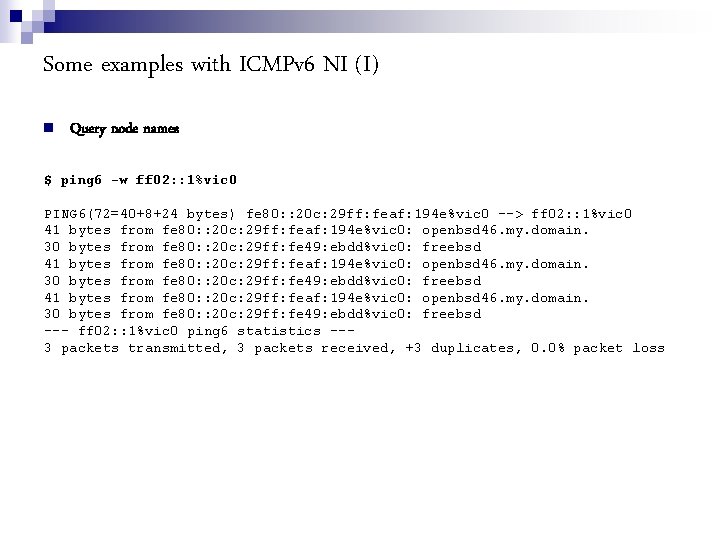
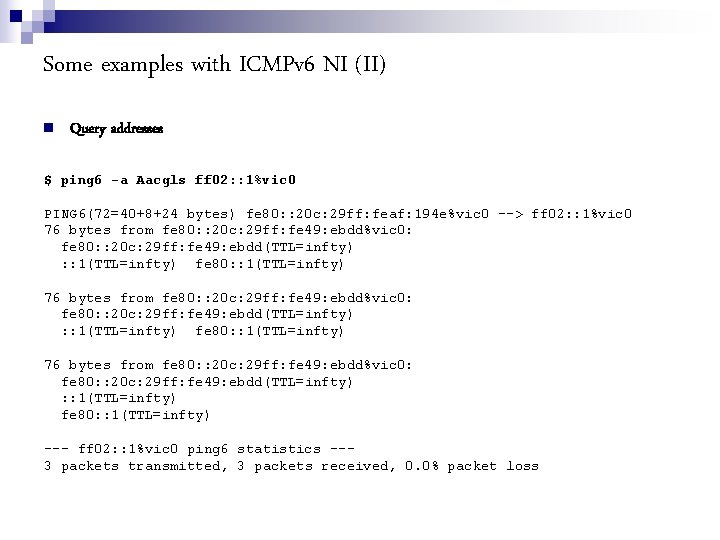
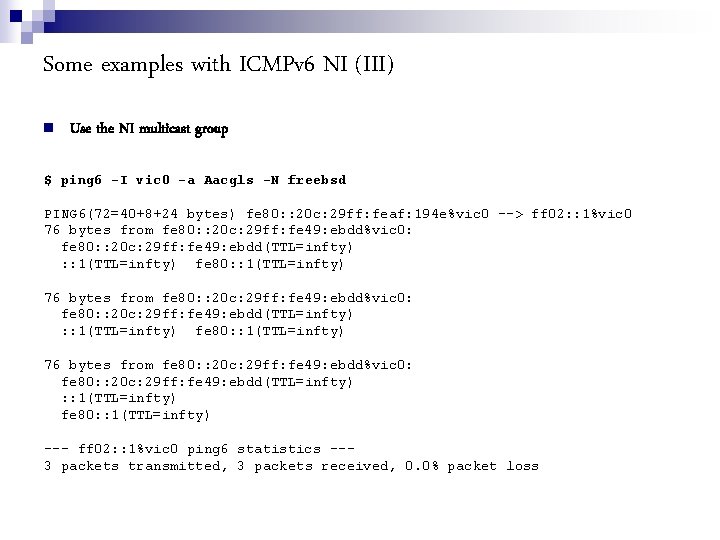
Node Information Query/Response Specified in RFC 4620 as “Experimental”, but included (and enabled by default) in KAME Allows nodes to request certain network information about a node in a server-less environment Queries are sent with a target name or address (IPv 4 or IPv 6) Queried information may include: node name, IPv 4 addresses, or IPv 6 addresses Node Information Queries can be sent with the ping 6 command (“-w” and “-b” options)
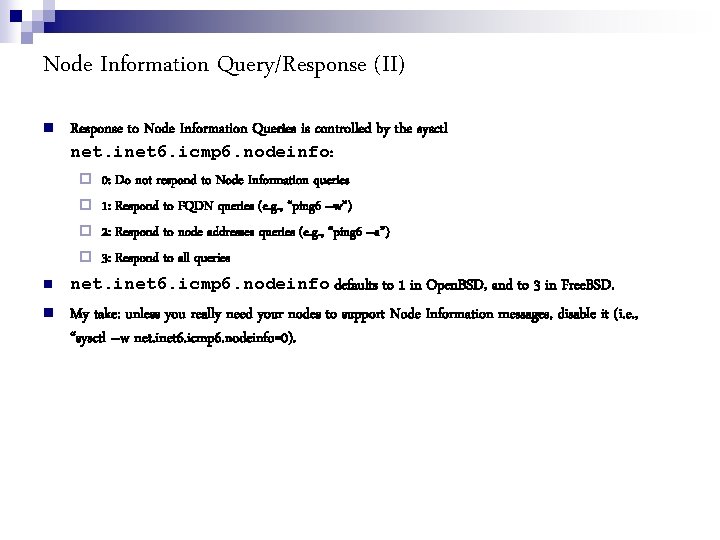
Node Information Query/Response (II) Response to Node Information Queries is controlled by the sysctl net. inet 6. icmp 6. nodeinfo: 0: Do not respond to Node Information queries 1: Respond to FQDN queries (e. g. , “ping 6 –w”) 2: Respond to node addresses queries (e. g. , “ping 6 –a”) 3: Respond to all queries net. inet 6. icmp 6. nodeinfo defaults to 1 in Open. BSD, and to 3 in Free. BSD. My take: unless you really need your nodes to support Node Information messages, disable it (i. e. , “sysctl –w net. inet 6. icmp 6. nodeinfo=0).
Some examples with ICMPv 6 NI (I) Query node names $ ping 6 -w ff 02: : 1%vic 0 PING 6(72=40+8+24 bytes) fe 80: : 20 c: 29 ff: feaf: 194 e%vic 0 --> ff 02: : 1%vic 0 41 bytes from fe 80: : 20 c: 29 ff: feaf: 194 e%vic 0: openbsd 46. my. domain. 30 bytes from fe 80: : 20 c: 29 ff: fe 49: ebdd%vic 0: freebsd --- ff 02: : 1%vic 0 ping 6 statistics --3 packets transmitted, 3 packets received, +3 duplicates, 0. 0% packet loss
Some examples with ICMPv 6 NI (II) Query addresses $ ping 6 -a Aacgls ff 02: : 1%vic 0 PING 6(72=40+8+24 bytes) fe 80: : 20 c: 29 ff: feaf: 194 e%vic 0 --> ff 02: : 1%vic 0 76 bytes from fe 80: : 20 c: 29 ff: fe 49: ebdd%vic 0: fe 80: : 20 c: 29 ff: fe 49: ebdd(TTL=infty) : : 1(TTL=infty) fe 80: : 1(TTL=infty) --- ff 02: : 1%vic 0 ping 6 statistics --3 packets transmitted, 3 packets received, 0. 0% packet loss
Some examples with ICMPv 6 NI (III) Use the NI multicast group $ ping 6 -I vic 0 -a Aacgls -N freebsd PING 6(72=40+8+24 bytes) fe 80: : 20 c: 29 ff: feaf: 194 e%vic 0 --> ff 02: : 1%vic 0 76 bytes from fe 80: : 20 c: 29 ff: fe 49: ebdd%vic 0: fe 80: : 20 c: 29 ff: fe 49: ebdd(TTL=infty) : : 1(TTL=infty) fe 80: : 1(TTL=infty) --- ff 02: : 1%vic 0 ping 6 statistics --3 packets transmitted, 3 packets received, 0. 0% packet loss
Address Resolution
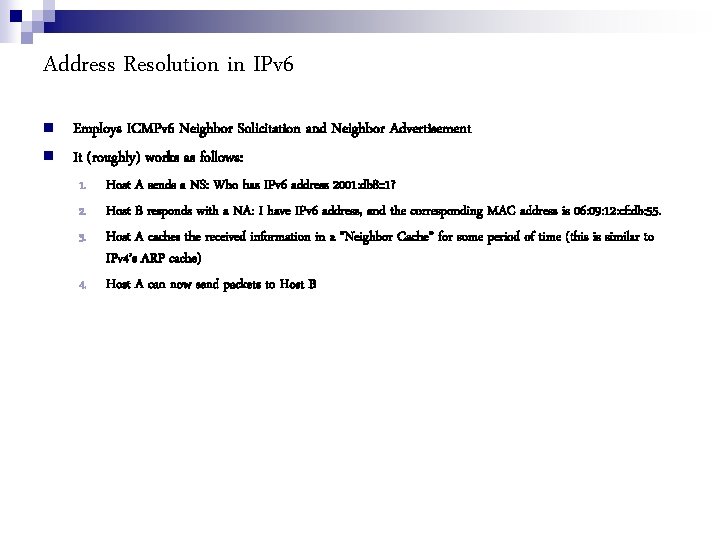
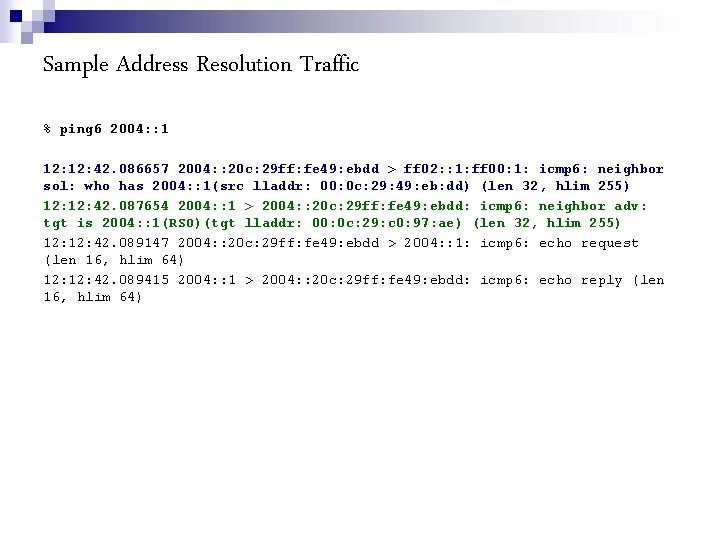
Address Resolution in IPv 6 Employs ICMPv 6 Neighbor Solicitation and Neighbor Advertisement It (roughly) works as follows: 1. 2. 3. 4. Host A sends a NS: Who has IPv 6 address 2001: db 8: : 1? Host B responds with a NA: I have IPv 6 address, and the corresponding MAC address is 06: 09: 12: cf: db: 55. Host A caches the received information in a “Neighbor Cache” for some period of time (this is similar to IPv 4’s ARP cache) Host A can now send packets to Host B
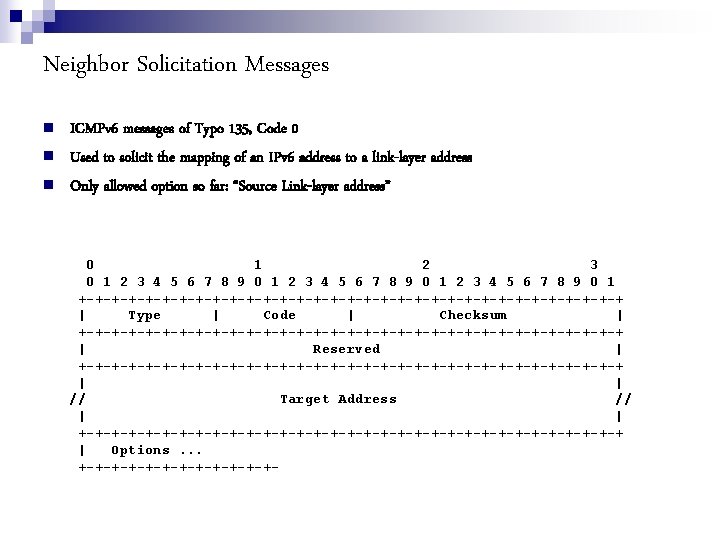
Neighbor Solicitation Messages ICMPv 6 messages of Typo 135, Code 0 Used to solicit the mapping of an IPv 6 address to a link-layer address Only allowed option so far: “Source Link-layer address” 0 1 2 3 4 5 6 7 8 9 0 1 +-+-+-+-+-+-+-+-+-+-+-+-+-+-+-+-+ | Type | Code | Checksum | +-+-+-+-+-+-+-+-+-+-+-+-+-+-+-+-+ | Reserved | +-+-+-+-+-+-+-+-+-+-+-+-+-+-+-+-+ | | // Target Address // | | +-+-+-+-+-+-+-+-+-+-+-+-+-+-+-+-+ | Options. . . +-+-+-+-+-+-
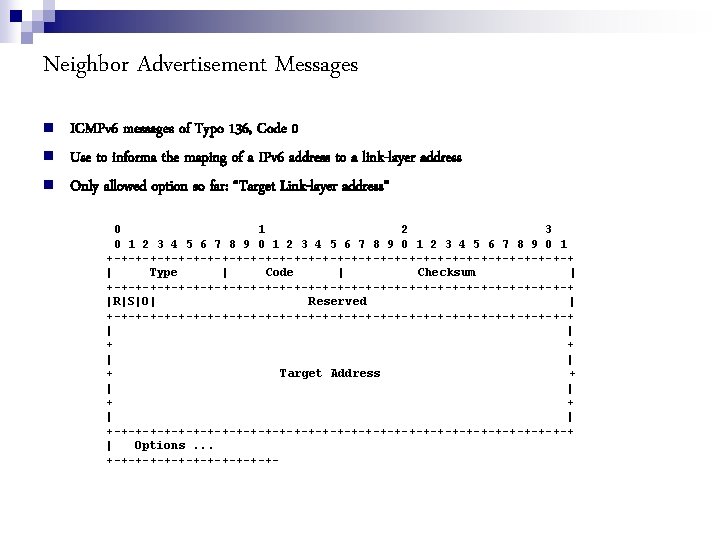
Neighbor Advertisement Messages ICMPv 6 messages of Typo 136, Code 0 Use to informa the maping of a IPv 6 address to a link-layer address Only allowed option so far: “Target Link-layer address” 0 1 2 3 4 5 6 7 8 9 0 1 +-+-+-+-+-+-+-+-+-+-+-+-+-+-+-+-+ | Type | Code | Checksum | +-+-+-+-+-+-+-+-+-+-+-+-+-+-+-+-+ |R|S|O| Reserved | +-+-+-+-+-+-+-+-+-+-+-+-+-+-+-+-+ | | + Target Address + | | +-+-+-+-+-+-+-+-+-+-+-+-+-+-+-+-+ | Options. . . +-+-+-+-+-+-
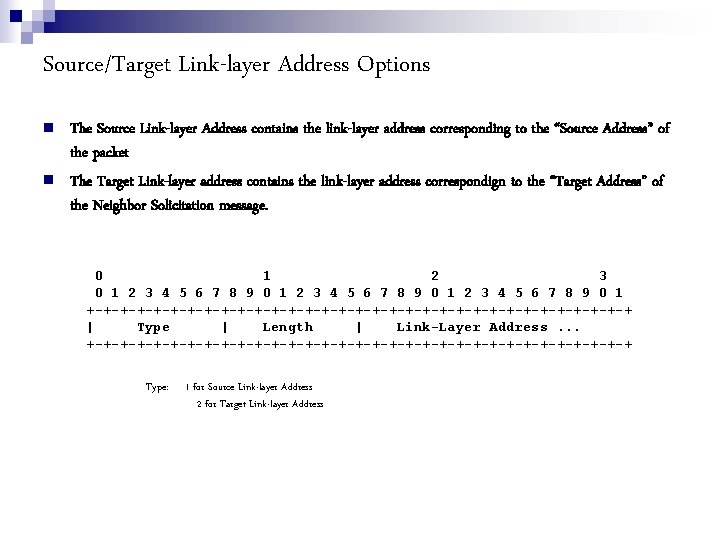
Source/Target Link-layer Address Options The Source Link-layer Address contains the link-layer address corresponding to the “Source Address” of the packet The Target Link-layer address contains the link-layer address correspondign to the “Target Address” of the Neighbor Solicitation message. 0 1 2 3 4 5 6 7 8 9 0 1 +-+-+-+-+-+-+-+-+-+-+-+-+-+-+-+-+ | Type | Length | Link-Layer Address. . . +-+-+-+-+-+-+-+-+-+-+-+-+-+-+-+-+ Type: 1 for Source Link-layer Address 2 for Target Link-layer Address
Sample Address Resolution Traffic % ping 6 2004: : 1 12: 42. 086657 2004: : 20 c: 29 ff: fe 49: ebdd > ff 02: : 1: ff 00: 1: icmp 6: neighbor sol: who has 2004: : 1(src lladdr: 00: 0 c: 29: 49: eb: dd) (len 32, hlim 255) 12: 42. 087654 2004: : 1 > 2004: : 20 c: 29 ff: fe 49: ebdd: icmp 6: neighbor adv: tgt is 2004: : 1(RSO)(tgt lladdr: 00: 0 c: 29: c 0: 97: ae) (len 32, hlim 255) 12: 42. 089147 2004: : 20 c: 29 ff: fe 49: ebdd > 2004: : 1: icmp 6: echo request (len 16, hlim 64) 12: 42. 089415 2004: : 1 > 2004: : 20 c: 29 ff: fe 49: ebdd: icmp 6: echo reply (len 16, hlim 64)
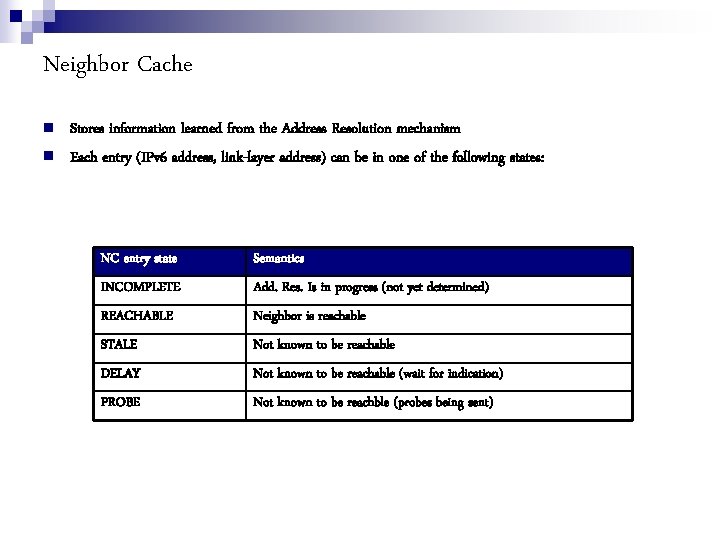
Neighbor Cache Stores information learned from the Address Resolution mechanism Each entry (IPv 6 address, link-layer address) can be in one of the following states: NC entry state Semantics INCOMPLETE Add. Res. Is in progress (not yet determined) REACHABLE Neighbor is reachable STALE Not known to be reachable DELAY Not known to be reachable (wait for indication) PROBE Not known to be reachble (probes being sent)
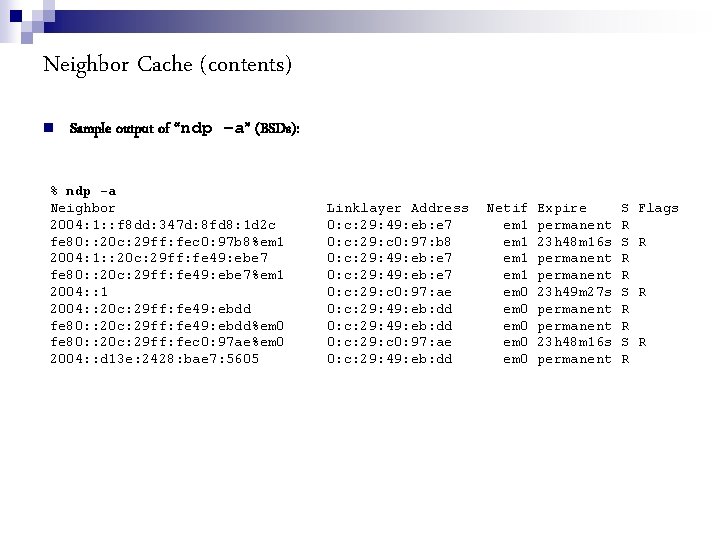
Neighbor Cache (contents) Sample output of “ndp –a” (BSDs): % ndp -a Neighbor 2004: 1: : f 8 dd: 347 d: 8 fd 8: 1 d 2 c fe 80: : 20 c: 29 ff: fec 0: 97 b 8%em 1 2004: 1: : 20 c: 29 ff: fe 49: ebe 7 fe 80: : 20 c: 29 ff: fe 49: ebe 7%em 1 2004: : 20 c: 29 ff: fe 49: ebdd fe 80: : 20 c: 29 ff: fe 49: ebdd%em 0 fe 80: : 20 c: 29 ff: fec 0: 97 ae%em 0 2004: : d 13 e: 2428: bae 7: 5605 Linklayer Address 0: c: 29: 49: eb: e 7 0: c: 29: c 0: 97: b 8 0: c: 29: 49: eb: e 7 0: c: 29: c 0: 97: ae 0: c: 29: 49: eb: dd Netif em 1 em 0 em 0 Expire permanent 23 h 48 m 16 s permanent 23 h 49 m 27 s permanent 23 h 48 m 16 s permanent S R R S R Flags R R R
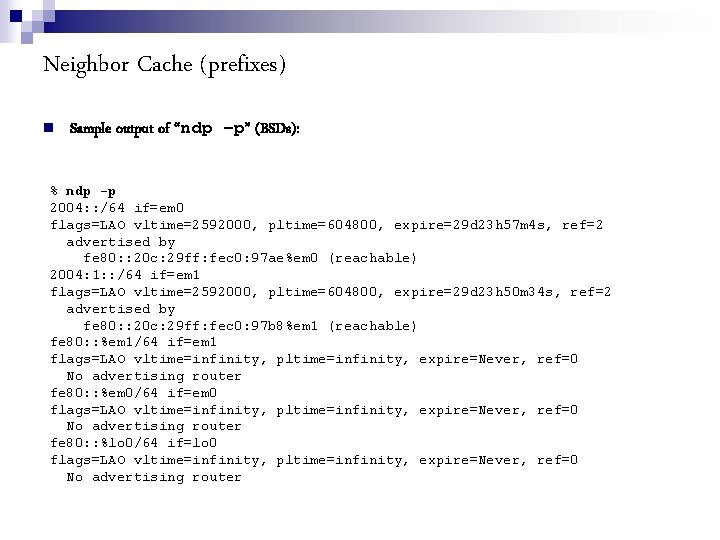
Neighbor Cache (prefixes) Sample output of “ndp –p” (BSDs): % ndp -p 2004: : /64 if=em 0 flags=LAO vltime=2592000, pltime=604800, expire=29 d 23 h 57 m 4 s, ref=2 advertised by fe 80: : 20 c: 29 ff: fec 0: 97 ae%em 0 (reachable) 2004: 1: : /64 if=em 1 flags=LAO vltime=2592000, pltime=604800, expire=29 d 23 h 50 m 34 s, ref=2 advertised by fe 80: : 20 c: 29 ff: fec 0: 97 b 8%em 1 (reachable) fe 80: : %em 1/64 if=em 1 flags=LAO vltime=infinity, pltime=infinity, expire=Never, ref=0 No advertising router fe 80: : %em 0/64 if=em 0 flags=LAO vltime=infinity, pltime=infinity, expire=Never, ref=0 No advertising router fe 80: : %lo 0/64 if=lo 0 flags=LAO vltime=infinity, pltime=infinity, expire=Never, ref=0 No advertising router
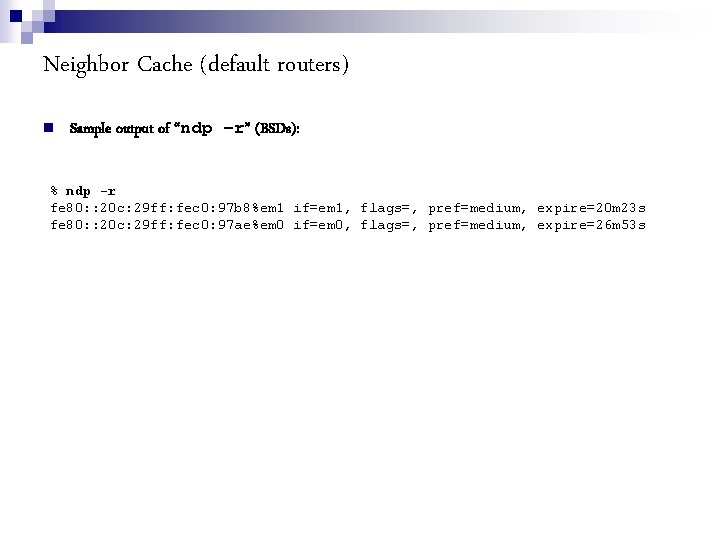
Neighbor Cache (default routers) Sample output of “ndp –r” (BSDs): % ndp -r fe 80: : 20 c: 29 ff: fec 0: 97 b 8%em 1 if=em 1, flags=, pref=medium, expire=20 m 23 s fe 80: : 20 c: 29 ff: fec 0: 97 ae%em 0 if=em 0, flags=, pref=medium, expire=26 m 53 s
Address Resolution sample attacks…
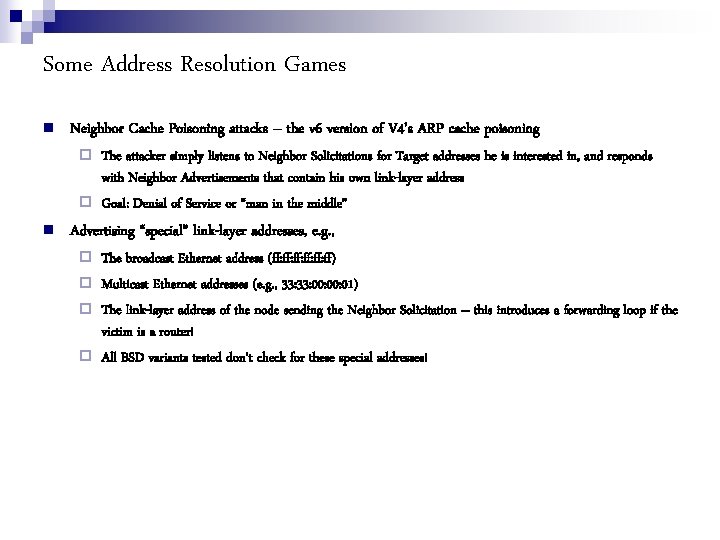
Some Address Resolution Games Neighbor Cache Poisoning attacks – the v 6 version of V 4’s ARP cache poisoning The attacker simply listens to Neighbor Solicitations for Target addresses he is interested in, and responds with Neighbor Advertisements that contain his own link-layer address Goal: Denial of Service or “man in the middle” Advertising “special” link-layer addresses, e. g. , The broadcast Ethernet address (ff: ff: ff: ff) Multicast Ethernet addresses (e. g. , 33: 00: 01) The link-layer address of the node sending the Neighbor Solicitation – this introduces a forwarding loop if the victim is a router! All BSD variants tested don’t check for these special addresses!
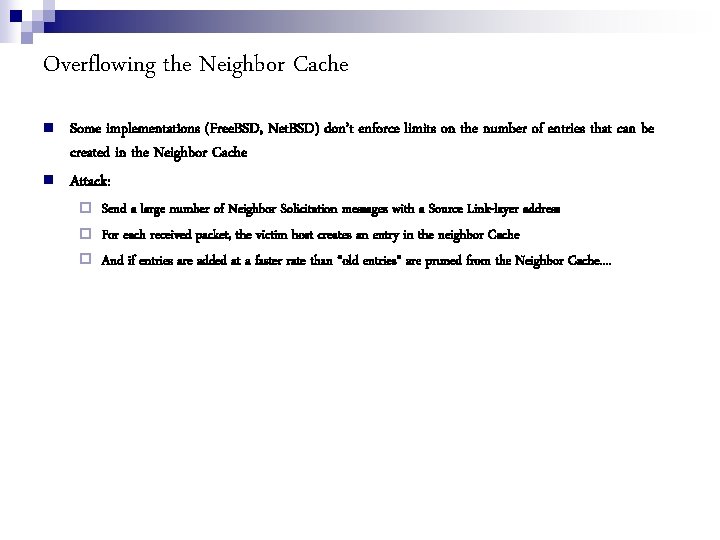
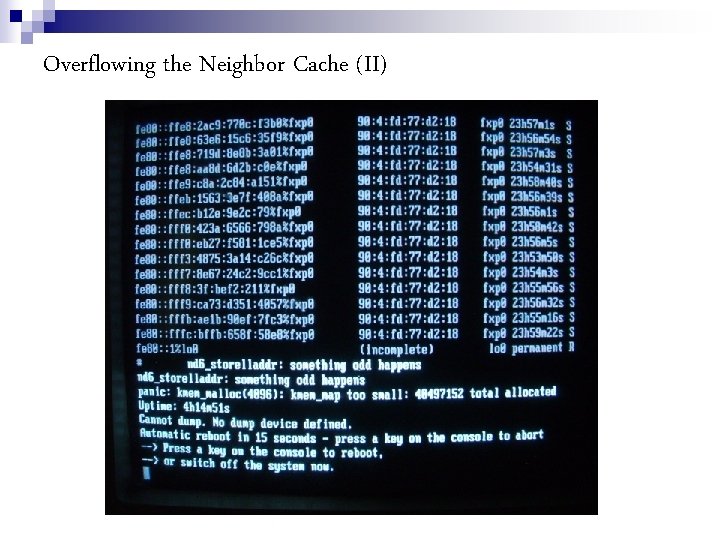
Overflowing the Neighbor Cache Some implementations (Free. BSD, Net. BSD) don’t enforce limits on the number of entries that can be created in the Neighbor Cache Attack: Send a large number of Neighbor Solicitation messages with a Source Link-layer address For each received packet, the victim host creates an entry in the neighbor Cache And if entries are added at a faster rate than “old entries” are pruned from the Neighbor Cache. .
Overflowing the Neighbor Cache (II)
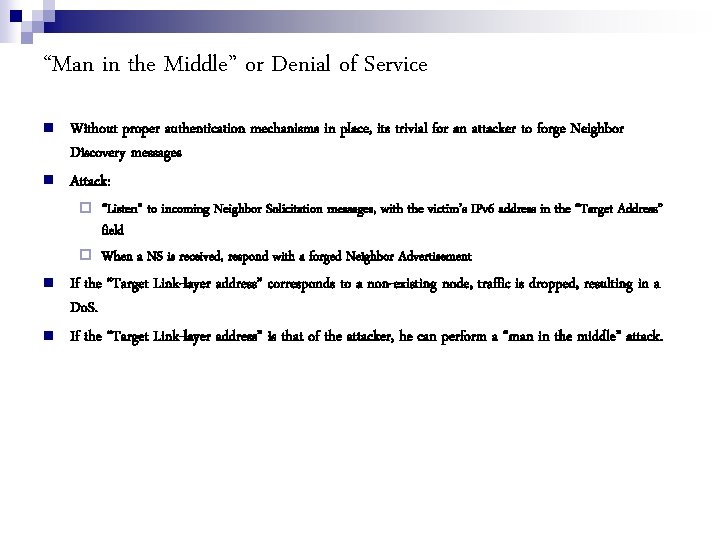
“Man in the Middle” or Denial of Service Without proper authentication mechanisms in place, its trivial for an attacker to forge Neighbor Discovery messages Attack: “Listen” to incoming Neighbor Solicitation messages, with the victim’s IPv 6 address in the “Target Address” field When a NS is received, respond with a forged Neighbor Advertisement If the “Target Link-layer address” corresponds to a non-existing node, traffic is dropped, resulting in a Do. S. If the “Target Link-layer address” is that of the attacker, he can perform a “man in the middle” attack.
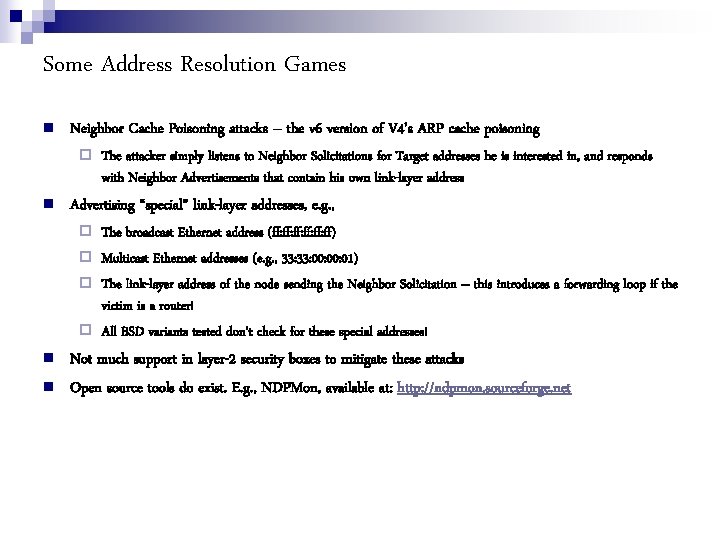
Some Address Resolution Games Neighbor Cache Poisoning attacks – the v 6 version of V 4’s ARP cache poisoning The attacker simply listens to Neighbor Solicitations for Target addresses he is interested in, and responds with Neighbor Advertisements that contain his own link-layer address Advertising “special” link-layer addresses, e. g. , The broadcast Ethernet address (ff: ff: ff: ff) Multicast Ethernet addresses (e. g. , 33: 00: 01) The link-layer address of the node sending the Neighbor Solicitation – this introduces a forwarding loop if the victim is a router! All BSD variants tested don’t check for these special addresses! Not much support in layer-2 security boxes to mitigate these attacks Open source tools do exist. E. g. , NDPMon, available at: http: //ndpmon. sourceforge. net
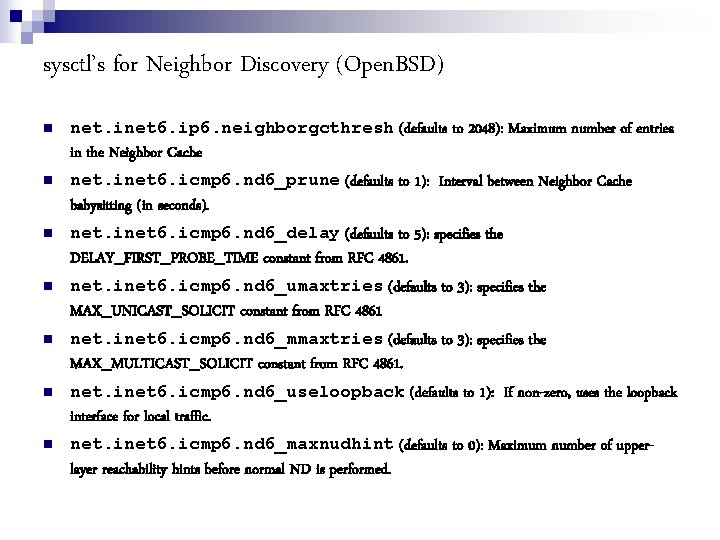
sysctl’s for Neighbor Discovery (Open. BSD) net. inet 6. ip 6. neighborgcthresh (defaults to 2048): Maximum number of entries in the Neighbor Cache net. inet 6. icmp 6. nd 6_prune (defaults to 1): Interval between Neighbor Cache babysitting (in seconds). net. inet 6. icmp 6. nd 6_delay (defaults to 5): specifies the DELAY_FIRST_PROBE_TIME constant from RFC 4861. net. inet 6. icmp 6. nd 6_umaxtries (defaults to 3): specifies the MAX_UNICAST_SOLICIT constant from RFC 4861 net. inet 6. icmp 6. nd 6_mmaxtries (defaults to 3): specifies the MAX_MULTICAST_SOLICIT constant from RFC 4861. net. inet 6. icmp 6. nd 6_useloopback (defaults to 1): If non-zero, uses the loopback interface for local traffic. net. inet 6. icmp 6. nd 6_maxnudhint (defaults to 0): Maximum number of upperlayer reachability hints before normal ND is performed.
IPv 6 Stateless Address Autoconfiguration (SLAAC)
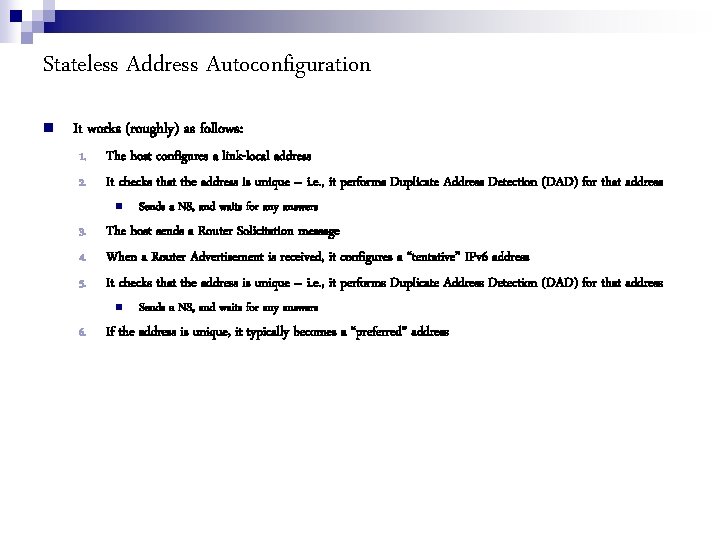
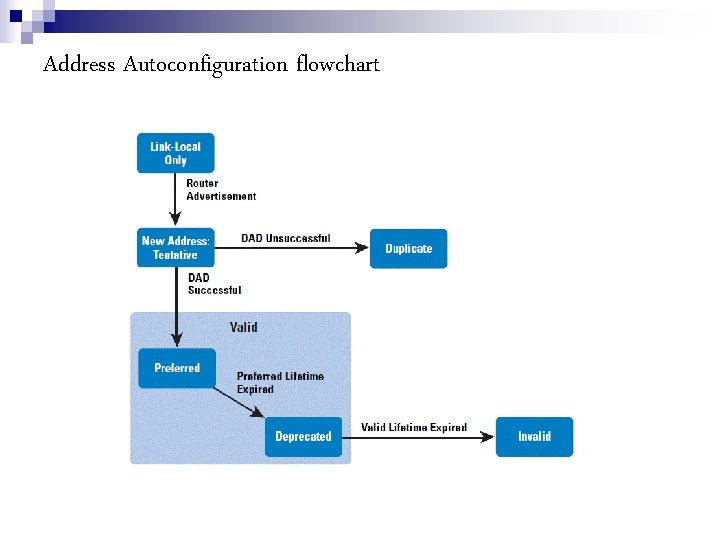
Stateless Address Autoconfiguration It works (roughly) as follows: 1. 2. The host configures a link-local address It checks that the address is unique – i. e. , it performs Duplicate Address Detection (DAD) for that address 3. 4. 5. The host sends a Router Solicitation message When a Router Advertisement is received, it configures a “tentative” IPv 6 address It checks that the address is unique – i. e. , it performs Duplicate Address Detection (DAD) for that address 6. Sends a NS, and waits for any answers If the address is unique, it typically becomes a “preferred” address
Address Autoconfiguration flowchart
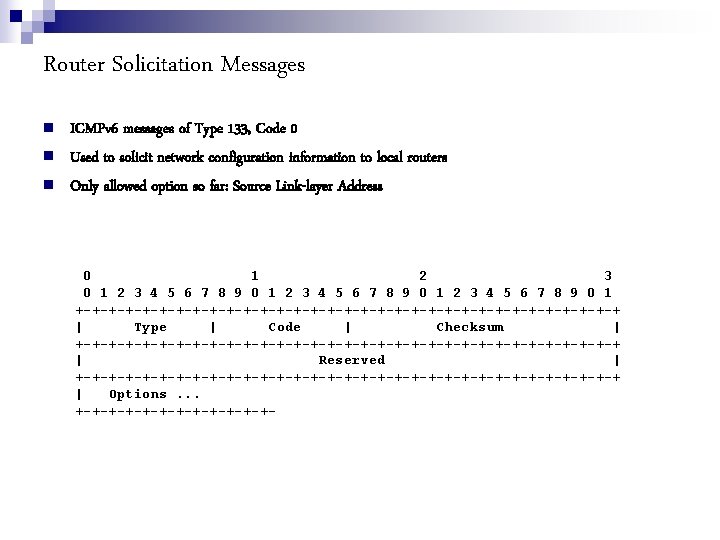
Router Solicitation Messages ICMPv 6 messages of Type 133, Code 0 Used to solicit network configuration information to local routers Only allowed option so far: Source Link-layer Address 0 1 2 3 4 5 6 7 8 9 0 1 +-+-+-+-+-+-+-+-+-+-+-+-+-+-+-+-+ | Type | Code | Checksum | +-+-+-+-+-+-+-+-+-+-+-+-+-+-+-+-+ | Reserved | +-+-+-+-+-+-+-+-+-+-+-+-+-+-+-+-+ | Options. . . +-+-+-+-+-+-
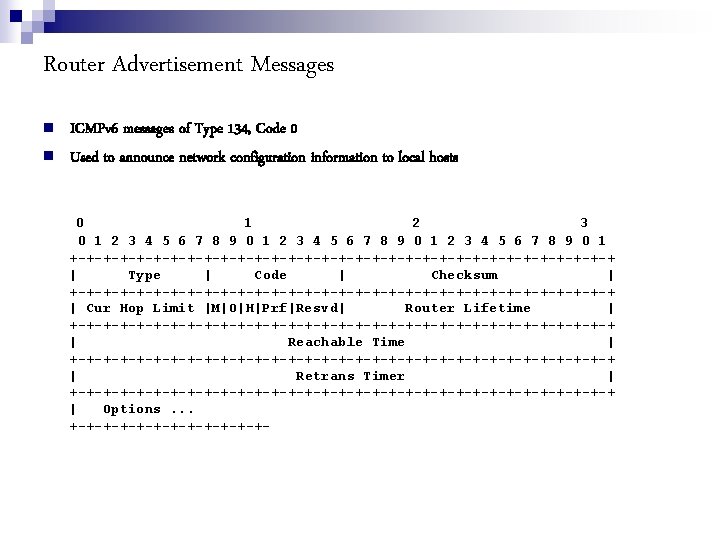
Router Advertisement Messages ICMPv 6 messages of Type 134, Code 0 Used to announce network configuration information to local hosts 0 1 2 3 4 5 6 7 8 9 0 1 +-+-+-+-+-+-+-+-+-+-+-+-+-+-+-+-+ | Type | Code | Checksum | +-+-+-+-+-+-+-+-+-+-+-+-+-+-+-+-+ | Cur Hop Limit |M|O|H|Prf|Resvd| Router Lifetime | +-+-+-+-+-+-+-+-+-+-+-+-+-+-+-+-+ | Reachable Time | +-+-+-+-+-+-+-+-+-+-+-+-+-+-+-+-+ | Retrans Timer | +-+-+-+-+-+-+-+-+-+-+-+-+-+-+-+-+ | Options. . . +-+-+-+-+-+-
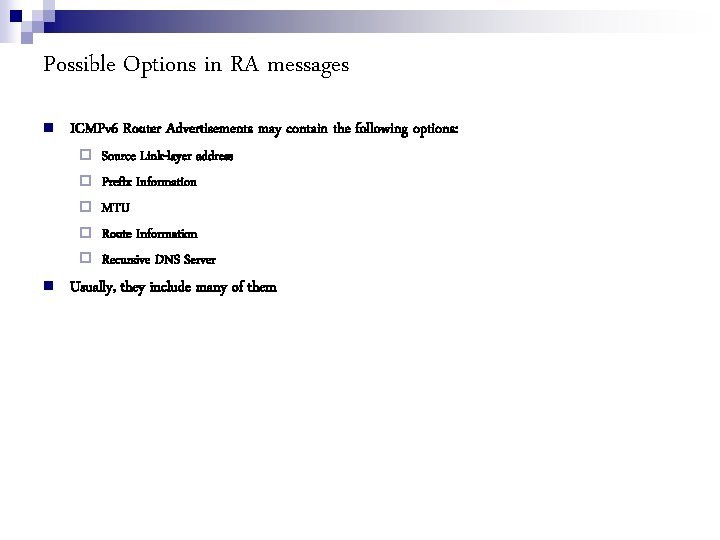
Possible Options in RA messages ICMPv 6 Router Advertisements may contain the following options: Source Link-layer address Prefix Information MTU Route Information Recursive DNS Server Usually, they include many of them
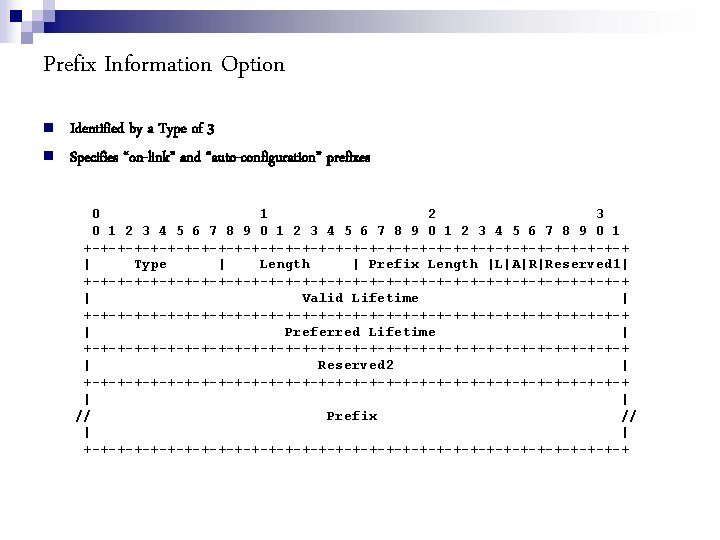
Prefix Information Option Identified by a Type of 3 Specifies “on-link” and “auto-configuration” prefixes 0 1 2 3 4 5 6 7 8 9 0 1 +-+-+-+-+-+-+-+-+-+-+-+-+-+-+-+-+ | Type | Length | Prefix Length |L|A|R|Reserved 1| +-+-+-+-+-+-+-+-+-+-+-+-+-+-+-+-+ | Valid Lifetime | +-+-+-+-+-+-+-+-+-+-+-+-+-+-+-+-+ | Preferred Lifetime | +-+-+-+-+-+-+-+-+-+-+-+-+-+-+-+-+ | Reserved 2 | +-+-+-+-+-+-+-+-+-+-+-+-+-+-+-+-+ | | // Prefix // | | +-+-+-+-+-+-+-+-+-+-+-+-+-+-+-+-+
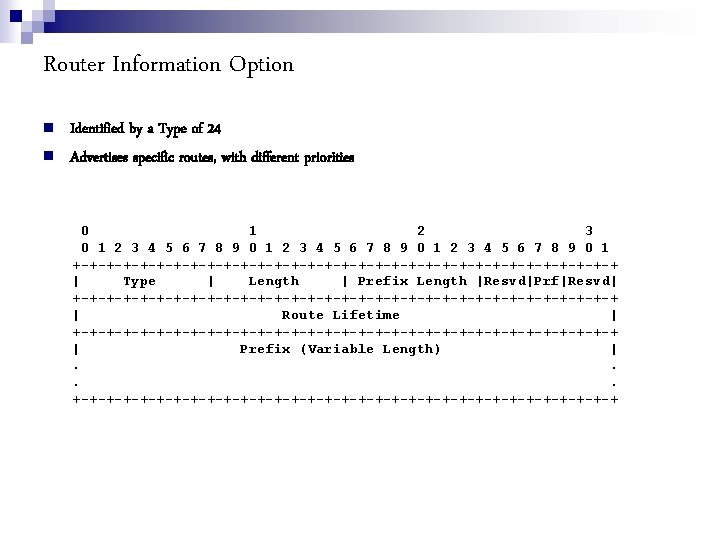
Router Information Option Identified by a Type of 24 Advertises specific routes, with different priorities 0 1 2 3 4 5 6 7 8 9 0 1 +-+-+-+-+-+-+-+-+-+-+-+-+-+-+-+-+ | Type | Length | Prefix Length |Resvd|Prf|Resvd| +-+-+-+-+-+-+-+-+-+-+-+-+-+-+-+-+ | Route Lifetime | +-+-+-+-+-+-+-+-+-+-+-+-+-+-+-+-+ | Prefix (Variable Length) |. . +-+-+-+-+-+-+-+-+-+-+-+-+-+-+-+-+
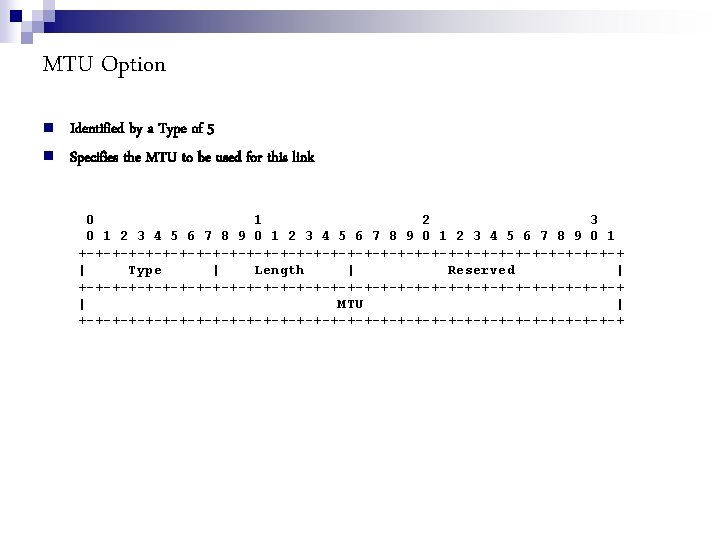
MTU Option Identified by a Type of 5 Specifies the MTU to be used for this link 0 1 2 3 4 5 6 7 8 9 0 1 +-+-+-+-+-+-+-+-+-+-+-+-+-+-+-+-+ | Type | Length | Reserved | +-+-+-+-+-+-+-+-+-+-+-+-+-+-+-+-+ | MTU | +-+-+-+-+-+-+-+-+-+-+-+-+-+-+-+-+
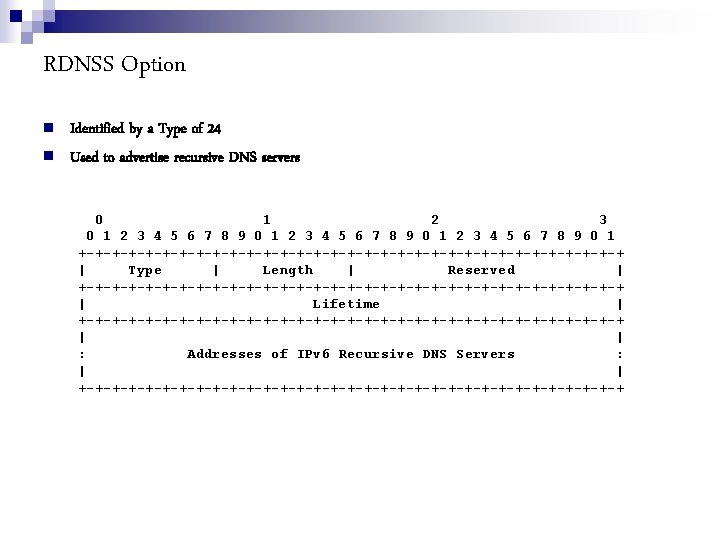
RDNSS Option Identified by a Type of 24 Used to advertise recursive DNS servers 0 1 2 3 4 5 6 7 8 9 0 1 +-+-+-+-+-+-+-+-+-+-+-+-+-+-+-+-+ | Type | Length | Reserved | +-+-+-+-+-+-+-+-+-+-+-+-+-+-+-+-+ | Lifetime | +-+-+-+-+-+-+-+-+-+-+-+-+-+-+-+-+ | | : Addresses of IPv 6 Recursive DNS Servers : | | +-+-+-+-+-+-+-+-+-+-+-+-+-+-+-+-+
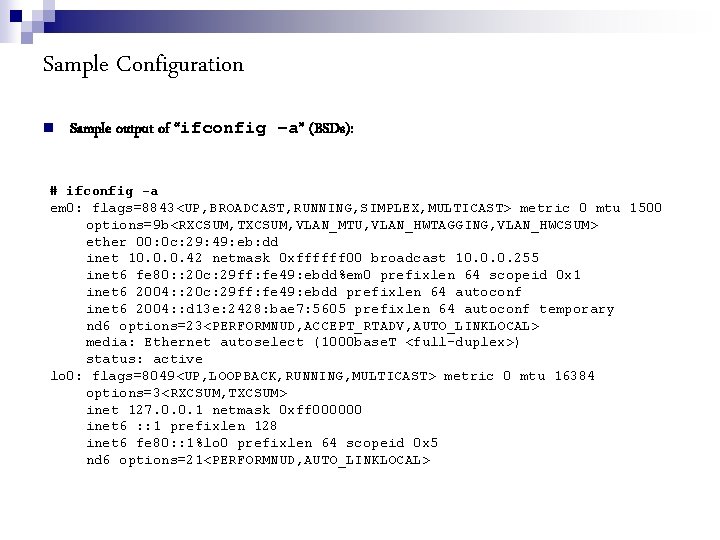
Sample Configuration Sample output of “ifconfig –a” (BSDs): # ifconfig -a em 0: flags=8843<UP, BROADCAST, RUNNING, SIMPLEX, MULTICAST> metric 0 mtu 1500 options=9 b<RXCSUM, TXCSUM, VLAN_MTU, VLAN_HWTAGGING, VLAN_HWCSUM> ether 00: 0 c: 29: 49: eb: dd inet 10. 0. 0. 42 netmask 0 xffffff 00 broadcast 10. 0. 0. 255 inet 6 fe 80: : 20 c: 29 ff: fe 49: ebdd%em 0 prefixlen 64 scopeid 0 x 1 inet 6 2004: : 20 c: 29 ff: fe 49: ebdd prefixlen 64 autoconf inet 6 2004: : d 13 e: 2428: bae 7: 5605 prefixlen 64 autoconf temporary nd 6 options=23<PERFORMNUD, ACCEPT_RTADV, AUTO_LINKLOCAL> media: Ethernet autoselect (1000 base. T <full-duplex>) status: active lo 0: flags=8049<UP, LOOPBACK, RUNNING, MULTICAST> metric 0 mtu 16384 options=3<RXCSUM, TXCSUM> inet 127. 0. 0. 1 netmask 0 xff 000000 inet 6 : : 1 prefixlen 128 inet 6 fe 80: : 1%lo 0 prefixlen 64 scopeid 0 x 5 nd 6 options=21<PERFORMNUD, AUTO_LINKLOCAL>
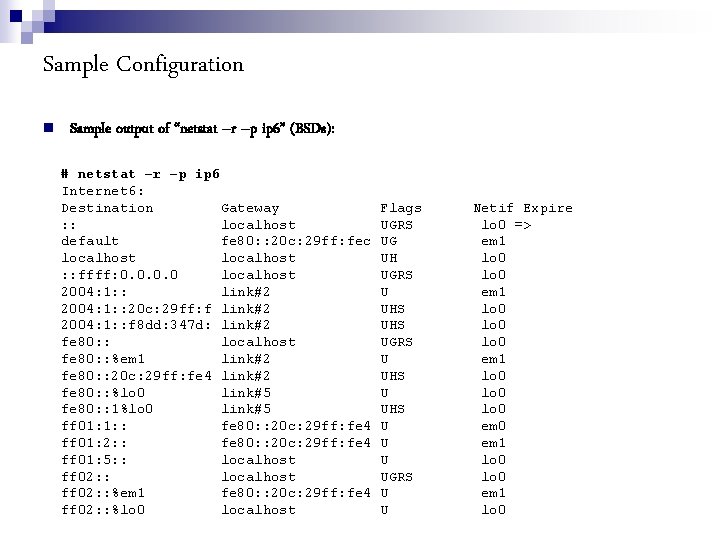
Sample Configuration Sample output of “netstat –r –p ip 6” (BSDs): # netstat –r –p ip 6 Internet 6: Destination Gateway : : localhost default fe 80: : 20 c: 29 ff: fec localhost : : ffff: 0. 0 localhost 2004: 1: : link#2 2004: 1: : 20 c: 29 ff: f link#2 2004: 1: : f 8 dd: 347 d: link#2 fe 80: : localhost fe 80: : %em 1 link#2 fe 80: : 20 c: 29 ff: fe 4 link#2 fe 80: : %lo 0 link#5 fe 80: : 1%lo 0 link#5 ff 01: 1: : fe 80: : 20 c: 29 ff: fe 4 ff 01: 2: : fe 80: : 20 c: 29 ff: fe 4 ff 01: 5: : localhost ff 02: : %em 1 fe 80: : 20 c: 29 ff: fe 4 ff 02: : %lo 0 localhost Flags UGRS UG UH UGRS U UHS U UGRS U U Netif Expire lo 0 => em 1 lo 0 lo 0 em 1 lo 0 em 1 lo 0
IPv 6 SLAAC some sample attacks…
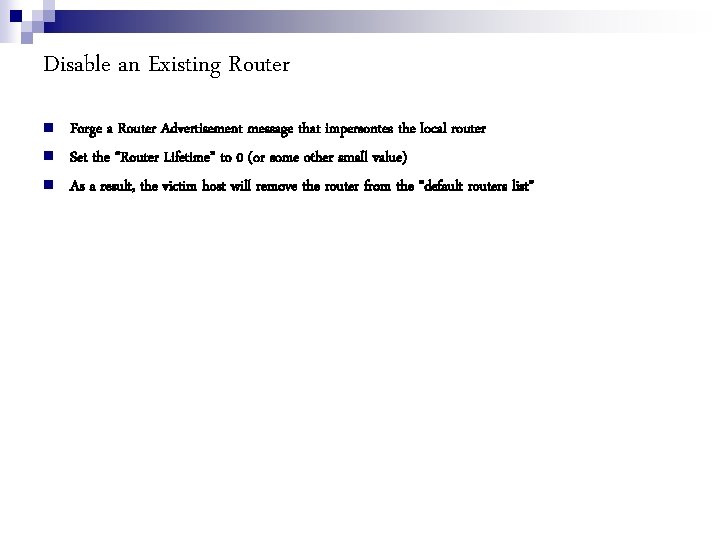
Disable an Existing Router Forge a Router Advertisement message that impersontes the local router Set the “Router Lifetime” to 0 (or some other small value) As a result, the victim host will remove the router from the “default routers list”
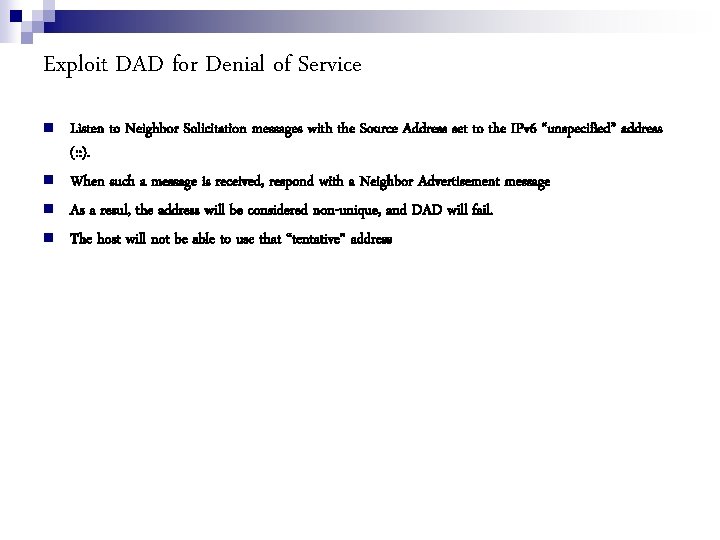
Exploit DAD for Denial of Service Listen to Neighbor Solicitation messages with the Source Address set to the IPv 6 “unspecified” address (: : ). When such a message is received, respond with a Neighbor Advertisement message As a resul, the address will be considered non-unique, and DAD will fail. The host will not be able to use that “tentative” address
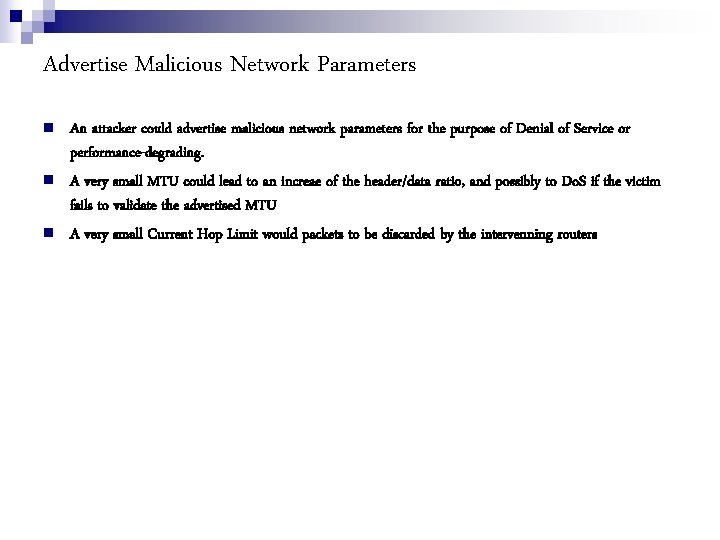
Advertise Malicious Network Parameters An attacker could advertise malicious network parameters for the purpose of Denial of Service or performance-degrading. A very small MTU could lead to an increae of the header/data ratio, and possibly to Do. S if the victim fails to validate the advertised MTU A very small Current Hop Limit would packets to be discarded by the intervenning routers
IPv 6 SLAAC Some sysctl’s…
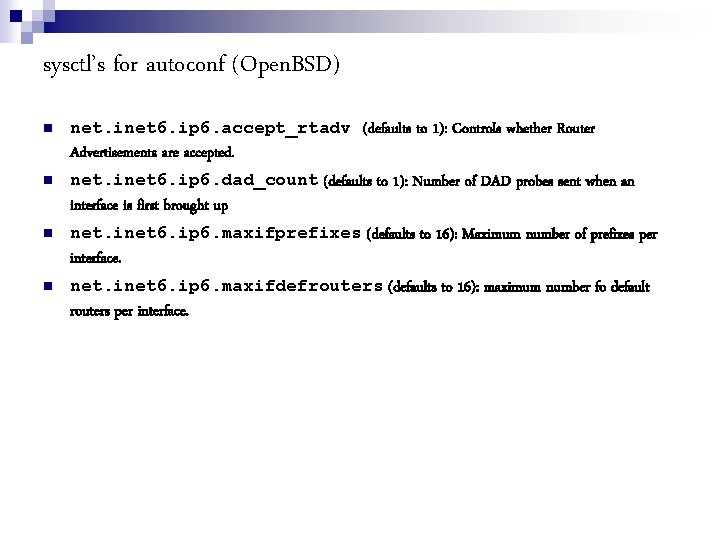
sysctl’s for autoconf (Open. BSD) net. inet 6. ip 6. accept_rtadv (defaults to 1): Controls whether Router Advertisements are accepted. net. inet 6. ip 6. dad_count (defaults to 1): Number of DAD probes sent when an interface is first brought up net. inet 6. ip 6. maxifprefixes (defaults to 16): Maximum number of prefixes per interface. net. inet 6. ip 6. maxifdefrouters (defaults to 16): maximum number fo default routers per interface.
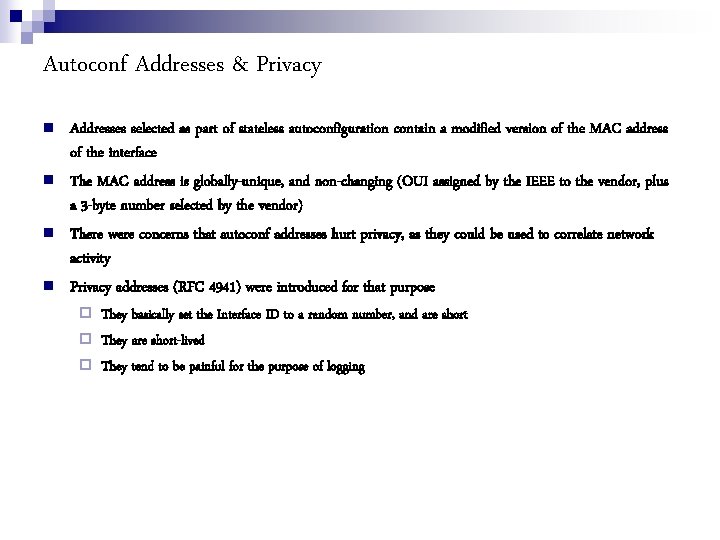
Autoconf Addresses & Privacy Addresses selected as part of stateless autoconfiguration contain a modified version of the MAC address of the interface The MAC address is globally-unique, and non-changing (OUI assigned by the IEEE to the vendor, plus a 3 -byte number selected by the vendor) There were concerns that autoconf addresses hurt privacy, as they could be used to correlate network activity Privacy addresses (RFC 4941) were introduced for that purpose They basically set the Interface ID to a random number, and are short They are short-lived They tend to be painful for the purpose of logging
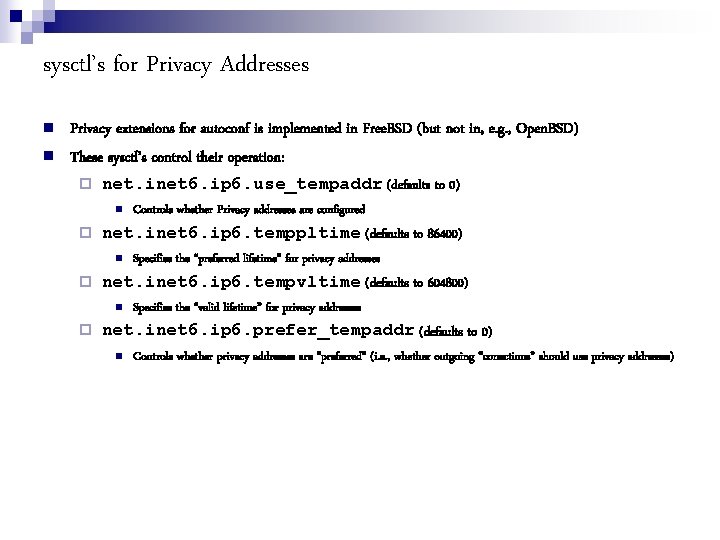
sysctl’s for Privacy Addresses Privacy extensions for autoconf is implemented in Free. BSD (but not in, e. g. , Open. BSD) These sysctl’s control their operation: net. inet 6. ip 6. use_tempaddr (defaults to 0) net. inet 6. ip 6. temppltime (defaults to 86400) Specifies the “preferred lifetime” for privacy addresses net. inet 6. ip 6. tempvltime (defaults to 604800) Controls whether Privacy addresses are configured Specifies the “valid lifetime” for privacy addresses net. inet 6. ip 6. prefer_tempaddr (defaults to 0) Controls whether privacy addresses are “preferred” (i. e. , whether outgoing “conections” should use privacy addresses)
IPv 6 SLAAC Router Advertisement Guad (RA-Guard)
Router Advertisement Guard Many organizations employ “RA-Guard” as the first line of defense against attacks based on forged Router-Advertisements RA-Guard works (roughly) as follows: A layer-2 device is configured such that it accepts Router Advertisements on a specified port. Router Advertisement messages received on other port are silently dropped (At layer-2) The RA-Guard mechanism relies on the device’s ability to identify Router Advertisement messages
IPv 6 SLAAC RA-Guard evasion
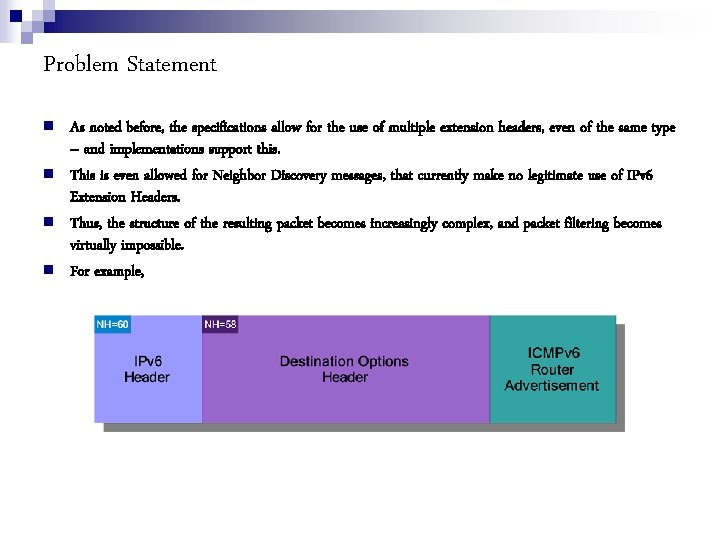
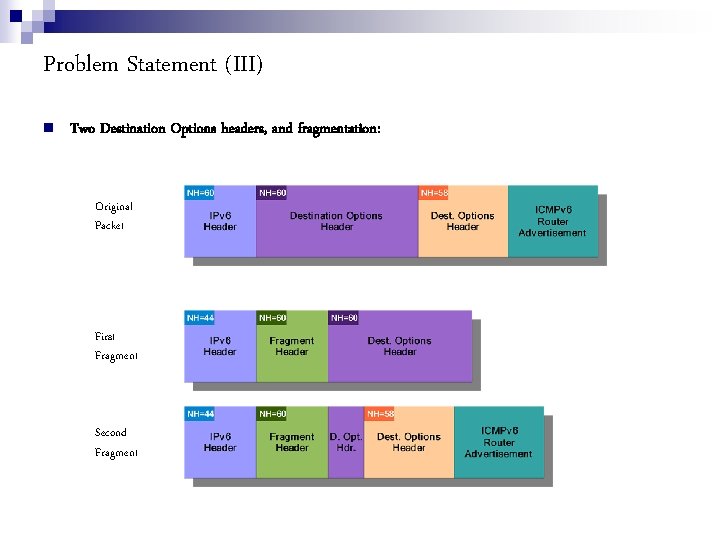
Problem Statement As noted before, the specifications allow for the use of multiple extension headers, even of the same type – and implementations support this. This is even allowed for Neighbor Discovery messages, that currently make no legitimate use of IPv 6 Extension Headers. Thus, the structure of the resulting packet becomes increasingly complex, and packet filtering becomes virtually impossible. For example,
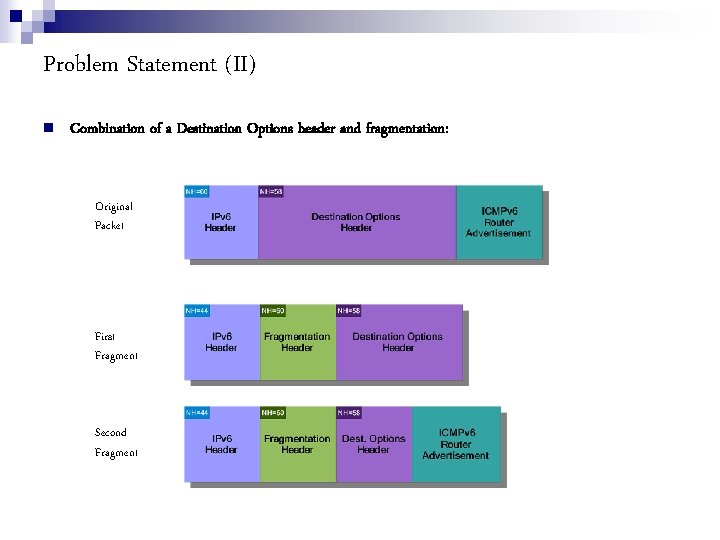
Problem Statement (II) Combination of a Destination Options header and fragmentation: Original Packet First Fragment Second Fragment
Problem Statement (III) Two Destination Options headers, and fragmentation: Original Packet First Fragment Second Fragment
Some Conclusions The use of a single “Destination Options” header is enough to evade most implementations of RAGuard. If a Fragment Header is combined with two Destination Options headers, it becomes impossible for layer -2 device to filter forged Router Advertisements. This technique can also be exploited to circumvent Neighbor Discover monitoring tools such as NDPMon See my ongoing work on RA-Guard evasion: http: //tools. ietf. org/id/draft-gont-v 6 ops-ra-guard-evasion-01. txt http: //tools. ietf. org/id/draft-gont-6 man-nd-extension-headers-01. txt Or http: //tools. ietf. org/id/gont
Dynamic Host Configuration Protocol version 6 (DHCPv 6)
Brief Overview IPv 6 version of DHCPv 4: mechanism for stateful configuration It implements “prefix delegation”, such that a DHCPv 6 server can assign not only an IPv 6 address, but also an IPv 6 prefix. It is an optional mechanism which is invoked only if specified by Router Advertisement messages. It used to be the only mechanism available to advertise recursive DNS servers It can be exploited in a similar way to Router Advertisement messages. It suffers the same problems as IPv 6 SLAAC: If no authentication is enforced, it is trivial for an attacker to forge DHCPv 6 packets Layer 2 - mitigations can be easily circumvented with the same techniques as for RA-Guard
Multicast Listener Discovery
Brief Overview A generic protocol that allows hosts to inform local routers which multicast groups they are interested in. Routers use thi infomation to decide which packets must be forwarded to the local segment. Since Neighbor Discovery uses multicast addresses (the solicited-node multicast addresse), MLD is used by all IPv 6 nodes In practice, the only use for MLD with Neighbor Discovery is MLD-snooping switches – switches that interpret MLD packet to decide on which ports packets should be forwarded. Potential issues: If a MLD-snooping switch is employed, MLD could be exploited for Denial of Service attacks. MLDv 2 implements per-source filtering capabilities, and greatly increases the complexity of MLD(v 1). Security-wise, MLDv 1 should be preferred.
IPsec Support
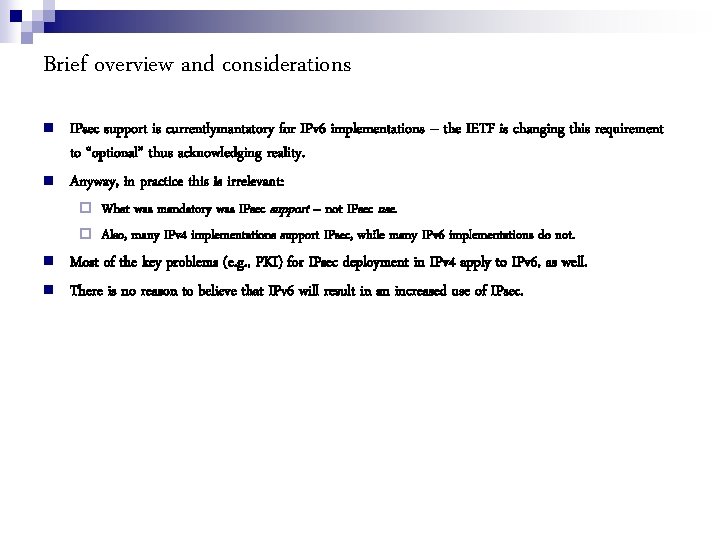
Brief overview and considerations IPsec support is currentlymantatory for IPv 6 implementations – the IETF is changing this requirement to “optional” thus acknowledging reality. Anyway, in practice this is irrelevant: What was mandatory was IPsec support – not IPsec use. Also, many IPv 4 implementations support IPsec, while many IPv 6 implementations do not. Most of the key problems (e. g. , PKI) for IPsec deployment in IPv 4 apply to IPv 6, as well. There is no reason to believe that IPv 6 will result in an increased use of IPsec.
DNS support for IPv 6
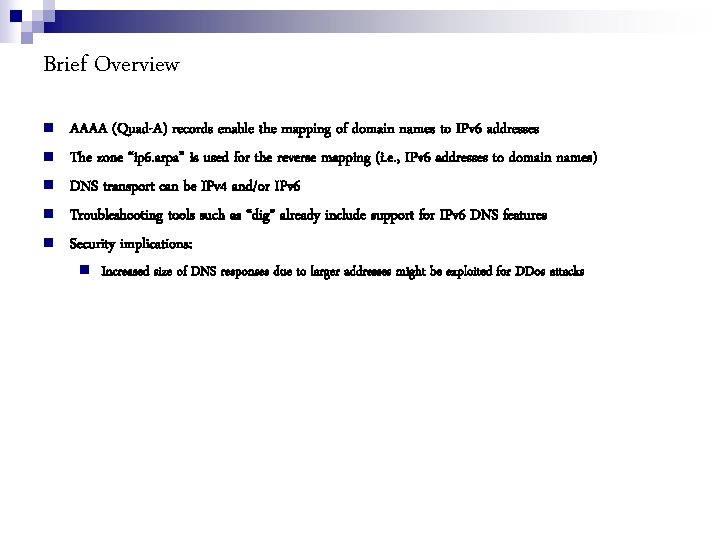
Brief Overview AAAA (Quad-A) records enable the mapping of domain names to IPv 6 addresses The zone “ip 6. arpa” is used for the reverse mapping (i. e. , IPv 6 addresses to domain names) DNS transport can be IPv 4 and/or IPv 6 Troubleshooting tools such as “dig” already include support for IPv 6 DNS features Security implications: Increased size of DNS responses due to larger addresses might be exploited for DDos attacks
IPv 6 Transition Co-Existence Technologies
IPv 6 Transition/Co-existence Technologies IPv 6 is not backwards-compatible with IPv 4 Original transition plan: deploy IPv 6 before we ran out of IPv 4 addresses, and eventually turn off IPv 4 when no longer needed – it didn’t happen Current transition/co-existence plan: based on a toolbox: dual-stack tunnels translation
Transition Technologies Dual Stack
Dual-stack Each node supports both IPv 4 and IPv 6 Domain names include both A and AAAA (Quad A) records IPv 4 or IPv 6 are used as needed Dual-stack was the original transition co-existence plan, and still is the recommended strategy for servers Virtually all popular operating systems include native IPv 6 support enabled by default
Exploiting Native IPv 6 Support An attacker can connect to an IPv 4 -only network, and forge IPv 6 Router Advertisement messages. (*) The IPv 4 -ony hosts would “become” dual-stack IPv 6 could be leveraged to evade network security controls (if the network ignores IPv 6) Possible counter-measures: Implemente Ipv 6 security controls, even on IPv 4 -only networks. Disable IPv 6 support in nodes that are not expected to use IPv 6 (*) http: //resources. infosecinstitute. com/slaac-attack/
Transition Technologies Tunnels
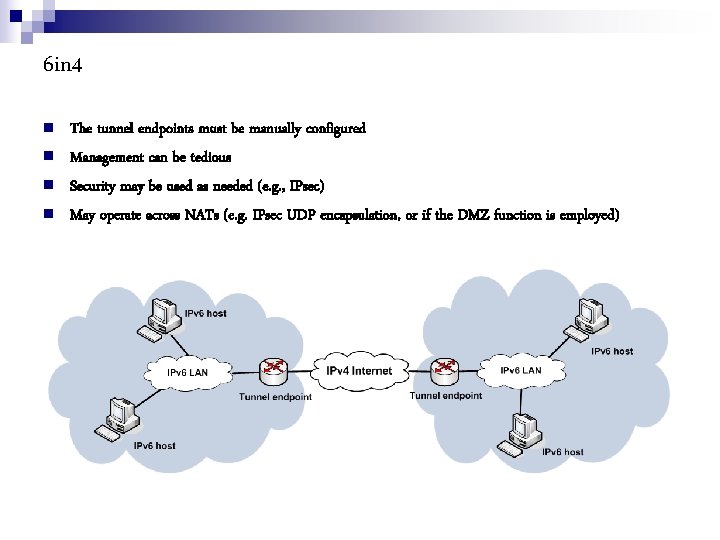
Tunnels Use the existing IPv 4 Internet to transport IPv 6 packets from/to IPv 6 islands Tunnels can be: configured: some sort of manual configuration is needed automatic: the tunnel end-points are derived from the IPv 6 addresses Configured tunnels: 6 in 4 Tunnel broker Automatic tunnels: ISATAP 6 to 4 6 rd Teredo
6 in 4 The tunnel endpoints must be manually configured Management can be tedious Security may be used as needed (e. g. , IPsec) May operate across NATs (e. g. IPsec UDP encapsulation, or if the DMZ function is employed)
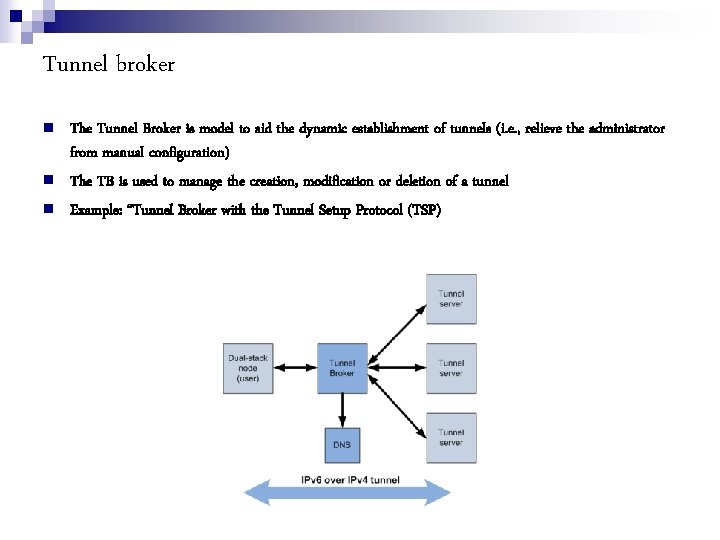
Tunnel broker The Tunnel Broker is model to aid the dynamic establishment of tunnels (i. e. , relieve the administrator from manual configuration) The TB is used to manage the creation, modification or deletion of a tunnel Example: “Tunnel Broker with the Tunnel Setup Protocol (TSP)
Tunnel Broker: Sample Implementation Gogoc is a tunnel broker implementation It even allows “anonymous” tunnel establishment (no account needed) Install it, and welcome to the IPv 6 Internet! Privacy concerns: Beware that all your traffic will most likely follow a completely different path from your normal IPv 4 traffic.
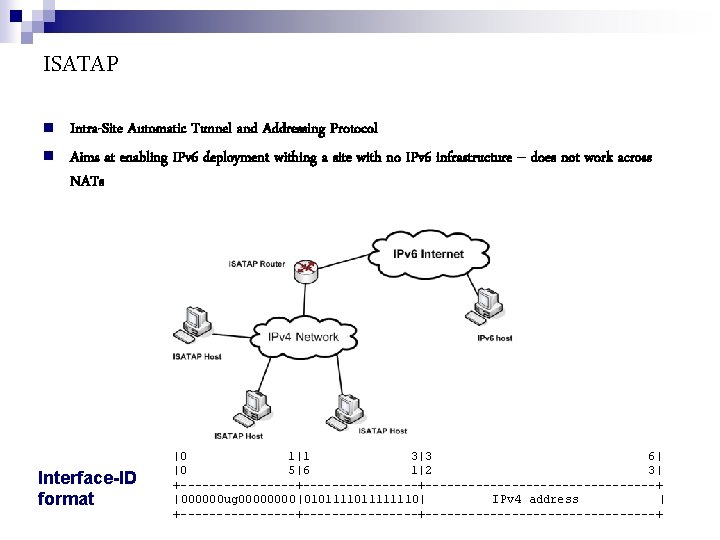
ISATAP Intra-Site Automatic Tunnel and Addressing Protocol Aims at enabling IPv 6 deployment withing a site with no IPv 6 infrastructure -- does not work across NATs Interface-ID format |0 1|1 3|3 6| |0 5|6 1|2 3| +----------------+----------------+ |000000 ug 0000|01011111110| IPv 4 address | +----------------+----------------+
Exploting ISATAP Microsoft implementations “learn” the IPv 4 address of the ISATAP router by resolving the name “isatap” (via DNS and others) An attacker could forge name resolution responses to: Impersonate a legitimate ISATAP router Enable IPv 6 connectivity in an otherwise IPv 4 -only network This could be used in conjunction with other attacks (e. g. forging DNS responses such that they contain AAAA records)
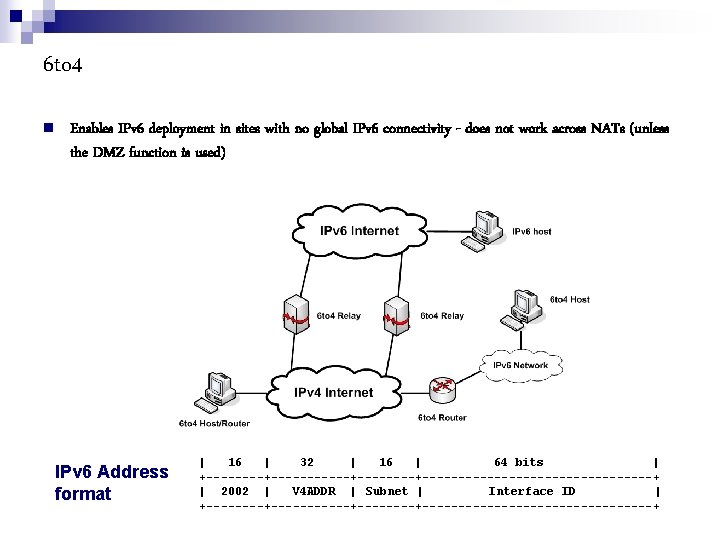
6 to 4 Enables IPv 6 deployment in sites with no global IPv 6 connectivity - does not work across NATs (unless the DMZ function is used) IPv 6 Address format | 16 | 32 | 16 | 64 bits | +--------+----------------------+ | 2002 | V 4 ADDR | Subnet | Interface ID | +--------+----------------------+
6 to 4 (II) Packets originate at a 6 to 4 host as native IPv 6 packets A 6 to 4 router encapsulates the packet in IPv 4, and sets the IPv 4 Destination Address to that of a 6 to 4 relay (or the corresponding anycast address 192. 88. 99. 1) The router decapsulates the IPv 6 packet and forwards it to the IPv 6 Internet Packets destinated from a native IPv 6 host to a 6 to 4 host are routed towards a relay (i. e. , peers advertising the 6 to 4 IPv 6 prefix) The relay encapsulates the packet into IPv 4, and sends it to the 6 to 4 router The 6 to 4 router decapsulates the IPv 6 packets, and forwards it to the “local” IPv 6 network Packets from 6 to 4 hosts to 6 to 4 hosts do not enter the IPv 6 Internet (the source 6 to 4 router sends the packet directly to the destination 6 to 4 router)
Problems with 6 to 4 Lots of poorly-managed 6 to 4 relays have been deployed In most cases they introduce PMTUD black-holes (e. g. as a result of ICMPv 6 rate-limiting) Lack of control of which 6 to 4 relays are used make troubleshooting difficult Use of the 6 to 4 anycast address makes it difficult to identify a poorly-managed relay in the 6 to 4 -> native IPv 6 direction It is always difficult to troubleshoot problems in the native IPv 6 -> 6 to 4 direction (the user has no control over which relay is used) Privacy concerns: 6 to 4 traffic might take a completely different path than IPv 4 traffic
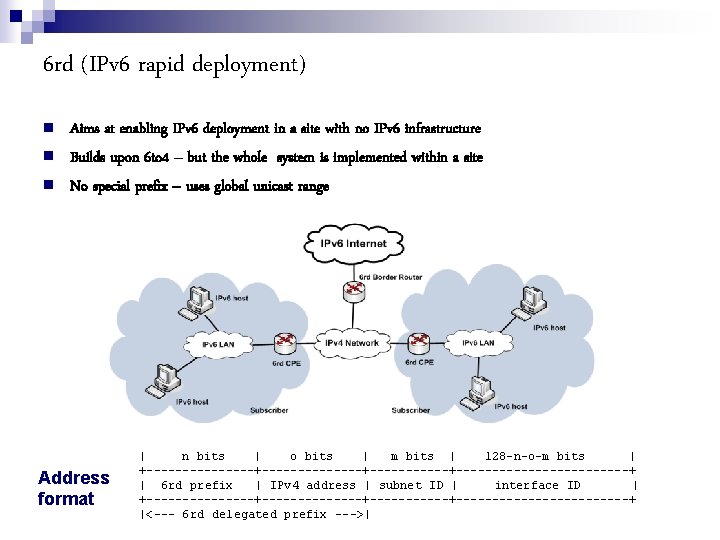
6 rd (IPv 6 rapid deployment) Aims at enabling IPv 6 deployment in a site with no IPv 6 infrastructure Builds upon 6 to 4 – but the whole system is implemented within a site No special prefix – uses global unicast range Address format | n bits | o bits | m bits | 128 -n-o-m bits | +--------+-------+------------------+ | 6 rd prefix | IPv 4 address | subnet ID | interface ID | +--------+-------+------------------+ |<--- 6 rd delegated prefix --->|
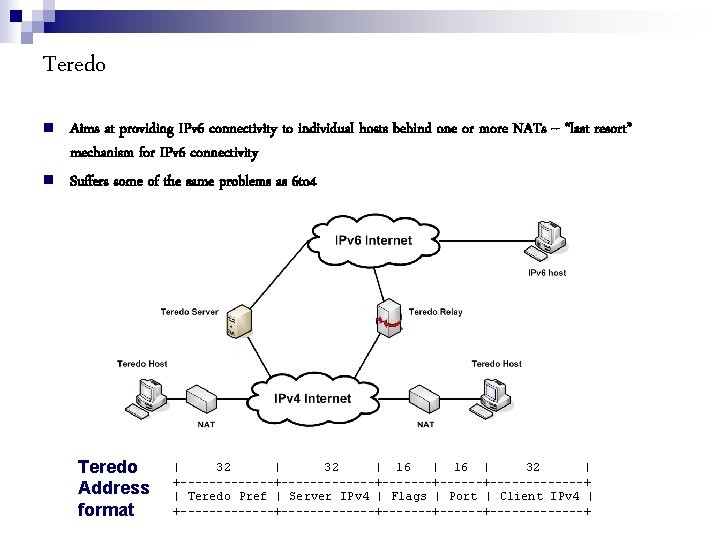
Teredo Aims at providing IPv 6 connectivity to individual hosts behind one or more NATs -- “last resort” mechanism for IPv 6 connectivity Suffers some of the same problems as 6 to 4 Teredo Address format | 32 | 16 | 32 | +-------------+-------+-------+ | Teredo Pref | Server IPv 4 | Flags | Port | Client IPv 4 | +-------------+-------+-------+
Securiy Implications of Teredo increases the host exposure to attack Hosts behind a NAT may become reachable from the public Internet Windows systems obtain the address of a Teredo serving by resolving “teredo. ipv 6. microsoft. com” An attacker could impersonate a Teredo server if he can attack the DNS Privacy concerns: Teredo traffic might take a completely different path than IPv 4 traffic
Translation All of the previous transition/co-existence technologies require assignment of both IPv 4 and IPv 6 addresses – what if there are no IPv 4 addresses left? A number of technologies are curerntly being developed in the IETF such that: IPv 4 addresses can be dynamically shared by a large number of hosts, or, IPv 6 -only nodes can still access IPv 4 -only nodes Among these technlogies are: CGN (Carrier-Grade NAT) NAT 64 A+P The future doesn’t look like very NAT-free…. .
Security Implications of IPv 6 on IPv 4 Networks
Security Implications on IPv 4 Networks Transition Technologies
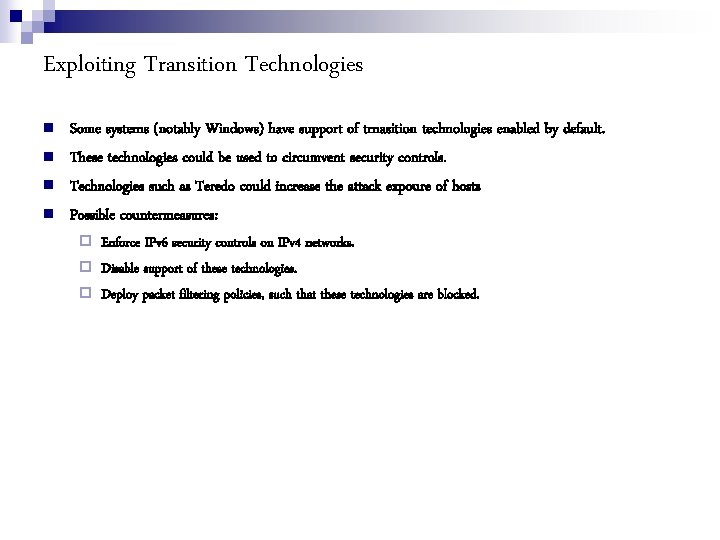
Exploiting Transition Technologies Some systems (notably Windows) have support of trnasition technologies enabled by default. These technologies could be used to circumvent security controls. Technologies such as Teredo could increase the attack expoure of hosts Possible countermeasures: Enforce IPv 6 security controls on IPv 4 networks. Disable support of these technologies. Deploy packet filtering policies, such that these technologies are blocked.
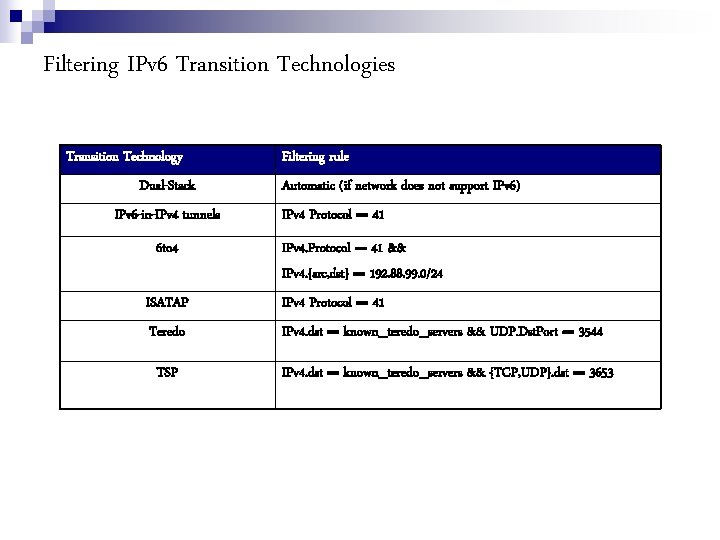
Filtering IPv 6 Transition Technologies Transition Technology Dual-Stack IPv 6 -in-IPv 4 tunnels 6 to 4 Filtering rule Automatic (if network does not support IPv 6) IPv 4 Protocol == 41 IPv 4. Protocol == 41 && IPv 4. {src, dst} == 192. 88. 99. 0/24 ISATAP IPv 4 Protocol == 41 Teredo IPv 4. dst == known_teredo_servers && UDP. Dst. Port == 3544 TSP IPv 4. dst == known_teredo_servers && {TCP, UDP}. dst == 3653
IPv 6 Network Reconnaissance
Network Reconnaisance Implications IPv 6 addressing on scanning
Global Unicast Addresses Syntax of the global unicast addresses: | n bits | m bits | 128 -n-m bits | Global Routing Prefix Subnet ID Interface ID The interface ID is typically 64 -bis Global Unicast Addresses can be generated with multiple different criteria: Use modified EUI-64 format identifierss (embed the MAC address) “Privacy Addresses” (or some of their variants) Manually-configured (e. g. , 2001: db 8: : 1) As specified by some specific transition-co-existence technology
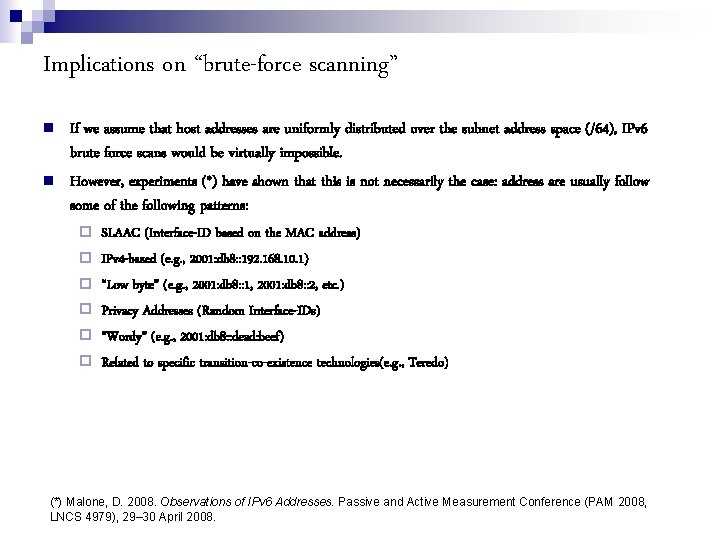
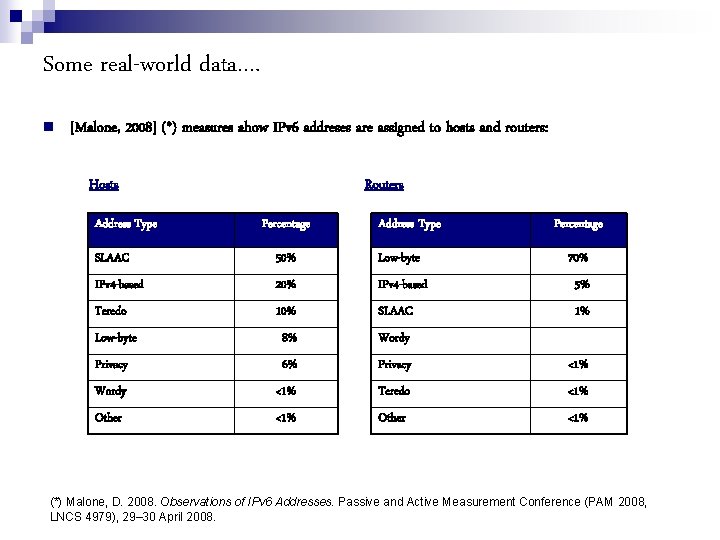
Implications on “brute-force scanning” If we assume that host addresses are uniformly distributed over the subnet address space (/64), IPv 6 brute force scans would be virtually impossible. However, experiments (*) have shown that this is not necessarily the case: address are usually follow some of the following patterns: SLAAC (Interface-ID based on the MAC address) IPv 4 -based (e. g. , 2001: db 8: : 192. 168. 10. 1) “Low byte” (e. g. , 2001: db 8: : 1, 2001: db 8: : 2, etc. ) Privacy Addresses (Random Interface-IDs) “Wordy” (e. g. , 2001: db 8: : dead: beef) Related to specific transition-co-existence technologies(e. g. , Teredo) (*) Malone, D. 2008. Observations of IPv 6 Addresses. Passive and Active Measurement Conference (PAM 2008, LNCS 4979), 29– 30 April 2008.
Some real-world data…. [Malone, 2008] (*) measures ahow IPv 6 addreses are assigned to hosts and routers: Hosts Address Type Routers Percentage Address Type Percentage SLAAC 50% Low-byte 70% IPv 4 -based 20% IPv 4 -based 5% Teredo 10% SLAAC 1% Low-byte 8% Wordy Privacy 6% Privacy <1% Wordy <1% Teredo <1% Other <1% (*) Malone, D. 2008. Observations of IPv 6 Addresses. Passive and Active Measurement Conference (PAM 2008, LNCS 4979), 29– 30 April 2008.
Some Advice In general, a node does not need to be “publicly reachable” (e. g. , servers), privacy addresses are desirable For servers, security-wise the policy of selection of IPv 6 addresses is irrelevant For clients, in most scenarios the use of “privacy extensions” (or some variant of it) is generally desirable: Some OSes implement the privacy extensions specified in RFC 4941 Others generate the Interface-ID as a result of a hash-function over (Prefix, MAC address, secret) In any case, always consider whether it would be applicable to enforce a packet filtering policy (i. e. , if possible, do not rely on “security through obscurity)
Network Reconnaisance Possible approaches
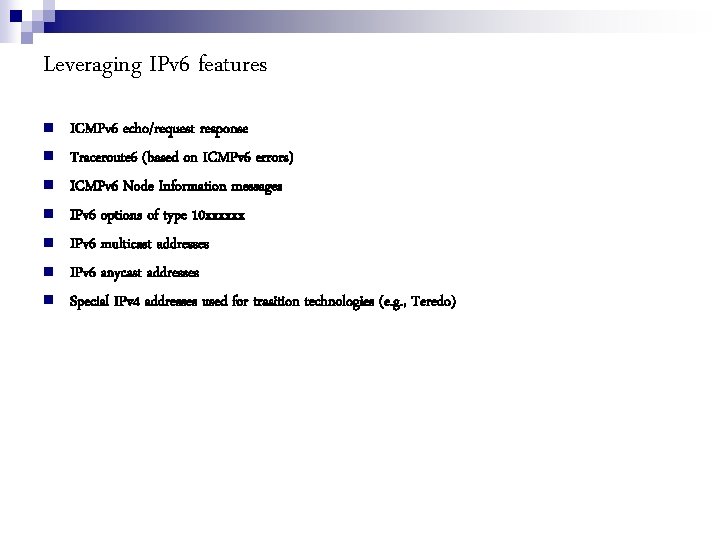
Leveraging IPv 6 features ICMPv 6 echo/request response Traceroute 6 (based on ICMPv 6 errors) ICMPv 6 Node Information messages IPv 6 options of type 10 xxxxxx IPv 6 multicast addresses IPv 6 anycast addresses Special IPv 4 addresses used for trasition technologies (e. g. , Teredo)
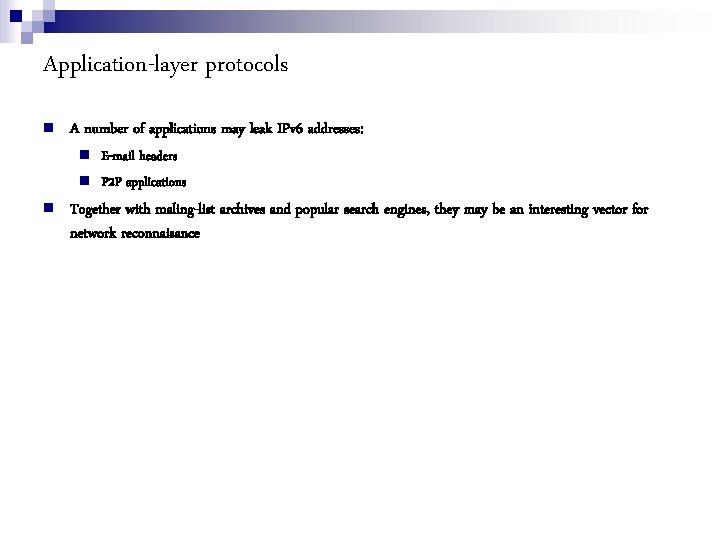
Application-layer protocols A number of applications may leak IPv 6 addresses: E-mail headers P 2 P applications Together with maling-list archives and popular search engines, they may be an interesting vector for network reconnaisance
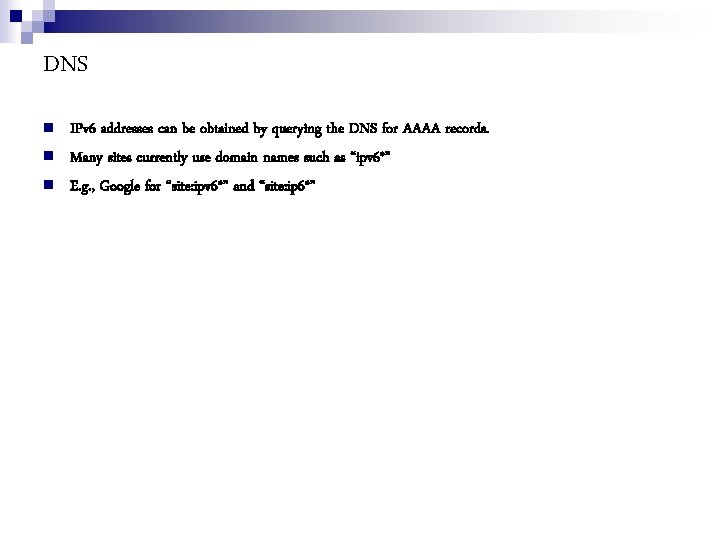
DNS IPv 6 addresses can be obtained by querying the DNS for AAAA records. Many sites currently use domain names such as “ipv 6*” E. g. , Google for “site: ipv 6*” and “site: ip 6*”
Network “Neighborhood” protocols m. DNS is being increasily used for discovering peers on the same network. Not IPv 6 -specific, but could be employed with IPv 6, too. Hosts announce themselves on the network, for ocassional networking. This provides yet another vector for network reconnaissance.
Some thoughts on IPv 6 security
Some thoughts. . . While IPv 6 provides similar features than IPv 4, it uses different mechanisms. – and the evil lies in the small details. The security implications of IPv 6 should be considered before it is deployed (not after!). Most systems have IPv 6 support enabled by default, and this has implications on “IPv 4 -only” networks! Even if you are not planning to deploy IPv 6 in the short term, most likely you will eventually do it. It is time to learn about and experiment with IPv 6!
Questions?
Acknowledgments Hack in Paris 2011 organizers Fernando Gont fernando@gont. com. ar http: //www. gont. com. ar