
Classful Subnetting IPv 4 References CCNA Curriculum CCNA
Classful Subnetting IPv 4 References: • CCNA Curriculum • CCNA Command Quick Reference by Scott Epson 1
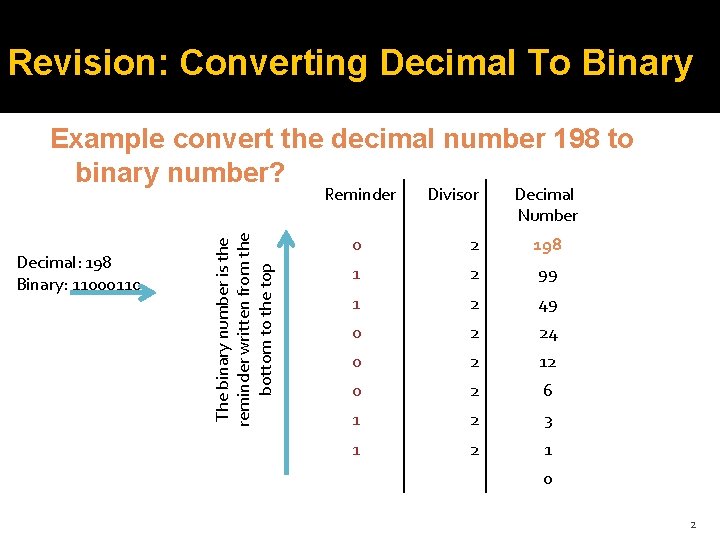
Revision: Converting Decimal To Binary Example convert the decimal number 198 to binary number? Decimal: 198 Binary: 11000110 The binary number is the reminder written from the bottom to the top Reminder Divisor Decimal Number 0 2 198 1 2 99 1 2 49 0 2 24 0 2 12 0 2 6 1 2 3 1 2 1 0 2
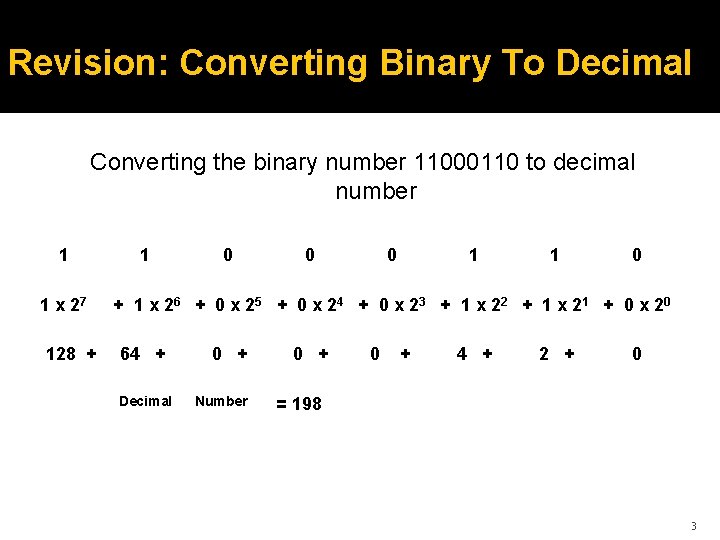
Revision: Converting Binary To Decimal Converting the binary number 11000110 to decimal number 1 1 x 27 128 + 1 0 0 0 1 1 0 + 1 x 2 6 + 0 x 2 5 + 0 x 24 + 0 x 2 3 + 1 x 2 2 + 1 x 2 1 + 0 x 2 0 64 + Decimal 0 + Number 0 + 4 + 2 + 0 = 198 3
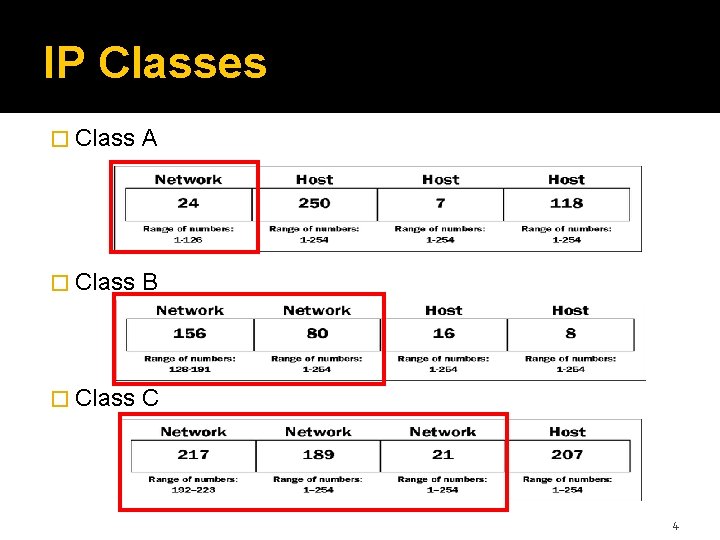
IP Classes � Class A � Class B � Class C 4
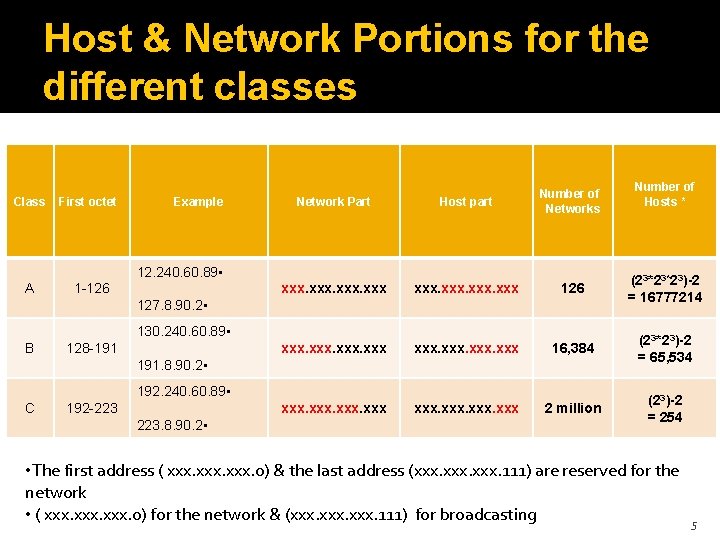
Host & Network Portions for the different classes Class First octet Example Network Part Host part xxx 126 (23*23*23)-2 = 16777214 xxx 16, 384 (23*23)-2 = 65, 534 xxx 2 million (23)-2 = 254 12. 240. 60. 89 • A 1 -126 127. 8. 90. 2 • 130. 240. 60. 89 • B 128 -191 191. 8. 90. 2 • 192. 240. 60. 89 • C 192 -223 223. 8. 90. 2 • Number of Hosts * Number of Networks • The first address ( xxx. 0) & the last address (xxx. 111) are reserved for the network • ( xxx. 0) for the network & (xxx. 111) for broadcasting 5
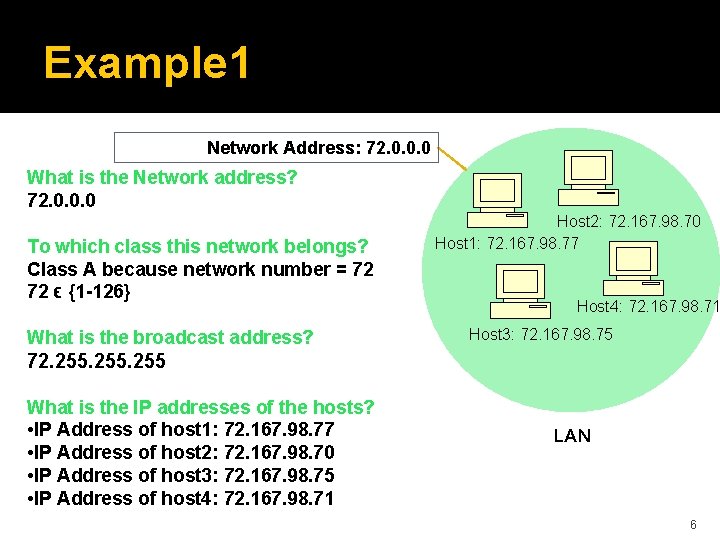
Example 1 Network Address: 72. 0. 0. 0 What is the Network address? 72. 0. 0. 0 To which class this network belongs? Class A because network number = 72 72 ϵ {1 -126} What is the broadcast address? Host 2: 72. 167. 98. 70 Host 1: 72. 167. 98. 77 Host 4: 72. 167. 98. 71 Host 3: 72. 167. 98. 75 72. 255 What is the IP addresses of the hosts? • IP Address of host 1: 72. 167. 98. 77 • IP Address of host 2: 72. 167. 98. 70 • IP Address of host 3: 72. 167. 98. 75 • IP Address of host 4: 72. 167. 98. 71 LAN 6
What is subnetting? � Subnetting is the process of borrowing bits from the HOST bits, in order to divide the larger network into small subnets. � Subnetting does NOT give you more hosts, but actually costs you hosts (decrease number of hosts). � You lose two host IP Addresses for each subnet, and perhaps one for the subnet IP address and one for the subnet broadcast IP address. 7
Why Do We Use Subnetting? A company uses two or more types of LAN technology (for example, Ethernet, Token Ring) on their network or different physical media (such as Ethernet, FDDI, WAN, etc. ) � Two network segments are restricted by distance limitations (for example, remote offices linked via point-topoint circuit). � Segments need to be localized for network management reasons (accounting segment, sales segment, etc. ). � Hosts which dominate most of the LAN bandwidth need to be isolated. � Security. � The most common reason is to control network traffic. � 8
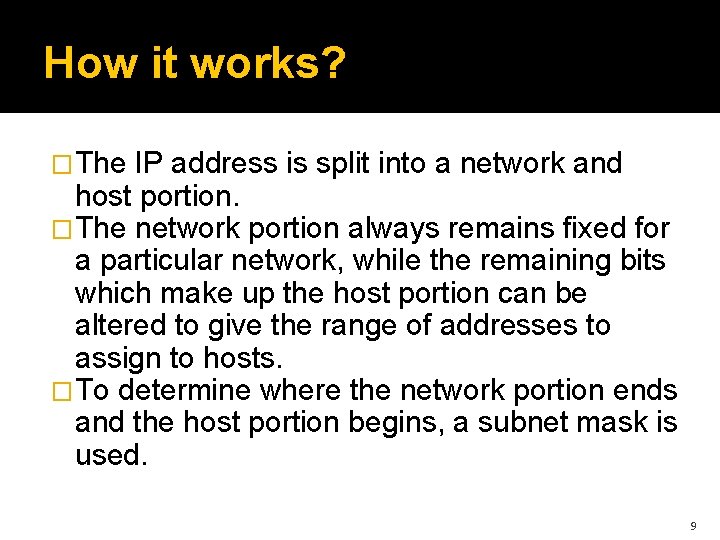
How it works? �The IP address is split into a network and host portion. �The network portion always remains fixed for a particular network, while the remaining bits which make up the host portion can be altered to give the range of addresses to assign to hosts. �To determine where the network portion ends and the host portion begins, a subnet mask is used. 9
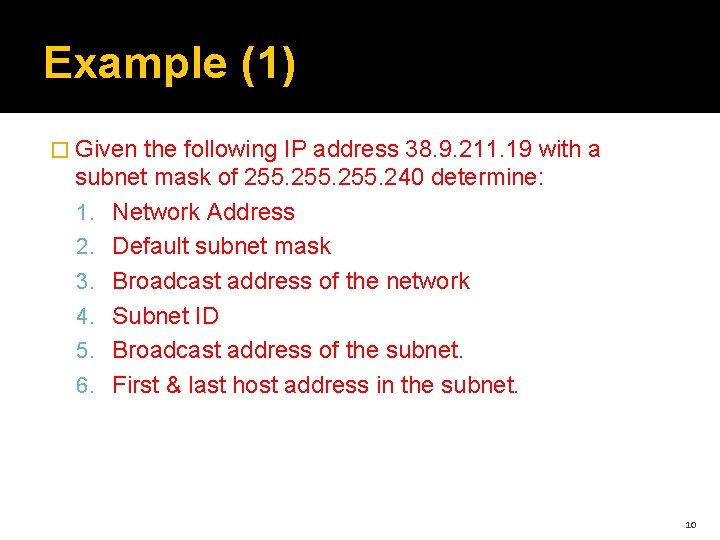
Example (1) � Given the following IP address 38. 9. 211. 19 with a subnet mask of 255. 240 determine: 1. Network Address 2. Default subnet mask 3. Broadcast address of the network 4. Subnet ID 5. Broadcast address of the subnet. 6. First & last host address in the subnet. 10
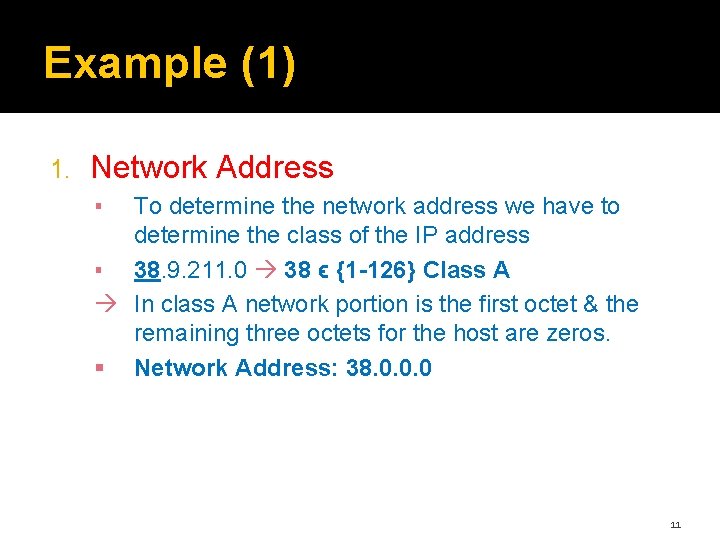
Example (1) 1. Network Address ▪ To determine the network address we have to determine the class of the IP address ▪ 38. 9. 211. 0 38 ϵ {1 -126} Class A In class A network portion is the first octet & the remaining three octets for the host are zeros. Network Address: 38. 0. 0. 0 11
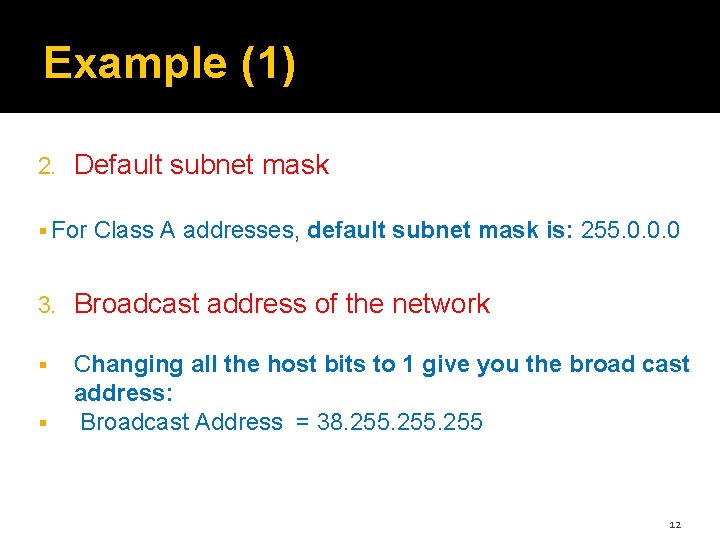
Example (1) 2. Default subnet mask For Class A addresses, default subnet mask is: 255. 0. 0. 0 3. Broadcast address of the network Changing all the host bits to 1 give you the broad cast address: Broadcast Address = 38. 255 12
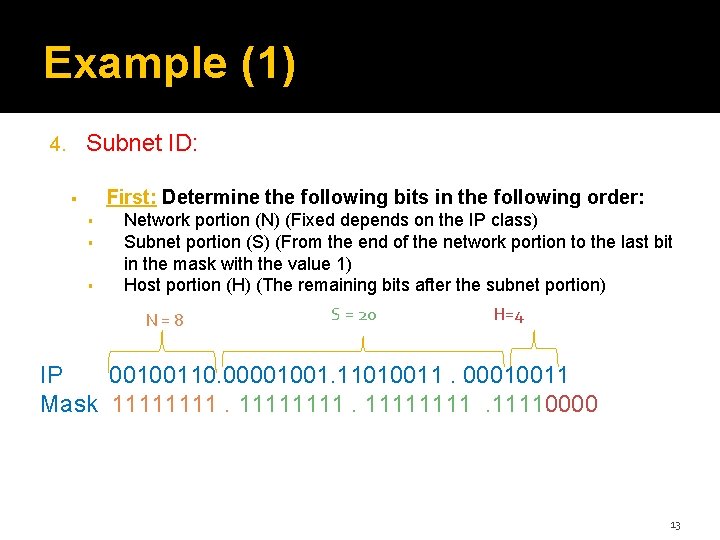
Example (1) Subnet ID: 4. First: Determine the following bits in the following order: ▪ ▪ Network portion (N) (Fixed depends on the IP class) Subnet portion (S) (From the end of the network portion to the last bit in the mask with the value 1) Host portion (H) (The remaining bits after the subnet portion) N=8 S = 20 H=4 IP 00100110. 00001001. 11010011. 00010011 Mask 11111111 . 11110000 13
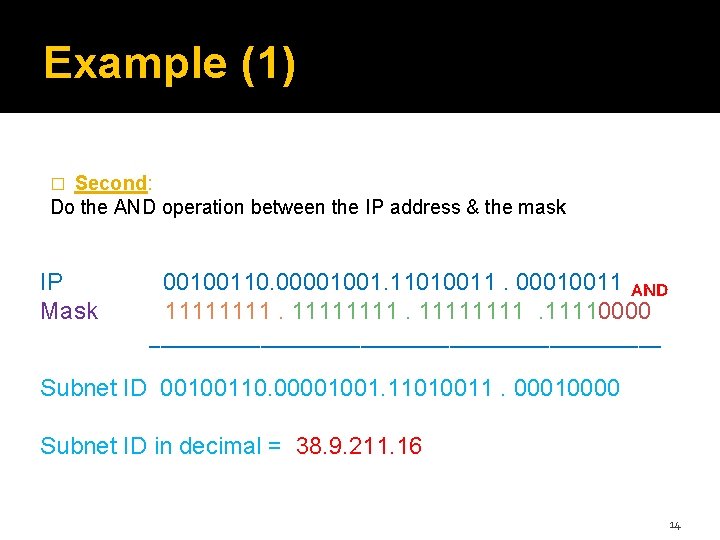
Example (1) Second: Do the AND operation between the IP address & the mask � IP 00100110. 00001001. 11010011. 00010011 AND Mask 11111111 . 11110000 _______________________ Subnet ID 00100110. 00001001. 11010011. 00010000 Subnet ID in decimal = 38. 9. 211. 16 14
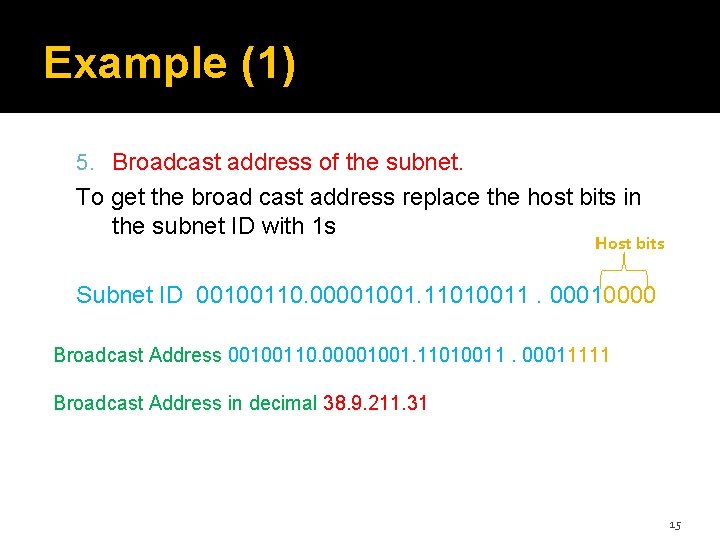
Example (1) 5. Broadcast address of the subnet. To get the broad cast address replace the host bits in the subnet ID with 1 s Host bits Subnet ID 00100110. 00001001. 11010011. 00010000 Broadcast Address 00100110. 00001001. 11010011. 00011111 Broadcast Address in decimal 38. 9. 211. 31 15
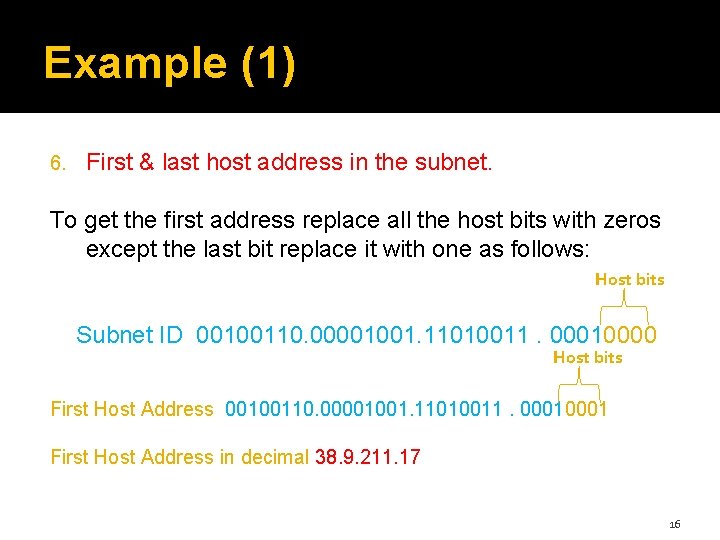
Example (1) 6. First & last host address in the subnet. To get the first address replace all the host bits with zeros except the last bit replace it with one as follows: Host bits Subnet ID 00100110. 00001001. 11010011. 00010000 Host bits First Host Address 00100110. 00001001. 11010011. 0001 First Host Address in decimal 38. 9. 211. 17 16
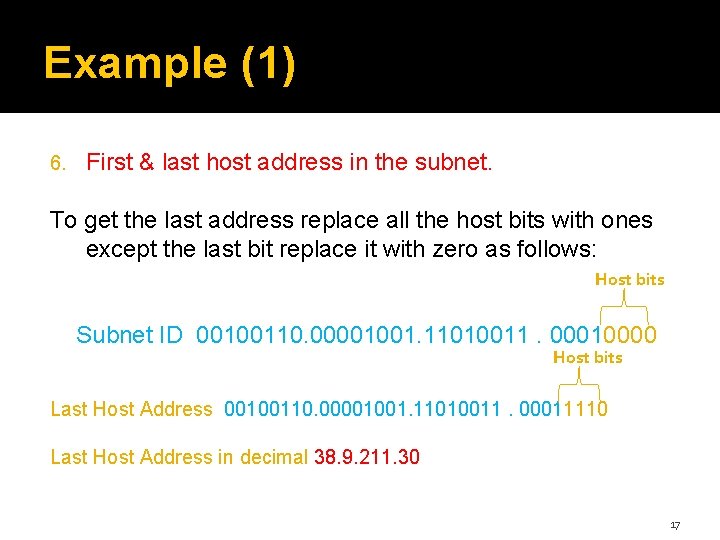
Example (1) 6. First & last host address in the subnet. To get the last address replace all the host bits with ones except the last bit replace it with zero as follows: Host bits Subnet ID 00100110. 00001001. 11010011. 00010000 Host bits Last Host Address 00100110. 00001001. 11010011. 00011110 Last Host Address in decimal 38. 9. 211. 30 17
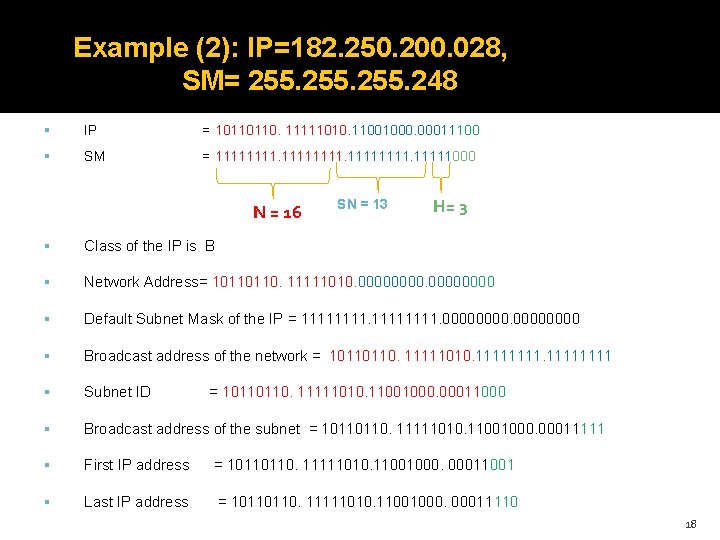
Example (2): IP=182. 250. 200. 028, SM= 255. 248 IP = 10110110. 11111010. 11001000. 00011100 SM = 11111111. 11111000 N = 16 SN = 13 H= 3 Class of the IP is B Network Address= 10110110. 11111010. 00000000 Default Subnet Mask of the IP = 11111111. 0000 Broadcast address of the network = 10110110. 11111010. 11111111 Subnet ID = 10110110. 11111010. 11001000. 00011000 Broadcast address of the subnet = 10110110. 11111010. 11001000. 00011111 First IP address = 10110110. 11111010. 11001000. 00011001 Last IP address = 10110110. 11111010. 11001000. 00011110 18
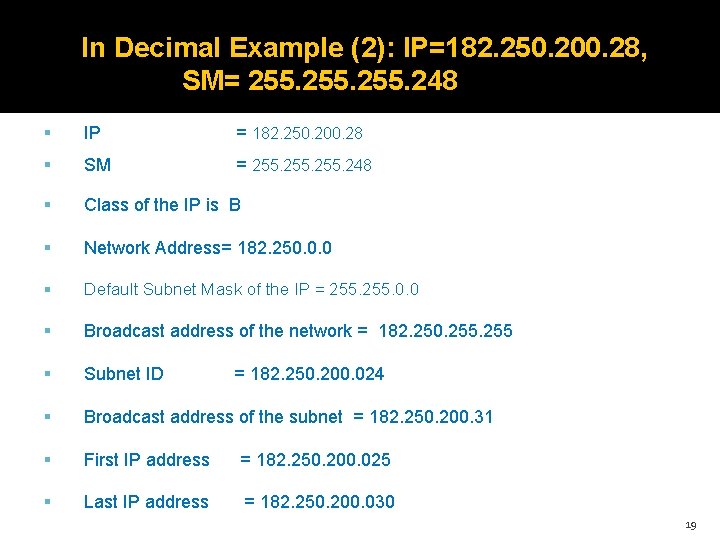
In Decimal Example (2): IP=182. 250. 200. 28, SM= 255. 248 IP = 182. 250. 200. 28 SM = 255. 248 Class of the IP is B Network Address= 182. 250. 0. 0 Default Subnet Mask of the IP = 255. 0. 0 Broadcast address of the network = 182. 250. 255 Subnet ID = 182. 250. 200. 024 Broadcast address of the subnet = 182. 250. 200. 31 First IP address = 182. 250. 200. 025 Last IP address = 182. 250. 200. 030 19
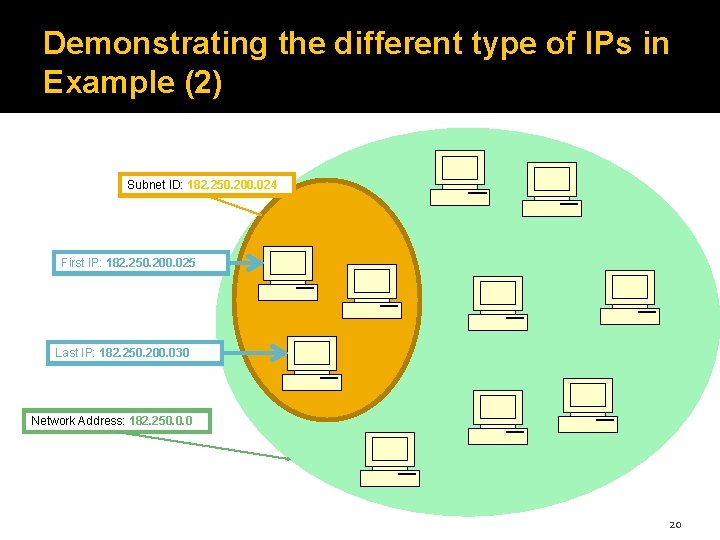
Demonstrating the different type of IPs in Example (2) Subnet ID: 182. 250. 200. 024 First IP: 182. 250. 200. 025 Last IP: 182. 250. 200. 030 Network Address: 182. 250. 0. 0 20
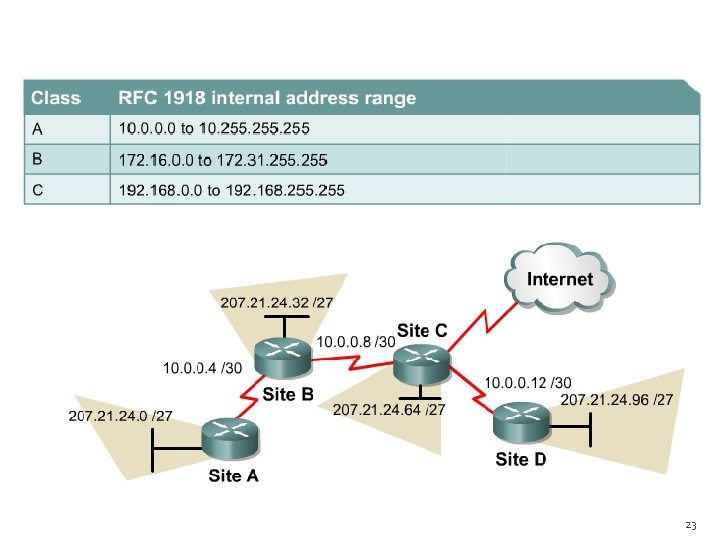
Public and private IP addresses � Public IP addresses are unique and it must be obtained from an Internet service provider (ISP) � RFC 1918 sets aside three blocks of IP addresses for private, internal use. These three blocks consist of one Class A, a range of Class B addresses, and a range of Class C addresses. Addresses that fall within these ranges are not routed on the Internet backbone. Internet routers immediately discard private addresses. 21
Public and private IP addresses � If addressing a nonpublic intranet, a test lab, or a home network, private addresses can be used instead of globally unique addresses. � Connecting a network using private addresses to the Internet requires translation of the private addresses to public addresses. This translation process is referred to as Network Address Translation (NAT). 22
23
- Slides: 23