
Lecture 22 Ethical Hacking Objectives Ethical hacking What
Lecture 22 Ethical Hacking
Objectives • Ethical hacking • What you can do legally as an ethical hacker • What you cannot do as an ethical hacker 2
Hacker and Ethical hacker • Hackers – Access computer system or network without authorization – Breaks the law; can go to prison • Ethical hacker – Performs most of the same activities but with owner’s permission – Employed by companies to perform penetration tests 3
Penetration test vs. Security test • Penetration test – Legal attempt to break into a company’s network to find its weakest link – Tester only reports findings • Security test – More than an attempt to break in; also includes analyzing company’s security policy and procedures – Tester offers solutions to secure or protect the network 4
Penetration test & Security test • Programming languages used by experienced penetration testers – Practical Extraction and Report Language (Perl) –C • Tiger box – Collection of OSs and hacking tools – Helps penetration testers and security testers conduct vulnerabilities assessments and attacks 5
Penetration-Testing Methodologies • Penetration-Testing Methodologies – White box model – Black box model – Gray box model • White box model – Tester is told everything about the network topology and technology – Tester is authorized to interview IT personnel and company employees – Makes tester job a little easier 6
Penetration-Testing Methodologies (continued) • Black box model – Company staff does not know about the test – Tester is not given details about the network • Burden is on the tester to find these details – Tests if security personnel are able to detect an attack • Gray box model – Hybrid of the white and black box models – Company gives tester partial information 7
Certification Programs for Network Security Personnel • Penetration testers need to have – the technical skills – good understanding of networks – the role of management in an organization. • Network security certification programs – – Certified Ethical Hacker (CEH) OSSTMM Professional Security Tester (OPST) Certified Information Systems Security Professional (CISSP) Global Information Assurance Certification (GIAC) • Certifications that help prepare for these certifications – Comp. TIA Security+ – Network+ 8
Certified Ethical Hacker (CEH) • Developed by the International Council of Electronic Commerce Consultants (EC-Council) – Based on 21 domains (subject areas) – Web site: www. eccouncil. org – Red team: Composed of people with varied skills • Conducts penetration tests 9
OSSTMM Professional Security Tester (OPST) • Designated by the Institute for Security and Open Methodologies (ISECOM) – Based on the Open Source Security Testing Methodology Manual (OSSTMM) – Consists of 5 domains – Web site: www. isecom. org 10
Certified Information Systems Security Professional (CISSP) • Issued by the International Information Systems Security Certifications Consortium (ISC 2) – Usually more concerned with policies and procedures – Consists of 10 domains – Web site: www. isc 2. org 11
SANS Institute • Sys. Admin, Audit, Network, Security (SANS) – Offers certifications through Global Information Assurance Certification (GIAC) – Top 20 list • One of the most popular SANS Institute documents • Details the most common network exploits • Suggests ways of correcting vulnerabilities – Web site: www. sans. org 12
Objectives • Ethical hacking • What you can do legally as an ethical hacker • What you cannot do as an ethical hacker 13
What You Can Do Legally • As an ethical hacker, be aware of what is allowed and what is not allowed – Laws involving technology change as rapidly as technology itself – Find what is legal for you locally • Laws change from place to place • Some hacking Tools on your computer might be illegal to possess – Contact local law enforcement agencies before installing hacking tools 14
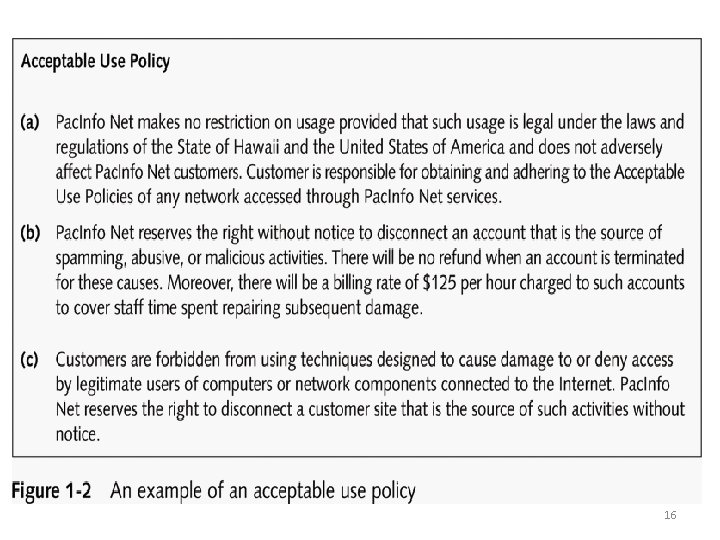
Is Port Scanning Legal? • Federal Government does not see it as a violation – Allows each state to address it separately – Some states deem it legal • As noninvasive or nondestructive in nature • Not always the case • Read your ISP’s “Acceptable Use Policy” 15
16
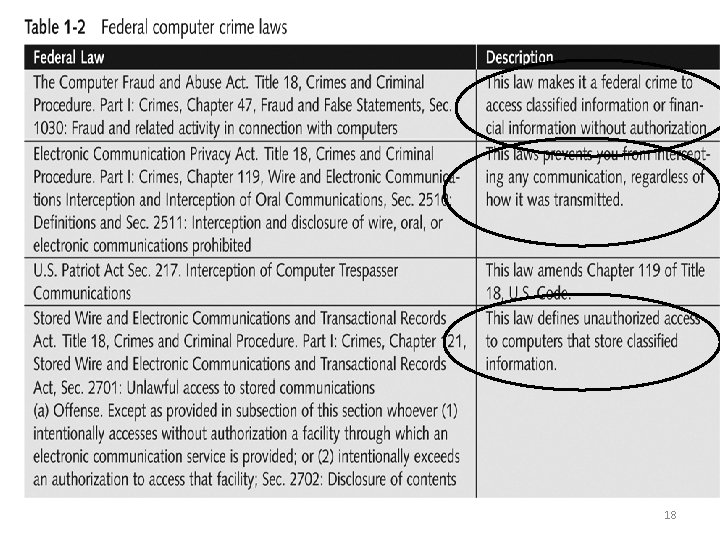
Federal Laws • Federal computer crime laws are getting more specific – Cover cybercrimes and intellectual property issues • Computer Hacking and Intellectual Property (CHIP) – New government branch to address cybercrimes and intellectual property issues 17
18
Objectives • Ethical hacking • What you can do legally as an ethical hacker • What you cannot do as an ethical hacker 19
What You Cannot Do Legally • Accessing a computer without permission is illegal • Other illegal actions – Installing worms or viruses – Denial of Service attacks – Denying users access to network resources • As an independent contractor (ethical hacker), using a contract is just good business – Contracts may be useful in court – Internet can also be a useful resource – Have an attorney read over your contract before sending or signing it 20
Ethical Hacking in a Nutshell • What it takes to be a security tester ? – Knowledge of network and computer technology – Ability to communicate with management and IT personnel – Understanding of the laws – Ability to use necessary tools 21
- Slides: 21