Government of the Union S Manikandan The Union
- Slides: 99
Government of the Union S. Manikandan
The Union Executive • • • The President The Vice President The Council of Ministers The Attorney General for India The Comptroller and Auditor General of India (CAG)
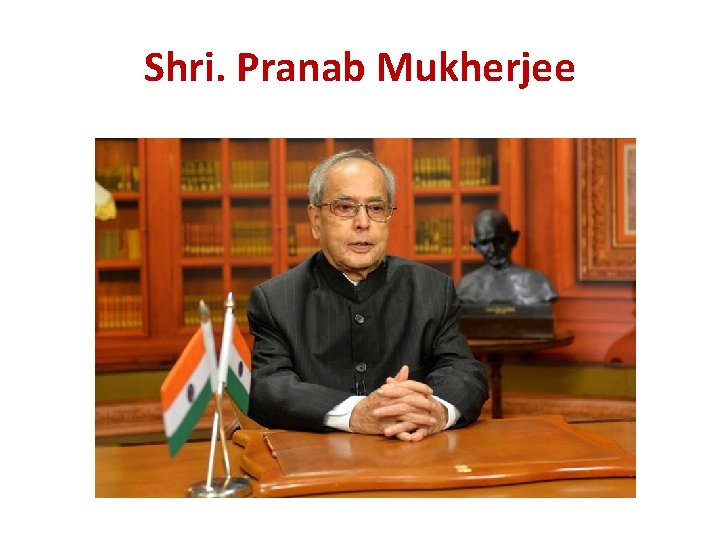
The President The Present President of India • Pranab Mukherjee Preceded by Pratibha Patil
Shri. Pranab Mukherjee
• • • Shri Pranab Mukherjee Father's Name: Late Shri Kamada Kinkar Mukherjee Mother's Name: Late Smt. Rajlakshmi Mukherjee Date of Birth: December 11, 1935 Place of Birth: Mirati, Kirnahar, District: Birbhum, West Bengal Marital Status: Married Spouse's Name: Late Smt. Suvra Mukherjee Children: Two sons and one daughter Educational Qualifications: M. A. (History), M. A. (Political Science), LL. B. , D. Litt. (Honoris Causa), Educated at Vidyasagar College Permanent Address: Flat No. 2 -A, First Floor, 60/2/7, Kavi Bharti Sarani, Lake Road, Kolkata-700 029 West Bengal, Tel. (033) 24648366 Present Address: Rashtrapati Bhavan, New Delhi, 110 004. , Tel: 011 -23015321 Profession: Political and Social Worker, Teacher, Journalist, Writer Family Background: Father was a freedom fighter, was imprisoned for more than 10 years, participated in all Congress movements from 1920, was a member of AICC, and West Bengal Legislative Council (1952 -64), President, District Congress Committee, Birbhum (WB).
Election of the President • Article 54 of the Indian Constitution discusses the election of the President. • It says that the President shall be elected by the members of an electoral college, which consists of the elected members of both the Houses of Parliament, and the Legislative Assemblies of the States and the two Union Territories, namely Delhi and Puducherry. • The election of the President is held in accordance with a system of proportional representation by means of a single transferable vote. He can be re-elected to the office of the President. • The oath of the President is administered by the Chief Justice of India, and in his absence, by the most senior judge of the Supreme Court.
Eligibility • Article 58 of the Indian Constitution says that the presidential candidate must: • Be a citizen of India. • Have completed the age of thirty-five years. • Be qualified for elections as a member of the Lok Sabha. • Not hold any office of profit under the Union or any State government, or any local or other authority.
Term of office • Article 56 of the Indian Constitution says that the President shall hold office for a term of five years from the date he takes up his post. • He may resign from his office by writing his resignation to the Vice. President of India. • But, he will continue to hold his office, in spite of tendering his resignation, until his successor takes up his office. • And, before his office gets vacated, an election should be held for the same. • Article 61 provides for the manner in which he can be impeached on the violation of the Constitution. • The Vice-President acts as his substitute in case his office falls vacant on the grounds of his death, resignation or impeachment or otherwise. • Such a vacancy should be filled by an election necessarily taking place within six months of his office falling vacant.
Power and Duties of the President The President of India is vested with • the Executive • Legislative • Emergency • Diplomatic • Judicial and • Military powers
Executive powers • All the executive powers of the Union shall be vested in him. • These powers should be exercised by him in accordance with the Constitution of India. • He appoints the Prime Minister and the Council of Ministers. • He also appoints the judges of the Supreme Court and the High Courts in the states, besides appointing the Attorney General and Comptroller and auditor General of India. • Among other critical powers, he enjoys the pardoning power, whereby he can pardon the death sentence awarded to a convict.
Legislative powers • He can dissolve the Lok Sabha and end a session of the Parliament. • He can also address the Parliament in its first session every year. • He can nominate 12 members to the Rajya Sabha. These members must have extra ordinary accomplishments in the fields of science, art, literature and social service. • He can also nominate 2 members to the Lok Sabha from the Anglo-Indian Community. • When a bill is passed by the Parliament, the President can give or withhold his assent to it. • He can also return it to the Parliament, unless it's a Money Bill or a Constitutional Amendment Bill.
Emergency powers • He can declare national, state and financial emergency. • National emergency can be declared on the grounds of war, external aggression or armed rebellion in the country. • This can be done on the written request of the Cabinet Ministers after the proclamation has been approved by the Parliament. • State emergency can be imposed in a state if it fails to run constitutionally. • Financial emergency can be proclaimed if there is a likelihood of the financial instability in the country.
Financial powers • Only when the President recommends can a money bill be introduced in the Parliament. • He lays the Union budget before the Parliament and makes advances out of the Contingency Fund.
Diplomatic, Military and Judicial powers • He appoints ambassadors and high commissioners to other countries. • All international treaties are signed on his behalf. • Under Military powers, he can declare war and conclude peace. • He appoints Chief of Army, Navy and Air Force. • He can dismiss judges if two-third majority of the members present of the two Houses of the Parliament pass the resolution to that effect.
Salary • The salary and allowances of the President are fixed by the Parliament of India. • The current salary of the President is Rs 150000 per month.
Vacancy in the Office of President A vacancy in the office of the President may caused in any of the following ways • (i) on the expiry of his term of five years • (ii) by his death • (iii) by his resignation • (iv) on his removal by impeachment
Impeachment of President • Impeachment is the process to remove the President of India from his office before his term expires. • The Impeachment can be carried out if the Constitution of India is violated by the President and the proceedings can be initiated in either of the two houses of the Parliament. • Two-thirds majority is required to pass the resolution in the House. • Thereafter, a notice signed by a quarter of the members of the House and containing the charges is sent to the President. • After 14 days the charges are taken into consideration by the other House and in the meantime the President can defend himself. • If the charges are approved by the second House also then the President is said to have been impeached. He has to leave his office.
The Vice President Shri Mohd. Hamid Ansari Father's Name: Mohammad Abdul Aziz Ansari Mother's Name: Mrs. Aasiya Begum Date of Birth: 1 April 1937 Place of Birth: Calcutta Marital Status: Married Spouse's Name: Mrs. Salma Ansari Children: Two sons and one daughter Educational Qualifications: BA (Hons); MA (Political Science) Permanent Address: D-55, IFS Apartments, Mayur Vihar, Phase-I, Delhi - 110091 • Present Address: Vice-President House, 6, Maulana Azad Road, New Delhi - 110011 Tel. - 23016422, 23016344 • E-mail: vpindia@sansad. nic. in • • •
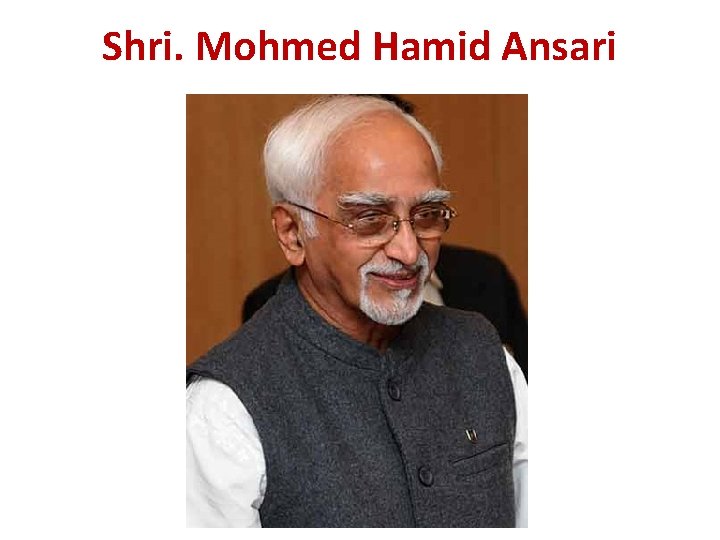
Shri. Mohmed Hamid Ansari
Residence of the Vice President • Unlike the President, the Vice President is not allotted any special residential privileges while in office. • While the President of India stays in the Rastrapati Bhavan, the Vice President is not subject to any such benefits during his or her tenure as the Vice President.
Role of the Vice President • According to the Constitution of India, the office of the Vice President is the second highest constitutional post in independent India. • The Vice President is the 'ex-officio' Chairperson of the Rajya Sabha. • The office of the Vice President in India is complementary to that of the President, in that, the Vice President takes over the role of the President in the latter’s absence. • In other words, the role of the Vice President is to assist the President in being the nominal head of the Republic of India. • However, one must remember that the office of the President and the Vice President cannot be combined in one person, as per the Constitution of India.
Powers and Functions of the Vice President • The Vice President of India, after the President, is the highest dignitary of India, and certain powers are attached to the office of the Vice President. These are: • The Vice President shall discharge the functions of the President during the temporary absence of the President due to illness or any other cause due to which the President is unable to carry out his functions.
• The Vice President shall act as the President, in case of any vacancy in the office of the President by reason of his death, resignation, removal through impeachment or otherwise. The Vice President shall take over the duties of the President until a new President is elected and resumes office. • The Vice President is the ex-officio Chairman of the Council of States. • When the Vice President acts as, or discharges the functions of the President, he or she immediately ceases to perform the normal functions of being the Chairman of the Council of States.
Eligibility Criteria The qualifications needed to become a Vice President of India are the following: • He or she must be a citizen of India. • He or she must be over 35 years of age. • He or she must not hold any office of profit. • He or she must be qualified for election as a Member of the Rajya Sabha or the Council of States.
Facilities for the Vice President • The Vice President, unlike the President, is not entitled to any special emoluments and privileges during his term of office. • However, when he discharges the duties of the President in the latter’s absence, the Vice President enjoys all the benefits that are enjoyed by the President, during that tenure.
Salary of the Vice President • The Vice President is entitled to receiving the salary of the Chairman of the Council of States, which presently amounts to Rs 1, 25, 000 per month. • However, when the Vice President performs the functions of the President or discharges the duties of the President, in the latter’s temporary absence, he is entitled to the salary as well as special privileges of the President.
Selection Process of the Vice President • Like the election of the President, the election of the Vice President is indirect and in accordance with the system of proportional representation, through the concept of a single transferable vote by secret ballot. • The electoral college, which consists of members of both houses of the Parliament, cast their votes to elect the Vice President. • However, there is a slight difference in the election of the Vice President and that of the President. The members of the State Legislatures have no role to play in the election of the Vice President, unlike that of the President.
• The Election Commission of India, which holds elections in the country, is responsible for ensuring that free and fair elections to the post of a Vice President are held in the following steps: • A Returning Officer who is appointed for the elections, sends out public notices issuing the date of election to the office of the Vice President. The elections for the same must be held within a period of 60 days of the expiry of the term of office of the previous Vice President.
• The nomination of candidates to the office of a Vice President must be affirmed by 20 electors (Members of Parliament) who act as proposers, and 20 electors who act as seconders. • Each candidate must deposit a total of Rs 15, 000 to the Reserve Bank of India, as part of the nomination process. • The Returning Officer carefully scrutinises and adds to the ballot, the names of all eligible candidates.
• The elections are then held by proportional representation by means of a single transferable vote. The nominated candidates can also cast their votes. • The Returning Officer declares the results to the electoral college, the Central Government and the Election Commission of India, respectively. The name of the Vice President is then officially announced by the Central Government.
Duty Term or Period of the Vice President • The office of the Vice President is for a period of five years. There is no fixed retirement age to the Vice President, as he or she can remain in the post for five years. • However, he or she can be re-elected as the Vice President for any number of times. The office of the Vice President can also terminate earlier before the fixed five-year term, either by resignation or by removal by the President.
• There is no formal process of impeachment for the removal of the Vice President, and a removal proceeding can be initiated when members of the Rajya Sabha vote against the Vice President in an effective majority and members of Lok Sabha agree to this decision in a simple majority. • A total of 14 days advance notice must be given prior to the initiation of the removal proceedings of the Vice President. In such cases, when a temporary vacancy in the office of the Vice President is created, the Deputy Chairman of the Rajya Sabha takes over the role of the Chairman of the Rajya Sabha.
Pension of the Vice President • Although there is no particular fixed pension in the Constitution for the Vice President of India, according to the Vice President’s Pension Act of 1997, the pension of the Vice President is half of the salary that he/she is entitled to, during his term of office.
Facts… • Dr. Sarvepalli Radhakrishnan was the first Vice President of independent India, elected to the office in 1952. • The only Vice President to be re-elected for a second term was Dr. S Radhakrishnan, who again became the Vice President in the year 1957. • No Vice President, in the history of independent India, has had to face removal proceedings before the expiry of the term of office.
• K R Narayanan, Shankar Dayal Sharma, R Venkataraman, V V Giri, Zakir Hussain and Dr. S Radhakrishnan, each of whom was a President of India at different points in time, remained Vice Presidents before they were elected as Presidents. • The present Vice President of India, Mohammad Hamid Ansari, has served as an ambassador to many countries across the world.
The Prime Minister of India The Head of the Government
• The Prime Minister of India is the head of the executive branch of the Government of India. • His position is distinct from that of the President of India, who is the head of the State. • As India follows a parliamentary system of government, most of the executive powers are exercised by the Prime Minister. • He acts as an advisor to the President and is the leader of the Council of Ministers. • The President appoints the Prime Minister of India and on his advice, appoints the Council of Ministers. • The Prime Minister can be a member of either the Lok Sabha or the Rajya Sabha.
Prime Ministers of India Since independence in 1947 • India has had 15 different Prime Ministers till now. There have been many outstanding leaders from different political parties who held India’s top post. Some of them served a complete five-year term while others governed the nation for more than five years. • Narendra Modi is the present Prime Minister of India as leader of single majority party gained in the last general election.
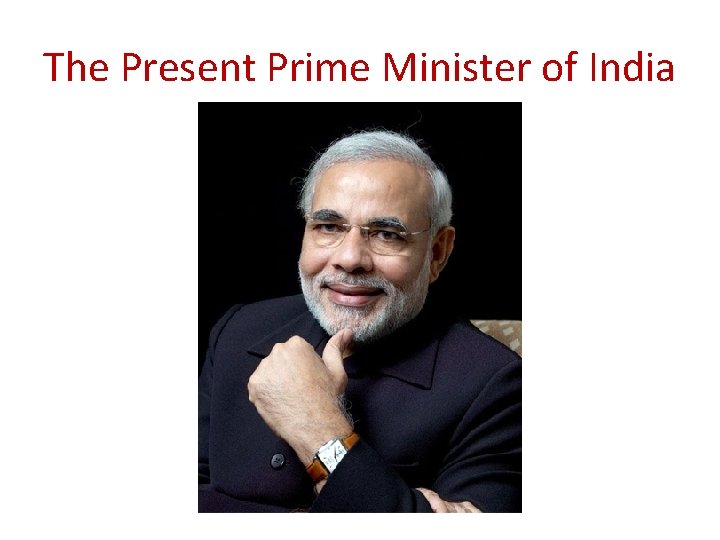
The Present Prime Minister of India
Shri Narendra Damodardas Modi • • Born: September 17, 1950 (age 65), Vadnagar Spouse: Jashodaben Narendrabhai Modi (m. 1968) Parents: Heeraben Modi, Damodardas Mulchand Modi Narendra Damodardas Modi is the 15 th and current Prime Minister of India, in office since 26 May 2014. Modi, a leader of the Bharatiya Janata Party was the Chief Minister of Gujarat from 2001 to 2014 and is the Member of Parliament from Varanasi.
Background of Narendra Modi • Narendra Damodardas Modi hails from a family of grocers in a town called Vadnagar in the northern Mehsana district of the state of Gujarat. • He was born on 17 September 1950 to Damodardas Mulchand Modi and Heeraben Modi. Narendra Modi is the third eldest of his six siblings. • Modi’s saga of struggle began when as a teenager, he, along with his brother, used to run a tea stall near a railway station in Ahmedabad. • He did his schooling from Vadnagar and obtained a master's degree in Political Science from the Gujarat University. • One of his school teachers described him as an average student but a brilliant debater. • During his college days, he acted as a pracharak (promoter) of the Rashtriya Swayamsevak Sangh (RSS).
The official residence of the Indian Prime Minister 7, Race Course Road, New Delhi. It is also his main workplace. The official name of the residence is “Panchavati”. It was built in the 1980 s. The entire complex spreads over an area of 12 acres and comprises five bungalows. • When a person is appointed as the new Prime Minister, his predecessor vacates the residence and the incumbent is advised to move to his official residence at the earliest. • • •
Roles and Responsibilities of Prime Minister The roles and responsibilities of the Prime Minister are as follows: • Link between President and Council of Ministers: – The Prime Minister is the leader of the Council of Ministers and serves as the channel of communication between the President and the Council of Ministers. – It is his duty to communicate to the President all the decisions taken by the Council of Ministers and to provide information regarding administration of the Union or proposals for the legislature as called for by the President. Allocation of Portfolios: – He allocates portfolios among the ministers and distributes work among various ministries and offices. – The Prime Minister coordinates work among various ministries and departments through the Cabinet Secretariat.
• Prime Minister also retains certain portfolios that are not allocated to other ministers. • He is generally in charge of the following ministries/departments: – Ministry of Personnel, Public Grievances and Pensions Ministry of Planning Department of Atomic Energy Department of Space Appointments Committee of the Cabinet
Leader of the Cabinet • The Prime Minister summons and presides over meetings of the cabinet and determines what business shall be transacted in these meetings. • Link between the Parliament and the Cabinet: – The Prime Minister is also the link between the cabinet and the Parliament. – He is the chief spokesperson of the government in the Parliament, along with the leader of the party in majority in the Lok Sabha. – It is his responsibility to announce important policy decisions. – The Prime Minister can also intervene in debates of general importance in the Parliament to clarify the government’s stand or policy.
Official Representative • The Prime Minister represents India in various delegations, high-level meetings and international organisations and also addresses the nation on various occasions of national importance.
Powers/Authorities of Prime Minister The various powers and authorities enjoyed by the Prime Minister are as follows: • Head of the Government: – The Prime Minister of India is the head of the Government. – Though the President is the head of the State, most of the executive decisions are taken by the Prime Minister. – All the important decision-making bodies in India, like the Union Cabinet and the Planning Commission, run under his supervision.
Leader of the Council of Ministers • As far as the Prime Minister’s relation to the Council of Ministers is concerned, his position is that of “First among Equals”. • In the case of death or resignation of the Prime Minister, the entire Council of Ministers has to resign. • The ministers directly report to the Prime Minister. • He can also remove a minister by asking for his resignation or having him dismissed by the President. • If any difference of opinion arises between the Prime Minister and any other minister, the opinion of the Prime Minister prevails.
Leader of the Parliament • The Prime Minister is the Leader of the House to which he belongs. • He can take part in debates in the House of which he is not a member. • He can also advise the President to dissolve the Lok Sabha.
Representative of the Country • In international affairs, he is the spokesperson of the country. • The Prime Minister plays a major role in directing India’s foreign policy.
Selection Process of Prime Minister • The Constitution states that the President of India should appoint the leader of the party or alliance which is in majority in the Lok Sabha as the Prime Minister of India. • In case no party or alliance enjoys majority, the President appoints the leader of the largest party or alliance as the Prime Minister. • But he has to win the confidence vote in the Lower House of the Parliament as early as possible. • A member of either the Lok Sabha or the Rajya Sabha can be appointed as the Prime Minister. • If he is not a member of either House of the Parliament then he has to be elected to either House within six months of his appointment. • As the Prime Minister, he is the Leader of the House of which he is a member.
Term and Retirement Age of Prime Minister • Unlike the President, the Prime Minister does not have a fixed tenure. • The full term of the Prime Minister is five years, which coincides with the normal life of the Lok Sabha. • However, the term can end sooner if he loses the vote of confidence in the Lower House. • So, it can be said that he remains in power as long as he enjoys the confidence of the Lok Sabha. • The Prime Minister can also resign by writing to the President. • There are no term limits on the office of the Prime Minister. • There is also no official retirement age.
Facilities • Official House called “Panchavati” • Personal staff Special Protection Group (SPG) who is responsible for his security • Prime Ministerial car • Exclusive aircraft (Air India One)
Eligibility Criteria to become Prime Minister of India • To be eligible for the position of the Prime Minister of India, a person should: – Be a citizen of India. – Be a member of either the Lok Sabha or the Rajya Sabha. – Complete 25 years of age if he is a member of the Lok Sabha – or 30 years if he is a member of the Rajya Sabha. • A person cannot be the Prime Minister of India if he holds any office of profit under the Government of India, the government of any state, or any local or other authority subject to the control of any of the said governments.
Salary of Prime Minister of India • According to Article 75 of the Constitution of India, the salary of the Prime Minister is decided by the Parliament and revised from time to time. • As on 31 July 2012 the monthly pay and allowances of the Prime Minister of India was – Rs. 1, 60, 000 (US $2, 600). Pay and Allowance of the Prime Minister on 31 July 2012 (in rupees) – Pay 50000 – Sumptuary Allowance 3000 – Daily Allowance 62, 000 (@ 2, 000 per day) – Constituency Allowance 45000 – Gross 1, 60, 000
Pension • Former Prime Ministers of India are provided with: – Rent-free accommodation for lifetime. Medical facilities, 14 secretarial staff, office expenses against actual expenditure, six domestic executive -class flight tickets, and unlimited free train travels for first five years. – SPG cover for one year. – After five years: One personal assistant and peon, free air and train tickets and Rs. 6, 000 for office expenses.
Facts about Indian Prime Ministers… • Jawaharlal Nehru was the longest serving Indian Prime Minister, starting from India's independence in 1947 to his death in 1964. • Gulzari Lal Nanda served twice as the acting Prime Minister of India after the death of Jawaharlal Nehru and Lal Bahadur Shastri. • Indira Gandhi was named “Woman of the Millennium” in a poll organised by the British Broadcasting Corporation (BBC) in 1999. Former Prime Minister Indira Gandhi was the first woman to receive the Bharat Ratna. She was also awarded Bangladesh’s highest civilian award “Bangladesh Swadhinata Samman” in 2011.
• Morarji Desai was the first non-Congress Prime Minister of India. He was also the first Prime Minister to resign without completing his full term. Morarji Desai is the only Indian Prime Minister to be conferred upon the Nishaan-e-Pakistan (Pakistan’s highest civilian award). • Rajiv Gandhi was the youngest Indian Prime Minister; he assumed office at the age of 40. Rajiv Gandhi was the first Prime Minister of India to live in 7, Race Course. • P. V. Narasimha Rao was the first Prime Minister from South India. • H. D. Deve Gowda was the first Prime Minister of India who was a member of the Rajya Sabha. • Dr. Manmohan Singh was the longest-serving Prime Minister of India who was a member of the Rajya Sabha (2004 -2014).
The Council of Ministers • Effective executive power rests with the Council of Ministers, headed by the prime minister, who is chosen by the majority party or coalition in the Lok Sabha and is formally appointed by the president. • The Council of Ministers, also formally appointed by the president, is selected by the prime minister. • The most important group within the council is the cabinet.
The Council of Ministers • Cabinet Ministers • Ministers of State (Independent Charge) • Ministers of State
Functions of the Council of Ministers • Though there is an elected President at the top of the Government structure, the constitution in reality establishes a British cabinet type of Government in India. • Artivle 74(1) requires the President to have a Council of Ministers with the Prime Minister at the head to “aid and advice” him in the exercise of his power. • To remove the impression that the advice given by the Council of Ministers may not be binding on the President, the 42 nd amendment of the constitution has made the ministerial advice expressly binding on the President.
The Attorney General for India PART V CHAPTER I. -THE EXECUTIVE 76. Attorney-General for India. - (1) The President shall appoint a person who is qualified to be appointed a Judge of the Supreme Court to be Attorney-General for India. (2) It shall be the duty of the Attorney-General to give advice to the Government of India upon such legal matters, and to perform such other duties of a legal character, as may from time to time be referred or assigned to him by the President, and to discharge the functions conferred on him by or under this Constitution or any other law for the time being in force. (3) In the performance of his duties the Attorney-General shall have right of audience in all courts in the territory of India. (4) The Attorney-General shall hold office during the pleasure of the President, and shall receive such remuneration as the President may determine.
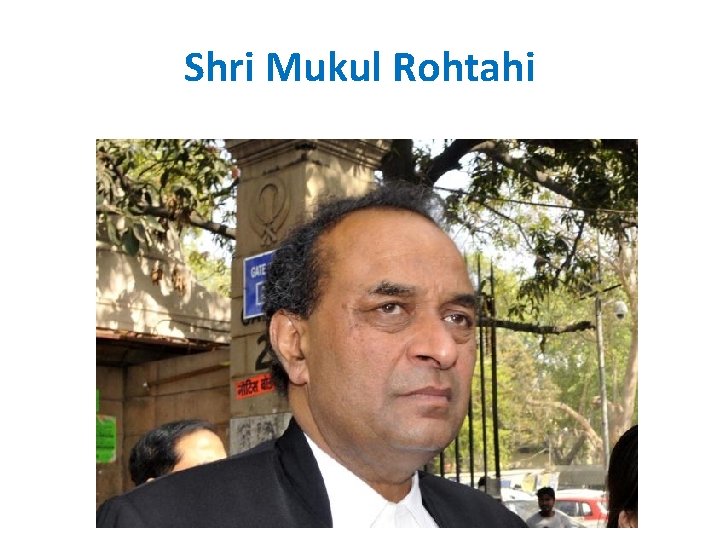
Shri Mukul Rohtahi
• The Attorney General has a unique role to play as a Minister. • One part of the Attorney General's role is that of a Cabinet Minister. In this capacity the Minister is responsible for representing the interests and perspectives of the Ministry at Cabinet, while simultaneously representing the interests and perspectives of Cabinet and consequently the Government to the Ministry and the Ministry's communities of interest. • The Attorney General is the chief law officer of the Executive Council. The responsibilities stemming from this role are unlike those of any other Cabinet member. The role has been referred to as "judicial-like" and as the "guardian of the public interest". • Much has been written on the subject of ministerial responsibilities and the unique role of the Attorney General.
• There are various components of the Attorney General's role. The Attorney General has unique responsibilities to the Crown, the courts, the Legislature and the executive branch of government. • While there are different emphases and nuances attached to these there is a general theme throughout all the various aspects of the Attorney General's responsibilities that the office has a constitutional and traditional responsibility beyond that of a political minister.
The statutory responsibilities of the office are found in section 5 of the Ministry of the Attorney General Act. Section 5 states: "The Attorney General, • is the Law Officer of the Executive Council; • shall see that the administration of public affairs is in accordance with the law; • shall superintend all matters connected with the administration of justice in Ontario;
• shall perform the duties and have the powers that belong to the Attorney General and Solicitor General of England by law and usage, so far as those powers and duties are applicable to Ontario, and also shall perform the duties and powers that, until the Constitution Act, 1867 came into effect, belonged to the offices of the Attorney General and Solicitor General in the provinces of Canada and Upper Canada and which, under the provisions of that Act, are within the scope of the powers of the Legislature; • shall advise the Government upon all matters of law connected with legislative enactments and upon all matters of law referred to him or her by the Government; • shall advise the Government upon all matters of a legislative nature and superintend all Government measures of a legislative nature;
• shall advise the heads of ministries and agencies of Government upon all matters of law connected with such ministries and agencies; • shall conduct and regulate all litigation for and against the Crown or any ministry or agency of government in respect of any subject within the authority or jurisdiction of the Legislature; • shall superintend all matters connected with judicial offices; • shall perform such other functions as are assigned to him or her by the Legislature or by the Lieutenant Governor in Council. "
The Comptroller and Auditor General of India (CAG) PART V CHAPTER V. - COMPTROLLER AND AUDITOR-GENERAL OF INDIA 149. Duties and powers of the Comptroller and Auditor-General The Comptroller and Auditor-General shall perform such duties and exercise such powers in relation to the accounts of the Union and of the States and of any other authority or body as may be prescribed by or under any law made by Parliament and, until provision in that behalf is so made, shall perform such duties and exercise such powers in relation to the accounts of the Union and of the States as were conferred on or exercisable by the Auditor-General of India immediately before the commencement of this Constitution in relation to the accounts of the Dominion of India and of the Provinces respectively.
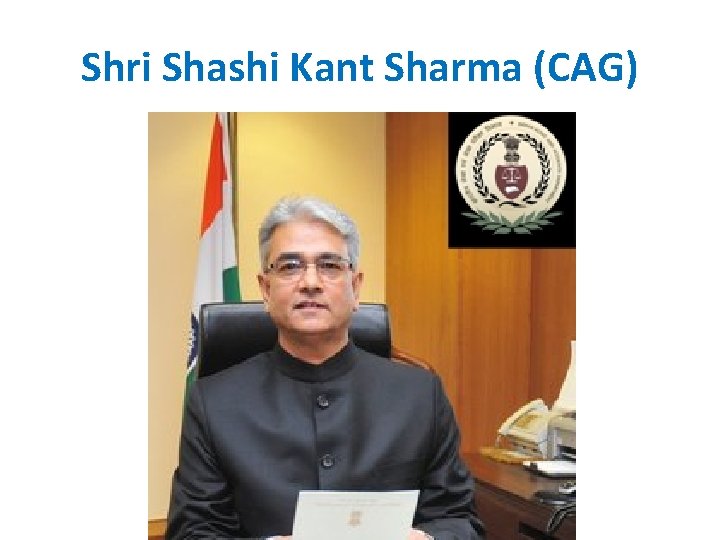
Shri Shashi Kant Sharma (CAG)
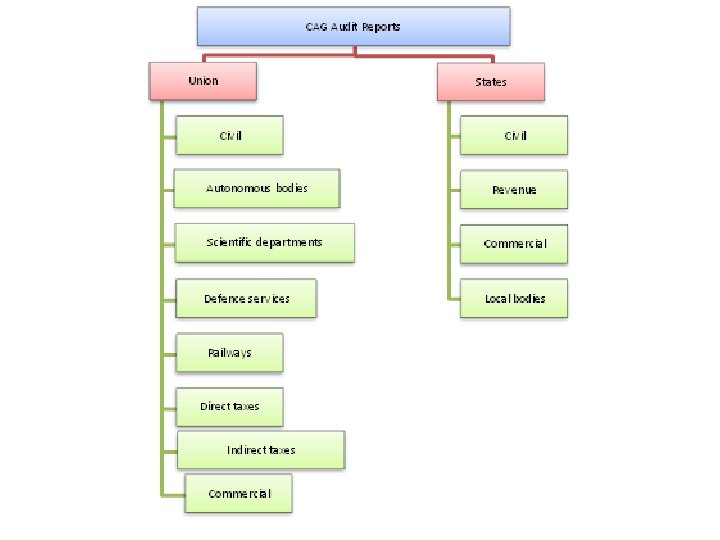
• Shri Shashi Kant Sharma is Comptroller and Auditor General (C&AG) of India since May, 2013. • As a constitutional functionary, he is primarily entrusted with the responsibility to audit the accounts of the Union Government and of the State Governments of India. • His reports are laid before the Parliament and Legislatures of the States.
• Shri Shashi Kant Sharma belongs to the 1976 batch of Indian Administrative Service (Bihar Cadre). • He has wide experience in the fields of Public Administration, Financial Services and Infrastructure Development. • He was serving as Defence Secretary before joining the position of C&AG. He has also served as Secretary, Department of Financial Services in the Ministry of Finance and as Secretary, Information Technology in the Ministry of Communication and I. T. • He also served as a Director on the Boards of Directors of State Bank of India and Life Insurance Corporation of India. • He has worked as Director General (Defence Acquisition) in the Ministry of Defence, Additional Secretary, Ministry of Personnel, Public Grievances and Pensions and Principal Commissioner, Delhi Development Authority. • Earlier he served as Joint Secretary in the Ministry of Defence and also as Director in Ministry of Human Resources Development
• The role, function and duties of the Comptroller and Auditor General are elaborated by an act of the Parliament passed in 1971. • Arts. 148 -151 of the Indian constitution creates and regulates the office of Comptroller and Auditor General of India. • Dr. D. D. Basu considers the office of the Comptroller and Auditor General as “pivotal” to the control of entire financial system of the country. • Dr. Ambedkar felt that the Comptroller and Auditor General of India shall be the most important officer under the constitution of India.
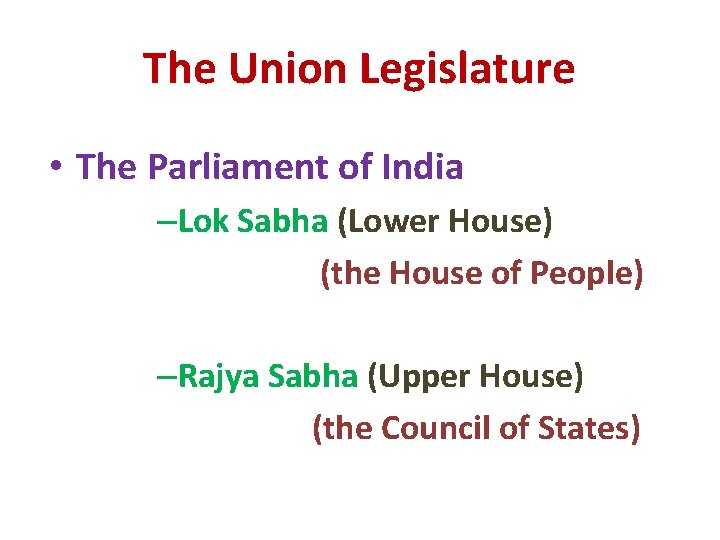
The Union Legislature • The Parliament of India –Lok Sabha (Lower House) (the House of People) –Rajya Sabha (Upper House) (the Council of States)
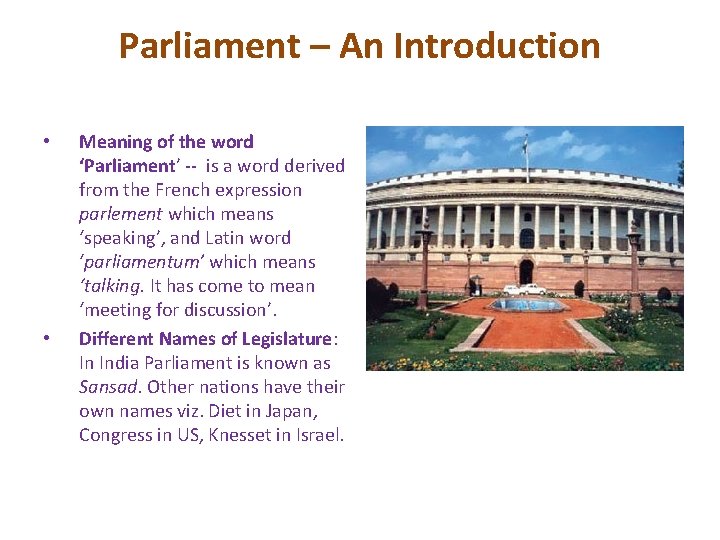
Parliament – An Introduction • • Meaning of the word ‘Parliament’ -- is a word derived from the French expression parlement which means ‘speaking’, and Latin word ‘parliamentum’ which means ‘talking. It has come to mean ‘meeting for discussion’. Different Names of Legislature: In India Parliament is known as Sansad. Other nations have their own names viz. Diet in Japan, Congress in US, Knesset in Israel.
Basic Characteristics of Parliament India has borrowed this nomenclature from England has adopted what is called as ‘Westminster model of parliamentary system’ but Indian Sansad has its unique set of characteristics such as 1. Union Parliament is non-sovereign 2. Representation to both the Houses is given on the basis of population 3. Provision of joint sitting of both the Houses 4. Provision of nomination in both the Houses
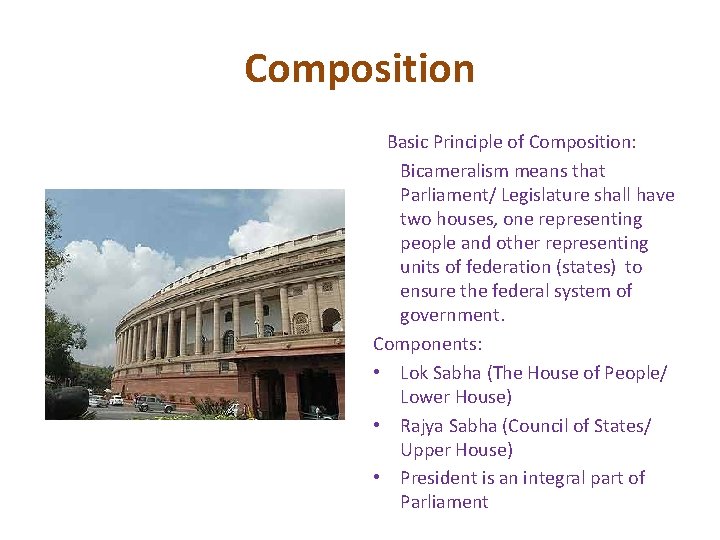
Composition Basic Principle of Composition: Bicameralism means that Parliament/ Legislature shall have two houses, one representing people and other representing units of federation (states) to ensure the federal system of government. Components: • Lok Sabha (The House of People/ Lower House) • Rajya Sabha (Council of States/ Upper House) • President is an integral part of Parliament
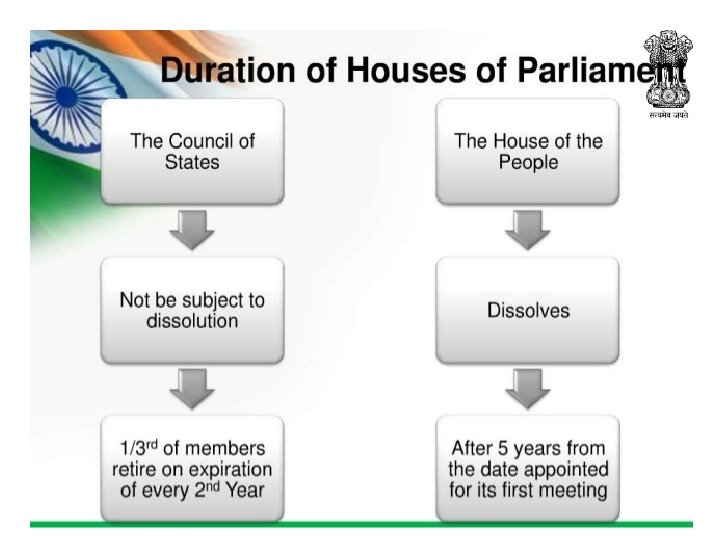
Lok Sabha • Total members – 545 (530 from different states + 13 from UTs + 2 Anglo. Indians) • Method of Election: Directly by the people on the basis of universal adult franchise and territorial constituencies • Basic qualifications of the members: 1. 2. 3. 4. 5. Must be a citizen of India; Must be not less than 25 years of age; Should not hold any Office of Profit; Should neither be insane, nor bankrupt, and Should possess all those qualification prescribed by the Parliament from time to time. • • Tenure: 5 years Number of Sessions: Two Mandatory Sessions Quorum: 1/10 th Presiding Officer: Speaker, elected by the members
Rajya Sabha • Total members – 250 (238 elected + 12 nominated by the President from amongst scientists, artists, scholars, social workers etc. ) • Method of Election: Members are elected by the members of State Legislative Assemblies through open ballot by single transferable vote of proportional representation system • Tenure: Permanent House but members of Rajya Sabha have 6 years terms and 1/3 rd of its member retire every second year • Qualifications: Not less than 30 years of Age, other qualifications remain as those required for Lok Sabha. • Presiding Officer: Vice President is ex-officio Chairman of Rajya Sabha • Quorum: 1/10 th
Parliament of India – Composition, Powers and Role
7 essential functions of the Parliament of India • Our constitution has adopted a Parliamentary System of Government. Under such a system there is a curious mixture of the legislative and executive organs of the state. • While discussing the functions of Parliament this aspect should always be borne in mind. • To begin with the Parliament provides the Council of Ministers to run the administration of the State and holds it responsible. • The membership, of the Council of Ministers is drawn from the two chambers of the Parliament.
Controlling the Executive • A very significant function of Parliament is to exercise its control on the Council of Ministers by way of holding it responsible for its acts of omissions and commissions. Article 75(3) expressly states that the Council of Minister remains in office, so long as it enjoys the confidence of the Lok Sabha. • Parliament exercise the control by asking question to the ministers through its members, by raising adjournment motions, cut motions, censure motions or debates. • More importantly the Lok Sabha can pass a vote of no confidence against the Council of Ministers which compels it to resign collectively. • Thus the parliament holds the ministers responsible individually and collectively. • This critical function of the Parliament ensures a responsive and responsible government.
Law Making • Law making is the primary function of any legislature. • The Parliament of India makes law on all matter included in the Union list and concurrent list of course the state legislatures share with the parliament the power to make law from the concurrent list with its prior permission.
• However under certain special circumstances the Parliament can make law for the states also. For examples the special circumstances are a) Promulgation of Emergency, b) A resolution passed by Rajya Sabha with special majority asking to make law for the states in the national interest which can remain valid for one year, c) A resolution by two or three states urging upon the Parliament to make law for them on certain items of the State list, d) If there is any international treaty or agreement is to be executed.
Controlling the Finance • The Parliament, particularly, the Lok Sabha exercises substantial functions in the domain of finance. • The legislature of any responsible system of Government has to ensure that public funds are raised and spent with its consent and control. • The Constitution of India has armed the union Parliament more particularly the Lok Sabha to exercise greater control over the National finance. • The executive or the Government of the nation has no authority to spend any money on its own without the approval of the Parliament. • Every financial year, the budget prepared by the Finance Minister is presented in the Lok Sabha for its approval.
• Any proposal for levying new taxes or any proposal for expenditure needs the sanction of the Parliament. • There also two very important Committee of the Parliament known as Public Accounts Committee and the Public Estimates Committee, and Comptroller and Auditor General, a Constitutional authority appointed by the President who examine the legality of expenditure and place a report for discussion in the Parliament.
• However it may be noted that Lok Sabha enjoys the exclusive power to control the national finances. The Rajya Sabha has no role to play in such a field. • A Money Bill can only be introduced in the Lok Sabha. After it is passed there it is sent to the Rajya Sabha who has to return the Bill within fourteen days with or without its recommendations. • However these recommendations may or may not be accepted by the Lok sabha. If the bill is not returned within the specified time of 14 days it is deemed to be approved by the Rajya Sabha.
Raising Deliberations • As an organ of information the Parliament has a formidable role to play. All the important administrative policies are discussed on the floors of the Parliament. • So that not only the Cabinets gets the advice of the Parliament and learns about its lapses but the nation as a whole is enlightened about serious matters of public importance. • This undoubtedly contributes to the growth of political conscious on the part of the people.
Constituent Functions • Parliament is the only body, under the constitution, to initiate any proposal for amendment of the constitution. • A proposal for amendment can be initiated in either House of Parliament. The bulk of such proposal are approved finally when passed by both the chambers with special majority of two-thirds of its members. • However some provisions require the approval of at least half of the states after they are passed by the Parliament with required majority.
Electoral Functions • The Parliament has some electoral functions to perform. • It takes part in the election of the President and the Vice-President of India. • It also elects various members to its committees, and the presiding officers and Deputy presiding officers.
Judicial Functions • The judicial functions of the Parliament are no less significant. • It has the power to impeach the President, the Vice-President, the judges of the Supreme Court and the High Court. • The Chairman and members of the Public Service Commission’s of the Union and the States as well, the Comptroller and Auditor General. • Impeachment is a judicial trial of the legislature to remove high Constitutional authorities after such a proposal is passed with required majority. • It can also punish its members and officials for its contempt’s. This power is not subject to review of the court.
Parliamentary Committees “Committee are eyes, ears and hands of the legislature and sometimes these become the brain of the house also” – Thomas Reed Basic Purpose of the Committees is to 1. 2. 3. 4. 5. Bring Efficiency Save Time, Expert Knowledge can be acquired Members of Opposition also get chance to participate Discussions above party-lines • • Adhoc Committees: Usually on topical issues. Standing Committees: the Business Advisory Committee, the Committee on Petitions, the Committee of Privileges and the Rules Committee, Department Related Standing Committees such as Committee on Commerce, HRD, Home Affairs etc. Other Committees: Committee on Estimates, Committee on Public Undertakings, Committee on Public Accounts, Business Advisory Committee, Committee on Private Members’ Bills and Resolutions, Committee of Privileges, Committee on Petitions, Committee on the Welfare of SCs and STs, Committee on Empowerment of Women etc. Different Committees: •
Role of Parliament – in Nutshell • • To form or end the Government To represent the electorate To legislate To hold the Government accountable for its actions To monitor the expenditure of public funds To be a forum for debate To be a forum for the expression of grievances To call for Information
Critique of Parliament • Only a talking-shop of the so-called representatives who are elected most of the times by gaining less than 50% votes • Absenteeism, Disruption in the Proceedings etc. • Decisions are taken by organizations/ party-in-power outside the Parliament, and Parliament is used just formal ratification. Indo-US nuclear deal is one example. • Gender-imbalance • Lack of intra-party democracy within parties does not let the debate become non-partisan • Number of days of Parliament sittings is declining. In 1951 Lok Sabha sat for 151 days, in 2007 it came down to 66. • Inquiry reports are either not tabled, or at times delayed for political reasons. • Members are turn-coats and find ways and means to defect. • Charges of corruption against members • There is a legislative vacuum. Laws on burning issues like surrogacy, cloning, money laundering, euthanasia, terrorism either need be reformed or made. Many sensitive bills are still pending, Women Reservation Bill is one.
Reforms in Parliament • Parliament should sit for a minimum of 120 -140 days • Important decisions on policy matters must be discussed in the Parliament before they are taken. • Parties must give more representation to women to bring about a desirable gender-balance in the numbers in Parliament • People should be given the right to recall, if MPs do not participate in Parliamentary proceedings • Ensure more participation of the voters in the election so as to make the concept of representation valid and justifiable.