
GOVERNMENT GENERAL SERVICES UNION PREPARING MANAGEMENT SUPPORT OFFICERS




- Slides: 24
GOVERNMENT GENERAL SERVICES UNION PREPARING MANAGEMENT SUPPORT OFFICERS FOR OFFICE MANAGEMENT ASSISTANT PRESENTED BY F K YARROO MINISTRY OF HEALTH AND QUALITY OF LIFE (5754 6786) SEPTEMBER 2017
CORRESPONDENCE REPORT MINUTE
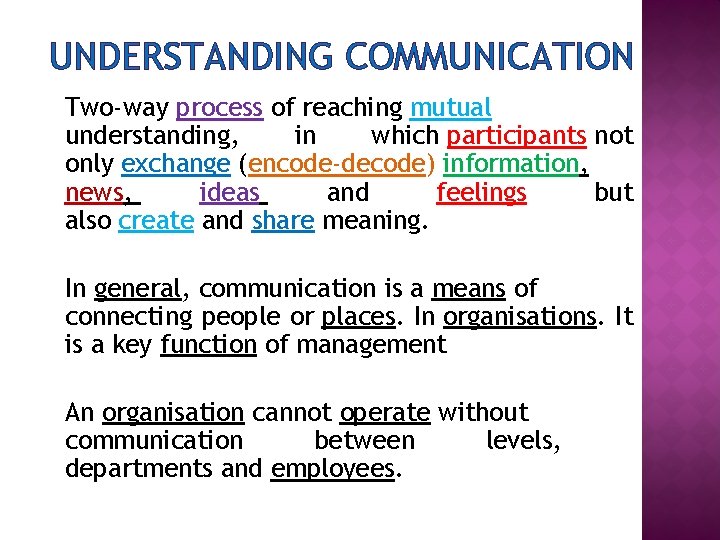
UNDERSTANDING COMMUNICATION Two-way process of reaching mutual understanding, in which participants not only exchange (encode-decode) information, news, ideas and feelings but also create and share meaning. In general, communication is a means of connecting people or places. In organisations. It is a key function of management An organisation cannot operate without communication between levels, departments and employees.
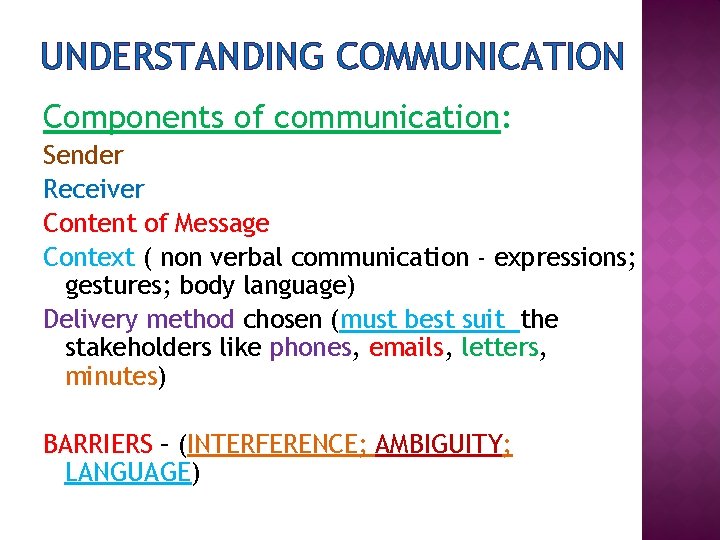
UNDERSTANDING COMMUNICATION Components of communication: Sender Receiver Content of Message Context ( non verbal communication - expressions; gestures; body language) Delivery method chosen (must best suit the stakeholders like phones, emails, letters, minutes) BARRIERS – (INTERFERENCE; AMBIGUITY; LANGUAGE)
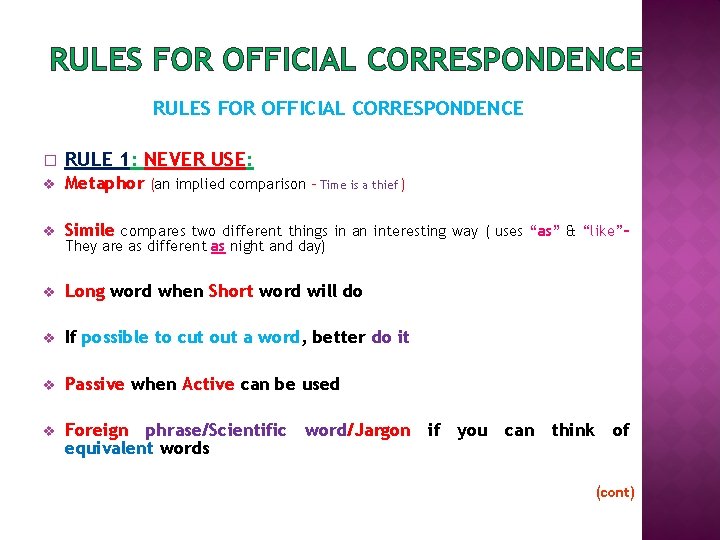
RULES FOR OFFICIAL CORRESPONDENCE � RULE 1: NEVER USE: v Metaphor (an implied comparison - Time is a thief ) v Simile compares two different things in an interesting way ( uses “as” & “like”- v Long word when Short word will do v If possible to cut out a word, better do it v Passive when Active can be used v Foreign phrase/Scientific word/Jargon if you can think of equivalent words They are as different as night and day) (cont)
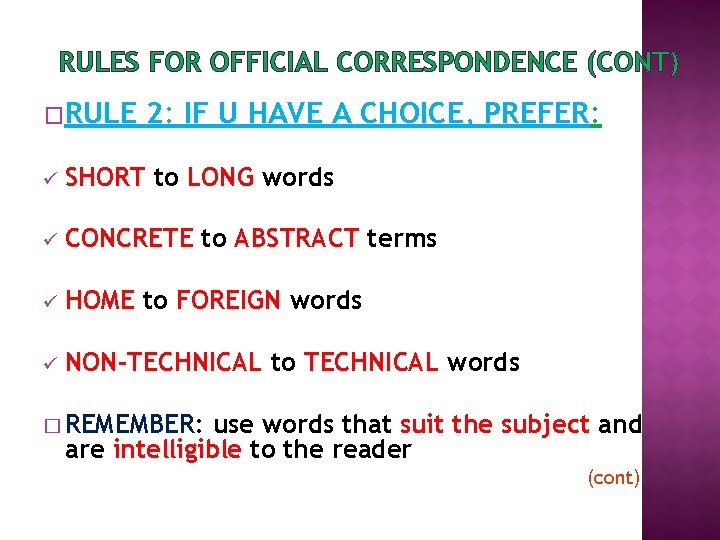
RULES FOR OFFICIAL CORRESPONDENCE (CONT) �RULE 2: IF U HAVE A CHOICE, PREFER: ü SHORT to LONG words ü CONCRETE to ABSTRACT terms ü HOME to FOREIGN words ü NON-TECHNICAL to TECHNICAL words � REMEMBER: use words that suit the subject and are intelligible to the reader (cont)
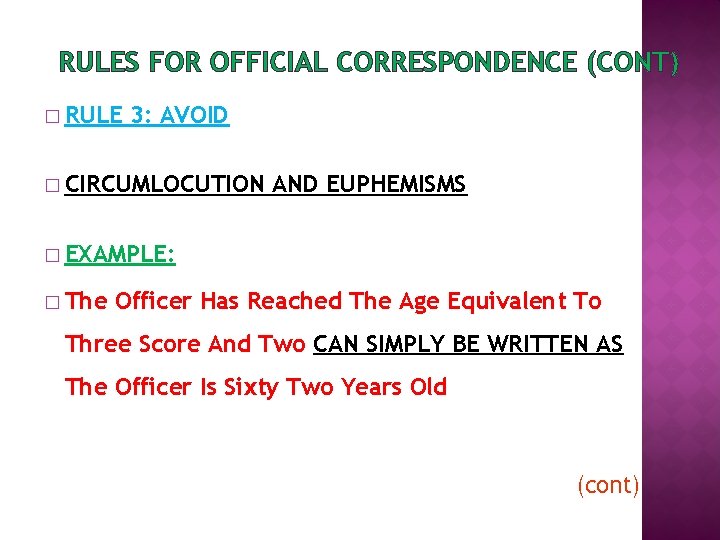
RULES FOR OFFICIAL CORRESPONDENCE (CONT) � RULE 3: AVOID � CIRCUMLOCUTION AND EUPHEMISMS � EXAMPLE: � The Officer Has Reached The Age Equivalent To Three Score And Two CAN SIMPLY BE WRITTEN AS The Officer Is Sixty Two Years Old (cont)
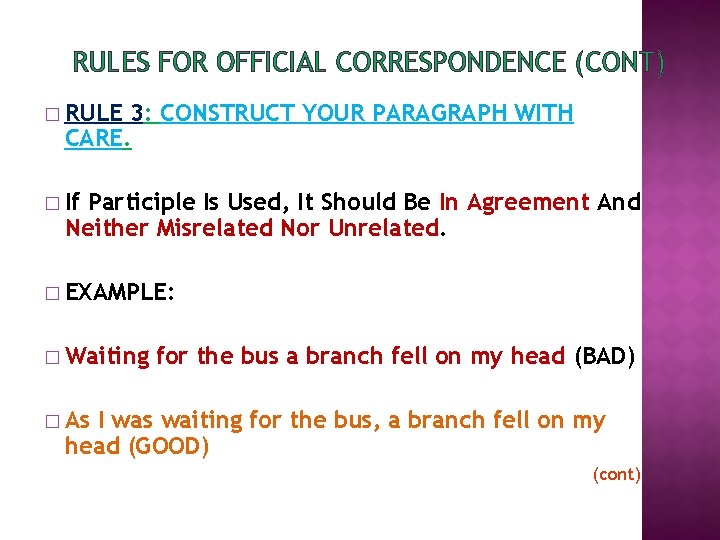
RULES FOR OFFICIAL CORRESPONDENCE (CONT) � RULE 3: CONSTRUCT YOUR PARAGRAPH WITH CARE. � If Participle Is Used, It Should Be In Agreement And Neither Misrelated Nor Unrelated. � EXAMPLE: � Waiting for the bus a branch fell on my head (BAD) � As I was waiting for the bus, a branch fell on my head (GOOD) (cont)
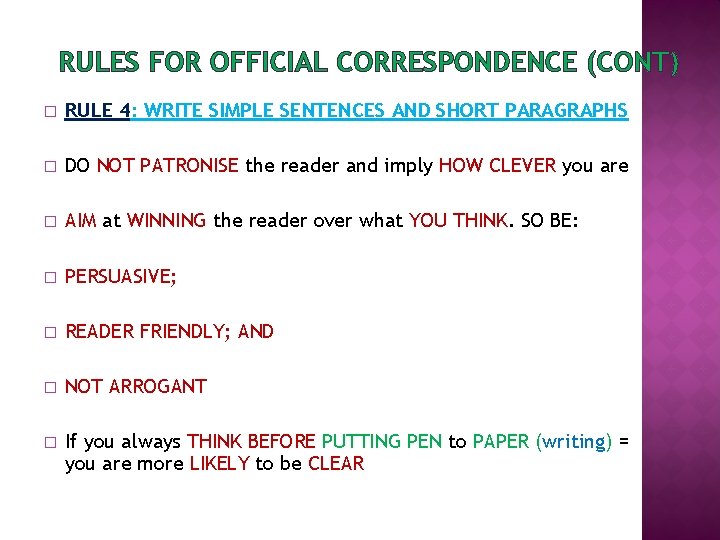
RULES FOR OFFICIAL CORRESPONDENCE (CONT) � RULE 4: WRITE SIMPLE SENTENCES AND SHORT PARAGRAPHS � DO NOT PATRONISE the reader and imply HOW CLEVER you are � AIM at WINNING the reader over what YOU THINK. SO BE: � PERSUASIVE; � READER FRIENDLY; AND � NOT ARROGANT � If you always THINK BEFORE PUTTING PEN to PAPER (writing) = you are more LIKELY to be CLEAR
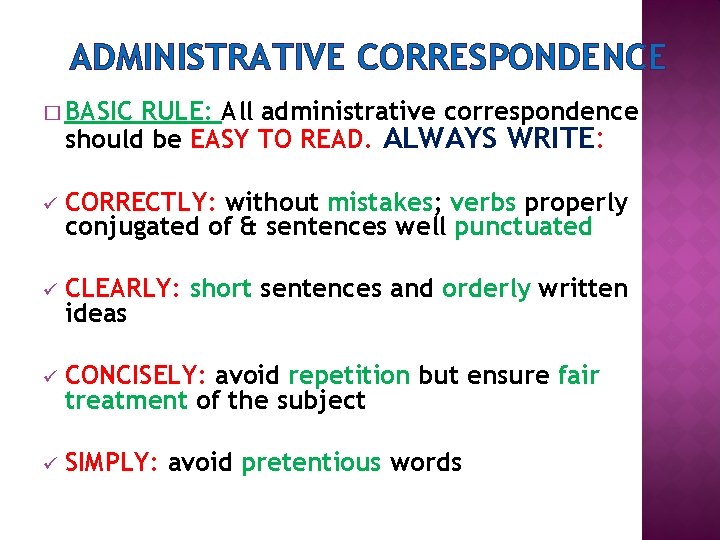
ADMINISTRATIVE CORRESPONDENCE � BASIC RULE: All administrative correspondence should be EASY TO READ. ALWAYS WRITE: ü CORRECTLY: without mistakes; verbs properly conjugated of & sentences well punctuated ü CLEARLY: short sentences and orderly written ideas ü CONCISELY: avoid repetition but ensure fair treatment of the subject ü SIMPLY: avoid pretentious words
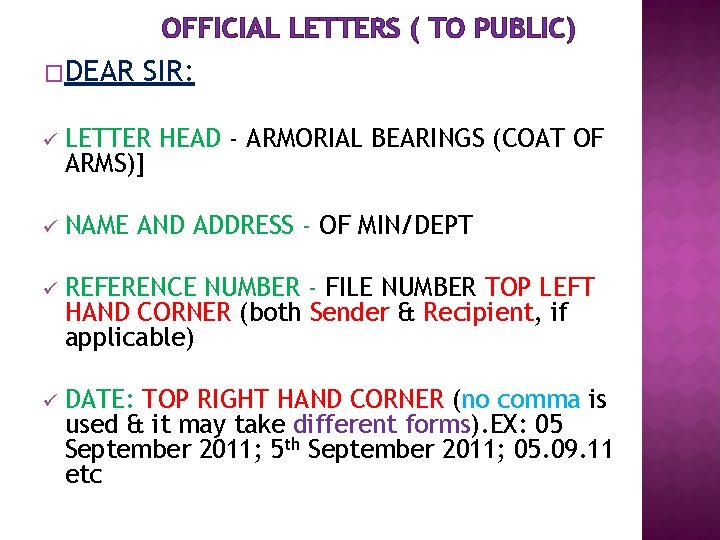
OFFICIAL LETTERS ( TO PUBLIC) �DEAR SIR: ü LETTER HEAD - ARMORIAL BEARINGS (COAT OF ARMS)] ü NAME AND ADDRESS - OF MIN/DEPT ü REFERENCE NUMBER - FILE NUMBER TOP LEFT HAND CORNER (both Sender & Recipient, if applicable) ü DATE: TOP RIGHT HAND CORNER (no comma is used & it may take different forms). EX: 05 September 2011; 5 th September 2011; 05. 09. 11 etc
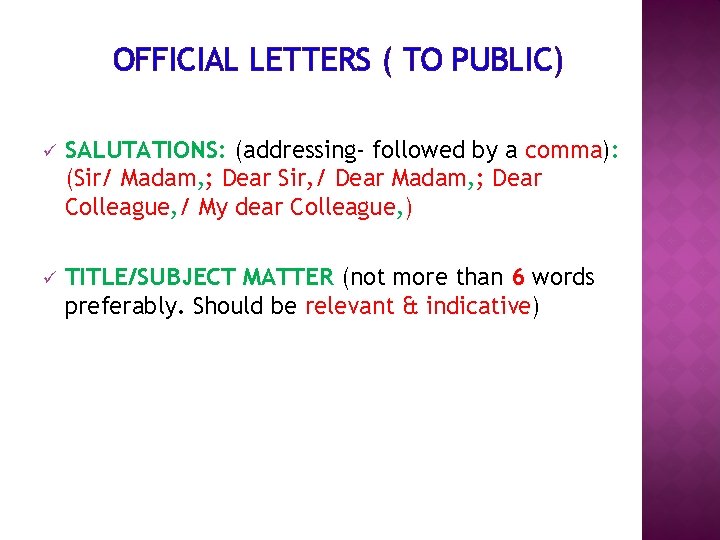
OFFICIAL LETTERS ( TO PUBLIC) ü SALUTATIONS: (addressing- followed by a comma): (Sir/ Madam, ; Dear Sir, / Dear Madam, ; Dear Colleague, / My dear Colleague, ) ü TITLE/SUBJECT MATTER (not more than 6 words preferably. Should be relevant & indicative)
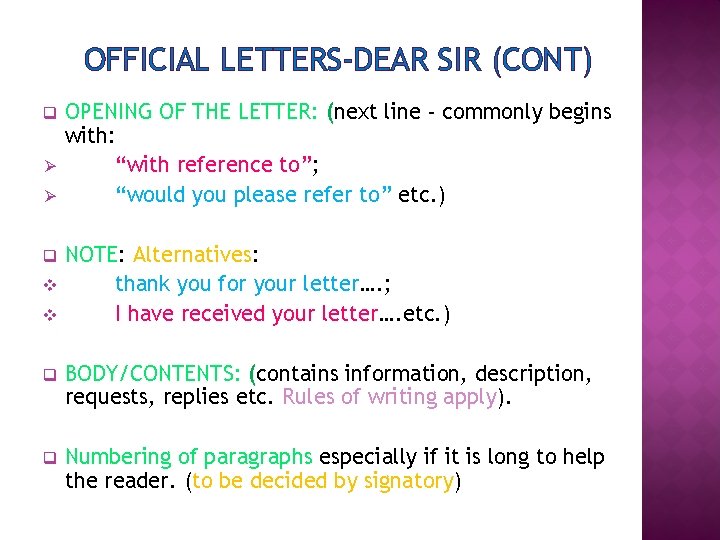
OFFICIAL LETTERS-DEAR SIR (CONT) q Ø Ø q v v OPENING OF THE LETTER: (next line - commonly begins with: “with reference to”; “would you please refer to” etc. ) NOTE: Alternatives: thank you for your letter…. ; I have received your letter…. etc. ) q BODY/CONTENTS: (contains information, description, requests, replies etc. Rules of writing apply). q Numbering of paragraphs especially if it is long to help the reader. (to be decided by signatory)
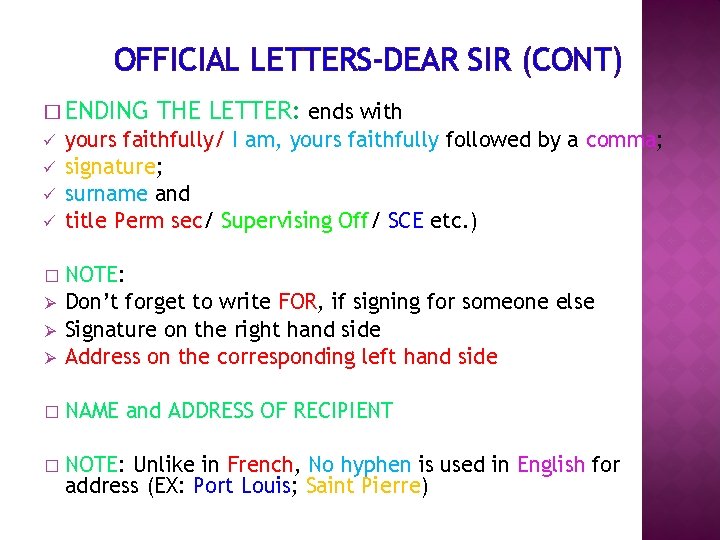
OFFICIAL LETTERS-DEAR SIR (CONT) � ENDING ü ü THE LETTER: ends with yours faithfully/ I am, yours faithfully followed by a comma; signature; surname and title Perm sec/ Supervising Off/ SCE etc. ) Ø NOTE: Don’t forget to write FOR, if signing for someone else Signature on the right hand side Address on the corresponding left hand side � NAME and ADDRESS OF RECIPIENT � NOTE: Unlike in French, No hyphen is used in English for address (EX: Port Louis; Saint Pierre) � Ø Ø
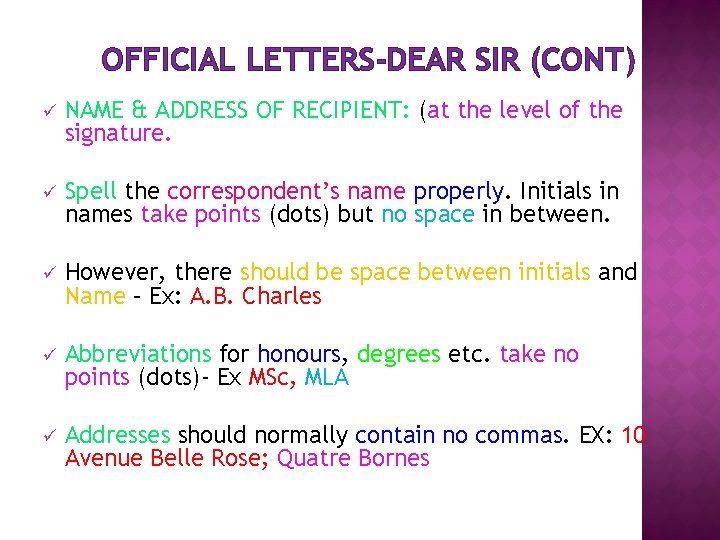
OFFICIAL LETTERS-DEAR SIR (CONT) ü NAME & ADDRESS OF RECIPIENT: (at the level of the signature. ü Spell the correspondent’s name properly. Initials in names take points (dots) but no space in between. ü However, there should be space between initials and Name – Ex: A. B. Charles ü Abbreviations for honours, degrees etc. take no points (dots)- Ex MSc, MLA ü Addresses should normally contain no commas. EX: 10 Avenue Belle Rose; Quatre Bornes
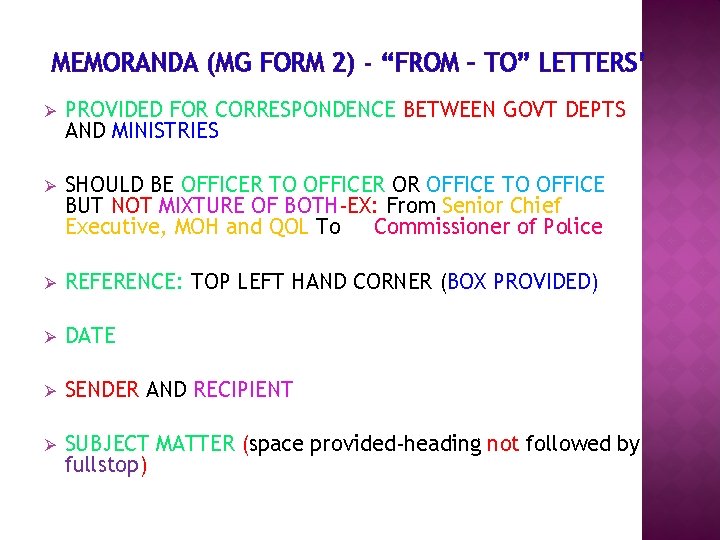
MEMORANDA (MG FORM 2) - “FROM – TO” LETTERS’ Ø PROVIDED FOR CORRESPONDENCE BETWEEN GOVT DEPTS AND MINISTRIES Ø SHOULD BE OFFICER TO OFFICER OR OFFICE TO OFFICE BUT NOT MIXTURE OF BOTH-EX: From Senior Chief Executive, MOH and QOL To Commissioner of Police Ø REFERENCE: TOP LEFT HAND CORNER (BOX PROVIDED) Ø DATE Ø SENDER AND RECIPIENT Ø SUBJECT MATTER (space provided-heading not followed by fullstop)
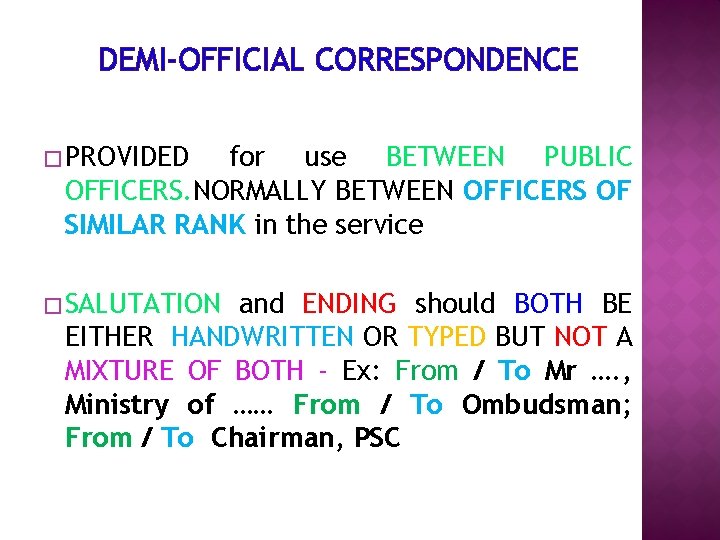
DEMI-OFFICIAL CORRESPONDENCE � PROVIDED for use BETWEEN PUBLIC OFFICERS. NORMALLY BETWEEN OFFICERS OF SIMILAR RANK in the service � SALUTATION and ENDING should BOTH BE EITHER HANDWRITTEN OR TYPED BUT NOT A MIXTURE OF BOTH - Ex: From / To Mr …. , Ministry of …… From / To Ombudsman; From / To Chairman, PSC
THANK YOU
MINUTE SHEET
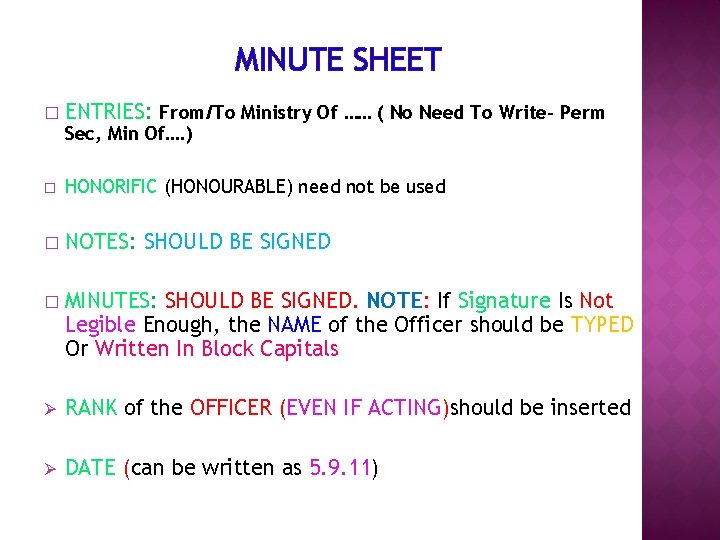
MINUTE SHEET � ENTRIES: From/To Ministry Of …… ( No Need To Write- Perm Sec, Min Of…. ) � HONORIFIC (HONOURABLE) need not be used � NOTES: SHOULD BE SIGNED � MINUTES: SHOULD BE SIGNED. NOTE: If Signature Is Not Legible Enough, the NAME of the Officer should be TYPED Or Written In Block Capitals Ø RANK of the OFFICER (EVEN IF ACTING)should be inserted Ø DATE (can be written as 5. 9. 11)
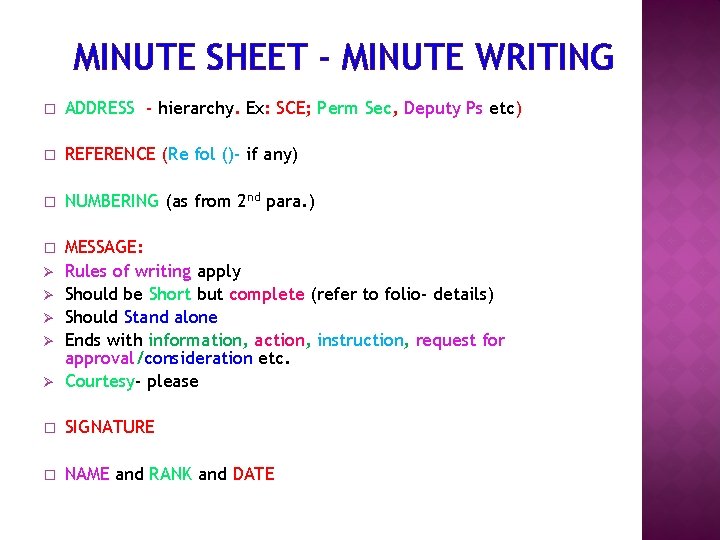
MINUTE SHEET - MINUTE WRITING � ADDRESS - hierarchy. Ex: SCE; Perm Sec, Deputy Ps etc) � REFERENCE (Re fol ()- if any) � NUMBERING (as from 2 nd para. ) � Ø MESSAGE: Rules of writing apply Should be Short but complete (refer to folio- details) Should Stand alone Ends with information, action, instruction, request for approval/consideration etc. Courtesy- please � SIGNATURE � NAME and RANK and DATE Ø Ø
REPORT WRITING
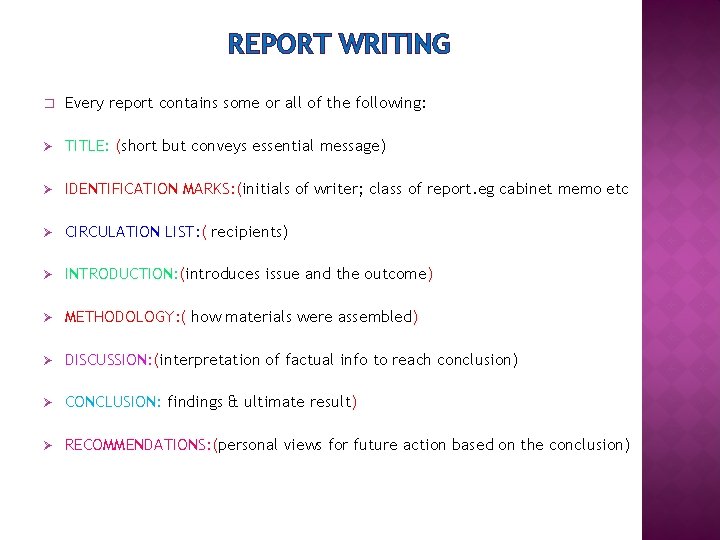
REPORT WRITING � Every report contains some or all of the following: Ø TITLE: (short but conveys essential message) Ø IDENTIFICATION MARKS: (initials of writer; class of report. eg cabinet memo etc Ø CIRCULATION LIST: ( recipients) Ø INTRODUCTION: (introduces issue and the outcome) Ø METHODOLOGY: ( how materials were assembled) Ø DISCUSSION: (interpretation of factual info to reach conclusion) Ø CONCLUSION: findings & ultimate result) Ø RECOMMENDATIONS: (personal views for future action based on the conclusion)
THANK YOU