
ECBUNRESTRICTED XVII JORNADA ANUAL DE RIESGOS El reto

ECB-UNRESTRICTED XVII JORNADA ANUAL DE RIESGOS El reto de la transformación Clausura “Retos de la Unión Bancaria” Ramón Quintana Director General Microprudential Supervision II European Central Bank Madrid, 22 November 2018
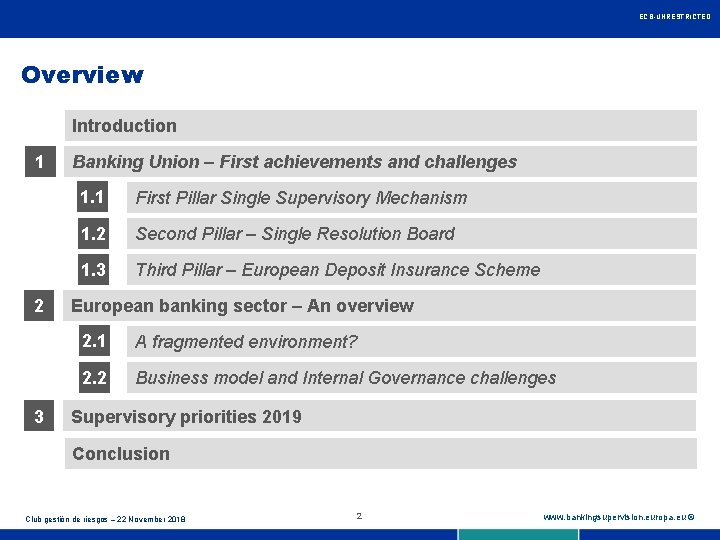
Rubric ECB-UNRESTRICTED Overview Introduction 1 2 3 Banking Union – First achievements and challenges 1. 1 First Pillar Single Supervisory Mechanism 1. 2 Second Pillar – Single Resolution Board 1. 3 Third Pillar – European Deposit Insurance Scheme European banking sector – An overview 2. 1 A fragmented environment? 2. 2 Business model and Internal Governance challenges Supervisory priorities 2019 Conclusion Club gestión de riesgos – 22 November 2018 2 www. bankingsupervision. europa. eu ©
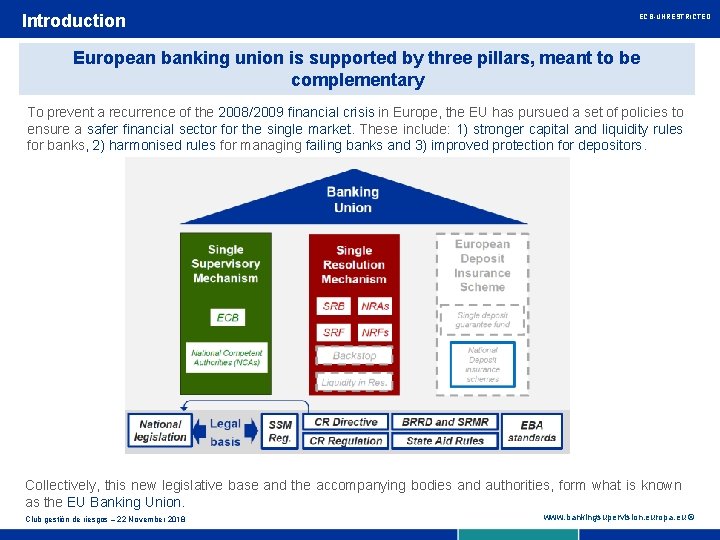
Rubric Introduction ECB-UNRESTRICTED European banking union is supported by three pillars, meant to be complementary To prevent a recurrence of the 2008/2009 financial crisis in Europe, the EU has pursued a set of policies to ensure a safer financial sector for the single market. These include: 1) stronger capital and liquidity rules for banks, 2) harmonised rules for managing failing banks and 3) improved protection for depositors. Collectively, this new legislative base and the accompanying bodies and authorities, form what is known as the EU Banking Union. Club gestión de riesgos – 22 November 2018 www. bankingsupervision. europa. eu ©
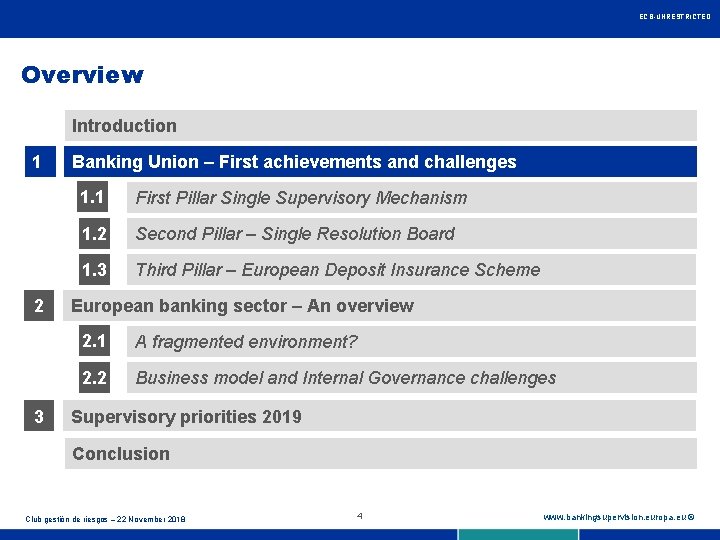
Rubric ECB-UNRESTRICTED Overview Introduction 1 2 3 Banking Union – First achievements and challenges 1. 1 First Pillar Single Supervisory Mechanism 1. 2 Second Pillar – Single Resolution Board 1. 3 Third Pillar – European Deposit Insurance Scheme European banking sector – An overview 2. 1 A fragmented environment? 2. 2 Business model and Internal Governance challenges Supervisory priorities 2019 Conclusion Club gestión de riesgos – 22 November 2018 4 www. bankingsupervision. europa. eu ©
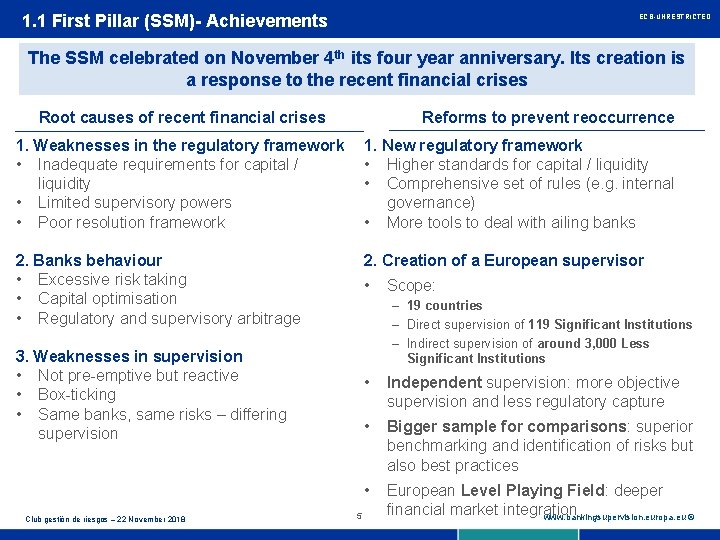
Rubric 1. 1 First Pillar (SSM)- Achievements ECB-UNRESTRICTED The SSM celebrated on November 4 th its four year anniversary. Its creation is a response to the recent financial crises Root causes of recent financial crises Reforms to prevent reoccurrence 1. Weaknesses in the regulatory framework • Inadequate requirements for capital / liquidity • Limited supervisory powers • Poor resolution framework 1. New regulatory framework • Higher standards for capital / liquidity • Comprehensive set of rules (e. g. internal governance) • More tools to deal with ailing banks 2. Banks behaviour • Excessive risk taking • Capital optimisation • Regulatory and supervisory arbitrage 2. Creation of a European supervisor • ‒ 19 countries ‒ Direct supervision of 119 Significant Institutions ‒ Indirect supervision of around 3, 000 Less Significant Institutions 3. Weaknesses in supervision • Not pre-emptive but reactive • Box-ticking • Same banks, same risks – differing supervision Club gestión de riesgos – 22 November 2018 Scope: 5 • Independent supervision: more objective supervision and less regulatory capture • Bigger sample for comparisons: superior benchmarking and identification of risks but also best practices • European Level Playing Field: deeper financial market integration www. bankingsupervision. europa. eu ©
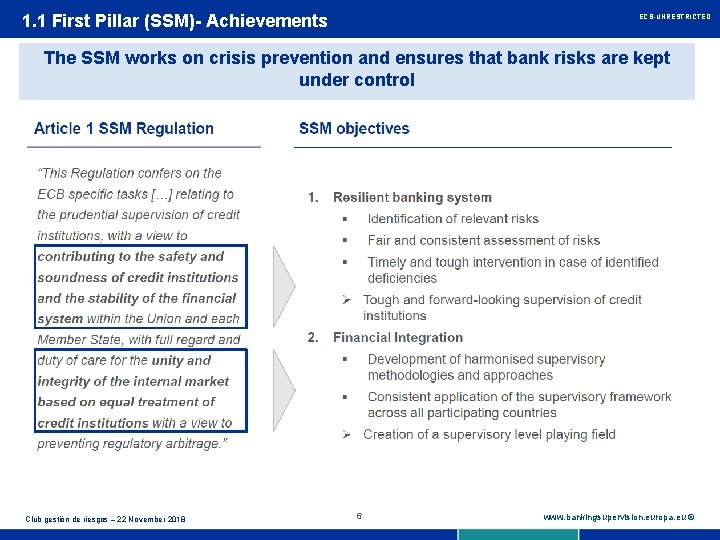
Rubric 1. 1 First Pillar (SSM)- Achievements ECB-UNRESTRICTED The SSM works on crisis prevention and ensures that bank risks are kept under control Club gestión de riesgos – 22 November 2018 6 www. bankingsupervision. europa. eu ©
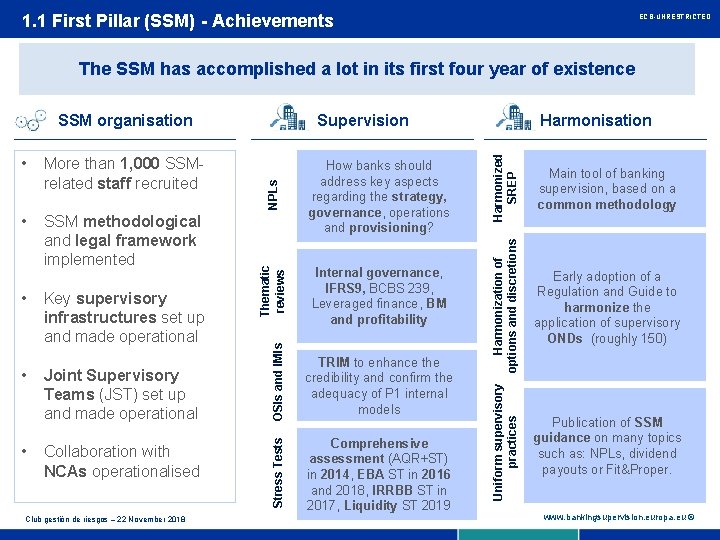
Rubric 1. 1 First Pillar (SSM) - Achievements ECB-UNRESTRICTED The SSM has accomplished a lot in its first four year of existence • • • Key supervisory infrastructures set up and made operational Joint Supervisory Teams (JST) set up and made operational Collaboration with NCAs operationalised Club gestión de riesgos – 22 November 2018 TRIM to enhance the credibility and confirm the adequacy of P 1 internal models Comprehensive assessment (AQR+ST) in 2014, EBA ST in 2016 and 2018, IRRBB ST in 2017, Liquidity ST 2019 7 Harmonized SREP Internal governance, IFRS 9, BCBS 239, Leveraged finance, BM and profitability Harmonisation Harmonization of Uniform supervisory options and discretions practices SSM methodological and legal framework implemented NPLs • How banks should address key aspects regarding the strategy, governance, operations and provisioning? OSIs and IMIs More than 1, 000 SSMrelated staff recruited Stress Tests • Supervision Thematic reviews SSM organisation Main tool of banking supervision, based on a common methodology Early adoption of a Regulation and Guide to harmonize the application of supervisory ONDs (roughly 150) Publication of SSM guidance on many topics such as: NPLs, dividend payouts or Fit&Proper. www. bankingsupervision. europa. eu ©
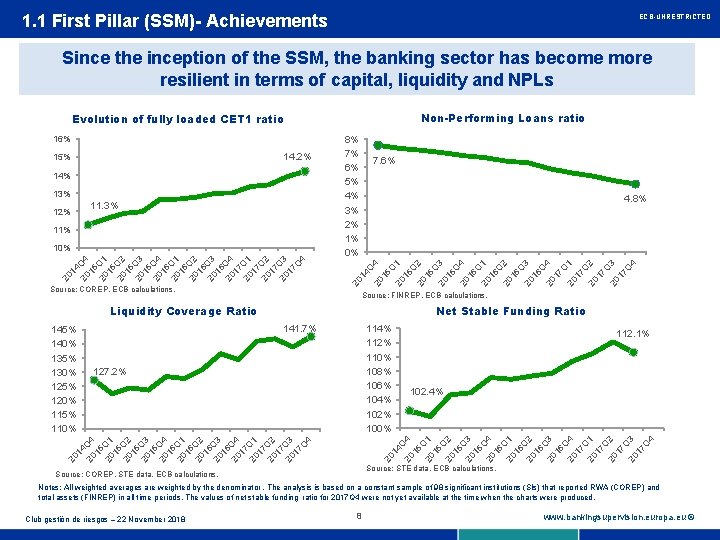
Rubric 1. 1 First Pillar (SSM)- Achievements ECB-UNRESTRICTED Since the inception of the SSM, the banking sector has become more resilient in terms of capital, liquidity and NPLs Non-Performing Loans ratio Evolution of fully loaded CET 1 ratio Source: COREP, ECB calculations. 1 15 Q 20 2 15 Q 20 3 15 Q 20 4 16 Q 20 1 16 Q 20 2 16 Q 20 3 16 Q 20 4 17 Q 20 1 17 Q 20 2 17 Q 20 3 17 Q 4 20 14 20 Q 4 15 20 Q 1 15 20 Q 2 15 20 Q 3 15 20 Q 4 16 20 Q 1 16 20 Q 2 16 20 Q 3 16 20 Q 4 17 20 Q 1 17 20 Q 2 17 20 Q 3 17 Q 4 10% 20 11% 4. 8% 4 11. 3% Source: FINREP, ECB calculations. Liquidity Coverage Ratio Net Stable Funding Ratio 114% 112% 110% 108% 106% 104% 102% 100% 2 15 Q 20 3 15 Q 20 4 16 Q 20 1 16 Q 20 2 16 Q 20 3 16 Q 20 4 17 Q 20 1 17 Q 20 2 17 Q 20 3 17 Q 4 1 15 Q 20 15 Q 4 20 20 14 Q 20 102. 4% 14 Q 4 15 20 Q 1 15 20 Q 2 15 20 Q 3 15 20 Q 4 16 20 Q 1 16 20 Q 2 16 20 Q 3 16 20 Q 4 17 20 Q 1 17 20 Q 2 17 20 Q 3 17 Q 4 127. 2% 112. 1% 20 141. 7% 145% 140% 135% 130% 125% 120% 115% 110% 20 12% 15 Q 13% 20 14% 7. 6% 14 Q 14. 2% 15% 8% 7% 6% 5% 4% 3% 2% 1% 0% 20 16% Source: STE data, ECB calculations. Source: COREP, STE data, ECB calculations. Notes: All weighted averages are weighted by the denominator. The analysis is based on a constant sample of 98 significant institutions (SIs) that reported RWA (COREP) and total assets (FINREP) in all time periods. The values of net stable funding ratio for 2017 Q 4 were not yet available at the time when the charts were produced. Club gestión de riesgos – 22 November 2018 8 www. bankingsupervision. europa. eu ©
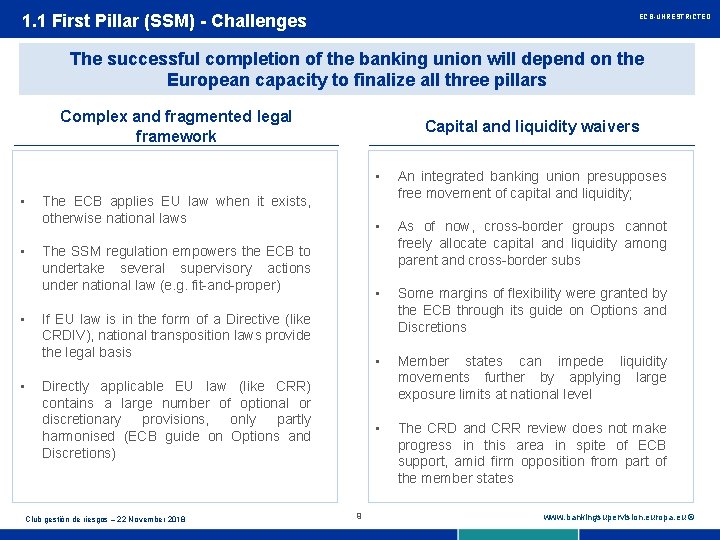
Rubric 1. 1 First Pillar (SSM) - Challenges ECB-UNRESTRICTED The successful completion of the banking union will depend on the European capacity to finalize all three pillars Complex and fragmented legal framework • • Capital and liquidity waivers The ECB applies EU law when it exists, otherwise national laws The SSM regulation empowers the ECB to undertake several supervisory actions under national law (e. g. fit-and-proper) If EU law is in the form of a Directive (like CRDIV), national transposition laws provide the legal basis Directly applicable EU law (like CRR) contains a large number of optional or discretionary provisions, only partly harmonised (ECB guide on Options and Discretions) Club gestión de riesgos – 22 November 2018 9 • An integrated banking union presupposes free movement of capital and liquidity; • As of now, cross-border groups cannot freely allocate capital and liquidity among parent and cross-border subs • Some margins of flexibility were granted by the ECB through its guide on Options and Discretions • Member states can impede liquidity movements further by applying large exposure limits at national level • The CRD and CRR review does not make progress in this area in spite of ECB support, amid firm opposition from part of the member states www. bankingsupervision. europa. eu ©
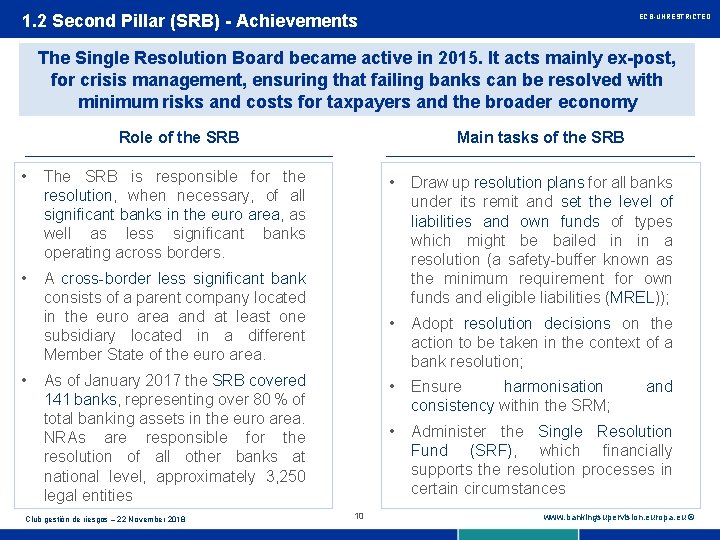
Rubric 1. 2 Second Pillar (SRB) - Achievements ECB-UNRESTRICTED The Single Resolution Board became active in 2015. It acts mainly ex-post, for crisis management, ensuring that failing banks can be resolved with minimum risks and costs for taxpayers and the broader economy Role of the SRB • The SRB is responsible for the resolution, when necessary, of all significant banks in the euro area, as well as less significant banks operating across borders. • A cross-border less significant bank consists of a parent company located in the euro area and at least one subsidiary located in a different Member State of the euro area. • Main tasks of the SRB As of January 2017 the SRB covered 141 banks, representing over 80 % of total banking assets in the euro area. NRAs are responsible for the resolution of all other banks at national level, approximately 3, 250 legal entities Club gestión de riesgos – 22 November 2018 10 • Draw up resolution plans for all banks under its remit and set the level of liabilities and own funds of types which might be bailed in in a resolution (a safety-buffer known as the minimum requirement for own funds and eligible liabilities (MREL)); • Adopt resolution decisions on the action to be taken in the context of a bank resolution; • Ensure harmonisation consistency within the SRM; • Administer the Single Resolution Fund (SRF), which financially supports the resolution processes in certain circumstances and www. bankingsupervision. europa. eu ©
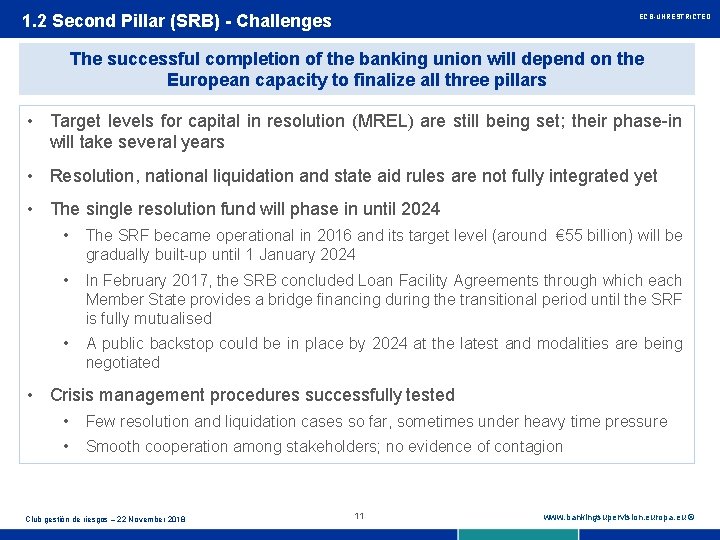
Rubric 1. 2 Second Pillar (SRB) - Challenges ECB-UNRESTRICTED The successful completion of the banking union will depend on the European capacity to finalize all three pillars • Target levels for capital in resolution (MREL) are still being set; their phase-in will take several years • Resolution, national liquidation and state aid rules are not fully integrated yet • The single resolution fund will phase in until 2024 • The SRF became operational in 2016 and its target level (around € 55 billion) will be gradually built-up until 1 January 2024 • In February 2017, the SRB concluded Loan Facility Agreements through which each Member State provides a bridge financing during the transitional period until the SRF is fully mutualised • A public backstop could be in place by 2024 at the latest and modalities are being negotiated • Crisis management procedures successfully tested • Few resolution and liquidation cases so far, sometimes under heavy time pressure • Smooth cooperation among stakeholders; no evidence of contagion Club gestión de riesgos – 22 November 2018 11 www. bankingsupervision. europa. eu ©
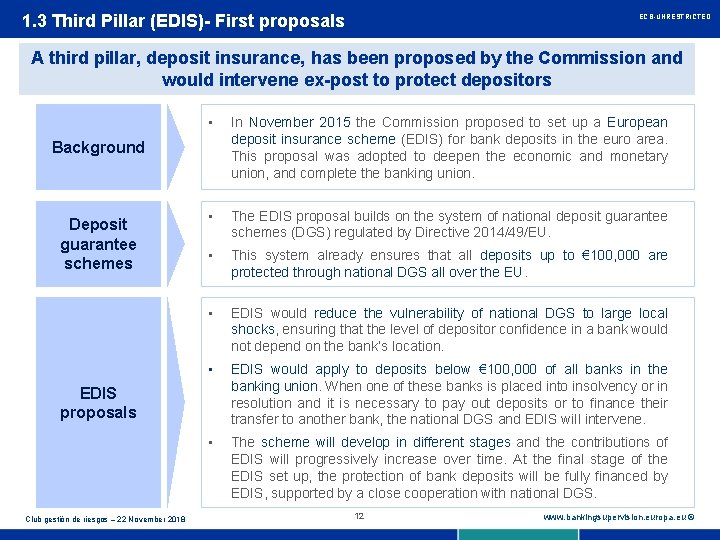
Rubric 1. 3 Third Pillar (EDIS)- First proposals ECB-UNRESTRICTED A third pillar, deposit insurance, has been proposed by the Commission and would intervene ex-post to protect depositors • In November 2015 the Commission proposed to set up a European deposit insurance scheme (EDIS) for bank deposits in the euro area. This proposal was adopted to deepen the economic and monetary union, and complete the banking union. • The EDIS proposal builds on the system of national deposit guarantee schemes (DGS) regulated by Directive 2014/49/EU. • This system already ensures that all deposits up to € 100, 000 are protected through national DGS all over the EU. • EDIS would reduce the vulnerability of national DGS to large local shocks, ensuring that the level of depositor confidence in a bank would not depend on the bank’s location. • EDIS would apply to deposits below € 100, 000 of all banks in the banking union. When one of these banks is placed into insolvency or in resolution and it is necessary to pay out deposits or to finance their transfer to another bank, the national DGS and EDIS will intervene. • The scheme will develop in different stages and the contributions of EDIS will progressively increase over time. At the final stage of the EDIS set up, the protection of bank deposits will be fully financed by EDIS, supported by a close cooperation with national DGS. Background Deposit guarantee schemes EDIS proposals Club gestión de riesgos – 22 November 2018 12 www. bankingsupervision. europa. eu ©
Rubric 1. 3 Third Pillar (EDIS) - Challenges ECB-UNRESTRICTED The successful completion of the banking union will depend on the European capacity to finalize all three pillars • At the moment there is only minimum harmonisation of national schemes, in the form of a Directive (minimum guarantee, time for disbursement) • Compromise blocked by controversy between risk reduction and risk sharing (link with sovereign risks in bank portfolios) Club gestión de riesgos – 22 November 2018 13 www. bankingsupervision. europa. eu ©
Rubric ECB-UNRESTRICTED Overview Introduction 1 2 3 Banking Union – First achievements and challenges 1. 1 First Pillar Single Supervisory Mechanism 1. 2 Second Pillar – Single Resolution Board 1. 3 Third Pillar – European Deposit Insurance Scheme European banking sector – An overview 2. 1 A fragmented environment? 2. 2 Business model and Internal Governance challenges Supervisory priorities 2019 Conclusion Club gestión de riesgos – 22 November 2018 14 www. bankingsupervision. europa. eu ©
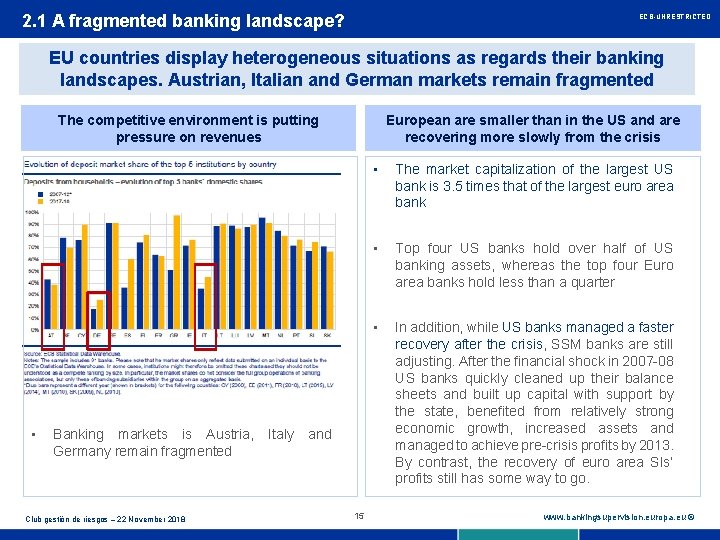
Rubric 2. 1 A fragmented banking landscape? ECB-UNRESTRICTED EU countries display heterogeneous situations as regards their banking landscapes. Austrian, Italian and German markets remain fragmented The competitive environment is putting pressure on revenues • Banking markets is Austria, Germany remain fragmented Club gestión de riesgos – 22 November 2018 Italy European are smaller than in the US and are recovering more slowly from the crisis and 15 • The market capitalization of the largest US bank is 3. 5 times that of the largest euro area bank • Top four US banks hold over half of US banking assets, whereas the top four Euro area banks hold less than a quarter • In addition, while US banks managed a faster recovery after the crisis, SSM banks are still adjusting. After the financial shock in 2007 -08 US banks quickly cleaned up their balance sheets and built up capital with support by the state, benefited from relatively strong economic growth, increased assets and managed to achieve pre-crisis profits by 2013. By contrast, the recovery of euro area SIs’ profits still has some way to go. www. bankingsupervision. europa. eu ©
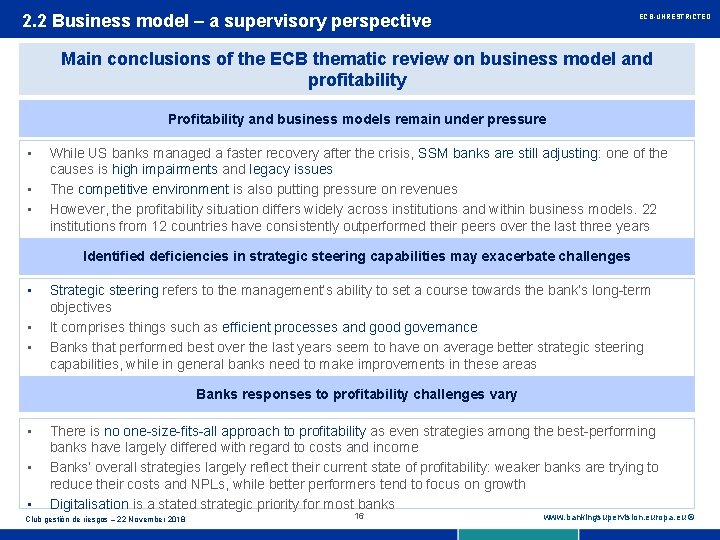
Rubric 2. 2 Business model – a supervisory perspective ECB-UNRESTRICTED Main conclusions of the ECB thematic review on business model and profitability Profitability and business models remain under pressure • • • While US banks managed a faster recovery after the crisis, SSM banks are still adjusting: one of the causes is high impairments and legacy issues The competitive environment is also putting pressure on revenues However, the profitability situation differs widely across institutions and within business models. 22 institutions from 12 countries have consistently outperformed their peers over the last three years Identified deficiencies in strategic steering capabilities may exacerbate challenges • • • Strategic steering refers to the management’s ability to set a course towards the bank’s long-term objectives It comprises things such as efficient processes and good governance Banks that performed best over the last years seem to have on average better strategic steering capabilities, while in general banks need to make improvements in these areas Banks responses to profitability challenges vary • • • There is no one-size-fits-all approach to profitability as even strategies among the best-performing banks have largely differed with regard to costs and income Banks’ overall strategies largely reflect their current state of profitability: weaker banks are trying to reduce their costs and NPLs, while better performers tend to focus on growth Digitalisation is a stated strategic priority for most banks Club gestión de riesgos – 22 November 2018 16 www. bankingsupervision. europa. eu ©
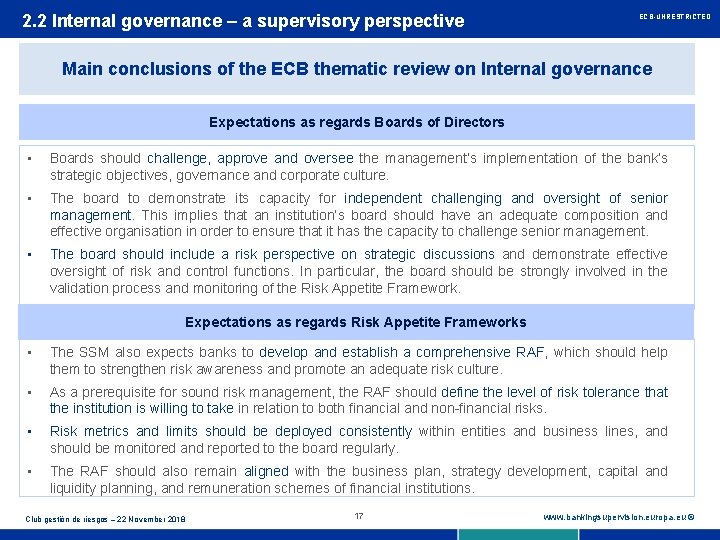
Rubric 2. 2 Internal governance – a supervisory perspective ECB-UNRESTRICTED Main conclusions of the ECB thematic review on Internal governance Expectations as regards Boards of Directors • Boards should challenge, approve and oversee the management’s implementation of the bank’s strategic objectives, governance and corporate culture. • The board to demonstrate its capacity for independent challenging and oversight of senior management. This implies that an institution’s board should have an adequate composition and effective organisation in order to ensure that it has the capacity to challenge senior management. • The board should include a risk perspective on strategic discussions and demonstrate effective oversight of risk and control functions. In particular, the board should be strongly involved in the validation process and monitoring of the Risk Appetite Framework. Expectations as regards Risk Appetite Frameworks • The SSM also expects banks to develop and establish a comprehensive RAF, which should help them to strengthen risk awareness and promote an adequate risk culture. • As a prerequisite for sound risk management, the RAF should define the level of risk tolerance that the institution is willing to take in relation to both financial and non-financial risks. • Risk metrics and limits should be deployed consistently within entities and business lines, and should be monitored and reported to the board regularly. • The RAF should also remain aligned with the business plan, strategy development, capital and liquidity planning, and remuneration schemes of financial institutions. Club gestión de riesgos – 22 November 2018 17 www. bankingsupervision. europa. eu ©
Rubric ECB-UNRESTRICTED Overview Introduction 1 2 3 Banking Union – First achievements and challenges 1. 1 First Pillar Single Supervisory Mechanism 1. 2 Second Pillar – Single Resolution Board 1. 3 Third Pillar – European Deposit Insurance Scheme European banking sector – An overview 2. 1 A fragmented environment? 2. 2 Business model and Internal Governance challenges Supervisory priorities 2019 Conclusion Club gestión de riesgos – 22 November 2018 18 www. bankingsupervision. europa. eu ©
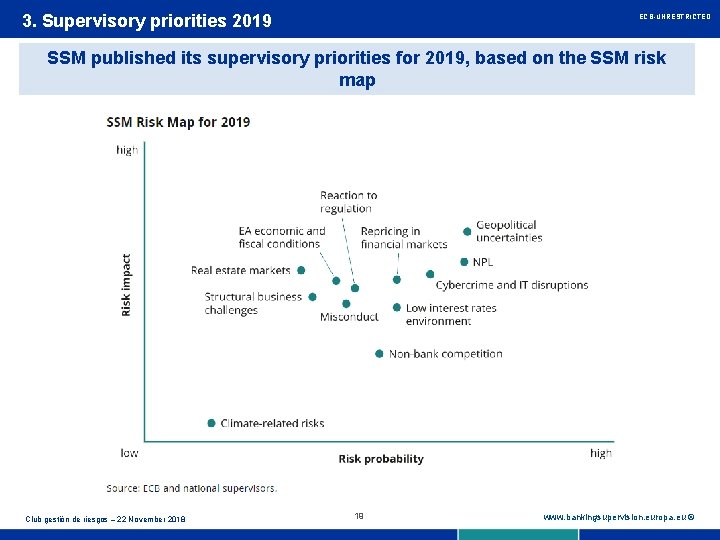
Rubric 3. Supervisory priorities 2019 ECB-UNRESTRICTED SSM published its supervisory priorities for 2019, based on the SSM risk map Club gestión de riesgos – 22 November 2018 19 www. bankingsupervision. europa. eu ©
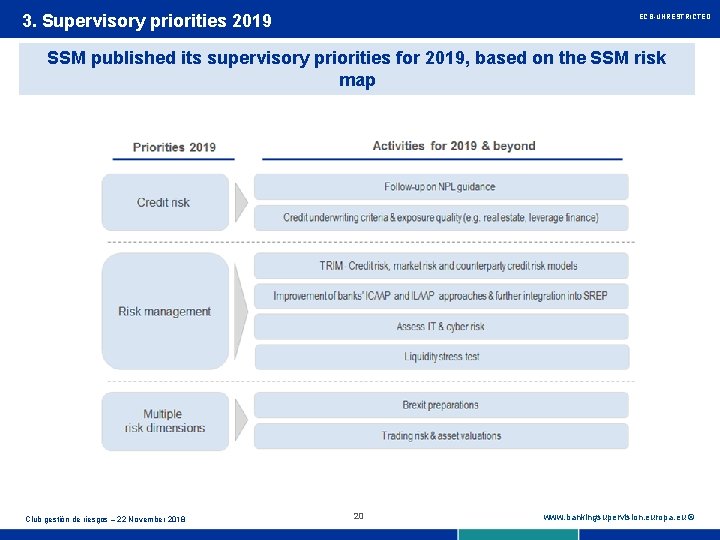
Rubric 3. Supervisory priorities 2019 ECB-UNRESTRICTED SSM published its supervisory priorities for 2019, based on the SSM risk map Club gestión de riesgos – 22 November 2018 20 www. bankingsupervision. europa. eu ©

Rubric Conclusion ECB-UNRESTRICTED Thank you Club gestión de riesgos – 22 November 2018 21 www. bankingsupervision. europa. eu ©
- Slides: 21