
The European Union 446 million people 27 countries


- Slides: 43
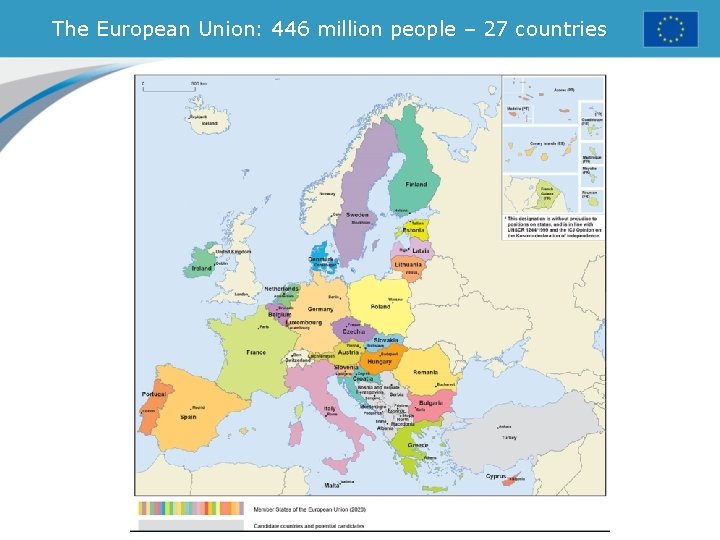
The European Union: 446 million people – 27 countries
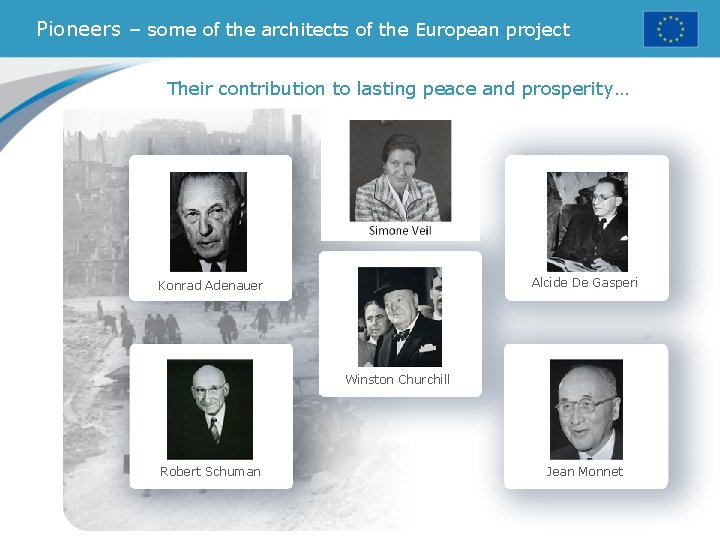
Pioneers – some of the architects of the European project Their contribution to lasting peace and prosperity… Alcide De Gasperi Konrad Adenauer Winston Churchill Robert Schuman Jean Monnet
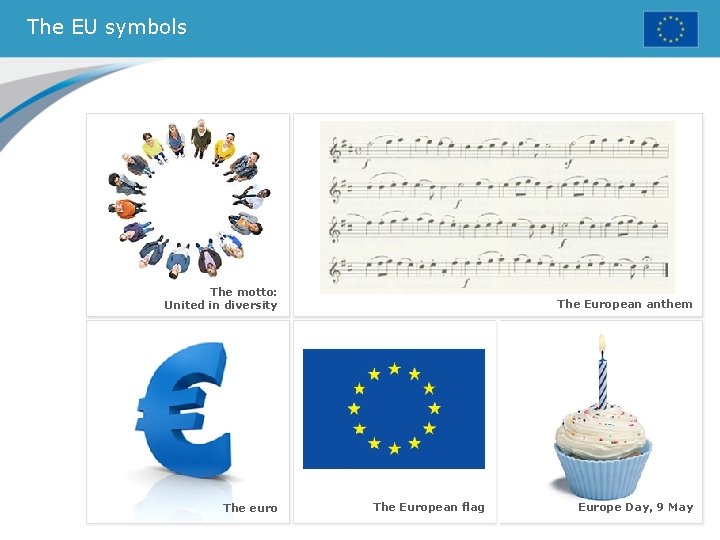
The EU symbols The motto: United in diversity The euro The European anthem The European flag Europe Day, 9 May
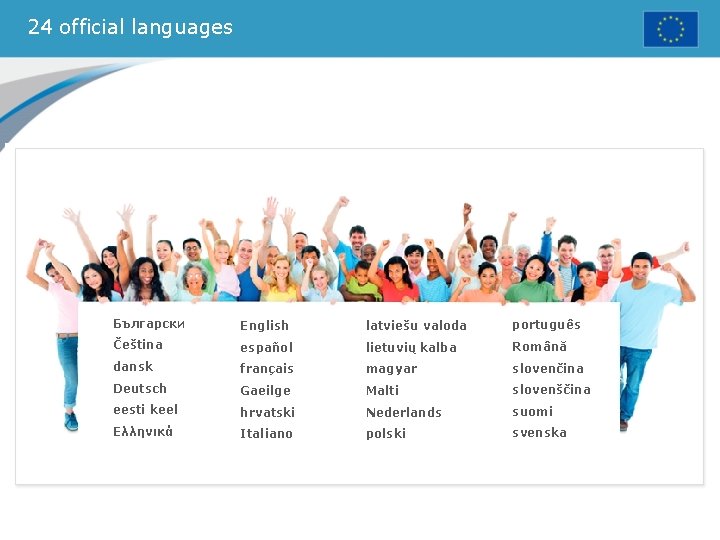
24 official languages Български English latviešu valoda português Čeština español lietuvių kalba Română dansk français magyar slovenčina Deutsch Gaeilge Malti slovenščina eesti keel hrvatski Nederlands suomi Ελληνικά Italiano polski svenska
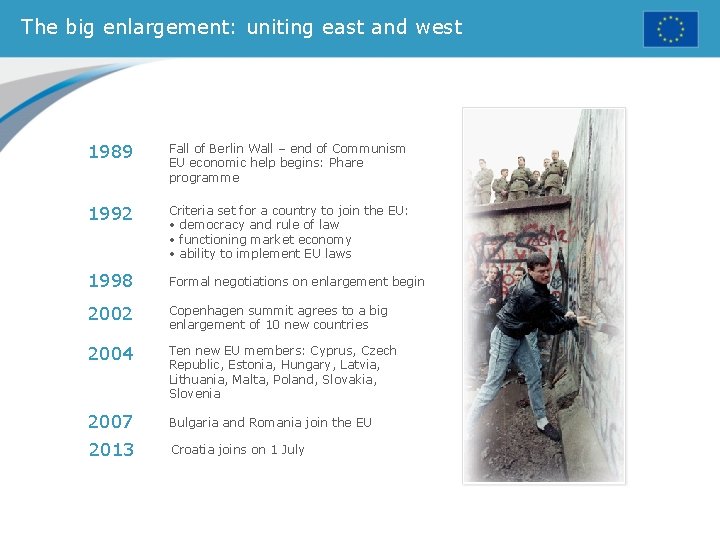
The big enlargement: uniting east and west 1989 Fall of Berlin Wall – end of Communism EU economic help begins: Phare programme 1992 Criteria set for a country to join the EU: • democracy and rule of law • functioning market economy • ability to implement EU laws 1998 Formal negotiations on enlargement begin 2002 Copenhagen summit agrees to a big enlargement of 10 new countries 2004 Ten new EU members: Cyprus, Czech Republic, Estonia, Hungary, Latvia, Lithuania, Malta, Poland, Slovakia, Slovenia 2007 Bulgaria and Romania join the EU 2013 Croatia joins on 1 July
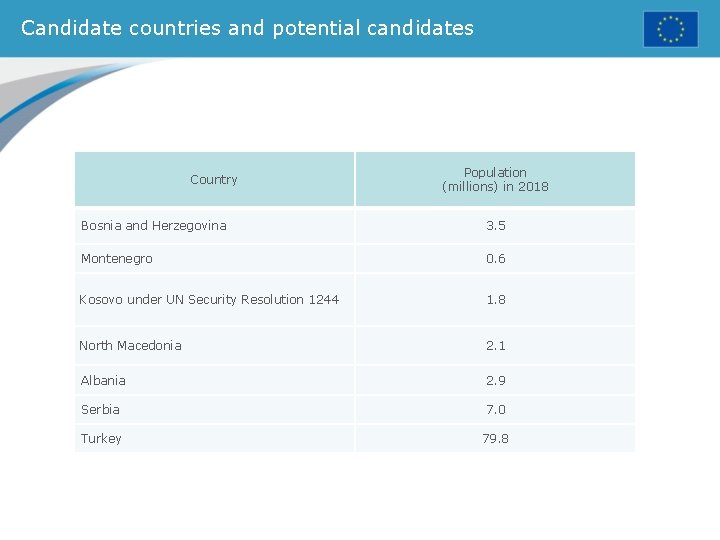
Candidate countries and potential candidates Country Population (millions) in 2018 Bosnia and Herzegovina 3. 5 Montenegro 0. 6 Kosovo under UN Security Resolution 1244 1. 8 North Macedonia 2. 1 Albania 2. 9 Serbia 7. 0 Turkey 79. 8
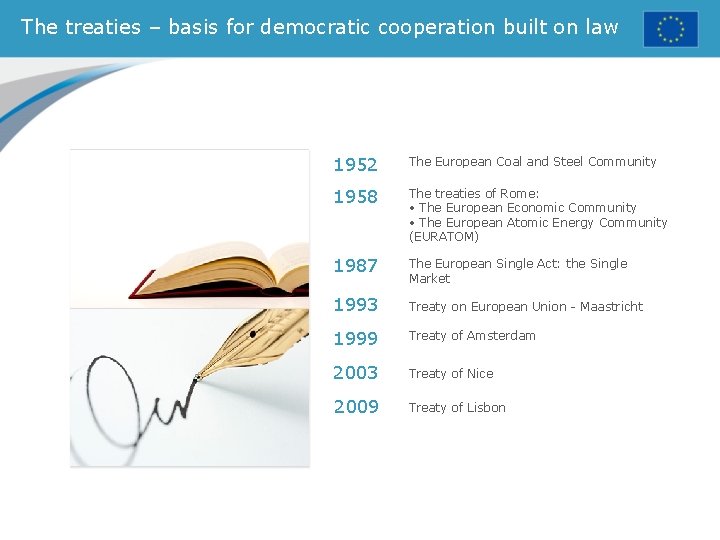
The treaties – basis for democratic cooperation built on law 1952 The European Coal and Steel Community 1958 The treaties of Rome: • The European Economic Community • The European Atomic Energy Community (EURATOM) 1987 The European Single Act: the Single Market 1993 Treaty on European Union - Maastricht 1999 Treaty of Amsterdam 2003 Treaty of Nice 2009 Treaty of Lisbon
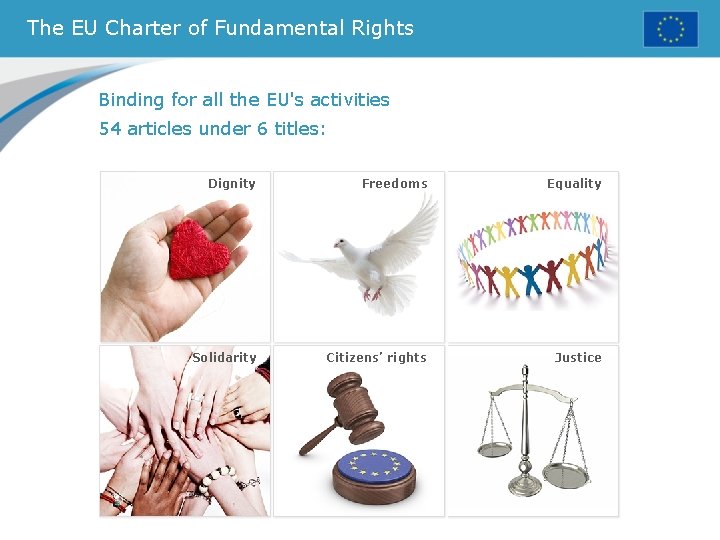
The EU Charter of Fundamental Rights Binding for all the EU's activities 54 articles under 6 titles: Dignity Freedoms Equality Solidarity Citizens’ rights Justice
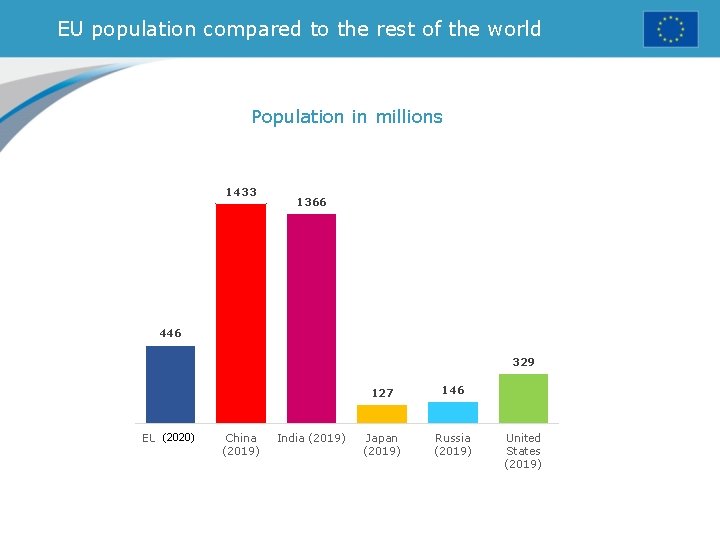
EU population compared to the rest of the world Population in millions 1433 1366 446 329 (2020) EU (2019) China (2019) India (2019) 127 146 Japan (2019) Russia (2019) United States (2019)
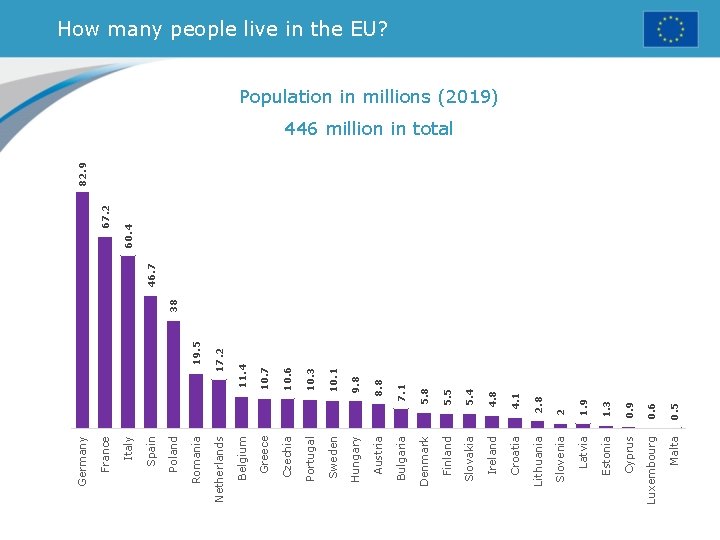
5. 4 4. 8 4. 1 2. 8 2 Slovakia Ireland Croatia Lithuania Slovenia 0. 5 5. 5 Finland Malta 5. 8 Denmark 0. 6 7. 1 Bulgaria Luxembourg 8. 8 Austria 0. 9 9. 8 Hungary Cyprus 10. 1 Sweden 1. 3 10. 3 Portugal Estonia 10. 6 Czechia 1. 9 10. 7 Greece Latvia 11. 4 17. 2 19. 5 Belgium Netherlands Romania Poland Spain Italy France Germany 38 46. 7 60. 4 67. 2 82. 9 How many people live in the EU? Population in millions (2019) 446 million in total
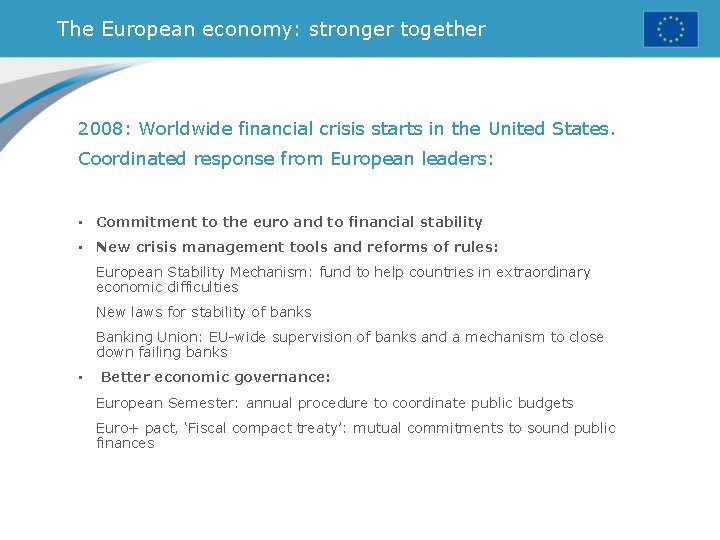
The European economy: stronger together 2008: Worldwide financial crisis starts in the United States. Coordinated response from European leaders: • Commitment to the euro and to financial stability • New crisis management tools and reforms of rules: European Stability Mechanism: fund to help countries in extraordinary economic difficulties New laws for stability of banks Banking Union: EU-wide supervision of banks and a mechanism to close down failing banks • Better economic governance: European Semester: annual procedure to coordinate public budgets Euro+ pact, ‘Fiscal compact treaty’: mutual commitments to sound public finances
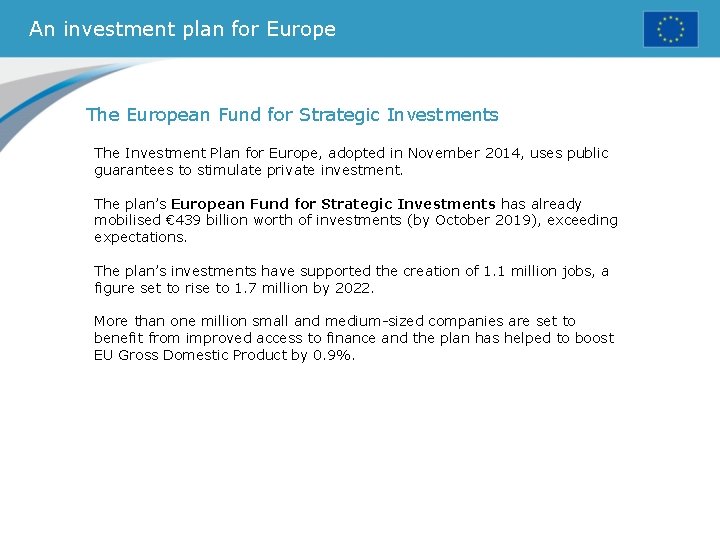
An investment plan for Europe The European Fund for Strategic Investments The Investment Plan for Europe, adopted in November 2014, uses public guarantees to stimulate private investment. The plan’s European Fund for Strategic Investments has already mobilised € 439 billion worth of investments (by October 2019), exceeding expectations. The plan’s investments have supported the creation of 1. 1 million jobs, a figure set to rise to 1. 7 million by 2022. More than one million small and medium-sized companies are set to benefit from improved access to finance and the plan has helped to boost EU Gross Domestic Product by 0. 9%.
Banking union: safe and reliable banks The EU’s response to the financial crisis: • Rulebook: New laws to ensure that banks have adequate capital and better risk control • Supervision: The European Central Bank supervises the +/- 130 of the most important banks National bank supervisors work closely together • Resolution: A Europe-wide Single Resolution Board can decide to wind down a failing bank This is backed by a fund that banks themselves pay into, thus ensuring that taxpayers do not have to pick up the bill.
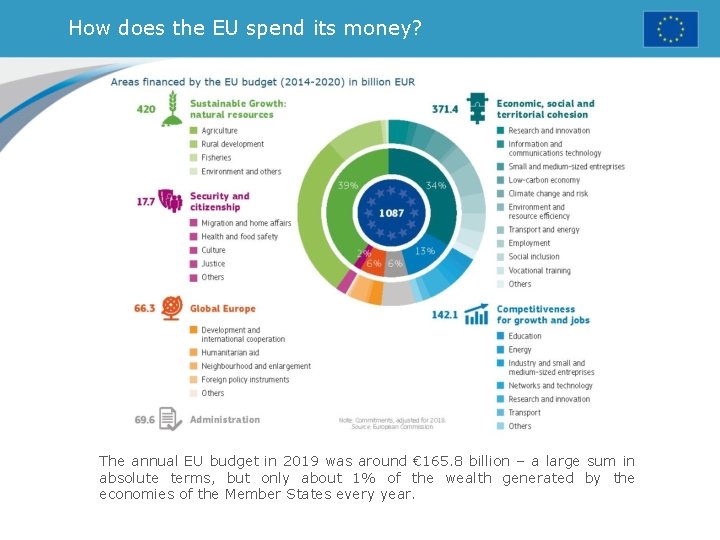
How does the EU spend its money? The annual EU budget in 2019 was around € 165. 8 billion – a large sum in absolute terms, but only about 1% of the wealth generated by the economies of the Member States every year.
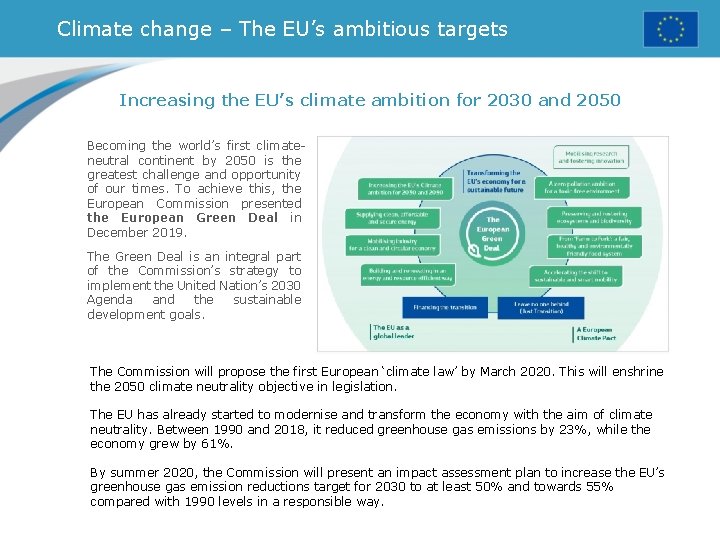
Climate change – The EU’s ambitious targets Increasing the EU’s climate ambition for 2030 and 2050 Becoming the world’s first climateneutral continent by 2050 is the greatest challenge and opportunity of our times. To achieve this, the European Commission presented the European Green Deal in December 2019. The Green Deal is an integral part of the Commission’s strategy to implement the United Nation’s 2030 Agenda and the sustainable development goals. The Commission will propose the first European ‘climate law’ by March 2020. This will enshrine the 2050 climate neutrality objective in legislation. The EU has already started to modernise and transform the economy with the aim of climate neutrality. Between 1990 and 2018, it reduced greenhouse gas emissions by 23%, while the economy grew by 61%. By summer 2020, the Commission will present an impact assessment plan to increase the EU’s greenhouse gas emission reductions target for 2030 to at least 50% and towards 55% compared with 1990 levels in a responsible way.
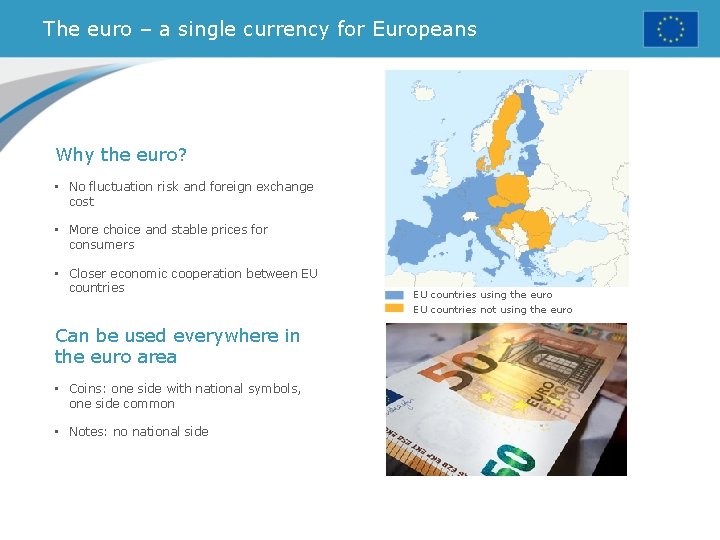
The euro – a single currency for Europeans Why the euro? • No fluctuation risk and foreign exchange cost • More choice and stable prices for consumers • Closer economic cooperation between EU countries using the euro EU countries not using the euro Can be used everywhere in the euro area • Coins: one side with national symbols, one side common • Notes: no national side
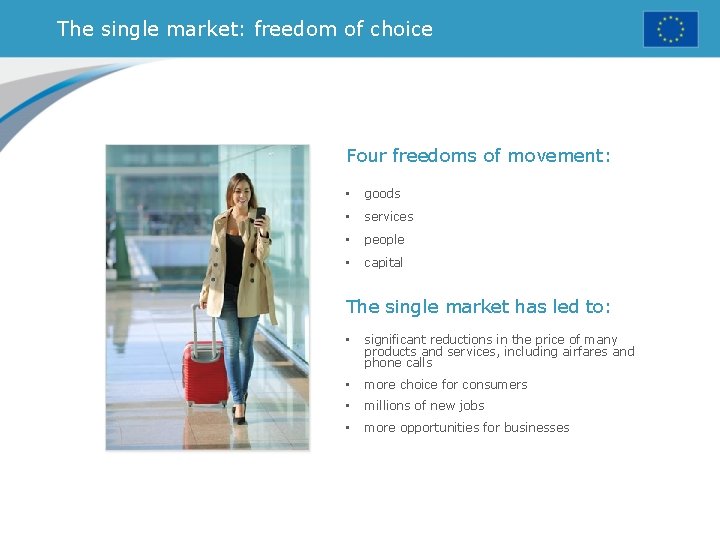
The single market: freedom of choice Four freedoms of movement: • goods • services • people • capital The single market has led to: • significant reductions in the price of many products and services, including airfares and phone calls • more choice for consumers • millions of new jobs • more opportunities for businesses
Connecting Europe: The Digital Single Market Since May 2015, the European Commission has delivered most of the proposals announced in its Digital Single Market strategy. These include: • Roaming charges ended in June 2017, so people can use their mobile device when travelling in the EU, paying the same prices as at home. • Strong new EU rules on personal data protection came into force on 25 May 2018. • The Wi. Fi 4 EU initiative supports installing free public Wi-Fi hotspots in local communities across the EU. • New tools to help defend people and businesses against cyberattacks. • From 2018, new rules let people use their online subscriptions to films and TV, e-books, video games and music services when travelling within the EU. • In 2018, plans to invest € 1 billion in building a world-class European supercomputers infrastructure.
Social Europe has the best levels of social protection in the world and ranks highly in terms of quality of life and wellbeing. It maintains these through a number of initiatives: • The European Social Charter guarantees fundamental social and economic rights. It guarantees a broad range of everyday human rights related to employment, housing, health, education, social protection and welfare • The European Social Fund is Europe’s main instrument for supporting jobs, helping people get better jobs and ensuring fairer job opportunities for all EU citizens. Investment of € 10 billion a year improves job prospects for millions of Europeans, in particular those who find it difficult to get work • The European Employment Strategy's main aim is the creation of more and better jobs throughout the EU • The Youth Guarantee is a commitment by all Member States to ensure that all young people under the age of 25 years receive a good quality offer of: • employment • continued education • apprenticeship • traineeship within a period of four months of becoming unemployed or leaving formal education.
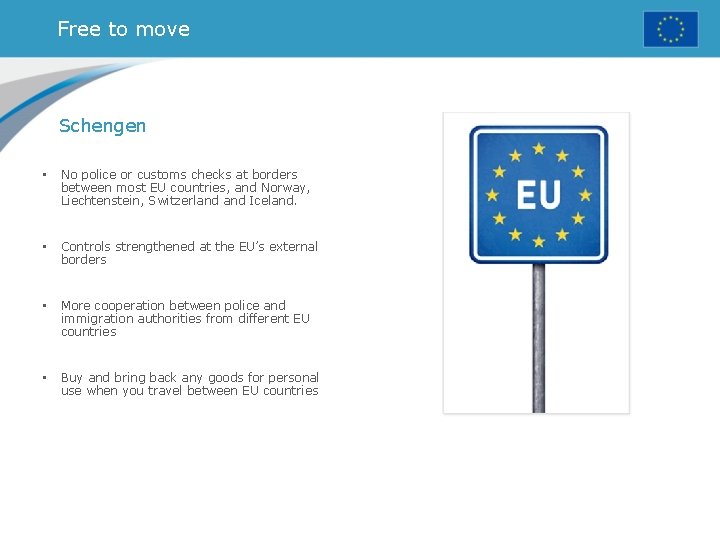
Free to move Schengen • No police or customs checks at borders between most EU countries, and Norway, Liechtenstein, Switzerland Iceland. • Controls strengthened at the EU’s external borders • More cooperation between police and immigration authorities from different EU countries • Buy and bring back any goods for personal use when you travel between EU countries
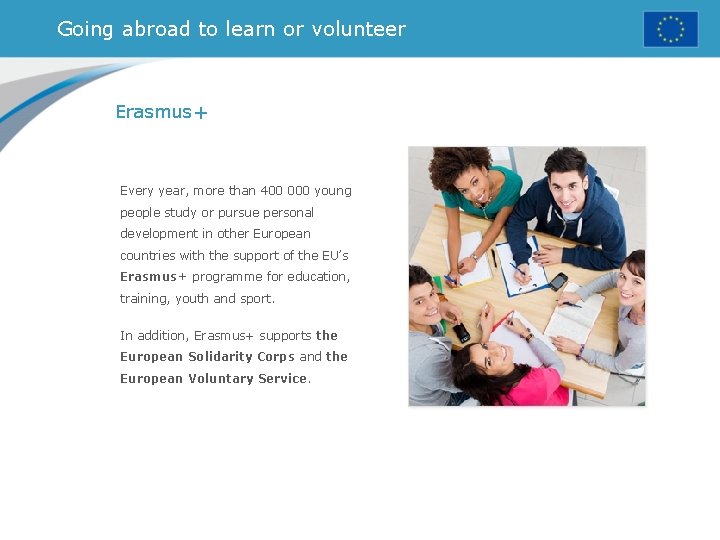
Going abroad to learn or volunteer Erasmus+ Every year, more than 400 000 young people study or pursue personal development in other European countries with the support of the EU’s Erasmus+ programme for education, training, youth and sport. In addition, Erasmus+ supports the European Solidarity Corps and the European Voluntary Service.
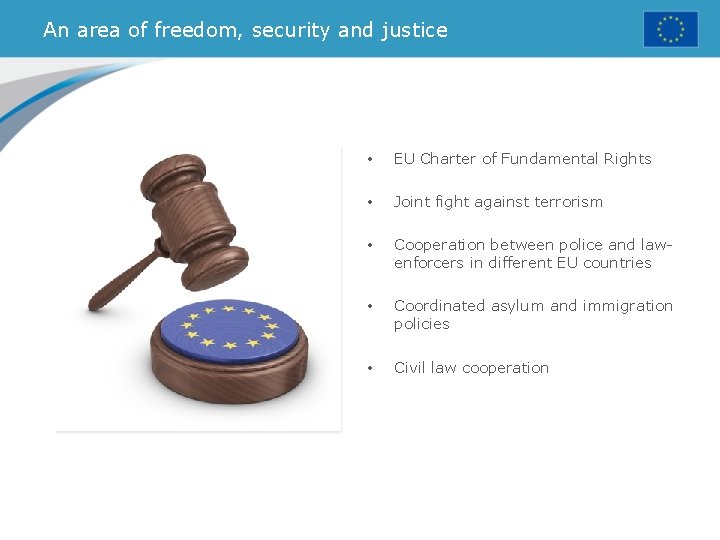
An area of freedom, security and justice • EU Charter of Fundamental Rights • Joint fight against terrorism • Cooperation between police and lawenforcers in different EU countries • Coordinated asylum and immigration policies • Civil law cooperation
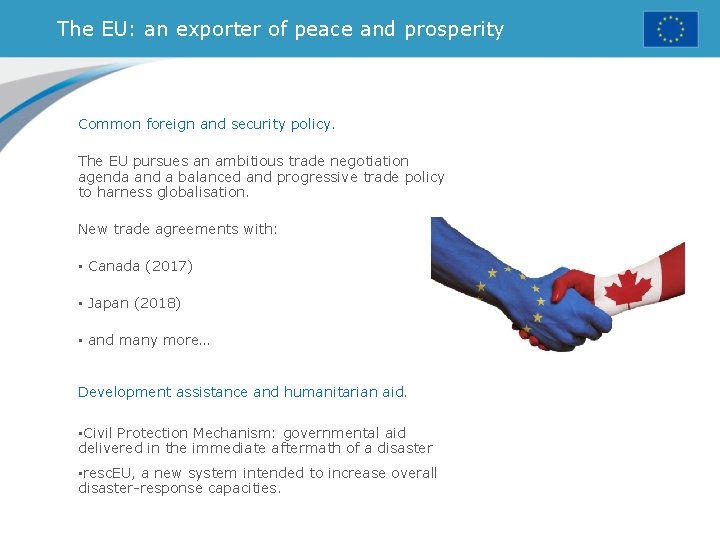
The EU: an exporter of peace and prosperity Common foreign and security policy. The EU pursues an ambitious trade negotiation agenda and a balanced and progressive trade policy to harness globalisation. New trade agreements with: • Canada (2017) • Japan (2018) • and many more… Development assistance and humanitarian aid. • Civil Protection Mechanism: governmental aid delivered in the immediate aftermath of a disaster • resc. EU, a new system intended to increase overall disaster-response capacities.
The EU: strengthening security and defence cooperation The EU’s foreign and security policy is centred on: • • Promoting international peace and security, Development cooperation, Human rights and the rule of law Responding to humanitarian and climate emergencies. Internationally, the EU uses its diplomatic, political, economic, security and humanitarian tools for peaceful solutions to conflicts, in particular in Libya, Syria and Ukraine. In December 2017, 25 Member States agreed to establish a Permanent Structured Cooperation, a legally binding framework together more closely on security and defence. In 2017, a European Defence Fund was launched for cooperation in research and development for joint industrial defence products and technologies. The Fund will invest € 90 million in research and € 500 million in development by 2020. In April 2019, the European Parliament endorsed plans for the Fund to receive an estimated € 13 billion in the EU’s next long-term budget between 2021 and 2027, and finance collaborative research projects mainly through grants.
The EU is the biggest provider of development aid in the world Through aid and cooperation, the European Union supports developing countries and their transition to economic and social stability. The European Union and its Member States continued to be the world's leading provider of official development assistance in 2018 and stepped up their efforts directed at developing countries. Collective assistance from the European Union and its Member States amounted to more than € 74. 4 billion in 2018. In September 2018, the Africa–Europe Alliance for Sustainable Investment and Jobs was launched. Its aim is to take the EU’s partnership with Africa to the next level by helping to improve job creation in Africa by supporting education and skills, boosting trade and mobilising investment in strategic economic sectors.
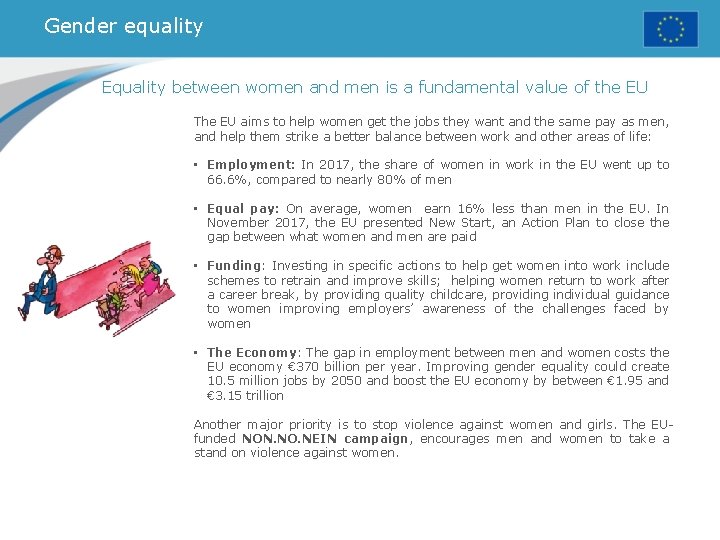
Gender equality Equality between women and men is a fundamental value of the EU The EU aims to help women get the jobs they want and the same pay as men, and help them strike a better balance between work and other areas of life: • Employment: In 2017, the share of women in work in the EU went up to 66. 6%, compared to nearly 80% of men • Equal pay: On average, women earn 16% less than men in the EU. In November 2017, the EU presented New Start, an Action Plan to close the gap between what women and men are paid • Funding: Investing in specific actions to help get women into work include schemes to retrain and improve skills; helping women return to work after a career break, by providing quality childcare, providing individual guidance to women improving employers’ awareness of the challenges faced by women • The Economy: The gap in employment between men and women costs the EU economy € 370 billion per year. Improving gender equality could create 10. 5 million jobs by 2050 and boost the EU economy by between € 1. 95 and € 3. 15 trillion Another major priority is to stop violence against women and girls. The EUfunded NON. NO. NEIN campaign, encourages men and women to take a stand on violence against women.
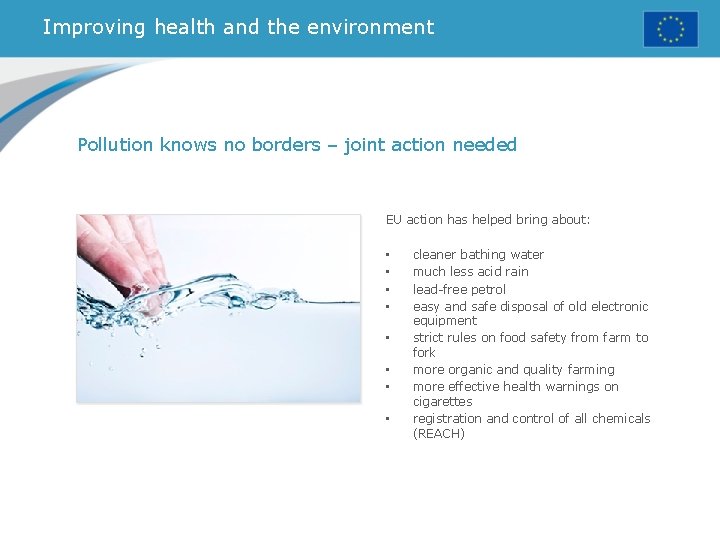
Improving health and the environment Pollution knows no borders – joint action needed EU action has helped bring about: • • cleaner bathing water much less acid rain lead-free petrol easy and safe disposal of old electronic equipment strict rules on food safety from farm to fork more organic and quality farming more effective health warnings on cigarettes registration and control of all chemicals (REACH)
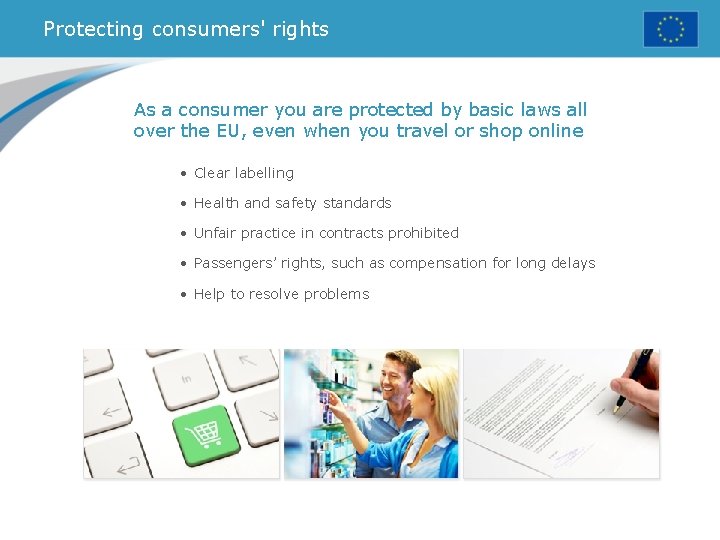
Protecting consumers' rights As a consumer you are protected by basic laws all over the EU, even when you travel or shop online • Clear labelling • Health and safety standards • Unfair practice in contracts prohibited • Passengers’ rights, such as compensation for long delays • Help to resolve problems
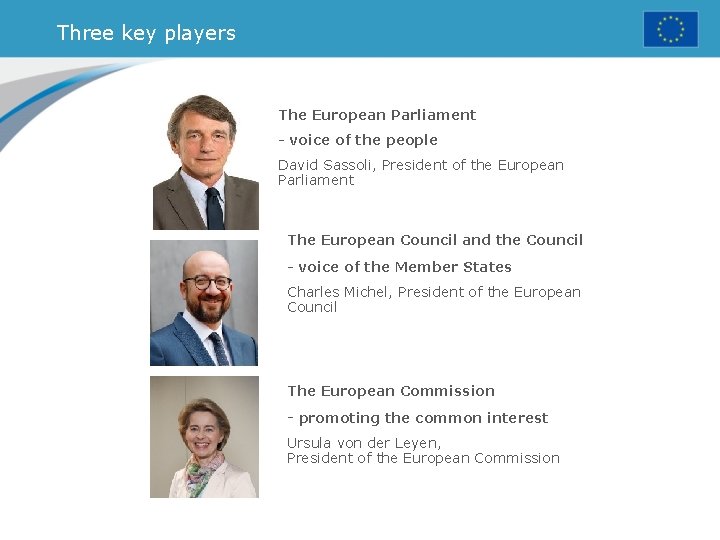
Three key players The European Parliament - voice of the people David Sassoli, President of the European Parliament The European Council and the Council - voice of the Member States Charles Michel, President of the European Council The European Commission - promoting the common interest Ursula von der Leyen, President of the European Commission
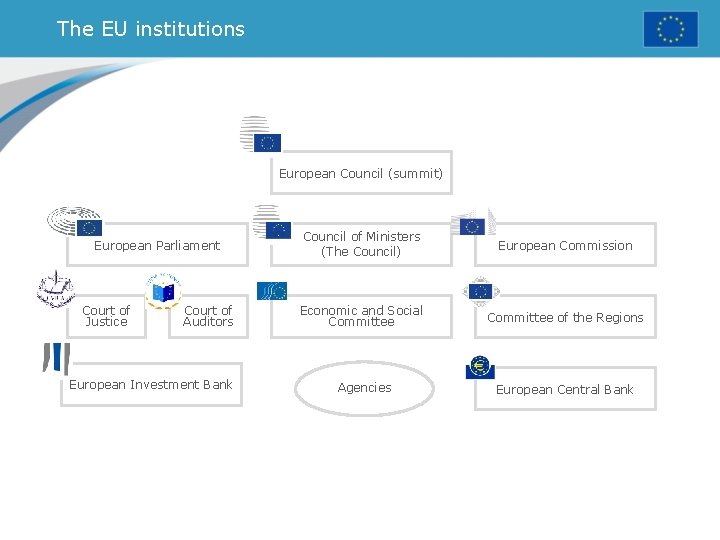
The EU institutions European Council (summit) European Parliament Court of Justice Court of Auditors European Investment Bank Council of Ministers (The Council) European Commission Economic and Social Committee of the Regions Agencies European Central Bank
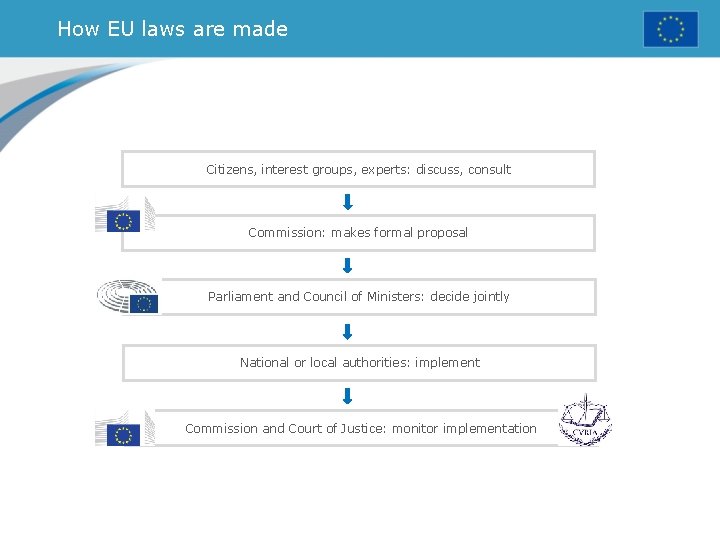
How EU laws are made Citizens, interest groups, experts: discuss, consult Commission: makes formal proposal Parliament and Council of Ministers: decide jointly National or local authorities: implement Commission and Court of Justice: monitor implementation
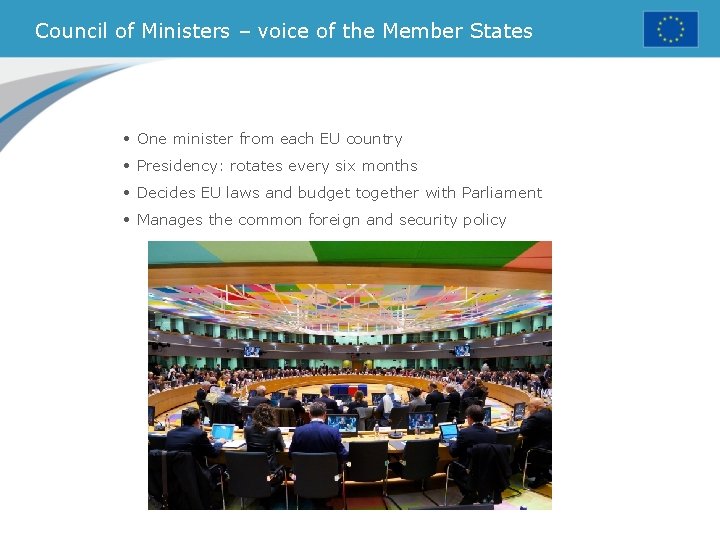
Council of Ministers – voice of the Member States • One minister from each EU country • Presidency: rotates every six months • Decides EU laws and budget together with Parliament • Manages the common foreign and security policy
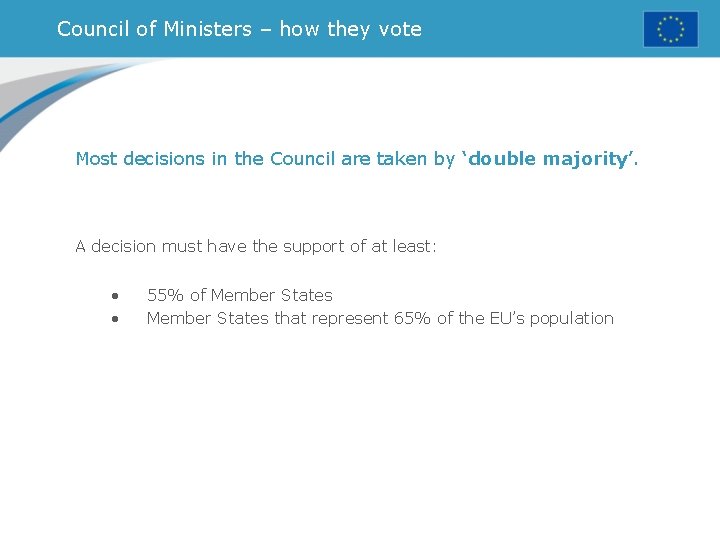
Council of Ministers – how they vote Most decisions in the Council are taken by ‘double majority’. A decision must have the support of at least: • • 55% of Member States that represent 65% of the EU’s population
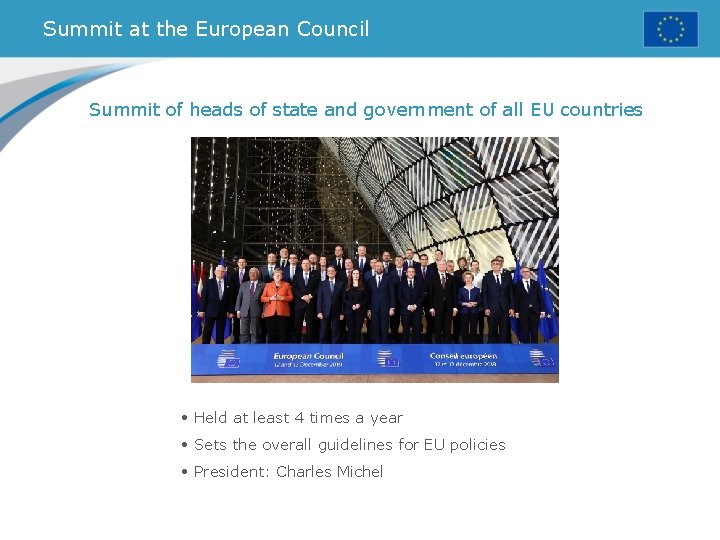
Summit at the European Council Summit of heads of state and government of all EU countries • Held at least 4 times a year • Sets the overall guidelines for EU policies • President: Charles Michel
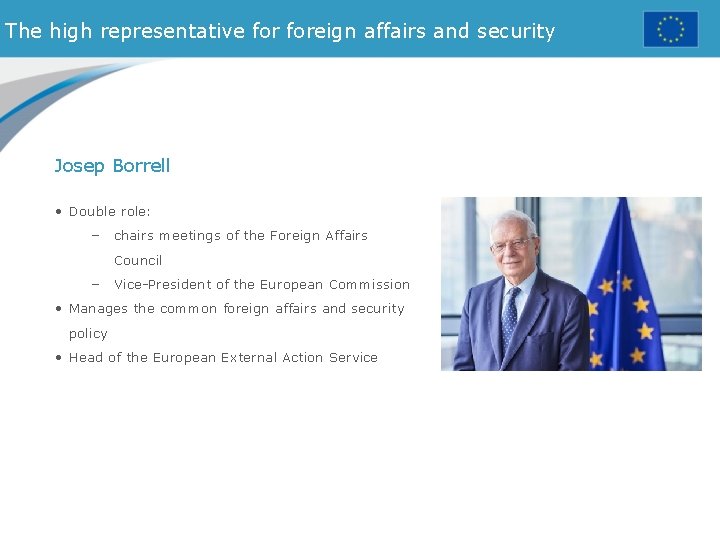
The high representative foreign affairs and security Josep Borrell • Double role: – chairs meetings of the Foreign Affairs Council – Vice-President of the European Commission • Manages the common foreign affairs and security policy • Head of the European External Action Service
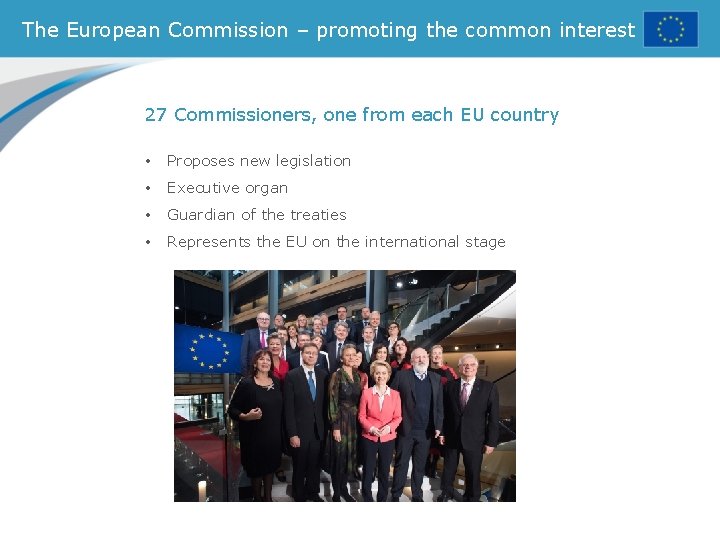
The European Commission – promoting the common interest 27 Commissioners, one from each EU country • Proposes new legislation • Executive organ • Guardian of the treaties • Represents the EU on the international stage
The Court of Justice – upholding the law 27 independent judges, one from each EU country • Rules on how to interpret EU law • Ensures EU countries apply EU laws in the same way
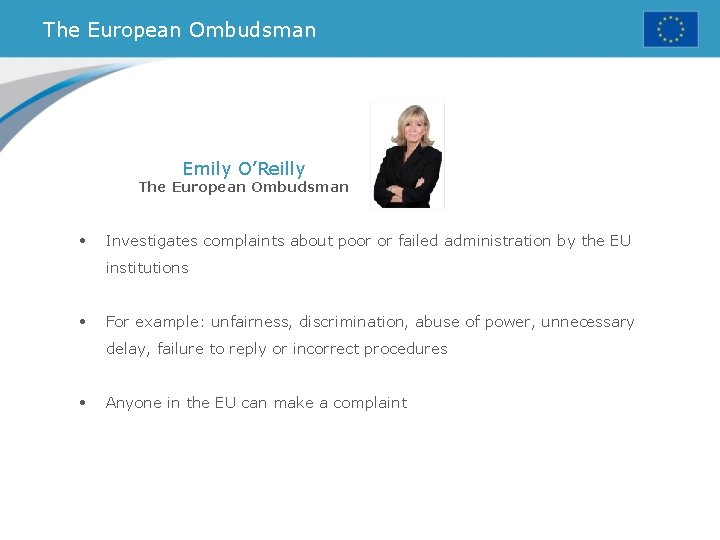
The European Ombudsman Emily O’Reilly The European Ombudsman • Investigates complaints about poor or failed administration by the EU institutions • For example: unfairness, discrimination, abuse of power, unnecessary delay, failure to reply or incorrect procedures • Anyone in the EU can make a complaint
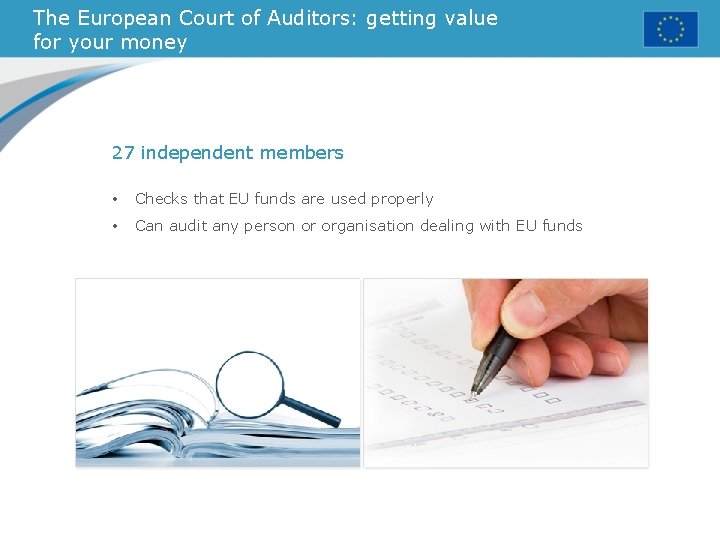
The European Court of Auditors: getting value for your money 27 independent members • Checks that EU funds are used properly • Can audit any person or organisation dealing with EU funds
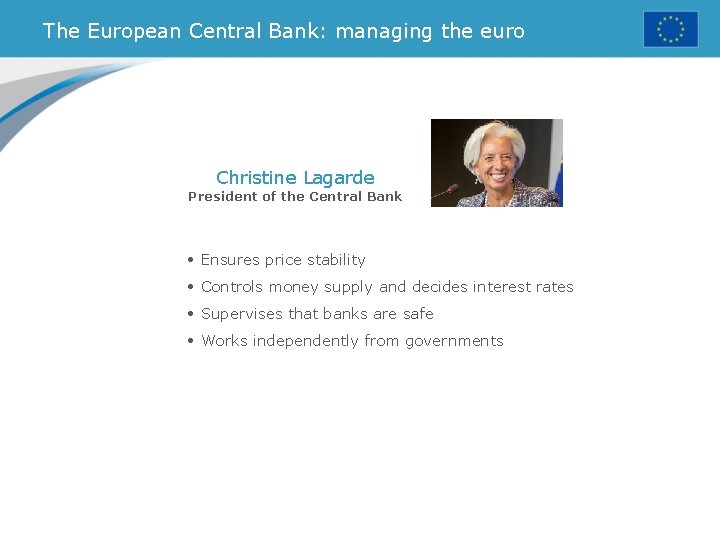
The European Central Bank: managing the euro Christine Lagarde President of the Central Bank • Ensures price stability • Controls money supply and decides interest rates • Supervises that banks are safe • Works independently from governments
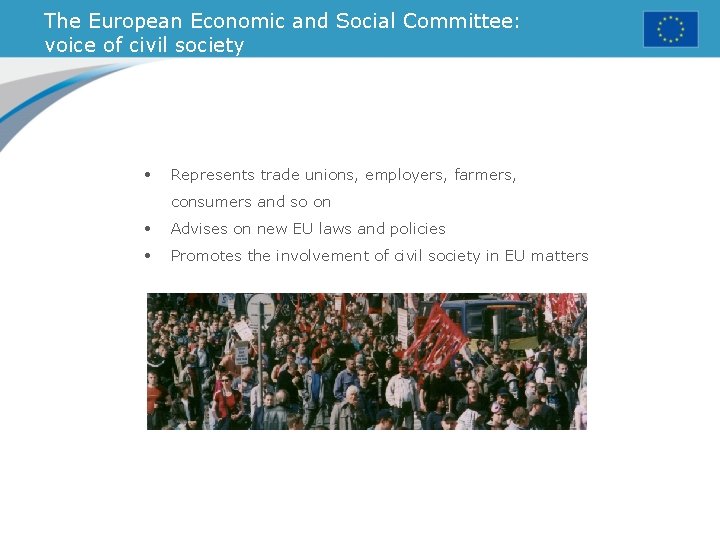
The European Economic and Social Committee: voice of civil society • Represents trade unions, employers, farmers, consumers and so on • Advises on new EU laws and policies • Promotes the involvement of civil society in EU matters
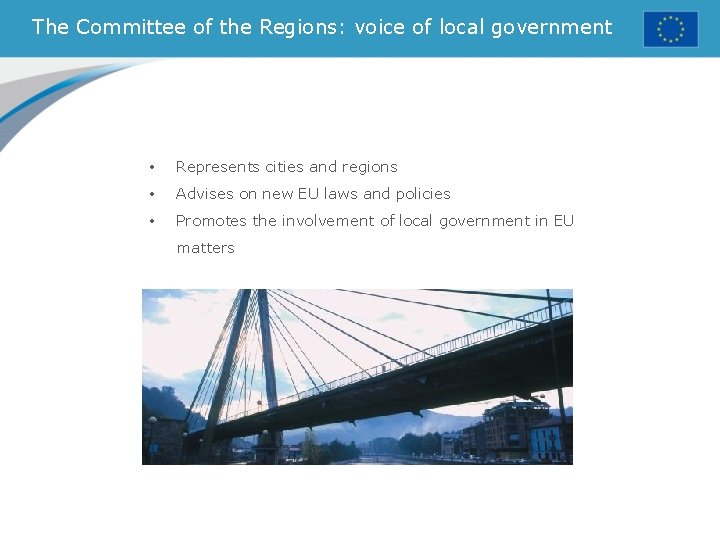
The Committee of the Regions: voice of local government • Represents cities and regions • Advises on new EU laws and policies • Promotes the involvement of local government in EU matters
Getting in touch with the EU Questions about the EU? Europe Direct can help • By phone, email or webchat • Regional information centres across the EU europa. eu/europedirect