Equipment and Materials Identification Partnership for Environmental Education



- Slides: 102
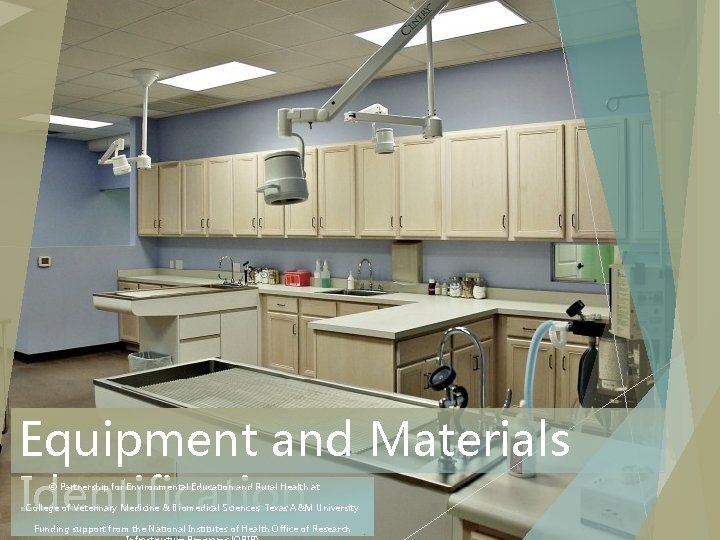
Equipment and Materials Identification © Partnership for Environmental Education and Rural Health at College of Veterinary Medicine & Biomedical Sciences, Texas A&M University Funding support from the National Institutes of Health Office of Research
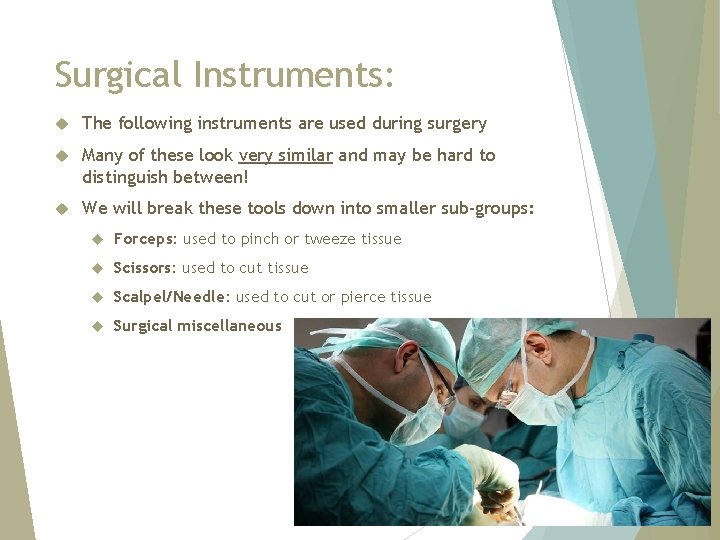
Surgical Instruments: The following instruments are used during surgery Many of these look very similar and may be hard to distinguish between! We will break these tools down into smaller sub-groups: Forceps: used to pinch or tweeze tissue Scissors: used to cut tissue Scalpel/Needle: used to cut or pierce tissue Surgical miscellaneous
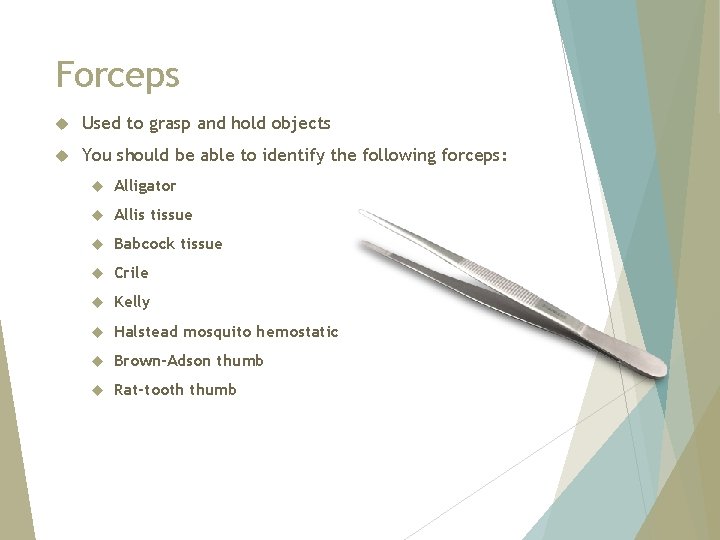
Forceps Used to grasp and hold objects You should be able to identify the following forceps: Alligator Allis tissue Babcock tissue Crile Kelly Halstead mosquito hemostatic Brown-Adson thumb Rat-tooth thumb
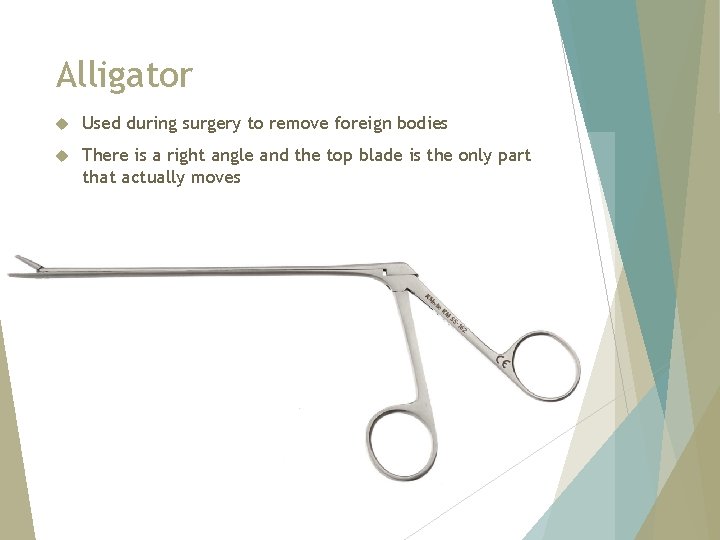
Alligator Used during surgery to remove foreign bodies There is a right angle and the top blade is the only part that actually moves
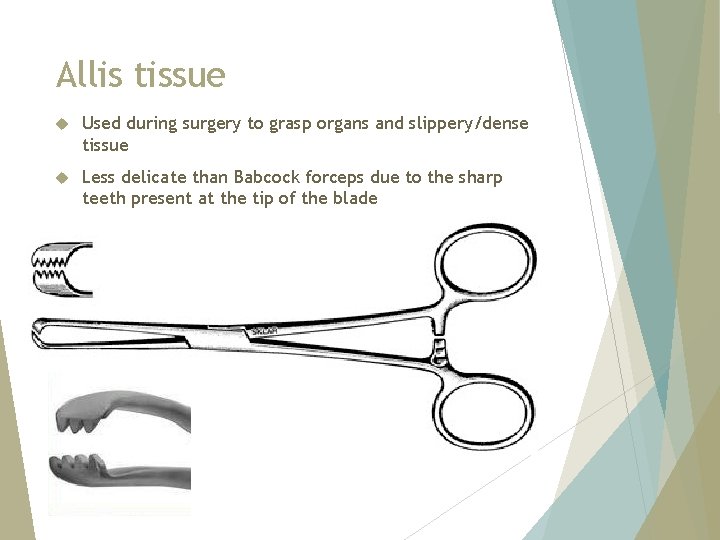
Allis tissue Used during surgery to grasp organs and slippery/dense tissue Less delicate than Babcock forceps due to the sharp teeth present at the tip of the blade
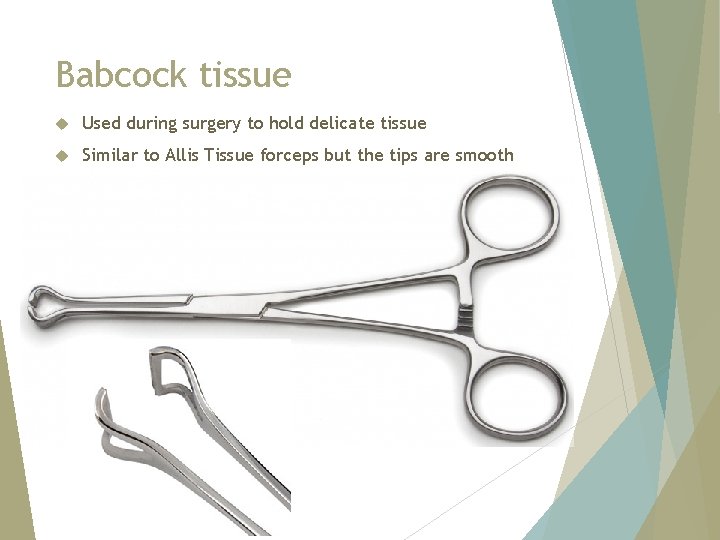
Babcock tissue Used during surgery to hold delicate tissue Similar to Allis Tissue forceps but the tips are smooth
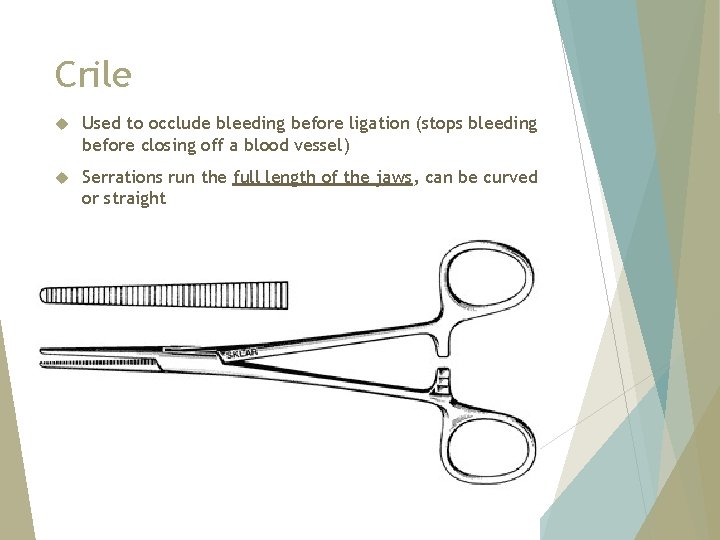
Crile Used to occlude bleeding before ligation (stops bleeding before closing off a blood vessel) Serrations run the full length of the jaws, can be curved or straight
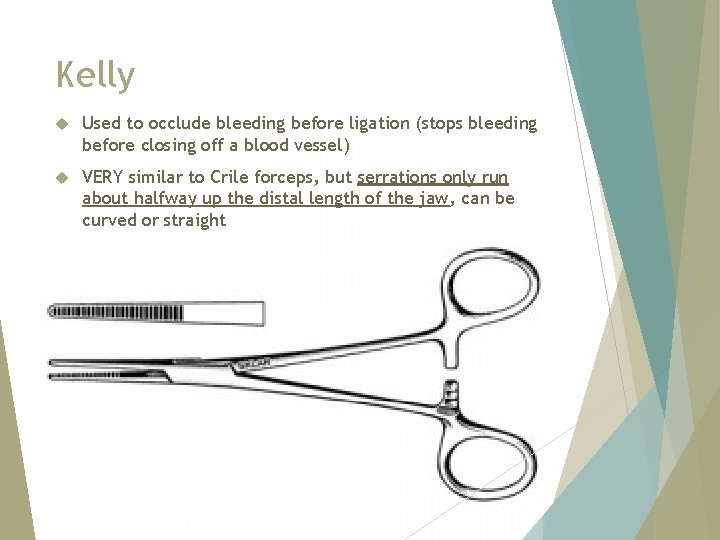
Kelly Used to occlude bleeding before ligation (stops bleeding before closing off a blood vessel) VERY similar to Crile forceps, but serrations only run about halfway up the distal length of the jaw, can be curved or straight
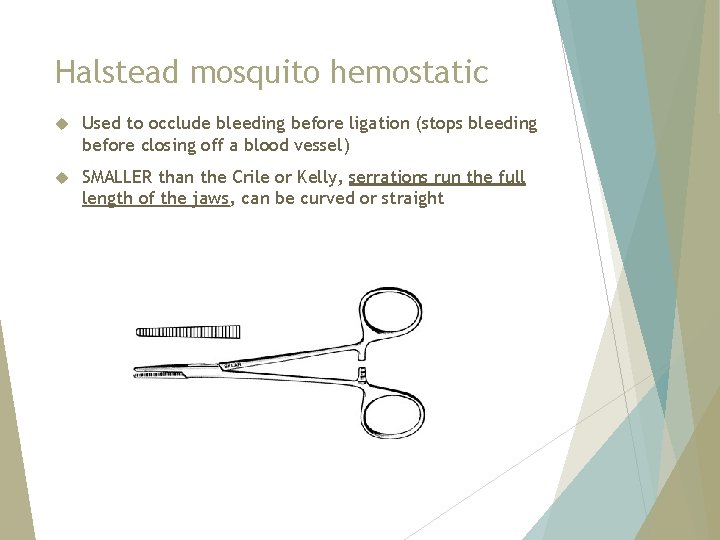
Halstead mosquito hemostatic Used to occlude bleeding before ligation (stops bleeding before closing off a blood vessel) SMALLER than the Crile or Kelly, serrations run the full length of the jaws, can be curved or straight
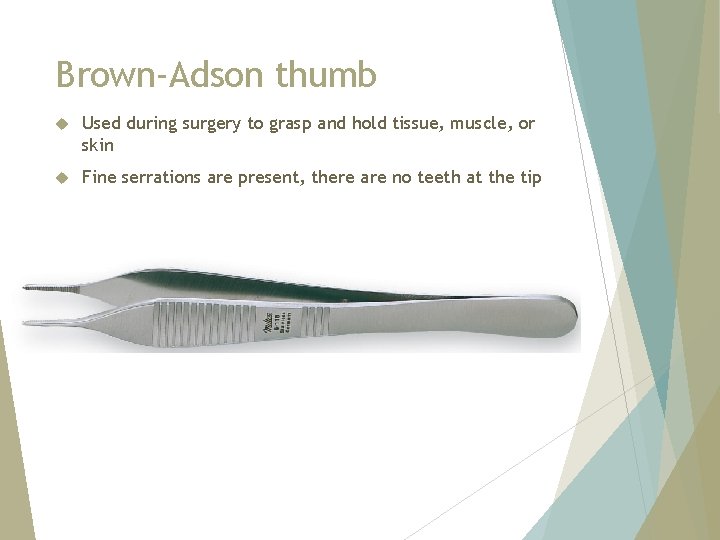
Brown-Adson thumb Used during surgery to grasp and hold tissue, muscle, or skin Fine serrations are present, there are no teeth at the tip
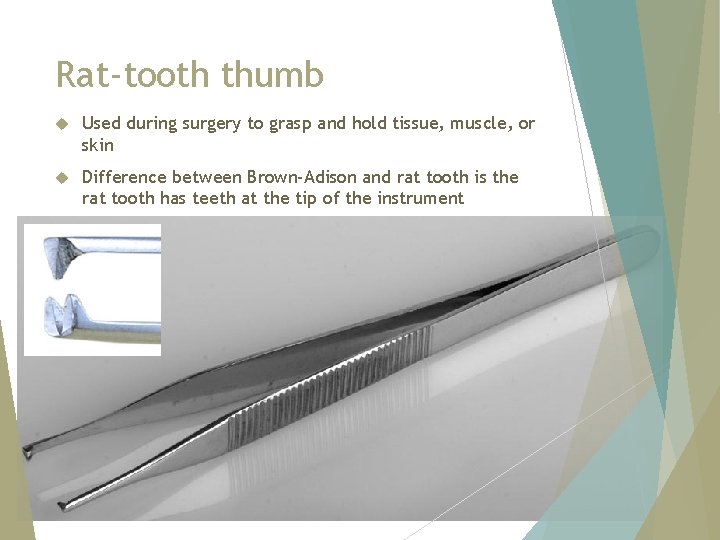
Rat-tooth thumb Used during surgery to grasp and hold tissue, muscle, or skin Difference between Brown-Adison and rat tooth is the rat tooth has teeth at the tip of the instrument
Scissors Surgical instruments used for cutting material and tissue You should be able to identify the following scissors: Suture wire cutting Bandage Littauer suture removal Mayo dissecting Metzenbaum dissecting
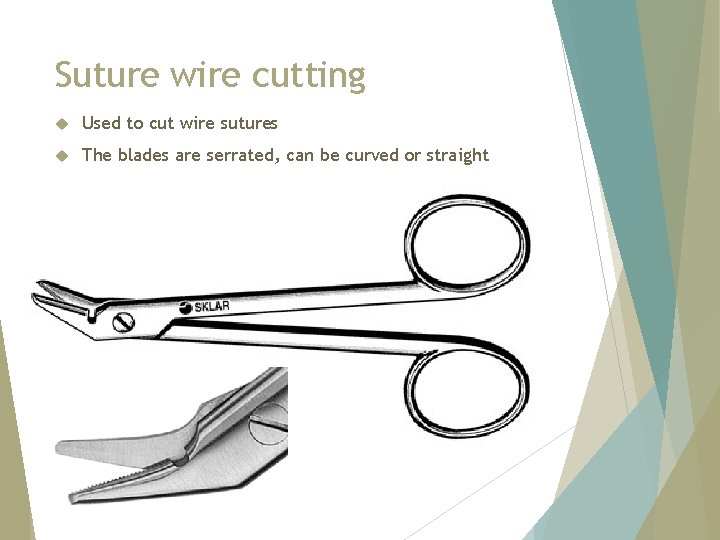
Suture wire cutting Used to cut wire sutures The blades are serrated, can be curved or straight
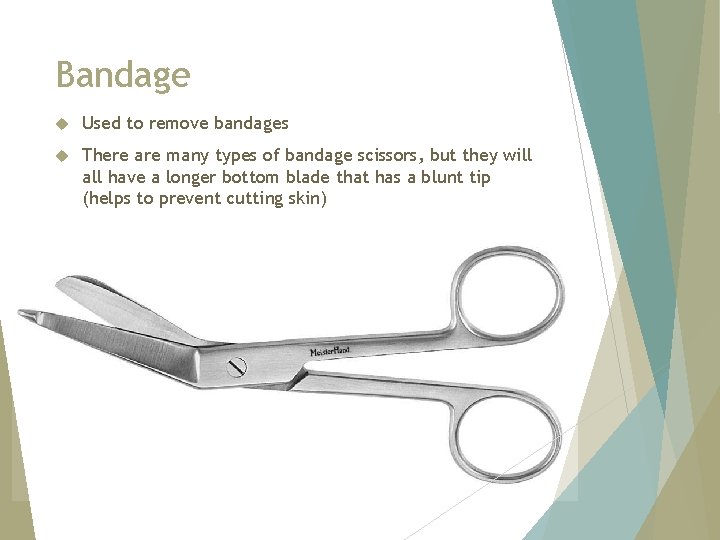
Bandage Used to remove bandages There are many types of bandage scissors, but they will all have a longer bottom blade that has a blunt tip (helps to prevent cutting skin)
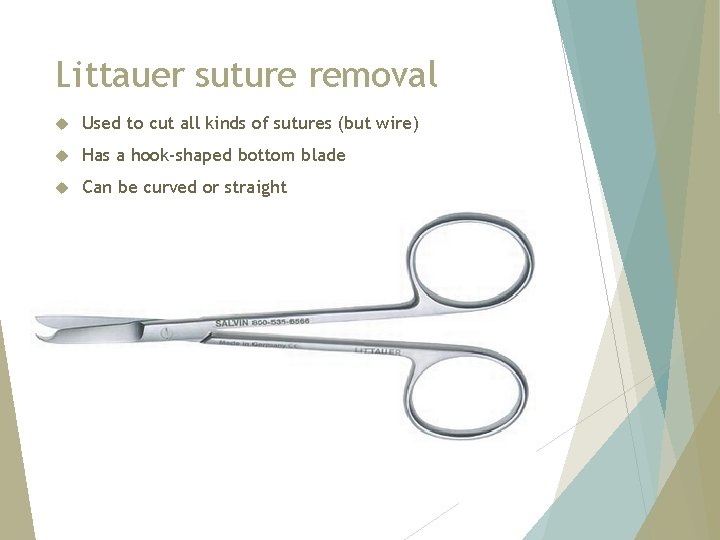
Littauer suture removal Used to cut all kinds of sutures (but wire) Has a hook-shaped bottom blade Can be curved or straight
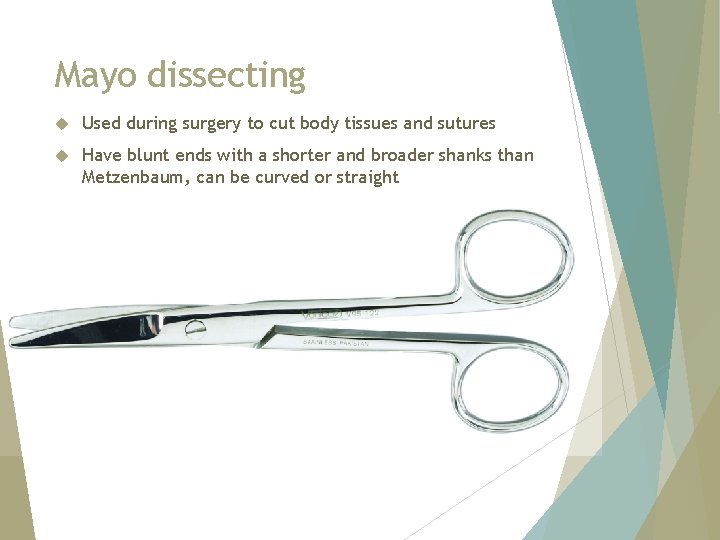
Mayo dissecting Used during surgery to cut body tissues and sutures Have blunt ends with a shorter and broader shanks than Metzenbaum, can be curved or straight
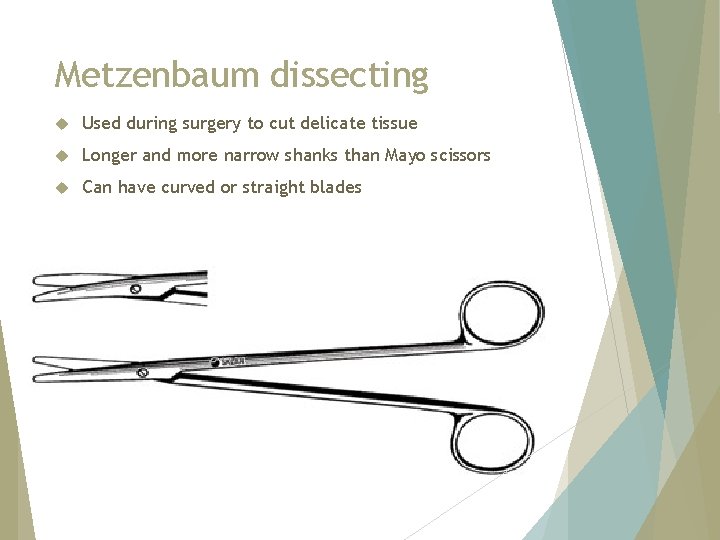
Metzenbaum dissecting Used during surgery to cut delicate tissue Longer and more narrow shanks than Mayo scissors Can have curved or straight blades
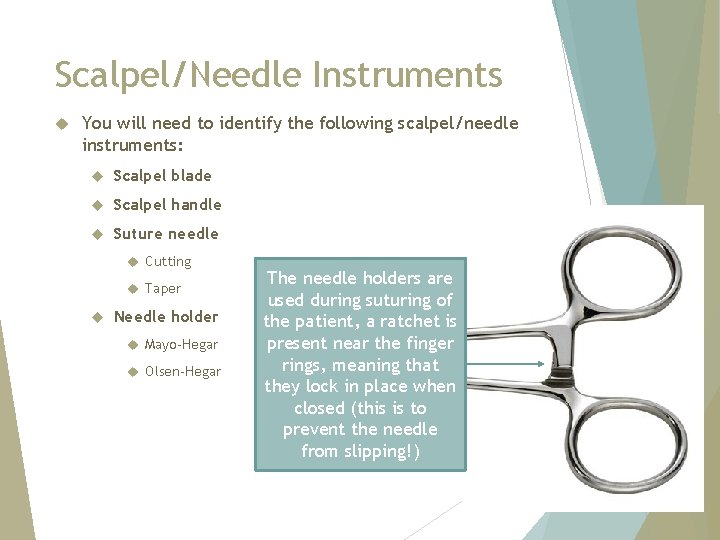
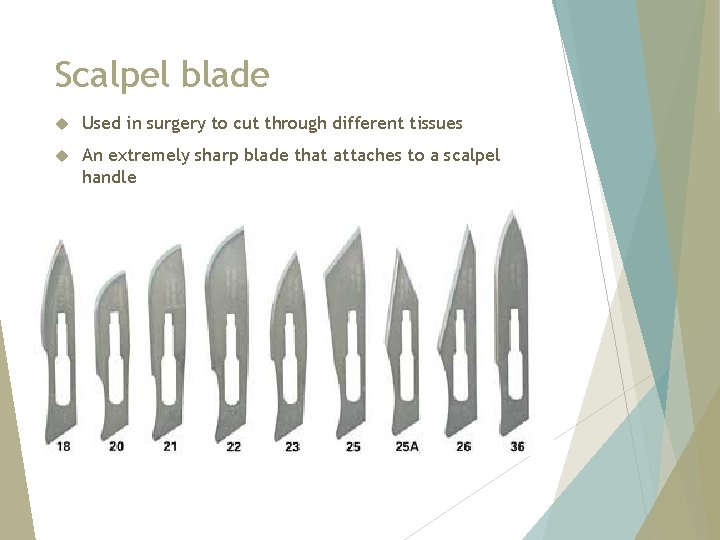
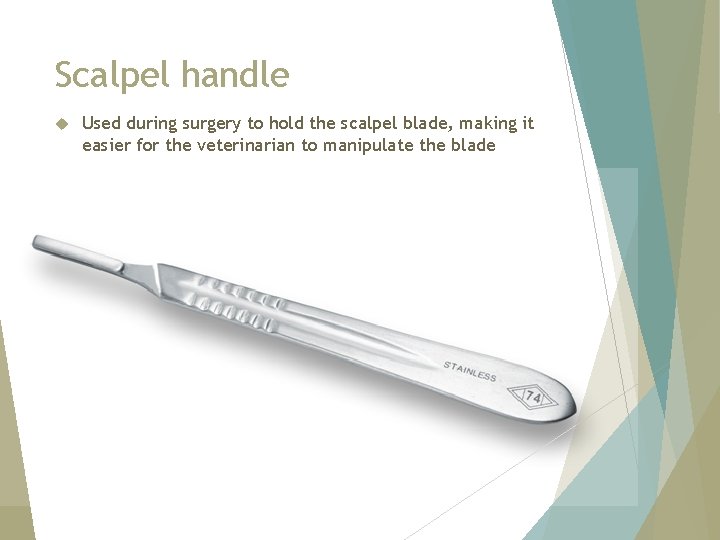
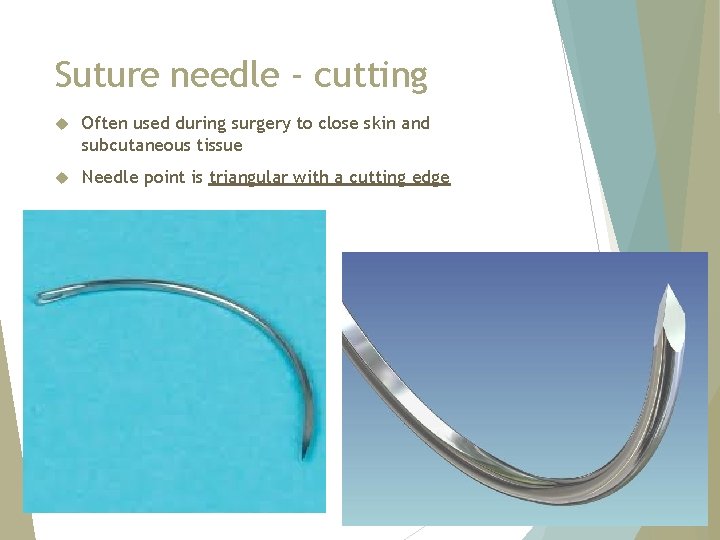
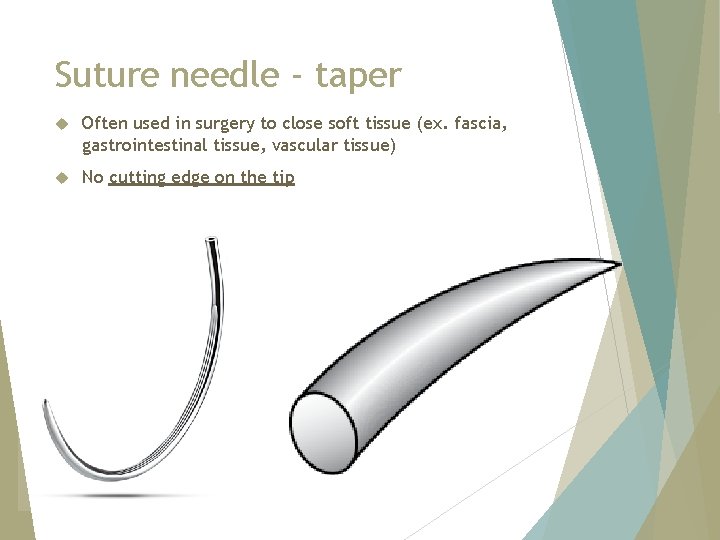
Scalpel/Needle Instruments You will need to identify the following scalpel/needle instruments: Scalpel blade Scalpel handle Suture needle Cutting Taper Needle holder Mayo-Hegar Olsen-Hegar The needle holders are used during suturing of the patient, a ratchet is present near the finger rings, meaning that they lock in place when closed (this is to prevent the needle from slipping!)
Scalpel blade Used in surgery to cut through different tissues An extremely sharp blade that attaches to a scalpel handle
Scalpel handle Used during surgery to hold the scalpel blade, making it easier for the veterinarian to manipulate the blade
Suture needle - cutting Often used during surgery to close skin and subcutaneous tissue Needle point is triangular with a cutting edge
Suture needle - taper Often used in surgery to close soft tissue (ex. fascia, gastrointestinal tissue, vascular tissue) No cutting edge on the tip
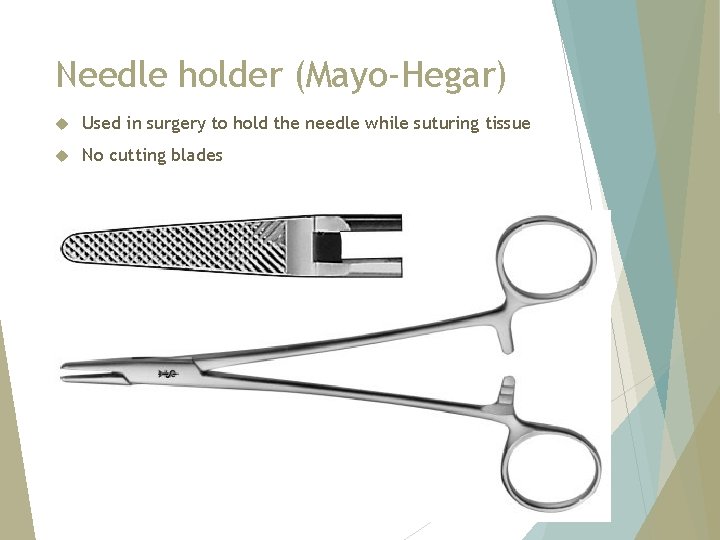
Needle holder (Mayo-Hegar) Used in surgery to hold the needle while suturing tissue No cutting blades
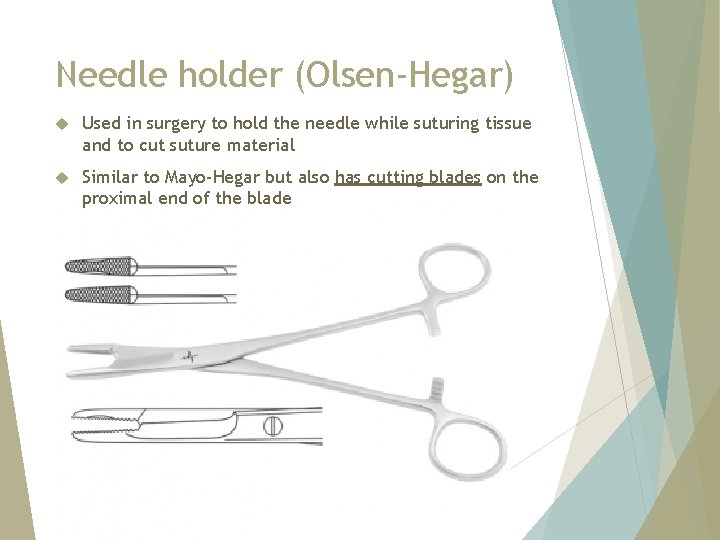
Needle holder (Olsen-Hegar) Used in surgery to hold the needle while suturing tissue and to cut suture material Similar to Mayo-Hegar but also has cutting blades on the proximal end of the blade
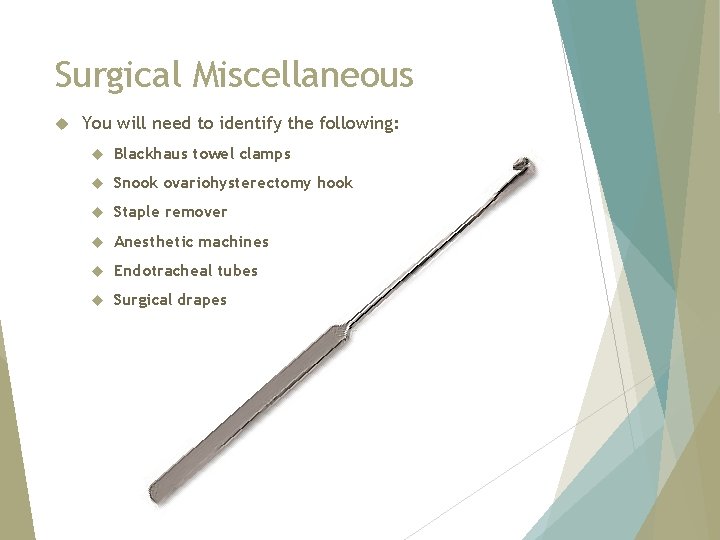
Surgical Miscellaneous You will need to identify the following: Blackhaus towel clamps Snook ovariohysterectomy hook Staple remover Anesthetic machines Endotracheal tubes Surgical drapes
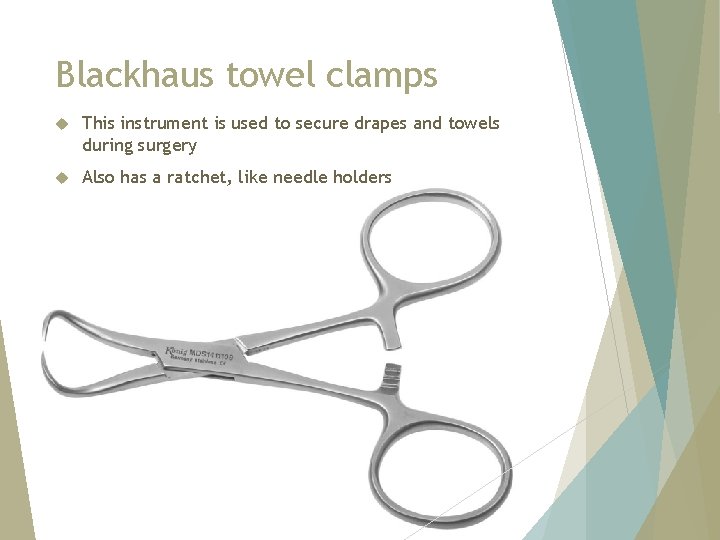
Blackhaus towel clamps This instrument is used to secure drapes and towels during surgery Also has a ratchet, like needle holders
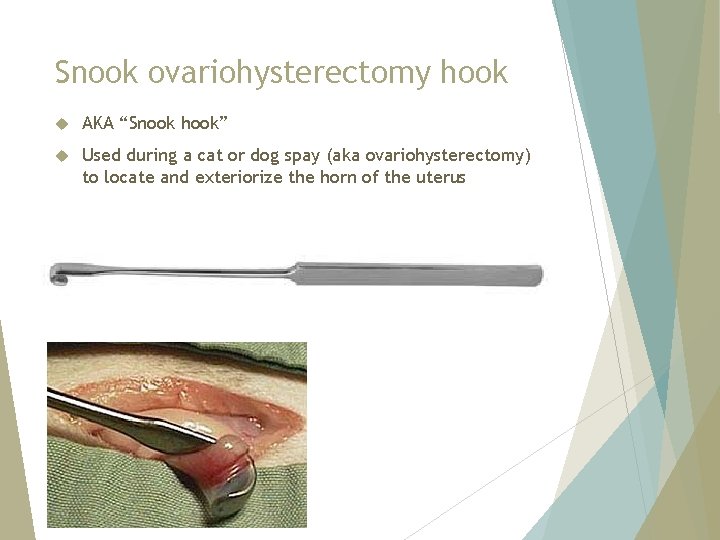
Snook ovariohysterectomy hook AKA “Snook hook” Used during a cat or dog spay (aka ovariohysterectomy) to locate and exteriorize the horn of the uterus
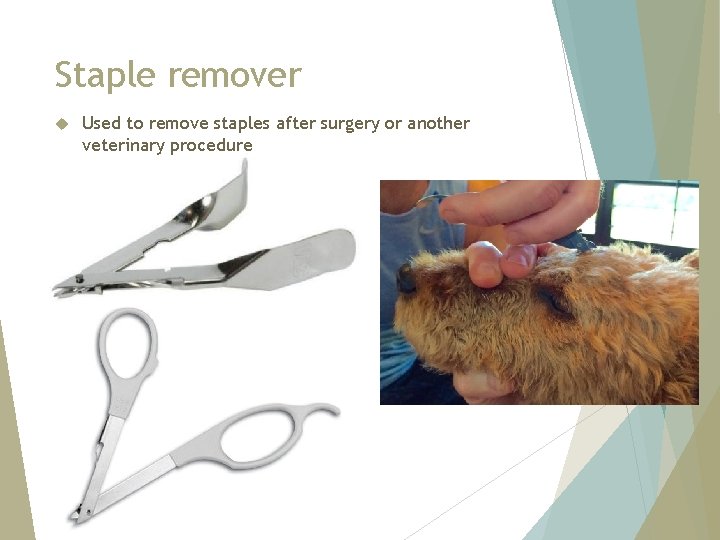
Staple remover Used to remove staples after surgery or another veterinary procedure
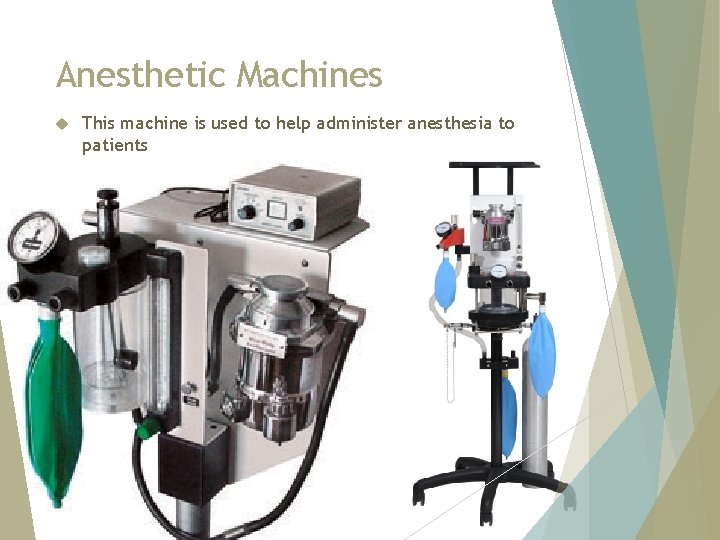
Anesthetic Machines This machine is used to help administer anesthesia to patients
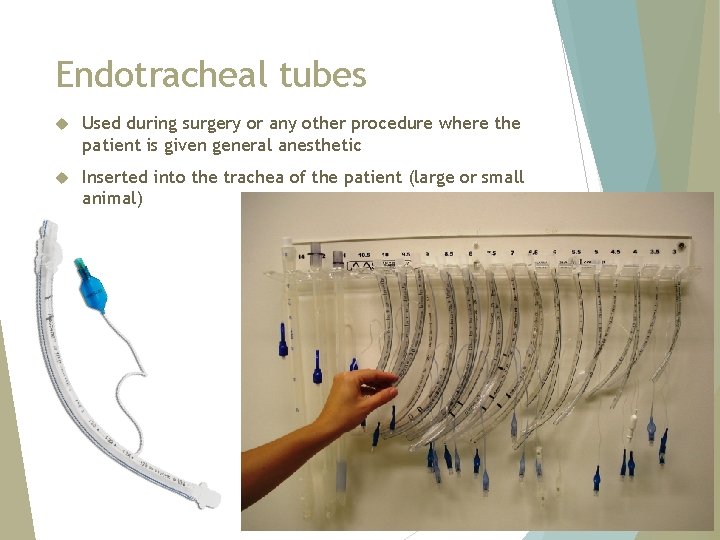
Endotracheal tubes Used during surgery or any other procedure where the patient is given general anesthetic Inserted into the trachea of the patient (large or small animal)
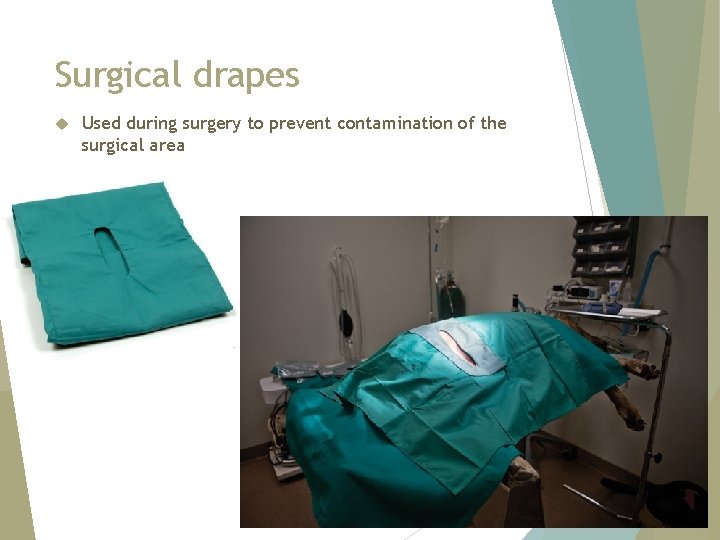
Surgical drapes Used during surgery to prevent contamination of the surgical area
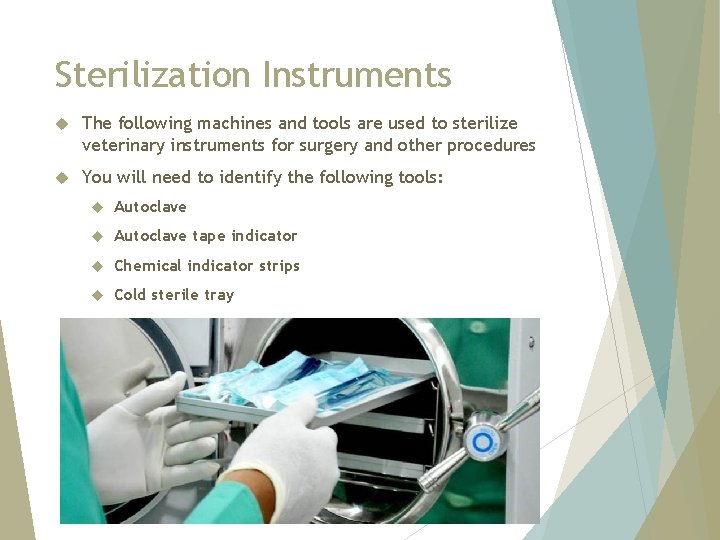
Sterilization Instruments The following machines and tools are used to sterilize veterinary instruments for surgery and other procedures You will need to identify the following tools: Autoclave tape indicator Chemical indicator strips Cold sterile tray
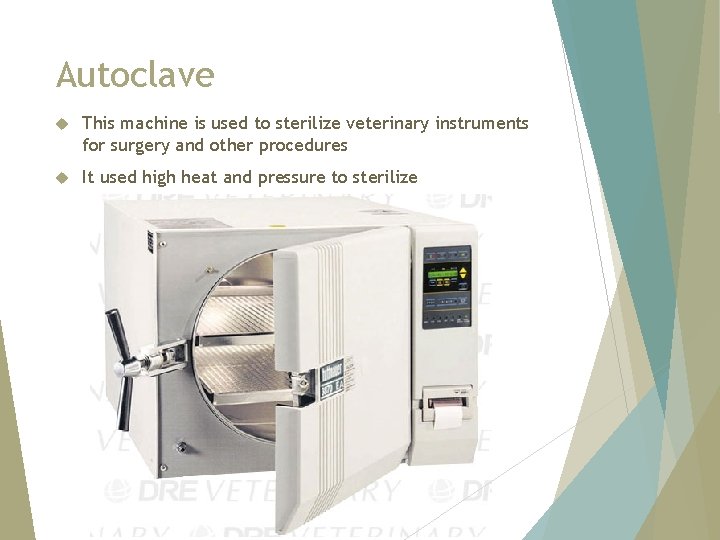
Autoclave This machine is used to sterilize veterinary instruments for surgery and other procedures It used high heat and pressure to sterilize
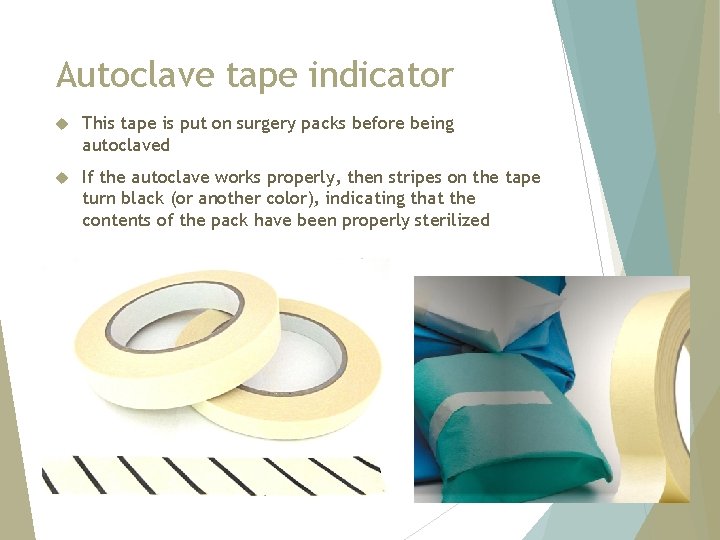
Autoclave tape indicator This tape is put on surgery packs before being autoclaved If the autoclave works properly, then stripes on the tape turn black (or another color), indicating that the contents of the pack have been properly sterilized
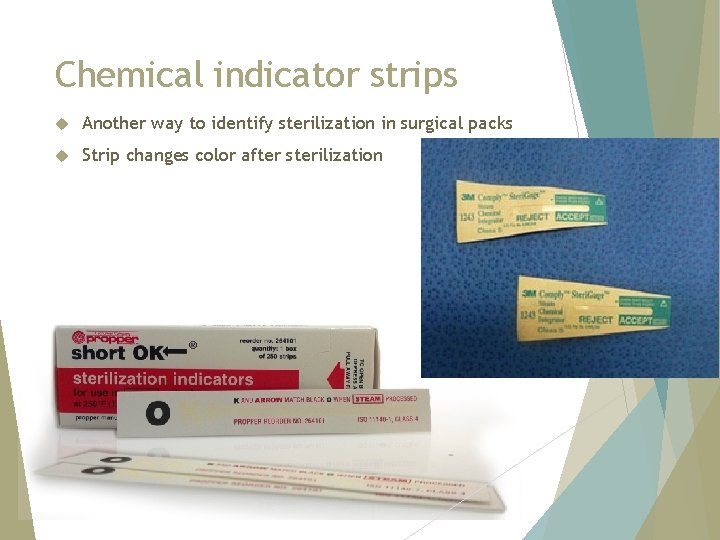
Chemical indicator strips Another way to identify sterilization in surgical packs Strip changes color after sterilization
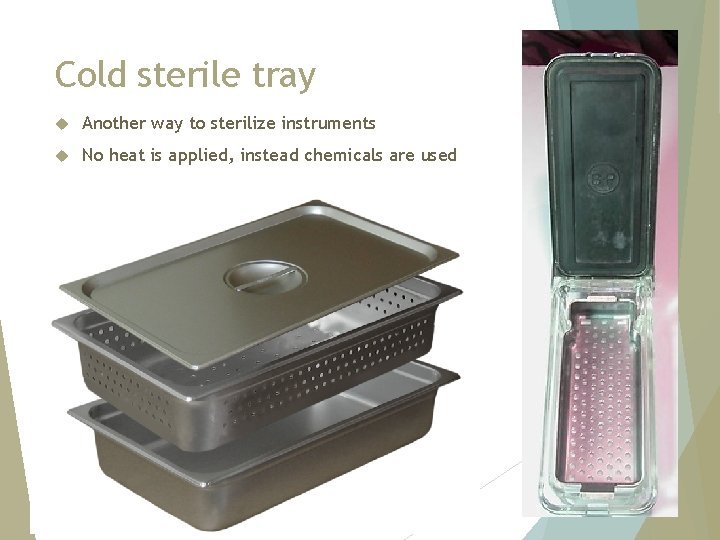
Cold sterile tray Another way to sterilize instruments No heat is applied, instead chemicals are used
Examination/Diagnostic Tools These tools are used in the examination or diagnostic process at the veterinary clinic You will need to identify the following tools: Centrifuge Endoscope Laparoscope Laryngoscope Ophthalmoscope Otoscope Stethoscope Tonometer
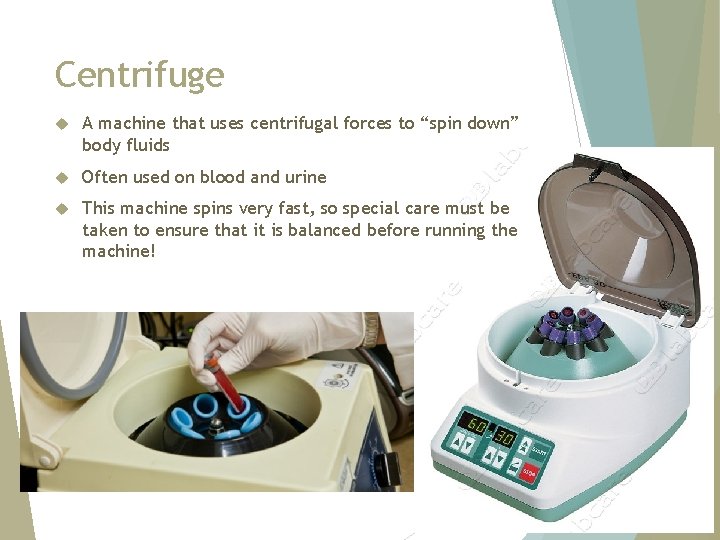
Centrifuge A machine that uses centrifugal forces to “spin down” body fluids Often used on blood and urine This machine spins very fast, so special care must be taken to ensure that it is balanced before running the machine!
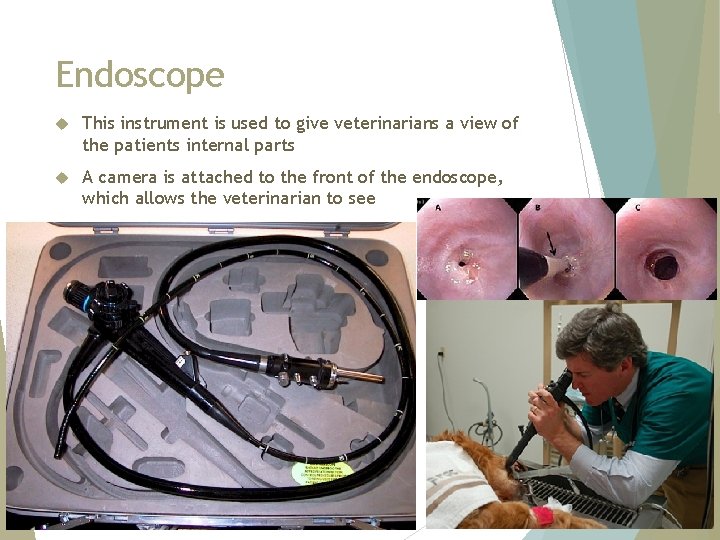
Endoscope This instrument is used to give veterinarians a view of the patients internal parts A camera is attached to the front of the endoscope, which allows the veterinarian to see
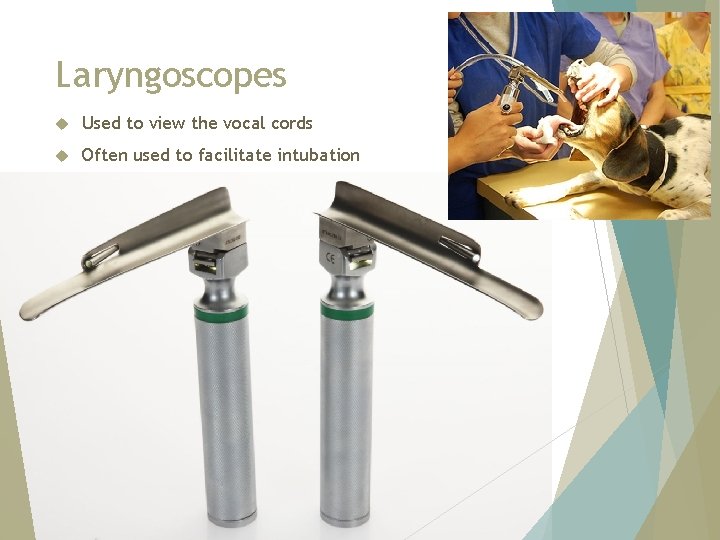
Laryngoscopes Used to view the vocal cords Often used to facilitate intubation
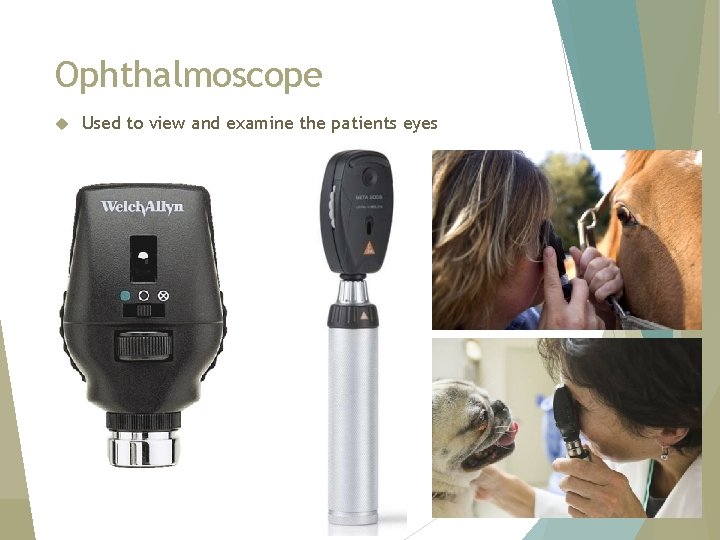
Ophthalmoscope Used to view and examine the patients eyes
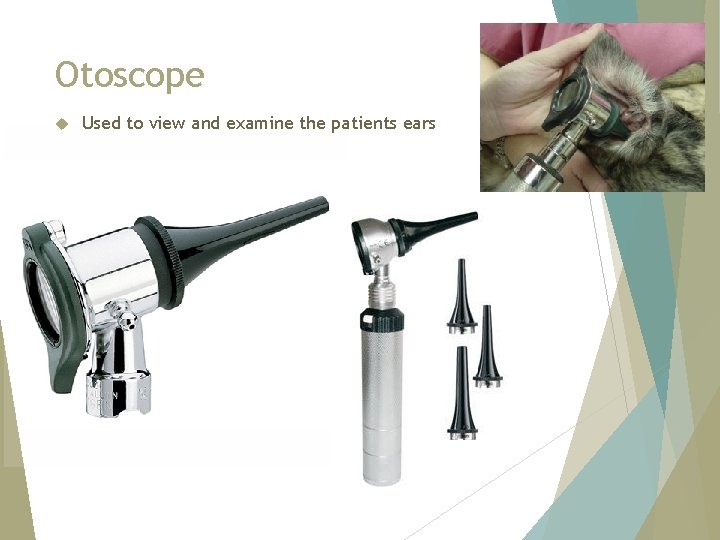
Otoscope Used to view and examine the patients ears
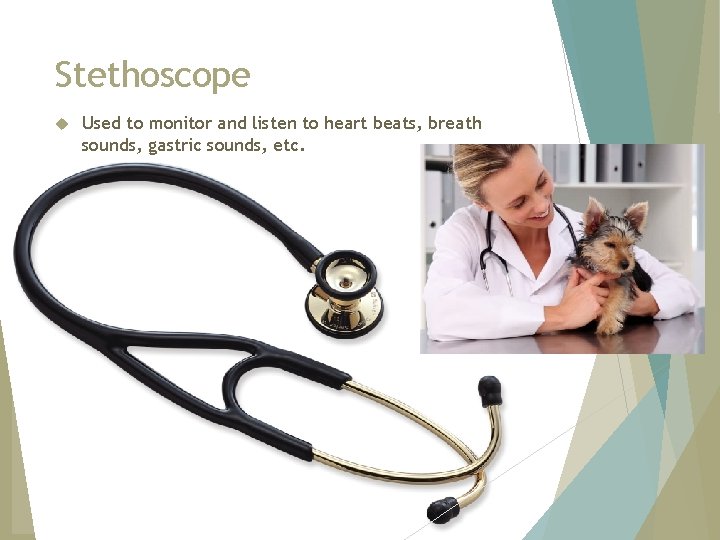
Stethoscope Used to monitor and listen to heart beats, breath sounds, gastric sounds, etc.
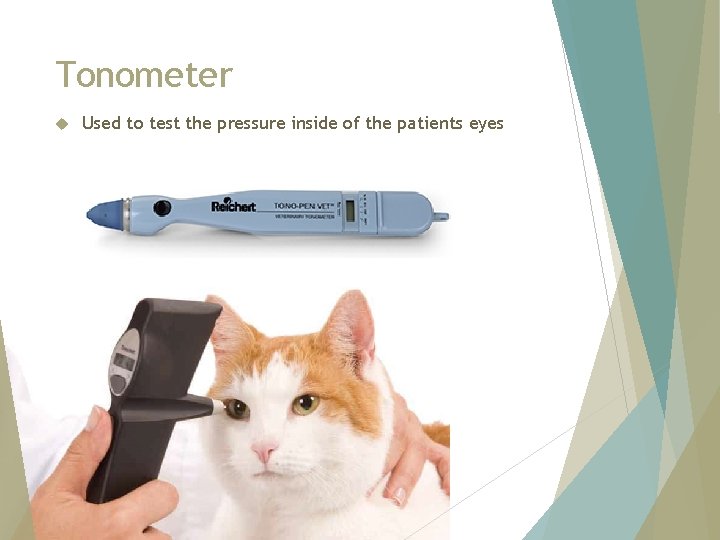
Tonometer Used to test the pressure inside of the patients eyes
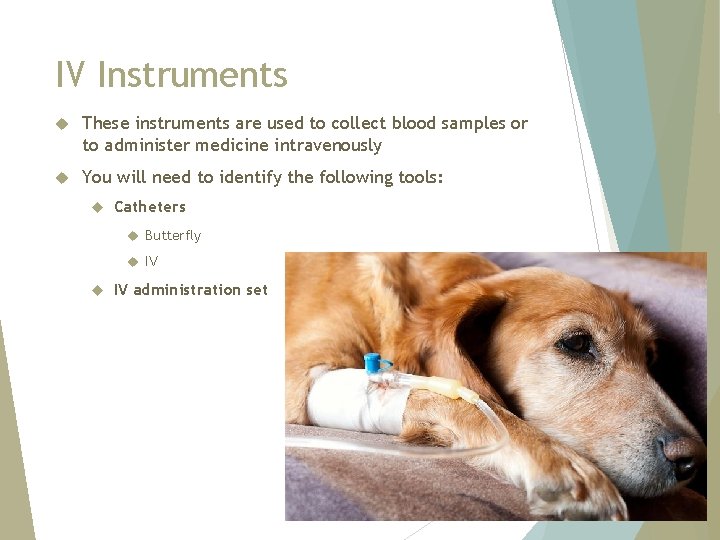
IV Instruments These instruments are used to collect blood samples or to administer medicine intravenously You will need to identify the following tools: Catheters Butterfly IV IV administration set
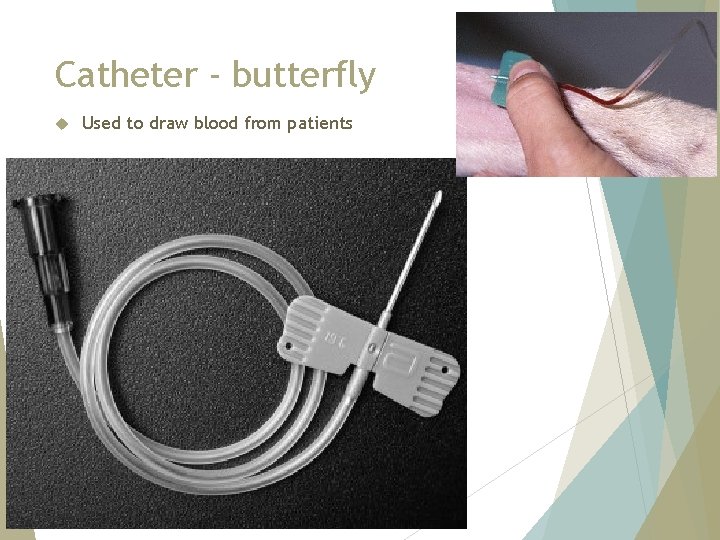
Catheter - butterfly Used to draw blood from patients
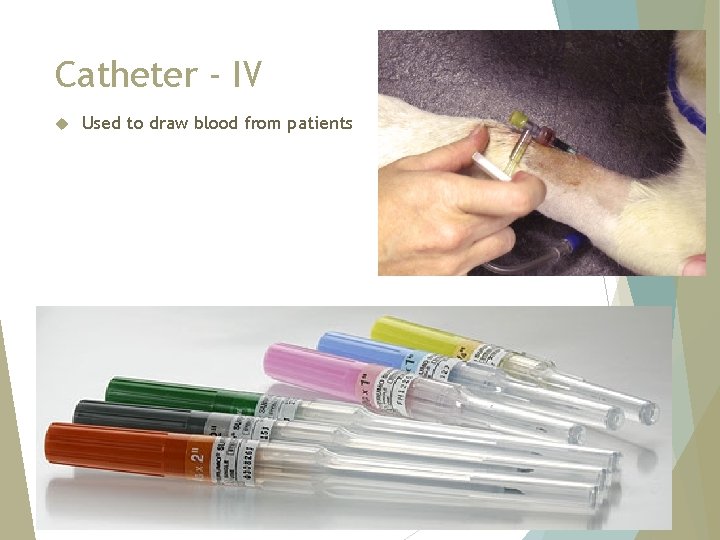
Catheter - IV Used to draw blood from patients
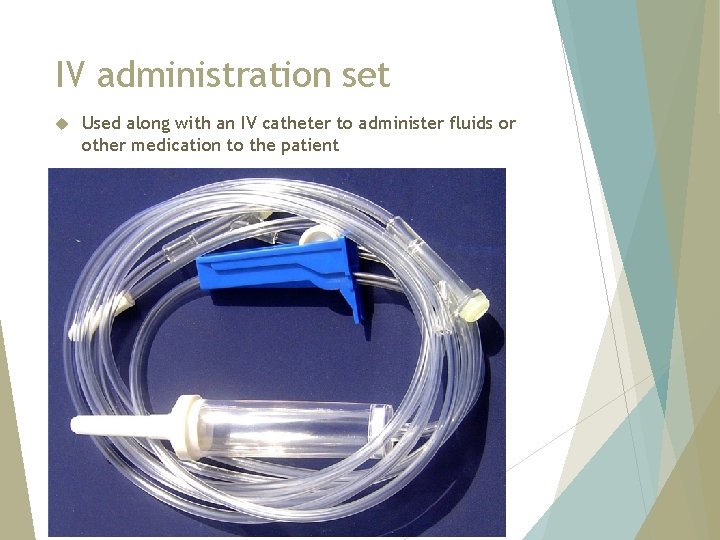
IV administration set Used along with an IV catheter to administer fluids or other medication to the patient
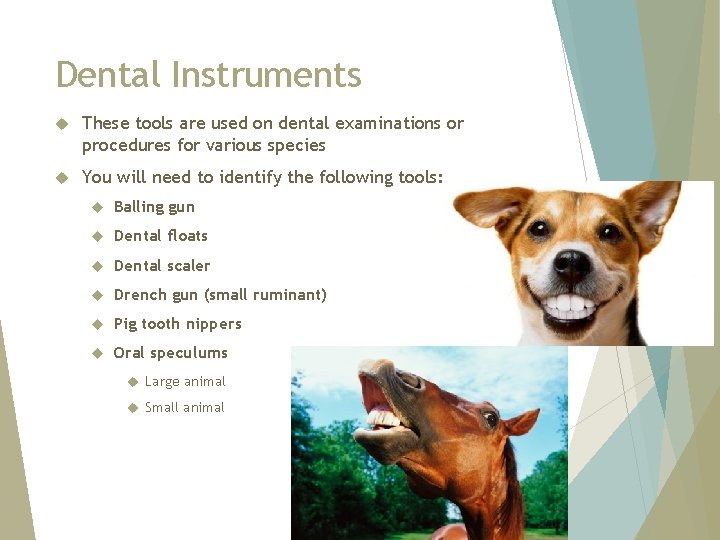
Dental Instruments These tools are used on dental examinations or procedures for various species You will need to identify the following tools: Balling gun Dental floats Dental scaler Drench gun (small ruminant) Pig tooth nippers Oral speculums Large animal Small animal
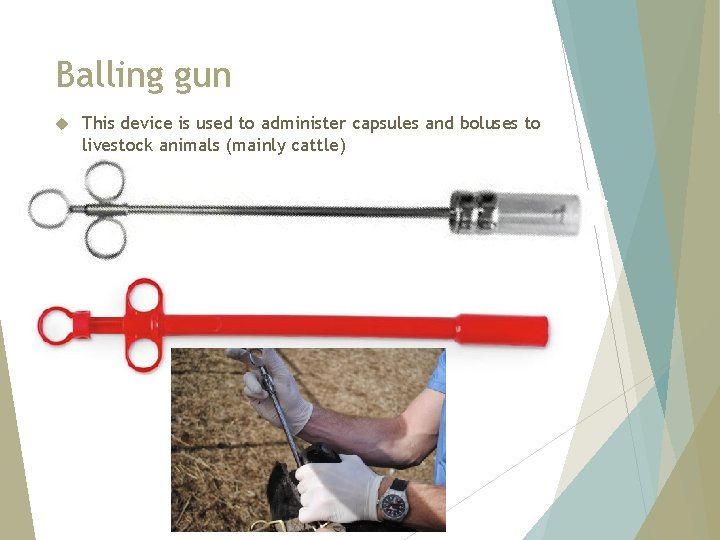
Balling gun This device is used to administer capsules and boluses to livestock animals (mainly cattle)
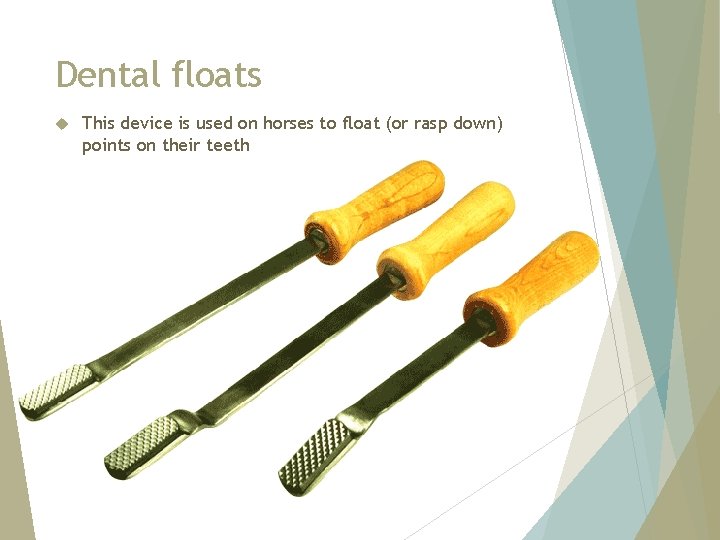
Dental floats This device is used on horses to float (or rasp down) points on their teeth
Horse floatation video
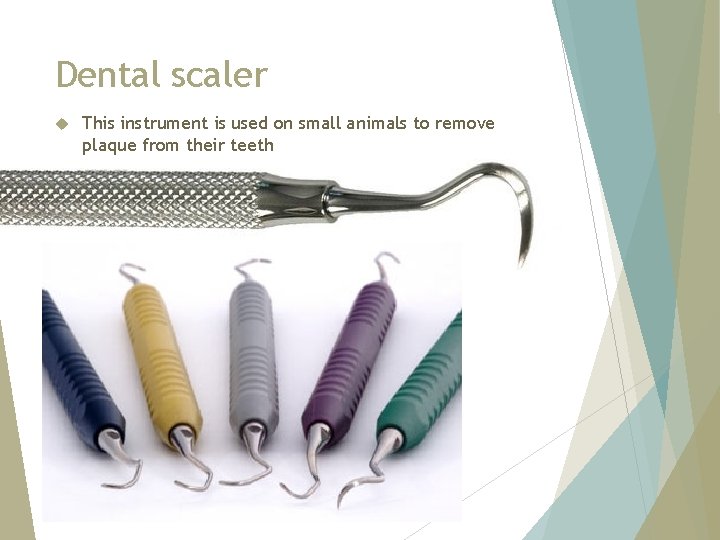
Dental scaler This instrument is used on small animals to remove plaque from their teeth
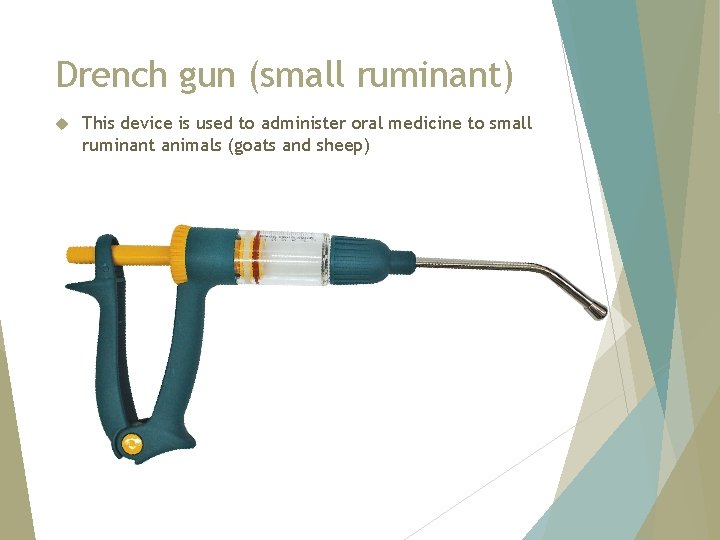
Drench gun (small ruminant) This device is used to administer oral medicine to small ruminant animals (goats and sheep)
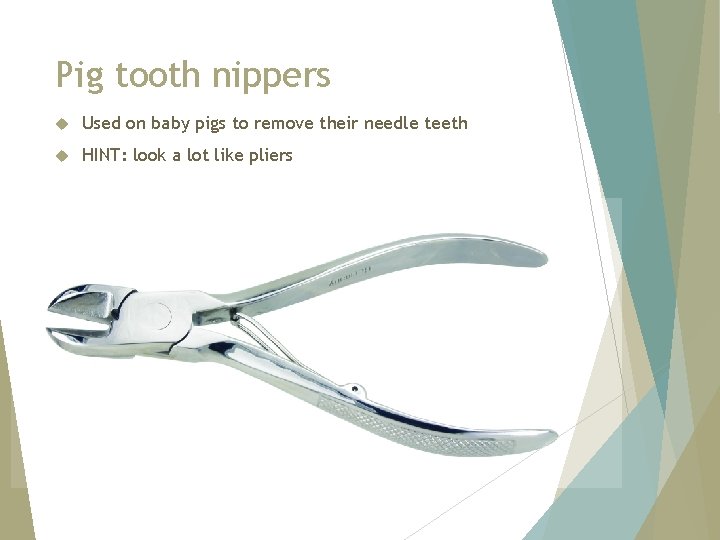
Pig tooth nippers Used on baby pigs to remove their needle teeth HINT: look a lot like pliers
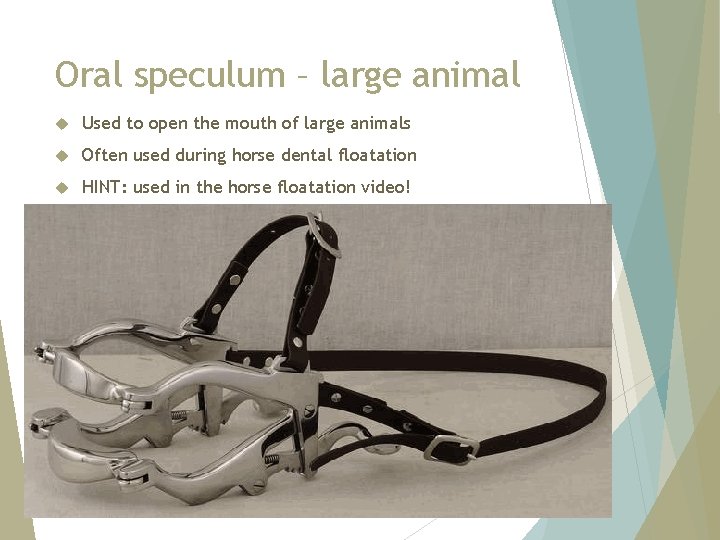
Oral speculum – large animal Used to open the mouth of large animals Often used during horse dental floatation HINT: used in the horse floatation video!
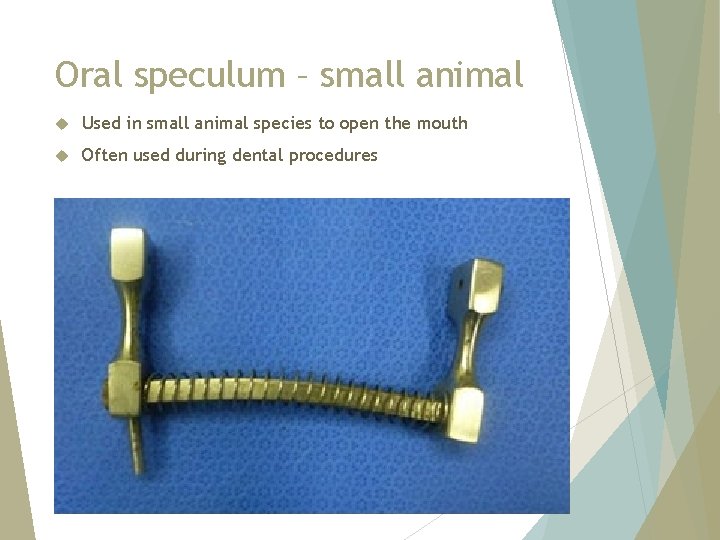
Oral speculum – small animal Used in small animal species to open the mouth Often used during dental procedures
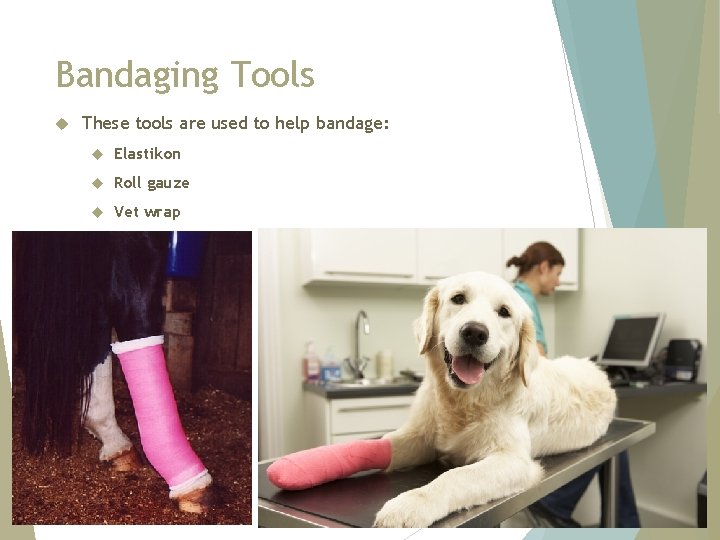
Bandaging Tools These tools are used to help bandage: Elastikon Roll gauze Vet wrap
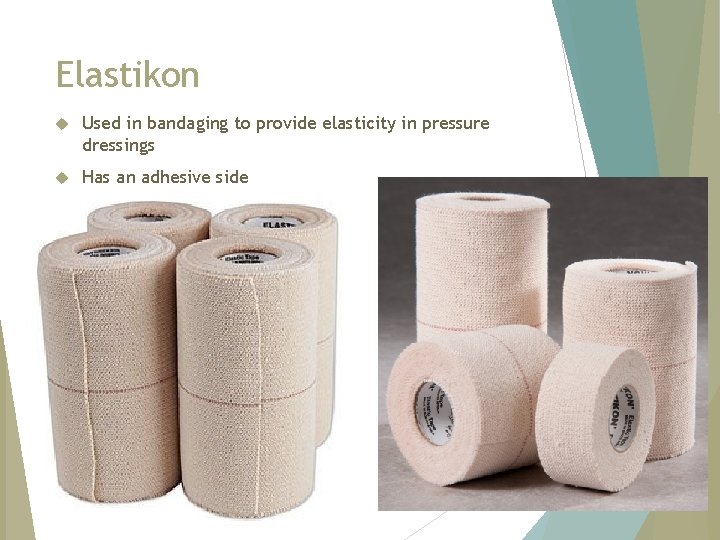
Elastikon Used in bandaging to provide elasticity in pressure dressings Has an adhesive side
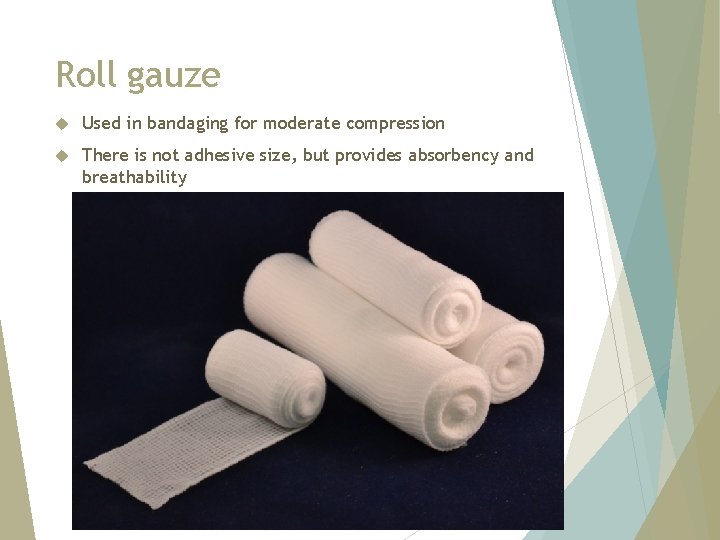
Roll gauze Used in bandaging for moderate compression There is not adhesive size, but provides absorbency and breathability
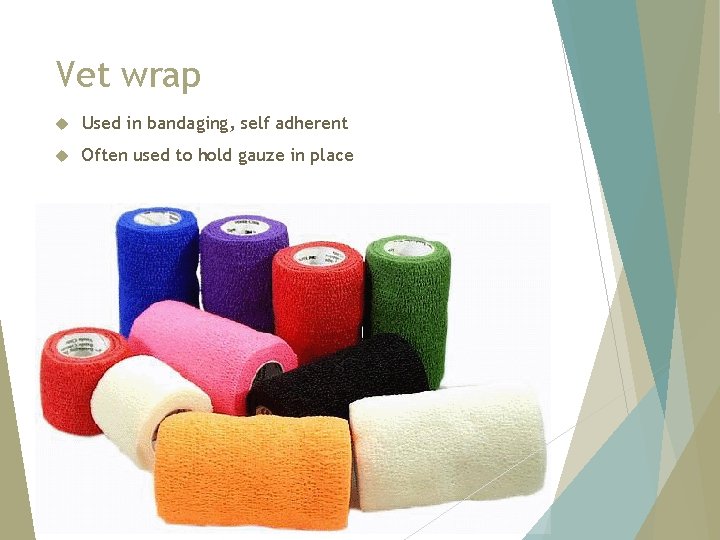
Vet wrap Used in bandaging, self adherent Often used to hold gauze in place
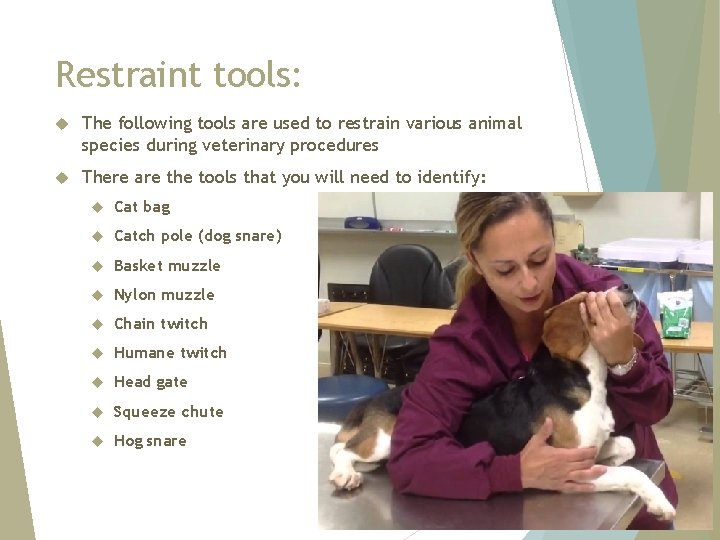
Restraint tools: The following tools are used to restrain various animal species during veterinary procedures There are the tools that you will need to identify: Cat bag Catch pole (dog snare) Basket muzzle Nylon muzzle Chain twitch Humane twitch Head gate Squeeze chute Hog snare
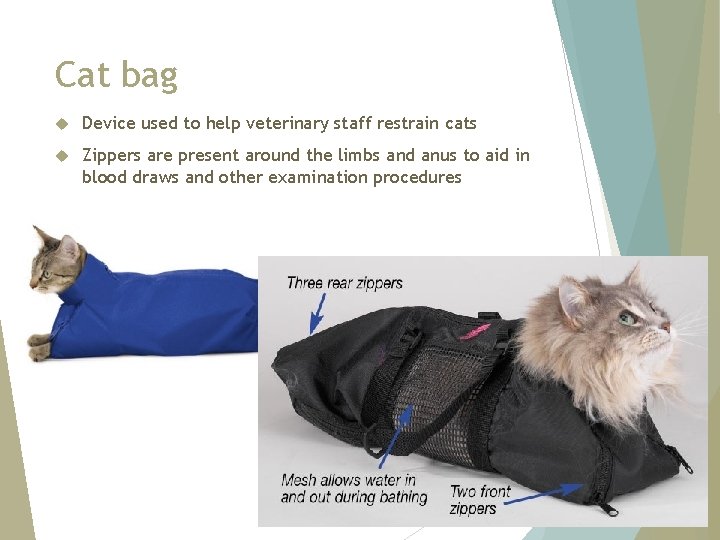
Cat bag Device used to help veterinary staff restrain cats Zippers are present around the limbs and anus to aid in blood draws and other examination procedures
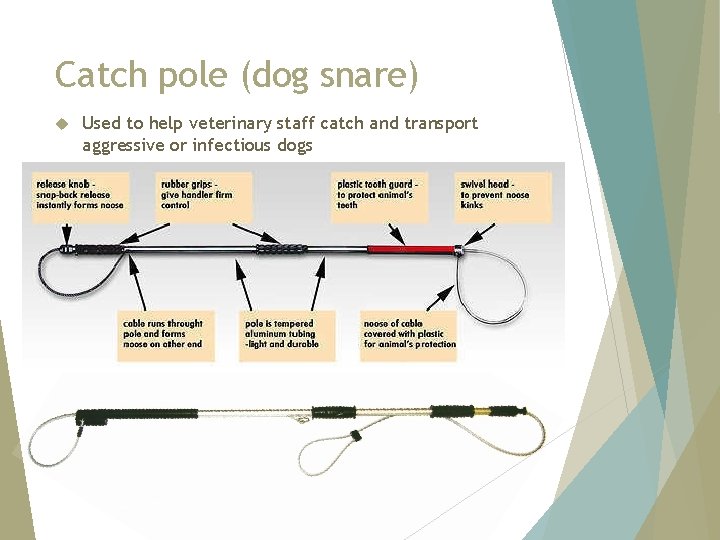
Catch pole (dog snare) Used to help veterinary staff catch and transport aggressive or infectious dogs
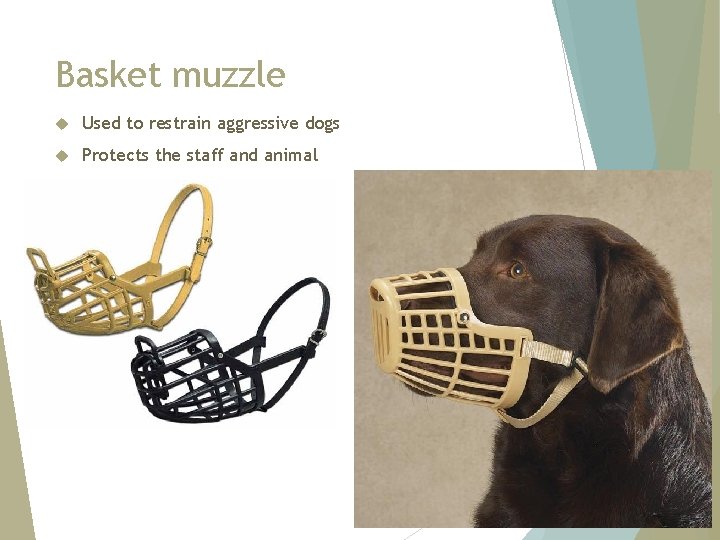
Basket muzzle Used to restrain aggressive dogs Protects the staff and animal
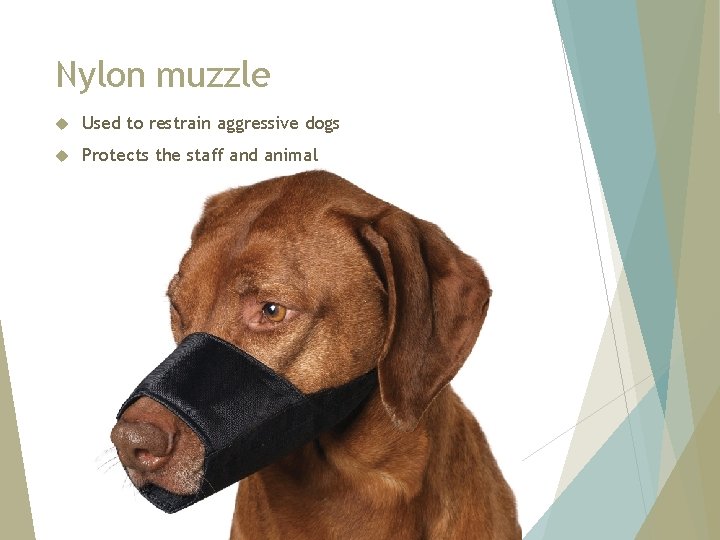
Nylon muzzle Used to restrain aggressive dogs Protects the staff and animal
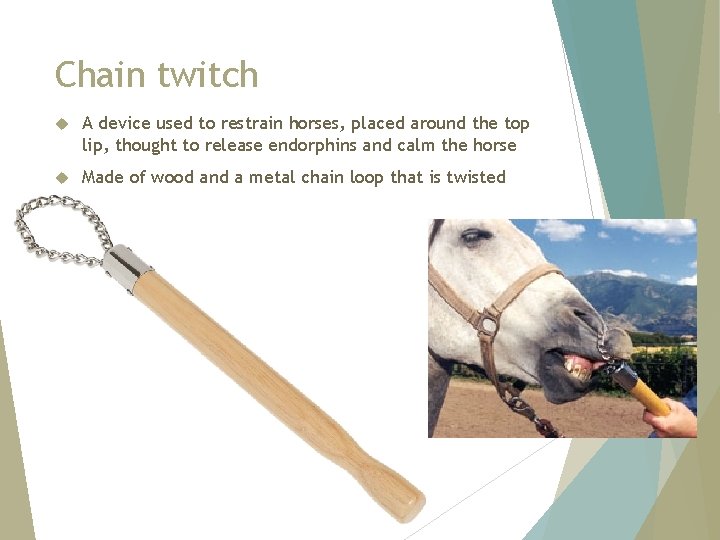
Chain twitch A device used to restrain horses, placed around the top lip, thought to release endorphins and calm the horse Made of wood and a metal chain loop that is twisted
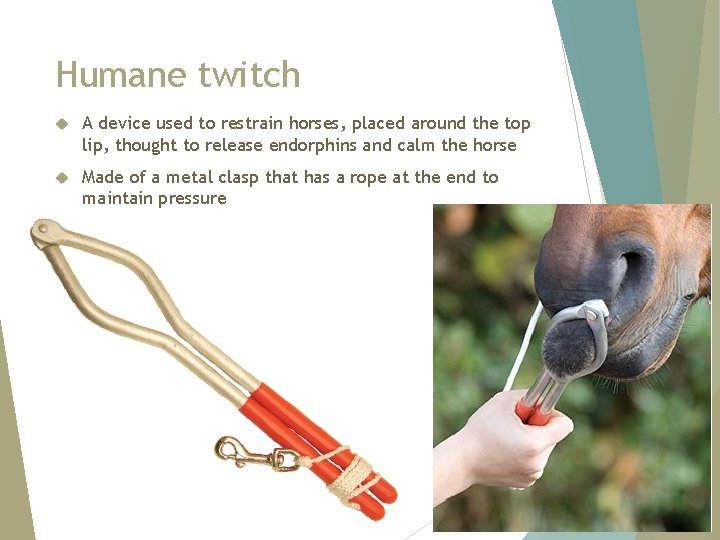
Humane twitch A device used to restrain horses, placed around the top lip, thought to release endorphins and calm the horse Made of a metal clasp that has a rope at the end to maintain pressure
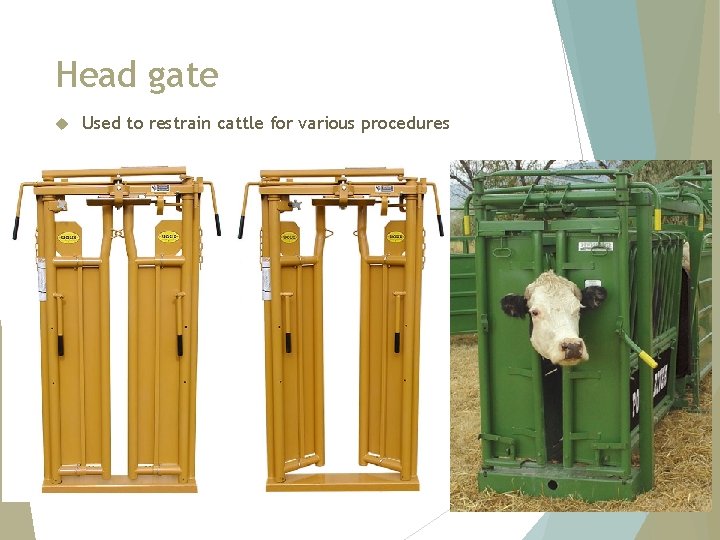
Head gate Used to restrain cattle for various procedures
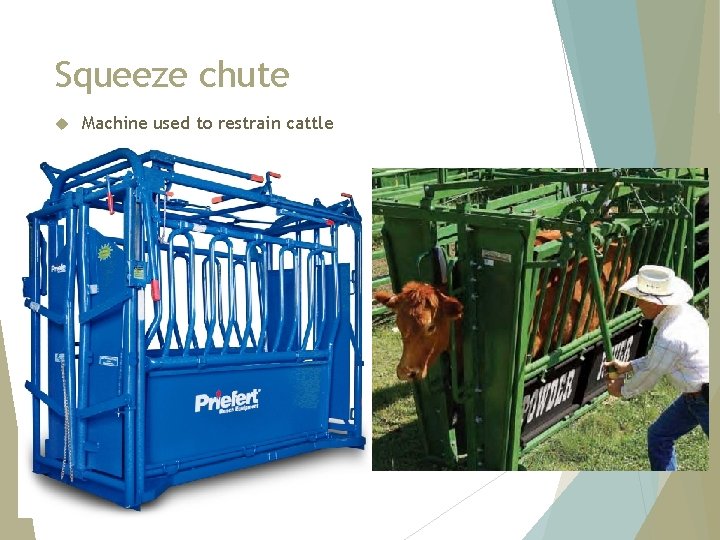
Squeeze chute Machine used to restrain cattle
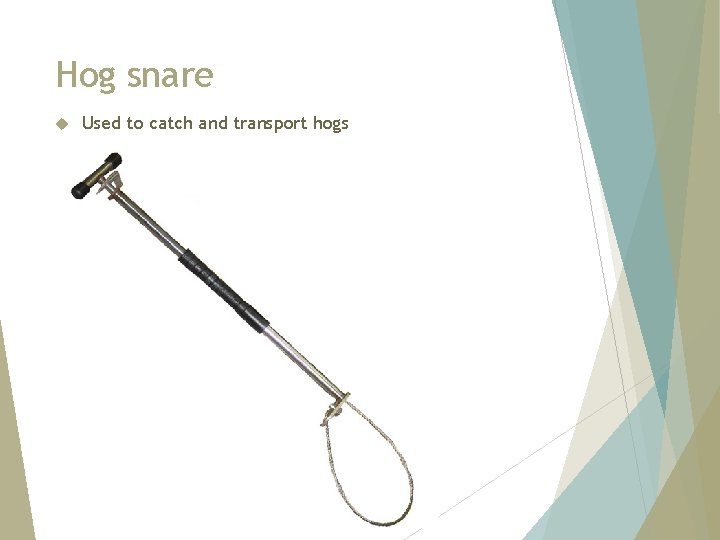
Hog snare Used to catch and transport hogs
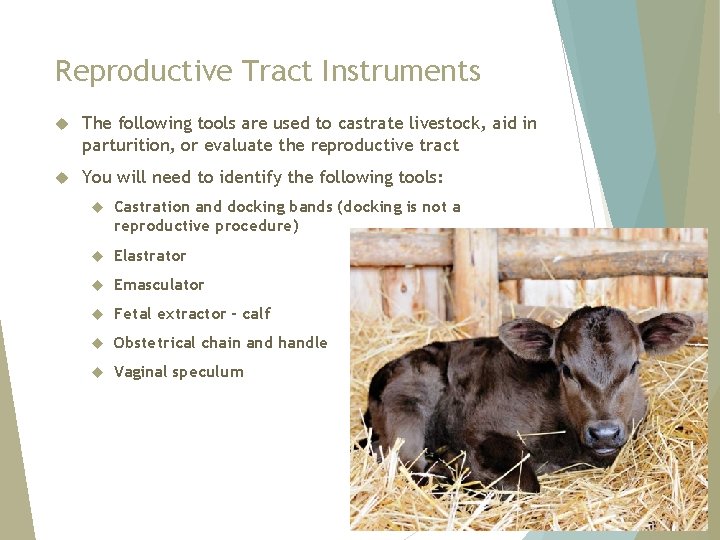
Reproductive Tract Instruments The following tools are used to castrate livestock, aid in parturition, or evaluate the reproductive tract You will need to identify the following tools: Castration and docking bands (docking is not a reproductive procedure) Elastrator Emasculator Fetal extractor - calf Obstetrical chain and handle Vaginal speculum
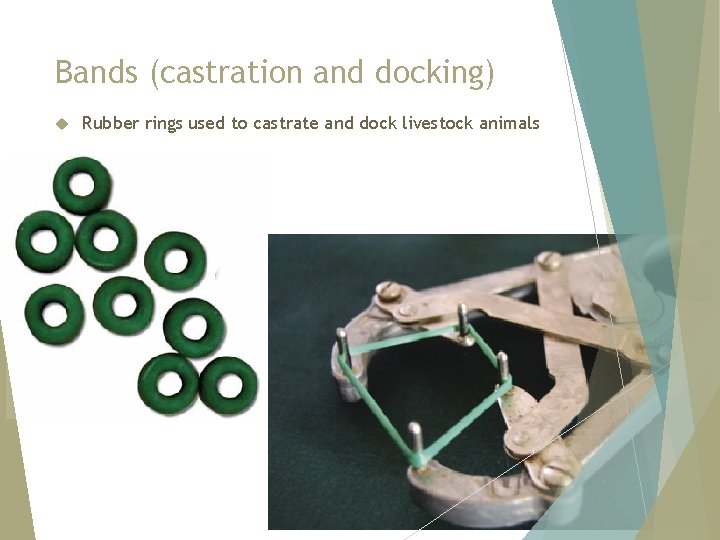
Bands (castration and docking) Rubber rings used to castrate and dock livestock animals
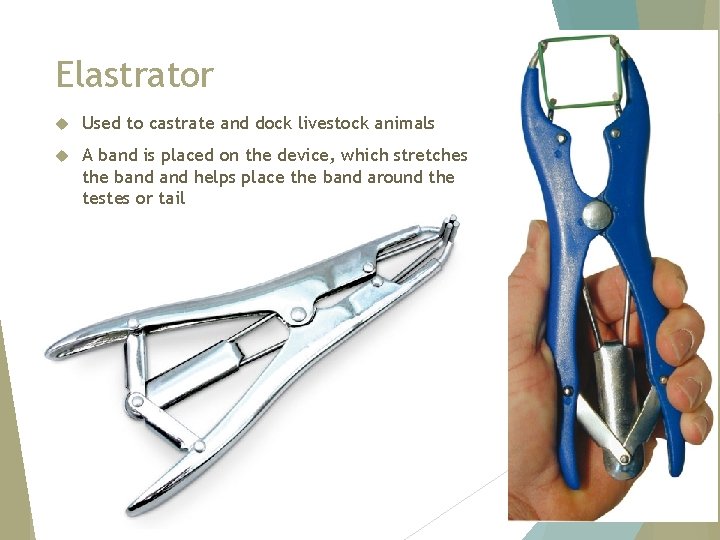
Elastrator Used to castrate and dock livestock animals A band is placed on the device, which stretches the band helps place the band around the testes or tail
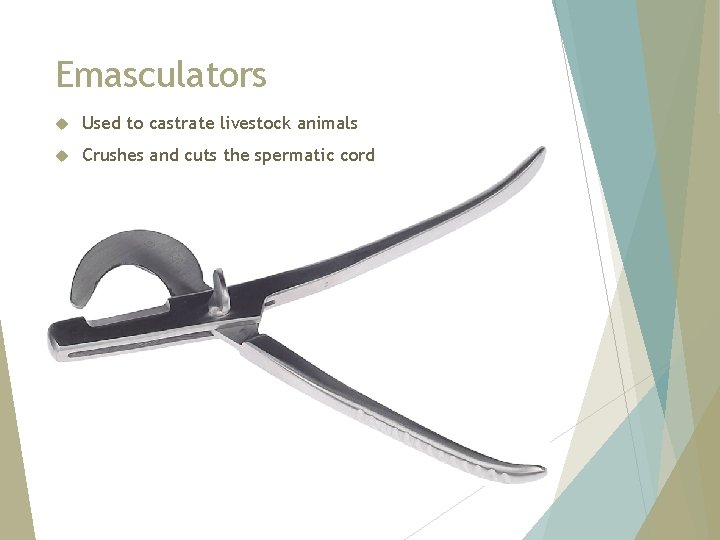
Emasculators Used to castrate livestock animals Crushes and cuts the spermatic cord
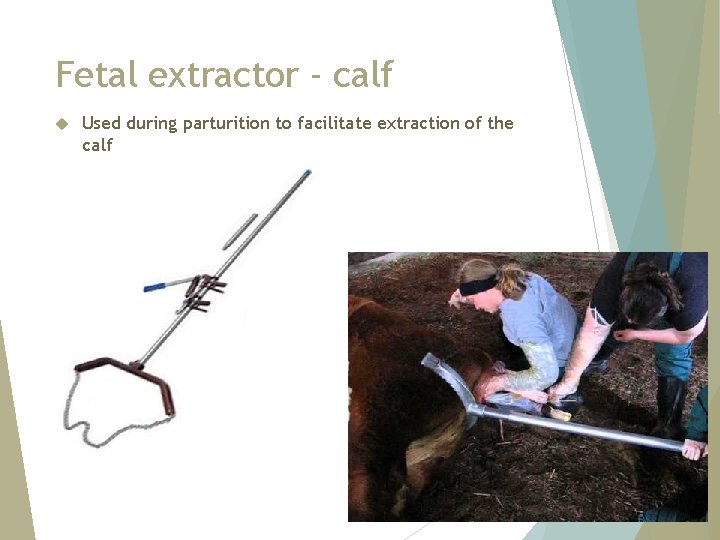
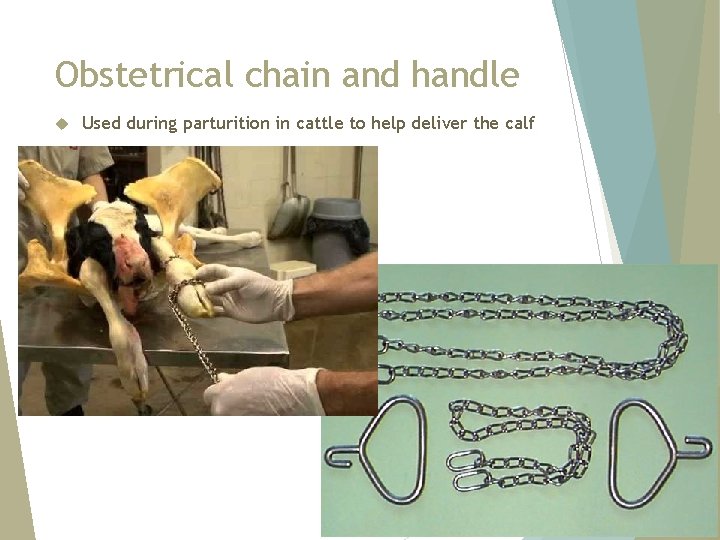
Fetal extractor - calf Used during parturition to facilitate extraction of the calf
Obstetrical chain and handle Used during parturition in cattle to help deliver the calf
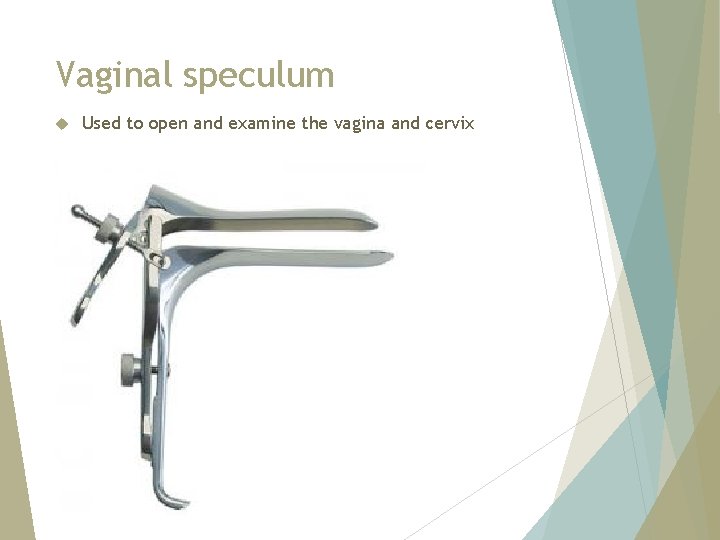
Vaginal speculum Used to open and examine the vagina and cervix
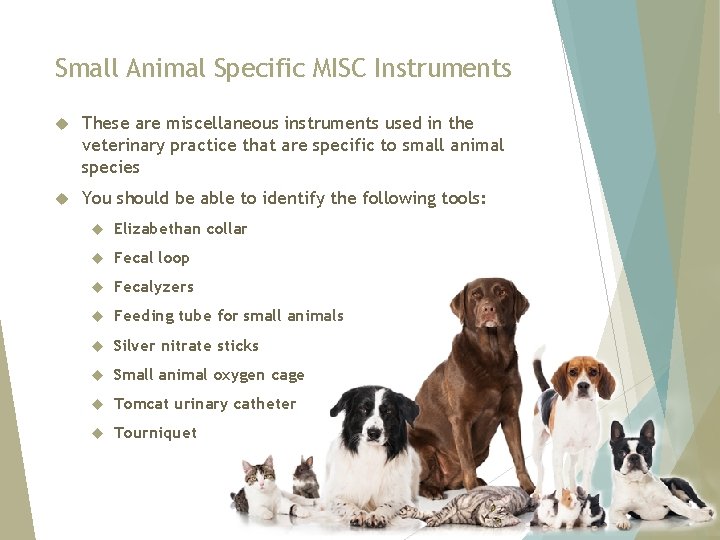
Small Animal Specific MISC Instruments These are miscellaneous instruments used in the veterinary practice that are specific to small animal species You should be able to identify the following tools: Elizabethan collar Fecal loop Fecalyzers Feeding tube for small animals Silver nitrate sticks Small animal oxygen cage Tomcat urinary catheter Tourniquet
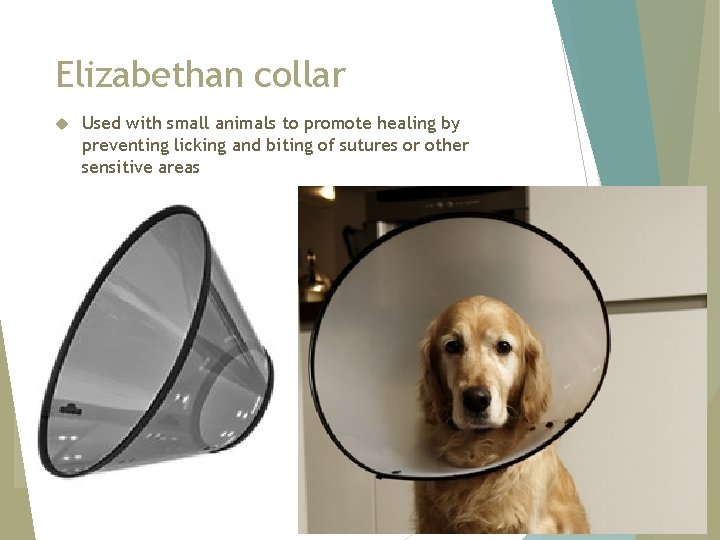
Elizabethan collar Used with small animals to promote healing by preventing licking and biting of sutures or other sensitive areas
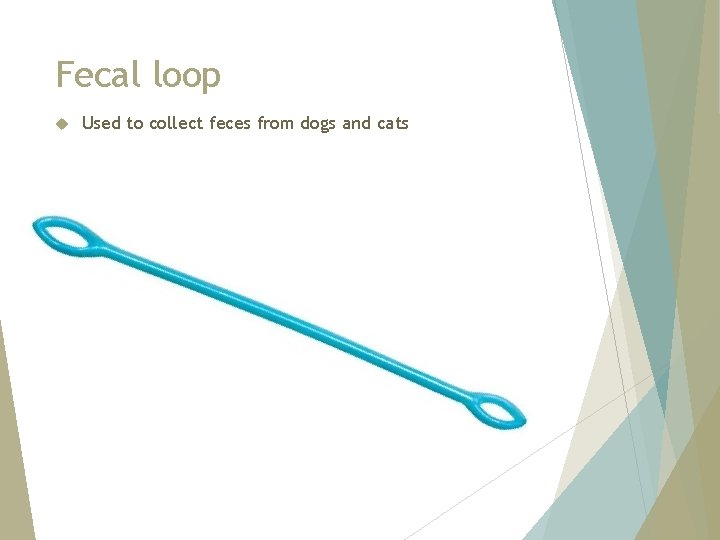
Fecal loop Used to collect feces from dogs and cats
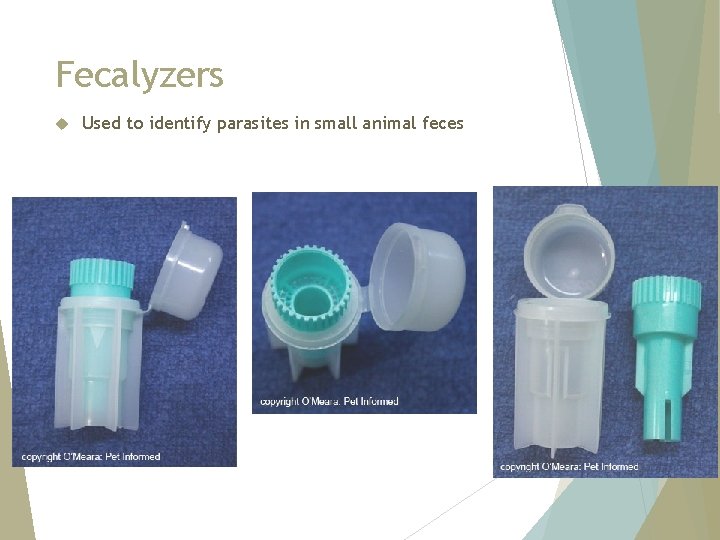
Fecalyzers Used to identify parasites in small animal feces
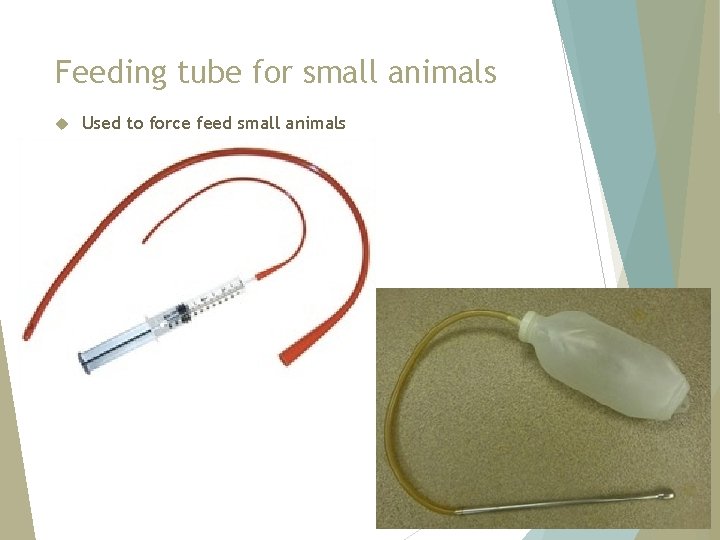
Feeding tube for small animals Used to force feed small animals
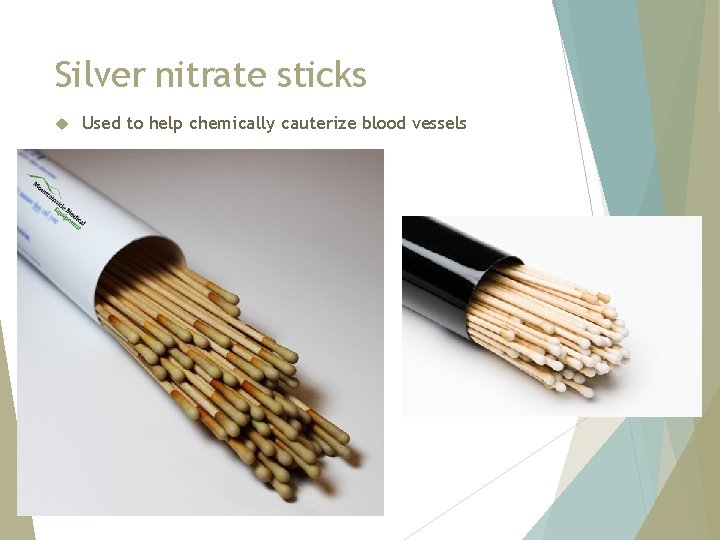
Silver nitrate sticks Used to help chemically cauterize blood vessels
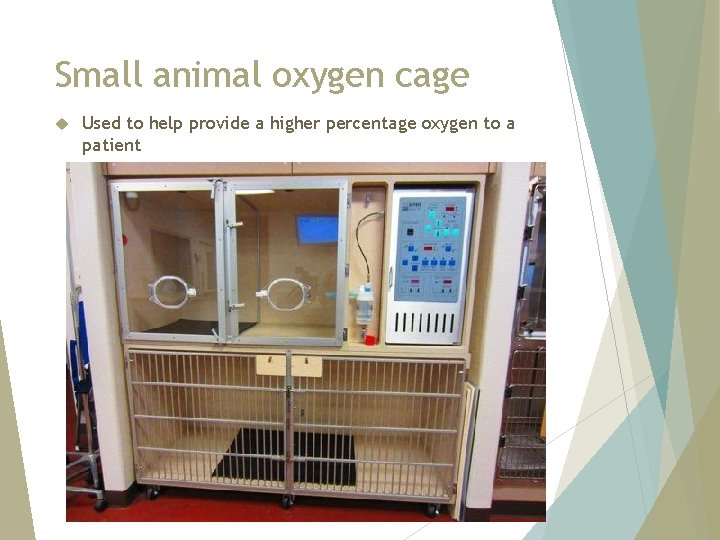
Small animal oxygen cage Used to help provide a higher percentage oxygen to a patient
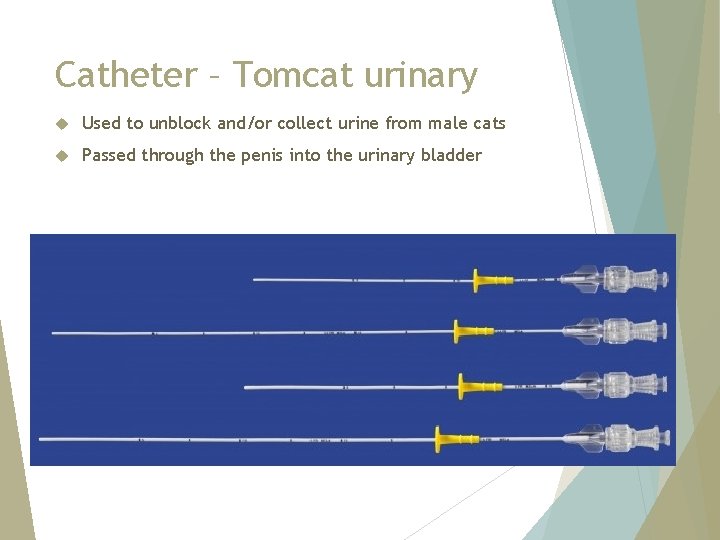
Catheter – Tomcat urinary Used to unblock and/or collect urine from male cats Passed through the penis into the urinary bladder
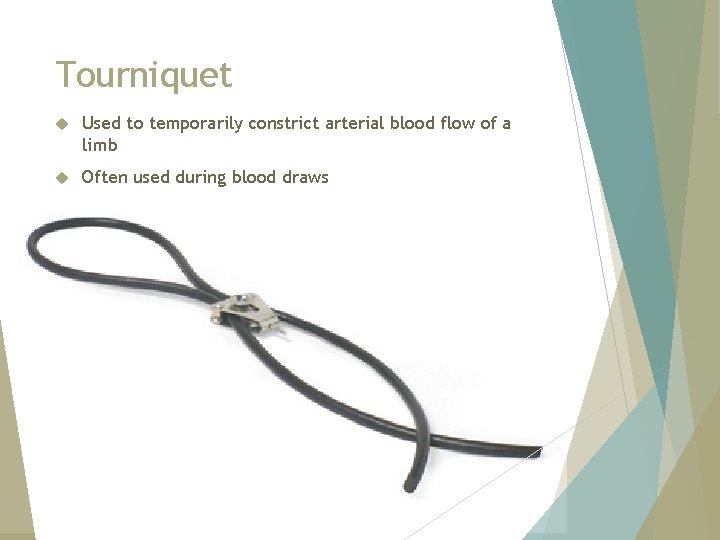
Tourniquet Used to temporarily constrict arterial blood flow of a limb Often used during blood draws
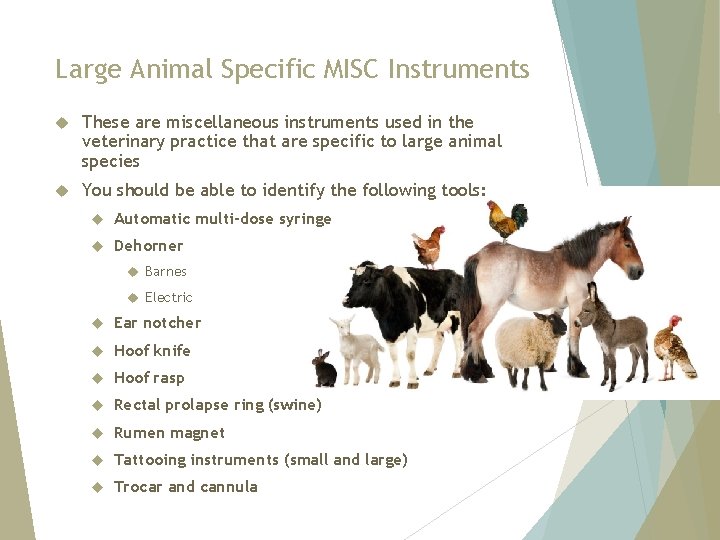
Large Animal Specific MISC Instruments These are miscellaneous instruments used in the veterinary practice that are specific to large animal species You should be able to identify the following tools: Automatic multi-dose syringe Dehorner Barnes Electric Ear notcher Hoof knife Hoof rasp Rectal prolapse ring (swine) Rumen magnet Tattooing instruments (small and large) Trocar and cannula
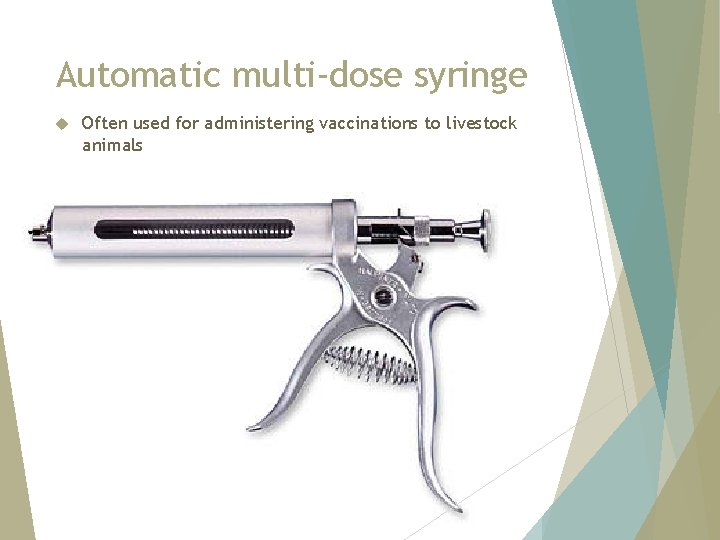
Automatic multi-dose syringe Often used for administering vaccinations to livestock animals
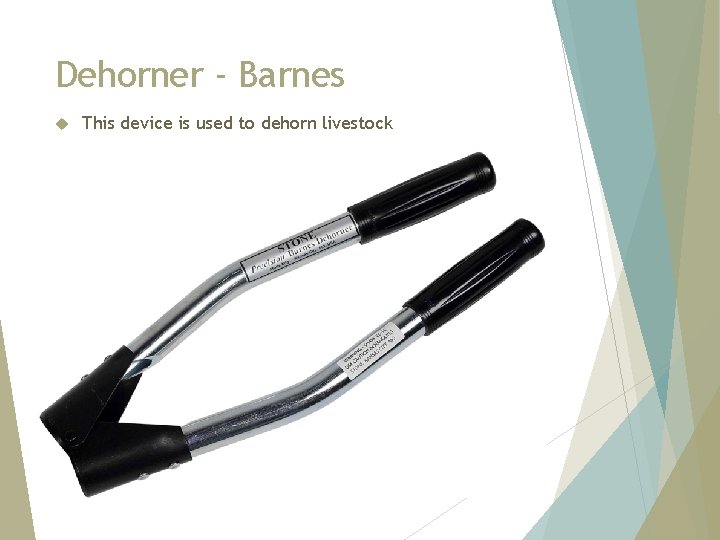
Dehorner - Barnes This device is used to dehorn livestock
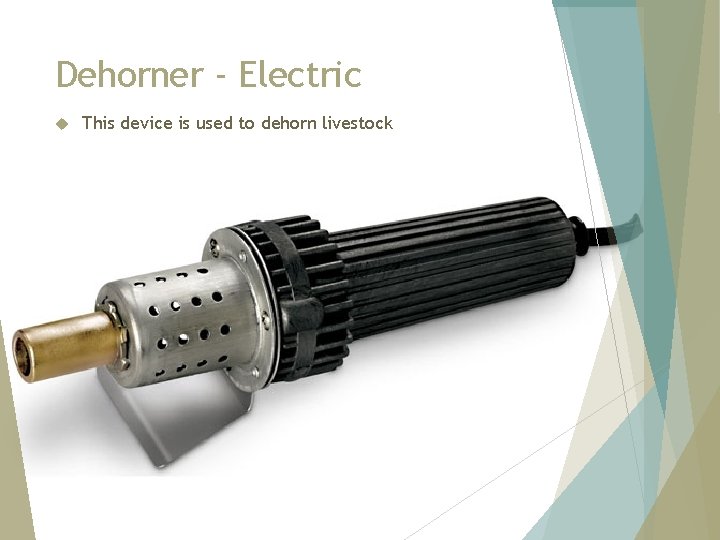
Dehorner - Electric This device is used to dehorn livestock
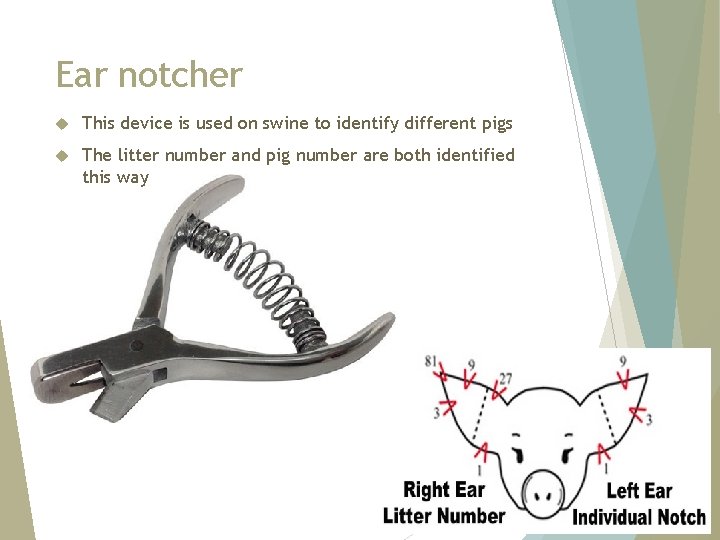
Ear notcher This device is used on swine to identify different pigs The litter number and pig number are both identified this way
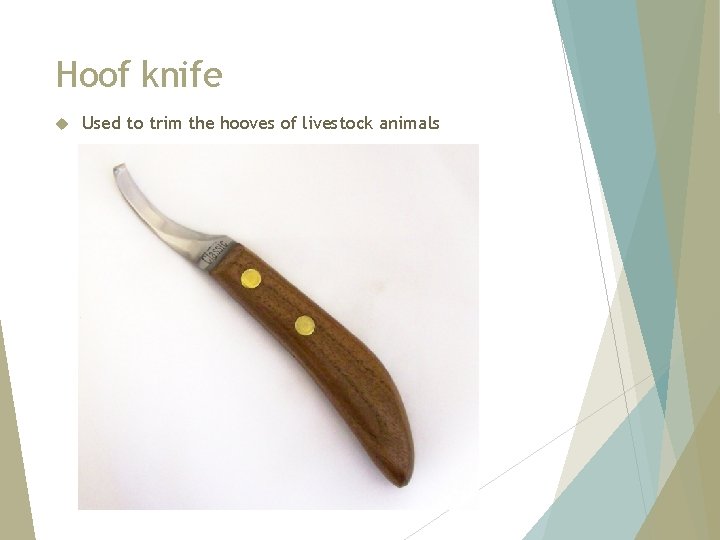
Hoof knife Used to trim the hooves of livestock animals
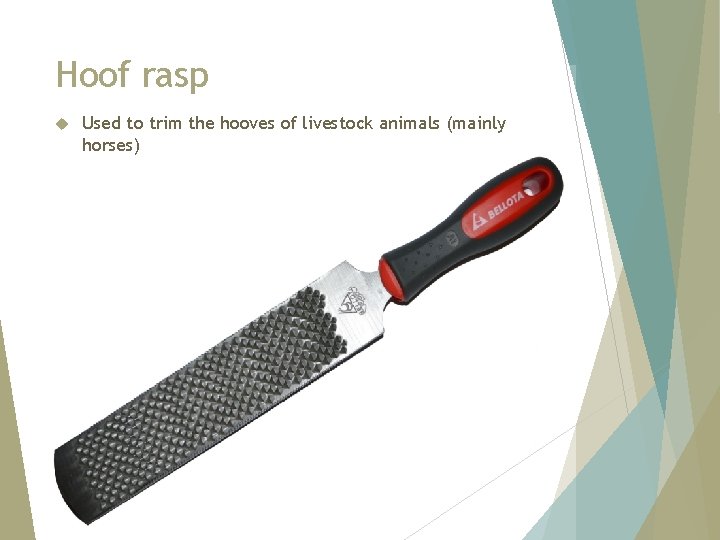
Hoof rasp Used to trim the hooves of livestock animals (mainly horses)
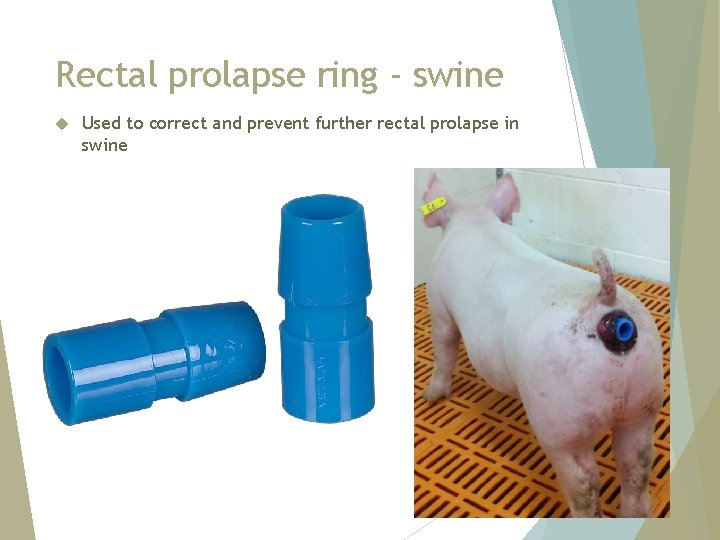
Rectal prolapse ring - swine Used to correct and prevent further rectal prolapse in swine
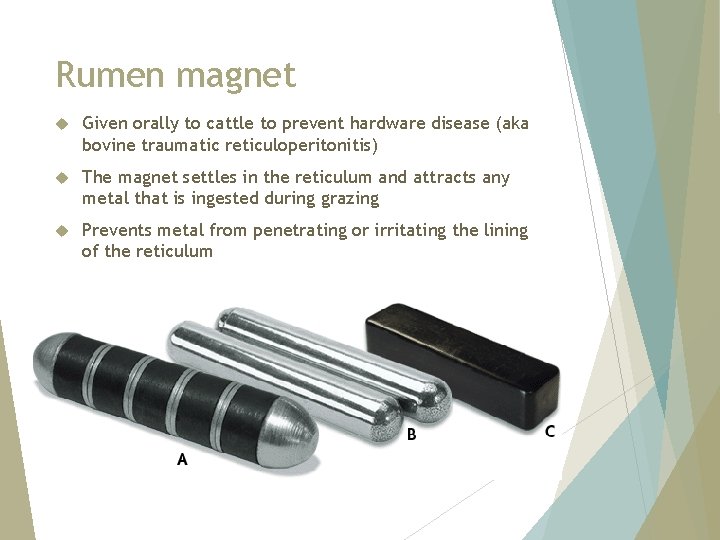
Rumen magnet Given orally to cattle to prevent hardware disease (aka bovine traumatic reticuloperitonitis) The magnet settles in the reticulum and attracts any metal that is ingested during grazing Prevents metal from penetrating or irritating the lining of the reticulum
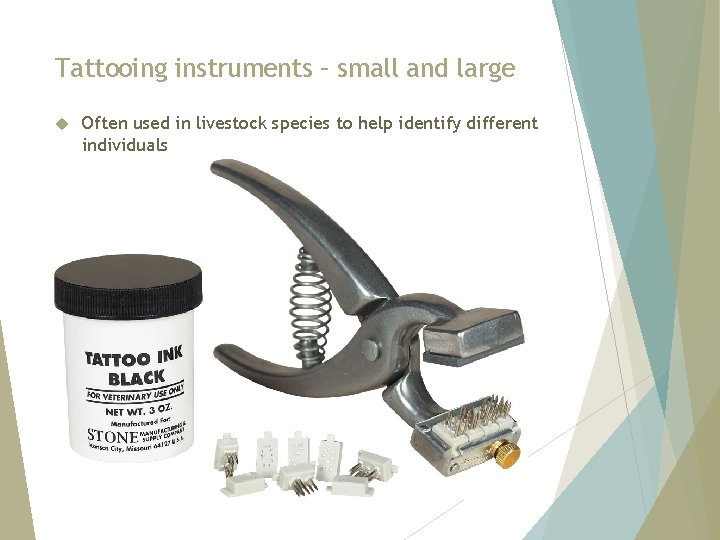
Tattooing instruments – small and large Often used in livestock species to help identify different individuals
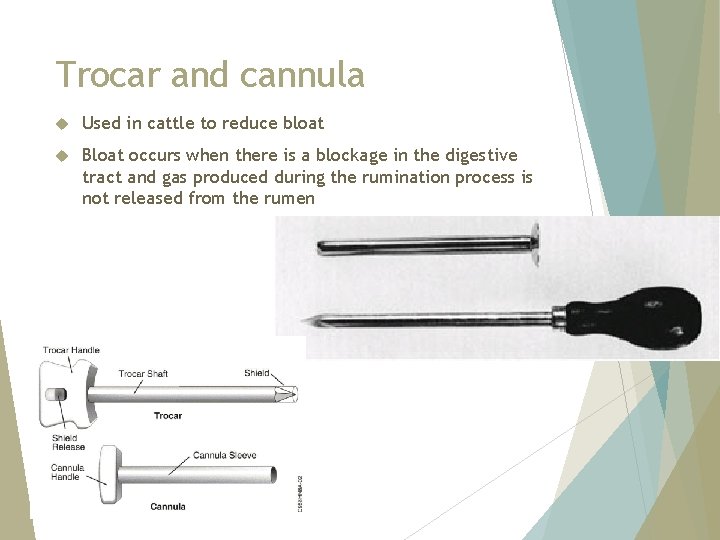
Trocar and cannula Used in cattle to reduce bloat Bloat occurs when there is a blockage in the digestive tract and gas produced during the rumination process is not released from the rumen
Veterinary Practice MISC These are tools that you will find in the veterinary Tools practice that are not associated with any other category that we have discussed so far You should be able to identify the following tools: Ambubag Gravity feeder/J tube Radiology personal protective equipment
Ambubag This is a hand-held device that is used to provide ventilation and oxygen to patients who are not breathing or not breathing adequately
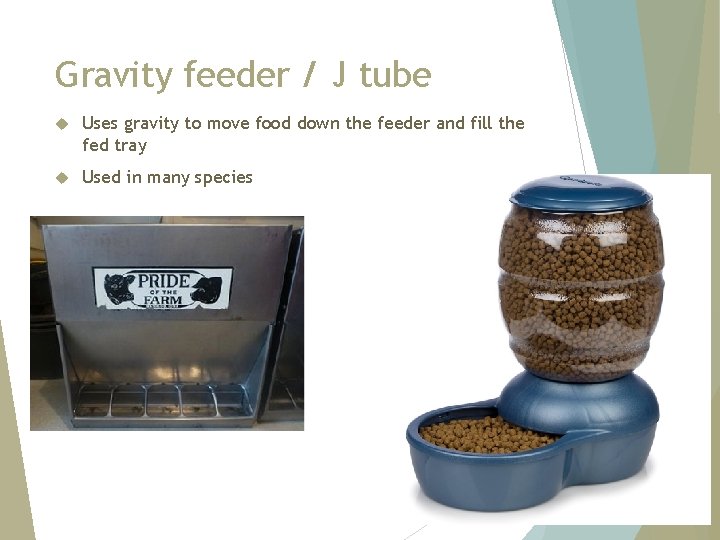
Gravity feeder / J tube Uses gravity to move food down the feeder and fill the fed tray Used in many species
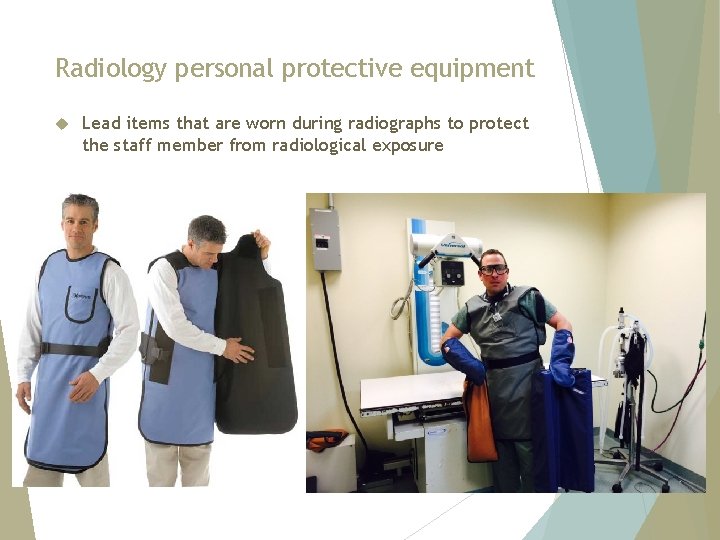
Radiology personal protective equipment Lead items that are worn during radiographs to protect the staff member from radiological exposure