Overview Outcomes of the National Environmental Education Action

- Slides: 18
Overview & Outcomes of the National Environmental Education Action Plan (NEEAP 1992 -2002) Merle C. Tan National Institute for Science & Mathematics Education Development University of the Philippines
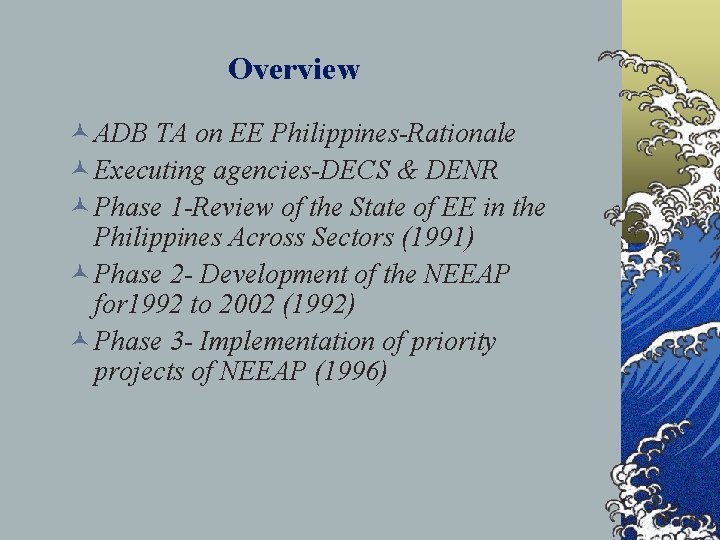
Overview © ADB TA on EE Philippines-Rationale © Executing agencies-DECS & DENR © Phase 1 -Review of the State of EE in the Philippines Across Sectors (1991) © Phase 2 - Development of the NEEAP for 1992 to 2002 (1992) © Phase 3 - Implementation of priority projects of NEEAP (1996)
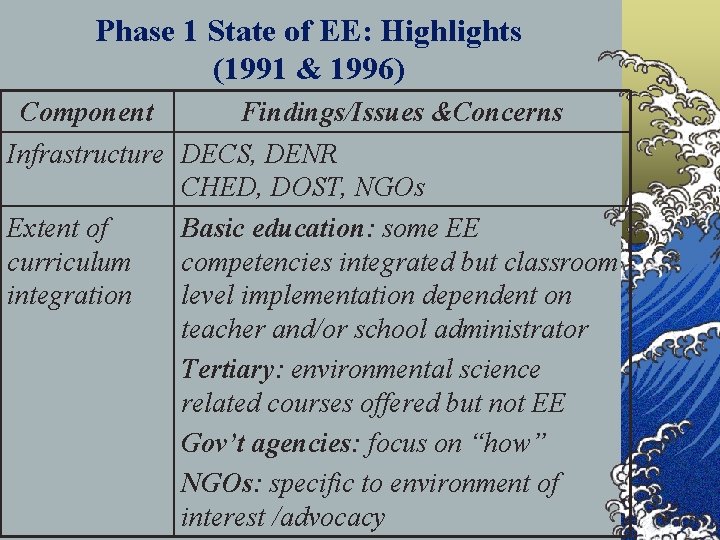
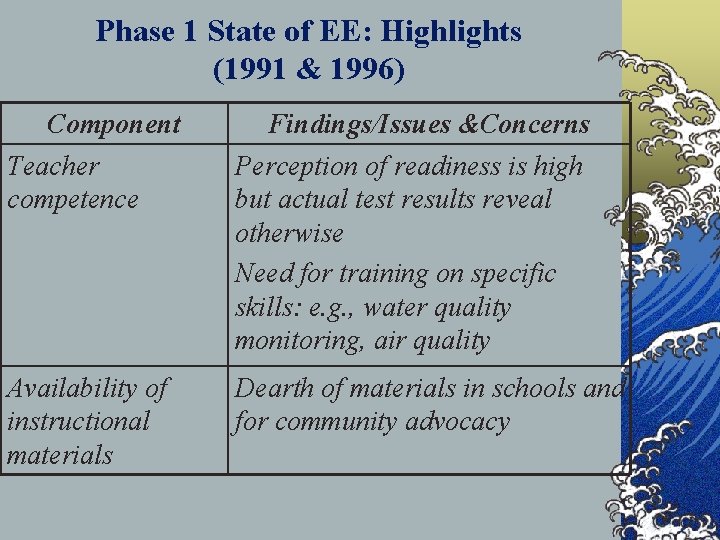
Phase 1 State of EE: Highlights (1991 & 1996) Component Findings/Issues &Concerns Infrastructure DECS, DENR CHED, DOST, NGOs Extent of Basic education: some EE curriculum competencies integrated but classroom integration level implementation dependent on teacher and/or school administrator Tertiary: environmental science related courses offered but not EE Gov’t agencies: focus on “how” NGOs: specific to environment of interest /advocacy
Phase 1 State of EE: Highlights (1991 & 1996) Component Teacher competence Findings/Issues &Concerns Perception of readiness is high but actual test results reveal otherwise Need for training on specific skills: e. g. , water quality monitoring, air quality Availability of instructional materials Dearth of materials in schools and for community advocacy
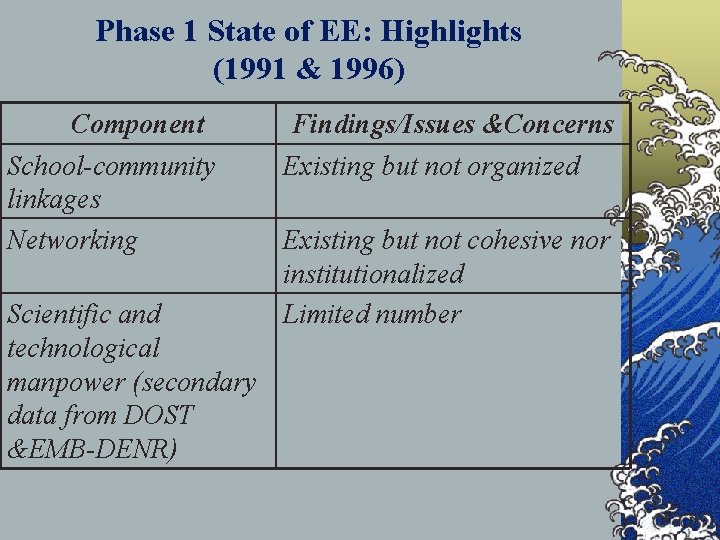
Phase 1 State of EE: Highlights (1991 & 1996) Component School-community linkages Networking Scientific and technological manpower (secondary data from DOST &EMB-DENR) Findings/Issues &Concerns Existing but not organized Existing but not cohesive nor institutionalized Limited number
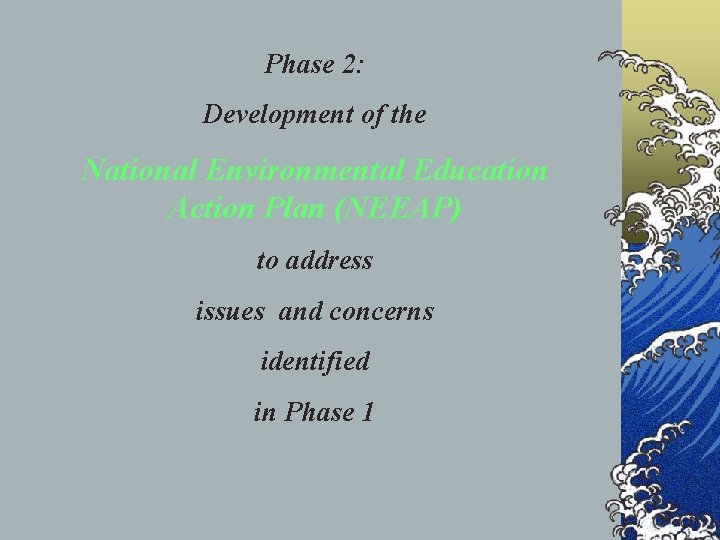
Phase 2: Development of the National Environmental Education Action Plan (NEEAP) to address issues and concerns identified in Phase 1
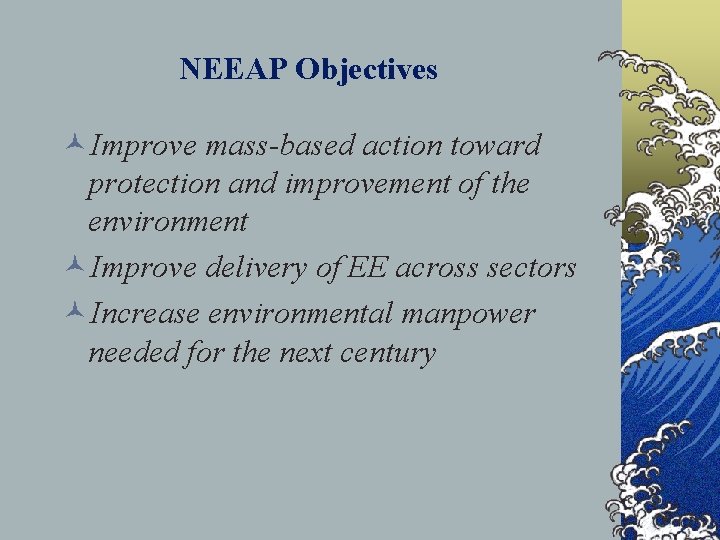
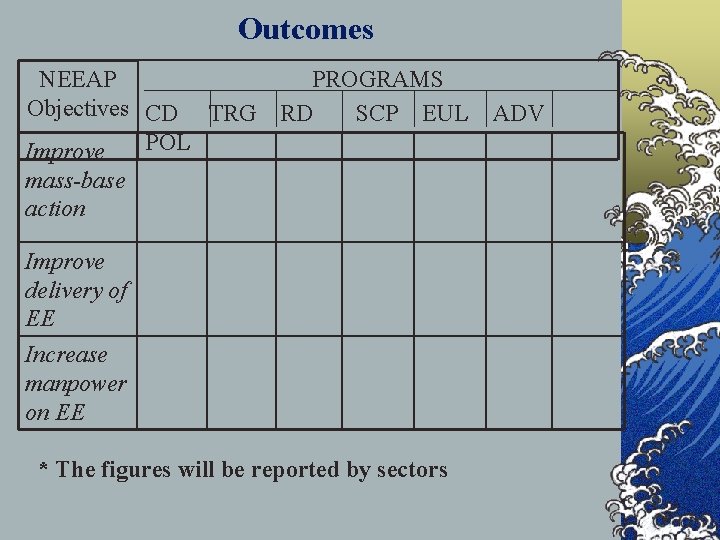
NEEAP Objectives ©Improve mass-based action toward protection and improvement of the environment ©Improve delivery of EE across sectors ©Increase environmental manpower needed for the next century
NEEAP Major Areas ©Curriculum Development ©Training ©Research & Development ©Scholarships ©Equipment Upgrading and Lending ©Information Education and Advocacy ©Policy Reforms
Phase 3 Projects ©Development of an EE curriculum guide/framework ©Preparation of exemplar instructional materials (e. g. , lesson plans) ©Development of support print and nonprint instructional materials (e. g. , videotapes, posters, story books) ©Design for a teacher training program in basic education
The EE Curriculum Guide Chapter 1: EE Basic Concepts and Guidelines § Components of the Environment § What is EE § EE Objectives § Guiding Principles for EE programs
The EE Curriculum Guide Chapter 3: Designing the EE Curriculum § Stages in Curriculum Developmentneeds assessment, decision making and integration § Emphases Across Grade Levels or Years § Characteristics of Learners-What These Mean for EE § Scope and Sequence
The EE Curriculum Guide Chapter 4: Implementing the EE Curriculum § Modes of Integration § Whole School Responsibilities
The EE Curriculum Guide Chapter 5: Teaching and Learning Strategies ©Learning about the environment ©Acquiring investigation skills ©Developing desirable attitudes and values of the environment ©Communicating KSAP
The EE Curriculum Guide Chapter 6: Assessing KSAP § Cognitive skills § Affective skills § Manipulative skills
The EE Curriculum Guide Chapter 7: Evaluating EE Programs § The Green Audit
Outcomes NEEAP Objectives CD TRG POL Improve PROGRAMS RD SCP EUL mass-base action Improve delivery of EE Increase manpower on EE * The figures will be reported by sectors ADV
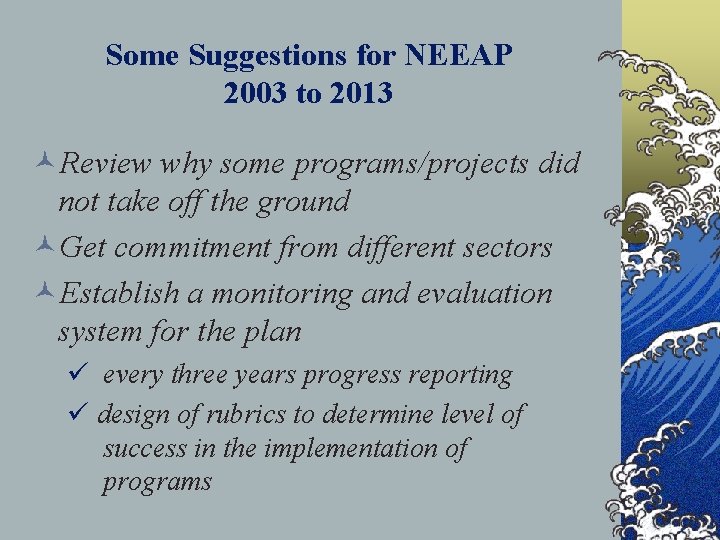
Some Suggestions for NEEAP 2003 to 2013 ©Review why some programs/projects did not take off the ground ©Get commitment from different sectors ©Establish a monitoring and evaluation system for the plan ü every three years progress reporting ü design of rubrics to determine level of success in the implementation of programs