New Pathway for Management Studies in China Exploring











- Slides: 88
New Pathway for Management Studies in China: Exploring Qualitative Research Methods of Business Anthropology Dr. Tian Guang Director of Business Anthropology Institute School of Business, Shantou University 汕头大学商学院——功在商道,心达寰宇
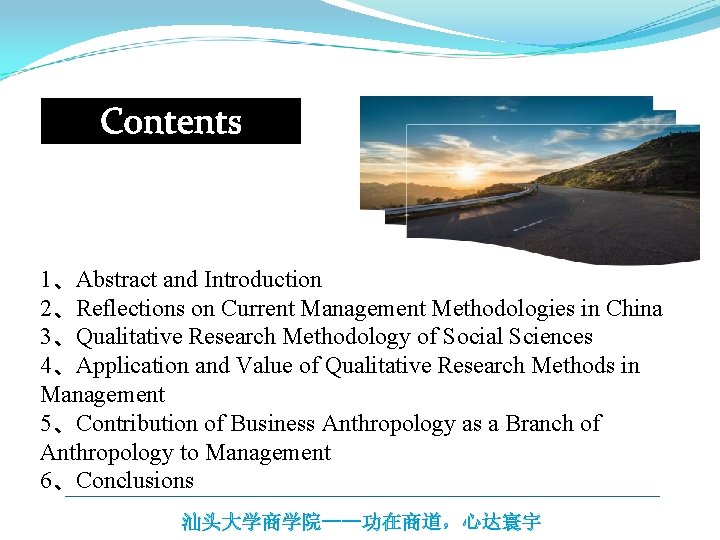
Contents 1、Abstract and Introduction 2、Reflections on Current Management Methodologies in China 3、Qualitative Research Methodology of Social Sciences 4、Application and Value of Qualitative Research Methods in Management 5、Contribution of Business Anthropology as a Branch of Anthropology to Management 6、Conclusions 汕头大学商学院——功在商道,心达寰宇
Abstract and Introduction: Purpose of this workshop Through an inventory of the existing literature body on the Chinese management studies, this workshop attempts to present a critic review on the phenomenon that the management studies in contemporary China over relies on quantitative research methodology. The workshop endeavors to demonstrate that the nature of scientific research is to innovate by seeking truth and therefore should not be restricted by research methods, let alone quantitative methods. In order to improve the effectiveness of academic researches, the workshop will help the scholars in China positively adopt the anthropological methodologies to conduct management studies and to enhance the process of the localization of management science in the country.
Abstract and Introduction: Design and approach It is designed to broaden the approaches toward Chinese management studies by introducing business anthropological methods to the Chinese management scholars. It adopts a comparative and case study methodology to demonstrate the limitations of quantitative methods and to illustrate the effectiveness of business anthropological approaches for management studies in the Chinese context.
Abstract and Introduction: Principal ideas and arguments The existing literature body demonstrates that excessive amounts of quantitative research approaches are utilized in current management studies while the effectiveness of qualitative methods are largely ignored by the scholars in China. The necessity for further understanding of qualitative research methods in management studies has been recognized more recently by the Chinese scholars who tend to agree that qualitative and quantitative research methodologies are simply different in approaches, while the results are the same. One of effective new paths of improving management studies and management practices is to apply anthropological research methods so that management theory in China can better explain actual human responses and factors that influence their behaviors.
Abstract and Introduction: Practical implications Anthropology has always been employed for practical applications. Anthropological methods can enlarge the approaches to the management studies and widen the scope for scholars to conduct their research. The combination of anthropology and management will accelerate the localization of management studies and accordingly speed up systematically establishing the Chinese management theory to promote the management practices in modern China.
Abstract and Introduction: Originality Business anthropology is emerging among a number of outstanding qualitative research methods of Western management studies. China’s management science community on the other hand is still a little behind in this respect. Our workshop is one of the pilot programs to elaborate on business anthropology as well as its contribution to specific areas in management studies, such as marketing management, product design and entrepreneurship in the Chinese context.
Abstract and Introduction With over three decades of development, management is no longer exotic in China, and Chinese management scholars are no longer solely satisfied with the application of Western management theory in China’s management practices. What China requires is management originating from home, developed at home and applicable to home, which is not only an expectation but also a requirement. Over three decades of experience has revealed that based on its own institutional environment, Western management theory is closely related to its political, economic and cultural background, and theory and methods of which are not “localized” to China. 汕头大学商学院——功在商道,心达寰宇
Abstract and Introduction China has accumulated sufficient practical experience in management and the survival and development environment for Chinese enterprises, which are different from those of Western countries. The reality requires management researchers in China to contemplate and explore social science attributes of management science. The paths and approaches of management research may differ depending on culture, and to a large extent, there is a significant difference in the rules and practices of management due to cultural diversity. 汕头大学商学院——功在商道,心达寰宇
Abstract and Introduction Qualitative research and quantitative research are merely different in approaches, while the results are the same. Appropriate research methods should be adopted in accordance with specific research backgrounds because both quantitative and qualitative methods provide assistance for research contents and objectives. The essence of scientific research is innovation and its principle is to eliminate the false and retain the true. Only with more excellent research and more widely accepted target of research can we offer greater contributions to the development of academic research. 汕头大学商学院——功在商道,心达寰宇
Abstract and Introduction Chinese scholars argue that it is not difficult to discover the true reason for the weakness of qualitative research after review, because it is lack of formal classic qualitative methodological theory and paradigm in the Chinese management academia. A number of qualitative research methods are applied maturely in Western social sciences and management studies, which definitely provide a paradigm for the research of qualitative methodology in China while considering new subjects of research. 汕头大学商学院——功在商道,心达寰宇
Abstract and Introduction As a branch of applied anthropology, business anthropology is emerging among a number of outstanding qualitative research methods of Western management research. The management studies and management practices need to take the perspective and methodology of business anthropology, because it can contribute to specific areas in management research, such as marketing, product design and entrepreneurship. Furthermore, the outlet for development of management in China ultimately lies in the exploration of new paths of localization based on the national conditions within China, for which business anthropology can make its contribution. 汕头大学商学院——功在商道,心达寰宇
Current Management Research in China Excessive amounts of quantitative research approaches such as quantitative modeling and econometric testing are utilized in current management research in China. More than 400 papers in Chinese and English were selected during the 4 th International Association for Chinese Management Research (IACMR) (authors are authorities in China’s management academia) and over 90% of which employ quantitative modeling. I directed students randomly selected 500 papers among 30 of the most important academic journals in management science in 2014. It was also found that nearly 90% of them focus on quantitative modeling and econometric tests.
Current Management Research in China American management academia has passed through the myth stage when only scientific empirical research papers accepted. Now American scholars focus more on the analysis of cultural background and social environment while also advocating for appropriate usage of computing and mathematical modeling in management research and management practices throughout a dynamic evolution of exploring subject rigor and practice correlation. It is undoubtedly a pity that China continues to repeat the mistake of American management academia in this respect with the historical background of quantitative research methods replacing research innovation during research on management and management practices in the United States.
Current Management Research in China A major reason for preference for econometric models and statistical computing is that quantitative analysis approaches are the death strike for papers with little substance and knowledge innovation and are also the top choice of academic journals short of profound insights to avoid criticism. The loss of current management research methodologies in China results from eagerness for quick success and instant benefits. Quantitative modeling analysis is a “latent rule”, as well as a permit for academic exploration. The practice, however, fully breaks from the original objectives and values of research. The method serves research contents, and content innovation is precisely the essence of research.
Current Management Research in China Starting from the historical origin of the school of management in Chinese universities, some scholars attribute the “natural” preference for quantitative research to the drawback of establishing school of management based on the tradition of engineering colleges. Those management scholars, however, who exclusively prefer quantitative research might forget the essence of management is human behavior. Management according to them is likely to descend to digital games.
Current Management Research in China Research methods should not be regarded as the sole criterion for determining research quality. Good research should be innovative with the false eliminated and the truth retained. The essence is to be innovative, and the principle is to eliminate the false and retain the true. Only through innovation can mediocre thoughts be avoided and prevented.
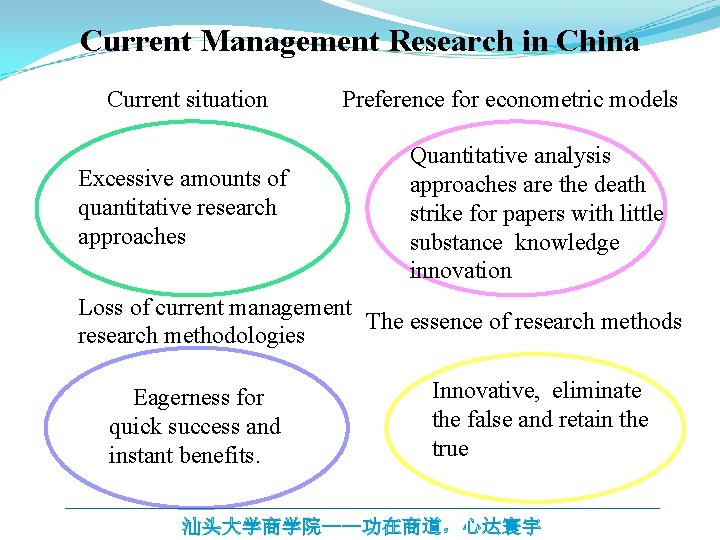
Current Management Research in China Current situation Excessive amounts of quantitative research approaches Preference for econometric models Quantitative analysis approaches are the death strike for papers with little substance knowledge innovation Loss of current management The essence of research methods research methodologies Eagerness for quick success and instant benefits. Innovative, eliminate the false and retain the true 汕头大学商学院——功在商道,心达寰宇
Qualitative Research Methodology of Social Sciences Qualitative research and quantitative research are two means to achieve the same goal. This goal is to investigate the essence of the same matter from different perspectives, at different levels and through different modes of operation. A comprehensive and deep understanding of matters can be realized for qualitative research through long-term in-depth experience, investigation and analysis throughout the interaction between researchers and research subjects. For quantitative research, on the other hand, the comprehensive and deep understanding of matters is achieved through measurement and computation of quantifiable content and analysis of correlation between variables.
Qualitative Research Methodology of Social Sciences Most arguments about “quantitative” and “qualitative” research in fact extend from literal interpretation to actual operation. Various methods should be employed according to actual research however simple or complex the research contents and paradigms happen to be. The root of the differences is that researchers in favor of quantitative methods regard themselves as simply trying to understand interpret objective laws and social phenomenon, while not intervening nor influencing targets of research. Researchers in favor of qualitative methods, on the other hand, place themselves and targets of research under the same umbrella, learning and experiencing acts, values, moral standards, customs and cultural forms.
Qualitative Research Methodology of Social Sciences For social sciences research in particular, the involvement of researchers in targets of research is a long-term and painstaking processes as if reeling silk from cocoons. This workshop will not go into details, but focus on qualitative research methods in view of a strong preference for quantitative research methods in domestic management research and scholarly recognition. Classical quantitative research methods primarily include: phenomenology, grounded theory, ethnography, and critical incident method.
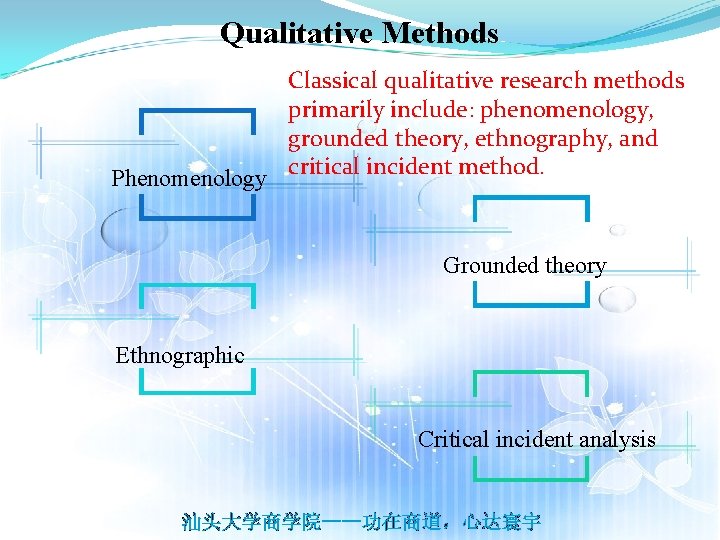
Qualitative Methods Classical qualitative research methods primarily include: phenomenology, grounded theory, ethnography, and Phenomenology critical incident method. Grounded theory Ethnographic Critical incident analysis 汕头大学商学院——功在商道,心达寰宇
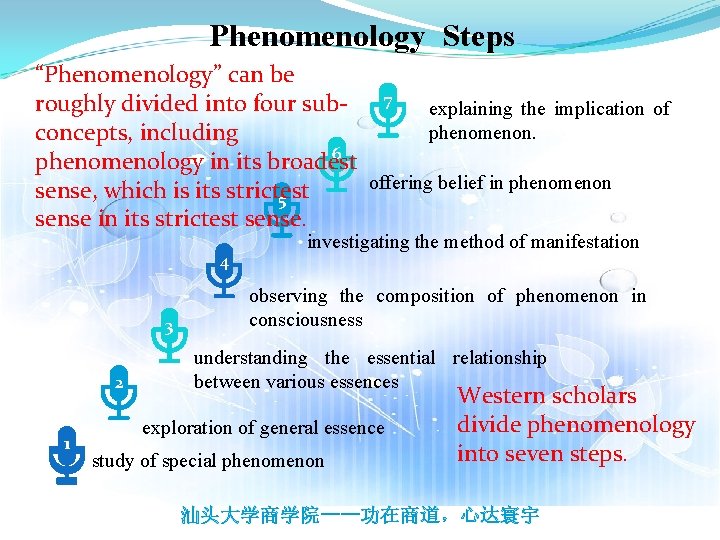
Phenomenology Steps “Phenomenology” can be 7 roughly divided into four subexplaining the implication of phenomenon. concepts, including 6 phenomenology in its broadest offering belief in phenomenon sense, which is its strictest 5 sense in its strictest sense. 4 3 2 1 investigating the method of manifestation observing the composition of phenomenon in consciousness understanding the essential relationship between various essences exploration of general essence study of special phenomenon Western scholars divide phenomenology into seven steps. 汕头大学商学院——功在商道,心达寰宇
Phenomenology is the study of experience and how we experience. It studies structures of conscious experience as experienced from a subjective or first-person point of view, along with its "intentionality" (the way an experience is directed toward a certain object in the world). It then leads to analyses of conditions of the possibility of intentionality, conditions involving motor skills and habits, background social practices and, often, language. Some steps of phenomenology can be regarded as original and unique, especially observation of the method of manifestation and the revelation of the composition of phenomenon in human consciousness. Basically, the originality of phenomenology is based on the decisive influence of the worship of philosophy.
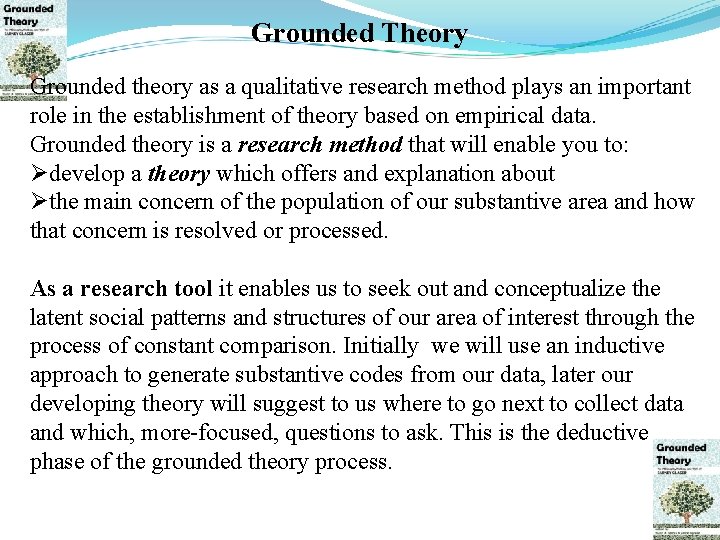
Grounded Theory Grounded theory as a qualitative research method plays an important role in the establishment of theory based on empirical data. Grounded theory is a research method that will enable you to: Ødevelop a theory which offers and explanation about Øthe main concern of the population of our substantive area and how that concern is resolved or processed. As a research tool it enables us to seek out and conceptualize the latent social patterns and structures of our area of interest through the process of constant comparison. Initially we will use an inductive approach to generate substantive codes from our data, later our developing theory will suggest to us where to go next to collect data and which, more-focused, questions to ask. This is the deductive phase of the grounded theory process.
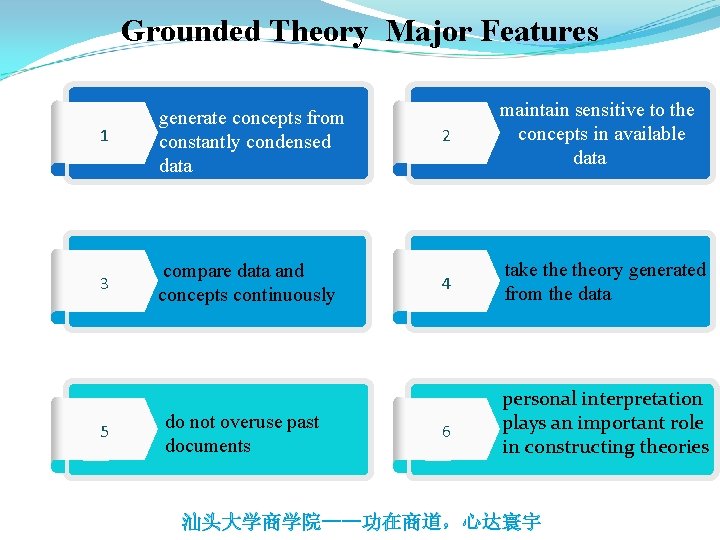
Grounded Theory Major Features maintain sensitive to the 1 generate concepts from g constantly condensed data 2 3 compare data and concepts continuously 4 5 do not overuse past documents 6 concepts in available data take theory generated from the data personal interpretation plays an important role in constructing theories 汕头大学商学院——功在商道,心达寰宇
Grounded Theory Grounded theory contains a complete standard for testing and evaluating concepts and basically consistent research process: Øopen and selective coding Øconstant comparison Øtheoretical sampling Øtheoretical saturation Øtheoretical coding Ømemo writing and hand sorting of memos In general, grounded theory is quite applicable to research on individual development processes, interpersonal relationships within groups, and interaction between individuals and groups.
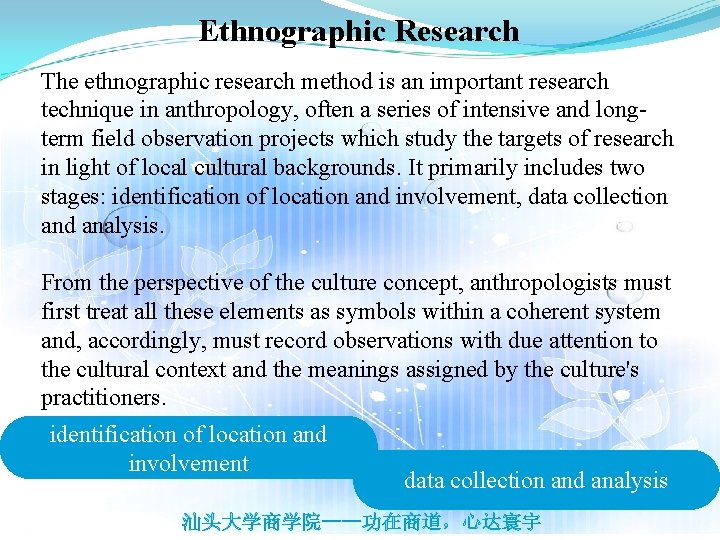
Ethnographic Research The ethnographic research method is an important research technique in anthropology, often a series of intensive and longterm field observation projects which study the targets of research in light of local cultural backgrounds. It primarily includes two stages: identification of location and involvement, data collection and analysis. From the perspective of the culture concept, anthropologists must first treat all these elements as symbols within a coherent system and, accordingly, must record observations with due attention to the cultural context and the meanings assigned by the culture's practitioners. identification of location and involvement data collection and analysis 汕头大学商学院——功在商道,心达寰宇
Ethnographic Research Data collected from directly observable material items, individual behaviors and performances (ceremonies, fights, games, meals), as well as ideas and arrangements that exist only in people's heads. Techniques: participant observation and key informant interviewing. Anthropologists will frequently to do quantitative research from which statistically validated inferences can be drawn. What I preferred is to do three way checking, triangular verifying. participant observation key informant interviewing. 汕头大学商学院——功在商道,心达寰宇
Ethnographic Research ØParticipant observation is based on living among the people under study for a lengthy period, and gathering data through continuous involvement in their lives and activities. ØThe ethnographer begins systematic observation and keeps daily field notes, in which the significant events of each day are recorded along with informants' interpretations. ØInitial observations focus on general, open ended data gathering derived from learning the most basic cultural rules and usually the local language as well. ØThis initial orientation process is important not only for providing a background for more narrowly focused investigation but also helps the anthropologist to gain rapport with his/her informants. 汕头大学商学院——功在商道,心达寰宇
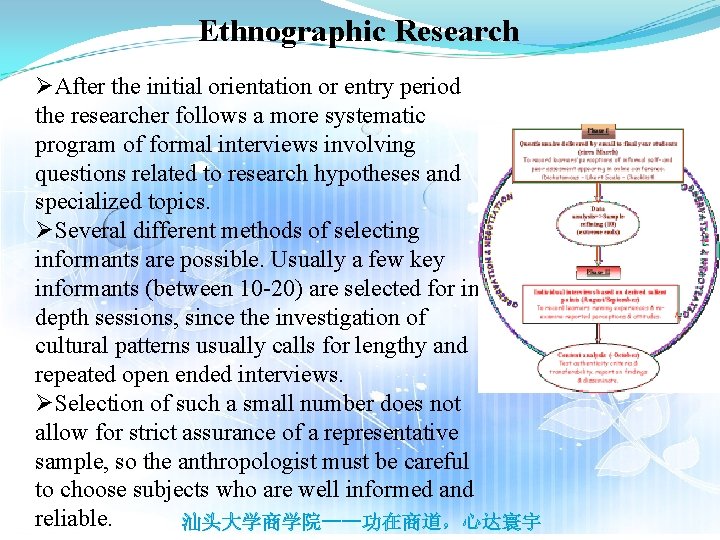
Ethnographic Research ØAfter the initial orientation or entry period the researcher follows a more systematic program of formal interviews involving questions related to research hypotheses and specialized topics. ØSeveral different methods of selecting informants are possible. Usually a few key informants (between 10 -20) are selected for indepth sessions, since the investigation of cultural patterns usually calls for lengthy and repeated open ended interviews. ØSelection of such a small number does not allow for strict assurance of a representative sample, so the anthropologist must be careful to choose subjects who are well informed and reliable. 汕头大学商学院——功在商道,心达寰宇
Ethnographic Research ØEthnographic researchers will also train informants to systematically report cultural data and recognize significant cultural elements and interconnections as the interview sequences unfold. ØKey informant selection is termed as judgment sampling and is very important for ethnographic research. ØInterviewing is an effective method to learn from people what they believe, how they think, and how that affects their life. ØFully-structured and semi-structured. Interviews should be crafted to answer a research question that could be developed from participate observations. ØLong interviews ØSurveys 汕头大学商学院——功在商道,心达寰宇
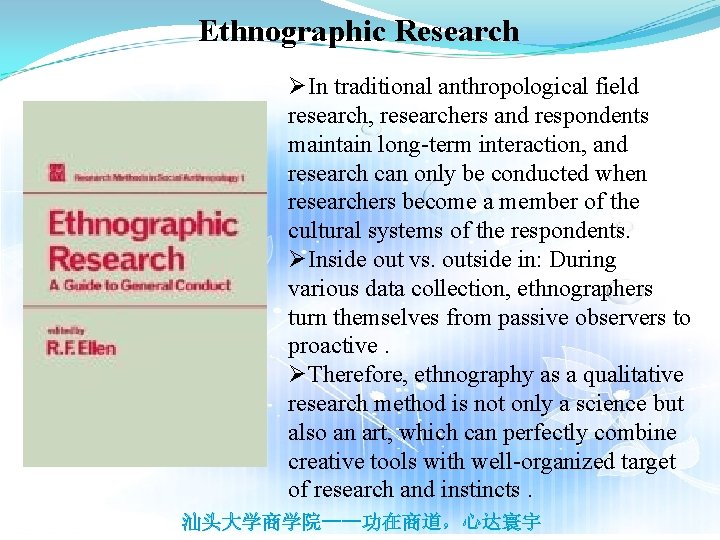
Ethnographic Research ØIn traditional anthropological field research, researchers and respondents maintain long-term interaction, and research can only be conducted when researchers become a member of the cultural systems of the respondents. ØInside out vs. outside in: During various data collection, ethnographers turn themselves from passive observers to proactive. ØTherefore, ethnography as a qualitative research method is not only a science but also an art, which can perfectly combine creative tools with well-organized target of research and instincts. 汕头大学商学院——功在商道,心达寰宇
Ethnographic Research Participant Observation Tools: A research journal for field notes is a very practical way to keep track of your observations. After an extended period, flipping through your journal, you might notice patterns that you had not realized were prevalent as you witnessed them in person. Also, as memory fails it is very important to have detailed notes of what you observed; otherwise your observations are meaningless. Journals are also valuable for recognizing our own biases or prejudices. It is here that we might begin to question some of our interpretations, and here we might realize possibilities that had not yet occurred to you. When conducting fieldwork, we should always question ourselves to make sure that we are in the right track of our research. 汕头大学商学院——功在商道,心达寰宇
Ethnographic Research Interviewing Tools: It is extremely important to record all interviews conducted as memory is not a sufficient source for citation. Transcriptions are required. The more you transcribe, the more protection provided for your research and analysis. Partial transcriptions are good for transcribing only the necessary or most valuable parts of your interview. We may not know what is the most valuable information we receives when hear it. It is beneficial to take light notes during the interview and extensive notes of what remember after the interview. Do not focus heavily on the note-taking in case miss what our interviewee is saying. 汕头大学商学院——功在商道,心达寰宇
Critical Incident Analysis Critical incidents are those which cause us to think and reflect, which leads to learning about ourselves or others (individuals and organizations) or about processes (e. g. about learning to be a social worker, the social work task or organizational policies and procedures). Most critical incidents are not at all dramatic or obvious but commonplace events that occur routinely in social work education and/or professional practice. What makes them “critical” is that they have caused us to think and reflect at this particular time (such as when something went better than expected, or vice versa ).
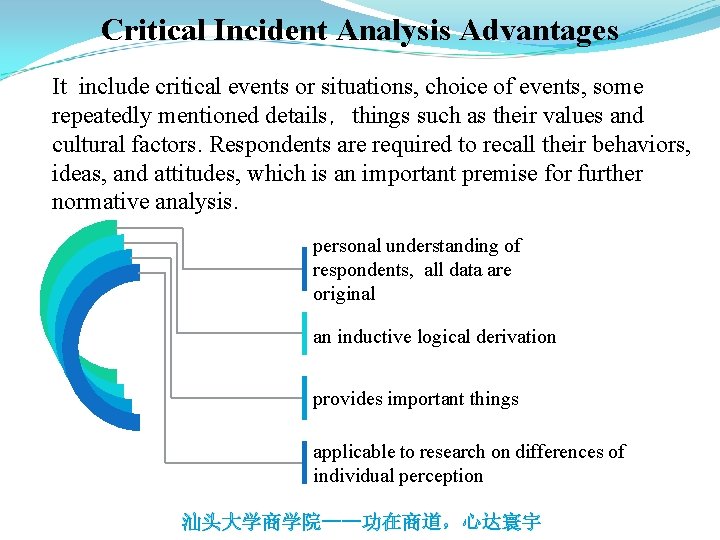
Critical Incident Analysis Advantages It include critical events or situations, choice of events, some repeatedly mentioned details,things such as their values and cultural factors. Respondents are required to recall their behaviors, ideas, and attitudes, which is an important premise for further normative analysis. personal understanding of respondents, all data are original an inductive logical derivation provides important things applicable to research on differences of individual perception 汕头大学商学院——功在商道,心达寰宇
Critical Incident Analysis Framework Account of the incident 1. What happened, where and when; who was involved? 2. What was your role/ involvement in the incident? 3. What was the context of this incident, e. g. previous involvement of yourself or other from this agency with this client/ client group? 4. What was the purpose and focus of your contact/ intervention at this point? Initial responses to the incident 1. What were your thoughts and feelings at the time of this incident? 2. What were the responses of other key individuals to this incident? If not known, what do you think these might have been?
Critical Incident Analysis Framework Issues and dilemmas highlighted by this incident 1. What practice dilemmas were identified as a result of this incident? 2. What are the values and ethical issues which are highlighted by this incident? 3. Are there implications for interdisciplinary and/ or inter-agency collaborations which you have identified as a result of this incident?
Critical Incident Analysis Framework Learning 1. What have you learned, e. g. about yourself, relationships with others, the social work task, organizational policies, and procedures? 2. What theory (or theories) has (or might have) helped develop your understanding about some aspect of this incident? 3. What research has (or might have) helped develop your understanding about some aspect of this incident? 4. How might an understanding of the legislative, organizational and policy contexts explain some aspects associated with this incident? 5. What future learning needs have you identified as a result of this incident? How might this be achieved?
Critical Incident Analysis Framework Outcomes 1. What were the outcomes of this incident for the various participants? 2. Are there ways in which this incident has led (or might lead to) changes in how you think, feel or act in particular situations? 3. What are your thoughts and feelings now about this incident?
Application and Value of Qualitative Research Methods in Management There are significant differences between qualitative research and quantitative research in terms of research process and design. Qualitative research is regarded as an interactive process during which researchers and respondents influence and learn from one another. With both advantages and disadvantages, research methods should be selected properly and in accordance with research contents under specific research backgrounds, never allowing research methods to determine research contents and objectives.
Application and Value of Qualitative Research Methods in Management Oversimplified classification of qualitative and quantitative research could absolutely result in opposition that prevents mutual learning and assimilation. As both quantitative and qualitative researches seek for a comprehensive and profound understanding of things, in essence there is no opposition between methods. Under this basic principle, to satisfy research requirements and deepening research, qualitative and quantitative research can be perfectly combined. The rough standards for distinguishing qualitative and quantitative research are of no practical significance to research itself.
Application and Value of Qualitative Research Methods in Management means coordinating relationships between humans and objects, and between objects through coordinating interpersonal relationships. This could mean tacit and or explicit understanding so as to complete tasks. The research contents of management is the coordination of interpersonal relationships, and the objective is to achieve maximum efficiency through coordination between human resources, financial resources and material resources. Researchers should be content and objective-oriented as they choose the optimal research methods or combination. They should avoid remaining mired in research methods.
Application and Value of Qualitative Research Methods in Management Classical research is composed of several important steps: 1, to define targets of research; 2, to determine research contents; 3, to conduct literature review; 4, to make an analysis of relations; 5, to raise hypotheses, collect data, refine original data; and 6, to present the final conclusions. Using the four important qualitative research methods discussed previously, from domestic top academic journals of management and elaborates on the application of research methods, hereby we select representative articles to make a brief statement. It can be clearly seen that qualitative research methods play an important driving role in each step of the research.
Application and Value of Qualitative Research Methods in Management In terms of management research, standard qualitative research begins by defining targets of research, constructing object-based concepts, summarizing the logical relationship between concepts through literature review to obtain dimensionalities and levels involved so that the composition, and targets of research and the relationship between each component can be described analyzed through phenomenology. Based on cognitive theory and phenomenological interview, Jiang et al. (2012) put forward a preliminary theoretical framework for the brand product knowledge system formed by consumer construction.
Application and Value of Qualitative Research Methods in Management Previous conceptual and empirical researches have not specifically touched upon the means of defining consumer brand product knowledge. Jiang’s qualittative research enables people to have a more profound understanding of the significance and nature of daily life experience, which also broadens the traditional thinking which confines the analysis of brand product cognition to association of brand physical characteristics and brand function evaluation. In terms of learning the background of targets of research and collecting data, anthropological ethnography methods can best reach the research requirements. Data are later collected by means of interview, observation and object analysis.
Application and Value of Qualitative Research Methods in Management Critical incident methods can collect original and private valuable information about targets of research. For example, Wang Zhijin (2009) constructed a model of personal information management (PIM) behavior by ethnographic research. He worked out the critical tasks in every stage according to the model. When the ethnographic method is employed for research PIM, it stresses that data should be collected in a natural context, which should only be utilized as evidence of user PIM behavioral processes. The research also provides an outlook on the application of ethnography in PIM and information management, it gives high recognition to ethnographic methods in regard to the pertinence, comprehensiveness, and accuracy of information collection.
Application and Value of Qualitative Research Methods in Management By using the critical incident method, Fei et al. (2001) conducted exploratory research on critical incidents of consumer guilt from different samples. The research firstly made a descriptive analysis of consumer guilt in different perspectives through content analysis, and then summarized the actions that marketers take to trigger consumer guilt, as well as the response of consumers and their relations. The original data acquired should also be classified, filed and encoded. The classified and staged analytical methods of original data are generally based on “Grounded Theory” in current mainstream research.
Application and Value of Qualitative Research Methods in Management Xu Lan et al. (2010) revealed four different mechanisms of consumer socialization in the intergenerational influence of parental brands with Mengniu Dairy as the target of research by grounded theory as the main research method. Li Zhigang et al. (2006) utilized the rapid growth model of Mengniu Dairy, which is characterized by accumulation, imitation and creation to explore the factors that influence the two development stages of imitation and creation. The research focused on the richness of information of target enterprises rather than the sample size.
Application and Value of Qualitative Research Methods in Management Wang Tao et al. (2012) constructed a formation mechanism and influencing mechanism model for country of origin image by collecting and analyzing comments and posts of Chinese products by consumers from the United States and India which satisfied the requirements from multi-national enterprises for a practicable dimensionality of country of origin image. The grounded theory was employed to process massive secondary data in Wang’s research, and theory behind the phenomenon was explored through an inductive approach based on systemized data collection and analysis.
Application and Value of Qualitative Research Methods in Management Huang Minxue et al. (2008) collected analyzed the posts of public comments on enterprise social responsibility, constructing the response model of “expectation-satisfaction-behavior”, and explaining public recognition and response models of enterprise social responsibility. Qualitative research methods can contribute to the collection and analysis of original data, based on the hermeneutic method. Previous studies primarily focus on the results of intergenerational influence, but lack analysis of internal deep mechanism of intergenerational influence. Based on classical hermeneutic research procedures, Huang’s research includes two stages, including data collection and data analysis, and finally the appropriateness of researcher subjective interpretation is tested through confirmatory procedures.
Application and Value of Qualitative Research Methods in Management Concise intuitive quantitative methods are always adopted in testing the reliability and validity of qualitative research and there a variety of methods available for the conclusion, including various quantitative researches. He Jiaxun et al. (2007) studied the marketing elements and basic mechanisms of consumer changed and unchanged attitudes toward old brands by using qualitative methods, and concluded that consumers hold different attitudes toward “changed and unchanged” old brands. They then continued to test whether different consumer characteristics affect the attitudes toward long-term development of time-honored brands by using qualitative methods to provide a theoretical foundation for market segmentation of classic brands.
Application and Value of Qualitative Research Methods in Management There are no standard procedures for specific research processes and designs in qualitative research, as such researchers would involve their own values in the research processes and employ specific qualitative research methods such as ethnography to establish multivariate research frameworks and designs applicable to specific situations. Among current management research items in China, however, due to the monotonous requirements of paradigm, quantitative research generally tests models based on hypotheses by using data analysis software, model-based research contents, and research process formally featured by “eight-part essay” (stereotyped writing).
Application and Value of Qualitative Research Methods in Management It is difficult to find the variation of precondition of model construction and its effects with standardized operations. If the model is constructed under such effects, it would be mistakenly assumed that the relationship between variables changes, whereas in fact it is the change of external environment and condition that leads to changed interactional relations. So-called innovation in many domestic researches merely means research results which are different from the past due to a lack of consideration of specific conditions.
Qualitative Research Methods in Management Enables people to have a more profound understanding of the significance and nature of daily life experience Concise intuitive quantitative methods are always adopted in testing the reliability and validity of qualitative research 汕头大学商学院——功在商道,心达寰宇
Qualitative Research Methods in Management Data are later collected by means of interview, observation and object analysis ※ Anthropological ethnography methods can best learning the background of targets of research and collecting data ※ Critical incident methods can collect original and private valuable information about targets of research. ※ The classified and staged analytical methods of original data are generally based on “Grounded Theory” in current mainstream research. 汕头大学商学院——功在商道,心达寰宇
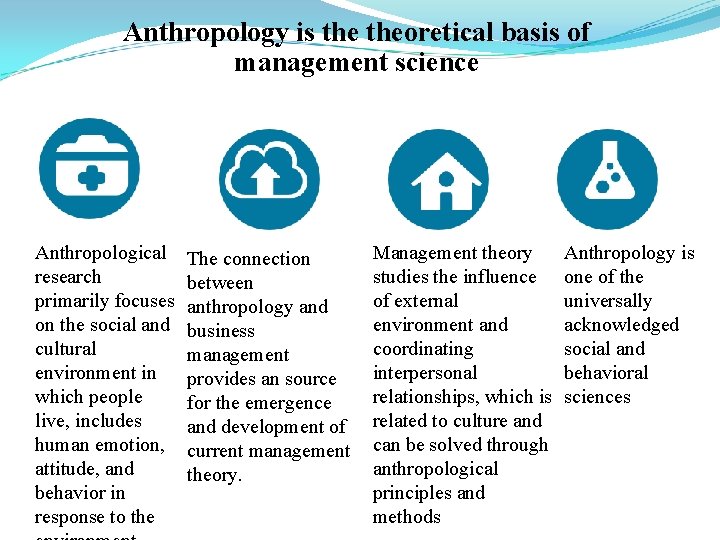
Anthropology is theoretical basis of management science Anthropological research primarily focuses on the social and cultural environment in which people live, includes human emotion, attitude, and behavior in response to the The connection between anthropology and business management provides an source for the emergence and development of current management theory. Management theory studies the influence of external environment and coordinating interpersonal relationships, which is related to culture and can be solved through anthropological principles and methods Anthropology is one of the universally acknowledged social and behavioral sciences
The characteristics of qualitative research methods in business anthropology Business anthropological research primarily focuses on organizational culture and social structure, the objects of which includes observable human social behavior and interaction, information of mutual communication between people, and material goods that constitute social practices. Business anthropologists need to conduct long-term field research, during which they generally place themselves into the cultural background of targets of research to collect original data by such methods as ethnography. There are four major methods in specific data collection, namely: participant observation, interview, questionnaire and covert observation.
The characteristics of qualitative research methods in business anthropology Business anthropological research is closely connected with other qualitative research methods such as phenomenology, grounded theory and critical incident method. The phenomenological method would be employed to define concepts based on targets of research and the logical relations between concepts before observation. Interview and questionnaire are conducted for convenience. During interview and observation, the critical incident method can be utilized to collect original valuable information about targets of research. Thus “grounded theory” can be utilized to classify, file and encode the collected original data. Finally, concise and intuitive qualitative methods are utilized in testing credibility and validity.
The characteristics of qualitative research methods in business anthropology There is a set of compete and fruitful qualitative research methods in business anthropology for specific branches of management research, such as marketing, product design, consumer behavior, knowledge management and entrepreneurship. Anthropological research is generally described as “pure” or basic, which exhibits seven distinct advantages: patient participant observation, research as insiders, diversified concrete operations, targeted professional knowledge, cross-cultural alertness, concern for the weak, and equal cooperation.
The characteristics of qualitative research methods in business anthropology Business anthropology provides typical cultural variables for research on consumer behaviors which shape disciplined social individuals through shared symbols, codes, value orientation and knowledge system. These consumers comply with various shows of distinct consumer behaviors. Business anthropological researchers on marketing generally use following methods for data collection and analysis, namely: observation, interview, document analysis, situational hypothesis, critical incident method, net analysis and focus group. Business anthropology provides deeper insights for product designers in understanding target market and analyzing consumption pattern.
The characteristics of qualitative research methods in business anthropology Some third-party organizations such as the American Institute of Graphic Arts (AIGA) even construct an ethnography model for product design (http: //www. aiga. org/ethnography-primer/). Anthropologists likewise construct an anthropological model for knowledge management aimed at answering how people with different backgrounds construct and manage knowledge. Entrepreneurship for business anthropologists is a progress of formation and development of social culture; anthropological methods are more applicable to explore and understand factors such as the external environment where entrepreneurship emerges, organizational structure, and the growth of an enterprise
The contribution of business anthropology to management science and practices Management is a social phenomenon, as well as a cultural phenomenon, while anthropology as a social and behavioral science has a unique tradition in terms of in-depth cultural studies. The research paradigm, research methods and research results of anthropology play an important role in directing management practices. This is especially true of the ethnographic research method has been widely applied in current management academia. Management and anthropology are essentially the same since both study interpersonal relationships. Management includes human thoughts, concepts, will, emotion and behavior, which are individual, uncertain, unquantifiable and cannot be easily described analyzed objectively by a purely natural scientific approach.
The contribution of business anthropology to management science and practices Management is a social phenomenon, as well as a cultural phenomenon, while anthropology as a social and behavioral science has a unique tradition in terms of in-depth cultural studies. The research paradigm, research methods and research results of anthropology play an important role in directing management practices. This is especially true of the ethnographic research method has been widely applied in current management academia. Management and anthropology are essentially the same since both study interpersonal relationships. Management includes human thoughts, concepts, will, emotion and behavior, which are individual, uncertain, unquantifiable and cannot be easily described analyzed objectively by a purely natural scientific approach.
The contribution of business anthropology to management science and practices For research on enterprise culture, for instance, domestic scholars generally adopt measurement indices widely utilized in foreign research. Whether they apply to management in China highlights the basic questions involved in various research, regardless of the rationality and explanatory power of these indices themselves. First-hand data can be obtained more directly and specifically so that theory can be developed in a set of sufficient targets of research with uniform characteristics on the one hand the conclusion can be fairly targeted, applicable and timely if business anthropological methods such as participant observation and open-ended questions are employed.
The contribution of business anthropology to management science and practices Business anthropology focuses on business organizations and their scopes, an important interdisciplinary area of anthropology, management and economics. Peculiar ethnographic method can exactly provides more rational explanation specific to different objects, reveal the immeasurable cultural and social models that influence human economic activities. Rudkin (2006) found two unique advantages of ethnography through research on financial service sector by using the method of ethnography. Researchers are able to look into the independent cultural connotation in a specific context; the ethnographic method helps researchers find marginalized in specific environment.
The contribution of business anthropology to management science and practices Business anthropologists suggest the application of anthropology in business management can be divided into seven aspects, namely: corporate culture, knowledge management, cultural audit, organizational change, product design, market and consumer behavior research, and globalization and cross-cultural business. The role of business anthropology in enterprise internal management includes audit and shape of corporate culture, tacit knowledge management and human resources management. Business anthropologists view organizational culture as the approach to overcome the external cultural environment restraints during auditing and shaping of corporate culture.
The contribution of business anthropology to management science and practices Business anthropologists question the assumed “right” way of doing things from the perspective of cultural difference. On the other hand, they take cultural difference as an opportunity to learn new approaches to solving problems and explore formal or informal knowledge so as to establish organizational culture beneficial to the development of the enterprise. For tacit knowledge management, it should be transformed into specific and understandable knowledge and practicable processes. Human resources management requires enterprises to solve various problems, such as high staff turnover, unreasonable position management and low employee satisfaction while ensuring employee relationships are in line with organizational objectives.
The contribution of business anthropology to management science and practices The influence of business anthropology on enterprise production primarily focuses on product design, product development and process innovation. Observation of consumer behavior from the anthropological perspective provides the most basic guidance for product design, services and application of new technologies. This incorporates not only the analysis of consumer behavior in the past, but also research on general consumer demand as well as projection of consumer trends in the future. Business anthropologists analyze the symbolic meaning of products to consumers, consumer motivation under the influence of specific social-cultural factors in marketing and sales.
The contribution of business anthropology to management science and practices Business anthropologists provide market strategies for enterprises to stimulate consumer enthusiasm. They performs even better in cross-cultural management and global operation of multi-national enterprises. Through observation of the world beyond national boundaries and cultural restraints from the anthropological perspective, business anthropology not only changes corporate value and culture, but also local culture of consumption and even wider lifestyles. Business anthropology as an important branch of anthropology not only carries forward mature qualitative research, but also applies anthropological achievements in management and brings revolutionary changes to management.
The significance of Chinese traditional culture for management: perspective of business anthropology As cross-cultural communication becomes more commonplace, almost every large-scale enterprise must have a diversified employee body from different cultural background for services and product sales in cross-cultural regions. More companies and managers in China come from developed economies with strong business backgrounds, where employees are farmers with strong agricultural production and life background under socialist systems. Both sides set up a formal organizational culture based on common interests and an informal agreement based on contradiction. Anthropologists research the correlation between formal and informal differences in corporate culture to solve present conflicts within the enterprise in the most appropriate way.
The significance of Chinese traditional culture for management: perspective of business anthropology Studying the “ 13 suicide incidents of Foxconn” from the anthropological perspective suggests that conflicts from different cultural background of employees exert a significant influence on employee satisfaction and business performance. It makes us fully realize that Chinese cultural tradition is entirely different from that of Western countries and oriental countries such as Japan and South Korea, and even significantly different from Taiwanese and Hong Kong culture. With 5000 years of civilization, the Chinese have formed a unique and stable cultural psychological structure; it makes management subject, management object and management in general in China significantly different from that of Western countries.
The significance of Chinese traditional culture for management: perspective of business anthropology Non-acclimatization of Western management theory in China is apparent. It is remiss to ignore the mature Chinese management ideology while blindly worshipping foreign theories. Chinese traditional culture adds both supplementation and innovation to management theory, especially Western management theory. Lv Li (2013) constructed a unique theoretical system based on Yi ology to interpret the relationship between “management and environment”. Yi-ology and Western management theory are essentially different in terms of theoretical source and approach. The interpretation of management epistemology and targets of research based on Yi-ology happens to coincide with that from the perspective of Western management theory.
The significance of Chinese traditional culture for management: perspective of business anthropology The management theory of Yi-ology is therefore both peculiar and universally applicable. In Chinese traditional culture, management thoughts about humans are still highlighting the wisdom of sages. Scholars divided Chinese traditional management thoughts into five aspects: proposition, employment, governance, conduct and education, and summarized representative aphorisms in each aspect as formal management thoughts. Chinese traditional management thoughts, including Legalism, Taoism, and Confucianism are consistent with Western counterparts in many aspects, explore even deeper on some questions, and add both innovation and supplementation to Western management theory.
The significance of Chinese traditional culture for management: perspective of business anthropology The theory of human nature, or a “desire for benefits and hatred for harms” put forward by Legalism can be very enlightening for effective application of incentives in modern business management. The concept of “not following the old routine” also conforms to the survival principle of modern enterprises which emphasizes innovation rather than. Taoism takes “Nothing can be more delicate than water” and “to be tender and modest” as the principle of order, placing emphasis on the coordination between the human and natural as well as the social environment, advocating team spirit and leader humanistic thought, “governing by non-interference”, fully respecting individual personalities and dignity, and striving to improve corporate social image.
The significance of Chinese traditional culture for management: perspective of business anthropology Taoism also seeks to enhance core competitiveness, perfect corporate culture and promote the building of corporate soft power by improving employee satisfaction and stimulating work enthusiasm. Confucianism also has far-reaching impacts on key management issues. It constructs ethical values with a focus on “benevolence, righteousness and propriety”, constantly influencing thought and behavior of Chinese people through language, character, and various cultural tools that form national collective behavior with a specific cultural background. Learning and absorbing the quintessence of Confucianism ethics and morals play an important role in building corporate image and constructing meaningful corporate culture.
The role of business anthropology in the localization of management practices in China It is true that in China Many enterprises have drawn significantly from Confucianism from different aspects, such as the idea of “harmony”, “honesty” and “perseverance”. These ideas are helpful in team work, devotion and innovation toward an enterprise. Seen from the history of management research, there remains a huge gap between the research achievements of Chinese managerialists and global management knowledge, and currently we are seriously lacking in knowledge regarding Chinese business management. Management science and management practices are different in various countries due to cultural differences.
The role of business anthropology in the localization of management practices in China The laws and facts of management show significant differences due to cultural difference, whereas culture is exactly the core of anthropological studies. Since 1990 s, the anthropology-based management paradigm and methodology emerged among European and American management schools and attached importance to management practices. Multi-national enterprises hire anthropologists to provide management measures with stronger operability so as to meet the requirements of external market and internal management. In China, because anthropology leading management studies in its early stage, Chinese indigenous management practices call for considerations from the anthropological perspective.
The role of business anthropology in the localization of management practices in China Management practice is not only about modes of production but also about the relationship with production. More importantly, it is a cultural process as well as the product of cultural environment. The impact of culture on management practice is fully embodied by corporate philosophy, corporate values, business ethics and organization system. The great influence of local environment and culture on management practices cannot be overlooked since management practice is closely related with mode of production, relations of production, and culture, and it is certainly not universal. Over longterm research processes, anthropologists have established themes sufficient to support the epistemology and methodology which are closely related with the “localization” of management practices.
The role of business anthropology in the localization of management practices in China Important themes include cultural relativism, unified theory, adaptation and holism. These themes stress research that place culture in specific historical and social context, and also reveal the general commonalities of cultural characteristics and elements based on common demands of people. Localization takes international situation into consideration and goes deeper into China’s conditions, which not only explores the universality of management theory but also its conditionality. Anthropology has always been employed for practical application. In addition, the rapid development of economic and business culture in the past decades has provided latent conditions for the emergence and development of business anthropology in China.
The role of business anthropology in the localization of management practices in China The role of humanistic elements in management research is acknowledged among Chinese managerialists who delve into the application of anthropological achievements and methods in management research. Guo Yi (2010) once pointed out that the organizational culture and management phenomenon of Chinese enterprises can by no means be explained by mechanically applying Western management theory with a simple “situation”. Instead, they are deeply rooted in “local knowledge” as a relatively independent knowledge system with distinct characteristics. The Western management theory also derives from its own institutional environment with distinct political, economic and cultural background.
The role of business anthropology in the localization of management practices in China In short, China must therefore have its own management theory in view of its overall situation. The combination of anthropology and management as well as localization of business and management anthropology in China is an important method of exploring Chinese management theory and localization of management practices.
Conclusions Through stages of learning, reference and imitation since the introduction of Western management theory in the 1980 s, management science research and education in China have been confronted with the question of where to go next. From “following suit” to “following along”, and on to “innovation”, management in China places greater emphasis on Chinese characteristics. Management is not only a branch of science in essence but also a response and interpretation of specific culture. Therefore, management must be localized for further development in China.
Conclusions Empirical analysis methods are still dominant in the present management research, which to a great extent ignores the condition of constructing variables and hypotheses; moreover it ignores the fact that the management behaviors take place in specific culture, which is the major premise of empirical analysis. Western management theories cannot be applied mechanically to explain questions by attaching some control variables or intermediary variables. An effective path of localization of management and management practices is to apply anthropological research methods to local management practices so that management theory in China can better explain actual human responses and factors that influence their behaviors.
Conclusions During localization, Chinese management scholars accept and conscientiously apply qualitative research methods, which are sure to help explore new paths of management research on a broader scale. While assimilating Western management theories and methods, the management academia in China should continually add Chinese elements so as to establish management science and methodology with Chinese characteristics. The five thousand years of history of Chinese civilization lays a solid humanistic foundation for the development of management science in China.
Conclusions More emphasis should be placed on Chinese characteristics during the development of management science, which is difficult to highlight in empirical research through quantitative analysis. In consequence, it is an effective approach to enhance the application of a non-positivist paradigm in management science research for the development of management science with Chinese characteristics.
References will be provided upon requesting: gtian@stu. edu. cn