Johali Fa PHE The CHS 436 Family Planning


- Slides: 75
ﺑﺴﻢ ﺍﻟﻠﻪ ﺍﻟﺮﺣﻤﻦ ﺍﻟﺮﺣﻴﻢ Johali Fa. PHE The CHS 436 Family Planning for HE 2018_2019 Do You Manage Love_ Family HE Plan Prevent HE Help To Reach ZD Family Wellness EISA ALI JOHALI ﺍﻟﺠﻮﺣﻠﻲ ﻋﻠﻲ ﺑﻦ ﻋﻴﺴﻰ
Course Syllabus Family Planning (CHS 436) HE Vision, mission • • Vision: Leadership and excellence in health education and promotion Mission: To contribute to promote community health and secure better quality of life through qualifying globally competitive cadres specialized in health education and promotion; who are characterized by creative thinking, innovation and self-confidence, armed with values and ethics needed to practice the profession within a multidisciplinary team, and competent in planning, implementation and evaluation of health education programs and campaigns, mobilizing community participation, and conducting distinguished scientific research”.
Course Syllabus Family Planning (CHS 436) Course Description: • This course enhances student’s understanding of the role of family planning as a determinant of health and enables him to acquire the essential knowledge and skills to understand, explain, and evaluate its objectives. The course includes; definition, rationale, impact of family planning, fertility motives, and role of health educator in family planning programs. Also, the course will increase student's awareness of family planning services, the population problems, and maternal & infant mortality. Furthermore, contraceptive methods: types, description, mechanism of action, effectiveness, advantages, side effects, and uses will be deeply discussed with gathering approach for counseling in family planning Course Major Reference the Textbook Johali. Fa. PHE The CHS 436 Family Planning for HE 2018_2019 https: //fac. ksu. edu. sa/ejohali/course/258799
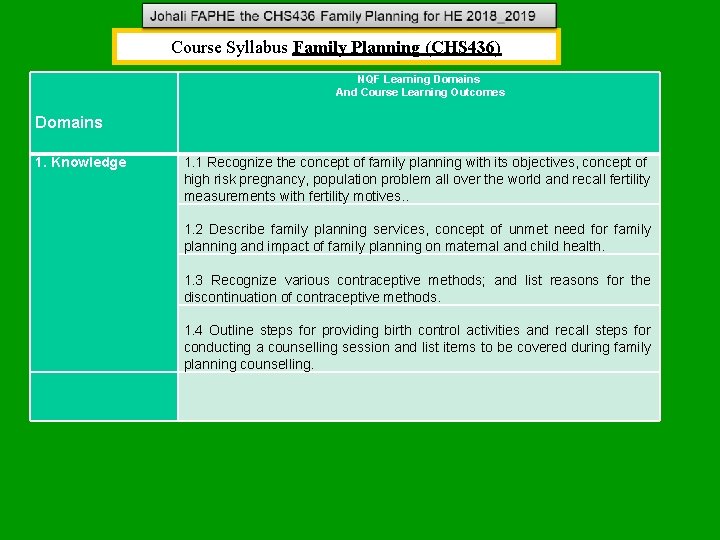
Course Syllabus Family Planning (CHS 436) NQF Learning Domains And Course Learning Outcomes Domains 1. Knowledge 1. 1 Recognize the concept of family planning with its objectives, concept of high risk pregnancy, population problem all over the world and recall fertility measurements with fertility motives. . 1. 2 Describe family planning services, concept of unmet need for family planning and impact of family planning on maternal and child health. 1. 3 Recognize various contraceptive methods; and list reasons for the discontinuation of contraceptive methods. 1. 4 Outline steps for providing birth control activities and recall steps for conducting a counselling session and list items to be covered during family planning counselling.
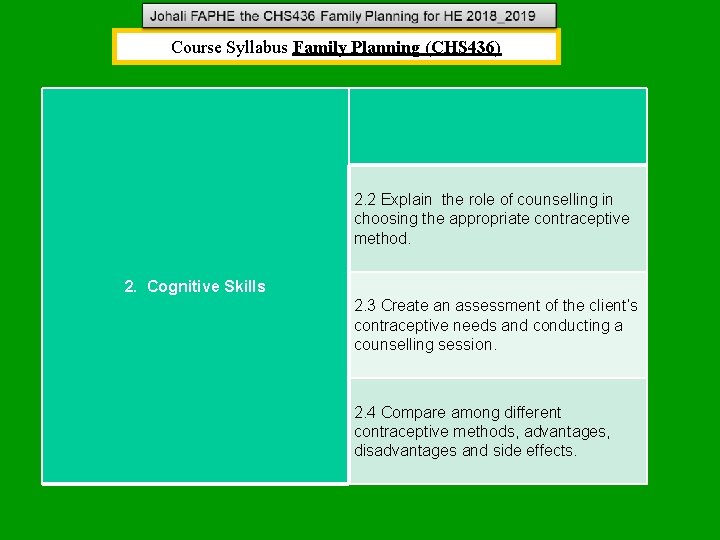
Course Syllabus Family Planning (CHS 436) 2. 2 Explain the role of counselling in choosing the appropriate contraceptive method. 2. Cognitive Skills 2. 3 Create an assessment of the client’s contraceptive needs and conducting a counselling session. 2. 4 Compare among different contraceptive methods, advantages, disadvantages and side effects.
Course Syllabus Family Planning (CHS 436) What is the main Objectives for this course? By the end of this course, students should be able to: Recognize the concept of family planning, its objectives and the concept of high risk pregnancy Recognize Population problem all over the world and strategies for solving it Appreciate the role of counselling in choosing the appropriate contraceptive method, and discuss different available contraceptive methods Evaluate the need for family planning and identify fertility measurements. . cover unmet needs
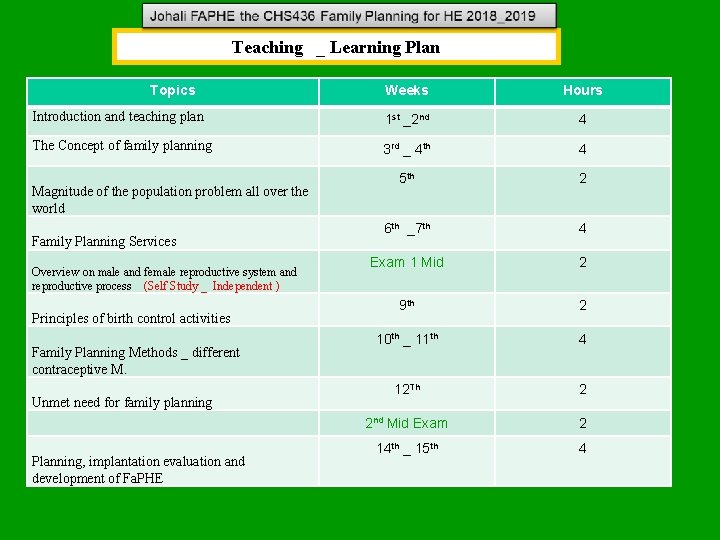
Teaching _ Learning Plan Topics Weeks Hours Introduction and teaching plan 1 st _2 nd 4 The Concept of family planning 3 rd _ 4 th 4 5 th 2 6 th _7 th 4 Exam 1 Mid 2 9 th 2 10 th _ 11 th 4 12 Th 2 2 nd Mid Exam 2 14 th _ 15 th 4 Magnitude of the population problem all over the world Family Planning Services Overview on male and female reproductive system and reproductive process (Self Study _ Independent ) Principles of birth control activities Family Planning Methods _ different contraceptive M. Unmet need for family planning Planning, implantation evaluation and development of Fa. PHE
YOUR ROLE Do You Remember Our National HE Definition ? State, Think in the course cover and discover ? - -
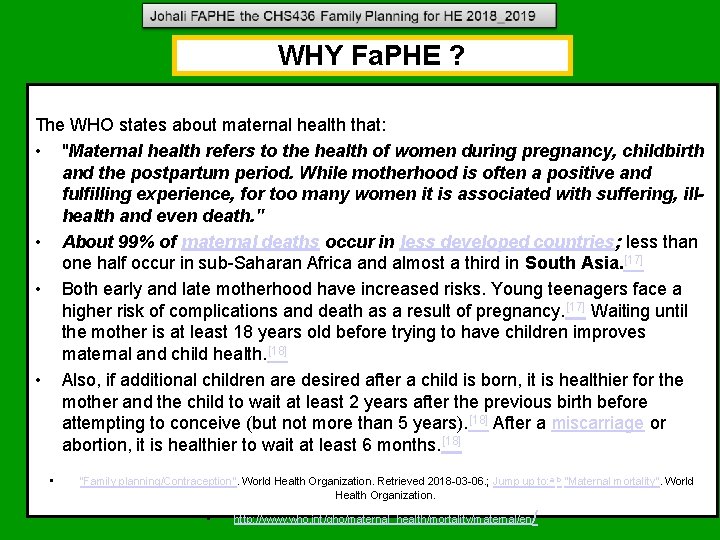
WHY Fa. PHE ? The WHO states about maternal health that: • "Maternal health refers to the health of women during pregnancy, childbirth and the postpartum period. While motherhood is often a positive and fulfilling experience, for too many women it is associated with suffering, illhealth and even death. " • About 99% of maternal deaths occur in less developed countries; less than one half occur in sub-Saharan Africa and almost a third in South Asia. [17] • Both early and late motherhood have increased risks. Young teenagers face a higher risk of complications and death as a result of pregnancy. [17] Waiting until the mother is at least 18 years old before trying to have children improves maternal and child health. [18] • Also, if additional children are desired after a child is born, it is healthier for the mother and the child to wait at least 2 years after the previous birth before attempting to conceive (but not more than 5 years). [18] After a miscarriage or abortion, it is healthier to wait at least 6 months. [18] • "Family planning/Contraception". World Health Organization. Retrieved 2018 -03 -06. ; Jump up to: a b "Maternal mortality". World Health Organization. • / http: //www. who. int/gho/maternal_health/mortality/maternal/en
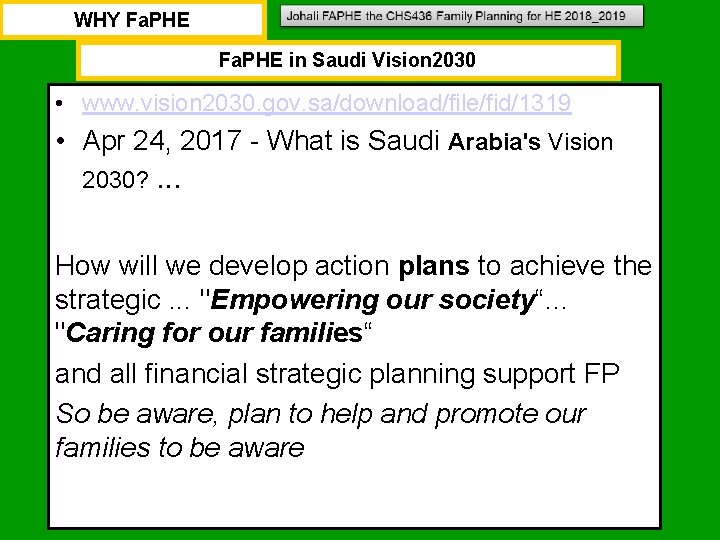
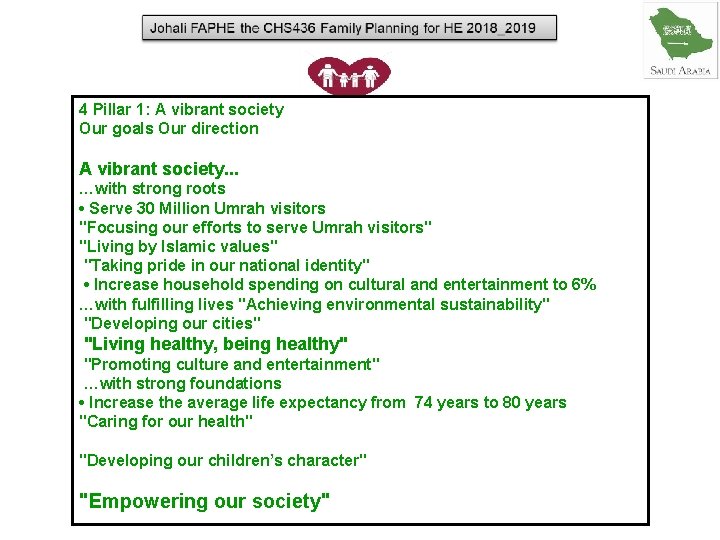
WHY Fa. PHE in Saudi Vision 2030 • www. vision 2030. gov. sa/download/file/fid/1319 • Apr 24, 2017 - What is Saudi Arabia's Vision 2030? . . . How will we develop action plans to achieve the strategic. . . "Empowering our society“… "Caring for our families“ and all financial strategic planning support FP So be aware, plan to help and promote our families to be aware
General Introduction Male Role to FP https: //www. youtube. com/watch? v=NF 3 A 0 r 5 JHYo ﺣﺬﻑ https: //www. youtube. com/user/FPNSW Family Planning NSW is the state's leading provider of reproductive and sexual health services. We provide clinical services, information and health promotion activities, education and training for health professionals and allied groups, research and advocacy. International Family Planning 101 ﻭﺍﻛﺘﺐ ﺭﻛﺰ https: //www. youtube. com/watch? v=f. KFZu. RHa. X 2 o Male involvement in Family Planning TV Funny https: //www. youtube. com/watch? v=C 4 QKO 4 OVUpw
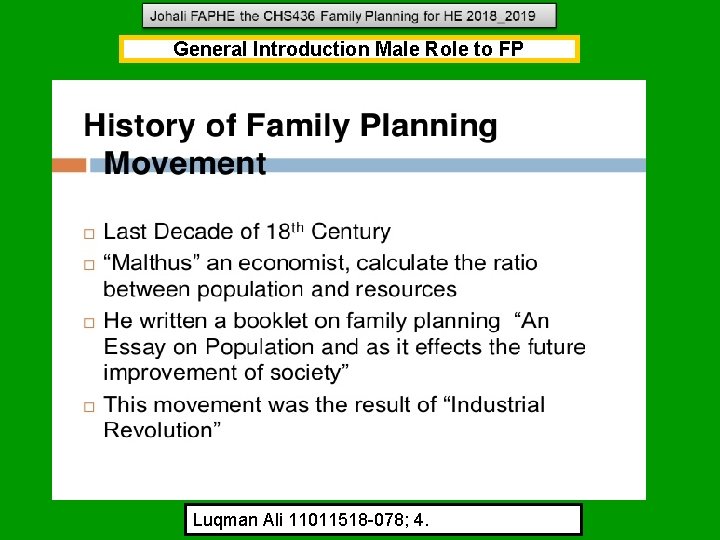
General Introduction Male Role to FP Luqman Ali 11011518 -078; 4.
The Concept of Family Planning
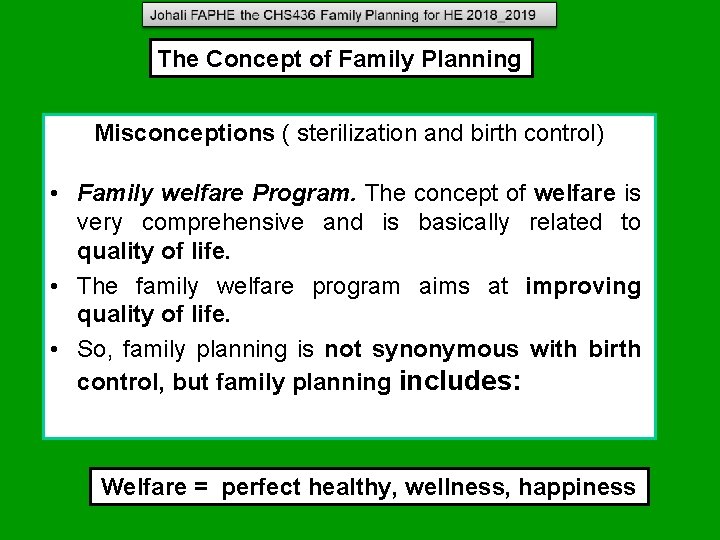
The Concept of Family Planning Misconceptions ( sterilization and birth control) • Family welfare Program. The concept of welfare is very comprehensive and is basically related to quality of life. • The family welfare program aims at improving quality of life. • So, family planning is not synonymous with birth control, but family planning includes: Welfare = perfect healthy, wellness, happiness
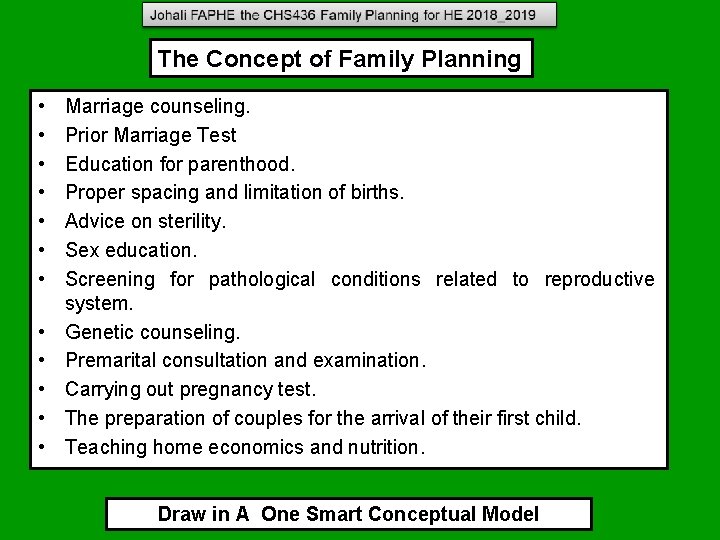
The Concept of Family Planning • • • Marriage counseling. Prior Marriage Test Education for parenthood. Proper spacing and limitation of births. Advice on sterility. Sex education. Screening for pathological conditions related to reproductive system. Genetic counseling. Premarital consultation and examination. Carrying out pregnancy test. The preparation of couples for the arrival of their first child. Teaching home economics and nutrition. Draw in A One Smart Conceptual Model
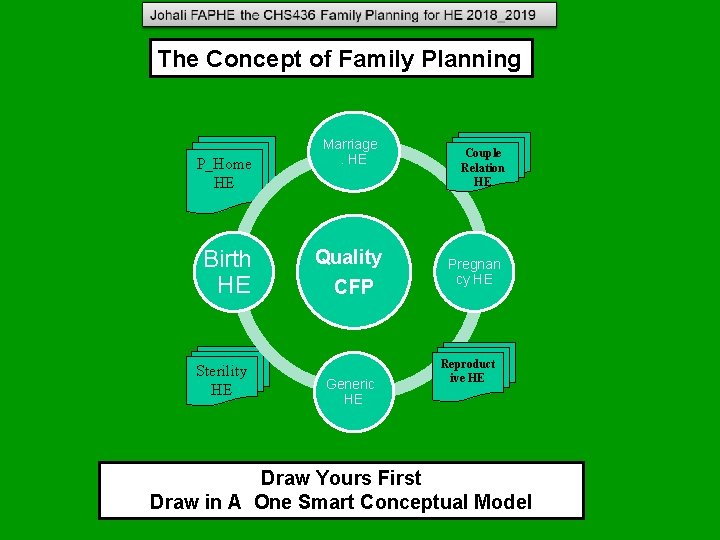
The Concept of Family Planning P_Home HE Birth HE Sterility HE Marriage . HE Quality CFP Generic HE Couple Relation HE Pregnan cy HE Reproduct ive HE Draw Yours First Draw in A One Smart Conceptual Model
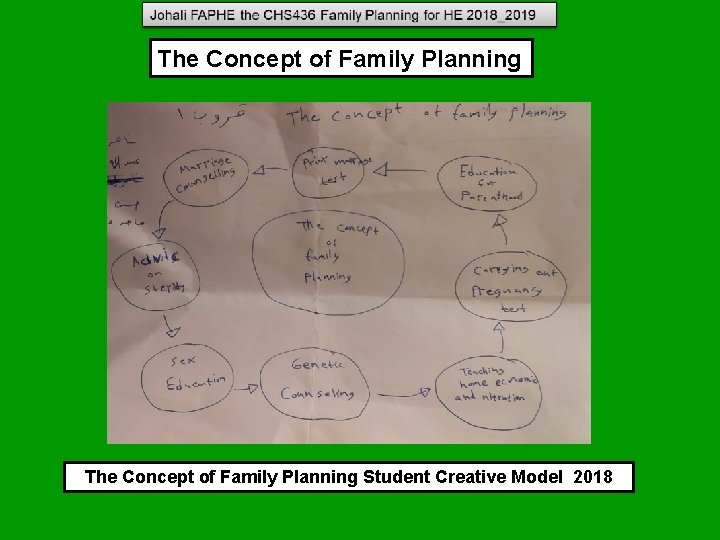
The Concept of Family Planning Student Creative Model 2018
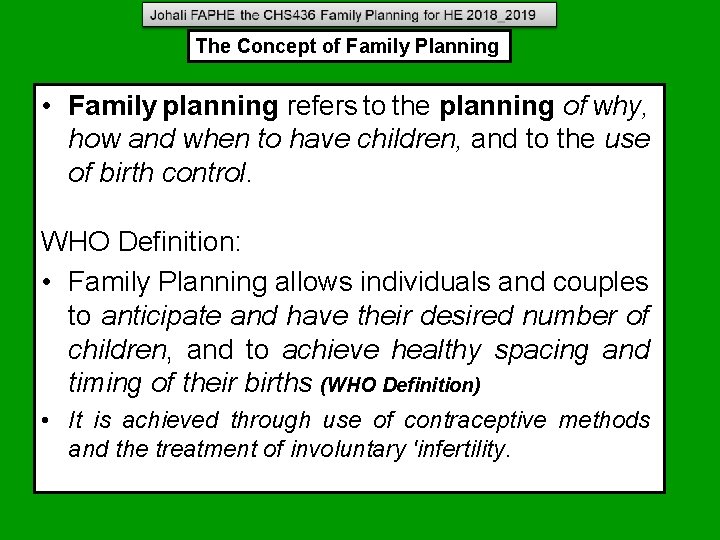
The Concept of Family Planning • Family planning refers to the planning of why, how and when to have children, and to the use of birth control. WHO Definition: • Family Planning allows individuals and couples to anticipate and have their desired number of children, and to achieve healthy spacing and timing of their births (WHO Definition) • It is achieved through use of contraceptive methods and the treatment of involuntary 'infertility.
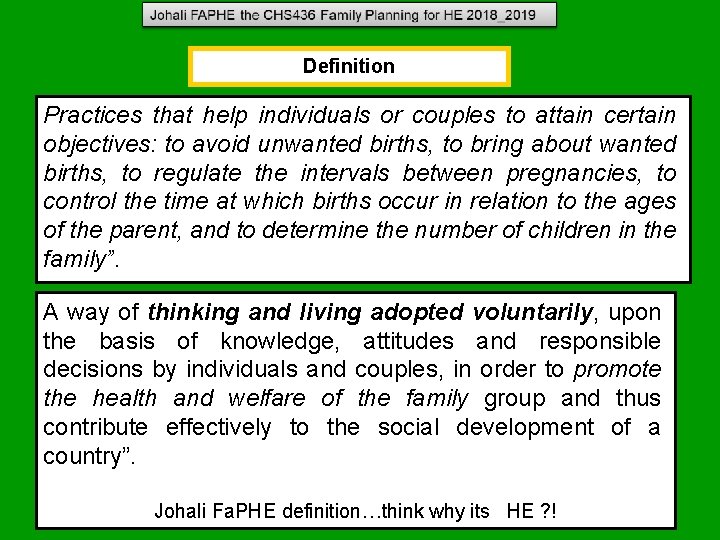
Definition Practices that help individuals or couples to attain certain objectives: to avoid unwanted births, to bring about wanted births, to regulate the intervals between pregnancies, to control the time at which births occur in relation to the ages of the parent, and to determine the number of children in the family”. A way of thinking and living adopted voluntarily, upon the basis of knowledge, attitudes and responsible decisions by individuals and couples, in order to promote the health and welfare of the family group and thus contribute effectively to the social development of a country”. Johali Fa. PHE definition…think why its HE ? !
Objectives of Family Planning Programs
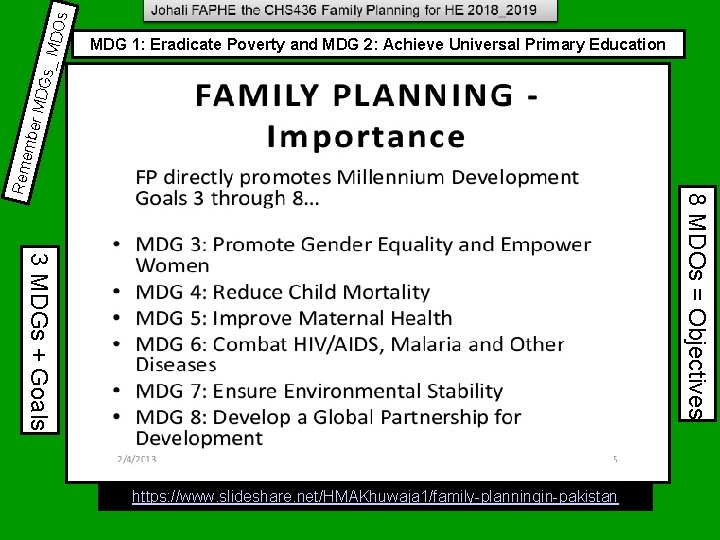
DOs s_ M 3 MDGs + Goals 8 MDOs = Objectives Rem embe r MDG 1: Eradicate Poverty and MDG 2: Achieve Universal Primary Education https: //www. slideshare. net/HMAKhuwaja 1/family-planningin-pakistan
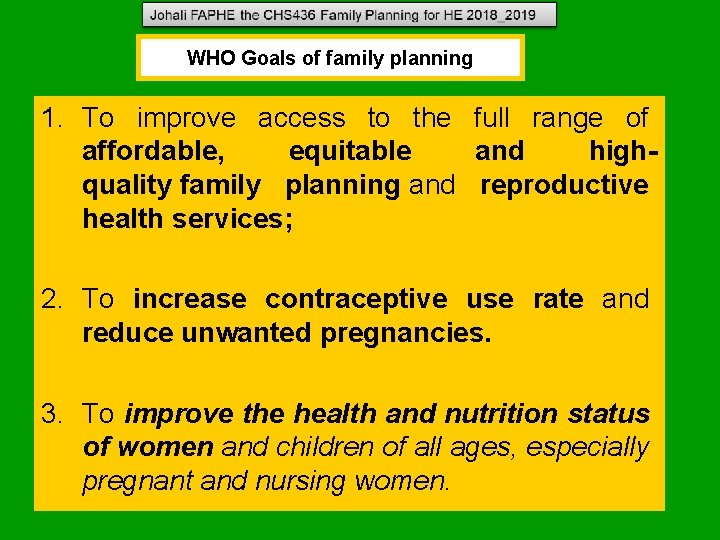
WHO Goals of family planning 1. To improve access to the full range of affordable, equitable and highquality family planning and reproductive health services; 2. To increase contraceptive use rate and reduce unwanted pregnancies. 3. To improve the health and nutrition status of women and children of all ages, especially pregnant and nursing women.
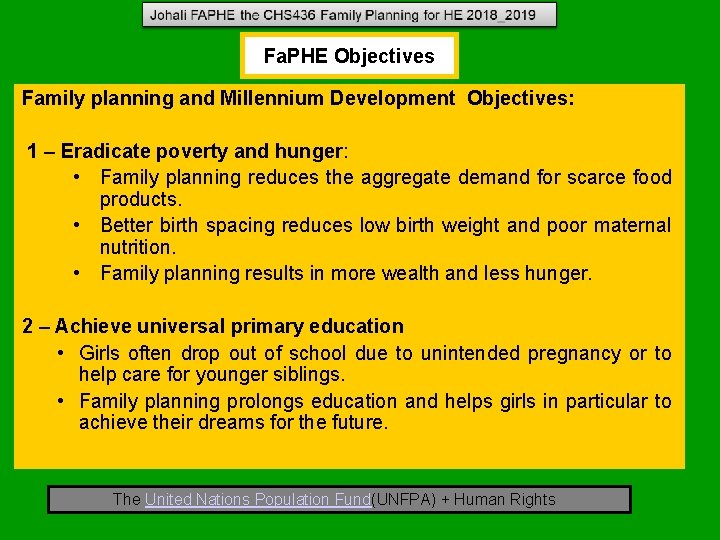
Fa. PHE Objectives Family planning and Millennium Development Objectives: 1 – Eradicate poverty and hunger: • Family planning reduces the aggregate demand for scarce food products. • Better birth spacing reduces low birth weight and poor maternal nutrition. • Family planning results in more wealth and less hunger. 2 – Achieve universal primary education • Girls often drop out of school due to unintended pregnancy or to help care for younger siblings. • Family planning prolongs education and helps girls in particular to achieve their dreams for the future. The United Nations Population Fund(UNFPA) + Human Rights
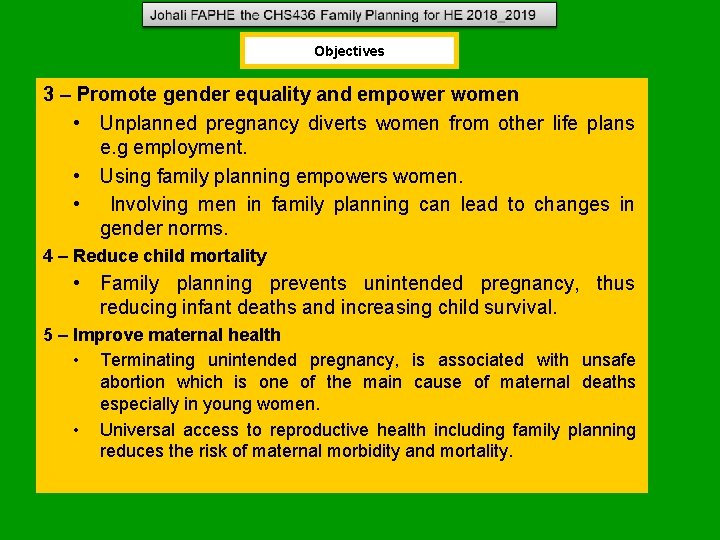
Objectives 3 – Promote gender equality and empower women • Unplanned pregnancy diverts women from other life plans e. g employment. • Using family planning empowers women. • Involving men in family planning can lead to changes in gender norms. 4 – Reduce child mortality • Family planning prevents unintended pregnancy, thus reducing infant deaths and increasing child survival. 5 – Improve maternal health • Terminating unintended pregnancy, is associated with unsafe abortion which is one of the main cause of maternal deaths especially in young women. • Universal access to reproductive health including family planning reduces the risk of maternal morbidity and mortality.
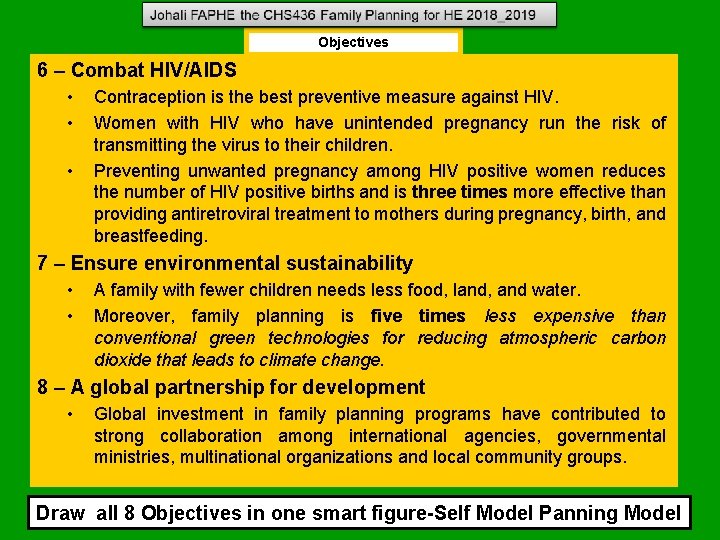
Objectives 6 – Combat HIV/AIDS • • • Contraception is the best preventive measure against HIV. Women with HIV who have unintended pregnancy run the risk of transmitting the virus to their children. Preventing unwanted pregnancy among HIV positive women reduces the number of HIV positive births and is three times more effective than providing antiretroviral treatment to mothers during pregnancy, birth, and breastfeeding. 7 – Ensure environmental sustainability • • A family with fewer children needs less food, land, and water. Moreover, family planning is five times less expensive than conventional green technologies for reducing atmospheric carbon dioxide that leads to climate change. 8 – A global partnership for development • Global investment in family planning programs have contributed to strong collaboration among international agencies, governmental ministries, multinational organizations and local community groups. Draw all 8 Objectives in one smart figure-Self Model Panning Model
The 3 WHO Goals MDGs Have to be achieved by the WHO 8 Objectives MDOs FOR YOU ? ! Draw the 3 WHO MDGs with the 8 WHO Objectives MDOs in One Smart Figure-Self Creative Model Panning Model
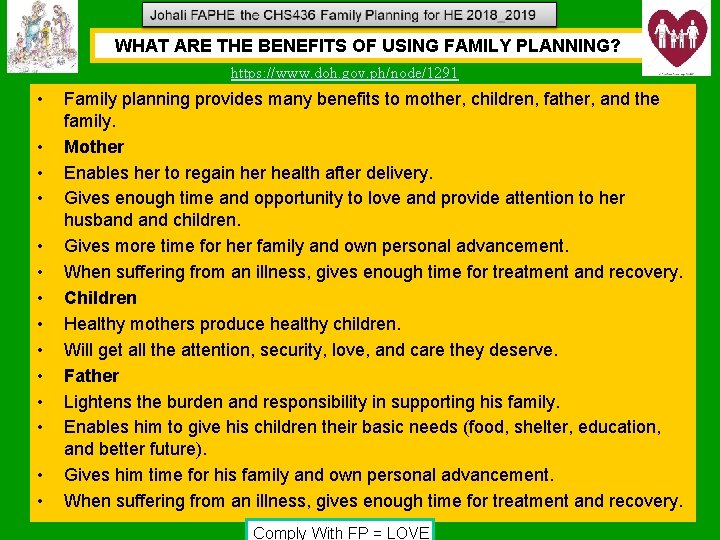
WHAT ARE THE BENEFITS OF USING FAMILY PLANNING? https: //www. doh. gov. ph/node/1291 • • • • Family planning provides many benefits to mother, children, father, and the family. Mother Enables her to regain her health after delivery. Gives enough time and opportunity to love and provide attention to her husband children. Gives more time for her family and own personal advancement. When suffering from an illness, gives enough time for treatment and recovery. Children Healthy mothers produce healthy children. Will get all the attention, security, love, and care they deserve. Father Lightens the burden and responsibility in supporting his family. Enables him to give his children their basic needs (food, shelter, education, and better future). Gives him time for his family and own personal advancement. When suffering from an illness, gives enough time for treatment and recovery. Comply With FP = LOVE
Family Planning Risk Factors
Risk Factors • A couple's decision to begin, prevent, or interrupt a pregnancy may be influenced by many factors including maternal medical disorders, risks involved in the pregnancy, and socioeconomic factors. . If contraception fails, abortion (termination of pregnancy) may be considered.
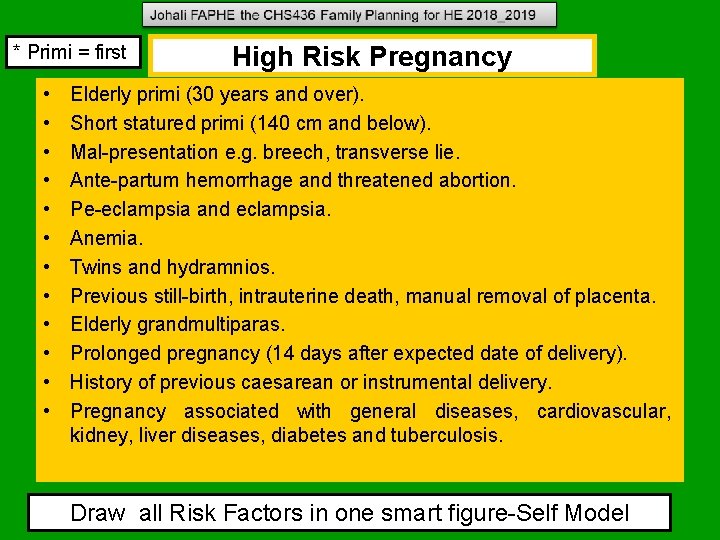
* Primi = first • • • High Risk Pregnancy Elderly primi (30 years and over). Short statured primi (140 cm and below). Mal-presentation e. g. breech, transverse lie. Ante-partum hemorrhage and threatened abortion. Pe-eclampsia and eclampsia. Anemia. Twins and hydramnios. Previous still-birth, intrauterine death, manual removal of placenta. Elderly grandmultiparas. Prolonged pregnancy (14 days after expected date of delivery). History of previous caesarean or instrumental delivery. Pregnancy associated with general diseases, cardiovascular, kidney, liver diseases, diabetes and tuberculosis. Draw all Risk Factors in one smart figure-Self Model
Johali FAPHE the CHS 436 Family Planning for HE 2018_2019 FAMILY PLANNING SERVICES • Family planning services are defined as ; “Educational, comprehensive medical or social activities which enable individuals, including minors, to determine freely the number and spacing of their children and to select the means by which this may be achieved". Family planning – Wikipedia
Johali FAPHE the CHS 436 Family Planning for HE 2018_2019 Perspectives on family planning services A consensus is growing that access to care may not be enough to improve poor reproductive health due to: 1. Perceptions of the quality of reproductive health services, 2. Constraints experienced by providers in the delivery of reproductive health services, 3. Impact of quality of care on reproductive health outcomes, 4. Perspectives of special populations: adolescents, men, women at the end of the reproductive lifecycle, refugees, HIV-positive men and women, and the urban and rural poor.
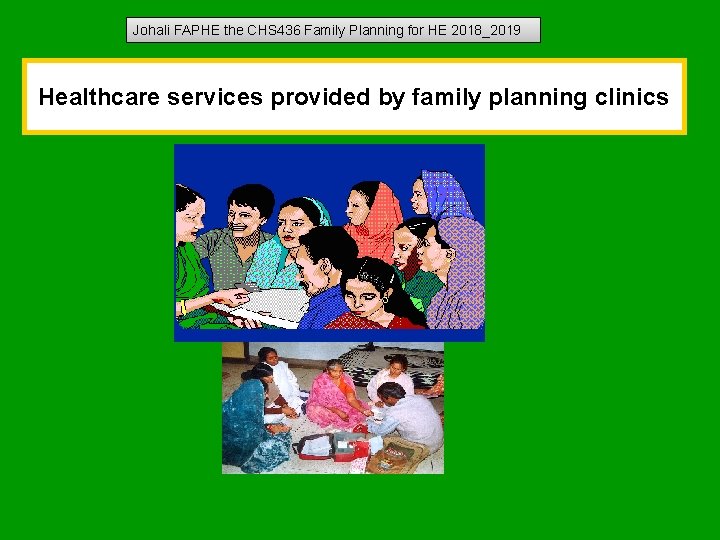
Johali FAPHE the CHS 436 Family Planning for HE 2018_2019 Healthcare services provided by family planning clinics
Johali FAPHE the CHS 436 Family Planning for HE 2018_2019 A - MEDICAL SERVICES • • Comprehensive physical exams & health screenings Pelvic and breast exams Pap smear Blood pressure & weight check Pregnancy testing & options counseling Preconceptual counseling Sexually Transmitted Diseases (STDs), On-site diagnosis & treatment • Birth control instruction & counseling • Infertility education and referral
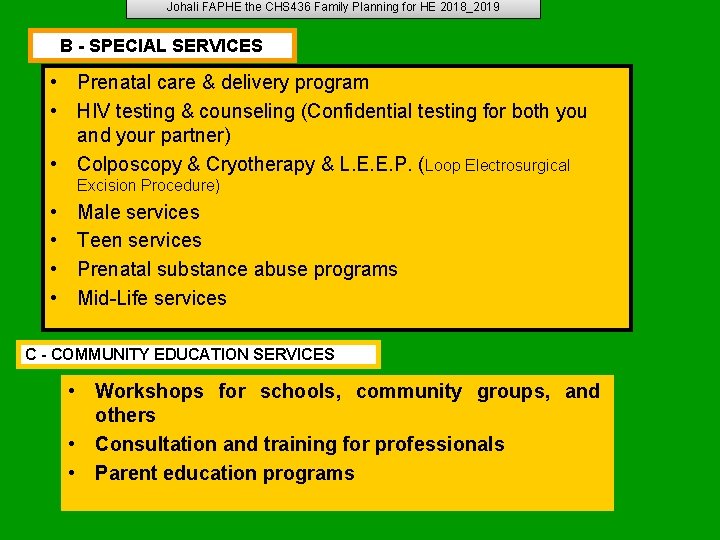
Johali FAPHE the CHS 436 Family Planning for HE 2018_2019 B - SPECIAL SERVICES • Prenatal care & delivery program • HIV testing & counseling (Confidential testing for both you and your partner) • Colposcopy & Cryotherapy & L. E. E. P. (Loop Electrosurgical Excision Procedure) • • Male services Teen services Prenatal substance abuse programs Mid-Life services C - COMMUNITY EDUCATION SERVICES • Workshops for schools, community groups, and others • Consultation and training for professionals • Parent education programs
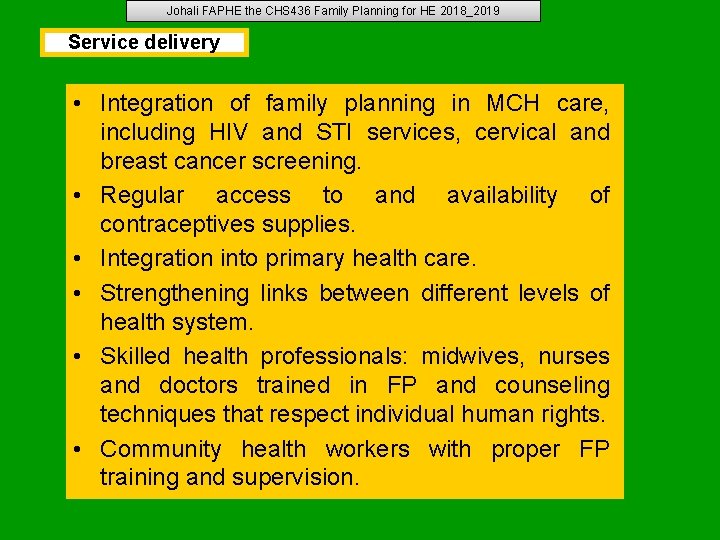
Johali FAPHE the CHS 436 Family Planning for HE 2018_2019 Service delivery • Integration of family planning in MCH care, including HIV and STI services, cervical and breast cancer screening. • Regular access to and availability of contraceptives supplies. • Integration into primary health care. • Strengthening links between different levels of health system. • Skilled health professionals: midwives, nurses and doctors trained in FP and counseling techniques that respect individual human rights. • Community health workers with proper FP training and supervision.
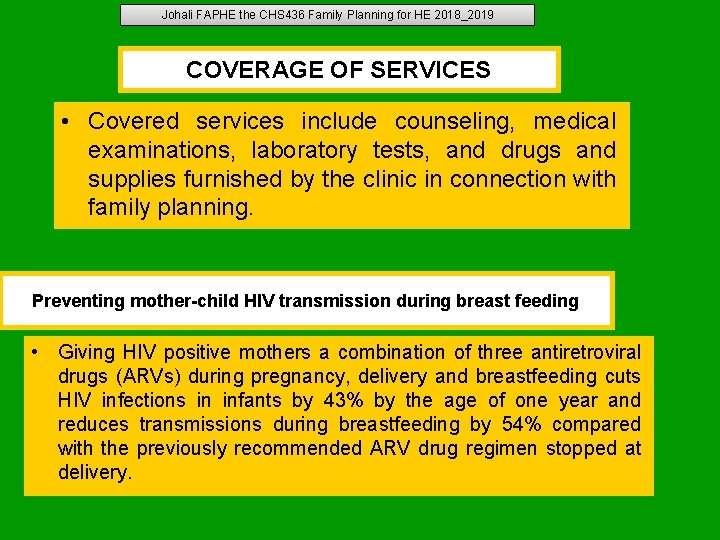
Johali FAPHE the CHS 436 Family Planning for HE 2018_2019 COVERAGE OF SERVICES • Covered services include counseling, medical examinations, laboratory tests, and drugs and supplies furnished by the clinic in connection with family planning. Preventing mother-child HIV transmission during breast feeding • Giving HIV positive mothers a combination of three antiretroviral drugs (ARVs) during pregnancy, delivery and breastfeeding cuts HIV infections in infants by 43% by the age of one year and reduces transmissions during breastfeeding by 54% compared with the previously recommended ARV drug regimen stopped at delivery.
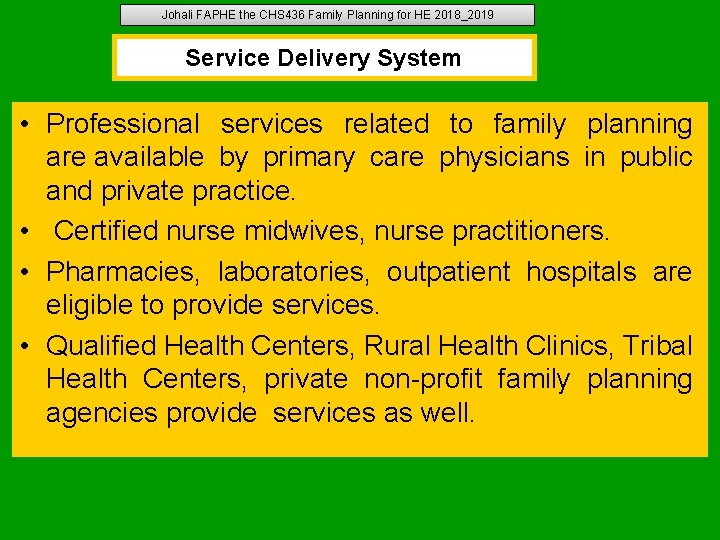
Johali FAPHE the CHS 436 Family Planning for HE 2018_2019 Service Delivery System • Professional services related to family planning are available by primary care physicians in public and private practice. • Certified nurse midwives, nurse practitioners. • Pharmacies, laboratories, outpatient hospitals are eligible to provide services. • Qualified Health Centers, Rural Health Clinics, Tribal Health Centers, private non-profit family planning agencies provide services as well.
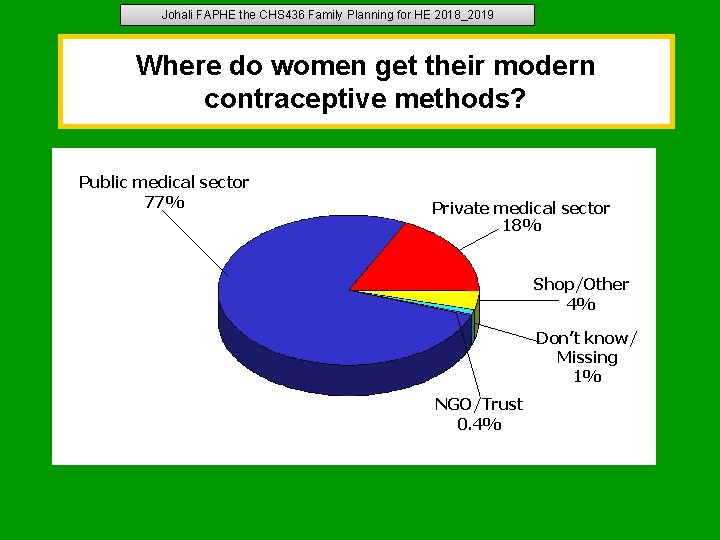
Johali FAPHE the CHS 436 Family Planning for HE 2018_2019 Where do women get their modern contraceptive methods? Public medical sector 77% Private medical sector 18% Shop/Other 4% Don’t know/ Missing 1% NGO/Trust 0. 4%
Family Planning Program planning, evaluation and develop models and steps National Family Health Survey-2
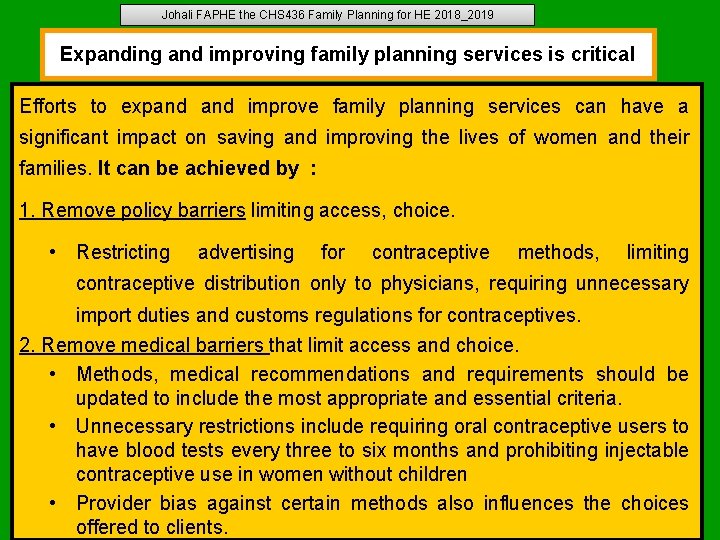
Johali FAPHE the CHS 436 Family Planning for HE 2018_2019 Expanding and improving family planning services is critical Efforts to expand improve family planning services can have a significant impact on saving and improving the lives of women and their families. It can be achieved by : 1. Remove policy barriers limiting access, choice. • Restricting advertising for contraceptive methods, limiting contraceptive distribution only to physicians, requiring unnecessary import duties and customs regulations for contraceptives. 2. Remove medical barriers that limit access and choice. • Methods, medical recommendations and requirements should be updated to include the most appropriate and essential criteria. • Unnecessary restrictions include requiring oral contraceptive users to have blood tests every three to six months and prohibiting injectable contraceptive use in women without children • Provider bias against certain methods also influences the choices National Family Health Survey-2 offered to clients.
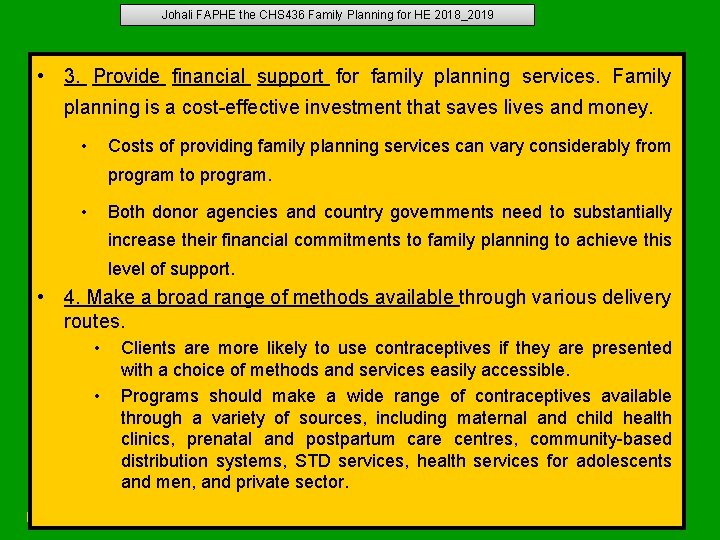
Johali FAPHE the CHS 436 Family Planning for HE 2018_2019 • 3. Provide financial support for family planning services. Family planning is a cost-effective investment that saves lives and money. • Costs of providing family planning services can vary considerably from program to program. • Both donor agencies and country governments need to substantially increase their financial commitments to family planning to achieve this level of support. • 4. Make a broad range of methods available through various delivery routes. • • Clients are more likely to use contraceptives if they are presented with a choice of methods and services easily accessible. Programs should make a wide range of contraceptives available through a variety of sources, including maternal and child health clinics, prenatal and postpartum care centres, community-based distribution systems, STD services, health services for adolescents and men, and private sector. National Family Health Survey-2
Johali FAPHE the CHS 436 Family Planning for HE 2018_2019 5. Use appropriate information, education, and communication strategies to inform people. • Programs can help to ensure that couples have enough information to make • • • an informed decision through face-to-face counseling with appropriate print materials and by using the mass media. All community-based communication channels and systems should be utilized, particularly those involving local leaders, healers, and events. All forms of communication should be culturally appropriate and respectful of the client's needs. Counseling process should be an interactive one; 6. Support provider training and supervision. • • • Training workers in interpersonal communication and counseling skills as well as in technical aspects of contraceptive service provision yields positive results. Clients who receive services from trained providers are more likely to accept and use contraception, report fewer and milder side effects, and return for regular visits. Supportive supervision helps to reinforce skills learned in training. National Family Health Survey-2
Johali FAPHE the CHS 436 Family Planning for HE 2018_2019 7. Support research and evaluation of family planning methods and programs. • Research on contraceptive technologies contributes to the development of new methods, improvement of existing methods, and knowledge of method safety. • Research on how family planning programs operate can help determine the best ways of providing different contraceptive methods in diverse cultures and program settings. • Information from both types of research is critical to expanding the acceptability and impact of family planning programs. Look tom the figure _ redraw … research and; Redraw your smart planning and development model
Use the above 7 Steps to Redraw your smart planning and development model it can be 7 Or 11+ Steps !? For You
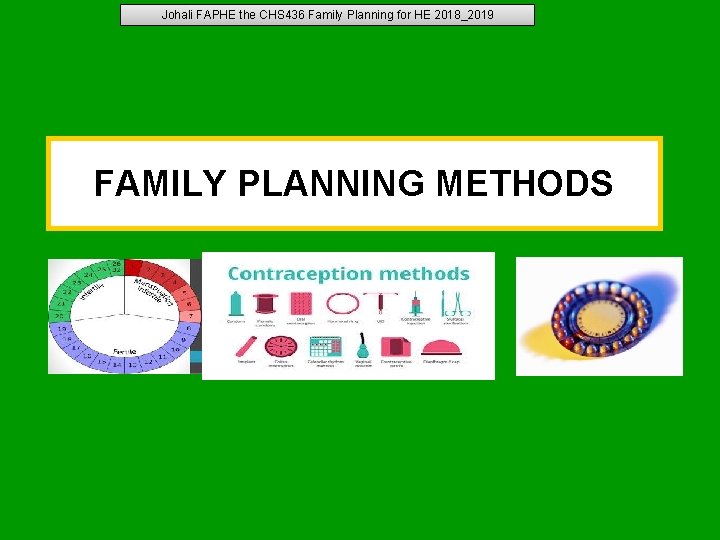
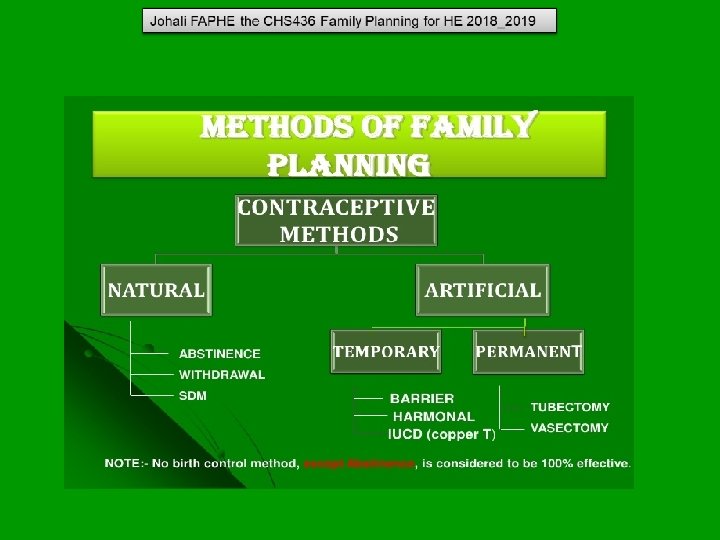
Johali FAPHE the CHS 436 Family Planning for HE 2018_2019 FAMILY PLANNING METHODS
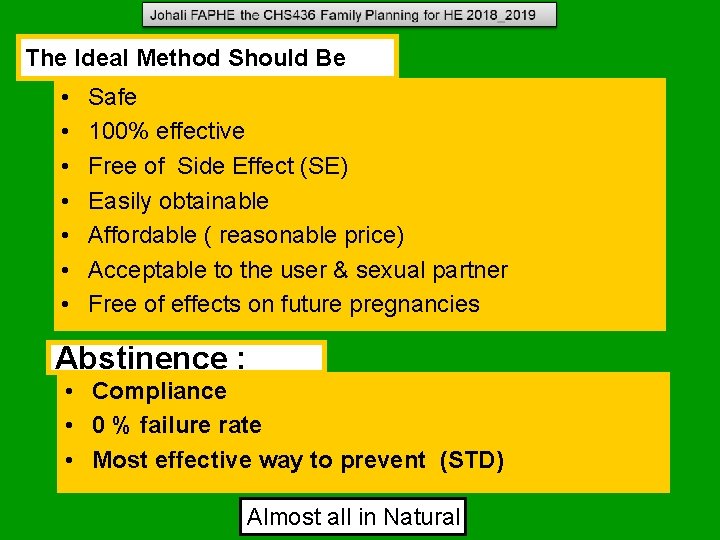
The Ideal Method Should Be • • Safe 100% effective Free of Side Effect (SE) Easily obtainable Affordable ( reasonable price) Acceptable to the user & sexual partner Free of effects on future pregnancies Abstinence : • Compliance • 0 % failure rate • Most effective way to prevent (STD) Almost all in Natural
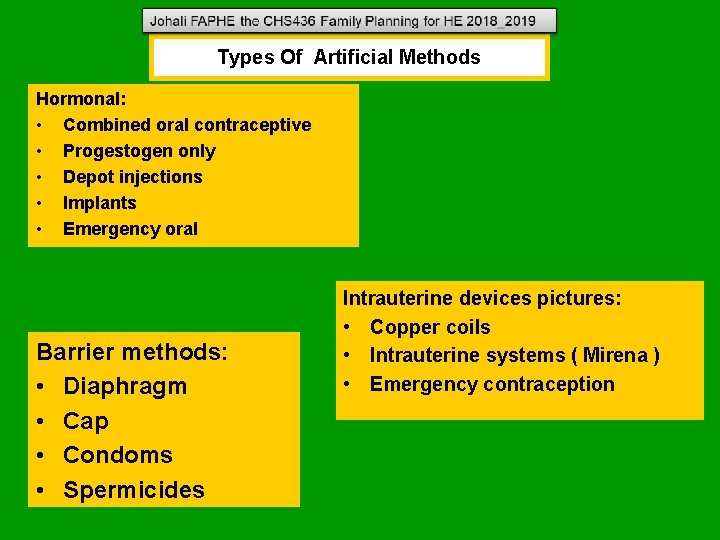
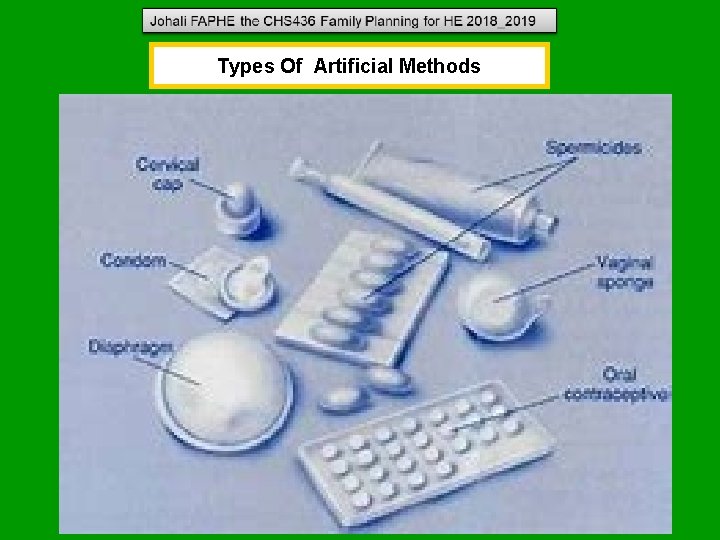
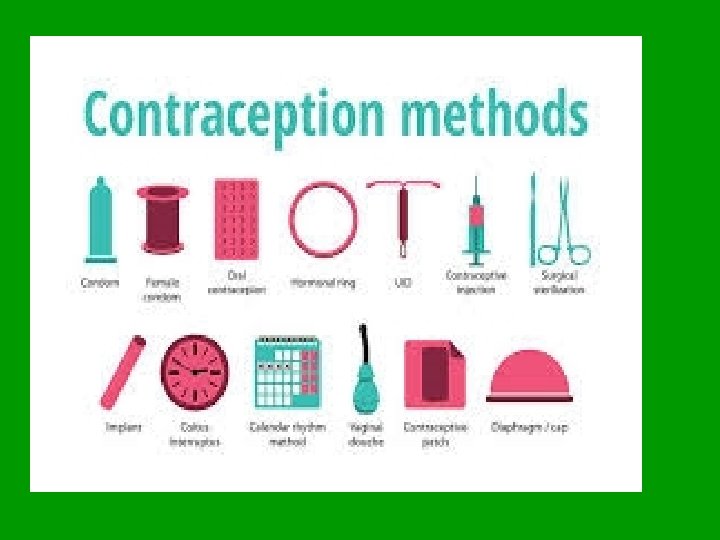
Types Of Artificial Methods Hormonal: • Combined oral contraceptive • Progestogen only • Depot injections • Implants • Emergency oral Barrier methods: • Diaphragm • Cap • Condoms • Spermicides Intrauterine devices pictures: • Copper coils • Intrauterine systems ( Mirena ) • Emergency contraception
Types Of Artificial Methods
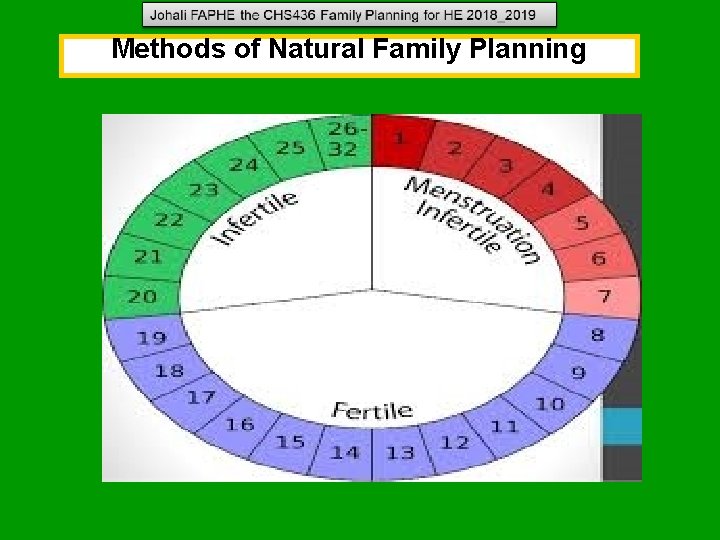
Methods of Natural Family Planning
Fertility is the quality of being fertile and productiveness Fertility is the natural capability to produce offspring (children) Fertility differs from fecundity, which is defined as the potential for reproduction (influenced by gamete production, fertilization and carrying a pregnancy to term). A lack of fertility is infertility while a lack of fecundity would be called sterility Pregnancy Anticipating a new baby is one of life's most unique and precious experience.
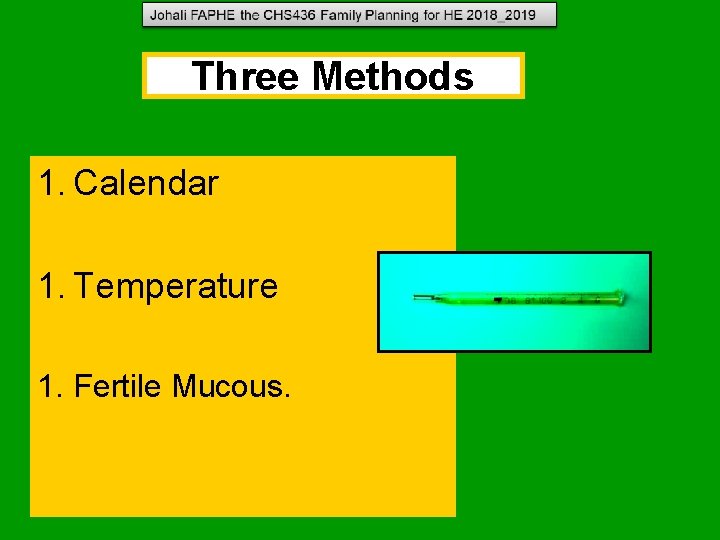
Three Methods 1. Calendar 1. Temperature 1. Fertile Mucous.
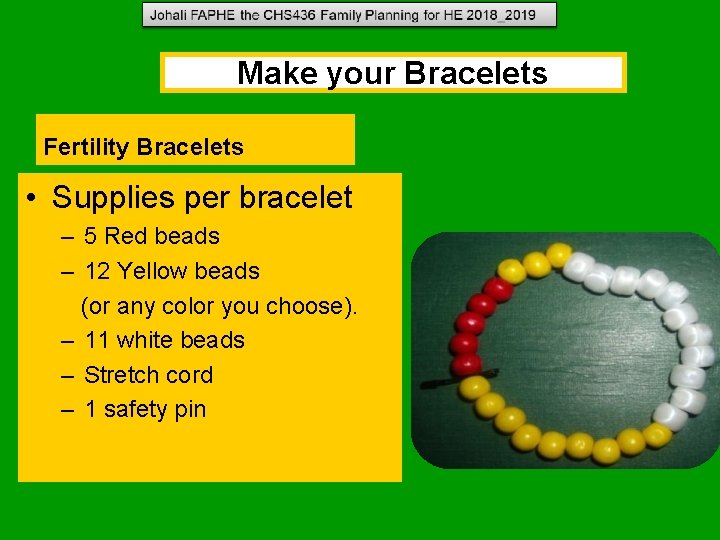
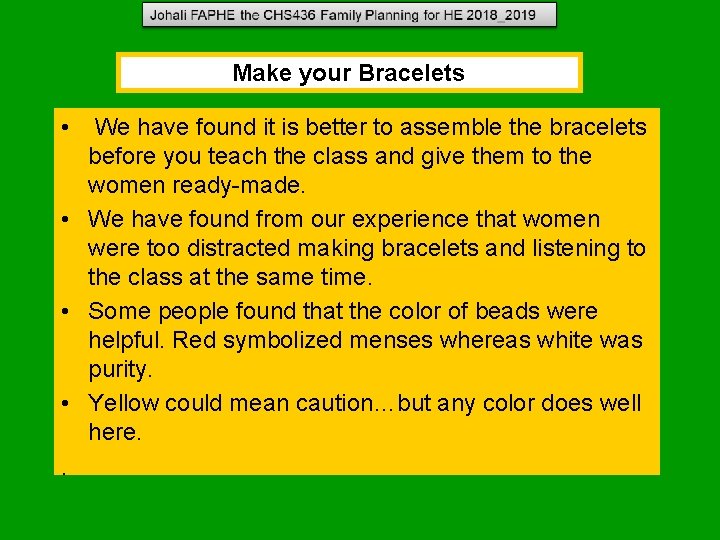
Make your Bracelets Fertility Bracelets • Supplies per bracelet – 5 Red beads – 12 Yellow beads (or any color you choose). – 11 white beads – Stretch cord – 1 safety pin
Make your Bracelets • We have found it is better to assemble the bracelets before you teach the class and give them to the women ready-made. • We have found from our experience that women were too distracted making bracelets and listening to the class at the same time. • Some people found that the color of beads were helpful. Red symbolized menses whereas white was purity. • Yellow could mean caution…but any color does well here. .
What do we do? • Men are always fertile and women are fertile once a month. Answer = When is a women fertile?
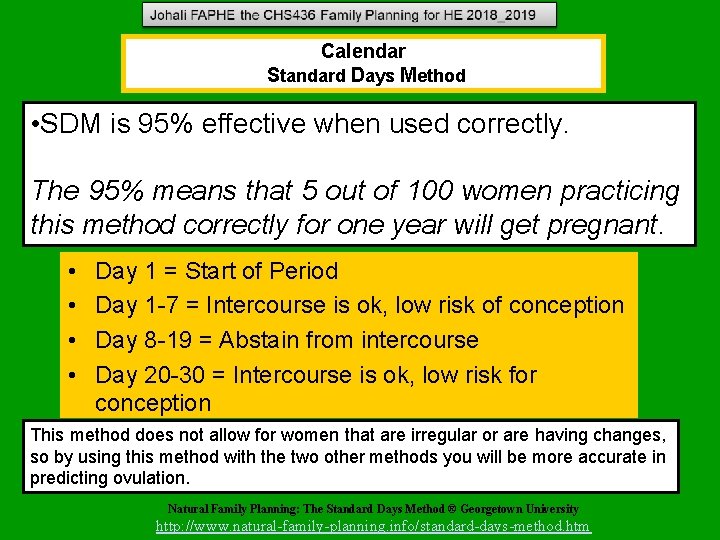
Calendar Standard Days Method • SDM is 95% effective when used correctly. The 95% means that 5 out of 100 women practicing this method correctly for one year will get pregnant. • • Day 1 = Start of Period Day 1 -7 = Intercourse is ok, low risk of conception Day 8 -19 = Abstain from intercourse Day 20 -30 = Intercourse is ok, low risk for conception This method does not allow for women that are irregular or are having changes, so by using this method with the two other methods you will be more accurate in predicting ovulation. Natural Family Planning: The Standard Days Method ® Georgetown University http: //www. natural-family-planning. info/standard-days-method. htm
Read _ Training _ Play role of Practice The Standard Days Method® and Cycle. Beads® A Simple Fertility Awareness-based Approach to Family Planning
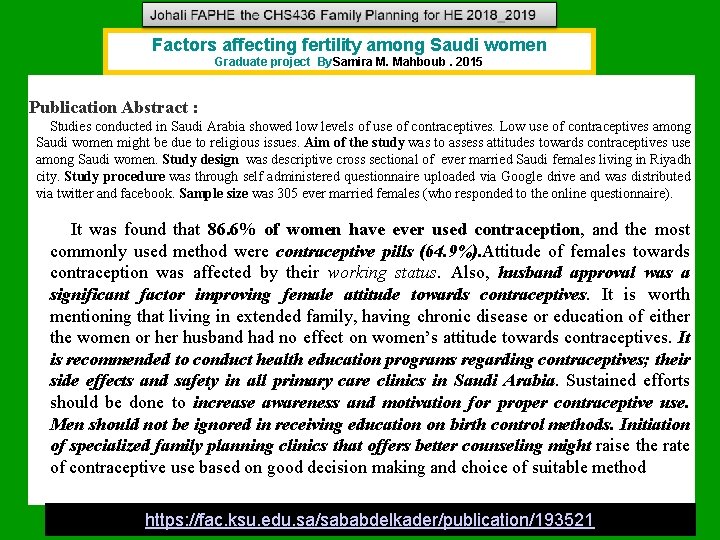
Factors affecting fertility among Saudi women Graduate project By. Samira M. Mahboub. 2015 Publication Abstract : Studies conducted in Saudi Arabia showed low levels of use of contraceptives. Low use of contraceptives among Saudi women might be due to religious issues. Aim of the study was to assess attitudes towards contraceptives use among Saudi women. Study design was descriptive cross sectional of ever married Saudi females living in Riyadh city. Study procedure was through self administered questionnaire uploaded via Google drive and was distributed via twitter and facebook. Sample size was 305 ever married females (who responded to the online questionnaire). It was found that 86. 6% of women have ever used contraception, and the most commonly used method were contraceptive pills (64. 9%). Attitude of females towards contraception was affected by their working status. Also, husband approval was a significant factor improving female attitude towards contraceptives. It is worth mentioning that living in extended family, having chronic disease or education of either the women or her husband had no effect on women’s attitude towards contraceptives. It is recommended to conduct health education programs regarding contraceptives; their side effects and safety in all primary care clinics in Saudi Arabia. Sustained efforts should be done to increase awareness and motivation for proper contraceptive use. Men should not be ignored in receiving education on birth control methods. Initiation of specialized family planning clinics that offers better counseling might raise the rate of contraceptive use based on good decision making and choice of suitable method https: //fac. ksu. edu. sa/sababdelkader/publication/193521
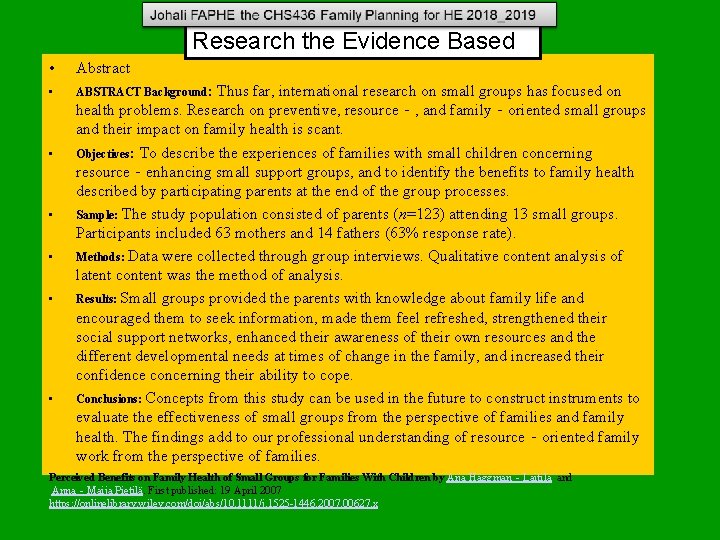
Research the Evidence Based • Abstract • ABSTRACT Background: Thus far, international research on small groups has focused on • • • health problems. Research on preventive, resource‐, and family‐oriented small groups and their impact on family health is scant. Objectives: To describe the experiences of families with small children concerning resource‐enhancing small support groups, and to identify the benefits to family health described by participating parents at the end of the group processes. Sample: The study population consisted of parents (n=123) attending 13 small groups. Participants included 63 mothers and 14 fathers (63% response rate). Methods: Data were collected through group interviews. Qualitative content analysis of latent content was the method of analysis. Results: Small groups provided the parents with knowledge about family life and encouraged them to seek information, made them feel refreshed, strengthened their social support networks, enhanced their awareness of their own resources and the different developmental needs at times of change in the family, and increased their confidence concerning their ability to cope. Conclusions: Concepts from this study can be used in the future to construct instruments to evaluate the effectiveness of small groups from the perspective of families and family health. The findings add to our professional understanding of resource‐oriented family work from the perspective of families. Perceived Benefits on Family Health of Small Groups for Families With Children by Arja Häggman‐Laitila and Anna‐Maija Pietilä. First published: 19 April 2007 https: //onlinelibrary. wiley. com/doi/abs/10. 1111/j. 1525 -1446. 2007. 00627. x
Family Planning Programs Plan _ Evaluate and Develop https: //www. healthypeople. gov Self Learning Activities
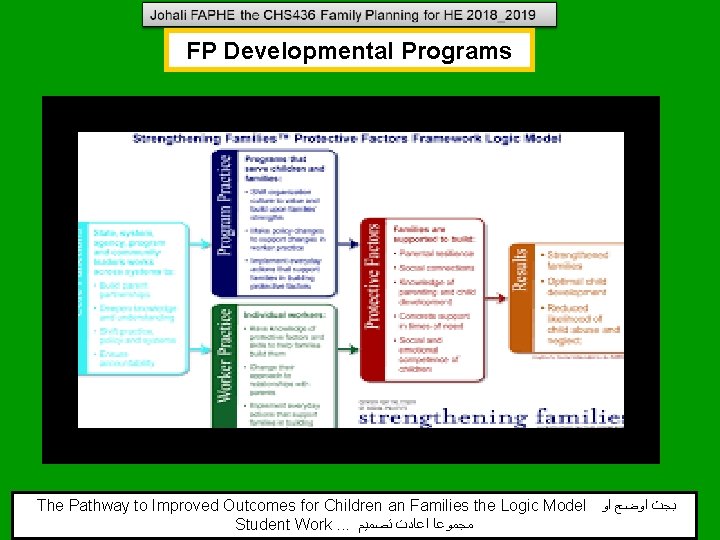
FP Developmental Programs The Pathway to Improved Outcomes for Children an Families the Logic Model ﺍﻭﺿﺢ ﺑﺠﺚ Student Work. . . ﺗﺼﻤﻴﻢ ﺍﻋﺎﺩﺕ ﻣﺠﻤﻮﻋﺎ
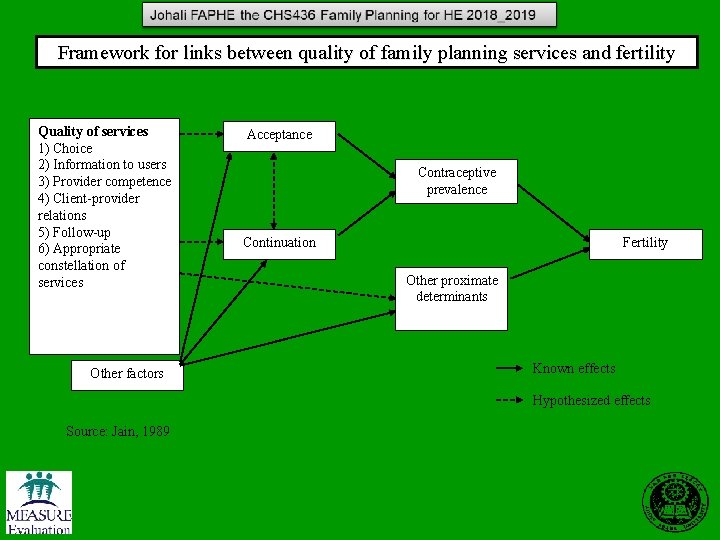
Framework for links between quality of family planning services and fertility This is a conceptual framework that specifies the links between the quality of family-planning services and outcomes and impacts at the population level developed by Anrudh Jain in 1989. On the left of the framework are the six dimensions of quality as defined in the Bruce-Jain framework. Quality of care is hypothesized to influence both contraceptive adoption and contraceptive continuation, which in turn influences contraceptive prevalence and fertility. There is also another “black box” for other factors that influence acceptance and continuation as well as other proximate determinants which in turn influence fertility. These boxes are not expanded further because they are not central to the conceptualization of the impact of quality on population outcomes. The impact evaluation question is, therefore, to demonstrate the link between quality of family planning services and population outcomes such as contraceptive adoption and continuation and current contraceptive use.
Framework for links between quality of family planning services and fertility Quality of services 1) Choice 2) Information to users 3) Provider competence 4) Client-provider relations 5) Follow-up 6) Appropriate constellation of services Other factors Acceptance Contraceptive prevalence Continuation Fertility Other proximate determinants Known effects Hypothesized effects Source: Jain, 1989
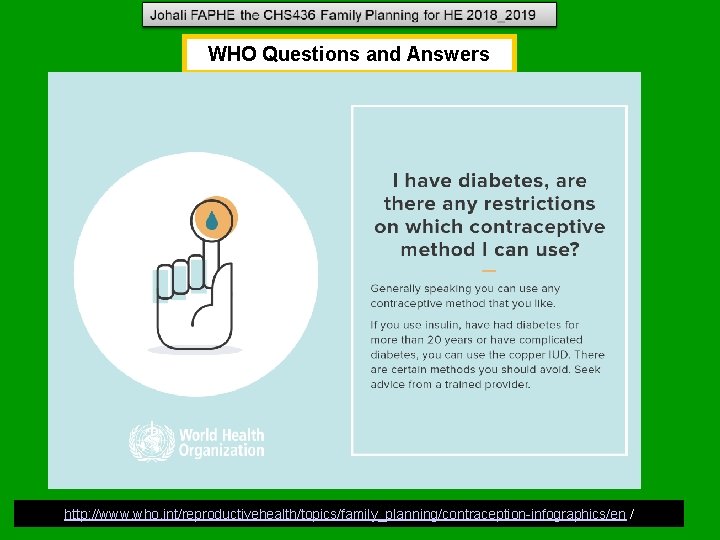
WHO Questions and Answers http: //www. who. int/reproductivehealth/topics/family_planning/contraception-infographics/en /
Islam and Family Planning You have to discover more !? (smart assignments) Med J Malaysia. 2003 Mar; 58 Suppl A: 49 -60. Social and religious dimensions of unwanted pregnancy: an Islamic perspective. Kasule OH. Abstract The concept of 'unwanted pregnancy' is a recent in human history and is associated with social stresses of modern life. The purposes of the law, maqasid al shari'at, and its principles, qawa'id a shari'at, focus on preventing 'unwanted pregnancy', protecting the rights of the fetus and infant, and mitigating (justifying) the adverse effects of 'unwanted pregnancy' by social measures. ‘ So; the Unwanted pregnancy' is associated with: 1) General social determinants (hedonistic life styles “ seeking pleasure unethical to us” _ sexual transgression “ «����� , addiction to drugs, fear of poverty, and low female status) and’ 2) Specific antecedent causes (sexual crimes, egoistic greed, maternal/fetal disease, and gender discrimination).
Islam and Family Planning You have to discover more !? (smart assignments) Med J Malaysia. 2003 Mar; 58 Suppl A: 49 -60. 2) Specific antecedent causes (sexual crimes, egoistic greed “selfish greedy ﻏ�ﻴ�ﺓ « `ﺍﻭ ﺧ�ﻴﺌﺔ ﺫﺍﺗﻴﺔ , maternal/fetal disease, and gender discrimination). These are prevented by sexual hygiene, marriage, contraception, deterring sexual crimes, and raising the status of women. The adverse sequelae of 'unwanted pregnancy' (feticide, infanticide, or child abuse and neglect) these can be prevented by defending the basic human right of the fetus and infant to life, promoting social institutions for child welfare (nuclear family, extended family, foster care ���� , and open adoption ����� ). Closed adoption ﺍﻟﻘﺮﻳﺐ ﺗﺒﻨﻲ is forbidden by Law but care in a foster home is allowed and is encouraged if the nuclear and extended families are unwilling or are unable to care for children. Abortion at any stage of pregnancy is a crime against humanity. It is not a solution to the problem but is part of the problem. It will encourage more 'unwanted pregnancies'.
Islam and Family Planning You have to discover !? Place of G=Family Planning and Child health in Islam ( For You Student Centred )
Resources _ References The Basics of Community-Based FP Course BASICS OF COMMUNITY-BASED FAMILY PLANNING TRAINING CURRICULUM Facilitators Guide Updated on April 27, 2009 This course was developed by the Child Survival Technical Support Plus (CSTS+) Project at Macro International, with funds from the Office of Population Reproductive Health Flexible Fund. References 1 Centers for Disease Control and Prevention. Achievements in public health, 1900– 1999: Family planning. MMWR Weekly. 1999 Dec 3; 48(47): 1073 -80. Available from: https: //www. cdc. gov/mmwr/preview/mmwrhtml/mm 4847 a 1. htm 2 Sonfield A, Hasstedt K and Gold RB, Moving Forward: Family Planning in the Era of Health Reform, New York: Guttmacher Institute, 2014. 3 Gipson J, Koenig M, Hindin M (2008). The effects of unintended pregnancy on infant, child and parental health: A review of the literature. Studies in Family Planning; 39(1): 18 -38. 4 Guttmacher Institute. In Brief: Facts on Publicly Funded Contraceptive Services in the United States. New York, NY: 2014. Available from: https: //www. guttmacher. org/pubs/fb_contraceptive_serv. html 5 Gavin L, Moskosky S, Carter M, et al. Providing quality family planning services: recommendations of CDC and the US Office of Population Affairs. MMWR Recomm Rep 2014; 63(No. RR-04. ( 6 Gavin L, Pazol K. Update: Providing Quality Family Planning Services — Recommendations from CDC and the U. S. Office of Population Affairs, 2015. MMWR Morb Mortal Wkly Rep 2016; 65: 231– 234. DOI: http: //dx. doi. org/10. 15585/mmwr. mm 6509 a 3. 7 Frost J. US women’s reliance on publicly funded family planning clinics as their usual source of medical care. Paper presented at National Survey of Family Growth Research Conference; 2008 Oct; Hyattsville, MD. 8 Frost, J, Frohwirth L, Blades N, et al. Publicly Funded Contraceptive Services at U. S. Clinics, 2015, New York: Guttmacher Institute, 2017. Available from: https: //www. guttmacher. org/report/publicly-funded-contraceptive-services-us-clinics-2015 9 Lawrence B. Finer, Ph. D. , and Mia R. Zolna, M. P. H. Declines in Unintended Pregnancy in the United States, 2008– 2011, N Engl J Med 2016; 374: 843 -852 March 3, 2016 DOI: 10. 1056/NEJMsa 1506575. Available from: http: //www. nejm. org/doi/full/10. 1056/NEJMsa 1506575
4 Pillar 1: A vibrant society Our goals Our direction A vibrant society. . . …with strong roots • Serve 30 Million Umrah visitors "Focusing our efforts to serve Umrah visitors" "Living by Islamic values" "Taking pride in our national identity" • Increase household spending on cultural and entertainment to 6% …with fulfilling lives "Achieving environmental sustainability" "Developing our cities" "Living healthy, being healthy" "Promoting culture and entertainment" …with strong foundations • Increase the average life expectancy from 74 years to 80 years "Caring for our health" "Developing our children’s character" "Empowering our society"
SMART QUESTIONS
THANKS FOR BIENG READY & WELLING TO HELP and MOTIVATE FP To HAVE HEALTHY HAPPY SAUDI ARABIAN NATION