
Monitoring and Evaluation Family Planning Programs Session Objectives
Monitoring and Evaluation: Family Planning Programs

Session Objectives § Be able to apply basic M&E concepts (frameworks, indicators, etc. ) to family planning (FP) programs § Be able to summarize the main issues in M&E of FP programs from post-Cairo and MDG perspective § Be able to summarize the M&E issues for FP integration and quality of care programs.
Session Overview 1. Background on FP and current context 2. FP framework 3. FP Indicators 4. Monitoring quality of care 5. Evaluating the impact of quality 6. Integration of FP into other health programs
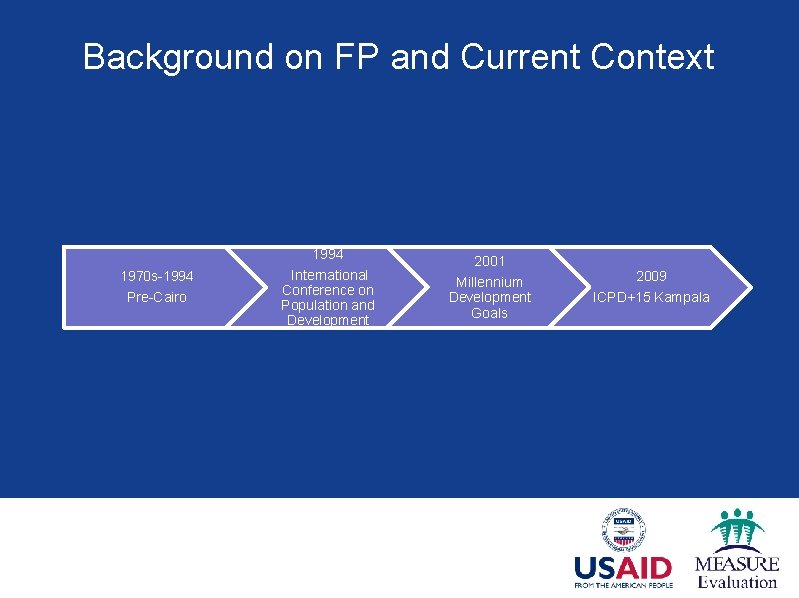
Background on FP and Current Context 1994 1970 s-1994 Pre-Cairo International Conference on Population and Development 2001 Millennium Development Goals 2009 ICPD+15 Kampala
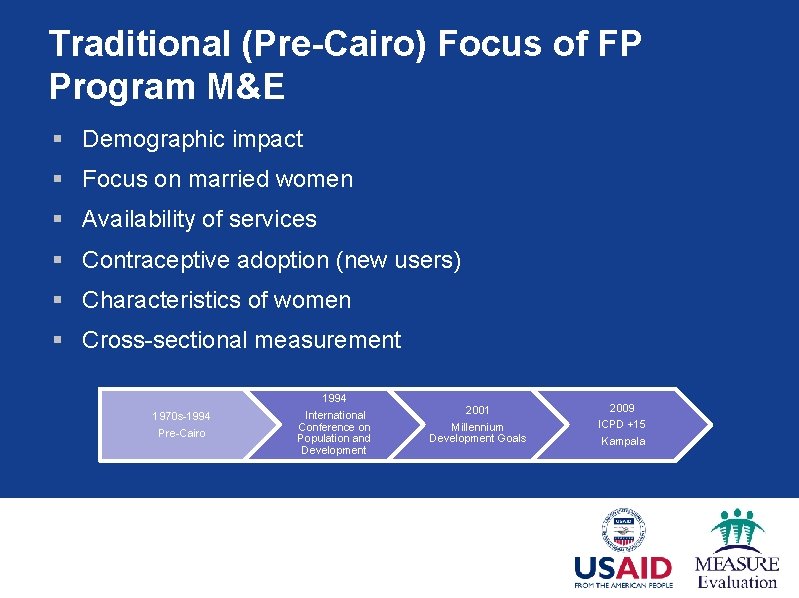
Traditional (Pre-Cairo) Focus of FP Program M&E § Demographic impact § Focus on married women § Availability of services § Contraceptive adoption (new users) § Characteristics of women § Cross-sectional measurement 1970 s-1994 Pre-Cairo 1994 International Conference on Population and Development 2001 Millennium Development Goals 2009 ICPD +15 Kampala
Cairo: Objectives of FP Programs Overall, called for a shift to broader definition of reproductive health, explicit focus on gender, human rights, and reproductive choice. Objectives included: § To help couples and individuals meet their reproductive goals § To prevent unwanted and high-risk pregnancies § To make quality FP services affordable, acceptable, and accessible § To improve the quality of FP information education communication, counseling, and services § To increase participation and sharing of responsibility of men in FP § To promote breastfeeding to enhance birth spacing 1970 s-1994 Pre-Cairo 1994 International Conference on Population and Development 2001 Millennium Development Goals 2009 ICPD +15 Kampala
Background on MDGs § Worldwide commitment to ending poverty § Consists of eight anti-poverty goals to be achieved by 2015 § Goals include: § Goal 1: Eradicate extreme poverty and hunger § Goal 2: Achieve universal primary education § Goal 3: Promote gender equality and empower women § Goal 4: Reduce child mortality § Goal 5: Improve maternal health § Goal 6: Combat HIV/AIDS, malaria and other diseases § Goal 7: Ensure environmental sustainability § Goal 8: Develop a Global Partnership for Development 1970 s-1994 Pre-Cairo 1994 International Conference on Population and Development 2000 Millennium Development Goals 2009 ICPD +15 Kampala
FP and MDGs § FP and Reproductive health as defined by ICPD NOT originally included as a goal or a target, but later included within goal 5 in 2006 § 5. B: Achieve universal access to reproductive health § Emphasis on scale-up of RH services § MDGS had a broader focus § FP greatly influences all MDGs especially: § Goal 3: Promote gender equality and empower women § Goal 5: Improve maternal health § Goal 6: Combat HIV/AIDS, malaria, and other diseases 1970 s-1994 Pre-Cairo 1994 International Conference on Population and Development 2001 Millennium Development Goals 2009 ICPD +15 Kampala
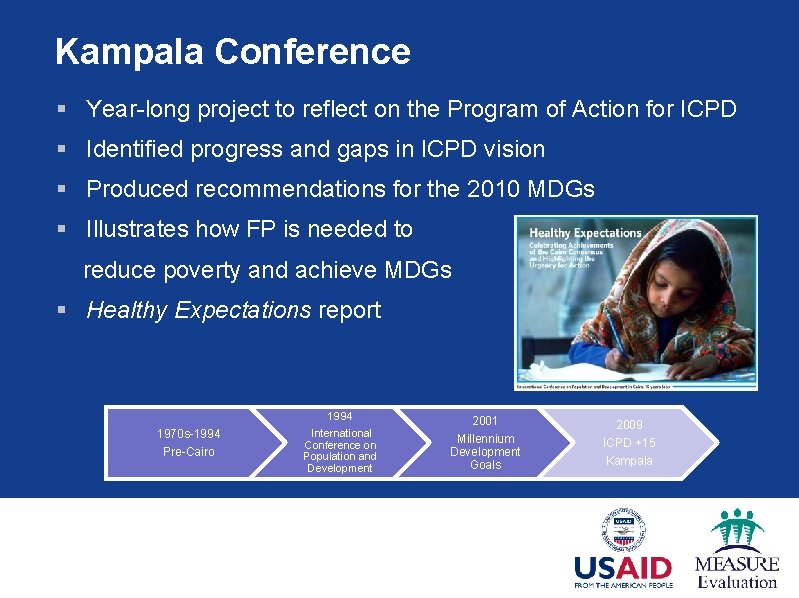
Kampala Conference § Year-long project to reflect on the Program of Action for ICPD § Identified progress and gaps in ICPD vision § Produced recommendations for the 2010 MDGs § Illustrates how FP is needed to reduce poverty and achieve MDGs § Healthy Expectations report 1970 s-1994 Pre-Cairo 1994 International Conference on Population and Development 2001 Millennium Development Goals 2009 ICPD +15 Kampala
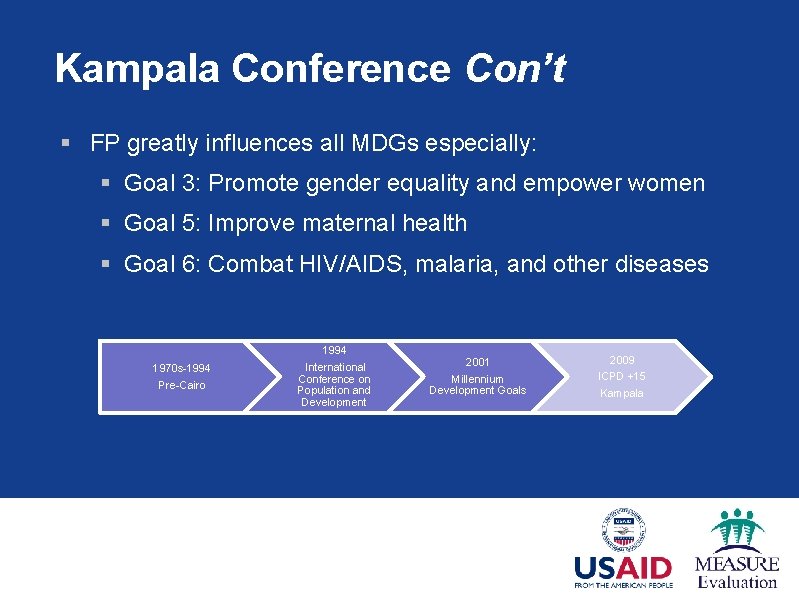
Kampala Conference Con’t § FP greatly influences all MDGs especially: § Goal 3: Promote gender equality and empower women § Goal 5: Improve maternal health § Goal 6: Combat HIV/AIDS, malaria, and other diseases 1970 s-1994 Pre-Cairo 1994 International Conference on Population and Development 2001 Millennium Development Goals 2009 ICPD +15 Kampala
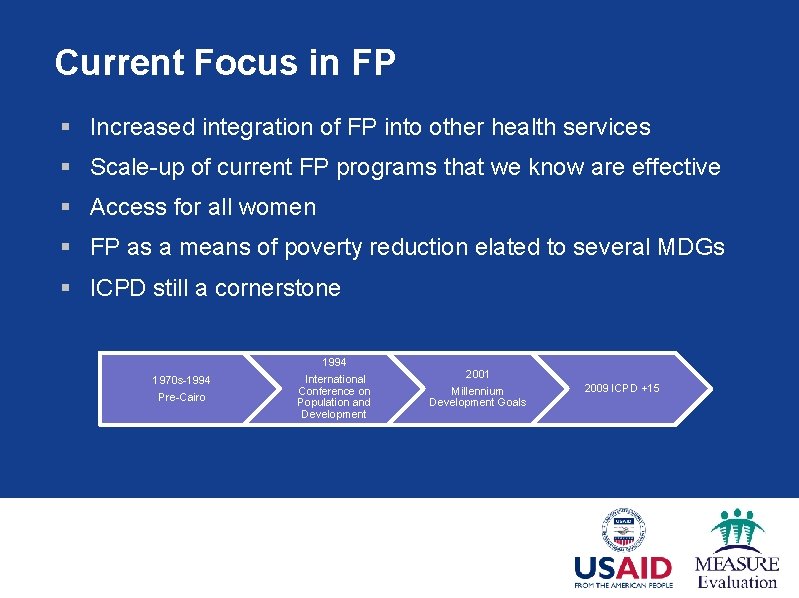
Current Focus in FP § Increased integration of FP into other health services § Scale-up of current FP programs that we know are effective § Access for all women § FP as a means of poverty reduction elated to several MDGs § ICPD still a cornerstone 1970 s-1994 Pre-Cairo 1994 International Conference on Population and Development 2001 Millennium Development Goals 2009 ICPD +15
Exercise 1: Implications of Global Policy Changes § Discuss the implications of ICPD & MDGs for M&E of FP programs. § Identify three or more ways in which the traditional focus of FP programs might shift in light of the MDG agenda. § What are the implications of these changes for M&E?
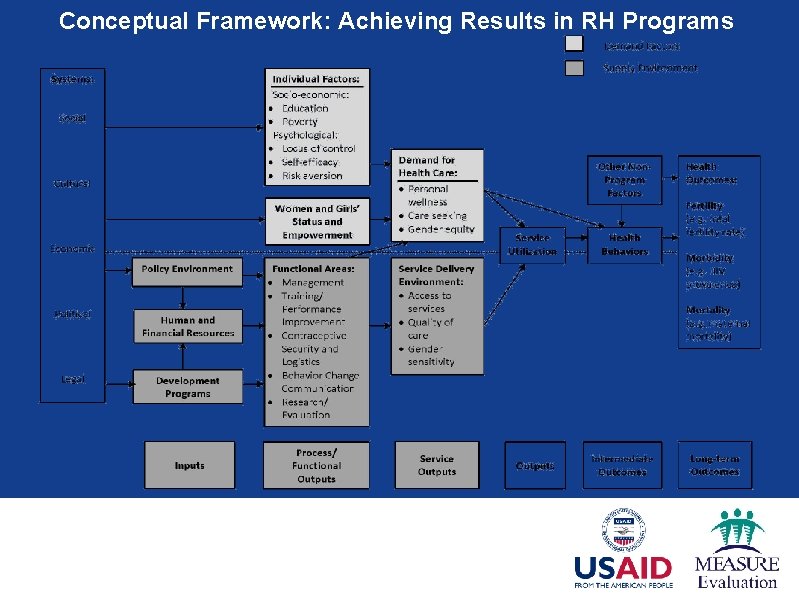
Conceptual Framework: Achieving Results in RH Programs
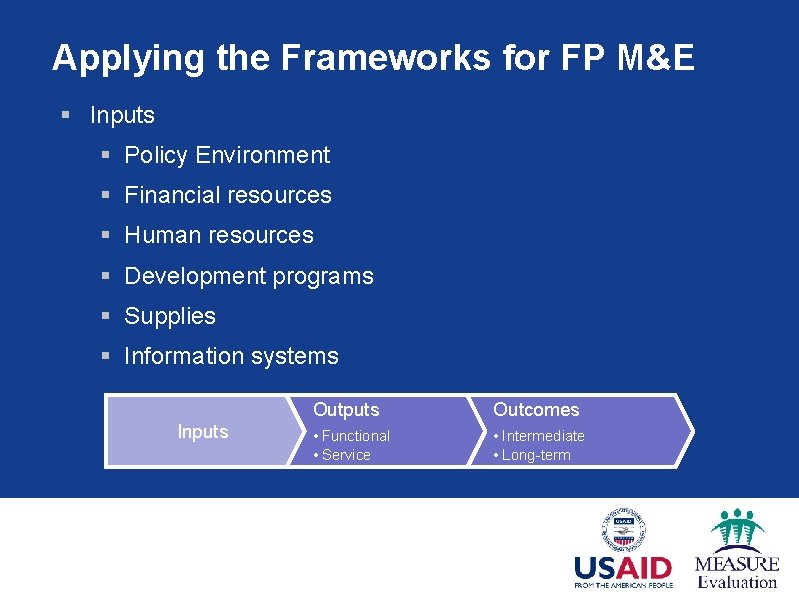
Applying the Frameworks for FP M&E § Inputs § Policy Environment § Financial resources § Human resources § Development programs § Supplies § Information systems Inputs Outcomes • Functional • Service • Intermediate • Long-term
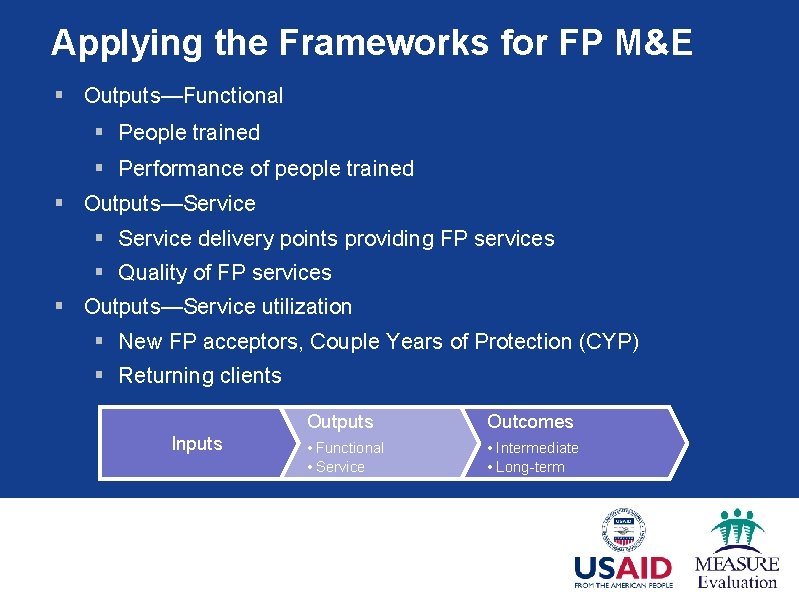
Applying the Frameworks for FP M&E § Outputs—Functional § People trained § Performance of people trained § Outputs—Service § Service delivery points providing FP services § Quality of FP services § Outputs—Service utilization § New FP acceptors, Couple Years of Protection (CYP) § Returning clients Inputs Outcomes • Functional • Service • Intermediate • Long-term
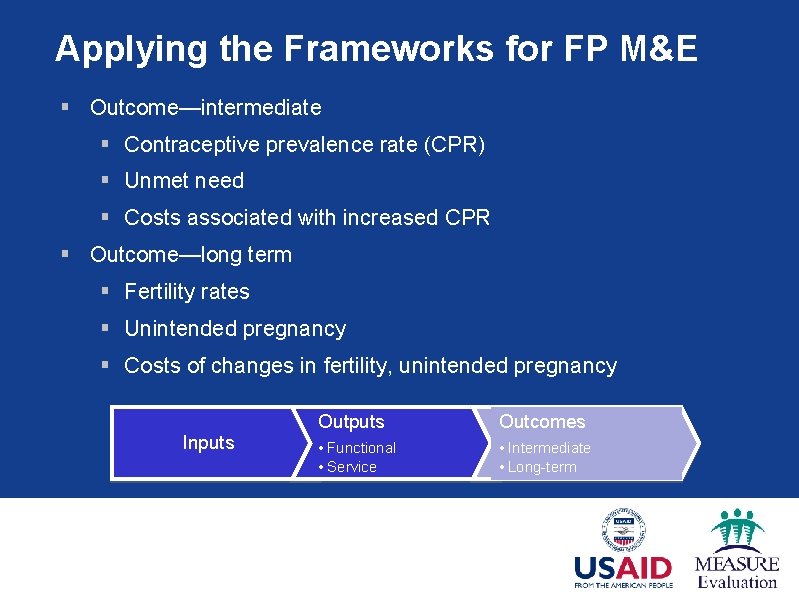
Applying the Frameworks for FP M&E § Outcome—intermediate § Contraceptive prevalence rate (CPR) § Unmet need § Costs associated with increased CPR § Outcome—long term § Fertility rates § Unintended pregnancy § Costs of changes in fertility, unintended pregnancy Inputs Outcomes • Functional • Service • Intermediate • Long-term
What is different about M&E of FP programs? § Basic principles are the same as in other health programs § Outcomes relatively well-defined, focused, and measurable § Long history of data collection on FP outcomes through WFS, DHS—document global trends § Attempts to link outcomes to program outputs—evidence of program effects
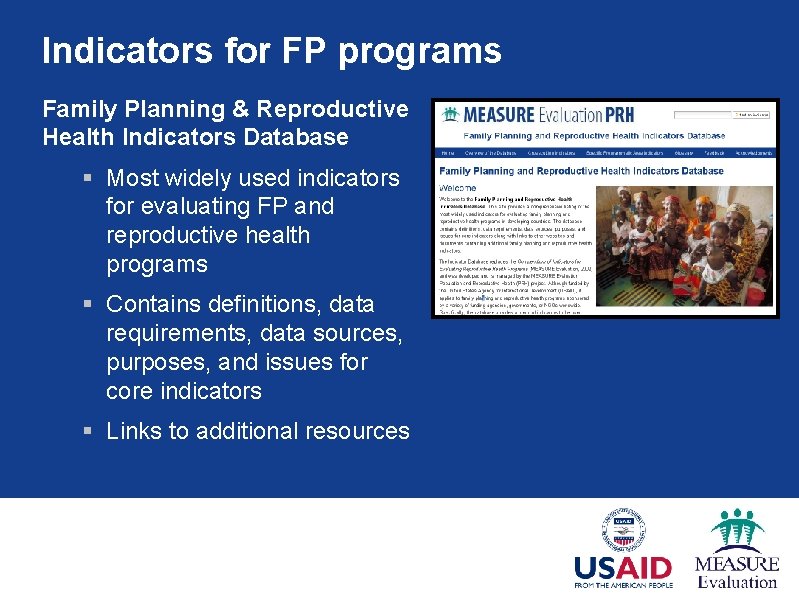
Indicators for FP programs Family Planning & Reproductive Health Indicators Database § Most widely used indicators for evaluating FP and reproductive health programs § Contains definitions, data requirements, data sources, purposes, and issues for core indicators § Links to additional resources
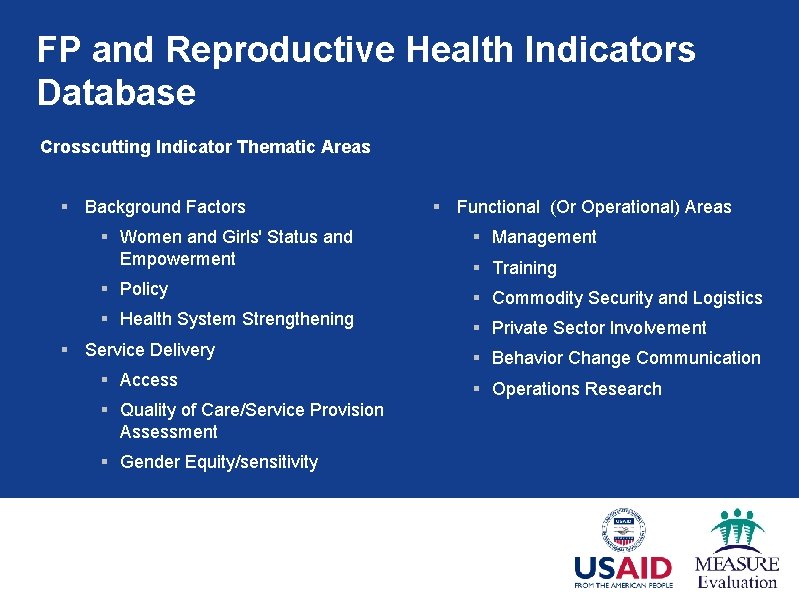
FP and Reproductive Health Indicators Database Crosscutting Indicator Thematic Areas § Background Factors § Functional (Or Operational) Areas § Women and Girls' Status and Empowerment § Management § Policy § Commodity Security and Logistics § Health System Strengthening § Private Sector Involvement § Service Delivery § Access § Quality of Care/Service Provision Assessment § Gender Equity/sensitivity § Training § Behavior Change Communication § Operations Research
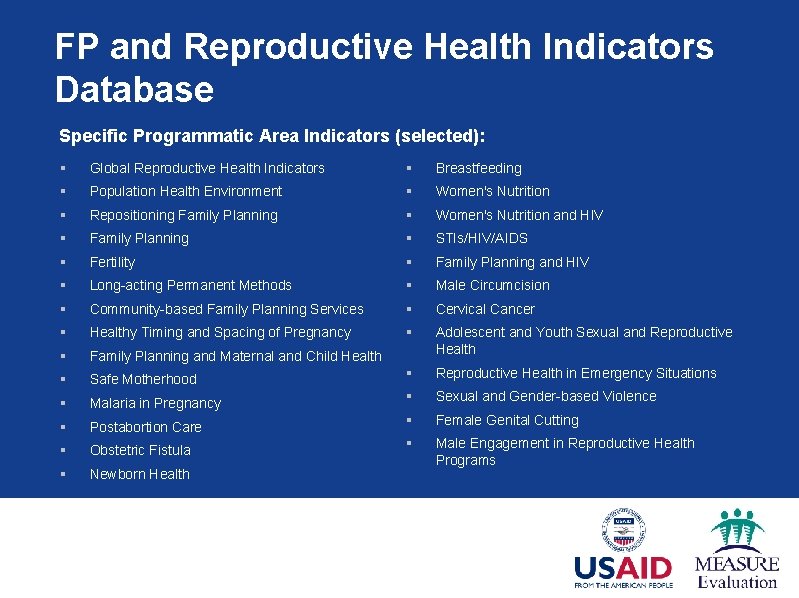
FP and Reproductive Health Indicators Database Specific Programmatic Area Indicators (selected): § Global Reproductive Health Indicators § Breastfeeding § Population Health Environment § Women's Nutrition § Repositioning Family Planning § Women's Nutrition and HIV § Family Planning § STIs/HIV/AIDS § Fertility § Family Planning and HIV § Long-acting Permanent Methods § Male Circumcision § Community-based Family Planning Services § Cervical Cancer § Healthy Timing and Spacing of Pregnancy § § Family Planning and Maternal and Child Health Adolescent and Youth Sexual and Reproductive Health § Safe Motherhood § Reproductive Health in Emergency Situations § Malaria in Pregnancy § Sexual and Gender-based Violence § Postabortion Care § Female Genital Cutting § Obstetric Fistula § § Newborn Health Male Engagement in Reproductive Health Programs
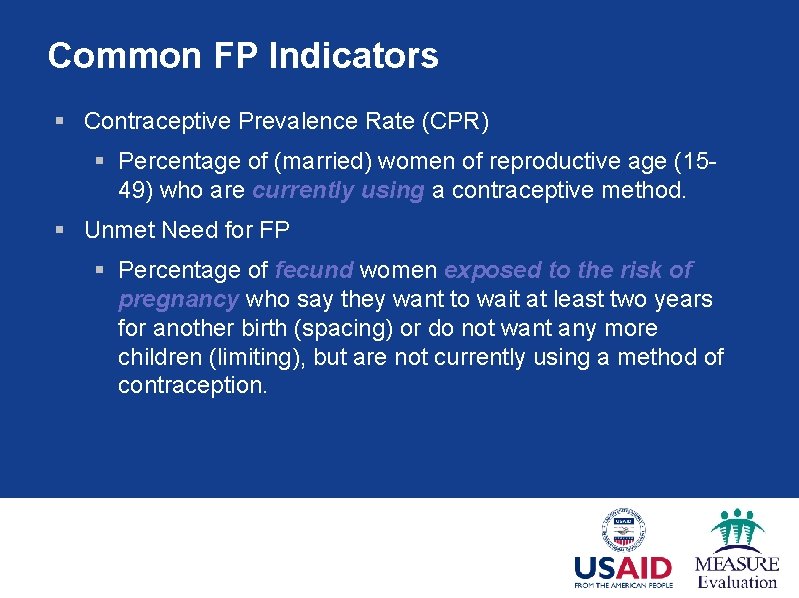
Common FP Indicators § Contraceptive Prevalence Rate (CPR) § Percentage of (married) women of reproductive age (1549) who are currently using a contraceptive method. § Unmet Need for FP § Percentage of fecund women exposed to the risk of pregnancy who say they want to wait at least two years for another birth (spacing) or do not want any more children (limiting), but are not currently using a method of contraception.
Related Indicators § Demand for FP § Percentage of (married) women using FP + percentage (married) women with unmet need for FP § Percentage of demand satisfied § Percentage of (married) women using FP / percentage (married) women with demand for FP
CPR vs Unmet Need CPR Unmet Need § Relatively simple to define § Relatively complex to define § Uni-dimensional § Consistency over time § Does not capture concept of meeting needs § Multi-dimensional— demand & use § Definition has evolved § Captures concept of meeting need
Exercise 2: Unmet Need § Do the indicators show the same patterns in each country? § Which countries seem to be the most successful in FP based on each indicator? § Do your conclusions vary depending on which indicator you look at? § How do the trends in one indicator influence your interpretation or understanding of trends in the other? § What does this tell you about the advantages and disadvantages of each indicator?
Unmet Need Exercise
Monitoring Quality of Care
What is Quality of Care in FP? § General, loosely-defined concept § Multidimensional § Context specific Why is it important? § Higher utilization of services § Fewer unintended pregnancies
Bruce-Jain Framework § Choice of contraceptive methods § Information given to users § Provider competence § client/provider relations § re-contact and follow-up mechanisms § appropriate constellation of services This definition has been expanded to look at a larger range of RH services, incentives, gender, standards of care and access issues.
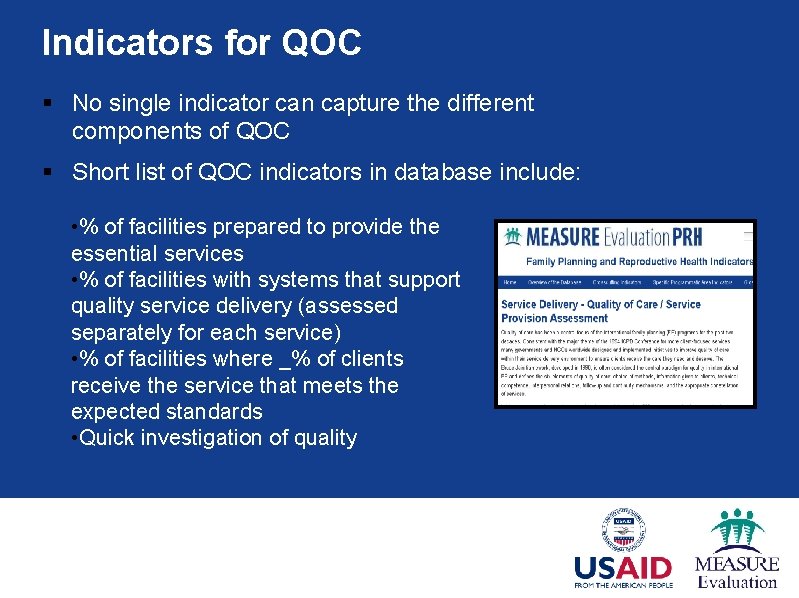
Indicators for QOC § No single indicator can capture the different components of QOC § Short list of QOC indicators in database include: • % of facilities prepared to provide the essential services • % of facilities with systems that support quality service delivery (assessed separately for each service) • % of facilities where _% of clients receive the service that meets the expected standards • Quick investigation of quality
Facility Surveys for QOC Indicators § Situation Analysis § MEASURE Evaluation Quick Investigation of Quality (QIQ) § Carried out in Ecuador, Turkey, Uganda, Zimbabwe § MEASURE DHS+ Service Provision Assessments (SPA)
Some Data Collection Issues § Small sample sizes for FP clients, especially in low prevalence countries § Observation in clinics that use a client flow approach § Sampling § Courtesy bias and hawthorn effects § Unit of analysis (client, provider, facility)
Case Study: QOC in Turkey
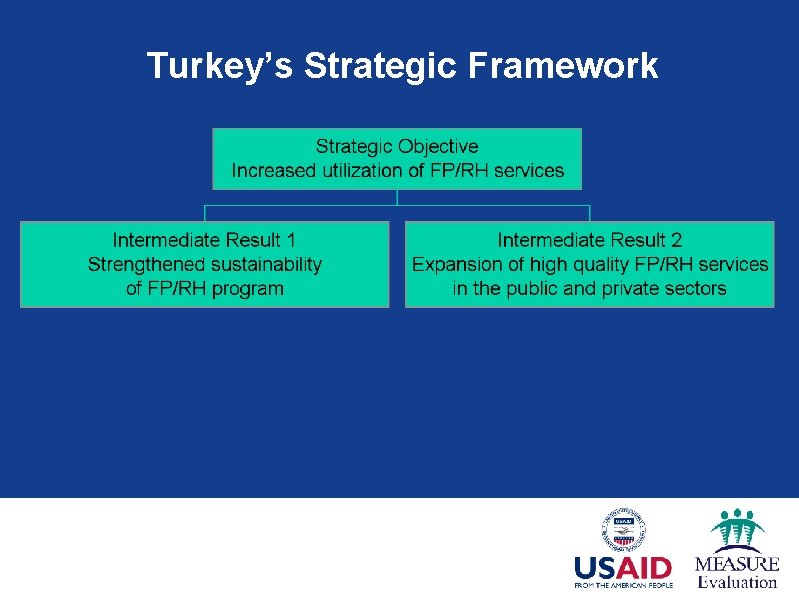
Turkey’s Strategic Framework
The Quality Index § Method availability § Availability of trained personnel § Perceived quality of FP counseling § Adequate infection-prevention measures § Availability of IEC materials § Physical access to FP services
Data Source § Istanbul Quality Surveys § Facility inventory § Client exit interviews § Based on MEASURE Evaluation QIQ
The Quality Index § Sum of scores from the 6 components (range 0 -6)
Method Availability § Proportion of facilities that distribute or prescribe 3 or more modern FP methods
Perceived Quality of FP Counseling § Proportion of clients who report § they were seated § had sufficient time with the provider § clearly understood the information provided
Adequate Infection Prevention Measures § Proportion of facilities that meet the following standards : § Plastic bucket for CL solution § Unused IUD kits kept sterile § Medical waste kept in leakproof containers with lids § Appropriate containers for sharp objects
Evaluating the Impact of Quality of Care
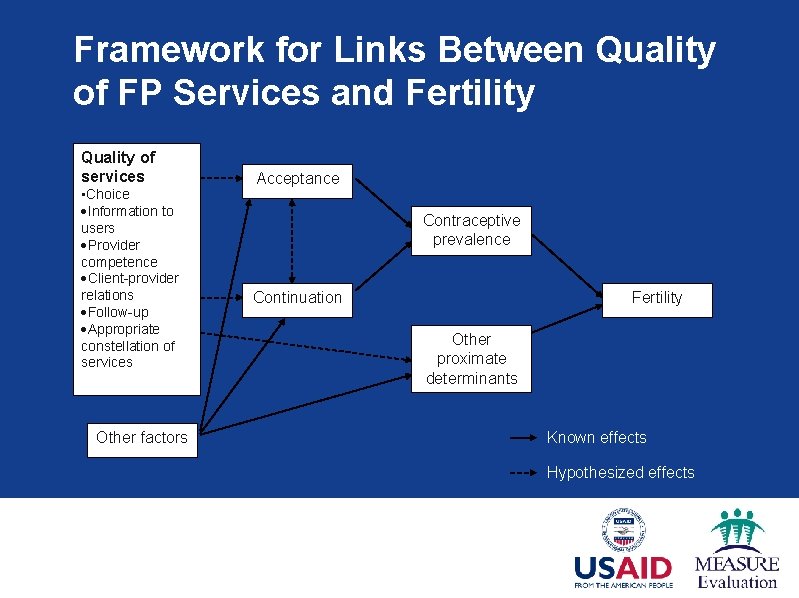
Framework for Links Between Quality of FP Services and Fertility Quality of services • Choice ·Information to users ·Provider competence ·Client-provider relations ·Follow-up ·Appropriate constellation of services Other factors Acceptance Contraceptive prevalence Continuation Fertility Other proximate determinants Known effects Hypothesized effects Source: Jain, 1989
Outcomes of Interest § Intention to use § Contraceptive adoption § Contraceptive discontinuation § Failure § Switching § Stopping § Current contraceptive use § Contraceptive choice § Unwanted pregnancy
Examples of Impact Studies § Peru (Mensch, et al. , 1996) § Morocco (Steele, et al. , 1999) § Kenya (Reynolds et al. , 2009) § Egypt (Hong et al. 2006) § DHS 2003 and ESPA data linked with GIS
Integration of Family Planning
Introduction to FP Integration § Overall § Effort to include FP with nutrition, maternal and child health, antenatal and prenatal care, post-abortion care, other SRH services § HIV/FP Integration § Both central to reproductive health § Serve similar populations § May reach more people § Reduces HIV-clinic stigma § Efficient use of resources and time
Context § Considerable progress in preventing unwanted pregnancy but unmet need remains substantial § Rapid increases in HIV in many countries § Changing funding focus to HIV from FP § Integrated vs. vertical programs
FP/HIV Integration Indicators Still in validating phase § #/% of HIV-related service delivery points with FP/HIV integrated services § #/% of HIV-related service clients screened for FP need § % of HIV-related service delivery point clients who received a FP method or referral after FP counseling § % of repeat counseling and testing clients reporting unintended pregnancy § % of FP clients who received HIV testing at the FP service delivery point or were referred for HIV testing § % of female clients of reproductive age attending HIV-related service delivery points with unmet need for FP Source: FP and Reproductive Health Indicators Database
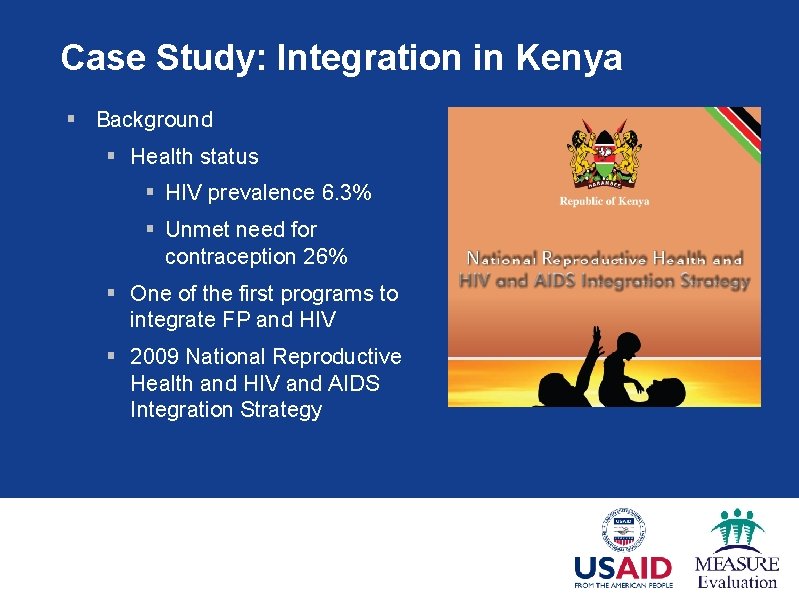
Case Study: Integration in Kenya § Background § Health status § HIV prevalence 6. 3% § Unmet need for contraception 26% § One of the first programs to integrate FP and HIV § 2009 National Reproductive Health and HIV and AIDS Integration Strategy
Principles of Integration of FP/HIV Services in Kenya § Government strategy on integration disseminated § FP/HIV services integrated with MNCH § Intrafacility referral predominant in hospitals § Community outreach and follow-up through community health volunteers § Task shifting and training on integrated service delivery § Integrated services recorded in Mother & Child Health Booklet § Principal indicator is number of facilities providing integrated services.
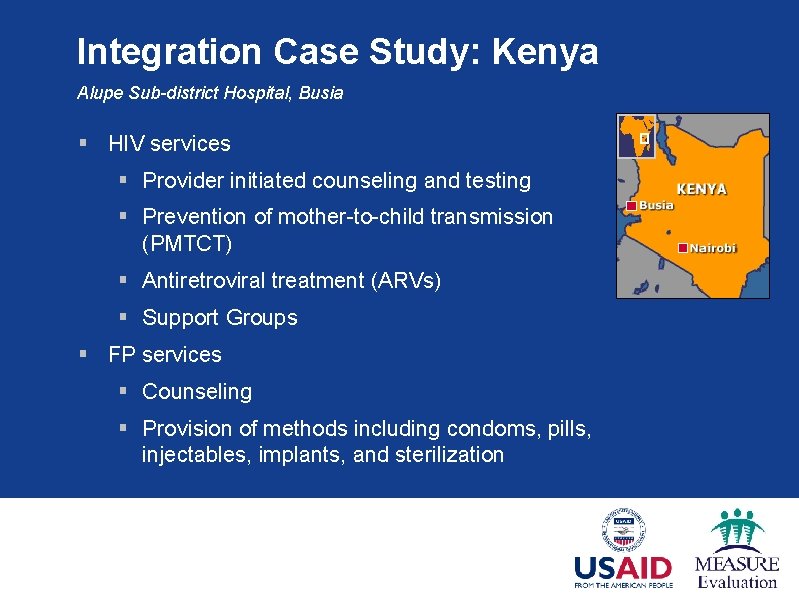
Integration Case Study: Kenya Alupe Sub-district Hospital, Busia § HIV services § Provider initiated counseling and testing § Prevention of mother-to-child transmission (PMTCT) § Antiretroviral treatment (ARVs) § Support Groups § FP services § Counseling § Provision of methods including condoms, pills, injectables, implants, and sterilization
Integration Case Study: Kenya con’t § All women assessed for FP needs § Asked about pregnancy status and current desire for pregnancy § All patients offered HIV-tests, regardless of reason for visit § Mother & Child Health Booklet § All services recorded § Kept by the woman § Community Health Volunteers § Services under one roof, same day, different providers
Exercise 3: Integration/Qo. C 1. Divide up into groups and choose either § A FP/HIV integration principles § An aspect of Quality of Care § Listed on handouts 2. Develop a basic input-outcome-impact framework for a simple program in this area. 3. Suggest 3 -6 indicators to monitor your program. § Look at the list of indicators in the database and determine if they are appropriate for your program 4. What data sources would you propose to collect these indicators?
MEASURE Evaluation is funded by the U. S. Agency for International Development (USAID) and implemented by the Carolina Population Center at the University of North Carolina at Chapel Hill in partnership with Futures Group, ICF Macro, John Snow, Inc. , Management Sciences for Health, and Tulane University. Views expressed in this presentation do not necessarily reflect the views of USAID or the U. S. government. MEASURE Evaluation is the USAID Global Health Bureau's primary vehicle for supporting improvements in monitoring and evaluation in population, health and nutrition worldwide.
- Slides: 53