Do Now Activity 1 Please find the Anticipation






- Slides: 130
Do Now Activity 1. Please find the Anticipation Guide on the first page in your participant workbook 2. Read the directions at the top of the page and read the 7 statements, marking a T for true and a F for false in the left hand column 3. We will group check at 9: 05 4. If you finish beforehand please feel free to compare your answers with your tablemates 1
http: //miblsi. cenmi. org Strengthening Literacy Instruction – 3 rd Grade K 2015 Mi. BLSi State Conference Sonia M. Lewis, Ed. S. , BCBA Terri Metcalf, Ed. D, JD Mi. BLSi Content Specialist slewis@miblsimtss. org tmetcalf@miblsimtss. org
References & Resources Archer, A. , & Hughes, C. (2011). Explicit instruction: Effective and efficient teaching. New York: Guilford Press Carnine, D. W. , Silbert, J. , Kame’ enui, E. J. , & Tarver, S. G. (2010). Direct instruction reading (5 th Ed. ). Columbus, OH: Pearson Eunice Kennedy Shriver National Institute of Child Health and Human Development, NIH, DHHS. (2001). Put Reading First: The Research Building Blocks for Teaching Children to Read (N/A). Washington, DC: U. S. Government Printing Office. Hasbrouck, J. & Glaser, D. (2012). Reading Fluency, Understanding and Teaching this Complex Skill. Hattie. J. , (2009). Visible Learning. London & NY: Routledge 3
References & Resources Kosanovich, M. , & Verhagen, C. (2012). Building the foundation: A suggested progression of sub-skills to achieve the reading standards: Foundational skills in the common core state standards. Portsmouth, NH: RMC Research Corporation, Center on Instruction Moats, L. C. (2000). Speech to print: Language essentials for teachers. Baltimore: Paul Brookes National Reading Panel (NRP) (2000). Teaching children to read: An evidence-based assessment of the scientific research literature on reading and its implications for reading instruction. Washington DC: National Institute of Child Health and Human Development. The Simple View of Reading (Gough & Tunmer, 1986) Websites: dibels. org, www. fcrr. org, www. readsters. com, & childrenofthecode. org 4
Group Expectations • Be Responsible • • Attend to the “come back together” signal Actively participate • Be Respectful • Please allow others to listen • • Please turn off cell phones Please limit sidebar conversations Share “air time” Please refrain from email and internet browsing • Be Safe • Take care of your own needs 5
Group Check 6
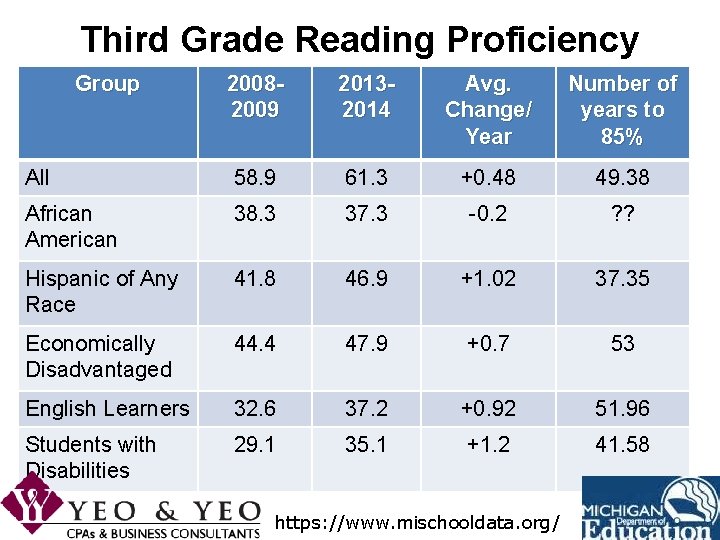
Third Grade Reading Proficiency Group 20082009 20132014 Avg. Change/ Year Number of years to 85% All 58. 9 61. 3 +0. 48 49. 38 African American 38. 3 37. 3 -0. 2 ? ? Hispanic of Any Race 41. 8 46. 9 +1. 02 37. 35 Economically Disadvantaged 44. 4 47. 9 +0. 7 53 English Learners 32. 6 37. 2 +0. 92 51. 96 Students with Disabilities 29. 1 35. 1 +1. 2 41. 58 https: //www. mischooldata. org/
Achievement Gap or Gap from Research to Practice? 8
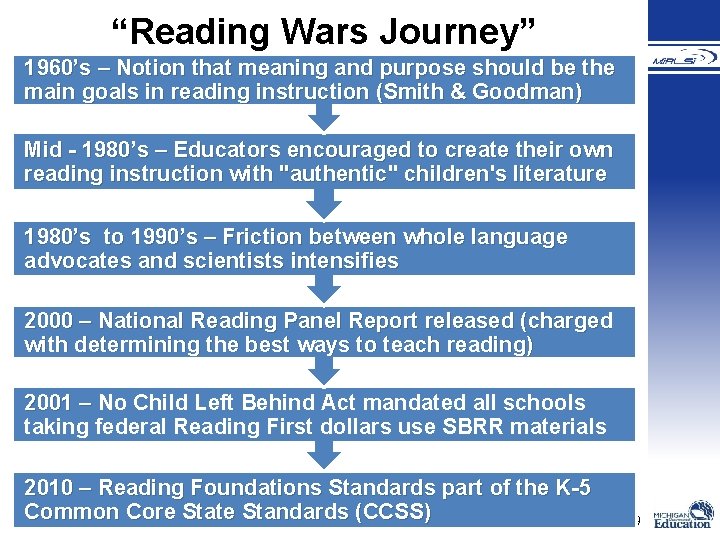
“Reading Wars Journey” 1960’s – Notion that meaning and purpose should be the main goals in reading instruction (Smith & Goodman) Mid - 1980’s – Educators encouraged to create their own reading instruction with "authentic" children's literature 1980’s to 1990’s – Friction between whole language advocates and scientists intensifies 2000 – National Reading Panel Report released (charged with determining the best ways to teach reading) 2001 – No Child Left Behind Act mandated all schools taking federal Reading First dollars use SBRR materials 2010 – Reading Foundations Standards part of the K-5 Common Core State Standards (CCSS) 9
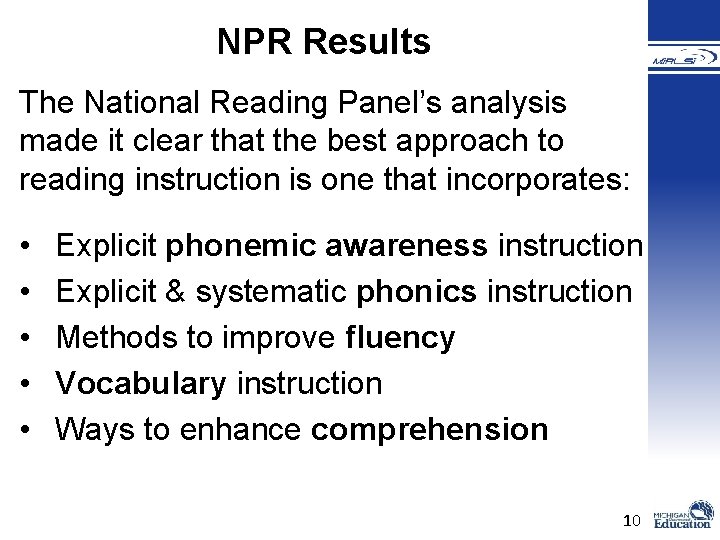
NPR Results The National Reading Panel’s analysis made it clear that the best approach to reading instruction is one that incorporates: • • • Explicit phonemic awareness instruction Explicit & systematic phonics instruction Methods to improve fluency Vocabulary instruction Ways to enhance comprehension 10
“They NPR only included the studies they knew would get the results they wanted. ” • Reading-research journals publish articles that defy reasonable standards of acceptable methodology in all other sciences • The number of scientifically credible studies of reading instruction is extremely small in comparison to the number of “studies” published • In reading, anyone who publishes in any form is referred to as a “researcher” or an “expert” 11
Is Science Valued in Education? • A study published by the National Center for Teacher Quality found that just 15 percent of education schools train their students in the basics of SBRR reading strategies • Licensure tests, for the most part, do not examine education graduates on their understanding of SBRR reading strategies Transitioning from what we believe to what science says is true is not always easy, and when beliefs are deeply rooted, resistance is strong 12
Achievement Gap or Gap from Research to Practice? 13
Compelling Why • Spring of 2014 – Mi. BLSi created the Tier 1 Elementary Strengthening Reading Implementation content • Two strands (three days each) • • Kindergarten and 1 st Grade 2 nd and 3 rd Grade • Strand for the Implementer’s Conference • Future Implementers Networking Opportunities (INO’s) 14
Tell me and I’ll forget, Show me and I may remember, Involve me and I’ll understand. Chinese Proverb 15
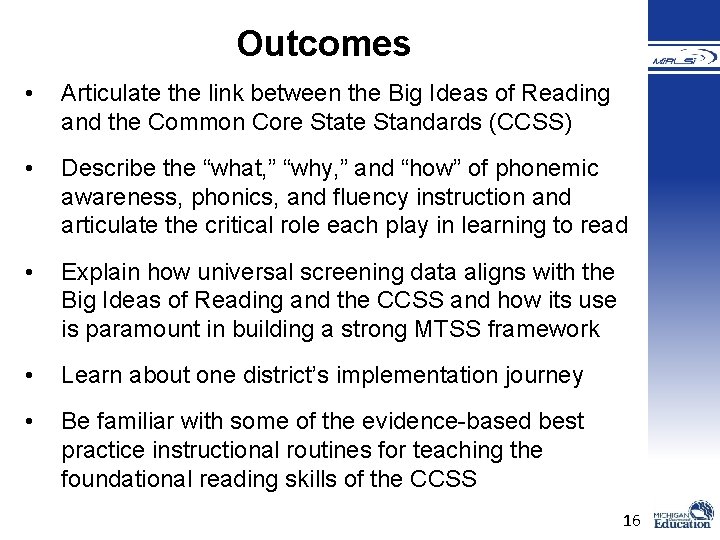
Outcomes • Articulate the link between the Big Ideas of Reading and the Common Core State Standards (CCSS) • Describe the “what, ” “why, ” and “how” of phonemic awareness, phonics, and fluency instruction and articulate the critical role each play in learning to read • Explain how universal screening data aligns with the Big Ideas of Reading and the CCSS and how its use is paramount in building a strong MTSS framework • Learn about one district’s implementation journey • Be familiar with some of the evidence-based best practice instructional routines for teaching the foundational reading skills of the CCSS 16
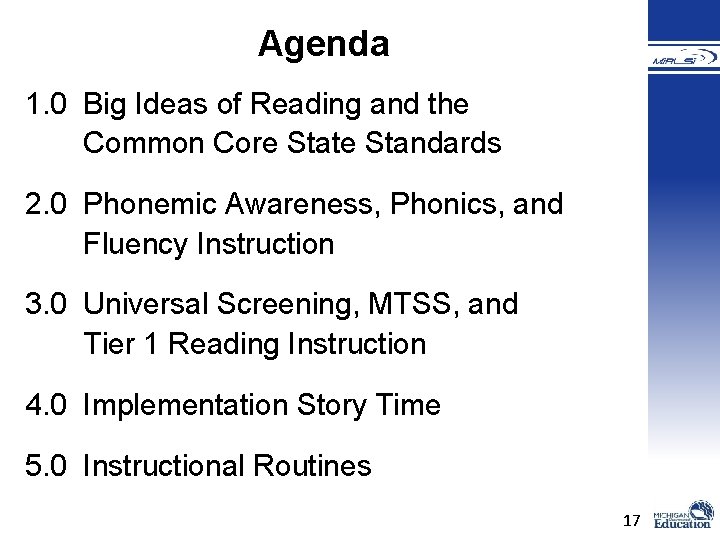
Agenda 1. 0 Big Ideas of Reading and the Common Core State Standards 2. 0 Phonemic Awareness, Phonics, and Fluency Instruction 3. 0 Universal Screening, MTSS, and Tier 1 Reading Instruction 4. 0 Implementation Story Time 5. 0 Instructional Routines 17
1. 0 Big Ideas of Reading and the Common Core State Standards 18
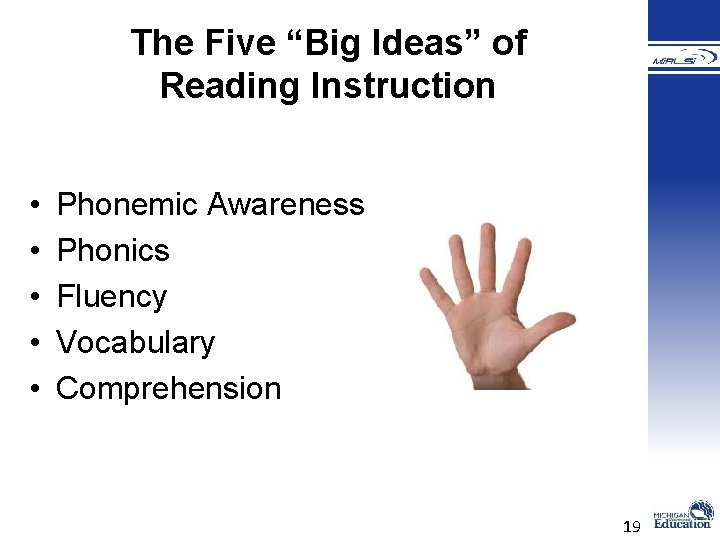
The Five “Big Ideas” of Reading Instruction • • • Phonemic Awareness Phonics Fluency Vocabulary Comprehension 19
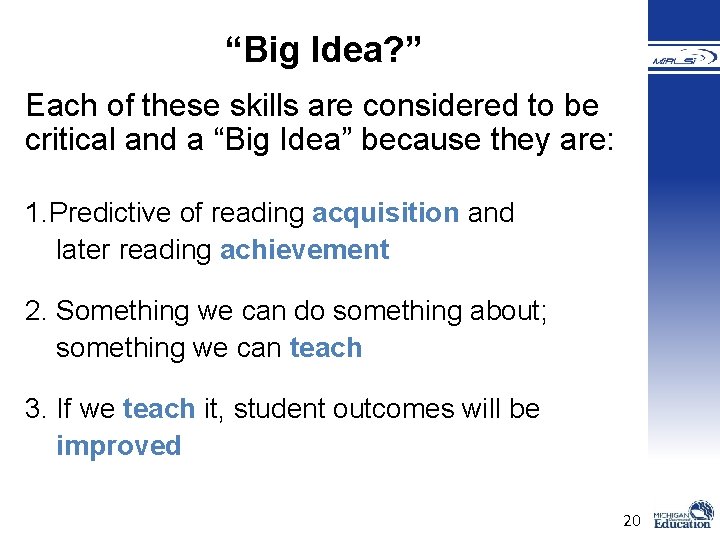
“Big Idea? ” Each of these skills are considered to be critical and a “Big Idea” because they are: 1. Predictive of reading acquisition and later reading achievement 2. Something we can do something about; something we can teach 3. If we teach it, student outcomes will be improved 20
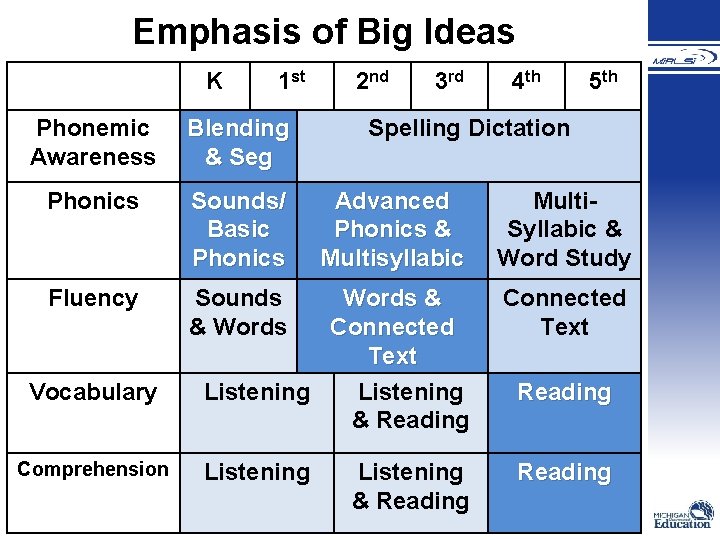
Emphasis of Big Ideas K 1 st Phonemic Awareness Blending & Seg Phonics Sounds/ Basic Phonics Fluency Sounds & Words Vocabulary Comprehension 2 nd 3 rd 4 th 5 th Spelling Dictation Advanced Phonics & Multisyllabic Multi. Syllabic & Word Study Words & Connected Text Listening & Reading 21
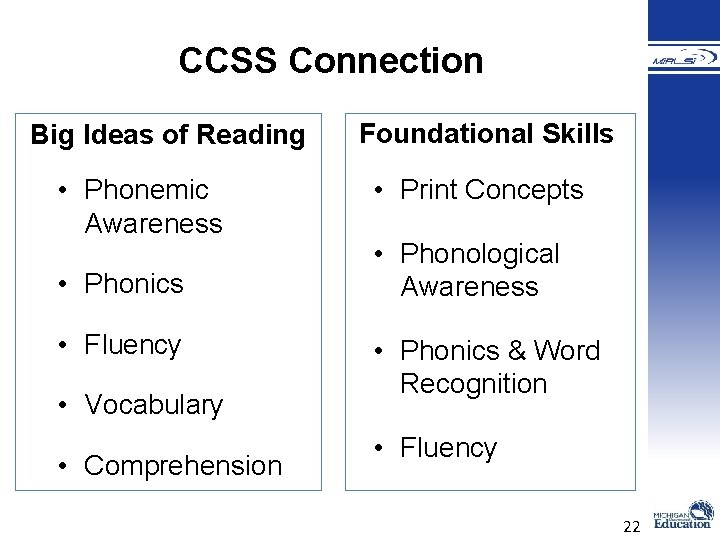
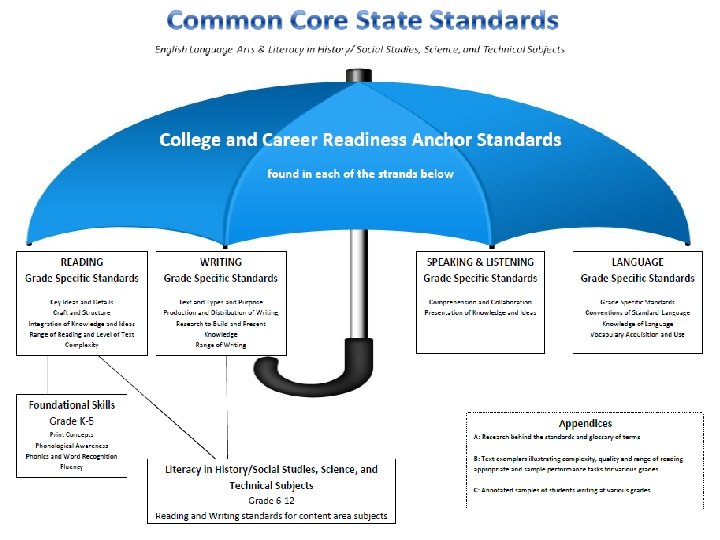
CCSS Connection Big Ideas of Reading • Phonemic Awareness • Phonics • Fluency • Vocabulary • Comprehension Foundational Skills • Print Concepts • Phonological Awareness • Phonics & Word Recognition • Fluency 22
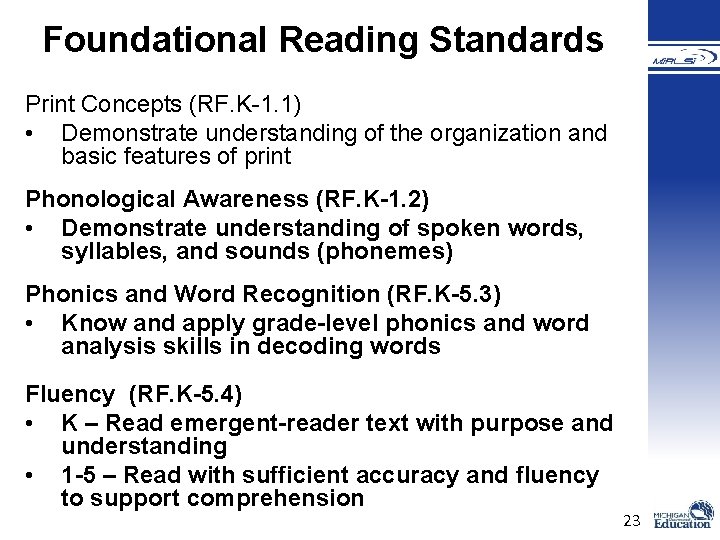
Foundational Reading Standards Print Concepts (RF. K-1. 1) • Demonstrate understanding of the organization and basic features of print Phonological Awareness (RF. K-1. 2) • Demonstrate understanding of spoken words, syllables, and sounds (phonemes) Phonics and Word Recognition (RF. K-5. 3) • Know and apply grade-level phonics and word analysis skills in decoding words Fluency (RF. K-5. 4) • K – Read emergent-reader text with purpose and understanding • 1 -5 – Read with sufficient accuracy and fluency to support comprehension 23
24
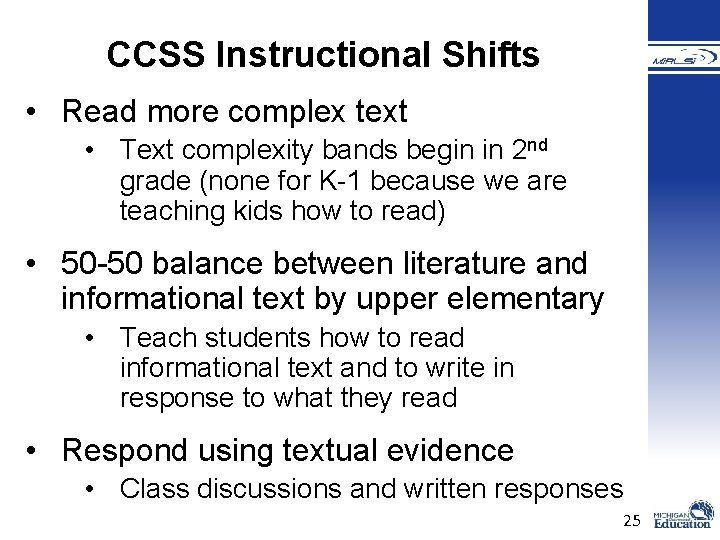
CCSS Instructional Shifts • Read more complex text • Text complexity bands begin in 2 nd grade (none for K-1 because we are teaching kids how to read) • 50 -50 balance between literature and informational text by upper elementary • Teach students how to read informational text and to write in response to what they read • Respond using textual evidence • Class discussions and written responses 25
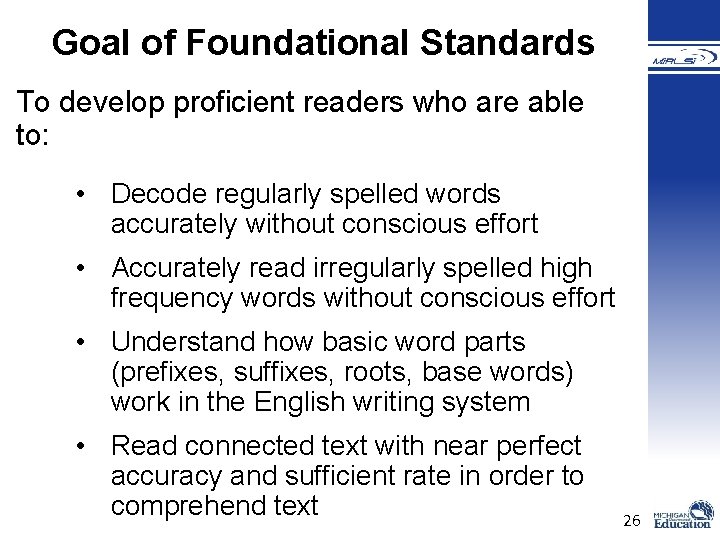
Goal of Foundational Standards To develop proficient readers who are able to: • Decode regularly spelled words accurately without conscious effort • Accurately read irregularly spelled high frequency words without conscious effort • Understand how basic word parts (prefixes, suffixes, roots, base words) work in the English writing system • Read connected text with near perfect accuracy and sufficient rate in order to comprehend text 26
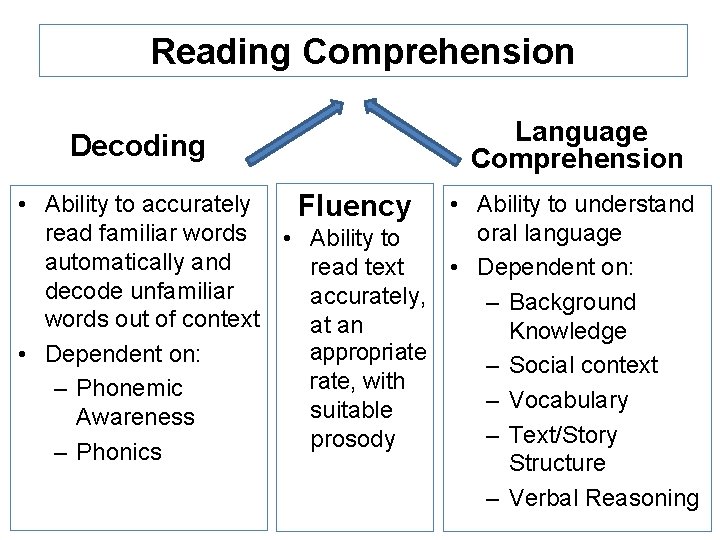
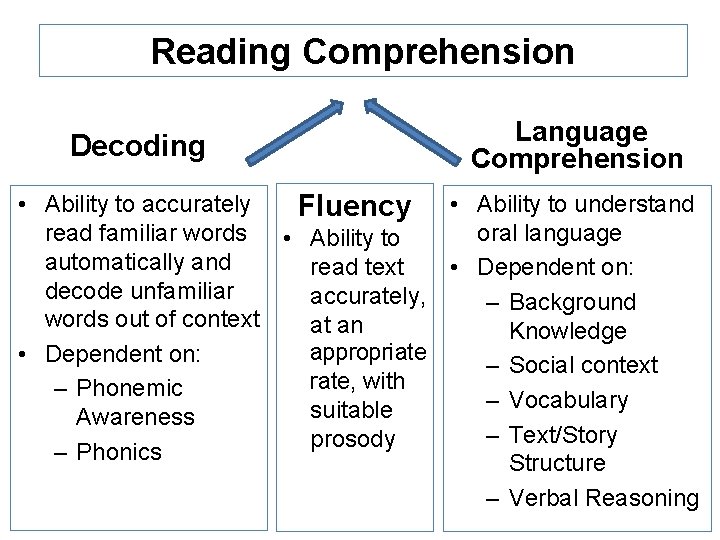
Reading Comprehension Decoding Language Comprehension • Ability to accurately Fluency • Ability to understand oral language read familiar words • Ability to automatically and read text • Dependent on: decode unfamiliar accurately, – Background words out of context at an Knowledge appropriate • Dependent on: – Social context rate, with – Phonemic – Vocabulary suitable Awareness – Text/Story prosody – Phonics Structure – Verbal Reasoning
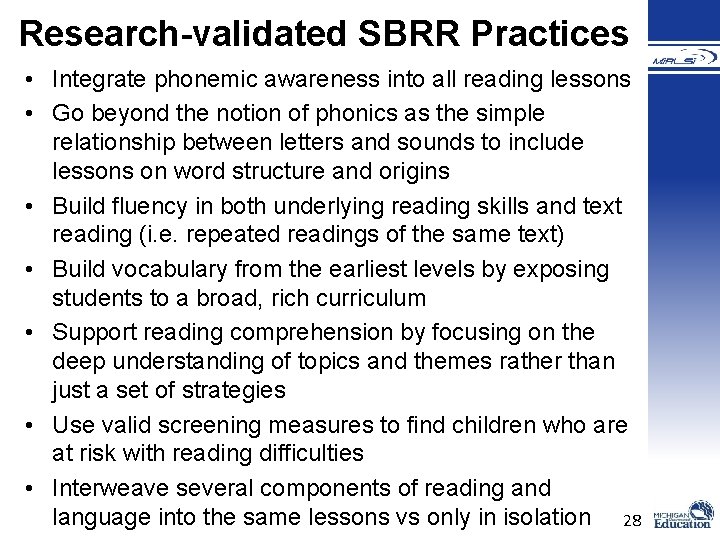
Research-validated SBRR Practices • Integrate phonemic awareness into all reading lessons • Go beyond the notion of phonics as the simple relationship between letters and sounds to include lessons on word structure and origins • Build fluency in both underlying reading skills and text reading (i. e. repeated readings of the same text) • Build vocabulary from the earliest levels by exposing students to a broad, rich curriculum • Support reading comprehension by focusing on the deep understanding of topics and themes rather than just a set of strategies • Use valid screening measures to find children who are at risk with reading difficulties • Interweave several components of reading and language into the same lessons vs only in isolation 28
2. 0 Phonemic Awareness, Phonics, and Fluency Instruction 29
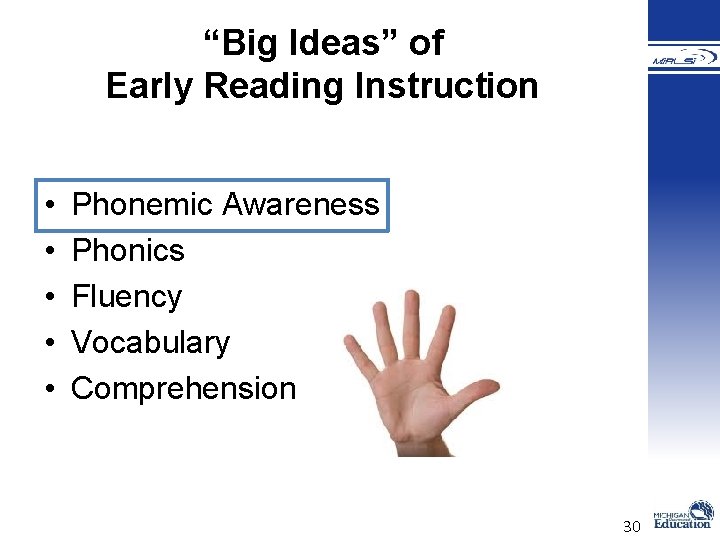
“Big Ideas” of Early Reading Instruction • • • Phonemic Awareness Phonics Fluency Vocabulary Comprehension 30
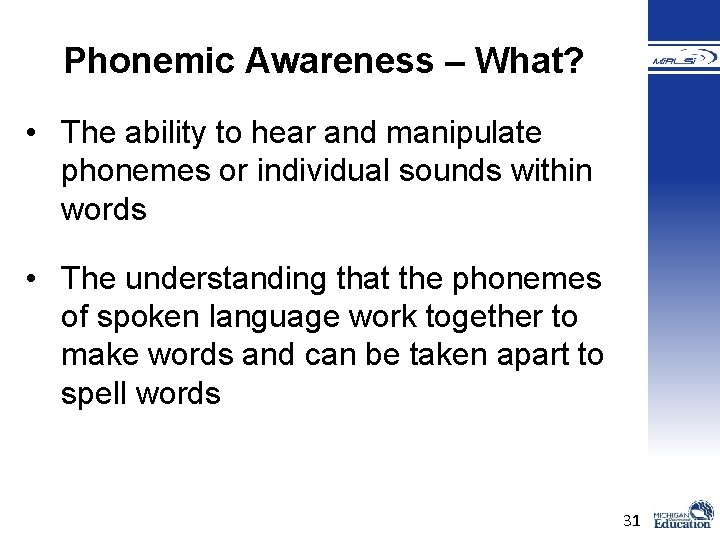
Phonemic Awareness – What? • The ability to hear and manipulate phonemes or individual sounds within words • The understanding that the phonemes of spoken language work together to make words and can be taken apart to spell words 31
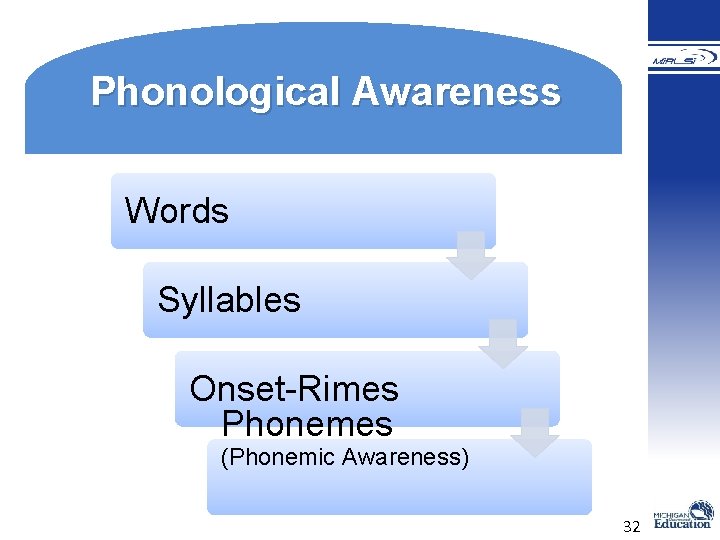
Phonological Awareness Words Syllables Onset-Rimes Phonemes (Phonemic Awareness) 32
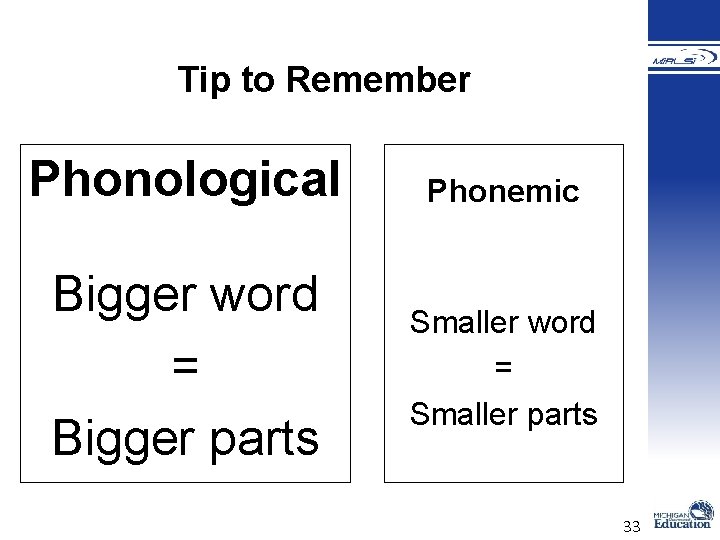
Tip to Remember Phonological Phonemic Bigger word = Bigger parts Smaller word = Smaller parts 33 33
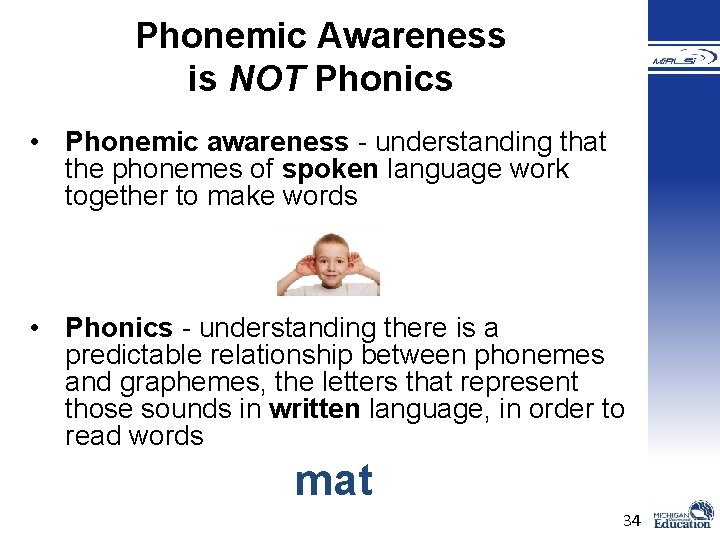
Phonemic Awareness is NOT Phonics • Phonemic awareness - understanding that the phonemes of spoken language work together to make words • Phonics - understanding there is a predictable relationship between phonemes and graphemes, the letters that represent those sounds in written language, in order to read words mat 34
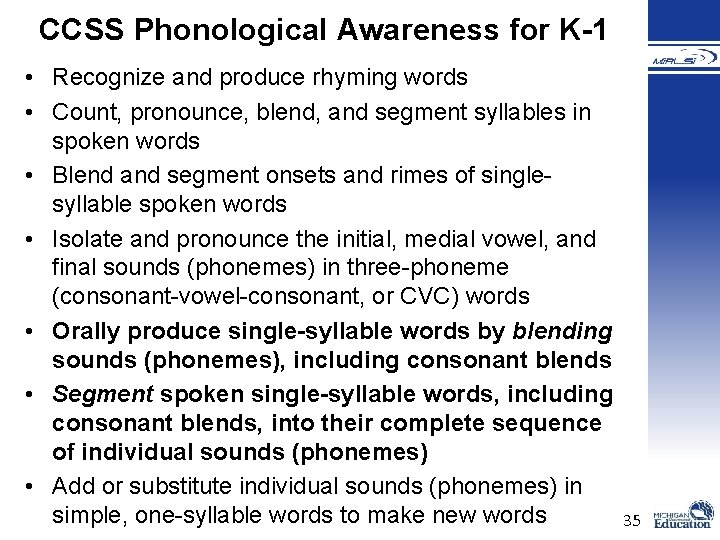
CCSS Phonological Awareness for K-1 • Recognize and produce rhyming words • Count, pronounce, blend, and segment syllables in spoken words • Blend and segment onsets and rimes of singlesyllable spoken words • Isolate and pronounce the initial, medial vowel, and final sounds (phonemes) in three-phoneme (consonant-vowel-consonant, or CVC) words • Orally produce single-syllable words by blending sounds (phonemes), including consonant blends • Segment spoken single-syllable words, including consonant blends, into their complete sequence of individual sounds (phonemes) • Add or substitute individual sounds (phonemes) in simple, one-syllable words to make new words 35
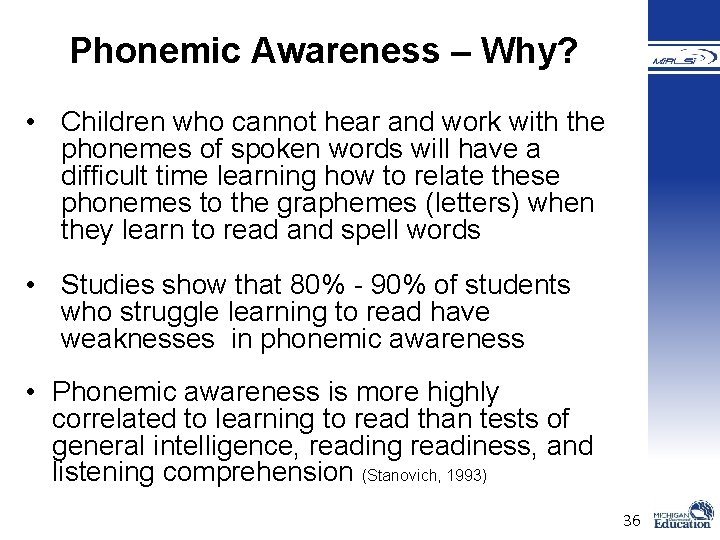
Phonemic Awareness – Why? • Children who cannot hear and work with the phonemes of spoken words will have a difficult time learning how to relate these phonemes to the graphemes (letters) when they learn to read and spell words • Studies show that 80% - 90% of students who struggle learning to read have weaknesses in phonemic awareness • Phonemic awareness is more highly correlated to learning to read than tests of general intelligence, reading readiness, and listening comprehension (Stanovich, 1993) 36
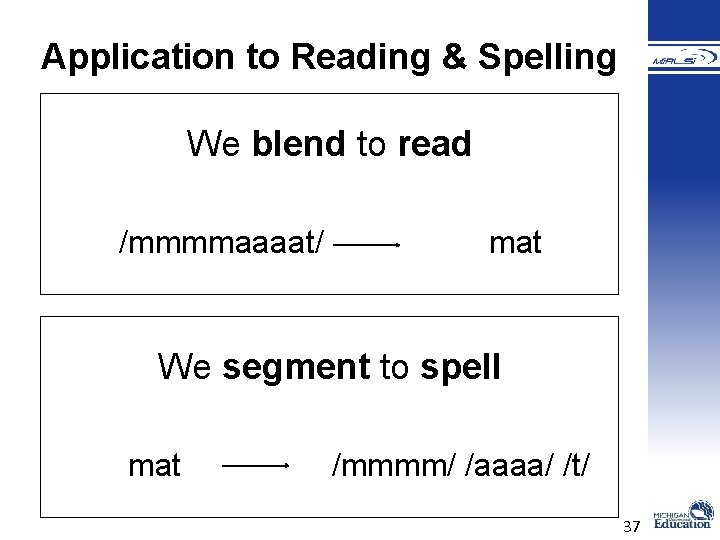
Application to Reading & Spelling We blend to read /mmmmaaaat/ mat We segment to spell mat /mmmm/ /aaaa/ /t/ 37
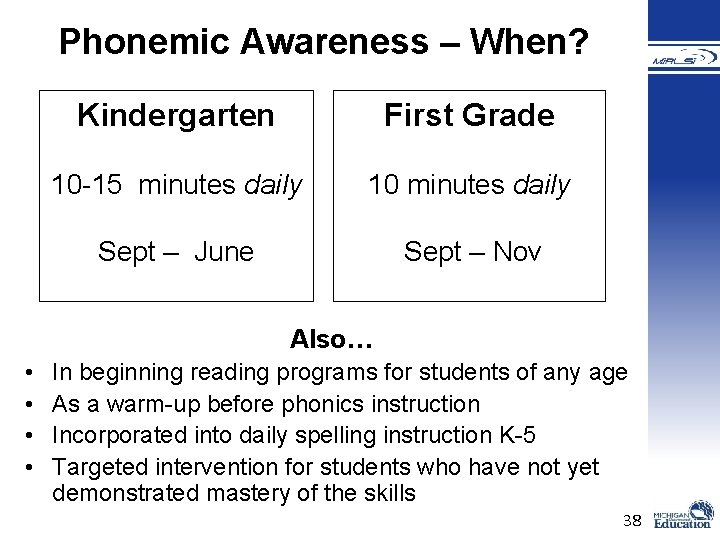
Phonemic Awareness – When? Kindergarten First Grade 10 -15 minutes daily 10 minutes daily Sept – June Sept – Nov Also… • • In beginning reading programs for students of any age As a warm-up before phonics instruction Incorporated into daily spelling instruction K-5 Targeted intervention for students who have not yet demonstrated mastery of the skills 38
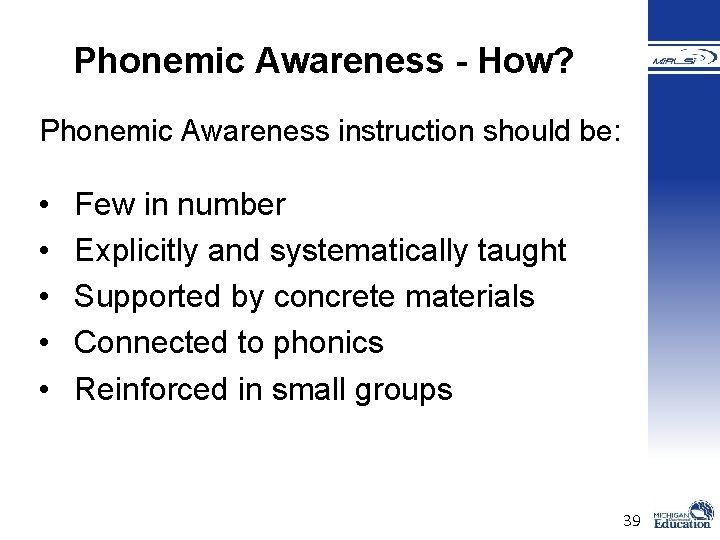
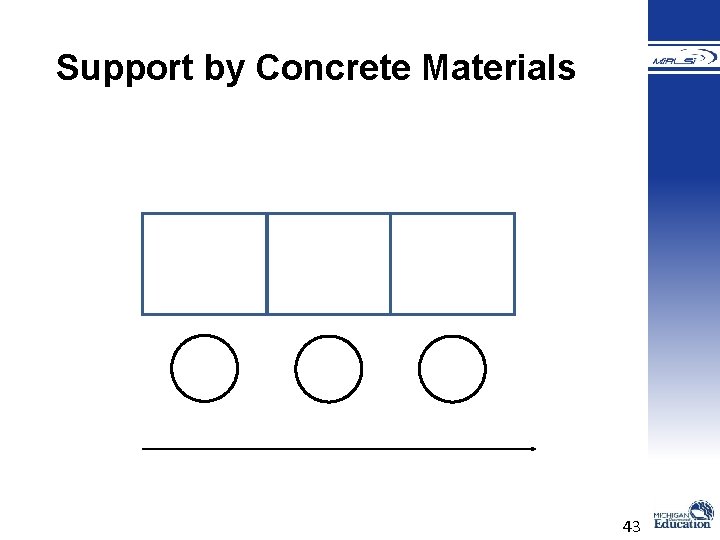
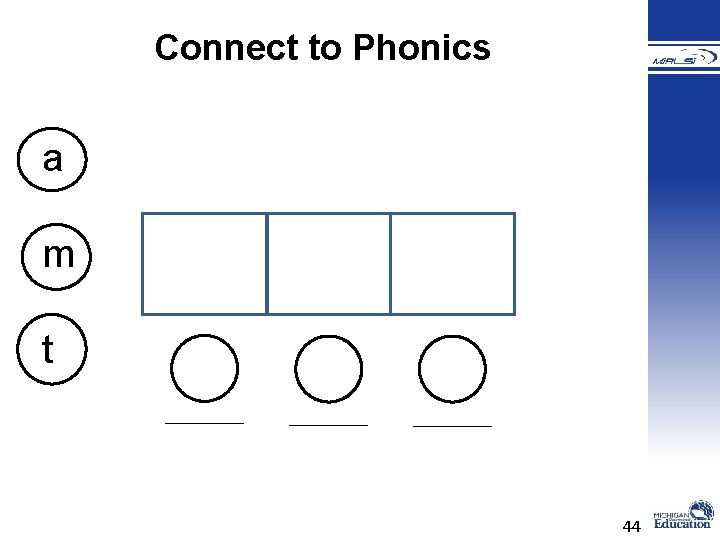
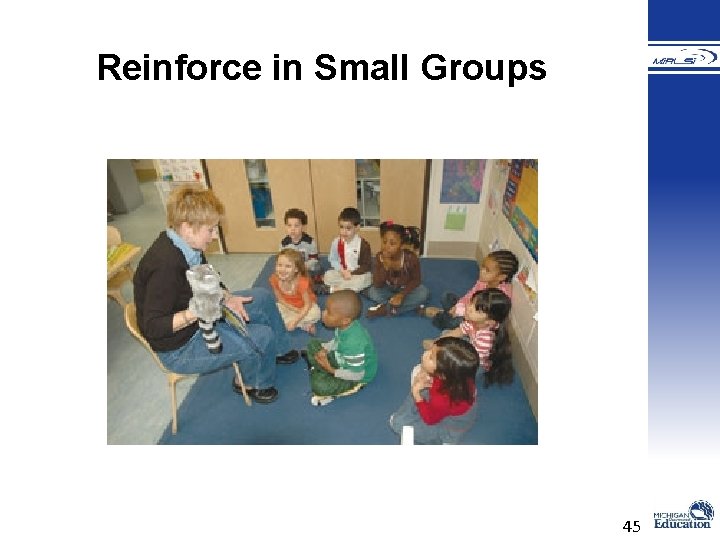
Phonemic Awareness - How? Phonemic Awareness instruction should be: • • • Few in number Explicitly and systematically taught Supported by concrete materials Connected to phonics Reinforced in small groups 39
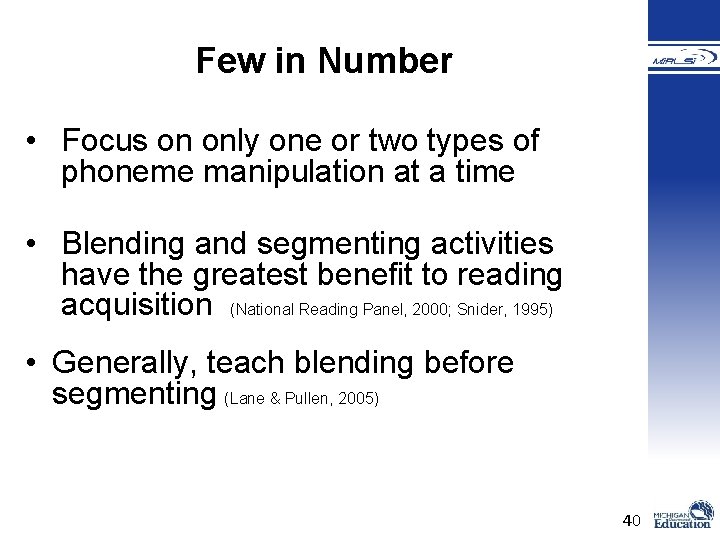
Few in Number • Focus on only one or two types of phoneme manipulation at a time • Blending and segmenting activities have the greatest benefit to reading acquisition (National Reading Panel, 2000; Snider, 1995) • Generally, teach blending before segmenting (Lane & Pullen, 2005) 40
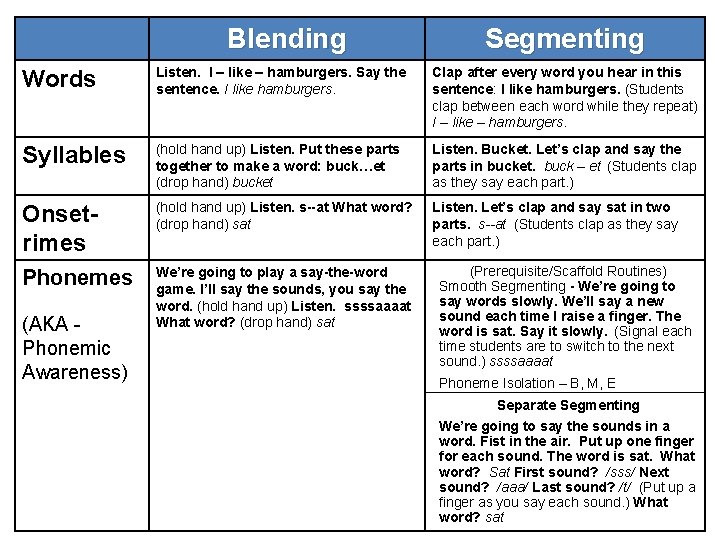
Blending Segmenting Words Listen. I – like – hamburgers. Say the sentence. I like hamburgers. Clap after every word you hear in this sentence: I like hamburgers. (Students clap between each word while they repeat) I – like – hamburgers. Syllables (hold hand up) Listen. Put these parts together to make a word: buck…et (drop hand) bucket Listen. Bucket. Let’s clap and say the parts in bucket. buck – et (Students clap as they say each part. ) Onsetrimes (hold hand up) Listen. s--at What word? (drop hand) sat Listen. Let’s clap and say sat in two parts. s--at (Students clap as they say each part. ) Phonemes We’re going to play a say-the-word game. I’ll say the sounds, you say the word. (hold hand up) Listen. ssssaaaat What word? (drop hand) sat (AKA - Phonemic Awareness) (Prerequisite/Scaffold Routines) Smooth Segmenting - We’re going to say words slowly. We’ll say a new sound each time I raise a finger. The word is sat. Say it slowly. (Signal each time students are to switch to the next sound. ) ssssaaaat Phoneme Isolation – B, M, E Separate Segmenting We’re going to say the sounds in a word. Fist in the air. Put up one finger for each sound. The word is sat. What word? Sat First sound? /sss/ Next sound? /aaa/ Last sound? /t/ (Put up a finger as you say each sound. ) What word? sat
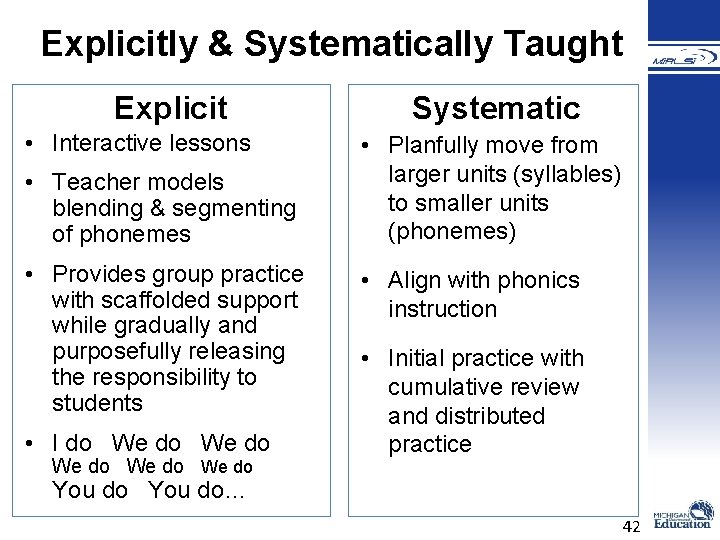
Explicitly & Systematically Taught Explicit • Interactive lessons • Teacher models blending & segmenting of phonemes • Provides group practice with scaffolded support while gradually and purposefully releasing the responsibility to students • I do We do We do Systematic • Planfully move from larger units (syllables) to smaller units (phonemes) • Align with phonics instruction • Initial practice with cumulative review and distributed practice You do… 42
Support by Concrete Materials 43
Connect to Phonics a m t 44
Reinforce in Small Groups 45
Put Reading First The Research Building Blocks for Teaching Children to Read National Institute for Literacy 46
Activity 1) Read/skim pages 1 -9 of the Put Reading First booklet 2) Check your phonemic awareness graphic organizer and add to it any other important facts, considering pertinent information specific to your local context 3) Compare your graphic organizer with your partner’s while you wait for the “Come Back” signal 47
Practice Phonemic Awareness “Four Corner” Game P 1 – What? and Why? P 2 – How? and Other 48
“Big Ideas” of Early Reading Instruction • • • Phonemic Awareness Phonics Fluency Vocabulary Comprehension 49
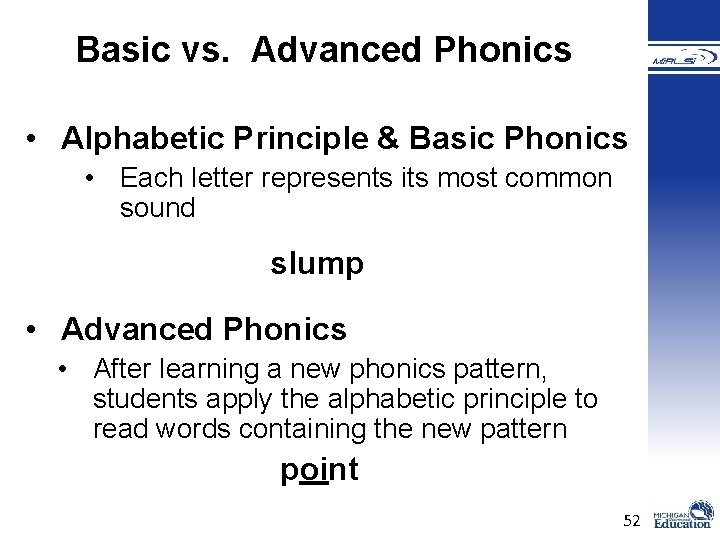
Phonics – What? • Process of using relationship between the letters (graphemes) of written language and the individual sounds (phonemes) of spoken language to read words • Goal of phonics instruction is to help children to learn and use the alphabetic principle 50
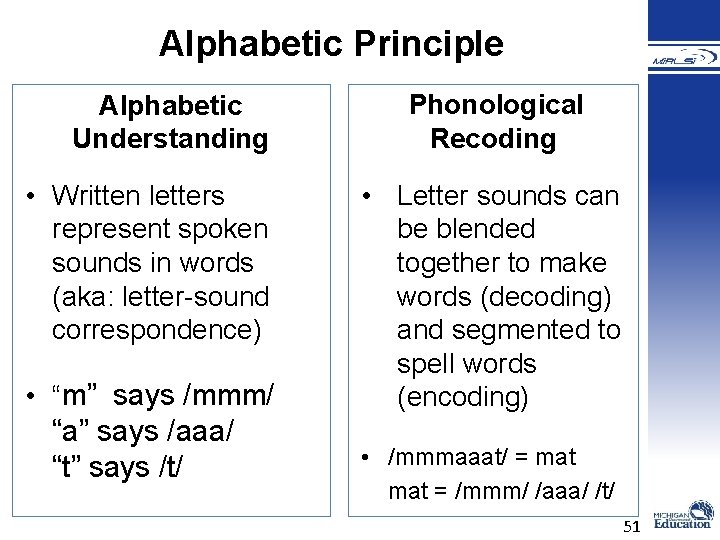
Alphabetic Principle Alphabetic Understanding • Written letters represent spoken sounds in words (aka: letter-sound correspondence) • “m” says /mmm/ “a” says /aaa/ “t” says /t/ Phonological Recoding • Letter sounds can be blended together to make words (decoding) and segmented to spell words (encoding) • /mmmaaat/ = mat = /mmm/ /aaa/ /t/ 51
Basic vs. Advanced Phonics • Alphabetic Principle & Basic Phonics • Each letter represents its most common sound slump • Advanced Phonics • After learning a new phonics pattern, students apply the alphabetic principle to read words containing the new pattern point 52
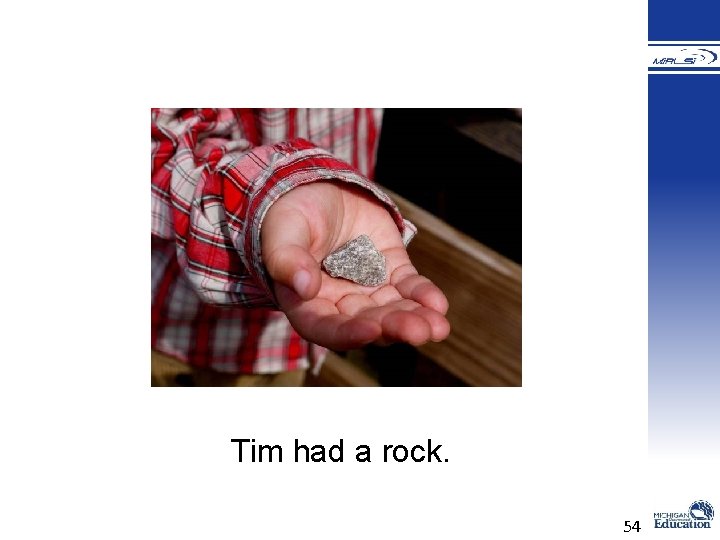
Phonics Memorizing & Guessing • Some children, especially those with strong language skills, can memorize words and use context clues when “reading” • When in fact their phonics skills are weak and they are merely “guessing” their way through the text • Reading difficulties may not be apparent until the later primary grades 53
Tim had a rock. 54
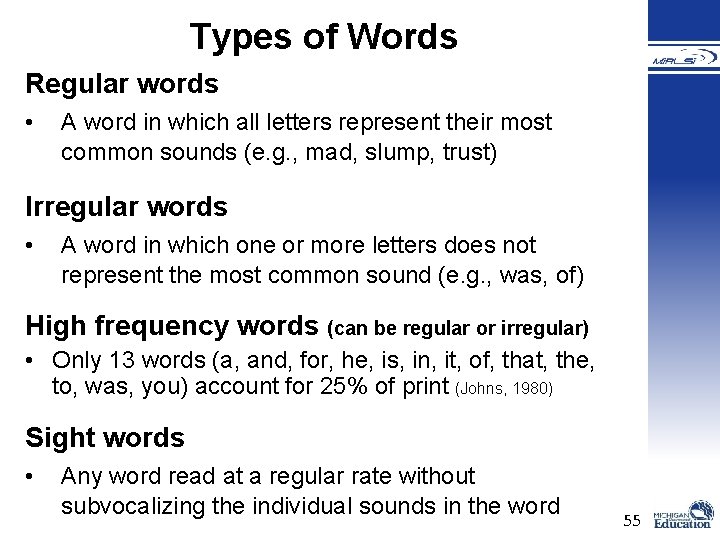
Types of Words Regular words • A word in which all letters represent their most common sounds (e. g. , mad, slump, trust) Irregular words • A word in which one or more letters does not represent the most common sound (e. g. , was, of) High frequency words (can be regular or irregular) • Only 13 words (a, and, for, he, is, in, it, of, that, the, to, was, you) account for 25% of print (Johns, 1980) Sight words • Any word read at a regular rate without subvocalizing the individual sounds in the word 55
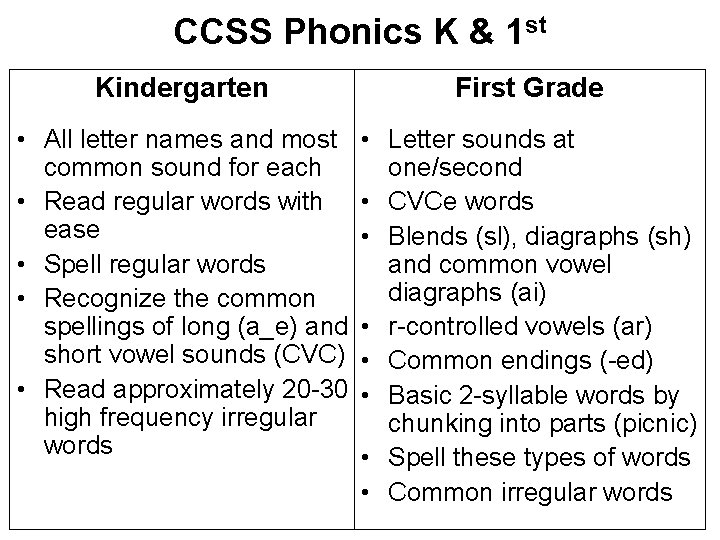
CCSS Phonics K & 1 st Kindergarten First Grade • All letter names and most • common sound for each • Read regular words with • ease • • Spell regular words • Recognize the common spellings of long (a_e) and • short vowel sounds (CVC) • • Read approximately 20 -30 • high frequency irregular words • Letter sounds at one/second CVCe words Blends (sl), diagraphs (sh) and common vowel diagraphs (ai) r-controlled vowels (ar) Common endings (-ed) Basic 2 -syllable words by chunking into parts (picnic) Spell these types of words • Common irregular words
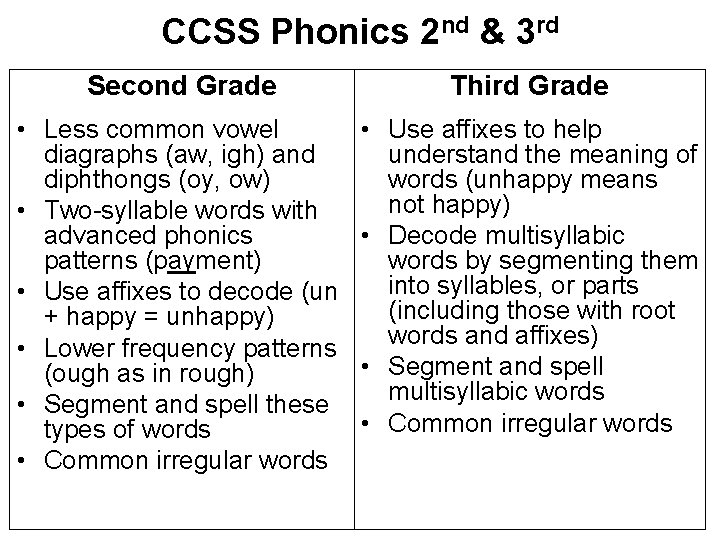
CCSS Phonics 2 nd & 3 rd Second Grade Third Grade • Less common vowel diagraphs (aw, igh) and diphthongs (oy, ow) • Two-syllable words with advanced phonics patterns (payment) • Use affixes to decode (un + happy = unhappy) • Lower frequency patterns (ough as in rough) • Segment and spell these types of words • Common irregular words • Use affixes to help understand the meaning of words (unhappy means not happy) • Decode multisyllabic words by segmenting them into syllables, or parts (including those with root words and affixes) • Segment and spell multisyllabic words • Common irregular words
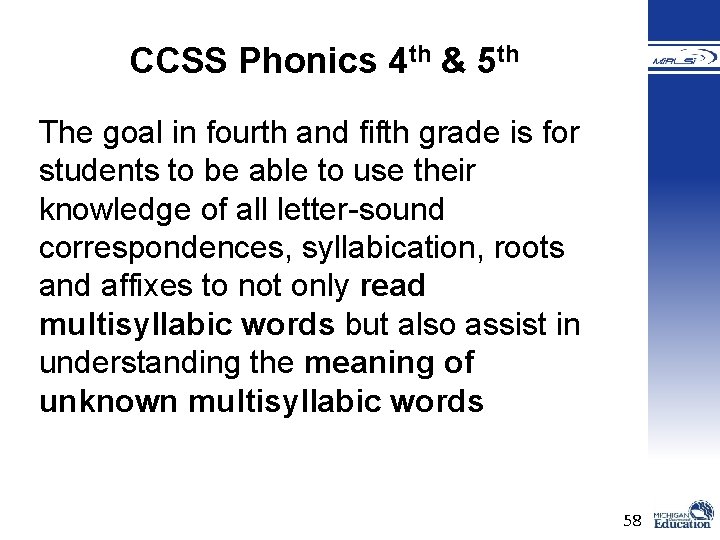
CCSS Phonics 4 th & 5 th The goal in fourth and fifth grade is for students to be able to use their knowledge of all letter-sound correspondences, syllabication, roots and affixes to not only read multisyllabic words but also assist in understanding the meaning of unknown multisyllabic words 58
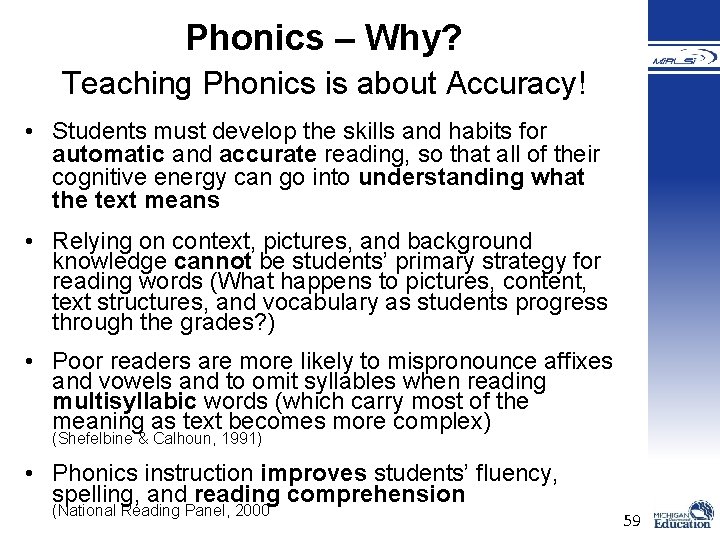
Phonics – Why? Teaching Phonics is about Accuracy! • Students must develop the skills and habits for automatic and accurate reading, so that all of their cognitive energy can go into understanding what the text means • Relying on context, pictures, and background knowledge cannot be students’ primary strategy for reading words (What happens to pictures, content, text structures, and vocabulary as students progress through the grades? ) • Poor readers are more likely to mispronounce affixes and vowels and to omit syllables when reading multisyllabic words (which carry most of the meaning as text becomes more complex) (Shefelbine & Calhoun, 1991) • Phonics instruction improves students’ fluency, spelling, and reading comprehension (National Reading Panel, 2000 59
“There is no comprehension strategy powerful enough to compensate for the fact you can’t read the words. ” 60
“The Matthew Effect” (Stanovich, 1986) “The rich get richer and the poor get poorer” Children who can decode CAN and DO read more words, develop a larger vocabulary, are better comprehenders, enjoy reading, and thus read MORE… So they continue to develop their skills and outpace lower-skill peers 61
Characteristics of Good Readers • Good readers rely primarily on the letters in a word, rather than context or pictures, to identify/pronounce familiar and unfamiliar words (Ehri, 1994) • Good readers automatically identify patterns in words and chunk common letter combinations and units of meaning (morphemes) into identifiable word parts before reading the whole word (Ehri, 1998) • Eye movement research with adults reading multisyllabic words shows their eyes move with a variety of fixations, saccades, return sweeps, and regressions - rather than the often assumed impression that our eyes glide smoothly across the page when reading (Rayner, Juhasz, & Pollatsek, 2007) 62
What about Background Knowledge & Context? • To assist in determining word meanings • Many things we use as condiments for our food, such as pepper and curry powder, cannot be grown in this country. • To make corrections • • For words with multiple pronunciations (ex. read) To change pronunciations for words (ex. kind, husband) 63
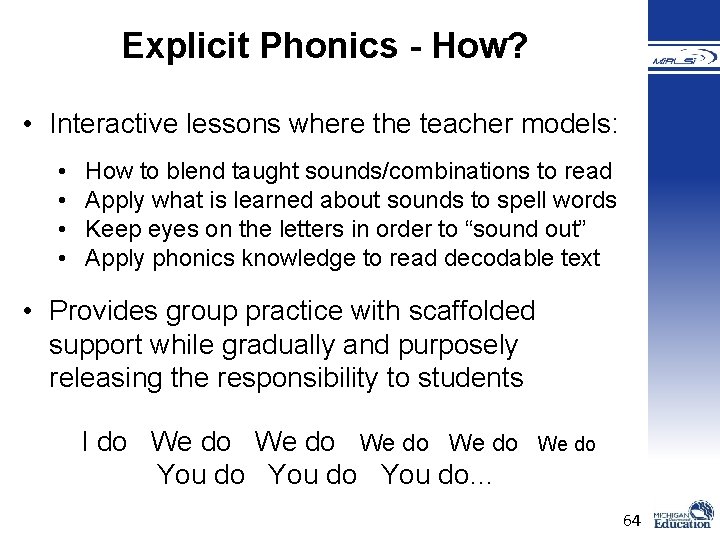
Explicit Phonics - How? • Interactive lessons where the teacher models: • • How to blend taught sounds/combinations to read Apply what is learned about sounds to spell words Keep eyes on the letters in order to “sound out” Apply phonics knowledge to read decodable text • Provides group practice with scaffolded support while gradually and purposely releasing the responsibility to students I do We do We do You do… 64
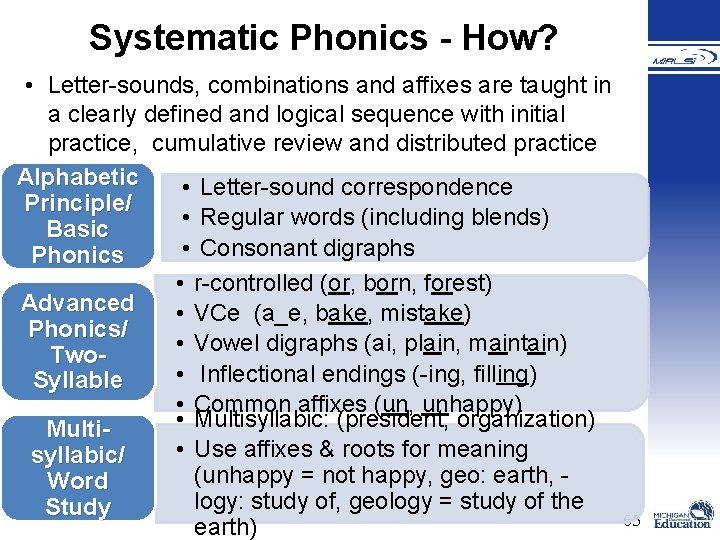
Systematic Phonics - How? • Letter-sounds, combinations and affixes are taught in a clearly defined and logical sequence with initial practice, cumulative review and distributed practice Alphabetic • Letter-sound correspondence Principle/ • Regular words (including blends) Basic • Consonant digraphs Phonics • r-controlled (or, born, forest) Advanced • VCe (a_e, bake, mistake) Phonics/ • Vowel digraphs (ai, plain, maintain) Two • Inflectional endings (-ing, filling) Syllable • Common affixes (un, unhappy) • Multisyllabic: (president, organization) Multi • Use affixes & roots for meaning syllabic/ (unhappy = not happy, geo: earth, Word logy: study of, geology = study of the Study 65 earth)
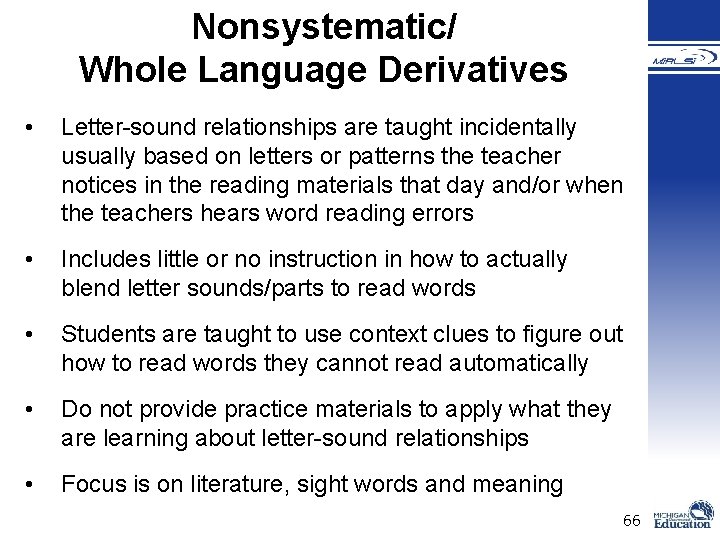
Nonsystematic/ Whole Language Derivatives • Letter-sound relationships are taught incidentally usually based on letters or patterns the teacher notices in the reading materials that day and/or when the teachers hears word reading errors • Includes little or no instruction in how to actually blend letter sounds/parts to read words • Students are taught to use context clues to figure out how to read words they cannot read automatically • Do not provide practice materials to apply what they are learning about letter-sound relationships • Focus is on literature, sight words and meaning 66
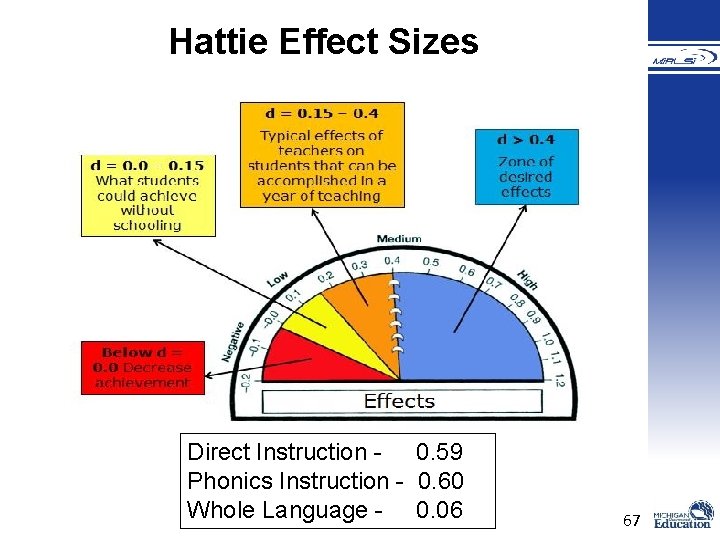
Hattie Effect Sizes Direct Instruction - 0. 59 Phonics Instruction - 0. 60 Whole Language - 0. 06 67
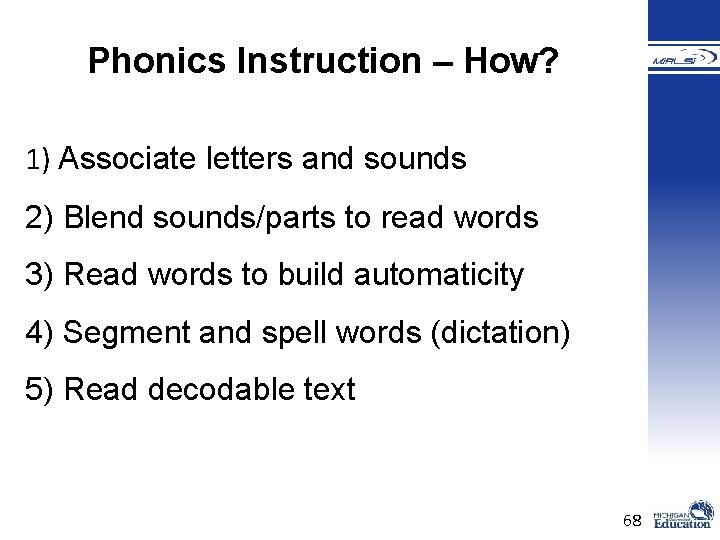
Phonics Instruction – How? 1) Associate letters and sounds 2) Blend sounds/parts to read words 3) Read words to build automaticity 4) Segment and spell words (dictation) 5) Read decodable text 68
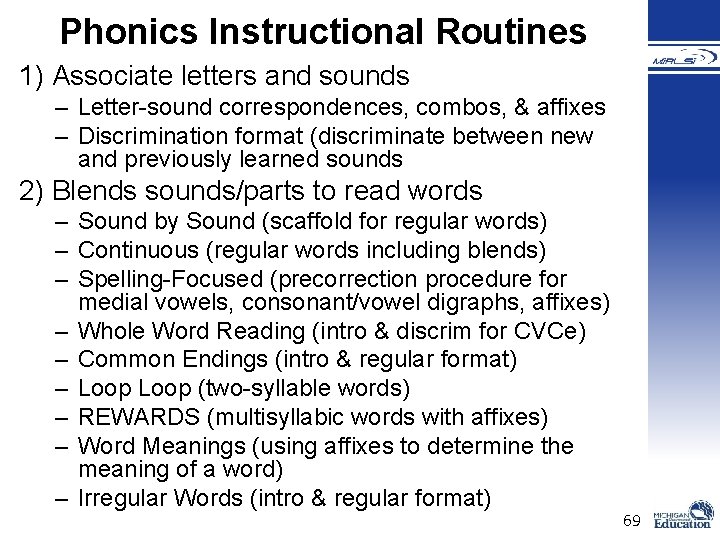
Phonics Instructional Routines 1) Associate letters and sounds – Letter-sound correspondences, combos, & affixes – Discrimination format (discriminate between new and previously learned sounds 2) Blends sounds/parts to read words – Sound by Sound (scaffold for regular words) – Continuous (regular words including blends) – Spelling-Focused (precorrection procedure for medial vowels, consonant/vowel digraphs, affixes) – Whole Word Reading (intro & discrim for CVCe) – Common Endings (intro & regular format) – Loop (two-syllable words) – REWARDS (multisyllabic words with affixes) – Word Meanings (using affixes to determine the meaning of a word) – Irregular Words (intro & regular format) 69
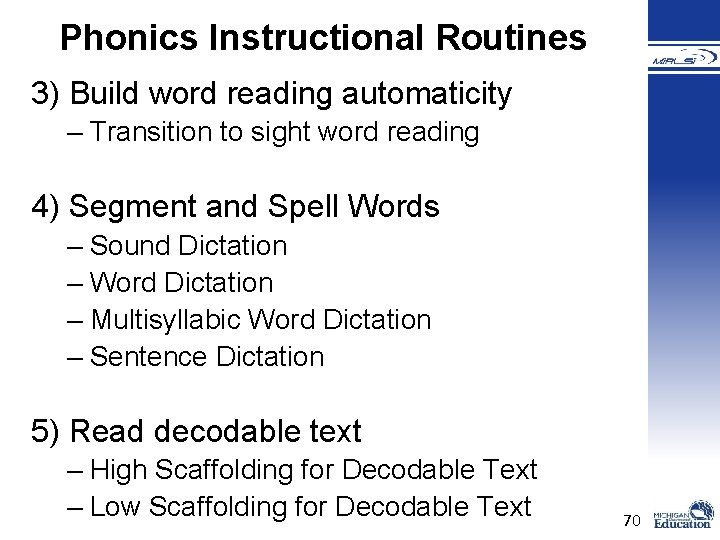
Phonics Instructional Routines 3) Build word reading automaticity – Transition to sight word reading 4) Segment and Spell Words – Sound Dictation – Word Dictation – Multisyllabic Word Dictation – Sentence Dictation 5) Read decodable text – High Scaffolding for Decodable Text – Low Scaffolding for Decodable Text 70
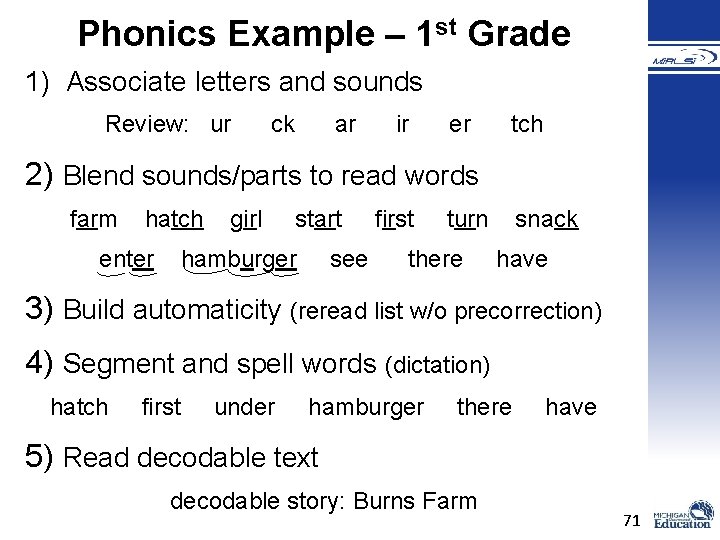
Phonics Example – 1 st Grade 1) Associate letters and sounds Review: ur ck ar ir er tch 2) Blend sounds/parts to read words farm hatch girl start first turn snack enter hamburger see there have 3) Build automaticity (reread list w/o precorrection) 4) Segment and spell words (dictation) hatch first under hamburger there have 5) Read decodable text decodable story: Burns Farm 71
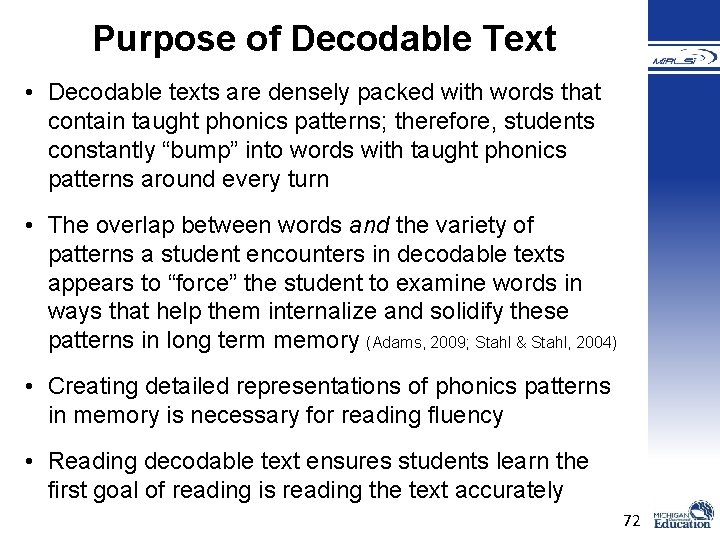
Purpose of Decodable Text • Decodable texts are densely packed with words that contain taught phonics patterns; therefore, students constantly “bump” into words with taught phonics patterns around every turn • The overlap between words and the variety of patterns a student encounters in decodable texts appears to “force” the student to examine words in ways that help them internalize and solidify these patterns in long term memory (Adams, 2009; Stahl & Stahl, 2004) • Creating detailed representations of phonics patterns in memory is necessary for reading fluency • Reading decodable text ensures students learn the first goal of reading is reading the text accurately 72
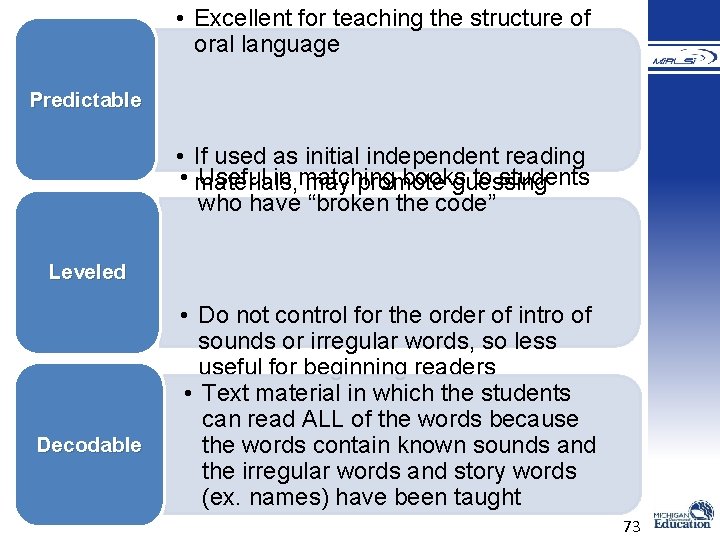
• Excellent for teaching the structure of oral language Predictable • If used as initial independent reading • materials, may promote guessing Useful in matching books to students who have “broken the code” Leveled Decodable • Do not control for the order of intro of sounds or irregular words, so less useful for beginning readers • Text material in which the students can read ALL of the words because the words contain known sounds and the irregular words and story words (ex. names) have been taught 73
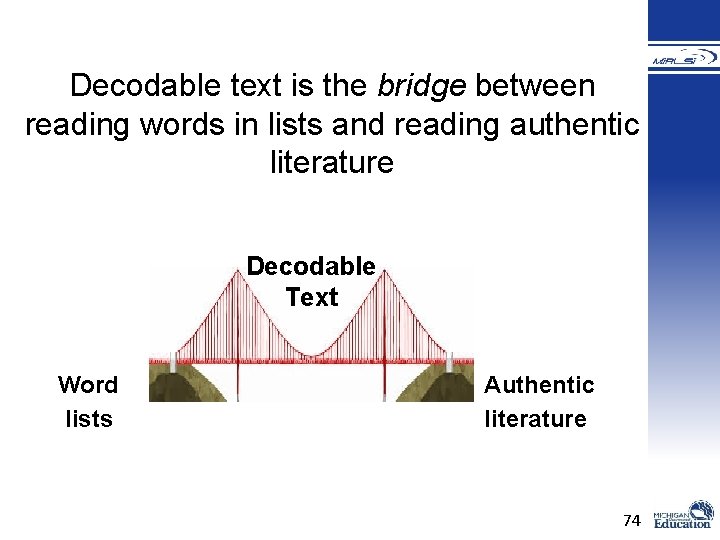
Decodable text is the bridge between reading words in lists and reading authentic literature Decodable Text Word lists Authentic literature 74
Webinar Resource Using Decodable Books and Early Leveled Readers Appropriately for Beginning Readers Presented by Linda Farrell http: //www. voyagersopris. com/webinarseries/spring-and-fall/2013 -springseries/using-decodable-books-and-earlyleveled-readers-appropriately-forbeginning-readers 75
Activity 1) Read/skim pages 11 -17 of the Put Reading First booklet 2) Check your phonics graphic organizer and add to it any other important facts, considering pertinent information specific to your local context 3) Compare your graphic organizer with your partner’s while you wait for the “Come Back” signal 76
Practice Phonics “Red/Black” Game P 1 – What? and Why? “My kids who can actually read don’t do well on the DIBELS NWF Measure” P 2 – How? and DC “I don’t use decodables because they are not authentic literature” 77
“Big Ideas” of Early Reading Instruction • • • Phonemic Awareness Phonics Fluency Vocabulary Comprehension 78
Fluency – What? Reasonably accurate reading at an appropriate rate with suitable prosody that leads to accurate and deep comprehension and motivation to read (Hasbrouk & Glaser, 2012) 79
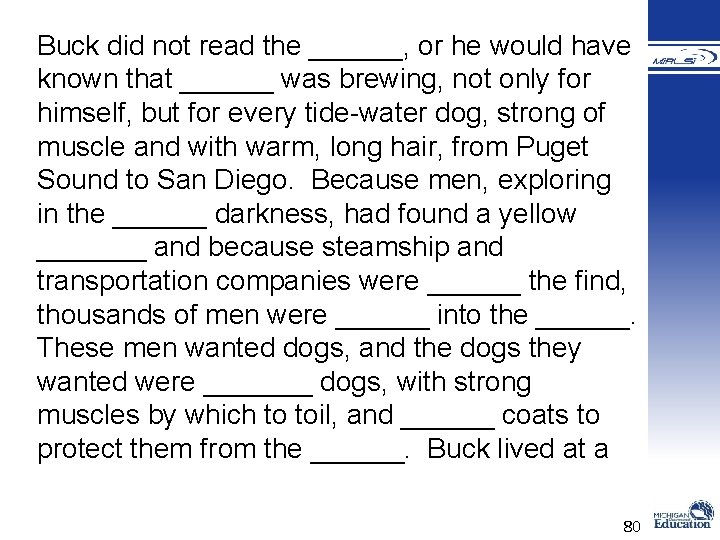
Buck did not read the ______, or he would have known that ______ was brewing, not only for himself, but for every tide-water dog, strong of muscle and with warm, long hair, from Puget Sound to San Diego. Because men, exploring in the ______ darkness, had found a yellow _______ and because steamship and transportation companies were ______ the find, thousands of men were ______ into the ______. These men wanted dogs, and the dogs they wanted were _______ dogs, with strong muscles by which to toil, and ______ coats to protect them from the ______. Buck lived at a 80
Buck did not read the newspaper, or he would have known that trouble was brewing, not only for himself, but for every tide-water dog, strong of muscle and with warm, long hair, from Puget Sound to San Diego. Because men, exploring in the Arctic darkness, had found a yellow metal and because steamship and transportation companies were booming the find, thousands of men were rushing into the Northland. These men wanted dogs, and the dogs they wanted were heavy dogs, with strong muscles by which to toil, and furry coats to protect them from the frost. Buck lived at a 81
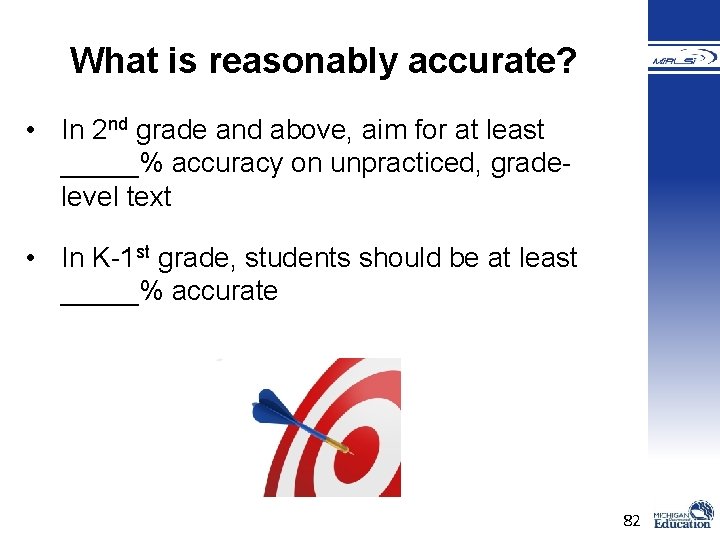
What is reasonably accurate? • In 2 nd grade and above, aim for at least _____% accuracy on unpracticed, gradelevel text • In K-1 st grade, students should be at least _____% accurate 82
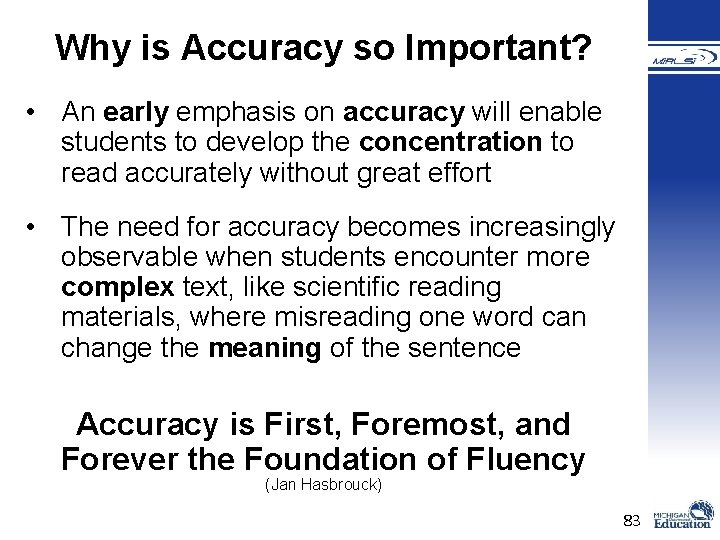
Why is Accuracy so Important? • An early emphasis on accuracy will enable students to develop the concentration to read accurately without great effort • The need for accuracy becomes increasingly observable when students encounter more complex text, like scientific reading materials, where misreading one word can change the meaning of the sentence Accuracy is First, Foremost, and Forever the Foundation of Fluency (Jan Hasbrouck) 83
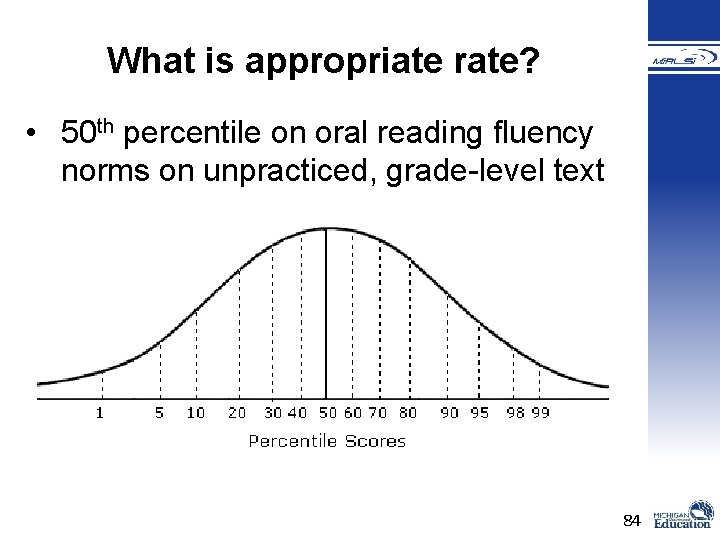
What is appropriate rate? • 50 th percentile on oral reading fluency norms on unpracticed, grade-level text 84
National Oral Reading Fluency Norms 50 th Percentiles Hasbrouck and Tindal (2006) Grade Fall 1 Winter Spring 23 53 2 51 72 89 3 71 92 107 4 94 112 123 5 110 127 139 6 127 140 150 7 128 136 150 8 133 146 151
What is suitable prosody? • Mirrors spoken language and conveys meaning • Often referred to as expression and proper phrasing 86
The origin of the word fluency is the Latin word fluens, which means to flow. A reader who is fluent reads smoothly and effortlessly: the reading flows 87
CCSS Fluency • Kindergarten – “Read emergent-reader text with purpose and understanding. ” • Emergent reader text is defined, in Appendix A of the CCSS, as “texts consisting of short sentences comprised of learned sight words and CVC words; may also include rebuses to represent words that cannot yet be decoded or recognized. ” • 1 st – 5 th grade – “Read with sufficient accuracy and fluency to support comprehension. ” 88
Fluency – Why? • Fluency is a general outcome measure that correlates extremely high with comprehension • Children who read fluently CAN and DO: • • Read more Develop a larger vocabulary Are better comprehenders Perform better on assessments Complete assignments easier Enjoy reading Are motivated, thus reap the benefits of reading more! 89
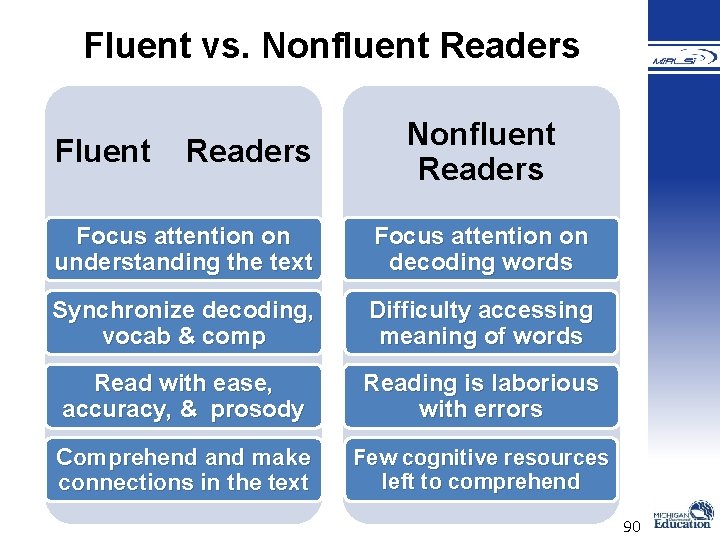
Fluent vs. Nonfluent Readers Fluent Readers Nonfluent Readers Focus attention on understanding the text Focus attention on decoding words Synchronize decoding, vocab & comp Difficulty accessing meaning of words Read with ease, accuracy, & prosody Reading is laborious with errors Comprehend and make connections in the text Few cognitive resources left to comprehend 90
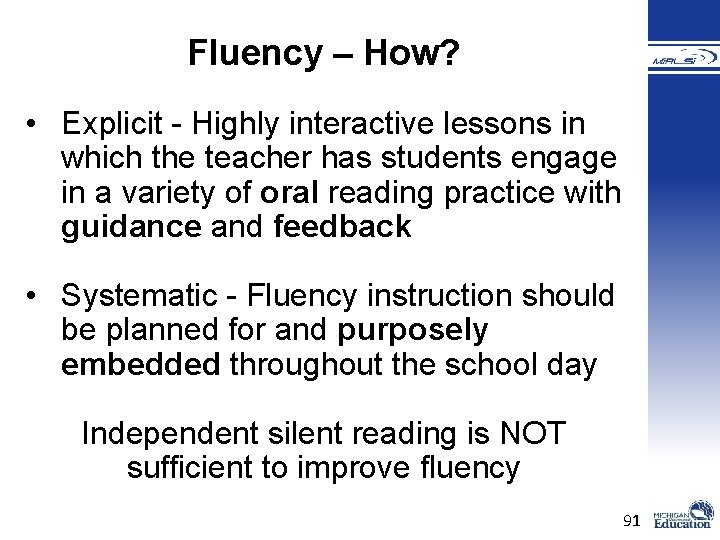
Fluency – How? • Explicit - Highly interactive lessons in which the teacher has students engage in a variety of oral reading practice with guidance and feedback • Systematic - Fluency instruction should be planned for and purposely embedded throughout the school day Independent silent reading is NOT sufficient to improve fluency 91
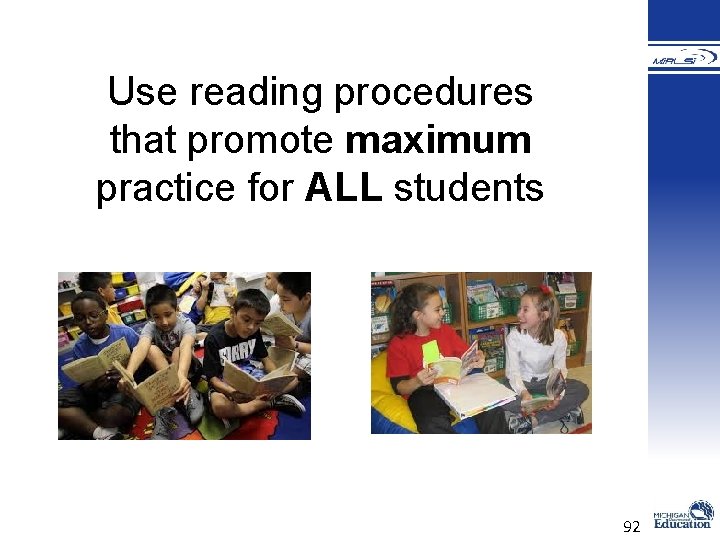
Use reading procedures that promote maximum practice for ALL students 92
And the Winner is… Repeated reading (deep, close reading) remains the “gold standard” for fluency instruction 93
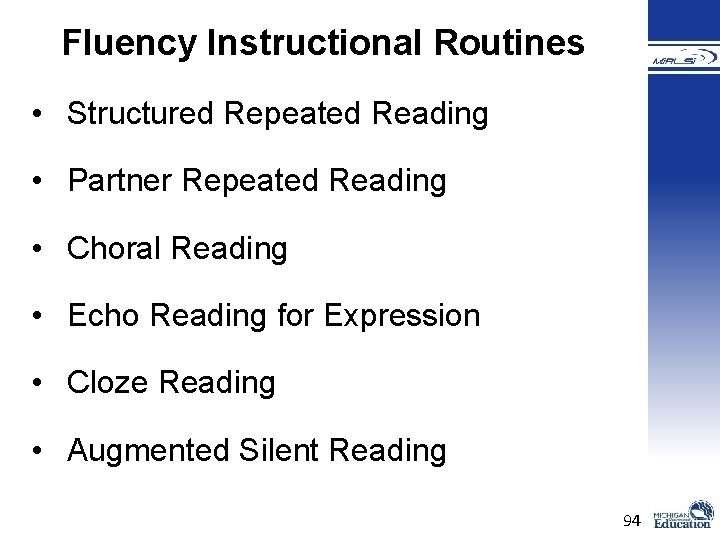
Fluency Instructional Routines • Structured Repeated Reading • Partner Repeated Reading • Choral Reading • Echo Reading for Expression • Cloze Reading • Augmented Silent Reading 94
Activity As you watch the video of fluency practices in a third grade classroom, please record the following: - Good instructional practices related to fluency instruction - General good teaching practices observed related to explicit and systematic instruction - Missed opportunities/room to grow 95
Activity 1) Read/skim pages 19 -27 of the Put Reading First booklet 2) Check your fluency graphic organizer and add to it any other important facts, considering pertinent information specific to your local context 3) Compare your graphic organizer with your partner’s while you wait for the “Come Back” signal 96
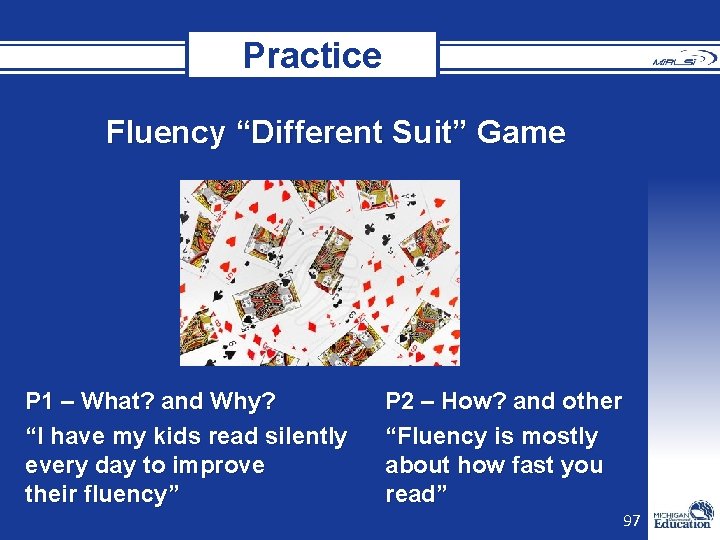
Practice Fluency “Different Suit” Game P 1 – What? and Why? “I have my kids read silently every day to improve their fluency” P 2 – How? and other “Fluency is mostly about how fast you read” 97
3. 0 Universal Screening, MTSS, and Tier 1 Reading Instruction 98
Reading Comprehension Decoding Language Comprehension • Ability to accurately Fluency • Ability to understand oral language read familiar words • Ability to automatically and read text • Dependent on: decode unfamiliar accurately, – Background words out of context at an Knowledge appropriate • Dependent on: – Social context rate, with – Phonemic – Vocabulary suitable Awareness – Text/Story prosody – Phonics Structure – Verbal Reasoning
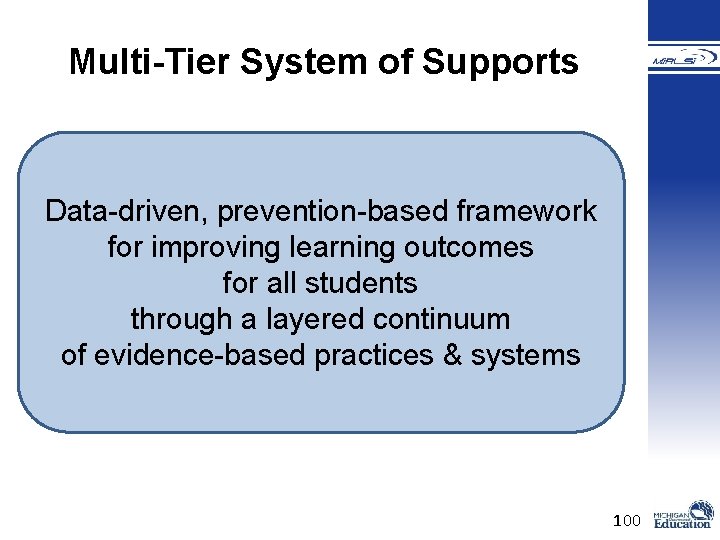
Multi-Tier System of Supports Data-driven, prevention-based framework for improving learning outcomes for all students through a layered continuum of evidence-based practices & systems 100
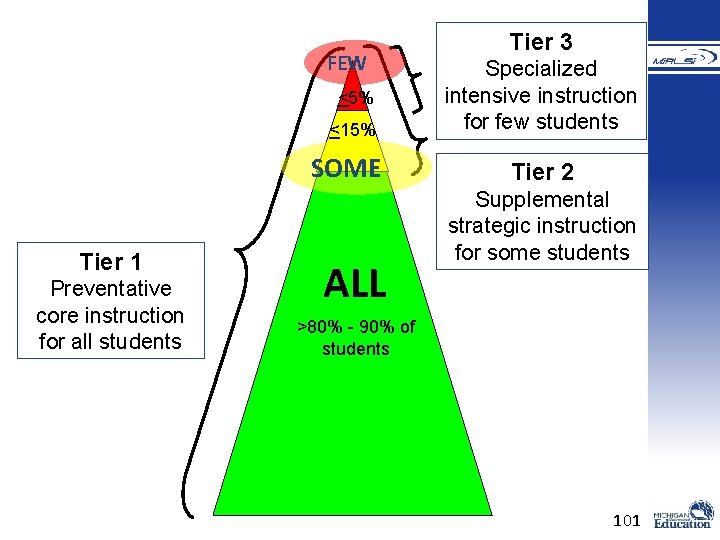
FEW <5% <15% SOME Tier 1 ALL Tier 3 Specialized intensive instruction for few students Tier 2 Supplemental strategic instruction for some students Preventative core instruction >80% - 90% of for all students 101
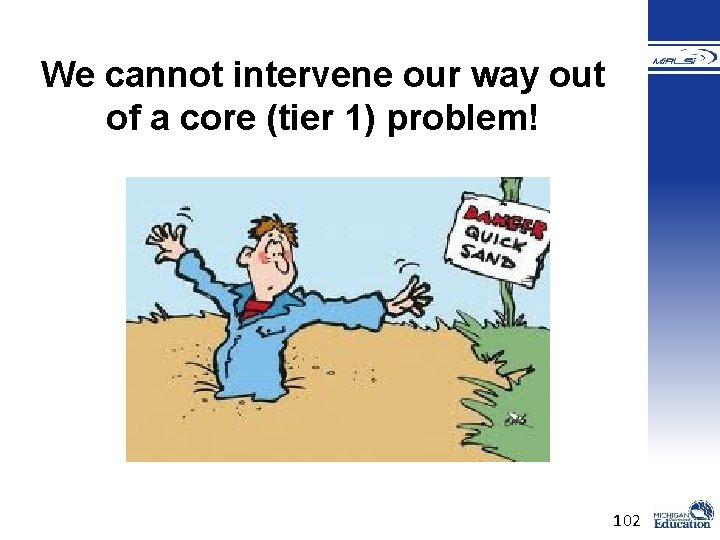
We cannot intervene our way out of a core (tier 1) problem! 102
Purpose of DIBELS Next • To accurately identify students in need of support early • To provide meaningful and important instructional goals • To evaluate progress toward the instructional goals • To help modify instruction as needed for students to make adequate progress • To help systems evaluate their core and supplemental programs 103
Why These Measures? • They relate to the BIG IDEAS! • They are indicators of critical early literacy skills that are the most highly predictive of later reading achievement • The measures are NOT meant to be comprehensive of all aspects of reading 104
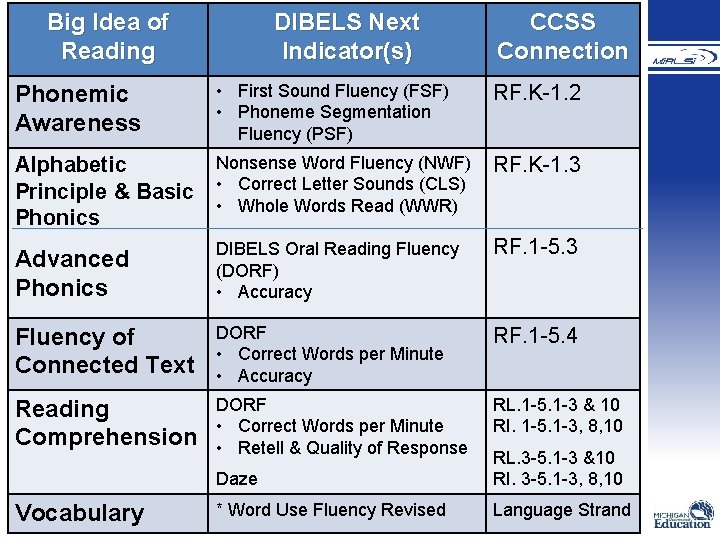
Big Idea of Reading Phonemic Awareness DIBELS Next Indicator(s) • First Sound Fluency (FSF) • Phoneme Segmentation Fluency (PSF) Nonsense Word Fluency (NWF) Alphabetic Principle & Basic • Correct Letter Sounds (CLS) • Whole Words Read (WWR) Phonics CCSS Connection RF. K-1. 2 RF. K-1. 3 Advanced Phonics DIBELS Oral Reading Fluency (DORF) • Accuracy RF. 1 -5. 3 Fluency of Connected Text DORF • Correct Words per Minute • Accuracy RF. 1 -5. 4 Reading Comprehension DORF • Correct Words per Minute • Retell & Quality of Response RL. 1 -5. 1 -3 & 10 RI. 1 -5. 1 -3, 8, 10 Daze Vocabulary * Word Use Fluency Revised RL. 3 -5. 1 -3 &10 RI. 3 -5. 1 -3, 8, 10 Language Strand 105
Why Nonsense Words? • Nonsense words are used to explore whether beginning stage readers can apply the alphabetic principle when coming to a word s/he does not recognize automatically • We continue to use our alphabetic principle in middle school, high school, and beyond when we come to a word we do not know • Real words cannot be used because it is unclear if the student actually has the skills to sound out and read the word (versus it being a memorized word) 106
Interpretation of your DIBELS data is dependent on understanding what the Benchmark Goals mean! 107
Understanding Benchmark Goals have three critical components: 1. A skill 2. A level of performance 3. A point in time They represent the lowest level of okay for ALL students! Dynamic Measurement Group 108
What Does Benchmark Mean? • Benchmark goals represent lowest levels of performance that, with continued good instruction, students have an 80% - 90% chance of meeting the next benchmark goal • Some-risk means a 40 - 60% chance of meeting the next benchmark goal • High-risk means 10% - 20% chance of meeting the next benchmark goal UNLESS WE DO SOMETHING! 109
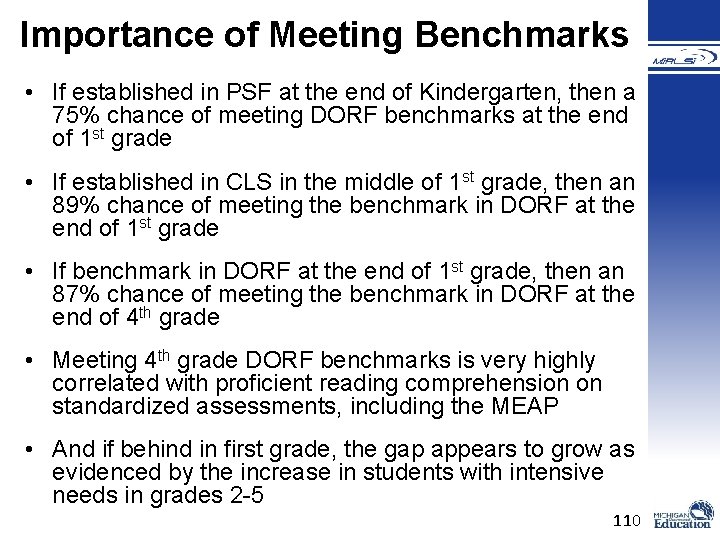
Importance of Meeting Benchmarks • If established in PSF at the end of Kindergarten, then a 75% chance of meeting DORF benchmarks at the end of 1 st grade • If established in CLS in the middle of 1 st grade, then an 89% chance of meeting the benchmark in DORF at the end of 1 st grade • If benchmark in DORF at the end of 1 st grade, then an 87% chance of meeting the benchmark in DORF at the end of 4 th grade • Meeting 4 th grade DORF benchmarks is very highly correlated with proficient reading comprehension on standardized assessments, including the MEAP • And if behind in first grade, the gap appears to grow as evidenced by the increase in students with intensive needs in grades 2 -5 110
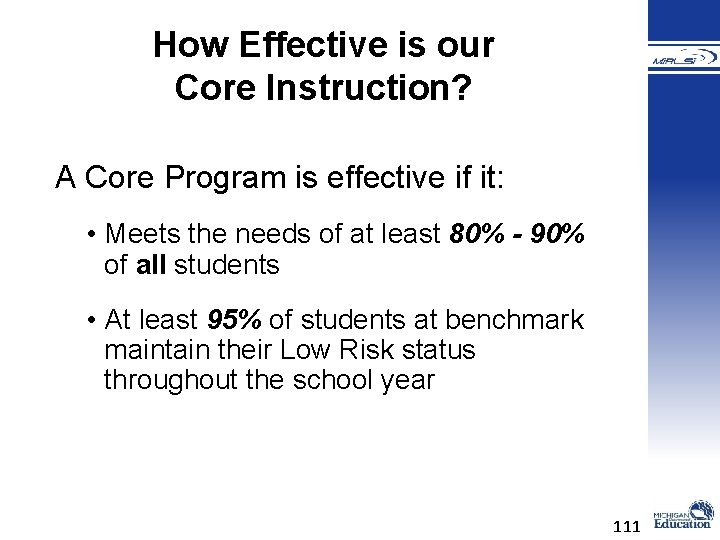
How Effective is our Core Instruction? A Core Program is effective if it: • Meets the needs of at least 80% - 90% of all students • At least 95% of students at benchmark maintain their Low Risk status throughout the school year 111
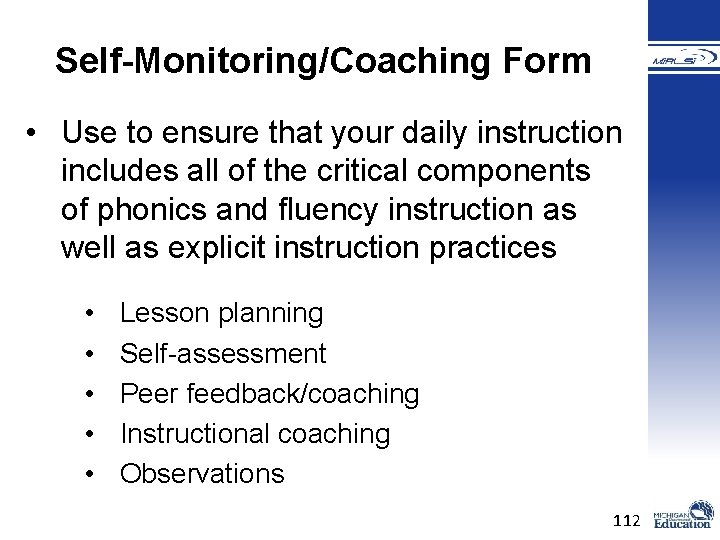
Self-Monitoring/Coaching Form • Use to ensure that your daily instruction includes all of the critical components of phonics and fluency instruction as well as explicit instruction practices • • • Lesson planning Self-assessment Peer feedback/coaching Instructional coaching Observations 112
Activity 1) Complete your MTSS Guided Notes 2) Compare your MTSS Guided Notes with your partner’s while you wait for the “Come Back” signal 113
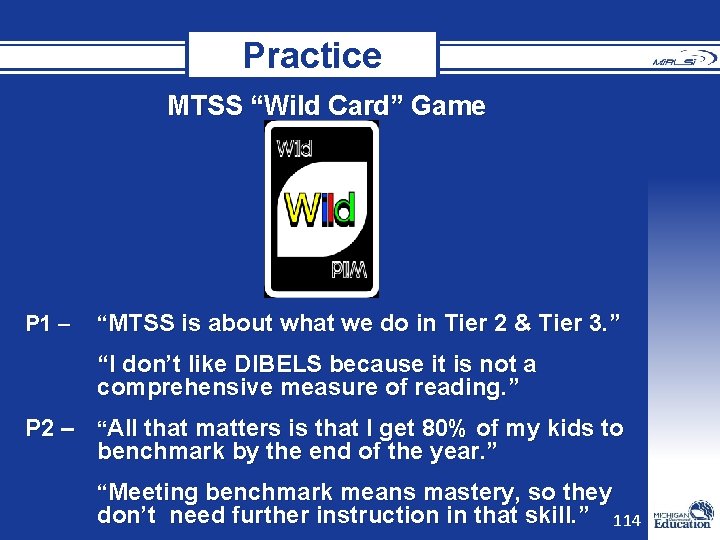
Practice MTSS “Wild Card” Game P 1 – “MTSS is about what we do in Tier 2 & Tier 3. ” “I don’t like DIBELS because it is not a comprehensive measure of reading. ” P 2 – “All that matters is that I get 80% of my kids to benchmark by the end of the year. ” “Meeting benchmark means mastery, so they don’t need further instruction in that skill. ” 114
4. 0 Implementation Story Time 115
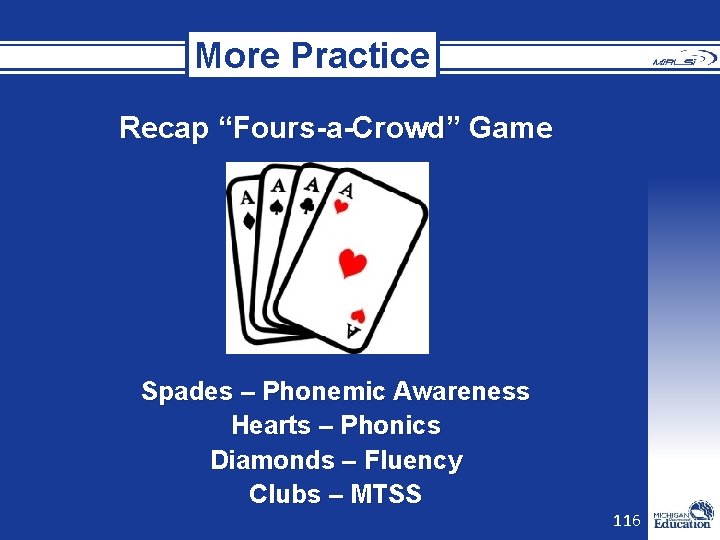
More Practice Recap “Fours-a-Crowd” Game Spades – Phonemic Awareness Hearts – Phonics Diamonds – Fluency Clubs – MTSS 116
5. 0 Instructional Routines 117
Instructional Routines • Clear, concise language used consistently across lessons • Instructional routines improve student achievement by increasing: • • • Student motivation Opportunities to respond Opportunities for feedback Student attentiveness Mastery of skills 118
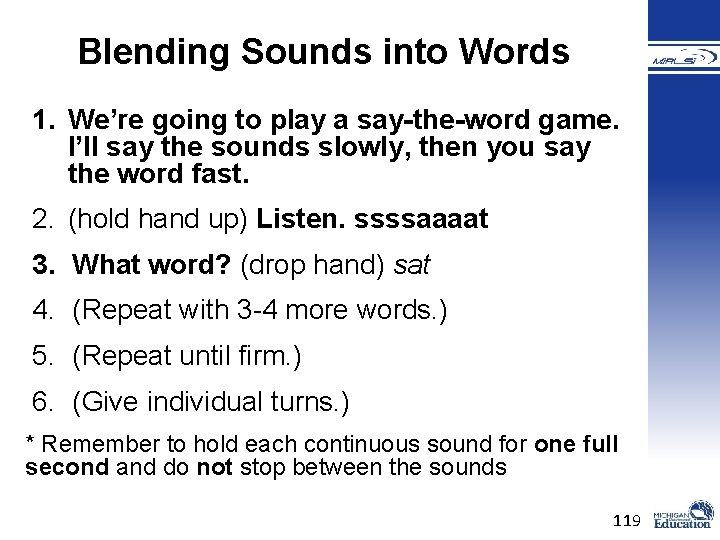
Blending Sounds into Words 1. We’re going to play a say-the-word game. I’ll say the sounds slowly, then you say the word fast. 2. (hold hand up) Listen. ssssaaaat 3. What word? (drop hand) sat 4. (Repeat with 3 -4 more words. ) 5. (Repeat until firm. ) 6. (Give individual turns. ) * Remember to hold each continuous sound for one full second and do not stop between the sounds 119
Your Turn Blending Sounds mad slip cat math 120
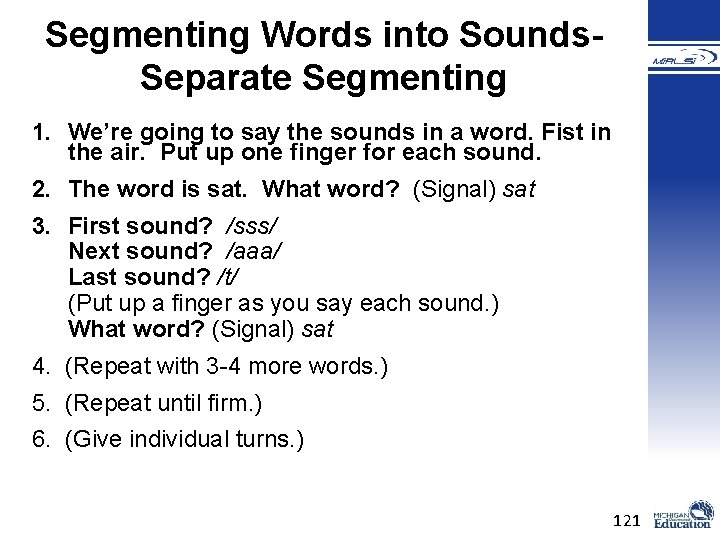
Segmenting Words into Sounds. Separate Segmenting 1. We’re going to say the sounds in a word. Fist in the air. Put up one finger for each sound. 2. The word is sat. What word? (Signal) sat 3. First sound? /sss/ Next sound? /aaa/ Last sound? /t/ (Put up a finger as you say each sound. ) What word? (Signal) sat 4. (Repeat with 3 -4 more words. ) 5. (Repeat until firm. ) 6. (Give individual turns. ) 121
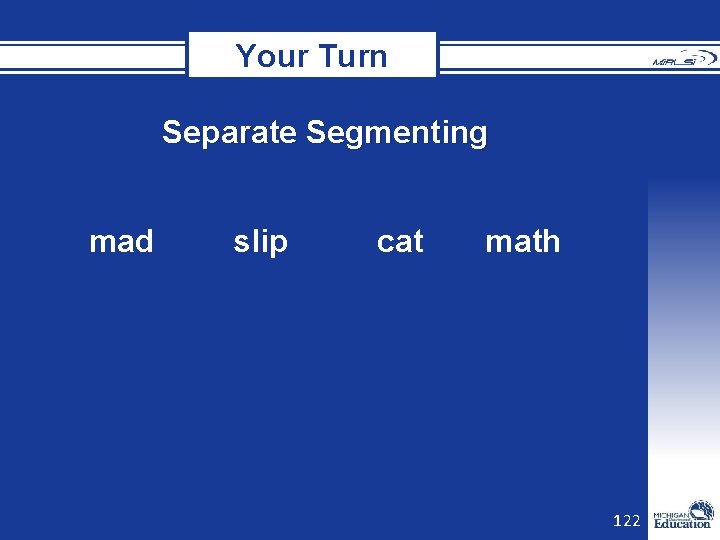
Your Turn Separate Segmenting mad slip cat math 122
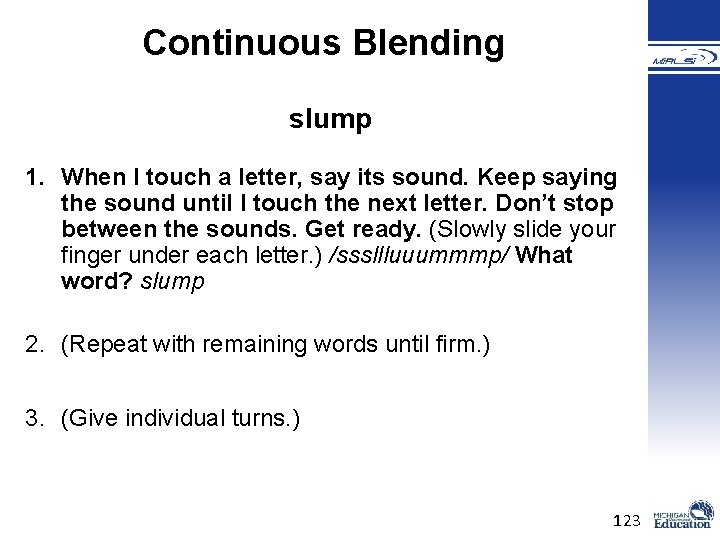
Continuous Blending slump 1. When I touch a letter, say its sound. Keep saying the sound until I touch the next letter. Don’t stop between the sounds. Get ready. (Slowly slide your finger under each letter. ) /sssllluuummmp/ What word? slump 2. (Repeat with remaining words until firm. ) 3. (Give individual turns. ) 123
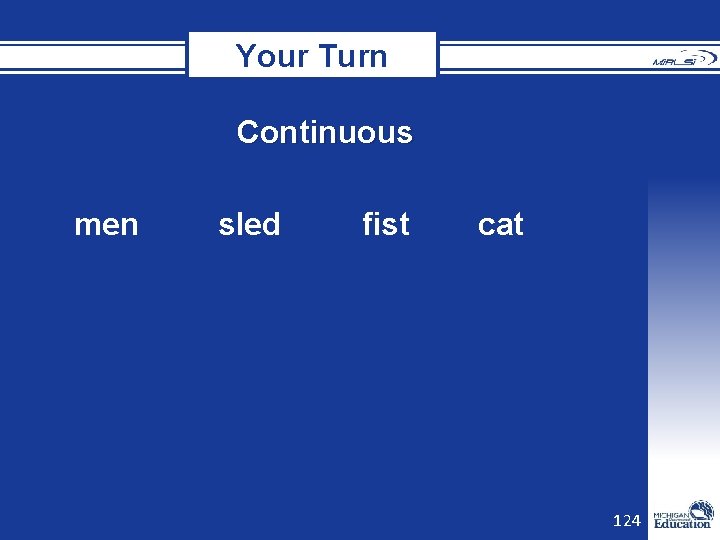
Your Turn Continuous men sled fist cat 124
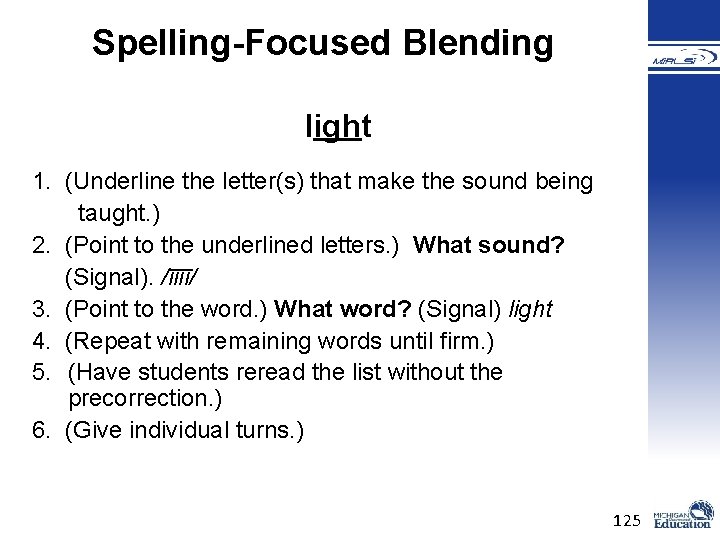
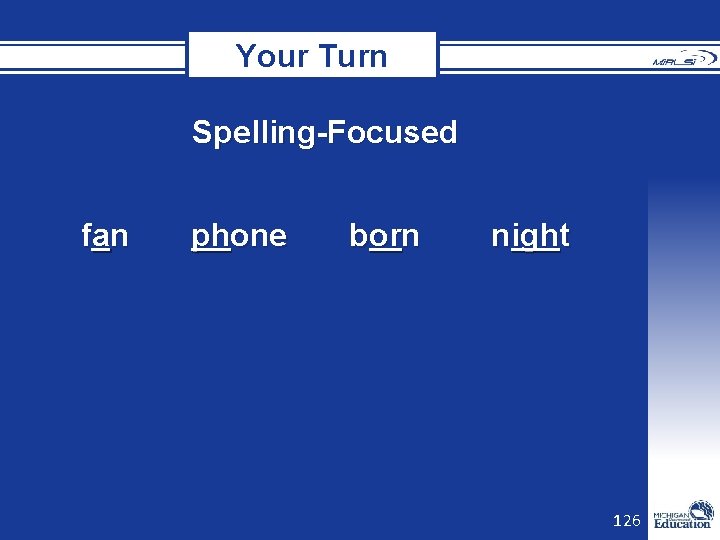
Spelling-Focused Blending light 1. (Underline the letter(s) that make the sound being taught. ) 2. (Point to the underlined letters. ) What sound? (Signal). /īīīī/ 3. (Point to the word. ) What word? (Signal) light 4. (Repeat with remaining words until firm. ) 5. (Have students reread the list without the precorrection. ) 6. (Give individual turns. ) 125
Your Turn Spelling-Focused fa n phone born night 126
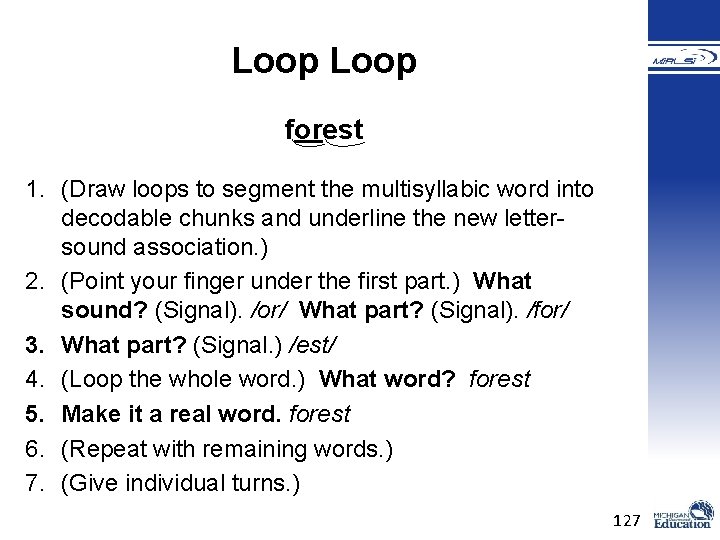
Loop forest 1. (Draw loops to segment the multisyllabic word into decodable chunks and underline the new lettersound association. ) 2. (Point your finger under the first part. ) What sound? (Signal). /or/ What part? (Signal). /for/ 3. What part? (Signal. ) /est/ 4. (Loop the whole word. ) What word? forest 5. Make it a real word. forest 6. (Repeat with remaining words. ) 7. (Give individual turns. ) 127
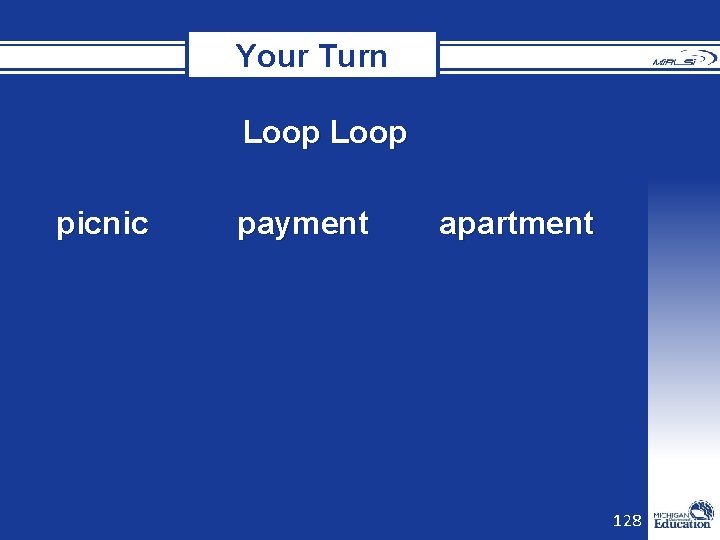
Your Turn Loop picnic payment apartment 128
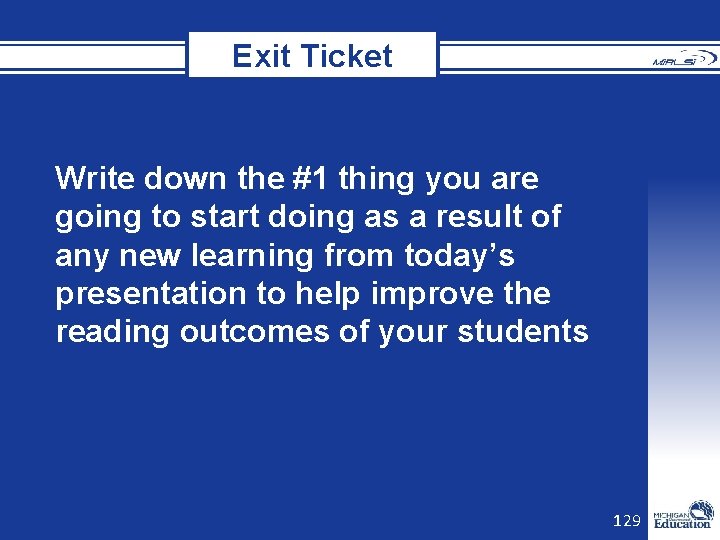
Exit Ticket Write down the #1 thing you are going to start doing as a result of any new learning from today’s presentation to help improve the reading outcomes of your students 129
You have the most important job in the world. Thank you for all that you do for your students! 130