
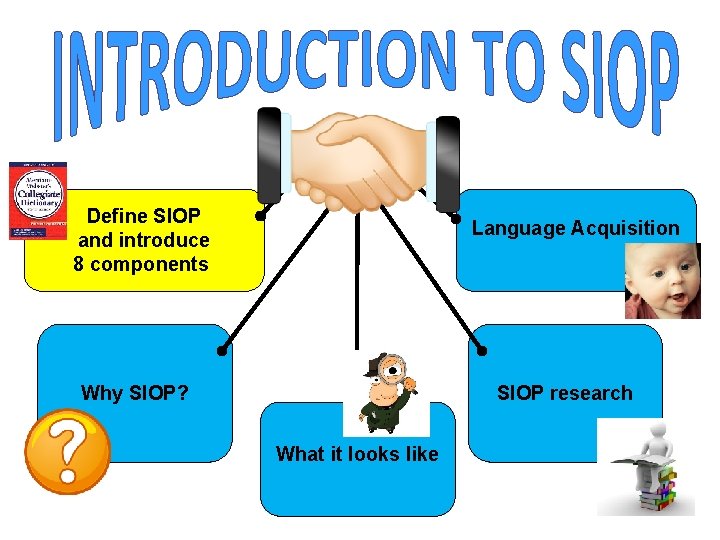
2 ANTICIPATION GUIDE Define SIOP and introduce 8

- Slides: 89
2 ANTICIPATION GUIDE
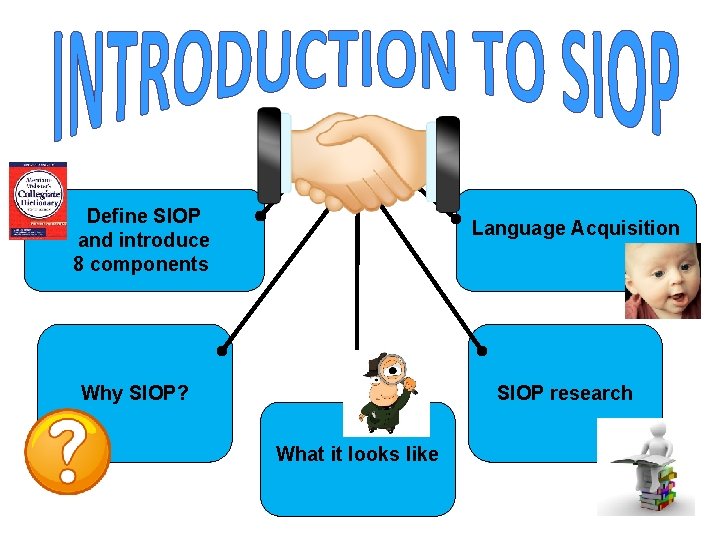
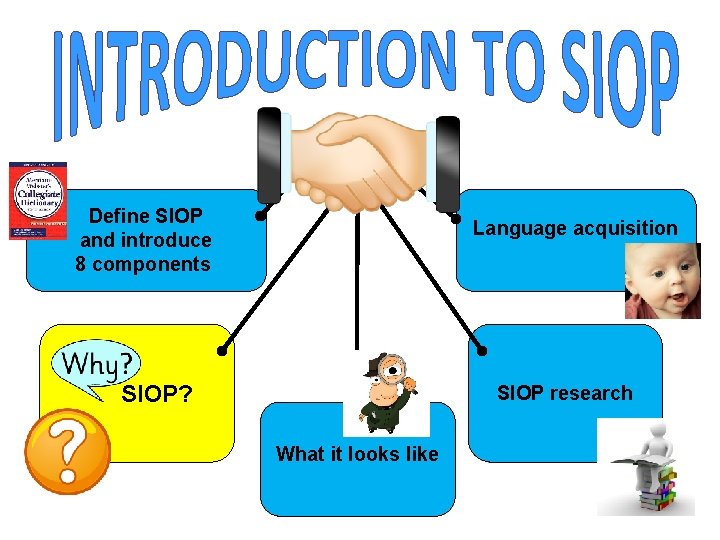
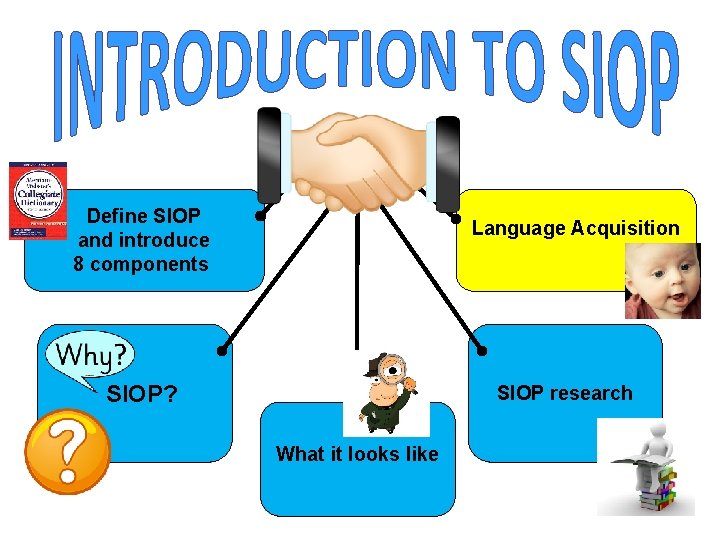
Define SIOP and introduce 8 components Language Acquisition Why SIOP? SIOP research What it looks like
Introduction to SIOP Content Objectives: v I can define Sheltered Instruction Observational Protocol and why it’s important. v I can understand the research that supports this model and how it affects language acquisition. Language Objectives: v I can discuss my role as an ESL teacher and the impact of SIOP on instruction.
Define SIOP and introduce 8 components Language Acquisition Why SIOP? SIOP research What it looks like
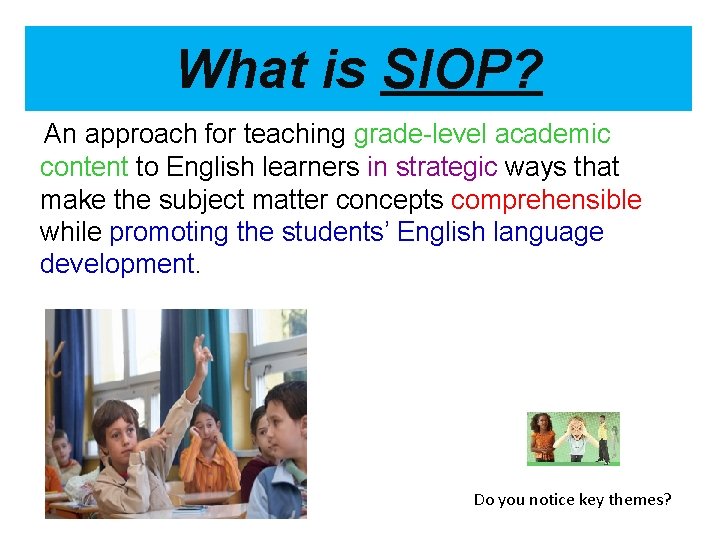
What is SIOP? An approach for teaching grade-level academic content to English learners in strategic ways that make the subject matter concepts comprehensible while promoting the students’ English language development. 6 Do you notice key themes?
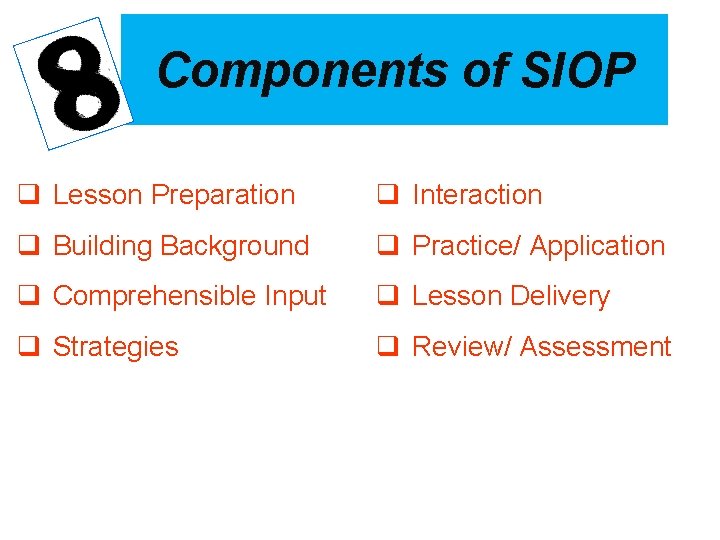
Components of SIOP q Lesson Preparation q Interaction q Building Background q Practice/ Application q Comprehensible Input q Lesson Delivery q Strategies q Review/ Assessment
Define SIOP and introduce 8 components Language acquisition SIOP? SIOP research What it looks like
Introduction to SIOP Model Video v Provide content area instruction that is accommodated to the needs of ELLs at all levels. v Integrate academic language instruction into content area instruction. v High expectations for academic success of ELLs and ALL students in all content area.
Define SIOP And introduce 8 components Language acquisition SIOP? SIOP research What it looks like
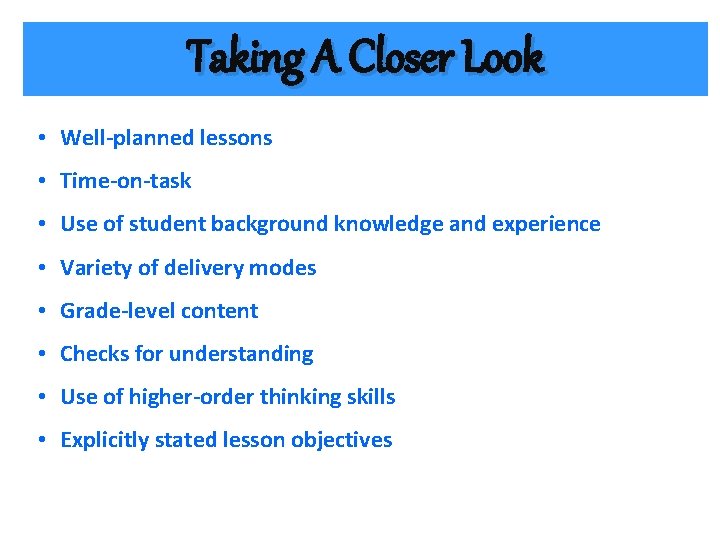
Taking a Closer Look Taking A Closer Look • Well-planned lessons • Time-on-task • Use of student background knowledge and experience • Variety of delivery modes • Grade-level content • Checks for understanding • Use of higher-order thinking skills • Explicitly stated lesson objectives
Define SIOP And introduce 8 components Language acquisition SIOP? SIOP research What it looks like
Research says…. . The SIOP Model can be viewed as an instructional model and as a tool for training and evaluating educators who work with ELLs. Several studies have found that participation in professional development and the continued use of observations, rating rubrics, or checklists similar to those used with SIOP have increased teachers’ use of targeted instructional techniques such as SI (Crawford et al. , 2008; Friend et al. , 2009; Gibbons, 2003; Giouroukakis et al. , 2011).
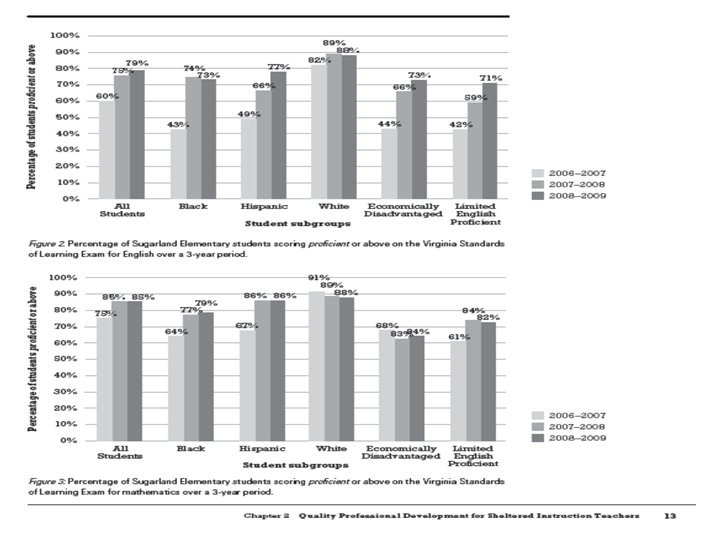
• Students with SIOP-trained teachers participated in the (SIOP) PD program with summer institutes, followup workshops, and on-site coaching. SIOP-trained teachers made statistically significant gains in their average mean scores for oral language, writing, and total proficiency on the state assessment for English language proficiency, compared to the comparison group of English learners (Short, Fidelman, & Louguit, 2012) • Similar SIOP studies across K-12 classrooms in various content areas including math and science classrooms performing better when SIOP implemented with high fidelity than those that did not implement SIOP.
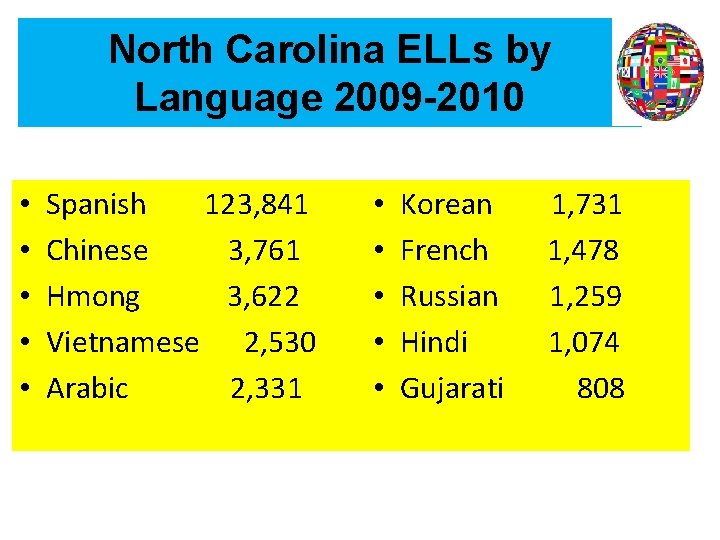
North Carolina ELLs by Language 2009 -2010 • • • Spanish 123, 841 Chinese 3, 761 Hmong 3, 622 Vietnamese 2, 530 Arabic 2, 331 • • • Korean French Russian Hindi Gujarati 1, 731 1, 478 1, 259 1, 074 808 17
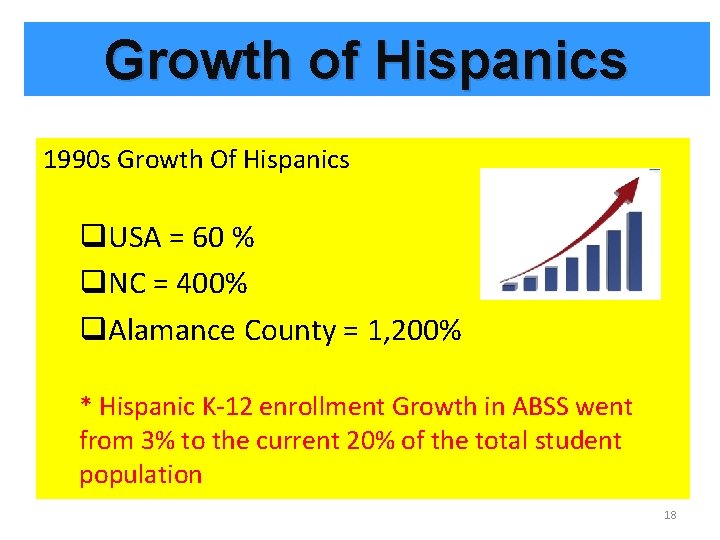
Growth of Hispanics 1990 s Growth Of Hispanics q. USA = 60 % q. NC = 400% q. Alamance County = 1, 200% * Hispanic K-12 enrollment Growth in ABSS went from 3% to the current 20% of the total student population 18
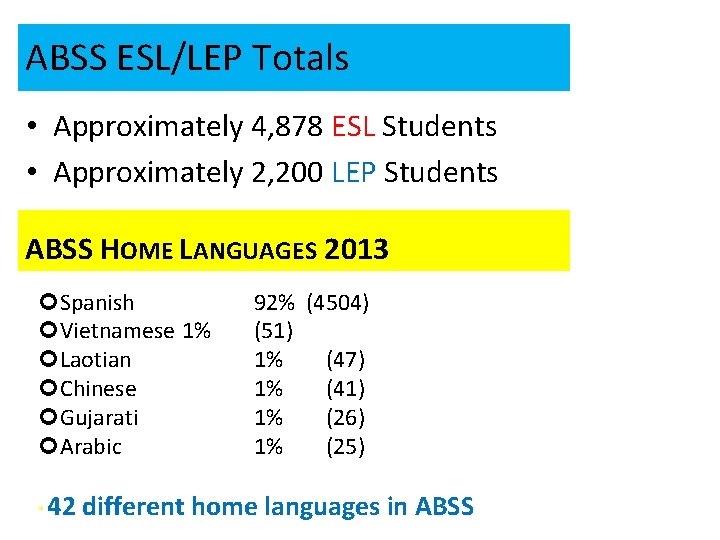
ABSS ESL/LEP Totals • Approximately 4, 878 ESL Students • Approximately 2, 200 LEP Students ABSS HOME LANGUAGES 2013 Spanish Vietnamese 1% Laotian Chinese Gujarati Arabic * 92% (4504) (51) 1% (47) 1% (41) 1% (26) 1% (25) 42 different home languages in ABSS 19
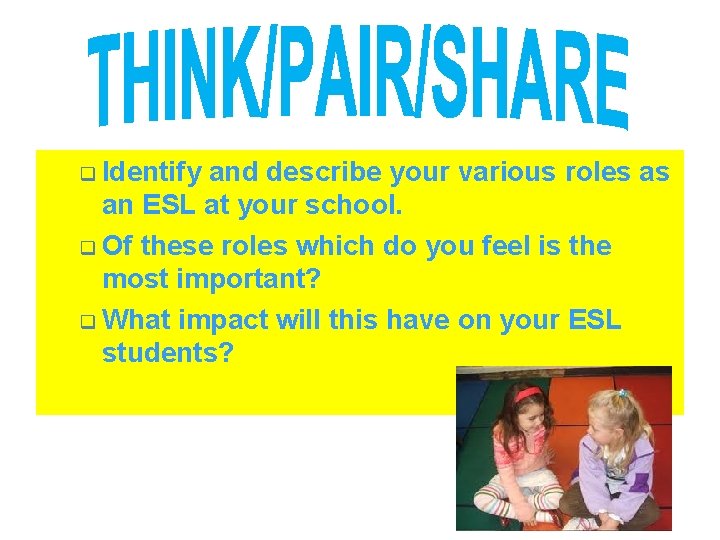
q Identify and describe your various roles as an ESL at your school. q Of these roles which do you feel is the most important? q What impact will this have on your ESL students?
Define SIOP and introduce 8 components Language Acquisition SIOP? SIOP research What it looks like
Language Acquisition ❝To have another language is to possess a second soul. ❞ ‒Charlemagne 22
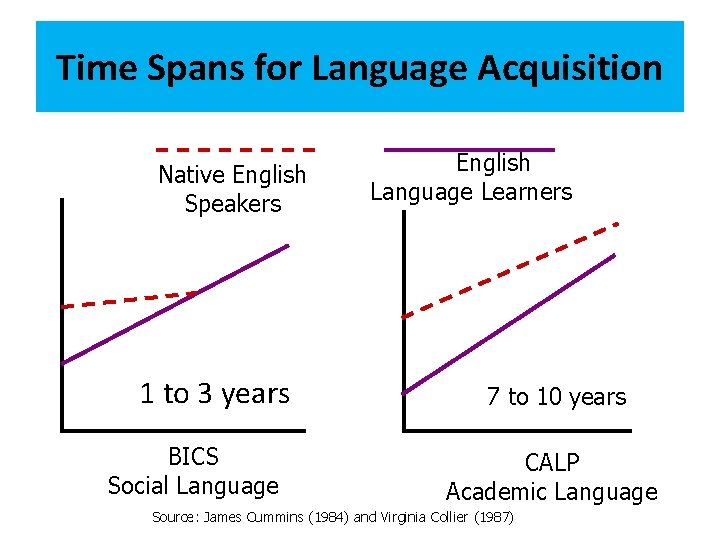
Time Spans for Language Acquisition Native English Speakers 1 to 3 years BICS Social Language English Language Learners 7 to 10 years CALP Academic Language Source: James Cummins (1984) and Virginia Collier (1987) 23
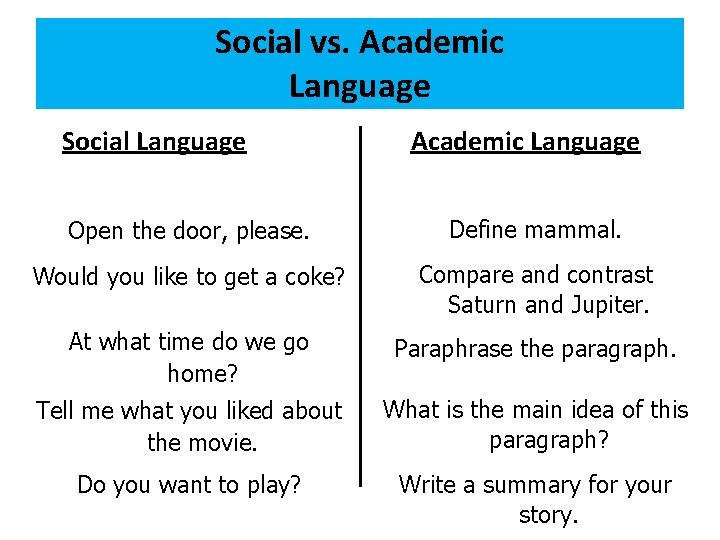
Social vs. Academic Language Social Language Academic Language Open the door, please. Define mammal. Would you like to get a coke? Compare and contrast Saturn and Jupiter. At what time do we go home? Paraphrase the paragraph. Tell me what you liked about the movie. What is the main idea of this paragraph? Do you want to play? Write a summary for your 24 story.
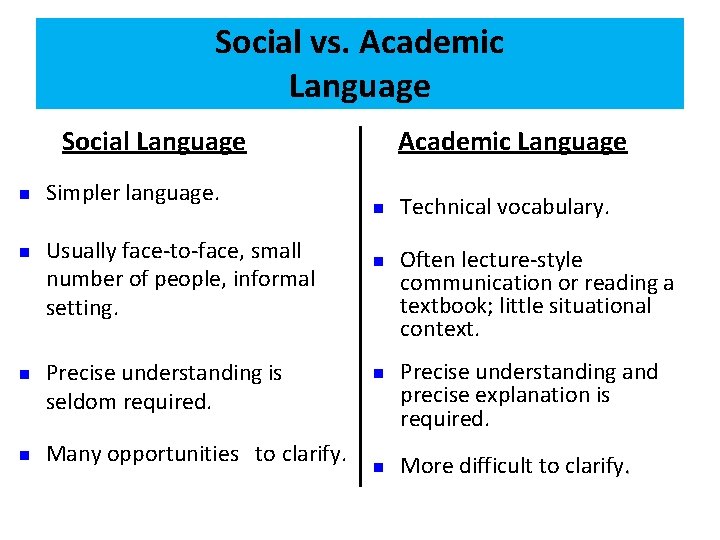
Social vs. Academic Language Social Language n n Simpler language. Usually face-to-face, small number of people, informal setting. Precise understanding is seldom required. Many opportunities to clarify. Academic Language n n Technical vocabulary. Often lecture-style communication or reading a textbook; little situational context. Precise understanding and precise explanation is required. More difficult to clarify. 25
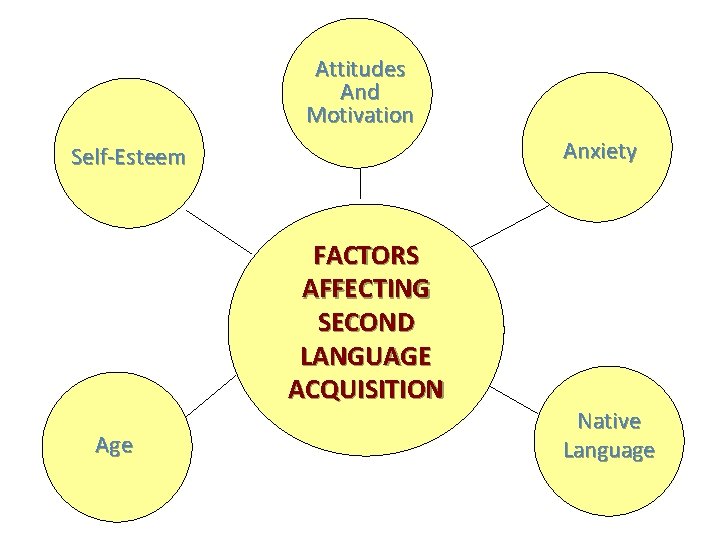
Attitudes And Motivation Anxiety Self-Esteem FACTORS AFFECTING SECOND LANGUAGE ACQUISITION Age Native Language 26
Content Objectives: v I can define Sheltered Instruction Observational Protocol and why it’s important. v I can understand the research that supports this model and how it affects language acquisition. Language Objectives: v I can discuss my role as an ESL teacher and the impact of SIOP on instruction.
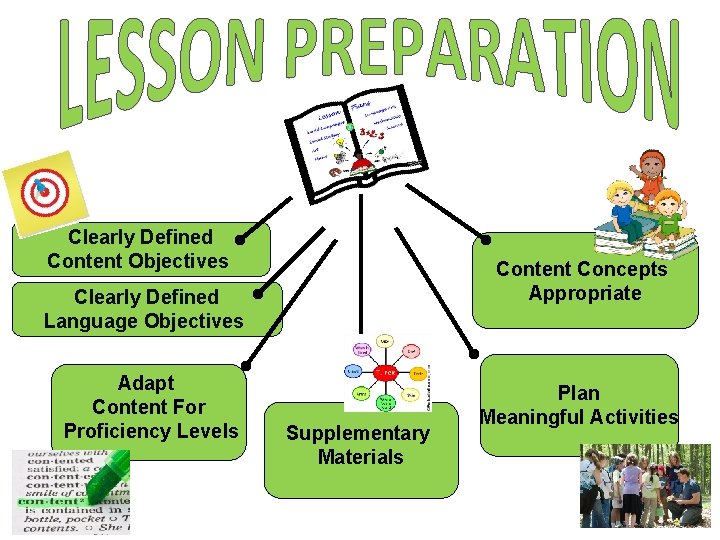
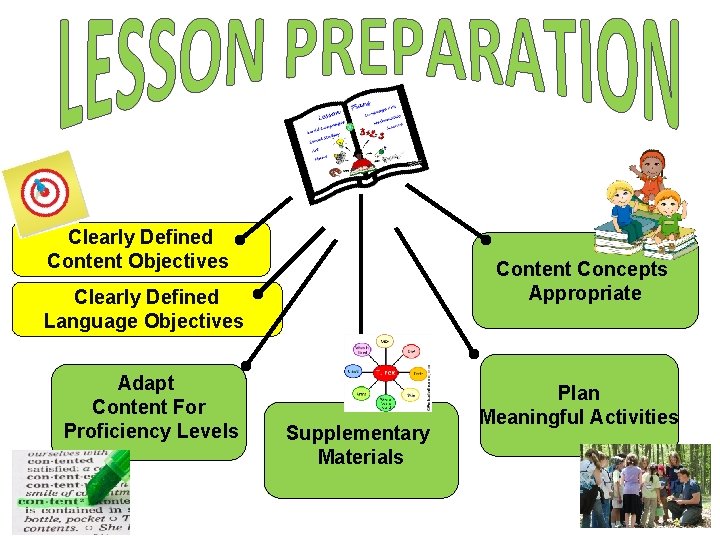
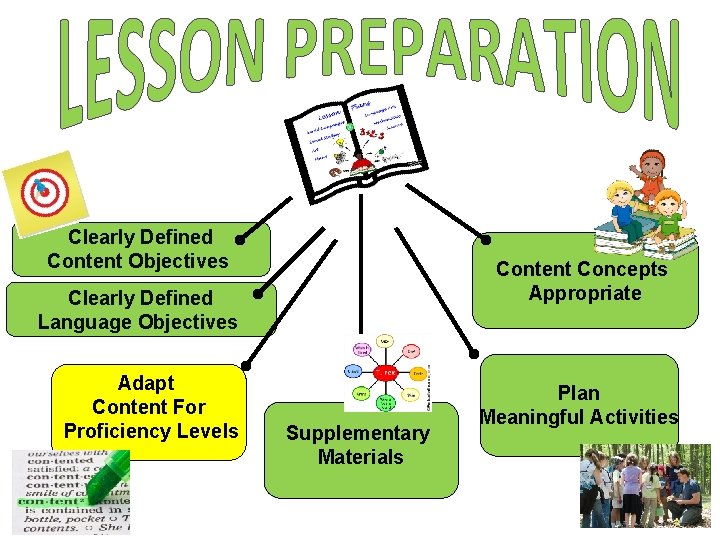
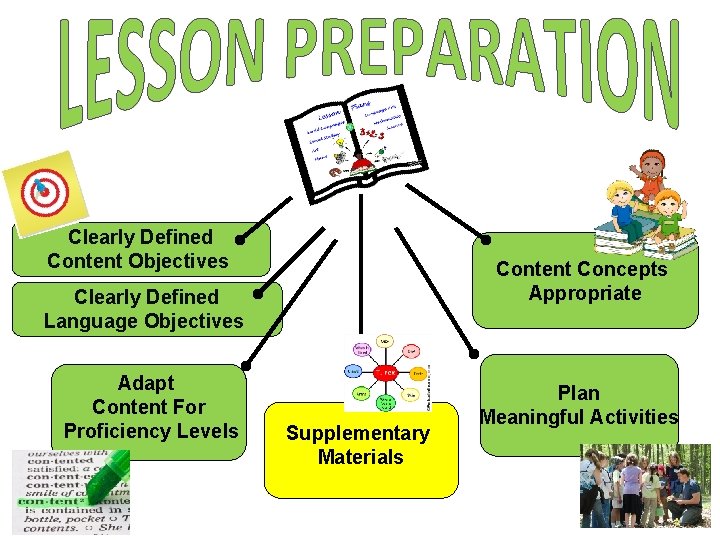
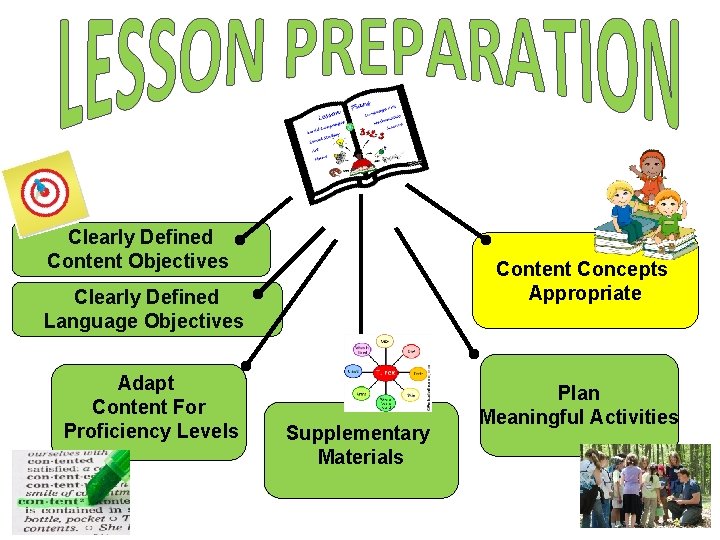
Clearly Defined Content Objectives Content Concepts Appropriate Clearly Defined Language Objectives Adapt Content For Proficiency Levels Supplementary Materials Plan Meaningful Activities
Lesson Preparation Content Objectives: v I can identify Lesson Preparation as a component of SIOP and the features of this component. v I can Identify properties of a language objective. Language Objectives: v Given a content objective, I can write a language objective using multiple properties of language objectives.
……thinking about your lesson plan, how does the anatomy of a lesson merge with SIOP? AOL What do you notice? SIOP Handout
Clearly Defined Content Objectives Content Concepts Appropriate Clearly Defined Language Objectives Adapt Content For Proficiency Levels Supplementary Materials Plan Meaningful Activities
Learning Objectives Are Essential! (Content and Language) 1. They guide both teaching and learning in a classroom. 2. They are the foundation of a lesson. 3. SIOP classrooms have both content and language learning goals. 4. They should be written in kid friendly language, posted and reviewed with students. 5. Attainment of the objectives should be assessed and reviewed with the students throughout the lesson.
Content Learning Objectives • They describe WHAT needs to be learned in regards to content. • They should be written at the lesson level and should be taught and learned in one or two lessons. • They should be developed from the state standards, district essentials guide, common core. SCAVENGER HUNT
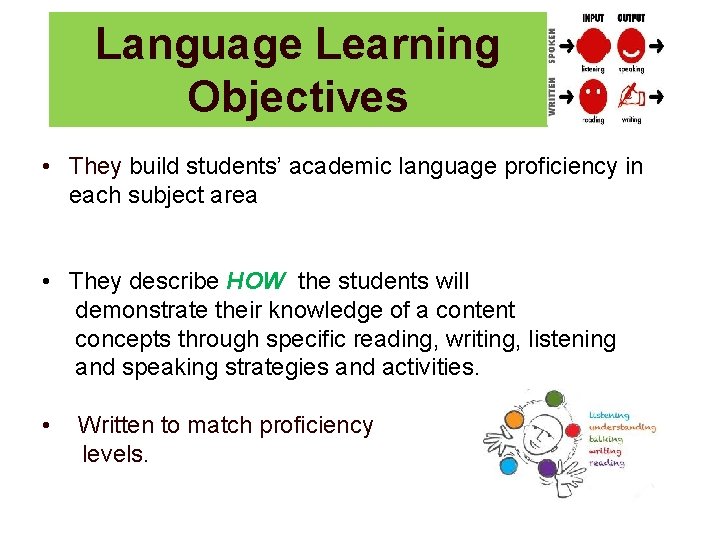
Language Learning Objectives • They build students’ academic language proficiency in each subject area • They describe HOW the students will demonstrate their knowledge of a content concepts through specific reading, writing, listening and speaking strategies and activities. • Written to match proficiency levels.
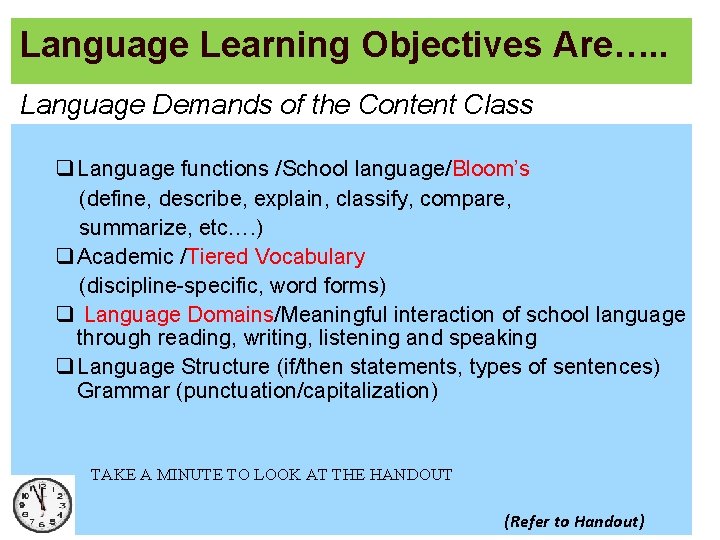
Language Learning Objectives Are…. . Language Demands of the Content Class q Language functions /School language/Bloom’s (define, describe, explain, classify, compare, summarize, etc…. ) q Academic /Tiered Vocabulary (discipline-specific, word forms) q Language Domains/Meaningful interaction of school language through reading, writing, listening and speaking q Language Structure (if/then statements, types of sentences) Grammar (punctuation/capitalization) TAKE A MINUTE TO LOOK AT THE HANDOUT (Refer to Handout)
PROPERTY HUNTERS Directions: 1. Read each objective and determine the properties. 2. After determining the properties present, circle the language function, underline the content vocabulary and draw a box around the language domain. Turn and talk with your partner to discuss your answers.
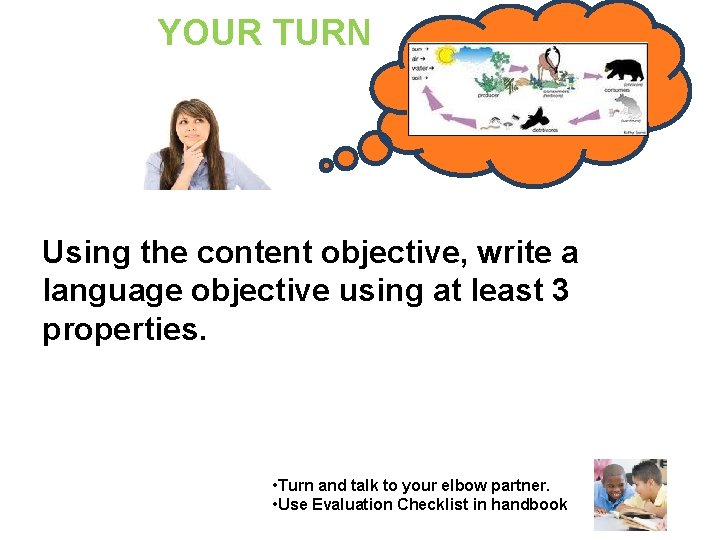
YOUR TURN Using the content objective, write a language objective using at least 3 properties. • Turn and talk to your elbow partner. • Use Evaluation Checklist in handbook
Clearly Defined Content Objectives Content Concepts Appropriate Clearly Defined Language Objectives Adapt Content For Proficiency Levels Supplementary Materials Plan Meaningful Activities
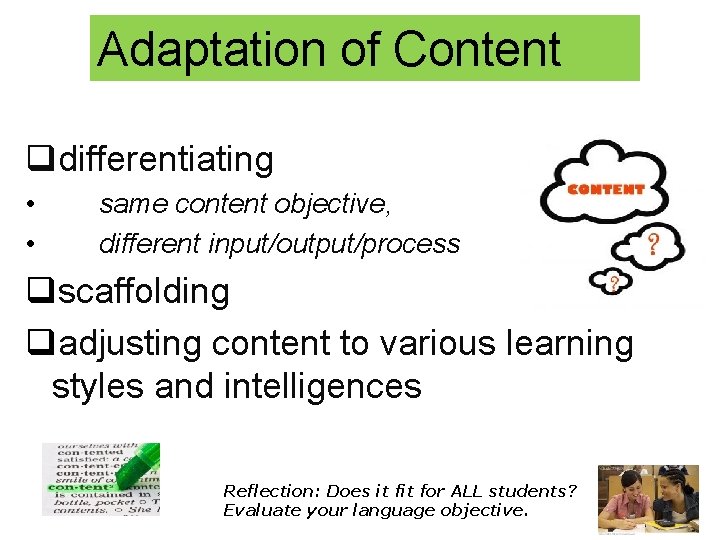
Adaptation of Content qdifferentiating • • same content objective, different input/output/process qscaffolding qadjusting content to various learning styles and intelligences Reflection: Does it for ALL students? Evaluate your language objective.
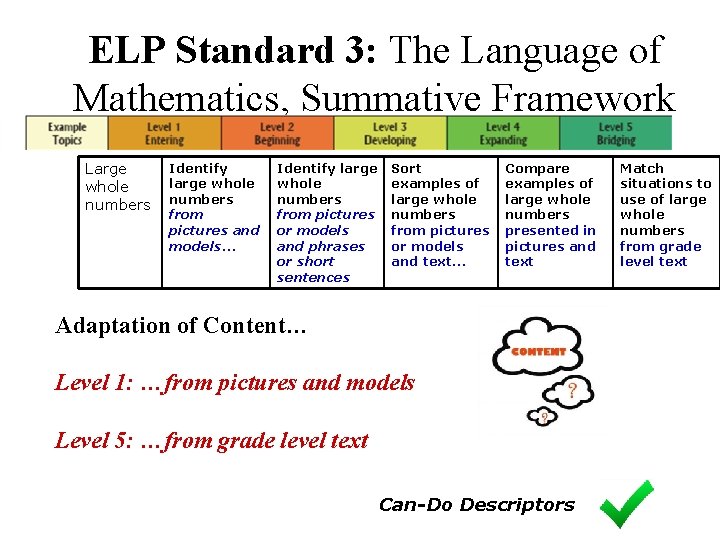
ELP Standard 3: The Language of Mathematics, Summative Framework Large whole numbers Identify large whole numbers from pictures and models… Identify large whole numbers from pictures or models and phrases or short sentences Sort examples of large whole numbers from pictures or models and text… Compare examples of large whole numbers presented in pictures and text Adaptation of Content… Level 1: …from pictures and models Level 5: …from grade level text Can-Do Descriptors Match situations to use of large whole numbers from grade level text
FRAMEWORK CONVERSATIONS With your group, look at the Common Core Scaffolding Frameworks. 1. How do you think these frameworks adapt content? 2. What do you notice about the MPIs across language levels? 3. How does this translate to day lesson planning?
Clearly Defined Content Objectives Content Concepts Appropriate Clearly Defined Language Objectives Adapt Content For Proficiency Levels Supplementary Materials Plan Meaningful Activities
Supplementary Materials Clear and Meaningful! q Hands-on manipulatives - cubes, counter chips q Realia – any real-life objects that pertain to the lesson q Pictures – Google Image is a great resource q Visuals - graphs, charts, timelines, props q Multimedia - DVDs, learn 360 video clips, tape recordings q Demonstrations - modeling how to use the materials q Related Literature - fiction and nonfiction picture books q Hi-Lo Readers - books that are high interest but lower readability level. q Adapted Text – rewriting text so that it is at a lower readability level but focuses on the same content.
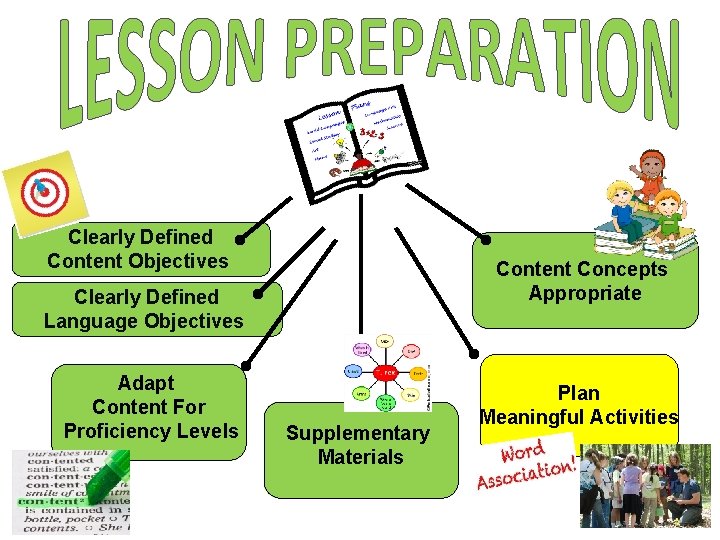
Clearly Defined Content Objectives Content Concepts Appropriate Clearly Defined Language Objectives Adapt Content For Proficiency Levels Supplementary Materials Plan Meaningful Activities
Quick write conversations Use the handout and complete the sentence starter regarding meaningful activities. Once you have completed your part, sign your name and pass to the next person at your table. They will then elaborate on your point and sign their name.
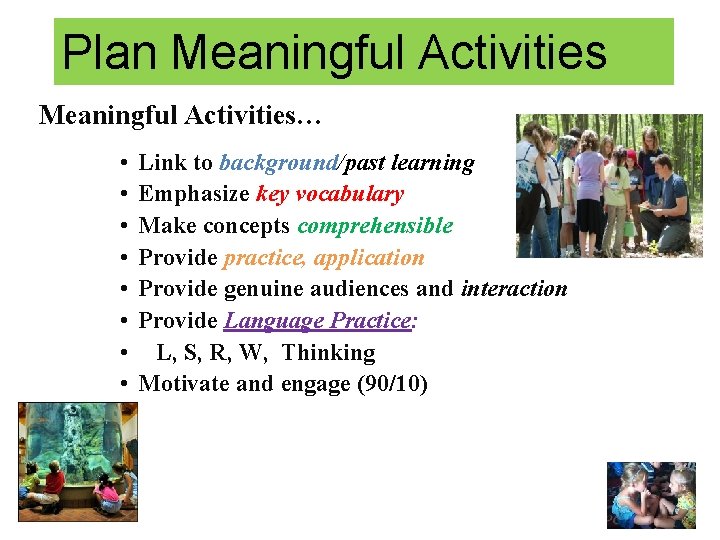
Plan Meaningful Activities… • • Link to background/past learning Emphasize key vocabulary Make concepts comprehensible Provide practice, application Provide genuine audiences and interaction Provide Language Practice: L, S, R, W, Thinking Motivate and engage (90/10)
Clearly Defined Content Objectives Content Concepts Appropriate Clearly Defined Language Objectives Adapt Content For Proficiency Levels Supplementary Materials Plan Meaningful Activities
Concepts are Appropriate SIOP classrooms ensure that even when lesson materials may need to be adapted to meet the needs of English learners, the content is never diminished.
Content Objectives: v I can identify Lesson Preparation as a component of SIOP and the features of this component. v I can Identify properties of a language objective. Language Objectives: v Given a content objective, I can write a language objective using multiple properties of language objectives.
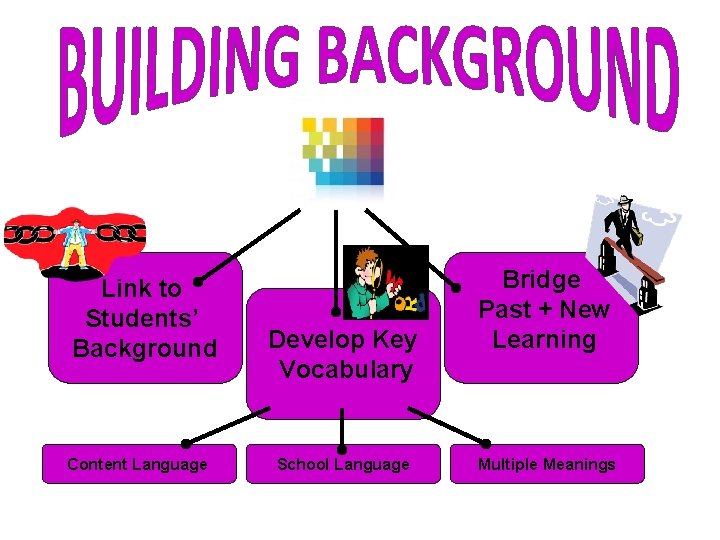
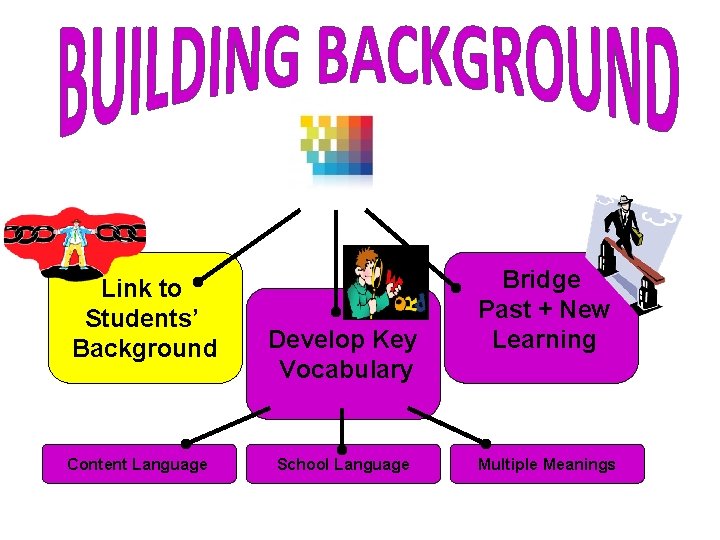
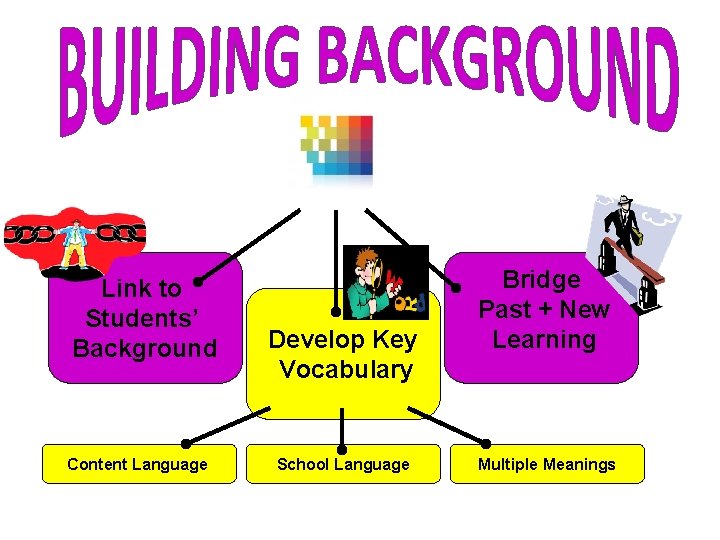
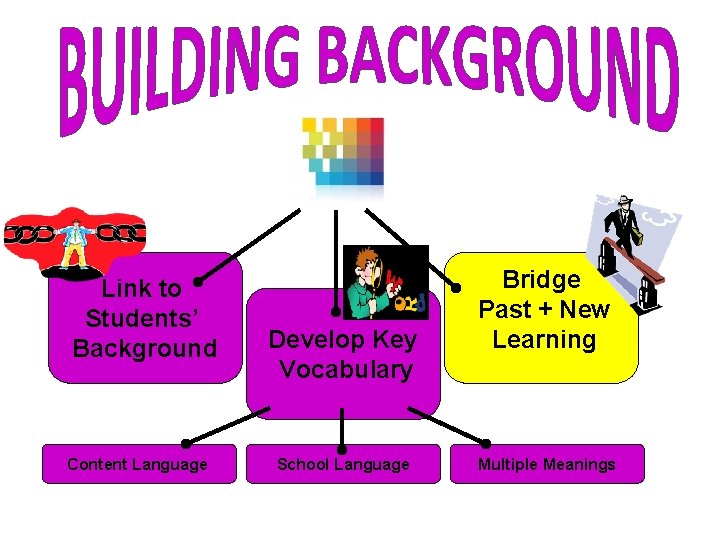
Link to Students’ Background Content Language Develop Key Vocabulary School Language Bridge Past + New Learning Multiple Meanings
Building Background Content Objectives: v v v I can identify the Building Background component of SIOP and the three features of this component I can discover ways to build students background knowledge. I can identify characteristics of effective vocabulary instruction. Language Objectives: v v I can explain why building background knowledge is essential when introducing new concepts. I can read the passage and distinguish tiered vocabulary.
Rigging the Jib Rigging the jib varies somewhat depending on your equipment. Some jibs have fasteners or clips on the luff of the sail; others have sleeves. Attach them to the forestay, starting with the fastener at the bottom of the luff first, and continuing up to the top. Attach the jib halyard to the head of the jib. Check that the haylard is not twisted around the forestay. Attach the jib sheets to the jib clew and feed through the jib blocks (fairheads) on each side of the cockpit. Once the jib and main are rigged, you are ready to raise the sails, but before you do, double check to make sure the main sheet and the jib sheet are not cleated and will run freely, and then the cunningham or downhaul and the boom bang are cleated. Make sure that the daggarboard is in the down position. Now secure the rudder and the tiller and check to see if they are working properly.
Rigging the Jib What do you think about this text for a developing reader? For the proficient reader? • As a reader, what is easy for you? • List all of the aspects that are easy to read? • What specifically is hard? Why? • What could you do to make this passage more accessible to all students.
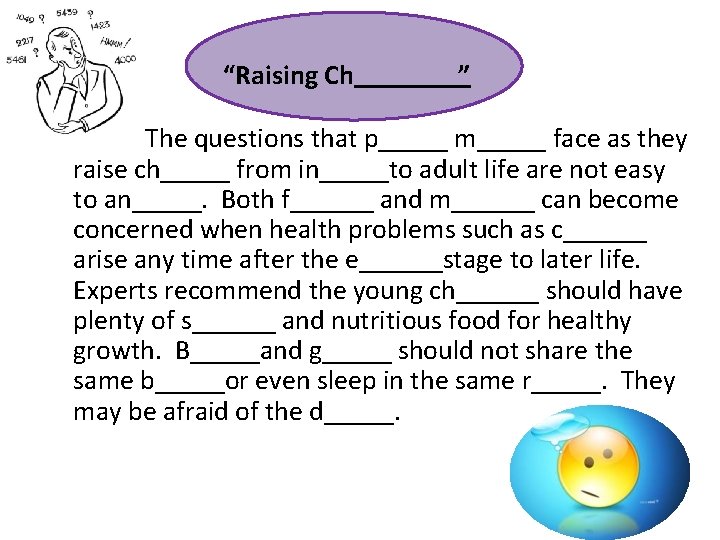
“Raising Ch ” The questions that p_____ m_____ face as they raise ch_____ from in_____to adult life are not easy to an_____. Both f______ and m______ can become concerned when health problems such as c______ arise any time after the e______stage to later life. Experts recommend the young ch______ should have plenty of s______ and nutritious food for healthy growth. B_____and g_____ should not share the same b_____or even sleep in the same r_____. They may be afraid of the d_____.
Link to Students’ Background Content Language Develop Key Vocabulary School Language Bridge Past + New Learning Multiple Meanings
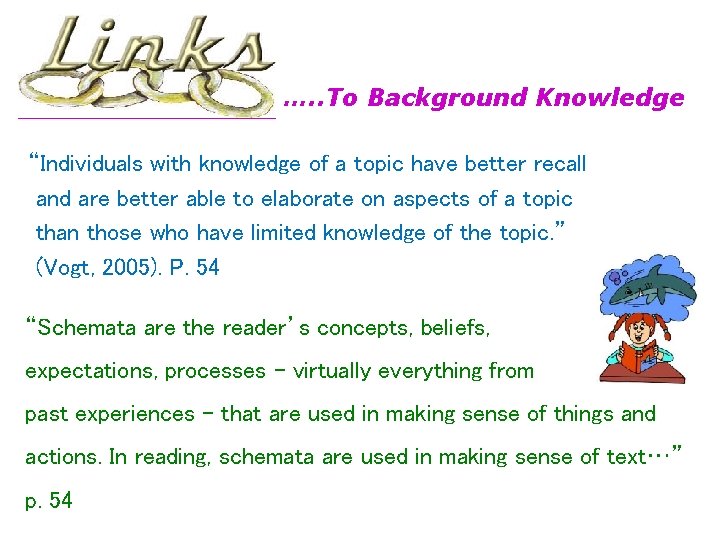
…. . To Background Knowledge “Individuals with knowledge of a topic have better recall and are better able to elaborate on aspects of a topic than those who have limited knowledge of the topic. ” (Vogt, 2005). P. 54 “Schemata are the reader’s concepts, beliefs, expectations, processes – virtually everything from past experiences – that are used in making sense of things and actions. In reading, schemata are used in making sense of text…” p. 54
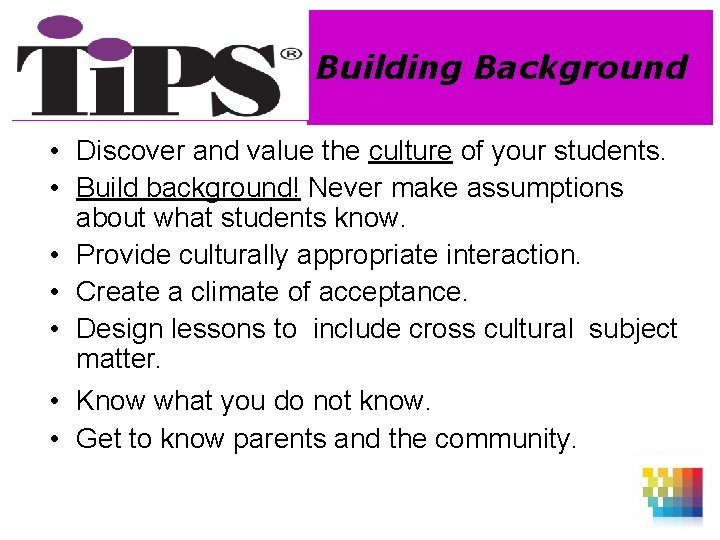
Building Background • Discover and value the culture of your students. • Build background! Never make assumptions about what students know. • Provide culturally appropriate interaction. • Create a climate of acceptance. • Design lessons to include cross cultural subject matter. • Know what you do not know. • Get to know parents and the community.
Link to Students’ Background Content Language Develop Key Vocabulary School Language Bridge Past + New Learning Multiple Meanings
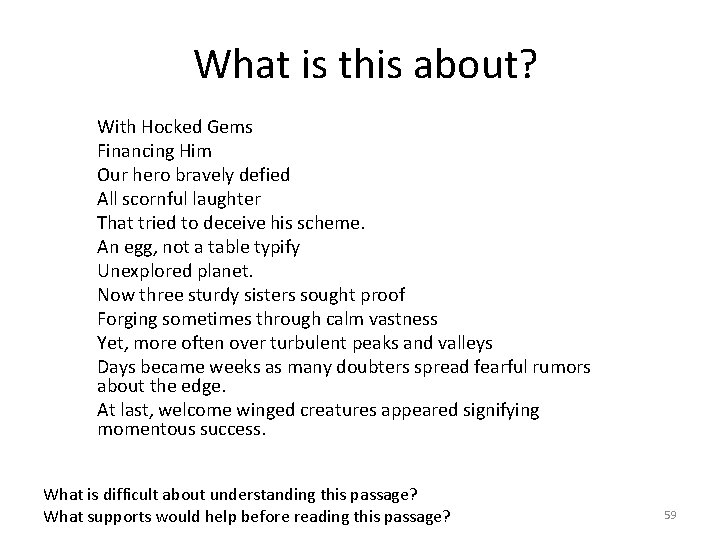
What is this about? With Hocked Gems Financing Him Our hero bravely defied All scornful laughter That tried to deceive his scheme. An egg, not a table typify Unexplored planet. Now three sturdy sisters sought proof Forging sometimes through calm vastness Yet, more often over turbulent peaks and valleys Days became weeks as many doubters spread fearful rumors about the edge. At last, welcome winged creatures appeared signifying momentous success. What is difficult about understanding this passage? What supports would help before reading this passage? 59
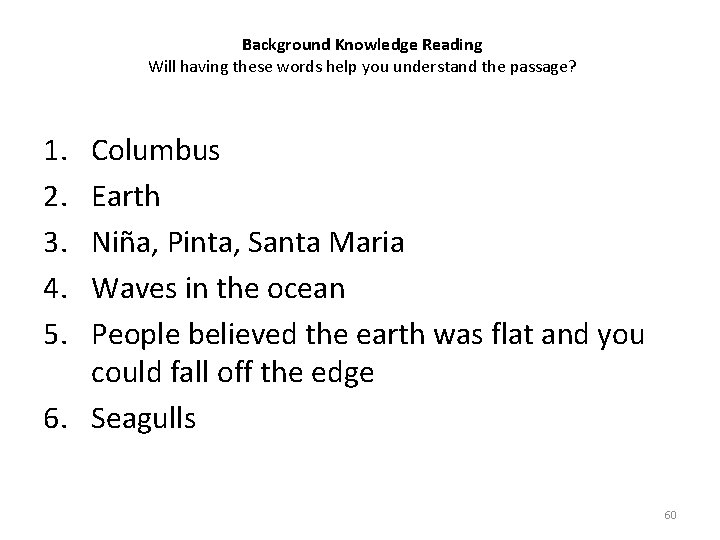
Background Knowledge Reading Will having these words help you understand the passage? 1. 2. 3. 4. 5. Columbus Earth Niña, Pinta, Santa Maria Waves in the ocean People believed the earth was flat and you could fall off the edge 6. Seagulls 60
Emphasize Key Vocabulary • Vocabulary knowledge is important in comprehension q. Incidental vocabulary q. Explicit vocabulary 61 Activity: Compare/Contrast Incidental vs. Explicit Vocabulary Refer to handout
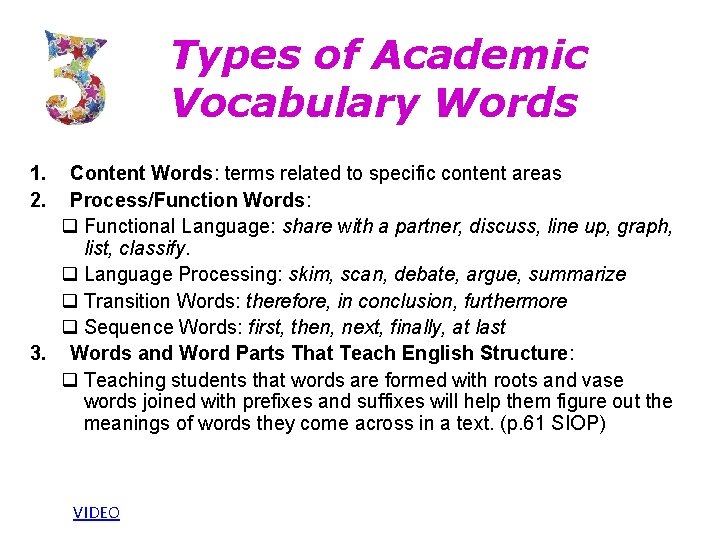
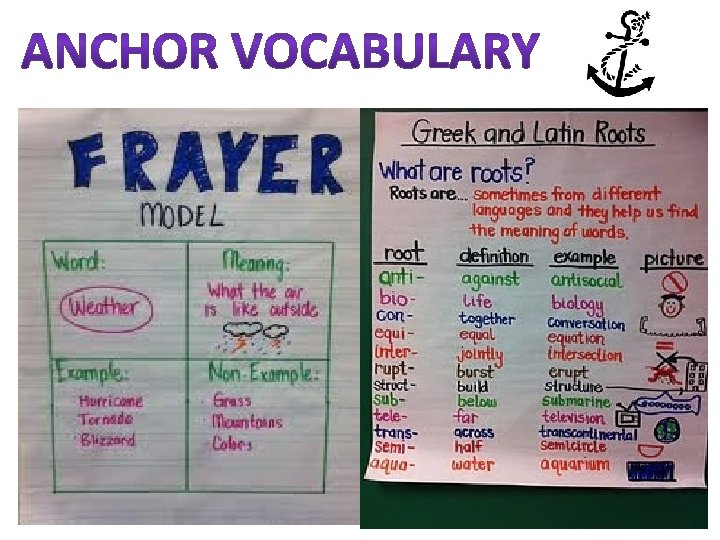
Types of Academic Vocabulary Words 1. 2. Content Words: terms related to specific content areas Process/Function Words: q Functional Language: share with a partner, discuss, line up, graph, list, classify. q Language Processing: skim, scan, debate, argue, summarize q Transition Words: therefore, in conclusion, furthermore q Sequence Words: first, then, next, finally, at last 3. Words and Word Parts That Teach English Structure: q Teaching students that words are formed with roots and vase words joined with prefixes and suffixes will help them figure out the meanings of words they come across in a text. (p. 61 SIOP) VIDEO
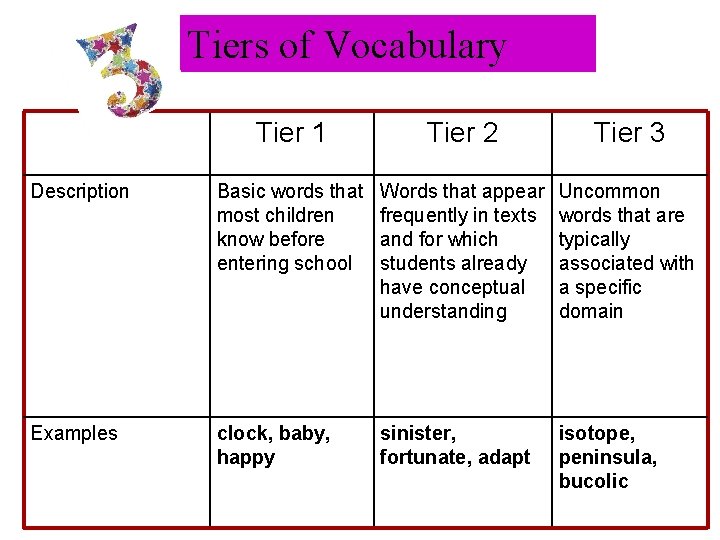
Tiers of Vocabulary Tier 1 Tier 2 Tier 3 Description Basic words that most children know before entering school Words that appear frequently in texts and for which students already have conceptual understanding Uncommon words that are typically associated with a specific domain Examples clock, baby, happy sinister, fortunate, adapt isotope, peninsula, bucolic
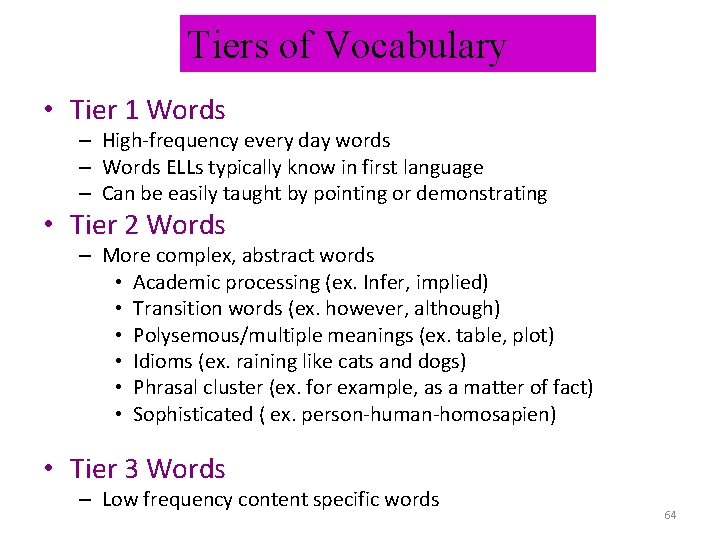
Tiers of Vocabulary • Tier 1 Words – High-frequency every day words – Words ELLs typically know in first language – Can be easily taught by pointing or demonstrating • Tier 2 Words – More complex, abstract words • Academic processing (ex. Infer, implied) • Transition words (ex. however, although) • Polysemous/multiple meanings (ex. table, plot) • Idioms (ex. raining like cats and dogs) • Phrasal cluster (ex. for example, as a matter of fact) • Sophisticated ( ex. person-human-homosapien) • Tier 3 Words – Low frequency content specific words 64
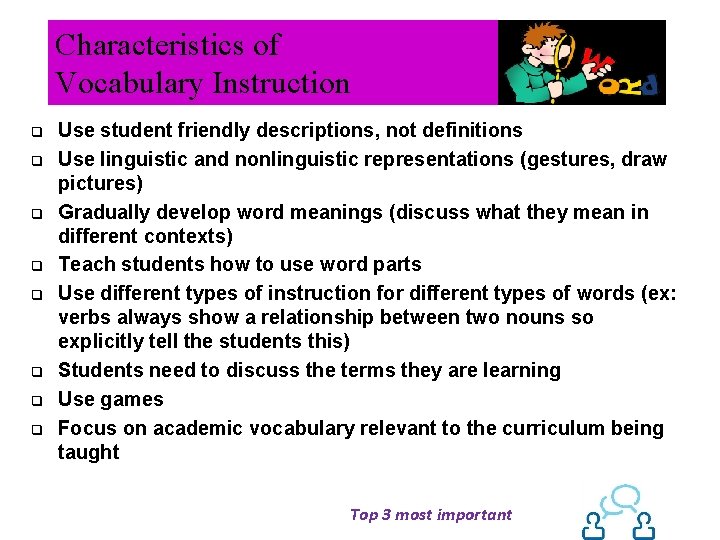
Characteristics of Vocabulary Instruction q q q q Use student friendly descriptions, not definitions Use linguistic and nonlinguistic representations (gestures, draw pictures) Gradually develop word meanings (discuss what they mean in different contexts) Teach students how to use word parts Use different types of instruction for different types of words (ex: verbs always show a relationship between two nouns so explicitly tell the students this) Students need to discuss the terms they are learning Use games Focus on academic vocabulary relevant to the curriculum being taught Top 3 most important
Problematic Areas q idioms q culturally embedded meanings q homophones q suffixes q prefixes q superlatives q false-cognates q content vocabulary q Words with Multiple Meanings (polysemous) Polysemous Words Activity
1. Each table choose one index card. 2. Allow each person at your table to quietly read the word to themselves. 3. Each person then takes a turn to write 1 way that word can be used. 4. Continue passing the card around your table to write additional ways, until time is up 5. NO talking at your tables, please
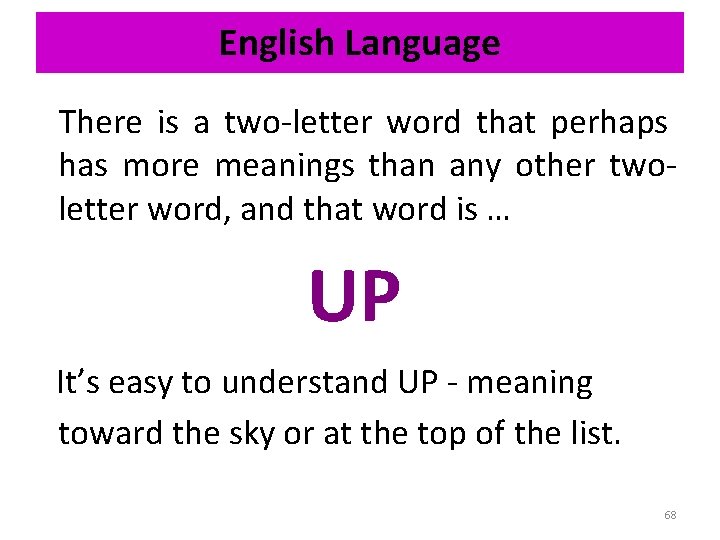
English Language There is a two-letter word that perhaps has more meanings than any other twoletter word, and that word is … UP It’s easy to understand UP - meaning toward the sky or at the top of the list. 68
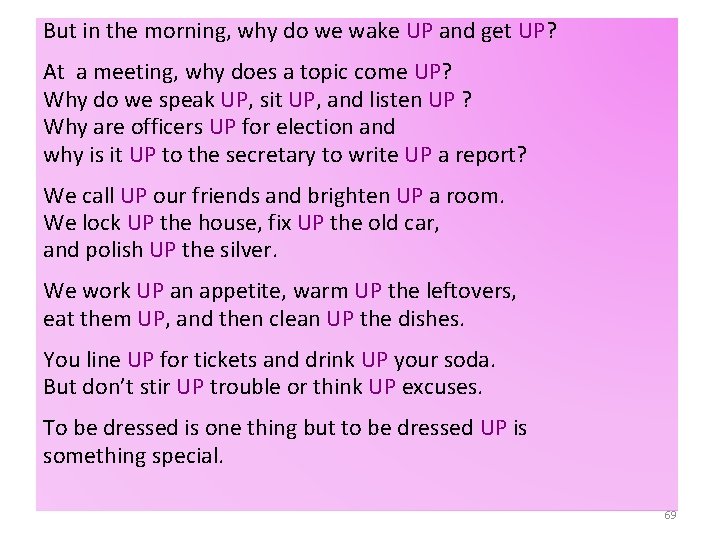
But in the morning, why do we wake UP and get UP? At a meeting, why does a topic come UP? Why do we speak UP, sit UP, and listen UP ? Why are officers UP for election and why is it UP to the secretary to write UP a report? We call UP our friends and brighten UP a room. We lock UP the house, fix UP the old car, and polish UP the silver. We work UP an appetite, warm UP the leftovers, eat them UP, and then clean UP the dishes. You line UP for tickets and drink UP your soda. But don’t stir UP trouble or think UP excuses. To be dressed is one thing but to be dressed UP is something special. 69
And if that is not confusing enough… A drain must be opened UP if it is stopped UP. Stores open UP in the morning and close UP at night. When it threatens to rain, it clouds UP. When the sun comes out, it clears UP. When it rains, it wets UP everything and when it doesn’t rain, things dry UP. To wise UP on the many uses of UP, look it UP in the dictionary. It takes UP almost ¼ of a dictionary page and can add UP to about thirty definitions. If you are UP to it, make UP a list of the many ways UP is used. It will take UP a lot of your time, but if you don’t give UP, you may end UP with a hundred or more. We seem to be pretty mixed UP about UP, but my time is UP so I’ll wrap it UP. I’ll just shut UP and leave the rest UP to you! 70
Vocabulary Instruction q Ensure multiple exposures q Contextualize vocabulary q Provide opportunities to use words q Cultivate word awareness q Consider cultural background q Group words in categories q Teach more than key vocabulary What does it mean to know a word? How can you assess whether students know it? 71 VIDEO
Link to Students’ Background Content Language Develop Key Vocabulary School Language Bridge Past + New Learning Multiple Meanings
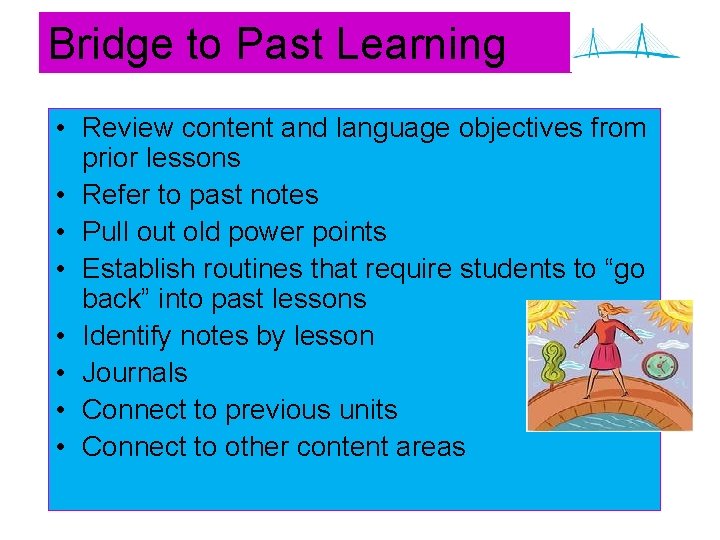
Bridge to Past Learning • Review content and language objectives from prior lessons • Refer to past notes • Pull out old power points • Establish routines that require students to “go back” into past lessons • Identify notes by lesson • Journals • Connect to previous units • Connect to other content areas
Building Background Content Objectives: v v v I can identify the Building Background component of SIOP and the three features of this component I can discover ways to build students background knowledge. I can identify characteristics of effective vocabulary instruction. Language Objectives: v v I can explain why building background knowledge is essential when introducing new concepts. I can read the passage and distinguish tiered vocabulary.
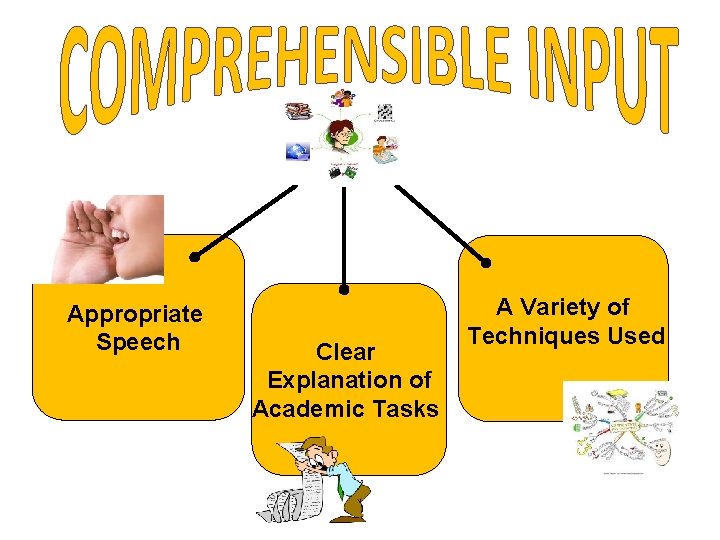
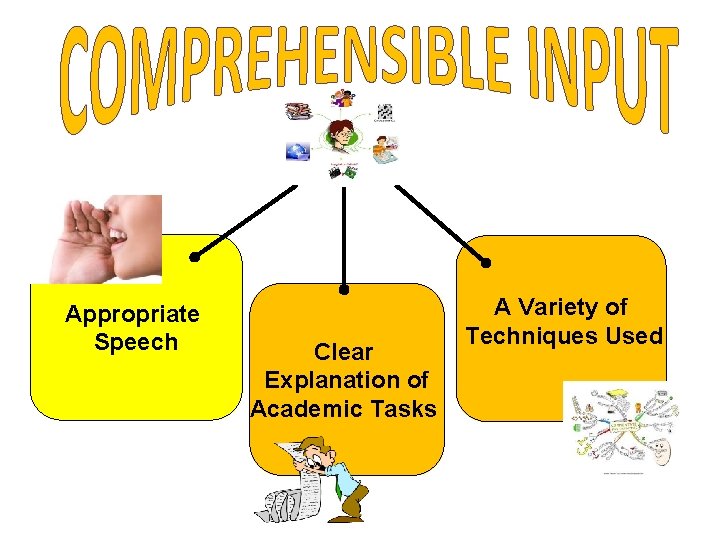
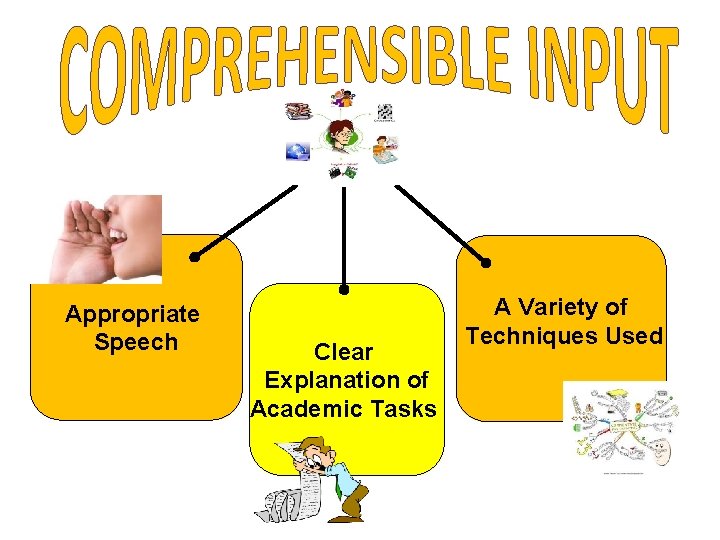
Appropriate Speech Clear Explanation of Academic Tasks A Variety of Techniques Used
Comprehensible Input Content Objectives: v v I can identify the Comprehensible Input component of SIOP and the three features of this component. I can discover ways to make content comprehensible. Language Objectives: v v I can evaluate and revise an academic task to make it comprehensible for ELL students. I can share techniques used to increase comprehensible input. German Coastguard
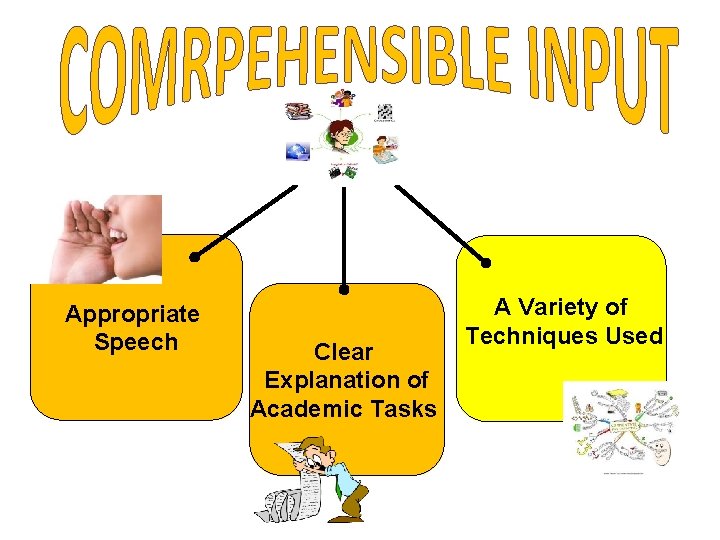
Appropriate Speech Clear Explanation of Academic Tasks A Variety of Techniques Used
Appropriate Speech Directions: 1. Number 1 – 12 on a sticky note. 2. Read each characteristic for appropriate speech from the next slide. 3. Write A for always, S for sometimes, and N for never according to how often you use each characteristic.
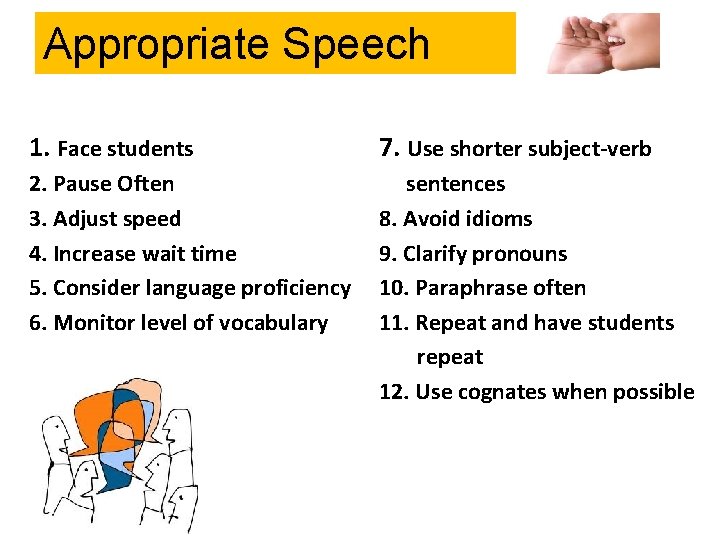
Appropriate Speech 1. Face students 7. Use shorter subject-verb 2. Pause Often 3. Adjust speed 4. Increase wait time 5. Consider language proficiency 6. Monitor level of vocabulary sentences 8. Avoid idioms 9. Clarify pronouns 10. Paraphrase often 11. Repeat and have students repeat 12. Use cognates when possible
Appropriate Speech Clear Explanation of Academic Tasks A Variety of Techniques Used
Clear Explanation of Academic Tasks In groups of 2 assign each person a role. One being the teacher and one being the student. The Teacher will read an academic task only one time. The Student will have to listen and complete the activity. Students: What did you understand? Now with your partner revise the academic task so that is more comprehensible. Use the chart paper and other materials provided. Share your revision with the group.
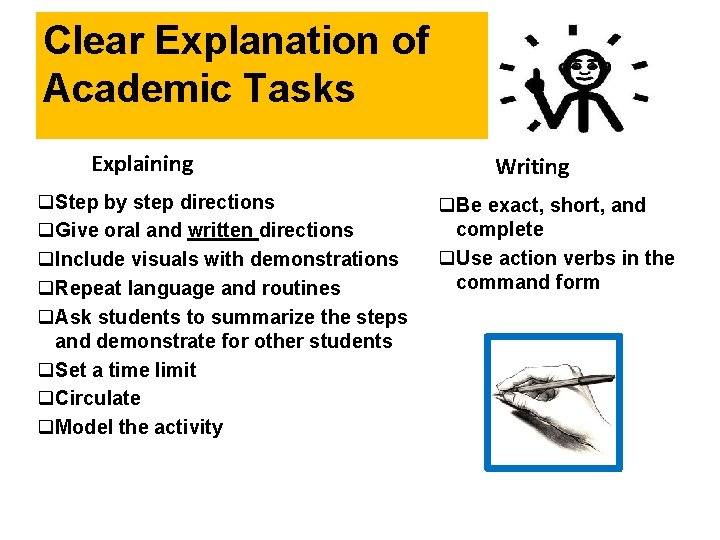
Clear Explanation of Academic Tasks Explaining q. Step by step directions q. Give oral and written directions q. Include visuals with demonstrations q. Repeat language and routines q. Ask students to summarize the steps and demonstrate for other students q. Set a time limit q. Circulate q. Model the activity Writing q. Be exact, short, and complete q. Use action verbs in the command form
Appropriate Speech Clear Explanation of Academic Tasks A Variety of Techniques Used
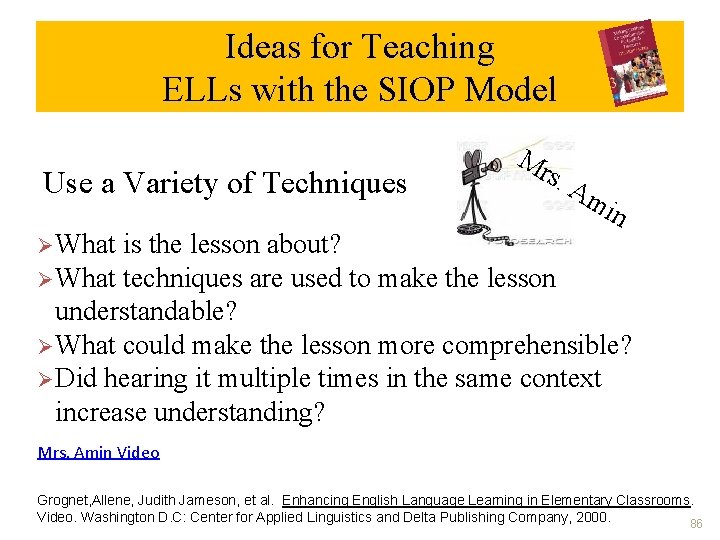
Ideas for Teaching ELLs with the SIOP Model Use a Variety of Techniques Mr s. A mi n Ø What is the lesson about? Ø What techniques are used to make the lesson understandable? Ø What could make the lesson more comprehensible? Ø Did hearing it multiple times in the same context increase understanding? Mrs. Amin Video Grognet, Allene, Judith Jameson, et al. Enhancing English Language Learning in Elementary Classrooms. Video. Washington D. C: Center for Applied Linguistics and Delta Publishing Company, 2000. 86
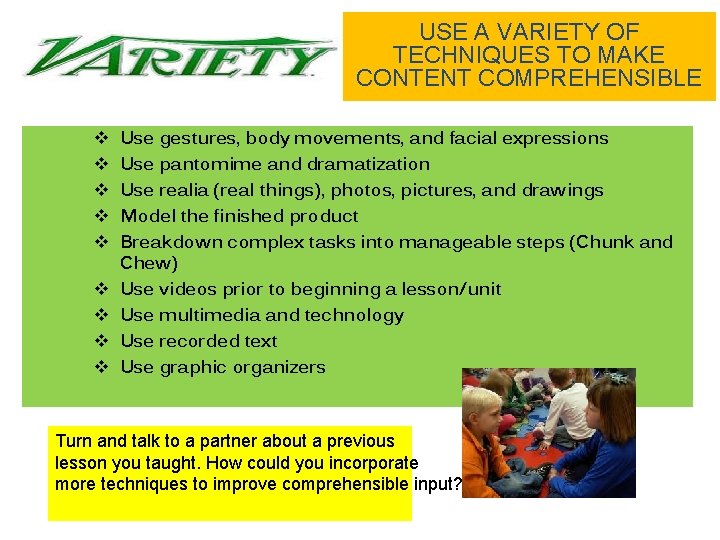
USE A VARIETY OF TECHNIQUES TO MAKE CONTENT COMPREHENSIBLE v v v v v Use gestures, body movements, and facial expressions Use pantomime and dramatization Use realia (real things), photos, pictures, and drawings Model the finished product Breakdown complex tasks into manageable steps (Chunk and Chew) Use videos prior to beginning a lesson/unit Use multimedia and technology Use recorded text Use graphic organizers Turn and talk to a partner about a previous lesson you taught. How could you incorporate more techniques to improve comprehensible input?
Comprehensible Input Do you know? Content Objectives: v v I can identify the Comprehensible Input component of SIOP and the three features of this component I can discover ways to make content comprehensible. Language Objectives: v v I can evaluate and revise an academic task to make it comprehensible for ELL students. I can share techniques used to increase comprehensible input.
Carousel Activity Directions: Using the charts around the room labeled with the SIOP components we discussed today, write one thing you learned about each component.