
Energy in Food Do now activity What have


- Slides: 12
Energy in Food Do now activity: What have you eaten so far today? How much energy do you think you have used up?
Progress indicators GOOD PROGRESS: • Compare the energy values of foods • Compare the energy in foods with the energy needed for different activities. OUTSTANDING PROGRESS: • Calculate energy expenditure
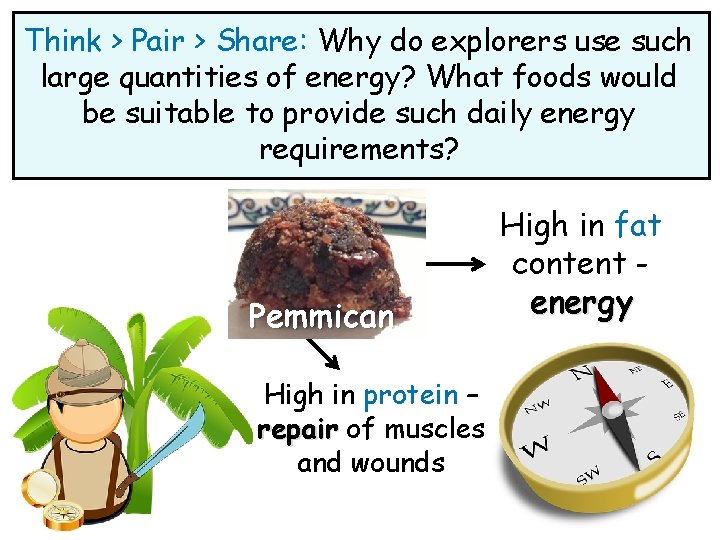
Think > Pair > Share: Why do explorers use such large quantities of energy? What foods would be suitable to provide such daily energy requirements? Pemmican High in protein – repair of muscles and wounds High in fat content energy
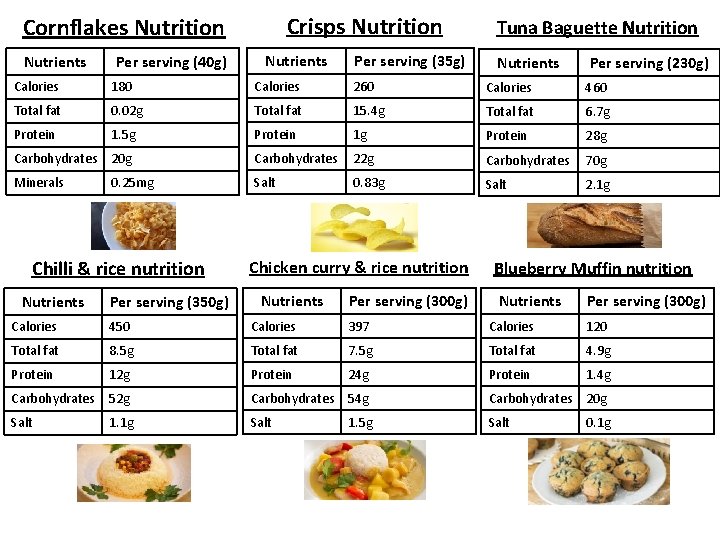
Task: Look at different food labels, complete the following tasks: Could use a laptop to help you with this task!! 1. Use the energy values of the foods to estimate your daily energy intake Remember to use the same units each time (joules, kilojoules or calories) and note down values for typical portion sizes. 2. How does this compare with others? 3. Make a list of what you will use the energy for in your body. 4. What would increase or reduce your daily energy needs?
Crisps Nutrition Cornflakes Nutrition Nutrients Per serving (40 g) Nutrients Per serving (35 g) Tuna Baguette Nutrition Nutrients Per serving (230 g) Calories 180 Calories 260 Calories 460 Total fat 0. 02 g Total fat 15. 4 g Total fat 6. 7 g Protein 1. 5 g Protein 1 g Protein 28 g Carbohydrates 20 g Carbohydrates 22 g Carbohydrates 70 g Minerals Salt 0. 83 g Salt 2. 1 g 0. 25 mg Chilli & rice nutrition Nutrients Per serving (350 g) Chicken curry & rice nutrition Nutrients Per serving (300 g) Blueberry Muffin nutrition Nutrients Per serving (300 g) Calories 450 Calories 397 Calories 120 Total fat 8. 5 g Total fat 7. 5 g Total fat 4. 9 g Protein 12 g Protein 24 g Protein 1. 4 g Carbohydrates 52 g Carbohydrates 54 g Carbohydrates 20 g Salt 1. 1 g 1. 5 g 0. 1 g
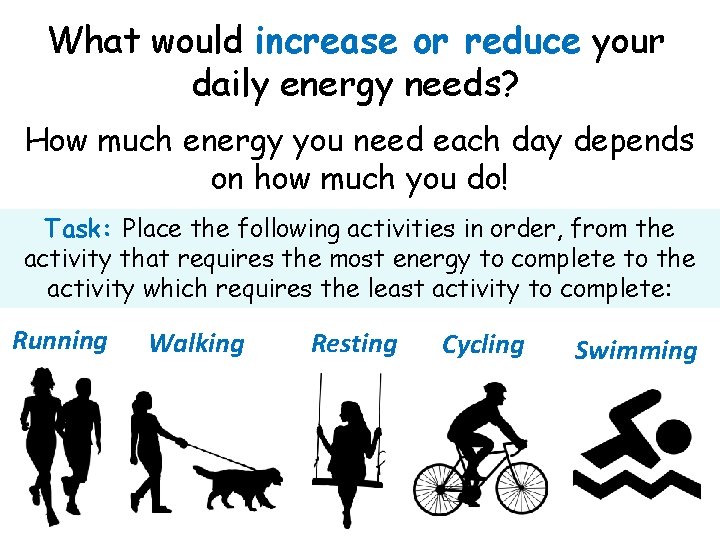
What would increase or reduce your daily energy needs? How much energy you need each day depends on how much you do! Task: Place the following activities in order, from the activity that requires the most energy to complete to the activity which requires the least activity to complete: Running Walking Resting Cycling Swimming
Least energy intensive activity Most energy intensive activity Self-assessment
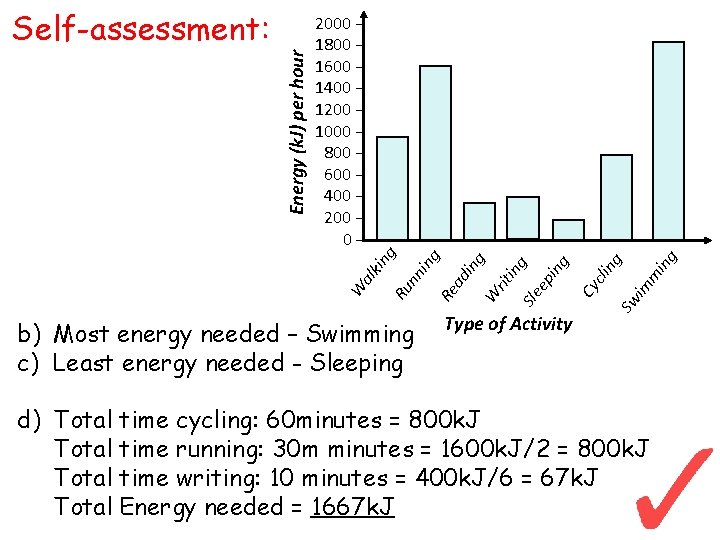
Daily Energy Requirements a) Draw a bar chart to represent the information provided in the table Activity Energy (k. J) per hour Walking 900 Running 1600 Reading 350 Writing 400 Sleeping 200 Cycling 800 Swimming 1800 b) Which activity requires the most amount of energy? c) Which activity requires the least amount of energy? d) If you cycled 30 minutes from your home to the park, then ran around playing football for 30 minutes with your friends. Next, you cycled home the same distance and once home you completed your English writing homework which took 10 minutes. How much energy would you need?
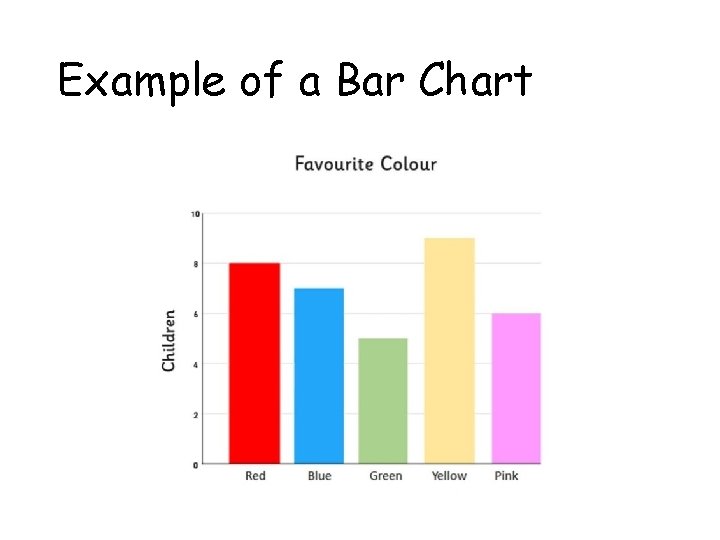
Example of a Bar Chart
b) Most energy needed – Swimming c) Least energy needed - Sleeping im m g Type of Activity Sw Cy c lin ing Sle ep ing W rit ing ad Re nn Ru alk W ing 2000 – 1800 – 1600 – 1400 – 1200 – 1000 – 800 – 600 – 400 – 200 – 0– ing Energy (k. J) per hour Self-assessment: d) Total time cycling: 60 minutes = 800 k. J Total time running: 30 m minutes = 1600 k. J/2 = 800 k. J Total time writing: 10 minutes = 400 k. J/6 = 67 k. J Total Energy needed = 1667 k. J
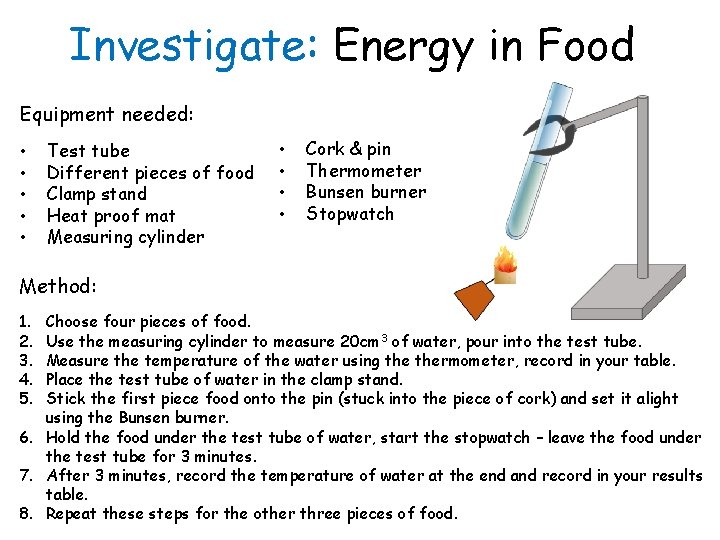
Investigate: Energy in Food Equipment needed: • • • Test tube Different pieces of food Clamp stand Heat proof mat Measuring cylinder • • Cork & pin Thermometer Bunsen burner Stopwatch Method: 1. 2. 3. 4. 5. Choose four pieces of food. Use the measuring cylinder to measure 20 cm 3 of water, pour into the test tube. Measure the temperature of the water using thermometer, record in your table. Place the test tube of water in the clamp stand. Stick the first piece food onto the pin (stuck into the piece of cork) and set it alight using the Bunsen burner. 6. Hold the food under the test tube of water, start the stopwatch – leave the food under the test tube for 3 minutes. 7. After 3 minutes, record the temperature of water at the end and record in your results table. 8. Repeat these steps for the other three pieces of food.
Plenary ~ Twitter Write a tweet demonstrating what you have learnt today!! No more than 140 characters and #key words!!